
Joshua (13-14)
It is important to mark clearly the distinction between the work done by Joshua and the work left for Israel. Joshua overthrew the ruling powers of most tribes in the Land of Canaan, destroyed their king, defeated the armies, and captured the fortresses to such an extent as to give Israel a firm foothold in the country.
But Joshua did not exterminate the population from every portion even of that territory which he had captured and distributed to the other tribes. And there were several nations—of whom the Philistines and Phœnicians were the chief—whom he left entirely intact.
Joshua 13
1 Now Joshua was old and stricken in years; and the Lord said unto him: “Thou art old and stricken in years, and there remaineth yet very much land to be possessed.
— now Joshua was old; what age Joshua was advanced we cannot determine, but after seven years in conquests his work was over, and now he had only to take steps to secure the completion by others of the triumph which he would never see;
— Joshua died at the age of one hundred ten years (Joshua 24:29); he had subdued part of the central mountain nucleus, but the low-lying stretch of country on the coast, Philistia and the maritime plain up to Tyre and Sidon and other outlying districts, remained unsubdued.
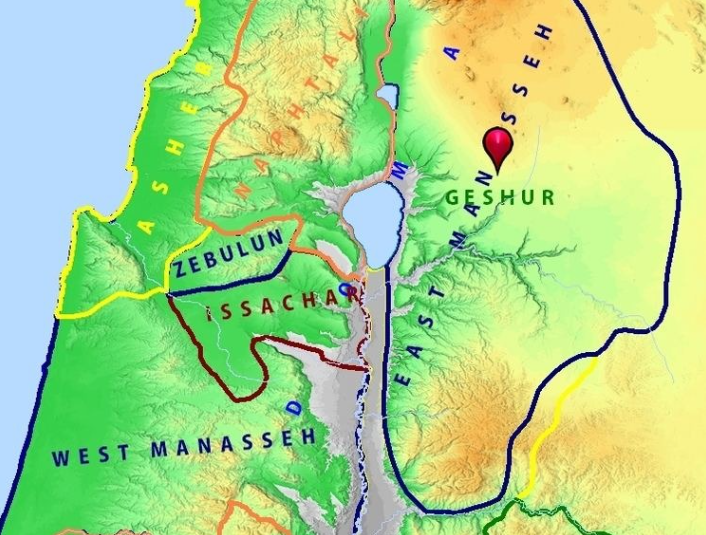
2 This is the land that yet remaineth: all the borders of the Philistines and all Geshuri,
— that yet remaineth: Geshuri; a people alongn the north-east of Canaan; and the Philistines are on the southwest.
3 from Sihor, which is before Egypt, even unto the borders of Ekron northward, which is counted as Canaanite; five lords of the Philistines — the Gazathites, and the Ashdothites, the Ashkelonites, the Gittites, and the Ekronites; also the Avites;
4 from the south, all the land of the Canaanites, and Mearah that is beside the Sidonians, unto Aphek, to the borders of the Amorites;
—.
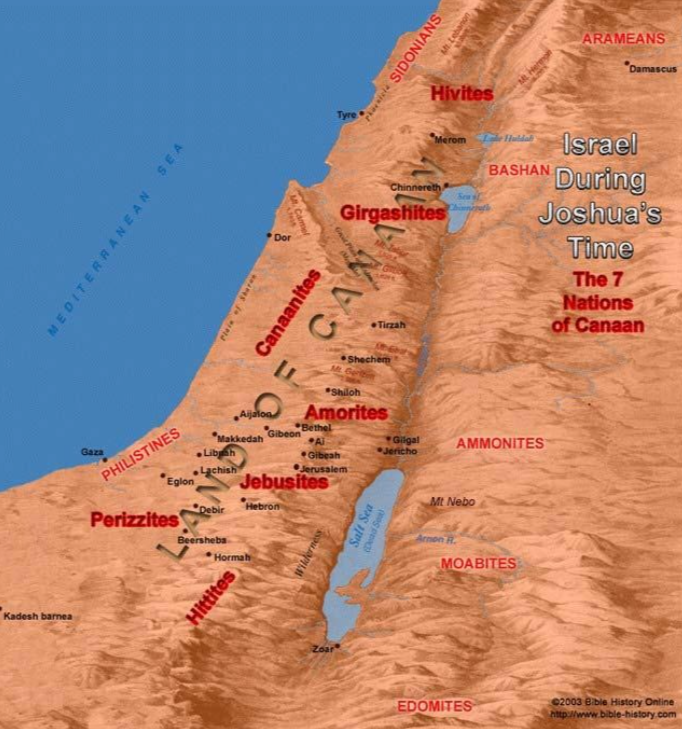
5 and the land of the Gebalites, and all Lebanon, toward the sunrising, from Baalgad under Mount Hermon unto the entrance into Hamath.
— and the land of the Giblites; the territory of the population of Gebal; this was another country that remained unconquered.
6 All the inhabitants of the hill country from Lebanon unto Misrephothmaim, and all the Sidonians, them will I drive out from before the children of Israel. Only divide thou it by lot unto the Israelites for an inheritance, as I have commanded thee.
— all the inhabitants of the hill country from Lebanon unto Misrephoth-maim; that is, all the Sidonians and Phœnicians.
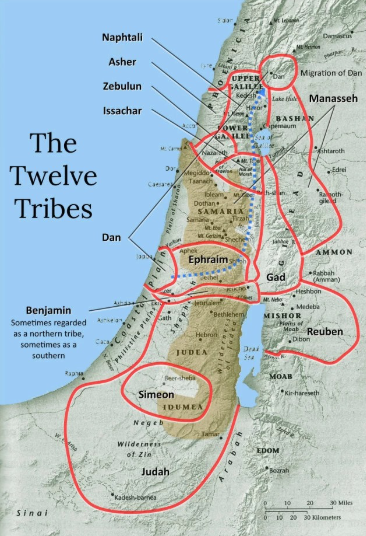
7 Now therefore divide this land for an inheritance unto the nine tribes and the halftribe of Manasseh”—
— it is the will of God that every man should know his own, and not take that which is another’s; the world must be governed, not by force, but rights.
8 with whom the Reubenites and the Gadites have received their inheritance which Moses gave them beyond the Jordan eastward, even as Moses the servant of the Lord gave them:
— unto the nine tribes: of Judah, Simeon, Benjamin, Dan, Ephraim, Zebulun, Issachar, Asher, and Naphtali, in which order they are placed, when the Lord gave to Moses the names of the men that should divide the land under Eleazar and Joshua.
9 from Aroer that is upon the bank of the River Arnon, and the city that is in the midst of the river, and all the plain of Medeba unto Dibon;
— Medeba unto Dibon — two cities anciently belonging to the Moabites, and taken from them by the Amorites Numbers 21:30; and from them by the Israelites.
10 and all the cities of Sihon king of the Amorites, who reigned in Heshbon, unto the border of the children of Ammon;
— and all the cities of Sihon king of the Amorites, which reigned in Heshbon; a city he took from the Moabites, and made it his royal seat, Numbers 21:26,
11 and Gilead, and the border of the Geshurites and Maachathites, and all Mount Hermon, and all Bashan unto Salcah;
— and Gilead, the land of Gilead, which was part of the kingdom of Og, half of which was given to Reuben, and the other half to Gad;
12 all the kingdom of Og in Bashan, who reigned in Ashtaroth and in Edrei, who remained of the remnant of the giants; for these did Moses smite and cast them out.
— all the kingdom of Og in Bashan, who reigned in Ashtaroth and in Edrei, in extent to the whole region on the west of the Jordan; these were the remnant of the giants.
13 Nevertheless the children of Israel expelled not the Geshurites nor the Maachathites, but the Geshurites and the Maachathites dwell among the Israelites until this day.
14 Only unto the tribe of Levi he gave no inheritance; the sacrifices of the Lord God of Israel made by fire are their inheritance, as He said unto them.
15 And Moses gave unto the tribe of the children of Reuben inheritance according to their families.
16 And their border was from Aroer, that is on the bank of the River Arnon, and the city that is in the midst of the river, and all the plain by Medeba;
17 Heshbon and all her cities that are in the plain: Dibon, and Bamothbaal, and Bethbaalmeon,
18 and Jahazah, and Kedemoth, and Mephaath,
19 and Kirjathaim, and Sibmah, and Zarethshahar on the mount of the valley,
20 and Bethpeor, and Ashdothpisgah, and Bethjeshimoth,
21 and all the cities of the plain and all the kingdom of Sihon king of the Amorites, who reigned in Heshbon, whom Moses smote with the princes of Midian: Evi, and Rekem, and Zur, and Hur, and Reba, who were dukes of Sihon dwelling in the country.
22 Balaam also the son of Beor, the soothsayer, did the children of Israel slay with the sword among those who were slain by them.
23 And the border of the children of Reuben was the Jordan and the border thereof. This was the inheritance of the children of Reuben according to their families, the cities and the villages thereof.
24 And Moses gave inheritance unto the tribe of Gad, even unto the children of Gad according to their families.
25 And their border was Jazer, and all the cities of Gilead, and half the land of the children of Ammon, unto Aroer that is before Rabbah;—
26 and from Heshbon unto Ramathmizpeh, and Betonim, and from Mahanaim unto the border of Debir;
27 and in the valley, Betharam, and Bethnimrah, and Succoth, and Zaphon, the rest of the kingdom of Sihon king of Heshbon, the Jordan and his border, even unto the edge of the Sea of Chinnereth on the other side of the Jordan eastward.—
28 This is the inheritance of the children of Gad according to their families, the cities and their villages.
29 And Moses gave inheritance unto the halftribe of Manasseh; and this was the possession of the halftribe of the children of Manasseh by their families:
30 and their border was from Mahanaim, all Bashan, all the kingdom of Og king of Bashan, and all the towns of Jair, which are in Bashan, threescore cities;
31 and half of Gilead, and Ashtaroth, and Edrei, cities of the kingdom of Og in Bashan, were pertaining unto the children of Machir the son of Manasseh, even to one half of the children of Machir by their families.
32 These are the countries which Moses distributed for inheritance in the plains of Moab on the other side of the Jordan, by Jericho eastward.
33 But unto the tribe of Levi Moses gave not any inheritance: the Lord God of Israel was their inheritance, as He said unto them.

Joshua 14
1 And these are the countries which the children of Israel inherited in the land of Canaan, which Eleazar the priest and Joshua the son of Nun and the heads of the fathers of the tribes of the children of Israel distributed for inheritance to them.
— the heads of the fathers of the 12 tribes; these men are all named in Numbers 34:16-28, one from every tribe, in addition to Eleazar and Joshua.
2 By lot was their inheritance, as the Lord commanded by the hand of Moses, for the nine tribes and for the halftribe.
— by lot; we are not told in what manner the lot was cast: perhaps two urns were employed, one containing a description of the districts to be allotted, the other the names of the tribes.
3 For Moses had given the inheritance of two tribes and a halftribe on the other side of the Jordan; but unto the Levites he gave no inheritance among them,
— for Moses, the reason is stated here why there were only nine tribes and a half, because two tribes and a half had already received their inheritance on the east of the Jordan, and no land was given to the Levites as an inheritance.
4 for the children of Joseph were two tribes: Manasseh and Ephraim. Therefore they gave no part unto the Levites in the land, save cities to dwell in, with their suburbs for their cattle and for their substance.
— were two tribes; double portion, or the portion of two tribes, 1 Chronicles 5:1-2, for the sons of Joseph formed two tribes in consequence of the adoption of Ephraim and Manasseh by the patriarch Jacob; and therefore though Levi was excluded.
5 As the Lord commanded Moses, so the children of Israel did; and they divided the land.
— the result of the lot was accepted as the decree of God; for the lot was not controlled in any way by the opinion, or decision, or authority of men.
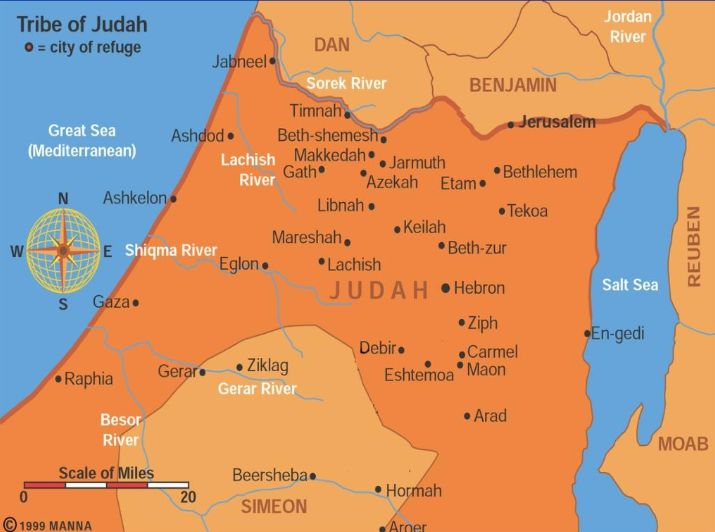
6 Then the children of Judah came unto Joshua in Gilgal; and Caleb the son of Jephunneh the Kenezite said unto him, “Thou knowest the thing that the Lord said unto Moses the man of God concerning me and thee in Kadeshbarnea.
— then Caleb and the children of Judah came unto Joshua in Gilgal, for Gilgal served as their headquarter, the capital where the Ark and most of the priests and Levites would be stationed.
7 Forty years old was I when Moses the servant of the Lord sent me from Kadeshbarnea to spy out the land; and I brought him word again as it was in mine heart.
— Caleb’s words expressed thankfulness and praise, and they are put as the ground of the request that he has to make.
8 Nevertheless my brethren who went up with me made the heart of the people melt, but I wholly followed the Lord my God.
9 And Moses swore on that day, saying, ‘Surely the land whereon thy feet have trodden shall be thine inheritance and thy children’s for ever, because thou hast wholly followed the Lord my God.’
— and Moses had swore earlier on that land, the land whereon thy feet have trodden shall be thine, Numbers 14:24, Deuteronomy 1:36;
— Caleb’s request is, Give me this mountain, or Hebron where he had spied there earlier, because it was also in God’s promise to give that land to him and he would let Israel knows how much he valued the promise.
10 And now, behold, the Lord hath kept me alive, as He said, these forty and five years, even since the Lord spoke this word unto Moses while the children of Israel wandered in the wilderness; and now, lo, I am this day fourscore and five years old.
— the Lord hath kept me alive these forty and five years; forty were spent in the wilderness, and perhaps five since they came into Canaan; hence eighty-five years of age.
11 As yet I am as strong this day as I was in the day that Moses sent me: as my strength was then, even so is my strength now for war, both to go out and to come in.
— as yet I am as strong this day as I was in the day that Moses sent me; to spy the land, forty five years ago; suggesting that he was as sound in his mind, understanding, judgment and memory; it still required a large share of strength and courage to attempt the conquest of that land, but Caleb had that strength.
12 Now therefore give me this mountain whereof the Lord spoke in that day, for thou heardest in that day how the Anakim were there, and that the cities were great and fortified. If it so be that the Lord will be with me, then I shall be able to drive them out, as the Lord said.”
— it was now in the Anakims’ possession, and Caleb would let Israel know how little he feared the enemy, even they were giants who dwelt in the mountains and their cities, Hebron, Debir, and Anab, which were large and well fortified.
13 And Joshua blessed him, and gave unto Caleb the son of Jephunneh Hebron for an inheritance.
— the Anakims had in the course of Joshua’s campaigns in the south been expelled from “this mountain,” that is, the mountain country round Hebron, but they had only withdrawn to the neighboring cities of Philistia Joshua 11:22.
14 Hebron therefore became the inheritance of Caleb the son of Jephunneh the Kenizzite unto this day, because he wholly followed the Lord God of Israel.
— Caleb finally drove out this formidable race and occupied Hebron and its dependent towns and district permanently, Joshua 15:13.
15 And the name of Hebron before was Kirjatharba, which Arba was a great man among the Anakim. And the land had rest from war.
— Hebron previous name was Kirjatharba, named after Arba, the father of the Anakim.


