
Judges (11-12)
Judges 11
1 Now Jephthah the Gileadite was a mighty man of valor, but he was the son of a harlot; and Gilead begot Jephthah.
— Gilead is a proper name, not the name of a city in this instance; but is this Gilead the son of Machir, the son of Manasseh, or some later Gilead?
2 And Gilead’s wife bore him sons; and his wife’s sons grew up, and they thrust out Jephthah and said unto him, “Thou shalt not inherit in our father’s house, for thou art the son of a strange woman.”
— Jephthah the Gileadite; but Gilead’s other wife bore him sons; and they thrust out Jephthah: out of his father’s house, his father in all likelihood being dead, or he would not have suffered it, and what follows confirms it that he was dead.
3 Then Jephthah fled from his brethren and dwelt in the land of Tob; and there were gathered vain men to Jephthah, and went out with him.
— in the land of Tob; this is to the north of Gilead, toward Damascus; there gathered vain men to Jephthah—idle, freebooting, and desperate more salvaging then the style of Robin Hood.
4 And it came to pass in process of time that the children of Ammon made war against Israel.
— again and again, the children of Ammon made war against Israel.
5 And it was so, that when the children of Ammon made war against Israel, the elders of Gilead went to fetch Jephthah out of the land of Tob.
— Jephthah the Gileadite; was from the tribe of Manasseh.
6 And they said unto Jephthah, “Come, and be our captain, that we may fight with the children of Ammon.”
— our captain: they didn’t say our king; for the experience of Abimelech’s kingship had cooled their appetite in that particular; but just our captain; being convinced by Abimelech’s conduct that such a step would be wrong.
7 And Jephthah said unto the elders of Gilead, “Did not ye hate me, and expel me out of my father’s house? And why have ye come unto me now when ye are in distress?”
— did not ye expel me out of my father’s house, and deprive me of all share in my father’s goods, which, though a bastard, was due to me?
8 And the elders of Gilead said unto Jephthah, “Therefore we turn again to thee now, that thou mayest go with us and fight against the children of Ammon, and be our head over all the inhabitants of Gilead.”
— that thou mayest go with us, despite Jephthah being only half an Israelite; and fight against the children of Ammon, and be our head, again not a king, having learnt their lesson, over all the inhabitants of Gilead.
9 And Jephthah said unto the elders of Gilead, “If ye bring me home again to fight against the children of Ammon, and the Lord deliver them before me, shall I be your head?”
— shall I be your head? will you really make good this promise? Jephthah being solicitous in this case, either from his zeal for the public good, or from his instincce of self-preservation, that he might be secured from his brethren.
10 And the elders of Gilead said unto Jephthah, “The Lord be witness between us if we do not so, according to thy words.”
— the Lord be our witness; that is, the Lord be a hearer; whatever we speak, it concerns us to remember that God is a hearer!
11 Then Jephthah went with the elders of Gilead, and the people made him head and captain over them; and Jephthah uttered all his words before the Lord in Mizpah.
— before the Lord in Mizpeh; this phrase supposed that the oath was taken before the Ark in the Tabernacle; or Urim and Thummim. Mizpeh was located in the territory of Ephraim, bordering Benjamin, south of Shiloh.
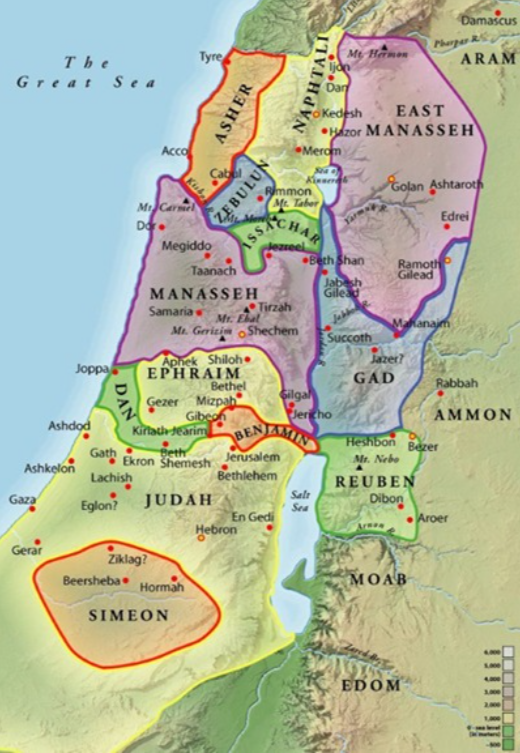
12 And Jephthah sent messengers unto the king of the children of Ammon, saying, “What hast thou to do with me, that thou hast come against me to fight in my land?”
13 And the king of the children of Ammon answered unto the messengers of Jephthah, “Because Israel took away my land when they came up out of Egypt, from Arnon even unto Jabbok and unto the Jordan. Now therefore restore those lands again peaceably.”
14 And Jephthah sent messengers again unto the king of the children of Ammon,
15 and said unto him, “Thus saith Jephthah: Israel took not away the land of Moab, nor the land of the children of Ammon;
16 but when Israel came up from Egypt, and walked through the wilderness unto the Red Sea and came to Kadesh,
17 then Israel sent messengers unto the king of Edom, saying, ‘Let me, I pray thee, pass through thy land.’ But the king of Edom would not hearken thereto. And in like manner they sent unto the king of Moab, but he would not consent; and Israel abode in Kadesh.
18 Then they went along through the wilderness, and compassed the land of Edom and the land of Moab, and came by the east side of the land of Moab and pitched camp on the other side of Arnon, but came not within the border of Moab; for Arnon was the border of Moab.
19 And Israel sent messengers unto Sihon king of the Amorites, the king of Heshbon; and Israel said unto him, ‘Let us pass, we pray thee, through thy land into my place.’
20 But Sihon trusted not Israel to pass through his borders; but Sihon gathered all his people together and pitched camp in Jahaz, and fought against Israel.
21 And the Lord God of Israel delivered Sihon and all his people into the hand of Israel, and they smote them. So Israel possessed all the land of the Amorites, the inhabitants of that country.
22 And they possessed all the borders of the Amorites, from Arnon even unto Jabbok and from the wilderness even unto the Jordan.
23 “So now the Lord God of Israel hath dispossessed the Amorites from before His people Israel. And shouldest thou possess it?
24 Wilt not thou possess that which Chemosh thy god giveth thee to possess? So whomsoever the Lord our God shall drive out from before us, them will we possess.
25 And now art thou any thing better than Balak the son of Zippor, king of Moab? Did he ever strive against Israel, or did he ever fight against them
26 while Israel dwelt in Heshbon and her towns, and in Aroer and her towns, and in all the cities that are along by the borders of Arnon, three hundred years? Why therefore did ye not recover them within that time?
27 Therefore I have not sinned against thee, but thou doest me wrong to war against me. The Lord, the Judge, be judge this day between the children of Israel and the children of Ammon.”
28 However the king of the children of Ammon hearkened not unto the words of Jephthah which he sent him.
29 Then the Spirit of the Lord came upon Jephthah, and he passed over Gilead and Manasseh, and passed over Mizpah of Gilead; and from Mizpah of Gilead he passed over unto the children of Ammon.
30 And Jephthah vowed a vow unto the Lord, and said, “If Thou shalt without fail deliver the children of Ammon into mine hands,
31 then it shall be that whatsoever cometh forth from the doors of my house to meet me, when I return in peace from the children of Ammon, shall surely be the Lord’S, and I will offer it up for a burnt offering.”
32 So Jephthah passed over unto the children of Ammon to fight against them, and the Lord delivered them into his hands.
33 And he smote them from Aroer even till thou come to Minnith, even twenty cities, and unto the plain of the vineyards with a very great slaughter. Thus the children of Ammon were subdued before the children of Israel.
34 And Jephthah came to Mizpah unto his house, and behold, his daughter came out to meet him with timbrels and with dances; and she was his only child. Besides her he had neither son nor daughter.
35 And it came to pass, when he saw her, that he rent his clothes and said, “Alas, my daughter! Thou hast brought me very low, and thou art one of them that trouble me; for I have opened my mouth unto the Lord, and I cannot go back.”
36 And she said unto him, “My father, if thou hast opened thy mouth unto the Lord, do to me according to that which hath proceeded out of thy mouth, forasmuch as the Lord hath taken vengeance for thee on thine enemies, even of the children of Ammon.”
37 And she said unto her father, “Let this thing be done for me: let me alone two months, that I may go up and down upon the mountains and bewail my virginity, I and my fellows.”
— and bewail my virginity; it is a striking evidence of the strong desire among ancient women to be mothers, as seen in Sarah, Rachel, Hannah, and others;
— lesson: we need to be very careful and well-advised about making vows, lest we entangle ourselves. Any vow we have solemnly vowed to God, we must perform, if it be possible and lawful, though it be difficult and grievous to us.
38 And he said, “Go.” And he sent her away for two months; and she went with her companions, and bewailed her virginity upon the mountains.
— the thought that was so grievous to the maiden was not death, but to die unwedded and childless; because the absence of motherhood cut off from her, and, in this instance, from her house.
39 And it came to pass at the end of two months that she returned unto her father, who did with her according to his vow which he had vowed; and she knew no man. And it was a custom in Israel
— he did with her according to his vow, that is, it was perceived that Jephthah’s daughter was not sacrificed, but only devoted to perpetual virginity, which then was esteemed a great curse and reproach,
40 that the daughters of Israel went yearly to lament the daughter of Jephthah the Gileadite four days in a year.
— there is no example in all the Scripture of any woman that was obliged to perpetual virginity by any vow of her own, much less by the vow of her parents; but “it was a custom in Israel” in those days.
Judges 12
1 And the men of Ephraim gathered themselves together and went northward, and said unto Jephthah, “Why passed thou over to fight against the children of Ammon, and didst not call us to go with thee? We will burn thine house upon thee with fire.”
— Jephthah, the Gileadite, hailed from the tribe of Manasseh, which explains the longstanding rivalry between Ephraim and Manasseh;
— these Ephraimites were a proud and turbulent people, and especially were very jealous of the tribe of Manasseh, of which both Gideon and Jephthah were; the one of the half tribe on this side Jordan, and the other of the half that was on the other side; and they were jealous of both.
2 And Jephthah said unto them, “I and my people were at great strife with the children of Ammon; and when I called you, ye delivered me not out of their hands.
— and when I called you, ye delivered me not; this affirms that they had begged for their assistance earlier, but they had refused to grant their request.
3 And when I saw that ye delivered me not, I put my life in my hands and passed over against the children of Ammon, and the Lord delivered them into my hand. Why then have ye come up unto me this day to fight against me?”
— this Jephthah had encountered and routed the Ammonites with the aid of his Gileadite volunteers alone; and since the Lord had enabled him to conquer without requiring assistance from any other tribe, why should the Ephraimites take offense?
4 Then Jephthah gathered together all the men of Gilead and fought with Ephraim; and the men of Gilead smote Ephraim, because they said, “Ye Gileadites are fugitives of Ephraim among the Ephraimites and among the Manassites.”
— ye Gileadites are fugitives of Ephraim; this probably intended an insult to mean you Gileadites of Manasseh were merely of runaway slaves, who belong to neither Ephraim nor Manasseh;
— the rivalry between Ephraim and Manasseh have now turned into a civil war.
5 And the Gileadites seized the passages of the Jordan before the Ephraimites; and it was so, that when those Ephraimites who had escaped said, “Let me go over,” that the men of Gilead said unto him, “Art thou an Ephraimite?” If he said, “Nay,”
— those Ephraimites who had escaped; unlike the days of Joshua, that means Ephraimites had lost their ability to fight;
— art thou an Ephraimite? there must have been considerable traffic across the Jordan fords, and the object was to distinguish between Ephraimite fugitives and harmless travellers and merchants;
6 then said they unto him, “Say now Shibboleth.” And he said “Sibboleth,” for he could not frame to pronounce it right. Then they took him and slew him at the passages of the Jordan; and there fell at that time of the Ephraimites forty and two thousand.
— say now Shibboleth; the word means “ford;” and he could not frame to pronounce it right, hence fell at that time the Ephraimites forty and two thousand; because they said, Ye Gileadites are fugitives of Ephraim.
7 And Jephthah judged Israel six years. Then died Jephthah the Gileadite, and was buried in one of the cities of Gilead.
— Jephthah, the Gileadite, from the tribe of Manasseh, as a judge; and he judged Israel six years, after the affair of the Ephraimites, he was acknowledged by all Israel as their judge and supreme governor, but did not live long.
8 And after him Ibzan of Bethlehem judged Israel.
— Ibzan; nothing more is known of Ibzan than is detailed in these three verses. Bethlehem; some fancied him the same as Boaz Ruth 2:1 of Bethlehem-Judah. Others, from the juxtaposition of Elon the Zebulonite Judges 12:11, understand Bethlehem in the tribe of Zebulon Joshua 19:15.
9 And he had thirty sons, and thirty daughters whom he sent abroad, and took in thirty daughters from abroad for his sons. And he judged Israel seven years.
— Ibzan of Bethlehem had thirty sons and thirty daughters, suggesting polygamy, considerable wealth, and official status, though nothing is recorded about his achievements.
10 Then died Ibzan, and was buried at Bethlehem.
11 And after him Elon, a Zebulonite, judged Israel; and he judged Israel ten years.
— Elon, a Zebulonite; judged Israel; one of the tribe of Zebulun: and he judged Israel ten years.
12 And Elon the Zebulonite died, and was buried in Aijalon in the country of Zebulun.
13 And after him Abdon the son of Hillel, a Pirathonite, judged Israel.
— Hillel; the first occurrence of a name, “praising,” destined to be so famous in the annals of Jewish theology. Hillel, the rival of Shammai, shortly before the NT times, may be regarded, with all his faults, as by far the greatest and most famous of the Rabbis.
14 And he had forty sons and thirty grandsons, who rode on threescore and ten ass colts; and he judged Israel eight years.
— the number of his family, that rode on seventy ass colts; indicates their being all mounted on asses, are indications of his wealth and state.
15 And Abdon the son of Hillel the Pirathonite died, and was buried in Pirathon in the land of Ephraim, in the mount of the Amalekites.
— in the mount of the Amalekites; the phrase points to an early settlement of Amalekites in central Canaan.


