
Judges (13-14)
~
Judges 13
1 And the children of Israel did evil again in the sight of the Lord, and the Lord delivered them into the hand of the Philistines forty years.
— forty years; the Philistine dominion began before the birth of Samson Judges 13:5, and was in force during Samson’s twenty years’ judgeship Judges 14:4; Judges 15:20. The 40 years are, therefore, about coincident with Samson’s life;
— forty years; the ark had been taken and sent back about twenty years before this battle, and the acts of Samson probably fall within those twenty years.
2 And there was a certain man of Zorah, of the family of the Danites, whose name was Manoah; and his wife was barren and bore not.
— there was a certain man, Manoah, of the tribe of Dan; and his wife was barren; the introduction of the birth of Samuel.
3 And the angel of the Lord appeared unto the woman and said unto her, “Behold now, thou art barren and bearest not; but thou shalt conceive and bear a son.
— the angel of the Lord; somehow Manoah’s wife was satisfied that the messenger was of God.
4 Now therefore beware, I pray thee, and drink not wine nor strong drink, and eat not any unclean thing.
— drink not wine; the mother was to share for a time in part of the Nazarite vow; nd her son was to be a perpetual Nazarite to God, from his conception to his death; because he was to deliver Israel out of the power of his foes.
5 For, lo, thou shalt conceive and bear a son; and no razor shall come on his head, for the child shall be a Nazirite unto God from the womb. And he shall begin to deliver Israel out of the hand of the Philistines.”
— no razor shall come on his head; the law of the Nazarite is laid down in Numbers 6.
6 Then the woman came and told her husband, saying, “A man of God came unto me, and his countenance was like the countenance of an angel of God, very fearsome; but I asked him not from whence he was, neither told he me his name.
— a man of God; angels always appeared in human form, and Manoah’s wife, though awe-struck by the majesty of the angel’s appearance, did not know him to be other than a prophet.
7 But he said unto me, ‘Behold, thou shalt conceive and bear a son. And now drink no wine nor strong drink, neither eat any unclean thing; for the child shall be a Nazirite to God from the womb to the day of his death.’”
— the order was given to her that the child shall be a Nazarite; unto his death; for he was to be a perpetual Nazarite; perhaps to teach the Israelites a moral lesson.
8 Then Manoah entreated the Lord, and said, “O my Lord, let the man of God which Thou didst send come again unto us and teach us what we shall do unto the child that shall be born.”
— then Manoah entreated the Lord; on being informed by his wife of the welcome intimation, the husband made it the subject of earnest prayer to God.
9 And God hearkened to the voice of Manoah, and the angel of God came again unto the woman as she sat in the field; but Manoah her husband was not with her.
— but Manoah her husband was not with her; the angel appeared to the woman again, because she would know him to be the same.
10 And the woman made haste and ran, and showed her husband and said unto him, “Behold, the man hath appeared unto me, that came unto me the other day.”
— and said unto him, behold, the man hath appeared unto me that came unto me the other day.
11 And Manoah arose and went after his wife, and came to the man and said unto him, “Art thou the man that spokest unto the woman?” And he said, “I am.”
— and he said, I am; the very same person; for though he was not a man, yet appearing in an human form was taken for one.
12 And Manoah said, “Now let thy words come to pass. How shall we order the child, and how shall we do unto him?”
— what shall be the ways of educating the child? What rules shall we observe in bringing him up? How shall we do unto him?
13 And the angel of the Lord said unto Manoah, “Of all that I said unto the woman let her beware.
— of all that I said, let her beware; after the child is born, let her observe the same orders; though the angel gives no answer to Manoah’s question, how the child should be educated.
14 She may not eat of any thing that cometh of the vine, neither let her drink wine or strong drink, nor eat any unclean thing. All that I commanded her let her observe.”
— any thing that cometh of the vine, any liquor of grapes,; neither let her drink wine or strong drink.
15 And Manoah said unto the angel of the Lord, “I pray thee, let us detain thee until we shall have made ready a kid for thee.”
— I pray thee let me detain thee, until we shall have made ready a kid for thee; to eat a meal with them, in token of gratitude for the great news he had been at in bringing these happiness to them.
16 And the angel of the Lord said unto Manoah, “Though thou detain me, I will not eat of thy bread; and if thou wilt offer a burnt offering, thou must offer it unto the Lord.” For Manoah knew not that he was an angel of the Lord.
— angels invariably discourage and reprove that “worship of angels;” but if thou wilt offer a burnt offering, thou must offer it unto the Lord.
17 And Manoah said unto the angel of the Lord, “What is thy name, that when thy sayings come to pass we may do thee honor?”
18 And the angel of the Lord said unto him, “Why askest thou thus after my name, seeing it is secret?”
— seeing it is secret; and not to be known; not coming to know the actual name of the angel; the only angel who names himself in Scripture is Gabriel.
19 So Manoah took a kid with a meat offering, and offered it upon a rock unto the Lord; and the angel did wondrously, and Manoah and his wife looked on.
— and offered it upon a rock; the presence and influence of the angel being a sufficient warrant for the offering of sacrifice by a person who was not a priest, and in a place otherwise forbidden; yet still accepted.
20 For it came to pass, when the flame went up toward heaven from off the altar, that the angel of the Lord ascended in the flame of the altar. And Manoah and his wife looked on it, and fell on their faces to the ground.
— when the flame went up toward heaven from off the altar, the rock is now seen as an altar, and the flame indicates acceptance from God; and they fell on their faces; in reverence to that glorious presence manifested in so wonderful a manner.
21 But the angel of the Lord appeared no more to Manoah and to his wife. Then Manoah knew that he was an angel of the Lord.
— then Manoah knew that he was an angel of the Lord; by the wondrous things that had happened: causing fire to come down from heaven, or out of the rock, ascending in the midst of the flame, without being hurt by it, and going up to heaven in it.
22 And Manoah said unto his wife, “We shall surely die, because we have seen God.”
— we shall surely die, because we have seen God; by which it appears that he not only believed him to be an angel, and not a man, but a divine Person; for though angels are sometimes called “Elohim,” the word here used,
— righteous men should not conclude they would die on sight of an angel; but their notion was, that an appearance of God to them was death, and were surprised when it did not follow, Genesis 32:30; yet this doctrine is not expressed in the Scriptures.
23 But his wife said unto him, “If the Lord were pleased to kill us, He would not have received a burnt offering and a meat offering at our hands, neither would He have shown us all these things nor would He, as at this time, have told us such things as these.”
— a point of great observance: if the Lord was pleased to kill us, he would not have received a burnt offering and a meat offering at our hands; as they should have a son.
24 And the woman bore a son, and called his name Samson; and the child grew, and the Lord blessed him.
— and the Lord blessed him; that is, endowed him with all those gifts of grat mind and strong body which were necessary for the work he was designed for.
25 And the Spirit of the Lord began to move him at times in the camp of Dan between Zorah and Eshtaol.
— the Spirit of the Lord; that is, the spirit of courage extraordinary strength from the Lord.
Judges 14
1 And Samson went down to Timnah, and saw a woman in Timnah of the daughters of the Philistines.
— the Spirit of the Lord began to move Samson when a youth; this was evidence that the Lord blessed him, but there too, await trouble ahead of him.
2 And he came up and told his father and his mother, and said, “I have seen a woman in Timnah of the daughters of the Philistines. Now therefore get her for me for a wife.”
— of the daughters of the Philistines; this was against the law, forbidding intermarriages with Canaanites (Exodus 34:16; Deuteronomy 7:3-4).
3 Then his father and his mother said unto him, “Is there not a woman among the daughters of thy brethren or among all my people, that thou goest to take a wife of the uncircumcised Philistines?” And Samson said unto his father, “Get her for me, for she pleaseth me well.”
— get her for me as a wife; here is an example to all children, confronting the spirit of the fifth commandment; thus a sign of troubles ahead;
— is there never a woman among the daughters of thy brethren—that is, “of thine own tribe”—a Danite woman.
4 But his father and his mother knew not that it was because of the Lord, and that He sought an occasion against the Philistines. For at that time the Philistines had dominion over Israel.
— knew not that it was from the Lord; as God work in mysterious ways, even today; for he declares that the Laodicean church belongs to him—a true church, yet blind, wretched, and naked.
5 Then went Samson and his father and his mother down to Timnah, and came to the vineyards of Timnah; and behold, a young lion roared against him.
— the vineyards of Timnath; all this being land of the Philistines, and especially the neighbouring valley of Sorek, famous for its vines (Isaiah 5:2; Jeremiah 2:21), among the hills of Judah.
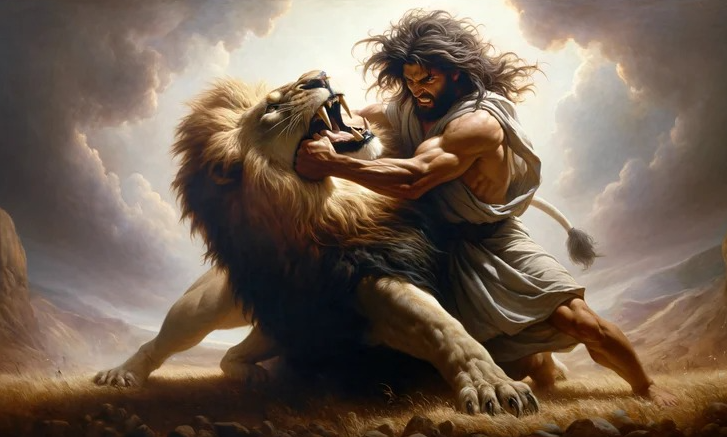
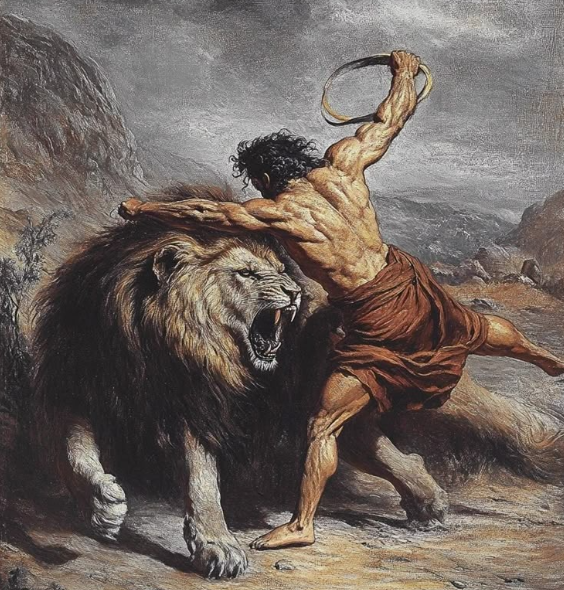
6 And the Spirit of the Lord came mightily upon him, and he rent him as he would have rent a kid, and he had nothing in his hand; but he told not his father or his mother what he had done.
— he told not his father or his mother, lest by their means it should be publicly known; for he wisely considered that it was not yet a fit time to awaken the jealousies and fears of the Philistines concerning him.
7 And he went down and talked with the woman, and she pleased Samson well.
— he went down, and talked with the woman; the social intercourse between the youth of different sexes is extremely rare in those days, “and she pleased Samson well;” but none realised this is from the Lord.
8 And after a time he returned to take her, and he turned aside to see the carcass of the lion; and behold, there was a swarm of bees and honey in the carcass of the lion.
— after a time; there is nothing to show how long this time was; where a betrothal might last a year in nomal case, but Samson’s case might be a week or less.
9 And he took thereof in his hands and went on eating, and came to his father and mother; and he gave to them, and they ate. But he told them not that he had taken the honey out of the carcass of the lion.
— and also gave some to his father and mother to eat, but did not tell them that he had got the honey out of the dead body of the lion; for in that case they would not only have refused to eat it as being unclean;
— but would have been aware of the fact, which Samson afterwards took as the subject of the riddle that he proposed to the Philistines.
10 So his father went down unto the woman; and Samson made there a feast, for so used the young men to do.
— went down unto the woman; formally, to claim her as the bride of his son.
11 And it came to pass, when they saw him, that they brought thirty companions to be with him.
— from the Philistines, the citizens of Timnath, when they saw that he was come to consummate his marriage: hirty companions; these were “the children of the bride-chamber;” to accompany the bride;
— the fact that Samson had brought none with him seems to prove that his marriage was highly unpopular among his own countrymen.
12 And Samson said unto them, “I will now put forth a riddle unto you. If ye can with certainty explain it to me within the seven days of the feast and find it out, then I will give you thirty shirts and thirty changes of garments;
— I will now put forth a riddle unto you; the custom of those times, and which was transmitted to succeeding ages, was to propose some enigmatical mysteries to guests; in order to render the feast more enjoyable;
13 but if ye cannot explain it to me, then shall ye give me thirty shirts and thirty changes of garments.” And they said unto him, “Put forth thy riddle, that we may hear it.”
— Samson’s riddle literally meant no more than that he had got honey, for food and for pleasure, from the lion, which in its strength and fury was ready to devour him.
14 And he said unto them, “Out of the eater came forth meat, and out of the strong came forth sweetness.” And they could not in three days expound the riddle.
— the riddle, a favorite eastern amusement at festive entertainments of this nature, is cast into poetical form; of great literary quality: the verse consists of two members with three beats in each.
15 And it came to pass on the seventh day that they said unto Samson’s wife, “Entice thy husband, that he may explain unto us the riddle, lest we burn thee and thy father’s house with fire. Have ye called us to take what we have? Is it not so?”
— that they said unto Samson’s wife, entice thy husband, that he may declare unto us the riddle; that is, persuade him to tell the meaning of it to her, that she might declare it to them;
— lest we burn thee and thy father’s house with fire; as, indeed, they ultimately did (Judges 15:6). If Samson appears in no very favourable light in this chapter, the Philistines show themselves to be most mean, treacherous and brutal;
— these days, these days, the personal and emotional challenges related to sex is common, for example, the story of Jensen and Alice Huang’s scandals.
16 And Samson’s wife wept before him, and said, “Thou dost but hate me, and lovest me not. Thou hast put forth a riddle unto the children of my people, and hast not told it me.” And he said unto her, “Behold, I have not told it to my father nor my mother, and shall I tell it to thee?”
— seeking synpathy, she wept before him; Samson’s riddle had the effect of making the whole wedding-feast of this ill-starred marriage one of the most embittered and least joyous that ever fell to a bridegroom’s lot;
— a weeping, teazing, fretting bride and sullen guests might have served as a warning that this Philistine marriages would be a bad omen for the sons of Israel.
17 And she wept before him the seven days while their feast lasted. And it came to pass on the seventh day that he told her, because she pressed sorely upon him; and she told the riddle to the children of her people.
— she wept before him, the seven days; or rather, the rest of the seven days; that is, should be after the third day.
18 And the men of the city said unto him on the seventh day before the sun went down: “What is sweeter than honey? And what is stronger than a lion?” And he said unto them, “If ye had not plowed with my heifer, ye would not have found out my riddle.”
— another piece of literary quality; plowed with my heifer; this proverbial phrase an implication that Samson suspected his wife of ‘adultery’ but there is no sufficient reason for this literal view.
19 And the Spirit of the Lord came upon him; and he went down to Ashkelon, and slew thirty men of them and took their apparel, and gave changes of garments unto those who expounded the riddle. And his anger was kindled, and he went up to his father’s house.
— to Ashkelon; possibly he seized the opportunity during some great feast to Dagon, or even of another marriage festival, since the linen robes and rich garments would not be such as would be worn every day;
— Samson saw at once that she had betrayed him; he lets them know in a speech, which was of the nature of a riddle, that he had discovered their treachery.
20 But Samson’s wife was given to his companion, whom he had used as his friend.
— as soon as Samson departed, Samson’s wife was given to his friend, whom he had chosen as a friend, a maid most likely, one of the thirty, and all this furnished out an occasion and opportunity, which they sought for, to be revenged, as in the following chapter shows.


