
Joshua (11-12)

We’ll explore this query further as we dive into ancient Israel.
Joshua 11
1 And it came to pass, when Jabin king of Hazor had heard those things, that he sent to Jobab king of Madon, and to the king of Shimron, and to the king of Achshaph,
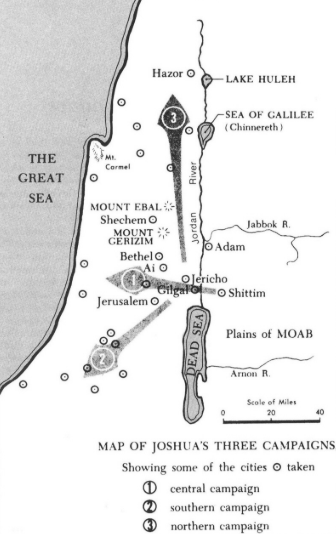
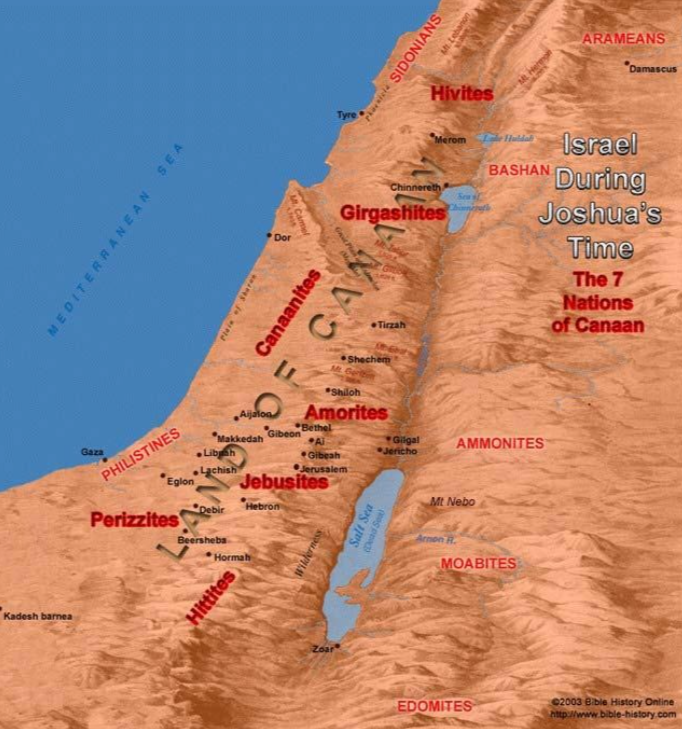
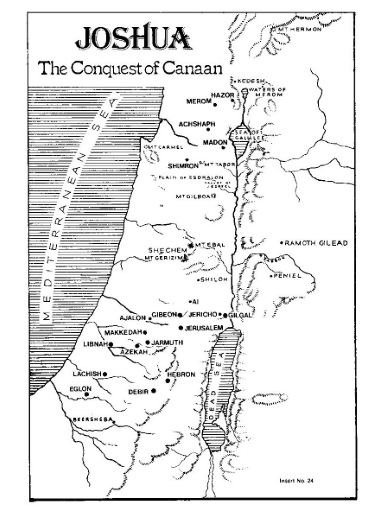
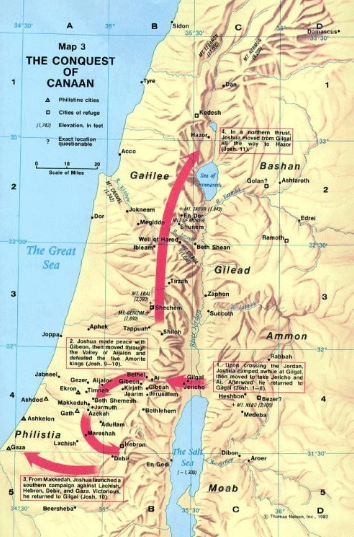
— after the eastern and southern campaim, Joshua was now ready to campaign northward; Hazor, is the head of the principalities of Northern Canaan, and was afterward assigned to the tribe of Naphtali;
— and to the king of Shimron; not Samaria, for that was built by Omri, king of Israel, and had its name from Shemer, the owner of the hill on which it was built some hundreds of years after this; besides Samaria was in the tribe of Ephraim;
2 and to the kings who were on the north of the mountains and of the plains south of Chinneroth, and in the valley, and in the borders of Dor on the west,
— and of the plains south of Cinneroth; or Gennesaret, of the land and lake of which we read in the New Testament, Matthew 14:34;
3 and to the Canaanite on the east and on the west, and to the Amorite, and the Hittite, and the Perizzite, and the Jebusite in the mountains, and to the Hivite under Hermon in the land of Mizpah.
— and the Jebusite in the mountains; in the mountainous part of Judea, in the mountains about Jerusalem, and which they still inhabited, and did to the times of David.
4 And they went out, they and all their hosts with them, many people, even as the sand that is upon the seashore in multitude, with horses and chariots very many.
— much people, even as the sand that is upon the seashore in multitude; a proverbial expression, to denote an exceeding great number.
5 And when all these kings were assembled together, they came and pitched camp together at the waters of Merom to fight against Israel.
— these kings, pitched at the waters of Merom; a lake north by the river Jordan, which was in the territory of the king of Shimron, near Hazor.
6 And the Lord said unto Joshua, “Be not afraid because of them, for tomorrow about this time will I deliver them up all slain before Israel. Thou shalt hamstring their horses and burn their chariots with fire.”
— and the Lord said unto Joshua, be not afraid because of them; of their number, of their horsemen, and of their scythed chariots; which might at first hearing occasion some fear and dread.
7 So Joshua came, and all the people of war with him, against them by the waters of Merom suddenly, and they fell upon them.
— Joshua and his forces came to them suddenly, unawares, and they fell upon them; at once, which threw them into disorder and confusion.
8 And the Lord delivered them into the hand of Israel, who smote them and chased them unto Great Sidon, and unto Misrephothmaim [or, Burning of waters], and unto the Valley of Mizpeh eastward; and they smote them until they left them none remaining.
— Great Sidon; a great city in the northwest part of Canaan, upon the sea. The prophets frequently couple Tyre and Sidon together, as does also the New Testament.
9 And Joshua did unto them as the Lord bade him: he hamstrung their horses and burned their chariots with fire. — or he houghed their horses, and burnt their chariots with fire;
— houghing the horses is done by cutting the sinews and arteries of their hinder legs, so that they not only become hopelessly lame, but bleed to death. The reasons for this special command were that the Lord designed to lead the Israelites to trust in Him, not in military resources.
10 And Joshua at that time turned back and took Hazor, and smote the king thereof with the sword; for Hazor formerly was the head of all those kingdoms.
— to Hazor, for was the head of all those kingdoms, and near to where Joshua first fell upon them, but through this pursuit he was led on many miles beyond it.
11 And they smote all the souls who were therein with the edge of the sword, utterly destroying them. There was not any left to breathe; and he burned Hazor with fire.
— and he burnt Hazor with fire; as he did Jericho and Ai; but it seems that this city, like Gaza, though burnt, was built again and inhabited by the Canaanites.
12 And all the cities of those kings, and all the kings of them, did Joshua take and smote them with the edge of the sword; and he utterly destroyed them, as Moses the servant of the Lord commanded.
— and smote them with the edge of the sword; both the kings and the inhabitants of those cities: and he utterly destroyed them, as Moses commanded.
13 But as for the cities that stood still in their strength, Israel burned none of them, save Hazor only. That did Joshua burn.
— those who “stood still in their strength” are those who remained absolutely neutral in the war. That is, with the exception of Hazor, Joshua did not burn the cities, but left them standing, each on its former site.
14 And all the spoil of these cities, and the cattle, the children of Israel took for booty unto themselves; but every man they smote with the edge of the sword until they had destroyed them, neither left they any to breathe.
— any gold, silver, household goods, corn, wine, oil, or any mercantile goods, together with cattle of every sort, all were taken by them for a prey, for their own use and benefit, which were allowed.
15 As the Lord commanded Moses His servant, so did Moses command Joshua, and so did Joshua. He left nothing undone of all that the Lord commanded Moses.
— so Joshua left nothing undone of all that the Lord commanded Moses; both with respect to the destruction of the people, and of all their images, altars, groves, and high places.
16 So Joshua took all that land: the hills, and all the south country, and all the land of Goshen, and the valley, and the plain, and the mountain of Israel, and the valley of the same,
— the mountain of Israel; possibly the hill of Samaria, or the mountains of Ephraim.
17 even from Mount Halak, that goeth up to Seir, even unto Baalgad in the Valley of Lebanon under Mount Hermon. And all their kings he took, and smote them and slew them.
—north tothe valley of Lebanon, under Mount Hermon; south to the country of Seir or Edom, that part of it which was south from Judea.
18 Joshua made war a long time with all those kings.
19 There was not a city that made peace with the children of Israel, save the Hivites, the inhabitants of Gibeon. All others they took in battle.
— save the Hivites; those from Gibeon had surrendered peacefully; and over time, might have been absorbed into their communities and became as Israelites.
20 For it was of the Lord to harden their hearts, that they should come against Israel in battle, that He might destroy them utterly and that they might have no favor, but that He might destroy them, as the Lord commanded Moses.
— for it was the Lord’s will to harden their hearts that he might destroy them; just as he hardened the hearts of Pharaoh and the Egyptians, that his power might be displayed in their destruction.
21 And at that time came Joshua and cut off the Anakim from the mountains: from Hebron, from Debir, from Anab, and from all the mountains of Judah, and from all the mountains of Israel. Joshua destroyed them utterly with their cities.
— Joshua cut off the Anakims; described as a wild, barbarous, and gigantic people, Numbers 13:33, who were of a different original from that of the Canaanites, and inhabited certain mountains of the country.
22 There were none of the Anakim left in the land of the children of Israel; only in Gaza, in Gath, and in Ashdod, there remained.
— so the giants were still in Gaza, in Gath, and in Ashdod, into which either some of the Anakims escaped, and there took shelter, or they had been there from ancient time, and the Israelites could not yet expel them.
23 So Joshua took the whole land, according to all that the Lord said unto Moses; and Joshua gave it for an inheritance unto Israel according to their divisions by their tribes. And the land rested from war.
— here begins the seventh year, reckoning from after the passage over Jordan; the first sabbatical year celebrated by them after Joshua had brought them into rest.
Joshua 12
1 Now these are the kings of the land whom the children of Israel smote, and possessed their land on the other side of the Jordan toward the rising of the sun, from the River Arnon unto Mount Hermon and all the plain on the east:
— these are the kings of the land, this summary account of Israel’s conquests comes in here not only as a conclusion of the history of the wars of Canaan, from the river Arnon unto the mount Hermon, and all the plain on the east; that we might at one view see what they had gotten.
2 Sihon king of the Amorites, who dwelt in Heshbon and ruled from Aroer, which is upon the bank of the River Arnon, from the middle of the river, and from half of Gilead, even unto the River Jabbok, which is the border of the children of Ammon,
— Sihon king of the Amorites, who dwelt in Heshbon; which he took from the Moabites, and made his capital city, Numbers 21:26.
3 and from the plain to the Sea of Chinneroth on the east, and unto the sea of the plain, even the Salt Sea on the east, the way to Bethjeshimoth, and from the south, under Ashdothpisgah;
— the sea of the plain; the Salt Sea is so called because it was a famous plain, pleasant and fruitful, before it was turned into a salt sea. From the south, or, on or towards the south.
4 and the territory of Og king of Bashan, who was of the remnant of the giants, who dwelt at Ashtaroth and at Edrei,
— and the coast of Og king of Bashan, the country that he reigned over, who was another king of the Amorites, smitten by Israel in the times of Moses.
5 and reigned in Mount Hermon and in Salcah and in all Bashan, unto the border of the Geshurites and the Maachathites, and half of Gilead, the border of Sihon king of Heshbon.
— the river Arnon on the south and mount Hermon on the north were the respective boundaries of the land acquired by the Israelites beyond Jordan.
6 These Moses the servant of the Lord and the children of Israel smote; and Moses the servant of the Lord gave it for a possession unto the Reubenites and the Gadites and the halftribe of Manasseh.
— the above mentioned land, these did Moses and the children of Israel took, for a possession unto the Reubenites, and the Gadites, and the half tribe of Manasseh.
7 And these are the kings of the country which Joshua and the children of Israel smote on this side of the Jordan on the west, from Baalgad in the Valley of Lebanon even unto the Mount Halak that goeth up to Seir, which Joshua gave unto the tribes of Israel for a possession according to their divisions,
8 in the mountains and in the valleys and in the plains, and in the springs and in the wilderness and in the south country — the Hittites, the Amorites, and the Canaanites, the Perizzites, the Hivites, and the Jebusites:
— in the mountains and in the valleys,in the plains and in the springs, in the wilderness this was the land God appointed for Israel; yet in the past it is one of the most barren and unprofitable regions in the world;
— the Hittites, the Amorites, and the Canaanites, the Perizzites, the Hivites, and the Jebusites; which were the nations that inhabited the land of Canaan before it was taken and possessed by the Israelites.
Compare Joshua’s conquest with God’s earlier promise to Abraham:
After these things the word of the Lord came unto Abram in a vision, saying, “Fear not, Abram. I am thy shield and thy exceeding great reward.”
On the same day the Lord made a covenant with Abram, saying, “Unto thy seed have I given this land, from the river of Egypt unto the great river, the River Euphrates:
19 the Kenites and the Kenizzites and the Kadmonites,
20 and the Hittites and the Perizzites and the Rephaim,
21 and the Amorites and the Canaanites and the Girgashites and the Jebusites.” Genesis 15:1,18-21
9 the king of Jericho, one; the king of Ai, which is beside Bethel, one;
10 the king of Jerusalem, one; the king of Hebron, one;
11 the king of Jarmuth, one; the king of Lachish, one;
12 the king of Eglon, one; the king of Gezer, one;
13 the king of Debir, one; the king of Geder, one;
14 the king of Hormah, one; the king of Arad, one;
15 the king of Libnah, one; the king of Adullam, one;
16 the king of Makkedah, one; the king of Bethel, one;
17 the king of Tappuah, one; the king of Hepher, one;
18 the king of Aphek, one; the king of Lasharon, one;
19 the king of Madon, one; the king of Hazor, one;
20 the king of Shimronmeron, one; the king of Achshaph, one;
21 the king of Taanach, one; the king of Megiddo, one;
22 the king of Kedesh, one; the king of Jokneam of Carmel, one;
23 the king of Dor in the province of Dor, one; the king of the nations of Gilgal, one;
24 the king of Tirzah, one — all the kings thirty and one.


