MENE MENE TEKEL UPHARSIN: A compelling Prophecy concerning the United States and Great Britain
The Targum, an Insight of Ezra (D-Jeremiah)
(1) Then said I, “Ah, Lord God! Behold, I cannot speak, for I am a child.” Jeremiah 1:6
— then said I, Ah, Lord God! the word אהה, “Ah” is used in distress and grief, showing that the prophet was troubled and uneasy at his call, and would gladly have been excused on the following account;
— behold, I cannot speak; or “I know not how to speak” properly, politely or eloquently, especially before great personages, kings and princes, and the citizens of Jerusalem; a similar excuse Moses made, Exodus 4:10;
— the Targum says, “I do not know how to prophesy: for I am a youth” ~ emphasizes that as a youth his calling started at a young age, suggesting immaturity or lack of authority; meaning either in knowledge and understanding, or in years.
(2) But the Lord said unto me, “Say not, ‘I am a child,’ for thou shalt go to all whom I shall send thee, and whatsoever I command thee thou shalt speak. Jeremiah 1:7
— for thou shall go to all that I shall send thee; either to “every place” as the Targum paraphrases: “For wherever I send you, you shall go;”
— or as the Septuagint renders the words “to whomsoever I shall send thee;” the sense is, that he should go everywhere, to every person and with any message he should be sent unto and with.
(3) Moreover the word of the Lord came unto me, saying, “Jeremiah, what seest thou?” And I said, “I see a rod of an almond tree.” Jeremiah 1:11
— “What do you see, Jeremiah?” and I said, I see a rod of an almond tree; a dry stick, without leaves or fruit upon it, and yet he knew it to be an almond tree stick; though some think it had leaves and fruit on it, by which it was known;
— the almond-tree, off springs forth a rod, represents the speedy approach of judgments; the Targum says, “and I said, a king hastening to do evil I see;” meaning Nebuchadnezzar, king of Babylon, hastening to bring destruction upon the house of Judah.
(4) And the word of the Lord came unto me the second time, saying, “What seest thou?” And I said, “I see a seething pot, and the face thereof is toward the north.” Jeremiah 1:13
— after the first vision (the almond rod), God now presents a more ominous image; the Targum paraphrases the words as, “and I see a boiling cauldron;” Jeremiah sees a pot bubbling violently—symbolizing unrest, judgment and divine wrath.
(5) And they shall fight against thee; but they shall not prevail against thee, for I am with thee,” saith the Lord, “to deliver thee.” Jeremiah 1:19
— and they shall fight against thee; the Targum adds, “that they may hide the words of thy prophecy;” or “to suppress the words of your prophecy.”
(6) “Go and cry in the ears of Jerusalem, saying, ‘Thus saith the Lord: “‘I remember thee, the kindness of thy youth, the love of thine espousals, when thou wentest after Me in the wilderness, in a land that was not sown. Jeremiah 2:2
— God commands Jeremiah to deliver a message directly to the inhabitants of Jerusalem;
— the Targum says, “and they walked after my two messengers, Moses and Aaron, in the wilderness forty years without food, in a land that was not sown;” during the Exodus in the wilderness; where you passed through many difficulties;
— and lived upon the providence of God, which, in a wonderful manner, supported them with the necessaries of life, which otherwise they could have died.
(7) Thus saith the Lord: “What iniquity have your fathers found in Me, that they are gone far from Me, and have walked after vanity, and have become vain? Jeremiah 2:5
— the Targum asks, “what falsehood have your fathers found in my word?” None at all; God is a covenant keeping God.
(8) “Therefore I will yet plead with you,” saith the Lord, “and with your children’s children will I plead. Jeremiah 2:9
— wherefore I will yet plead with you, saith the Lord; either verbally, by reasoning with them and reproving them for their ignorance, stupidity and idolatry; or by deeds, inflicting punishment upon them;
— so the Targum says, “therefore I will take vengeance on you, or punish you, saith the Lord;” even your children’s children.
(9) For pass over to the isles of Chittim and see; and send unto Kedar and consider diligently, and see if there be such a thing. Jeremiah 2:10
— and send unto Kedar; which was in Arabia, and lay to the east, as Chittim to the west; and so the Targum paraphrases it, “send to the provinces of the Arabians.”
(10) Why readiest thou thy way to seek love? Therefore hast thou also taught the wicked ones thy ways. Jeremiah 2:33
— or the sense is, why art thou so diligent and industrious to make thy way, by sacrifices and ceremonies, oblations and ablutions, in order to seek and obtain love and favors from the nations, which are all in vain?
— the Targum says: “why dost thou make thy way beautiful, to procure loves (or lovers) to be joined to the nations?”
(11) Will He reserve His anger for ever? Will He keep it to the end?’ Behold, thou hast spoken, and done evil things as thou couldest.” Jeremiah 3:5
— the Targum says, “is it possible that thy sins should be kept for thee for ever, or the stroke (of punishment) be strengthened upon thee to the end?”
(12) And I saw that for all the causes for which backsliding Israel committed adultery, I had put her away and given her a bill of divorce; yet her treacherous sister Judah feared not, but went and played the harlot also. Jeremiah 3:8
— yet her treacherous sister Judah feared not: committed idolatry and offended the Lord, nor stood in awe of his judgements; but went and played the harlot; committed idolatry, as the ten tribes did, taking no warning by what befell them.
— the Targum says, “I caused them to go into captivity as those that give a bill of divorce (to their wives) and dismiss them:”
(13) ‘Turn, O backsliding children,’ saith the Lord, ‘for I am married unto you; and I will take you, one from a city and two from a family, and I will bring you to Zion. Jeremiah 3:14
— backsliding children; the Targum says, “for I am well pleased with you;” to which Rashi adds “and you are called by My name, that I am your Master, and it is not honorable for Me to leave you in the hands of My enemies.”
(14) “And it shall come to pass when ye be multiplied and increased in the land, in those days,” saith the Lord, “they shall say no more, ‘The ark of the covenant of the Lord.’ Neither shall it come to mind, neither shall they remember it; neither shall they visit it, neither shall that be done any more. Jeremiah 3:16
— but the Targum paraphrases the last clause, “neither shall they make war with it any more.”
“And it shall be, when you multiply and increase in the land in those days, says the LORD, they shall no longer say, ‘The Ark of the Covenant of the LORD,’ nor shall it enter their mind, nor shall they remember it, nor shall they be shaken [by its absence], nor shall they carry it out to war anymore.” Jeremiah 3:16 Jonathan
(15) At that time they shall call Jerusalem the Throne of the Lord, and all the nations shall be gathered unto it, to the name of the Lord, to Jerusalem; neither shall they walk any more after the imagination of their evil heart. Jeremiah 3:17
“At that time, they will call Jerusalem the place of the dwelling of the Divine Presence (Shekhinah) of the Lord, and all nations will come to worship there in the name of the Lord in Jerusalem. They will no longer follow the evil thoughts of their hearts.” Jeremiah 3:17 Jonathan
(16) “Return, ye backsliding children, and I will heal your backslidings.” “Behold, we come unto Thee, for Thou art the Lord our God. Jeremiah 3:22
— and I will heal your backslidings; that is, God will forgive your sins; sins are the breaking of his commandments and the wounds that resulted from it; and pardoning them is healing them.
— the Targum says, “I will forgive you when ye return.”
(17) At that time shall it be said to this people and to Jerusalem: “A dry wind of the high places in the wilderness toward the daughter of My people — not to fan, nor to cleanse — Jeremiah 4:11
— a dry wind toward the daughter of My people, the children of God’s chosen nation, both to fan or to cleanse, a scorching wind which carried off the chaff as the threshed grain was winnowed;
— the Targum says, “as the south wind upon the heads of floods of water in the wilderness, so is the way of the congregation of my people;” a south wind and not the north wind as designed; since this scorching wind intends Nebuchadnezzar and his army, which should come from Babylon, from the north.
(18) “Make ye mention to the nations. Behold, publish against Jerusalem that watchers come from a far country and give out their voice against the cities of Judah. Jeremiah 4:16
— and give out their voice against the cities of Judah; threaten the ruin of them; Syria, Lebanon, Egypt, Jordan, Saudi Arabia, Qatar, Turkey, Iran, the alarm of war; to give the orders to besiege Judah.
— the Targum says, “the armies of invading nations are coming swiftly like harvesters from a distant land, and they will encamp around the borders of Judah and raise their voices against her.”
(19) Therefore a lion out of the forest shall slay them, and a wolf of the evenings shall despoil them; a leopard shall watch over their cities. Every one that goeth out thence shall be torn in pieces, because their transgressions are many, and their backslidings are increased. Jeremiah 5:6
“Therefore, a king with his armies shall ascend against them like a lion from the forest and kill them; nations that are as strong as evening wolves shall plunder them; rulers who are mighty like leopards lie in wait against their cities; anyone who goes out from them shall be killed, because their rebellions are many and their backslidings are strong.”
(20) As a cage is full of birds, so are their houses full of deceit; therefore they have become great and have waxed rich. Jeremiah 5:27
— the Septuagint version renders it, “a snare which has been set is full of birds, so are their houses full of deceit” which agrees with what goes before. It seems to intend a decoy, in which many birds are put to allure others; and, what with them, and those that are drawn in by them;
— the Targum renders it, “Like a fattening cage full of birds, so are their houses full of deceit; therefore they have become great and wealthy.”
(21) The shepherds with their flocks shall come unto her; they shall pitch their tents against her round about; they shall feed every one in his place.” Jeremiah 6:3
— the Targum identifies the shepherds and their flocks as “kings and their forces,” making the threat more explicit and regal in scale; the sense is, kings or their general shall lay a grim and calculated siege of Jerusalem, and against other cities and another, until they have subdued the whole land;
“Against her shall come kings and their armies; they shall pitch tents around her, each assisting his fellow.”
(22) “For from the least of them even unto the greatest of them, every one is given to covetousness; and from the prophet even unto the priest, every one dealeth falsely. Jeremiah 6:13
— from the prophet unto the priest everyone deal falsely; their false prophet, as the Septuagint and other versions; the priest of Baal, both acted deceitfully; the one in prophesying lies to the people, the other in drawing them off from the pure worship of God;
— the Targum says, “from the scribe to the priest” from the lowest order of teachers to the highest in ecclesiastical office; the whole shows a most general and dreadful corruption.
(23) Therefore hear, ye nations, and know, O congregation, what is among them. — hear, ye nations (Goyim); the heathen are called upon to take notice of these warnings of God’s wrath against both the Israelites and the Jews, Jeremiah 6:18
— what sins were among them; what transgressions are committed by them; which were the cause of the Lord’s threatening them with judgements, and bringing consequences upon them; so the Targum says “and let the congregation of Israel know their sins.”
(24) Hear, O earth: Behold, I will bring evil upon this people, even the fruit of their thoughts, because they have not hearkened unto My words nor to My law, but rejected it. Jeremiah 6:19
— the expression, “O earth” is expressed seven times throughout the OT, here by Jeremiah, elsewhere by Moses, Job, Isaiah and Micah, empahsizing that God, too, has a message for the whole of humanity;
— even the fruit of their thoughts; the Targum renders it, “the retribution or reward of their works;”
“Hear, O land of Israel! Behold, I am bringing disaster upon this people—the reward for their deeds—because they did not accept the words of My servants the prophets, and My Torah, they rejected it.”
(25) Thus saith the Lord: “Behold, a people cometh from the north country, and a great nation shall be raised from the sides of the earth. Jeremiah 6:22
— and a great nation shall be raised; that is, by the Lord, who would stir them up to this undertaking; the Targum says, “many people shall come openly from the ends of the earth;” Babylon wasn’t from the end of the earth, hence this would be another great nation.
— during Jeremiah’s time, God warned of an enemy coming from the North, but more relevant for us today, Ezekiel waned of an enemy coming from the South; so what is it?
(26) Go not forth into the field nor walk by the way, for the sword of the enemy and fear is on every side. Jeremiah 6:25
— and fear is on every side; all round the city of Jerusalem, being encompassed by a Babylon army from the North: or the enemy’s sword from the South, as “is fear on every side” causes fear in all parts round the city;
— the Targum says, “Do not go out to the field, and do not walk on the road, for the sword of the enemy brings death—it strikes down those who gather from every direction;” or, encircling all around.
(27) Trust ye not in lying words, saying, “The temple of the Lord, the temple of the Lord, the temple of the Lord are these.” Jeremiah 7:4
— the three-fold repetition of the words, the Temple of the Lord, was, perhaps every Jew was obliged to visit the Temple thrice a year. But it seems also likely that they are thus repeated, to express the importance of the Temple where the Most High dwells;
— these were the lying words uttering at the temple on which they trusted, the trusting in human lying in which God through Isaiah solemnly cautions them;
— trust ye not in lying words; not the words of the lying prophets, as the Targum says,
“Do not trust in the words of the false prophets who say: ‘Before the Temple of the LORD you worship, before the Temple of the LORD you sacrifice, before the Temple of the LORD you bow down—three times a year you present yourselves before Him!'”
(28) And I will cast you out of My sight, as I have cast out all your brethren, even the whole seed of Ephraim.’ Jeremiah 7:15
— as I have cast out all your brethren, even the whole seed of Ephraim; or as the Targum says,
“And I will exile you from the land of My sanctuary, just as I exiled all your brothers—the entire seed of Israel.”
— as Ephraim were carried captive off into Assyria, so would the two tribes of Judah and Benjamin; who could not expect to fare better than their brethren, who were more numerous than they; but both were guilty of the same sins.
(29) “‘Cut off thine hair, O Jerusalem, and cast it away, and take up a lamentation on high places; for the Lord hath rejected and forsaken the generation of His wrath. Jeremiah 7:29
— Jeremiah addresses Jerusalem under the figure of a woman, who, in grief for her lost children, deprives her head of its chief ornament and goes up to the hills to mourn;
— the Targum says, “pluck off the hair for thy great ones who will be exiled, and take up a lamentation for the princes; for the Lord has distanced Himself and abandoned the generation that transgressed against His Word.”
(30) “For behold, I will send serpents, cockatrices, among you, which will not be charmed, and they shall bite you,” saith the Lord. Jeremiah 8:17
— the Targum says, “For behold, I am sending you against deadly nations, like venomous serpents that cannot be charmed, and they shall kill you, says the Lord.” And they shall bite you, or kill you; for the bite of a serpent is deadly.
(31) Behold the voice of the cry of the daughter of my people, because of them that dwell in a far country: “Is not the Lord in Zion? Is not her King in her?” “Why have they provoked Me to anger with their graven images and with strange vanities?” Jeremiah 8:19
— behold, the voice of the cry of the daughter of my people; such was God’s sympathy for his countrymen, his people in distress, whom he affectionately calls the daughter of his people;
— “Is not the Lord in Zion? If they return to God, he will allow himself to be found by them;
— the Targum says “Behold, the voice of the cry of the assembly of My people from a distant land! The prophets rebuke them: ‘Is the Shechinah of the LORD no longer in Zion? Is her King no longer in her?’ [God responds:] ‘Why then have they provoked Me with their images, with the worship of foreign idols?'”
(32) “And they bend their tongues like their bow for lies, but they are not valiant for the truth upon the earth; for they proceed from evil to evil, and they know not Me,” saith the Lord. Jeremiah 9:3
— the words may be rendered, “they bend their tongues, their bow is a lie” either deceitful, or carries a lie in it, and shoots one out of it for a kill;
— like chronic liars, their tongues were like bows, and their lying words like arrows that injure or kill; see Psalms 64:3, or “like their deceitful bow”
— to which the Targum says, “Let every man beware of his neighbor, and do not trust in any brother; for every brother lies in wait to entrap, and every friend walks in deceit,” Or, “they teach their tongues words of falsehood, they are like to a deceitful bow.”
(33) Therefore thus saith the Lord of hosts: “Behold, I will melt them and try them; for how else shall I do for the daughter of My people? Jeremiah 9:7
— calls the daughter of my people; such was God’s compassion for his countrymen, his people in distress, whom he addresses affectionately;
— “I will melt them” by afflicting them with heatwaves in some areas while freezing them with chilling blizzards in others; “to try them” by having droughts in one place while torrential rains and floods in another; and ask, Do they cry to me? If not what else shall I do? if still no repentance, into Captivity again?
“Therefore, thus says the Lord of Hosts: Behold, I am bringing upon them affliction and refining them. And after them, what else can I do because of the sins of the congregation of My people?”
(34) Therefore thus saith the Lord of hosts, the God of Israel: “Behold, I will feed them, even this people, with wormwood and give them water of gall to drink. Jeremiah 9:15
— the word rendered wormwood here, it seems, signifying an herb which is not only bitter and nauseous but noxious; and give them water of gall to drink; meaning either of the entrails of a beast so called, or of the juice of the herb hemlock, as the word is rendered in Hosea 10:4, as poison of a serpent, signifying that their punishment would be very severe;
“Therefore, thus says the Lord of Hosts, the God of Israel: Behold, I am bringing affliction upon this people, bitter like tendons, and I will make them drink the cup of curse to the heads of serpents.”
(35) Thus saith the Lord: “Let not the wise man glory in his wisdom, neither let the mighty man glory in his might; let not the rich man glory in his riches. Jeremiah 9:23
— thus saith the Lord, let not the wise man glory in his wisdom, not in his intellect or knowledge of things: this is often but an appearance of wisdom, but not a true knowledge of God;
— the Targum paraphrases them (v22), “Thus says the Lord: Let not Solomon son of David boast in his wisdom, nor Samson son of Manoah boast in his strength, nor Ahab son of Omri boast in his wealth.”
(36) who would not fear Thee, O King of nations? For to Thee doth it appertain, inasmuch as among all the wise men of the nations and in all their kingdoms, there is none like unto Thee. Jeremiah 10:7
— among all the wise men of the nations and in all their kingdoms there is none like unto thee; no matter where a person searches for a god who might stand a comparison with Yehovah, the quest will be useless: He, and he the Most High, alone, is the only Being worthy of worship;
— the Targum reaffirms Him as “King of all nations;”
“Who would not fear before You, O King over all the nations? For Yours is the kingdom! For among all the wise men of the nations and in all their kingdoms, there is none besides You!”
(37) “Thus shall ye say unto them: ‘The gods that have not made the heavens and the earth, even they shall perish from the earth and from under these heavens.’” Jeremiah 10:11
— this verse is, unlike the rest of the chapter, written in Aramaic (presumely to those already exiled);
— the gods that have not made the heavens and the earth; shall perish from the earth and from under heavens; which the Targum paraphrases, “they and their worshippers shall perish from the earth, and shall be consumed from under these heavens.”
“This is the copy of the letter that Jeremiah the prophet sent to the rest of the elders of the exile who were in Babylon: And if the Chaldeans among whom you live say to you, ‘Worship idols, O house of Israel!’ thus shall you answer and thus shall you say to them: ‘The idols that you worship are useless idols; from heaven they are unable to bring down rain, and from the earth they are unable to yield fruit. They and their worshipers shall perish from the earth and be destroyed from under these heavens!'” Jeremiah 10:11 Jonathan
(38) He hath made the earth by His power; He hath established the world by His wisdom, and hath stretched out the heavens by His discretion. Jeremiah 10:12
— he hath made the earth by his power; the Targum considers these words as a continuation of the answer of the Jews to the Chaldeans; paraphrasing them thus,
“And thus shall you say to them: ‘We worship Him who made the earth by His power, who established the world by His wisdom, and by His understanding stretched out the heavens!'”
(39) Therefore thus saith the Lord: ‘Behold, I will bring evil upon them, which they shall not be able to escape; and though they shall cry unto Me, I will not hearken unto them. Jeremiah 11:11
— and I will not hearken unto them: because their prayers were hypocritical, and not attended true repentance; otherwise, when men cry to God, under a sense of sin, being truly sorry for it, he hears them, and delivers them;
“Therefore, thus says the LORD: ‘Behold, I am bringing upon them disaster from which they shall not be able to escape; and they shall pray before Me, but I will not accept their prayer.'”
(40) The Lord called thy name, ‘A Green Olive Tree,’ fair and of goodly fruit. With the noise of a great tumult He hath kindled fire upon it, and the branches of it are broken. Jeremiah 11:16
“Behold, like a beautiful olive tree with fine branches and pleasing appearance, whose foliage is mingled among the trees—so did the Lord call your name among the nations. But when you transgressed the Torah, mighty nations like fire will come upon you and attach themselves to your branches.”
(41) But I was like a lamb or an ox that is brought to the slaughter; and I knew not that they had devised devices against me, saying, “Let us destroy the tree with the fruit thereof, and let us cut him off from the land of the living, that his name may be no more remembered.” Jeremiah 11:19
— the pronoun ‘I’ was Jeremiah, but prophetic also for the Messiah; like a lamb or an ox; some translate it “as a choice lamb;” that is brought to the slaughter; to be sacrificed or killed by the butcher; so ignorant was the prophet of the designs of his townsmen against him, and not at all jealous that they wished him ill; since he meant none to them, but sought their good;
“But I was like a gentle lamb led to the slaughter, and I did not know that they had plotted evil against me, saying, ‘Let us put poison in his food and cut him off from the land of Israel, so that his name will no longer be remembered.’”
(42) “If thou hast run with the footmen and they have wearied thee, then how canst thou contend with horses? And if in the land of peace, wherein thou trusted, they wearied thee, then how wilt thou do in the swelling of the Jordan?
— if you couldn’t cope with small things how could you cope with big issues? if crossing the Jordan already wearied you, wait till you come cross the Euphrates?
“This is the response to Jeremiah the prophet concerning his petition: ‘Prophet, you are like a man who ran with footmen and became weary; how then do you compare to run against horses in a plain? And in a land of peace you rely and fall; how then do you compare to act against the wild beasts that are in the thickets of the Jordan? And if regarding the good things that I do for Nebuchadnezzar king of Babylon—who is like a mere footman—you, O prophet, see and marvel, how then when I show you what I am destined to do for your righteous ancestors of old, who ran like horses to perform good deeds before Me? And yet I promised them that I would bring upon their children blessings and consolations—behold, like the waters that come down in a flood to the Jordan!’”
(43) And it shall come to pass, if they will diligently learn the ways of My people, to swear by My name, ‘The Lord liveth,’ as they taught My people to swear by Baal, then shall they be built in the midst of My people. Jeremiah 12:16
— then shall they be built in the midst of my people; become part of the building of God’s physical and spiritual government; being laid upon the same foundation of the patriarchs, the prophets and the apostles;
— the Targum says, “and they [Goyim] shall be established in the midst of my people.”
“And it shall come to pass, if they will indeed learn from the ways of the assembly of My people, to swear by My Name: ‘As the LORD lives!’—just as they taught My people to swear by the name of idols—then they shall be established in the midst of My people.”
(44) “Thus saith the Lord: ‘In this manner will I mar (destroy) the pride of Judah and the great pride of Jerusalem. Jeremiah 13:9
— will God destroy the pride of Judah, and the strength of Jerusalem? Or their glory, or excellency; that which they were proud of; their city which was burnt, and their Temple which was destroyed by the Chaldeans; their king, princes and nobles, who were carried captive into Babylon, stripped of all their grandeur, honour and glory;
— the Targum says, “so will I ruin the pride of the men of Judah, and the strength of the inhabitants of Jerusalem;” meaning the proud men of Jerusalem would be destroyed.
Nebuchadnezzar – King of Babylon and Conqueror of Judah
(45) Therefore will I uncover thy skirts upon thy face, that thy shame may appear. Jeremiah 13:26
— the Targum says, “and I also will reveal the confusion of thy sin upon thy face, and thy shame shall be seen;” that their sins might appear to themselves and others, of which they had reason to be ashamed.
(46) “And I will appoint over them four kinds,” saith the Lord: “the sword to slay, and the dogs to tear, and the fowls of the heaven and the beasts of the earth to devour and destroy. Jeremiah 15:3
— the Targum expounds on the “four evil punishments;”
“And I will appoint over them four evil punishments, says the LORD: those who are slain with the sword to be killed; and the dogs to drag away; and the birds of the heavens and the beasts of the earth to consume and to destroy.”
(47) Therefore will I cast you out of this land into a land that ye know not, neither ye nor your fathers; and there shall ye serve other gods day and night, where I will not show you favor.’ Jeremiah 16:13
— the Targum reaffirms, “and there shall ye serve people that worship idols day and night” that as they had served idols, now they should serve the people, the worshippers of those idols; the former was their sin, the latter their punishment;
“And I will cast you out from upon this land to a land that you have not known, neither you nor your fathers; and there you shall serve the nations that worship idols day and night, for I will not grant you compassion.”
(48) O My mountain in the field, I will give thy substance and all thy treasures to the spoil, and thy high places for sin throughout all thy borders. Jeremiah 17:3
— O my mountain in the midst of the field; a poetic phrase for either the Temple, called the mountain of the house, and of the Lord’s house, Micah 3:12, or else Jerusalem, which stood on a hill in the midst of a plain, surrounded with fruitful fields and gardens; or in the midst of a land like a field;
— the Targum says, “because thou worshippest idols upon the mountains in the field, your wealth and all your treasuries I will give over to spoil, because of the sins with which you were worshiping idols within all your borders.”
(49) And thou, even thyself, shalt discontinue from thine heritage that I gave thee; and I will cause thee to serve thine enemies in the land which thou knowest not; for ye have kindled a fire in Mine anger which shall burn for ever.” Jeremiah 17:4
— God will cause Israel to serve their enemies in the land which thou knowest not; the Babylonians in Chaldea; or, later, the Romans;
— the Targum takes in the whole of the sense, “And I will bring an enemy upon your land, and it shall be desolate like the Sabbatical year [Shemitah]; and upon you I will execute the retribution of judgment until I exile you from your inheritance which I gave to you. And you shall be subjected to your enemies in a land that you have not known; for a strong fury like fire has gone forth from before Me in anger; unto eternity it shall abide!”
(50) And go forth unto the Valley of the Son of Hinnom, which is by the entry of the East Gate, and proclaim there the words that I shall tell thee, Jeremiah 19:2
— which is by the entry of the East gate; the main gate into and out of Jerusalem, which lay through the east of the city;
— the Targum calls it “the dung gate” through which the filth of the city was carried out, and laid near it; this dung gate is situated near the southeast corner of the Old City, southwest of the Temple Mount;
(51) And I will cause them to eat the flesh of their sons and the flesh of their daughters, and they shall eat every one the flesh of his friend in the siege and straits with which their enemies and they that seek their lives shall straiten them.’ Jeremiah 19:9
— and God will cause them to eat the flesh of their sons, and the flesh of their daughters; for want of food; the famine should be so great and pressing. Jeremiah, that foretells this, was a witness of it, and has left it on record, Lamentations 2:20;
— and they shall eat everyone the flesh of his friend; the Targum interprets it, the goods or substance of his neighbour; which is sometimes the sense of eating the flesh of another; as it is to be taken in a literal sense;
Then Hananiah the prophet took the yoke from off the prophet Jeremiah’s neck, and broke it, Jeremiah 28:10
(52) Then they shall answer, ‘Because they have forsaken the covenant of the Lord their God, and worshiped other gods and served them.’” Jeremiah 22:9
— they left the true God, worshipped other gods; served stocks and stones; or as the Targum says
“And they shall say: ‘Because they abandoned the covenant of the LORD their God, and bowed down to the idols of the worshipers of stars, and served them.’”
(53) The wind shall eat up all thy shepherds (pastors), and thy lovers shall go into captivity; surely then shalt thou be ashamed and confounded for all thy wickedness. Jeremiah 22:22
— the Targum says, “All your leaders shall be scattered to every wind, and your lovers shall go into captivity; for then you shall be ashamed and humbled because of all your wickedness.”
(54) O earth, earth, earth, hear the word of the Lord! Jeremiah 22:29
— the expression, “O earth” is expressed seven times throughout the OT, here by Jeremiah, elsewhere by Moses, Job, Isaiah and Micah, empahsizing that God, too, has a message for the whole of humanity;
— hear the word of the Lord, O earth, earth, earth; to the inhabitants of the whole earth, not jus to the land of Israel; or rather the earth on which men dwell, is here called upon as a witness to what is after said;
— to rebuke the stupidity of the people and to quicken their attention to somewhat very remarkable and worthy of notice, and therefore the word is repeated three times;
— so the Targum says, “out of his own land they carried him captive into another land; O land of Israel, receive the words of the Lord.”
(55) [The whole context of Jeremiah 23 is on false prophets]
“Woe be unto the shepherds that destroy and scatter the sheep of My pasture!” saith the Lord. Jeremiah 23:1
— woe be unto the shepherds “פַּרְנָסַיָא;” they are wolves like Sanballat and Tobiah; Or “O ye shepherds” or “governors” as the Targum says;
— the civil rulers and magistrates, kings and princes of the land of Judah; since ecclesiastical rulers, the priests and prophets, are mentioned as distinct from them in Jeremiah 23:9; whose business it was to rule and guide, protect and defend the people;
— that destroy and scatter the sheep; setting bad examples, led them into idolatry which were the cause of their ruin and of their being carried captive and scattered in other countries; inasmuch as these people were the Lord’s pasture sheep, whom he had committed them to the care and charge of these shepherds.
Wolves, like Sanballat and Tobiah, scattered and remained hidden!
(56) “Behold, the days come,” saith the Lord, “that I will raise unto David a righteous Branch; and a King shall reign and prosper, and shall execute judgement and justice in the earth. Jeremiah 23:5
— that I will raise unto David a righteous Branch; the Messiah; so it is explained by the Targum, which calls him the Messiah of the righteous; and by the ancient Jews also; who is spoken of frequently by the prophets as a branch, Isaiah 4:2.
(57) Mine heart within me is broken because of the prophets; all my bones shake. I am like a drunken man and like a man whom wine hath overcome, because of the Lord and because of the words of His holiness. Jeremiah 23:9
— mine heart within me is broken because of these false prophets, as the Targum interprets it, because of their false doctrines and wicked lives introduced first by Jeroboam, but later by the like Sanballat and Tobiah; and because of the mischief they did the people, and the ruin they brought upon them and to themselves.
(58a) “For both prophet and priest are profane; yea, in My house have I found their wickedness,” saith the Lord. Jeremiah 23:11
— for both prophet and priest are profane; being guilty of the mentioned sins;
— the Targum says, “the scribe and the priest; even in My Sanctuary,” and such were the false scribes and priests in the ‘Temple’ of God; they played “the hypocrite” as some render the word here; and are often charged with the sin of false doctrines and others called hypocrites.
(58b) “And I have seen folly in the prophets of Samaria: They prophesied in Baal and caused My people Israel to err. Jeremiah 23:13
(59) Therefore thus saith the Lord of hosts concerning the prophets: “Behold, I will feed them with wormwood, and make them drink the water of gall; for from the prophets of Jerusalem is profaneness gone forth into all the land.” Jeremiah 23:15
— therefore thus saith the Lord of hosts concerning the prophets; concerning the false prophets, as the Targum says; their sin is before declared, and now their punishment: behold, I will feed them with wormwood; with some bitter affliction and calamity;
— so the Targum says, “behold, I will bring upon them distress bitter as wormwood;” and make them drink the water of gall: or “the juice of hemlock” or “poison” or “the savour of death,” as they poisoned the people with their false doctrines, they shall drink poison themselves; which is bitter and unpleasant and which is noxious and hurtful; not only a bitter potion, but a destructive one;
— the Targum says, “Therefore, thus says the LORD of Hosts concerning the false prophets: ‘Behold, I am bringing upon them distress bitter as wormwood [gall], and I will give them to drink a cup of evil curse like the heads of serpents; for from the prophets of Jerusalem pollution [godlessness] has gone forth to all the inhabitants of the land.'”
(60) Thus saith the Lord of hosts: “Hearken not unto the words of the prophets that prophesy unto you. They make you vain; they speak a vision of their own heart, and not out of the mouth of the Lord. Jeremiah 23:16
— they make you vain; they filled their heads with vain and empty things, and their hearts with vain hopes; they taught vain things, and made them vain and sinful in their lives and conversations; and therefore were not to be hearkened to;
— so the Targum says, “Thus says the LORD of Hosts: ‘Do not accept the words of the false prophets who prophesy to you; they are misleading you. They speak the wickedness of their own heart, and not by the Word of the LORD.'”
(61) The prophet that hath a dream, let him tell a dream; and he that hath My word, let him speak My word faithfully. What is the chaff to the wheat?” saith the Lord. Jeremiah 23:28
— the prophet that hath a dream, let him tell a dream; the Septuagint says, “let him tell his dream” let him tell it as his own, and not as a dream from the Lord;
— let him speak my word faithfully; or “truly” or “let him speak my word, truth” which is truth; or for it is truth; so this is a reason why it should be spoken freely, fully, publicly and boldly, because it is truth and nothing but truth: or “let him speak my word as truth;”
— why do ye mix the chaff with the wheat? the Targum interprets this of persons, paraphrasing the words thus, “behold, as one separates between the chaff and the wheat, so I separate between the righteous and the wicked, saith the Lord.”
(62) Behold, I am against the prophets,” saith the Lord, “that use their tongues and say, ‘He saith.’ Jeremiah 23:31
— the Targum says, “who prophesy according to the will of their own hearts; therefore, behold, I send my fury against the false prophets.”
(63) therefore behold, I, even I, will utterly forget you, and I will forsake you and the city that I gave you and your fathers, and cast you out of My presence. Jeremiah 23:39
— and the city that I gave you and your fathers; the city of Jerusalem, which he had given to you to dwell in, and your children after you; but now all having sinned against him and provoked him;
— “I will crush and cast you out;” the Targum says, “I will remove you far away;” this signifies their going into captivity.
(64) And I will bring an everlasting reproach upon you, and a perpetual shame which shall not be forgotten.” Jeremiah 23:40
— and I will bring an everlasting reproach upon you and a perpetual shame;
— the Targum says “And I will place upon you eternal disgrace, and you shall bear everlasting humiliation that will not cease.”
(65) and all the kings of the north, far and near, one with another, and all the kingdoms of the world which are upon the face of the earth; and the king of Sheshach shall drink after them. Jeremiah 25:26
“And all the kings of the north, those near and far, one to another;” “And all the kingdoms of the nations upon the face of the earth” “And the king of Babylon shall drink after them” — a better translation might be “But the king of Babylon shall drink before them.”
(66) Thus saith the Lord of hosts: “Behold, evil shall go forth from nation to nation, and a great whirlwind shall be raised up from the coasts of the earth.” Jeremiah 25:32
— and a great whirlwind shall be raised up from the coasts of the earth; or “from the sides of it” that is, “from the ends of it;”
— thus the Targum paraphrases it, “Behold, evil goes forth from nation to nation, and great peoples shall come in the tumult of the sword upon the earth.”
(67) Howl, ye shepherds, and cry; and wallow yourselves in the ashes, ye leaders of the flock; for the days of your slaughter and of your dispersions are accomplished, and ye shall fall like a pleasant vessel. Jeremiah 25:34
— howl; false prophets and false shepherd play a prominent role in God’s rebuke;
— the Targum says, “howl, ye kings, and cry” and the rulers, princes and governors of the nations before threatened with destruction are meant; who are here called upon to lamentation and mourning for the ruin and loss of their kingdoms.
(68) And it shall come to pass, that the nation and kingdom which will not serve the same Nebuchadnezzar the king of Babylon, and that will not put their neck under the yoke of the king of Babylon, that nation will I punish, saith the Lord, with the sword and with the famine and with the pestilence, until I have consumed them by his hand. Jeremiah 27:8
— that nation disobeyed, that nation will I punish, saith the Lord, with the Sword, Famine and Pestilence; with one judgement after another; some will perish by the sword of the enemy, sallying out upon them, or endeavouring to make their escape;
— so the Targum says, “And it shall be that any nation or kingdom that will not serve him, Nebuchadnezzar the king of Babylon, and that will not put its neck under the yoke of the king of Babylon, with the sword, and with famine, and with pestilence I will punish that nation, says the LORD, until I have delivered them into his hand.”
(69) Therefore hearken not unto the words of the prophets who speak unto you, saying, ‘Ye shall not serve the king of Babylon,’ for they prophesy a lie unto you. Jeremiah 27:14
— therefore hearken not unto the words of these false prophets, as the Targum says; And you shall not listen to the words of the false prophets who speak to you, saying, ‘You shall not serve the king of Babylon,’ for they prophesy a lie to you.”
(70) ‘For I have not sent them,’ saith the Lord, ‘yet they prophesy a lie in My name; that I might drive you out, and that ye might perish, ye and the prophets who prophesy unto you.’” Jeremiah 27:15
— ye, and the false prophets, as the Targum again calls them, “‘For I have not sent them,’ says the LORD, ‘yet they prophesy in My Name falsely, in order that I may drive you out and that you may perish—you and the false prophets who prophesy to you.'”
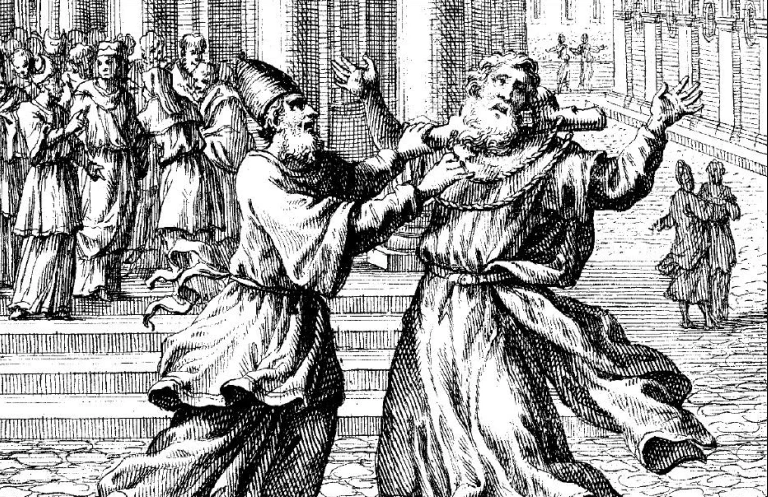
Then Hananiah the prophet took the yoke from off the prophet Jeremiah’s neck, and broke it, Jeremiah 28:10
(71) Thus shalt thou also speak to Shemaiah the Nehelamite, saying, Jeremiah 29:24
— or, Shemaiah “the dreamer” because he pretended to have dreams from the Lord; prophetic heading introducing a divine decree against a false prophet in exile;
— or because what he delivered as prophecies were mere dreams; as that the captives should quickly return to their own land; so the Targum, paraphrasing “Shemaiah, who was of Halem;” he was another of the false prophets in Babylon.
(72) “Thus saith the Lord: ‘Behold, I will bring back from captivity Jacob’s tents, and have mercy on his dwelling places; and the city shall be built upon her own heap, and the palace shall remain after the manner thereof. Jeremiah 30:18
— althought not explicitly stated here, the Targum identifies this city as Jerusalem, and the Temple rebuilt; and God will have mercy on his dwelling places; by restoring the full house of Israel or Jacob’s posterity, to their dwelling places in Jerusalem, and other places rebuilt by them and for them;
“Thus says the Lord: I will restore the captivity of Jacob’s land, and I will have compassion on his dwellings. The city of Jerusalem shall be rebuilt on its proper site, and the Temple shall be established when He sees it.”
(73) And they built the high places of Baal, which are in the Valley of the Son of Hinnom, to cause their sons and their daughters to pass through the fire unto Molech, which I commanded them not, neither came it into My mind that they should do this abomination, to cause Judah to sin. Jeremiah 32:35
— to cause their sons and their daughters to pass through the fire unto Molech: “pass through the fire” not in the original Masoretic Text, but explicitly expressed in the Targum;
“And they built the high places of Baal, which are in the Valley of the Son of Hinnom, to pass their sons and their daughters through the fire to Molech—which I did not command in My Torah, nor did it come into My will to commit this abomination, in order to make the house of Judah guilty.”
(74) ‘Call unto Me, and I will answer thee, and show thee great and mighty things, which thou knowest not.’ Jeremiah 33:3
— some versions read it, “things reserved” or “hidden things that you have not known,” as the Targum says; and so Rashi interprets it of future events, of things reserved in the heart of God;
“Pray before Me and I will accept your prayer, and I will show you great and hidden [guarded] things that you do not know.” Jonathan
— which thou knowest not; until revealed; canst be known without further revelation; that by these great and hidden things are not meant the destruction of Jerusalem, nor the seventy years’ captivity,
— nor return from that, nor things which Jeremiah had been made acquainted with time after time, and had prophesied of them; but something not revealed as yet; such great and hidden things might be “sweet as honey in the mouth but would make thy belly bitter,” Revelation 10:9-10
(75) therefore thus saith the Lord God of hosts, the God of Israel: Behold, I will bring upon Judah and upon all the inhabitants of Jerusalem all the evil that I have pronounced against them, because I have spoken unto them but they have not heard, and I have called unto them but they have not answered.’” Jeremiah 35:17
— the Targum says God “sent to them all My servants the prophets,”
“Therefore, thus says the LORD of Hosts, the God of Israel: ‘Behold, I am bringing upon the men of Judah and upon all the inhabitants of Jerusalem all the evil that I decreed against them; because I sent to them all My servants the prophets, but they did not accept [them], and they prophesied to them, but they did not return.'”
(76) Now while he had not yet gone back, he said, “Go back to Gedaliah the son of Ahikam, the son of Shaphan, whom the king of Babylon hath made governor over the cities of Judah, and dwell with him among the people; or go wheresoever it seemeth convenient unto thee to go.” So the captain of the guard gave him victuals and a reward and let him go. Jeremiah 40:5
— according to the Targum, these are the words of Nebuzaradan;
“And if you do not desire to return [with me to Babylon], then return to Gedaliah son of Ahikam, son of Shaphan, whom the king of Babylon appointed over the cities of the house of Judah, and dwell with him in the midst of the people; or to anywhere that is proper in your eyes to go—go.” And the chief executioner [Nebuzaradan] appointed for him provisions and a gift, and sent him off.
(77) And they departed and dwelt in the habitation of Chimham, which is by Bethlehem, to go to enter into Egypt, Jeremiah 41:17
— and dwelt in the habitation of Chimham, which is by Bethlehem: so called perhaps from Chimham, the son of Barzillai the Gileadite, to whom David or Solomon might give this place to dwell in, II Samuel 19:37;
“And they went and stayed in Neruth, which David had given to Chimham son of Barzillai the Gileadite, which is beside Bethlehem, intending to go to enter into Egypt.”
(78) “Take great stones in thine hand, and hide them in the clay in the brickkiln, which is at the entry of Pharaoh’s house in Tahpanhes, in the sight of the men of Judah; Jeremiah 43:9
— the palace of Pharaoh included not only the buildings proper, but their entire enclosure as well, surrounded by a high wall. Opposite the entrance of this enclosure the bricks for the building or for the repairing of the royal palace were made, and it was in the clay of this kiln among the stones that Jeremiah and others were to be hidden;
— Tahpanhes is the same with “Hanes” in Jeremiah 2:16 and Tahpanhes, Jeremiah 43:7 as the Targum calls it; it is thought to be the same with Daphnae Pelusiae; here Pharaoh had a house or palace; Jeremiah 43:9 and this is the reason that the entourage from Judah and the king’s daughters had good refuge to go for protection;
“Take with you large stones and hide them in the mortar of the building which is at the gate of Pharaoh’s house in Tahpanhes, in the sight of the Judean men.”
— Tahpanhes is the seat of the Pharaoh of Egypt where the Jewish refugee came for; Jeremiah performed this specifically before the Judean men so that when Nebuchadnezzar eventually invaded Egypt and set his pavilion over those very stones (v. 10), the surviving Judeans would remember Jeremiah’s action and recognize that the destruction was divine retribution for their reliance on Egypt rather than God.
(79) They are not humbled even unto this day, neither have they feared, nor walked in My law, nor in My statutes that I set before you and before your fathers. Jeremiah 44:10
— they are not humbled even unto this day, they had not yet learned to turn to the Lord with contrite hearts, neither have they feared nor walked in my Law nor my Statutes that I set before them and before their fathers;
— they had deliberately ignored the norm and rule which the Lord had given them to follow, and the Lord speaks of them partly in the third person to give expression to the supreme disgust which filled his heart at their behavior;
— the Targum says, “they cease not unto this day;” that is, from committing the same things; which shows they had no true humiliation and contrition for them. This is to be understood not of the Jews in Babylon only, but chiefly of those in Egypt;
“They have not ceased [their stubbornness] unto this day, and they have not feared, and they have not walked in My Law nor in My statutes which I set before you and before your fathers.”
(80) “Let not the swift flee away, nor the mighty man escape; they shall stumble and fall toward the north by the River Euphrates. Jeremiah 46:6
— let not the swift flee away, nor the mighty men escape; those that were swift of foot, or carried but light armour, let not such trust to their swiftness; nor let the mighty man think to escape by reason of his great strength, to make his way through the enemy, and get out of his hands;
— or the Targum renders as future, “The swift shall not flee, and the mighty warrior shall not escape; in the northern land, by the bank of the river Euphrates, they stumbled and fell.”
The place where this route and slaughter would be made was Carchemish (v2) which was situated by that great river Euphrates.
(81) Egypt riseth up like a flood, and his waters are moved like the rivers; and he saith, ‘I will go up, and will cover the earth; I will destroy the city and the inhabitants thereof.’ Jeremiah 46:8
— and he saith, I will go up; I, the Pharaoh king of Egypt, I will go up from my own land to the north to meet the king of Babylon: and will cover the earth with his Egyptian army: even all toward the north country, including the Babylonish empire;
— God will destroy the city, and the inhabitants thereof; which restrains to the city Carchemish, where his army was smitten: but it is better to interpret, the singular by the plural, as the Targum does, “I will destroy cities” since it was not a single city he came up to take, nor would this satisfy his ambition and temper;
“The king of Egypt, who ascends with his armies like a cloud that rises and covers the land, like springs of water whose waters churn; and he said: ‘I will ascend, I will cover the land, I will destroy cities and those who dwell in them.'”
(82) Also her hired men are in the midst of her like fatted bullocks; for they also are turned back, and have fled away together. They did not stand, because the day of their calamity had come upon them, and the time of their visitation. Jeremiah 46:21
— all her hired men are in the midst of her like fatted bullocks; or “bullocks of the stall” soldiers of other countries that were hired into the service of Egypt and lived so deliciously there, that they were unfit for war and were like fatted beasts prepared for the slaughter.
— the Targum interprets it, her princes; who had the care like fatted calves and of the feeding of this princeling; these themselves were like that, nourished for the day of slaughter.
“Even her nobles in her midst are like fatted calves; for they too turned back and fled together, they were not able to stand; for the day of their destruction has come upon them, the time of the visitation of their evil.”
(83) The voice thereof shall go like a serpent; for they shall march with an army and come against her with axes, as hewers of wood. Jeremiah 46:22
— the voice thereof shall go like a serpent; that is, the voice of Egypt as she flees away from the enemy shall be like the voice of a serpent hissing;
— like a serpent hissing impotently at the woodcutters who disturb its retreat through the thick underwood; signifying, that their voice should be low and submissive and should not speak one big or murmuring word to their conquerors;
— for the Targum; the meaning is that the Chaldeans should come with a great army, and march against the Egyptians with great strength, force and fury:
“The sound of the clashing of their weapons is like crawling reptiles; for they shall march against you in armies, and as those who enter with axes to cut down the trees of the forest.”
(84) They shall cut down her forest,” saith the Lord, “though it cannot be searched, because they are more than the grasshoppers, and are innumerable. Jeremiah 46:23
— they shall cut down her forest, saith the Lord; the land of Egypt compared to a forest for the multitude of its cities, towns and their inhabitants; which should be destroyed by the Chaldeans as a forest is cut down by hewers of wood;
— the metaphor is continued with the Targum interpreting this as the princes or nobles of Egypt and their destruction; because they are more like grasshoppers, are innumerable; which creatures come in large numbers, and eat up every green tree and herb; and so the Chaldean army, being alike numerous, would easily cut down the trees of this forest.
“Destroy her nobles, says the LORD, for they are without end; for they are more numerous than the locusts, and they have no number.”
(85) And the spoiler shall come upon every city, and no city shall escape; the valley also shall perish, and the plain shall be destroyed, as the Lord hath spoken. Jeremiah 48:8
— and the spoiler shall come upon every city; that is, Nebuchadnezzar king of Babylon and his army;
— the Targum says, the spoilers, who came against and took every city of Moab and wasted them; this being known that Nebuchadnezzar subduing the Ammonites and Moabites: and no city shall escape; the spoiler and destruction by him;
“And spoilers shall come upon all their cities, and not a city among them shall escape; and those who dwell in the valley shall perish, and those who dwell on the plain shall be destroyed, as the LORD has spoken.”
(86) For was not Israel a derision unto thee? Was he found among thieves? For since thou spokest of him, thou skipped for joy. Jeremiah 48:27
— for was not Israel a derision unto thee? in the time of his calamity when the ten tribes were carried captive by the Assyrians some years ago; and of late the two tribes of Judah and Benjamin by the Chaldeans; the Moabites rejoiced at this, which they ought not to have done;
— the Targum says, “And because you rejoiced over the destruction of Israel, though they did not sin against you, as if they were found among thieves, and because you multiplied words against them—therefore you shall be tossed into exile.”
(87) O vine of Sibmah, I will weep for thee with the weeping of Jazer; thy plants are gone over the sea, they reach even to the sea of Jazer. The spoiler is fallen upon thy summer fruits and upon thy vintage, Jeremiah 48:32
— O vine of Sibmah; Sibmah was a city in the land of Moab abounding with vines, but now should be destroyed; and Jazer another city in the same country, which was destroyed before the other; and therefore its destruction should be lamented and wept over, as that had been: or “from” or “after the weeping of Jazer,”
— the Targum says, “therefore as I have brought an army against Jazer, so I will bring slayers against Sibmah; they that carry them captive have waded; they have passed through the sea; they are come to the sea of Jazer; upon thy harvest, and upon thy vintage, the spoilers are fallen.”
(88) Therefore behold, the days come,” saith the Lord, “that I will cause an alarm of war to be heard in Rabbah of the Ammonites; and it shall be a desolate heap, and her daughters shall be burned with fire; then shall Israel be heir unto them that were his heirs,” saith the Lord. Jeremiah 49:2
“Therefore, behold, the days are coming, says the Lord, when I will cause the sound of battle to be heard against Rabbah of the children of Ammon. It shall become a desolate heap, and its villages shall be burned with fire. Then Israel shall take possession of the property of those nations who had dispossessed them, says the Lord.”
(89) Concerning Edom, thus saith the Lord of hosts: “Is wisdom no more in Teman? Is counsel perished from the prudent? Is their wisdom vanished? Jeremiah 49:7
— concerning a subtle shift from the Ammonites to Edom, thus saith the Lord of hosts; or “unto Edom;” or “against Edom” all which also true, the Idumeans, the posterity of Esau, who was called Edom; Herod the Great, an Idumean, king over Judea; was an example of the Idumean cruelty over the Jews; which could be as yet future, points at the destruction of Rome and the Romans, who with the Jews frequently go by the name of Edom;
— is wisdom no more in Teman? a city in Edom which had its name from Teman, a grandson of Esau, Genesis 36:11; whose descendants were called Temanites; one of which was Eliphaz, a friend of Job’s, Job 2:11; it was a principal city, famous for men of wisdom.
— the Targum says, “is there no more wisdom in the south?” but Rashi interprets it as Edom, which lay south to the land of Israel; “And your south side shall be from the desert of Zin close by the side of Edom” (Numbers 34:3).
— one other theory is that the Ottoman Turks (or today’s Turkey) are the sons of Teman. Perhaps, from Chief Teman, they could be another branch of the numerous sons or grandson of Esau.
“To Edom, thus says the LORD of Hosts: Is there no longer wisdom in the South? Has counsel ceased from the children? Has their wisdom spoiled?”
(90) “Thus saith the Lord of hosts: “‘Behold, I will break the bow of Elam, the chief of their might. Jeremiah 49:35
— thus saith the Lord of hosts, I will break the bow of Elam; Persia; the inhabitants of this country were famous for their skill in archery; this the Lord threatens to break so that it should be useless and of no more service to them to defend themselves or annoy others;
— their strength, as the Targum says; “Thus says the LORD of Hosts: Behold, I am breaking the strength of Elam, the chief of their might.”
(91) And I will set My throne in Elam, and will destroy from thence the king and the princes,’ saith the Lord. Jeremiah 49:38
— my throne in Elam; this is a throne belonging to God, because God gave it to him; his dominian over Elam, and Elam’s authority over it, were from God;
— the best explanation is best understood to be Cyrus, the Lord’s servant and anointed; whose throne might well be a throne given by God. Exploring this concept further, everything on earth belongs to God, everything that are even of God’s enemies, in heaven or on the earth, are God’s;
— the Targum of Jonathan says “And I will set the throne of My kingdom in Elam, and I will destroy from there [their] king and princes, says the Lord.”
(92) “‘But it shall come to pass in the latter days, that I will bring back the captives of Elam,’ saith the Lord.” Jeremiah 49:39
— though that is observed in the first year of his reign, some have thought that it is best to understand it or Cyrus, the Lord’s servant and anointed;
— and whose throne might well be called the throne of God, which he gave him, and set him on in an eminent manner, not only there, but even everywhere;
— the Targum of Jonathan says “And it shall be at the end of days, I will bring back the exile (captives) of Elam, says the Lord.”
(93) I have laid a snare for thee, and thou art also taken, O Babylon, and thou wast not aware; thou art found and also caught, because thou hast striven against the Lord. Jeremiah 50:24
— God have laid a snare for them, and O Babylon shall be taken, retorting to the strategy that Cyrus used, in draining the river Euphrates, and marching his army up through it into the midst of the city of Babylon and took it by surprise while the inhabitants were feasting and revelling all night;
— for one part of the city was seized and taken before the other knew anything of it; thou art found, and also caught; as wild beasts in a net or birds in a snare. The Targum reaffirms this, “A snare was laid for you, and you were also taken, O Babylon, and you did not know; your sins were sought out and found, and you were also caught, because you provoked strife against the people of the LORD.”
(94) A sword is upon the liars, and they shall dote! A sword is upon her mighty men, and they shall be dismayed! Jeremiah 50:36
— a sword is upon their liars; the Targum renders it “Those who kill with the sword shall come against her diviners, and they shall be confounded; those who kill with the sword shall come against her mighty men, and they shall be broken.”
(95) The violence done to me and to my flesh be upon Babylon,” shall the inhabitant of Zion say; “and my blood upon the inhabitants of Chaldea!” shall Jerusalem say. Jeremiah 51:35
— the violence done to me, and to my flesh, be upon Babylon; that is, let the injuries done to Zion and her children, be avenged on Babylon;
— the Targum says, “‘The violence done to me and my spoil be upon Babylon,’ the Assembly of Zion shall say; ‘and the guilt of the innocent blood shed in me be upon the inhabitants of the land of the Chaldeans,’ Jerusalem shall say.”
(96) “How Sheshach is taken! And how the praise of the whole earth is surprised! How Babylon has become an astonishment among the nations! Jeremiah 51:41
— how is Sheshach taken! Not the city Shushan but Babylon as is plain from a following clause; and so the Targum says, “How Babylon is conquered, and the praise of all the earth is seized! How Babylon has become a desolation among the nations!”
(97) Though Babylon should mount up to heaven, and though she should fortify the height of her strength, yet from Me shall despoilers come unto her,” saith the Lord. Jeremiah 51:53
— though Babylon should mount up to heaven; could their walls, which were very high, two hundred cubits high, as Herodotus says, be carried up as high as heaven; or their towers, which were exceeding high,
— the Targum says, “Even though Babylon should build buildings as high as the top of heaven, and even though she should fortify strong fortresses up to the height, from before Me plunderers shall come upon her, says the LORD.” Yet from me shall spoilers come, saith the Lord; the Medes and Persians.
~ Come to my parlour ~ the spider says to the butterfly: “Hear, ye deaf; and look, ye blind, that ye may see.”
"Who is blind, but My servant? Or deaf, as My messenger that I sent? Who is blind as he that is perfect, and blind as the Lord’s servant?” Isaiah 42:18-19
"Where two sit together to study the Torah, the Shekinah rests between them."
“Cry aloud, spare not; lift up thy voice like a trumpet! And show My people their transgression and the house of Jacob their sins" Isaiah 58:1
“Son of man, I have made thee a watchman unto the house of Israel; therefore hear the word out of My mouth, and give them warning from Me.
18 When I say unto the wicked, ‘Thou shalt surely die,’ and thou givest him not warning, nor speakest to warn the wicked from his wicked way to save his life, the same wicked man shall die in his iniquity; but his blood will I require at thine hand.
19 Yet if thou warn the wicked, and he turn not from his wickedness nor from his wicked way, he shall die in his iniquity; but thou hast delivered thy soul" Ezekiel 3:17-19
Now, consider this PROPHECY:
“And upon thy sword shalt thou depend, entering at every place: yet thou shalt be supple and credulous, and be in subjection to thy brother [Jacob]; but it will be that when his sons [the children of Israel] become evil, and fall from keeping the commandments of the law, thou shalt break his yoke of servitude from off thy neck…. and then will I kill Jakob my brother,” Genesis 27:41-42 the Targum of Jonathan
“Speak thou also unto the children of Israel, saying, ‘Verily My Sabbaths ye shall keep; for it is a sign between Me and you throughout your generations, that ye may know that I am the Lord who doth sanctify you'" Exodus 31:13
Archives
Words of Great Insight
ISRAEL, today as in the past, has many BLIND shepherd, for it was prophesied:
“His watchmen are BLIND; they are all ignorant; they are all DUMB dogs, they cannot bark, sleeping, lying down, loving to slumber” Isaiah 56:10
The mission here is to provide research ARTICLES that are ENLIGHTENING and EASY TO UNDERSTAND using SCRIPTURES to help improve our knowledge and make our life better.
“I have seen a horrible thing in the house of ISRAEL; there is the whoredom of EPHRAIM, Israel is defiled” Hosea 6:10
“Shall a TRUMPET be blown in the city, and the people not be afraid? Shall there be evil in a city, and the LORD hath not done it?” Amos 3:6
“Hear, ye DEAF; and look, ye BLIND, that ye may see” Isaiah 42:18
Hence the RESEARCH produced here are to help us UNDERSTAND and hopefully WE all could learn together.