
Judges (7-8)
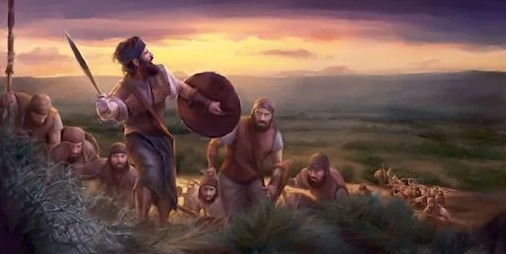
How should one chase a thousand, and two put ten thousand to flight, unless their Rock had sold them, and the Lord had shut them up? Deuteronomy 32:30
Judges 7
1 Then Jerubbaal (who is Gideon) and all the people who were with him, rose up early and pitched camp beside the well of Harod, so that the host of the Midianites were on the north side of them by the hill of Moreh in the valley.
— Gideon with two and thirty thousand men encamps against the Midianites; they, by God’s command and token, are lessened to three hundred, Judges 7:1-8.
2 And the Lord said unto Gideon, “The people who are with thee are too many for Me to give the Midianites into their hands, lest Israel vaunt themselves against Me, saying, ‘Mine own hand hath saved me.’
— the confederate of Midianites were 135,000 in number (Judges 8:10), but Gideon’s forces only 32,000 (Judges 7:4).
3 Now therefore go, proclaim in the ears of the people, saying, ‘Whosoever is fearful and afraid, let him return and depart early from Mount Gilead.’” And there returned of the people twenty and two thousand, and there remained ten thousand.
— “mount Gilead” was a rallying-cry of the Manassites in general, for Gilead was a son of Abiezer; the name “Gilead” of the trans-Jordanic district fell to the half-tribe of Manasseh (Joshua 17:5-6);
— and there returned of the people 22,000, and there remained only 10,000.
4 And the Lord said unto Gideon, “The people are yet too many. Bring them down unto the water, and I will try them for thee there. And it shall be that of whom I say unto thee, ‘This shall go with thee,’ the same shall go with thee; and of whomsoever I say unto thee, ‘This shall not go with thee,’ the same shall not go.”
— I will try them, that is, “I will purge them,” as gold from dross, and this is the literal sense of the word (Isaiah 1:25; Isaiah 48:10); to purge the wicked from the righteous, suppose that to those who bowed on their knees to drink, were such as had been used to bow the knee to Baal, and the rest not.
5 So he brought down the people unto the water; and the Lord said unto Gideon, “Every one that lappeth of the water with his tongue as a dog lappeth, him shalt thou set by himself; likewise every one that boweth down upon his knees to drink.”
— so he brought them down to the water; his whole army of 10,000 men.
6 And the number of those who lapped, putting their hand to their mouth, was three hundred men; but all the rest of the people bowed down upon their knees to drink water.
— that lapped, putting their hand to their mouth; literally, licked with their hand to their mouth.
7 And the Lord said unto Gideon, “By the three hundred men who lapped will I save you and deliver the Midianites into thine hand, and let all the other people go every man unto his place.”
— God provides that the praise of victory may be wholly to himself, by appointing only three hundred men to be employed.
8 So the people took victuals in their hand, and their trumpets; and he sent all the rest of Israel every man unto his tent, and retained those three hundred men. And the host of Midian was beneath him in the valley.
— and they (the 300) took the provisions and trumpets of the people (the 9,700) in their hands, so that it would be the desire of all that the brave 300 should be well supplied.
9 And it came to pass the same night that the Lord said unto him, “Arise, get thee down unto the host, for I have delivered it into thine hand.
— and it came to pass the same night that the Lord said to Gideon; the night after there had been so great a reduction of his army, from 32,000 to three hundred; that’s less than one percent. When WCG was at it heights, there were probably 150,000 attending during the feast, with about 100,000 as members; at one percent would bring it down to around a thousand today.
10 But if thou fear to go down, go thou with Purah thy servant down to the host,
— Phurah thy servant; the name Phurah means “branch,” the word for “servant” is literally boy, but here means the armour-bearer.
11 and thou shalt hear what they say; and afterward shall thine hands be strengthened to go down unto the host.” Then went he down with Purah his servant unto the outside of the armed men who were in the host.
— “unto the host,” that is, unto the camp, the camp of the confederate headed by the Midianites of 135,000 strong:
and you shall hear what they are saying, and afterward your hand shall be strengthened, and you shall go down against the camp.” And he went down, he and Purah his servant, to the side of the armed men who were in the camp. Jonathan
12 And the Midianites and the Amalekites and all the children of the East lay along in the valley like grasshoppers for multitude; and their camels were without number, as the sand by the seaside for multitude.
— like grasshoppers; the confederate headed by Midianites and the Amalekites; lay along in the valley like grasshoppers for multitude, and their camels without number.
13 And when Gideon had come, behold, there was a man who told a dream unto his fellow, and said, “Behold, I dreamed a dream; and lo, a cake of barley bread tumbled into the host of Midian and came unto a tent, and smote it so that it fell, and overturned it so that the tent lay flat.”
— a man who told a dream: I dreamed a dream, and, lo, a cake of barley bread tumbled into the host of Midian; this was a characteristic and very expressive dream from an unknown in the circumstances.
14 And his fellow answered and said, “This is nothing else save the sword of Gideon the son of Joash, a man of Israel, for into his hand hath God delivered Midian and all the host.”
— the dream seemed to have a subtle meaning in it; the interpretation evidently proved to be from the Lord, and to re-enforce that the name of Gideon would fill the Midianites with terror.
15 And it was so, when Gideon heard the telling of the dream and the interpretation thereof, that he worshiped, and returned into the host of Israel and said, “Arise, for the Lord hath delivered into your hand the host of Midian.”
— when Gideon heard, he worshipped, praising God for this special encouragement, then he divided the men into three companies.
16 And he divided the three hundred men into three companies, and he put a trumpet in every man’s hand, with empty pitchers and lamps within the pitchers.
—a trumpet; hearing the sound of three hundred rams’ horns, the Midianites would naturally suppose that they were being attacked by three hundred thousand companies; against the 135,000 grasshoppers;
And five of you shall chase a hundred, and a hundred of you shall put ten thousand to flight; and your enemies shall fall before you by the sword. Leviticus 26:8
How should one chase a thousand, and two put ten thousand to flight, unless their Rock had sold them, and the Lord had shut them up? Deuteronomy 32:30
17 And he said unto them, “Look on me and do likewise; and behold, when I come to the outside of the camp, it shall be that as I do, so shall ye do.
— look on me; he showed all the three hundred the way in which, at a given signal, to break the pitchers, wave the torches, and shout. The signal would be given to the one hundred whom he himself headed.
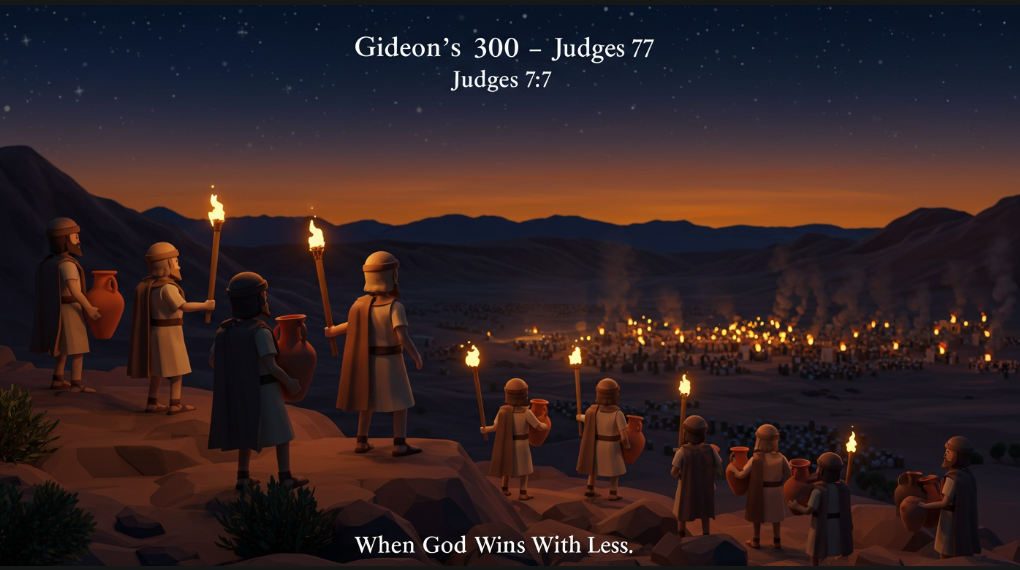
18 When I blow with a trumpet, I and all that are with me, then blow ye the trumpets also on every side of all the camp and say, ‘The sword of the Lord and of Gideon!’”
— he mentions his own name, together with God’s, not out of vain ostentation or arrogance; for he mentions God in the first and himself only as his servant; also, because his name was grown formidable to them, and so was likely to cause terror in their flight, as it did.
19 So Gideon and the hundred men who were with him came unto the outside of the camp in the beginning of the middle watch, and they had but newly set the watch; and they blew the trumpets and broke the pitchers that were in their hands.
— the middle watch; the Jews anciently divided the night, from sunset to sun rise into three watches (Exodus 14:24; 1Samuel 11:11); at the beginning of the middle watch, that is, soon after 10 at night; which would be the time at which the host would be deep in their first sleep
— but during NT times, the subsequent division were into four watches of three hours each (Matthew 14:25; Mark 6:48).
20 And the three companies blew the trumpets and broke the pitchers, and held the lamps in their left hands and the trumpets in their right hands to blow therewith, and they cried, “The sword of the Lord and of Gideon!”
— the trumpets in their right hands; thus they were comparatively defenceless, though, if they had any armour at all, doubtless they could still hold the lamp on the left arm, while the sword, if any, could be girded on the thigh.
21 And they stood every man in his place round about the camp, and all the host ran and cried and fled.
— and they stood every man in his place round about the camp; but the confederate saw them as three hundred thousand companies.
22 And the three hundred blew the trumpets; and the Lord set every man’s sword against his fellow, even throughout all the host; and the host fled to Bethshittah towards Zererah and to the border of Abelmeholah unto Tabbath.
— so confused and confounded that the confederate ran, cried and fled, “every man’s sword against his fellow.”
23 And the men of Israel gathered themselves together out of Naphtali and out of Asher and out of all Manasseh, and pursued after the Midianites.
— out of Naphtali; undoubedly, some of these pursuers were some of those who had left Gideon’s camp before the victory; those of Naphtali and Asher and out of all Manasseh; would pursue the fleeing Midianites eastward.
24 And Gideon sent messengers throughout all Mount Ephraim, saying, “Come down against the Midianites, and take before them the waters unto Bethbarah and the Jordan.” Then all the men of Ephraim gathered themselves together, and took the waters unto Bethbarah and the Jordan.
— throughout all mount Ephraim; Gideon had not ventured to summon these haughty, yet withdrawn clansmen before his victory was assured.
25 And they took two princes of the Midianites, Oreb and Zeeb; and they slew Oreb upon the rock of Oreb, and Zeeb they slew at the wine press of Zeeb, and pursued Midian, and brought the heads of Oreb and Zeeb to Gideon on the other side of the Jordan.
— “they pursued Midian,” to which the Ephraimites continued the pursuit of the Midianites on the east of the Jordan and after slaying these princes there; they then brought back their heads to Gideon when they regathered in the west side of the Jordan.
Judges 8
1 And the men of Ephraim said unto him, “Why hast thou served us thus, that thou called us not when thou wentest to fight with the Midianites?” And they chided him sharply.
— the men of Ephraim; the arrogance of this tribe was derived partly from its strength, and partly from the memories of their ancestor Joseph; from the fact that Jacob, in his blessing, had preferred the younger Ephraim before his elder brother, Manasseh;
— and now, from the double portion which Joseph had received in memorial of his pre-eminence; his elder son, Manasseh, has taken the mantle, taking the lead; of which tribe Gideon was, who, by this act, had seemed to advance his own tribe, and to depress those of Ephraim.
— and the men of Ephraim said unto Gideon; why hast thou neglected us, overlooked us, which they took as a reproach to them, as if he had bore them ill will; that he did not call them first, when he called other tribes, as Asher, Zebulun, and Naphtali?
2 And he said unto them, “What have I done now in comparison with you? Is not the gleaning of the grapes of Ephraim better than the vintage of Abiezer? — Abiezer; the family of Abiezer, from which Gideon was from;
— is not the gleaning; here it implies that Ephraim, by a mere subsequent and secondary effort, would have achieved more as yet than Gideon himself had done, for there can be no doubt that the Ephraimites had wrought at such a splendid victory without them;
And he said to them, “What have I done now in comparison with you? Are not the weak ones of the house of Ephraim better than the strong ones of the house of Abiezer? Jonathen
3 God hath delivered into your hands the princes of Midian, Oreb and Zeeb. And what was I able to do in comparison with you?” Then their anger was abated toward him when he had said that.
— Gideon therefore soothes their wounded pride by confessing that Ephraim could have done more, though they had joined him so late in the day, than he had been able to effect in the whole campaign.
4 And Gideon came to the Jordan and passed over, he and the three hundred men who were with him, faint, yet pursuing them.
— and passed over; passing over; as it may be regarded that Succoth was east of Jordan; and yet, though they were so faint, they were still eagerly pursuing them.
5 And he said unto the men of Succoth, “Give, I pray you, loaves of bread unto the people who follow me, for they are faint, and I am pursuing after Zebah and Zalmunna, kings of Midian.”
— and Gideon asked for bread from those in Succoth; which was in the tribe of Gad, allied to the eastern Manasseh, which was entirely east of the Jordan, Joshua 13:27-28; and the ruins are at Sukkot, on the east of Jordan.
6 And the princes of Succoth said, “Are the hands of Zebah and Zalmunna now in thine hand, that we should give bread unto thine army?”
— the number of the followers of Zebah and Zalmunna was still so formidable, and Gideon’s venture was still so doubtful, that the men of Succoth (being on the same side of the Jordan) would not risk the vengeance of the Midianites by giving supplies to Gideon’s men.
7 And Gideon said, “Therefore when the Lord hath delivered Zebah and Zalmunna into mine hand, then I will tear your flesh with the thorns of the wilderness and with briers.”
— and Gideon said; note in this verse the mixture of heroic faith and barbarous ruthlessness in his approach of the punishment which he threatened to inflict.
8 And he went up thence to Penuel and spoke unto them likewise, and the men of Penuel answered him as the men of Succoth had answered him.
— Gideon also went up thence to Penuel.; which was also in the tribe of Gad.
9 And he spoke also unto the men of Penuel, saying, “When I come again in peace, I will break down this tower.”
— Gideon threatened to break down a tower; pointing to one which stood in their city, and in which they placed their confidence; and when he threatened them, boasted of it as their security.
10 Now Zebah and Zalmunna were in Karkor, and their hosts with them, about fifteen thousand men, all that were left of all the hosts of the children of the East; for there fell a hundred and twenty thousand men who drew the sword.
— Zebah and Zalmunna were in Karkor, a town on the eastern confines of Gad.
11 And Gideon went up by the way of those who dwelt in tents on the east of Nobah and Jogbehah, and smote the host; for the host was secure.
— on the east of Nobah and Jogbehah; the first was in the tribe of Manasseh, and the latter in the tribe of Gad, and both it seems were on the confines of those eastern tribes.
12 And when Zebah and Zalmunna fled, he pursued after them and took the two kings of Midian, Zebah and Zalmunna, and discomfited all the host.
— he pursued after them, and took the two kings of Midian, Zebah and Zalmunna, and discomfited all the host; or terrified them, so that they fled some one way and some another, and the kings being left alone were easily taken.
13 And Gideon the son of Joash returned from battle before the sun was up.
— before the sun was up; the rendering is certain, it would prove that he had made a night attack on the camp at Karkor.
14 and caught a young man of the men of Succoth and inquired of him; and he wrote down for him the princes of Succoth and the elders thereof, even threescore and seventeen men.
— threescore and seventeen; 77, perhaps a sort of their Sanhedrin of Seventy (Numbers 11:16), with their presiding sheykhs.
15 And he came unto the men of Succoth and said, “Behold Zebah and Zalmunna, with whom ye did upbraid me, saying, ‘Are the hands of Zebah and Zalmunna now in thine hand, that we should give bread unto thy men who are weary?’”
— the two kings of Midian, Zebah and Zalmunna,
— that are weary; the addition of these words enhances the guilt of these elders, though the exhaustion of Gideon’s force may have seemed to them a reason for alarm, lest their pursuit should end in rout.
16 And he took the elders of the city and thorns of the wilderness and briers, and with them he taught the men of Succoth.
— with them as example, Gideon taught the men of Succoth, which was in the tribe of Gad, that he made their death an example to the rest of the inhabitants, to terrify them from such ungenerous behaviour for the future.
17 And he beat down the tower of Penuel, and slew the men of the city.
— the tower of Penuel; a territory of Ephraim, the importance of the place led to its re-fortification by Jeroboam (1Kings 12:25);
Then Jeroboam built Shechem in Mount Ephraim and dwelt therein, and went out from thence and built Penuel. 1Kings 12:25
18 Then said he unto Zebah and Zalmunna, “What manner of men were they whom ye slew at Tabor?” And they answered, “As thou art, so were they; each one resembled the children of a king.”
— Zebah and Zalmunna, they were the two kings of the Midianites, on the eastern confines of Gad. Gideon killed their warriors, and beat down their towers, but still haven’t killed their kings; but perhaps brought back to his own city Ophrah:
— they had been kept alive in order to answer the cowardly taunt of the elders of Succoth. Perhaps Gideon reserved their death for the place where he had once lived with his brothers, whom they had slain.
19 And he said, “They were my brethren, even the sons of my mother. As the Lord liveth, if ye had saved them alive, I would not slay you.”
— the sons of my mother; we learn that these kings had put the brothers of Gideon to death, and apparently not in open fight; but they had murdered them in an unrighteous and cruel manner.
20 And he said unto Jether his firstborn, “Up, and slay them.” But the youth drew not his sword; for he feared, because he was yet a youth.
— he said unto Jether, Up, and slay them; this he said to animate his son to the use of arms for God and country, and that he might have a share in the honour of the victory.
21 Then Zebah and Zalmunna said, “Rise thou, and fall upon us; for as the man is, so is his strength.” And Gideon arose and slew Zebah and Zalmunna, and took away the ornaments that were on their camels’ necks.
— thereupon Gideon slew them, and took the little moons upon the necks of their camels as booty; the little moons” were crescent-shaped ornaments of silver or gold, such as men and women wore upon their necks.
22 Then the men of Israel said unto Gideon, “Rule thou over us, both thou and thy son and thy son’s son also; for thou hast delivered us from the hand of Midian.”
— rule thou over us; not as a judge, for as such he already ruled over them, but as a king; both thou and thy son, and let the kingdom be hereditary to thee and to thy family.
23 And Gideon said unto them, “I will not rule over you, neither shall my son rule over you: the Lord shall rule over you.”
— the Lord shall rule over you; as a king, their government was a theocracy; hence he rejected their offer, because he looked upon God as their king, who appointed what deputy he pleased to govern them; that God was their supreme Ruler and King.
24 And Gideon said unto them, “I would make a request of you, that ye would give me every man the earrings from his spoil.” (For they had golden earrings, because they were Ishmaelites.)
— the earrings of his prey, means a ring which, sometimes at least, was worn, especially by women, in the nose (Genesis 24:47; Isaiah 3:21; Ezekiel 16:12; Job 42:11). In the absence of any regular currency, these gold rings served as a sort of coinage;
— because a mixture of people all called by one general name, Ishmaelites; hence these “Ishmaelites” or Arabians and “Midianites” occur as convertible terms in Genesis 37:28.
And the Midianite men, masters of business, passed by; and they drew and brought up Joseph out of the pit, and sold Joseph to the Arabians for twenty mahin of silver; and they bought sandals of them. And they brought Joseph to Mizraim. Genesis 37:28 Jonathan
25 And they answered, “We will willingly give them.” And they spread a garment, and cast therein every man the earrings from his spoil.
— Gideon thought to keep up the remembrance of this victory by an ephod, made of the choicest of the spoils; probably this ephod had, as usual, a teraphim annexed to it, and Gideon intended this for an oracle to be consulted.
26 And the weight of the golden earrings that he requested was a thousand and seven hundred shekels of gold, besides ornaments and collars and purple raiment that were on the kings of Midian, and besides the chains that were about their camels’ necks.
— many are led into false ways by one false step even of a good intention, it became a snare to Gideon himself, and it proved the ruin of the family.
27 And Gideon made an ephod thereof and put it in his city, even in Ophrah. And all Israel went thither a whoring after it, which thing became a snare unto Gideon and to his house.
— put an ephod in his city, even in Ophrah; this gives us a clue to Gideon’s motive. Shiloh, the national sanctuary, was in the precincts of the fierce tribe of Ephraim, and Gideon may have been as anxious as Jeroboam afterwards was to keep some direct hold on the nation’s worship, as one of the secrets of political power;
— all Israel went whoring; committed idolatry with it; or went thither to inquire the will of God, whereby they were drawn from the true ephod in Shiloh, instituted by God for this end, when they could inquired of God by Urim and Thummim, which was to be worn by the high-priest only.
28 Thus was Midian subdued before the children of Israel, so that they lifted up their heads no more. And the country was in quietness forty years in the days of Gideon.
— Midian maybe subdued for forty years; but Israel sinned within as these ornaments feed into the lust of their eye, and form the pride of life for those living in Ophrah, with an alternate ephod as well as tend to the indulgences of the flesh, bring shame on those who became a snare to it!
29 And Jerubbaal the son of Joash went and dwelt in his own house.
— Jerubbaal; the sudden reversion to this name may be significant; as Baal had failed to “plead,” but nevertheless Gideon was not safe from idolatrous tendencies; his relations with the tribe of Ephraim probably made him unwilling to resort to Shiloh;
— it seems that Gideon being now the civil ruler, desired to have an ephod of his own, kept in his own city, Ophrah, to he worn by the priest whenever Gideon might summon it to inquire of the Lord for him.
30 And Gideon had threescore and ten sons of his body begotten, for he had many wives.
— the phrase “of his body begotten” or “that went out of his thigh” is used to show that they were his own sons.
31 And his concubine who was in Shechem also bore him a son, whose name he called Abimelech.
— his concubine that was in Shechem; Abimelech’s mother was not reckoned among the wives, being, probably, one of the Canaanite population in Shechem Judges 9:28 : neither was Abimelech himself reckoned with the 70 other sons of Jerubbaal (Judges 9:24. Compare Judges 11:1-2).
32 And Gideon the son of Joash died at a good old age, and was buried in the sepulcher of Joash his father in Ophrah of the Abiezrites.
— and Gideon died; Gideon died in peace and prosperity; in a good old age but the evil seed which he had sown bore bitter fruit in the next generation; and was buried in the sepulchre of Joash his father, in Ophrah of the Abiezrites; a city which belonged to the family of the Abiezrites, who were of the tribe of Manasseh.
33 And it came to pass, as soon as Gideon was dead, that the children of Israel turned again and went a whoring after the Baalim, and made Baalberith their god.
— made Baal-berith their god; Baal-berith means “Lord of the covenant,” a counterfeit; the Hebrew bears the meaning given it by some of the versions: “They made a covenant with Baal that he should be their god”
And it was, when Gideon died, that the children of Israel turned back and strayed after the Baalim, and they made for themselves Baal-berith into an idol. Jonathan
34 And the children of Israel remembered not the Lord their God, who had delivered them out of the hands of all their enemies on every side;
— during Gideon’s life time, there were no record of any separate high-priest in operation; and as soon as Gideon was dead; they went after Baalim, and showed no kindness to the family of Gideon;
35 neither showed they kindness to the house of Jerubbaal (namely, Gideon), according to all the goodness which he had shown unto Israel.
— but, on the contrary, great unkindness and cruelty, slaying his seventy sons, as related in the following chapter.


