
Infiltration of the Samaritans
The Samaritans came to inhabit the northern kingdom of Israel after the Assyrian conquest in 721 BC. When the Israelites were exiled to Assyria, the Assyrian kings brought in people from other parts of their empire to settle in the land left vacant by the northern kingdom’s former inhabitants.
“For the children of Israel walked in all the sins of Jeroboam which he did; they departed not from them,
“until the Lord removed Israel out of His sight, as He had said by all His servants the prophets. So was Israel carried away out of their own land to Assyria unto this day.
“And the king of Assyria brought men from Babylon, and from Cuthah, and from Ava, and from Hamath, and from Sepharvaim, and placed them in the cities of Samaria instead of the children of Israel; and they possessed Samaria and dwelt in the cities thereof” II Kings 17:22-24
The Samaritans, a group of pagan foreigners already considered spiritually corrupt, created their own religion, which the Jews saw as heretical. This came about after lions started attacking and killing some of the new settlers.
They turned to the king of Assyria for help, and he commanded that one of the priests, who happened to be of the lowest-ranked, who had been taken away, be returned to teach the new settlers how to live.
They built a temple on Mount Gerizim as their central place of worship, convinced it was the location Moses had originally chosen for the Israelites to gather and honor God.
“So they feared the Lord, and made unto themselves from the lowest of them priests of the high places, who sacrificed for them in the houses of the high places.
“They feared the Lord, but served their own gods, after the manner of the nations who carried them away from thence” II Kings 17:32-33
The Samaritans developed their own distinct version of the five books of Moses, known as the Pentateuch, while rejecting the writings of the prophets and Jewish traditions. They claimed themselves as the true descendants of Israel and guardians of the original faith, viewing the Jerusalem temple and the Levitical priesthood as illegitimate.
When the Jews returned to rebuild Jerusalem, they faced opposition from the Samaritans, which fueled further resentment as the two groups settled in the land in opposition to each other.
The Samaritan infiltration had a big impact on the Jewish communities after their return from Babylon. To the Jews, these infiltrations were considered even more threatening than their idols; they were seen as half-breeds who had nefariously corrupted their true faith.
Nehemiah was deeply disappointed, especially since some members of the priesthood, who were close and trusted friends, had been bribed to join the Samaritan plot to take his life in the Sanctuary and later enforce the Samaritan style of worship on the returning Jews.
As recorded in Nehemiah 13, Nehemiah finds out that one of the grandsons of the high priest Eliashib had married Sanballat’s daughter, making him the son-in-law of Nehemiah’s greatest enemy.
Nehemiah discovered that Eliashib had rented out the Temple’s storerooms to Tobiah, cutting off the Levites from their tithes. As a result, Eliashib was expelled from Jerusalem for dishonoring the priesthood.
“And one of the sons of Joiada, the son of Eliashib the high priest, was son-in-law to Sanballat the Horonite; therefore I chased him from me” Nehemiah 13:28
Upon finding out their scheme, Nehemiah pleaded with God, saying
“He (name not given, but a son of a priest of the house of Shemaiah; to be an agent of Tobiah and Sanballat) had been hired to make me afraid so I would sin by doing what he suggested. Then they could create a slanderous report to use against me,” Nehemiah 6:13
“Remember, O my God, don’t forget all the evil of Tobiah, Sanballat, Noadiah the prophetess and the rest of the prophets, who were trying to intimidate me,” Nehemiah 6:14
He, along with those from the house of Shemaiah and others forming “a multitude,” according to the Septuagint, were hired against Nehemiah to frighten and intimidate him.
So, how did these enemies plot and scheme against Nehemiah? Later, Ezra were to face the same challenges.
Nehemiah and Ezra and their enemies

(1) Sanballet: a Samarian leader, perhaps a Governor
He was also called “the Horonite,” and was associated with Tobiah the Ammonite and Geshem the Arabian (Nehemiah 2:19; 4:7). But his home was evidently at Samaria, from wherever “Horon” he may have came from.
Sanballat was the chief opponents when Nehemiah was building the walls of Jerusalem and carrying out other reforms among the Jewish community, while at the same time, they were facing a league of enemies from the Samaritans, the Ammonites, and the Arabs.
“When Sanballat the Horonite, and Tobiah the servant, the Ammonite, heard of it, it grieved them exceedingly that there was come a man to seek the welfare of the children of Israel” Nehemiah 2:10.
When Nehemiah disclosed his intention of building the walls of Jerusalem they laughed him to scorn, and mocked at him, “Will ye rebel against the king?”
“But when Sanballat the Horonite, and Tobiah the servant, the Ammonite, and Geshem the Arabian, heard it, they laughed us to scorn, and despised us, and said, What is this thing that ye do? will ye rebel against the king?” Nehemiah 2:19.
Nehemiah resented their insinuation, and gave them to understand that they had no right in Jerusalem, nor any interest in its affairs. As soon as Sanballat and his associates heard that Nehemiah and the Jews were actually building the walls, they were angry:
“But it came to pass, that when Sanballat heard that we builded the wall, he was wroth, and took great indignation, and mocked the Jews.
“And he spoke before his brethren and the army of Samaria, and said, What do these feeble Jews? Will they fortify themselves? Will they make sacrifice? Will they finish it in a day? Will they revive the stones out of the heaps of the rubbish which are burned?
“Now Tobiah the Ammonite was by him, and he said, ‘Even that which they build, if a fox goes up, he shall even break down their stone wall'” Nehemiah 4:1-3
And Sanballat addressed the army of Samaria with a contemptuous reference to “these feeble Jews.” Tobiah appeased him by saying that a jackal climbing on the wall they were building would break it down.
While Nehemiah and his builders, the Jews, vigorously hurried the work, Sanballat and his associates were organizing their forces to fight against Jerusalem (Nehemiah 4:8).
Nehemiah stayed focused on rebuilding the walls despite Sanballat and his allies challenging him and the Jews at five different times to meet for battle in the plain of Ono. But Nehemiah firmly refused each time, determined not to fall into their traps. (Nehemiah 6:1-7).
(2) Tobiah, who was an Ammonite
Tobiah was an Ammonite who had infiltrated into the house of Judah and the Temple in Jerusalem. This was obviously a violation of the Lord’s command:
“An Ammonite or Moabite shall not enter into the congregation of the Lord; even to their tenth generation shall they not enter into the congregation of the Lord for ever” Deuteronomy 23:3.
Eliashib the high priest, had nefariously allowed Tobiah, an Ammonite, into the Temple – Nehemiah 13:4-9
4 And before this, Eliashib the priest, having the oversight of the chamber of the house of our God, was allied unto Tobiah.
5 And he had prepared for him a great chamber, where previously they laid the meat offerings, the frankincense and the vessels and the tithes of the corn, the new wine and the oil, which were commanded to be given to the Levites and the singers and the gatekeepers, and the offerings of the priests.
6 But in all this time I was not at Jerusalem; for in the two and thirtieth year of Artaxerxes king of Babylon I came unto the king, and after certain days I obtained leave from the king.
7 And I came to Jerusalem and learned of the evil that Eliashib had done for Tobiah in preparing him a chamber in the courts of the house of God.
8 And it grieved me sore; therefore I cast forth all the household stuff of Tobiah out of the chamber.
9 Then I commanded, and they cleansed the chambers; and thither I brought back the vessels of the house of God, with the meat offering and the frankincense. Nehemiah 13:4-9
There are four things mentioned in particular that show the backsliding of the returning Jews: (a) the presence of Tobiah, an Ammonite, into the courts of the Temple; (b) the failure to provide adequately for the Levites; (c) the desecration of the Sabbath; and (d) the return of mixed marriages with unbelievers.
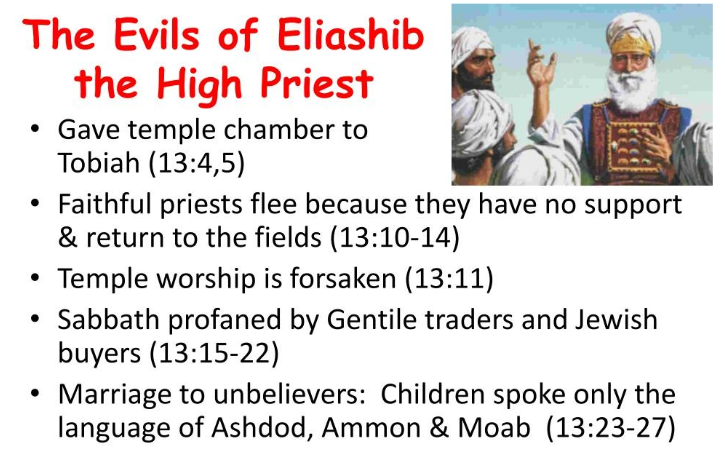
When Nehemiah came back to Jerusalem he saw something that must have both grieved and angered him. He found that the priest Eliashib had entered into an agreement with one of the men who had been at the forefront of the opposition to the wall rebuilding.
Not only was Tobiah personally a proven enemy of the people of God, he was an Ammonite, a part of the ‘mixed multitude’ put out of the Temple years before.
In Nehemiah 6, Tobiah was exerting his influence from the outside, and maintaining contact with some of the nobles within by letter. But now he was right inside! It is not at all surprising that Nehemiah was outraged!
(a) The Temple rooms that Tobiah was occupying were supposed to be used for the storage of tithes and offerings for the priests and for the service of God’s sanctuary. It was unthinkable that rooms set apart for a holy purpose should be used by a pagan opponent of the work of God.
(b) Eliashib, son of Joiakim (Nehemiah 12:10); he had failed as the spiritual leader of the people and had neglected to maintain the purity of the house of God. He had not recognised the danger of having an alliance with such a man. Possibly Eliashib thought the regulations for ‘separation’ and ‘no mixing’ were far too strict and uncharitable, and they ignore God’s commands at his peril!
(c) “And one of the sons of Joiada, the son of Eliashib the high priest, was son-in-law to Sanballat the Horonite [governor of Samaria]; and I chased him from me. Remember them, O my God, because they have defiled the priesthood, and the covenant of the priesthood, and of the Levites” (Nehemiah 13:28-29). — note: the priesthood being defiled
Nehemiah was not just grieved but determined to take radical measures to solve the problem. He threw Tobiah and all his possessions out of the Temple; he restored the Temple rooms to their proper function. No doubt some would see his action as being harsh but like the Lord Jesus when he cleansed the Temple Nehemiah had the wisdom not to confuse ‘love’ with ‘being nice’!
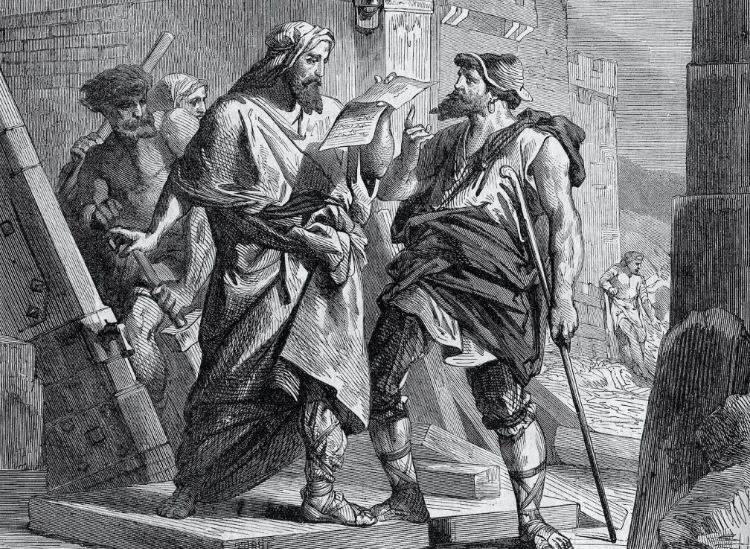
(3) Shemaiah, the son of Delaiah; so was he belonging to the 23rd order of the priesthood?
Shemaiah was a self-prefessing prophet who prophecised against Nehemiah, he was probably one of the chief of the priests, 1 Chronicles 24:18; the “children of Tobiah” being listed in Ezra 2:60 as 23rd order of the priesthood.
Question: as Tobiah had infiltred the courts of the Temple, could he had also forged the list of the priesthood, so that ‘Shemaiah’ is listed together with ‘the children of Tobiah’? (Ezra 2:60). This question arises because otherwise the “children of Tobiah” seems to pop up of nowhere?
Afterward I [Nehemiah] came unto the house of Shemaiah the son of Delaiah the son of Mehetabeel, who was confined at home; and he said, “Let us meet together in the house of God, within the temple, and let us shut the doors of the temple; for they are coming to kill you—at night they are coming to kill you,” Nehemiah 6:10.
Shemaiah’s proposal is that Nehemiah should hide himself in sacred precincts, where only priests could go. He implies that this advice which he gives as a prophet is sufficient sanction to absolve the act of profanation. The safety of the governor, he seems to say, is of more importance than a detail of Temple worship.
Nehemiah refuses to listen to Shemaiah:
(a) He has his duty and position as governor to remember; it is not for him to show the white flag;
(b) The proposal to take refuge in the Temple is monstrous; it was forbidden by the Law, which he served, and to trespass upon the domain of the priests was impious in the extreme.
Jamieson-Fausset-Brown Bible Commentary; writing of Nehemiah 6:10. Afterward I came unto the house of Shemaiah, &c.—This man was the son of a priest, who was an intimate and confidential friend of Nehemiah. The young man claimed to be endowed with the gift of prophecy.
Having been secretly bribed by Sanballat, he [Shemaiah], in his pretended capacity of prophet, told Nehemiah that his enemies were that night to make an attempt upon his life. He advised him, at the same time, to consult his safety by concealing himself in the sanctuary, a crypt which, from its sanctity, was strong and secure.
But the noble-minded governor determined at all hazards to remain at his post, and not bring discredit on the cause of God and religion by his unworthy cowardice in leaving the temple and city unprotected.
This plot, together with a secret collusion between the enemy and the nobles of Judah who were favorably disposed towards the bad Samaritan in consequence of his Jewish connections (Neh 6:18), the undaunted courage and vigilance of Nehemiah were enabled, with the blessing of God, to defeat, and the erection of the walls thus built in troublous times (Dan 9:25) was happily completed (Neh 6:15) in the brief space of fifty-two days.
So rapid execution, even supposing some parts of the old wall standing, cannot be sufficiently accounted for, except by the consideration that the builders labored with the ardor of religious zeal, as men employed in the work of God.
(4) Noadiah, a professed prophetess; but who was Noadiah?
Noadiah is mentioned only once in one of the prayers of Nehemiah, and nowhere else referred to. She was one that falsely pretended to possess the spirit of prophecy: no doubt, a false prophetess, and was hired, and in the same scheme with Shemaiah, to frighten Nehemiah with false prophecies.
The law of Moses enjoins the governors of the Jews to punish such as were proven to be false prophets; but because Nehemiah was prevented in a capacity to do so, as many rich and powerful Jews were protecting Noadish, he could only pray to God to remember and punish them.
Thus in his imprecation (cursing), Nehemiah said:
“Remember Tobiah and Sanballat, O my God, according to these things that they did, and also the prophetess Noadiah and the rest of the prophets who wanted to make me afraid” Nehemiah 6:14.
Besides Noadiah, it seems from this and many other passages that there were quite a few among the Jews who claimed to be prophets without any divine calling; but by taking bribes from Sanballat and his cohorts, they often misled and swayed the people, who should have followed Nehemiah’s example instead.
Similarly, the Jewish community should have considered the spirit of these prophets, whether they spoke that which were agreeable to the divine laws. Further, they should have tried these prophets; and because they did not do so, they were, instead, led to hearken to them, for which they were severely rebuked and most probably punished.
But Nehemiah, having many powerful enemies surrounding him, was unable to accomplish his duty. Hence, no judgement or punishment were executed, but with only cursings from him; thus Nehemiah could only pray that God would remember to curse them.
~~~~
The Samaritans are SUN worshippers.
With the Samaritans, they brought from Assyria their Sun-god: their sabbaths became Sundays, where they were original Sun-worshippers.
“And the king of Assyria brought men from Babylon, and from Cuthah, and from Ava, and from Hamath, and from Sepharvaim, and placed them in the cities of Samaria instead of the children of Israel; and they possessed Samaria and dwelt in the cities thereof” II Kings 17:24.

Hayyim Schauss points out that these Samaritans would go up to Mount Gerizim every year, and half an hour before sunset, as the 14th of Nisan draws to a close, their high priest leads the assembly in silent prayer:
“Exactly at sunset the High Priest faces WESTWARD and reads that portion of the Pentateuch which orders the slaughtering of the Pesach sacrifice. About twelve or fourteen of the younger Samaritans busy themselves, meanwhile, with preparing the sacrificial animals. They form a circle about the pit of fire, holding the lambs between their legs, and as the High Priest utters the words, ‘And the whole assembly of the congregation of Israel shall kill it at dusk,’ they utter a benediction and throw the lambs, throats to the pit, where they are slaughtered by two ritual slaughterers. Six or seven sheep are slaughtered” (The Jewish Festivals, pg 63; or online).
As a sesult, Sunday-worshippers and other false prophets are everywhere; the Samaritan “Jews” and the latter-day Samaritan “Christians” who follow them. They interpret the ‘wave sheaf’ offering perversely, insisting that the day after the Sabbath to begin the count falls on the weekly Sunday.
This change is significant, extremely significant, because by doing so, the firstruits, where the redemption of humanity were to be drawn upon the blood of the Lamb being sacrificed, is now being severed, and reattached to another ‘saviour.’
Dig deeper into this concept further, the five events during the Spring Festival are actually closely connected. In fact, the Spring Festival is a single cohesive unit:
(1) on the fourteenth, the Passover, the Lamb was sacrificed, at even, (2) on the fifteenth, the partaking of the Passover where the Israelites were to eat and share in the sacrifice (3) on the sixteenth, the wave sheaf offering, the omer was waved by the high priest as firstfruits to be accepted before the Lord, and (4) the journey began to Pentecost, or Shavuot, and (5) fifty days later, on Sivan 6th, where “Pentecost has fully come,” it marks the end or culmination of the Spring journey.
To reinterprete the Spring Festival by realigning the link, to start the count, from the 16th high-day Sabbath to a weekly Sunday, is to break a foundamental link. The new link meant that humanity were to draw inspiration from the Sun-god instead of from the Passover Lamb.

The New Testament is built upon the Old Testament, not the Old Testament upon the New. These pretending Christians are reading the Scriptures up-side-down.
Just like in the days of old, when God told Adam and Eve not to eat from the Tree of the Knowledge of Good and Evil, Satan came along and said otherwise. In the same way, the redemption of humans as firstfruits was meant to be tied to Christ’s sacrifice at Passover, but Satan stepped in to break that link and turn our focus toward the Sun-god of Babylon. Hence “in vain they do worship me, teaching for doctrines the commandments of men” Matthew 15:9.


 Current World Affairs