
A Critique of Fred Coulter’s Passover (12-15)
A Critique of Fred Coulter’s Passover (h,i)
Passover on the 14th or 15th?
Fred R. Coulter
Christian Biblical Church of God
Post Office Box 1442
Hollister California 95024-1442
This is another Critique of Fred Coulter’s The Christian Passover. The main question isn’t whether the Passover falls on the early or late fourteenth of Nisan, but whether the Passover observance extended beyond the fourteenth. Quoted are Fred Coulter’s book, from an internet online version, which I presume, is his latest. Most of his quotes are in block form, in PINK and indented so as to differentiate his writings from other comments. The Scriptures, in RED, must and foremost, be our primary focus and guide.
Chapters 12 – 13
II Chronicles 29:2 says “And he [Hezekiah] did that which was right in the sight of the Lord” and this, of course, includes sanctifying the house of the Lord cleaning the altar, all the vessels, and the table for the shewbread (verses 17-18). It was reemphasized in verse 15 that the commandment of the king, as well as “by the word of the Lord.”
II Chronicles 30:12 says: “Also the hand of God was in Judah, to give them one heart to do the commandment of the king and of the princes by the word of the Lord.” The burnt offerings and peace offerings were accompanied by much rejoicing, enhanced by having music, songs, accompanied by various instruments — cymbals, psalteries, harps and trumpets — which were commandments of King David and other prophets, and they performed with praises and gladness.
In his account of Hezekiah’s Passover, Ezra records that “the runners went with the letters from the king and his princes throughout all Israel and Judah…according to the commandment of the king…” (II Chron. 30:6). (The Christian Passover, pg 142)
After taking counsel, the decree was to invite those living in the countryside of those left from other tribes, Ephraim and Manasseh — to make proclamation throughout all Israel, from Beersheba even to Dan — and the running and sending out letters to inform the other tribes, were the king’s command to keep the Passover in the second month.
“So the posts passed from city to city through the country of Ephraim and Manasseh even unto Zebulun: but they laughed them to scorn, and mocked them” (II Chronicles 30:10).
Note, the Scriptures didn’t say the descendants of Ephraim and Manasseh laughed and mocked them to scorn; it says the people living in those regions mentioned laughed and mocked them to scorn.
Clearly, the descendants of Ephraim and Manasseh had been carried away by the Assyrians, and the countryside was now inhabited by those brought from Babylon. These were the idol-worshipping Samaritans who would surely have good reasons for a good laugh.
But if the intended audience were the remnants of the northern ten tribes, the laughter would be derisive—mocking the very thought of returning to Jerusalem’s Temple, since their sacrifices would be preferred offered in Bethel, or up north, Dan.
In response to Hezekiah’s command to come to Jerusalem for the Passover, Ezra records that “…many people gathered at Jerusalem to keep the Feast of Unleavened Bread in the second month…” (verse 13). This is the first Scriptural record in which the Feast of Unleavened Bread and the Passover are used interchangeably in referring to the spring festival season (verses 1-2, 13). (Pg 143)
Not so, it’s not the first record. Earlier in the original Exodus 12 (and also Deuteronomy 16) the two feasts have been all along a composite festival. As a reminder of my observation of previous critique (chapters 10-11):
Of the 50 (not counting verse 1) verses in Exodus 12:
— 29 (58%) are clearly pertaining to the Passover or its ordinances (verses 2-14, 21-28, 43-50);
— 5 (10%) are judgement on those not defended by the blood of the sacrifice (29-33); but still related to the Passover above;
— 8 (16%) are coming out of Egypt (35-38, 40-42, 51); and
— only 8 (16%) are about unleavened bread (15-20, 34, 39). In fact, eating unleavened bread wasn’t planned; it was thrust upon them (34).

The primary focus of Exodus 12 is the Passover, which also included bringing God’s judgement on the Egyptians; the mentioning of unleavened bread during Exodus is just a sideshow of the central theme of Passover.
Further, in Deuteronomy 16:1-8 when Moses wrote it in his last days (39 years after the original Exodus), the names Passover and Days of Unleavened Bread were used interchangeably.
In Hezekiah’s instance, the name “Passover” is used in II Chronicles 30:2 “to keep the Passover in the second month,” and then in verse 13 “And there assembled at Jerusalem many people to keep the Feast of Unleavened Bread in the second month.”
They were indeed a composite festival right at the start in Exodus, followed closely by Deuteronomy, and reaffirmed during Hezekiah’s time. And even in the New Testament times, the Gospel writers also used the terms “Passover” and “Feast of Unleavened Bread” interchangeably.
Second, Hezekiah was a good king, who was righteous before God. The Scriptures speak well of him, who “kept His commandments which the Lord commanded Moses. And the Lord was with him”
And he [Hezekiah] did that which was right in the sight of the Lord, according to all that David his father did.
He removed the high places, and broke the images, and cut down the Asherah poles, and broke in pieces the brazen serpent that Moses had made; for until those days the children of Israel burned incense to it; and he called it Nehushtan.
He trusted in the Lord God of Israel, so that after him was none like him among all the kings of Judah, nor any who were before him.
For he cleaved to the Lord and departed not from following Him, but kept His commandments which the Lord commanded Moses.
And the Lord was with him, and he prospered whithersoever he went forth; and he rebelled against the king of Assyria and served him not. II Kings 18:3-7
And they (the congregation of Israel that assembled at Jerusalem) stood in their place, according to their order “according to the law of Moses,” II Chronicles 30:16. Surely anyone who postulates about Hezekiah not keeping the law of Moses is a liar.
And Fred Coulter continues:
As we continue to study the account in II Chronicles, we will see that Hezekiah’s Passover is the first record in Scripture of killing the Passover lambs at the temple. Although Ezra’s account does not state the time that the lambs were slain, it appears that they were slain during the day portion of the 14th.
. . . This is also the first Scriptural record of killing the Passover at the temple and dashing the blood of the lamb against the altar instead of applying the blood to the door posts at home, as was done with the domestic sacrifice of the lamb. Why did Hezekiah institute these changes in the observance of the Passover? (Pg 143)
It is an absolute truth that the Passover lamb were slain during the day portion of the 14th, but it wasn’t the first time. So says II Kings 18:3 And he [Hezekiah] did that which was right in the sight of the Lord. And he did “according to all that David his father did,” proving that King David also kept the Passover to God’s approval that Hezekiel was following. Only those too self-absorbing says otherwise.
Second, Leviticus 17 says if one were to make a sacrifice, any sacrifice including the Passover “in the camp” or “out of the camp,” the blood must be brought to the tabernacle, and the priest shall sprinkle the blood upon the altar of the Lord at the door of the tabernacle (verse 6).
In verse 8, it says, “And thou shalt say unto them: ‘Whatsoever man there be of the house of Israel, or of the strangers who sojourn among you, who offereth a burnt offering or sacrifice. In the Good News Translation, it says “who offer a burnt offering or any other sacrifice.”

All indications are that the sacrifice mentioned would inevitably include the Passover sacrifice, only that the GNT made it clearer.
Leviticus 17 in the Targum gave a clearer but incorporates a warning:
“And the Lord spake with Mosheh, saying: Speak with Aharon and with his sons, and with the sons of Israel, and tell them: This is the word which the Lord hath commanded, saying: Any man, young or old, of the house of the lineage of Israel, who slaughters a slaughtering of an ox, a lamb, or a goat in the camp, or who slaughters outside the camp, and bringeth it not to the door of the tabernacle of ordinance to offer it an oblation before the Lord, before the tabernacle of the Lord, the blood of slaughter shall be reckoned to that man, and it shall be to him as if he had shed innocent blood, and that man shall be destroyed from his people.” Leviticus 17:1-4 Jonathan
The critical performance of a sacrifice or any sacrifice “in the camp” or “outside of the camp” which includes the Passover, is that “the priest shall sprinkle the blood upon the altar of the Lord at the door of the tabernacle.”
Since memorial time, the priests had sprinkled the blood upon the alter evidently from the time of Moses and evidentently down to King Hezekiah and Ezra. The penalty for infringement is DEATH: it is “as if he had shed innocent blood, and that man shall be destroyed from his people.” If Moses had any doubt about such ruling, he had all the opportunity and time to ask God who dwelt between the cherubim in the Sanctuary for any clarification.

There is not one detail in the account which resembles the domestic observance that is recorded in Exodus 12. To the contrary, the account in II Chronicles 30 points out the changes that were instituted for the temple sacrifice of the Passover. The lambs that were killed at the temple were slain by the Levites, not by “the whole assembly of the congregation of Israel,” as in Exodus 12. (Pg 144)
Of course the domestic Passover in Egypt was a one-off occurrence. Never were the children of Israel required to experience a night of trepidation again, nor to experience a night of the Death Angels’ bloodbath to all the firstborn. Nor given anymore opportunity to plunder the Egyptians.
The Levitical duties of the tribe of Levites and the Sanctuary were not instituted at the time of the Exodus. But once instituted, it was centralized.
Although the tabernacle moved with the Israelites in the wilderness it was in Jerusalem in later years that God’s Holy City was chosen to place His name there.
“Thou mayest not sacrifice the Passover within any of thy gates which the Lord thy God giveth thee,” Deuteronomy 16:5.
Hence many of the Exodus 12 requirements were a one-off situation, otherwise every Israelites every year would be perfecting their eating in haste with their loins girded, sandals on their feet, staff in their hands; all pretending to flee from a non-existing Pharaoh and his non-existing armies in an re-enactment of the Exodus.
And then there’s another team of actors and actresses that needed to be hired, crying and pretending to bury their own dead while waving goodbye, happy to see the much-hated Israelites for the last time who had caused them so much trouble.
Ezra’s account in II Chronicles 30 shows that God accepted this temple-centered Passover, although it was contrary to the ordinances that He had established, because of the prayers of Hezekiah and the repentance of the people. But God’s acceptance of this Passover does not mean that He intended this type of Passover to replace the domestic Passover. The commands for the domestic observance of the Passover, as recorded in Exodus 12, were still in effect. Consider this: If the ordinances of the Passover were not in effect at that time, there would have been no need for Hezekiah to pray for forgiveness for those who ate the Passover contrary to God’s requirements. (Pg 147)
If “it was contrary to the ordinances,” then Hezekiah wouldn’t be a righteous King. But the Scripture in II Kings 18:3 says, “And he (Hezekiah) did that which was right in the sight of the Lord.” So this is a clear case whether a self-absorbing Fred Coulter is too puff-up or the testimony from the Scriptures is false.

During the Exodus the command to kill the lamb in their houses (a domestic passover) were obviously a one-off situation. Later, other laws and ordinances were established, like the command to commence a holy assembly on the first and last days of Unleavened Bread, which wasn’t in the original Exodus.
Hezekiah’s prayers were for the fact that they were late for the Passover, which should be on the first month, but they celebrated it on the second month, which is contrary to the law. But the main reason was, even allowed a month late, they were still unclean to partake in the Passover ordinances.
For a multitude of the people, even many from Ephraim, and Manasseh, Issachar, and Zebulun had not cleansed themselves, yet they ate the Passover otherwise than it was written. But Hezekiah prayed for them, saying, “The good Lord pardon every one who prepareth his heart to seek God, the Lord God of his fathers, though he be not cleansed according to the purification of the sanctuary.” And the Lord hearkened to Hezekiah, and healed the people. II Chronicles 30:18-20
Uncleaniness include touching a dead human body made a person unclean for seven days (Numbers 19); bodily discharges or skin conditions: abnormal physical discharges (Leviticus 15) or infectious skin conditions (Leviticus 14) required a seven-day waiting period after symptoms ceased, accompanied by specific washings on the 1st and 7th days and sacrifices on the 8th day.
Others such as childbirth (Leviticus 12), initial unclean stage: 7 days for a male child, 14 days for a female child. Secondary purification waiting period: an additional 33 days (for a boy) or 66 days (for a girl).
We should refer back to Chapter One, this is what Fred Coulter wrote, which is so true:
“Anyone who twists and distorts the Scriptures is “using the law unlawfully,” as Paul said, and will end up believing false, satanic doctrines, which subvert the souls of men,” (Pg 13).
~~~~~
~~ 13 ~~
Josiah, who was anointed before he was born, was a good king. Early in his reign, he forsook the idolatrous practices of his wicked father Amon and began to worship the Lord, following the righteous example of his ancestor David:
Josiah was eight years old when he began to reign, and he reigned in Jerusalem one and thirty years. And he did that which was right in the sight of the Lord, and walked in the ways of David his father, and declined neither to the right nor to the left. II Chronicles 34:1-2.
Adam Clarke comments further, “He never swerved from God and truth; he never omitted what he knew to be his duty to God.”
And the testimony from II Chronicles 34

And the king (King Josiah) stood in his place, and made a covenant before the Lord to walk after the Lord, and to keep His commandments and His testimonies and His statutes, with all his heart and with all his soul, to perform the words of the covenant which are written in this book.
And he caused all who were present in Jerusalem and Benjamin to stand to it. And the inhabitants of Jerusalem did according to the covenant of God, the God of their fathers.
And Josiah took away all the abominations out of all the countries that pertained to the children of Israel, and made all who were present in Israel to serve, even to serve the Lord their God. And all his days they (the children of Israel) departed not from following the Lord, the God of their fathers. II Chronicles 34:31-33
Note that King Josiah “made a covenant before the Lord to walk after the Lord and to keep His commandments and His testimonies and His statutes, with all his heart and with all his soul.” King Josiah was a good king: “And all his days they (the children of Israel) departed not from following the Lord, the God of their fathers.”
But as usual, a self-absorbing Fred Coulter always has something bad about King Josiah:
The description of the sacrificing does not fit the ordinances that God established for the domestic observance of the Passover. There is no mention of the lambs being killed by “the whole assembly of the congregation of Israel,” as in Exodus 12. Rather, the account gives a detailed description of the slaying of the lambs at the temple by the Levites, and the sprinkling of the lamb’s blood against the altar by the priests. (Pg 153)
The sacrificing that was performed by the priests and Levites in this account was not conducted according to the ordinances that God gave to Moses for the observance of the Passover. (Pg 154)
And there were no mention of the lambs being killed by “the whole assembly of the congregation of Israel,” was because the Exodus 12 experience was a one-time incident. During the Exodus, there was no altar in Egypt! The Levites and priesthood haven’t being instituted; they were instituted only later in Leviticus 17 which commands that if one were to make a sacrifice, “in the camp” or “outside of the camp,” the blood must be brought to the tabernacle, and the priest shall sprinkle the blood upon the altar of the Lord at the door of the tabernacle (Leviticus 17:6).
So there was also a change in the practice of killing the lamb from their Exodus experience as the Scriptures say:
“And they (the congregation, as well as the Levites) killed the Passover lamb, and the priests sprinkled the blood (at the altar) from their hands, and the Levites flayed them,” II Chronicles 35:11.
Josiah was a good king; he “took away all the abominations out of all the countries that pertained to the children of Israel,” but Fred Coulter is full of contempt that he was a bad one, one whose (Josiah’s) Passover “was not conducted according to the ordinances that God gave to Moses for the observance of the Passover.” But this is what the Scripture says:
“And like unto him (referring to Josiah) was there no king before him, who turned to the Lord with ALL his heart and with ALL his soul and with ALL his might, according to ALL the Law of Moses; neither after him arose there any like him” II Kings 23:25.
Notice the four “ALL” – reflecting on his inner character
(1) with ALL his heart;
(2) with ALL his soul;
(3) with ALL his might,
(4) according to ALL the Law of Moses.
Then another set of four – reflecting what he achieved with such character
And Josiah took away ALL the abominations out of ALL the countries that pertained to the children of Israel, and made ALL who were present in Israel to serve, even to serve the Lord their God. And ALL his days they departed not from following the Lord, the God of their fathers. II Chronicles 34:33
Can we say any one of our endtime crop of religious leaders — wretched, blind, and naked — has any of these qualities today?Are the Scriptures being untruthful, or is Fred Coulter just too full of himself?
As we read the account in II Chronicles 35, we find that the entire ceremony was conducted by the priests and Levites, who stood in their places to serve at the altar, offering sacrifices and carrying out all the duties that were assigned to their courses (verses 2-5). Notice Josiah’s exhortation to the Levites: “‘And kill the Passover, and sanctify yourselves, and prepare your brethren so that they may do according to the word of the LORD by the hand of Moses.’ And Josiah gave to the people from the flock, lambs and kids, all for the Passover offerings, for all who were present, to the number of thirty thousand, and three thousand oxen. These were from what the king owned” (verses 6-7).
This verse is significant because bullocks and oxen were never to be used for the Passover sacrifice. God had commanded that the animals for the Passover sacrifice be selected from the sheep or the goats (Ex. 12:5). The bullocks that Josiah gave to the people were not for the Passover sacrifice itself. These “Passover offerings,” were to be sacrificed by the priests and Levites as burnt offerings, peace offerings and thank offerings. The priests received “…for the Passover offerings two thousand six hundred sheep, and three hundred oxen.” And the Levites received “…for Passover offerings five thousand sheep, and five hundred oxen” (II Chron.35:8-9). (Pg 154)
Notice the PASSOVER offering came from BOTH the flock and from the herd:
(I) King Josiah himself gave from the “lambs and kids from the flock, all for the Passover offerings for all who were present, to the number of thirty thousand, and three thousand bullocks,” (II Chron. 35:7);
(II) Josiah’s princes, chief priests and officials gave “for the Passover offerings two thousand and six hundred small cattle and three hundred oxen,” (verse 8);
(III) Conaniah and other chief Levites gave “for Passover offerings five thousand small cattle and five hundred oxen,” (verse 9).
The fact that oxens were included for the “Passover offerings” is because the Passover and Unleavened Bread were well amalgamated. And since King Josiah did “according to ALL the Law of Moses” meant that right at the beginning at the time of the original Exodus the amalgamation was instituted then. The composite feast consisted of sacrificing one lamb on the fourteenth for the Passover proper and “two young bullocks, and one ram, and seven lambs of the first year” for each of the seven Days of Unleavened Bread.
Sacrifices from the flock and the herd are needed for both the Passover and the Days of Unleavened Bread, all seven days (Numbers 28:19).
Numbers 28:16 And in the fourteenth day of the first month is the passover of the LORD. And in the fifteenth day of this month is the feast: seven days shall unleavened bread be eaten. In the first day shall be an holy convocation; ye shall do no manner of servile work therein:
19 But ye shall offer a sacrifice made by fire for a burnt offering unto the Lord; two young bullocks, and one ram, and seven lambs of the first year: they shall be unto you without blemish: After this manner ye shall offer daily, throughout the seven days, the meat of the sacrifice made by fire, of a sweet savour unto the Lord: it shall be offered beside the continual (daily) burnt offering, and his drink offering. (Numbers 28:16-24).
Just as translating from one language into another can be confusing, the numerous idiosyncrasies of the Hebrew language have definitely add to further confusions. When inspiring the writings of the Scriptures, God purposely didn’t made it obvious; he incorpoates conplexities so that he could easily whip out those he long foresaw as self-absorbing and stiff-necked.
The Passover is a composite feast composed of the Passover proper and the seven Days of Unleavened Bread. But God also incorporates alternate route so that those who wanted an alternate path could easily find support. The Jewish Encyclopedia (initiated by Reformed Jews) digged deeper into this phenomenon by stating the concept that the two festivals as distinct was promoted correctly by the Samaritans: “The Samaritans consider the Feast of Passover and the Feast of Unleavened Bread as two distinct festivals.”
These animals from both the flock and the herd were offered as burnt offerings, peace offerings and thank offerings. They were offered on the night of the 15th and each day during the Feast of Unleavened Bread. The fact that they are called “Passover offerings” indicates that during this time in history, the entire Feast of Unleavened Bread began to be called “Passover.”
As the account shows, the lambs were brought to the temple to be sacrificed by the priests and the Levites, and the blood of the lambs was sprinkled against the altar in the manner that was practiced for peace offerings and thank offerings. This was done by Josiah’s command: “So the service was prepared, and the priests stood in their place, and the Levites in their courses, according to the king’s commandment. And they killed the Passover offerings, and the priests sprinkled the blood from their hands, and the Levites flayed them [cut them open and removed the guts]. And they removed the burnt offerings [the interior fat and genital organs] so that they might give, according to the divisions of the families of the people, to offer to the LORD as it is written in the book of Moses; and so they did to the oxen” (II Chron. 35:10-12). (Pg 154)
Again once the composite feast is understood there is no problem understanding that the sacrifice and other offerings were composed of animals from the flock and from the herd, composed of thirty thousand lambs and kids as well as three thousand oxen owned by King Josiah.
In fact, since King Josiah was a righteous king, his action validates the concept that Passover and Days of unleavened Bread were and have always been a composite Festival. In fact, Fred Coulter admitted: “The fact that they are called “Passover offerings” indicates that during this time in history, the entire Feast of Unleavened Bread began to be called “Passover” (pg 154). To be more correct, the entire Feast of Unleavened Bread and “Passover” began as a composite Festival right from the Exodus; as Josiah kept (4) ALL the Law of Moses, (3) with ALL his might, (2) with ALL his soul; and (1) with ALL his heart.
The sacrificing that was performed by the priests and Levites in this account was not conducted according to the ordinances that God gave to Moses for the observance of the Passover. The Passover ordinances that God delivered to Moses are recorded in the book of Exodus, which is the second book in the Pentateuch, or the “Book of the Law.” These ordinances of God do not instruct the priests and Levites to sacrifice the Passover lambs and sprinkle the blood on the altar, nor to burn the fat and other parts. The phrase “as it is written in the book of Moses” is not referring to the ordinances for the Passover, but to the ordinances that God established for peace offerings, which required that the blood of the sacrificial animal be sprinkled against the altar, and the fat and certain organs be burnt on the altar (Lev. 3). (Pg 154-155)
Not so, II Chronicles 35:6 says “So kill the Passover lamb (not the peace offering) . . . that they may do according to the word of the Lord by the hand of Moses.” The central theme about King Josiah was about keeping the Passover, not about offering a peace offering. So much twistings and wringings of God’s word! The verse actually reaffirms that the blood of the sacrificial animal should be sprinkled against the altar. Josiah was a righteous king. “And he did that which was right in the sight of the Lord, and walked in all the way of David his father, and turned not aside to the right hand or to the left” II Kings 22:2. Fred Coulter has so much lying problems reading the Scriptures or is he suffering from memory lapses? Instead of sending tithes to Fred, his sleepy faithfuls should send him to the nearest hospital for a thorough clinical checkout.
After relating the sacrifice of the lambs and the oxen, the account describes the manner in which they were cooked: “And they roasted [Hebrew bashal] the passover with fire according to the ordinance; and the holy offerings they sod [boiled] in pots [Hebrew bashal], and in caldrons, and in pans, and carried them quickly to all the children of the people” (II Chron. 35:13, JPSA)
Bashal is never used to signify the act of roasting. The use of the word “roasted” in II Chronicles 35:13 is a blatant mistranslation of the Hebrew text. Bashal is first used in this verse to indicate that the sacrifices were cooked over fire, and then to specify that the cooking was done by boiling the flesh of the animals in pots and pans. None of these sacrifices were roasted, as God had commanded for the sacrifice of the Passover lambs (Ex. 12:9). (Pg 155)
If “they roasted [Hebrew bashal] the passover with fire according to the ordinance” then they must be doing the right thing. So why all the complainings? If they had boiled the Passover then it wasn’t according to the ordinances, then there is an issue. The KJV translates Strong’s H1310 (bashal) in the following manner (and times): seethe (10x), boil (6x), sod (6x), bake (2x), ripe (2x), roast (2x).
The KJV and most translations translate bashal as “roasted”: “And they roasted the Passover lamb with fire according to the ordinance.” The Bible says they did the roasting “according to the ordinance.” The same word bashal is used in Deuteronomy 16:7 “And thou shalt roast (H1310 bashal) and eat it in the place which the Lord thy God shall choose.” Only “A Faithful Version” by a “not-sure-what-his-level-of-Hebrew-is” author translates it as “boil.”
Bear with me that I should dive deeper into this leather bound Faithful Version. II Chronicles 35:13 is translated as “And they boiled the Passover offerings over fire according to the law.”
If it is “according to law” it is correct to translate it as “roast.” But what this translator means is that what they did is contrary to the law. In which case it should be translated, “And they boiled the Passover offerings over fire contrary to the law” if he insists bashal should be translated as “boil.”
Hope one of his sleepy faithful will finally wake up, do humanity a favor, and inform the author of this parody, or at least beg for clarity how boiling is “according to law?
And the king commanded all the people, saying, “Keep the Passover unto the LORD your God, as it is written in the Book of this Covenant.” Surely there was not held such a Passover from the days of the judges who judged Israel, nor in all the days of the kings of Israel nor of the kings of Judah, but in the eighteenth year of King Josiah wherein this Passover was held to the Lord in Jerusalem. (II Kings 23:21-23).
Rashi: such a Passover sacrifice had not been performed: So many people had not assembled at any Passover sacrifice as assembled at this one.
Clarke: – Not one on purer principles, more heartily joined in by the people present, more literally consecrated, or more religiously observed. The words do not apply to the number present, but to the manner and spirit.
This is similar to II Chronicles 35:18 “There was no passover like that” which means that this Passover distinguished from all the former Passovers because it was performed with great generosity — from Josiah, his princes and others who contributed to his people such a great number of lambs and oxens — boosting their joys and spirit that neither even David nor Solomon had done.
~~~~~
Chapters 14 – 15

Ezra was a righteous scribe, a righteous high priest, one with a composite character. His priestly lineage could be traced all the way back to Aaron, the first high priest established under Moses (Ezra 7:1-5).
Ezra returned to Jerusalem from Babylonian exile and faithfully reintroduced the Torah to all those who followed him (Ezra 7:10 and Nehemiah 8). For Ezra had prepared his heart to seek the law of the Lord and to do it, and to teach in Israel statutes and judgments.
He was so righteous that he was regarded as the second Moses in the Voice Translation of Ezra 7:10, “He was a second Moses” he was like Moses who tenaciously studied, practiced, and taught the Eternal’s law to Israel.
With the above in mind, we’ll continue with our critique:
WHAT IS THE TRUE MEANING OF DEUTERONOMY 16?
The advocates of a 15th Passover claim that the commands of God in Deuteronomy 16 support the temple sacrifice of the Passover lambs. On the surface, it appears that these commands required the sacrificing of the Passover at the temple, and that the Passover and the first day of the Feast of Unleavened Bread were combined into one feast. This interpretation of Deuteronomy 16 is taught by Jewish and Christian scholars alike. As the Interpreter’s Dictionary of the Bible states, “The section in Deut. 16:1-10 was interpreted as an attempt to abolish the private Passover celebrations…(p. 668).” (The Christian Passover, pg 159).
Is this interpretation of Deuteronomy 16 correct? Did God abolish the domestic Passover by commanding that the Passover sacrifice be offered at the temple? If that is the meaning of God’s commands in Deuteronomy 16, then these commands are clearly contradicting His commands in Exodus 12, Numbers 9 and Leviticus 23 concerning the Passover and the Feast of Unleavened Bread. (ibid)
During the forty years of wandering in the desert, the children of Israel performed their sacrifices at the Sanctuary, but when the Temple was established God told King Solomon that He had chosen for Himself to move the place of sacrifice to Jerusalem. Hence a Temple-centered sacrifice in Jerusalem is a God-ordained command.
And just a reminder — The Interpreter’s Dictionary of the Bible, was published by Abingdon Press from 2006 to 2009 — Its chief editor is feminist Katharine Doob Sakenfeld, a spinoff from the Reform Movement!
Thus Solomon finished the house of the Lord and the king’s house; and all that came into Solomon’s heart to do in the house of the Lord and in his own house, he prosperously effected. And the Lord appeared to Solomon by night and said unto him: “I have heard thy prayer, and have chosen this place for Myself for a house of sacrifice” (II Chronicles 7:11-12).

And “this place” is in Jerusalem, and its purpose is for “a house of sacrifice.”
“I (God) have chosen Jerusalem, that My name might be there” (II Chronicles 6:6).
And continue in II Chronicles 7:1 Now when Solomon had made an end of praying, the fire came down from heaven and consumed the burnt offering and the sacrifices; and the glory of the Lord filled the house. And the priests could not enter into the house of the Lord, because the glory of the Lord had filled the Lord’S house.
3 And when all the children of Israel saw how the fire came down and the glory of the Lord upon the house, they bowed themselves with their faces to the ground upon the pavement, and worshiped and praised the Lord, saying, “For He is good, for His mercy endureth for ever.”
4 Then the king and all the people offered sacrifices before the Lord.
5 And King Solomon offered a sacrifice of twenty and two thousand oxen, and a hundred and twenty thousand sheep; so the king and all the people dedicated the house of God. II Chronicles 7:1-5
That place chosen by God is Jerusalem as affirmed in II Chronicles 6:6, “I have chosen Jerusalem, that My name might be there.” Only the self-absorbed think otherwise.
I King 9:3 And the Lord said unto him, “I have heard thy prayer and thy supplication that thou hast made before Me. I have hallowed this house which thou hast built, to put My name there forever; and Mine eyes and Mine heart shall be there perpetually.
II Chronicles 7:12 And the Lord appeared to Solomon by night and said unto him: “I have heard thy prayer, and have chosen this place [Jerusalem] for Myself for a house of sacrifice.
I King 9:25 And three times in a year Solomon offered burnt offerings and peace offerings upon the altar which he built unto the Lord, and he burned incense upon the altar that was before the Lord. So he finished the house.
Adam Clarke: Three times in a year did Solomon offer – These three times were: 1. The passover 2. The feast of pentecost 3. The feast of tabernacles.
Ellicott’s Commentary on the Bible – Three times in a year — no doubt at the three great feasts, the Passover, the Feast of Weeks, and the Feast of Tabernacles.
Undoubtedly this means at the three solemn great feasts (Deuteronomy 16:16) — the Passover (which is often used interchangeably with the Days of Unleavened Bread), Pentecost and Tabernacles. And the Temple in Jerusalem is not only a house of sacrifices; it’s also a house of prayers, a hybrid character:
II Chronicles 7:13 If I shut up heaven that there be no rain, or if I command the locusts to devour the land or if I send pestilence among My people, if My people, who are called by My name, shall humble themselves and pray, and seek My face and turn from their wicked ways, then will I hear from heaven, and will forgive their sin and will heal their land.
15 Now Mine eyes shall be open and Mine ears attentive unto the prayer that is made in this place.
16 For now have I chosen and sanctified this house, that My name may be there for ever; and Mine eyes and Mine heart shall be there perpetually. II Chronicles 7:13-16
And many people, seeking the Lord God of Israel, setting their hearts right, went to Jerusalem to offer sacrifices, any sacrifice, including the most important of all sacrifices, the Passover:
“And after them, out of all the tribes of Israel, such as set their hearts to seek the Lord God of Israel came to Jerusalem to sacrifice unto the Lord God of their fathers,” (II Chronicles 11:16).
Before Moses sacrifices could be made anywhere. But once the tabernacle was built, Moses received the command from the Lord God of Israel that sacrifices could only be brought to the “entrance of the tent of meeting” as instructed in Leviticus 17. And when the Temple was built in Jerusalem, God placed His name, eyes and heart there “forever” and “perpetually,” (I King 9:3).
Although Deuteronomy 16 contains instructions for the Feast of Unleavened Bread and the two other holy days seasons, the fact that the word “Passover” appears in Verse 1 has caused great confusion in the minds of many Bible students and scholars. They are not aware that these verses were edited by Ezra long after the book of Deuteronomy was originally written, and that in Ezra’s time the entire eight-day observance of the Passover and the Feast of Unleavened Bread was called “Passover.” When we understand that the term “Passover” was used for the Feast of Unleavened bread, the seeming discrepancy between Deuteronomy 16 and other Scriptural passages is eliminated. (Pg 165)
First of all, Ezra couldn’t have edited Deuteronomy 16 and yet remained one who “had prepared his heart to seek the law of the LORD,” (Ezra 7:10). He was so righteous that he was regarded as the second Moses, so how could he had obeyed the commandment: “not add to the Word that I tell you, and do not take away from it?” (Deuteronomy 4:2).
When we place all the jigsaw pieces together and they fix nicely, there isn’t any confusion. If the puzzle doesn’t fit, Fred Coulter’s understanding is obviously wrong, and so there is “great confusion.” The plain meaning of Deuteronomy 16 supports the theme that the amalgamation of the Passover with the Days of Unleavened Bread started way back during the Exodus.
The books of Genesis, Exodus, Leviticus and Numbers were mainly the words of God to His subjects — to Adam, to Abraham, to Jacob, to Moses — but in the book of Deuteronomy it was Moses speaking to the Israelites.
Deuteronomy 1:1 says “These are the words which Moses spoke unto all Israel on this side of the Jordan in the wilderness . . . And it came to pass in the fortieth year, in the eleventh month, on the first day of the month, that Moses spoke unto the children of Israel according unto all that the Lord had given him in commandment unto them.” Deuteronomy 1:1-3

So when Moses spoke, he spoke “according unto all that the Lord had given him.” He uses terms that were slightly different from what God spoke as expressed in Genesis, Exodus, Leviticus and Numbers.
In Deuteronomy Moses couldn’t be just repeating the same line, word for word, that God used before. Moses would sometimes clarify seemingly confusing issues, or to elucidate complex subjects as the wordings in Deuteronomy 16 show.
Beside the fact that the Passover is a composite festival composed of an eight days festival, Scriptures show that it could be known by either of its names. Hence sometimes it is referred to as the Passover while other times as the Days of Unleavened Bread, as the following shows.
Deuteronomy 16:1 “Observe the month of Abib, and keep the Passover unto the Lord thy God; for in the month of Abib the Lord thy God brought thee forth out of Egypt by night.
Exodus 34:18 “The Feast of Unleavened Bread shalt thou keep. Seven days thou shalt eat unleavened bread, as I commanded thee, in the time of the month of Abib; for in the month of Abib thou camest out from Egypt.
Both verses claim it was during their festive time that they came out of Egypt! This couldn’t be possible if Passover is distinct from the Days of Unleavened Bread. The children of Israel knew this composite characteristic from the beginning all along. There is no confusion.
If Moses had any doubt, he had full access to God at the Holy of Holies at the Sanctuary to ask and seek clarification. One example is found in Numbers 9 when some Israelites had came in contact with the dead, and thought they couldn’t keep the Passover. Moses said to them, “Stand still, and I will hear what the Lord will command concerning you” (verse 8). Moses had never been denied access to God to seek clarification on any issue or for any reason.
The book of Deuteronomy is composed entirely of the words of Moses, spoken from his heart to his people Israel. And since Moses was a righteous man, he spoke in a language that we can understand, yet it’s the Word of God.
Years later Ezra used the same methodology for those who returned from the Exile and who had lost the Hebrew language, and who knew only the Aramaic language, and this same process gave birth to the Targum, another source of the Scriptures that we should refer from time to time. And the Targum says in Exodus 12: that the Passover was a late fourteenth and the eating was on the fifteenth:
“And you shall eat the flesh on that night, the fifteenth of Nisan” Exodus 12:8 Jonathan
And this is confirmed by Deuteronomy 16:4, which commands us regarding the Passover Sacrifice: “and there shall not remain of the flesh [and bones] that you slaughter at evening on the first day until the morning.” — “first day” of course, refers to the first day of the seven days of unleavened bread.
The Targum is a Ezra-inspired Scripture.
“So they read in the book, in the law of God, distinctly, and gave the sense and caused them to understand the reading” Nehemiah 8:8
Nehemiah 8:8 implied not only the reading of the Law, but also made interpretation of its Hebraic meaning — its translation and interpretation — were simplifies from Hebrew to Aramaic, so that the common people in the streets could understand, and this practice was broadened and spread to all the synagogues in Judea. Before long the Aramaic Targum was written, and today, translated — including some explanations — in the English language.
Let’s have another look at the original Passover, during the Exodus:
Exodus 12:6 And ye shall keep it up until the fourteenth day of the same month, and the whole assembly of the congregation of Israel shall kill it in the evening (ben ha arbayim).
7 And they shall take of the blood, and strike it on the two side posts and on the upper door post of the houses wherein they shall eat it.
8 And they shall eat the flesh in that night, roasted with fire; and with unleavened bread and with bitter herbs they shall eat it. Exodus 12:6-8. (The Targum identified that night as the night of the fifteenth of Nisan).
Note in verse 8 that the Targum identified that night as “the night of the fifteenth.” Along with the Masoretic Text and the Septuagint, the Targum is also an important source of our Bible and ignoring it could only lead to our own paucity.
It was Ezra whose work gave rise to the Targum, translating the Hebrew Text to Aramaic so that the rank and file could understand. Ezra was “a righteous priest” and “a scribe skilled in the law.” He’s a hybrid, at one time, he appeared as a scribe, but a high priest on another.
Ezra 7:10 For Ezra had prepared his heart to seek the law of the Lord and to do it, and to teach in Israel statutes and judgments. The Voice translated this same verse as, “He (Ezra) was a second Moses, and tenaciously studied, practiced, and taught the Eternal’s law to Israel.”
Let’s have another look; let’s accept that the Pharisees sat on Moses’ seat as Christ instructed, instead of twisting the Scriptures for their own evil end and stigmatizing them:
Exodus 12:6 says to keep the Passover, where the lamb was sacrificed at even — “after noon and until nightfall.” From verse 7 to 11, it is describing the night as the Passover, ending by saying “it is the Lord’S Passover.” So the Passover stretched into the Days of Unleavened Bread. The eating of unleavened bread also starts from the fourteenth of Nisan, at even (verse 18, ba-erev).
Further, commenting on the beginning verse 8, “And they shall eat the flesh in that night,” the Targum translates this as the night of the fifteenth (of Nisan).
In Nisan, on the fourteenth day of the month, you shall kill the passover, and at evening on the fifteenth you shall eat unleavened bread until the twenty-first of the month. On the evening of the twenty-second you may eat leavened bread. Exodus 12:18 Jonathan
That same night was what the Lord (often deemed as the night of the Death Angel) would do, to “execute judgment.” That night, when the Lord execute His judgment, was meant to be a memorial, and it was “a feast to the Lord.”
The Targum says further,
“And it was in the dividing of the night [idiom for midnight] of the fifteenth, that the Word of the Lord slew all the firstborn in the land of Mizraim (Egypt), from the firstborn son of Pharoh, who would have sat upon the throne of his kingdom, unto the firstborn sons of the kings who were captives in the dungeon as hostages under Pharoh’s hand.” Exodus 12:29 Jonathan
The subject was still the Passover — about how Passover was to be kept. What happened on the Passover night. And how we should be keeping Passover by having seven days of eating unleavened bread — observed Passover by eating unleavened bread for seven days.
Only in verse 17 is the phrase “the Feast of Unleavened Bread” appears. And how should we keep it? The answer is found in verse 18; we are to keep it by eating unleavened bread starting from the fourteenth (NOT Fifteenth), at even. So the observance of Unleavened Bread starts a few hours before the fifteenth, EXACTLY the same time to kill the Passover which is also on the fourteenth, at even.
The Scriptures were a bit vague on casual reading, but on closer scrutiny, it is extremely clear. The two feasts, known by either name, are a composite, and this Exodus 12 account shows that the original distinction between the two feasts were well interweaved right from the start.
Moses knew he would not be crossing the Jordan with the Israelites. So he took the opportunity to point the Israelites toward the Lord and impressed upon a new generation the importance of heeding His Commandments. For God it is His glory to conceal a mystery, sometimes to hide a truth and sometimes to hook out those having a contemptuous attitude. And Moses warned those found to be guilty of persisting with this contemptuous spirit, a serious charge, would be put to death:
Deuteronomy 16:18 “You shall appoint judges and officers in all your towns that the Lord your God is giving you, according to your tribes, and they shall judge the people with righteous judgment.
Deuteronomy 17:11 According to the sentence of the law which they shall teach thee, and according to the judgment which they shall tell thee, thou shalt do: thou shalt not decline from the sentence which they shall shew thee, to the right hand, nor to the left. 12 And the man who will do presumptuously, and will not hearken unto the priest who standeth to minister there before the Lord thy God, or unto the judge, even that man shall die. Deuteronomy 17:11-12
Moses knew he would die soon and his understanding had been conveyed to the judges, the Levites and priests where the true interpretation of the law were taught. So in the book of Deuteronomy Moses spoke and explained unto all Israel “according unto all that the Lord had given him” as to how to keep them, the blessing they would have if they obey, or cursing if they disobey, in a language they could understand. Men may have good intentions, but may do things seen as presumptuously?
So what is presumptuous or presumptuously?
Below are its synonyms:
arrogant, bumptious, cavalier, chesty, haughty, high-and-mighty, high-handed, high-hat, huffish, huffy, imperious, important, lofty, lordly, masterful, overweening, peremptory, pompous, presuming, pretentious, self-asserting, self-assertive, sniffy, supercilious, superior, uppish, uppity
Perhaps the compound word ‘self-absorbing’ would encompass all of the above.
And those judgments in Deuteronomy 17 would have the force of law, and of God. In Deuteronomy 19:17 Then both the men, between whom the controversy is, shall stand before the Lord, before the priests and the judges. When we stand before a judge, we stand before God. “Then his master shall bring him unto the judges [H430 elohim]” (Exodus 21:6). It is the judgment-seat of God. Elsewhere God says He is coming as a consuming fire. “For the Lord thy God is a consuming fire” (Deuteronomy 4:24, 9:3, Hebrew 12:29).
On another note, the word “pesach” has a few timeframes. Just like the word “yowm” could be a 24-hour day or a 12-hour day, both concepts are contained within such a verse like Genesis 1:5.
But pesach could be any one of four timeframes:
(a) An approximately 6-hour period — “after noon and until nightfall” erev or ben ha arbayim, when the lamb was killed.
(b) A one day 24-hours concept, as in Numbers 28:16 “‘And on the fourteenth day of the first month is the Passover of the Lord.
(c) A seven-day festival as in Exodus 12:4-15, Deuteronomy 16:1-8, and as in Ezekiel 45:21 where it is explicitly described, “In the first month, on the fourteenth day of the month, ye shall have the Passover, a feast of seven days. Unleavened bread shall be eaten.”
(d) An 8-day period is when the 7-days Days of Unleavened Bread is included to the 14th day when the Passover lamb was killed; this would add up to 8. The whole period is also known as the Passover. Another reason is back when the months of the Jewish calendar were determined by observations of the new moon, eyewitnesses would bring their testimony to the rabbinical court in Jerusalem, and the court would sanctify the new month based on this testimony. But faraway communities such as Babylonia couldn’t get the message in time, and didn’t know when the new month had begun, though they could narrow the possibilities to two days. So to play it safe, they observed another day, so Pesach were observed as an eight-day festival.
God’s inspiration of the Scriptures is a double-edged sword: it unveils truth to the receptive, while embedding complexities that veil it from those foreknown to be self-absorbing and stiff-necked. Deuteronomy 16, however, clarifies some earlier Scriptures as to how to keep the Passover:
(i) Passover was to be offered in the place which the Lord shall choose, not within any of their gates (Deuteronomy 16:2,5). It was no longer in their houses as was during the Exodus, hence a “domestic passover” for later observances is a misconception.
(ii) For purposes of the timing of the sacrifice of Pesach, the time is erev (Deuteronomy 16:6), the same time as ben ha arbayim (Exodus 12:6). Thus erev, the first erev for this purpose, is defined as “after noon until nightfall” (Exodus 12:6).
(iii) Erev (Deuteronomy 16:6) is being defined as “at the going down of the sun.” It’s again the first erev, from the first moment when the sun starts to go down when it passes its zenith. It is also the same time to start eating unleavened bread (Exodus 12:18). So the eating of unleavened bread started earlier than eating Pesach by some 6 or more hours.
Now on the first day of the Feast of Unleavened Bread, the disciples came to Jesus, saying unto Him, “Where wilt Thou that we prepare for Thee to eat the Passover?” Matthew 26:17
And on the first day of Unleavened Bread, when they killed the Passover lamb, His disciples said unto Him, “Where wilt Thou have us go and prepare, that Thou mayest eat the Passover?” Mark 14:12
Isn’t it amazing: the disciples were only concern about the eating part of the Festival!
(iv) God specifies that three times a year all males should appear before Him in the place which He shall choose, which were later identified by God to be in Jerusalem (II Chronicles 6:6): in the Feast of Unleavened Bread, the Feast of Weeks, and in the Feast of Tabernacles (Deuteronomy 16:16, which clarifies Exodus 23:14,17; 34:23).
We should study the Scriptures in great detail and scrutinise microscopically what it actually says, not presuming what we thought it says. Start eating unleavened bread from the fourteenth onward, at even, ba–erev, don’t wait until the fifteenth: “Thou shalt not offer the blood of My sacrifice with leavened bread” reaffirms Exodus 23:18.
The originator of the idea that these feasts as distinct originated from the Samaritans who then penetrated the Sadducees, who died out during the AD 70 inferno, but resurfaced during the ninth and tenth century by the Karaites. And since the last two centuries, this Samaritan idea had been promoted by the Jewish Reform Movement, and then by the Worldwide Church of God and its splinters: the CoG Communities. “You shall know them by their fruits” Matthew 7:16. And they all bear the same Samaritan fruits.
And just as a reminder of what Fred Coulter wrote so truthfully of himself and his comrade in the CoG Communities back to Chapter One:
“False doctrines and misinterpretations are continually being spread because ministers and teachers use the Word of God deceitfully. How diabolical it is to take the Word of God, which is the truth, and misapply it to create a lie!” (Pg 13)
So true, for it was well prophesied way ahead when God looked down from heaven and said in Hosea 11:12 “Ephraim compasseth me about with lies, and the house of Israel with deceit.”
~~ 15 ~~
We’re now onto chapter 15 of The Christian Passover.
In this chapter, we will examine the historical circumstances that led to the modifications that Ezra made in Deuteronomy 16. These same circumstances led Ezra to institute a “new Passover law,” which officially centralized the Passover at Jerusalem. As in the days of Hezekiah and Josiah, this action was an emergency measure in response to a national crisis. The true worship of God in Jerusalem was being threatened by a Samaritan conspiracy, and the Scriptures—particularly the books of the Law—were in danger of being corrupted. (Pg 174)
Ezra would have sinned if he had instituted a “new Passover law.” The Scriptures says Ezra was a righteous scribe and a righteous high priest. And if he had instituded anything new, God would be with him, for he was a righteous scribe and a righteous priest before God.
After returning to Jerusalem from Babylonian exile, he reintroduced the Torah to all those who followed him (Ezra 7:10 and Nehemiah 8).
For Ezra had prepared his heart to seek the law of the Lord and to do it, and to teach in Israel statutes and judgments. He was so righteous that he was regarded as the second Moses, but Fred Coulter finds it appropriate to demonise a righteous man of God, sugarcoating his statements but actually vilifying him by accusing him of forging the Scriptures.
To preserve the true worship of God, Ezra used his authority as priest and religious leader of the Jews to edit and canonize the Old Testament Scriptures. As part of his work in preserving the Book of the Law, known today as the Pentateuch, Ezra edited Deuteronomy 16 in order to make the text more understandable to the Jews of his day. Since they referred to the Feast of Unleavened Bread as “Passover,” Ezra edited the commands in Deuteronomy 16 to fit this later terminology. The offerings for the seven days of unleavened bread are referred to as “passover-offerings” because the Feast of Unleavened Bread was called “Passover.” (Pg 174)
While Ezra was responsible for centralizing the Passover, it is important to remember that his action was intended to protect the true worship of God. He was not acting in opposition to God’s ordinances and therefore was NOT ACTING AGAINST THE AUTHORITY OF GOD. (Pg 177)
Why such doublespeak above? Or a gobbledygook? A doublespeak is a language that deliberately obscures, disguises, distorts, or reverses the meaning of words. If centralizing the Passover in Jerusalem is not against God, then it is for God. Why so much ambiguity in his language to distort his true message?
A gobbledygook is usually used as either a substitute for a speaker’s lack of knowledge or confusion about a subject. If forging the Scriptures is “NOT ACTING AGAINST THE AUTHORITY OF GOD” then what is it?
This is not only lying but playing with various forms of deceits, a prime example of Ephraim’s character:
“Ephraim compasseth me about with lies, and the house of Israel with deceit;” (Hosea 11:12).
Ezra had prepared his heart to seek the Lord and to teach in Israel His laws, statutes and judgments. He was so highly regarded that he was appraised as the second Moses.
To this day, the members of this Samaritan religion keep their Passover at the beginning of the 14th, in the same manner as their ancestors. The fact that this Jewish/Samaritan sect has always observed a domestic Passover indicates that the temple sacrifice of the Passover lambs was not the practice in Jerusalem when their religion was founded. The following description of their Passover confirms that it has not changed from the original domestic observance: (Pg 182)
No, they don’t. The Samaritans kept their passovers outdoors at Mount Gerizim, just as the Sun was about to set and their celebration went into the night under the light of the moon, near today’s city of Nablus in the West Bank. This mountain isn’t at their homes, so to say it’s a “domestic Passover” is another lie.
But yes, the Samaritans kept their passover at the beginning of the fourteenth, and through Tobiah, the Ammonite, this belief penetrated the Jewish community through a sect later known as the Sadducees, accompanied by their close comrade, the Boethusians, who both died out during the AD 70 inferno, but this belief resurfaced in the ninth and tenth century with the birth of a Jewish sect known as the Karaites.
For more, see Infiltration of the Samaritans
And since the last two centuries, this idea of an early fourteenth passover was regenerated by the Jewish Reform Movement and modern Protestants (A.T. Olmstead, including Ernst Würthwein both works Fred relied heavily from) springing forth as experts many from Jewish background.
And then at the tail end by the Worldwide Church of God and today its Laodicean splinters: the Church of God Communities who are described as blind, wretched and naked. “You shall know them by their fruits.” And they all bear the same fruits of whom the CoG Communities today follows exactly in the same manner like their forebears.
“They, therefore, observe Pesach exactly as it was observed two or three thousand years ago [emphasis added]….Modern historical research has proved that the Samaritans are not descendants of the heathen colonists settled in the northern kingdom by the conquerors of Samaria, as was once assumed….Actually the Samaritans of today are a small and poor remnant of an old and great Jewish sect….The only religious books that they possess, however, are the Pentateuch and Joshua….these two hundred [remnant] Samaritans observe Pesach to this day on Mount Gerizim, in a manner that other Jews ceased practising thousands of years ago. The custom of offering sacrifices has died out with the Samaritans, except on the fourteenth day of Nisan, when they offer the ceremonial Pesach sacrifice” (Schluss, The Jewish Festivals, pp. 60-61). (Pg 182)
Another book published by Schocken, a spinoff of the Reform Movement, author Hayyim Schluss would like us to think that the Samaritans are “not descendants of the heathen colonists” but “a small and poor remnant of an old and great Jewish sect.”
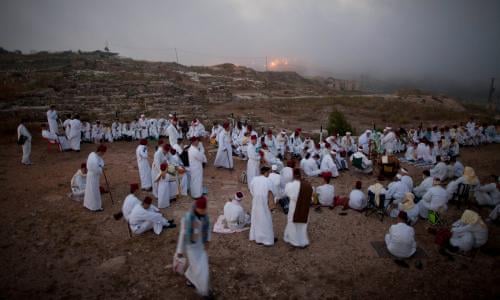
But the Scriptures give a different view, that the new settlers weren’t a Jewish sect but idols-worshippers from various regions of Babylonia when the Assyrians captured their land and redistributed its captives throughout the Assyrian empire. The background of the arrival of the Samaritans to live in Samaria is recorded in the Scriptures for our enlightenment, hence there is no need to seek guidance from Schluss’ heresy.
And the Lord rejected all the seed of Israel and afflicted them, and delivered them into the hands of despoilers until He had cast them out of His sight.
For He rent Israel from the house of David, and they made Jeroboam the son of Nebat king. And Jeroboam drove Israel from following the Lord, and made them sin a great sin.
For the children of Israel walked in all the sins of Jeroboam which he did; they departed not from them, until the Lord removed Israel out of His sight, as He had said by all His servants the prophets. So was Israel carried away out of their own land to Assyria unto this day.
And the king of Assyria brought men from Babylon, and from Cuthah, and from Ava, and from Hamath, and from Sepharvaim, and placed them in the cities of Samaria instead of the children of Israel; and they possessed Samaria and dwelt in the cities thereof (II Kings 17:20-24).
The newly arrived Samaritans, actually from “Babylon, and from Cuthah, and from Ava, and from Hamath, and from Sepharvaim,” occupied the country formerly belonging to the tribe of Ephraim, Manasseh and the other Ten Tribes where most of today’s Church of God communities come from. The capital of their country was Samaria, then a large and splendid city.
When the ten tribes were carried away into captivity to Assyria, the king of Assyria sent people from Cutha, Ava, Hamath, and Sepharvaim to inhabit Samaria (II Kings 17:24). For simplicity, Jews call these new settlers “Cutheans,” but in a religious sense, they were a mix from five different groups, all idol-worshippers, who would be more accurately described collectively as Babylonians.
In order to preserve the true worship of God, it was essential to differentiate the Scriptures of the Jerusalem Jews from the Scriptures of the Jewish/Samaritan religion. The first step was to set the Scriptures in order and canonize each book as the authentic Word of God. When this work was completed, accurate copies of the entire text had to be made and distributed to Jewish synagogues throughout the empire. Once canonized, the Word of God could be preserved for all time. (Pg 183)
As part of the canonization of the Scriptures, Ezra also edited the books which became the Old Testament. This editing included the substitution of current terminology for ancient names that were no longer in use. (Pg 184)
Ezra edited Deuteronomy 16 from the then old Samaritan version, so Fred Coulter alleged, as the Samaritan version must be the authentic version. Quoting his own work, “The Original Bible Restored,” he says, “Although a few alterations were made in the text of the Old Testament after its canonization, there is no question that Ezra was the one who compiled the books, edited them and canonized them” (ibid). But of course, Fred was mainly referring to Ezra’s forging of Deuteronomy 16 (mainly verses 1-8).
If you compare Deuteronomy 16:1-8 in the Samaritan version to the King James, they are virtually the same. There would actually be more difference between the King James and the Revised Version.
“Whatever I command you, observe to do it. Thou shalt not add thereto nor diminish from it (Deuteronomy 12:32). Forging the Bible is a serious charge, risking eternal life (Revelation 22:18-19). But on the other hand, if Ezra isn’t guilty of forging, then his accusers would be in danger of death.
Fred Coulter’s charge isn’t alone. He has a few comrades: all ex-ministers of the now non- existing WCG, all graduate of the defunk Ambassador College. They are happy to share their views.
From Frank W Nelte, referring to Deuteronomy 16:1, 2, 4, 5, 6
These verses give the impression that the Passover is being spoken about. But the word “Passover” was deviously inserted into these verses by some dishonest scribe. The motivation for these devious changes was to justify the Jewish custom of referring to the Seven Days of Unleavened Bread as “Passover”.
The evidence for the fraudulent changes in this section of Scripture is not found in preserved manuscripts but in the pages of the Bible itself. We are dealing with a passage that is absolutely vital to upholding a Jewish belief, which belief is clearly unbiblical according to all the other Scriptures in the entire Old Testament. And these fraudulent changes have been accepted in every preserved manuscript, because they endorse a specific Jewish custom.
In addition, there is also a mistranslation in verse 6.
The only evidence for these alterations consists of exposing incompatible, contradictory and illogical statements in the changed text, when compared to other biblical passages. The person who altered this text overlooked some things which expose his fraudulent tampering.
Here are the changes that were made:
In these verses some scribe REMOVED the expression “the Feast of Unleavened Bread” from verse 1, and then REPLACED IT with the word “Passover”. In addition, this scribe also simply INSERTED the word “Passover” into the text of verses 2, 5 and 6 (SOME SCRIBES CHANGE THE TEXT OF DEUTERONOMY 16:1-6).
From John W Ritenbaugh:
In the context of Deuteronomy 16, the word “Passover” is beginning to look clearly out of place. As we continue to look further, we are going to see that verses 1-8 have nothing to do at all with instructions for the Passover lamb, but rather for Unleavened Bread, and specifically the Night To Be Much Observed, which is of course the first night after the Passover, not the same night as the Passover.
How did the name “Passover” get in there? God certainly did not inspire it to be in there. It had to have been edited into Deuteronomy 16 at a much later time (when the entire eight days of the spring festival were commonly called Passover) than from when it was originally written. You will see this very clearly in the New Testament that the entire spring feast was commonly called Passover by the Jews. Somebody, in copying, must have deliberately removed the name “Unleavened Bread” and placed the name “Passover” into Deuteronomy 16 in order to give support to a 15th Passover—to a Temple-centered 15th Passover (Passover transcript, Part 9).
“Why were these particular Scriptures chosen as the ones to be edited? It was very likely because Deuteronomy 16 does not contain any numbered dates—for example, “Passover is on the 14th, and the Feast of Unleavened Bread on the 15th.” Because of the lack of numbers, the text in Deuteronomy 16 could be edited and changed to give the appearance of a 15th Passover. But if the texts of Exodus 12, Numbers 9, and Leviticus 23 would be altered, somebody would have to alter the numbers, and that would result in very dramatic editing. That was unthinkable, and it would have been very obvious, too, that the Scriptures had been tampered with.”
“Who would have the authority to make such a change from Unleavened Bread to Passover in Deuteronomy 16? The finger of history points to someone during or after the time of Ezra. Ezra came along in the period roughly between 530 BC and about 515 BC. When Ezra came on the scene, the Jews, who had just come out of captivity, were again starting down the same path that originally took them into captivity” (Passover transcript, Part 10).
Tampering and forging God’s Word are serious charges, whose penalty is death (Revelation 22:18-19):
“For I testify unto every man that heareth the words of the prophecy of this book: If any man shall add unto these things, God shall add unto him the plagues that are written in this book.
“And if any man shall take away from the words of the book of this prophecy, God shall take away his part out of the Book of Life and out of the Holy City, and from the things which are written in this book,” Revelation 22:18-19.
Zechariah 11:8 is one of the most intriguing verse in the Scriptures. It says, “Three shepherds also I cut off in one month; and my soul loathed them and their soul also abhorred me.” Who are these three shepherds? Could they be Fred Coulter, Frank Nelte and John Ritenbaugh? (JR died May 28, 2023; Sunday, on a Samaritan Pentecost).
~~~
~~~~~~~~


