
A Critique of Fred Coulter’s Passover (6-9)
A Critique of Fred Coulter’s Passover (d-e)
Passover on the 14th or 15th?
Fred R. Coulter
Christian Biblical Church of God
Post Office Box 1442
Hollister California 95024-1442
This is a continuation of a Critique of Fred Coulter’s Passover. This Passover controversy is an important Bible subject and we’ll follow it in detail. The main issue is whether the Passover is on the early or late fourteenth of Nisan.
Quoted are Fred Coulter’s work, from an internet PDF version. These excerpts are in block form, in PINK, and indented so as to differentiate them from other quotes or comments. The Scriptures, in RED, must be our primary focus and guide, and sometimes the Scriptures, which include the Septuagint and the Targum, say things very different from what we think!
And so with that in mind, we’ll begin:
Chapter 6 – 7
The killing of the Passover lambs took place AT THE BEGINNING of the fourteenth day. As the thirteenth day of the month drew to a close, all the children of Israel assembled their families and gathered around the lambs, watching the sun set and waiting for the sun to disappear below the horizon. The instant it dropped below the horizon, ending the thirteenth and beginning ben ha arbayim of the fourteenth, all the children of Israel killed the Passover lambs at precisely the same time! What a fantastic occurrence!
As God had commanded, “And the whole assembly of the congregation of Israel shall kill it BETWEEN THE TWO EVENINGS [Hebrew ben ha arbayim]” (Ex. 12:6). (Pg 57).
What is being described above – “watching the sun set waiting for the sun to disappear below the horizon” – resembles a passover at Mount Gerizim! The Samaritans, donning long white robes, chanting prayers and eating in haste would keep their passover — with belts on their waists, sandals on their feet, and staffs in their hands — at Mount Gerizim at sunset. What a fantastic scene!
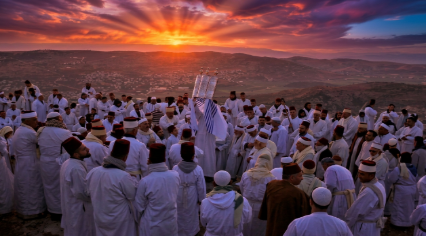
What Hayyim Schauss wrote below about facing WESTWARD toward the setting SUN and about the REJOICING KISSES could complement Fred Coulter’s book:
“Exactly at sunset the High Priest faces westward and reads that portion of the Pentateuch which orders the slaughtering of the Pesach sacrifice. About twelve or fourteen of the younger Samaritans busy themselves, meanwhile, with preparing the sacrificial animals. They form a circle about the pit of fire, holding the lambs between their legs, and as the High Priest utters the words, ‘And the whole assembly of the congregation of Israel shall kill it at dusk,’ they utter a benediction and throw the lambs, throats to the pit, where they are slaughtered by two ritual slaughterers. Six or seven sheep are slaughtered.
“The slaughtering is a signal for general rejoicing. Greetings are exchanged in the oriental manner; the participants kiss one another, first on the right shower and then on the left” (Schauss, The Jewish Festivals, pg 63; or online).
The Samaritans were very particular that the sheep should not be killed a minute before or after the sun went down. Just as the sun dipped into the Mediterranean the sheep were killed, the people shouting all the time. In reality, exactly “AT SUNSET” the Samaritans would be facing “WESTWARD” in worshipping their God. But, in fact, they are SUN WORSHIPPERS, a syncretic blend of paganism and heresy, and this ancient apostasy is continuing in the CoG (CoGs) Communities today, unabashed.

“At sunset, or ba erev,” according to Fred Coulter, “is a very short period of time. It begins when the sun appears to touch the horizon,” and that’s when the lamb was killed, all simultaneously, during and is no more than 3-5 minutes. “What a fantastic occurrence!” Fred added his expression as the Samaritans began kissing each other on the shoulders, first on the right , then on the left.
But note one significant difference. The Samaritans don’t have another sacrifice following one at ba erev to satisfy ben ha arbayim as expressed in Exodus 12:6. Even the Samaritans are not that foolish, but Fred Coulter would whip out another rabbit from his hat and make another sacrifice. One at ben ha arbayim, and another one at ba erev. He wrote of others but in reality some of his observations are for himself. Here is one:
“WHAT FOLLY! What foolishness to accept a traditional belief that directly conflicts with the truth of God’s Word, and to use interpretations of Scripture that promote the false ideas of men! No wonder God says that He entraps the intelligent in the foolishness of their own human wisdom” (Pg 61).
According to Fred, “there can be no doubt whatsoever that ben ha arbayim comes after ba erev, or sunset.” And he kept on harping his stupidity, “we have found irrefutable proof that ben ha arbayim — “between the two evenings,” or “between the setting-times”—begins immediately after the day has ended at sunset, or ba erev.”
His analysis requires two rabbits for his passover, called Fred Coulter’s passover, one for his analysis of ben ha arbayim Exodus 12:6 and the other to satisfy his definition of ba erev Deuteronomy 16:6.
Like a magical touch of Simon Magus, it’s another sleight of hand. And together with most of today’s Churches of God Communities, they also believe the same magic. It’s no surprise they all came from the same homeland — from Samaria.
“Ephraim compasseth me with lies, and the house of Israel with deceit” Hosea 11:12.
“And the head of Ephraim is Samaria” Isaiah 7:9
The Churches of God Communities may fervently consider themselves as virgins, waiting, waiting, but they haven’t realized they are being described elsewhere as “wretched” and “blind” and “naked,” (Revelation 3:17) and lies!
But the House of Israel continue with their deep-seated hatred of their brother Judah:
“Manasseh, Ephraim; and Ephraim, Manasseh; and they together shall be against Judah. For all this His anger is not turned away, but His hand is stretched out still” Isaiah 9:21.
The Orthodoxy Rabbinic interpretation as to when to correctly kill the lamb is confirmed by the work of Ezra: The lamb were indeed killed on the afternoon of the fourteenth and eaten on the night of the fifteenth. The Targum (530 BC to 500 AD), whose origin was during the intertestamental period, translates and explains the eating of the Passover from the Hebrew in Exodus 12 into the vernacular, in a very simple language, and verse 8 is extremely clear: “And you shall eat the flesh on that night, the fifteenth of Nisan . . .” (Exodus 12:8 Jonathan)

When the Exile returned from Babylon, Ezra, a Levite and high priest, read and translated the Torah in Hebrew into the common Aramaic language, and he, or other Levites, explained the Torah so the people could understand.
“The Levites … instructed the people in the Law while the people were standing there. They read from the Book of the Law of God, making it clear and giving the meaning so that the people understood what was being read” (Nehemiah 8:7–8).
Another way of saying: the Law was read by Ezra, verse by verse, and each verse was followed by a recitation by the Levites into the Aramaic version. Hence in Nehemiah 8:8 Ezra narrated not only the reading of the Law, but the Levites interprete and explain the Torah from Hebrew into the vernacular in Aramaic. Only then could the Jewish returnees understand.
Now on the subject of the true timing of when the quail arrived in the evening, the Rabbinic understanding is that the quail arrived in the afternoon, anytime when the sun moved passed its zenith, until sunset, which is the first phase of erev — this same period could also be described as ben ha arbayim — “between the two evenings,” or “after noon and until nightfall.”

During this time of about six hours, it is daylight time and the Israelites wouldn’t have any problem catching the quail, killing them, skinning and cleaning them, cooking and having them for food. There wouldn’t be any problem at all about keeping the Sabbath when it arrived a few hours later.
Also, the Scriptures are silent about the quails appearing six times a week in any manner like manna did for forty years as expressed in Exodus 16:35. In fact, the story of the quail in Numbers 11 strongly hints, especially with a plague involved, that it is a one-off event, as there were no record of any quail catching or eating again.
Also, in Numbers 11:32, it confirms the time “all that day and all that night and all the next day” was actually the time spent on waiting, watching and when the quails came, the catching and gathering the quails.
Thus says the Targum:
“And they who had been wanting in faith arose: and all that day, and all the night, and all the day that followed, they gathered the quails; even he who was lame and infirm gathered ten korin (ten donkeys’ loads), and they spread them abroad round about the camps” (Numbers 11:32 Jonathan).
No other details were given but Scriptures commented that the gathering of the quails was so great that the catch could last not just a week or two, but a whole month’s supply.
And after this incident, no repeat of the quail’s appearance were ever mentioned again. The story of the quails is about a contemptuous, a wicked and a lusting people, offering no thanksgiving to Him that fed them, thus deserving a death penalty by a flaming fire from the Lord – all hinting that Numbers 11 was the only and final event.
Regardless of the quails appearing once or more, the story of the quails is about a contemptuous, a wicked and a lusting people, offering no thanksgiving to Him that fed them, thus deserving a death penalty by a flaming fire from the Lord.
All these bad attributes mentioned above brought about their downfall, a lesson they needed to learn to be content, be humble and be thankful with having manna for the rest of their forty years wandering in the desert.
Fred Coulter continues:
“To roast a whole lamb or kid weighing 20-30 pounds until the meat was thoroughly done would take approximately 4-5 hours. The total time needed to have the meal ready is estimated to be from 4 and 1/2 hours at the earliest, to 5 and 3/4 hours at the latest, which includes 30-45 minutes to prepare the lamb and 4-5 hours to roast it” (Pg 67).
If a lamb were to be killed at 6 PM, at sunset, as Fred Coulter advocates, and allowing an hour to set the fire which, and roasting the lamb would take approximately 4-5 hours.
“The fire had to be kindled well in advance in order to be hot enough to roast the lamb, and additional wood had to be added periodically to keep the fire burning sufficiently during the time needed to roast the meat. Moreover, sufficient wood had to be stockpiled to burn the entire remains of skin, intestines, fat and bones when the meal was completed” (ibid).
To fulfill all the requirements for the Passover exactly as God had commanded would have taken the children of Israel from 6 PM until approximately 2-3 AM, as we reckon time. (Pg 68).
It would be approaching midnight when the Passover meal is ready. Does this make sense? It does make sense when the timing matches the Samaritan tradition of spending the entire night on Mount Gerizim for their Passover.
The question of Fred’s book is errorous. It is not a question of the 14th or the 15th? The Orthodox Jews have it on BOTH the 14th AND the 15th. The Passover Festival started with the killing of the lamb at 3 PM on the 14th, and continued the eating of the lamb on the 15th. Passover is a composite festival, whereby in the process of keeping this festival, unleavened bread were to be eaten for the next seven days.
Besides flouting and stigmatizing the Rabbinic understanding of evening (erev), Fred Coulter also redefines what morning (bôqer) is in Genesis 1:5 And the evening (erev) and the morning (bôqer) were the first day. Such a day is a full 24-hours day.
In the idiosyncrasies and beauty of the Hebrew language and other oracles that God had created specifically for the Orthodox for safe-keeping, erev can refer to any one of three timeframes: (1) from noon or midday to sunset, (2) from sunset to midnight, or (3) from noon or midday to midnight.
(1) erev: from noon to sunset; only this timeframe coinsides with the term ben ha’arbayim;
(2) erev: from sunset to midnight: this timeframe is to start a day, or the Sabbath; also the time to eat the Passover;
(3) erev: from noon to midnight; this is a 12-hour evening, or for today’s readers, better known as the whole 6-hour afternoon and the first 6-hour night; and when combined with the other 12-hour morning, from midnight, it completes a full 24-hour day. This concept is key to understanding the Genesis creation: “And the evening and the morning were the first day.”
Here in the Creation account in Genesis, a day is a 24-hour day which is divided into evening (erev – the third meaning above) and morning (bôqer), each would only be a 12-hour period. The full extent of time for this evening (erev) is a 12-hour period from noon to midnight; and for morning (bôqer) is another 12-hour from midnight to noon.

The English language has numerous idiosyncrasies, too. For another example, the words “America” and “American” carry a unique set of linguistic and global confusion.
For English speakers, “America” refers to a single country—the United States of America. However, geographically and historically, it refers to two entire continents (North America and South America) comprising 35 sovereign nations.
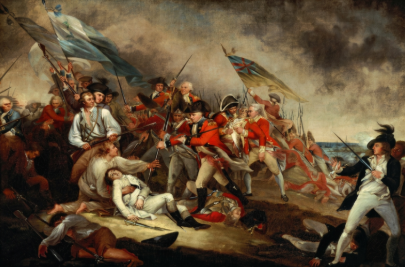
If someone says “I’m traveling across America,” an English speaker assumes they are visiting the US, whereas someone from Brazil, Mexico or Argentina would view “America” as the entire Western Hemisphere stretching from Canada to Chile.
In Spanish and Portuguese, the Western Hemisphere is a single continent called América. Referring solely to US citizens as americanos is seen as exclusionary or even hubristic, as anyone from Canada down to Tierra del Fuego is also an “American.”
During the 1500s–1600s: “American” referred exclusively to the Indigenous peoples of the Americas. Only after the post 1776 ‘American’ Revolution, did it morphed into its modern political definition solely for the self-absorbing citizens of the United States.
That’s how the word “even” or “evening,” once referred to a roughly six-hour span from afternoon to nightfall, ended up being restricted to just those fleeting moments of dusk or twilight, much to our modern-day confusion, adding yet to an impulsive life-and-death urge why such a compelling 508-paged book, The Christian Passover, should be written.
~~~~~
~ ~ 7 ~ ~
Up to Chapter 7 of Fred Coulter’s The Christian Passover, we can see the author had quoted a lot from Everett Fox’s translation and from the Schocken Bible. And both sources translate boqer as “until sunrise” or “UNTIL DAYBREAK,” (pg 71) or “beginning at the crack of dawn,” (pg 77).
Or we’ll the the text with context in Chapter 7:
God strictly forbade any Israelite to leave his house until sunrise. The Schocken Bible conveys the precise meaning of the Hebrew word boqer, showing the exact time at which the children of Israel were permitted to leave: “Now you—you are not to go out, any man from the entrance to his house, UNTIL DAYBREAK” (Ex. 12:22, SB). (Pg 71)
Morning, or boqer, does not include any part of the night, or lailah. Boqer begins with the first light of dawn, just before the sun rises above the horizon. Nowhere in Scripture is there any indication that boqer is “long before sunrise” or “the latter portion of the night.” The Scriptures never refer to the dark hours after midnight as boqer, or “morning.” (Pg 78)
And flashback to similar issues in earlier chapters, Coulter wrote:
“At sunset,” or ba erev, is a very short period of time. It begins when the sun appears to touch the horizon, and ends when the sun drops be low the horizon. The total duration of its setting is no more than 3-5 min utes. The term ba erev is very specific! (Pg 35).
Everett Fox, a noted authority in Biblical Hebrew, holds firmly to the definition of ben ha arbayim as the time between sunset and darkness. Here is Fox’s translation of God’s command in Leviticus 23:5 concerning the Passover: “On the first New-Moon, on the fourteenth after the New Moon, between the setting-times [Hebrew ben ha arbayim] (is) Passover to YHWH” (SB).
The Schocken Bible offers the following footnote to clarify this verse: “Between the setting-times: Between the time that the sun is be low the horizon, no longer visible, and total darkness. (Pg 51-52).
So who is Everett Fox, “a noted authority in Biblical Hebrew“ since he is greatly admired by Fred Coulter? And who are behind the Schocken Bible? As Fred had quoted principally from Fox’s translation and the Schocken Bible we’ll take a deeper dive to find out more.
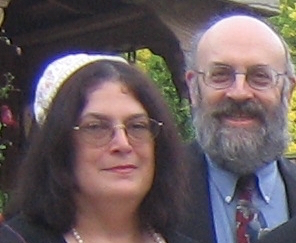
Everett Fox spent years at Brandeis University as a college student, majoring in Near Eastern and Judaic Studies. He is the husband of Jewish educator, Rabbi Cherie Koller-Fox (a Jewish feminist), yet he is described, at best, as a conservative Jewish scholar.
Although Fox studied at the Jewish Theological Seminary (JTS) of America in New York for only one and a half years at the Seminary, the influence from the reform-minded Seminary had a deep impact on him, as evidence showed in his translation of the Bible, published by Schocken Books. And they all teamed up to publish the Schocken Bible (described as an offshoot of the Buber-Rosenzweig translation), from which Fred Coulter quoted extensively.
The JTS seminary was started by Rabbi Zecharias Frankel (1801-1875) who was a leading figure in mid-19th Century German Jew. Known both for his traditionalist views and the esteem he held for scientific study of Judaism. Frankel was, ironically, at first considered a conservative within the nascent Reform Judaism Movement.
The Reform Judaism Movement, or Reform Judaism, or sometimes just the Reform Movement advocates that Jewish laws are not static, but rather have always developed in response to changing conditions. In his endeavour, Frankel amassed scholarly support which showed one must be open to a changing environment and developing Judaism in the same evolving fashion that the law should be reinterpreted, and as a way of restoring meaning to modern life.

Although the Jewish Theological Seminary of America was alleged to be a product of the Reform Movement, it claimed to be “a new rabbinical school” in New York City.
There were power struggles between the two, but eventually Reform Judaism gained ground as the Seminary developed a new movement known as Conservative Judaism. This ‘conservatism’ may not sound conservative — traditionalist, orthodox, conventional — but Reform Judaism were just only taking place at a slower pace. Nevertheless the Jewish Theological Seminary became the primary educational and religious center of Conservative Judaism.
The central theme for the Conservative Movement is that Jewish Law shouldn’t be regarded as static, but “to reignite a fresh religious insight,” that Rabbinic Judaism be regarded as non-binding and that individual Jew should be regarded as autonomous, and that our perception of Judaism “should incorporate openness to external influences and progressive values” as the years unfold. Concurrently, examining Jewish history and rabbinic literature through the lens of academic criticism, it maintained that these laws were “always subject to considerable evolution, and must continue to do so.”

Thus from the beginning in the 1970s, the topic of women’s ordination was regularly discussed at JTS. A special commission (which consisted of 11 men and three women) was established by the chancellor of the Seminary to study the issue of ordaining women as rabbis. After years of discussion, the JTS faculty voted to ordain women as rabbis and as cantors in 1983.
The first female rabbi to graduate from the school (and the first female Conservative Jewish rabbi in the world) was Amy Eilberg, who graduated and was ordained as a rabbi in 1985. The first class of female rabbis that was admitted to JTS in 1984 included Rabbi Naomi Levy, who later became a best-selling author and Nina Beth Cardin, who became an author and environmental activist. Erica Lippitz and Marla Rosenfeld Barugel were the first women ordained as cantors by JTS (and the first female Conservative Jewish cantors in the world). They were both ordained in 1987.
Since March 2007, JTS has accepted openly gay, lesbian, and bisexual students into their rabbinical and cantorial programs. This is to uphold the Seminary’s non-discrimination policies for their new founded admission policy, without taking a stance on same-sex unions. JTS marked the first anniversary of the change with a special program.
Since then, special programs were established to recognize the pluralism in the student body. In April 2011, JTS held a Yom Iyyun, or day of learning, about LGBTQ issues, and their intersection with Judaism. Joy Ladin, a transgender woman who teaches English at Yeshiva University, gave a talk about her life. Other programs included creating welcoming communities, and inclusive prayer, among others. It was sponsored by other Jewish social action groups to ensure that all other queer individuals are included in all sectors of Jewish life.

Ladin has described her girlhood intuiting at a young age, viewing her assigned male identity as “false” as a child. At age eight, she began calling herself a “pacifist” in order to avoid combative play and athletics.
She received her PhD from Princeton University in 2000, her MFA in Creative Writing from the University of Massachusetts Amherst in 1995 and her BA from Sarah Lawrence College in 1982. In 2007, Ladin received tenure at Yeshiva University, and thereafter announced her gender transition. In consternation, the Yeshiva could only place her on 18 month paid leave, but with the aid of lawyers from Lambda Legal, Ladin returned to work at Yeshiva University in 2008.
Since its birth, Reform Judaism had given themselves a new challenge. In an effort to avoid what they perceived as “bondage to Judaism” the Bible has to be reinterpreted in a different way from what the Rabbinic Orthodoxy believes.
Thus the Hebrew term ben ha arbayim is reinterpreted as between the setting-times and erev as dusk. And bôqer, which Orthodoxy defined as the time after midnight to noon, is redefined and restricted to daybreak or sunrise. So Passover and the Exodus were redefined to recapture the spirit of the ancient Samaritans, a spirit that persistently looked at Jewish laws and issues not from a static viewpoint, but from an evolving angle.
Biblical and non-Biblical history has recorded a couple of evolving reinterpretations at various times to suit a new social and political environment, each has its own axe to grind:
(1) King Jeroboam — Being anointed King of the Northern Kingdom, Jeroboam quickly felt he needed a new place of worship, lest his subjects could be influenced to pledge their allegiance back to the Kingdom of Judah based on Jerusalem. For the convenience of his subjects, he chose two places: Bethel and Dan. And to differentiate from Jerusalem’s feasts, he moved the Feast of Tabernacles to the eighth month. Also, he made himself the high priest, whose action drove most of the Levites and others in the priesthood south to the Kingdom of Judah.

(2) The Samaritans — After the Shalmaneser king of Assyria had taken the Ten Tribes into Exile, he took the surrounding heathens to resettle the land.
And the king of Assyria brought men from Babylon, and from Cuthah, and from Ava, and from Hamath, and from Sepharvaim, and placed them in the cities of Samaria instead of the children of Israel; and they possessed Samaria and dwelt in the cities thereof. (II Kings 17:24).
But lions plagued the new settlers, so they needed a priest from the previous populace to come and teach them how to worship the God of the land. Having secured a returning priest, the new settlers “feared the Lord, but served their own gods, after the manner of the nations who carried them away from thence” (II Kings 17:33).
(3) Sanballat the Horonite — He was a Samaritan governor and was a chief opponent of Nehemiah and Ezra, and who, with some Jewish allies, constantly fought against Jerusalem and the teaching of Ezra. Failing to infiltrate Jerusalem in the rebuilding Temple activities, he sought consent from the Persian Court to build a similar temple on Mount Gerizim as Nehemiah had done in Jerusalem. And he had one of the grandsons of Eliashib, the high priest in Jerusalem, made a high priest in Mount Gerizim. He was Manasseh, who married a daughter of Sanballat, and was dispelled from Jerusalem for not keeping his lineage pure (Nehemiah 13:28). The Mountain Gerizim was inserted into the Pentateuch to make the new mountain under their control as God’s sacred mountain.
(4) The Sadducees — the Sadducaic sect claimed they drew their name from Zadok, the first high priest of Israel to serve in the First Temple, with further claims they were the “sons of Zadok,” descendants of Eleazar, son of Aaron. Many of the Pharisees were also priests and both participated in the Temple and in the Sanhedrin, so there were intense rivalries battling each other for centuries. The Boethusians and the Herodias had strong blood ties and were close compatriots of the Sadducees.
(5) The Karaites — Anan ben David (715 – 795 or 811?), a nasi, a prince, from a family of exilarchs, the leaders of Babylonian Jewry, was the founder of the Karaite movement. His followers were, at first, called Ananites, but adopted Karaism as their movement. They rejected the Oral law as divinely inspired and because many of their other beliefs were similar to the Sadducees, some claimed they were descendents from them. Nehemia Gordon is a prominent Karaite today among English-speaking audiences.
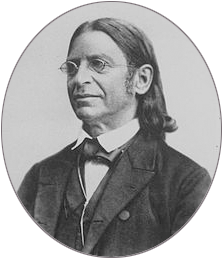
(6) Reform Judaism — Abraham Geiger (1810 – 1874), a rabbi in Germany, was considered the founding father of the Reform Movement. Emphasizing Judaism’s constant development along history and universalist traits, Geiger sought to reformulate a new form of Judaism in what he regarded as a religion compliant with modern times. And so he did, splitting Judaism further in varied forms: Reform, Conservative, Progressive, Liberal, Humanistic and Reconstructionist.
(7) Church of God Communities — together with the Church of God, Seventh Day, the Seventh-Day Adventists came from the teachings of William Miller (1782 – 1849), especially the need to keep the seventh-day Sabbath. Next came Herbert W Armstrong who started the Radio Church of God in 1933 (renamed Worldwide Church of God in1968), and Ambassador College in 1947. Following his death in 1986, the church and the college collapsed, and now a couple of its splinters remain, known collectively as the Church of God Communities, manages to survive but just limping along.
But here our concentration is on the (6) Reform Judaism for the moment:
The Orthodox or Rabbinic life faced many challenges since the Industrial Revolution and were subjected to numerous scrutiny among the majority of Jews living in the diaspora at large. And soon their claim as sole traditional theological authority to Torah Law and practice were not sustainable over the difficulties they were facing. This gave rise to demand for changes and reforms in various guises — a stiffnecked people adding sin to sin, a rebellious and lying children — would all be ending by a consuming fire. Thus says in the Sacred Text:

“Woe to the rebellious children,” saith the Lord, “that take counsel, but not of Me, and that cover with a covering, but not of My Spirit, that they may add sin to sin . . . that this is a rebellious people, lying children, children that will not hear the law of the Lord” (Isaiah 30:1,9).
And the Lord said unto Moses, “I have seen this people, and behold, it is a stiffnecked people. Now therefore let Me alone, that My wrath may wax hot against them, and that I may consume them” (Exodus 32:9-10).
“Understand therefore this day that the Lord thy God is He who goeth over before thee as a consuming fire” (Deuteronomy 9:3).
Could this wrath of “a consuming fire” that were destined for other people in ancient times be turned around in our modern era toward the CoG Communities by the same Lord? And could it “begin at My sanctuary?” (Ezekiel 9:6) That is, Could it begin with the CoG Communities? We’ll see as we investigate this complex question further in later critiques.
~~~~~
Chapters 8 – 9
The Critique of Coulter’s The Christian Passover continues:
In Chapter 8, vanity aside, Fred Coulter is quoting his own translation as before. For one who doesn’t have any Hebrew of any descriptions, it’s quite an amazing feat!
Coulter accurately translates ba erev as “at sunset,” showing that the Feast of Unleavened Bread begins immediately after the Passover day ends: “And you shall keep the Feast of Unleavened Bread, for in this same day [the 15th, the first day of the Feast of Unleavened Bread] I have brought your armies out of the land of Egypt. Therefore you shall keep this day in your generations as a law forever. In the first month, on the fourteenth day of the month at sunset [ending the Passover day and beginning the 15th], you shall eat unleavened bread, until the twenty-first day of the month at sunset [ending the 21st day]” (Ex. 12:17-18). (The Christian Passover, Pg 89)
GOD DID NOT COMBINE THE PASSOVER AND THE FIRST DAY OF UNLEAVENED BREAD. It was the leaders of Judaism who changed the commandments of God and combined the two feasts, eliminating the 14th Passover and proclaiming the 15th as the Passover day, and then supporting their erroneous teaching with the empty argument of a “day’s delay.” (Pg 90)
Fred’s analysis is all over the place. If unleavened were to be eaten only AFTER “the Passover day,” but the Scriptures say to eat unleavened bread on “the fourteenth day, at even,” until the twentieth-first day of the month at even, Exodus 12:18.
“In the first month, on the fourteenth day of the month at even (ba-erev), ye shall eat unleavened bread until the one and twentieth day of the month at even (ba-erev)” Exodus 12:18
“Thou shalt not offer the blood of My sacrifice with leaven, neither shall the sacrifice of the Feast of the Passover be left until the morning” Exodus 34:25
The Scriptures says, the moment the Passover lamb was killed, it was also the same moment that only unleavened bread were to be eaten. In both instances, in Deuteronomy 16:6 and Exodus 12:18. Observing the Unleavened Bread ordinance starts the exact moment the Passover lamb was killed. Passover, incorporating unleavened bread observance, is a multifaceted Festival. It is a composite Festival, yet each of its components could stand by itself.
Passover and Unleavened Bread were well amalgamated right at the beginning, at the time of the original Exodus.
And this amalgamation is confirmed in another passage in Exodus 34:25
“Thou shalt not offer the blood of My sacrifice with leaven, neither shall the sacrifice of the Feast of the Passover be left until the morning” Exodus 34:25.
— that is, the moment the lamb being killed, and blood offered, no leaven was to be found. Further, it expressed Passover as a Feast and it is to be celebrated with unleavened bread. Hence the Passover Feast is a Composite Feast.
Rashi: You shall not slaughter the Passover sacrifice as long as leaven still exists. This is a [specific] warning to the slaughterer, to the one who sprinkles the blood, or to one of the members of the group [bringing this sacrifice]. -[from Pes. 63b].
In Deuteronomy 16:6 ba·erev is the time to kill the Passover on the fourteenth; and in Exodus 12:18 ba·erev on the fourteenth is also to commence eating unleavened bread. The Composite Feast started on the fourteenth, at erev, and continued through the fifteenth to the twentieth (Exodus 12:18).
Here is a great revelation from Ezra: his-inspired Targum had made it crystal clear that the Passover was a late fourteenth and the eating was on the fifteenth: “And you shall eat the flesh on that night, the fifteenth of Nisan . . .” Exodus 12:8 Jonathan
And this composite characteristic is confirmed in the New Testament time:
Now on the first day of the Feast of Unleavened Bread, the disciples came to Jesus, saying unto Him, “Where wilt Thou that we prepare for Thee to eat the Passover?” Matthew 26:17
And on the first day of Unleavened Bread, when they killed the Passover lamb, His disciples said unto Him, “Where wilt Thou have us go and prepare, that Thou mayest eat the Passover?” Mark 14:12
“Now the Feast of Unleavened Bread drew nigh, which is called the Passover,” Luke 22:1
“Then came the Day of Unleavened Bread when the Passover lamb must be killed,” Luke 22:7
In both Testament times (Old and New), the Passover and Unleavened Bread ordinances were well interlaced. The testimonies from Exodus 12 and the New Testament are like twin mirrors: when placed against the CoG Communities, they reflect their nakedness. But these Wretches and Blind could not see their Nakedness because they are blind and they continue speaking with various deceptions. (Revelation 3:17)
This is plainly what the Scriptures say, but “Ephraim compasseth me with lies, and the house of Israel with deceit” (Hosea 11:12). Only the stiff-necked couldn’t see this. Plain and simple. The modern day descendants of Ephraim operate with lies and deceit!
And they are throwing diatribes and lying against the one with the Oracles of God, the Jews (Romans 3:1-4). Below is another verse great for reflection:
“Manasseh, Ephraim; and Ephraim, Manasseh; and they together shall be against Judah. For all this His anger is not turned away, but His hand is stretched out still” Isaiah 9:21.
John Gill: for all this his anger is not turned away, but his hand is stretched out still; that is, the anger of God, that was not turned away; he had not yet stirred up all his wrath, he had not done with them, he had still other judgments to bring upon them; and his hand continued to be stretched out to inflict them, seeing they were not brought to repentance by what was already done unto them; so the Targum, “for all this they do not return from their sins, that he may turn away his anger from them, but still retain their sins; and yet his stroke will be to take vengeance on them.’
The anger of God will begin at His Sanctuary:
“Go ye after him through the city and smite. Let not your eye spare, neither have ye pity. Slay utterly old and young, both maids and little children and women; but come not near any man upon whom is the mark; and begin at My sanctuary,” Ezekiel 9:5-6.
Again, Fred Coulter spent a lot of time writing about travelling in the darkness of the night.
He wrote:
When the sun began to set, ending the 14th, and beginning the 15th, the children of Israel were all ready to begin the Exodus. . . . The first column would have begun to march out at about 6 PM, as the sun was setting, and the end of the last column would have left the city at about eleven o’clock on the night of the 15th. (Pg 94)
Eleven o‘clock at night is deep into the night! And then further down:
“The Scriptures clearly record that the Exodus began at the going down of the sun, and continued on into the night: “…the LORD your God brought you forth out of Egypt BY NIGHT…. at sunset [ba erev, the beginning of the 15th], at the going down of the sun, at the time that you came out of Egypt” (Deut. 16:1, 6).” (Pg 97) — the erev here is the second erev
But a few pages earlier, Fred wrote, contradicting himself again and again, adding errors to errors:
Imagine the difficulties the children of Israel would have encountered if they had attempted to travel to Rameses by night with no light to guide them. Some families might have ended up in the wrong city and missed the Exodus! And how could they have kept their sheep and goats from being scattered along the way? It is no easy task to keep stragglers from wandering off during the daylight hours; it would have been an impossible task in the dark hours after midnight. (Pg 91)
Deuteronomy 16:6 (thou shalt sacrifice the Passover at even [first erev], from noon to the going down of the sun) is a passage identifying the time when the Passover was to be killed, not when the Israelits were to go out of Egypt.
So it was possible to travel before midnight, but impossible after midnight! In these few pages, Fred Coulter whines back and forth about travelling in the dark contradicting himself what he wrote earlier in the same paragraph: with no light to guide them “[s]ome families might have ended up in the wrong city and missed the Exodus!”
That night, of course, was on the fifteenth, under a full moon, and there shouldn’t be any difficulties seeing the Egyptians burying their dead, either later that night, or early morning. Neither would the Egyptians have any difficulties seeing the children of Israel going out with a high hand.
Traditions or precedents could be bad, but it could also be good. To say all traditions are bad are just too foolish.
Paul, a Pharisee and who never denounced himself as one, testified:
“I profited in the Jews’ religion beyond many of my equals in mine own nation, being more exceedingly zealous of the traditions of my fathers.” Galatians 1:14
“Therefore, brethren, stand fast and hold to the traditions which ye have been taught, whether by word or our epistle.” 2 Thessalonians 2:15
We should learn how to distinguish good traditions from bad ones. We should be learning how to judge, how to be good judges. A good judge has to filter through all sorts of “evidence” and “testimonies” to arrive at a correct final decision. This means our rationale, logic, and emotions must be shielded from the illogically absurd, ridiculous, unfounded, and unbalanced thoughts that tried to muddle our filtering process.
Which tradition is Biblical, which tradition is shaky and without foundation. Without a sound filtering process how could anyone be qualify to be a judge?
~~~~~
~ ~ 9 ~ ~
Critique of Chapter 9 continues:
In our study of the Passover account in the book of Exodus, we found no evidence to support the Jewish tradition of a late afternoon temple sacrifice of the Passover lambs. On the contrary, we found that all the Scriptural evidence points to a Passover at the beginning of the 14th. By letting the Scriptures define “morning” and “night,” we have determined that the children of Israel killed the Passover lambs on the 14th as the day began, right after sunset of the 13th day. (The Christian Passover, pg 101)
Do not be mistaken, the Bible isn’t a dictionary. At best, a verse here or there could hint what a word means, but normally it doesn’t. Most of the meaning of these words are known orally to people who have Hebrew as their native language.
In fact the Hebrew Text that Moses wrote doesn’t have any vowels, thus the Text couldn’t give any clue how the words are to be pronounced, least of all the meanings of each of those words.
To say that “the Scriptures define ‘morning’ and ‘night‘” is not just being misguided, it’s fooling himself. The Samaritans were the first pretenders who foolishly thought of themselves as capable of interpreting the Scriptures, and so they led a string of heresies along the way down to our modern era.
For more, see
In Chapter 9, Fred Coulter asked in a paragraph a series of questions:
Is there any Biblical evidence that God altered the Passover ordinances that He had given to Moses? (Pg 102)
Of course, He did. The original Passover had to be observed in a certain manner because of what God was going to achieve His deliverance of the children of Israel from Egypt. However, in later years, it was a commemoration of the event, not the event itself. If not, during each Passover thereafter, every Israelites would still be:
(a) Eating with their loins girded, sandals on their feet, staff in their hands; and they were to eat in haste;
(b) Go and spoil the Egyptians: jewellery of gold and silver; raiment and any other things in the morning;
(c) Pretend fleeing from Pharaoh and his armies in an re-enactment of the Exodus.
Did God Himself end the domestic sacrifice of the Passover lambs? (ibid)
Of course, He did. Otherwise we wouldn’t read of a 12-year old Messiah-to-be going to Jerusalem to keep the Passover with His parents. They should have kept it back in Galilee, but they didn’t.
Also, the Mishnah sheds more light on this:
What are the differences between the Paschal lamb that was offered in Egypt and the Paschal lamb offered in all later generations? The Paschal lamb offered in Egypt had its blood sprinkled upon the lintel and the two doorposts with a bundle of hyssop, unlike the Paschal lamb in later years. In addition, the Paschal lamb in Egypt was eaten in haste on only one night, whereas the Paschal lamb of subsequent generations is observed for the whole seven days (Pesachim 9).
The Mishnah supports the Scriptures intimately.
After Israel’s first Passover, did He institute a mandatory tabernacle sacrifice of the Passover lambs? (ibid)
Of course, He did. Otherwise what’s the point of God setting aside a whole tribe of Levi and establishing the Priesthood for a special purpose and then having the ordinances of the sanctuary and Temple instituted. The Scriptures warn in Leviticus 17 to bring the blood of any sacrifices to the sanctuary.
Leviticus 17 says if one were to make a sacrifice, any sacrifice including the Passover “in the camp” or “outside of the camp,” the blood must be brought to the tabernacle, and the priest shall sprinkle the blood upon the altar of the Lord at the door of the tabernacle (Leviticus 17:1-6).
The penalty for disobedience is death, for any man who refuses to do;
“And bringeth it not unto the door of the tabernacle of the congregation, to offer it unto the Lord; even that man shall be cut off from among his people” (Leviticus 17:9).
And thou shalt say unto them, Whatsoever man there be of the house of Israel, or of the strangers which sojourn among you, that offereth a burnt offering or sacrifice, and bringeth it not unto the door of the tabernacle of the congregation, to offer it unto the Lord; even that man shall be cut off from among his people (Deuteronomy 16:5-6).
During the time of Moses, Joshua and the Judges, the sacrifices were performed where the Sanctuary was situated, but when the Temple was established permanently in one place it was God who told King Solomon that He had chosen for Himself to move the place of sacrifice to Jerusalem. Hence a Temple-centered sacrifice in Jerusalem is a God-ordained command:
Thus Solomon finished the house of the Lord and the king’s house; and all that came into Solomon’s heart to do in the house of the Lord and in his own house, he prosperously effected. And the Lord appeared to Solomon by night and said unto him: “I have heard thy prayer, and have chosen this place for Myself for a house of sacrifice” (II Chronicles 7:11-12).
“The house of the Lord” is “a house of sacrifice.” And “this place” is in Jerusalem:
“(God) have chosen Jerusalem, that My name might be there” (II Chronicles 6:6).
And many people, seeking the Lord God of Israel, went to Jerusalem to offer sacrifices:
“And after them, out of all the tribes of Israel, such as set their hearts to seek the Lord God of Israel came to Jerusalem to sacrifice unto the Lord God of their fathers” (II Chronicles 11:16).
Other scriptures highlight God’s deep passion and love for the City of Jerusalem.
II Kings 21:4 . . . the Lord said, “In Jerusalem will I put My name.”
II Kings 21:7 . . . the Lord said to David and to Solomon his son, “In this house and in Jerusalem, which I have chosen out of all tribes of Israel, will I put My name for ever.
II Chronicles 6:6 . . . but I have chosen Jerusalem, that My name might be there.
II Chronicles 33:4 . . . the Lord had said, “In Jerusalem shall My name be for ever.”
Ezra 7:19 The vessels also that are given thee for the service of the house of thy God, those deliver thou before the God of Jerusalem.
Ezra 8:30 So the priests and the Levites took the weight of the silver and the gold and the vessels, to bring them to Jerusalem unto the house of our God.
Psalm 116:19 in the courts of the Lord’s house, in the midst of thee, O Jerusalem. Praise ye the Lord!
Psalm 125:2 As the mountains are round about Jerusalem, so the Lord is round about His people from henceforth, even for ever.
Psalm 135:21 Blessed be the Lord out of Zion, who dwelleth in Jerusalem! Praise ye the Lord!
Psalm 147:12 Praise the Lord, O Jerusalem! Praise thy God, O Zion!
Isaiah 2:3 And many people shall go and say, “Come ye, and let us go up to the mountain of the Lord, to the house of the God of Jacob; and He will teach us of His ways, and we will walk in His paths.” For out of Zion shall go forth the law, and the word of the Lord from Jerusalem.
Isaiah 28:14 Therefore hear the word of the Lord, ye scornful men, that rule this people which is in Jerusalem.
Jeremiah 3:17 At that time they shall call Jerusalem the Throne of the Lord, and all the nations shall be gathered unto it, to the name of the Lord, to Jerusalem.
Ezekiel 5:5 “Thus saith the Lord God: This is Jerusalem. I have set it in the midst of the nations and countries that are round about her.
Micah 4:2 And many nations shall come and say, “Come, and let us go up to the mountain of the Lord, and to the house of the God of Jacob. And He will teach us of His ways, and we will walk in His paths.” For the law shall go forth from Zion, and the word of the Lord from Jerusalem.
Zechariah 8:3 “Thus saith the Lord: ‘I am returned unto Zion, and will dwell in the midst of Jerusalem; and Jerusalem shall be called a city of truth, and the mountain of the Lord of hosts, the Holy Mountain.’
Zechariah 14:8 And it shall be in that day, that living waters shall go out from Jerusalem, half of them toward the eastern sea and half of them toward the hinder sea; in summer and in winter shall it be.
The Scriptures are extremely clear but the Blind couldn’t see this because they are just too self-absorbing.
Did God require that the blood of the Passover lambs be sprinkled on the altar? (Pg 102)
Of course, He did.
And they stood in their place after their manner, according to the law of Moses the man of God: the priests sprinkled the blood, which they received of the hand of the Levites. II Chronicles 30:16
And they killed the passover, and the priests sprinkled the blood from their hands, and the Levites flayed them. II Chronicles 35:11
During Passover, the altar is a place of worship presented to God, otherwise King Hezekiah and King Josiah would have commanded the people should instead be taking the blood and striking it at the lintels and both sides of the doorposts of their houses.
In accordance with God’s command, the morning offering was originally offered at sunrise, when the morning begins, and the evening offering was originally offered between sunset and dark. Every day of the year, there was an offering at the beginning of daylight and at the beginning of darkness. Later records of the temple service show that a change was instituted in the time of the evening offering. Instead of an offering immediately after sunset, as God had commanded, the offering was moved to the late afternoon. (Pg 103)
Once again, Fred Coulter makes more allegations of heresy without offering any evidence. Conveniently, he alleges that the original morning and evening sacrifices were offered “at the beginning of daylight” and “at the beginning of darkness” but offers any record or evidence of when the change took place, unless that record came from the Samaritans.
If he could, he would be a Biblical genius, worthy of a Nobel Prize, if not he must be displaying a figment of his own imagination or he is just a serial liar.
Throughout Fred’s writings, he harped continuously about observing a “domestic Passover” but he never defined it clearly. Okay maybe the case in Egypt should serve as the best example, since he advocates the nine Passover ordinances were never changed.
Should this be the case Israelites would be observing Passover in their houses, just as they did in the land of Goshen. Should that be the case, Galileans need not come to Jerusalem and yet Jesus and his disciples went to Jerusalem in numerous times to observe Passover there.
Were they gallivanting in Jerusalem? Were they disobedient? They were supposed to keep their Passover in their houses, back in Galilee, shouldn’t they? This is a serious charge, a travesty and bothering blasphemy!
God’s commandment is clear in the writings of Moses:
Deuteronomy 16:16: “Three times a year shall all thy males appear before the Lord thy God in the place which He shall choose: in the Feast of Unleavened Bread, and in the Feast of Weeks, and in the Feast of Tabernacles.” And Deuteronomy 16:5, “Thou mayest not sacrifice the Passover within any of thy gates which the Lord thy God giveth thee.”
A “domestic Passover” wasn’t sanctified by God in subsequent years. It would be one “within … thy gates” and thus wasn’t allowed. It would be outright rebellion!

That place chosen by God is Jerusalem as affirmed in II Chronicles 6:6, “I have chosen Jerusalem, that My name might be there.”
And a few pages later, Fred Coulter wrote in Bold:
GOD DID NOT REQUIRE THAT THE PASSOVER LAMBS BE SACRIFICED AT THE TABERNACLE.
There is not a single word in Numbers 28 concerning a Passover sacrifice at the tabernacle. The Hebrew word for “sacrifice” is not used in Numbers 28:16, which is the only verse that speaks of the Passover. (Pg 109)
All Sacrifices except the Passover
Were to be Brought to the Tabernacle (Pg 113)
If the blood of the Lamb were not offered at the altar, where would it go? Wasting it by pouring it onto the ground? Is Christ’s blood not precious enough to be presented to the Father at the altar?
Number 28-29 may not specify that the bllod of the sacrifice be conducted near a Sanctuary, but chapter 17 of Leviticus did.
And the priest shall sprinkle the blood upon the altar of the Lord at the door of the tabernacle of the congregation, and burn the fat for a sweet savour unto the Lord. Leviticus 17:6
Anyone who read Fred Coulter’s argument in the whole chapter and wouldn’t find further in Leviticus 17 would be persuaded to his allegation. In fact Leviticus 17 refers to any sacrifice offered and commanded that the blood needs to be brought to the tabernacle. And Passover is inherently a sacrifice! Christ, our saviour, is a sacrifice! Ephesians 5:2; 1 Corinthians 5:7
“But this Man, after He had offered one sacrifice for sins for ever, sat down at the right hand of God” Hebrews 10:12.
“And thou shalt say unto them: ‘Whatsoever man there be of the house of Israel, or of the strangers who sojourn among you, who offereth a burnt offering or sacrifice (H2077 zebach) and bringeth it not unto the door of the tabernacle of the congregation to offer it unto the Lord, even that man shall be cut off from among his people” Leviticus 17:8-9.
Also, the Targum Leviticus 17 comments (first part) below makes this very clear:
And the Lord spake with Mosheh, saying:
Speak with Aharon and with his sons, and with the sons of Israel, and tell them: This is the word which the Lord hath commanded, saying:
A man of the house of Israel, young or old, who shall kill as a sacrifice a bullock, or lamb, or goat in the camp, or who killeth it [outside] the camp,
and bringeth it not to the door of the tabernacle of ordinance to offer it an oblation before the Lord, before the tabernacle of the Lord, the blood of slaughter shall be reckoned to that man, and it shall be to him as if he had shed innocent blood, and that man shall be destroyed from his people.
In order that the sons of Israel may bring their sacrifices which they have heretofore killed on the face of the field, they may henceforth bring them before the Lord, at the door of the tabernacle of ordinance, unto the priest, and sacrifice their consecrated victims before the Lord.
And the priest shall sprinkle the blood upon the altar of the Lord, at the door of the tabernacle of ordinance, and burn the fat, to be received with acceptance before the Lord.
Neither shall they offer any more their sacrifices unto idols which are like unto demons, after which they have wandered. This shall be an everlasting statute to them, unto their generations.
And thou shalt tell them: A man, whether young or old, of the house of Israel, or of the strangers who sojourn among you, who shall sacrifice a burnt offering, or consecrated oblation,
and bring it not to the door of the tabernacle of ordinance, to be made an oblation before the Lord, that man shall be destroyed from his people. Leviticus 17:1-9 Jonathan
A Passover is inherently a sacrifice. Its blood is to be brought to the tabernacle before the Lord. And the priest shall sprinkle the blood upon the altar, at the door of the tabernacle.
Note on Rashi’s comment on Leviticus 17:3
Rashi: “Who slaughters an ox, a lamb, [or a goat]: Scripture is speaking of [slaughtering] holy sacrifices [not of slaughtering ordinary animals], for Scripture continues, “to offer up as a sacrifice” (next verse). – [Torath Kohanim 17:91]”
Note that the Targum also says about those not obeying, “that man shall be destroyed from his people.” Leviticus 17:4 Jonathan
It is the same word zebach in Hebrew as in the Masoretic Exodus 12:27 “That ye shall say, It is the sacrifice (H2077) of the LORD’S passover, who passed over the houses of the children of Israel in Egypt, when he smote the Egyptians, and delivered our houses.”

In the Masoretic Text, the word Pesach inherently refers to a sacrifice. While these inherent qualities may not be obvious in English, the Targum makes them explicitly clear.
And in the month of Nisan, on the fourteenth day of the month, is the sacrifice of the Pascha before the Lord. Numbers 28:16 Jonathan
In the month of Nisan, on the fourteenth day of the month, between the suns (ben ha-‘arbayim — literally “between the two evenings”) the time for the sacrifice of the Pascha to the Name of the Lord. Leviticus 23:5 Jonathan
In the Good News Translation of Leviticus 17:8, it says “who offer a burnt offering or any other sacrifice.” Other translations may not insert the phrase “any other,” but by inserting it, the GNT has made it clearer — that any sacrifice includes the Pesach, the LORD’S passover.
Hence the phase to “kill the Pesach” or “eat the Pesach” makes sense in our English language. Passover isn’t a day! We couldn’t kill a day, neither can we eat a day.
For references of Passover as the sacrificial lamb are listed as follows:
(a) “to eat the Passover” — Exodus 12:11,43, II Chron 30:18
(b) “to kill the Passover” — Exodus 12:21, II Chron 30:15, 35:1,6,11
(c) “to sacrifice the Passover” — Exodus 12:27, 34:25, Deu 16:2,5-6
(d) “to roast the Passover” — II Chron 35:13
The critical performance of any sacrifice is that “the priest shall sprinkle the blood upon the altar of the Lord at the door of the tabernacle.”
The priests had sprinkled the blood upon the alter since he time of Moses, down to Ezra, and then during the time of Christ. If Moses had any doubt, he had all the time to ask God who dwelt between the cherubim in the Temple for any further details.
And this is connected to an intriguing mystery!
Most of us would have heard or read of Ron Wyatt’s testimony. And what if his finding is true, that at the moment when Jesus Christ died at 3 PM that fourteenth afternoon, an earthquake occurred, cracking the rocks underneath. And his blood then dripped through the rocks onto the Mercy Seat on top of the Ark of the Covenant under Golgotha, otherwise also referred to in Scripture as the “place of the skull.”
Christ’s testimony is another witness that the Passover Lamb was to be sacrificed at 3 PM in the afternoon, “at even” on the fourteenth, otherwise Christ’s death couldn’t have fulfilled the Passover ordinance.

At the same movement, while the Jews were killing their lambs for the Passover, and the priests splinking the blood on the altar, Christ’s blood dripped into the Mercy Seat for the sin of the whole world!
The biblical narratives indicate that the crucifixion took place outside the city walls — “outside the camp,” and His blood was miraculously brought “into the camp,” revealing why the blood could be killed outside the camp but only its blood brought into the camp for the priest to sprinkle on the altar.
If Ron’s attestation is true, the story of Christ’s death and sacrifice would reveal how the Lamb was ordained with so much forethought right from the foundation of the world. Well planned and well thought-out by the Great God of this Universe. Are we amazed? I’m stunned. It is the mystery of mysteries!
~~~~~


