
Genesis (39-40)
~~
Genesis 39
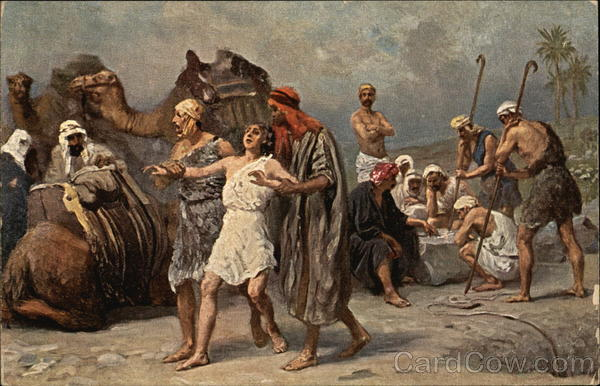
1 And Joseph was brought down to Egypt; and Potiphar, an officer of Pharaoh, captain of the guard, an Egyptian, bought him from the hands of the Ishmaelites, who had brought him down thither. — and Potiphar an officer of Pharaoh, captain of the guard, an Egyptian;
— Potiphar, as his name signifies, the fruit of Pot or Phut, that is, the son or grandson of Put, perhaps; which would be common in Egypt, since it was the name of a son of Ham, Genesis 10:6, from whom Joseph came into the land of Egypt; called the land of Ham, Psalm 105:23;
— the Targum Onkelos says
Yoseif was brought down to Egypt. He was purchased by Potiphar—an officer of Pharaoh, the chief of the slaughterers, an Egyptian—from the Yishmaelites [Arabs] who had brought him down there.
2 And the Lord was with Joseph, and he was a prosperous man; and he was in the house of his master the Egyptian. — Joseph was banished from his father’s house, but the Lord was with him; it is God’s presence that make him prosperous;
— the Targum Onkelos says
[The Word of] Adonoy was with Yoseif[’s support], and he was successful. He was [a servant] in the house of his master, the Egyptian.
3 And his master saw that the Lord was with him, and that the Lord made all that he did to prosper in his hand. — which led to the conviction of Potiphar concerning Joseph was of remarkable success which he saw attending all his efforts and undertakings;
— the Targum Onkelos says
His master saw that [the Word of] Adonoy was with him [supported him], and that whatever he did, Adonoy made it succeed through his hand.
4 And Joseph found grace in his sight, and he served him. And he made him overseer over his house, and all that he had he put into his hand. — and he made him overseer over his house; that is, after he had served him some time;
— he advanced Joseph and made him the head servant, or steward of his house; the Targum Onkelos says
Yoseif found favor in his eyes, and he served him personally. He appointed him supervisor over his household, and all that he possessed he placed in his hand.
5 And it came to pass from the time that he had made him overseer in his house and over all that he had, that the Lord blessed the Egyptian’s house for Joseph’s sake; and the blessing of the Lord was upon all that he had in the house and in the field.
— that the Lord blessed the Egyptian’s house for Joseph’s sake; that is, much more than before; everything under his hands succeeded, now much more abundantly;
— the Targum Onkelos says
From the time he appointed him supervisor over his household and over all that he possessed, Adonoy blessed the house of the Egyptian for Yoseif’s sake. The blessing of Adonoy was in all that he possessed, in the house and in the field.
6 And he left all that he had in Joseph’s hand; and he knew not anything he had, save the bread which he ate. And Joseph was a goodly person, and wellfavored. — everything went on smoothly; and with Joseph as manager he had no need to worry a thing, except as regards food;
— the Targum Onkelos says
He left everything he possessed in the hand of Yoseif. He did not concern himself with anything about him, except for the bread he ate. Yoseif was well-built and good looking.
7 And it came to pass after these things, that his master’s wife cast her eyes upon Joseph; and she said, “Lie with me.” — lie with me; now directly, there being both opportunity and convenience, perhaps her chamber was near;
— the Targum Onkelos says
After these events, his master’s wife cast her eyes upon Yoseif, and she said, Be with me.
8 But he refused, and said unto his master’s wife, “Behold, my master knoweth not what is with me in the house, and he hath committed all that he hath to my hand. — but he refused, and said unto his master’s wife; reasoning with her about the evil nature of the crime she tempted him to;
— the Targum Onkelos says
He refused and said to his master’s wife, Behold, my master knows nothing about what I am doing in the house, and all that he possess, he has placed in my hands.
9 There is none greater in this house than I, neither hath he kept back any thing from me but thee, because thou art his wife. How then can I do this great wickedness, and sin against God?”
— how can I do this great wickedness? how can I, to whom my master has shown so much kindness, when I was a forlorn stranger from a foreign land, and was offered to him in the capacity of a slave;
— and sin against God? the words are emphatic, “this! this wickedness! this great one!” adultery was reckoned a great sin among all nations, and this, had Joseph committed it;
— the Targum Onkelos says
No one in this house is greater than me. He has not withheld anything from me other than you, for you are his wife. How can I do such a great evil, and sin against [before] God.
10 And it came to pass, as she spoke to Joseph day by day, that he hearkened not unto her to lie by her or to be with her. — he avoided her company and familiar conversation, as evil in itself, the present circumstances considered, and as an occasion of further evil;
— the Targum Onkelos says
Even though she spoke to Yoseif every day, he would not listen to [obey] her, to lie next to her, [nor] to be with her.
— the Targum of Jonathan reveals Joseph’s knowledge of the world to come, saying
“And it was, as she spoke with Joseph day by day, and he would not receive from her [instruction] to lie beside her, [lest he] be found guilty with her on the Great Day of Judgment in the World to Come.”
11 And it came to pass about this time that Joseph went into the house to do his business, and there were none of the men of the house there within.
— and there was none of the men of the house there within; being all gone to the public festival, or however there were none in that part of the house where Joseph was;
— Joseph resists the daily solicitations of his master’s wife to lie with her. “None greater in this house than I” he pleads the unreserved trust his master had reposed in him;
— the Targum Onkelos says
It was on such a day, that he came to the house to do his work [examine the recordings of his accounts]. No man of the household was there in the house.
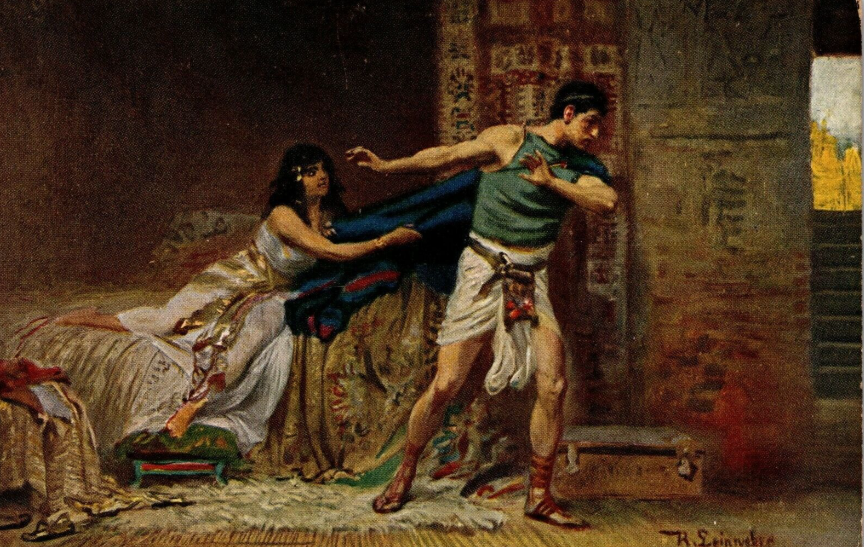
12 And she caught him by his garment, saying, “Lie with me.” And he left his garment in her hand and fled, and got himself out. — and he left his garment in her hand, and fled, and got him out;
— it was his outward loose garment she laid hold on, out of which he slipped himself, and so got clear of her, and ran away;
— the Targum Onkelos says
She grabbed him by his garment, saying, Be with me. He left his garment in her hand, and fled, and he went outside [to the marketplace].
13 And it came to pass, when she saw that he had left his garment in her hand and had fled forth, — his garment; this accident provided the only circumstantial piece of evidence for the charge brought against him;
— the Targum Onkelos says
It was when she saw that he left his garment in her hand and had fled outside [to the marketplace],
14 that she called unto the men of her house and spoke unto them, saying, “See, he hath brought in a Hebrew unto us to mock us. He came in unto me to lie with me, and I cried with a loud voice.
— see, he hath brought in an Hebrew; to mock us, an affected and blind aspersion of her husband for keeping in his house an Hebrew, the very abomination of Egyptians;
— the Targum Onkelos says
that she called to the men of the household and said to them, See, he brought us a Hebrew man to mock us. He came to be with me, and I called out in a loud voice.
15 And it came to pass when he heard that I lifted up my voice and cried, that he left his garment with me and fled, and got himself out.” — when this daring assault upon Joseph’s chastity had failed, the adulterous woman reversed the whole affair, charged him with an attack upon her modesty;
— the Targum Onkelos says
When he heard that I raised my voice and cried out, he left his garment with me, and fled and went outside [to the marketplace].
16 And she laid aside his garment by her until his lord came home. — and she laid up his garment by her; as a proof of what she laid to his charge, and as a testimony against him;
— the Targum Onkelos says
She laid his garment near her until his master came home.
17 And she spoke unto him according to these words, saying, “The Hebrew servant whom thou hast brought unto us came in unto me to mock me. — the Hebrew servant whom thou hast brought unto us; thus she makes her husband accessory to the crime;
— the Targum Onkelos says
She spoke to him [her husband] according to these words, saying, The Hebrew slave came to me—the same one you brought into us—[he came to] mock me.
18 And it came to pass, as I lifted up my voice and cried, that he left his garment with me and fled out.” — she then left the garment lying by her side till the return of Joseph’s master, to whom she repeated her tale;
— the Targum Onkelos says
When I raised my voice and cried out, he left his garment with me and fled outside [to the marketplace].
19 And it came to pass, when his master heard the words of his wife which she spoke unto him, saying, “After this manner did thy servant to me,” that his wrath was kindled. — her husband believes her story and naturally resents the supposed unfaithfulness of his slave;
— the Targum Onkelos says
When his master heard the words of his wife which she spoke to him, saying, Your slave did such things to me, he became furious.
20 And Joseph’s master took him and put him into the prison, a place where the king’s prisoners were bound; and he was there in the prison. — in prison; usually a subterranean dungeon; He that answereth a matter before he heareth it, it is folly and shame unto him, Proverbs 18:13
— the Targum Onkelos says
Yoseif’s master took him and placed him in [appointed him over] the prison, the place where the king’s prisoners were jailed. He remained there in the prison.
21 But the Lord was with Joseph and showed him mercy, and gave him favor in the sight of the keeper of the prison. — and the Lord was with Joseph; under his afflictions; supporting him with his right hand; sanctifying all his troubles to him, and so causing him to bear them patiently;
— and showed him mercy, and gave him favour in the sight of the keeper of the prison; who was the underkeeper to Potiphar;
— the Targum Onkelos says
[The Word of] Adonoy was with Yoseif[’s support], and extended kindness to him, granting him favor in the eyes of the prison chief.
22 And the keeper of the prison committed to Joseph’s hand all the prisoners who were in the prison; and whatsoever they did there, he was the doer of it.
— and whatsoever they did there, he was the doer of it; not that he did everything that was done in the prison: but the meaning is that he gave orders for the doing of everything, and there was nothing done without his supervision;
— the Targum Onkelos says
The prison chief gave [appointed] Yoseif [to be in] control over all the prisoners in the prison, and everything that had to be done there, he was the one who did it [it was done by his word].
23 The keeper of the prison looked not into any thing that was under his hand, because the Lord was with him; and that which he did, the Lord made it to prosper.
— the keeper of the prison looked not to anything that was under his hand; under the hand of Joseph; he took no account of what was in his hands, nor required any of him;
— the Targum Onkelos says
The prison chief did not have to look after anything that was under [see any offense committed by] his hand, because [the Word of] Adonoy was with him [his support] and whatever he did, Adonoy made him succeed.
Genesis 40
1 And it came to pass after these things, that the butler of the king of Egypt and his baker had offended their lord the king of Egypt.
— butler; one who gives to drink, cupbearer; also overseer of the royal vineyards, as well as the cellars; and the chief of the bakers, have offended; having, probably, some hundreds of servants under them;
— the Targum Onkelos says
After these events, an offense was committed by the Egyptian king’s butler and baker against their master, the king of Egypt.
2 And Pharaoh was wroth against two of his officers—against the chief of the butlers and against the chief of the bakers. — who both were employed in providing wine and food for him, there was one of each who was over the rest;
— and as their business was to see that those under them did their work well, when they were faulty the principal officers were answerable: yet they might have neglected to look after those that were under them, and so were culpable, and drew upon them the wrath and resentment of their lord;
— the Targum Onkelos says
Pharaoh was enraged at his two officials, the chief butler and the chief baker.
3 And he put them under guard in the house of the captain of the guard, into the prison, the place where Joseph was bound.
— Pharaoh put them in prison; whatever was their crime until their case could be investigated, to the custody of the captain of the guard, that is, Potiphar, in an outer part of whose house the royal prison was situated;
— the Targum Onkelos says
He placed them under guard in the house of the chief executioner, in the prison, where Yoseif was imprisoned.
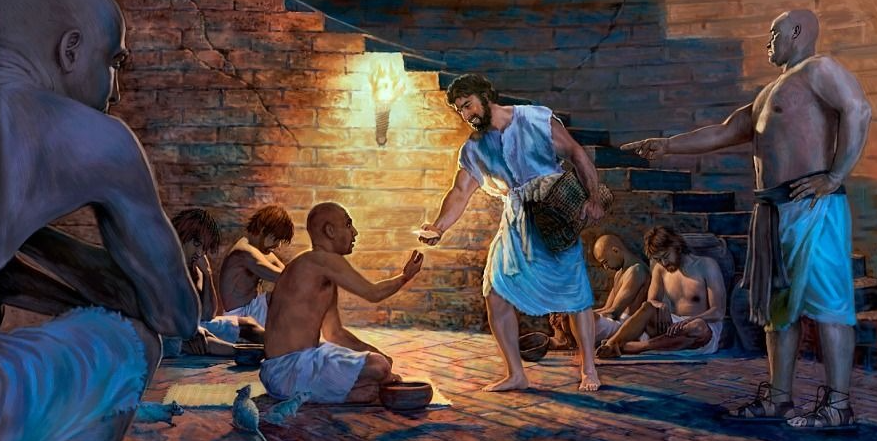
4 And the captain of the guard charged Joseph with them, and he served them; and they continued a season under guard. — and the captain of the guard charged Joseph to his care and custody;
— the Targum Onkelos says
The chief of the slaughterers appointed Yoseif to be with them and he served them. They were under guard for a period of time.
5 And they dreamed a dream both of them, each man his dream in one night, each man according to the interpretation of his dream, the butler and the baker of the king of Egypt, who were bound in the prison.
— these prisoners dream, “each according to the interpretation of his dream,” the imagery of which was suited to indicate his future state;
— the Targum Onkelos says
The two of them had a dream. Each of them had his dream on the same night, each man according to the interpretation of his dream, the butler and the baker of the king of Egypt, who were imprisoned in the prison.
6 And Joseph came in unto them in the morning and looked upon them, and behold, they were sad. — they were sad; they looked sorrowful, dejected, and uneasy;
— the Targum Onkelos says
Yoseif came to them in the morning, and he saw them, and behold they were troubled.
7 And he asked Pharaoh’s officers who were with him in the guard of his lord’s house, saying, “Why look ye so sadly today?”
— the Targum Onkelos says
He asked Pharaoh’s officials, who were with him, under guard in his master’s house, saying, Why do you look so bad today?
8 And they said unto him, “We have dreamed a dream, and there is no interpreter of it.” And Joseph said unto them, “Do not interpretations belong to God? Tell me them, I pray you.”
— do not interpretations belong to God? for it is only that God who sends these dreams that can interpret them, and to him you should seek for it;
— the Targum Onkelos says
They said to him, We had a dream, and there is no interpreter of it. Yoseif said to them, Do not [Are] interpretations [of dreams] belong to [not from] God. Tell them to me, please [now].
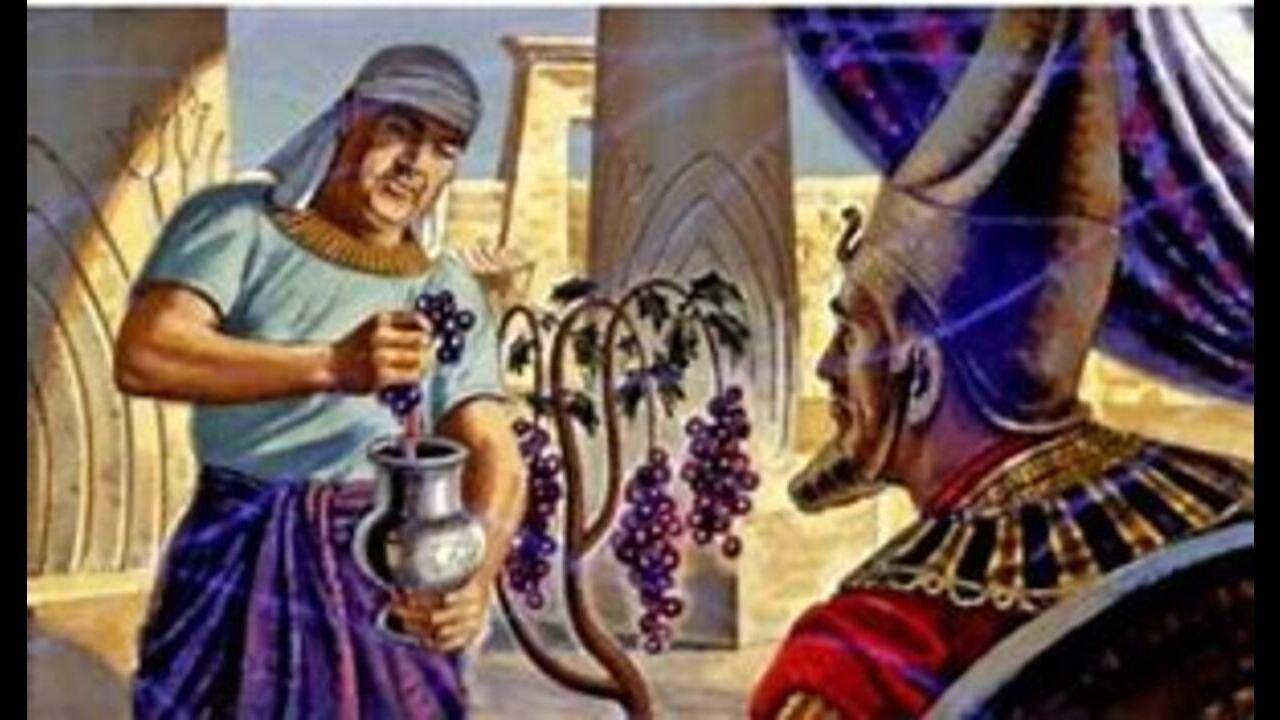
9 And the chief butler told his dream to Joseph, and said to him, “In my dream, behold, a vine was before me.
— the Targum Onkelos says
The butler told his dream to Yoseif. He said to him, In my dream, behold a grape vine was before me.
10 And in the vine were three branches; and it was as though it budded and her blossoms shot forth, and the clusters thereof brought forth ripe grapes.
— the Targum Onkelos says
On the vine there were three branches, as [when] if budding, [it brought out blossoms and] its [the] blossoms blooming, and its clusters ripening into grapes.
11 And Pharaoh’s cup was in my hand; and I took the grapes and pressed them into Pharaoh’s cup, and I gave the cup into Pharaoh’s hand.”
— the Targum Onkelos says
Pharaoh’s cup was in my hand. I took the grapes and squeezed them into Pharaoh’s cup. I then placed the cup into Pharaoh’s hand.
12 And Joseph said unto him, “This is the interpretation of it: The three branches are three days. — speaking as an inspired interpreter, Joseph told the butler that within three days he would be restored to all the honors and privileges of his office;
— the Targum Onkelos says
Yoseif said to him, This is its interpretation: The three branches are three days.
— the Targum of Jonathan reveals the deeper meaning of their dreams, saying
“And Joseph said to him: ‘This is the final interpretation of the dream: The three branches are the three Patriarchs of the world—Abraham, Isaac, and Jacob—whose children’s children are destined to be enslaved to Egypt in clay, in bricks, and in all labor in the fields. And after this, they will be redeemed by the hand of three shepherds.
And that which you said, “I took the grapes and pressed them into Pharaoh’s cup and gave the cup into Pharaoh’s hand”—that is the vial of wrath which Pharaoh is destined to drink in the end. And you, Chief Butler, will receive a good reward for the good dream you dreamed. This is its interpretation for you: the three branches are three days until your redemption.'”
13 Yet within three days shall Pharaoh lift up thine head and restore thee unto thy place; and thou shalt deliver Pharaoh’s cup into his hand, after the former manner when thou wast his butler.
— the Targum Onkelos says
In another [At the end of] three days, Pharaoh will lift [take] your head, and restore you to your position. You will place Pharaoh’s cup in his hand, as was your previous practice when you were his butler.
14 But think on me when it shall be well with thee, and show kindness, I pray thee, unto me; and make mention of me unto Pharaoh, and bring me out of this house. — and show kindness unto me; he pleads no merit for what he had done in interpreting his dream,
— but puts the good office he desires him to do for him upon the foot of kindness to a man in distress, and asks it as a favour, by way of entreaty and request;
— the Targum Onkelos says
But remember me when things go well with you. Please [Now] deal kindly with me [with goodness], and mention me to [before] Pharaoh, and take me out of this house [prison].
15 For indeed I was stolen away out of the land of the Hebrews; and here also have I done nothing that they should put me into the dungeon.”
— since he had been in the land of Egypt, he had not been guilty of any criminal action wherefore he should be put into a prison, and especially into a dungeon, a dark and filthy place under ground, as dungeons usually were;
— the Targum Onkelos says
I was kidnaped from the land of the Hebrews, and here I have also done nothing that they should have put me in this dungeon [prison].
16 When the chief baker saw that the interpretation was good, he said unto Joseph, “I also was in my dream, and behold, I had three white baskets on my head.
— the Targum Onkelos says
The chief baker saw that he interpreted well. He said to Yoseif, I, too, dreamed. Behold there were three fancy baskets on my head.
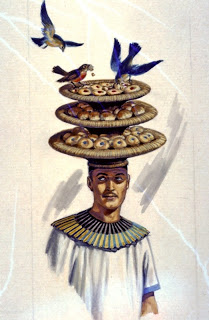
17 And in the uppermost basket there were all manner of baked meats for Pharaoh, and the birds ate them out of the basket upon my head.”
— the Targum Onkelos says
In the top basket there were various kinds of food for Pharaoh, consisting of baked goods, and the bird was eating them from the basket that was on my head.
18 And Joseph answered and said, “This is the interpretation thereof: The three baskets are three days.
— the Targum Onkelos says
Yoseif replied and said, This is its interpretation: The three baskets represent three days.
19 Yet within three days shall Pharaoh lift up thy head from off thee, and shall hang thee on a tree; and the birds shall eat thy flesh from off thee.”
— the Targum Onkelos says
In another [At the end of] three days, Pharaoh will lift [remove] your head from off you. He will hang you on a tree, and the bird will eat your flesh from off you.
20 And it came to pass the third day, which was Pharaoh’s birthday, that he made a feast unto all his servants. And he lifted up the head of the chief butler and of the chief baker among his servants.
— the Targum Onkelos says
It was on the third day, which was Pharaoh’s birthday, that he [Pharaoh] made a feast for all his servants. He lifted [remembered] the head of the chief butler, and the head of the chief baker among his servants.
21 And he restored the chief butler unto his butlership again, and he gave the cup into Pharaoh’s hand;
— the Targum Onkelos says
He restored the chief butler to his position, and he presented the cup into Pharaoh’s hand.
— the Targum of Jonathan adds this as a reason of his being restored, “because he found that he was not in that counsel,” in which it was consulted to poison Pharaoh;
22 but he hanged the chief baker, as Joseph had interpreted to them. — but he hanged the chief baker; that is; the Pharaoh ordered the chief baker to be hanged; because, as the same Targum Jonathan says, the chief baker had conspired to kill him (Pharaoh);
— the Targum Onkelos says
The chief baker, he hung, just as Yoseif had interpreted to them.
23 Yet did not the chief butler remember Joseph, but forgot him.
— the Targum Onkelos says
[However] the chief butler did not remember Yoseif, but forgot him.
— the Targum of Jonathan says:
But because, Joseph had withdrawn from the mercy that is above, and had put his confidence in the chief butler and waited on the flesh, therefore the chief butler did not remember Joseph, but forgot him, until the time of the end when the Lord came that he should be released.


