
Judges (3-4)
The last verse of the last chapter 2:23, “Therefore the Lord left those nations without driving them out hastily, neither delivered He them into the hand of Joshua,” the children of Israel didn’t choose a successor to Joshua; only judges did they appoint; some named, others no names were given.
And so, the majority of these judges would be Levites, entrusted across 48 cities, so they could patiently learn the laws and statutes and guide others in understanding them.
Judges 3
1 Now these are the nations which the Lord left, to test Israel by them, even as many of Israel as had not known all the wars of Canaan
— now these are the nations which the Lord left to prove Israel their commitment to the Lord, which were later identified, Judges 3:3.
2 (only so that the generations of the children of Israel might know to teach them war, at least such as before knew nothing thereof),
— as before knew nothing thereof; that is, they knew nothing of those nations, or of those wars, unless being taught.
3 namely: five lords of the Philistines, and all the Canaanites, and the Sidonians, and the Hivites who dwelt in Mount Lebanon, from Mount Baalhermon unto the entrance of Hamath.
— five lords of the Philistines; they were the princes of Gaza, Ashdod, Askelon, Gath and Ekron; three of these, Gaza, Ashkelon, and Ekron, had been taken by Judah, since the death of Joshua, Judges 1:18; but they soon recovered themselves.
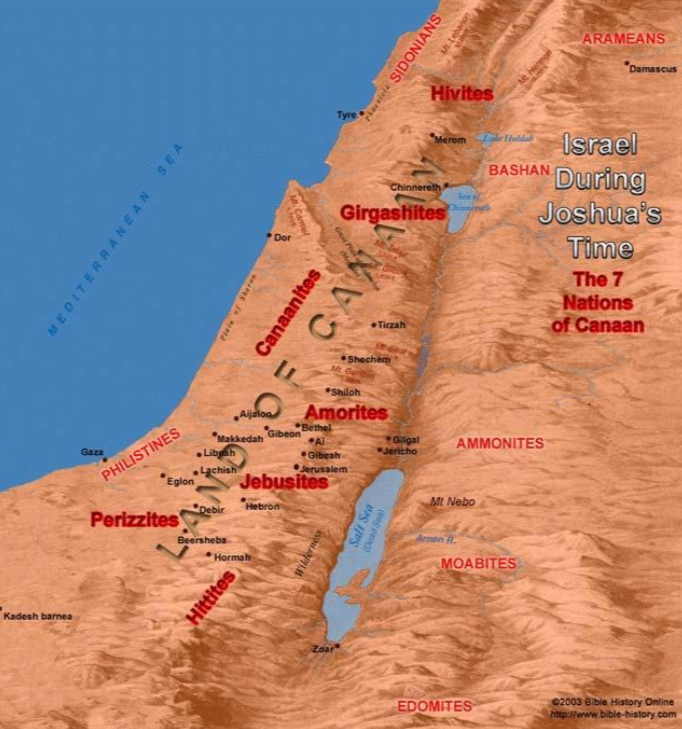
— the Philistines were a people originally from Egypt (Mizraim), but came from there and settled in these parts, and were in the times of Abraham, and were very troublesome to the Israelites in later times; Genesis 10:13-14.
4 And they were to test Israel by them, to know whether they would hearken unto the commandments of the Lord, which He commanded their fathers by the hand of Moses.
— to test Israel; that their commitment and faithfulness to the one living and true God might appear strone, if they did not imitate these nations, and relapse into idolatry, and their baseness and degeneracy if they did.
5 And the children of Israel dwelt among the Canaanites, Hittites, and Amorites, and Perizzites, and Hivites, and Jebusites.
— but the Israelites did not stand the test by dwelling in the midst of the Canaanites, for they contracted marriages with them, and served their gods, contrary to the express prohibition of the Lord.
6 And they took their daughters to be their wives, and gave their daughters to their sons, and served their gods.
— and served Baalim and the groves; or, Baalim in groves; that is, false gods, or rather their images, set up under shady trees, contrary to the command of God.

7 And the children of Israel did evil in the sight of the Lord, and forgot the Lord their God, and served the Baalim and the Asherahs.
— some thought that Asherah and Astarte were different although they are allied deities.

8 Therefore the anger of the Lord was hot against Israel, and He sold them into the hand of Chushanrishathaim, king of Mesopotamia; and the children of Israel served Chushanrishathaim eight years.
— into the hand of Chushan-rishathaim eight years; King of Mesopotamia; which was that part of Syria or Assyria, which lay between the two great rivers Tigris and Euphrates.
9 And when the children of Israel cried unto the Lord, the Lord raised up a deliverer to the children of Israel who delivered them, even Othniel the son of Kenaz, Caleb’s younger brother.
— Othniel; tt means “lion of God,” brother of Caleb being young enough to marry Caleb’s daughter, hence marrying a niece.
10 And the Spirit of the Lord came upon him, and he judged Israel and went out to war; and the Lord delivered Chushanrishathaim, king of Mesopotamia, into his hand. And his hand prevailed against Chushanrishathaim;
— Israel’s first judge was Othniel, nephew of Caleb as the Spirit of the Lord came upon Othniel; and Othniel could be a judge for forty years (Jewish year: 2533-2573),
11 and the land had rest forty years, and Othniel the son of Kenaz died.
— does it mean that during the forty years, they include observing the seven year sabbath and the Jubilees? (Jewish year: 2573).
12 And the children of Israel did evil again in the sight of the Lord; and the Lord strengthened Eglon the king of Moab against Israel, because they had done evil in the sight of the Lord.
— strengthened Eglon the king of Moab; this event referred to by the prophet Samuel, in 1Samuel 12:9 Eglon was a successor of Balak; and Ruth was a possible daughter of Eglon, if not could be related; Ruth 1:1-4;
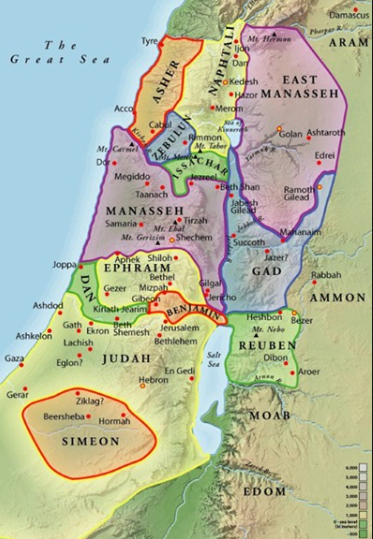
— the land of Moab lay on the east of the Dead Sea and stretched eastwards to the desert; on the south it bordered on Edom; on and on the north were Reuben and Gad.; and further on the northeast were the Ammonites.
13 And he gathered unto him the children of Ammon and Amalek, and went and smote Israel, and possessed the city of palm trees.
— and Eglon the king of Moab formed allies with the children of Ammon and Amalek to attack Israelites; and made the Israelites tributary for eighteen years, reducing the Israelites to servitude.
14 So the children of Israel served Eglon the king of Moab eighteen years.
— King Eglon allied himself with the Ammonites and Amalekites, invaded the land of Israel, took the palm-city (which many identified as Jericho, Judges 1:16), and made the Israelites even on the west side of the Jordan pay tributes for eighteen years.
15 But when the children of Israel cried unto the Lord, the Lord raised them up a deliverer, Ehud the son of Gera, a Benjamite, a man lefthanded; and by him the children of Israel sent a present unto Eglon the king of Moab. — (Jewish year: 2573);
— the Lord raised them up a deliverer, Ehud, a Benjamite; this after the children of Israel had cried unto the Lord; but nowhere says he was a judge;
— the children of Israel sent a present; this is above a tribute which had been imposed upon them; a voluntary present above their usual payments, whereby they hoped to mollify his mind and render him favourable and off their guard.
16 But Ehud made himself a dagger which had two edges, of a cubit length; and he girded it under his raiment upon his right thigh.
— made himself a dagger which had two edges, of a cubit length; hidden inside a long flowing robe upon his right thigh that it might be the less discernible and suspected.
17 And he brought the present unto Eglon king of Moab. And Eglon was a very fat man.
— and Eglon was a very fat man: and so the less active, and unable to decline and avoid the stroke, he might see, when about to be given him.
18 And when he had made an end of offering the present, he sent away the people who bore the present.
— he sent away the people that bore the present; not the servants of Eglon that introduced him, but the children of Israel that came along with him, and carried the present for him: these he dismissed, perhaps in the presence of the king of Moab.
19 But he himself turned again from the quarries that were by Gilgal and said, “I have a secret errand unto thee, O king,” who said, “Keep silence!” And all who stood by him went out from him.
— who said, keep silence; that is, the king of Moab said so either to Ehud, be silent until he had sent out his servants that were nearby him, that they might not hear the secret.
20 And Ehud came unto him; and he was sitting in a summer parlor, which he had for himself alone. And Ehud said, “I have a message from God unto thee.” And he arose out of his seat.
— I have a message from God unto thee; as if to say that he had a dream to impart to Eglon, by command of God. The whole narrative implies that Ehud was, to some extent, an honoured person even among the Moabites. Probably he was reckoned as a prophet.
21 And Ehud put forth his left hand, and took the dagger from his right thigh, and thrust it into his belly.
— that most probably, he stabbed him to the heart; and the fat closed upon the blade (so that there was nothing to be seen in front, because he did not draw the sword out of his body), and the blade came out between the legs.
22 And the haft also went in after the blade, and the fat closed upon the blade, so that he could not draw the dagger out of his belly; and the dirt came out. — dirt; that is, excrements;
— Ehud the son of Gera, a Benjamite, he may not be a posterity of Joseph, but closely related as another son of Rachel, he could also be a flame to the posterity of Esau, and perhaps Moab;
And it came to pass, when Rachel had borne Joseph, that Jacob said unto Laban, “Send me away, that I may go unto mine own place and to my country. Genesis 30:25
— the Targum of Jonathan reveals in greater depth how the posterity of Joseph, were to be a yoke (Genesis 27:40) and a flame unto the house of Esau, and perhaps Moab, saying
“And it was, when Rachel had given birth to Joseph, that Jacob said through the Holy Spirit that the House of Joseph is destined to be like a flame to consume the House of Esau. He said: ‘From now on, I am not afraid of Esau and his legions.’ And he said to Laban: ‘Send me away, that I may go to my own place and to my own land.’” Genesis 30:25 Jonathan
23 Then Ehud went forth through the porch and shut the doors of the parlor upon him, and locked them.
— locked them; either by pulling it close after him, as we do when doors have spring-locks; or by taking the key with him for more caution; and this he did, that they supposing the king to be retired, might wait till he was gone.
24 When he had gone out, his servants came; and when they saw that, behold, the doors of the parlor were locked, they said, “Surely he covereth his feet in his summer chamber.”
— he covereth his feet, probably takng a nap because this was a more likely reason of their long waiting at his door, lest they should disturb his repose.
25 And they tarried till they were ashamed; and behold, he opened not the doors of the parlor. Therefore they took a key and opened them; and behold, their lord was fallen down dead on the earth.
— they tarried, waited, till they were ashamed; getting confused, or, confounded, not conceiving what could cause him to sleep so much longer than usual.
26 And Ehud escaped while they tarried, and passed beyond the quarries and escaped unto Seirah.
— Ehud escaped whilst the servants of Eglon were waiting, and passed the stone quarries and reached Seirah, perhaps it was a wooded region.
27 And it came to pass, when he had come, that he blew a trumpet in the mountain of Ephraim; and the children of Israel went down with him from the mount, and he before them.
— in the mountain of Ephraim; the hill country of Ephraim was always the refuge of Israel freedom.
28 And he said unto them, “Follow after me, for the Lord hath delivered your enemies the Moabites into your hand.” And they went down after him, and took the fords of the Jordan toward Moab, and suffered not a man to pass over.
— Ehud “went down” from the mountain of Ephraim into the Jordan valley beneath it, straight to the Jordan fords, so as to intercept all communication between the Moabites on the west side and those on the east.
29 And they slew of Moab at that time about ten thousand men, all lusty and all men of valor; and there escaped not a man.
— about ten thousand men; these could had been sent into the land of Israel to keep it in subjection, or had settled themselves there for their better convenience, profit, and pleasure; it is very probable there were some of both sorts.
30 So Moab was subdued that day under the hand of Israel. And the land had rest fourscore years.
— the consequence of this victory was, that the land had rest eighty years; perhaps not the whole land of Israel, but the eastern part of it, which had thus shaken off the yoke of Moab.
31 And after him was Shamgar the son of Anath, who slew of the Philistines six hundred men with an ox goad; and he also delivered Israel.
— Shamgar the son of Anath; that is, after the death of Ehud, probably the third judge of the Israelites.
Judges 4
1 And the children of Israel again did evil in the sight of the Lord when Ehud was dead.
— the children of Israel again did evil in the sight of the Lord; which was the fruit and effect of the long rest and peace they enjoyed; and which is often the case of a people favoured with peace and prosperity.
2 And the Lord sold them into the hand of Jabin king of Canaan, who reigned in Hazor, the captain of whose host was Sisera, who dwelt in Harosheth of the Gentiles.
— king of Canaan; of some great nation of the Canaanites; Jabin was called king of Hazor, and sends messages to all the other Canaanite princes.
3 And the children of Israel cried unto the Lord; for he had nine hundred chariots of iron, and twenty years he mightily oppressed the children of Israel.
— Jabin king of Canaan, had nine hundred chariots of iron; his captain was Sisera, to tyrannize the children of Israel for 20 years.
4 And Deborah, a prophetess, the wife of Lapidoth, judged Israel at that time.
— Deborah; she is perhaps the only judge to whom the title “prophetess” is expressly given because of the spirit of prophecy that was upon her. Miriam maybe a prophetess, but she wasn’t a judge.
5 And she dwelt under the palm tree of Deborah between Ramah and Bethel in Mount Ephraim, and the children of Israel came up to her for judgment.
— and Deborah dwelt and sat in her judgment-seat under the canopy of a palm-tree in Mount Ephraim; which places were in the tribe of Benjamin in the borders of Ephraim.
6 And she sent and called Barak the son of Abinoam out of Kedeshnaphtali, and said unto him, “Hath not the Lord God of Israel commanded, saying, ‘Go and draw near Mount Tabor, and take with thee ten thousand men of the children of Naphtali and of the children of Zebulun;
— another Barak of the same name; this being from the tribe of Naphtali, and a city of refuge, Joshua 20:7; Barak, the name signifies lightning, appropriate for a warrior.
7 and I will draw unto thee Sisera, the captain of Jabin’s army, with his chariots and his multitude to the River Kishon; and I will deliver him into thine hand’?”
— because the spirit of prophecy was upon her; she prophecised “and I will deliver him into thine hand.”
8 And Barak said unto her, “If thou wilt go with me, then I will go; but if thou wilt not go with me, then I will not go.”
— his refusal to go without her shows the weakness of his trust as Barak felt how much would be gained by the presence of the inspired prophetess.
9 And she said, “I will surely go with thee. Notwithstanding, the journey that thou takest shall not be for thine honor, for the Lord shall sell Sisera into the hand of a woman.” And Deborah arose, and went with Barak to Kedesh.
— for the Lord shall sell Sisera into the hand of a woman, that is, a small punishment for his diffidence and reluctance to comply with her directions; and as he would not go without a woman, so a woman should take away his honour from him.
10 And Barak called Zebulun and Naphtali to Kedesh, and he went up with ten thousand men at his heels; and Deborah went up with him.
— and Deborah went up with him; and his ten thousand footmen, to the top of Mount Tabor, to encourage him and them with her presence.
11 (Now Heber the Kenite, who was of the children of Hobab the father-in-law of Moses, had severed himself from the Kenites and pitched his tent unto the plain of Zaanaim, which is by Kedesh.)
— now Heber the Kenite; the husband of Jael; had severed himself from the Kenites.
12 And they showed Sisera that Barak the son of Abinoam had gone up to Mount Tabor.
— and they showed Sisera; either some of the Canaanites that dwelt near Tabor, or some spies that Sisera had out.
13 And Sisera gathered together all his chariots, even nine hundred chariots of iron, and all the people who were with him, from Harosheth of the Gentiles unto the river of Kishon.
— and all the people that were with him; his soldiers, Jabin’s army, of which he was captain, and are called a multitude.
14 And Deborah said unto Barak, “Up! For this is the day in which the Lord hath delivered Sisera into thine hand. Has not the Lord gone out before thee?” So Barak went down from Mount Tabor, and ten thousand men after him.
— Deborah said unto Barak, Up, Arise, Delay not. Notice how Deborah takes the lead throughout as the inspired prophetess.
15 And the Lord discomfited Sisera and all his chariots and all his host with the edge of the sword before Barak, so that Sisera alighted down off his chariot and fled away on his feet.
— the Lord discomfited Sisera — Hebrew, “threw his army into confusion;” men, horses, and chariots being intermingled in wild confusion: with great terror and noise, probably with thunder, and lightning, and hailstones, or other such instruments of destruction poured upon them from heaven.
16 But Barak pursued after the chariots and after the host unto Harosheth of the Gentiles; and all the host of Sisera fell upon the edge of the sword, and there was not a man left.
— all the host of Sisera fell upon the edge of the sword, and there was not a man left; no, not one, excepting Sisera.
17 However Sisera fled away on his feet to the tent of Jael the wife of Heber the Kenite, for there was peace between Jabin the king of Hazor and the house of Heber the Kenite.
— Sisera went, not to Heber’s tent, but to Joel’s, as more secure from pursuit. Women normally occupied a separate tent those days.
18 And Jael went out to meet Sisera, and said unto him, “Turn in, my lord, turn in to me. Fear not.” And when he had turned in unto her into the tent, she covered him with a mantle.
— she covered him with a mantle; rather, with the tent-rug of goat’s hair is usually a part of the furniture of an Arabic tent.
19 And he said unto her, “Give me, I pray thee, a little water to drink; for I am thirsty.” And she opened a bottle of milk, and gave him drink, and covered him.
— she gave him milk instead of water, no doubt for the purpose of giving to her guest a friendly and hospitable reception.
20 Again he said unto her, “Stand in the door of the tent, and it shall be, when any man doth come and inquire of thee and say, ‘Is there any man here?’ that thou shalt say, ‘No.’”
— that thou shalt say, no; there is no man; but to this she made no commitment to follow his instruction.
21 Then Jael, Heber’s wife, took a nail of the tent and took a hammer in her hand, and went softly unto him and smote the nail into his temples, and fastened it into the ground; for he was fast asleep and weary. So he died.
— a nail of the tent; probably one of the great tent-pegs used to fasten down the cords which keep the tent in its place.
22 And behold, as Barak pursued Sisera, Jael came out to meet him and said unto him, “Come, and I will show thee the man whom thou seekest.” And when he came into her tent, behold, Sisera lay dead, and the nail was in his temples.
— behold, Sisera lay dead; thus the glory, such as it was, of having slain the general of the enemy passed to a woman. He that had thought to have destroyed Israel with his many iron chariots, is himself destroyed with one iron nail.
It was probable that Jael really intended kindness to Sisera; but by a Divine impulse she was afterwards led to reconsider him as an enemy of the Lord and of his people, and better to destroy him. Thus the weak things of the world confound the mighty.
23 So God subdued on that day Jabin the king of Canaan before the children of Israel.
— thus was Deborah’s prophecy to Barak (Judges 4:9) fulfilled. The Lord had sold Sisera into the hand of a woman, Jael, Heber’s wife, a proselyte; a relation of Moses and a convert from the Kenites; and deprived Barak of the glory of victory.
24 And the hand of the children of Israel prospered, and prevailed against Jabin the king of Canaan, until they had destroyed Jabin king of Canaan.
— to the declared will of God, that they should not spare the Canaanites, but destroy them; and accordingly, we hear no more of Canaanite domination in the Book of Judges.


