
Joshua (19-20)
Joshua 19
1 And the second lot came forth to Simeon, even for the tribe of the children of Simeon according to their families; and their inheritance was within the inheritance of the children of Judah.
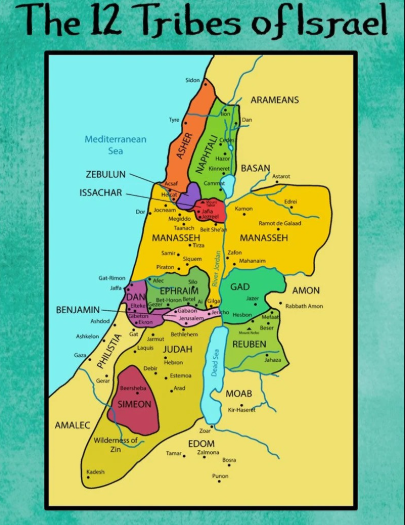
— the southern part of the inheritance of Judah was given up to Simeon; which was within the inheritance of the children of Judah; thus were Jacob’s words brought to pass, which he spoke on his death-bed regarding Simeon and Levi: “I will divide them in Jacob, and scatter them in Israel.”
— the Simeonite territory is described by its towns, of which fourteen were in the Negeb, and four others Joshua 19:7 partly in the Negeb and partly in “the valley.”
2 And they had in their inheritance Beersheba (or Sheba), and Moladah,
3 and Hazarshual, and Balah, and Ezem,
4 and Eltolad, and Bethul, and Hormah,
5 and Ziklag, and Bethmarcaboth, and Hazarsusah,
6 and Bethlebaoth, and Sharuhen: thirteen cities and their villages;
7 Ain, Rimmon, and Ether, and Ashan: four cities and their villages;
8 and all the villages that were round about these cities to Baalathbeer, Ramah of the South. This is the inheritance of the tribe of the children of Simeon according to their families.
— we now come to the inheritance of the children of Simeon.
9 Out of the portion of the children of Judah was the inheritance of the children of Simeon, for the part of the children of Judah was too much for them. Therefore the children of Simeon had their inheritance within the inheritance of them.
— out of the portion of the children of Judah was the inheritance of the children of Simeon, which is the reason why no description is given of the border of their inheritance, because that is before given in the account of the lot of Judah.
10 And the third lot came up for the children of Zebulun according to their families, and the border of their inheritance was unto Sarid.
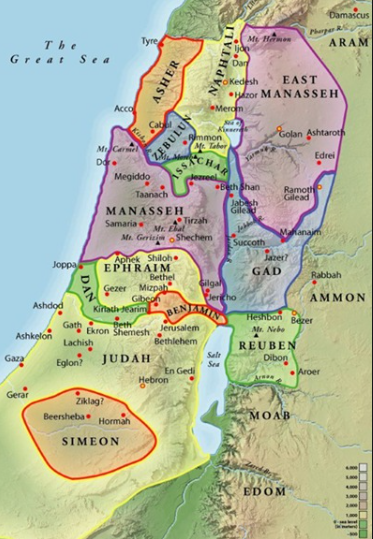
— the third lot came up for the children of Zebulun; the boundaries of the possession assigned to them extended from the Lake of Chinnereth (Sea of Galilee) on the east, to the Mediterranean on the west.
11 And their border went up toward the sea, and Maralah, and reached to Dabbasheth, and reached to the river that is before Jokneam,
— the territory of Zebulun gave the tribe those “abundance of the seas” attributed to the Blessing of Moses (Deuteronomy 33:18) but would probably reach to the Mediterranean, though its eastern side could also reach the Sea of Galilee (Lake of Chinnereth); but the land allocated is landlocked on virtuall every map;
— thus it is always where the original got it wrong, and all the next copiers got the same errors; a clear case of the blind leading the blind; as Jacob’s prophecy is, Zebulun shall be a haven of ships, Genesis 49:13, “and his border shall be unto Sidon.”
12 and turned from Sarid eastward toward the sunrising unto the border of Chislothtabor, and then goeth out to Daberath, and goeth up to Japhia,
13 and from thence passeth on along on the east to Gittahhepher, to Ittahkazin, and goeth out to Rimmon to Neah.
14 And the border compasseth it on the north side to Hannathon, and the boundaries thereof are in the Valley of Jiphthahel,
15 and Kattath, and Nahallal, and Shimron, and Idalah, and Bethlehem: twelve cities with their villages.
— Bethlehem; the other Bethlehem is called in Judges and Ruth, Bethlehem which is inJudah.
16 This is the inheritance of the children of Zebulun according to their families, these cities with their villages.
17 And the fourth lot came out to Issachar, for the children of Issachar according to their families.
— the fourth lot came out to Issachar; instead of describing the boundaries of this tribe, the inspired historian gives a list of its principal cities.
18 And their border was toward Jezreel, and Chesulloth, and Shunem,
19 and Hapharaim, and Shion, and Anaharath,
20 and Rabbith, and Kishion, and Abez,
21 and Remeth, and Engannim, and Enhaddah, and Bethpazzez.
22 And the border reacheth to Tabor, and Shahazimah, and Bethshemesh, and the boundaries of their border were at the Jordan: sixteen cities with their villages.
23 This is the inheritance of the tribe of the children of Issachar according to their families, the cities and their villages.
24 And the fifth lot came out for the tribe of the children of Asher according to their families.
— Asher and Naphtali had been associated with Dan during the Exodus, and with him had encamped on the north side of the tabernacle; but operated on the rear when they moved.
25 And their border was Helkath, and Hali, and Beten, and Achshaph,
26 and Alammelech, and Amad, and Mishal; and reacheth to Carmel westward, and to Shihorlibnath;
27 and turneth toward the sunrising to Bethdagon, and reacheth to Zebulun, and to the Valley of Jiphthahel toward the north side of Bethemek, and Neiel, and goeth out to Cabul on the left hand,
28 and Ebron, and Rehob, and Hammon, and Kanah, even unto Great Sidon.
29 And then the border turneth to Ramah, and to the stronghold city of Tyre; and the border turneth to Hosah, and the boundaries thereof are at the sea from the border to Achzib;
30 Ummah also, and Aphek, and Rehob: twenty and two cities with their villages.
31 This is the inheritance of the tribe of the children of Asher according to their families, these cities with their villages.
32 The sixth lot came out to the children of Naphtali, even for the children of Naphtali according to their families.
— the sixth lot came out the children of Naphtali; here the younger son of Bilhah, the hand-maid of Rachel, is preferred before the elder, who was Dan. Here, the cities mentioned have not been discovered.
33 And their border was from Heleph, from Allon to Zaanannim, and Adami, Nekeb, and Jabneel, unto Lakkum; and the boundaries thereof were at the Jordan.
34 And then the border turneth westward to Aznothtabor, and goeth out from thence to Hukkok, and reacheth to Zebulun on the south side, and reacheth to Asher on the west side, and to Judah upon the Jordan toward the sunrising.
35 And the fortified cities are Ziddim, Zer, and Hammath, Rakkath, and Chinnereth,
36 and Adamah, and Ramah, and Hazor,
37 and Kedesh, and Edrei, and Enhazor,
38 and Iron, and Migdalel, Horem, and Bethanath, and Bethshemesh: nineteen cities with their villages.
39 This is the inheritance of the tribe of the children of Naphtali according to their families, the cities and their villages.
40 And the seventh lot came out for the tribe of the children of Dan according to their families.
— the seventh lot came out for the tribe of Dan; which was the last lot drawn; it lay on the west of Benjamin and consisted of portions surrendered by Judah and Ephraim.
41 And the border of their inheritance was Zorah, and Eshtaol, and Irshemesh,
42 and Shaalabbin, and Aijalon, and Jethlah,
43 And Elon, and Timnah, and Ekron,
44 and Eltekeh, and Gibbethon, and Baalath,
45 and Jehud, and Beneberak, and Gathrimmon,
46 and Mejarkon, and Rakkon, with the border before Joppa.
47 And the border of the children of Dan went out too little for them. Therefore the children of Dan went up to fight against Leshem, and took it and smote it with the edge of the sword, and possessed it and dwelt therein, and called Leshem, Dan, after the name of Dan their father.
— in Judges 1, “The Amorites forced the children of Dan into the mountains,” and hence the incentive to more away, “for they would not suffer them to come down into the valley;” and this must be the reason they moved further north along the coast to resettle.
“And the Amorites forced the children of Dan into the mountain, for they would not suffer them to come down to the valley” Judges 1:34;
— further, the tribe of Dan is strongly associated with idolatry, especially the carved image in Judges 18 and Jeroboam’s golden calf in Dan (1 Kings 12:28–30); and this long-standing pattern is the main reason many interpreters believe Dan is omitted from Revelation 7’s list of the 144,000.
48 This is the inheritance of the tribe of the children of Dan according to their families, these cities with their villages.
— and didn’t put up courage to fight the Amorites but moved north to put to the sword “a people quiet and secure,” which surprised the Sidonion inhabitants of Leshem, an unwarlike and peaceable race, exterminated them, and annexed their city and territory to the portion of Dan. (More at the end of this chapter)
49 When they had made an end of dividing the land for inheritance by their borders, the children of Israel gave an inheritance to Joshua the son of Nun among them.
50 According to the word of the Lord they gave him the city which he asked, even Timnathserah in Mount Ephraim; and he built the city and dwelt therein.
— an inheritance for Joshua till all the tribes were settled; according to the word of the Lord they gave him the city which he asked, even Timnath-serah (called Tibneh, which was once a large town, about seven hours to the north of Jerusalem) in mount Ephraim. Timnath-serah on Mount Gaash (Jud 2:9): Joshua founded it, and was afterwards buried there (Jos 24:30).
51 These are the inheritances which Eleazar the priest and Joshua the son of Nun, and the heads of the fathers of the tribes of the children of Israel divided for an inheritance by lot in Shiloh before the Lord, at the door of the tabernacle of the congregation. So they made an end of dividing the country.
— this concluding verse is the formal close of the section which narrates the history of the land distribution; and to stamp it with due importance, the names of the commissioners are repeated, as well as the spot where so memorable a transaction took place.
~~~~~
The narrative of Micah’s Idol in Judges 17–18 is one of the most remarkable stories in the Book of Judges, and it directly explains the origins and territorial migration of the Tribe of Dan.
Here is how the story connects to the Danites and why it holds such a significant place in biblical history:
Key Summary of the Narrative
- Micah’s Cultic Shrine (Judges 17):
- A man named Micah from the hill country of Ephraim steals silver from his mother, repents, and returns it.
- His mother consecrates part of the silver to manufacture a carved image, a cast idol, an ephod, and household idols (teraphim).
- Micah sets up a private shrine in his home and eventually hires a young Levitical priest (later revealed to be Jonathan, a descendant of Moses) to act as his personal priest.
- The Tribe of Dan’s Search for Land (Judges 18):
- The Danites, finding themselves unable to secure their original territorial allotment in the central coast (due to Amorite/Philistine pressure), send out five spies to search for a new area to settle.
- The spies stop at Micah’s house in Ephraim, recognize the voice of the Levite (Jonathan), and ask him to consult God regarding their mission. He gives them a favorable response.
- The spies find the peaceful, isolated, and fertile northern city of Laish (Lebanon region), which is undefended and unaffiliated with Sidon.
- The Theft and Re-establishment of the Idol:
- The Danites muster an army of 600 armed men and march north to attack Laish.
- On their way, they raid Micah’s house, confiscate his carved idol, ephod, and teraphim, and persuade Micah’s Levite (Jonathan) to come with them as a priest for an entire tribe rather than just one household.
- When Micah pursues them, the Danites warn him that complaining will cost him his life, and he gives up.
- The Settlement of Dan:
- The Danite army attacks Laish, burns the city, puts its inhabitants to the sword, and rebuilds the city, renaming it Dan.
- They set up Micah’s idol in Dan, establishing a northern sanctuary with a hereditary Levitical priesthood that lasts until the exile of the land (“all the time that the house of God was at Shiloh”).
Significance of the Story in Judges
- The Motif of Anarchy: The narrative opens and closes with the famous refrain of the late period of the Judges: “In those days Israel had no king; everyone did as they saw fit” (Judges 17:6, 21:25). It illustrates moral, religious, and political disintegration.
- Origins of the Northern Shrine: This story serves as the historical background for how Dan became a famous religious/cultic site. Centuries later, during the Divided Monarchy, King Jeroboam I selected Dan as one of his two national sanctuaries (installing a golden calf there alongside Bethel).
- Tribal Relocation: It documents the migration of the Danites from their original central allocation (near Zorah, Eshtaol, and Aijalon) to the far northern boundary of Israel—giving rise to the proverbial expression describing the entire extent of the Promised Land: “from Dan to Beersheba.”
~~~~~
Joshua 20
1 The Lord also spoke unto Joshua, saying,
2 “Speak to the children of Israel, saying, ‘Appoint out for you cities of refuge, whereof I spoke unto you by the hand of Moses,
— the selection of the cities brings out a difference between the right of asylum and the somewhat similar right in churches but not the Tabernacle or Temple. Their inhabitants represented God to Israel, and as such were the fit persons to cast a shield over the fugitives; while yet their cities were less sacred than the Temple, and in them the innocent man-slayer could live for years.
3 that the slayer who killeth any person unawares and unwittingly may flee thither; and they shall be your refuge from the avenger of blood.
— unawares and unwittingly, through ignorance, or error, or mistake, and without knowledge; the same thing twice repeated, to cut off all the claims and expectations that wilful murderers might have of protection here.
4 And when he that doth flee unto one of those cities shall stand at the entrance of the gate of the city and shall declare his cause in the ears of the elders of that city, they shall take him into the city unto them and give him a place, that he may dwell among them.
— the institution of the cities of refuge, together with the rules prescribed for the guidance of those who sought an asylum within their walls, was an important provision, tending to secure the ends of justice as well any as of true negligence or ignorance.
5 And if the avenger of blood pursue after him, then they shall not deliver the slayer up into his hand, because he smote his neighbor unwittingly and hated him not beforehand.
— as soon as the manslayer presented himself at the city of refuge, the elders of the city were to hold an inquiry, and receive him provisionally into the city; they shall not deliver the slayer up into his hands; to be slain by him, but shall protect him.
6 And he shall dwell in that city until he stand before the congregation for judgment, and until the death of the high priest who shall be in those days. Then shall the slayer return and come unto his own city and unto his own house, unto the city from whence he fled.’”
— and he shall dwell in that city until he shall stand before the congregation for judgment; that is, until his cause was heard in the court of judicature in his own city, or in any other to which the avenger of blood should appeal.
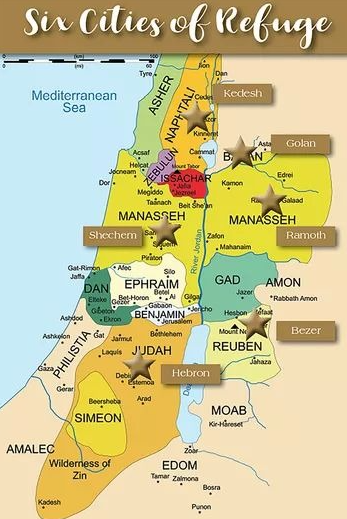
7 And they appointed Kedesh in Galilee in Mount Naphtali, and Shechem in Mount Ephraim, and Kirjatharba (which is Hebron) in the mountain of Judah.
— (A) On the West: (1) Kedesh, in Naphtali (2) Shechem, in Mount Ephraim (3) Hebron, in Judah.
8 And on the other side of the Jordan by Jericho eastward, they assigned Bezer in the wilderness upon the plain from the tribe of Reuben, and Ramoth in Gilead from the tribe of Gad, and Golan in Bashan from the tribe of Manasseh.
— (B) On the East (1) Golan, in Bashan (2) Ramoth-Gilead, in Gad (3) Bezer, in Reuben.
9 These were the cities appointed for all the children of Israel and for the stranger who sojourneth among them, that whosoever killeth any person unawares might flee thither, and not die by the hand of the avenger of blood until he stood before the congregation.
— appointed; or, of refuge or resort. Some versions have followed the LXX. Greek, unawares; Hebrew, in error or inadvertently as some versions say.


