
Joshua (15-16)
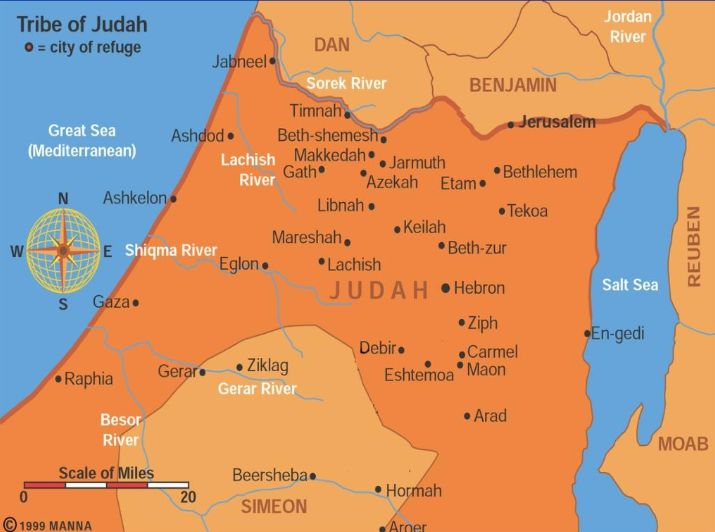
Joshua 15
1 This then was the lot of the tribe of the children of Judah by their families: even to the border of Edom to the Wilderness of Zin southward was the outermost part of the south border.
— it is noticeable that Hebron appears to have been promised to Caleb (Joshua 14:12), and Shechem, the land of the Amorites, were assigned earlier to Joseph by Jacob (Genesis 48:21-22);
— but the question arises at this point how the position of the remaining seven were allotted.
2 And their south border was from the shore of the Salt Sea, from the bay that looketh southward.
— the bay that looketh southward; Hebrew, the tongue; either a creek or arm of that sea, or a promontory, which by learned authors is sometimes called a tongue.
3 And it went out to the south side to Maalehacrabbim, and passed along to Zin, and ascended up on the south side unto Kadeshbarnea, and passed along to Hezron, and went up to Adar, and went around to Karkaa.
4 From thence it passed toward Azmon and went out unto the river of Egypt; and the borders of that region were at the sea: this shall be your south border.
— and the outgoings of that coast were at the sea; the Mediterranean sea; or to the west; this was the utmost border of the tribe of Judah this way.
5 And the east border was the Salt Sea, even unto the end of the Jordan. And their border in the north quarter was from the bay of the sea at the uttermost part of the Jordan.
— the place where Jordan runs into the Dead Sea. The stone of Bohan; a place so called, not from Bohan’s dwelling there, for the Reubenites had no portion on this side Jordan.
6 And the border went up to Bethhogla and passed along by the north of Betharabah; and the border went up to the stone of Bohan the son of Reuben;
7 and the border went up toward Debir from the Valley of Achor, and so northward looking toward Gilgal, that is before the ascent to Adummim, which is on the south side of the river; and the border passed toward the waters of Enshemesh, and the boundaries thereof were at Enrogel.
8 And the border went up by the Valley of the Son of Hinnom unto the south side of the Jebusite (the same is Jerusalem); and the border went up to the top of the mountain that lieth before the Valley of Hinnom westward, which is at the end of the Valley of the Giants northward.
— unto the south side of the Jebusite; of the place the Jebusite inhabited: the same is Jerusalem; which was formerly called Jebus, from their inhabitants; yea, Jebusi, as may mot be intended for the inhabitants, but the place.
9 And the border was drawn from the top of the hill unto the fountain of the water of Nephtoah, and went out to the cities of Mount Ephron; and the border was drawn to Baalah, which is Kirjathjearim.
10 And the border compassed from Baalah westward unto Mount Seir, and passed along unto the side of Mount Jearim, which is Chesalon on the north side, and went down to Bethshemesh, and passed on to Timnah.
11 And the border went out unto the side of Ekron northward; and the border was drawn to Shicron, and passed along to Mount Baalah, and went out unto Jabneel; and the limit of the border was at the sea.
— and the border went out unto the side of Ekron northward, which was one of the principalities of the Philistines; and which, though it fell to the lot of Judah, Joshua 15:45, was not possessed by them.
12 And the west border was to the Great Sea and the coast thereof. This is the border of the children of Judah round about according to their families.
— and the west border was to the great sea, the Mediterranean sea, which lay west to the land of Canaan; and this border reached from Jabneel to the river of Egypt, where the southern border ended.
13 And unto Caleb the son of Jephunneh he gave a part among the children of Judah, according to the commandment of the Lord to Joshua, even the city of Arba (Arba was the father of Anak), which city is Hebron.
— the Anakims had in the course of Joshua’s campaigns in the south been expelled from “this mountain,” that is, the mountain country round Hebron, but they had only withdrawn to the neighboring cities of Philistia Joshua 11:22;
— Hebron previous name was Kirjatharba, named after Arba, the father of the Anakim.
14 And Caleb drove from thence the three sons of Anak: Sheshai, and Ahiman, and Talmai, the children of Anak.
— Sheshai, and Ahiman, and Talmai, the children of Anak; the very same giants Caleb saw at Hebron; Hebron previous name was Kirjatharba, named after Arba, the father of the Anakim.
15 And he went up thence to the inhabitants of Debir (and the name of Debir before was Kirjathsepher).
— and the name of Debir before was Kirjathsepher; or “the city of books,” or the city of the archives.
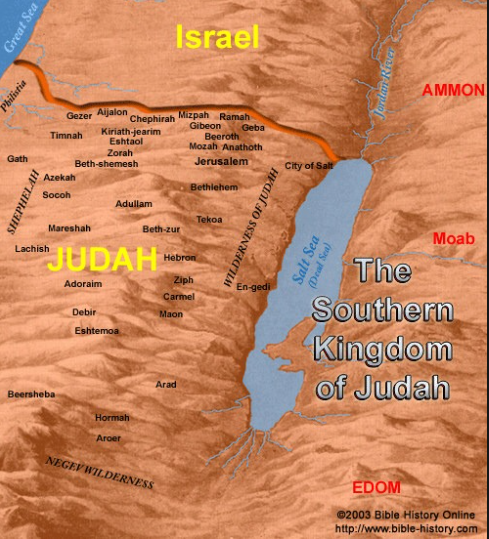
16 And Caleb said, “He that smiteth Kirjathsepher and taketh it, to him will I give Achsah my daughter as wife.”
— Achsah my daughter to wife, which is to be understood, if he were one who could marry her according to God’s law; and if she were willing.
17 And Othniel the son of Kenaz, the brother of Caleb, took it; and he gave him Achsah his daughter as wife.
— Othniel was probably Caleb’s younger brother; and besides, the word brother is commonly used for any kinsman; or might be a nephew.
18 And it came to pass, as she came unto him, that she moved him to ask of her father a field; and she alighted from her ass, and Caleb said unto her, “What wouldest thou?”
— she moved him to ask of her father a field; or persuaded him to make such a request to him, or that he would give her leave to make it.
19 She answered, “Give me a blessing, for thou hast given me a south land. Give me also springs of water.” And he gave her the upper springs and the nether springs.
— springs of water; that is, a field wherein are springs of water, such as were in the higher grounds, and such as were in the lower ones, that she might have a sufficiency to water all her lands and fields; which in that country were of great price.
20 This is the inheritance of the tribe of the children of Judah according to their families:
21 And the outermost cities of the tribe of the children of Judah toward the border of Edom southward were Kabzeel, and Eder, and Jagur,
22 and Kinah, and Dimonah, and Adadah,
23 and Kedesh, and Hazor, and Ithnan,
24 Ziph, and Telem, and Bealoth,
25 and Hazor, Hadattah, and Kerioth, and Hezron (which is Hazor),
26 Amam, and Shema, and Moladah,
27 and Hazargaddah, and Heshmon, and Bethpalet,
28 and Hazarshual, and Beersheba, and Bizjothjah,
29 Baalah, and Iim, and Ezem,
30 and Eltolad, and Chesil, and Hormah,
31 and Ziklag, and Madmannah, and Sansannah,
32 and Lebaoth, and Shilhim, and Ain, and Rimmon: all the cities are twenty and nine, with their villages.
33 And in the valley: Eshtaol, and Zorah, and Ashnah,
34 and Zanoah, and Engannim, Tappuah, and Enam,
35 Jarmuth, and Adullam, Socoh, and Azekah,
36 and Sharaim, and Adithaim, and Gederah, and Gederothaim: fourteen cities with their villages;
37 Zenan, and Hadashah, and Migdalgad,
38 and Dilean, and Mizpeh, and Joktheel,
39 Lachish, and Bozkath, and Eglon,
40 and Cabbon, and Lahmam, and Kithlish,
41 and Gederoth, Bethdagon, and Naamah, and Makkedah: sixteen cities with their villages;
42 Libnah, and Ether, and Ashan,
43 and Jiphtah, and Ashnah, and Nezib,
44 and Keilah, and Achzib, and Mareshah: nine cities with their villages;
45 Ekron, with her towns and her villages;
46 from Ekron even unto the sea, all that lay near Ashdod, with their villages;
47 Ashdod with her towns and her villages, Gaza with her towns and her villages, unto the river of Egypt and the Great Sea and the border thereof.
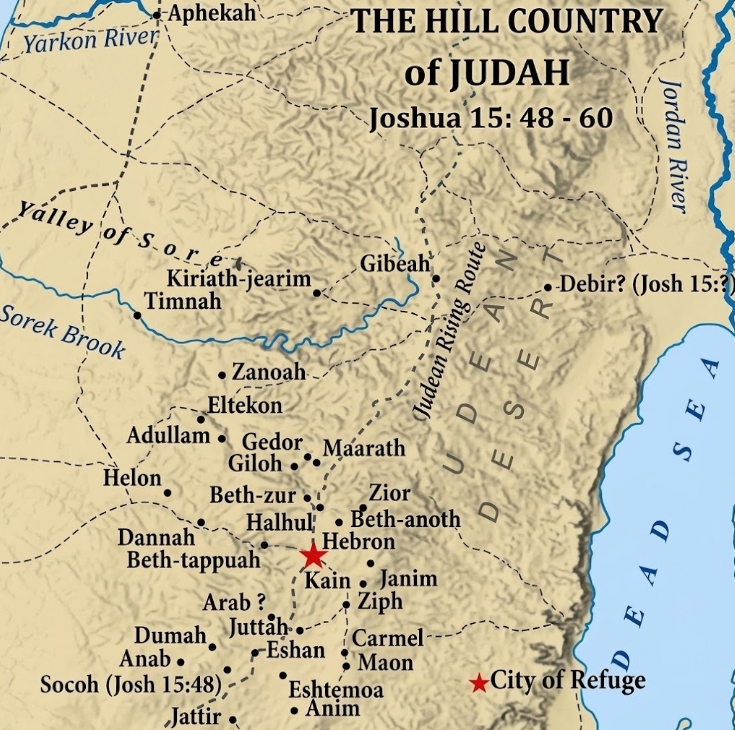
48 And in the mountains: Shamir, and Jattir, and Socoh,
49 and Dannah, and Kirjathsannah (which is Debir),
50 and Anab, and Eshtemoh, and Anim,
51 and Goshen, and Holon, and Giloh: eleven cities with their villages;
52 Arab, and Dumah, and Eshean,
53 and Janum, and Bethtappuah, and Aphekah,
54 and Humtah, and Kirjatharba (which is Hebron), and Zior: nine cities with their villages;
55 Maon, Carmel, and Ziph, and Juttah,
56 and Jezreel, and Jokdeam, and Zanoah,
57 Kain, Gibeah, and Timnah: ten cities with their villages;
58 Halhul, Bethzur, and Gedor,
59 and Maarath, and Bethanoth, and Eltekon: six cities with their villages;
60 Kirjathbaal (which is Kirjathjearim), and Rabbah: two cities with their villages;
61 in the wilderness: Betharabah, Middin, and Secacah,
62 and Nibshan, and the City of Salt, and Engedi; six cities with their villages.
63 As for the Jebusites, the inhabitants of Jerusalem, the children of Judah could not drive them out; but the Jebusites dwell with the children of Judah at Jerusalem unto this day.
— a part of Jerusalem was in the tribe of Judah, namely, the tower of Zion, mount Moriah, with some of the south parts adjacent; the rest of it was in the tribe of Benjamin, namely, the greatest part of the city itself;
— but the greatest part and main body of it, stood in the tribe of Benjamin; they could not drive them out because of their sloth, and cowardice, and wickedness, whereby the Jebusites dwell with the children of Judah to this day.
Joshua 16
Accordingly in the division of the land of Canaan under Joshua, there are three successive stages: first, the settlement of the tribe of Judah in the strongholds of the south of Palestine; secondly, the establishment of Ephraim and Manasseh in the centre of the country, and in some strong positions towards the north; thirdly, the settlement of the remaining tribes, so as to fill up the gaps left between Judah and Joseph, and also upon the outskirts of their territory, so as to be, as it were, under the shadow of their wings.
In the inheritance of Ephraim and Manasseh we observe some features which distinguish this description from that of Judah’s inheritance in Joshua 15. The boundaries of the territory are given, but there is no catalogue of cities; except Jericho and Bethel perhaps. There is also another peculiarity: the tribe of Ephraim is interlocked with the tribe of Manasseh, and the tribe of Manasseh again with Issachar and Asher, by the possession of cities in the territory of these other tribes.
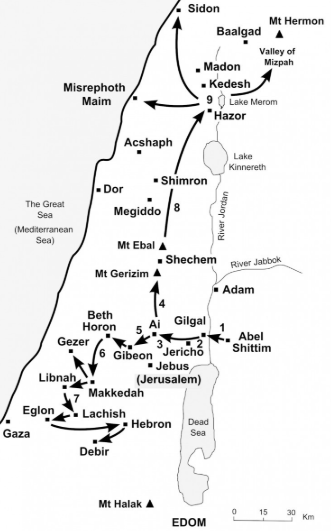
1 And the lot of the children of Joseph fell from the Jordan by Jericho, unto the water of Jericho on the east, to the wilderness that goeth up from Jericho throughout Mount Bethel,
— the order of precedence among the tribes of Israel was always Judah first and the sons of Joseph second; in the words of 1Chronicles 5:2, “Judah prevailed above his brethren, and of him came the chief ruler; but the birthright was Joseph’s,”
2 and goeth out from Bethel to Luz, and passeth along unto the borders of the Archites to Ataroth,
— mount Bethel—the ridge south of Bethel; having described the position of Joseph’s family generally the historian proceeds to define the territory; first, that of Ephraim.
3 and goeth down westward to the border of the Japhletites, unto the border of Bethhoron the Nether and to Gezer; and the boundaries thereof are at the sea.
4 So the children of Joseph, Manasseh, and Ephraim took their inheritance.
— to take their inheritance, because the tribes of Judah and Joseph did take their inheritances before the rest; by dividing it between them according to the direction of Joshua and Eleazar.
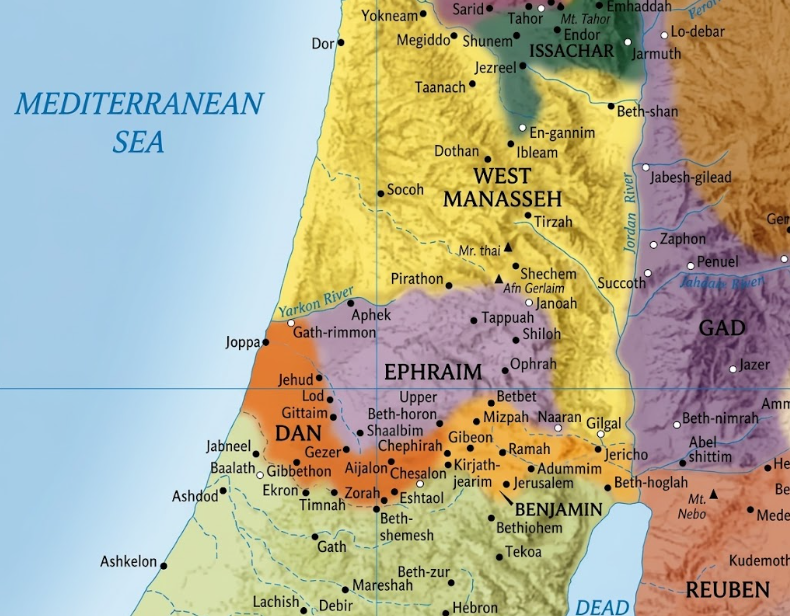
5 And the border of the children of Ephraim according to their families was thus: even the border of their inheritance on the east side was Atarothaddar, unto Bethhoron the Upper.
— the east side; that is, the north-east side.
6 And the border went out toward the sea to Michmethath on the north side; and the border went about eastward unto Taanathshiloh, and passed by it on the east to Janohah;
— Michmethah on the north side; the northern boundary is traced from this point eastward to the Jordan.
7 and it went down from Janohah to Ataroth and to Naarah, and came to Jericho and went out at the Jordan.
8 The border went out from Tappuah westward unto the River Kanah; and the boundaries thereof were at the sea. This is the inheritance of the tribe of the children of Ephraim by their families.
9 And the separate cities for the children of Ephraim were among the inheritance of the children of Manasseh, all the cities with their villages.
— the tribe of Ephraim, were among the inheritance of the children of Manasseh; some that were upon the borders of Ephraim, and within the territory of Manasseh, and it may be where it jetted out in a nook or corner.
10 And they drove not out the Canaanites who dwelt in Gezer, but the Canaanites dwell among the Ephraimites unto this day and serve under tribute.
— they didn’t drove them out; the failure of Ephraim is noticed, as was the failure of Judah above (Joshua 15:63).


