
Joshua (9-10)

Joshua 9
1 And it came to pass when all the kings who were on this side of the Jordan, in the hills and in the valleys and in all the borders of the Great Sea over against Lebanon — the Hittite, and the Amorite, the Canaanite, the Perizzite, the Hivite, and the Jebusite — heard thereof,
— the Canaanites had defended themselves, and their hearts hardened in their wickedness; these were destined for destrcuction earlier in Genesis 15;
2 that they gathered themselves together to fight with Joshua and with Israel with one accord.
— the Canaanites had defended themselves, but here they consult to attack Israel; though often at enmity with each other, yet they united against Israel.
3 And when the inhabitants of Gibeon heard what Joshua had done unto Jericho and to Ai,
4 they worked cunningly, and went and made as if they had been ambassadors, and took old sacks upon their asses, and wineskins, old and rent and bound up,
— Gibeon was one community of four as seen in Joshua 9:17. Their deception of Joshua and the Israelites on this occasion is revenge for what was done by Simeon and Levi to the Hivites long before, when Jacob first came to Shechem from Padan-Aram (Genesis 34);
5 and old and patched shoes upon their feet, and old garments upon them; and all the bread of their provision was dry and moldy.
— and old garments upon them; full of holes and rents, ragged and patched: old wine bottles, and bound up; these the poorer sort stow all their basic necessaries; it hints that the Gibeonites had decided to meet craft with craft.
6 And they went to Joshua unto the camp at Gilgal, and said unto him and to the men of Israel, “We have come from a far country. Now therefore make ye a league with us.”
— they went to Joshua unto the camp at Gilgal, the Israelitish headquarters; the strangers obtained an interview with Joshua and the elders.
7 And the men of Israel said unto the Hivites, “Perhaps ye dwell among us. Then how shall we make a league with you?”
— the Hivites, that is, the Gibeonites, who were Hivites, Joshua 11:19.
8 And they said unto Joshua, “We are thy servants.” And Joshua said unto them, “Who are ye? And from whence come ye?”
— We are thy servants; we desire a league with you upon your own terms; we are ready to accept of any conditions.
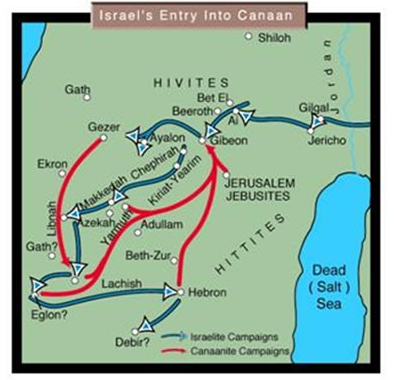
9 And they said unto him, “From a very far country thy servants have come because of the name of the Lord thy God; for we have heard the fame of him and all that he did in Egypt,
— much like the Samaritans before them; because of the name of the Lord thy God; because of what they had heard of his name, his power and goodness;
10 and all that he did to the two kings of the Amorites who were beyond the Jordan — to Sihon king of Heshbon, and to Og king of Bashan, who was at Ashtaroth.
— to Sihon king of Heshbon, and to Og king of Bashan in Ashtaroth; the history of which see in Numbers 21:21-35.
11 Therefore our elders and all the inhabitants of our country spoke to us, saying, ‘Take provisions with you for the journey, and go to meet them and say unto them, “We are your servants. Therefore now make ye a league with us.”’
— therefore now make ye a league with us; that we may live in friendship, and mutually assist each other, as occasion should require.
12 This our bread we took hot for our provision out of our houses on the day we came forth to go unto you; but now, behold, it is dry and it is moldy.
— and it is mouldy; which they gave as a demonstration and proof that they were come from a far country, as they had asserted.
13 And these skins of wine which we filled were new, and behold, they are rent; and these our garments and our shoes have become old by reason of the very long journey.”
— and these our garments, and our shoes, are become old by reason of the very long journey: quite worn out through length of time and tedious travels.
14 And the men took of their provisions, and asked not counsel at the mouth of the Lord.
— the Israelites suffered themselves to be taken in by such pretence; they have the Urim and Thummim of the high priest, yet they asked not at the mouth of the Lord.
15 And Joshua made peace with them, and made a league with them to let them live; and the princes of the congregation swore unto them.
— God is a jealous God, yet they made peace with them, not consulting God where they would have been forbidden to spare and connect themselves with any of the Canaanite tribes who embraced idolatry.
16 And it came to pass at the end of three days after they had made a league with them, that they heard that they were their neighbors and that they dwelt among them.
— the fraud was soon found out. as a lying tongue is but for a moment.
17 And the children of Israel journeyed and came unto their cities on the third day. Now their cities were Gibeon, and Chephirah, and Beeroth, and Kirjathjearim.
— Gibeon, and Chephirah, and Beeroth, and Kirjath-jearim; the first three of these were assigned to Benjamin (Joshua 18:21,25-26), the last to Judah (Joshua 15:60-63).
18 And the children of Israel smote them not, because the princes of the congregation had sworn unto them by the Lord God of Israel. And all the congregation murmured against the princes.
— and all the congregation murmured against the princes; not only for taking such an oath, but chiefly because they restrained them from stricking the Gibeonites.
19 But all the princes said unto all the congregation, “We have sworn unto them by the Lord God of Israel. Now therefore we may not touch them.
— we have sworn unto them by the Lord God of Israel; by an oath is a solemn sacred thing, and not to be broken.
20 This we will do to them: we will even let them live, lest wrath be upon us because of the oath which we swore unto them.”
— the violation of an oath is always sin, even when the oath has been taken inconsiderately.
21 And the princes said unto them, “Let them live, but let them be hewers of wood and drawers of water unto all the congregation, as the princes had promised them.”
— let them be hewers of wood, and drawers of water, unto all the congregation; let them be public servants.
22 And Joshua called for them, and he spoke unto them, saying, “Why have ye beguiled us, saying, ‘We are very far from you,’ when ye dwell among us?
— Joshua then summoned the Gibeonites, charged them with their deceit, and pronounced upon them the “lowest of the people” the curse of eternal servitude.
23 Now therefore ye are cursed, and there shall none of you be freed from being bondmen and hewers of wood and drawers of water for the house of my God.”
— the Gibeonites were to be employed forever in servile work; hewing of wood and drawing of water.
24 And they answered Joshua and said, “Because it was certainly told thy servants how the Lord thy God commanded his servant Moses to give you all the land and to destroy all the inhabitants of the land from before you, therefore we were sore afraid for our lives because of you, and have done this thing.
— that is, it was mere fear which drove the Gibeonites to act as they did.
25 And now, behold, we are in thine hand: as it seemeth good and right unto thee to do unto us, do.”
— we are in thy hand, do unto us as seemeth good and right unto thee, only save our souls; hence, they were adopted into Israel; the Gibeonites remained forever bondsmen of Israel.
26 And so did he unto them, and delivered them out of the hand of the children of Israel, that they slew them not.
— and even Joshua was moved to adopt them as his own.
27 And Joshua made them that day hewers of wood and drawers of water for the congregation and for the altar of the Lord, even unto this day, in the place which He should choose.
— perhaps a slight relief to the Levites, they as hewers of wood and drawers of water; the menials who performed the jobs of janitors and the drudgery in the sanctuary.
Joshua 10
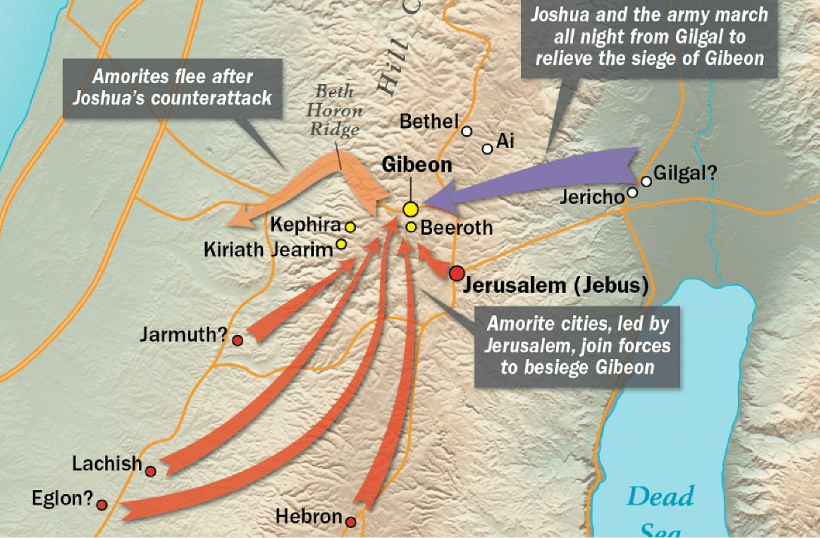
1 Now it came to pass when Adonizedec king of Jerusalem had heard how Joshua had taken Ai and had utterly destroyed it (as he had done to Jericho and her king, so he had done to Ai and her king), and how the inhabitants of Gibeon had made peace with Israel and were among them,
— Adonizedec king of Jerusalem; is whose name (Lord of Righteousness); an official title of the Jebusite kings? Is he the same Melchizedek (King of Righteousness) known elsewhere?
2 that they feared greatly because Gibeon was a great city, as one of the royal cities, and because it was greater than Ai and all the men thereof were mighty.
— that they feared greatly; the king of Jerusalem and his people, lest they should fall into the hands of the Israelites.
3 Therefore Adonizedec king of Jerusalem sent unto Hoham king of Hebron, and unto Piram king of Jarmuth, and unto Japhia king of Lachish, and unto Debir king of Eglon, saying,
— wherefore Adonizedek king of Jerusalem sent to Hoham king of Hebron, was twenty two miles from Jerusalem; it was an ancient city built seven years before Zoan in Egypt.
4 “Come up unto me and help me, that we may smite Gibeon; for it hath made peace with Joshua and with the children of Israel.”
— wherefore Adonizedek; said, Come up unto me, and help me, calling for a combined attack on Gibeon.
5 Therefore the five kings of the Amorites, the king of Jerusalem, the king of Hebron, the king of Jarmuth, the king of Lachish, the king of Eglon, gathered themselves together and went up, they and all their hosts, and encamped before Gibeon and made war against it.
— the five kings of the Amorites; this name is taken generally for any of the Canaanites: of the king of Jerusalem, the king of Hebron, the king of Jarmuth, the king of Lachish, and the king of Eglon.
6 And the men of Gibeon sent unto Joshua to the camp to Gilgal, saying, “Slacken not thy hand from thy servants. Come up to us quickly, and save us and help us; for all the kings of the Amorites who dwell in the mountains are gathered together against us.”
— their appeal was urgent: come up to us quickly, and save us, and help us; they did not doubt, if he made haste and helped them, but they should be saved by him.
7 So Joshua ascended from Gilgal, he and all the people of war with him and all the mighty men of valor.
8 And the Lord said unto Joshua, “Fear them not, for I have delivered them into thine hand. There shall not a man of them stand before thee.”
— the Lord then renewed the assurance of his help in this particular war, in which Joshua was about to fight for the first time with several allied kings of Canaan.
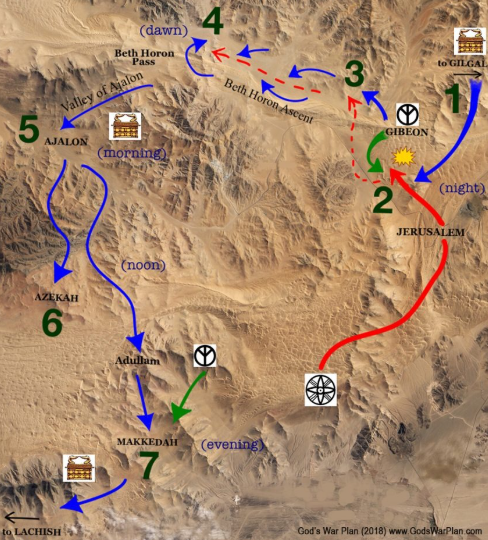
9 Joshua therefore came unto them suddenly, and went up from Gilgal all night.
— and Joshua came upon them suddenly; for all the night he had marched from Gilgal; which no doubt threw them into consternation and confusion.
10 And the Lord discomfited them before Israel, and slew them with a great slaughter at Gibeon, and chased them along the way that goeth up to Bethhoron, and smote them to Azekah and unto Makkedah.
— the Lord discomfited them, “terrified,” them, confounded the Amorite allies, perhaps by a fearful storm of lightning and thunder.
11 And it came to pass, as they fled from before Israel and were at the descent of Bethhoron, that the Lord cast down great stones from heaven upon them unto Azekah, and they died. There were more who died with hailstones than those whom the children of Israel slew with the sword.
— perhaps thunder and lightning were mixed with hailstones from heaven, sometimes that could kill men and cattle; like the hails which smote Egypt.
12 Then spoke Joshua to the Lord in the day when the Lord delivered up the Amorites before the children of Israel, and he said in the sight of Israel: “Sun, stand thou still upon Gibeon; and thou, moon, in the Valley of Aijalon.”
— Joshua’s day was long enough for his work, and that work was a victory which told on future generations. So life, short as it is, will be long enough for all that we have to do and to learn from.

13 And the sun stood still and the moon stayed until the people had avenged themselves upon their enemies. Is not this written in the Book of Jasher? So the sun stood still in the midst of heaven, and hastened not to go down for about a whole day.
— the Book of Jasher – or that of “the upright” or the book of the “righteous,” this Book is also quoted in II Samuel 1:18,
— a poetical appellation; wherein other memorable actions of worthy and righteous men were recorded; testifying in deeper and broader details where the Masoretic text only provides us with just a fleeing summary.
14 And there was no day like that before it or after it, that the Lord hearkened unto the voice of a man; for the Lord fought for Israel.
— the Lord fought for Israel this is added as the reason why God was so ready to answer Joshua’s petition because he was engaged and resolved to fight for Israel, and that in a more than ordinary manner.
15 And Joshua returned, and all Israel with him, unto the camp to Gilgal.
16 But these five kings fled and hid themselves in a cave at Makkedah.
17 And it was told Joshua, saying, “The five kings are found hidden in a cave at Makkedah.”
— saying, the five kings are found hid in a cave at Makkedah: this seems to make it appear that they were others, and not Joshua’s soldiers, that found them; for had they, no doubt they would have seized them.
18 And Joshua said, “Roll great stones upon the mouth of the cave, and set men by it to keep them.
— and Joshua said, roll great stones upon the mouth of the cave, to trao the kings in, that they might not make any escape.
19 And stay ye not, but pursue after your enemies and smite the hindmost of them. Permit them not to enter into their cities, for the Lord your God hath delivered them into your hand.”
— for the Lord your God hath delivered them into your hand; it is worth while to observe that the command given to Israel to exterminate the Canaanites.
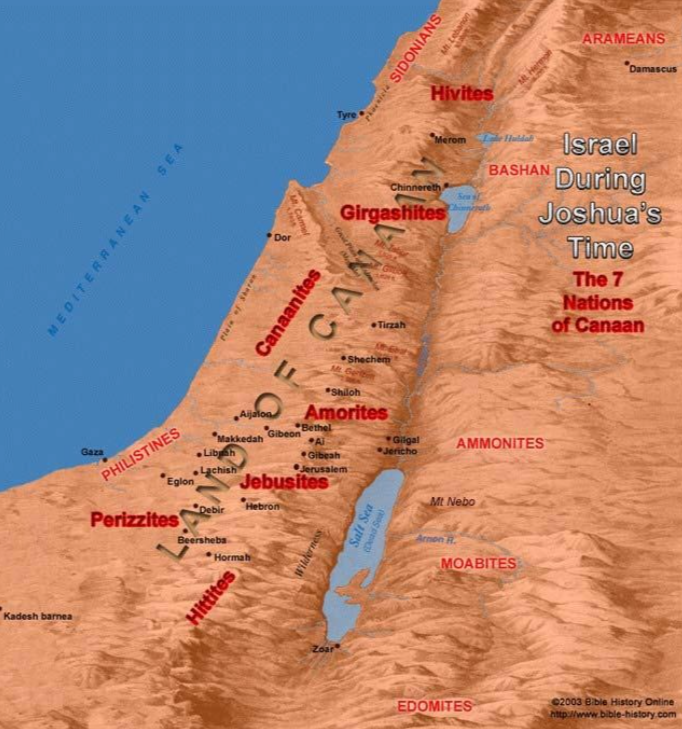
20 And it came to pass, when Joshua and the children of Israel had made an end of slaying them with a very great slaughter till they were consumed, that the rest who remained of them entered into fortified cities.
— that the rest which remained of them entered into fenced cities; to which they belonged, and which were afterwards taken.
21 And all the people returned to the camp to Joshua at Makkedah in peace. None moved his tongue against any of the children of Israel.
— at Makkedah; the pursuit was continued to Makkedah at the foot of the western mountains, where Joshua seems to have halted with the main body of his troops while a detachment was sent forward to scour the country in pursuit of the remaining stragglers.
22 Then said Joshua, “Open the mouth of the cave, and bring out those five kings unto me out of the cave.”
23 And they did so, and brought forth those five kings unto him out of the cave: the king of Jerusalem, the king of Hebron, the king of Jarmuth, the king of Lachish, and the king of Eglon.
— Joshua ordered the five kings to be fetched out of the cave, and directed the leaders of the army to set their feet upon the necks of the kings; and ordered the kings to be put to death, to be hanged upon trees until the evening.
24 And it came to pass, when they brought out those kings unto Joshua, that Joshua called for all the men of Israel, and said unto the captains of the men of war who went with him, “Come near, put your feet upon the necks of these kings.” And they came near and put their feet upon the necks of them.
— place your feet upon the necks of these kings, a gesture symbolizing their total subjugation and humiliation.
25 And Joshua said unto them, “Fear not, nor be dismayed. Be strong and of good courage, for thus shall the Lord do to all your enemies against whom ye fight.”
— be strong, and of good courage; and go on valiantly in subduing the rest of their enemies, and not be afraid of them.
26 And afterward Joshua smote them and slew them, and hanged them on five trees; and they were hanging upon the trees until the evening.
— he hanged them, after they were dead, as a brand of infamy, and as a warning to others, especially to the inhabitants of Makkedah.
27 And it came to pass at the time of the going down of the sun that Joshua commanded, and they took them down off the trees and cast them into the cave wherein they had been hid, and laid great stones in the cave’s mouth, which remain until this very day.
— they took them down; that neither wild beasts might come to devour them, nor any of their people to give them honourable burial; so that what had been their hiding place now became their grave.
28 And that day Joshua took Makkedah, and smote it with the edge of the sword, and the king thereof he utterly destroyed — them and all the souls who were therein. He let none remain, and he did to the king of Makkedah as he did unto the king of Jericho.
— that day Joshua took Makkedah; in this and the following verses is described the rapid succession of victory and extermination which swept the whole of southern and western region into the hands of Israel.
29 Then Joshua passed from Makkedah, and all Israel with him, unto Libnah, and fought against Libnah.
— unto Libnah, its suburbs was appropriated to the priests (Joshua 21:13; 1 Chronicles 6:57), and fought against Libnah; a city further west that fell to the tribe of Judah.
30 And the Lord delivered it also, and the king thereof, into the hand of Israel. And he smote it with the edge of the sword and all the souls who were therein. He let none remain in it, but did unto the king thereof as he did unto the king of Jericho.
— but Joshua also did unto the king thereof as he did unto the king of Jericho: slew him with the inhabitants; and to make way and room for the people of Israel.
31 And Joshua passed from Libnah, and all Israel with him, unto Lachish, and encamped against it and fought against it.
— unto Lachish, which, was eight miles from Libnah, and twenty miles southwest from Jerusalem.
32 And the Lord delivered Lachish into the hand of Israel, which took it on the second day, and smote it with the edge of the sword and all the souls who were therein, according to all that he had done to Libnah.
— and the Lord delivered Lachish into the hand of Israel, which he took on the second day.
33 Then Horam king of Gezer came up to help Lachish; and Joshua smote him and his people until he had left him none remaining.
— Gezer lies north of Joshua’s present line of operations, toward the southern border of the tribe of Ephraim.
34 And from Lachish Joshua passed unto Eglon, and all Israel with him; and they encamped against it, and fought against it.
— Joshua passed unto Eglon, eastward from Lachish to Eglon on the road from Jerusalem to Gaza; and destroys it with all its inhabitants.
35 And they took it on that day and smote it with the edge of the sword, and all the souls who were therein he utterly destroyed that day, according to all that he had done to Lachish.
36 And Joshua went up from Eglon, and all Israel with him, unto Hebron; and they fought against it.
37 And they took it and smote it with the edge of the sword, and the king thereof and all the cities thereof and all the souls who were therein. He left none remaining, according to all that he had done to Eglon, but destroyed it utterly and all the souls who were therein.
— though Joshua had taken it, and returned to Gilgal, it seems other Canaanites being burnt out, or driven away from their former seats, planted and fortified themselves there; which made it necessary for Caleb to retake it as recorded in Joshua 15:14 Judges 1:10.
38 And Joshua returned, and all Israel with him, to Debir, and fought against it.
— Joshua returned to Debir; even as far as Gaza, which was in the south-western region; and took Debir, which afterward was a city of Judah (Joshua 15:49) and one of the cities of the priests, Joshua 21:15.
39 And he took it, and the king thereof, and all the cities thereof; and they smote them with the edge of the sword and utterly destroyed all the souls who were therein. He left none remaining. As he had done to Hebron, so he did to Debir and to the king thereof, as he had done also to Libnah and to her king.
— the Anakites, although Joshua had thoroughly cleared them off the mountains of Judah, and from all the mountains of Israel, he had but left them in the towns of Gaza, in Gath, and in Ashdod (Joshua 11:21-22).
40 So Joshua smote all the country of the hills, and of the south and of the vale and of the springs, and all their kings. He left none remaining, but utterly destroyed all that breathed, as the Lord God of Israel commanded.
— of the hills; that is, the mountains of Judah and Ephraim; the south; the Nêgeb; the vale: Shephêlah, the plain of the coast, but apparently not including the Philistine territory, which was not conquered.
41 And Joshua smote them from Kadeshbarnea even unto Gaza, and all the country of Goshen, even unto Gibeon.
— unto Gaza; this limits Joshua’s conquests on the west, as the other line, “all the country of Goshen unto Gibeon,” does on the east.
42 And all these kings and their land did Joshua take at one time, because the Lord God of Israel fought for Israel.
— these kings and their country Joshua took at one time, that is, in one campaign, which lasted, however, a considerable time.
43 And Joshua returned, and all Israel with him, unto the camp to Gilgal.


