
Passover and Days of Unleavened Bread
Leviticus 23
And the Lord spoke unto Moses, saying,
2 “Speak unto the children of Israel and say unto them: ‘Concerning the feasts of the Lord, which ye shall proclaim to be holy convocations, even these are My feasts. Leviticus 23:1-2
First to observe is the Sabbath, celebrated weekly on the seventh day. Following that are the annual feasts, beginning with the Passover and Days of Unleavened Bread, which, unknown to most, is a composite Festival.
Leviticus 23 continues
4 “‘These are the feasts of the Lord, even holy convocations, which ye shall proclaim in their seasons.
— these are the annual feasts of the Lord; because the following are the festivals proper as distinguished from the Sabbath (Leviticus 23:37-38), and because they are now enumerated in their regular order, the introductory heading is here repeated.
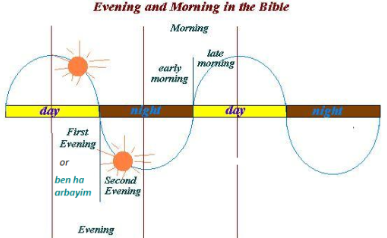
5 On the fourteenth day of the first month at evening is the Lord’S Passover. — at even or in the evening as renders in the parallel passage (Exodus 12:6); literally, this is between the two evenings;
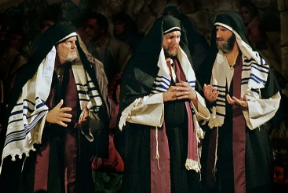
— the interpretation of this expression constituted one of the differences between the Sadducees and the Pharisees during the second Temple period, and they debated about the time for killing the paschal lamb and the evening sacrifices;
— according to the Sadducees, who followed the Samaritans, it is the time between the setting of the sun and the moment when the stars become visible, or when darkness sets in, that is, roughly between six and seven o’clock, a space of about one hour and twenty minutes;
— according to the Pharisees, however, “between the two evenings” means from the moment after the zenith of the sun at noon, to the disappearing of the sun. The first even is from the time when the sun begins to decline towards the west, to sun set; while the second even is when it goes down and until midnight;
— for the Pharisees, this is the reason why the paschal lamb in the evening sacrifice began to be killed and the blood sprinkled from 12.30 pm onward; as a longer period of time is needed for a large number of sacrifices (together with the evening sacrifices) on this day.
6 And on the fifteenth day of the same month is the Feast of Unleavened Bread unto the Lord; seven days ye must eat unleavened bread.
“Thou shalt not offer the blood of My sacrifice with leaven, neither shall the sacrifice of the Feast of the Passover be left until the morning” Exodus 34:25 — the moment the lamb was killed, the ordinance of unleavened bread should also be observed;
“In the first month, on the fourteenth day of the month at even, ye shall eat unleavened bread … ” Exodus 12:18 — the moment the lamb was killed is also the moment unleavened bread should be observed. That is, the Feast of Unleavened Bread is instituted at the same time as the Passover.
— in fact, Passover and the Feast of Unleavened Bread is a composite Feast; the whole festival is made of eight days, called indifferently the Feast of the Passover, Passover, or the Feast of Unleavened Bread. It is a hybrid festival;
— and this hybrid festival is comfirmed in Ezekiel 45
“In the first month, on the fourteenth day of the month, ye shall have the Passover, a feast of seven days. Unleavened bread shall be eaten” Ezekiel 45:21
Leviticus 23 (continues)
7 On the first day ye shall have a holy convocation; ye shall do no servile work therein. — the first day of unleavened bread, which commenced after the even of the 14th; in other words, the 15th Abib, ye shall have a holy convocation.
8 But ye shall offer an offering made by fire unto the Lord seven days. On the seventh day is a holy convocation; ye shall do no servile work therein.’” — in the seventh day or the last day is an holy convocation, ye shall do no servile work therein; an holy convocation same as on the first day.
The Scriptures says, the moment the Passover lamb was killed, it was also the same moment that only unleavened bread were to be eaten. In both instances, in Deuteronomy 16:6 and Exodus 12:18.
Observing the Unleavened Bread ordinance starts the exact moment the Passover lamb was killed. Passover, incorporating unleavened bread observance, is a multifaceted Festival. It is a composite Festival, yet each of its components could stand by itself.
Passover and Unleavened Bread were well amalgamated right at the beginning, at the time of the original Exodus.
In Deuteronomy 16:6 ba·erev is the time to kill the Passover on the fourteenth; and in Exodus 12:18 ba·erev on the fourteenth is also to commence eating unleavened bread. The Composite Feast started on the fourteenth, at erev, and continued through the fifteenth to the twentieth (Exodus 12:18).
Here is a great revelation from Ezra: his-inspired Targum had made it crystal clear that the Passover was on a late fourteenth and the eating of the lamb was on the fifteenth:
“And you shall eat the flesh on that night, the fifteenth of Nisan . . .” Exodus 12:8 Jonathan
And this composite characteristic is confirmed in the New Testament time:
Now on the first day of the Feast of Unleavened Bread, the disciples came to Jesus, saying unto Him, “Where wilt Thou that we prepare for Thee to eat the Passover?” Matthew 26:17
And on the first day of Unleavened Bread, when they killed the Passover lamb, His disciples said unto Him, “Where wilt Thou have us go and prepare, that Thou mayest eat the Passover?” Mark 14:12
“Now the Feast of Unleavened Bread drew nigh, which is called the Passover,” Luke 22:1
“Then came the Day of Unleavened Bread when the Passover lamb must be killed,” Luke 22:7
In both Testament times (Old and New), the Passover and Unleavened Bread ordinances were well interlaced. The testimonies from Exodus 12 and the New Testament are like twin mirrors: when placed against the CoG Communities, they reflect their nakedness. But these Wretches and Blind could not see their Nakedness because they are blind and they continue preaching with great deceptions, Revelation 3:17.
For further indepth Study on the Passover, see Passover Controversies.


