
What Is the Holy Spirit?
In the Scriptures, the word “spirit” is translated from the Hebrew word ר֣וּחַ ruʹach and the Greek word pneuʹma. Most often, those words refer to God’s active force, or holy spirit (Genesis 1:2). However, the Bible also uses those words in other senses:
“And the earth was without form, and void; and darkness was upon the face of the deep. And the Spirit (h7307 ר֣וּחַ rū·aḥ) of God moved upon the face of the waters” Genesis 1:2.
The Answer from the Scriptures
The holy spirit is God’s power in action, his active force (Micah 3:8; Luke 1:35). God sends out his spirit by projecting his energy to any place to accomplish his will — Psalm 104:30; 139:7. And because anything that comes out of God is holy, and as there are no capital letters in the Hebrew alphabets, whether they are expressed as the holy spirit or as the Holy Spirit is immaterial.
Micah 3:8 “But truly I am full of power by the spirit (h7307 ר֣וּחַ rū·aḥ) of the Lord, and of judgement and of might to declare unto Jacob his transgression and to Israel his sin.”
Luke 1:35 And the angel answered and said unto her, “The Holy Spirit shall come upon thee, and the power of the Highest shall overshadow thee: therefore also that holy thing which shall be born of thee shall be called the Son of God.”
Psalm 104:30 (Speaking of Genesis 1:1-3) You send forth Your Spirit, they are created.
- Breath — Habakkuk 2:19; Revelation 13:15
Habakkuk 2:19 Woe to him who says to wood, ‘Awake!’ To the dumb stone, ‘Arise! It shall teach!’ Behold, it is overlaid with gold and silver; Yet in it there is no breath (h7307 רוּחַ rū·aḥ) at all.
Revelation 13:15 “He was granted power to give breath (h7307) to the image of the beast, that the image of the beast should both speak and cause as many as would not worship the image of the beast to be killed.”
- Wind — Genesis 8:1; John 3:8
Genesis 8:1 “Then God remembered Noah, and every living thing, and all the animals that were with him in the ark. And God made a wind (h7307 rū·aḥ) to pass over the earth, and the waters subsided.”
John 3:8 Do not marvel that I said to you, ‘You must be born again.’ 8 The wind blows where it wishes, and you hear the sound of it, but cannot tell where it comes from and where it goes. So is everyone who is born of the Spirit.”
- The vital, or animating, force in living creatures — Job 34:14-15
Job 34:14-15 If He should set His heart on it, If He should gather to Himself His Spirit (h7307 rū·aḥ) and His breath (H5397 neshamah), 15 All flesh would perish together, And man would return to dust.
- A person’s disposition or attitude — Numbers 14:24
- Spirit persons, including God and the angels — 1 Kings 22:21; John 4:24
I Kings 22:21 “Then a spirit (h7307 rū·aḥ) came forward and stood before the Lord, and said, ‘I will persuade him.’ — a spirit can appear as a being or an angel, but nothing to suggest he’s a God, or a member of the Godhead.
John 4:24 “God is Spirit, and those who worship Him must worship in spirit and truth.”
The essence of the Scriptures lies in the shared sense of something unseen by humans that brings about visible effects. Similarly, the spirit of God, “like the wind, is invisible, immaterial and powerful.”
The Bible also refers to God’s holy spirit as his “hands” or “fingers” of God.
Psalm 8:3 When I consider Your heavens, the work of Your fingers, the moon and the stars, which You have ordained; 19:1 The heavens declare the glory of God; and the firmament shows His handiwork.
Luke 11:20; Matthew 12:28 Just as a craftsman uses his hands and fingers to do his work, God has used his spirit to produce his kingdom which results in the following:
- The universe — Psalm 33:6 “By the word of the Lord were the heavens made, and all the host of them by the breath (h7307 rū·aḥ) of His mouth;” Isaiah 66:1-2 Thus saith the Lord, “The heaven is My throne, and the earth is My footstool. Where is the house that ye build unto Me? And where is the place of My rest? 2 For all those things hath Mine hand made, and all those things have been,” saith the Lord. “But to this man will I look: even to him that is poor and of a contrite spirit (rū·aḥ), and trembleth at My word.
- The Bible — II Peter 1:20-21 “knowing this first: that no prophecy of the Scripture is of any private interpretation. For the prophecy came not in olden times by the will of man, but holy men of God spoke as they were moved by the Holy Spirit.”
- The miracles performed by his ancient servants and their zealous preaching — Luke 4:18; Acts 1:8,1 Corinthians 12:4-11.
- The fine qualities displayed by people who obey him — Galatians 5:22-23 “But the fruit of the Spirit is love, joy, peace, longsuffering, gentleness, goodness, faith, meekness, temperance: against such there is no law.”
The holy spirit is not a person
By referring to God’s spirit as his “hands,” “fingers,” or “breath,” the Bible shows that the holy spirit is not a person (Exodus 15:8,10)
Exodus 15:8 And with the blast of Your nostrils, the waters were gathered together; the floods stood upright like a heap; the depths congealed in the heart of the sea. . . 10 You blew with Your wind, the sea covered them; they sank like lead in the mighty waters.
A craftsman’s hands cannot function independent of his mind and body; likewise, the holy spirit operates only as God directs it.
“If you then, being evil, know how to give good gifts to your children, how much more will your heavenly Father give the holy spirit to those who ask Him!” Luke 11:13
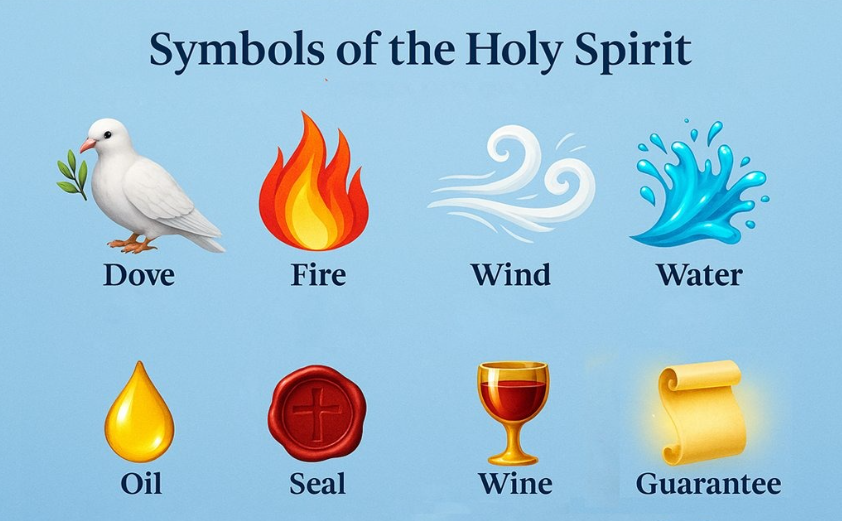
The Bible also compares God’s spirit to water and associates it with such things as faith and knowledge. These comparisons all point to the impersonal nature of the holy spirit — Isaiah 44:3; Acts 6:5; II Corinthians 6:6.
The Bible gives the names of Yehovah the Father and of his Son, Jesus Christ; yet, nowhere does it name the holy spirit (Isaiah 42:8; Luke 1:31).
When the Christian martyr Stephen was given a miraculous heavenly vision, he saw only two persons, not three. The Bible says:
“He, being full of holy spirit, gazed into heaven and caught sight of God’s glory and of Jesus standing at God’s right hand” Acts 7:55.
When John of Revelation was brought into vision in heaven, he saw only the Ancient of Days, described as the “Alpha and Omega,” that is, the Father; and his Son,, the Lamb: two persons, not three. Besides, the “angel of God” and the “spirit of God” could be read interchangeably. The Bible says in Revelation 1:
The mystery of the seven stars which thou sawest in My right hand, and the seven golden candlesticks: the seven stars are the angels of the seven churches, and the seven candlesticks which thou sawest are the seven churches. Revelation 1:20
The seven stars are the angels of the seven churches; that is, the seven stars which John saw in Christ’s right hand, represent the angels, or the seven churches of Asia, and in them all their pastors and ministers of the churches in all the periods of time until Christ’s second coming.
“And unto the angel of the church in Sardis write: ‘These things saith He that hath the seven Spirits of God and the seven stars: I know thy works, and that thou hast a name that thou livest, but thou art dead” Revelation 3:1.
The seven angel are also the seven spirits of God’s power in action, enabling each of the seven churches to see and understand a few things. Sometimes, the “hand of the Lord” or the “angel of God” verses the “spirit of God” could be read interchangeably; and this is true in the following instances:
So the Spirit lifted me up and took me away, and I went in bitterness, in the heat of my spirit; but the hand of the Lord was strong upon me. Ezekiel 3:14
The word of the Lord came expressly unto Ezekiel the priest, the son of Buzi, in the land of the Chaldeans by the River Chebar; and the hand of the Lord was there upon him. Ezekiel 1:3
Then the angel of the Lord went out and struck down one hundred eighty-five thousand in the camp of the Assyrians. When the people got up the next morning, there were all the dead bodies! Isaiah 37:36.
“My God sent his angel and shut the lions’ mouths; and they haven’t harmed me, for I was found innocent before him. And also before you, Your Majesty, I have not done harm,” Daniel 6:22.
I asked, “What are these, my lord?” The angel who was talking to me replied, “I will show you what they are,” Zechariah 1:9.
If the Spirit is a Being or an independent Personage by itself/himself; there would be seven Spirits (Revelation 3:1) of God before the heavenly Throne; and since these Spirits are inherently Holy, there should be seven Holy Spirits, as John saw them;
. . . and with these John would add Jesus Christ the Son, and God the Father, then there would be nine Personage; this is just simple arithmetic. Therefore there couldn’t be a Trinity since there are Nine in the Godhead; we should have a Polygon (a nine sided shape) or a Nonagon (nine straight sides that meet at nine corners); so surely the Godhead would be a Polyty or a Nonaty, but certainly couldn’t be a Trinity!
Misconceptions about the holy spirit
Misconception: The “Holy Ghost,” or holy spirit, is a person and is part of the Trinity, as stated at 1 John 5:7-8 in the King James version of the Bible.
Fact: The King James version of the Bible includes at 1 John 5:7-8 the words “in heaven, the Father, the Word, and the Holy Ghost: and these three are one. And there are three that bear witness in earth.”
However, researchers have found that those words were not written by the apostle John and so do not belong in the Bible. They were inserted by some copyist trying to promote the Trinity. Professor Bruce M. Metzger wrote: “That these words are spurious and have no right to stand in the New Testament is certain” — A Textual Commentary on the Greek New Testament, pg 719.
Misconception: The Bible personifies the holy spirit, and this proves that it is a person.
Fact: The Scriptures do at times personify the holy spirit, but this does not prove that the holy spirit is a person. The Bible also personifies wisdom, death, and sin. (Proverbs 1:20; Romans 5:17, 21) For example, wisdom is said to have “works” and “children,” and sin is depicted as seducing, killing, and working out covetousness — Matthew 11:19; Luke 7:35; Romans 7:8,11
Similarly, when the apostle John quoted Jesus, he personified the holy spirit as a “helper” (paraclete) that would give evidence, guide, speak, hear, declare, glorify, and receive. He used masculine personal pronouns such as “he” or “him” when referring to that “helper” (John 16:7-15). However, he did so because the Greek word for “helper” (pa·raʹkle·tos) is a masculine noun and requires a masculine pronoun according to the rules of Greek grammar. When John referred to the holy spirit using the neuter noun pneuʹma, he used the genderless pronoun “it” — John 14:16-17.
Misconception: Baptism in the name of the holy spirit proves that it is a person.
Fact: The Bible sometimes uses “name” to stand for power or authority (Deuteronomy 18:5, 19-22; Esther 8:10).
This is similar to its use in the English expression “in the name of the law,” which does not mean that the law is a person. A person who is baptized “in the name of ” the holy spirit recognizes the power and role of the holy spirit in accomplishing God’s will.
Misconception: Jesus’ apostles and other early disciples believed that the holy spirit was a person.
Matthew 28:19 “Go ye therefore and teach all nations, baptizing them in the name of the Father, and of the Son, and of the Holy Ghost,” — Interesting enough, this verse sounds far too trinitarian to have been included in Matthew’s original words but was inserted in the 3rd or 4th Centuries by some copyist trying to promote the Trinitarian formula for baptism.
Fact: The Bible does not say that, nor does history. The Encyclopædia Britannica states:
“The doctrine developed gradually over several centuries and through many controversies…”
“The definition that the holy spirit was a distinct divine Person . . . came at the Council of Constantinople in AD 381.” This was over 250 years after the last of the apostles had died.
The Hastings Dictionary of the Bible also provides proof that scholars generally regard the tripartite phrase of Matthew 28:19 to be a late Catholic addition.
For an indepth Study of Matthew 28:19 see A Study of Matthew 28:19


