
A Critique of Fred Coulter’s Passover (1-5)
A Critique of Fred Coulter’s Passover (a-c)
The Christian Passover What Does It Mean? When Should It Be Observed—the 14th or 15th?
Fred R. Coulter
Christian Biblical Church of God
Post Office Box 1442
Hollister California 95024-1442
And so with that in mind, we’ll begin:
Chapter 1- 2

Critiquing this Passover book is hard; it’s a pain. I wonder if any of his faithfuls have read any chapter of this book. I pretty much doubt it. The bulk of the book gives the impression of a “book is the result and accumulation of studies done by the author over the past fifty years.”
And there is another great claim, “the first book ever written and published that thoroughly explains all aspects of the Passover as recorded in the Bible.” It is an important subject, all right, ever since Malachi Message was written. And no doubt, we should not only read it through, but really study it.
It has expanded from under 300 pages in his first edition to well over 500 now, and it’s the most comprehensive book ever written on the Passover, “covering every aspects and questions ever raised.” But I doubt many of his faithfuls have really studied it through.
Here is what Edwards Norman says of Coulter’s writing:
“He took a certain approach to the complex issue of the Passover, and every time he ran into a scriptural obstacle, he wove an elaborate web to get around it—hence the large size of his book, The Christian Passover. Readers frequently accept his arguments, not because they are simply and clearly true, but because proving or disproving his vast amount of writing is an exhausting task that few have the time to complete” (Edwards, Norman: Coulter’s The Christian Passover. Servants’ News. May/June 2002).
So at last, I have put an effort to make a comprehensive critique on Coulter’s thick book. By following this series of critiques, I hope readers and his faithfuls will also have numerous questions like I have in many doubtful points. Otherwise our readers and his devotees aren’t thinking, as confirmed by a famous saying of Dr Hoeh: “if you believe everything we say you are not thinking.” And there are many questions raised in this critique. So let’s move on.
Quoted are Fred Coulter’s work, from an internet PDF version. These excerpts are in block form, in PINK, and indented so as to differentiate them from other quotes or comments. The Scriptures, in RED, must be our primary focus and guide, and sometimes the Scriptures, which include the Septuagint and the Targum, say things very different from what we think!
First, right from the start, on the Prologue (by Carl D Franklin)
The contentious controversy over a 14th or 15th Passover is an ancient conflict spanning over 3,000 years . . . Under the leadership of Ahab and Jezebel, Israel further abandoned her covenant with the Lord God and covenanted with the false impostor Baal. Forsaking the Nisan 14 Passover and the Nisan 15-21 Feast of Unleavened Bread, which the true Lord had commanded, Israel embraced Baal’s counterfeit Nisan 15 transubstantiation meal and a Nisan 15-21 leavened bread observance. (The Christian Passover, Prologue, pg i, PDF copy).
Although Ahab and Jezebel sinned greatly, there is no record anywhere that a 14th or 15th Passover controversy arose during their lifetime. By making such a presumptuous allegation, any non-sleepy reader would lose confidence in his writing.
To this day, Judah insists on observing the Passover on Nisan 15, clinging to the day that she was accustomed to observe in commemoration of Baal. (The Christian Passover, Prologue, pg iii).
Quoted later in the same prologue, he confused the sin of Ahab and Jezebel, who belonged to the northern house of Israel, with the house of Judah. The truth is that, there has never been any record showing that the house of Judah ever followed Ahab and Jezebel in the Passover controversy.
Judaism claims that according to their traditions, the Passover is on the 15th day of the first month of the Hebrew/Jewish calendar, and always has been, in spite of the fact that the Old Testament Scriptures clearly teach that it was originally observed on the 14th day of the first month. (Preface, pg vi).
As a result, Christians who observe the New Testament Passover have been confronted with the problem as to which day is correct, the 14th or the 15th. Some groups claim that it is the 14th, and offer many Scriptures to support their belief. Other groups, with equal conviction, point to Scrip tures which appear to show that the Passover should be observed on the 15th, as do the Jews. That is the dilemma! (Introduction, pg 2).
The Question isn’t just about whether Passover is on the 14th or 15th, as that’s too simplistic. The question is, what is the truth? Strange as it may seem, the truth is that Passover falls on both the 14th as well as on the 15th. The killing of the Passover Lamb was done on the 14th, at even, around 3 PM; and, still on Passover, it was eaten on the following night, on the 15th.
Here is the event: the eating of the sacrifice; eating in haste, with your loins girded, shoes on your feet, and staff in your hand—it is the Lord’s Passover (פֶּסַח H6453):
And thus shall ye eat it: with your loins girded, your shoes on your feet, and your staff in your hand; and ye shall eat it in haste; it is the Lord’S Passover. Exodus 12:11
The first chapter started with some excellent statements, but I’m afraid Fred Coulter would soon lose his focus and wrote something contrary to what he wrote:
The New Testament teaches that Jesus Christ is the true Passover Lamb of God for all time by the one perfect sacrifice of Himself (Heb. 7:27; 10:10). Paul declared of Jesus, “For Christ our Passover was sacrificed for us” (I Cor. 5:7). This was the plan of God from the beginning. Jesus was “…the Lamb [of God] slain from the foundation of the world” (Rev. 13:8). Without the sacrifice of Jesus Christ there is no remission of sins, no forgiveness of sins before God the Father. John the Baptist proclaimed, “Behold the Lamb of God, Who takes away the sin of the world” (John 1:29). He is the Beginning! (Chapter 1, pg 6).
It is certainly true to say that the true Lamb of God is the perfect sacrifice for all mankind, slain from the foundation of the world. Hence although the SACRIFICE OF THE LAMB (פֶּסַח H6453) is the primary focus, the expression Passover also includes the eating of the sacrifice (פֶּסַח H6453); and the Lord’s passing (פָּסַח H6452) over their houses, executing his judgement.
Although Strong allocates a new number for the same English word, the Hebrew originals are derived from the same source: (פֶּסַח H6453 Pecach) is a noun while פָּסַח (H6452 Pacach) is the verb that derives from the noun.
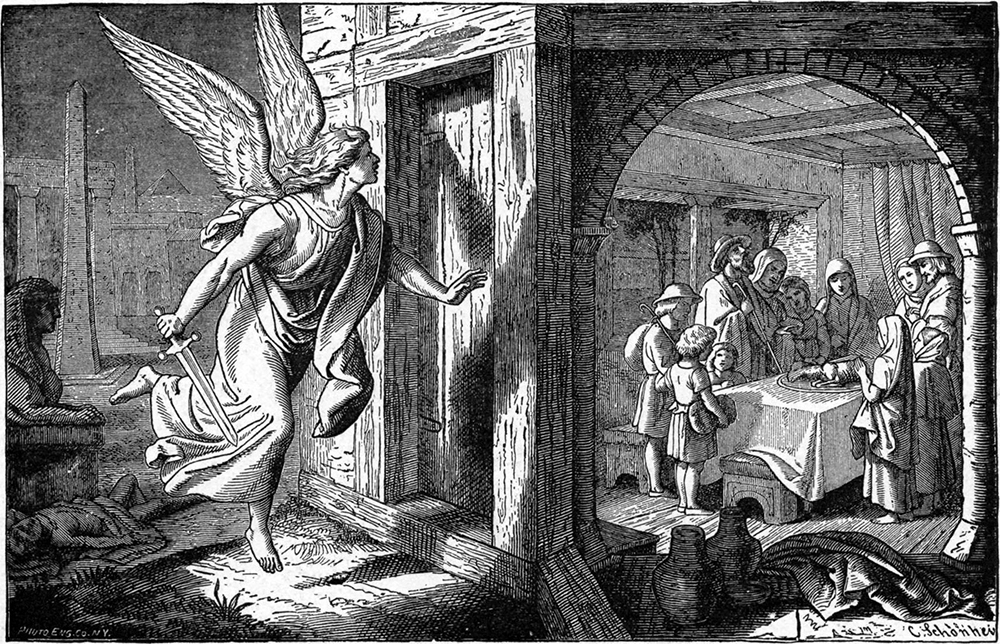
“The Passover received its name from the night in which God passed over the houses of the children of Israel and spared their firstborn from the plague of death, while they were still in their houses in the land of Egypt, before the Exodus took place—not while the Exodus was taking place! The Lord passed over the houses of the children of Israel and saw the blood of the Passover lambs on the side posts and lintels of their doors, and He did not kill their firstborn” (Pg 16).
Although the English term, Passover, coined by William Tyndale, comes from the night when God passed over the houses of the children of Israel and spared their firstborn from the plague of death, its central focus was the sacrifice of the Lamb. This sacrifice provided the blood to be spread on the doorposts, protecting any house marked with it from death.
Below are more of his quote, with emphasis added:
The Scriptures define the meaning of the word “passover.” The Passover is named for an event which was executed by God: “…It is the LORD’S Passover, for I will pass through the land of Egypt this night, and will smite all the first-born in the land of Egypt, both man and beast. And I will execute judgment against all the gods of Egypt. I am the LORD. And the blood shall be a sign to you upon the houses where you are. And when I see the blood, I WILL PASS OVER YOU. And the plague shall not be upon you to destroy you when I smite the land of Egypt” (Ex. 12:11-13). (Pg 16).
Not too accurate, though close; the real Passover was the sacrifice of the Lamb; secondary is the eating of the Passover; and is not just an event where God executed an event when the Egyptians were executed. The components of Passover are (1) the Lamb being sacrifice, (2) the sacrifice been eaten, and (3) when God executed his judgement upon those not having the Blood on their doorposts.
This term “the Lord’s Passover (H6453),” is the most important aspect of the Passover process: Leviticus 23:5 On the fourteenth day of the first month, at even, is the Lord’s Passover (H6453). What happened “at even” is the sacrifice — the KILLING of the LAMB. The emphasis is on “the Lord’s Passover” the KILLING as a Sacrifice — the rest are also important, but secondary. “And thus shall ye eat it: with your loins girded, your shoes on your feet, and your staff in your hand; and ye shall eat it in haste; it is the Lord’s Passover” (H6453) Exodus 12:11.
The SACRIFICE of the LORD’s LAMB is of primary importance. CHRIST is the VINE, the rest, the humanity that derives from the Blood of Christ, are the branches. Similarily, any protection from God’s judgement couldn’t work without the shield of Christ’s Blood.
John 15:5 “I am the vine, ye are the branches. He that abideth in Me and I in Him, the same bringeth forth much fruit, for without Me ye can do nothing.

The cart shouldn’t be placed before the horse. The participation of eating of the Sacrifice and the Death Angel’s “pass over” are also important, but only secondary effects, something that happens downstream. Cause and effects, or cause and consequences. Without the Vine, all branches will fade away. Without that shed blood, that protection from the Death Angel “passing over” wouldn’t happen.
Slain from the foundation of the world, the Lamb’s sacrifice is of supreme importance. This sacrifice is to be remembered every year since Exodus. And today we still remember it yearly. A source of confusion in translation: consonants are the same for both words, pacach and pecach in Strong’s Concordance, but vowels added to the original Hebrew consonants are different.
Below, we’ll dive deeper into Strong’s Concordance
Exodus 12:23 פָּסַח H6452 pacach pass over (the LORD will pass over)
“For the Lord will pass through to smite the Egyptians; and when he seeth the blood upon the lintel, and on the two side posts, the Lord will pass over H6452 the door, and will not suffer the destroyer to come in unto your houses to smite you” Exodus 12:23.
Outline of Biblical Usage for H6452 pacach
- to pass over, spring over
- (Qal) to pass over
- (Piel) to skip, pass over
- to limp
- (Qal) to limp
- (Niphal) to be lame
- (Piel) to limp
Exodus 12:21 פֶּסַח H6453 pecach passover (to kill or eat the Passover)
“Then Moses called for all the elders of Israel, and said unto them, Draw out and take you a lamb according to your families, and kill the passover H6453” Exodus 12:21.
Outline of Biblical Usage H6453 pecach
- passover
- sacrifice of passover
- animal victim of the passover
- festival of the passover
Leviticus 23:5 In the fourteenth day of the first month at even is the LORD’S passover H6453
Numbers 9:2 Let the children of Israel also keep the passover H6453 at his appointed season.
Ezekiel 45:21 In the first month, in the fourteenth day of the month, ye shall have the passover, H6453 a feast of seven days; unleavened bread shall be eaten.
Whenever the real Passover was referred to, we can ascertain which is the real Passover. For example, in Leviticus 23:5, “In the fourteenth day of the first month at even is the LORD’S passover H6453″ — the emphasis of Passover was the event ‘at even’ of the Sacrifice, not the event at midnight! The passing over of the Death Angels at midnight was a one-time event; it never happened again.
The word to commemorate the Exodus in Strong’s Concordance is Pecach (H6453) and not Pacach (H6452).
Exodus 12:25 “And it shall come to pass, when ye come to the land which the Lord will give you, according as He hath promised, that ye shall keep this service. And it shall come to pass, when your children shall say unto you, ‘What mean ye by this service?’ that ye shall say, ‘It is the sacrifice of the Lord’S Passover (H6453), who passed over (H6452) the houses of the children of Israel in Egypt when He smote the Egyptians and delivered our houses’” Exodus 12:25-27.
If H6452 pacach (as in the sense of the Lord passed over) is intended, it doesn’t make sense if we were to “kill the Passover,” or to “eat the Passover.” Perhaps, the “Lord’s passover” might be better understood as the Lord’s judgement?
This specific term “the Lord’S Passover (H6453),” is mentioned exactly word-for-word in Leviticus 23:5, “On the fourteenth day of the first month, at even, is the Lord’S Passover (H6453).”
The emphasis is on “the Lord’S Passover” as a Sacrifice — On the fourteenth day of the first month, at even, is the Lord’S Passover, (Levitcus 23:5). The emphasis on the Sacrifice makes greater sense in other Scriptures, especially in the New Testament period, to read about to “kill the Passover,” or to “eat the Passover.”
Elsewhere in the Old Testament, references of Passover (H6453 pecach) as the sacrificial lamb being made:
(a) “to eat the Passover” — Exodus 12:11,43, II Chron 30:18
(b) “to kill the Passover” — Exodus 12:21, II Chron 30:15, 35:1,6,11
(c) “to sacrifice the Passover” — Exodus 12:27, 34:25, Deu 16:2,5-6
(d) “to roast the Passover” — II Chron 35:13
The sacrifice of the LORD’s LAMB is of primary importance. The Death Angel’s “pass over” is also important, but only secondary. Cause and effect, or cause and consequence.
When William Tyndale translated the Pentateuch directly from the original Hebrew into English in 1530, he needed a word for the Hebrew noun Pesaḥ (פֶּסַח). Tyndale wanted a clear, plain English term that captured the literal meaning of the Hebrew verb Pasaḥ (פָּסַח)—which describes God “passing over” or stepping/skipping over the houses of the Israelites in Exodus 12. He combined the English verb phrase “pass over” into a single compound noun: thus Passover resulted in our English.
Fred Coulter’s analysis is, unfortunately, too way off by not emphasizing the Killing and Sacrifice of the Lamb:
“The Scriptures define the meaning of the word “passover.” The Passover is named for an event which was executed by God: “…It is the LORD’S Passover, for I will pass through the land of Egypt this night, and will smite all the first-born in the land of Egypt, both man and beast. And I will execute judgment against all the gods of Egypt. I am the LORD. And the blood shall be a sign to you upon the houses where you are. And when I see the blood, I WILL PASS OVER YOU. And the plague shall not be upon you to destroy you when I smite the land of Egypt” (Ex. 12:11-13). (Pg 16).
Later, Fred corrected himself, pointing to a cohesive whole:
At their next Passover, the first one in the wilderness after the tabernacle was set up and dedicated, the nine rules for “keeping” the Passover are called statutes and ordinances: “Let the children of Israel also keep the Passover at its appointed time. In the fourteenth day of this month, between the two evenings, you shall keep it in its appointed time. You shall keep it according to ALL ITS STATUTES, and according to ALL THE ORDINANCES of it” (Num. 9:2-3). (Pg 19).
Here Fred Coulter listed 9 requirements for keeping the passover, that “ALL THE ORDINANCES” must be kept during the Passover season, which includes requirement number one: 1) Select an unblemished male lamb less than one year old on the 10th day of the first month (Ex. 12:3).
In fact, there are three levels of time zooms or periods in reading Exodus 12 regarding the Passover question.
The three levels of zooming at Passover are:
(1) Passover “Between the evenings” or ben ha arbayim: “and the whole assembly of the congregation of Israel shall kill it in the evening” (Exodus 12:6). “Ba·erev” “thou shalt sacrifice the Passover at even” (Deuteronomy 16:6). This scenario is limited to “killing the Passover,” but depending on the context, it could extend into the night to include eating “the Passover.”
(2) Passover, a feast of seven days (Ezekiel 45:21); Passover is described here as a feast of seven days. That’s right. Passover is a composite festival. Deuteronomy 16 refers to Passover as the Days of Unleavened Bread, and uses the terms interchangeably throughout the chapter. It’s the same with Exodus 12, especially from v15: Passover on the Nisan 14th must be observed with unleavened bread; they are NOT distinct separate feasts;
In the first month, on the fourteenth day of the month at even, ye shall eat unleavened bread until the one and twentieth day of the month at even. Exodus 12:18
(3) Passover as a season, or the Passover season, which includes identifying the lamb on the tenth of Nisan, the killing of the Passover lamb, and the Feast of Unleavened Bread; and before that, requiring much preparation preparing offerings and planning the journey to Jerusalem. The season is one month generally: “Let the children of Israel also keep the Passover at his appointed season” (Numbers 9:2, Exodus 12).
The concept of Passover has either a limited meaning or a broader meaning. One could define Passover to include “ALL THE ORDINANCES” while another could be limited such as just to “kill the Passover,” or just to “eat the Passover.”
After the Jews returned from Babylon, they continued to keep the Passover under Ezra:
“And the children of the captivity kept the Passover upon the fourteenth day of the first month.
“For the priests and the Levites were purified together; all of them were pure, and killed the Passover lamb for all the children of the captivity, and for their brethren the priests, and for themselves” Ezra 6:19-20.
During the New Testament era, much of the record focuses only on the eating of the Passover: Mark 14:12,14; Luke 22:8,11,15; John 18:28. Only Luke 22:7 speaks of the Passover being killed.
But in 1 Corinthians 5:7, it spelt out clearly the central theme of Passover:
“For even Christ, our Passover, is sacrificed for us” 1 Corinthians 5:7
Christ is our true Passover, the Lamb who was sacrificed at 3 PM on the fourteenth of Nisan, at even. Therefore, the meal would take place on the fifteenth.
Finally, during the New Testament era, there were much evidence that the Passover and the Feast of Unleavened Bread are a composite Festival:
Now on the first day of the Feast of Unleavened Bread, the disciples came to Jesus, saying unto Him, “Where wilt Thou that we prepare for Thee to eat the Passover?” Matthew 26:17
And on the first day of Unleavened Bread, when they killed the Passover lamb, His disciples said unto Him, “Where wilt Thou have us go and prepare, that Thou mayest eat the Passover?” Mark 14:12
Now the Feast of Unleavened Bread drew nigh, which is called the Passover. Luke 22:1
Then came the Day of Unleavened Bread when the Passover lamb must be killed. Luke 22:7
The four verses quoted are clear and self evident: Passover is a composite Festival. Anyone with a self-absorbing mindset trying to understand these passages could only be confused.
~~~~~

The picture above shows two contrasting birds. Imagine that at every ten minutes interval, these two birds combined and morphed into a single dancing hybrid for one minute. How would a snapshot picture from an iPhone look like?
Imagine that such a bird attracting so much attention that busloads of school kids were brought in to study the hybrid and write reports on their observations. What would those reports be like?
Answer: It would be like what Moses wrote about the Passover and the Feast of Unleavened Bread in Exodus 12 and Deuteronomy 16, and what the New Testament writers describing the composite Passover Festival in the four verses quoted above.
~~~ ~ 3 & 4 ~ ~~~
In Chapter 3 and 4, Fred Coulter takes issue of the word ‘evening’ (ba·erev H6153), which according to him, should be translated as “dusk” or as “twilight.”
“In the first month, on the fourteenth day of the month at dusk, is the LORD’s passover. And on the fifteenth day of the same month is the feast of unleavened bread unto the LORD; seven days ye shall eat unleavened bread. In the first day ye shall have a holy convocation; ye shall do no manner of servile work. And ye shall bring an offering made by fire unto the LORD seven days; in the seventh day is a holy convocation; ye shall do no manner of servile work” (Lev. 23:4-8, JPSA).
This Scripture specifically states that the Passover is on the 14th day of the month “at dusk.” The Hebrew phrase that is translated “at dusk” in this passage from the JPSA version is ben ha arbayim. The same Hebrew phrase is translated “at even” in the King James Version. The use of these words by the translators of the KJV has led many to confuse the phrase ben ha arbayim with another Hebrew phrase that is also translated “at even,” or “evening.” (The Christian Passover, Chapter 3, Pg 23)
By quoting JPS translation, Fred felt he was right to have a Jewish Publication Society on his side, but he probably didn’t know that any JPS publications are from a new Jewish movement where they call themselves the Reform Jews, and not by the Rabbinic Jews.
Finding jobs in Germany during the 1800s was tough, so the gist of their reasoning went like this: if you couldn’t celebrate Passover on the fourteenth of Nisan, you do it in the next available month; similarly, if you couldn’t find work because you had to work on the Sabbath, you’d take the next available day, Sunday. “God will allow it,” these Reform Jews reassured themselves; thereafter, one reform followed another; and soon, they decided that ‘ben ha arbayim’ should be translated as ‘at dusk.’
More on this later, but in the meantime, we’ll consider the term ‘ben ha arbayim’ literally as “between the two evenings” which is translated into English as “at even.” The same happens with the other term ‘ereḇ’ is also translated as “even.” Since Strong Concordance allocates both terms as H6153, it indicates both words came from the same root.
However, both words or phrases are used in the Scriptures to describe the timing of the Passover. Below, we’ll analyse their differences:
(1) “And ye shall keep it up until the fourteenth day of the same month, and the whole assembly of the congregation of Israel shall kill it in the evening (H6153 ben ha arbayim)“ Exodus 12:6
Fred Coulter takes issue with the King James translation, and according to him, should be translated as “dusk.” It is a time period of 3 to 5 minutes, he wrote later. But according to Rabbinic Jews, the phase ‘ben ha arbayim’ is an idiom, and it is a much longer time, from mid-day to sunset; between the eves of two erevs.
Rabbi Rashi (1040-1105), a prominent medieval rabbi, explains Exodus 12:6
this phase ben ha arbayim in Ex 12:6: Heb. בֵּין הָעַרְבָּיִם From six hours [after sunrise] and onward is called בֵּין הָעַרְבַּיִם, literally, between the two evenings, for the sun is inclined toward the place where it sets to become darkened. It seems to me that the expression בֵּין הָעַרְבַּיִם denotes those hours between the darkening of the day and the darkening of the night. The darkening of the day is at the beginning of the seventh hour, when the shadows of evening decline, and the darkening of the night at the beginning of the night.
— in short, this means ben ha arbayim is the time after midday till sunset.
(2) Deuteronomy 16:6 But at the place which the Lord thy God shall choose to place his name in, there thou shalt sacrifice the passover at even (ba·erev, same root word as ben ha arbayim); or
Exodus 12:18 In the first month, on the fourteenth day of the month at even (ba·erev), ye shall eat unleavened bread, until the one and twentieth day of the month at even (ba·erev).
— In Orthodox terminology concerning Passover issue, there are two evenings (erevs), one from the time the sun begins to decline, and the other evening is after the sun has gone down.
To make this clearer, “between the two evenings” is from the time when the sun begins to incline towards the west, which is from the sixth hour [noon or 12 o’clock] and onwards.
It is erevim [“evenings”] because there are TWO EVENINGS, for “between the two evenings” which is from the time that the sun begins to decline as one evening, and the other evening is after the sun has GONE DOWN. It is the space of time in between which is meant by “between the two evenings.”

The Orthodox definition of ben ha’arbayim “between the two evenings” makes great sense. It is in between the first phase of erev when the sun had passed noon to the next phase of erev after sunset. Or as another way of expressing it, “after noon and until nightfall.” Note that “after noon” is a 2-word phase.
Fred Coulter wrote:
In all eleven passages where ben ha arbayim is used in the Scriptures, Strong’s concordance numbers and defines it as #6153, including it with ereb . . . While it is acceptable to translate the phrase ba erev as “evening” or “at even,” it is NOT proper to translate ben ha arbayim in this manner. The two phrases have COMPLETELY DIFFERENT MEANINGS. We will study ba erev in detail in the next chapter of this book. (Pg 23-24).
This is correct, ben (H996) ha arbayim (H6153) occur 11 times, and its meaning differs from ba·erev (H6153); so let’s study each of them in details.
The eleven verses that used ha arbayim are:
(1) And ye shall keep it up until the fourteenth day of the same month, and the whole assembly of the congregation of Israel shall kill it in the evening. Exodus 12:6
(2) “I have heard the murmurings of the children of Israel. Speak unto them, saying, ‘At even ye shall eat flesh, and in the morning ye shall be filled with bread; and ye shall know that I am the Lord your God.’” Exodus 16:12
(3) The one lamb thou shalt offer in the morning, and the other lamb thou shalt offer at even. Exodus 29:39
(4) And the other lamb thou shalt offer at even, and shalt do thereto according to the meat offering of the morning and according to the drink offering thereof, for a sweet savor, an offering made by fire unto the Lord. Exodus 29:41
(5) And when Aaron lighteth the lamps at even, he shall burn incense upon it, a perpetual incense before the Lord throughout your generations. Exodus 30:8
(6) On the fourteenth day of the first month at even is the Lord’S Passover. Leviticus 23:5
(7) In the fourteenth day of this month at even ye shall keep it in his appointed season. According to all the rites of it and according to all the ceremonies thereof shall ye keep it.” Numbers 9:3
(8) And they kept the Passover on the fourteenth day of the first month at even in the Wilderness of Sinai. According to all that the Lord commanded Moses, so did the children of Israel. Numbers 9:5
(9) The fourteenth day of the second month at even they shall keep it, and eat it with unleavened bread and bitter herbs. Numbers 9:11
(10) The one lamb shalt thou offer in the morning, and the other lamb shalt thou offer at even, Numbers 28:4
(11) And the other lamb shalt thou offer at even; as the meat offering of the morning and as the drink offering thereof thou shalt offer it, a sacrifice made by fire, of a sweet savor unto the Lord. Numbers 28:8
When the Orthodox definition of ben ha’arbayim “between the two evenings” is interpreted as “after noon and until nightfall,” all the pieces from the Passover puzzles fall into place. From the study of eleven cases above, there are six observations:

(1) The commandment to sacrifice a lamb daily in the morning and one in the evening: normally one at 9 AM and another at 3 PM, where ben ha’arbayim is defined as “after noon and until nightfall” (3, 4, 10, 11).
(2) The Passover lamb to be killed on the fourteenth at around 3 PM: (1, 6, 7, 8, 9).
(3) Lighting of the Sanctuary before nightfall, not after nightfall (5).
(4) Quails arriving as food for the Israelites in the “after noon” when there was light to do the catching, cleaning and cooking and not after nightfall (2).
(5) And most importantly, note that NONE of the above ben ha’arbayim were to start a Sabbath, or to start a new day, which would be after 6 PM (sunset, dusk, twilight) till midnight.
(6) For the start of Sabbaths, whether weekly or annual, or the beginning of nights, the term erev, specifically the second erev, is used. The time frame for the first erev, or ‘Afternoon’ in the chart, coincides with what’s known as ben ha’arbayim; that is, from mid-day til sunset.
Why are there so much confusion?
This is because erev can refer to any one of three timeframes: (1) from noon or midday to sunset, (2) from sunset to midnight, or (3) from noon or midday to midnight.
(1) erev: from noon to sunset; only this timeframe coinsides with the term ben ha’arbayim;
(2) erev: from sunset to midnight: this timeframe is to start a day, or the Sabbath; also the time to eat the Passover;
(3) erev: from noon to midnight; this is a 12-hour evening, or for today’s readers, better known as the whole 6-hour afternoon and the first 6-hour night; and when combined with the other 12-hour morning, from midnight, it completes a full 24-hour day. This concept is key to understanding the Genesis creation: “And the evening and the morning were the first day.”
Just as translating from one language into another can be confusing, the numerous idiosyncrasies of the Hebrew language have definitely add to further confusions. When inspiring the writings of the Scriptures, God reveals many things, but he also incorpoates conplexities that could confuse those he long foresaw as stubborn and stiff-necked.
When ben ha’arbayim is interpreted as “after noon and until nightfall,” which is the first erev, there are ample time of 6 hours for the preparation and killing, cleaning and roasting of the Passover lamb before nightfall arrives. And Aaron wouldn’t stumble lighting the Sanctuary after darkness had fallen, neither with the Israelites catching quails among nocturnal snakes in the Sinai desert.
The English language, too, has its own idiosyncrasies. For example, words could serve as their own direct opposites depending on how they are used:
(a) Sanction: to approve something (“The committee sanctioned the project”) Or to penalize something (“Economic sanctions were imposed”).
(b) Dust: to add fine particles (“Dust the cake with sugar”) Or to remove fine particles (“Dust the shelves”).
(c) Cleave: to stick closely together (“Cleave to your principles”) Or to split apart (“Cleave the wood in two”).
(d) Oversight: careful supervision (“Due to strong regulatory oversight”) Or an accidental omission (“It was a complete oversight on my part”).
Understanding these idiosyncrasies are important; otherwise no one would be able to figure out why a self-absorbing author felt the need to write a book of over 500 pages that only served to confuse himself.
~~~~~
Fred Coulter, in his criticism of the Orthodox Rabbi Rashi, wrote:
Rabbi Rashi states that ben ha arbayim, which literally means “between the setting-times,” refers to the time period from 1 PM, the
“evening” of day, until sunset, the “evening” of night. His definition places the slaying of the Passover lambs during the afternoon of the 14th—specifically, the time from one hour after noon until sunset of the 14th, at which time the 15th day begins. This interpretation of ben ha arbayim does not allow time to complete ALL NINE ORDINANCES of the Passover—including roasting and eating the lambs, and burning the remains—ON THE 14TH, as commanded in Scripture. (Pg 27)
Fred criticized Rashi for not fulfilling ALL NINE ORDINANCES, yet he conviently forgot his own. Just a reminder regarding the first rule written by a confused Coulter in case readers still hadn’t noticed he himself broke the first of “ALL NINE ORDINANCES” of the Passover:
1) Select an unblemished male lamb less than one year old on the 10th day of the first month (Ex. 12:3). (Pg 19)
I can imagine all the other helpers, with all the editing and proofreading, in the work—Carl and Jean Franklin, Philip Neal, Albert and Mela Cataga John, Hiedi and Sasha Vogele—must be very comfortable with this masterpiece.
Or are they sleeping?
~~ 4 & 5 ~~
Fred Coulter continues with Chapters 4 and 5:
The slaying of the lambs was the first of nine ordinances to be fulfilled on the Passover day. (Pg 33)
Look, the slaying of the lamb would be his second ordinance. Fred Coulter couldn’t even quote his own work accurately. Being so self-absorbing trying to prove some misguided hypothesis he ran too fast that he put the cart before the horse! Caught flat-footed again and again, how could anyone trust his interpretations? Just a reminder of his first ordinances, in case: 1) Select an unblemished male lamb less than one year old on the 10th day of the first month (Ex. 12:3). (Pg 19)
Also, to make his “domestic” Exodus passover more complete, Fred shouldn’t forget to include at least two other ordinances that night to his nine already stated:
10) They shall eat the passover with loins girded, shoes on their feet, staff in their hands; and they shall eat it in haste:
Exodus 12:11 And thus shall ye eat it: with your loins girded, your shoes on your feet, and your staff in your hand; and ye shall eat it in haste; it is the Lord’S Passover. — If a “domestic” Egyptian passover were to be repeated, this should also be repeated every year thereafter.
11) Stay indoors in their houses and burn any food remains with fire in the morning (boqer):
Exodus 12:10,22 And ye shall let nothing of it remain until the morning, and that which remaineth of it until the morning ye shall burn with fire. . . 22 . . . and none of you shall go out from the door of his house until the morning (boqer).
Numbers 9:12 “They shall leave none of it [food remains] unto the morning (boqer), nor break any bone of it. According to all the ordinances of the Passover they shall keep it.” — See, staying indoors until the morning (including burning any food remains) is another one of the ordinances which wasn’t included.
Just as a reminder, Fred Coulter’s nine ordinances (Page 19 of his book) are listed here:
1) Select an unblemished male lamb less than one year old on the 10th day of the first month (Ex. 12:3).
2) Kill the lamb on the 14th day of the first month at dusk [Hebrew ben ha arbayim, “between the two evenings”]. Share the lamb with a neighbor if one’s own family was too small to eat it. Do not break a bone of the lamb (Ex. 12:4, 6, 46).
3) Strike the side posts and lintel of the door of the house with some of the blood (Ex. 12:7).
4) Roast the whole lamb—head and legs and edible entrails—with fire (Ex. 12:9).
5) Do not boil the meat in water or eat it raw (Ex. 12:9).
6) Eat the flesh in that night with bitter herbs and unleavened bread (Ex. 12:8).
7) Allow no alien to eat it unless circumcised (Ex. 12:43-44).
8) Eat it in the same house where it was slain. Do not carry any of it out of the house (Ex. 12:46).
9) Burn any remains, such as the bones and fat, the skin and guts, with fire by morning (Ex. 12:10). (Pg 19)
Without these additional ordinances, his nine listings seem incomplete, something vitally important is missing in that original Exodus as commanded. The proposed ordinances in 10) and 11) are far more important commandments than say, 5) Do not boil the meat in water or eat it raw. In fact, 5) should be merged with 4) Roast the lamb with fire, as both are derive from a single verse Exodus 12:9.
Starting from page 34, Fred Coulter started to quote from the Schocken Bible, a translation by Everett Fox who is primarily associated with the Havurah movement; and his translations and teachings have been widely embraced across Reform Judaism and Conservative Judaism.
The Havurah movement was sparked by young, disaffected American Jews who were disillusioned by the impersonal, “country-club style” suburban synagogues of the post-WWII as too rigid, and opted for full gender equality in Jewish life. It later led the way in welcoming LGBTQ+ individuals, interfaith families, and non-binary worshippers.
Earlier in Chapter 3, Fred endosed Everett Fox translation, who defines ben ha arbayim as the time between sunset and dark.
“As we will see, one of the leading authorities in Biblical Hebrew, Everett Fox, defines ben ha ar bayim as the time between sunset and dark.” (Pg 31).
Later, from the Schocken Bible, Fred Coulter leans toward a new understanding:
“At sunset,” or ba erev, is a very short period of time. It begins when the sun appears to touch the horizon, and ends when the sun drops below the horizon. The total duration of its setting is no more than 3-5 minutes” (Pg 35).
— in short, Fred Coulter is saying, the phrase ba erev, or “at sunset,” designates the end of one day and the beginning of the next day — a period of no more than 3-5 minute.
The difference in the two definitions creates clarity on some issues but confusion in others since ba·erev could mean the ending or beginning of a day.

If the lamb were killed early during the five minute period it could be designated as the previous day, and therefore it would be an invalid sacrifice. If the lamb is killed slightly late after the five minutes allowed, it could also be an invalid sacrifice.
Within a five minute period has a very narrow margin for error. Second, if the lamb has to be killed within the five minute period then why is it also allowed within the one and a half hour period ben ha arbayim?
Also are the two periods ba·erev followed by ben ha arbayim? Fred Coulter answers this question in the affirmative in numerous places:
The chronological events that are recorded in Exodus 16 clearly define ben ha arbayim— “between the two evenings,” or “between the setting times”—as the time period that immediately FOLLOWS sunset, or ba erev (Pg 48).
We have examined the Scriptural evidence, and we have found irrefutable proof that ben ha arbayim— “between the two evenings,” or “between the setting-times”—begins immediately after the day has ended at sunset, or ba erev. . .
Ben ha arbayim is a relatively short period in the day. It begins when the sun disappears below the horizon and ends when the darkness of night has come. The length of time varies depending on the season of the year. In the winter, ben ha arbayim is approximately 30-40 minutes. In the spring or fall, ben ha arbayim lasts from approximately one hour to 1 hour and 15 minutes. In the middle of the summer, ben ha arbayim can last approximately 1 hour and 30 minutes. (Pg 50).
Ben ha arbayim—“between the two evenings,” would begin immediately after the day has ended at sunset, or ba erev, Fred Coulter says.
If so, then two lambs for Passover would be needed, MAGIC! One to be sacrificed at ben ha arbayim to fulfil Exodus 12:6 and another to be sacrificed minutes earlier at ba·erev to fulfil Deuteronomy 16:6. In Joshua 5:10 it confirms Passover was kept ba·erev at Gilgal after crossing the Jordan:
And the children of Israel encamped in Gilgal, and kept the Passover on the fourteenth day of the month at evening (ba·erev) in the plains of Jericho. Joshua 5:10
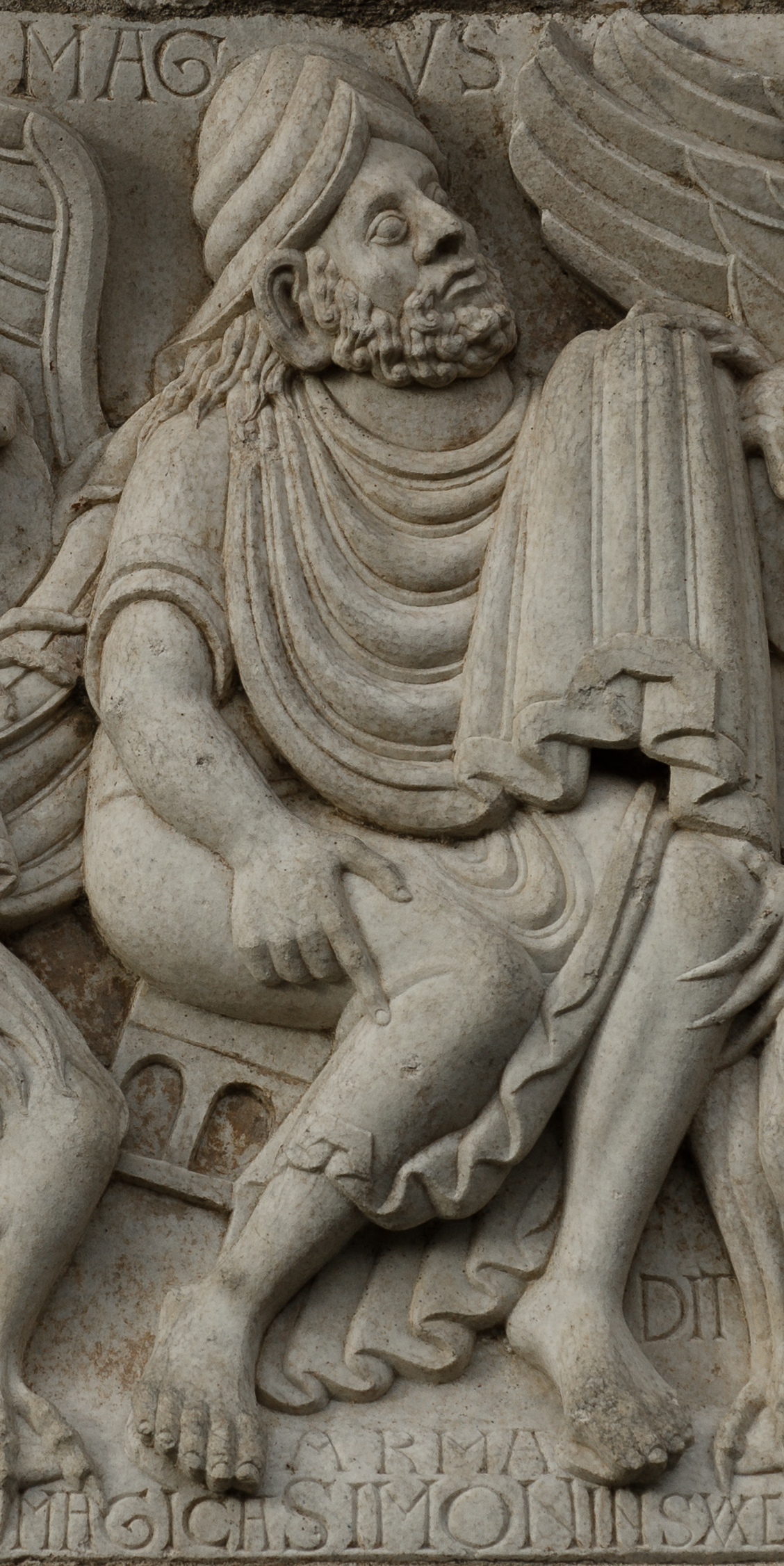
One lamb definitely couldn’t fulfil two sacrifices. Fred Coulter’s analysis can only add confusion to more confusion. His definition for ba·erev and ben ha arbayim is a sleight of hand! Magic! It is a touch of Simon Magus. His sleepy faithfuls would admire his skill with admiration!
His sloppy partners-in-Christ aren’t thinking. If they had used only some of their brain cells, they would have woken up from a cold shower. Or else they are sleeping, like the Laodicean virgins: “wretched, and miserable, and poor, and blind, and naked!”

The Talmud tells the story of a Gentile who went to Hillel the Elder and said to him, “I want to convert, but I want to accept only the Written Torah. So just teach me only the Written Torah.”
But Hillel knew that the man didn’t understand the purpose of the Oral Torah. So Hillel began to teach him the Aleph Bet (Hebrew alphabet). The first day, Hillel taught him the first two letters, aleph and bet.
The next day, Hillel taught him the same two letters in reverse. He showed him the letter aleph, but called it “bet.”
The man objected, “but yesterday you taught it the other way!”
“Well, then, you need me, a Rabbi, to teach you the Aleph Bet? So you have to trust my knowledge of the letters. What I tell you is the Oral Tradition. You can’t read the alphabet if no one tells you how they are pronounced. And you think you don’t need the Rabbis’ knowledge of Jewish Tradition in order to understand the words of the Torah? Those are much more difficult! Without an Oral Tradition you will never be able to learn the Torah.”
So it is clear that an Oral Tradition is needed, and that one exists.
For over three thousand years ago until the destruction of the Temple in AD 70, the Jews and Levites had been killing the daily sacrifice, one at 9 AM in the morning and another at 3 PM in the afternoon. Ben ha arbayim or “between the two evenings” is also an idiom meaning “between the beginnings of the two evenings,” or “after noon and until nightfall.”
Once this simple concept is understood, all the rest of the Bible jigsaw puzzles will fall nicely into place. Those trying to operate outside this understanding are operating at the edge, displaying their foolishness of self harm or risk participating in the witchcraft of Simon Magus.
~~~~~


