
Exodus (15-16)
Exodus 15
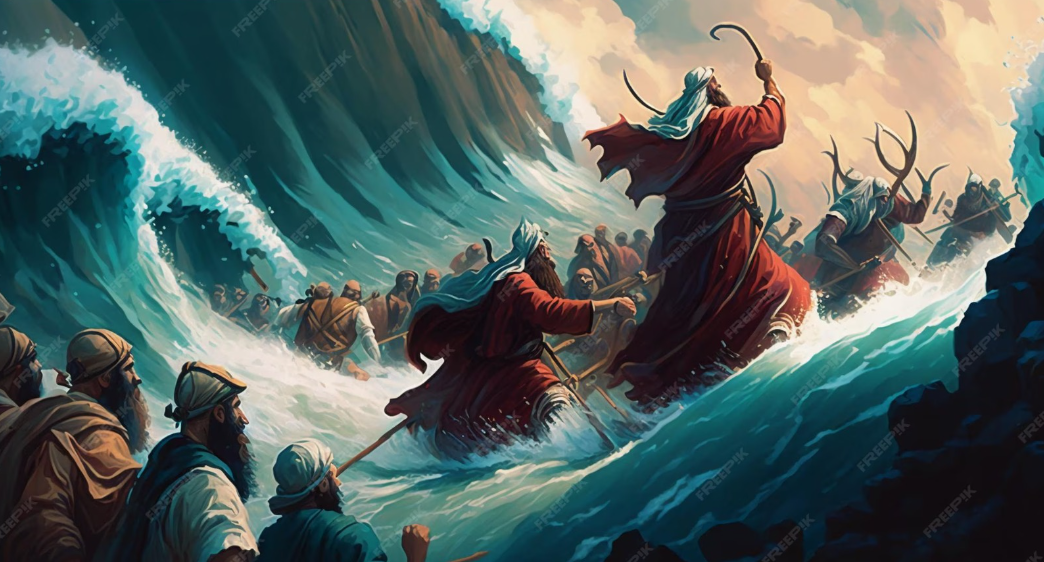
1 Then sang Moses and the children of Israel this song unto the Lord, and spoke, saying, “I will sing unto the Lord, for He hath triumphed gloriously; the horse and his rider hath He thrown into the sea.
— then sang Moses and the children of Israel; the scene of this thanksgiving song is supposed to have been at the landing place on the eastern shore of the Red Sea, at Ayoun Musa, “the fountains of Moses,”
— the Targum of Jonathan says
“Then Moses and the children of Israel sang this song of praise before the Lord, and they spoke, saying:
“‘We shall thank and praise before the Lord, the Exalted One who is exalted over the proud, and is uplifted over the haughty. Anyone who exalts himself before Him—He, by His Word, exacts punishment from him.
“Because the wicked Pharaoh acted insolently before the Lord and was uplifted in his heart, and pursued after the people of Israel—their horses and their riders He threw and drowned in the Red Sea.'”
2 The Lord is my strength and song, and He has become my salvation; He is my God, and I will prepare Him a habitation; my father’s God, and I will exalt Him.
— the Targum of Jonathan says
“The Strength and the greatness of the praise of the Fearful One over all worlds is the Lord; He spoke by His Word and became for me a saving God.
“From their mothers’ breasts, the infants were pointing with their fingers to their fathers, saying: ‘This is our God, who gave us honey to suck from the rock and oil from the flinty stone,’ at the time when our mothers went out into the open field to give birth and left us there; and [God] sent an angel to wash us and wrap us. And now, we shall praise the God of our fathers and exalt Him.”
3 The Lord is a man of war; the Lord is His name. — God’s name is the four-letter Hebrew word יהוה YHVH Yehovah (not Yahweh, since it is only used among the Samaritan communities; and not Jehovah since the letter J wasn’t around but only after the sixteenth century; (more on this at the end);
— the Targum of Jonathan says
“The children of Israel said: ‘The Lord is the Master who performs our battles in every generation,’ making His might known to His people, the House of Israel. The Lord is His name—as is His Name, so is His might. May His name be blessed for ever and ever.”
4 Pharaoh’s chariots and his host hath He cast into the sea; his chosen captains also are drowned in the Red Sea.
5 The depths have covered them; they sank into the bottom as a stone. — they sunk into the bottom as a stone; into the bottom of the sea, as a stone thrown into anybody of water sinks and rises not up again.
6 Thy right hand, O Lord, has become glorious in power; Thy right hand, O Lord, hath dashed in pieces the enemy. — thy right hand, O Lord, hath dashed in pieces the enemy; in a literal sense, Pharaoh and his host, the avowed enemies of Israel.
7 And in the greatness of Thine excellency Thou hast overthrown them that rose up against Thee; Thou sentest forth Thy wrath, which consumed them as stubble.
8 And with the blast of Thy nostrils the waters were gathered together, the floods stood upright as a heap, and the depths were congealed in the heart of the sea. — the blast of God’s nostrils corresponds to the east wind, which drove the waters back.
9 The enemy said, ‘I will pursue, I will overtake, I will divide the spoil; my lust shall be satisfied upon them. I will draw my sword; my hand shall destroy them.’
— the Targum of Jonathan says
“For the wicked Pharaoh, the hater and the adversary, said: ‘I will pursue after the people of Israel and I will come upon them while they are camping on the shore of the sea. I will arrange battle lines against them, and we shall slay among them a great and massive slaughter. We shall plunder from them great spoil and take from them many captives.
“I will divide their loot among my people, the makers of war; and when my soul is satiated with the blood of their slain, after that, I will draw my sword and destroy them with my right hand.'”
10 Thou didst blow with Thy wind, the sea covered them; they sank as lead in the mighty waters. — they sunk as lead in the mighty waters; which is a very heavy metal, and, being cast into the water, sinks to the bottom at once, as did the Egyptians in the Red sea.
11 “Who is like unto Thee, O Lord, among the gods? Who is like Thee, glorious in holiness, fearful in praises, doing wonders?
12 Thou stretchedst out Thy right hand; the earth swallowed them. — the earth swallowed them; the sea, which actually “swallowed them,” is a part of the earth.
— the Targum of Jonathan says
“The Sea and the Earth were litigating one with the other. The Sea said to the Earth: ‘Receive your children,’ and the Earth said to the Sea: ‘Receive your slain.’
“Neither the Sea wished to submerge them, nor the Earth wished to swallow them. The Earth was afraid to receive them, lest they be demanded from her on the Great Day of Judgment in the World to Come, just as the blood of Abel was demanded from her.
“Until You stretched out Your right hand, O Lord, in an oath to the Earth that they would not be demanded of her in the World to Come. Then the Earth opened her mouth and swallowed them.”
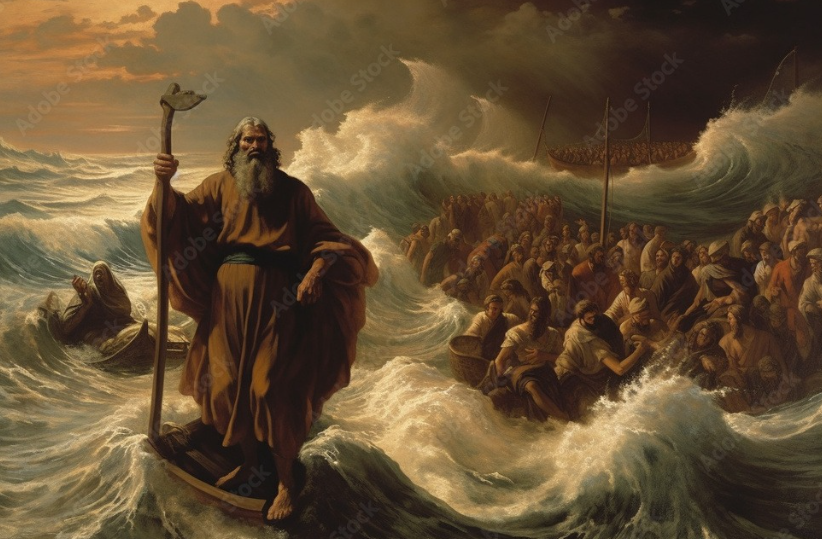
13 Thou in Thy mercy hast led forth the people whom Thou hast redeemed; Thou hast guided them in Thy strength unto Thy holy habitation.
14 “The people shall hear and be afraid; sorrow shall take hold on the inhabitants of Palestina. — the peoples: all the various tribes of the desert of Palestine—the Amalekites, Edomites, Philistines, Moabites, Amorites—
15 Then the chiefs of Edom shall be amazed; the mighty men of Moab, trembling shall take hold upon them; all the inhabitants of Canaan shall melt away.
— let the Edomites of Mount Seir be confounded and the Moabites be seized with fear and gave Israel a free passage through their borders (Deuteronomy 2:4-8, 18, 29), being afraid to oppose them;
— all the inhabitants of Canaan shall melt away; as their hearts did, through fear, when they heard what God did for Israel against the Egyptians and the Amorites, and understood that they were upon the march to their land to dispossess them.
16 Fear and dread shall fall upon them. By the greatness of Thine arm they shall be as still as a stone, till Thy people pass overya·‘ă·ḇōr5674, O Lord, till the people pass overya·‘ă·ḇōr5674, whom Thou hast purchased. — till thy people pass over (ya·‘ă·ḇōr5674); that is, cross the frontier of the Canaanites, and enter their country.
17 Thou shalt bring them in and plant them in the mountain of Thine inheritance, in the place, O Lord, which Thou hast made for Thee to dwell in, in the sanctuary, O Lord, which Thy hands have established. —in the mountain of thine inheritance; some suppose Mount Moriah to be especially intended;
— but it is better to understand Canaan generally, which is a country consisting almost entirely of mountains, with only two plains of any extent—those of Sharon and Esdraelon.
18 The Lord shall reign for ever and ever.” — the Lord shall reign; this concludes the whole song, by which Moses not only expresses his own faith and that of the people in God’s everlasting kingdom;
— the Targum of Jonathan says
“When the people of the House of Israel saw the miracles and the wonders that the Holy One—blessed be His name—performed for them at the Reed Sea (Red Sea), and the might of His hand, the children of the exiles answered and said to one another:
“‘Come, let us place the crown of majesty upon the head of our Redeemer, who causes all things to pass away but He does not pass away; who changes all things but He is not changed. For the crown of kingship is His! He is the King of Kings in this world, and His is the kingship in the World to Come, and His it is and shall be for ever and ever.'”
19 For the horse of Pharaoh went in with his chariots and with his horsemen into the sea, and the Lord brought again the waters of the sea upon them; but the children of Israel went on dry land in the midst of the sea.
— but the children of Israel went on dry land in the midst of the sea; which was a very wonderful thing, and was a just and sufficient reason for singing the above song to the Lord.
20 And Miriam the prophetess, the sister of Aaron, took a timbrel in her hand; and all the women went out after her with timbrels and with dances. — her name Miriam is the same as Mary; Miriam is called a prophetess, Numbers 12:2 because she and Aaron had evidently received divine communications.
21 And Miriam answered them: “Sing ye to the Lord, for He hath triumphed gloriously; the horse and his rider hath He thrown into the sea!”
— the Targum of Jonathan says
“And Miriam sang to them: ‘Let us thank and praise before the Lord, for strength and loftiness are His; He is exalted over the proud, and He is uplifted over the haughty. Because the wicked Pharaoh acted with presumption and pursued after the people, the children of Israel, He threw and submerged his horses and his chariots in the Sea of Reeds.'”
22 So Moses brought Israel from the Red Sea, and they went out into the Wilderness of Shur; and they went three days in the wilderness, and found no water. — and they went three days in the wilderness, and found no water; which must be very distressing to such a vast number of people and cattle, in a hot, sandy, desert.
23 And when they came to Marah, they could not drink of the waters of Marah, for they were bitter. Therefore the name of it was called Marah [that is, Bitterness].
24 And the people murmured against Moses, saying, “What shall we drink?”
25 And he cried unto the Lord; and the Lord showed him a tree, which when he had cast into the waters, the waters were made sweet. There He made for them a statute and an ordinance, and there He put them to the proof,
— the waters were made sweet, not so much by any virtue in that tree, as by the power of God, who used this rather as a sign to the Israelites, than as an instrument to himself in this work;
— the Targum of Jonathan says
“And [Moses] prayed before the Lord, and the Lord showed him a bitter tree of Oleander; and he wrote upon it the Great and Precious Name [of God] and cast it into the midst of the waters, and the waters became sweet.
There the Word of the Lord established for him the decree of the Sabbath, and the statute of honoring father and mother, the laws concerning wounds and injuries, and the fines imposed upon transgressors. And there [God] tested them with the tenth trial.”
26 and said, “If thou wilt diligently hearken to the voice of the Lord thy God, and wilt do that which is right in His sight, and wilt give ear to His commandments and keep all His statutes, I will put none of these diseases upon thee which I have brought upon the Egyptians; for I am the Lord that healeth thee.”
— for I am the Lord that healeth thee; both in body and soul; in body, by preserving from diseases, and by curing them when afflicted with them; and in soul, by pardoning their iniquities, which, in Scripture, is sometimes signified by healing;
— the Targum of Jonathan says
“And He said: ‘If you will diligently receive the Word of the Lord your God, and do what is right before Him, and listen to His commandments, and keep all His statutes—all the evil diseases that I placed upon the Egyptians, I will not place upon you.
And if you should transgress the words of the Torah, and [those diseases] are sent against you—if you return (repent), I will remove them from you; for I am the Lord your Healer.'”
27 And they came to Elim, where were twelve wells of water and threescore and ten palm trees; and they encamped there by the waters.
— they came to Elim. Elim was undoubtedly some spot in the comparatively fertile tract which lies south of the “wilderness of Shur,” intervening between it and the “wilderness of Sin.”

Exodus 16
1 And they took their journey from Elim, and all the congregation of the children of Israel came unto the Wilderness of Sin, which is between Elim and Sinai, on the fifteenth day of the second month after their departing out of the land of Egypt.
— they took their journey from Elim; the stay at Elim was probably for some days. “Sin” was reached on the fifteenth day of the second month, exactly one month after the departure from Egypt.
2 And the whole congregation of the children of Israel murmured against Moses and Aaron in the wilderness.
— murmured against Moses and Aaron in the wilderness; in the wilderness of Sin, where they were, and where no corn was to be had to make bread of; and their murmuring was not only against Moses, as before when they wanted water, but against Aaron also, who were jointly concerned in bringing them out of Egypt.
3 And the children of Israel said unto them, “Would to God we had died by the hand of the Lord in the land of Egypt, when we sat by the fleshpots and when we ate bread to the full! For ye have brought us forth into this wilderness to kill this whole assembly with hunger.”
— to kill this whole assembly with hunger; it is difficult to imagine that there could have been as yet any real danger of starvation. The sheep, the cattle, may have suffered in the passage through the wilderness of Shur, but the bulk of them would survive;
— would we died; they so undervalue their deliverance, that they wish they had died in Egypt; nay, and died by the hand of the Lord too; that is, by some of the plagues which cut off the Egyptians.
4 Then said the Lord unto Moses, “Behold, I will rain bread from heaven for you; and the people shall go out and gather a certain rate every day, that I may put them to the proof, whether they will walk in My law, or no.
— that I may prove them, whether they will walk in my law or no; by this single instance of their obedience to his will in going out every morning to gather their bread;
— that should be rained for them, he proposed to try and prove their obedience to his law in all other respects; what regard would be had to it when it should be given, and what might be expected from them, and likewise whether they would depend upon his providence in this case also.
5 And it shall come to pass that on the sixth day they shall prepare that which they bring in, and it shall be twice as much as they gather daily.” — on the sixth day; that is, the sixth day after the first giving of the manna;
— and it shall be twice as much as they gather daily: on that day should be rained double what fell on other days, and so twice as much should be gathered up.
6 And Moses and Aaron said unto all the children of Israel, “At evening (ḇā·‘e·reḇ), then ye shall know that the Lord hath brought you out from the land of Egypt;
— at even (ḇā·‘e·reḇ), then ye shall know that the Lord hath brought you out from the land of Egypt: that they were brought out they knew, but they make this to be an act and deed of Moses and Aaron;
7 and in the morning, then ye shall see the glory of the Lord, for He heareth your murmurings against the Lord. And what are we, that ye murmur against us?” — and in the morning, then ye shall see the glory of the Lord; as displayed by raining bread around their tents.
8 And Moses said, “This shall be when the Lord shall give you in the evening flesh to eat and in the morning bread to the full, for the Lord heareth your murmurings which ye murmur against Him. And what are we? Your murmurings are not against us, but against the Lord.”
— Moses said, “You will know this when the Lord gives you meat to eat in the evening and bread in the morning to satisfy you.
9 And Moses spoke unto Aaron, “Say unto all the congregation of the children of Israel, ‘Come near before the Lord, for He hath heard your murmurings.’” — and Moses spake unto Aaron, who was his prophet and spokesman to the people: say unto all the congregation of the children of Israel.
10 And it came to pass, as Aaron spoke unto the whole congregation of the children of Israel, that they looked toward the wilderness, and behold, the glory of the Lord appeared in the cloud.
— and, behold, the glory of the Lord appeared in the cloud; which went before them; there was a more than common brightness in it, an effulgence and beam of light and glory shining in it.
11 And the Lord spoke unto Moses, saying, — and the Lord spake unto Moses, out of the bright and glorious cloud: saying;
12 “I have heard the murmurings of the children of Israel. Speak unto them, saying, ‘At evening ye shall eat flesh, and in the morning ye shall be filled with bread; and ye shall know that I am the Lord your God.’”
— at evening (bên hā·‘ar·bā·yim “between the two evenings,” which is from noon to sunset); ye shall know that I am the Lord your God;
— this gave proof of his power as the Lord, and his particular favour to them as their God; when God plagued the Egyptians, it was to make them know that he is the Lord; when he provided for the Israelites, it was to make them know that he was their God.
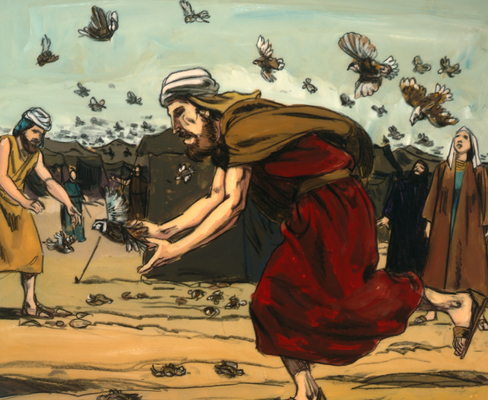
13 And it came to pass that at evening (ḇā·‘e·reḇ) the quails came up and covered the camp, and in the morning the dew lay round about the host.
— there are other meanings or applications for ḇā·‘e·reḇ but only one is revelant here, and that is, from noon to sunset; it was the time frame, the same time as bên hā·‘ar·bā·yim in the previous verse; yes in this case they mean the same or having the same time overlap;
— some misguided would like to think that the Scriptures define what ḇā·‘e·reḇ and bên hā·‘ar·bā·yim are; but the Scripture is certainly not a dictionary; meanings of words could only be supplied by oral knowledge; for more, see the Oracles of God; which is further inferred here; but his misguided people reject these truths.
14 And when the dew that lay had gone up, behold, upon the face of the wilderness there lay a small round thing, as small as the hoarfrost on the ground. — when the dew that lay was gone up; the moisture which lay upon the herbage soon evaporated, drawn up by the sun; and then the miracle revealed itself.
15 And when the children of Israel saw it, they said one to another, “What is this?” For they knew not what it was. And Moses said unto them, “This is the bread which the Lord hath given you to eat.
16 This is the thing which the Lord hath commanded: ‘Gather of it every man according to his eating, an omer for every man, according to the number of your persons. Take ye every man for those who are in his tents.’” — each man was to gather according to his immediate need and that of his family. No one was to seek to accumulate a store.
17 And the children of Israel did so and gathered, some more, some less. — every one was to gather according to the necessities of his family.
18 And when they measured it with an omer, he that gathered much had nothing over, and he that gathered little had no lack; they gathered every man according to his eating. — when they did mete it with an omer;
— on returning to their tents, with the manna which they had collected, the Israelites proceeded to measure it with their own, or a neighbour’s, omer measure, when the wonderful result appeared, that, whatever the quantity actually gathered by any one, the result of the measurement showed, exactly as many omers as there were persons in the family.
19 And Moses said, “Let no man leave any of it until the morning.” — had nothing over; whatever quantity each person had gathered, when he measured it in his tent, he found that he had just as many omers as he needed for the consumption of his family.
20 Notwithstanding, they hearkened not unto Moses; but some of them left part of it until the morning, and it bred worms and stank. And Moses was wroth with them. — it bred worms; so that we must view the result spoken of as a punishment for disobedience.
21 And they gathered it every morning, every man according to his eating; and when the sun waxed hot, it melted. —it melted; this refers to the manna which was not gathered.
22 And it came to pass that on the sixth day they gathered twice as much bread, two omers for one man; and all the rulers of the congregation came and told Moses. — lying in a great quantity, they gathered as much as they could, or just two omers for one man.
23 And he said unto them, “This is that which the Lord hath said: ‘Tomorrow is the rest of the holy Sabbath unto the Lord. Bake that which ye will bake today, and boil what ye will boil; and that which remaineth over lay up for yourselves to be kept until the morning.’”
— introducing an explanation of something unexpected, that is, the Sabbath; to inculcate the preparation and observance of the Sabbath; which were introduced well before the law was given at Mount Sinai.
24 And they laid it up until the morning, as Moses bade; and it did not stink, neither was there any worm therein. — there was an interposition of divine Providence in the keeping of it to such a Day.
25 And Moses said, “Eat that today, for today is a Sabbath unto the Lord. Today ye shall not find it in the field. — a Sabbath unto the Lord, to be wholly consecrated to his service, and therefore not to be employed in servile works, introduced well before the law was given at Mount Sinai.
26 Six days ye shall gather it, but on the seventh day, which is the Sabbath, in it there shall be none.” — the practical observance of the Sabbath was formally instituted before the giving of other laws.
27 And it came to pass that there went out some of the people on the seventh day to gather, and they found none. — went out some of the people; this was an act of willful disobedience.
28 And the Lord said unto Moses, “How long refuse ye to keep My commandments and My laws? — how long refuse ye to keep my commandments? the people had already broken one of the positive precepts with respect to the manna (Exodus 16:20); now they broke another.
29 See, for the Lord hath given you the Sabbath; therefore He giveth you on the sixth day the bread for two days. Abide ye every man in his place. Let no man go out of his place on the seventh day.”
30 So the people rested on the seventh day.
31 And the house of Israel called the name thereof manna; and it was like coriander seed, white; and the taste of it was like wafers made with honey.
32 And Moses said, “This is the thing which the Lord commandeth: ‘Fill an omer with it to be kept for your generations, that they may see the bread wherewith I have fed you in the wilderness when I brought you forth from the land of Egypt.’”
— fill an omer of manna to be kept for your generations; the mere fact of such a multitude being fed for forty years in the wilderness.
33 And Moses said unto Aaron, “Take a pot, and put an omer full of manna therein, and lay it up before the Lord to be kept for your generations.” — in a place where the Lord would hereafter fix the symbol of his presence, the ark, cherubim and mercy seat;
— lay it up before the Lord; the “pot of manna” was laid up before the Lord with the “tables of the covenant,” and “Aaron’s rod that budded;” Hebrews 9:4.
34 As the Lord commanded Moses, so Aaron laid it up before the testimony, to be kept. — before the testimony; the testimony is not the Ark of the Covenant, but the Covenant itself, or the two tables of stone engraved by the finger of God.
35 And the children of Israel ate manna forty years, until they came to a land inhabited. They ate manna until they came unto the borders of the land of Canaan. — forty years; for thirty-nine years and nine months;
— besides manna they had numerous flocks and herds, for milk, cheese and of course could be slaughtered for a constant supply of flesh.
36 Now an omer is a tenth part of an ephah.
~~~~
More on God’s name, Yehovah.
God’s name is the four-letter Hebrew word יהוה YHVH Yehovah, which are embedded in the Masoretic text over 6000 times, yet when translated into our English language most had been translated as Lord, or LORD, which are titles, but not his name. His name is יהוה Yehovah, or YEHOVAH (but there are no capital letters in Hebrew).
It wasn’t until 1524 that Gian Giorgio Trissino, an Italian Renaissance grammarian, invented the letter ‘J’ that this new letter started to take a hold in the writings of western Europe, including our English language. Even in 1611 when the first edition English Bible, the King James was published, the prophet Jeremiah was known as Ieremiah. Similarly, the name Jehovah is a very late comer.
But the Orthodox Jews have gone overboard, so holy is his name, they believe, thus they refrain from even calling his name, referring to him as Hashem, that is, “The Name,” which isn’t his name; just pointing, saying somewhat ‘you know what name I mean.’ His name is Yehovah, and is also not Yahweh, which is the Samaritan counterfeit version.
It is the same as the name Jesus we used today; if his name was used in his time two thousand years ago, he would have been known as Yeshua instead of Jesus. But never mind, as had often been the case, the essence is more important than the form.
His name Yehovah, is specifically stated, and should be used. Titles are okay, but sometimes He asked us pointedly to call on His name. The following verses translated as the LORD erred in presenting His name:
I am the LORD; that is My name. And My glory will I not give to another, neither My praise to graven images. Isaiah 42:8
And it shall come to pass, that whosoever shall call on the name of the LORD shall be delivered; for in Mount Zion and in Jerusalem shall be deliverance, as the LORD hath said, and in the remnant whom the LORD shall call. Joel 2:32
“I am sought of them that asked not for Me; I am found of them that sought Me not. I said, ‘Behold Me, behold Me,’ unto a nation that was not called by My name.” Isaiah 65:1
When we call our God, the LORD, we err, because his name is not the LORD, which is a title. His name is YEHOVAH! May We all ask for his forgiveness, and may Our merciful God forgive us all.


