Book of Jasher (23-24)

•October 1, 2024 • Leave a Comment

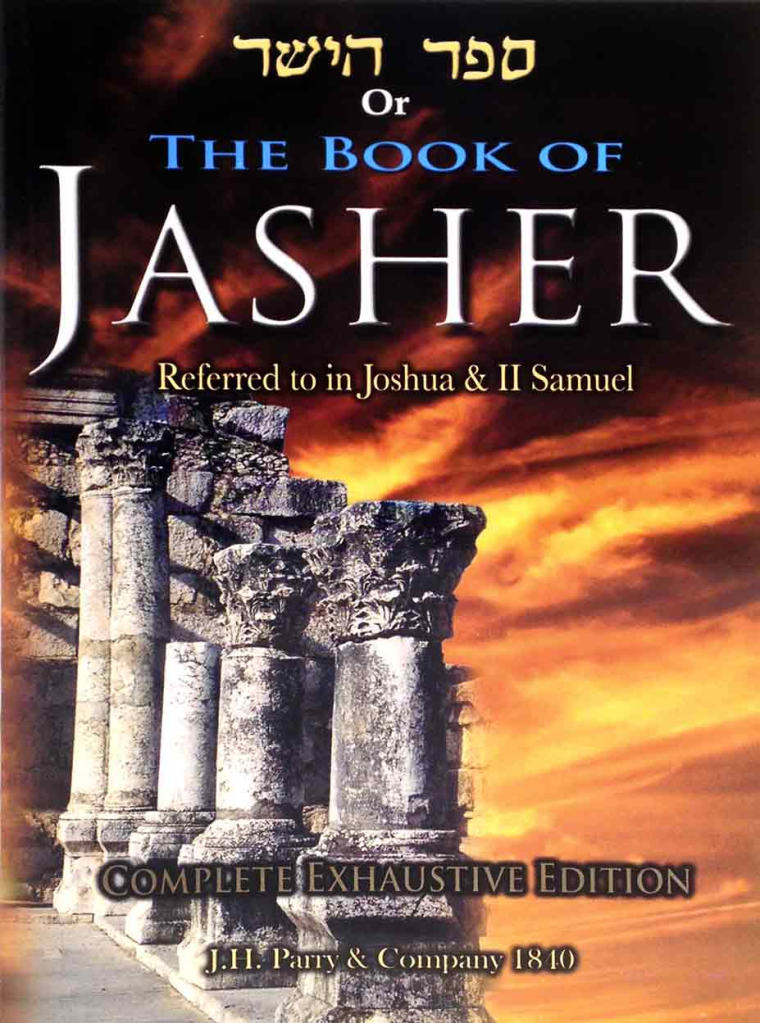
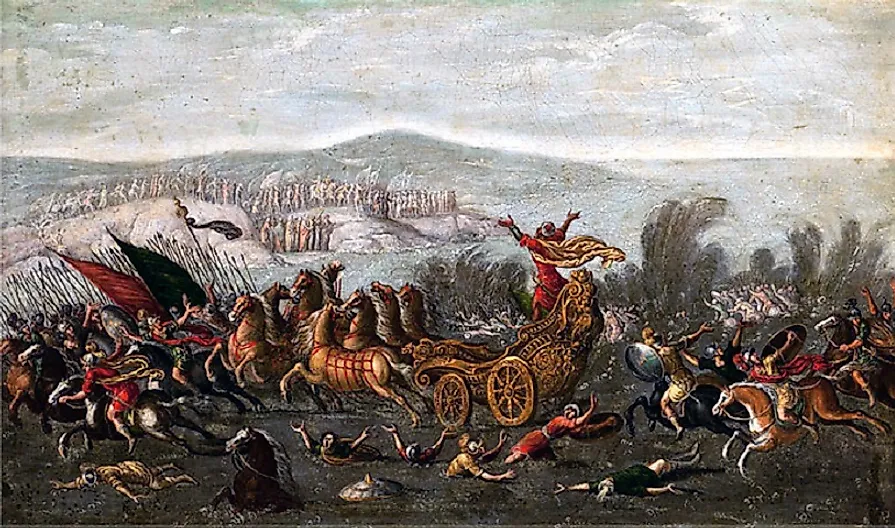
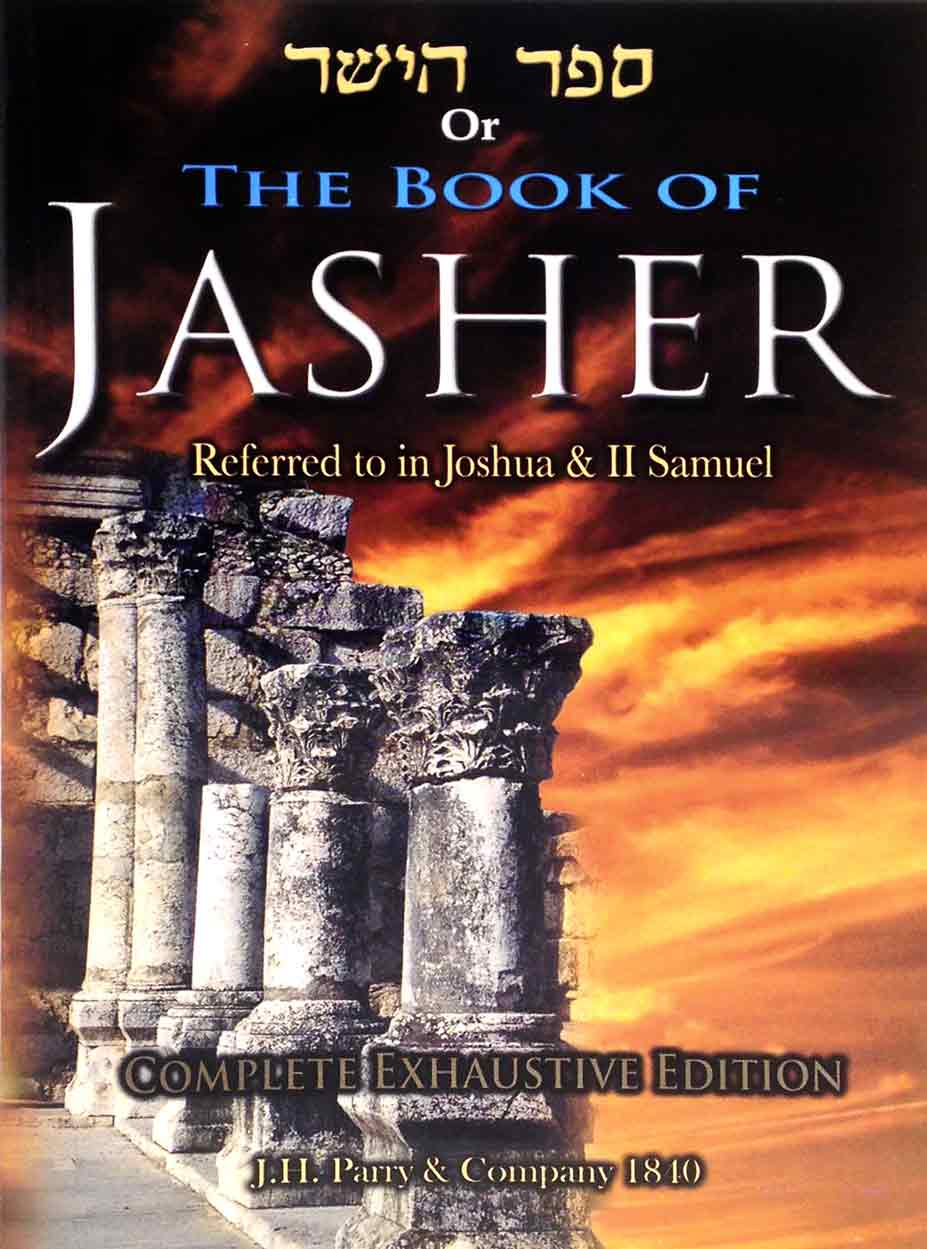
The Book of Jasher is mentioned in Joshua 10 when the Lord stopped the sun in the middle of the day during the battle of Beth Horon:

“And the sun stood still and the moon stayed until the people had avenged themselves upon their enemies. Is not this written in the Book of Jasher?”Joshua 10:13

The Book of Jasher is also mentioned in II Samuel 1:18-27 as containing the Song or Lament of the Bow, that mournful funeral song which David composed at the time of the death of Saul and Jonathan. “How are the mighty fallen!”

“How are the mighty fallen!” II Samuel 1:18-27

Book of Jasher Chapter 23

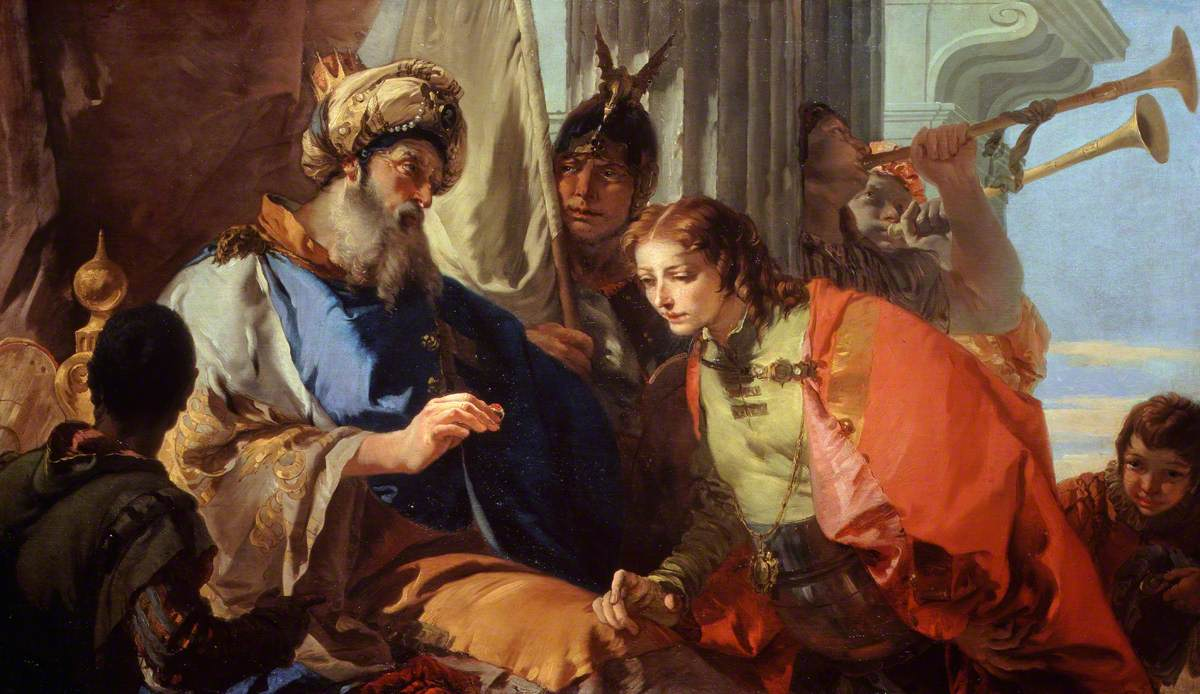
1 At that time the word of the Lord came to Abraham, and he said unto him, Abraham, and he said, Here I am.

2 And he said to him, Take now thy son, thine only son whom thou lovest, even Isaac, and go to the land of Moriah, and offer him there for a burnt offering upon one of the mountains which shall be shown to thee, for there wilt thou see a cloud and the glory of the Lord.

3 And Abraham said within himself, How shall I separate my son Isaac from Sarah his mother, in order to bring him up for a burnt offering before the Lord?

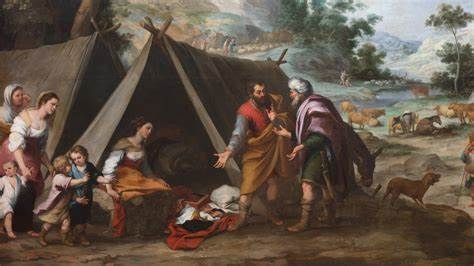
4 And Abraham came into the tent, and he sat before Sarah his wife, and he spoke these words to her,

5 My son Isaac is grown up and he has not for some time studied the service of his God, now tomorrow I will go and bring him to Shem, and Eber his son, and there he will learn the ways of the Lord, for they will teach him to know the Lord as well as to know that when he prayeth continually before the Lord, he will answer him, therefore there he will know the way of serving the Lord his God.

6 And Sarah said, Thou hast spoken well, go my lord and do unto him as thou hast said, but remove him not at a great distance from me, neither let him remain there too long, for my soul is bound within his soul.

7 And Abraham said unto Sarah, My daughter, let us pray to the Lord our God that he may do good with us.

8 And Sarah took her son Isaac and he abode all that night with her, and she kissed and embraced him, and gave him instructions till morning.

9 And she said to him, O my son, how can my soul separate itself from thee? And she still kissed him and embraced him, and she gave Abraham instructions concerning him.

10 And Sarah said to Abraham, O my lord, I pray thee take heed of thy son, and place thine eyes over him, for I have no other son nor daughter but him.

11 O forsake him not. If he be hungry give him bread, and if he be thirsty give him water to drink; do not let him go on foot, neither let him sit in the sun.

12 Neither let him go by himself in the road, neither force him from whatever he may desire, but do unto him as he may say to thee.

13 And Sarah wept bitterly the whole night on account of Isaac, and she gave him instructions till morning.

14 And in the morning Sarah selected a very fine and beautiful garment from those garments which she had in the house, that Abimelech had given to her.

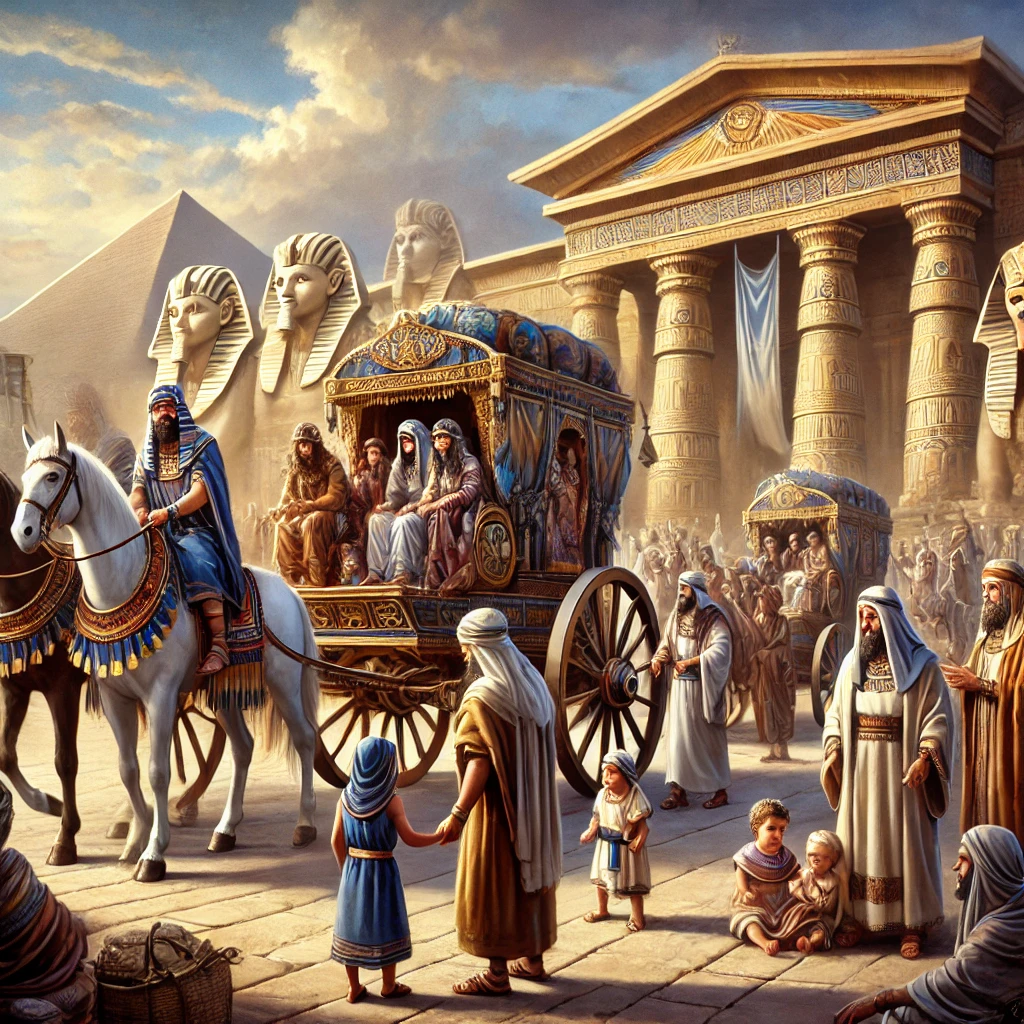
15 And she dressed Isaac her son therewith, and she put a turban upon his head, and she enclosed a precious stone in the top of the turban, and she gave them provision for the road, and they went forth, and Isaac went with his father Abraham, and some of their servants accompanied them to see them off the road.

16 And Sarah went out with them, and she accompanied them upon the road to see them off, and they said to her, Return to the tent.

17 And when Sarah heard the words of her son Isaac she wept bitterly, and Abraham her husband wept with her, and their son wept with them a great weeping; also those who went with them wept greatly.

18 And Sarah caught hold of her son Isaac, and she held him in her arms, and she embraced him and continued to weep with him, and Sarah said, Who knoweth if after this day I shall ever see thee again?

19 And they still wept together, Abraham, Sarah and Isaac, and all those that accompanied them on the road wept with them, and Sarah afterward turned away from her son, weeping bitterly, and all her men servants and maid servants returned with her to the tent.

20 And Abraham went with Isaac his son to bring him up as an offering before the Lord, as He had commanded him.

21 And Abraham took two of his young men with him, Ishmael the son of Hagar and Eliezer his servant, and they went together with them, and whilst they were walking in the road the young men spoke these words to themselves,

22 And Ishmael said to Eliezer, Now my father Abraham is going with Isaac to bring him up for a burnt offering to the Lord, as He commanded him.

23 Now when he returneth he will give unto me all that he possesses, to inherit after him, for I am his first born.

24 And Eliezer answered Ishmael and said, Surely Abraham did cast thee away with thy mother, and swear that thou shouldst not inherit any thing of all he possesses, and to whom will he give all that he has, with all his treasures, but unto me his servant, who has been faithful in his house, who has served him night and day, and has done all that he desired me? to me will he bequeath at his death all that he possesses.

25 And whilst Abraham was proceeding with his son Isaac along the road, Satan came and appeared to Abraham in the figure of a very aged man, humble and of contrite spirit, and he approached Abraham and said to him, Art thou silly or brutish, that thou goest to do this thing this day to thine only son?

26 For God gave thee a son in thy latter days, in thy old age, and wilt thou go and slaughter him this day because he committed no violence, and wilt thou cause the soul of thine only son to perish from the earth?

27 Dost thou not know and understand that this thing cannot be from the Lord? for the Lord cannot do unto man such evil upon earth to say to him, Go slaughter thy child.

28 And Abraham heard this and knew that it was the word of Satan who endeavored to draw him aside from the way of the Lord, but Abraham would not hearken to the voice of Satan, and Abraham rebuked him so that he went away.

29 And Satan returned and came to Isaac; and he appeared unto Isaac in the figure of a young man comely and well favored.

30 And he approached Isaac and said unto him, Dost thou not know and understand that thy old silly father bringeth thee to the slaughter this day for naught?

31 Now therefore, my son, do not listen nor attend to him, for he is a silly old man, and let not thy precious soul and beautiful figure be lost from the earth.

32 And Isaac heard this, and said unto Abraham, Hast thou heard, my father, that which this man has spoken? even thus has he spoken.

33 And Abraham answered his son Isaac and said to him, Take heed of him and do not listen to his words, nor attend to him, for he is Satan, endeavoring to draw us aside this day from the commands of God.

34 And Abraham still rebuked Satan, and Satan went from them, and seeing he could not prevail over them he hid himself from them, and he went and passed before them in the road; and he transformed himself to a large brook of water in the road, and Abraham and Isaac and his two young men reached that place, and they saw a brook large and powerful as the mighty waters.

35 And they entered the brook and passed through it, and the waters at first reached their legs.

36 And they went deeper in the brook and the waters reached up to their necks, and they were all terrified on account of the water; and whilst they were going over the brook Abraham recognized that place, and he knew that there was no water there before.

37 And Abraham said to his son Isaac, I know this place in which there was no brook nor water, now therefore it is this Satan who does all this to us, to draw us aside this day from the commands of God.

38 And Abraham rebuked him and said unto him, The Lord rebuke thee, O Satan, begone from us for we go by the commands of God.

39 And Satan was terrified at the voice of Abraham, and he went away from them, and the place again became dry land as it was at first.

40 And Abraham went with Isaac toward the place that God had told him.

41 And on the third day Abraham lifted up his eyes and saw the place at a distance which God had told him of.

42 And a pillar of fire appeared to him that reached from the earth to heaven, and a cloud of glory upon the mountain, and the glory of the Lord was seen in the cloud.

43 And Abraham said to Isaac, My son, dost thou see in that mountain, which we perceive at a distance, that which I see upon it?

44 And Isaac answered and said unto his father, I see and lo a pillar of fire and a cloud, and the glory of the Lord is seen upon the cloud.

45 And Abraham knew that his son Isaac was accepted before the Lord for a burnt offering.

46 And Abraham said unto Eliezer and unto Ishmael his son, Do you also see that which we see upon the mountain which is at a distance?

47 And they answered and said, We see nothing more than like the other mountains of the earth. And Abraham knew that they were not accepted before the Lord to go with them, and Abraham said to them, Abide ye here with the ass whilst I and Isaac my son will go to yonder mount and worship there before the Lord and then return to you.

48 And Eliezer and Ishmael remained in that place, as Abraham had commanded.

49 And Abraham took wood for a burnt offering and placed it upon his son Isaac, and he took the fire and the knife, and they both went to that place.

50 And when they were going along Isaac said to his father, Behold, I see here the fire and wood, and where then is the lamb that is to be the burnt offering before the Lord?

51 And Abraham answered his son Isaac, saying, The Lord has made choice of thee my son, to be a perfect burnt offering instead of the lamb.

52 And Isaac said unto his father, I will do all that the Lord spoke to thee with joy and cheerfulness of heart.

53 And Abraham again said unto Isaac his son, Is there in thy heart any thought or counsel concerning this, which is not proper? tell me my son, I pray thee, O my son conceal it not from me.

54 And Isaac answered his father Abraham and said unto him, O my father, as the Lord liveth and as thy soul liveth, there is nothing in my heart to cause me to deviate either to the right or to the left from the word that he has spoken to thee.

55 Neither limb nor muscle has moved or stirred at this, nor is there in my heart any thought or evil counsel concerning this.

56 But I am of joyful and cheerful heart in this matter, and I say, Blessed is the Lord who has this day chosen me to be a burnt offering before Him.

57 And Abraham greatly rejoiced at the words of Isaac, and they went on and came together to that place that the Lord had spoken of.

58 And Abraham approached to build the altar in that place, and Abraham was weeping, and Isaac took stones and mortar until they had finished building the altar.

59 And Abraham took the wood and placed it in order upon the altar which he had built.

60 And he took his son Isaac and bound him in order to place him upon the wood which was upon the altar, to slay him for a burnt offering before the Lord.

61 And Isaac said to his father, Bind me securely and then place me upon the altar lest I should turn and move, and break loose from the force of the knife upon my flesh and thereof profane the burnt offering; and Abraham did so.

62 And Isaac still said to his father, O my father, when thou shalt have slain me and burnt me for an offering, take with thee that which shall remain of my ashes to bring to Sarah my mother, and say to her, This is the sweet smelling savor of Isaac; but do not tell her this if she should sit near a well or upon any high place, lest she should cast her soul after me and die.

63 And Abraham heard the words of Isaac, and he lifted up his voice and wept when Isaac spake these words; and Abraham’s tears gushed down upon Isaac his son, and Isaac wept bitterly, and he said to his father, Hasten thou, O my father, and do with me the will of the Lord our God as He has commanded thee.

64 And the hearts of Abraham and Isaac rejoiced at this thing which the Lord had commanded them; but the eye wept bitterly whilst the heart rejoiced.

65 And Abraham bound his son Isaac, and placed him on the altar upon the wood, and Isaac stretched forth his neck upon the altar before his father, and Abraham stretched forth his hand to take the knife to slay his son as a burnt offering before the Lord.

66 At that time the angels of mercy came before the Lord and spake to him concerning Isaac, saying,

67 0 Lord, thou art a merciful and compassionate King over all that thou hast created in heaven and in earth, and thou supportest them all; give therefore ransom and redemption instead of thy servant Isaac, and pity and have compassion upon Abraham and Isaac his son, who are this day performing thy commands.

68 Hast thou seen, O Lord, how Isaac the son of Abraham thy servant is bound down to the slaughter like an animal? now therefore let thy pity be roused for them, O Lord.

69 At that time the Lord appeared unto Abraham, and called to him, from heaven, and said unto him, Lay not thine hand upon the lad, neither do thou any thing unto him, for now I know that thou fearest God in performing this act, and in not withholding thy son, thine only son, from me.

70 And Abraham lifted up his eyes and saw, and behold, a ram was caught in a thicket by his horns; that was the ram which the Lord God had created in the earth in the day that he made earth and heaven.

71 For the Lord had prepared this ram from that day, to be a burnt offering instead of Isaac.

72 And this ram was advancing to Abraham when Satan caught hold of him and entangled his horns in the thicket, that he might not advance to Abraham, in order that Abraham might slay his son.

73 And Abraham, seeing the ram advancing to him and Satan withholding him, fetched him and brought him before the altar, and he loosened his son Isaac from his binding, and he put the ram in his stead, and Abraham killed the ram upon the altar, and brought it up as an offering in the place of his son Isaac.

74 And Abraham sprinkled some of the blood of the ram upon the altar, and he exclaimed and said, This is in the place of my son, and may this be considered this day as the blood of my son before the Lord.

75 And all that Abraham did on this occasion by the altar, he would exclaim and say, This is in the room of my son, and may it this day be considered before the Lord in the place of my son; and Abraham finished the whole of the service by the altar, and the service was accepted before the Lord, and was accounted as if it had been Isaac; and the Lord blessed Abraham and his seed on that day.

76 And Satan went to Sarah, and he appeared to her in the figure of an old man very humble and meek, and Abraham was yet engaged in the burnt offering before the Lord.

77 And he said unto her, Dost thou not know all the work that Abraham has made with thine only son this day? for he took Isaac and built an altar, and killed him, and brought him up as a sacrifice upon the altar, and Isaac cried and wept before his father, but he looked not at him, neither did he have compassion over him.

78 And Satan repeated these words, and he went away from her, and Sarah heard all the words of Satan, and she imagined him to be an old man from amongst the sons of men who had been with her son, and had come and told her these things.

79 And Sarah lifted up her voice and wept and cried out bitterly on account of her son; and she threw herself upon the ground and she cast dust upon her head, and she said, O my son, Isaac my son, O that I had this day died instead of thee. And she continued to weep and said, It grieves me for thee, O my son, my son Isaac, O that I had died this day in thy stead.

80 And she still continued to weep, and said, It grieves me for thee after that I have reared thee and have brought thee up; now my joy is turned into mourning over thee, I that had a longing for thee, and cried and prayed to God till I bare thee at ninety years old; and now hast thou served this day for the knife and the fire, to be made an offering.

81 But I console myself with thee, my son, in its being the word of the Lord, for thou didst perform the command of thy God; for who can transgress the word of our God, in whose hands is the soul of every living creature?

82 Thou art just, O Lord our God, for all thy works are good and righteous; for I also am rejoiced with thy word which thou didst command, and whilst mine eye weepeth bitterly my heart rejoiceth.

83 And Sarah laid her head upon the bosom of one of her handmaids, and she became as still as a stone.

84 She afterward rose up and went about making inquiries till she came to Hebron, and she inquired of all those whom she met walking in the road, and no one could tell her what had happened to her son.

85 And she came with her maid servants and men servants to Kireath-arba, which is Hebron, and she asked concerning her Son, and she remained there while she sent some of her servants to seek where Abraham had gone with Isaac; they went to seek him in the house of Shem and Eber, and they could not find him, and they sought throughout the land and he was not there.

86 And behold, Satan came to Sarah in the shape of an old man, and he came and stood before her, and he said unto her, I spoke falsely unto thee, for Abraham did not kill his son and he is not dead; and when she heard the word her joy was so exceedingly violent on account of her son, that her soul went out through joy; she died and was gathered to her people.

87 And when Abraham had finished his service he returned with his son Isaac to his young men, and they rose up and went together to Beersheba, and they came home.

88 And Abraham sought for Sarah, and could not find her, and he made inquiries concerning her, and they said unto him, She went as far as Hebron to seek you both where you had gone, for thus was she informed.

89 And Abraham and Isaac went to her to Hebron, and when they found that she was dead they lifted up their voices and wept bitterly over her; and Isaac fell upon his mother’s face and wept over her, and he said, O my mother, my mother, how hast thou left me, and where hast thou gone? O how, how hast thou left me!

90 And Abraham and Isaac wept greatly and all their servants wept with them on account of Sarah, and they mourned over her a great and heavy mourning.

Book of Jasher Chapter 24

1 And the life of Sarah was one hundred and twenty-seven years, and Sarah died; and Abraham rose up from before his dead to seek a burial place to bury his wife Sarah; and he went and spoke to the children of Heth, the inhabitants of the land, saying,

2 I am a stranger and a sojourner with you in your land; give me a possession of a burial place in your land, that I may bury my dead from before me.

3 And the children of Heth said unto Abraham, behold the land is before thee, in the choice of our sepulchers bury thy dead, for no man shall withhold thee from burying thy dead.

4 And Abraham said unto them, If you are agreeable to this go and entreat for me to Ephron, the son of Zochar, requesting that he may give me the cave of Machpelah, which is in the end of his field, and I will purchase it of him for whatever he desire for it.

5 And Ephron dwelt among the children of Heth, and they went and called for him, and he came before Abraham, and Ephron said unto Abraham, Behold all thou requirest thy servant will do; and Abraham said, No, but I will buy the cave and the field which thou hast for value, In order that it may be for a possession of a burial place for ever.

6 And Ephron answered and said, Behold the field and the cave are before thee, give whatever thou desirest; and Abraham said, Only at full value will I buy it from thy hand, and from the hands of those that go in at the gate of thy city, and from the hand of thy seed for ever.

7 And Ephron and all his brethren heard this, and Abraham weighed to Ephron four hundred shekels of silver in the hands of Ephron and in the hands of all his brethren; and Abraham wrote this transaction, and he wrote it and testified it with four witnesses.

8 And these are the names of the witnesses, Amigal son of Abishna the Hittite, Adichorom son of Ashunach the Hivite, Abdon son of Achiram the Gomerite, Bakdil the son of Abudish the Zidonite.

9 And Abraham took the book of the purchase, and placed it in his treasures, and these are the words that Abraham wrote in the book, namely:

10 That the cave and the field Abraham bought from Ephron the Hittite, and from his seed, and from those that go out of his city, and from their seed for ever, are to be a purchase to Abraham and to his seed and to those that go forth from his loins, for a possession of a burial place for ever; and he put a signet to it and testified it with witnesses.

11 And the field and the cave that was in it and all that place were made sure unto Abraham and unto his seed after him, from the children of Heth; behold it is before Mamre in Hebron, which is in the land of Canaan.

12 And after this Abraham buried his wife Sarah there, and that place and all its boundary became to Abraham and unto his seed for a possession of a burial place.

13 And Abraham buried Sarah with pomp as observed at the interment of kings, and she was buried in very fine and beautiful garments.

14 And at her bier was Shem, his sons Eber and Abimelech, together with Anar, Ashcol and Mamre, and all the grandees of the land followed her bier.

15 And the days of Sarah were one hundred and twenty-seven years and she died, and Abraham made a great and heavy mourning, and he performed the rites of mourning for seven days.

16 And all the inhabitants of the land comforted Abraham and Isaac his son on account of Sarah.

17 And when the days of their mourning passed by Abraham sent away his son Isaac, and he went to the house of Shem and Eber, to learn the ways of the Lord and his instructions, and Abraham remained there three years.

18 At that time Abraham rose up with all his servants, and they went and returned homeward to Beersheba, and Abraham and all his servants remained in Beersheba.

19 And at the revolution of the year Abimelech king of the Philistines died in that year; he was one hundred and ninety-three years old at his death; and Abraham went with his people to the land of the Philistines, and they comforted the whole household and all his servants, and he then turned and went home.

20 And it was after the death of Abimelech that the people of Gerar took Benmalich his son, and he was only twelve years old, and they made him lying in the place of his father.

21 And they called his name Abimelech after the name of his father, for thus was it their custom to do in Gerar, and Abimelech reigned instead of Abimelech his father, and he sat upon his throne.

22 And Lot the son of Haran also died in those days, in the thirty-ninth year of the life of Isaac, and all the days that Lot lived were one hundred and forty years and he died.

23 And these are the children of Lot, that were born to him by his daughters, the name of the first born was Moab, and the name of the second was Benami.

24 And the two sons of Lot went and took themselves wives from the land of Canaan, and they bare children to them, and the children of Moab were Ed, Mayon, Tarsus, and Kanvil, four sons, these are fathers to the children of Moab unto this day.

25 And all the families of the children of Lot went to dwell wherever they should light upon, for they were fruitful and increased abundantly.

26 And they went and built themselves cities in the land where they dwelt, and they called the names of the cities which they built after their own names.

27 And Nahor the son of Terah, brother to Abraham, died in those days in the fortieth year of the life of Isaac, and all the days of Nahor were one hundred and seventy-two years and he died and was buried in Haran.

28 And when Abraham heard that his brother was dead he grieved sadly, and he mourned over his brother many days.

29 And Abraham called for Eliezer his head servant, to give him orders concerning his house, and he came and stood before him.

30 And Abraham said to him, Behold I am old, I do not know the day of my death; for I am advanced in days; now therefore rise up, go forth and do not take a wife for my son from this place and from this land, from the daughters of the Canaanites amongst whom we dwell.

31 But go to my land and to my birthplace, and take from thence a wife for my son, and the Lord God of Heaven and earth who took me from my father’s house and brought me to this place, and said unto me, To thy seed will I give this land for an inheritance for ever, he will send his angel before thee and prosper thy way, that thou mayest obtain a wife for my son from my family and from my father’s house.

32 And the servant answered his master Abraham and said, Behold I go to thy birthplace and to thy father’s house, and take a wife for thy son from there; but if the woman be not willing to follow me to this land, shall I take thy son back to the land of thy birthplace?

33 And Abraham said unto him, Take heed that thou bring not my son hither again, for the Lord before whom I have walked he will send his angel before thee and prosper thy way.

34 And Eliezer did as Abraham ordered him, and Eliezer swore unto Abraham his master upon this matter; and Eliezer rose up and took ten camels of the camels of his master, and ten men from his master’s servants with him, and they rose up and went to Haran, the city of Abraham and Nahor, in order to fetch a wife for Isaac the son of Abraham; and whilst they were gone Abraham sent to the house of Shem and Eber, and they brought from thence his son Isaac.

35 And Isaac came home to his father’s house to Beersheba, whilst Eliezer and his men came to Haran; and they stopped in the city by the watering place, and he made his camels to kneel down by the water and they remained there.

36 And Eliezer, Abraham’s servant, prayed and said, O God of Abraham my master; send me I pray thee good speed this day and show kindness unto my master, that thou shalt appoint this day a wife for my master’s son from his family.

37 And the Lord hearkened to the voice of Eliezer, for the sake of his servant Abraham, and he happened to meet with the daughter of Bethuel, the son of Milcah, the wife of Nahor, brother to Abraham, and Eliezer came to her house.

38 And Eliezer related to them all his concerns, and that he was Abraham’s servant, and they greatly rejoiced at him.

39 And they all blessed the Lord who brought this thing about, and they gave him Rebecca, the daughter of Bethuel, for a wife for Isaac.

40 And the young woman was of very comely appearance, she was a virgin, and Rebecca was ten years old in those days.

41 And Bethuel and Laban and his children made a feast on that night, and Eliezer and his men came and ate and drank and rejoiced there on that night.

42 And Eliezer rose up in the morning, he and the men that were with him, and he called to the whole household of Bethuel, saying, Send me away that I may go to my master; and they rose up and sent away Rebecca and her nurse Deborah, the daughter of Uz, and they gave her silver and gold, men servants and maid servants, and they blessed her.

43 And they sent Eliezer away with his men; and the servants took Rebecca, and he went and returned to his master to the land of Canaan.

44 And Isaac took Rebecca and she became his wife, and he brought her into the tent.

45 And Isaac was forty years old when he took Rebecca, the daughter of his uncle Bethuel, for a wife.

China’s Historical GDP Share in The World

•September 30, 2024 • Leave a Comment

There is an overview in an article on China Whisper.comChina`s historical GDP share in the world

An American Nobel winner claimed that by 2040 China will be the biggest economy on the earth and he also said that China had been the biggest economy on the earth for the last two thousand years. Now let’s take a look at China’s historical GDP share in the world:

Qin Dynasty (221–206 BC) GDP per capita: Unknown

The share of Qin dynasty and the dynasties before it are too aged to calculate, no relevant data is available, so we can only start from the Han dynasty.

Han dynasty (206 BC–220 AD) GDP per capita: $450 — 26%

Han Dynasty accounted for 26% of the global wealth, at that time the Roman Empire dominated western world, while Han Dynasty is the economic center of the eastern world.

The Han Dynasty Weiyang Palace in Xi’an

Tang Dynasty (618 – 907) GDP per capita: $480 — 58% of world GDP

China’s feudal society gets to its peak in Tang Dynasty, which accounted for 58% of the world GDP, the empire is very rich and powerful comparing with other countries of the same time.

In the western world the second Eastern Roman Empire accounted for only 9% of the world GDP. The third Arab Empire accounted for just 7% of the world’s GDP. The fourth Ancient India accounted for 7% of the world’s GDP. Tang Dynasty could be described as a dominance among many great ancient countries.

The Mazu temple during the Tang Dynasty

Song Dynasty (960-1279) GDP per capita: US$2,280 — 80%

The entire Song Dynasty accounted for 80% of the world’s GDP. This share should be the highest among Chinese history mainly due to a booming commerce, foreign trade and technological advancement, all these made Song the richest dynasty in Chinese history. After a thousand years, Westerners said: “a thousand years ago, China’s economic aggregate accounted for 80% of the world at that time.”

After a thousand years Chinese people said in shock: “how is this possible?” Western historians described its wealth and prosperity like this, the living conditions of a porter at the gate of the capital Dongjing city was even better than a Western monarch of the same period. Song is a classic dynasty that hide the wealth into the people.

Typical of Song Dynasty architecture in China

Yuan Dynasty (1271-1368) Estimated for about 30% -35% world GDP

It is difficult to calculate economic data of Yuan Dynasty, its GDP is estimated to account for about 30% -35% of the world according to the foreign research institutions.

Ming Dynasty (1368–1644) GDP per capita: US$600 — 55%

In the period of Wanli of the Ming Dynasty, its total wealth accounted for 55% of the world GDP. The average share was 45% during the whole Ming Dynasty, but the late Ming Dynasty rapidly declined for famine and war.

The Great Wall of China
The Temple of Heaven in Beijing
The Ming’s Beijing capital complex also called the Purple Forbidden City

Qing Dynasty (1644-1922) GDP per capita: US$600 — 35% -10% of World GDP (drastic decline due to the rise of the British Empire)

Qing Dynasty accounted for 35% -10% of the World GDP, the economy experienced big recession after 1840 Opium War, large amounts of silver were used  to pay indemnities to invaders and outflowed at the same time, causing its GDP rapidly falling from 35% in period of Kangxi and Qianlong to less than 10% in Jiaqing period.

People’s Republic of China (1949-current) GDP per capita: US$5414 — or 9.48 percent of world GDP

See also Wikipedia for this period.

The Gross Domestic Product (GDP) in China was worth 7298.1 billion US dollars in 2011, according to a report published by the World Bank. The GDP value of China is roughly equivalent to 9.48 percent of the world economy.

The China Whisper

A bending, glass-bottomed bridge for tourists in China
Domestic High Speed trains park at night
Overcapacity of EVs ready to flood Western Cities

Project 33 to beat China by 2027

•September 29, 2024 • Leave a Comment

Project 33: US Navy’s plan to beat China by 2027

AI, robotics and autonomous systems to enhance naval readiness but laggard shipbuilding and kill chain vulnerabilities will endure

AsiaTimes by Gabriel Honrada • September 23, 2024 ~ USNI News

The US Navy is racing to overhaul its force structure and readiness for a potential showdown with China over Taiwan as early as 2027.

USNI reported this month that the US Navy, under Chief of Naval Operations Admiral Lisa Franchetti, has issued new guidance to prepare for a potential conflict with China by 2027.

Chief of Naval Operations Adm Lisa Franchetti “possible war with China by 2027”

According to USNI, the “Chief of Naval Operations Navigation Plan for America’s Warfighting Navy,” also called the “Project 33” plan, aims to address maintenance backlogs and recruiting challenges and focus on readiness, capability and capacity.

The plan sets two primary goals: enhancing naval readiness and strengthening the US Navy’s role in the broader US joint warfighting ecosystem.

It identifies seven critical areas, including addressing maintenance backlogs, scaling robotic and autonomous systems, improving sailor recruitment and retention, and bolstering infrastructure.

The plan emphasizes multi-domain operations and technological innovation in response to heightened global threats—specifically from China’s expanding military capabilities and Russia’s increasingly aggressive actions.

It seeks to ensure that the US Navy maintains its superiority through readiness, joint force integration and warfighter competency, driven by advancements in artificial intelligence (AI), robotics and distributed maritime operations.

It underscores the importance of executing these initiatives swiftly to meet future challenges while preparing for sustained, high-end combat.

While the US Navy accelerates its efforts to counter China’s growing naval power, it faces the stark reality of lagging shipbuilding capacity and outdated kill chains that risk exposing critical vulnerabilities in a potential conflict.

Asia Times has previously noted that the US faces critical challenges in naval shipbuilding as it struggles to keep pace with China’s rapid naval expansion. China now has the world’s largest navy, with 370 ships and submarines and over 140 major surface combatants.

US is itching toward a plan to restore the Navy’s First Fleet in the South China Sea

China’s 13 naval shipyards have more capacity than all seven naval US shipyards combined, highlighting the US’ growing disadvantage in naval shipbuilding.

Further, US shipyards face skilled labor shortages, exacerbated by past budget cuts and layoffs that have depleted the specialized workforce needed for naval construction.

Moreover, outdated procurement strategies and reliance on high-cost, legacy warships such as aircraft carriers, destroyers and amphibious assault ships further hinder the US’s ability to rapidly scale up its fleet.

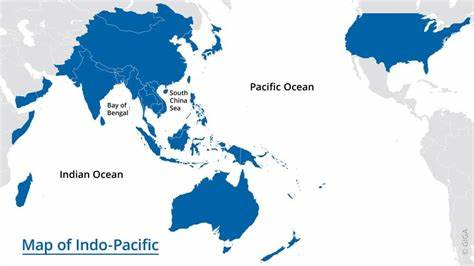
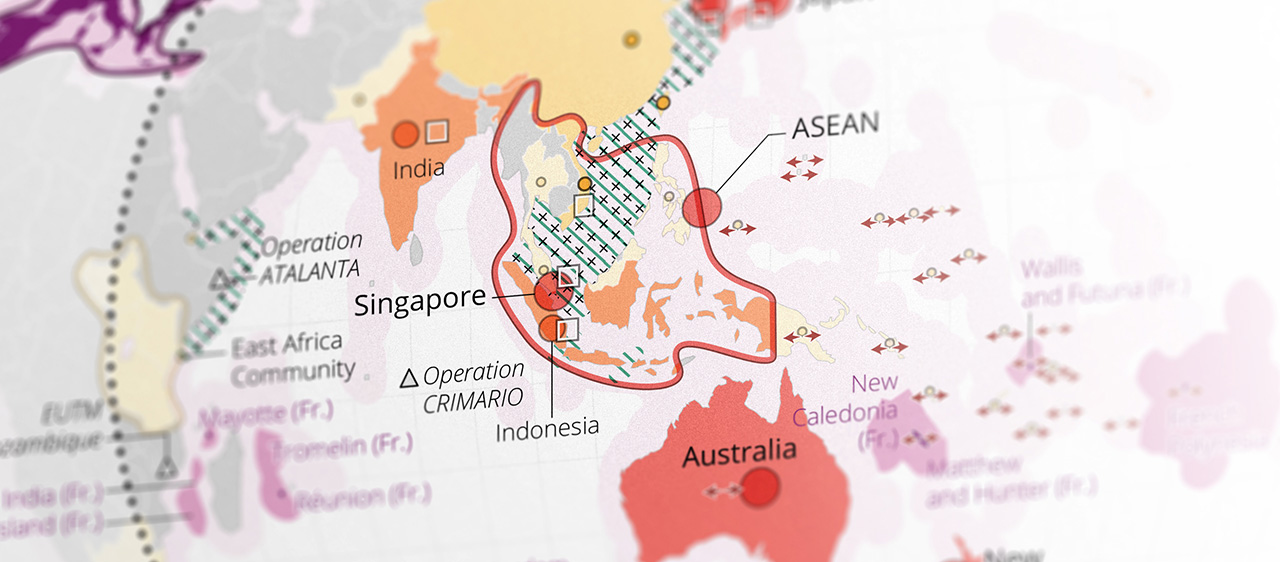
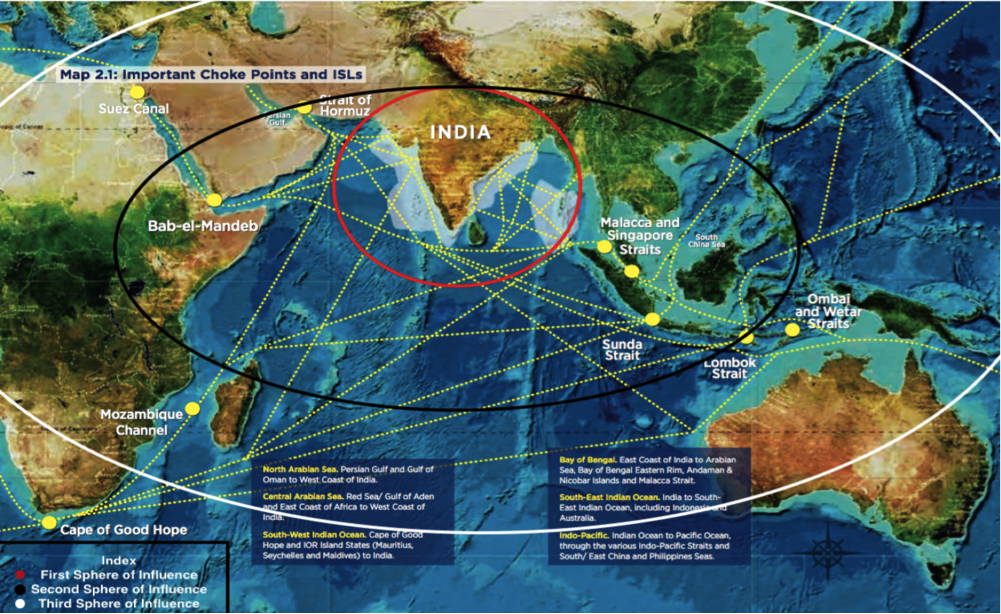
Still, the US is itching toward a plan to restore the Navy’s First Fleet in the South China Sea with the Strait of Malacca as its choke point to rebuff China in the Indo-Pacific Region.

Book of Jasher (21-22)

•September 29, 2024 • Leave a Comment

The Book of Jasher is mentioned in Joshua 10 when the Lord stopped the sun in the middle of the day during the battle of Beth Horon:

“And the sun stood still and the moon stayed until the people had avenged themselves upon their enemies. Is not this written in the Book of Jasher?”Joshua 10:13

The Book of Jasher is also mentioned in II Samuel 1:18-27 as containing the Song or Lament of the Bow, that mournful funeral song which David composed at the time of the death of Saul and Jonathan. “How are the mighty fallen!”

“How are the mighty fallen!” II Samuel 1:18-27

Book of Jasher Chapter 21

1 And it was at that time at the end of a year and four months of Abraham’s dwelling in the land of the Philistines in Gerar, that God visited Sarah, and the Lord remembered her, and she conceived and bare a son to Abraham.

2 And Abraham called the name of the son which was born to him, which Sarah bare to him, Isaac.

3 And Abraham circumcised his son Isaac at eight days old, as God had commanded Abraham to do unto his seed after him; and Abraham was one hundred, and Sarah ninety years old, when Isaac was born to them.

4 And the child grew up and he was weaned, and Abraham made a great feast upon the day that Isaac was weaned.

5 And Shem and Eber and all the great people of the land, and Abimelech king of the Philistines, and his servants, and Phicol, the captain of his host, came to eat and drink and rejoice at the feast which Abraham made upon the day of his son Isaac’s being weaned.

6 Also Terah, the father of Abraham, and Nahor his brother, came from Haran, they and all belonging to them, for they greatly rejoiced on hearing that a son had been born to Sarah.

7 And they came to Abraham, and they ate and drank at the feast which Abraham made upon the day of Isaac’s being weaned.

8 And Terah and Nahor rejoiced with Abraham, and they remained with him many days in the land of the Philistines.

9 At that time Serug the son of Reu died, in the first year of the birth of Isaac son of Abraham.

10 And all the days of Serug were two hundred and thirty-nine years, and he died.

11 And Ishmael the son of Abraham was grown up in those days; he was fourteen years old when Sarah bare Isaac to Abraham.

12 And God was with Ishmael the son of Abraham, and he grew up, and he learned to use the bow and became an archer.

13 And when Isaac was five years old he was sitting with Ishmael at the door of the tent.

14 And Ishmael came to Isaac and seated himself opposite to him, and he took the bow and drew it and put the arrow in it, and intended to slay Isaac.

15 And Sarah saw the act which Ishmael desired to do to her son Isaac, and it grieved her exceedingly on account of her son, and she sent for Abraham, and said to him, Cast out this bondwoman and her son, for her son shall not be heir with my son, for thus did he seek to do unto him this day.

16 And Abraham hearkened to the voice of Sarah, and he rose up early in the morning, and he took twelve loaves and a bottle of water which he gave to Hagar, and sent her away with her son, and Hagar went with her son to the wilderness, and they dwelt in the wilderness of Paran with the inhabitants of the wilderness, and Ishmael was an archer, and he dwelt in the wilderness a long time.

17 And he and his mother afterward went to the land of Egypt, and they dwelt there, and Hagar took a wife for her son from Egypt, and her name was Meribah.

18 And the wife of Ishmael conceived and bare four sons and two daughters, and Ishmael and his mother and his wife and children afterward went and returned to the wilderness.

19 And they made themselves tents in the wilderness, in which they dwelt, and they continued to travel and then to rest monthly and yearly.

20 And God gave Ishmael flocks and herds and tents on account of Abraham his father, and the man increased in cattle.

21 And Ishmael dwelt in deserts and in tents, traveling and resting for a long time, and he did not see the face of his father.

22 And in some time after, Abraham said to Sarah his wife, I will go and see my son Ishmael, for I have a desire to see him, for I have not seen him for a long time.

23 And Abraham rode upon one of his camels to the wilderness to seek his son Ishmael, for he heard that he was dwelling in a tent in the wilderness with all belonging to him.

24 And Abraham went to the wilderness, and he reached the tent of Ishmael about noon, and he asked after Ishmael, and he found the wife of Ishmael sitting in the tent with her children, and Ishmael her husband and his mother were not with them.

25 And Abraham asked the wife of Ishmael, saying, Where has Ishmael gone? and she said, He has gone to the field to hunt, and Abraham was still mounted upon the camel, for he would not get off to the ground as he had sworn to his wife Sarah that he would not get off from the camel.

26 And Abraham said to Ishmael’s wife, My daughter, give me a little water that I may drink, for I am fatigued from the journey.

27 And Ishmael’s wife answered and said to Abraham, We have neither water nor bread, and she continued sitting in the tent and did not notice Abraham, neither did she ask him who he was.

28 But she was beating her children in the tent, and she was cursing them, and she also cursed her husband Ishmael and reproached him, and Abraham heard the words of Ishmael’s wife to her children, and he was very angry and displeased.

29 And Abraham called to the woman to come out to him from the tent, and the woman came and stood opposite to Abraham, for Abraham was still mounted upon the camel.

30 And Abraham said to Ishmael’s wife, When thy husband Ishmael returneth home say these words to him,

31 A very old man from the land of the Philistines came hither to seek thee, and thus was his appearance and figure; I did not ask him who he was, and seeing thou wast not here he spoke unto me and said, When Ishmael thy husband returneth tell him thus did this man say, When thou comest home put away this nail of the tent which thou hast placed here, and place another nail in its stead.

32 And Abraham finished his instructions to the woman, and he turned and went off on the camel homeward.

33 And after that Ishmael came from the chase he and his mother, and returned to the tent, and his wife spoke these words to him,

34 A very old man from the land of the Philistines came to seek thee, and thus was his appearance and figure; I did not ask him who he was, and seeing thou wast not at home he said to me, When thy husband cometh home tell him, thus saith the old man, Put away the nail of the tent which thou hast placed here and place another nail in its stead.

35 And Ishmael heard the words of his wife, and he knew that it was his father, and that his wife did not honor him.

36 And Ishmael understood his father’s words that he had spoken to his wife, and Ishmael hearkened to the voice of his father, and Ishmael cast off that woman and she went away.

37 And Ishmael afterward went to the land of Canaan, and he took another wife and he brought her to his tent to the place where he then dwelt.

38 And at the end of three years Abraham said, I will go again and see Ishmael my son, for I have not seen him for a long time.

39 And he rode upon his camel and went to the wilderness, and he reached the tent of Ishmael about noon.

40 And he asked after Ishmael, and his wife came out of the tent and she said, He is not here my lord, for he has gone to hunt in the fields, and to feed the camels, and the woman said to Abraham, Turn in my lord into the tent, and eat a morsel of bread, for thy soul must be wearied on account of the journey.

41 And Abraham said to her, I will not stop for I am in haste to continue my journey, but give me a little water to drink, for I have thirst; and the woman hastened and ran into the tent and she brought out water and bread to Abraham, which she placed before him and she urged him to eat, and he ate and drank and his heart was comforted and he blessed his son Ishmael.

42 And he finished his meal and he blessed the Lord, and he said to Ishmael’s wife, When Ishmael cometh home say these words to him,

43 A very old man from the land of the Philistines came hither and asked after thee, and thou wast not here; and I brought him out bread and water and he ate and drank and his heart was comforted.

44 And he spoke these words to me: When Ishmael thy husband cometh home, say unto him, The nail of the tent which thou hast is very good, do not put it away from the tent.

45 And Abraham finished commanding the woman, and he rode off to his home to the land of the Philistines; and when Ishmael came to his tent his wife went forth to meet him with joy and a cheerful heart.

46 And she said to him, An old man came here from the land of the Philistines and thus was his appearance, and he asked after thee and thou wast not here, so I brought out bread and water, and he ate and drank and his heart was comforted.

47 And he spoke these words to me, When Ishmael thy husband cometh home say to him, The nail of the tent which thou hast is very good, do not put it away from the tent.

48 And Ishmael knew that it was his father, and that his wife had honored him, and the Lord blessed Ishmael.

Book of Jasher Chapter 22

1 And Ishmael then rose up and took his wife and his children and his cattle and all belonging to him, and he journeyed from there and he went to his father in the land of the Philistines.

2 And Abraham related to Ishmael his son the transaction with the first wife that Ishmael took, according to what she did.

3 And Ishmael and his children dwelt with Abraham many days in that land, and Abraham dwelt in the land of the Philistines a long time.

4 And the days increased and reached twenty six years, and after that Abraham with his servants and all belonging to him went from the land of the Philistines and removed to a great distance, and they came near to Hebron, and they remained there, and the servants of Abraham dug wells of water, and Abraham and all belonging to him dwelt by the water, and the servants of Abimelech king of the Philistines heard the report that Abraham’s servants had dug wells of water in the borders of the land.

5 And they came and quarreled with the servants of Abraham, and they robbed them of the great well which they had dug.

6 And Abimelech king of the Philistines heard of this affair, and he with Phicol the captain of his host and twenty of his men came to Abraham, and Abimelech spoke to Abraham concerning his servants, and Abraham rebuked Abimelech concerning the well of which his servants had robbed him.

7 And Abimelech said to Abraham, As the Lord liveth who created the whole earth, I did not hear of the act which my servants did unto thy servants until this day.

8 And Abraham took seven ewe lambs and gave them to Abimelech, saying, Take these, I pray thee, from my hands that it may be a testimony for me that I dug this well.

9 And Abimelech took the seven ewe lambs which Abraham had given to him, for he had also given him cattle and herds in abundance, and Abimelech swore to Abraham concerning the well, therefore he called that well Beersheba, for there they both swore concerning it.

10 And they both made a covenant in Beersheba, and Abimelech rose up with Phicol the captain of his host and all his men, and they returned to the land of the Philistines, and Abraham and all belonging to him dwelt in Beersheba and he was in that land a long time.

11 And Abraham planted a large grove in Beersheba, and he made to it four gates facing the four sides of the earth, and he planted a vineyard in it, so that if a traveler came to Abraham he entered any gate which was in his road, and remained there and ate and drank and satisfied himself and then departed.

12 For the house of Abraham was always open to the sons of men that passed and repassed, who came daily to eat and drink in the house of Abraham.

13 And any man who had hunger and came to Abraham’s house, Abraham would give him bread that he might eat and drink and be satisfied, and any one that came naked to his house he would clothe with garments as he might choose, and give him silver and gold and make known to him the Lord who had created him in the earth; this did Abraham all his life.

14 And Abraham and his children and all belonging to him dwelt in Beersheba, and he pitched his tent as far as Hebron.

15 And Abraham’s brother Nahor and his father and all belonging to them dwelt in Haran, for they did not come with Abraham to the land of Canaan.

16 And children were born to Nahor which Milca the daughter of Haran, and sister to Sarah, Abraham’s wife, bare to him.

17 And these are the names of those that were born to him, Uz, Buz, Kemuel, Kesed, Chazo, Pildash, Tidlaf, and Bethuel, being eight sons, these are the children of Milca which she bare to Nahor, Abraham’s brother.

18 And Nahor had a concubine and her name was Reumah, and she also bare to Nahor, Zebach, Gachash, Tachash and Maacha, being four sons.

19 And the children that were born to Nahor were twelve sons besides his daughters, and they also had children born to them in Haran.

20 And the children of Uz the first born of Nahor were Abi, Cheref, Gadin, Melus, and Deborah their sister.

21 And the sons of Buz were Berachel, Naamath, Sheva, and Madonu.

22 And the sons of Kemuel were Aram and Rechob.

23 And the sons of Kesed were Anamlech, Meshai, Benon and Yifi; and the sons of Chazo were Pildash, Mechi and Opher.

24 And the sons of Pildash were Arud, Chamum, Mered and Moloch.

25 And the sons of Tidlaf were Mushan, Cushan and Mutzi.

26 And the children of Bethuel were Sechar, Laban and their sister Rebecca.

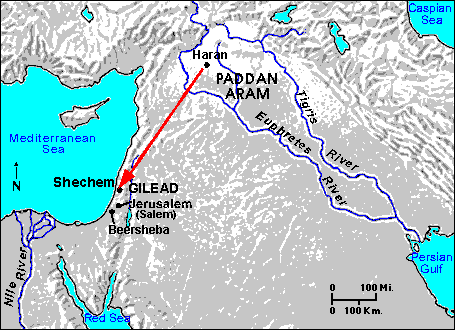
27 These are the families of the children of Nahor, that were born to them in Haran; and Aram the son of Kemuel and Rechob his brother went away from Haran, and they found a valley in the land by the river Euphrates.

28 And they built a city there, and they called the name of the city after the name of Pethor the son of Aram, that is Aram Naherayim unto this day.

29 And the children of Kesed also went to dwell where they could find a place, and they went and they found a valley opposite to the land of Shinar, and they dwelt there.

30 And they there built themselves a city, and they called the name at the city Kesed after the name of their father, that is the land Kasdim unto this day, and the Kasdim dwelt in that land and they were fruitful and multiplied exceedingly.

31 And Terah, father of Nahor and Abraham, went and took another wife in his old age, and her name was Pelilah, and she conceived and bare him a son and he called his name Zoba.

32 And Terah lived twenty-five years after he begat Zoba.

33 And Terah died in that year, that is in the thirty-fifth year of the birth of Isaac son of Abraham.

34 And the days of Terah were two hundred and five years, and he was buried in Haran.

35 And Zoba the son of Terah lived thirty years and he begat Aram, Achlis and Merik.

36 And Aram son of Zoba son of Terah, had three wives and he begat twelve sons and three daughters; and the Lord gave to Aram the son of Zoba, riches and possessions, and abundance of cattle, and flocks and herds, and the man increased greatly.

37 And Aram the son of Zoba and his brother and all his household journeyed from Haran, and they went to dwell where they should find a place, for their property was too great to remain in Haran; for they could not stop in Haran together with their brethren the children of Nahor.

38 And Aram the son of Zoba went with his brethren, and they found a valley at a distance toward the eastern country and they dwelt there.

39 And they also built a city there, and they called the name thereof Aram, after the name of their eldest brother; that is Aram Zoba to this day.

40 And Isaac the son of Abraham was growing up in those days, and Abraham his father taught him the way of the Lord to know the Lord, and the Lord was with him.

41 And when Isaac was thirty-seven years old, Ishmael his brother was going about with him in the tent.

42 And Ishmael boasted of himself to Isaac, saying, I was thirteen years old when the Lord spoke to my father to circumcise us, and I did according to the word of the Lord which he spoke to my father, and I gave my soul unto the Lord, and I did not transgress his word which he commanded my father.

43 And Isaac answered Ishmael, saying, Why dost thou boast to me about this, about a little bit of thy flesh which thou didst take from thy body, concerning which the Lord commanded thee?

44 As the Lord liveth, the God of my father Abraham, if the Lord should say unto my father, Take now thy son Isaac and bring him up an offering before me, I would not refrain but I would joyfully accede to it.

45 And the Lord heard the word that Isaac spoke to Ishmael, and it seemed good in the sight of the Lord, and he thought to try Abraham in this matter.

46 And the day arrived when the sons of God came and placed themselves before the Lord, and Satan also came with the sons of God before the Lord.

47 And the Lord said unto Satan, Whence comest thou? and Satan answered the Lord and said, From going to and fro in the earth, and from walking up and down in it.

48 And the Lord said to Satan, What is thy word to me concerning all the children of the earth? and Satan answered the Lord and said, I have seen all the children of the earth who serve thee and remember thee when they require anything from thee.

49 And when thou givest them the thing which they require from thee, they sit at their ease, and forsake thee and they remember thee no more.

50 Hast thou seen Abraham the son of Terah, who at first had no children, and he served thee and erected altars to thee wherever he came, and he brought up offerings upon them, and he proclaimed thy name continually to all the children of the earth.

51 And now that his son Isaac is born to him, he has forsaken thee, he has made a great feast for all the inhabitants of the land, and the Lord he has forgotten.

52 For amidst all that he has done he brought thee no offering; neither burnt offering nor peace offering, neither ox, lamb nor goat of all that he killed on the day that his son was weaned.

53 Even from the time of his son’s birth till now, being thirty-seven years, he built no altar before thee, nor brought any offering to thee, for he saw that thou didst give what he requested before thee, and he therefore forsook thee.

54 And the Lord said to Satan, Hast thou thus considered my servant Abraham? for there is none like him upon earth, a perfect and an upright man before me, one that feareth God and avoideth evil; as I live, were I to say unto him, Bring up Isaac thy son before me, he would not withhold him from me, much more if I told him to bring up a burnt offering before me from his flock or herds.

55 And Satan answered the Lord and said, Speak then now unto Abraham as thou hast said, and thou wilt see whether he will not this day transgress and cast aside thy words.

Book of Jasher (19-20)

•September 28, 2024 • Leave a Comment

The Book of Jasher is mentioned in Joshua 10 when the Lord stopped the sun in the middle of the day during the battle of Beth Horon:

“And the sun stood still and the moon stayed until the people had avenged themselves upon their enemies. Is not this written in the Book of Jasher?”Joshua 10:13

The Book of Jasher is also mentioned in II Samuel 1:18-27 as containing the Song or Lament of the Bow, that mournful funeral song which David composed at the time of the death of Saul and Jonathan. “How are the mighty fallen!”

“How are the mighty fallen!” II Samuel 1:18-27

Book of Jasher Chapter 19

1 And the cities of Sodom had four judges to four cities, and these were their names, Serak in the city of Sodom, Sharkad in Gomorrah, Zabnac in Admah, and Menon in Zeboyim.

2 And Eliezer Abraham’s servant applied to them different names, and he converted Serak to Shakra, Sharkad to Shakrura, Zebnac to Kezobim, and Menon to Matzlodin.

3 And by desire of their four judges the people of Sodom and Gomorrah had beds erected in the streets of the cities, and if a man came to these places they laid hold of him and brought him to one of their beds, and by force made him to lie in them.

4 And as he lay down, three men would stand at his head and three at his feet, and measure him by the length of the bed, and if the man was less than the bed these six men would stretch him at each end, and when he cried out to them they would not answer him.

5 And if he was longer than the bed they would draw together the two sides of the bed at each end, until the man had reached the gates of death.

6 And if he continued to cry out to them, they would answer him, saying, Thus shall it be done to a man that cometh into our land.

7 And when men heard all these things that the people of the cities of Sodom did, they refrained from coming there.

8 And when a poor man came to their land they would give him silver and gold, and cause a proclamation in the whole city not to give him a morsel of bread to eat, and if the stranger should remain there some days, and die from hunger, not having been able to obtain a morsel of bread, then at his death all the people of the city would come and take their silver and gold which they had given to him.

9 And those that could recognize the silver or gold which they had given him took it back, and at his death they also stripped him of his garments, and they would fight about them, and he that prevailed over his neighbor took them.

10 They would after that carry him and bury him under some of the shrubs in the deserts; so they did all the days to any one that came to them and died in their land.

11 And in the course of time Sarah sent Eliezer to Sodom, to see Lot and inquire after his welfare.

12 And Eliezer went to Sodom, and he met a man of Sodom fighting with a stranger, and the man of Sodom stripped the poor man of all his clothes and went away.

13 And this poor man cried to Eliezer and supplicated his favor on account of what the man of Sodom had done to him.

14 And he said to him, Why dost thou act thus to the poor man who came to thy land?

15 And the man of Sodom answered Eliezer, saying, Is this man thy brother, or have the people of Sodom made thee a judge this day, that thou speakest about this man?

16 And Eliezer strove with the man of Sodom on account of the poor man, and when Eliezer approached to recover the poor man’s clothes from the man of Sodom, he hastened and with a stone smote Eliezer in the forehead.

17 And the blood flowed copiously from Eliezer’s forehead, and when the man saw the blood he caught hold of Eliezer, saying, Give me my hire for having rid thee of this bad blood that was in thy forehead, for such is the custom and the law in our land.

18 And Eliezer said to him, Thou hast wounded me and requirest me to pay thee thy hire; and Eliezer would not hearken to the words of the man of Sodom.

19 And the man laid hold of Eliezer and brought him to Shakra the judge of Sodom for judgment.

20 And the man spoke to the judge, saying, I beseech thee my lord, thus has this man done, for I smote him with a stone that the blood flowed from his forehead, and he is unwilling to give me my hire.

21 And the judge said to Eliezer, This man speaketh truth to thee, give him his hire, for this is the custom in our land; and Eliezer heard the words of the judge, and he lifted up a stone and smote the judge, and the stone struck on his forehead, and the blood flowed copiously from the forehead of the judge, and Eliezer said, If this then is the custom in your land give thou unto this man what I should have given him, for this has been thy decision, thou didst decree it.

22 And Eliezer left the man of Sodom with the judge, and he went away.

23 And when the kings of Elam had made war with the kings of Sodom, the kings of Elam captured all the property of Sodom, and they took Lot captive, with his property, and when it was told to Abraham he went and made war with the kings of Elam, and he recovered from their hands all the property of Lot as well as the property of Sodom.

24 At that time the wife of Lot bare him a daughter, and he called her name Paltith, saying, Because God had delivered him and his whole household from the kings of Elam; and Paltith daughter of Lot grew up, and one of the men of Sodom took her for a wife.

25 And a poor man came into the city to seek a maintenance, and he remained in the city some days, and all the people of Sodom caused a proclamation of their custom not to give this man a morsel of bread to eat, until he dropped dead upon the earth, and they did so.

26 And Paltith the daughter of Lot saw this man lying in the streets starved with hunger, and no one would give him any thing to keep him alive, and he was just upon the point of death.

27 And her soul was filled with pity on account of the man, and she fed him secretly with bread for many days, and the soul of this man was revived.

28 For when she went forth to fetch water she would put the bread in the water pitcher, and when she came to the place where the poor man was, she took the bread from the pitcher and gave it him to eat; so she did many days.

29 And all the people of Sodom and Gomorrah wondered how this man could bear starvation for so many days.

30 And they said to each other, This can only be that he eats and drinks, for no man can bear starvation for so many days or live as this man has, without even his countenance changing; and three men concealed themselves in a place where the poor man was stationed, to know who it was that brought him bread to eat.

31 And Paltith daughter of Lot went forth that day to fetch water, and she put bread into her pitcher of water, and she went to draw water by the poor man’s place, and she took out the bread from the pitcher and gave it to the poor man and he ate it.

32 And the three men saw what Paltith did to the poor man, and they said to her, It is thou then who hast supported him, and therefore has he not starved, nor changed in appearance nor died like the rest.

33 And the three men went out of the place in which they were concealed, and they seized Paltith and the bread which was in the poor man’s hand.

34 And they took Paltith and brought her before their judges, and they said to them, Thus did she do, and it is she who supplied the poor man with bread, therefore did he not die all this time; now therefore declare to us the punishment due to this woman for having transgressed our law.

35 And the people of Sodom and Gomorrah assembled and kindled a fire in the street of the city, and they took the woman and cast her into the fire and she was burned to ashes.

36 And in the city of Admah there was a woman to whom they did the like.

37 For a traveler came into the city of Admah to abide there all night, with the intention of going home in the morning, and he sat opposite the door of the house of the young woman’s father, to remain there, as the sun had set when he had reached that place; and the young woman saw him sitting by the door of the house.

38 And he asked her for a drink of water and she said to him, Who art thou? and he said to her, I was this day going on the road, and reached here when the sun set, so I will abide here all night, and in the morning I will arise early and continue my journey.

39 And the young woman went into the house and fetched the man bread and water to eat and drink.

40 And this affair became known to the people of Admah, and they assembled and brought the young woman before the judges, that they should judge her for this act.

41 And the judge said, The judgment of death must pass upon this woman because she transgressed our law, and this therefore is the decision concerning her.

42 And the people of those cities assembled and brought out the young woman, and anointed her with honey from head to foot, as the judge had decreed, and they placed her before a swarm of bees which were then in their hives, and the bees flew upon her and stung her that her whole body was swelled.

43 And the young woman cried out on account of the bees, but no one took notice of her or pitied her, and her cries ascended to heaven.

44 And the Lord was provoked at this and at all the works of the cities of Sodom, for they had abundance of food, and had tranquility amongst them, and still would not sustain the poor and the needy, and in those days their evil doings and sins became great before the Lord.

45 And the Lord sent for two of the angels that had come to Abraham’s house, to destroy Sodom and its cities.

46 And the angels rose up from the door of Abraham’s tent, after they had eaten and drunk, and they reached Sodom in the evening, and Lot was then sitting in the gate of Sodom, and when he saw them he rose to meet them, and he bowed down to the ground.

47 And he pressed them greatly and brought them into his house, and he gave them victuals which they ate, and they abode all night in his house.

48 And the angels said to Lot, Arise, go forth from this place, thou and all belonging to thee, lest thou be consumed in the iniquity of this city, for the Lord will destroy this place.

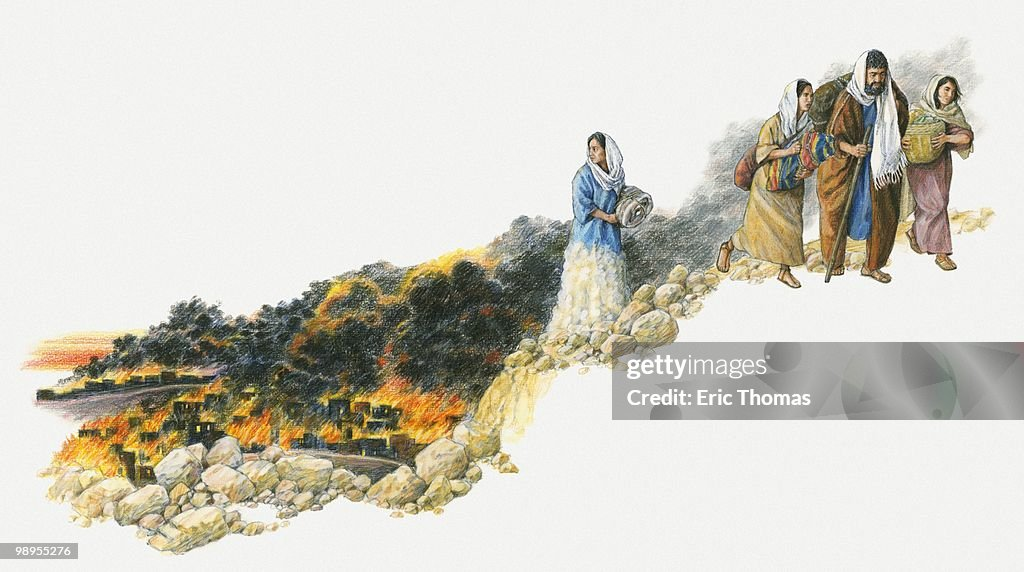
49 And the angels laid hold upon the hand of Lot and upon the hand of his wife, and upon the hands of his children, and all belonging to him, and they brought him forth and set him outside the cities.

50 And they said to Lot, Escape for thy life, and he fled and all belonging to him.

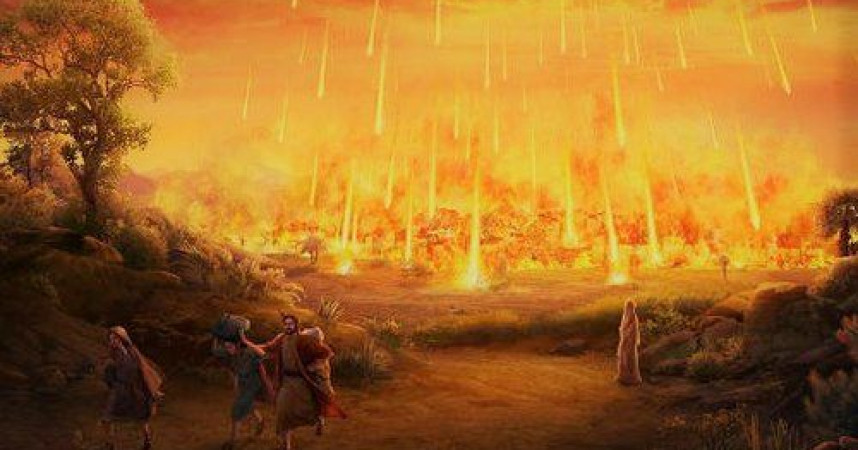
51 Then the Lord rained upon Sodom and upon Gomorrah and upon all these cities brimstone and fire from the Lord out of heaven.

52 And he overthrew these cities, all the plain and all the inhabitants of the cities, and that which grew upon the ground; and Ado the wife of Lot looked back to see the destruction of the cities, for her compassion was moved on account of her daughters who remained in Sodom, for they did not go with her.

53 And when she looked back she became a pillar of salt, and it is yet in that place unto this day.

54 And the oxen which stood in that place daily licked up the salt to the extremities of their feet, and in the morning it would spring forth afresh, and they again licked it up unto this day.

55 And Lot and two of his daughters that remained with him fled and escaped to the cave of Adullam, and they remained there for some time.

56 And Abraham rose up early in the morning to see what had been done to the cities of Sodom; and he looked and beheld the smoke of the cities going up like the smoke of a furnace.

57 And Lot and his two daughters remained in the cave, and they made their father drink wine, and they lay with him, for they said there was no man upon earth that could raise up seed from them, for they thought that the whole earth was destroyed.

58 And they both lay with their father, and they conceived and bare sons, and the first born called the name of her son Moab, saying, From my father did I conceive him; he is the father of the Moabites unto this day.

59 And the younger also called her son Benami; he is the father of the children of Ammon unto this day.

60 And after this Lot and his two daughters went away from there, and he dwelt on the other side of the Jordan with his two daughters and their sons, and the sons of Lot grew up, and they went and took themselves wives from the land of Canaan, and they begat children and they were fruitful and multiplied.

Book of Jasher Chapter 20

1 And at that time Abraham journeyed from the plain of Mamre, and he went to the land of the Philistines, and he dwelt in Gerar; it was in the twenty-fifth year of Abraham’s being in the land of Canaan, and the hundredth year of the life of Abraham, that he came to Gerar in the land of the Philistines.

2 And when they entered the land he said to Sarah his wife, Say thou art my sister, to any one that shall ask thee, in order that we may escape the evil of the inhabitants of the land.

3 And as Abraham was dwelling in the land of the Philistines, the servants of Abimelech, king of the Philistines, saw that Sarah was exceedingly beautiful, and they asked Abraham concerning her, and he said, She is my sister.

4 And the servants of Abimelech went to Abimelech, saying, A man from the land of Canaan is come to dwell in the land, and he has a sister that is exceeding fair.

5 And Abimelech heard the words of his servants who praised Sarah to him, and Abimelech sent his officers, and they brought Sarah to the king.

6 And Sarah came to the house of Abimelech, and the king saw that Sarah was beautiful, and she pleased him exceedingly.

7 And he approached her and said to her, What is that man to thee with whom thou didst come to our land? and Sarah answered and said He is my brother, and we came from the land of Canaan to dwell wherever we could find a place.

8 And Abimelech said to Sarah, Behold my land is before thee, place thy brother in any part of this land that pleases thee, and it will be our duty to exalt and elevate him above all the people of the land since he is thy brother.

9 And Abimelech sent for Abraham, and Abraham came to Abimelech.

10 And Abimelech said to Abraham, Behold I have given orders that thou shalt be honored as thou desirest on account of thy sister Sarah.

11 And Abraham went forth from the king, and the king’s present followed him.

12 As at evening time, before men lie down to rest, the king was sitting upon his throne, and a deep sleep fell upon him, and he lay upon the throne and slept till morning.

13 And he dreamed that an angel of the Lord came to him with a drawn sword in his hand, and the angel stood over Abimelech, and wished to slay him with the sword, and the king was terrified in his dream, and said to the angel, In what have I sinned against thee that thou comest to slay me with thy sword?

14 And the angel answered and said to Abimelech, Behold thou diest on account of the woman which thou didst yesternight bring to thy house, for she is a married woman, the wife of Abraham who came to thy house; now therefore return that man his wife, for she is his wife; and shouldst thou not return her, know that thou wilt surely die, thou and all belonging to thee.

15 And on that night there was a great outcry in the land of the Philistines, and the inhabitants of the land saw the figure of a man standing with a drawn sword in his hand, and he smote the inhabitants of the land with the sword, yea he continued to smite them.

16 And the angel of the Lord smote the whole land of the Philistines on that night, and there was a great confusion on that night and on the following morning.

17 And every womb was closed, and all their issues, and the hand of the Lord was upon them on account of Sarah, wife of Abraham, whom Abimelech had taken.

18 And in the morning Abimelech rose with terror and confusion and with a great dread, and he sent and had his servants called in, and he related his dream to them, and the people were greatly afraid.

19 And one man standing amongst the servants of the king answered the king, saying, O sovereign king, restore this woman to her husband, for he is her husband, for the like happened to the king of Egypt when this man came to Egypt.

20 And he said concerning his wife, She is my sister, for such is his manner of doing when he cometh to dwell in the land in which he is a stranger.

21 And Pharaoh sent and took this woman for a wife and the Lord brought upon him grievous plagues until he returned the woman to her husband.

22 Now therefore, O sovereign king, know what happened yesternight to the whole land, for there was a very great consternation and great pain and lamentation, and we know that it was on account of the woman which thou didst take.

23 Now, therefore, restore this woman to her husband, lest it should befall us as it did to Pharaoh king of Egypt and his subjects, and that we may not die; and Abimelech hastened and had Sarah called for, and she came before him, and he had Abraham called for, and he came before him.

24 And Abimelech said to them, What is this work you have been doing in saying you are brother and sister, and I took this woman for a wife?

25 And Abraham said, Because I thought I should suffer death on account of my wife; and Abimelech took flocks and herds, and men servants and maid servants, and a thousand pieces of silver, and he gave them to Abraham, and he returned Sarah to him.

26 And Abimelech said to Abraham, Behold the whole land is before thee, dwell in it wherever thou shalt choose.

27 And Abraham and Sarah, his wife, went forth from the king’s presence with honor and respect, and they dwelt in the land, even in Gerar.

28 And all the inhabitants of the land of the Philistines and the king’s servants were still in pain, through the plague which the angel had inflicted upon them the whole night on account of Sarah.

29 And Abimelech sent for Abraham, saying, Pray now for thy servants to the Lord thy God, that he may put away this mortality from amongst us.

30 And Abraham prayed on account of Abimelech and his subjects, and the Lord heard the prayer of Abraham, and he healed Abimelech and all his subjects.

Great Britain

•September 28, 2024 • Leave a Comment

At the height of its power and influence early in the 20th century, Great Britain controlled an empire covered approximately one fourth of the world’s territory (in 1922 it incorporated 13 million square miles) and boasted of 54 territories and colonies—including Canada, India, Pakistan, Egypt, Nigeria, Ghana and vast swaths of Africa, the land of Palestine, islands in the Caribbean, Hong Kong, Singapore, Australia, New Zealand, the Pacific islands and others.

Great Britain at its Height

Image result for of british empire

It was the most expansive empire in the history of the world, holding sway over some 460 million people—a fifth of the world’s population at the time. Moreover, following the defeat of Napoleonic France in 1815, Great Britain enjoyed a century of almost unchallenged global dominance through its vincible as well as its invincible Royal Navy rules the waves.

The British Empire also possessed or controlled several strategic sea gates—the Suez Canal, Gibraltar, the Cape of Good Hope, etc. Historians agree that Great Britain became the preeminent nation of the world as a consequence of wrestling itself from French dominance.

Indeed, after defeating Napoleon in 1815 it became clear that Britain was the undisputed ruler of the civilized world. Supported by unrivaled naval power, what followed was a century of peace—“Pax Britannica”—cut short only by the German militarism that triggered World War I in 1914-18, and again in World War II in 1941-45, and then its invincibility dropped out of any prominence.

Harbours of the US Navy Fleet | Fleet, Challenges and opportunities, Navy

The US is itching toward a plan to restore the Navy’s First Fleet in the South China Sea with the Strait of Malacca as its choke point to rebuff China in the Indo-Pacific Region

~~~~~Image result for us seven fleets with each a co-ordinated strike force maps

~~~~~

Yet Great Britain never control the United States as the map above depits. The new nation is to eclipe Great Britain. It would be Ephraim with seven fleets with each a co-ordinated strike force with numerous invincible submerines roaming up and down the whole world; and for decades, making any rival insignificance.

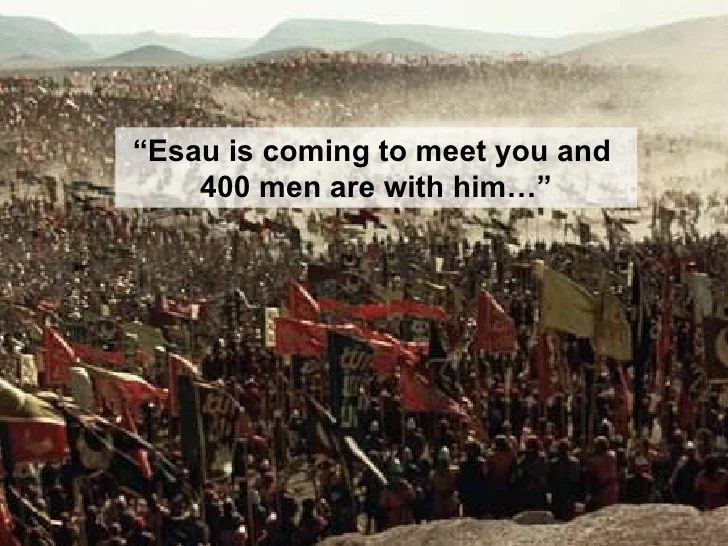
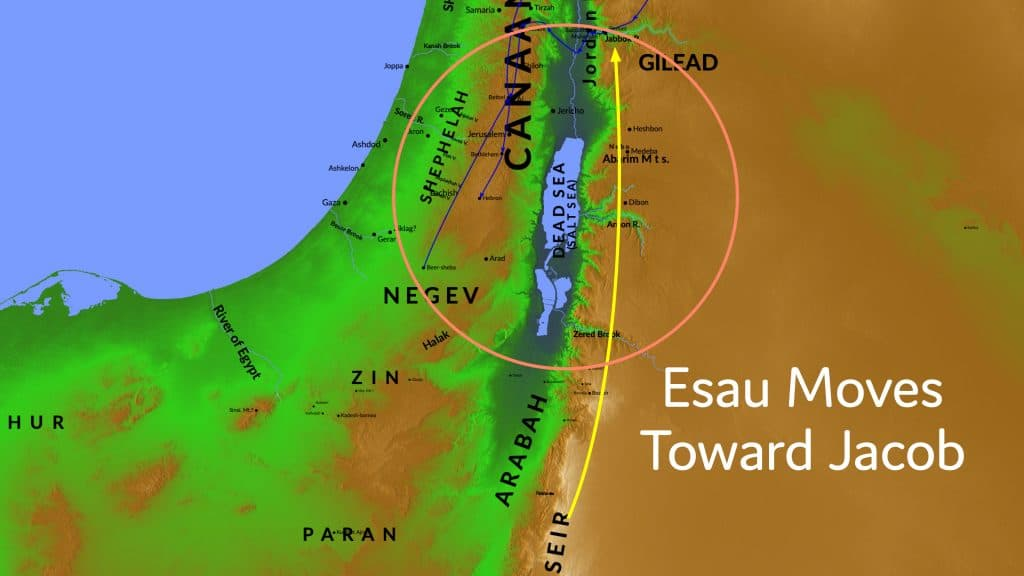
But Esau kept his hatred in his heart against Jacob his brother, on account of the order of blessing with which his father had blessed him; but is waiting, waiting for an appropriate opportunity:

“And upon thy sword shalt thou depend, entering at every place: yet thou shalt be supple and credulous, and be in subjection to thy brother [Jacob]; but it will be that when his sons [the posterity of Jacob, or the end-time children of Israel] become evil, and fall from keeping the commandments of the law, thou shalt break his yoke of servitude from off thy neck,

“… and Esau said in his heart, I will not do as Cain did, who slew Abel in the life (time) of his father, for which his father begat Seth, but will wait till the time when the days of mourning for the death of my father come, then will I kill Jacob my brother, and will be found the killer and the heir.” Genesis 27:40-41 Jonathan

Here’s How Bad a Nuclear War Would Actually Be

•September 27, 2024 • Leave a Comment

Here’s How Bad a Nuclear War Would Actually Be

Here’s why Putin decided to send a nuclear message to Washington

Could Zechariah 5 indicate there would be nuclear war?

TIME by Max Tegmark • June 9, 2023

We know that an all-out US-Russia nuclear war would be bad. But how bad, exactly? How do your chances of surviving the explosions, radiation, and nuclear winter depend on where you live? The past year’s unprecedented nuclear saber-rattling and last weekend’s chaos in Russia has made this question timely.

To help answer it, I’ve worked with an amazing interdisciplinary group of scientists (see end credits) to produce the most scientifically realistic simulation of a nuclear war using only unclassified data, and visualize it as a video. It combines detailed modeling of nuclear targeting, missile trajectories, blasts and the electromagnetic pulse, and of how black carbon smoke is produced, lofted and spread across the globe, altering the climate and causing mass starvation.

As the video illustrates, it doesn’t matter much who starts the war: when one side launches nuclear missiles, the other side detects them and fires back before impact. Ballistic missiles from US submarines west of Norway start striking Russia after about 10 minutes, and Russian ones from north of Canada start hitting the US a few minutes later.

The very first strikes fry electronics and power grids by creating an electro-magnetic pulse of tens of thousands of volts per meter. The next strikes target command-and-control centers and nuclear launch facilities. Land-based intercontinental ballistic missiles take about half an hour to fly from launch to target.

Major cities are targeted both because they contain military facilities and to stymie the enemy’s post-war recovery. Each impact creates a fireball about as hot as the core of the sun, followed by a radioactive mushroom cloud. These intense explosions vaporize people nearby and cause fires and blindness further away. The fireball expansion then causes a blast wave that damages buildings, crushing nearby ones.

The UK and France have nuclear capabilities and are obliged by NATO’s Article 5 to defend the US so, Russia hits them too. Firestorms engulf many cities, where storm-level winds fan the flames, igniting anything that can burn, melting glass and some metals and turning asphalt into flammable hot liquid.

Unfortunately, peer-reviewed research suggests that explosions, the electromagnetic pulse, and the radioactivity aren’t the worst part: a nuclear winter is caused by the black carbon smoke from the nuclear firestorms. The Hiroshima atomic bomb caused such a firestorm, but today’s hydrogen bombs are much more powerful.

A large city like Moscow, with almost 50 times more people than Hiroshima, can create much more smoke, and a firestorm that sends plumes of black smoke up into the stratosphere, far above any rain clouds that would otherwise wash out the smoke. This black smoke gets heated by sunlight, lofting it like a hot air balloon for up to a decade. High-altitude jet streams are so fast that it takes only a few days for the smoke to spread across much of the northern hemisphere.

This makes Earth freezing cold even during the summer, with farmland in Kansas cooling by about 20 degrees centigrade (about 40 degrees Fahrenheit), and other regions cooling almost twice as much. A recent scientific paper estimates that over 5 billion people could starve to death, including around 99% of those in the US, Europe, Russia, and China – because most black carbon smoke stays in the Northern hemisphere where it’s produced, and because temperature drops harm agriculture more at high latitudes.

It’s important to note that huge uncertainties remain, so the actual humanitarian impact could be either better or worse – a reason to proceed with caution. A recently launched $4M open research program will hopefully help clarify public understanding and inform the global policy conversation, but much more work is needed, since most of the research on this topic is classified and focused on military rather than humanitarian impacts.

We obviously don’t know how many people will survive a nuclear war. But if it’s even remotely as bad as this study predicts, it has no winners, merely losers. It’s easy to feel powerless, but the good news is that there is something you can do to help: please help share this video! The fact that nuclear war is likely to start via gradual escalation, perhaps combined by accident or miscalculation, means that the more people know about nuclear war, the more likely we are to avoid having one.

Book of Jasher (17-18)

•September 26, 2024 • Leave a Comment

The Book of Jasher is mentioned in Joshua 10 when the Lord stopped the sun in the middle of the day during the battle of Beth Horon:

“And the sun stood still and the moon stayed until the people had avenged themselves upon their enemies. Is not this written in the Book of Jasher?”Joshua 10:13

The Book of Jasher is also mentioned in II Samuel 1:18-27 as containing the Song or Lament of the Bow, that mournful funeral song which David composed at the time of the death of Saul and Jonathan. “How are the mighty fallen!”

“How are the mighty fallen!” II Samuel 1:18-27

Book of Jasher Chapter 17

1 And in those days, in the ninety-first year of the life of Abram, the children of Chittim made war with the children of Tubal, for when the Lord had scattered the sons of men upon the face of the earth, the children of Chittim went and embodied themselves in the plain of Canopia, and they built themselves cities there and dwelt by the river Tibreu.

2 And the children of Tubal dwelt in Tuscanah, and their boundaries reached the river Tibreu, and the children of Tubal built a city in Tuscanan, and they called the name Sabinah, after the name of Sabinah son of Tubal their father, and they dwelt there unto this day.

3 And it was at that time the children of Chittim made war with the children of Tubal, and the children of Tubal were smitten before the children of Chittim, and the children of Chittim caused three hundred and seventy men to fall from the children of Tubal.

4 And at that time the children of Tubal swore to the children of Chittim, saying, You shall not intermarry amongst us, and no man shall give his daughter to any of the sons of Chittim.

5 For all the daughters of Tubal were in those days fair, for no women were then found in the whole earth so fair as the daughters of Tubal.

6 And all who delighted in the beauty of women went to the daughters of Tubal and took wives from them, and the sons of men, kings and princes, who greatly delighted in the beauty of women, took wives in those days from the daughters of Tubal.

7 And at the end of three years after the children of Tubal had sworn to the children of Chittim not to give them their daughters for wives, about twenty men of the children of Chittim went to take some of the daughters of Tubal, but they found none.

8 For the children of Tubal kept their oaths not to intermarry with them, and they would not break their oaths.

9 And in the days of harvest the children of Tubal went into their fields to get in their harvest, when the young men of Chittim assembled and went to the city of Sabinah, and each man took a young woman from the daughters of Tubal, and they came to their cities.

10 And the children of Tubal heard of it and they went to make war with them, and they could not prevail over them, for the mountain was exceedingly high from them, and when they saw they could not prevail over them they returned to their land.

11 And at the revolution of the year the children of Tubal went and hired about ten thousand men from those cities that were near them, and they went to war with the children of Chittim.

12 And the children of Tubal went to war with the children of Chittim, to destroy their land and to distress them, and in this engagement the children of Tubal prevailed over the children of Chittim, and the children of Chittim, seeing that they were greatly distressed, lifted up the children which they had had by the daughters of Tubal, upon the wall which had been built, to be before the eyes of the children of Tubal.

13 And the children of Chittim said to them, Have you come to make war with your own sons and daughters, and have we not been considered your flesh and bones from that time till now?

14 And when the children of Tubal heard this they ceased to make war with the children of Chittim, and they went away.

15 And they returned to their cities, and the children of Chittim at that time assembled and built two cities by the sea, and they called one Purtu and the other Ariza.

16 And Abram the son of Terah was then ninety-nine years old.

17 At that time the Lord appeared to him and he said to him, I will make my covenant between me and thee, and I will greatly multiply thy seed, and this is the covenant which I make between me and thee, that every male child be circumcised, thou and thy seed after thee.

18 At eight days old shall it be circumcised, and this covenant shall be in your flesh for an everlasting covenant.

19 And now therefore thy name shall no more be called Abram but Abraham, and thy wife shall no more be called Sarai but Sarah.

20 For I will bless you both, and I will multiply your seed after you that you shall become a great nation, and kings shall come forth from you.

Book of Jasher Chapter 18

1 And Abraham rose and did all that God had ordered him, and he took the men of his household and those bought with his money, and he circumcised them as the Lord had commanded him.

2 And there was not one left whom he did not circumcise, and Abraham and his son Ishmael were circumcised in the flesh of their foreskin; thirteen years old was Ishmael when he was circumcised in the flesh of his foreskin.

3 And in the third day Abraham went out of his tent and sat at the door to enjoy the heat of the sun, during the pain of his flesh.

4 And the Lord appeared to him in the plain of Mamre, and sent three of his ministering angels to visit him, and he was sitting at the door of the tent, and he lifted his eyes and saw, and lo three men were coming from a distance, and he rose up and ran to meet them, and he bowed down to them and brought them into his house.

5 And he said to them, If now I have found favor in your sight, turn in and eat a morsel of bread; and he pressed them, and they turned in and he gave them water and they washed their feet, and he placed them under a tree at the door of the tent.

6 And Abraham ran and took a calf, tender and good, and he hastened to kill it, and gave it to his servant Eliezer to dress.

7 And Abraham came to Sarah into the tent, and he said to her, Make ready quickly three measures of fine meal, knead it and make cakes to cover the pot containing the meat, and she did so.

8 And Abraham hastened and brought before them butter and milk, beef and mutton, and gave it before them to eat before the flesh of the calf was sufficiently done, and they did eat.

9 And when they had done eating one of them said to him, I will return to thee according to the time of life, and Sarah thy wife shall have a son.

10 And the men afterward departed and went their ways, to the places to which they were sent.

11 In those days all the people of Sodom and Gomorrah, and of the whole five cities, were exceedingly wicked and sinful against the Lord and they provoked the Lord with their abominations, and they strengthened in aging abominably and scornfully before the Lord, and their wickedness and crimes were in those days great before the Lord.

12 And they had in their land a very extensive valley, about half a day’s walk, and in it there were fountains of water and a great deal of herbage surrounding the water.

13 And all the people of Sodom and Gomorrah went there four times in the year, with their wives and children and all belonging to them, and they rejoiced there with timbrels and dances.

14 And in the time of rejoicing they would all rise and lay hold of their neighbor’s wives, and some, the virgin daughters of their neighbors, and they enjoyed them, and each man saw his wife and daughter in the hands of his neighbor and did not say a word.

15 And they did so from morning to night, and they afterward returned home each man to his house and each woman to her tent; so they always did four times in the year.

16 Also when a stranger came into their cities and brought goods which he had purchased with a view to dispose of there, the people of these cities would assemble, men, women and children, young and old, and go to the man and take his goods by force, giving a little to each man until there was an end to all the goods of the owner which he had brought into the land.

17 And if the owner of the goods quarreled with them, saying, What is this work which you have done to me, then they would approach to him one by one, and each would show him the little which he took and taunt him, saying, I only took that little which thou didst give me; and when he heard this from them all, he would arise and go from them in sorrow and bitterness of soul, when they would all arise and go after him, and drive him out of the city with great noise and tumult.

18 And there was a man from the country of Elam who was leisurely going on the road, seated upon his ass, which carried a fine mantle of divers colors, and the mantle was bound with a cord upon the ass.

19 And the man was on his journey passing through the street of Sodom when the sun set in the evening, and he remained there in order to abide during the night, but no one would let him into his house; and at that time there was in Sodom a wicked and mischievous man, one skillful to do evil, and his name was Hedad.

20 And he lifted up his eyes and saw the traveler in the street of the city, and he came to him and said, Whence comest thou and whither dost thou go?

21 And the man said to him, I am traveling from Hebron to Elam where I belong, and as I passed the sun set and no one would suffer me to enter his house, though I had bread and water and also straw and provender for my ass, and am short of nothing.

22 And Hedad answered and said to him, All that thou shalt want shall be supplied by me, but in the street thou shalt not abide all night.

23 And Hedad brought him to his house, and he took off the mantle from the ass with the cord, and brought them to his house, and he gave the ass straw and provender whilst the traveler ate and drank in Hedad’s house, and he abode there that night.

24 And in the morning the traveler rose up early to continue his journey, when Hedad said to him, Wait, comfort thy heart with a morsel of bread and then go, and the man did so; and he remained with him, and they both ate and drank together during the day, when the man rose up to go.

25 And Hedad said to him, Behold now the day is declining, thou hadst better remain all night that thy heart may be comforted; and he pressed him so that he tarried there all night, and on the second day he rose up early to go away, when Hedad pressed him, saying, Comfort thy heart with a morsel of bread and then go, and he remained and ate with him also the second day, and then the man rose up to continue his journey.

26 And Hedad said to him, Behold now the day is declining, remain with me to comfort thy heart and in the morning rise up early and go thy way.

27 And the man would not remain, but rose and saddled his ass, and whilst he was saddling his ass the wife of Hedad said to her husband, Behold this man has remained with us for two days eating and drinking and he has given us nothing, and now shall he go away from us without giving anything? and Hedad said to her, Be silent.

28 And the man saddled his ass to go, and he asked Hedad to give him the cord and mantle to tie it upon the ass.

29 And Hedad said to him, What sayest thou? And he said to him, That thou my lord shalt give me the cord and the mantle made with divers colors which thou didst conceal with thee in thy house to take care of it.

30 And Hedad answered the man, saying, This is the interpretation of thy dream, the cord which thou didst see, means that thy life will be lengthened out like a cord, and having seen the mantle colored with all sorts of colors, means that thou shalt have a vineyard in which thou wilt plant trees of all fruits.

31 And the traveler answered, saying, Not so my lord, for I was awake when I gave thee the cord and also a mantle woven with different colors, which thou didst take off the ass to put them by for me; and Hedad answered and said, Surely I have told thee the interpretation of thy dream and it is a good dream, and this is the interpretation thereof.

32 Now the sons of men give me four pieces of silver, which is my charge for interpreting dreams, and of thee only I require three pieces of silver.

33 And the man was provoked at the words of Hedad, and he cried bitterly, and he brought Hedad to Serak judge of Sodom.

34 And the man laid his cause before Serak the judge, when Hedad replied, saying, It is not so, but thus the matter stands; and the judge said to the traveler, This man Hedad telleth thee truth, for he is famed in the cities for the accurate interpretation of dreams.

35 And the man cried at the word of the judge, and he said, Not so my Lord, for it was in the day that I gave him the cord and mantle which was upon the ass, in order to put them by in his house; and they both disputed before the judge, the one saying, Thus the matter was, and the other declaring otherwise.

36 And Hedad said to the man, Give me four pieces of silver that I charge for my interpretations of dreams; I will not make any allowance; and give me the expense of the four meals that thou didst eat in my house.

37 And the man said to Hedad, Truly I will pay thee for what I ate in thy house, only give me the cord and mantle which thou didst conceal in thy house.

38 And Hedad replied before the judge and said to the man, Did I not tell thee the interpretation of thy dream? the cord means that thy days shall be prolonged like a cord, and the mantle, that thou wilt have a vineyard in which thou wilt plant all kinds of fruit trees.

39 This is the proper interpretation of thy dream, now give me the four pieces of silver that I require as a compensation, for I will make thee no allowance.

40 And the man cried at the words of Hedad and they both quarreled before the judge, and the judge gave orders to his servants, who drove them rashly from the house.

41 And they went away quarreling from the judge, when the people of Sodom heard them, and they gathered about them and they exclaimed against the stranger, and they drove him rashly from the city.

42 And the man continued his journey upon his ass with bitterness of soul, lamenting and weeping.

43 And whilst he was going along he wept at what had happened to him in the corrupt city of Sodom.

US$1.6 billion on anti-China propaganda

•September 25, 2024 • Leave a Comment

Youtube • September 14, 2024 ~ ResponsibleStatecraft by Marcus Stanley

Instead of spending $1.6 billion on R&D to stay on top, the US government has passed a US$1.6 billion bill HR 1157 by a 351-36 majority that aims to spread anti-China propaganda internationally, earmarking $325 million a year down the drain until the year 2027 to “counter the malign influence” of China around the world.

This money for R&D would be more wisely spent to keep the nation ahead scientifically and economically, rather than for the State Department and USAID over the next five years to, among other purposes, subsidize media and civil society sources down the toilet around the world that counter Chinese “malign influence” globally. 

Crucially, HR 1157 doesn’t seem to contain any requirement that US government financing to foreign media be made transparent to citizens of foreign countries (although there is a requirement to report grants to certain US congressional committees).

Thus, it’s possible that the program could in some cases be used to subsidize covert anti-Chinese messaging in a manner similar to the way Russia is accused of covertly funding anti-Ukrainian messaging by US media influencers.

US$1.6 billion on anti-Belt and Road Initiative propaganda

Such anti-Chinese messaging could cover a wide range of bread-and-butter political issues in foreign countries. The definition of “malign influence” in the bill is extremely broad.

For example, program funds could support any effort to highlight the “negative impact” of Chinese economic and infrastructure investment in a foreign country. Or it could fund political messaging against Chinese contractors involved in building a port, road, or hospital, for example as part of Beijing’s globe-spanning Belt and Road Initiative.

That will mean that media outlets across the globe will be further incentivised to create and publish anti-China misinformation and lies aimed at slowing the country’s peaceful development. So, then, it’s more important than ever to have voices from China speaking directly to people around the world.

Just one of those voices is that of Victor Gao, who is regularly seen debating on behalf of his country to Western audiences. He’s a regular guest on the BBC’s HARDtalk, CNN, DW News, ABC, and he recently went Head to Head on Al Jazeera English with Medhi Hasan which we will also discuss.

Today, he’s here with me. This is Reports on China, I’m Andy Boreham in Shanghai.

~~~~~

~~~ US$1.6 billion down the drain to counter Chinese “malign influence” globally ~~~

~~~~

~~~ US$1.6 billion down the drain to counter Chinese “malign influence” globally ~~~

~~~~~

Question for Copilot: How much does the United States spend a year on propaganda against China?

Response

The United States has allocated significant funds to counter China’s influence and disinformation campaigns. For instance, the US Congress planned to allocate $500 million specifically for generating negative news coverage about China as part of the America COMPETES Act1. Additionally, the US State Department’s Global Engagement Center, which combats foreign propaganda and disinformation, has highlighted Beijing’s extensive efforts to reshape global narratives, spending billions annually23.

1global.chinadaily.com.cn 2aljazeera.com 3usnews.com 4bbc.com

ChinaDaily • 25 February, 2022

Aljazeera • September 29, 2023

Al Mayadeen English • September 12, 2024

Genesis (49-50)

•September 24, 2024 • Leave a Comment

~~~~~

~~~~~

Genesis 49

1 And Jacob called unto his sons and said, “Gather yourselves together, that I may tell you that which shall befall you in the last days. — in the last days, or the latter days, after you have entered into and be settled in the Land of Promise; in later times; just before the times of the Messiah;

“Gather yourselves together and hear, ye sons of Jacob, and hearken unto Israel your father: — here it contains a number of predictions or prophecies which were to be fulfilled at distant periods;

“Reuben, thou art my firstborn, my might, and the beginning of my strength, the excellency of dignity, and the excellency of power. — Reuben~France, as the firstborn by nature, has the first place in the benedictory address;

Unstable as water, thou shalt not excel, because thou wentest up to thy father’s bed; then defiledst thou it; he went up to my couch. — unstable as water, Reuben shalt not excel; as water is prone to flow downward to an inferior situation, so France should fall from the pre-eminence he had by birth;

— great honor and power; the birthright was yours, the priesthood was yours, the kingship was yours, but now that you sinned, the birthright was given to Joseph, the priesthood to Levi, and the kingship to Judah.

— May Reuben live and not die (Deu 33:6, because such sin is to be stoned to death Deu 27:20); but thou shalt not excel, or be not the most eminent amongst thy brethren; thou hast lost thy pre-eminency due to thee by birthright, both for thyself and for thy posterity (no prominent character are from Reuben/French);

— Reuben most famous posterity, Napoleon, was best known not for his conquest, but for his defeat at Waterloo; and it shall be given to others; the priesthood to Levi, the dominion or septer to Judah (the Jews); and the double portion of birthright to Joseph (the Anglo-Saxons).

“Simeon and Levi are brethren; instruments of cruelty are in their habitations. — Simeon and Levi are brethren; brother for Dinah, but not for Joseph, that is, they are alike in character and disposition;

— weapons of villainy are their heritage; these two brothers were in their same modes of thought and action; and were associated in the massacre of the Shechemites; but not for Joseph.

O my soul, come not thou into their secret; unto their assembly, mine honor, be not thou united; for in their anger they slew a man, and in their selfwill they dug down a wall. — my soul, come not thou into their secret; Jacob seems ashame to be with either of them; their cursed plot hatched in secret: far be it from me to approve of their secret designs.

Cursed be their anger, for it was fierce; and their wrath, for it was cruel! I will divide them in Jacob, and scatter them in Israel. — the violence against the Shechemites is a proof of this: thus both posteries of Simeon and Levi were to be scattered throughout Israel;

— for the tribe of Levi: “I am your portion and your inheritance” Numbers 18:20;

— for the tribe Simeon, the mysteries remain why they were lost among Israel;

“Judah, thou art he whom thy brethren shall praise; thy hand shall be on the neck of thine enemies; thy father’s children shall bow down before thee. — Judah, the fourth son of Jacob, comes in for the supremacy;

— thy hand shall be on the neck of thine enemies; that is, always ready to strangle its enemies to death;

— thy father’s children shall bow down before thee; before the kings that should spring from this tribe, and should rule over all the rest, as David and Solomon, to whom civil adoration and respect were given by them;

— the Book of Jasher, chapter 56, adds regarding Judah’s propensity and prominence in war, and the use of bow (and arrows); missiles, and all other form of weapons; that is, Judah is prone to go to war with its neighbours:

And Jacob said unto Judah, I know my son that thou art a mighty man for thy brethren; reign over them, and thy sons shall reign over their sons forever.

Only teach thy sons the bow and all the weapons of war, in order that they may fight the battles of their brother who will rule over his enemies. Book of Jasher 56:8-9

Judah is a lion’s whelp; from the prey, my son, thou art gone up. He stooped down, he couched as a lion, and as an old lion; who shall rouse him up? — Judah is a lion’s whelp; the lion is the king of beasts, the terror of the forest when he roars; when he seizeth his prey, none can resist him;

— this it was prophecised that the tribe of Judah should become very formidable, and should not only obtain great victories, but should peaceably enjoy what was gotten by those victories;

— here Judah is compared, not to a lion rampant, always raging, but to a lion couching, enjoying the satisfaction of his success, and that shouldn’t create vexation to others;

— who shall rouse him up? a lion grown up and in its full strength, or a lioness, which is the fiercest, and therefore the most dangerous to rouse up when laid down, either in its den, or with its prey in its paws: so dangerous it was to provoke the tribe of Judah;

10 The scepter shall not depart from Judah, nor a lawgiver from between his feet until Shiloh come; and unto Him shall the gathering of the people be.

— the sceptre shall not depart from Judah; the staff, adorned with carvings, and handed down from father to son, soon became the emblem of authority: kingship; also, the great council of the Israelites, termed the Sanhedrin; first constituted chiefly of the Levites, then the tribe of Judah, together they constitute the Jews;

— until Shilo arrives, this is the Messianic king; until he comes;

11 Binding his foal unto the vine, and his ass’s colt unto the choice vine, he washed his garments in wine, and his clothes in the blood of grapes. — binding his foal unto the vine; of the tribe of Judah, signify that vines should grow in such plenty, and so large and strong, that a man might fasten his ass to one of them;

— and he washed his garments in wine, and his clothes in the blood of grapes: an hyperbolical expression, setting forth the great abundance of wine in this tribe, of which there was such plenty, that if they would, they might have used it instead of water to wash their clothes in;

12 His eyes shall be red with wine, and his teeth white with milk. — his eyes shall be red with wine; signifying their adult or elder use of wine, and the effect of it on them; also the goodness and generosity of their wine, that if drank plentifully of, and especially to excess, would have such an effect;

— and his teeth white with milk; denoting the fruitfulness of his land, producing fine pastures, on which flocks and herds fed, and gave abundance of milk for their young; the Targums say “his mountains shall be red with his vineyards, and his hills shall drop wine, and his valleys shall be white with corn and flocks of sheep;”

13 “Zebulun shall dwell at the haven of the sea; and he shall be for a haven of ships, and his border shall be unto Sidon. — Zebulun~Holland; shall dwell at the haven of the “sea;” the territory of Holland, or the Netherlands, the tribe then lay upon the inland sea of Gennesaret and toward the shore of the Mediterranean; but now in low-lying northern Europe.

— that Jonah was from Zebulun; that is what is written: “The third lot arose [for the children of Zebulun.… from there it passed eastward [to Gat Ḥefer]” (Joshua 19:10, 13). And it is written: “In accordance with the word of the Lord, God of Israel, that He spoke by means of His servant Jonah son of Amitai [the prophet, who was from Gat Ḥefer]” (II Kings 14:25);

14 “Issachar is a strong ass, couching down between two burdens. — Issachar is a strong ass; the men of that tribe shall be strong and industrious, fit for and inclined to labour, particularly the toil of husbandry; like the ass that patiently carries his burden; to be active, given to agricultural labors;

— couching down between two burdens; for much of history, Finland was ruled by Sweden; and during the Cold War, had to struggle to navigate between Western and Soviet forces; even where it is now a part of NATO, it still has to couch between two burdens;

15 And he saw that rest was good, and the land that it was pleasant, and bowed his shoulder to bear, and became a servant to tribute. — a servant unto tribute; or task-work; it means service paid in actual labour, such as was exacted by Solomon of the descendants of the Canaanites (1Kings 9:21, where the phrase used here is translated “a tribute of bondservice;” and IIChronicles 8:8);

— asking ChatGPT: had Finland paid tributes to her neighbours in history?

Yes, Finland has historically been involved in paying tributes to neighboring powers under various circumstances. These payments were usually the result of political pressure, conquest, or as part of peace treaties. Here are some notable instances:

1. Tribute to Novgorod and Russia:

In the medieval period, parts of what is now Finland were under the influence of both Sweden and Novgorod (a powerful Russian principality). Some Finnish tribes, especially in Karelia and eastern Finland, were sometimes forced to pay tribute to Novgorod. This was part of the broader competition for control over Finland between Novgorod and Sweden.

  • Karelia: Eastern Finland and the Karelian region were especially contested. Finnic tribes in this region would at times pay tribute to Novgorod, particularly during periods when Novgorod held power over parts of the area.

2. Swedish Rule:

Finland was part of the Kingdom of Sweden from the 12th century until 1809. During this time, Finland did not pay tribute as a foreign subject but contributed to Swedish military campaigns and supported the Swedish economy through taxes, which sometimes resembled tribute-like obligations, especially in wartime.

  • Wars with Russia: Finland often bore the brunt of Swedish conflicts with Russia, and as part of the Kingdom of Sweden, its resources were used to support these wars. While this was not tribute in the classical sense, it involved significant economic sacrifice.

3. Under Russian Rule (1809–1917):

After Sweden ceded Finland to Russia following the Finnish War (1808–1809), Finland became an autonomous Grand Duchy under the Russian Empire. Although Finland had its own governmental structures and relative autonomy, it was required to support the Russian Empire, particularly in terms of military service and taxes.

  • Tribute-like obligations: Finland had to contribute economically and militarily to the Russian Empire. While Finland was not subjected to formal “tribute,” the economic obligations placed on it during its time as a Russian Grand Duchy were similar to the tributes or taxes paid by other subjugated territories.

4. Viking Age (pre-Swedish control):

Before becoming part of the Swedish kingdom, some Finnish tribes may have been subjected to tribute payments to Viking raiders from Scandinavia. This would have been common in the Viking Age, when Norsemen would raid or exert influence over coastal communities in the Baltic region, including those in Finland.

5. Post-Swedish and Russian Rule:

After gaining independence in 1917 following the Russian Revolution, Finland no longer paid tributes to any neighboring country. However, during the Winter War (1939–1940) and Continuation War (1941–1944) with the Soviet Union, Finland was forced to cede territory and make reparations to the Soviet Union after World War II.

  • War Reparations to the Soviet Union: While not a historical tribute in the traditional sense, Finland was forced to pay significant reparations to the Soviet Union after World War II. Finland’s war reparations were in the form of industrial goods, such as machinery, ships, and other materials, rather than direct monetary payments.

In summary, Finland has, at various points in its history, paid tribute or similar obligations to more powerful neighboring states, including Novgorod, Russia, and Sweden, depending on the political situation of the time. These tributes were generally part of power struggles over control of the region and were often driven by geopolitical pressures rather than voluntary alliances.

16 “Dan shall judge his people, as one of the tribes of Israel. — Dan; in passing on to the sons of the maids it was necessary to assure them of an independent rank among their brethren: the four tribes descended from them did always hold an inferior position;

— Dan is the first of the children of concubine wives as yet taken notice of; that a judge should arise out of him as out of the other tribes; that should judge all Israel, an honour given to Samson, who was of the tribe of Dan; today they Dan settled in Ireland and Denmark. 

17 Dan shall be a serpent by the way, an adder in the path, that biteth the horse’s heels, so that his rider shall fall backward. — the adder is the cerastes or horned serpent, of the color of the sand, and therefore, not easily recognized, that inflicts a fatal wound on him that unwarily treads on it; features that are conspicuous in Samson, the most illustrious of its judges;

— that biteth the horse heels, so that his rider shall fall backward; the golden calf set up in Dan by Jeroboam; for this sort of serpents lying in horse ways and cart ruts, snaps at and bites horses as the Ten Tribes of Northern Israel passed along Bethel and Dan; causing their riders to fall backward into idolatry;

Jeroboam, “It is too much for you to go up to Jerusalem. Behold thy gods, O Israel, which brought thee up out of the land of Egypt!”

18 I have waited for Thy salvation, O Lord! — missing out of the 144,000 of Revelation 7, Dan exclaimed “I have waited for thy salvation, O Lord.” Jacob finding his spirits faint and flag, stops and breathes awhile before he proceeded any further in blessing other tribes; —

19 “Gad, a troop shall overcome him; but he shall overcome at the last. — Gad~Switzerland; Gad, which signifies a troop, foresees the character a warlike tribe;

— being seated on the other side Jordan was exposed to the incursions and spoils of the Moabites and Amonites; who came upon them like troops of robbers, and seized upon their possessions and retained them for some years; 

20 “Out of Asher, his bread shall be fat, and he shall yield royal dainties. — Asher~Belgium; the territory of this tribe, extending along the coast from Mount Carmel to Lebanon, was very productive;

— replenished not only with bread for necessity, but with fatness, with dainties, royal daintie; not only oil for ointments, but also delicious and excellent fruits, fit to be presented to a king.

21 “Naphtali is a hind let loose; he giveth goodly words. — Naphtali~Sweden;  is a deer roaming at liberty; is light and active, moving rapidly like “a hind let loose;” or literally, sent forth, like the scouts or van of an army;

— a hind let loose; an image of ease and grace in movement, associated with promiscuous sex or experimenting with drugs;

22 “Joseph is a fruitful bough, even a fruitful bough by a well, whose branches run over the wall. — Joseph~US&UK is a fruitful bough; or as one, like the bough or branch of a tree laden with fruit, as he was with children;

— with Manasseh over running its walls into Canada, Australia and New Zealand; and from Ephraim: the original thirteen tribes, into Louisiana Purchase; Texas, New Mexico, Arizonia, California and westward march onto Hawaii, Guam and even the Philippines, engulfed the entire archipelago before dislodging it;

— one of which he called Ephraim from his fruitfulness, and both his sons became numerous, and the heads of two tribes in Israel; and with other temporal fruits and blessings, as riches and honour;

23 The archers have sorely grieved him, and shot at him, and hated him. — Joseph’s enemies described as archers, the arrows and the bow, in modern days term would be projectiles, artilleries, missiles, and drones; the words of these text are probably to be taken as prophecy; to future conflicts of the tribe of Joseph;

— at the endtime, the archers from his enemies have sorely grieved Joseph (or Ephraim and Manasseh); though he lived with ease and in honour, Jacob prophecised Joseph of the difficulties he had formerly waded through; as he had many enemies, now described as archers, being skilful to do mischief; they hated him, they shot their poisonous darts back at Joseph; remember this context: “Gather, and I will tell you what will befall you at the end of days” Genesis 49:1

24 But his bow abode in strength, and the arms of his hands were made strong by the hands of the mighty God of Jacob, from thence is the Shepherd, the Stone of Israel, — but Joseph’s bow abode in strength; God, the mighty God of Jacob; the Shepherd and Stone of Israel, came to Joseph’s rescue;

— Joshua, a descendant of Joseph, by Ephraim, may be a foretaste intended. He, as a solid shepherd, brought into the promised land of Canaan that flock of the Lord which Moses had indeed led forth from Egypt, but which he had left in a barren wilderness;

— say it differently, in the last days, the children of Joseph, Ephraim and Manasseh, the US and the UK, will have an enemy, or enemies, who would strike them with projectiles, artilleries, missiles, drones and even high-powered laser; but that Ephraim and Manasseh will strike back, and be triumphant not by their own hands but “by the hands of the mighty God of Jacob;”

25 even by the God of thy father, who shall help thee, and by the Almighty, who shall bless thee with blessings of heaven above, blessings of the deep that lieth under, blessings of the breasts and of the womb.

— blessings of heaven above are the rains and dew; those of “the deep” beneath are lakes, rivers, and springs; and those of “the breasts and womb” mean an abundant offspring both of men and cattle.

26 The blessings of thy father have prevailed above the blessings of my progenitors unto the utmost bound of the everlasting hills; they shall be on the head of Joseph, and on the crown of the head of him that was separate from his brethren.

— it means that the blessings which Jacob bestows upon Joseph are greater than those which he had himself received from his ancestors, Abraham and Isaac; but only earthly prosperity, as the chief spiritual blessing was bestowed upon Judah;

— the Targum of Jonathan added: “That the noble ones of the world — Ishmael, Esau, and all the sons of Keturah, have coveted,” symbolizing his greatness and elevated position. Ephraim’s primary emblem was an ox, with his secondary emblem being a unicorn.

27 “Benjamin shall raven as a wolf; in the morning he shall devour the prey, and at night he shall divide the spoil.” — the tribe, Benjamin~Norway&Iceland; compared to a wolf, but Judah was like a lion; a wolf famed for its fortitude, courage, and valour, as well as for its rapaciousness, it being a warlike tribe;

— both of these modern countries were heavily influenced by Viking exploration, which always involved plundering, pillaging and “dividing the spoil.”

28 All these are the twelve tribes of Israel, and this is it that their father spoke unto them and blessed them; every one according to his blessing he blessed them.

— there were indeed thirteen tribes, two springing from Joseph; but then the tribe of Levi had no part in the land of Canaan, which was divided into twelve parts; this shows that the above predictions respect not the persons of the patriarchs, but their tribes;

— why, then, does the verse state: each man in accordance with his blessing he blessed them? It is because he blessed them [by comparing] Judah to a lion, Dan to a serpent, Naphtali to a doe, Benjamin to a wolf, and he then included them all and rendered them lions and rendered them serpents.

29 And he charged them and said unto them, “I am to be gathered unto my people. Bury me with my fathers in the cave that is in the field of Ephron the Hittite, — bury me with my fathers; the other part of himself, his body, which should not be gathered to his people, as his soul would be, he orders to be interred with his fathers Abraham and Isaac;

30 in the cave that is in the field of Machpelah, which is before Mamre, in the land of Canaan, which Abraham bought with the field of Ephron the Hittite for a possession as a burying place.

31 There they buried Abraham and Sarah his wife; there they buried Isaac and Rebekah his wife, and there I buried Leah. — there they buried Abraham and Sarah his wife; Abraham buried Sarah there himself, and his two sons, Isaac and Ishmael, buried him there;

— there they buried Isaac and Rebekah his wife; we have no other account of the death of Rebekah, and her burial, but here; it is probable she died before Isaac, and that Isaac buried her in this cave; and here Esau and Jacob buried him;

— and there I buried Leah; of whose death and burial we also read nowhere else but here; it is probable she died before Isaac, and that Isaac buried her in this cave; and here Esau and Jacob buried him.

— but for Rachel, she died when she and Jacob journey from Shechem to Hebron, a short distance from Ephrath, which is glossed as Bethlehem (35:16–21, 48:7). She dies on the way giving birth to Benjamin:

“And Rachel died, and was buried on the way to Ephrath, which is Bethlehem. And Jacob set a pillar upon her grave: that is the pillar of Rachel’s grave unto this day.” — Genesis 35:19–20

32 The purchase of the field and of the cave that is therein was from the children of Heth.” — the estate was initially bought by Abraham of Ephron the Hittite, and that the children of Heth were witnesses of the bargain; and of the payment of the money, and by whom the estate was made sure to Abraham;

33 And when Jacob had made an end of commanding his sons, he gathered up his feet into the bed and yielded up the ghost, and was gathered unto his people. — Jacob died an easy death, without any pain or sickness; of his age one hundred and forty seven.

— and more details from Ezekiel 48

—— (North) Reuben~France; Judah&Levi~Israel;
—— (East) Joseph~US&UK; Benjamin~Norway&Iceland; Dan~Ireland&Denmark;
—— (South) Simeon~scattered throughout; Issachar~Finland; Zebulun~Holland;
—— (West) Gad~Switzerland; Asher~Belgium; Naphtali~Sweden

~~~

The identities of the various tribes above are largely drawn from the researches done by Steven Collins and from Yair Davidiy below; although there is a slight variant between them. Both, however, are erroneous in their identities of Ephraim and Manasseh.

The Tribes of Joseph dominate the USA, Britain, and related nations. Manasseh is especially evident in the USA, and was once present in Scotland. The Tribe of Reuben prevails in France;

Issachar in Switzerland and Finland; Benjamin in Belgium; Zebulon in the Netherlands; Dan in Denmark, as well as in Ireland, and parts of Britain; Naphtali in Norway, Gad in Sweden. The Tribe of Asher may be seen in Ireland; Ephraim, Manasseh and Judah in Ulster.

The Jewish People on the other hand derives mainly from the Tribes of Judah, Benjamin and Levi with minority element from the others.

For understanding who the modern tribes of Judah and Joseph are, the best book to have expounded this subject is “Judah’s Sceptre and Joseph’s Birthright” by J.H. Allen (1847-1930).

For more details on Ephraim and Manasseh, see

(1) Ephraim / The United States; (2) The Birthrights was Joseph’s (3) Ephraim and Manasseh 

(4) Who is Ephraim, a Chronic Liar? (5) The Ox without the Unicorn

Genesis 50

1 And Joseph fell upon his father’s face, and wept upon him, and kissed him. — probably the rest of Jacob’s sons and grandsons did the same, much moved, no doubt, with his dying words.

And Joseph commanded his servants the physicians to embalm his father; and the physicians embalmed Israel. — and the physicians embalmed him; the manner of embalming, with spices, and ointments, and other things necessary for the preservation of the body from putrefaction as long as might be;

And forty days were fulfilled for him (for so are fulfilled the days of those who are embalmed), and the Egyptians mourned for him threescore and ten days. — the process of embalming as occupying forty days and mouning continued until seventy days;

And when the days of his mourning were past, Joseph spoke unto the house of Pharaoh, saying, “If now I have found grace in your eyes, speak, I pray you, in the ears of Pharaoh, saying, — that Joseph did not address himself directly to Pharaoh, but through the members of the royal household;

‘My father made me swear, saying, “Lo, I die; in my grave which I have dug for myself in the land of Canaan, there shalt thou bury me.” Now therefore let me go up, I pray thee, and bury my father, and I will come again.’”

And Pharaoh said, “Go up, and bury thy father, according as he made thee swear.”

And Joseph went up to bury his father; and with him went up all the servants of Pharaoh, the elders of his house and all the elders of the land of Egypt,

and all the house of Joseph, and his brethren, and his father’s house. Only their little ones, and their flocks and their herds, they left in the land of Goshen.

And there went up with him both chariots and horsemen; and it was a very great company.

10 And they came to the threshing floor of Atad, which is beyond the Jordan, and there they mourned with a great and very sore lamentation; and he made a mourning for his father seven days.

11 And when the inhabitants of the land, the Canaanites, saw the mourning at the floor of Atad, they said, “This is a grievous mourning of the Egyptians.” Therefore the name of it was called Abelmizraim [that is, The mourning of the Egyptians], which is beyond the Jordan.

12 And his sons did unto him according as he commanded them.

13 For his sons carried him into the land of Canaan, and buried him in the cave of the field of Machpelah, which Abraham bought with the field for a possession as a burying place from Ephron the Hittite, before Mamre.

14 And Joseph returned into Egypt, he and his brethren and all who went up with him to bury his father, after he had buried his father.

15 And when Joseph’s brethren saw that their father was dead, they said, “Joseph will perhaps hate us, and will certainly requite us all the evil which we did unto him.”

16 And they sent a messenger unto Joseph, saying, “Thy father did command before he died, saying,

17 ‘So shall ye say unto Joseph, “Forgive, I pray thee now, the trespass of thy brethren and their sin, for they did unto thee evil.”’ And now, we pray thee, forgive the trespass of the servants of the God of thy father.” And Joseph wept when they spoke unto him.

18 And his brethren also went and fell down before his face, and they said, “Behold, we are thy servants.”

19 And Joseph said unto them, “Fear not; for am I in the place of God?

20 But as for you, ye thought evil against me, but God meant it unto good to bring to pass as it is this day, to save many people alive.

21 Now therefore fear ye not; I will nourish you and your little ones.” And he comforted them, and spoke kindly unto them.

22 And Joseph dwelt in Egypt, he and his father’s house; and Joseph lived a hundred and ten years.

23 And Joseph saw Ephraim’s children of the third generation. The children also of Machir the son of Manasseh were brought up upon Joseph’s knees.

24 And Joseph said unto his brethren, “I die; and God will surely visit you, and bring you out of this land unto the land which He swore to Abraham, to Isaac, and to Jacob.”

25 And Joseph took an oath from the children of Israel, saying, “God will surely visit you, and ye shall carry up my bones from hence.”

26 So Joseph died, being a hundred and ten years old. And they embalmed him, and he was put in a coffin in Egypt.

~ THE END ~

What Is the Jewish Approach to the Apocrypha?

•September 23, 2024 • Leave a Comment

What Is the Jewish Approach to the Apocrypha? — A Critique

Jewish Rabbi Studying Judaism

Chabad by Yehuda Shurpin

The word “apocrypha” originates from the Greek and Latin words for “secret” or “non-canonical.” It is commonly used to refer to ancient, mostly Second Temple–era works that are “outside” of the Jewish Bible.

— Okay, the Apocrypha is not canonized: this is a fair statement; but nothing about being “secret” has substance.

The Apocrypha includes, but is not limited to, works such as Sirach (Ben Sira), Maccabees, Judith, the book of Enoch, Jubilees, the story of Susanna, and Baruch.

Some of these works were known to us all along, and others were recently discovered among the Dead Sea Scrolls in the Qumran Caves and in the Cairo Genizah, both of which had preserved ancient Jewish manuscripts.

Divine Inspiration

The 24 books of the Bible (Tanach) were canonized by the Anshei Knesset Hagedolah (“Men of the Great Assembly”), which included some of the greatest Jewish scholars and leaders of the time, such as Ezra the Scribe, and even the last of the prophets, namely Haggai, Zechariah and Malachi. With the death of these prophets, the age of prophecy came to an end. Any later works are not considered Divinely inspired, and are therefore not included in the 24 books of the holy Scriptures.

— this is a great truth and authority: “canonized by the Anshei Knesset Hagedolah” especially with Ezra as its Nasi or Prince, the head of the Great Assembly.

While none of the books of the Apocrypha are considered to be Divinely inspired and are therefore not included in Jewish scripture, the question of whether they have any value from a Jewish perspective is a bit more nuanced.

— Okay: this is another fair statement.

Is the Apocrypha Kosher?

On the one hand, we find statements in the Talmud that seem to prohibit one from even reading these works. On the other hand, the Talmud and other Jewish works do on occasion cite specifics works of the Apocrypha.

— the Talmud is similarily not canonized, so why should we put so much weight onto it?

Some commentators explain that the Talmud’s prohibition relates to giving these books a holy status and/or the same status as Scripture, but that one may read (some of) them. Others explain that the prohibition was especially in force in the earlier generations, closer to the time the Apocrypha was written. Since these works were written in the style of Scripture, there was a fear that some would mistakenly surmise that they were included in it.

— if we should put a prohibition on the Apocrypha why don’t we similarily put a prohibition on the Talmud and similar Jewish works?

Even if we were to ascertain that a certain book would be “kosher,” the surviving versions of many of these works are translations from the Greek or Latin versions, which were themselves originally translated from Hebrew or Aramaic, with many additions and deletions along the way.

When discussing the Jewish view on the Apocrypha, it is helpful to split it up into three categories:

1. Antithetical to Jewish Scripture

Some of these books contain stories or ideas that contradict Scripture and/or Jewish thought. This category includes works such as the Story of Susanna (which, among other things, gives an erroneous portrayal of Jewish law, such as the laws of false witnesses), as well as the books of Enoch and Jubilees (in that they portray the dynamics between angels, G‑d and men in a way that is contrary to Judaism), as well as various other works.

— if such ideas that these books contain contradict Scriptures, then surely they should be put aside; but if they contradict just only Jewish thoughts, then how do we conceive that Jewish thoughts ride above these books, such as the books of Enoch and Jubilees?

2. Historically Valuable Information

Then there are the books that may not be sacred, but are useful in that they provide valuable information, not unlike history books. This category includes works such as 1 and 2 Maccabees (as opposed to 3 and 4 Macc., which would probably fit into the previous category), as well as Judith. Since these books are not Divinely inspired, there is no assurance that their contents are fully accurate, and they are given about the same weight as any other book of history.

3. Sirach—Book of Ecclesiasticus

Deserving a category of its own is the book of Sirach (Ben Sira), which the Talmud itself quotes a number of times. Also called the “Wisdom of Sirach,” it would seem that of all the books of the Apocrypha, this work got the closest to being included in the canon. We know when Ben Sira lived, since at the very end of the book he praises the high priest Shimon Hatzaddik, who was one of the last members of the Great Assembly.

It should be noted, however, that some of the quotes found in the Talmud from Ben Sira aren’t found in the version of the work commonly included in the Apocrypha. That work is actually a Greek translation made by Ben Sira’s grandson in the 2nd century BCE. The original Hebrew version had been lost for many years, and has been found only in the last century (in the Cairo Genizah and among the Dead Sea Scrolls).

Why was it not included in Tanach? Besides for the fact that it was written after the end of the age of prophecy, some of the teachings contained in the work were deemed not to be in sync with Jewish values. However, it appears that the rabbis considered at least some of the teachings to have value—if understood properly.

Bottom Line

The Apocrypha isn’t Divinely inspired, and is therefore not part of the canon, and some of its works are even antithetical to Judaism. Other works may indeed contain some valuable information, but they aren’t given any more credence than any other book, and be aware that there have been various additions and deletions made throughout the ages.

— this simplistic conclusion seems to indicate that Judaism is beyond the possibility of error/s, putting their own teachings at par with the Scriptures. Do they really think Judaism is infallible? Did their understanding of what is truth changed over the centuries? Or, is it not a scheme of worship becoming such idols like Prophetess Ellen G White or even leaning toward a fabricated religion promoted by Prophet Joseph Smith?

Book of Jasher (15-16)

•September 22, 2024 • Leave a Comment

The Book of Jasher is mentioned in Joshua 10 when the Lord stopped the sun in the middle of the day during the battle of Beth Horon:

“And the sun stood still and the moon stayed until the people had avenged themselves upon their enemies. Is not this written in the Book of Jasher?”Joshua 10:13

The Book of Jasher is also mentioned in II Samuel 1:18-27 as containing the Song or Lament of the Bow, that mournful funeral song which David composed at the time of the death of Saul and Jonathan. “How are the mighty fallen!”

“How are the mighty fallen!” II Samuel 1:18-27

Book of Jasher Chapter 15

1 And in that year there was a heavy famine throughout the land of Canaan, and the inhabitants of the land could not remain on account of the famine for it was very grievous.

2 And Abram and all belonging to him rose and went down to Egypt on account of the famine, and when they were at the brook Mitzraim they remained there some time to rest from the fatigue of the road.

3 And Abram and Sarai were walking at the border of the brook Mitzraim, and Abram beheld his wife Sarai that she was very beautiful.

4 And Abram said to his wife Sarai, Since God has created thee with such a beautiful countenance, I am afraid of the Egyptians lest they should slay me and take thee away, for the fear of God is not in these places.

5 Surely then thou shalt do this, Say thou art my sister to all that may ask thee, in order that it may be well with me, and that we may live and not be put to death.

6 And Abram commanded the same to all those that came with him to Egypt on account of the famine; also his nephew Lot he commanded, saying, If the Egyptians ask thee concerning Sarai say she is the sister of Abram.

7 And yet with all these orders Abram did not put confidence in them, but he took Sarai and placed her in a chest and concealed it amongst their vessels, for Abram was greatly concerned about Sarai on account of the wickedness of the Egyptians.

8 And Abram and all belonging to him rose up from the brook Mitzraim and came to Egypt; and they had scarcely entered the gates of the city when the guards stood up to them saying, Give tithe to the king from what you have, and then you may come into the town; and Abram and those that were with him did so.

9 And Abram with the people that were with him came to Egypt, and when they came they brought the chest in which Sarai was concealed and the Egyptians saw the chest.

10 And the king’s servants approached Abram, saying, What hast thou here in this chest which we have not seen? Now open thou the chest and give tithe to the king of all that it contains.

11 And Abram said, This chest I will not open, but all you demand upon it I will give. And Pharaoh’s officers answered Abram, saying, It is a chest of precious stones, give us the tenth thereof.

12 Abram said, All that you desire I will give, but you must not open the chest.

13 And the king’s officers pressed Abram, and they reached the chest and opened it with force, and they saw, and behold a beautiful woman was in the chest.

14 And when the officers of the king beheld Sarai they were struck with admiration at her beauty, and all the princes and servants of Pharaoh assembled to see Sarai, for she was very beautiful. And the king’s officers ran and told Pharaoh all that they had seen, and they praised Sarai to the king; and Pharaoh ordered her to be brought, and the woman came before the king.

15 And Pharaoh beheld Sarai and she pleased him exceedingly, and he was struck with her beauty, and the king rejoiced greatly on her account, and made presents to those who brought him the tidings concerning her.

16 And the woman was then brought to Pharaoh’s house, and Abram grieved on account of his wife, and he prayed to the Lord to deliver her from the hands of Pharaoh.

17 And Sarai also prayed at that time and said, O Lord God thou didst tell my Lord Abram to go from his land and from his father’s house to the land of Canaan, and thou didst promise to do well with him if he would perform thy commands; now behold we have done that which thou didst command us, and we left our land and our families, and we went to a strange land and to a people whom we have not known before.

18 And we came to this land to avoid the famine, and this evil accident has befallen me; now therefore, O Lord God, deliver us and save us from the hand of this oppressor, and do well with me for the sake of thy mercy.

19 And the Lord hearkened to the voice of Sarai, and the Lord sent an angel to deliver Sarai from the power of Pharaoh.

20 And the king came and sat before Sarai and behold an angel of the Lord was standing over them, and he appeared to Sarai and said to her, Do not fear, for the Lord has heard thy prayer.

21 And the king approached Sarai and said to her, What is that man to thee who brought thee hither? and she said, He is my brother.

22 And the king said, It is incumbent upon us to make him great, to elevate him and to do unto him all the good which thou shalt command us; and at that time the king sent to Abram silver and gold and precious stones in abundance, together with cattle, men servants and maid servants; and the king ordered Abram to be brought, and he sat in the court of the king’s house, and the king greatly exalted Abram on that night.

23 And the king approached to speak to Sarai, and he reached out his hand to touch her, when the angel smote him heavily, and he was terrified and he refrained from reaching to her.

24 And when the king came near to Sarai, the angel smote him to the ground, and acted thus to him the whole night, and the king was terrified.

25 And the angel on that night smote heavily all the servants of the king, and his whole household, on account of Sarai, and there was a great lamentation that night amongst the people of Pharaoh’s house.

26 And Pharaoh, seeing the evil that befell him, said, Surely on account of this woman has this thing happened to me, and he removed himself at some distance from her and spoke pleasing words to her.

27 And the king said to Sarai, Tell me I pray thee concerning the man with whom thou camest here; and Sarai said, This man is my husband, and I said to thee that he was my brother for I was afraid, lest thou shouldst put him to death through wickedness.

28 And the king kept away from Sarai, and the plagues of the angel of the Lord ceased from him and his household; and Pharaoh knew that he was smitten on account of Sarai, and the king was greatly astonished at this.

29 And in the morning the king called for Abram and said to him, What is this thou hast done to me? Why didst thou say, She is my sister, owing to which I took her unto me for a wife, and this heavy plague has therefore come upon me and my household.

30 Now therefore here is thy wife, take her and go from our land lest we all die on her account. And Pharaoh took more cattle, men servants and maid servants, and silver and gold, to give to Abram, and he returned unto him Sarai his wife.

31 And the king took a maiden whom he begat by his concubines, and he gave her to Sarai for a handmaid.

32 And the king said to his daughter, It is better for thee my daughter to be a handmaid in this man’s house than to be mistress in my house, after we have beheld the evil that befell us on account of this woman.

33 And Abram arose, and he and all belonging to him went away from Egypt; and Pharaoh ordered some of his men to accompany him and all that went with him.

34 And Abram returned to the land of Canaan, to the place where he had made the altar, where he at first had pitched his tent.

35 And Lot the son of Haran, Abram’s brother, had a heavy stock of cattle, flocks and herds and tents, for the Lord was bountiful to them on account of Abram.

36 And when Abram was dwelling in the land the herdsmen of Lot quarrelled with the herdsmen of Abram, for their property was too great for them to remain together in the land, and the land could not bear them on account of their cattle.

37 And when Abram’s herdsmen went to feed their flock they would not go into the fields of the people of the land, but the cattle of Lot’s herdsmen did otherwise, for they were suffered to feed in the fields of the people of the land.

38 And the people of the land saw this occurrence daily, and they came to Abram and quarrelled with him on account of Lot’s herdsmen.

39 And Abram said to Lot, What is this thou art doing to me, to make me despicable to the inhabitants of the land, that thou orderest thy herdsman to feed thy cattle in the fields of other people? Dost thou not know that I am a stranger in this land amongst the children of Canaan, and why wilt thou do this unto me?

40 And Abram quarrelled daily with Lot on account of this, but Lot would not listen to Abram, and he continued to do the same and the inhabitants of the land came and told Abram.

41 And Abram said unto Lot, How long wilt thou be to me for a stumbling block with the inhabitants of the land? Now I beseech thee let there be no more quarrelling between us, for we are kinsmen.

42 But I pray thee separate from me, go and choose a place where thou mayest dwell with thy cattle and all belonging to thee, but Keep thyself at a distance from me, thou and thy household.

43 And be not afraid in going from me, for if any one do an injury to thee, let me know and I will avenge thy cause from him, only remove from me.

44 And when Abram had spoken all these words to Lot, then Lot arose and lifted up his eyes toward the plain of Jordan.

45 And he saw that the whole of this place was well watered, and good for man as well as affording pasture for the cattle.

46 And Lot went from Abram to that place, and he there pitched his tent and he dwelt in Sodom, and they were separated from each other.

47 And Abram dwelt in the plain of Mamre, which is in Hebron, and he pitched his tent there, and Abram remained in that place many years.

Book of Jasher Chapter 16

1 At that time Chedorlaomer king of Elam sent to all the neighboring kings, to Nimrod, king of Shinar who was then under his power, and to Tidal, king of Goyim, and to Arioch, king of Elasar, with whom he made a covenant, saying, Come up to me and assist me, that we may smite all the towns of Sodom and its inhabitants, for they have rebelled against me these thirteen years.

2 And these four kings went up with all their camps, about eight hundred thousand men, and they went as they were, and smote every man they found in their road.

3 And the five kings of Sodom and Gomorrah, Shinab king of Admah, Shemeber king of Zeboyim, Bera king of Sodom, Bersha king of Gomorrah, and Bela king of Zoar, went out to meet them, and they all joined together in the valley of Siddim.

4 And these nine kings made war in the valley of Siddim; and the kings of Sodom and Gomorrah were smitten before the kings of Elam.

5 And the valley of Siddim was full of lime pits and the kings of Elam pursued the kings of Sodom, and the kings of Sodom with their camps fled and fell into the lime pits, and all that remained went to the mountain for safety, and the five kings of Elam came after them and pursued them to the gates of Sodom, and they took all that there was in Sodom.

6 And they plundered all the cities of Sodom and Gomorrah, and they also took Lot, Abram’s brother’s son, and his property, and they seized all the goods of the cities of Sodom, and they went away; and Unic, Abram’s servant, who was in the battle, saw this, and told Abram all that the kings had done to the cities of Sodom, and that Lot was taken captive by them.

7 And Abram heard this, and he rose up with about three hundred and eighteen men that were with him, and he that night pursued these kings and smote them, and they all fell before Abram and his men, and there was none remaining but the four kings who fled, and they went each his own road.

8 And Abram recovered all the property of Sodom, and he also recovered Lot and his property, his wives and little ones and all belonging to him, so that Lot lacked nothing.

9 And when he returned from smiting these kings, he and his men passed the valley of Siddim where the kings had made war together.

10 And Bera king of Sodom, and the rest of his men that were with him, went out from the lime pits into which they had fallen, to meet Abram and his men.

11 And Adonizedek king of Jerusalem, the same was Shem, went out with his men to meet Abram and his people, with bread and wine, and they remained together in the valley of Melech.

12 And Adonizedek blessed Abram, and Abram gave him a tenth from all that he had brought from the spoil of his enemies, for Adonizedek was a priest before God.

13 And all the kings of Sodom and Gomorrah who were there, with their servants, approached Abram and begged of him to return them their servants whom he had made captive, and to take unto himself all the property.

14 And Abram answered the kings of Sodom, saying, As the Lord liveth who created heaven and earth, and who redeemed my soul from all affliction, and who delivered me this day from my enemies, and gave them into my hand, I will not take anything belonging to you, that you may not boast tomorrow, saying, Abram became rich from our property that he saved.

15 For the Lord my God in whom I trust said unto me, Thou shalt lack nothing, for I will bless thee in all the works of thy hands.

16 And now therefore behold, here is all belonging to you, take it and go; as the Lord liveth I will not take from you from a living soul down to a shoetie or thread, excepting the expense of the food of those who went out with me to battle, as also the portions of the men who went with me, Anar, Ashcol, and Mamre, they and their men, as well as those also who had remained to watch the baggage, they shall take their portion of the spoil.

17 And the kings of Sodom gave Abram according to all that he had said, and they pressed him to take of whatever he chose, but he would not.

18 And he sent away the kings of Sodom and the remainder of their men, and he gave them orders about Lot, and they went to their respective places.

19 And Lot, his brother’s son, he also sent away with his property, and he went with them, and Lot returned to his home, to Sodom, and Abram and his people returned to their home to the plains of Mamre, which is in Hebron.

20 At that time the Lord again appeared to Abram in Hebron, and he said to him, Do not fear, thy reward is very great before me, for I will not leave thee, until I shall have multiplied thee, and blessed thee and made thy seed like the stars in heaven, which cannot be measured nor numbered.

21 And I will give unto thy seed all these lands that thou seest with thine eyes, to them will I give them for an inheritance forever, only be strong and do not fear, walk before me and be perfect.

22 And in the seventy-eighth year of the life of Abram, in that year died Reu, the son of Peleg, and all the days of Reu were two hundred and thirty-nine years, and he died.

23 And Sarai, the daughter of Haran, Abram’s wife, was still barren in those days; she did not bear to Abram either son or daughter.

24 And when she saw that she bare no children she took her handmaid Hagar, whom Pharaoh had given her, and she gave her to Abram her husband for a wife.

25 For Hagar learned all the ways of Sarai as Sarai taught her, she was not in any way deficient in following her good ways.

26 And Sarai said to Abram, Behold here is my handmaid Hagar, go to her that she may bring forth upon my knees, that I may also obtain children through her.

27 And at the end of ten years of Abram’s dwelling in the land of Canaan, which is the eighty-fifth year of Abram’s life, Sarai gave Hagar unto him.

28 And Abram hearkened to the voice of his wife Sarai, and he took his handmaid Hagar and Abram came to her and she conceived.

29 And when Hagar saw that she had conceived she rejoiced greatly, and her mistress was despised in her eyes, and she said within herself, This can only be that I am better before God than Sarai my mistress, for all the days that my mistress has been with my lord, she did not conceive, but me the Lord has caused in so short a time to conceive by him.

30 And when Sarai saw that Hagar had conceived by Abram, Sarai was jealous of her handmaid, and Sarai said within herself, This is surely nothing else but that she must be better than I am.

31 And Sarai said unto Abram, My wrong be upon thee, for at the time when thou didst pray before the Lord for children why didst thou not pray on my account, that the Lord should give me seed from thee?

32 And when I speak to Hagar in thy presence, she despiseth my words, because she has conceived, and thou wilt say nothing to her; may the Lord judge between me and thee for what thou hast done to me.

33 And Abram said to Sarai, Behold thy handmaid is in thy hand, do unto her as it may seem good in thy eyes; and Sarai afflicted her, and Hagar fled from her to the wilderness.

34 And an angel of the Lord found her in the place where she had fled, by a well, and he said to her, Do not fear, for I will multiply thy seed, for thou shalt bear a son and thou shalt call his name Ishmael; now then return to Sarai thy mistress, and submit thyself under her hands.

35 And Hagar called the place of that well Beer-lahai-roi, it is between Kadesh and the wilderness of Bered.

36 And Hagar at that time returned to her master’s house, and at the end of days Hagar bare a son to Abram, and Abram called his name Ishmael; and Abram was eighty-six years old when he begat him.

Genesis (47-48)

•September 21, 2024 • Leave a Comment

~~~~~

~~~~~

Genesis 47

1 Then Joseph came and told Pharaoh, and said, “My father and my brethren, and their flocks and their herds and all that they have, have come out of the land of Canaan; and behold, they are in the land of Goshen.”

— behold, they are in the land of Goshen; though Joseph had all along wished this to be the dwelling-place of his brethren, yet it was necessary to obtain Pharaoh’s permission; and at present Joseph only mentions that they had halted there.

And he took some of his brethren, even five men, and presented them unto Pharaoh. — the Targum of Jonathan identifies the five men as “Zebulon, Dan, Naphtali, Gad, and Asher”

And Pharaoh said unto his brethren, “What is your occupation?” And they said unto Pharaoh, “Thy servants are shepherds, both we and also our fathers.”

They said moreover unto Pharaoh, “To sojourn in the land have we come, for thy servants have no pasture for their flocks; for the famine is sore in the land of Canaan. Now therefore, we pray thee, let thy servants dwell in the land of Goshen.”

And Pharaoh spoke unto Joseph, saying, “Thy father and thy brethren have come unto thee.

The land of Egypt is before thee. In the best of the land make thy father and brethren to dwell; in the land of Goshen let them dwell; and if thou knowest any industrious men among them, then make them rulers over my cattle.”

— and if thou knowest any men of activity among them, then make them rulers over my cattle; Pharaoh offered to employ them as shepherds, provided they were active men; also, of body or mind, fit for royal employment of flocks and herds;

And Joseph brought in Jacob his father, and set him before Pharaoh; and Jacob blessed Pharaoh. — Jacob blessed Pharaoh; the patriarch’s grateful return for Pharaoh’s great kindness and generosity toward him and his house, which is repeated, Genesis 47:10, as being a circumstance very remarkable.

And Pharaoh said unto Jacob, “How old art thou?” — how many are the days of the years of thy life? And Jacob said unto Pharaoh, the days of the years of my pilgrimage (literally, of my sojournings, wanderings to and fro without any settled condition) are an hundred and thirty years;

And Jacob said unto Pharaoh, “The days of the years of my pilgrimage are a hundred and thirty years. Few and evil have the days of the years of my life been, and have not attained unto the days of the years of the life of my fathers in the days of their pilgrimage.”

— Jacob’s life till now is fell short of that of his ancestors in respect of duration (witness the 175 years of Abraham, and the 180 of Isaac)

10 And Jacob blessed Pharaoh, and went out from before Pharaoh.

11 And Joseph placed his father and his brethren, and gave them a possession in the land of Egypt, in the best of the land, in the land of Rameses, as Pharaoh had commanded. — the land of Rameses; “best of the land” this description of the land of Goshen appears only here;

12 And Joseph nourished his father and his brethren and all his father’s household with bread, according to their families. — the famine still continuing, during which time Joseph, as a dutiful and affectionate son, and as a kind brother, supplied them with all necessary provision, signified by bread.

13 And there was no bread in all the land; for the famine was very sore, so that the land of Egypt and all the land of Canaan fainted by reason of the famine.

— there was no bread in all the land; this probably refers to the second year of the famine when any little stores of individuals or families were exhausted and when the people had become universally dependent on the government;

14 And Joseph gathered up all the money that was found in the land of Egypt and in the land of Canaan for the corn which they bought; and Joseph brought the money into Pharaoh’s house.

— and Joseph brought the money into Pharaoh’s house: into his repository, as the Targum of Jonathan, into his treasury, not into his own house or coffers, in which he acted the faithful servant of Pharaoh;

15 And when money failed in the land of Egypt and in the land of Canaan, all the Egyptians came unto Joseph and said, “Give us bread; for why should we die in thy presence? For the money faileth.” — all the Egyptians came unto Joseph, and said, give us bread; freely, for nothing, since they had no money to buy any with:

16 And Joseph said, “Give your cattle; and I will give to you for your cattle, if money fail.” — and I will give you for your cattle, if money fail; that is, corn or wheat for cattle, if they had no money to give.

17 And they brought their cattle unto Joseph; and Joseph gave them bread in exchange for horses and for the flocks, and for the cattle of the herds and for the asses; and he fed them with bread for all their cattle for that year.

18 When that year was ended, they came unto him the second year, and said unto him, “We will not hide it from my lord that our money is spent; my lord also hath our herds of cattle. There is not anything left in the sight of my lord but our bodies and our lands.

— the seventh year is now come; their silver and cattle are now gone. Nothing remains but their lands, and with these themselves as serfs orr slaves of the Pharaoh.

19 Why shall we die before thine eyes, both we and our land? Buy us and our land for bread, and we and our land will be servants unto Pharaoh; and give us seed, that we may live and not die, that the land be not desolate.” — all the desperate Egyptians cried before their Pharaoh, willing to serve as his slaves;

20 And Joseph bought all the land of Egypt for Pharaoh; for the Egyptians sold every man his field, because the famine prevailed over them; so the land became Pharaoh’s. — and we and our land will be servants unto Pharaoh; both should be his; they would hold their land of him, and be tenants to him;

21 And as for the people, he removed them to cities, from one end of the borders of Egypt even to the other end thereof. — in the cities, the people would be sure of nourishment only if they were in the immediate neighbourhood of the food.

22 Only the land of the priests bought he not; for the priests had a portion assigned them by Pharaoh, and ate their portion which Pharaoh gave them. Therefore they sold not their lands. — it was then the custom in Egypt for the priests to have a daily allowance of cooked food.

23 Then Joseph said unto the people, “Behold, I have bought you this day and your land for Pharaoh. Lo, here is seed for you, and ye shall sow the land.

24 And it shall come to pass in the harvest, that ye shall give a fifth part unto Pharaoh, and four parts shall be your own for seed of the field and for your food, and for those of your households and for food for your little ones.” — the fifth part unto Pharaoh; a fifth part or 20% of their production;

25 And they said, “Thou hast saved our lives. Let us find grace in the sight of my lord, and we will be Pharaoh’s servants.” — we will be Pharaoh’s servants; signifying, that they esteemed it a great favour to be so on the foot of the bargain made with them;

26 And Joseph made it a law over the land of Egypt unto this day, that Pharaoh should have a fifth part, except the land of the priests only, which became not Pharaoh’s.

27 And Israel dwelt in the land of Egypt, in the country of Goshen; and they had possessions therein, and grew and multiplied exceedingly. — in the country of Goshen or in the land of Rameses, hence this land is the same;

28 And Jacob lived in the land of Egypt seventeen years; so the whole age of Jacob was a hundred forty and seven years. — Jacob’s life now is 147, still short of that of his ancestors: 175 years of Abraham, and the 180 of Isaac;

29 And the time drew nigh that Israel must die, and he called his son Joseph and said unto him, “If now I have found grace in thy sight, put, I pray thee, thy hand under my thigh, and deal kindly and truly with me: bury me not, I pray thee, in Egypt.

— Joseph retained his power and place near Pharaoh after the fourteen years of special service were completed; hence, Jacob looks to him for the accomplishment of his wishes concerning the place of his burial;

— “Put thy hand under my thigh” Genesis 24:2; that is,  swear to me; this binds Joseph by a solemn asseveration to carry his mortal remains to the land of promise. 

30 But I will lie with my fathers, and thou shalt carry me out of Egypt and bury me in their burying place.” And he said, “I will do as thou hast said.”

— bury me not, I pray thee, in Egypt; not choosing to lie among idolaters at death, with whom he cared not to have any fellowship in life.

31 And he said, “Swear unto me.” And he swore unto him. And Israel bowed himself upon the bed’s head. — and Jacob asked from Joseph; “Swear unto me”

— the right of primogeniture, the right, by law or custom, of the firstborn legitimate child, has been forfeited by Reuben; the double portion in the inheritance is now transferred to Joseph.

Genesis 48

1 And it came to pass after these things that one told Joseph, “Behold, thy father is sick”; and he took with him his two sons, Manasseh and Ephraim. — Joseph’s two sons Manasseh and Ephraim to be fathers of two tribes in Israel, Genesis 48:5,6

Rashi Gen 48:1 that Ephraim was accustomed to study with Jacob, and when Jacob became ill in the land of Goshen, Ephraim went to his father to Egypt to tell him.

And one told Jacob and said, “Behold, thy son Joseph cometh unto thee”; and Israel strengthened himself and sat upon the bed. — and Israel strengthened himself, and sat upon his bed; his spirits revived, his strength renewed, he got fresh vigour on hearing his son Joseph was coming;

And Jacob said unto Joseph, “God Almighty appeared unto me at Luz in the land of Canaan, and blessed me

and said unto me, ‘Behold, I will make thee fruitful and multiply thee; and I will make of thee a multitude of people, and will give this land to thy seed after thee for an everlasting possession.’

— and I will make of thee a multitude of people; a large nation, consisting of many tribes, even a company of nations, as the twelve tribes of Israel were;

And now thy two sons, Ephraim and Manasseh, who were born unto thee in the land of Egypt before I came unto thee into Egypt, are mine; as Reuben and Simeon, they shall be mine. — thy two sons, Ephraim and Manasseh; it was the intention of the aged patriarch to adopt Joseph’s sons as his own;

And thy issue whom thou begettest after them shall be thine, and shall be called after the name of their brethren in their inheritance. — but should be called either the children of Ephraim, or the children of Manasseh;

And as for me, when I came from Padan, Rachel died beside me in the land of Canaan on the way, when yet there was but a little way to come unto Ephrath; and I buried her there on the way to Ephrath” (the same is Bethlehem).

— Rachel died by me; this circumstance he here mentions, partly because the sight of Joseph and his children brought his beloved Rachel, Joseph’s mother, to his remembrance; and partly that he might assign a reason for transferring the right of the firstborn to Joseph;

And Israel beheld Joseph’s sons, and said, “Who are these?” — and said, who are these? whose sons are they? the Targum of Jonathan says, “from whom were these born to thee?”

And Joseph said unto his father, “They are my sons, whom God hath given me in this place.” And he said, “Bring them, I pray thee, unto me, and I will bless them.” — that I may bless them, not with a common, but with a paternal, and patriarchal, and prophetical blessing.

10 (Now the eyes of Israel were dim with age, so that he could not see.) And he brought them near unto him; and he kissed them and embraced them. — and he brought them near unto him; that he might have a better sight of them and bless them: and he kissed them, and embraced them: as a token of his affection for them.

11 And Israel said unto Joseph, “I had not thought to see thy face; and lo, God hath shown me also thy seed.” — God hath showed me also thy seed; it was an additional favour to see his offspring;

12 And Joseph brought them out from between his knees, and he bowed himself with his face to the earth. — he bowed himself, testifying thereby his reverence to his father, he had now showed his humble and earnest request for his blessing upon them.

13 And Joseph took them both, Ephraim in his right hand toward Israel’s left hand, and Manasseh in his left hand toward Israel’s right hand, and brought them near unto him.

14 And Israel stretched out his right hand and laid it upon Ephraim’s head, who was the younger, and his left hand upon Manasseh’s head, guiding his hands wittingly; for Manasseh was the firstborn.

15 And he blessed Joseph and said, “God, before whom my fathers Abraham and Isaac walked, the God who fed me all my life long unto this day,

16 the Angel who redeemed me from all evil, bless the lads; and let my name be named on them, and the name of my fathers Abraham and Isaac; and let them grow into a multitude in the midst of the earth.”

17 And when Joseph saw that his father laid his right hand upon the head of Ephraim, it displeased him; and he held up his father’s hand to remove it from Ephraim’s head unto Manasseh’s head.

18 And Joseph said unto his father, “Not so, my father, for this is the firstborn. Put thy right hand upon his head.”

— Jacob’s preference for Ephraim wasn’t out of the blue. Ephraim had Jacob’s right-hand blessing because Ephraim was accustomed to studying the Torah under Jacob (Rashi Genesis 48:1), while Manasseh, the firstborn was picked up by Joseph to be his assistant in governing Egypt; hence less time to learn from Jacob.

— from a critical verse in Deuteronomy 33:17

His glory is like the firstling of his bullock, and his horns are like the horns of unicorns. With them he shall push the people together to the ends of the earth; and they are the ten thousands of Ephraim, and they are the thousands of Manasseh.” Deuteronomy 33:17

19 And his father refused and said, “I know it, my son, I know it. He also shall become a people, and he also shall be great; but truly his younger brother shall be greater than he, and his seed shall become a multitude of nations.”

“I know it, my son, I know it,” Jacob said

20 And he blessed them that day, saying, “In thee shall Israel bless, saying, ‘God make thee as Ephraim and as Manasseh.’” And he set Ephraim before Manasseh.

21 And Israel said unto Joseph, “Behold, I die; but God shall be with you, and bring you again unto the land of your fathers.

22 Moreover I have given to thee one portion above thy brethren, which I took out of the hand of the Amorite with my sword and with my bow.”

— Ephraim before Manasseh! Who symbolises the Bullock and who is the Unicorn?

If Great Britain were truly Ephraim, then why does their Royal Standard bear the clear representation of the Unicorn – the symbol or sign of the tribe of Manasseh? The Unicorn of Great Britain identifies the British as primarily of the tribe of Manasseh. And if the unicorn is the symbol of Manasseh and the United States is “Manasseh” – why doesn’t the United States have this symbol in their national emblems and symbols?

The beginning of the story of America is the saga of the search for freedom to worship God without having to conform to the authority of a religious tyranny emanating from Europe. Today, as a whole, America remains a religious nation.

Among advanced industrialized countries, the United States is easily the most religious. Some 60 percent of its citizens say religion is very important to their lives, about six times the percentage of the French. But the divine looms even larger in most Americans’ hearts than those figures suggest. Some 90 percent say they believe in God – 94 percent if you add those who revere a ‘universal spirit’ – while less than 1 percent call themselves atheists or agnostics.

The United States was originally founded largely by Puritans, called Pilgrims, a break-away group of devout Christians who were known as Separatists, because they separated from the Church of England to follow the precepts of the Bible. Because of intense persecution, they sailed for the New World to establish a country where they could worship God in peace.

More on (1) Ephraim / The United States; (2) The Birthrights was Joseph’s

(3) Ephraim and Manasseh (4) Who is Ephraim, a Chronic Liar? (5) The Ox without the Unicorn

Book of Jasher (13-14)

•September 20, 2024 • Leave a Comment

The Book of Jasher is mentioned in Joshua 10 when the Lord stopped the sun in the middle of the day during the battle of Beth Horon:

“And the sun stood still and the moon stayed until the people had avenged themselves upon their enemies. Is not this written in the Book of Jasher?”Joshua 10:13

The Book of Jasher is also mentioned in II Samuel 1:18-27 as containing the Song or Lament of the Bow, that mournful funeral song which David composed at the time of the death of Saul and Jonathan. “How are the mighty fallen!”

“How are the mighty fallen!” II Samuel 1:18-27

Book of Jasher Chapter 13

1 And Terah took his son Abram and his grandson Lot, the son of Haran, and Sarai his daughter-in-law, the wife of his son Abram, and all the souls of his household and went with them from Ur Casdim to go to the land of Canaan. And when they came as far as the land of Haran they remained there, for it was exceedingly good land for pasture, and of sufficient extent for those who accompanied them.

2 And the people of the land of Haran saw that Abram was good and upright with God and men, and that the Lord his God was with him, and some of the people of the land of Haran came and joined Abram, and he taught them the instruction of the Lord and his ways; and these men remained with Abram in his house and they adhered to him.

3 And Abram remained in the land three years, and at the expiration of three years the Lord appeared to Abram and said to him; I am the Lord who brought thee forth from Ur Casdim, and delivered thee from the hands of all thine enemies.

4 And now therefore if thou wilt hearken to my voice and keep my commandments, my statutes and my laws, then will I cause thy enemies to fall before thee, and I will multiply thy seed like the stars of heaven, and I will send my blessing upon all the works of thy hands, and thou shalt lack nothing.

5 Arise now, take thy wife and all belonging to thee and go to the land of Canaan and remain there, and I will there be unto thee for a God, and I will bless thee. And Abram rose and took his wife and all belonging to him, and he went to the land of Canaan as the Lord had told him; and Abram was fifty years old when he went from Haran.

6 And Abram came to the land of Canaan and dwelt in the midst of the city, and he there pitched his tent amongst the children of Canaan, inhabitants of the land.

7 And the Lord appeared to Abram when he came to the land of Canaan, and said to him, This is the land which I gave unto thee and to thy seed after thee forever, and I will make thy seed like the stars of heaven, and I will give unto thy seed for an inheritance all the lands which thou seest.

8 And Abram built an altar in the place where God had spoken to him, and Abram there called upon the name of the Lord.

9 At that time, at the end of three years of Abram’s dwelling in the land of Canaan, in that year Noah died, which was the fifty-eighth year of the life of Abram; and all the days that Noah lived were nine hundred and fifty years and he died.

10 And Abram dwelt in the land of Canaan, he, his wife, and all belonging to him, and all those that accompanied him, together with those that joined him from the people of the land; but Nahor, Abram’s brother, and Terah his father, and Lot the son of Haran and all belonging to them dwelt in Haran.

11 In the fifth year of Abram’s dwelling in the land of Canaan the people of Sodom and Gomorrah and all the cities of the plain revolted from the power of Chedorlaomer, king of Elam; for all the kings of the cities of the plain had served Chedorlaomer for twelve years, and given him a yearly tax, but in those days in the thirteenth year, they rebelled against him.

12 And in the tenth year of Abram’s dwelling in the land of Canaan there was war between Nimrod king of Shinar and Chedorlaomer king of Elam, and Nimrod came to fight with Chedorlaomer and to subdue him.

13 For Chedorlaomer was at that time one of the princes of the hosts of Nimrod, and when all the people at the tower were dispersed and those that remained were also scattered upon the face of the earth, Chedorlaomer went to the land of Elam and reigned over it and rebelled against his lord.

14 And in those days when Nimrod saw that the cities of the plain had rebelled, he came with pride and anger to war with Chedorlaomer, and Nimrod assembled all his princes and subjects, about seven hundred thousand men, and went against Chedorlaomer, and Chedorlaomer went out to meet him with five thousand men, and they prepared for battle in the valley of Babel which is between Elam and Shinar.

15 And all those kings fought there, and Nimrod and his people were smitten before the people of Chedorlaomer, and there fell from Nimrod’s men about six hundred thousand, and Mardon the king’s son fell amongst them.

16 And Nimrod fled and returned in shame and disgrace to his land, and he was under subjection to Chedorlaomer for a long time, and Chedorlaomer returned to his land and sent princes of his host to the kings that dwelt around him, to Arioch king of Elasar, and to Tidal king of Goyim, and made a covenant with them, and they were all obedient to his commands.

17 And it was in the fifteenth year of Abram’s dwelling in the land of Canaan, which is the seventieth year of the life of Abram, and the Lord appeared to Abram in that year and he said to him, I am the Lord who brought thee out from Ur Casdim to give thee this land for an inheritance.

18 Now therefore walk before me and be perfect and keep my commands, for to thee and to thy seed I will give this land for an inheritance, from the river Mitzraim unto the great river Euphrates.

19 And thou shalt come to thy fathers in peace and in good age, and the fourth generation shall return here in this land and shall inherit it forever; and Abram built an altar, and he called upon the name of the Lord who appeared to him, and he brought up sacrifices upon the altar to the Lord.

20 At that time Abram returned and went to Haran to see his father and mother, and his father’s household, and Abram and his wife and all belonging to him returned to Haran, and Abram dwelt in Haran five years.

21 And many of the people of Haran, about seventy-two men, followed Abram and Abram taught them the instruction of the Lord and his ways, and he taught them to know the Lord.

22 In those days the Lord appeared to Abram in Haran, and he said to him, Behold, I spoke unto thee these twenty years back saying,

23 Go forth from thy land, from thy birth-place and from thy father’s house, to the land which I have shown thee to give it to thee and to thy children, for there in that land will I bless thee, and make thee a great nation, and make thy name great, and in thee shall the families of the earth be blessed.

24 Now therefore arise, go forth from this place, thou, thy wife, and all belonging to thee, also every one born in thy house and all the souls thou hast made in Haran, and bring them out with thee from here, and rise to return to the land of Canaan.

25 And Abram arose and took his wife Sarai and all belonging to him and all that were born to him in his house and the souls which they had made in Haran, and they came out to go to the land of Canaan.

26 And Abram went and returned to the land of Canaan, according to the word of the Lord. And Lot the son of his brother Haran went with him, and Abram was seventy-five years old when he went forth from Haran to return to the land of Canaan.

27 And he came to the land of Canaan according to the word of the Lord to Abram, and he pitched his tent and he dwelt in the plain of Mamre, and with him was Lot his brother’s son, and all belonging to him.

28 And the Lord again appeared to Abram and said, To thy seed will I give this land; and he there built an altar to the Lord who appeared to him, which is still to this day in the plains of Mamre.

Book of Jasher Chapter 14

1 In those days there was in the land of Shinar a wise man who had understanding in all wisdom, and of a beautiful appearance, but he was poor and indigent; his name was Rikayon and he was hard set to support himself.

2 And he resolved to go to Egypt, to Oswiris the son of Anom king of Egypt, to show the king his wisdom; for perhaps he might find grace in his sight, to raise him up and give him maintenance; and Rikayon did so.

3 And when Rikayon came to Egypt he asked the inhabitants of Egypt concerning the king, and the inhabitants of Egypt told him the custom of the king of Egypt, for it was then the custom of the king of Egypt that he went from his royal palace and was seen abroad only one day in the year, and after that the king would return to his palace to remain there.

4 And on the day when the king went forth he passed judgment in the land, and every one having a suit came before the king that day to obtain his request.

5 And when Rikayon heard of the custom in Egypt and that he could not come into the presence of the king, he grieved greatly and was very sorrowful.

6 And in the evening Rikayon went out and found a house in ruins, formerly a bake house in Egypt, and he abode there all night in bitterness of soul and pinched with hunger, and sleep was removed from his eyes.

7 And Rikayon considered within himself what he should do in the town until the king made his appearance, and how he might maintain himself there.

8 And he rose in the morning and walked about, and met in his way those who sold vegetables and various sorts of seed with which they supplied the inhabitants.

9 And Rikayon wished to do the same in order to get a maintenance in the city, but he was unacquainted with the custom of the people, and he was like a blind man among them.

10 And he went and obtained vegetables to sell them for his support, and the rabble assembled about him and ridiculed him, and took his vegetables from him and left him nothing.

11 And he rose up from there in bitterness of soul, and went sighing to the bake house in which he had remained all the night before, and he slept there the second night.

12 And on that night again he reasoned within himself how he could save himself from starvation, and he devised a scheme how to act.

13 And he rose up in the morning and acted ingeniously, and went and hired thirty strong men of the rabble, carrying their war instruments in their hands, and he led them to the top of the Egyptian sepulchre, and he placed them there.

14 And he commanded them, saying, Thus saith the king, Strengthen yourselves and be valiant men, and let no man be buried here until two hundred pieces of silver be given, and then he may be buried; and those men did according to the order of Rikayon to the people of Egypt the whole of that year.

15 And in eight months time Rikayon and his men gathered great riches of silver and gold, and Rikayon took a great quantity of horses and other animals, and he hired more men, and he gave them horses and they remained with him.

16 And when the year came round, at the time the king went forth into the town, all the inhabitants of Egypt assembled together to speak to him concerning the work of Rikayon and his men.

17 And the king went forth on the appointed day, and all the Egyptians came before him and cried unto him, saying,

18 May the king live forever. What is this thing thou doest in the town to thy servants, not to suffer a dead body to be buried until so much silver and gold be given? Was there ever the like unto this done in the whole earth, from the days of former kings yea even from the days of Adam, unto this day, that the dead should not be buried only for a set price?

19 We know it to be the custom of kings to take a yearly tax from the living, but thou dost not only do this, but from the dead also thou exactest a tax day by day.

20 Now, O king, we can no more bear this, for the whole city is ruined on this account, and dost thou not know it?

21 And when the king heard all that they had spoken he was very wroth, and his anger burned within him at this affair, for he had known nothing of it.

22 And the king said, Who and where is he that dares to do this wicked thing in my land without my command? Surely you will tell me.

23 And they told him all the works of Rikayon and his men, and the king’s anger was aroused, and he ordered Rikayon and his men to be brought before him.

24 And Rikayon took about a thousand children, sons and daughters, and clothed them in silk and embroidery, and he set them upon horses and sent them to the king by means of his men, and he also took a great quantity of silver and gold and precious stones, and a strong and beautiful horse, as a present for the king, with which he came before the king and bowed down to the earth before him; and the king, his servants and all the inhabitants of Egypt wondered at the work of Rikayon, and they saw his riches and the present that he had brought to the king.

25 And it greatly pleased the king and he wondered at it; and when Rikayon sat before him the king asked him concerning all his works, and Rikayon spoke all his words wisely before the king, his servants and all the inhabitants of Egypt.

26 And when the king heard the words of Rikayon and his wisdom, Rikayon found grace in his sight, and he met with grace and kindness from all the servants of the king and from all the inhabitants of Egypt, on account of his wisdom and excellent speeches, and from that time they loved him exceedingly.

27 And the king answered and said to Rikayon, Thy name shall no more be called Rikayon but Pharaoh shall be thy name, since thou didst exact a tax from the dead; and he called his name Pharaoh.

28 And the king and his subjects loved Rikayon for his wisdom, and they consulted with all the inhabitants of Egypt to make him prefect under the king.

Rikayon, first Pharaoh of Egypt

29 And all the inhabitants of Egypt and its wise men did so, and it was made a law in Egypt.

30 And they made Rikayon Pharaoh prefect under Oswiris king of Egypt, and Rikayon Pharaoh governed over Egypt, daily administering justice to the whole city, but Oswiris the king would judge the people of the land one day in the year, when he went out to make his appearance.

31 And Rikayon Pharaoh cunningly usurped the government of Egypt, and he exacted a tax from all the inhabitants of Egypt.

32 And all the inhabitants of Egypt greatly loved Rikayon Pharaoh, and they made a decree to call every king that should reign over them and their seed in Egypt, Pharaoh.

33 Therefore all the kings that reigned in Egypt from that time forward were called Pharaoh unto this day.

Genesis (45-46)

•September 19, 2024 • Leave a Comment

~~~~~

~~~~~

Genesis 45

1 Then Joseph could not restrain himself before all those who stood by him; and he cried, “Cause every man to go out from me!” And there stood no man with him while Joseph made himself known unto his brethren.

And he wept aloud, and the Egyptians and the house of Pharaoh heard.

And Joseph said unto his brethren, “I am Joseph. Doth my father yet live?” And his brethren could not answer him, for they were troubled at his presence.

And Joseph said unto his brethren, “Come near to me, I pray you.” And they came near; and he said, “I am Joseph your brother, whom ye sold into Egypt.

Now therefore be not grieved nor angry with yourselves that ye sold me hither, for God sent me before you to preserve life.

For these two years hath the famine been in the land, and yet there are five years in which there shall neither be planting nor harvest.

And God sent me before you to preserve you a posterity in the earth, and to save your lives by a great deliverance.

So now it was not you that sent me hither, but God; and He hath made me a father to Pharaoh, and lord of all his house and a ruler throughout all the land of Egypt.

— God hath made me a father to Pharaoh; that is, the Pharaoh’s principal counsellor of state, to guide his affairs with a fatherly care, and to have the authority, respect, and power of a father with him;

Hasten ye, and go up to my father and say unto him, ‘Thus saith thy son Joseph: God hath made me lord of all Egypt. Come down unto me, tarry not;

10 and thou shalt dwell in the land of Goshen, and thou shalt be near unto me — thou, and thy children, and thy children’s children, and thy flocks and thy herds and all that thou hast.

— the land of Goshen; this land, also called “the land of Rameses” (Genesis 47:11), probably from the city “Raamses,” which the Israelites were compelled to build there (Exodus 1:11)

— was situated on the eastern bank of the Nile, hence when the Israelites were fleeing Egypt during the Exodus they were not known to have crossed the Nile;

11 And there will I nourish thee (for yet there are five years of famine), lest thou and thy household and all that thou hast come to poverty.’ — thy household; as the famine had lasted only two years, and as Jacob had preserved his flocks and herds, so probably he had lost few or none of the large number of men-servants and women-servants who belonged to him.

12 And behold, your eyes see, and the eyes of my brother Benjamin, that it is my mouth that speaketh unto you.

Arts portray Benjamin as a young lad, but he was already a Grandpa!

13 And ye shall tell my father of all my glory in Egypt, and of all that ye have seen; and ye shall make haste and bring down my father hither.”

14 And he fell upon his brother Benjamin’s neck, and wept; and Benjamin wept upon his neck.

15 Moreover he kissed all his brethren, and wept upon them; and after that his brethren talked with him.

16 And the fame thereof was heard in Pharaoh’s house, saying, “Joseph’s brethren have come”; and it pleased Pharaoh well, and his servants.

17 And Pharaoh said unto Joseph, “Say unto thy brethren, ‘This do ye: Load your beasts and go, get you unto the land of Canaan.

18 And take your father and your households, and come unto me; and I will give you the good of the land of Egypt, and ye shall eat the fat of the land.’

19 Now thou art commanded, this do ye: ‘Take with you wagons out of the land of Egypt for your little ones and for your wives, and bring your father, and come.

20 Also, regard not your possessions, for the good of all the land of Egypt is yours.’”

21 And the children of Israel did so; and Joseph gave them wagons, according to the commandment of Pharaoh, and gave them provision for the way.

22 To all of them he gave each man changes of raiment; but to Benjamin he gave three hundred pieces of silver, and five changes of raiment.

23 And to his father he sent in this manner: ten asses laden with the good things of Egypt, and ten sheasses laden with corn and bread and meat for his father on the way.

24 So he sent his brethren away, and they departed; and he said unto them, “See that ye fall not out on the way.”

25 And they went up out of Egypt, and came into the land of Canaan unto Jacob their father,

26 and told him, saying, “Joseph is yet alive, and he is governor over all the land of Egypt.” And Jacob’s heart fainted, for he believed them not.

27 And they told him all the words of Joseph which he had said unto them; and when he saw the wagons which Joseph had sent to carry him, the spirit of Jacob their father revived.

28 And Israel said, “It is enough; Joseph my son is yet alive! I will go and see him before I die.”

~~~~~

Genesis 46

1 And Israel took his journey with all that he had and came to Beersheba, and offered sacrifices unto the God of his father Isaac.

And God spoke unto Israel in the visions of the night and said, “Jacob, Jacob.” And he said, “Here am I.”

And He said, “I am God, the God of thy father. Fear not to go down into Egypt, for I will there make of thee a great nation.

I will go down with thee into Egypt, and I will also surely bring thee up again; and Joseph shall put his hand upon thine eyes.”

And Jacob rose up from Beersheba; and the sons of Israel carried Jacob their father, and their little ones and their wives, in the wagons which Pharaoh had sent to carry him.

And they took their cattle and their goods which they had gotten in the land of Canaan, and came into Egypt, Jacob, and all his seed with him:

his sons and his sons’ sons with him, his daughters and his sons’ daughters; and all his seed brought he with him into Egypt.

An artistic depiction of Pharaoh’s royal wagons being given to transport Jacob, his sons, and their little ones to Egypt

And these are the names of the children of Israel who came into Egypt, Jacob and his sons: Reuben, Jacob’s firstborn.

And the sons of Reuben: Hanoch and Pallu, and Hezron and Carmi.

10 And the sons of Simeon: Jemuel and Jamin and Ohad and Jachin and Zohar and Shaul the son of a Canaanite woman.

11 And the sons of Levi: Gershon, Kohath, and Merari.

12 And the sons of Judah: Er and Onan, and Shelah and Perez and Zerah (but Er and Onan died in the land of Canaan). And the sons of Perez were Hezron and Hamul.

13 And the sons of Issachar: Tola, and Puvah and Job, and Shimron.

14 And the sons of Zebulun: Sered and Elon and Jahleel.

15 These are the sons of Leah, whom she bore unto Jacob in Padanaram, with his daughter Dinah. All the souls of his sons and his daughters were thirty and three. — Leah’s daughter Dinah also came to Egypt; no sign she was married after her misfortune in Shechem;

— all the souls; were thirty and three; that is, six sons, twenty-three grandsons, two great grandsons, Dinah, and Jacob himself; the other daughters and granddaughters are omitted.

16 And the sons of Gad: Ziphion and Haggi, Shuni, and Ezbon, Eri, and Arodi, and Areli.

17 And the sons of Asher: Jimnah and Ishuah, and Isui and Beriah, and Serah their sister. And the sons of Beriah: Heber and Malchiel.

18 These are the sons of Zilpah, whom Laban gave to Leah his daughter, and these she bore unto Jacob, even sixteen souls.

19 The sons of Rachel, Jacob’s wife: Joseph and Benjamin.

20 And unto Joseph in the land of Egypt were born Manasseh and Ephraim, whom Asenath the daughter of Potipherah, priest of On, bore unto him.

21 And the sons of Benjamin were Belah and Becher and Ashbel, Gera and Naaman, Ehi and Rosh, Muppim and Huppim and Ard. — the LXX gives Benjamin three sons, Bela, Chobor, and Ashbel; six grandsons, sons of Bela, viz. Gera, Naaman, Ehi, Rosh, Muppim, and Huppim; and one great-grandson, Ard, the son of Gera.

And the sons of Benjamin; Bala, and Bochor, and Asbel. And the sons of Bala were Gera, and Noeman, and Anchis, and Ros, and Mamphim. And Gera begot Arad. Genesis 46:21 Septuagint

22 These are the sons of Rachel, who were born to Jacob; all the souls were fourteen.

23 And the son of Dan: Hushim.

24 And the sons of Naphtali: Jahzeel and Guni, and Jezer and Shillem.

25 These are the sons of Bilhah, whom Laban gave unto Rachel his daughter, and she bore these unto Jacob; all the souls were seven.

26 All the souls who came with Jacob into Egypt, who came out of his loins, besides Jacob’s sons’ wives, all the souls were threescore and six.

27 And the sons of Joseph who were born to him in Egypt were two souls; all the souls of the house of Jacob who came into Egypt, were threescore and ten.

28 And he sent Judah before him unto Joseph to direct his face unto Goshen, and they came into the land of Goshen.

29 And Joseph made ready his chariot, and went up to meet Israel his father in Goshen, and presented himself unto him; and he fell on his neck, and wept on his neck a good while.

30 And Israel said unto Joseph, “Now let me die, since I have seen thy face, because thou art yet alive.”

31 And Joseph said unto his brethren and unto his father’s house, “I will go up and show Pharaoh, and say unto him, ‘My brethren and my father’s house, who were in the land of Canaan, have come unto me.

32 And the men are shepherds, for their trade hath been to feed cattle; and they have brought their flocks and their herds, and all that they have.’

33 And it shall come to pass, when Pharaoh shall call you and shall say, ‘What is your occupation?’

34 that ye shall say, ‘Thy servants’ trade hath been about cattle from our youth even until now, both we and also our fathers,’ that ye may dwell in the land of Goshen; for every shepherd is an abomination unto the Egyptians.”

Book of Jasher (11-12)

•September 18, 2024 • Leave a Comment

The Book of Jasher is mentioned in Joshua 10 when the Lord stopped the sun in the middle of the day during the battle of Beth Horon:

“And the sun stood still and the moon stayed until the people had avenged themselves upon their enemies. Is not this written in the Book of Jasher?”Joshua 10:13

The Book of Jasher is also mentioned in II Samuel 1:18-27 as containing the Song or Lament of the Bow, that mournful funeral song which David composed at the time of the death of Saul and Jonathan. “How are the mighty fallen!”

“How are the mighty fallen!” II Samuel 1:18-27

Book of Jasher Chapter 11

1 And Nimrod son of Cush was still in the land of Shinar, and he reigned over it and dwelt there, and he built cities in the land of Shinar.

2 And these are the names of the four cities which he built, and he called their names after the occurrences that happened to them in the building of the tower.

3 And he called the first Babel, saying, Because the Lord there confounded the language of the whole earth; and the name of the second he called Erech, because from there God dispersed them.

4 And the third he called Eched, saying there was a great battle at that place; and the fourth he called Calnah, because his princes and mighty men were consumed there, and they vexed the Lord, they rebelled and transgressed against him.

5 And when Nimrod had built these cities in the land of Shinar, he placed in them the remainder of his people, his princes and his mighty men that were left in his kingdom.

6 And Nimrod dwelt in Babel, and he there renewed his reign over the rest of his subjects, and he reigned securely, and the subjects and princes of Nimrod called his name Amraphel, saying that at the tower his princes and men fell through his means.

7 And notwithstanding this, Nimrod did not return to the Lord, and he continued in wickedness and teaching wickedness to the sons of men; and Mardon, his son, was worse than his father, and continued to add to the abominations of his father.

8 And he caused the sons of men to sin, therefore it is said, From the wicked goeth forth wickedness.

9 At that time there was war between the families of the children of Ham, as they were dwelling in the cities which they had built.

10 And Chedorlaomer, king of Elam, went away from the families of the children of Ham, and he fought with them and he subdued them, and he went to the five cities of the plain and he fought against them and he subdued them, and they were under his control.

11 And they served him twelve years, and they gave him a yearly tax.

12 At that time died Nahor, son of Serug, in the forty-ninth year of the life of Abram son of Terah.

13 And in the fiftieth year of the life of Abram son of Terah, Abram came forth from the house of Noah, and went to his father’s house.

14 And Abram knew the Lord, and he went in his ways and instructions, and the Lord his God was with him.

15 And Terah his father was in those days, still captain of the host of king Nimrod, and he still followed strange gods.

16 And Abram came to his father’s house and saw twelve gods standing there in their temples, and the anger of Abram was kindled when he saw these images in his father’s house.

17 And Abram said, As the Lord liveth these images shall not remain in my father’s house; so shall the Lord who created me do unto me if in three days’ time I do not break them all.

18 And Abram went from them, and his anger burned within him. And Abram hastened and went from the chamber to his father’s outer court, and he found his father sitting in the court, and all his servants with him, and Abram came and sat before him.

19 And Abram asked his father, saying, Father, tell me where is God who created heaven and earth, and all the sons of men upon earth, and who created thee and me. And Terah answered his son Abram and said, Behold those who created us are all with us in the house.

20 And Abram said to his father, My lord, shew them to me I pray thee; and Terah brought Abram into the chamber of the inner court, and Abram saw, and behold the whole room was full of gods of wood and stone, twelve great images and others less than they without number.

21 And Terah said to his son, Behold these are they which made all thou seest upon earth, and which created me and thee, and all mankind.

22 And Terah bowed down to his gods, and he then went away from them, and Abram, his son, went away with him.

23 And when Abram had gone from them he went to his mother and sat before her, and he said to his mother, Behold, my father has shown me those who made heaven and earth, and all the sons of men.

24 Now, therefore, hasten and fetch a kid from the flock, and make of it savory meat, that I may bring it to my father’s gods as an offering for them to eat; perhaps I may thereby become acceptable to them.

25 And his mother did so, and she fetched a kid, and made savory meat thereof, and brought it to Abram, and Abram took the savory meat from his mother and brought it before his father’s gods, and he drew nigh to them that they might eat; and Terah his father, did not know of it.

26 And Abram saw on the day when he was sitting amongst them, that they had no voice, no hearing, no motion, and not one of them could stretch forth his hand to eat.

27 And Abram mocked them, and said, Surely the savory meat that I prepared has not pleased them, or perhaps it was too little for them, and for that reason they would not eat; therefore tomorrow I will prepare fresh savory meat, better and more plentiful than this, in order that I may see the result.

28 And it was on the next day that Abram directed his mother concerning the savory meat, and his mother rose and fetched three fine kids from the flock, and she made of them some excellent savory meat, such as her son was fond of, and she gave it to her son Abram; and Terah his father did not know of it.

29 And Abram took the savory meat from his mother, and brought it before his father’s gods into the chamber; and he came nigh unto them that they might eat, and he placed it before them, and Abram sat before them all day, thinking perhaps they might eat.

30 And Abram viewed them, and behold they had neither voice nor hearing, nor did one of them stretch forth his hand to the meat to eat.

31 And in the evening of that day in that house Abram was clothed with the spirit of God.

32 And he called out and said, Woe unto my father and this wicked generation, whose hearts are all inclined to vanity, who serve these idols of wood and stone which can neither eat, smell, hear nor speak, who have mouths without speech, eyes without sight, ears without hearing, hands without feeling, and legs which cannot move; like them are those that made them and that trust in them.

33 And when Abram saw all these things his anger was kindled against his father, and he hastened and took a hatchet in his hand, and came unto the chamber of the gods, and he broke all his father’s gods.

34 And when he had done breaking the images, he placed the hatchet in the hand of the great god which was there before them, and he went out; and Terah his father came home, for he had heard at the door the sound of the striking of the hatchet; so Terah came into the house to know what this was about.

35 And Terah, having heard the noise of the hatchet in the room of images, ran to the room to the images, and he met Abram going out.

36 And Terah entered the room and found all the idols fallen down and broken, and the hatchet in the hand of the largest, which was not broken, and the savory meat which Abram his son had made was still before them.

37 And when Terah saw this his anger was greatly kindled, and he hastened and went from the room to Abram.

38 And he found Abram his son still sitting in the house; and he said to him, What is this work thou hast done to my gods?

39 And Abram answered Terah his father and he said, Not so my lord, for I brought savory meat before them, and when I came nigh to them with the meat that they might eat, they all at once stretched forth their hands to eat before the great one had put forth his hand to eat.

40 And the large one saw their works that they did before him, and his anger was violently kindled against them, and he went and took the hatchet that was in the house and came to them and broke them all, and behold the hatchet is yet in his hand as thou seest.

41 And Terah’s anger was kindled against his son Abram, when he spoke this; and Terah said to Abram his son in his anger, What is this tale that thou hast told? Thou speakest lies to me.

42 Is there in these gods spirit, soul or power to do all thou hast told me? Are they not wood and stone, and have I not myself made them, and canst thou speak such lies, saying that the large god that was with them smote them? It is thou that didst place the hatchet in his hands, and then sayest he smote them all.

43 And Abram answered his father and said to him, And how canst thou then serve these idols in whom there is no power to do any thing? Can those idols in which thou trustest deliver thee? can they hear thy prayers when thou callest upon them? can they deliver thee from the hands of thy enemies, or will they fight thy battles for thee against thy enemies, that thou shouldst serve wood and stone which can neither speak nor hear?

44 And now surely it is not good for thee nor for the sons of men that are connected with thee, to do these things; are you so silly, so foolish or so short of understanding that you will serve wood and stone, and do after this manner?

45 And forget the Lord God who made heaven and earth, and who created you in the earth, and thereby bring a great evil upon your souls in this matter by serving stone and wood?

46 Did not our fathers in days of old sin in this matter, and the Lord God of the universe brought the waters of the flood upon them and destroyed the whole earth?

47 And how can you continue to do this and serve gods of wood and stone, who cannot hear, or speak, or deliver you from oppression, thereby bringing down the anger of the God of the universe upon you?

48 Now therefore my father refrain from this, and bring not evil upon thy soul and the souls of thy household.

49 And Abram hastened and sprang from before his father, and took the hatchet from his father’s largest idol, with which Abram broke it and ran away.

50 And Terah, seeing all that Abram had done, hastened to go from his house, and he went to the king and he came before Nimrod and stood before him, and he bowed down to the king; and the king said, What dost thou want?

51 And he said, I beseech thee my lord, to hear me–Now fifty years back a child was born to me, and thus has he done to my gods and thus has he spoken; and now therefore, my lord and king, send for him that he may come before thee, and judge him according to the law, that we may be delivered from his evil.

52 And the king sent three men of his servants, and they went and brought Abram before the king. And Nimrod and all his princes and servants were that day sitting before him, and Terah sat also before them.

53 And the king said to Abram, What is this that thou hast done to thy father and to his gods? And Abram answered the king in the words that he spoke to his father, and he said, The large god that was with them in the house did to them what thou hast heard.

54 And the king said to Abram, Had they power to speak and eat and do as thou hast said? And Abram answered the king, saying, And if there be no power in them why dost thou serve them and cause the sons of men to err through thy follies?

55 Dost thou imagine that they can deliver thee or do anything small or great, that thou shouldst serve them? And why wilt thou not sense the God of the whole universe, who created thee and in whose power it is to kill and keep alive?

56 0 foolish, simple, and ignorant king, woe unto thee forever.

57 I thought thou wouldst teach thy servants the upright way, but thou hast not done this, but hast filled the whole earth with thy sins and the sins of thy people who have followed thy ways.

58 Dost thou not know, or hast thou not heard, that this evil which thou doest, our ancestors sinned therein in days of old, and the eternal God brought the waters of the flood upon them and destroyed them all, and also destroyed the whole earth on their account? And wilt thou and thy people rise up now and do like unto this work, in order to bring down the anger of the Lord God of the universe, and to bring evil upon thee and the whole earth?

59 Now therefore put away this evil deed which thou doest, and serve the God of the universe, as thy soul is in his hands, and then it will be well with thee.

60 And if thy wicked heart will not hearken to my words to cause thee to forsake thy evil ways, and to serve the eternal God, then wilt thou die in shame in the latter days, thou, thy people and all who are connected with thee, hearing thy words or walking in thy evil ways.

61 And when Abram had ceased speaking before the king and princes, Abram lifted up his eyes to the heavens, and he said, The Lord seeth all the wicked, and he will judge them.

Book of Jasher Chapter 12

1 And when the king heard the words of Abram he ordered him to be put into prison; and Abram was ten days in prison.

2 And at the end of those days the king ordered that all the kings, princes and governors of different provinces and the sages should come before him, and they sat before him, and Abram was still in the house of confinement.

3 And the king said to the princes and sages, Have you heard what Abram, the son of Terah, has done to his father? Thus has he done to him, and I ordered him to be brought before me, and thus has he spoken; his heart did not misgive him, neither did he stir in my presence, and behold now he is confined in the prison.

4 And therefore decide what judgment is due to this man who reviled the king; who spoke and did all the things that you heard.

5 And they all answered the king saying, The man who revileth the king should be hanged upon a tree; but having done all the things that he said, and having despised our gods, he must therefore be burned to death, for this is the law in this matter.

6 If it pleaseth the king to do this, let him order his servants to kindle a fire both night and day in thy brick furnace, and then we will cast this man into it. And the king did so, and he commanded his servants that they should prepare a fire for three days and three nights in the king’s furnace, that is in Casdim; and the king ordered them to take Abram from prison and bring him out to be burned.

7 And all the king’s servants, princes, lords, governors, and judges, and all the inhabitants of the land, about nine hundred thousand men, stood opposite the furnace to see Abram.

8 And all the women and little ones crowded upon the roofs and towers to see what was doing with Abram, and they all stood together at a distance; and there was not a man left that did not come on that day to behold the scene.

9 And when Abram was come, the conjurors of the king and the sages saw Abram, and they cried out to the king, saying, Our sovereign lord, surely this is the man whom we know to have been the child at whose birth the great star swallowed the four stars, which we declared to the king now fifty years since.

10 And behold now his father has also transgressed thy commands, and mocked thee by bringing thee another child, which thou didst kill.

11 And when the king heard their words, he was exceedingly wroth, and he ordered Terah to be brought before him.

12 And the king said, Hast thou heard what the conjurors have spoken? Now tell me truly, how didst thou; and if thou shalt speak truth thou shalt be acquitted.

13 And seeing that the king’s anger was so much kindled, Terah said to the king, My lord and king, thou hast heard the truth, and what the sages have spoken is right. And the king said, How couldst thou do this thing, to transgress my orders and to give me a child that thou didst not beget, and to take value for him?

14 And Terah answered the king, Because my tender feelings were excited for my son, at that time, and I took a son of my handmaid, and I brought him to the king.

15 And the king said Who advised thee to this? Tell me, do not hide aught from me, and then thou shalt not die.

16 And Terah was greatly terrified in the king’s presence, and he said to the king, It was Haran my eldest son who advised me to this; and Haran was in those days that Abram was born, two and thirty years old.

17 But Haran did not advise his father to anything, for Terah said this to the king in order to deliver his soul from the king, for he feared greatly; and the king said to Terah, Haran thy son who advised thee to this shall die through fire with Abram; for the sentence of death is upon him for having rebelled against the king’s desire in doing this thing.

18 And Haran at that time felt inclined to follow the ways of Abram, but he kept it within himself.

19 And Haran said in his heart, Behold now the king has seized Abram on account of these things which Abram did, and it shall come to pass, that if Abram prevail over the king I will follow him, but if the king prevail I will go after the king.

20 And when Terah had spoken this to the king concerning Haran his son, the king ordered Haran to be seized with Abram.

21 And they brought them both, Abram and Haran his brother, to cast them into the fire; and all the inhabitants of the land and the king’s servants and princes and all the women and little ones were there, standing that day over them.

22 And the king’s servants took Abram and his brother, and they stripped them of all their clothes excepting their lower garments which were upon them.

23 And they bound their hands and feet with linen cords, and the servants of the king lifted them up and cast them both into the furnace.

24 And the Lord loved Abram and he had compassion over him, and the Lord came down and delivered Abram from the fire and he was not burned.

25 But all the cords with which they bound him were burned, while Abram remained and walked about in the fire.

26 And Haran died when they had cast him into the fire, and he was burned to ashes, for his heart was not perfect with the Lord; and those men who cast him into the fire, the flame of the fire spread over them, and they were burned, and twelve men of them died.

27 And Abram walked in the midst of the fire three days and three nights, and all the servants of the king saw him walking in the fire, and they came and told the king, saying, Behold we have seen Abram walking about in the midst of the fire, and even the lower garments which are upon him are not burned, but the cord with which he was bound is burned.

28 And when the king heard their words his heart fainted and he would not believe them; so he sent other faithful princes to see this matter, and they went and saw it and told it to the king; and the king rose to go and see it, and he saw Abram walking to and fro in the midst of the fire, and he saw Haran’s body burned, and the king wondered greatly.

29 And the king ordered Abram to be taken out from the fire; and his servants approached to take him out and they could not, for the fire was round about and the flame ascending toward them from the furnace.

30 And the king’s servants fled from it, and the king rebuked them, saying, Make haste and bring Abram out of the fire that you shall not die.

31 And the servants of the king again approached to bring Abram out, and the flames came upon them and burned their faces so that eight of them died.

32 And when the king saw that his servants could not approach the fire lest they should be burned, the king called to Abram, O servant of the God who is in heaven, go forth from amidst the fire and come hither before me; and Abram hearkened to the voice of the king, and he went forth from the fire and came and stood before the king.

33 And when Abram came out the king and all his servants saw Abram coming before the king, with his lower garments upon him, for they were not burned, but the cord with which he was bound was burned.

34 And the king said to Abram, How is it that thou wast not burned in the fire?

35 And Abram said to the king, The God of heaven and earth in whom I trust and who has all in his power, he delivered me from the fire into which thou didst cast me.

36 And Haran the brother of Abram was burned to ashes, and they sought for his body, and they found it consumed.

37 And Haran was eighty-two years old when he died in the fire of Casdim. And the king, princes, and inhabitants of the land, seeing that Abram was delivered from the fire, they came and bowed down to Abram.

38 And Abram said to them, Do not bow down to me, but bow down to the God of the world who made you, and serve him, and go in his ways for it is he who delivered me from out of this fire, and it is he who created the souls and spirits of all men, and formed man in his mother’s womb, and brought him forth into the world, and it is he who will deliver those who trust in him from all pain.

39 And this thing seemed very wonderful in the eyes of the king and princes, that Abram was saved from the fire and that Haran was burned; and the king gave Abram many presents and he gave him his two head servants from the king’s house; the name of one was Oni and the name of the other was Eliezer.

40 And all the kings, princes and servants gave Abram many gifts of silver and gold and pearl, and the king and his princes sent him away, and he went in peace.

41 And Abram went forth from the king in peace, and many of the king’s servants followed him, and about three hundred men joined him.

42 And Abram returned on that day and went to his father’s house, he and the men that followed him, and Abram served the Lord his God all the days of his life, and he walked in his ways and followed his law.

43 And from that day forward Abram inclined the hearts of the sons of men to serve the Lord.

44 And at that time Nahor and Abram took unto themselves wives, the daughters of their brother Haran; the wife of Nahor was Milca and the name of Abram’s wife was Sarai. And Sarai, wife of Abram, was barren; she had no offspring in those days.

45 And at the expiration of two years from Abram’s going out of the fire, that is in the fifty-second year of his life, behold king Nimrod sat in Babel upon the throne, and the king fell asleep and dreamed that he was standing with his troops and hosts in a valley opposite the king’s furnace.

46 And he lifted up his eyes and saw a man in the likeness of Abram coming forth from the furnace, and that he came and stood before the king with his drawn sword, and then sprang to the king with his sword, when the king fled from the man, for he was afraid; and while he was running, the man threw an egg upon the king’s head, and the egg became a great river.

47 And the king dreamed that all his troops sank in that river and died, and the king took flight with three men who were before him and he escaped.

48 And the king looked at these men and they were clothed in princely dresses as the garments of kings, and had the appearance and majesty of kings.

49 And while they were running, the river again turned to an egg before the king, and there came forth from the egg a young bird which came before the king, and flew at his head and plucked out the king’s eye.

50 And the king was grieved at the sight, and he awoke out of his sleep and his spirit was agitated; and he felt a great terror.

51 And in the morning the king rose from his couch in fear, and he ordered all the wise men and magicians to come before him, when the king related his dream to them.

52 And a wise servant of the king, whose name was Anuki, answered the king, saying, This is nothing else but the evil of Abram and his seed which will spring up against my Lord and king in the latter days.

53 And behold the day will come when Abram and his seed and the children of his household will war with my king, and they will smite all the king’s hosts and his troops.

54 And as to what thou hast said concerning three men which thou didst see like unto thyself, and which did escape, this means that only thou wilt escape with three kings from the kings of the earth who will be with thee in battle.

55 And that which thou sawest of the river which turned to an egg as at first, and the young bird plucking out thine eye, this means nothing else but the seed of Abram which will slay the king in latter days.

56 This is my king’s dream, and this is its interpretation, and the dream is true, and the interpretation which thy servant has given thee is right.

57 Now therefore my king, surely thou knowest that it is now fifty-two years since thy sages saw this at the birth of Abram, and if my king will suffer Abram to live in the earth it will be to the injury of my lord and king, for all the days that Abram liveth neither thou nor thy kingdom will be established, for this was known formerly at his birth; and why will not my king slay him, that his evil may be kept from thee in latter days?

58 And Nimrod hearkened to the voice of Anuki, and he sent some of his servants in secret to go and seize Abram, and bring him before the king to suffer death.

59 And Eliezer, Abram’s servant whom the king had given him, was at that time in the presence of the king, and he heard what Anuki had advised the king, and what the king had said to cause Abram’s death.

60 And Eliezer said to Abram, Hasten, rise up and save thy soul, that thou mayest not die through the hands of the king, for thus did he see in a dream concerning thee, and thus did Anuki interpret it, and thus also did Anuki advise the king concerning thee.

61 And Abram hearkened to the voice of Eliezer, and Abram hastened and ran for safety to the house of Noah and his son Shem, and he concealed himself there and found a place of safety; and the king’s servants came to Abram’s house to seek him, but they could not find him, and they searched through out the country and he was not to be found, and they went and searched in every direction and he was not to be met with.

62 And when the king’s servants could not find Abram they returned to the king, but the king’s anger against Abram was stilled, as they did not find him, and the king drove from his mind this matter concerning Abram.

63 And Abram was concealed in Noah’s house for one month, until the king had forgotten this matter, but Abram was still afraid of the king; and Terah came to see Abram his son secretly in the house of Noah, and Terah was very great in the eyes of the king.

64 And Abram said to his father, Dost thou not know that the king thinketh to slay me, and to annihilate my name from the earth by the advice of his wicked counsellors?

65 Now whom hast thou here and what hast thou in this land? Arise, let us go together to the land of Canaan, that we may be delivered from his hand, lest thou perish also through him in the latter days.

66 Dost thou not know or hast thou not heard, that it is not through love that Nimrod giveth thee all this honor, but it is only for his benefit that he bestoweth all this good upon thee?

67 And if he do unto thee greater good than this, surely these are only vanities of the world, for wealth and riches cannot avail in the day of wrath and anger.

68 Now therefore hearken to my voice, and let us arise and go to the land of Canaan, out of the reach of injury from Nimrod; and serve thou the Lord who created thee in the earth and it will be well with thee; and cast away all the vain things which thou pursuest.

69 And Abram ceased to speak, when Noah and his son Shem answered Terah, saying, True is the word which Abram hath said unto thee.

70 And Terah hearkened to the voice of his son Abram, and Terah did all that Abram said, for this was from the Lord, that the king should not cause Abram’s death.

Genesis (43-44)

•September 17, 2024 • Leave a Comment

~~~~~

The Book of Jasper Chapter 53 (inserted between the chapters) because it provides more details for deeper understanding

Genesis 43

1 And the famine was sore in the land.

And it came to pass, when they had eaten up the corn which they had brought out of Egypt, their father said unto them, “Go again, buy us a little food.”

And Judah spoke unto him, saying, “The man did solemnly declare unto us, saying, ‘Ye shall not see my face, unless your brother be with you.’

If thou wilt send our brother with us, we will go down and buy thee food.

But if thou wilt not send him, we will not go down, for the man said unto us, ‘Ye shall not see my face, unless your brother be with you.’”

And Israel said, “Why dealt ye so ill with me, as to tell the man whether ye had yet a brother?”

And they said, “The man asked us strictly about our state, and about our kindred, saying, ‘Is your father yet alive? Have ye another brother?’ And we told him according to the tenor of these words. Could we certainly know that he would say, ‘Bring your brother down’?”

And Judah said unto Israel his father, “Send the lad with me, and we will arise and go, that we may live and not die, both we and thou, and also our little ones.

I will be surety for him; from my hand shalt thou require him. If I bring him not unto thee and set him before thee, then let me bear the blame for ever;

10 for had we not lingered, surely now we would have returned this second time.”

11 And their father Israel said unto them, “If it must be so now, do this: Take of the best fruits in the land in your vessels, and carry down the man a present, a little balm and a little honey, spices and myrrh, nuts and almonds.

12 And take double money in your hand; and the money that was brought again in the mouth of your sacks, carry it again in your hand. Perhaps it was an oversight.

13 Take also your brother, and arise, go again unto the man;

14 and God Almighty give you mercy before the man, that he may send away your other brother and Benjamin. If I am bereaved of my children, I am bereaved!”

15 And the men took that present, and they took double money in their hand, and Benjamin; and they rose up, and went down to Egypt, and stood before Joseph.

16 And when Joseph saw Benjamin with them, he said to the ruler of his house, “Bring these men home, and slay a beast and make ready; for these men shall dine with me at noon.”

17 And the man did as Joseph bade, and the man brought the men into Joseph’s house.

18 And the men were afraid because they were brought into Joseph’s house; and they said, “Because of the money that was returned in our sacks the first time are we brought in, that he may seek occasion against us and fall upon us, and take us for bondmen, and also our asses.”

19 And they came near to the steward of Joseph’s house, and they communed with him at the door of the house

20 and said, “O sir, we came indeed down the first time to buy food.

21 And it came to pass, when we came to the inn, that we opened our sacks, and behold, every man’s money was in the mouth of his sack, our money in full weight; and we have brought it again in our hand.

22 And other money have we brought down in our hands to buy food. We cannot tell who put our money in our sacks.”

23 And he said, “Peace be to you, fear not; your God and the God of your father hath given you treasure in your sacks. I had your money.” And he brought Simeon out unto them.

24 And the man brought the men into Joseph’s house, and gave them water and they washed their feet; and he gave their asses provender.

25 And they made ready the present for Joseph’s coming at noon, for they heard that they should eat bread there.

26 And when Joseph came home, they brought him the present which was in their hand into the house, and bowed themselves before him to the earth.

27 And he asked them of their welfare and said, “Is your father well, the old man of whom ye spoke? Is he yet alive?”

28 And they answered, “Thy servant our father is in good health; he is yet alive.” And they bowed down their heads and made obeisance.

29 And he lifted up his eyes and saw his brother Benjamin, his mother’s son, and said, “Is this your younger brother of whom ye spoke unto me?” And he said, “God be gracious unto thee, my son.”

30 And Joseph made haste, for his heart yearned for his brother, and he sought somewhere to weep; and he entered into his chamber and wept there. — Joseph making himself known to Benjamin wasn’t in any of the Masoretic Text, but revealed in the Book of Jasper;

31 And he washed his face and went out, and restrained himself, and said, “Set on the bread.”

32 And they served him by himself, and them by themselves, and the Egyptians who ate with him by themselves, because the Egyptians might not eat bread with the Hebrews, for that is an abomination unto the Egyptians.

33 And they sat before him, the firstborn according to his birthright and the youngest according to his youth; and the men marveled one at another. — Reuben, the firstborn, first, and so on to Benjamin the youngest;

— the Targum of Jonathan says “the sons of Leah on one side, and the sons of Zilpha on the other side, and the sons of Bilhah on another side, and Benjamin the son of Rachel he ordered by the side of himself.”

34 And he took and sent portions unto them from before him, but Benjamin’s portion was five times as much as any of theirs. And they drank and were merry with him. — “Benjamin’s portion was five times” wan’t explained in this text but is in both the Targum and Jasper, as more details revealed below;

The Book of Jasper Chapter 53

1 And the sons of Jacob rose up and took Benjamin and the whole of the presents, and they went and came to Egypt and they stood before Joseph.

2 And Joseph beheld his brother Benjamin with them and he saluted them, and these men came to Joseph’s house.

3 And Joseph commanded the superintendent of his house to give to his brethren to eat, and he did so unto them.

4 And at noon time Joseph sent for the men to come before him with Benjamin, and the men told the superintendent of Joseph’s house concerning the silver that was returned in their sacks, and he said unto them, It will be well with you, fear not, and he brought their brother Simeon unto them.

5 And Simeon said unto his brethren, The lord of the Egyptians has acted very kindly unto me, he did not keep me bound, as you saw with your eyes, for when you went out from the city he let me free and dealt kindly with me in his house.

6 And Judah took Benjamin by the hand, and they came before Joseph, and they bowed down to him to the ground.

7 And the men gave the present unto Joseph and they all sat before him, and Joseph said unto them, Is it well with you, is it well with your children, is it well with your aged father? and they said, It is well, and Judah took the record which Jacob had sent and gave it into the hand of Joseph.

8 And Joseph read the letter and knew his father’s writing, and he wished to weep and he went into an inner room and he wept a great weeping; and he went out.

9 And he lifted up his eyes and beheld his brother Benjamin, and he said, Is this your brother of whom you spoke unto me? And Benjamin approached Joseph, and Joseph placed his hand upon his head and he said unto him, May God be gracious unto thee my son.

10 And when Joseph saw his brother, the son of his mother, he again wished to weep, and he entered the chamber, and he wept there, and he washed his face, and went out and refrained from weeping, and he said, Prepare food.

11 And Joseph had a cup from which he drank, and it was of silver beautifully inlaid with onyx stones and bdellium, and Joseph struck the cup in the sight of his brethren whilst they were sitting to eat with him.

12 And Joseph said unto the men, I know by this cup that Reuben the first born, Simeon and Levi and Judah, Issachar and Zebulun are children from one mother, seat yourselves to eat according to your births.

13 And he also placed the others according to their births, and he said, I know that this your youngest brother has no brother, and I, like him, have no brother, he shall therefore sit down to eat with me.

14 And Benjamin went up before Joseph and sat upon the throne, and the men beheld the acts of Joseph, and they were astonished at them; and the men ate and drank at that time with Joseph, and he then gave presents unto them, and Joseph gave one gift unto Benjamin, and Manasseh and Ephraim saw the acts of their father, and they also gave presents unto him, and Osnath [wife of Joseph and the mother of his sons] gave him one present, and they were five presents in the hand of Benjamin.

15 And Joseph brought them out wine to drink, and they would not drink, and they said, From the day on which Joseph was lost we have not drunk wine, nor eaten any delicacies.

16 And Joseph swore unto them, and he pressed them hard, and they drank plentifully with him on that day, and Joseph afterward turned to his brother Benjamin to speak with him, and Benjamin was still sitting upon the throne before Joseph.

17 And Joseph said unto him, Hast thou begotten any children? and he said, Thy servant has ten sons, and these are their names, Bela, Becher, Ashbal, Gera, Naaman, Achi, Rosh, Mupim, Chupim, and Ord, and I called their names after my brother whom I have not seen.

18 And he ordered them to bring before him his map of the stars, whereby Joseph knew all the times, and Joseph said unto Benjamin, I have heard that the Hebrews are acquainted with all wisdom, dost thou know anything of this?

19 And Benjamin said, Thy servant is knowing also in all the wisdom which my father taught me, and Joseph said unto Benjamin, Look now at this instrument and understand where thy brother Joseph is in Egypt, who you said went down to Egypt.

20 And Benjamin beheld that instrument with the map of the stars of heaven, and he was wise and looked therein to know where his brother was, and Benjamin divided the whole land of Egypt into four divisions, and he found that he who was sitting upon the throne before him was his brother Joseph, and Benjamin wondered greatly, and when Joseph saw that his brother Benjamin was so much astonished, he said unto Benjamin, What hast thou seen, and why art thou astonished?

21 And Benjamin said unto Joseph, I can see by this that Joseph my brother sitteth here with me upon the throne, and Joseph said unto him, I am Joseph thy brother, reveal not this thing unto thy brethren; behold I will send thee with them when they go away, and I will command them to be brought back again into the city, and I will take thee away from them.

22 And if they dare their lives and fight for thee, then shall I know that they have repented of what they did unto me, and I will make myself known to them, and if they forsake thee when I take thee, then shalt thou remain with me, and I will wrangle with them, and they shall go away, and I will not become known to them.

23 At that time Joseph commanded his officer to fill their sacks with food, and to put each man’s money into his sack, and to put the cup in the sack of Benjamin, and to give them provision for the road, and they did so unto them.

24 And on the next day the men rose up early in the morning, and they loaded their asses with their corn, and they went forth with Benjamin, and they went to the land of Canaan with their brother Benjamin.

25 They had not gone far from Egypt when Joseph commanded him that was set over his house, saying, Rise, pursue these men before they get too far from Egypt, and say unto them, Why have you stolen my master’s cup?

26 And Joseph’s officer rose up and he reached them, and he spoke unto them all the words of Joseph; and when they heard this thing they became exceedingly wroth, and they said, He with whom thy master’s cup shall be found shall die, and we will also become slaves.

27 And they hastened and each man brought down his sack from his ass, and they looked in their bags and the cup was found in Benjamin’s bag, and they all tore their garments and they returned to the city, and they smote Benjamin in the road, continually smiting him until he came into the city, and they stood before Joseph.

28 And Judah’s anger was kindled, and he said, This man has only brought me back to destroy Egypt this day.

29 And the men came to Joseph’s house, and they found Joseph sitting upon his throne, and all the mighty men standing at his right and left.

30 And Joseph said unto them, What is this act that you have done, that you took away my silver cup and went away? but I know that you took my cup in order to know thereby in what part of the land your brother was.

31 And Judah said, What shall we say to our lord, what shall we speak and how shall we justify ourselves, God has this day found the iniquity of all thy servants, therefore has he done this thing to us this day.

32 And Joseph rose up and caught hold of Benjamin and took him from his brethren with violence, and he came to the house and locked the door at them, and Joseph commanded him that was set over his house that he should say unto them, Thus saith the king, Go in peace to your father, behold I have taken the man in whose hand my cup was found.

Genesis 44

1 And he commanded the steward of his house, saying, “Fill the men’s sacks with food, as much as they can carry, and put every man’s money in the mouth of his sack.

And put my cup, the silver cup, in the sack’s mouth of the youngest, and his corn money.” And he did according to the word that Joseph had spoken.

As soon as the morning was light, the men were sent away, they and their asses.

And when they had gone out of the city, and not yet far off, Joseph said unto his steward, “Up, follow after the men; and when thou dost overtake them, say unto them, ‘Why have ye rewarded evil for good?

Is not this that from which my lord drinketh, and whereby indeed he divineth? Ye have done evil in so doing.’”

And he overtook them, and he spoke unto them these same words.

And they said unto him, “Why saith my lord these words? God forbid that thy servants should do according to this thing!

Behold, the money which we found in the mouths of our sacks we brought again unto thee out of the land of Canaan. How then would we steal out of thy lord’s house silver or gold?

With whomsoever of thy servants it be found, both let him die, and we also will be my lord’s bondmen.”

10 And he said, “Now also let it be according unto your words: he with whom it is found shall be my servant, and ye shall be blameless.”

11 Then every man speedily took down his sack to the ground, and opened every man his sack.

12 And he searched, and began with the eldest and ended with the youngest; and the cup was found in Benjamin’s sack.

13 Then they rent their clothes; and every man loaded his ass, and returned to the city.

14 And Judah and his brethren came to Joseph’s house (for he was yet there), and they fell before him on the ground.

15 And Joseph said unto them, “What deed is this that ye have done? Know ye not that such a man as I can certainly divine?”

16 And Judah said, “What shall we say unto my lord? What shall we speak? Or how shall we clear ourselves? God hath found out the iniquity of thy servants; behold, we are my lord’s servants, both we and he also with whom the cup was found.”

17 And he said, “God forbid that I should do so; but the man in whose hand the cup is found, he shall be my servant; and as for you, go up in peace unto your father.”

18 Then Judah came near unto him and said, “Oh my lord, let thy servant, I pray thee, speak a word in my lord’s ears, and let not thine anger burn against thy servant; for thou art even as Pharaoh.

19 My lord asked his servants, saying, ‘Have ye a father or a brother?’

20 And we said unto my lord, ‘We have a father, an old man, and a child of his old age, a little one; and his brother is dead, and he alone is left of his mother, and his father loveth him.’

21 And thou saidst unto thy servants, ‘Bring him down unto me, that I may set mine eyes upon him.’

22 And we said unto my lord, ‘The lad cannot leave his father; for if he should leave his father, his father would die.’

23 And thou saidst unto thy servants, ‘Unless your youngest brother come down with you, ye shall see my face no more.’

24 And it came to pass, when we came up unto thy servant, my father, we told him the words of my lord.

25 And our father said, ‘Go again, and buy us a little food.’

26 And we said, ‘We cannot go down. If our youngest brother be with us, then will we go down, for we may not see the man’s face unless our youngest brother is with us.’

27 And thy servant, my father, said unto us, ‘Ye know that my wife bore me two sons;

28 and the one went out from me, and I said, “Surely he is torn in pieces”; and I saw him not since.

29 And if ye take this also from me, and harm befall him, ye shall bring down my gray hairs with sorrow to the grave.’

30 Now therefore when I come to thy servant my father and the lad be not with us, seeing that his life is bound up in the lad’s life,

31 it shall come to pass, when he seeth that the lad is not with us, that he will die; and thy servants shall bring down the gray hairs of thy servant our father with sorrow to the grave.

32 For thy servant became surety for the lad unto my father, saying, ‘If I bring him not unto thee, then I shall bear the blame to my father for ever.’

33 Now therefore, I pray thee, let thy servant remain instead of the lad as a bondman to my lord, and let the lad go up with his brethren.

34 For how shall I go up to my father and the lad be not with me, lest perhaps I see the evil that shall come upon my father?”

Trump’s 100% Tariff’ for Countries That Snub Dollar

•September 16, 2024 • Leave a Comment

Donald Trump’s threat to slap countries that shun the US dollar with 100% tariffs is a “lose-lose” situation for both America and Brics countries.

During a rally in Wisconsin on Saturday local time, the former president promised that he would push to keep the US dollar as the world’s reserve currency, if elected in November.

“Many countries are leaving the dollar. They not going to leave the dollar with me. I’ll say, you leave the dollar, you’re not doing business with the United States because we’re going to put 100% tariff on your goods,” Trump said.

The US dollar is a sort of privilege that the US economy has been enjoying, and it’s sort of a liquidity tax on the rest of the globe, so we shouldn’t not surprised to see this kind of threat. And in recent years, from Brazil to Southeast Asia, countries have been calling for trade to be conducted in currencies besides the greenback.

CNN by Katie Lobosco • September 9, 2024

Tariffs are a tax

Here’s how tariffs work: When the US puts a tariff on an imported good, the cost of the tariff usually comes directly out of the bank account of an American buyer.

“It’s fair to call a tariff a tax because that’s exactly what it is,” said Erica York, a senior economist at the right-leaning Tax Foundation.

“There’s no way around it. It is a tax on people who buy things from foreign businesses,” she added.

Trump has said that if elected, he would impose tariffs of up to 20% on every foreign import coming into the US, as well as another tariff upward of 60% on all Chinese imports. He also said he would impose a “100% tariff” on countries that shift away from using the US dollar.

These duties would add to the tariffs he put on foreign steel and aluminum, washing machines, and many Chinese-made goods including baseball hats, luggage, bicycles, TVs and sneakers. President Joe Biden has left many of the Trump-era tariffs in place.

It’s possible that a foreign company chooses to pay the tariff or to lower its prices to stay competitive with US-made goods that aren’t impacted by the duty.

But study after study, including one from the federal government’s bipartisan US International Trade Commission, have found that Americans have borne almost the entire cost of Trump’s tariffs on Chinese products.

To date, Americans have paid more than $242 billion to the US Treasury for tariffs that Trump imposed on imported solar panels, steel and aluminum, and Chinese-made goods, according to US Customs and Border Protection.

But China is only one member of BRICS, there are also Brazil, Russia, India, South Africa; then Iran, Egypt, Ethiopia, UEA and Saudi Arabia. All these countries have already pledged to use local currencies in their trade with each other.

Then there are some 30 or 44 more countries vying to join BRICS. The 16th BRICS summit, scheduled for October 2024 in the Kazan region of Russia, will serve as the platform for deliberating on the new membership applications. 

Book of Jasher (9-10)

•September 15, 2024 • Leave a Comment

The Book of Jasher is mentioned in Joshua 10 when the Lord stopped the sun in the middle of the day during the battle of Beth Horon:

“And the sun stood still and the moon stayed until the people had avenged themselves upon their enemies. Is not this written in the Book of Jasher?”Joshua 10:13

The Book of Jasher is also mentioned in II Samuel 1:18-27 as containing the Song or Lament of the Bow, that mournful funeral song which David composed at the time of the death of Saul and Jonathan. “How are the mighty fallen!”

“How are the mighty fallen!” II Samuel 1:18-27

Book of Jasher Chapter 9

1 And Haran, the son of Terah, Abram’s oldest brother, took a wife in those days.

2 Haran was thirty-nine years old when he took her; and the wife of Haran conceived and bare a son, and he called his name Lot.

3 And she conceived again and bare a daughter, and she called her name Milca; and she again conceived and bare a daughter, and she called her name Sarai.

4 Haran was forty-two years old when he begat Sarai, which was in the tenth year of the life of Abram; and in those days Abram and his mother and nurse went out from the cave, as the king and his subjects had forgotten the affair of Abram.

5 And when Abram came out from the cave, he went to Noah and his son Shem, and he remained with them to learn the instruction of the Lord and his ways, and no man knew where Abram was, and Abram served Noah and Shem his son for a long time.

6 And Abram was in Noah’s house thirty-nine years, and Abram knew the Lord from three years old, and he went in the ways of the Lord until the day of his death, as Noah and his son Shem had taught him; and all the sons of the earth in those days greatly transgressed against the Lord, and they rebelled against him and they served other gods, and they forgot the Lord who had created them in the earth; and the inhabitants of the earth made unto themselves, at that time, every man his god; gods of wood and stone which could neither speak, hear, nor deliver, and the sons of men served them and they became their gods.

7 And the king and all his servants, and Terah with all his household were then the first of those that served gods of wood and stone.

8 And Terah had twelve gods of large size, made of wood and stone, after the twelve months of the year, and he served each one monthly, and every month Terah would bring his meat offering and drink offering to his gods; thus did Terah all the days.

9 And all that generation were wicked in the sight of the Lord, and they thus made every man his god, but they forsook the Lord who had created them.

10 And there was not a man found in those days in the whole earth, who knew the Lord (for they served each man his own God) except Noah and his household, and all those who were under his counsel knew the Lord in those days.

11 And Abram the son of Terah was waxing great in those days in the house of Noah, and no man knew it, and the Lord was with him.

12 And the Lord gave Abram an understanding heart, and he knew all the works of that generation were vain, and that all their gods were vain and were of no avail.

13 And Abram saw the sun shining upon the earth, and Abram said unto himself Surely now this sun that shines upon the earth is God, and him will I serve.

14 And Abram served the sun in that day and he prayed to him, and when evening came the sun set as usual, and Abram said within himself, Surely this cannot be God?

15 And Abram still continued to speak within himself, Who is he who made the heavens and the earth? who created upon earth? where is he?

16 And night darkened over him, and he lifted up his eyes toward the west, north, south, and east, and he saw that the sun had vanished from the earth, and the day became dark.

17 And Abram saw the stars and moon before him, and he said, Surely this is the God who created the whole earth as well as man, and behold these his servants are gods around him: and Abram served the moon and prayed to it all that night.

18 And in the morning when it was light and the sun shone upon the earth as usual, Abram saw all the things that the Lord God had made upon earth.

19 And Abram said unto himself Surely these are not gods that made the earth and all mankind, but these are the servants of God, and Abram remained in the house of Noah and there knew the Lord and his ways’ and he served the Lord all the days of his life, and all that generation forgot the Lord, and served other gods of wood and stone, and rebelled all their days.

20 And king Nimrod reigned securely, and all the earth was under his control, and all the earth was of one tongue and words of union.

21 And all the princes of Nimrod and his great men took counsel together; Phut, Mitzraim, Cush and Canaan with their families, and they said to each other, Come let us build ourselves a city and in it a strong tower, and its top reaching heaven, and we will make ourselves famed, so that we may reign upon the whole world, in order that the evil of our enemies may cease from us, that we may reign mightily over them, and that we may not become scattered over the earth on account of their wars.

22 And they all went before the king, and they told the king these words, and the king agreed with them in this affair, and he did so.

23 And all the families assembled consisting of about six hundred thousand men, and they went to seek an extensive piece of ground to build the city and the tower, and they sought in the whole earth and they found none like one valley at the east of the land of Shinar, about two days’ walk, and they journeyed there and they dwelt there.

24 And they began to make bricks and burn fires to build the city and the tower that they had imagined to complete.

25 And the building of the tower was unto them a transgression and a sin, and they began to build it, and whilst they were building against the Lord God of heaven, they imagined in their hearts to war against him and to ascend into heaven.

26 And all these people and all the families divided themselves in three parts; the first said We will ascend into heaven and fight against him; the second said, We will ascend to heaven and place our own gods there and serve them; and the third part said, We will ascend to heaven and smite him with bows and spears; and God knew all their works and all their evil thoughts, and he saw the city and the tower which they were building.

27 And when they were building they built themselves a great city and a very high and strong tower; and on account of its height the mortar and bricks did not reach the builders in their ascent to it, until those who went up had completed a full year, and after that, they reached to the builders and gave them the mortar and the bricks; thus was it done daily.

28 And behold these ascended and others descended the whole day; and if a brick should fall from their hands and get broken, they would all weep over it, and if a man fell and died, none of them would look at him.

29 And the Lord knew their thoughts, and it came to pass when they were building they cast the arrows toward the heavens, and all the arrows fell upon them filled with blood, and when they saw them they said to each other, Surely we have slain all those that are in heaven.

30 For this was from the Lord in order to cause them to err, and in order; to destroy them from off the face of the ground.

31 And they built the tower and the city, and they did this thing daily until many days and years were elapsed.

32 And God said to the seventy angels who stood foremost before him, to those who were near to him, saying, Come let us descend and confuse their tongues, that one man shall not understand the language of his neighbor, and they did so unto them.

33 And from that day following, they forgot each man his neighbor’s tongue, and they could not understand to speak in one tongue, and when the builder took from the hands of his neighbor lime or stone which he did not order, the builder would cast it away and throw it upon his neighbor, that he would die.

34 And they did so many days, and they killed many of them in this manner.

35 And the Lord smote the three divisions that were there, and he punished them according to their works and designs; those who said, We will ascend to heaven and serve our gods, became like apes and elephants; and those who said, We will smite the heaven with arrows, the Lord killed them, one man through the hand of his neighbor; and the third division of those who said, We will ascend to heaven and fight against him, the Lord scattered them throughout the earth.

36 And those who were left amongst them, when they knew and understood the evil which was coming upon them, they forsook the building, and they also became scattered upon the face of the whole earth.

37 And they ceased building the city and the tower; therefore he called that place Babel, for there the Lord confounded the Language of the whole earth; behold it was at the east of the land of Shinar.

38 And as to the tower which the sons of men built, the earth opened its mouth and swallowed up one third part thereof, and a fire also descended from heaven and burned another third, and the other third is left to this day, and it is of that part which was aloft, and its circumference is three days’ walk.

39 And many of the sons of men died in that tower, a people without number.

Book of Jasher Chapter 10

1 And Peleg the son of Eber died in those days, in the forty-eighth year of the life of Abram son of Terah, and all the days of Peleg were two hundred and thirty-nine years.

2 And when the Lord had scattered the sons of men on account of their sin at the tower, behold they spread forth into many divisions, and all the sons of men were dispersed into the four corners of the earth.

3 And all the families became each according to its language, its land, or its city.

4 And the sons of men built many cities according to their families, in all the places where they went, and throughout the earth where the Lord had scattered them.

5 And some of them built cities in places from which they were afterward extirpated, and they called these cities after their own names, or the names of their children, or after their particular occurrences.

6 And the sons of Japheth the son of Noah went and built themselves cities in the places where they were scattered, and they called all their cities after their names, and the sons of Japheth were divided upon the face of the earth into many divisions and languages.

7 And these are the sons of Japheth according to their families, Gomer, Magog, Medai, Javan, Tubal, Meshech and Tiras; these are the children of Japheth according to their generations.

8 And the children of Gomer, according to their cities, were the Francum, who dwell in the land of Franza, by the river Franza, by the river Senah.

9 And the children of Rephath are the Bartonim, who dwell in the land of Bartonia by the river Ledah, which empties its waters in the great sea Gihon, that is, oceanus.

10 And the children of Tugarma are ten families, and these are their names: Buzar, Parzunac, Balgar, Elicanum, Ragbib, Tarki, Bid, Zebuc, Ongal and Tilmaz; all these spread and rested in the north and built themselves cities.

11 And they called their cities after their own names, those are they who abide by the rivers Hithlah and Italac unto this day.

12 But the families of Angoli, Balgar and Parzunac, they dwell by the great river Dubnee; and the names of their cities are also according to their own names.

13 And the children of Javan are the Javanim who dwell in the land of Makdonia, and the children of Medaiare are the Orelum that dwell in the land of Curson, and the children of Tubal are those that dwell in the land of Tuskanah by the river Pashiah.

14 And the children of Meshech are the Shibashni and the children of Tiras are Rushash, Cushni, and Ongolis; all these went and built themselves cities; those are the cities that are situate by the sea Jabus by the river Cura, which empties itself in the river Tragan.

15 And the children of Elishah are the Almanim, and they also went and built themselves cities; those are the cities situate between the mountains of Job and Shibathmo; and of them were the people of Lumbardi who dwell opposite the mountains of Job and Shibathmo, and they conquered the land of Italia and remained there unto this day.

16 And the children of Chittim are the Romim who dwell in the valley of Canopia by the river Tibreu.

17 And the children of Dudonim are those who dwell in the cities of the sea Gihon, in the land of Bordna.

18 These are the families of the children of Japheth according to their cities and languages, when they were scattered after the tower, and they called their cities after their names and occurrences; and these are the names of all their cities according to their families, which they built in those days after the tower.

19 And the children of Ham were Cush, Mitzraim, Phut and Canaan according to their generation and cities.

20 All these went and built themselves cities as they found fit places for them, and they called their cities after the names of their fathers Cush, Mitzraim, Phut and Canaan.

21 And the children of Mitzraim are the Ludim, Anamim, Lehabim, Naphtuchim, Pathrusim, Casluchim and Caphturim, seven families.

22 All these dwell by the river Sihor, that is the brook of Egypt, and they built themselves cities and called them after their own names.

23 And the children of Pathros and Casloch intermarried together, and from them went forth the Pelishtim, the Azathim, and the Gerarim, the Githim and the Ekronim, in all five families; these also built themselves cities, and they called their cities after the names of their fathers unto this day.

24 And the children of Canaan also built themselves cities, and they called their cities after their names, eleven cities and others without number.

25 And four men from the family of Ham went to the land of the plain; these are the names of the four men, Sodom, Gomorrah, Admah and Zeboyim.

26 And these men built themselves four cities in the land of the plain, and they called the names of their cities after their own names.

27 And they and their children and all belonging to them dwelt in those cities, and they were fruitful and multiplied greatly and dwelt peaceably.

28 And Seir the son of Hur, son of Hivi, son of Canaan, went and found a valley opposite to Mount Paran, and he built a city there, and he and his seven sons and his household dwelt there, and he called the city which he built Seir, according to his name; that is the land of Seir unto this day.

29 These are the families of the children of Ham, according to their languages and cities, when they were scattered to their countries after the tower.

30 And some of the children of Shem son of Noah, father of all the children of Eber, also went and built themselves cities in the places wherein they were scattered, and they called their cities after their names.

31 And the sons of Shem were Elam, Ashur, Arpachshad, Lud and Aram, and they built themselves cities and called the names of all their cities after their names.

32 And Ashur son of Shem and his children and household went forth at that time, a very large body of them, and they went to a distant land that they found, and they met with a very extensive valley in the land that they went to, and they built themselves four cities, and they called them after their own names and occurrences.

33 And these are the names of the cities which the children of Ashur built, Ninevah, Resen, Calach and Rehobother; and the children of Ashur dwell there unto this day.

34 And the children of Aram also went and built themselves a city, and they called the name of the city Uz after their eldest brother, and they dwell therein; that is the land of Uz to this day.

35 And in the second year after the tower a man from the house of Ashur, whose name was Bela, went from the land of Ninevah to sojourn with his household wherever he could find a place; and they came until opposite the cities of the plain against Sodom, and they dwelt there.

36 And the man rose up and built there a small city, and called its name Bela, after his name; that is the land of Zoar unto this day.

37 And these are the families of the children of Shem according to their language and cities, after they were scattered upon the earth after the tower.

38 And every kingdom, city, and family of the families of the children of Noah built themselves many cities after this.

39 And they established governments in all their cities, in order to be regulated by their orders; so did all the families of the children of Noah forever.

An ‘Act of War’ against Russia!

•September 14, 2024 • Leave a Comment

Vladimir Putin sends direct threat to the UK over ‘act of war’ move against Russia

The Express • September 12, 2024 ~ RT News

Vladimir Putin has warned that the West letting Kyiv use longer-range weapons to strike Russian targets would mean NATO would be “at war” with Russia.

Sir Keir Starmer is travelling to Washington to meet US President Joe Biden to discuss allowing Ukraine to use long-range Storm Shadow missiles following pleas from Kyiv.

The Russia’s President insisted his country would take “appropriate decisions” against any threats it faces.

Putin said: “If this decision is made, it will mean nothing other than the direct participation of NATO countries – the United States, European countries – in the war in Ukraine.

“This is their direct participation and this already, of course, significantly changes the very essence, the very nature of the conflict.

“This would mean that NATO countries – the United States and European countries – are at war with Russia.

“And if that is the case then, bearing in mind the change in the very essence of this conflict, we will take appropriate decisions based on the threats that will be posed to us.”

US Secretary of State Antony Blinken and Foreign Secretary David Lammy suggested in a visit to Kyiv on Wednesday that Putin had already escalated the war by seeking missiles from Iran.

Concern about escalation has been one of the reasons why permission has not been given to Kyiv to use Western long-range weapons to strike targets inside Russia.

But Mr Blinken said: “Just speaking for the United States, from day one …. we have adjusted and adapted As needs have changed as the battlefield has changed, and I have no doubt that we’ll continue to do that as this, as this evolves.”

Escalation was “one of the factors that we always consider but it’s certainly not the only factor and it’s not necessarily a dispositive factor.”

He added: “We’ve seen Russia now pursue and indeed escalate its attacks inside Ukraine, on civilians, on energy infrastructure, as well as on the Ukrainian military that’s defending its country.

“And we’ve now seen this action of Russia acquiring ballistic missiles from Iran, which will further empower their aggression in Ukraine. So if anyone is taking escalatory action, it would appear to be Mr Putin and Russia.”

Mr Lammy said: “It is Putin who has escalated this week with the shipment of ballistic missiles from Iran and we’re seeing this new axis, Russia, Iran, North Korea. We urge China not to throw their lot in with this group of renegades.”

ChatGPT: Is the Use of Nuclear Weapons Prophecised?

•September 14, 2024 • Leave a Comment

One intriguing Chapter in Zechariah has the theme of nations using nuclear weapons devastating the whole world; and that is in Chapter 5.

Is the Use of Nuclear Weapons Prophecised?

Here, we’ll inquire from ChatGPT to take a look at the Targum of Jonathan version. The two cities to be wiped out, was identified in an earlier Study as New York City and Washington DC; one who steals, and one who swears false oaths that would be facing swift judgment and be taken off “like an eagle swooping down;” perhaps by nuclear weapons from flying missiles.

Zechariah 5

1 וְתָבֵית וּזְקָפֵית עֵינַי וַחֲזֵית וְהָא מְגִלָה פִּרְחָא:

Translation: “And I looked up my eyes and saw, and behold, a flying scroll. And he said to me, ‘What do you see?’ And I said, ‘I see a flying scroll, its length is twenty cubits and its width ten cubits.'”

Commentary: This passage is from the book of Zechariah (chapter 5:1-2). The prophet Zechariah describes a vision in which he sees a flying scroll, a large one measuring twenty cubits in length and ten cubits in width (approximately 30 feet by 15 feet).

In biblical symbolism, the scroll often represents a message or decree from God. Here, the scroll seems to represent divine judgment. The vision is interpreted as conveying a message of judgment against those who sin, particularly against thieves and those who swear falsely by God’s name, as detailed in the verses that follow.

The large size of the scroll emphasizes the magnitude of the divine judgment that is about to befall the sinners, and the fact that it is flying suggests that the judgment is swift and inevitable. This vision aligns with the prophetic tradition of conveying warnings to the people of Israel, calling for repentance and adherence to the covenant with God.

A flying scroll, one side for one who steals, the other side for one who swears

2 וַאֲמַר לִי דָא מוּמְתָא דַעֲתִידָא לְמִפַּק עַל אַפֵּי כָל אַרְעָא אֲרֵי כָל דְגָנֵיב וּמְכַדֵיב מִדָא לָקֵי וְכָל דְקַיָם בִּשְׁמִי לִשְׁקַר מִדָא לָקֵי:

Translation: “And he said to me, ‘This is the curse that is going forth over the face of the whole land, because everyone who steals will be punished according to it, and everyone who swears falsely by My name will be punished according to it.'”

Commentary: This passage continues the vision from Zechariah 5:1. The flying scroll is identified as a “curse” that goes out over the whole land. The curse is directed at two particular groups of sinners: those who steal and those who swear falsely in God’s name. These two sins—stealing and false oaths—represent violations of both ethical conduct (theft) and religious integrity (swearing falsely by God’s name).

The punishment (“לקי” – “will be punished”) is inevitable for those who commit these acts. The emphasis on a curse covering “the whole land” implies a widespread issue within the community, suggesting that these sins are common and systemic. This divine judgment is a warning and a call for moral and spiritual reform.

In ancient Israel, theft and false oaths were serious offenses not only against individuals but also against the community and God. The vision underscores the importance of honesty, integrity, and faithfulness to God’s commandments. The flying scroll serves as a powerful image of impending judgment, highlighting that divine retribution will reach all who are guilty.

3 וַאֲמַר לִי דָא מוּמְתָא דַעֲתִידָא לְמִפַּק עַל אַפֵּי כָל אַרְעָא אֲרֵי כָל דְגָנֵיב וּמְכַדֵיב מִדָא לָקֵי וְכָל דְקַיָם בִּשְׁמִי לִשְׁקַר מִדָא לָקֵי:

Translation: “And he said to me, ‘This is the curse that is destined to go forth over the entire land, for everyone who steals will be punished according to it, and everyone who swears falsely by My name will be punished according to it.'”

Commentary: This Aramaic passage describes a curse that will spread across the land. It specifically targets two types of people: those who steal and those who swear falsely by God’s name. The curse implies divine justice and punishment for these moral transgressions, showing that both actions violate ethical and religious law.

The text emphasizes that both types of wrongdoers—thieves and those who bear false witness—are subject to the same judgment. These sins were seen as not only offenses against individuals but as offenses against the social and spiritual fabric of the community. The message is clear: justice will be served, and divine retribution is inevitable for those who break the commandments.

The mention of “going forth over the entire land” reflects the wide-reaching nature of the curse, implying that no one can escape divine judgment, and it signals a warning for all to adhere to righteousness and truth.

4 אַפֵּיקְתָּהּ אֲמַר יְיָ צְבָאוֹת וְתֵיעוּל לְבֵית גַנְבָא וּלְבֵית דִמְקַיֵם בִּשְׁמִי לִשְׁקַר וּתְבִית בְּגוֹ בֵיתֵיהּ וּתְשֵׁיצִינֵיהּ וְיַת אָעוֹהִי וְיַת אַבְנוֹהִי:

Translation: “The LORD of Hosts has declared: ‘I will send it out, and it will enter the house of the thief and the house of the one who swears falsely by My name. It will reside in his house and consume it, along with its timber and its stones.'”

Commentary: This passage continues with the theme of divine retribution, focusing on a curse or divine punishment being sent out to address the sins of theft and false oaths. The curse will not only affect the person committing the transgression but will invade their very home, symbolizing the pervasive consequences of their actions.

The destruction is thorough, extending to the very structure of the house—both its wood (“timber”) and its stones—showing that nothing will be left untouched by the curse. This suggests that the punishment for these sins will be total and inescapable, affecting both the material possessions and the life of the sinner.

The idea that the curse “resides” in the house indicates that it is not a fleeting punishment but one that persists, symbolizing the lasting consequences of living a life of dishonesty and immorality. It serves as a strong warning to adhere to ethical conduct, particularly in matters of truth and justice.

5 וּנְפַק מַלְאֲכָא דִמְמַלֵיל עִמִי וַאֲמַר לִי זְקוֹף כְּעַן עֵינָךְ וַחֲזֵי מַן דְגָלָן אִלֵין:

Translation: “And the angel who was speaking with me went out and said to me, ‘Lift now your eyes and see who these are that are going forth.'”

Commentary: In this verse, an angel, serving as a divine messenger, instructs the prophet or visionary to lift his eyes and observe those who are going forth. The command to “lift your eyes” is a common biblical motif, often indicating a moment of revelation or insight into divine or spiritual realities.

The phrase “who these are that are going forth” likely refers to the actions or presence of certain individuals or entities—possibly angels, divine agents, or symbolic figures—who are set in motion by God’s will. The vision that follows may reveal something about judgment, mission, or the unfolding of divine plans. The context suggests that the visionary is about to witness something significant that requires spiritual awareness and attentiveness.

This passage highlights the role of angels as intermediaries between God and humanity, guiding the visionary to understand higher truths. It also invites reflection on the importance of spiritual discernment in recognizing the workings of the divine in the world.

6 וַאֲמָרֵית מַן אִינוּן וַאֲמַר אִלֵין עַמָא דַהֲווֹ נַסְבִין וְיָהֲבִין בִּמְכִילְתָּא דְשִׁקְרָא וַאֲמַר הָא אִינוּן גְלָן קֳדָם כָּל יַתְבֵי אַרְעָא:

Translation: “And I said, ‘Who are they?’ And he said, ‘These are the people who have taken and given in the measure of falsehood.’ And he said, ‘Behold, these are the ones going forth before all the inhabitants of the earth.'”

Commentary: In this dialogue, the visionary inquires about the identity of the figures he sees, and the angel responds by revealing that these individuals are associated with falsehood and deceit. The phrase “taken and given in the measure of falsehood” likely refers to those who have engaged in dishonest practices, whether in trade, speech, or behavior. The focus on “falsehood” emphasizes moral corruption, which contrasts with divine truth and justice.

The statement “these are the ones going forth before all the inhabitants of the earth” suggests that these individuals are being exposed or judged publicly for their actions. The image of going forth could symbolize their departure from righteousness or their coming to judgment. It reflects a universal theme of accountability, where those who have lived in deceit will be revealed before the entire world.

This passage serves as a moral warning, highlighting the consequences of engaging in falsehood and the inevitability of divine justice. It also emphasizes that deceit does not remain hidden forever; eventually, it is brought to light, and those involved must face the repercussions.

7 וְהָא עַמְמַיָא קַלִילִין מַגְלַן יַתְהוֹן בְּקַלִילוּ וְאָתוֹ עַמְמִין אוֹחֲרָנִין וִיתִיבוּ בְּאַתְרַיְהוֹן עַל דַהֲווֹ נָסְבִין וְיָהֲבִין בִּמְכִילְתָּא דְשִׁקְרָא:

Translation: “And behold, the nations will be quickly exiled in swift judgment, and other nations will come and settle in their places because they had taken and given in the measure of falsehood.”

Commentary: This passage describes the downfall of nations that have engaged in deceit, as they are swiftly removed or exiled. The phrase “quickly exiled in swift judgment” suggests an immediate and severe punishment for their dishonesty. This divine retribution leads to other nations taking their place, indicating that no power or status is permanent, especially when built on falsehood.

The phrase “because they had taken and given in the measure of falsehood” reinforces the idea that their downfall is directly tied to their unethical behavior, particularly in economic or social exchanges where truth and integrity were compromised.

This vision portrays a moral lesson about the fragility of nations and societies that operate on dishonesty. It suggests that falsehood can lead to downfall, and others will replace those who fail to live up to moral standards. It serves as a warning about the consequences of corrupt practices on both an individual and collective level, emphasizing the importance of honesty and integrity.

8 וַאֲמַר עַל דָא אִתְחַיְבוּ וּגְלוֹ עַל דַהֲווֹ נַסְבִין וְיָהֲבִין בִּמְכִילְתָּא דְשִׁקְרָא וַאֲתוֹ עַמְמִין אוֹחֲרָנִין וִיתִיבוּ בְּאַתְרֵיהוֹן:

Translation: “And he said: For this, they are guilty and exiled, because they had taken and given in the measure of falsehood, and other nations came and settled in their places.”

Commentary: This passage emphasizes the moral responsibility that led to the exile of certain nations. Their guilt stems from engaging in deceitful practices, represented by the phrase “taken and given in the measure of falsehood.” The consequence of their dishonesty is exile, a divine punishment for their moral failings. The idea of other nations coming to take their place highlights the transience of power and the fact that those who fail to act justly will be replaced.

This serves as a reflection on justice and the ethical standards expected of nations or societies. The implication is that dishonesty, especially in dealings or transactions, brings about downfall and displacement, making room for others to inhabit the space left by those who failed morally. It reinforces the theme of divine justice and accountability for actions, stressing that nations, like individuals, are subject to judgment based on their ethical conduct.

9 וּזְקָפֵית עֵינַי וַחֲזֵית וְהָא תַרְתֵּין מְדִינָן גַלְיָן לְבֵינֵי מַלְכְּוַת עַמְמֵי אַרְעָא וְעַמְמִין קַלִילִין מִגְלַן יַתְהוֹן בְקַלִילוּ כְּמָא דְמִשְׁתְּדֵי נִשְׁרָא וְאַגְלִיאוּ יַת עַמָא דַהֲווֹ נַסְבִין וְיָהֲבִין בִּמְכִילְתָּא דְשִׁקְרָא לְבֵינֵי מַלְכְּוַת עַמְמַיָא דְאַרְעָא דִתְחוֹת כָּל שְׁמַיָא:

Translation: “And I lifted my eyes and saw, and behold, two cities were revealed among the kingdoms of the nations of the earth, and the nations quickly removed them with ease, like an eagle swooping down. And the people who had taken and given in the measure of falsehood were exiled among the kingdoms of the nations under the entire heavens.”

Commentary: In this vision, the speaker witnesses two cities being unveiled or exposed among the nations. These cities likely symbolize communities or nations that were prominent or influential but are now revealed for their corrupt practices. The imagery of an eagle swooping down suggests that the removal or destruction of these cities happened swiftly and effortlessly, indicating divine intervention or judgment.

The reference to the people who “had taken and given in the measure of falsehood” reiterates a previous theme: these people or nations engaged in deceitful practices, leading to their downfall. Their exile among the kingdoms of the world signifies a scattering or displacement as a result of their wrongdoing, echoing the biblical motif of exile as punishment for moral failure.

The passage reflects the idea of divine justice being meted out across nations, with those who fail ethically being cast out and dispersed. The eagle, a symbol of speed and power, emphasizes how swiftly judgment can befall those who are unfaithful to principles of truth and justice.

Two cities revealed to be quickly destroyed, “like an eagle swooping down”

10 וַאֲמָרֵית לְמַלְאֲכָא דִמְמַלֵיל עִמִי לְאָן אִינוּן מַגְלַן יַת עַמָא דַהֲווֹ נַסְבִין וְיָהֲבִין בִמְכִילְתָּא דְשִׁקְרָא:

Translation: “And I said to the angel who spoke with me, ‘Where are those who have been removed and given in the measure of falsehood?'”

Commentary: In this passage, the speaker is inquiring about the location or fate of those individuals or nations that had been previously removed or displaced due to their engagement in deceitful practices. The “angel” represents a divine or supernatural being who provides insight or guidance.

The term “measure of falsehood” suggests that these individuals or groups were characterized by deceit and dishonesty. The speaker’s question indicates a concern or curiosity about their ultimate destination or current state after being judged or exiled.

This passage highlights themes of accountability and divine justice. It reflects a preoccupation with understanding the consequences of moral failure and the fate of those who have acted unethically. The interaction with the angel underscores a quest for clarity and resolution regarding the impact of falsehood and deceit in the world.

11 וַאֲמַר לִי לְאִתְקַנָאָה לְהוֹן אֲתַר בִּמְדִינַת בָּבֶל וְיִתְעַכְּבוּן וְיִתְאַחֲרוּן תַּמָן עַד דְיִמְטוּ זִמְנֵיהוֹן:

Translation: “And he said to me to establish a place for them in the land of Babylon, and they will be delayed and will linger there until their times are completed.”

Commentary: In this passage, the speaker is instructed to create a designated location or provision for a certain group or individuals in Babylon. The directive implies that these individuals will experience a period of delay and prolongation in their stay in Babylon until a specified time or condition is fulfilled.

The use of “establish a place” suggests that there is a need for some form of preparation or arrangement for these individuals, possibly indicating that they are in a state of transition or awaiting a particular event or resolution. The reference to “their times are completed” implies that there is an appointed period or destiny that must be fulfilled before they can move on or their situation changes.

This passage can reflect themes of exile, patience, and the unfolding of divine or predetermined plans. It suggests a period of waiting or enduring as part of a larger, divinely orchestrated process.

From the Masoretic Text: Could Zechariah 5 indicate there would be nuclear war?

Genesis (41-42)

•September 14, 2024 • Leave a Comment

~~~~

Genesis 41

1 And it came to pass at the end of two full years, that Pharaoh dreamed; and behold, he stood by the river. — Pharaoh dreamed; after two years spent in the prison, the time has now come for Joseph’s elevation to influence and power;

And behold, there came up out of the river seven wellfavored cows, and fatfleshed; and they fed in a meadow.

And behold, seven other cows came up after them out of the river, illfavored and leanfleshed, and stood by the other cows upon the brink of the river.

And the illfavored and leanfleshed cows ate up the seven wellfavored and fat cows. So Pharaoh awoke.

And he slept and dreamed the second time; and behold, seven ears of corn came up upon one stalk, rank and good.

And behold, seven thin ears, blasted with the east wind sprang up after them.

And the seven thin ears devoured the seven rank and full ears. And Pharaoh awoke, and behold, it was a dream.

And it came to pass in the morning that his spirit was troubled; and he sent and called for all the magicians of Egypt, and all the wise men thereof. And Pharaoh told them his dream, but there was none that could interpret them unto Pharaoh.

Then spoke the chief butler unto Pharaoh, saying, “I do remember my faults this day.

10 Pharaoh was wroth with his servants, and put me under guard in the captain of the guard’s house, both me and the chief baker.

11 And we dreamed a dream one night, I and he; we dreamed each man according to the interpretation of his dream.

12 And there was there with us a young man, a Hebrew, servant to the captain of the guard; and we told him, and he interpreted to us our dreams. To each man according to his dream he did interpret.

13 And it came to pass, as he interpreted to us, so it was: me he restored unto mine office, and him he hanged.”

14 Then Pharaoh sent and called Joseph, and they brought him hastily out of the dungeon; and he shaved himself and changed his raiment, and came in unto Pharaoh.

15 And Pharaoh said unto Joseph, “I have dreamed a dream, and there is none that can interpret it; and I have heard say of thee, that thou canst understand a dream to interpret it.”

16 And Joseph answered Pharaoh, saying, “It is not in me: God shall give Pharaoh an answer of peace.”

17 And Pharaoh said unto Joseph, “In my dream, behold, I stood upon the bank of the river.

18 And behold, there came up out of the river seven cows, fatfleshed and wellfavored, and they fed in a meadow.

19 And behold, seven other cows came up after them, poor and very illfavored and leanfleshed, such as I never saw in all the land of Egypt for badness.

20 And the lean and the illfavored cows ate up the first seven fat cows;

21 and when they had eaten them up, it could not be known that they had eaten them, but they were still illfavored, as at the beginning. So I awoke.

22 And I saw in my dream, and behold, seven ears came up in one stalk, full and good;

23 and behold, seven ears, withered, thin, and blasted with the east wind sprang up after them.

24 And the thin ears devoured the seven good ears. And I told this unto the magicians, but there was none that could declare it to me.”

25 And Joseph said unto Pharaoh, “The dreams of Pharaoh are one. God hath shown Pharaoh what He is about to do.

26 The seven good cows are seven years, and the seven good ears are seven years: the dreams are one.

27 And the seven thin and illfavored cows that came up after them are seven years, and the seven empty ears blasted with the east wind shall be seven years of famine.

28 This is the thing which I have spoken unto Pharaoh: what God is about to do He showeth unto Pharaoh. — what God is about to do, he sheweth unto Pharaoh: the events of fourteen years with respect to plenty and famine.

29 Behold, there come seven years of great plenty throughout all the land of Egypt. — behold, there come seven years of great plenty throughout all the land of Egypt; not only a sufficiency but an abundance, even to luxury;

30 And there shall arise after them seven years of famine; and all the plenty shall be forgotten in the land of Egypt, and the famine shall consume the land.

— and all the plenty shall be forgotten in the land of Egypt; the seven years of plenty being all spent, it should be as if it never was; the minds of men would be so intent upon their present distressed case and circumstances, that they should wholly forget how it had been with them in time past;

31 And the plenty shall not be known in the land by reason of that famine following, for it shall be very grievous. — the former plenty was in some measure known by the stores of provisions laid up in the seven years, and which were brought forth when the famine became very pressing;

— but by that time, and before the seven years of it were ended, there were no traces of the foregoing plenty to be observed; for it shall be very grievous; as it was both in Egypt and in all the countries round about.

32 And for that the dream was repeated unto Pharaoh twice; it is because the thing is established by God, and God will shortly bring it to pass. — the dream was doubled unto Pharaoh twice; or was repeated to him under different figures and images:

— it is because the thing is established by God; by a firm decree of his, and is sure, and will most certainly be accomplished; and to assure him of it was the repetition of the dream made.

33 Now therefore let Pharaoh seek out a man discreet and wise, and set him over the land of Egypt. — now therefore let Pharaoh look out a man discreet and wise, one of good judgment and of abilities equal to the execution of a scheme hereafter proposed.

34 Let Pharaoh do this, and let him appoint overseers over the land, and take up a fifth part of the land of Egypt in the seven plenteous years.

— take up the fifth part of the land, that is, exact a fifth part of the produce that it had been usual in Egypt to pay to the king a tithe of the crop, and the doubling of the tributes would not press very heavily on the people in these years of extraordinary abundance.

35 And let them gather all the food of those good years that come, and lay up corn under the hand of Pharaoh, and let them keep food in the cities. — Joseph now proceeds to interpret the dream, and offer counsel suitable to the emergency. “What the God is about to do.”

36 And that food shall be for store for the land against the seven years of famine which shall be in the land of Egypt, that the land perish not through the famine.” — against the seven years of famine: and so be a supply to the inhabitants of the land, when they should be sore pressed with a famine, and know not what to do, nor where to go for food;

37 And the counsel was good in the eyes of Pharaoh and in the eyes of all his servants. — Pharaoh readily approved of the advice Joseph gave, and of the scheme and plan which he proposed;

38 And Pharaoh said unto his servants, “Can we find such a one as this is, a man in whom the Spirit of God is?” — Joseph’s sudden promotion by Pharaoh who made him his second in command.

39 And Pharaoh said unto Joseph, “Inasmuch as God hath shown thee all this, there is none so discreet and wise as thou art. — Pharaoh acknowledges the gift that is in Joseph to be from God.

40 Thou shalt be over my house, and according unto thy word shall all my people be ruled. Only in the throne will I be greater than thou.”

41 And Pharaoh said unto Joseph, “See, I have set thee over all the land of Egypt.”

42 And Pharaoh took off his ring from his hand and put it upon Joseph’s hand, and arrayed him in vestures of fine linen, and put a gold chain about his neck. — his ring, his signet ring;

— as decrees became law when stamped with the royal signet, it was naturally the symbol of authority; and put it on Joseph’s hand, who is thus invested with power.

43 And he made him to ride in the second chariot which he had; and they cried before him, “Bow the knee!” And he made him ruler over all the land of Egypt. — in the second chariot; the object of this procession was to display Joseph to the people as their new governor;

— the Pharaoh, probably, took the chief part in this parade, riding in the first chariot of state; bow the knee: they commanded all that passed by him, or came to him, to show their reverent respect to him in this manner.

44 And Pharaoh said unto Joseph, “I am Pharaoh, and without thee shall no man lift up his hand or foot in all the land of Egypt.” — I am Pharaoh, that is, only I am the king, I reserve to myself the sovereign power over thee, and over all.

45 And Pharaoh called Joseph’s name Zaphnathpaaneah; and he gave him for a wife Asenath the daughter of Potipherah, priest of On. And Joseph went out over all the land of Egypt. — gave him to wife Asenath, the daughter of Poti-pherah, from a family of high distinction.

46 And Joseph was thirty years old when he stood before Pharaoh king of Egypt. And Joseph went out from the presence of Pharaoh, and went throughout all the land of Egypt. — Joseph was thirty years old; so that his life had been a life of suffering and imprisonment for about thirteen years.

47 And in the seven plenteous years the earth brought forth by handfuls. — such as the gatherers take up in their hands when reaped, in order to bind up in sheaves:

— now such was the fruitfulness of the land during the seven years of plenty, that either one stalk produced as many ears as a man could hold in his hand;

48 And he gathered up all the food of the seven years which were in the land of Egypt, and laid up the food in the cities; the food of the field, which was round about every city, laid he up in the same. — and laid up the food in the cities; in places built for that purpose, and whither the people round about could easily bring it, and fetch it, when it was wanted.

49 And Joseph gathered corn as the sand of the sea — very much, until he left off numbering; for it was without number.

50 And unto Joseph were born two sons before the years of famine came, whom Asenath the daughter of Potipherah, priest of On, bore unto him. — Ephraim signifies fruitfulness, and Manasseh, forgetfulness.

51 And Joseph called the name of the firstborn Manasseh [that is, Forgetting], “For God,” said he, “hath made me forget all my toil and all my father’s house.”

52 And the name of the second called he Ephraim [that is, Fruitful], “For God hath caused me to be fruitful in the land of my affliction.”

53 And the seven years of plenteousness, which were in the land of Egypt, were ended.

54 And the seven years of dearth began to come, according as Joseph had said; and the dearth was in all lands, but in all the land of Egypt there was bread.

— but in all the land of Egypt there was bread; which was in the hands of everyone, and remained of their old stores in the years of plenty not yet exhausted, and which continued for some time after the dearth began.

55 And when all the land of Egypt was famished, the people cried to Pharaoh for bread; and Pharaoh said unto all the Egyptians, “Go unto Joseph. What he saith to you, do.” — and Pharaoh said to the Egyptians, go unto Joseph; whom he had appointed over this business of providing and laying up corn against this time, and of distributing it.

56 And the famine was over all the face of the earth; and Joseph opened all the storehouses and sold unto the Egyptians. And the famine waxed sore in the land of Egypt. — and the famine waxed sore in the land of Egypt; there being no overflow of the Nile year after year, and nothing left of the old stock but what was in the storehouses.

57 And all countries came into Egypt to Joseph to buy corn, because the famine was so sore in all lands. and all countries came into Egypt to Joseph for to buy corn; all the neighbouring nations (Syria, Arabia, Palestine, Canaan, Lebanon), when they heard there was corn there for money, came from all parts for Egypt and were glad to get it at such expense and trouble.

Genesis 42

1 Now when Jacob saw that there was corn in Egypt, Jacob said unto his sons, “Why do ye look one upon another?” — why look ye one upon another? as careless and helpless persons, each one expecting relief from the other; but none offering either counsel or help for the subsistence of all;

And he said, “Behold, I have heard that there is corn in Egypt. Go down thither and buy for us from thence, that we may live and not die.” — “Behold, I have heard there is grain in Egypt; or Mizraim, which is its old name; a posterity of Ham;

And Joseph’s ten brethren went down to buy corn in Egypt. — Joseph’s ten brethren obeyed their father’s orders, and immediately set out for Egypt;

But Benjamin, Joseph’s brother, Jacob sent not with his brethren, for he said, “Lest perhaps mischief befall him.” — for Jacob said, lest peradventure mischief befall him; as had to Joseph his brother, as he imagined;

And the sons of Israel came to buy corn among those who came, for the famine was in the land of Canaan.

And Joseph was the governor over the land, and he it was who sold to all the people of the land; and Joseph’s brethren came and bowed down themselves before him with their faces to the earth.

— Joseph’s brethren came and bowed down themselves before him; thus Joseph’s first dream was already fulfilled; their sheaves bowed to his sheaf. Joseph now was the governor, in the zenith of his power and influence.

Joseph’s brethren came and bowed down themselves before Joseph

And Joseph saw his brethren, and he recognized them, but made himself as a stranger unto them and spoke roughly unto them; and he said unto them, “From whence come ye?” And they said, “From the land of Canaan to buy food.” — Joseph spoke roughly unto them; he has been accused of harshness in his treatment of his brethren, partly, to bring their wickedness to remembrance;

And Joseph knew his brethren, but they knew not him. — they would not recognize him, as he used the Egyptian language, was clad in a white linen dress, and being but seventeen when sold, had during the twenty years of separation changed in appearance much more than they had.

And Joseph remembered the dreams which he dreamed about them, and said unto them, “Ye are spies! To see the nakedness of the land ye have come!” — after accusing “Ye are spies! Joseph should have them given six strokes of the rattan each before he proceeded with the proceeding;

10 And they said unto him, “Nay, my lord, but to buy food have thy servants come. — but to buy food are thy servants come; that and no other was the errand they came upon.

“Ye are spies! And you claim to be the sons of Abraham, and what shall the sons of Jacob do in the houses of harlots?

11 We are all one man’s sons; we are true men, thy servants are no spies.” — we are all one man’s sons; therefore not likely to be spies;

12 And he said unto them, “Nay, but to see the nakedness of the land ye have come.” — to see the nakedness of the land ye are come; this he urged in order to get a further account from them of their family and the state of affairs, which he was surely anxious to know.

13 And they said, “Thy servants are twelve brethren, the sons of one man in the land of Canaan; and behold, the youngest is this day with our father, and one is no more.” — they concluded with great probability that he was dead, because for twenty years together they had heard nothing, either of him or from him;

14 And Joseph said unto them, “That is it that I spoke unto you, saying, ‘Ye are spies!’ — “Ye are spies”” a strong accusion regarding strangers in all Eastern countries down to the present day.

15 Hereby ye shall be tested: by the life of Pharaoh ye shall not go forth hence, unless your youngest brother come hither. — by the life of Pharaoh; it was common in ancient times to swear by their Pharaohs; as afterwards the Romans used to swear by the name and life of their emperors.

16 Send one of you and let him fetch your brother; and ye shall be kept in prison, that your words may be tested, whether there be any truth in you; or else by the life of Pharaoh surely ye are spies!” — by the life of Pharaoh, surely ye are spies; intending to put them in prison, but afterwards modified his threat;

17 And he put them all together into custody three days. — again, Joseph should have given them six strokes of the rattan each before bringing them out from prison;

18 And Joseph said unto them the third day, “This do, and live, for I fear God: — how Joseph accused them of being spies isn’t explained here; but the Book of Jasher has more details: “why do you come through ten gates of the city? it can only be that you have come to spy through the land!”

Book of Jasher Chapter 51

1 And Jacob afterward heard that there was corn in Egypt, and he called unto his sons to go to Egypt to buy corn, for upon them also did the famine prevail, and he called unto his sons, saying,

2 Behold I hear that there is corn in Egypt, and all the people of the earth go there to purchase, now therefore why will you show yourselves satisfied before the whole earth? go you also down to Egypt and buy us a little corn amongst those that come there, that we may not die.

3 And the sons of Jacob hearkened to the voice of their father, and they rose up to go down to Egypt in order to buy corn amongst the rest that came there.

4 And Jacob their father commanded them, saying, When you come into the city do not enter together in one gate, on account of the inhabitants of the land.

5 And the sons of Jacob went forth and they went to Egypt, and the sons of Jacob did all as their father had commanded them, and Jacob did not send Benjamin, for he said, Lest an accident might befall him on the road like his brother; and ten of Jacob’s sons went forth.

6 And whilst the sons of Jacob were going on the road, they repented of what they had done to Joseph, and they spoke to each other, saying, We know that our brother Joseph went down to Egypt, and now we will seek him where we go, and if we find him we will take him from his master for a ransom, and if not, by force, and we will die for him.

7 And the sons of Jacob agreed to this thing and strengthened themselves on account of Joseph, to deliver him from the hand of his master, and the sons of Jacob went to Egypt; and when they came near to Egypt they separated from each other, and they came through ten gates of Egypt, and the gate keepers wrote their names on that day, and brought them to Joseph in the evening.

8 And Joseph read the names from the hand of the gate-keepers of the city, and he found that his brethren had entered at the ten gates of the city, and Joseph at that time commanded that it should be proclaimed throughout the land of Egypt, saying,

9 Go forth all ye store guards, close all the corn stores and let only one remain open, that those who come may purchase from it.

10 And all the officers of Joseph did so at that time, and they closed all the stores and left only one open.

11 And Joseph gave the written names of his brethren to him that was set over the open store, and he said unto him, Whosoever shall come to thee to buy corn, ask his name, and when men of these names shall come before thee, seize them and send them, and they did so.

12 And when the sons of Jacob came into the city, they joined together in the city to seek Joseph before they bought themselves corn.

13 And they went to the walls of the harlots, and they sought Joseph in the walls of the harlots for three days, for they thought that Joseph would come in the walls of the harlots, for Joseph was very comely and well favored, and the sons of Jacob sought Joseph for three days, and they could not find him.

14 And the man who was set over the open store sought for those names which Joseph had given him, and he did not find them.

15 And he sent to Joseph, saying, These three days have passed, and those men whose names thou didst give unto me have not come; and Joseph sent servants to seek the men in all Egypt, and to bring them before Joseph.

16 And Joseph’s servants went and came into Egypt and could not find them, and went to Goshen and they were not there, and then went to the city of Rameses and could not find them.

17 And Joseph continued to send sixteen servants to seek his brothers, and they went and spread themselves in the four corners of the city, and four of the servants went into the house of the harlots, and they found the ten men there seeking their brother.

18 And those four men took them and brought them before him, and they bowed down to him to the ground, and Joseph was sitting upon his throne in his temple, clothed with princely garments, and upon his head was a large crown of gold, and all the mighty men were sitting around him.

19 And the sons of Jacob saw Joseph, and his figure and comeliness and dignity of countenance seemed wonderful in their eyes, and they again bowed down to him to the ground.

20 And Joseph saw his brethren, and he knew them, but they knew him not, for Joseph was very great in their eyes, therefore they knew him not.

21 And Joseph spoke to them, saying, From whence come ye? and they all answered and said, Thy servants have come from the land of Canaan to buy corn, for the famine prevails throughout the earth, and thy servants heard that there was corn in Egypt, so they have come amongst the other comers to buy corn for their support.

22 And Joseph answered them, saying, If you have come to purchase as you say, why do you come through ten gates of the city? it can only be that you have come to spy through the land.

23 And they all together answered Joseph, and said, Not so my lord, we are right, thy servants are not spies, but we have come to buy corn, for thy servants are all brothers, the sons of one man in the land of Canaan, and our father commanded us, saying, When you come to the city do not enter together at one gate on account of the inhabitants of the land.

24 And Joseph again answered them and said, That is the thing which I spoke unto you, you have come to spy through the land, therefore you all came through ten gates of the city; you have come to see the nakedness of the land.

25 Surely every one that cometh to buy corn goeth his way, and you are already three days in the land, and what do you do in the walls of harlots in which you have been for these three days? surely spies do like unto these things.

26 And they said unto Joseph, Far be it from our lord to speak thus, for we are twelve brothers, the sons of our father Jacob, in the land of Canaan, the son of Isaac, the son of Abraham, the Hebrew, and behold the youngest is with our father this day in the land of Canaan, and one is not, for he was lost from us, and we thought perhaps he might be in this land, so we are seeking him throughout the land, and have come even to the houses of harlots to seek him there.

27 And Joseph said unto them, And have you then sought him throughout the earth, that there only remained Egypt for you to seek him in? And what also should your brother do in the houses of harlots, although he were in Egypt? have you not said, That you are from the sons of Isaac, the son of Abraham, and what shall the sons of Jacob do then in the houses of harlots?

28 And they said unto him, Because we heard that Ishmaelites stole him from us, and it was told unto us that they sold him in Egypt, and thy servant, our brother, is very comely and well favored, so we thought he would surely be in the houses of harlots, therefore thy servants went there to seek him and give ransom for him.

29 And Joseph still answered them, saying, Surely you speak falsely and utter lies, to say of yourselves that you are the sons of Abraham; as Pharaoh liveth you are spies, therefore have you come to the houses of harlots that you should not be known.

30 And Joseph said unto them, And now if you find him, and his master requireth of you a great price, will you give it for him? and they said, It shall be given.

31 And he said unto them, And if his master will not consent to part with him for a great price, what will you do unto him on his account? and they answered him, saying, If he will not give him unto us we will slay him, and take our brother and go away.

32 And Joseph said unto them, That is the thing which I have spoken to you; you are spies, for you are come to slay the inhabitants of the land, for we heard that two of your brethren smote all the inhabitants of Shechem, in the land of Canaan, on account of your sister, and you now come to do the like in Egypt on account of your brother.

33 Only hereby shall I know that you are true men; if you will send home one from amongst you to fetch your youngest brother from your father, and to bring him here unto me, and by doing this thing I will know that you are right.

34 And Joseph called to seventy of his mighty men, and he said unto them, Take these men and bring them into the ward.

35 And the mighty men took the ten men, they laid hold of them and put them into the ward, and they were in the ward three days.

36 And on the third day Joseph had them brought out of the ward, and he said unto them, Do this for yourselves if you be true men, so that you may live, one of your brethren shall be confined in the ward whilst you go and take home the corn for your household to the land of Canaan, and fetch your youngest brother, and bring him here unto me, that I may know that you are true men when you do this thing.

37 And Joseph went out from them and came into the chamber, and wept a great weeping, for his pity was excited for them, and he washed his face, and returned to them again, and he took Simeon from them and ordered him to be bound, but Simeon was not willing to be done so, for he was a very powerful man and they could not bind him.

38 And Joseph called unto his mighty men and seventy valiant men came before him with drawn swords in their hands, and the sons of Jacob were terrified at them.

39 And Joseph said unto them, Seize this man and confine him in prison until his brethren come to him, and Joseph’s valiant men hastened and they all laid hold of Simeon to bind him, and Simeon gave a loud and terrible shriek and the cry was heard at a distance.

40 And all the valiant men of Joseph were terrified at the sound of the shriek, that they fell upon their faces, and they were greatly afraid and fled.

41 And all the men that were with Joseph fled, for they were greatly afraid of their lives, and only Joseph and Manasseh his son remained there, and Manassah the son of Joseph saw the strength of Simeon, and he was exceedingly wroth.

42 And Manassah the son of Joseph rose up to Simeon, and Manassah smote Simeon a heavy blow with his fist against the back of his neck, and Simeon was stilled of his rage.

43 And Manassah laid hold of Simeon and he seized him violently and he bound him and brought him into the house of confinement, and all the sons of Jacob were astonished at the act of the youth.

44 And Simeon said unto his brethren, None of you must say that this is the smiting of an Egyptian, but it is the smiting of the house of my father.

45 And after this Joseph ordered him to be called who was set over the storehouse, to fill their sacks with corn as much as they could carry, and to restore every man’s money into his sack, and to give them provision for the road, and thus did he unto them.

46 And Joseph commanded them, saying, Take heed lest you transgress my orders to bring your brother as I have told you, and it shall be when you bring your brother hither unto me, then will I know that you are true men, and you shall traffic in the land, and I will restore unto you your brother, and you shall return in peace to your father.

47 And they all answered and said, According as our lord speaketh so will we do, and they bowed down to him to the ground.

Each of them should be given six strokes of the rattan

48 And every man lifted his corn upon his ass, and they went out to go to the land of Canaan to their father; and they came to the inn and Levi spread his sack to give provender to his ass, when he saw and behold his money in full weight was still in his sack.

49 And the man was greatly afraid, and he said unto his brethren, My money is restored, and lo, it is even in my sack, and the men were greatly afraid, and they said, What is this that God hath done unto us?

50 And they all said, And where is the Lord’s kindness with our fathers, with Abraham, Isaac, end Jacob, that the Lord has this day delivered us into the hands of the king of Egypt to contrive against us?

51 And Judah said unto them, Surely we are guilty sinners before the Lord our God in having sold our brother, our own flesh, and wherefore do you say, Where is the Lord’s kindness with our fathers?

52 And Reuben said unto them, Said I not unto you, do not sin against the lad, and you would not listen to me? now God requireth him from us, and how dare you say, Where is the Lord’s kindness with our fathers, whilst you have sinned unto the Lord?

53 And they tarried over night in that place, and they rose up early in the morning and laded their asses with their corn, and they led them and went on and came to their father’s house in the land of Canaan.

54 And Jacob and his household went out to meet his sons, and Jacob saw and behold their brother Simeon was not with them, and Jacob said unto his sons, Where is your brother Simeon, whom I do not see? and his sons told him all that had befallen them in Egypt. Book of Jasher Chapter 51

“Ye are spies! And you claim to be the sons of Abraham and Isaac, but what shall the sons of Jacob do in the houses of harlots?

19 If ye be true men, let one of your brethren be bound in the prison house. Go ye, carry corn for the famine of your houses.

20 But bring your youngest brother unto me; so shall your words be verified, and ye shall not die.” And they did so.

21 And they said one to another, “We are verily guilty concerning our brother, in that we saw the anguish of his soul when he besought us, and we would not hear. Therefore has this distress come upon us.”

22 And Reuben answered them, saying, “Spoke I not unto you, saying, ‘Do not sin against the child’; and ye would not hear? Therefore, behold, also his blood is required.”

23 And they knew not that Joseph understood them, for he spoke unto them by an interpreter.

24 And he turned himself away from them and wept; and returned to them again and communed with them, and took from them Simeon and bound him before their eyes.

25 Then Joseph commanded to fill their sacks with corn and to restore every man’s money into his sack, and to give them provision for the way; and thus did he unto them.

26 And they laded their asses with the corn and departed thence.

27 And as one of them opened his sack to give his ass provender at the inn, he espied his money; for behold, it was in the mouth of his sack. — here “one of them” isn’t identified, but was Levi in the Book of Jasher 51:48

28 And he said unto his brethren, “My money is restored; and lo, it is even in my sack.” And their heart failed them and they were afraid, saying one to another, “What is this that God hath done unto us?”

29 And they came unto Jacob their father, unto the land of Canaan, and told him all that befell them, saying,

30 “The man who is the lord of the land spoke roughly to us, and took us for spies of the country.

31 And we said unto him, ‘We are true men; we are no spies.

32 We are twelve brethren, sons of our father. One is no more, and the youngest is this day with our father in the land of Canaan.’

33 And the man, the lord of the country, said unto us, ‘Hereby shall I know that ye are true men: Leave one of your brethren here with me, and take food for the famine of your households, and be gone;

34 and bring your youngest brother unto me. Then shall I know that ye are not spies, but that ye are true men; so will I deliver you your brother, and ye shall traffic in the land.’”

35 And it came to pass as they emptied their sacks, that behold, every man’s bundle of money was in his sack; and when both they and their father saw the bundles of money, they were afraid.

36 And Jacob their father said unto them, “Me have ye bereaved of my children: Joseph is no more, and Simeon is no more, and ye will take Benjamin away. All these things are against me.”

37 And Reuben spoke unto his father, saying, “Slay my two sons if I bring him not to thee. Deliver him into my hand, and I will bring him to thee again.”

38 And he said, “My son shall not go down with you, for his brother is dead, and he is left alone. If mischief befall him by the way in which ye go, then shall ye bring down my gray hairs with sorrow to the grave.”

Book of Jasher (7-8)

•September 13, 2024 • Leave a Comment

The Book of Jasher is mentioned in Joshua 10 when the Lord stopped the sun in the middle of the day during the battle of Beth Horon:

“And the sun stood still and the moon stayed until the people had avenged themselves upon their enemies. Is not this written in the Book of Jasher?”Joshua 10:13

The Book of Jasher is also mentioned in II Samuel 1:18-27 as containing the Song or Lament of the Bow, that mournful funeral song which David composed at the time of the death of Saul and Jonathan. “How are the mighty fallen!”

~~~~

“How are the mighty fallen!” II Samuel 1:18-27

Book of Jasher Chapter 7

1 And these are the names of the sons of Noah: Japheth, Ham and Shem; and children were born to them after the flood, for they had taken wives before the flood.

2 These are the sons of Japheth; Gomer, Magog, Madai, Javan, Tubal, Meshech, and Tiras, seven sons.

3 And the sons of Gomer were Askinaz, Rephath and Tegarmah.

4 And the sons of Magog were Elichanaf and Lubal.

5 And the children of Madai were Achon, Zeelo, Chazoni and Lot.

6 And the sons of Javan were Elisha, Tarshish, Chittim and Dudonim.

7 And the sons of Tubal were Ariphi, Kesed and Taari.

8 And the sons of Meshech were Dedon, Zaron and Shebashni.

9 And the sons of Tiras were Benib, Gera, Lupirion and Gilak; these are the sons of Japheth according to their families, and their numbers in those days were about four hundred and sixty men.

10 And these are the sons of Ham; Cush, Mitzraim, Phut and Canaan, four sons; and the sons of Cush were Seba, Havilah, Sabta, Raama and Satecha, and the sons of Raama were Sheba and Dedan.

11 And the sons of Mitzraim were Lud, Anom and Pathros, Chasloth and Chaphtor.

12 And the sons of Phut were Gebul, Hadan, Benah and Adan.

13 And the sons of Canaan were Zidon, Heth, Amori, Gergashi, Hivi, Arkee, Seni, Arodi, Zimodi and Chamothi.

14 These are the sons of Ham, according to their families, and their numbers in those days were about seven hundred and thirty men.

15 And these are the sons of Shem; Elam, Ashur, Arpachshad, Lud and Aram, five sons; and the sons of Elam were Shushan, Machul and Harmon.

16 And the sons of Ashar were Mirus and Mokil, and the sons of Arpachshad were Shelach, Anar and Ashcol.

17 And the sons of Lud were Pethor and Bizayon, and the sons of Aram were Uz, Chul, Gather and Mash.

18 These are the sons of Shem, according to their families; and their numbers in those days were about three hundred men.

19 These are the generations of Shem; Shem begat Arpachshad and Arpachshad begat Shelach, and Shelach begat Eber and to Eber were born two children, the name of one was Peleg, for in his days the sons of men were divided, and in the latter days, the earth was divided.

20 And the name of the second was Yoktan, meaning that in his day the lives of the sons of men were diminished and lessened.

21 These are the sons of Yoktan; Almodad, Shelaf, Chazarmoveth, Yerach, Hadurom, Ozel, Diklah, Obal, Abimael, Sheba, Ophir, Havilah and Jobab; all these are the sons of Yoktan.

22 And Peleg his brother begat Yen, and Yen begat Serug, and Serug begat Nahor and Nahor begat Terah, and Terah was thirty-eight years old, and he begat Haran and Nahor.

23 And Cush the son of Ham, the son of Noah, took a wife in those days in his old age, and she bare a son, and they called his name Nimrod, saying, At that time the sons of men again began to rebel and transgress against God, and the child grew up, and his father loved him exceedingly, for he was the son of his old age.

24 And the garments of skin which God made for Adam and his wife, when they went out of the garden, were [eventually] given to Cush.

25 For after the death of Adam and his wife, the garments were given to Enoch, the son of Jared, and when Enoch was taken up to God, he gave them to Methuselah, his son.

26 And at the death of Methuselah, Noah took them and brought them to the ark, and they were with him until he went out of the ark.

27 And in their going out, Ham stole those garments from Noah his father, and he took them and hid them from his brothers.

28 And when Ham begat his first born Cush, he gave him the garments in secret, and they were with Cush many days.

29 And Cush also concealed them from his sons and brothers, and when Cush had begotten Nimrod, he gave him those garments through his love for him, and Nimrod grew up, and when he was twenty years old he put on those garments.

30 And Nimrod became strong when he put on the garments, and God gave him might and strength, and he was a mighty hunter in the earth, yea, he was a mighty hunter in the field, and he hunted the animals and he built altars, and he offered upon them the animals before the Lord.

31 And Nimrod strengthened himself, and he rose up from amongst his brethren, and he fought the battles of his brethren against all their enemies round about.

32 And the Lord delivered all the enemies of his brethren in his hands, and God prospered him from time to time in his battles, and he reigned upon earth.

33 Therefore it became current in those days, when a man ushered forth those that he had trained up for battle, he would say to them, Like God did to Nimrod, who was a mighty hunter in the earth, and who succeeded in the battles that prevailed against his brethren, that he delivered them from the hands of their enemies, so may God strengthen us and deliver us this day.

34 And when Nimrod was forty years old, at that time there was a war between his brethren and the children of Japheth, so that they were in the power of their enemies.

35 And Nimrod went forth at that time, and he assembled all the sons of Cush and their families, about four hundred and sixty men, and he hired also from some of his friends and acquaintances about eighty men, and be gave them their hire, and he went with them to battle, and when he was on the road, Nimrod strengthened the hearts of the people that went with him.

36 And he said to them, Do not fear, neither be alarmed, for all our enemies will be delivered into our hands, and you may do with them as you please.

37 And all the men that went were about five hundred, and they fought against their enemies, and they destroyed them, and subdued them, and Nimrod placed standing officers over them in their respective places.

38 And he took some of their children as security, and they were all servants to Nimrod and to his brethren, and Nimrod and all the people that were with him turned homeward.

39 And when Nimrod had joyfully returned from battle, after having conquered his enemies, all his brethren, together with those who knew him before, assembled to make him king over them, and they placed the regal crown upon his head.

40 And he set over his subjects and people, princes, judges, and rulers, as is the custom amongst kings.

41 And he placed Terah the son of Nahor the prince of his host, and he dignified him and elevated him above all his princes.

42 And whilst he was reigning according to his heart’s desire, after having conquered all his enemies around, he advised with his counselors to build a city for his palace, and they did so.

43 And they found a large valley opposite to the east, and they built him a large and extensive city, and Nimrod called the name of the city that he built Shinar, for the Lord had vehemently shaken his enemies and destroyed them.

44 And Nimrod dwelt in Shinar, and he reigned securely, and he fought with his enemies and he subdued them, and he prospered in all his battles, and his kingdom became very great.

45 And all nations and tongues heard of his fame, and they gathered themselves to him, and they bowed down to the earth, and they brought him offerings, and he became their lord and king, and they all dwelt with him in the city at Shinar, and Nimrod reigned in the earth over all the sons of Noah, and they were all under his power and counsel.

46 And all the earth was of one tongue and words of union, but Nimrod did not go in the ways of the Lord, and he was more wicked than all the men that were before him, from the days of the flood until those days.

47 And he made gods of wood and stone, and he bowed down to them, and he rebelled against the Lord, and taught all his subjects and the people of the earth his wicked ways; and Mardon his son was more wicked than his father.

48 And every one that heard of the acts of Mardon the son of Nimrod would say, concerning him, From the wicked goeth forth wickedness; therefore it became a proverb in the whole earth, saying, From the wicked goeth forth wickedness, and it was current in the words of men from that time to this.

49 And Terah the son of Nahor, prince of Nimrod’s host, was in those days very great in the sight of the king and his subjects, and the king and princes loved him, and they elevated him very high.

50 And Terah took a wife and her name was Amthelo the daughter of Cornebo; and the wife of Terah conceived and bare him a son in those days.

51 Terah was seventy years old when he begat him, and Terah called the name of his son that was born to him Abram, because the king had raised him in those days, and dignified him above all his princes that were with him.

Book of Jasher Chapter 8

1 And it was in the night that Abram was born, that all the servants of Terah, and all the wise men of Nimrod, and his conjurors came and ate and drank in the house of Terah, and they rejoiced with him on that night.

2 And when all the wise men and conjurors went out from the house of Terah, they lifted up their eyes toward heaven that night to look at the stars, and they saw, and behold one very large star came from the east and ran in the heavens, and he swallowed up the four stars from the four sides of the heavens.

3 And all the wise men of the king and his conjurors were astonished at the sight, and the sages understood this matter, and they knew its import.

4 And they said to each other, This only betokens the child that has been born to Terah this night, who will grow up and be fruitful, and multiply, and possess all the earth, he and his children for ever, and he and his seed will slay great kings, and inherit their lands.

5 And the wise men and conjurors went home that night, and in the morning all these wise men and conjurors rose up early, and assembled in an appointed house.

6 And they spoke and said to each other, Behold the sight that we saw last night is hidden from the king, it has not been made known to him.

7 And should this thing get known to the king in the latter days, he will say to us, Why have you concealed this matter from me, and then we shall all suffer death; therefore, now let us go and tell the king the sight which we saw, and the interpretation thereof, and we shall then remain clear.

8 And they did so, and they all went to the king and bowed down to him to the ground, and they said, May the king live, may the king live.

9 We heard that a son was born to Terah the son of Nahor, the prince of thy host, and we yesternight came to his house, and we ate and drank and rejoiced with him that night.

10 And when thy servants went out from the house of Terah, to go to our respective homes to abide there for the night, we lifted up our eyes to heaven, and we saw a great star coming from the east, and the same star ran with great speed, and swallowed up four great stars, from the four sides of the heavens.

11 And thy servants were astonished at the sight which we saw, and were greatly terrified, and we made our judgment upon the sight, and knew by our wisdom the proper interpretation thereof, that this thing applies to the child that is born to Terah, who will grow up and multiply greatly, and become powerful, and kill all the kings of the earth, and inherit all their lands, he and his seed forever.

12 And now our lord and king, behold we have truly acquainted thee with what we have seen concerning this child.

13 If it seemeth good to the king to give his father value for this child, we will slay him before he shall grow up and increase in the land, and his evil increase against us, that we and our children perish through his evil.

14 And the king heard their words and they seemed good in his sight, and he sent and called for Terah, and Terah came before the king.

15 And the king said to Terah, I have been told that a son was yesternight born to thee, and after this manner was observed in the heavens at his birth.

16 And now therefore give me the child, that we may slay him before his evil springs up against us, and I will give thee for his value, thy house full of silver and gold.

17 And Terah answered the king and said to him: My Lord and king, I have heard thy words, and thy servant shall do all that his king desireth.

18 But my lord and king, I will tell thee what happened to me yesternight, that I may see what advice the king will give his servant, and then I will answer the king upon what he has just spoken; and the king said, Speak.

19 And Terah said to the king, Ayon, son of Mored, came to me yesternight, saying,

20 Give unto me the great and beautiful horse that the king gave thee, and I will give thee silver and gold, and straw and provender for its value; and I said to him, Wait till I see the king concerning thy words, and behold whatever the king saith, that will I do.

21 And now my lord and king, behold I have made this thing known to thee, and the advice which my king will give unto his servant, that will I follow.

22 And the king heard the words of Terah, and his anger was kindled and he considered him in the light of a fool.

23 And the king answered Terah, and he said to him, Art thou so silly, ignorant, or deficient in understanding, to do this thing, to give thy beautiful horse for silver and gold or even for straw and provender?

24 Art thou so short of silver and gold, that thou shouldst do this thing, because thou canst not obtain straw and provender to feed thy horse? and what is silver and gold to thee, or straw and provender, that thou shouldst give away that fine horse which I gave thee, like which there is none to be had on the whole earth?

25 And the king left off speaking, and Terah answered the king, saying, Like unto this has the king spoken to his servant;

26 I beseech thee, my lord and king, what is this which thou didst say unto me, saying, Give thy son that we may slay him, and I will give thee silver and gold for his value; what shall I do with silver and gold after the death of my son? who shall inherit me? surely then at my death, the silver and gold will return to my king who gave it.

27 And when the king heard the words of Terah, and the parable which he brought concerning the king, it grieved him greatly and he was vexed at this thing, and his anger burned within him.

28 And Terah saw that the anger of the king was kindled against him, and he answered the king, saying, All that I have is in the king’s power; whatever the king desireth to do to his servant, that let him do, yea, even my son, he is in the king’s power, without value in exchange, he and his two brothers that are older than he.

29 And the king said to Terah, No, but I will purchase thy younger son for a price.

30 And Terah answered the king, saying, I beseech thee my lord and king to let thy servant speak a word before thee, and let the king hear the word of his servant, and Terah said, Let my king give me three days’ time till I consider this matter within myself, and consult with my family concerning the words of my king; and he pressed the king greatly to agree to this.

31 And the king hearkened to Terah, and he did so and he gave him three days’ time, and Terah went out from the king’s presence, and he came home to his family and spoke to them all the words of the king; and the people were greatly afraid.

32 And it was in the third day that the king sent to Terah, saying, Send me thy son for a price as I spoke to thee; and shouldst thou not do this, I will send and slay all thou hast in thy house, so that thou shalt not even have a dog remaining.

33 And Terah hastened, (as the thing was urgent from the king), and he took a child from one of his servants, which his handmaid had born to him that day, and Terah brought the child to the king and received value for him.

34 And the Lord was with Terah in this matter, that Nimrod might not cause Abram’s death, and the king took the child from Terah and with all his might dashed his head to the ground, for he thought it had been Abram; and this was concealed from him from that day, and it was forgotten by the king, as it was the will of Providence not to suffer Abram’s death.

35 And Terah took Abram his son secretly, together with his mother and nurse, and he concealed them in a cave, and he brought them their provisions monthly.

36 And the Lord was with Abram in the cave and he grew up, and Abram was in the cave ten years, and the king and his princes, soothsayers and sages, thought that the king had killed Abram.

Could Zechariah 5 indicate there would be a nuclear war?

•September 12, 2024 • Leave a Comment

Could the symbolism in Zechariah 5 indicate that there would be a nuclear war at this endtime?

Without the vowels, the consonents for these three words are the same, indicating they are from the same root, hence reading into this encryptic text from Zechariah 5, the message could have numerous possibilities.

And here below is one possibility

Zechariah 5

1 Then I turned, and lifted up mine eyes and looked, and behold, a flying scroll. — after a time interval, Zechariah turned and lifted up his eyes and looked: behold a flying scroll, a metaphor for global judgement or destruction a book-scroll or parchment of great size or consisting of many large leaves fastened together;

— a parallel scene of a book-scroll of what Ezekiel saw, in Ezekiel 2, “and in it was written lamentations and mourning and woe,” a consequence of a judgement resulting in a global destruction;

And I saw, and behold, a hand stretched out to me, and behold, in it was a scroll of a book.
And he spread it out before me, and it was inscribed before and behind, and there was written upon it lamentations and murmuring and woe. Ezekiel 2:9-10

And he said unto me, “What seest thou?” And I answered, “I see a flying scroll. The length thereof is twenty cubits and the breadth thereof ten cubits.”

— and the angel said unto Zechariah, What seest thou? And Zechariah answered, I see a parchment loose or unrolled moving through the air; the length thereof is twenty cubits and the breadth thereof ten cubits, the dimensions approximately ten yards by five yards.

A flying scroll, a flying curse to engulf the face of the earth, one side decimating one who steals, the other side decimating one who swears.

3 Then said he unto me, “This is the curse that goeth forth over the face of the whole earth; for every one who stealeth shall be cut off as on this side according to it, and every one who sweareth shall be cut off as on that side according to it.

— without waiting for a question on the part of the prophet, the angel then said unto Zechariah, This is the curse that goeth forth over the face of the whole earth, as written on the scroll;

— the two sins of theft and false swearing; for whosoever that steal shall be cut off as on this side according to it, and anyone who swears, especially modern White House politicians, swearing before the Bible, a challenge before God; thus, those that had taken false oaths without upholding their integrities shall be cut off; that is, being destroyed or decimated according to their wickedness; sinners who refuse to repent, who persist in their wickedness, must be cut off and removed;

— the one being against the second, as two categories of curses; show that the curses of the law reaches all sorts of sins and wickedness; pretty much similar to what Ezekiel saw: “of written lamentations and mourning and woe.” The message of Ezekiel is primarily a warning to the house of Israel (mentions 169 times); to Ephraim, being the chief tribe.

For more, see ‘the US is the true ’empire of lies’ or, Who is Ephraim, a Chronic Liar?

4 ‘I will bring it forth,’ saith the Lord of hosts,‘ and it shall enter into the house of the thief and into the house of him that sweareth falsely by My name. And it shall remain in the midst of his house and shall consume it, with the timber thereof and the stones thereof.’”

— the Lord will bring it forth, namely, the curse and the judgement with it, saith the Lord of hosts, and it shall enter into the house of the thief and into the house of him that sweareth falsely by my name, swearing before the Bible, swearing before God, these two classes of sinners being named as most prominent of all unrepentant transgressors;

— and it shall remain in the midst of his house, lodging there, dwelling there permanently, and shall consume it with the timber thereof and the stones thereof, not leaving a vestige of it. These words are properly expressive of the curse and of the punishment of God upon these form of deliberate transgression; which would be like a consuming fire upon anyone and everyone who steal and swear falsely;

— Rashi: I have brought it forth: to walk to and fro in the land and to wreak vengeance upon the thieves and the swearers of falsehoods from now on; and it shall come into the house of the thief, etc;

— and a saying goes: “a man that swears much shall be full of iniquity, and the plague shall not depart from his house,” and “if a man swears in vain, he shall not be innocent or justified, for his house shall be full of calamities.”

5 Then the angel who talked with me went forth and said unto me, “Lift up now thine eyes and see what is this that goeth forth.”

— then the angel that talked with Zechariah, and said unto Zechariah, ‘Lift up now thine eyes and see what is this that goeth forth,’ appearing before his eyes, something that Zechariah should observe very closely.

6 And I said, “What is it?” And he said, “This is an ephah that goeth forth.” He said moreover, “This is their resemblance through all the earth.”

— ‘this is an ephah that goeth forth,’ the ephah being a dry measure corresponding roughly to our peck; the object in the vision was evidently a receptacle having the shape of an ephah, maybe it is a nuclear payload like “Little Boy” and the ephah was chosen because it was often called the measure of unrighteousness and of deceits;

— the angel said, ‘This is their resemblance through all the earth,’ literally, ‘this their eye in all the land,” that is, this is the object of their gaze, all eyes are centered upon it: “a nuclear explosion?”

7 And behold, there was lifted up a weighty piece of lead, and this is a woman who sitteth in the midst of the ephah. — first appearance of a woman, perhaps a church, one of wickedness, a declaying nation? Or a fire, the afterburner of a missile? the missile being covered by a layer of lead;

— and behold there was lifted up a talent of lead, a great round piece, weighing about a hundred pounds; and this is a woman that sitteth in the midst of the ephah, the female personification of wickedness held within the ephah by the great weight;

— is God trying to convey to the people of the endtime, that there would be nuclear weapons carried by missiles caused by cheatings and false swearings that result in “great wickedness”?

The afterburner of a Russian Naval Hypersonic Missile

8 And he said, “This is wickedness.” And he cast it into the midst of the ephah, and he cast the weight of lead upon the mouth thereof.

— and the angel said, ‘This is wickedness,’ Israel being imbued with false doctrines, and godlessness personified. And the angel cast it into the midst of the ephah, thus preventing her escape; and he cast the weight of lead upon the mouth thereof, this acting as a cover keeping her shut up within the measure.

9 Then I lifted up mine eyes and looked, and behold, there came out two women, and the wind was in their wings (for they had wings like the wings of a stork), and they lifted up the ephah between the earth and the heaven.

— fascinated by a further wonderful thing that happened, then lifted Zechariah up his eyes and behold, there came out two women, and the wind was in their wings, aiding them in their movement forward as they carried the ephah;

— two women appear; perhaps two entities: church and state? Or two missiles? Or two nuclear explosions?

— for they had wings (missiles) like the wings of an eagle; and they lifted up the ephah (with nuclear payload) between the earth and the heaven, missiles carrying nuclear payloads or drones flying along quickly, between the earth and the first heaven.

10 Then said I to the angel who talked with me, “Whither do these bear the ephah?” — then asked Zechariah the angel who talked with him, “Where do these bear the ephah?”

11 And he said unto me, “To build it a house in the land of Shinar; and it shall be established, and set there upon her own base.” — and the angel said unto Zechariah, ‘To build an house in the land of Shinar,’ that is, Babylon; typical from olden times as the land of rebellion against the Lord;

— in the province of Babylon, as the Targum confirms it; for Babel, physical or spiritual Babylon, was in the land of Shinar; Genesis 11:1-9; and it shall be established and set there upon her own base; representative of the ungodly world, a mystery of iniquity, Revelation 17:5; wickedness was to have its place; a place of wickedness;

— to-day, from a spiritual point of view, Washington DC and New York city could be considered the most perverted cities in the world, politically (one side of the scroll a warning for those who swears falsely under oath before the Bible upon taking office) and economically (the other side of the scroll meant for those who steals through Wall Street tradings: insider tradings and other cheatings, share manipulations and more);

— and perhaps this reference to Babylon or spiritual Babylon could be meant for these end-time godless cities; that is, either one, or both, of these modern Babylonian metropolises could be destined to be blown up by a nuclear conflagration; verse 3 above indicate both cities destroyed;

— and second, the United States is so far the only country that has used two nuclear weapons against another, perhaps this verse “as you have done, it shall be done to you;” of a prophetic boomerang effect could shed some light that could flared up not just the United States but would even engulf the whole world:

“For the day of the Lord is near upon all the nations. As you have done, it shall be done to you; your dealings will return upon your own head” Obadiah 1:15

— and then appear the four chariots of horses in the next chapter!

Zechariah 5: Could the symbolism in Zechariah 5 indicate that there would be nuclear war at the endtime?

ChatGPT: Is the Use of Nuclear Weapons Prophecised?

Ezekiel 4 (Septuagint: ChatGPT)

•September 12, 2024 • Leave a Comment

The Septuagint version differs from the Masoretic Text and the Targum: the Septuagint has the additional 150 days in verse 4; and elsewhere, the 190 days in place of 390 days.

“The anger of the Lord shall not return, until He has executed and until He has performed the intent of His thought; in the latter days ye shall understand it perfectly” Jeremiah 23:20

Ezekiel 4 (Septuagint: translation and comments from ChatGPT)

1 ΚΑΙ σύ, υἱὲ ἀνθρώπου, λαβὲ σεαυτῷ πλίνθον καὶ θήσεις αὐτὴν πρὸ προσώπου σου καὶ διαγράψεις ἐπ᾿ αὐτὴν πόλιν τὴν ῾Ιερουσαλήμ

Translation: “And you, son of man, take a brick and place it before yourself and engrave upon it the city of Jerusalem.”

Commentary: This verse is from the Book of Ezekiel in the Bible, specifically Ezekiel 4:1. In this prophetic vision, God instructs Ezekiel to take a brick and engrave the name of Jerusalem on it. This action is symbolic and serves several purposes:

  1. Symbolic Representation: The brick represents Jerusalem, and the act of engraving it signifies the city’s importance and centrality in the prophecy. This visual representation is meant to convey a message about the city’s fate.
  2. Prophetic Significance: By placing the brick before himself, Ezekiel is enacting a symbolic prophecy concerning Jerusalem. It is a way to communicate the message of divine judgment and impending disaster to the people.
  3. Visual Aid: The act serves as a tangible reminder of the prophecy and the conditions facing Jerusalem. It helps to make the abstract message more concrete and memorable for those receiving it.

Overall, this prophetic act is part of a broader narrative in which Ezekiel uses symbolic actions to convey God’s messages about the consequences of Jerusalem’s actions and its future.

2 καὶ δώσεις ἐπ᾿ αὐτὴν περιοχὴν καὶ οἰκοδομήσεις ἐπ᾿ αὐτὴν προμαχῶνας καὶ περιβαλεῖς ἐπ᾿ αὐτὴν χάρακα καὶ δώσεις ἐπ᾿ αὐτὴν παρεμβολὰς καὶ τάξεις τὰς βελοστάσεις κύκλῳ.

Translation: “And you shall place a siege works against it, and you shall build a siege wall against it, and you shall set up a mound against it, and you shall place camps against it, and you shall place battering rams against it all around.”

Commentary: This verse continues from Ezekiel 4:1, detailing specific actions Ezekiel is instructed to perform with the brick representing Jerusalem. These actions are symbolic representations of the siege that will come upon the city:

  1. Siege Works: The verse describes the construction of siege works, which include building a siege wall, placing a mound (or rampart), and setting up camps and battering rams. These are all elements used in ancient warfare to lay siege to a city.
  2. Symbolic Representation of Siege: By enacting these symbols, Ezekiel is illustrating the forthcoming siege and destruction of Jerusalem. The brick and the detailed construction are meant to represent the military actions that will besiege the city, emphasizing the severity of the forthcoming divine judgment.
  3. Prophetic Symbolism: Each element of the siege (wall, mound, camps, and battering rams) serves as a visual metaphor for the various aspects of the siege and destruction that Jerusalem will face. It is a vivid way to convey the seriousness of the prophecy and the certainty of its fulfillment.
  4. Divine Judgment: This act is a dramatic and impactful way to show the people of Jerusalem that their city will be surrounded, attacked, and ultimately destroyed due to their actions and disobedience. The detailed depiction serves to underline the inevitability of the divine judgment being foretold.

Overall, Ezekiel’s actions are intended to serve as a powerful visual representation of the siege and destruction of Jerusalem, underscoring the gravity of the prophetic message.

3 καὶ σὺ λάβε σεαυτῷ τήγανον σιδηροῦν καὶ θήσεις αὐτὸ τοῖχον σιδηροῦν ἀνὰ μέσον σοῦ καὶ ἀνὰ μέσον τῆς πόλεως καὶ ἑτοιμάσεις τὸ πρόσωπόν σου ἐπ᾿ αὐτήν, καὶ ἔσται ἐν συγκλεισμῷ, καὶ συγκλείσεις αὐτήν· σημεῖόν ἐστι τοῦτο τοῖς υἱοῖς ᾿Ισραήλ. 

Translation: “And you, take for yourself a piece of ironware and set it as an iron wall between you and the city, and prepare your face against it, and it shall be in a state of siege, and you shall besiege it. This shall be a sign to the children of Israel.”

Commentary:

  1. Iron Wall: Ezekiel is instructed to take a piece of iron (likely a pan or similar object) and use it as a symbolic iron wall between himself and the city of Jerusalem. This act symbolizes the impenetrable barrier that will exist between Jerusalem and its deliverance, emphasizing the severity of the siege and the divine judgment.
  2. Symbolic Representation: By preparing his face against the iron wall, Ezekiel is demonstrating the divine judgment that will come against Jerusalem. The wall symbolizes the impenetrable nature of the siege and the separation between the people and their salvation.
  3. Sign to Israel: This act serves as a symbolic gesture to the people of Israel, making the prophecy tangible and visually impactful. It represents the certainty of the siege and the divine intention to bring about judgment upon the city.
  4. State of Siege: The instruction to place the iron wall and to be in a state of siege emphasizes the unrelenting nature of the forthcoming siege. It is a metaphor for the divine decision to cut off Jerusalem from any hope of escape or deliverance.

Overall, this act is meant to vividly demonstrate the divine judgment and the forthcoming siege of Jerusalem. By using tangible symbols, Ezekiel helps the people visualize the gravity of the situation and the inevitability of the divine decree.

4 Καὶ σὺ κοιμηθήσῃ ἐπὶ τὸ πλευρόν σου τὸ ἀριστερὸν καὶ θήσεις τὰς ἀδικίας τοῦ οἴκου ᾿Ισραὴλ ἐπ᾿ αὐτοῦ κατὰ ἀριθμὸν τῶν ἡμερῶν πεντήκοντα καὶ ἑκατόν, ἃς κοιμηθήσῃ ἐπ᾿ αὐτοῦ, καὶ λήψῃ τὰς ἀδικίας αὐτῶν.

Translation: “And you shall lie on your left side and set the iniquities of the house of Israel upon it, according to the number of the days, fifty and one hundred, upon which you shall lie upon it, and you shall bear their iniquities.”

Commentary:

  1. Lying on the Left Side: Ezekiel is instructed to lie on his left side as a symbolic act representing the bearing of the iniquities of the house of Israel. This act is both a physical and symbolic demonstration of the burdens that Israel will face due to their sins.
  2. Number of Days: The command specifies a period of 150 days (fifty plus one hundred). Each day represents a period of time in which Ezekiel will symbolically bear the sins of Israel. This could be interpreted as representing the cumulative guilt and judgment that will be imposed on the nation.
  3. Bearing Iniquities: By lying on his side for the specified period, Ezekiel is symbolically carrying the weight of Israel’s sins. This act emphasizes the severity of Israel’s transgressions and the corresponding divine judgment they are to face.
  4. Symbolic Act: This prophetic action is designed to make the consequences of Israel’s iniquities more tangible to them. The act serves as a visual representation of the spiritual and moral burden they bear and the forthcoming punishment.

Overall, this instruction further emphasizes the seriousness of Israel’s sins and the impending divine judgment. It uses Ezekiel’s physical actions to symbolize the spiritual reality of Israel’s situation, making the prophecy more vivid and impactful for the people.

5 καὶ ἐγὼ δέδωκά σοι τὰς δύο ἀδικίας αὐτῶν εἰς ἀριθμὸν ἡμερῶν ἐνενήκοντα καὶ ἑκατὸν ἡμέρας. καὶ λήψῃ τὰς ἀδικίας τοῦ οἴκου ᾿Ισραὴλ 

Translation: “And I have given you the two iniquities of them for a number of ninety and one hundred days. And you shall bear the iniquities of the house of Israel.”

Commentary:

  1. Two Iniquities: This verse indicates that Ezekiel will bear “two iniquities,” which might refer to the major sins or transgressions committed by the house of Israel. The specific nature of these “two iniquities” is not detailed in this verse but is a part of the symbolic act.
  2. Ninety and One Hundred Days: The period of 190 days (ninety plus one hundred) is significant. This extended period underscores the gravity and the extensive nature of the sins being symbolically represented. It suggests a prolonged period of suffering or judgment proportional to the sins.
  3. Bearing Iniquities: Ezekiel’s symbolic act of lying on his side for this extended period is meant to bear the burden of Israel’s iniquities. It reinforces the concept that the prophet is taking on the symbolic role of suffering for the nation’s sins, illustrating the weight of their wrongdoing and the severity of the consequences they face.
  4. Symbolism of Time: The use of specific time frames in prophetic actions is common in biblical texts. It conveys the idea that the consequences of sin and divine judgment are not immediate but will unfold over a defined period.

In summary, this passage continues the symbolic act of Ezekiel bearing the sins of Israel, emphasizing the seriousness of their iniquities and the length of time during which this symbolic burden will be carried. The specific numbers serve to underline the extensive nature of Israel’s transgressions and the protracted period of judgment they face.

6 καὶ συντελέσεις ταῦτα πάντα· καὶ κοιμηθήσῃ ἐπὶ τὸ πλευρόν σου τὸ δεξιὸν καὶ λήψῃ τὰς ἀδικίας τοῦ οἴκου ᾿Ιούδα τεσσαράκοντα ἡμέρας. ἡμέραν εἰς ἐνιαυτὸν τέθεικά σοι.

Translation: “And you shall complete all these things. And you shall lie on your right side and bear the iniquities of the house of Judah forty days. A day for each year have I appointed for you.”

Commentary:

  1. Completion of the Symbolic Acts: This verse continues the instructions given to Ezekiel, indicating that he will complete the symbolic acts he has been performing. The completion signifies the end of a period of symbolic representation of the nation’s sins.
  2. Lying on the Right Side: The change from lying on the left side to the right side signifies a transition in the symbolic act. The right side is often associated with favor or blessing in biblical symbolism, which may indicate a shift in focus from the iniquities of Israel to those of Judah.
  3. Bearing the Iniquities of Judah: Ezekiel is now instructed to bear the iniquities of the house of Judah specifically, separate from those of Israel. This reflects the idea that Judah, while related, is being judged for its own distinct set of sins.
  4. Forty Days: The period of forty days represents a time of judgment or testing, which is a common symbolic duration in biblical texts. It contrasts with the one hundred ninety days previously assigned for Israel, emphasizing a different or lesser duration for Judah’s sins.
  5. Day for Each Year: The principle of “a day for each year” is a common prophetic symbolism where each day represents a year of actual time. This means that Ezekiel’s forty days correspond to forty years of judgment or consequences for the house of Judah.
  6. Symbolic Judgment: The use of symbolic acts and specific time frames in Ezekiel serves to convey the seriousness and extent of divine judgment against the nations. It emphasizes that the consequences of sin are not arbitrary but are proportional to the sins committed.

In summary, this passage details the final part of Ezekiel’s symbolic actions, focusing on Judah and using a forty-day period to represent forty years of iniquity. The use of symbolic time frames underscores the prophetic message about the consequences of sin and divine judgment.

7 καὶ εἰς τὸν συγκλεισμὸν ῾Ιερουσαλὴμ ἑτοιμάσεις τὸ πρόσωπόν σου καὶ τὸν βραχίονά σου στερεώσεις καὶ προφητεύσεις ἐπ᾿ αὐτήν. 

Translation: “And you shall prepare your face toward the siege of Jerusalem, and you shall strengthen your arm, and prophesy against it.”

Commentary:

  1. Preparing the Face Toward the Siege: This instruction directs Ezekiel to face towards Jerusalem, symbolizing his role in focusing on and confronting the impending siege. It emphasizes the importance of his prophetic message and the seriousness of the judgment that is about to fall upon Jerusalem.
  2. Strengthening the Arm: This could symbolize the act of fortifying oneself or preparing to take a strong stand against the city. It might also indicate the need for strength and resilience in delivering the message of prophecy, as well as in the face of the forthcoming judgment.
  3. Prophesying Against Jerusalem: Ezekiel is tasked with delivering a prophetic message that condemns Jerusalem. This continues the theme of prophetic judgment against the city, emphasizing that the consequences of its actions are being communicated clearly and authoritatively.
  4. Symbolic Representation of Siege: The act of preparing his face and arm towards the city symbolizes Ezekiel’s active engagement in the prophetic role. It serves as a representation of the siege that Jerusalem will experience, reinforcing the gravity of the situation and the certainty of its occurrence.
  5. Prophetic Responsibility: This instruction highlights the responsibility of the prophet to actively communicate and address the judgment that is about to come. It underscores the role of prophecy not just as a passive revelation but as an active declaration of divine will.

In summary, this verse focuses on the act of Ezekiel preparing himself to prophesy against Jerusalem, symbolically aligning himself with the impending siege and emphasizing his role in delivering the message of judgment. The preparation and strengthening indicate the seriousness and urgency of his prophetic task.

8 καὶ ἐγὼ ἰδοὺ δέδωκα ἐπὶ σὲ δεσμούς, καὶ μὴ στραφῇς ἀπὸ τοῦ πλευροῦ σου ἐπὶ τὸ πλευρόν σου, ἕως οὗ συντελεσθῶσιν ἡμέραι τοῦ συγκλεισμοῦ σου.

Translation: “And behold, I have placed chains upon you, and you shall not turn from your side to the other side, until the days of your siege are completed.”

Commentary:

  1. Chains Upon You: This symbolizes the physical and symbolic restraints placed upon Ezekiel, illustrating the seriousness and constraint of the prophetic message he must deliver. It represents the limitation and burden of his role, as well as the confinement of the people’s situation being prophesied.
  2. Not Turning From Your Side: Ezekiel is instructed to remain in a fixed position, which can be seen as a metaphor for steadfastness and unwavering focus on the prophecy and its message. This permanence signifies the unchanging nature of the prophecy and the inevitable reality of the siege.
  3. Completion of the Siege: The duration of Ezekiel’s confinement corresponds with the length of the siege he is prophesying about. It emphasizes the connection between the prophet’s experience and the events he is foretelling. Until the siege is fulfilled, Ezekiel must maintain his position, reflecting the ongoing nature of the divine judgment.
  4. Symbolic Representation: The physical act of remaining in one position and being bound by chains symbolizes the prophet’s dedication and the inescapable nature of the message he must deliver. It conveys the gravity of the judgment and the necessity for the people to understand the seriousness of their situation.

In summary, this verse illustrates the extent of Ezekiel’s prophetic mission, emphasizing his unchanging position and the physical constraints imposed on him as symbols of the impending siege and the unalterable nature of the divine message.

9  Καὶ σὺ λάβε σεαυτῷ πυροὺς καὶ κριθὰς καὶ κύαμον καὶ φακὸν καὶ κέγχρον καὶ ὄλυραν καὶ ἐμβαλεῖς αὐτὰ εἰς ἄγγος ἓν ὀστράκινον καὶ ποιήσεις αὐτὰ σεαυτῷ εἰς ἄρτους, καὶ κατὰ ἀριθμὸν τῶν ἡμερῶν, ἃς σὺ καθεύδεις ἐπὶ τοῦ πλευροῦ σου, ἐνενήκοντα καὶ ἑκατὸν ἡμέρας φάγεσαι αὐτά.

Translation: “And you shall take for yourself wheat, barley, beans, lentils, millet, and spelt, and you shall put them into one vessel of clay and make them into bread for yourself. According to the number of the days that you lie on your side, ninety and one hundred days you shall eat it.”

Commentary:

  1. Ingredients for Bread: The specified ingredients—wheat, barley, beans, lentils, millet, and spelt—are basic staples and represent a form of simple sustenance. The use of these ingredients underscores the scarcity and hardship during the siege, as Ezekiel is commanded to prepare his food from these basic, less refined elements.
  2. One Vessel of Clay: The use of a clay vessel emphasizes the humble and makeshift nature of the preparation. Clay is a common material, often associated with everyday use and simplicity.
  3. Bread Preparation: Making bread from these mixed grains signifies endurance and survival under duress. The act of baking bread with these ingredients symbolizes the sustenance needed during the time of hardship and siege.
  4. Number of Days: The command to eat this bread for ninety and one hundred days corresponds to the number of days Ezekiel was to lie on his side, reflecting the extended period of the siege and the prolonged nature of the suffering that is being prophesied.
  5. Symbolic Act: This act serves as a physical manifestation of the coming hardship and scarcity that the people will face during the siege. It is a dramatic representation meant to convey the severity of the situation and to prepare the people for the difficult times ahead.

In summary, Ezekiel’s preparation of bread with basic ingredients and the duration for which he must eat it serve to symbolize the impending deprivation and suffering that will be experienced during the siege. It is a vivid and tangible sign intended to communicate the reality of the prophesied judgment and to impress upon the people the severity of their situation.

10 καὶ τὸ βρῶμά σου, ὃ φάγεσαι, ἐν σταθμῷ εἴκοσι σίκλους τὴν ἡμέραν· ἀπὸ καιροῦ ἕως καιροῦ φάγεσαι αὐτά.

Translation: “And your food, which you shall eat, shall be in a measure of twenty shekels a day; from time to time you shall eat it.”

Commentary:

  1. Daily Ration: The specific measure of twenty shekels per day for food indicates a strict rationing of provisions. This reflects the scarcity and the controlled distribution of resources during the siege. The use of a weight measurement (shekels) underlines the precise and limited nature of the food supply.
  2. Controlled Intake: The phrase “from time to time” suggests that Ezekiel is to eat this rationed amount intermittently, further emphasizing the hardship and the limited availability of food. This intermittent consumption highlights the severity of the famine and siege conditions.
  3. Symbolic Representation: This regulation of daily food intake serves to underscore the reality of deprivation and scarcity that the people will face. By living under these conditions, Ezekiel is dramatizing the suffering that the Israelites will endure due to the siege.

In summary, the prescription of a specific measure of food per day and the command to eat it intermittently are meant to symbolize the extreme rationing and deprivation that will occur during the siege, reinforcing the message of judgment and hardship.

11 καὶ ὕδωρ ἐν μέτρῳ πίεσαι τὸ ἕκτον τοῦ εἴν· ἀπὸ καιροῦ ἕως καιροῦ πίεσαι.

Translation: “And you shall drink water by measure, the sixth part of a hin; from time to time you shall drink it.”

Commentary:

  1. Water Rationing: The instruction to drink water by measure, specifically the sixth part of a hin, illustrates the precise control and limitation of resources. A hin is a unit of liquid measure, and the sixth part indicates a very small quantity, reflecting the severe scarcity of water during the siege.
  2. Intermittent Consumption: The phrase “from time to time” again emphasizes the irregularity in the availability of water, mirroring the irregularities and hardships faced by the besieged. This highlights the challenging conditions that the people will experience.
  3. Symbolic Significance: Just as with the food, the measured and intermittent nature of the water consumption symbolizes the broader deprivation and the dire circumstances resulting from the siege. It represents the suffering and the constraints imposed on the people.

Overall, this command reinforces the theme of scarcity and suffering by illustrating the restricted availability of both food and water during the siege, underlining the harsh conditions that the Israelites will endure as part of the prophetic message.

12 καὶ ἐγκρυφίαν κρίθινον φάγεσαι αὐτά· ἐν βολβίτοις κόπρου ἀνθρωπίνης ἐγκρύψεις αὐτὰ κατ᾿ ὀφθαλμοὺς αὐτῶν 

Translation: “And you shall eat it as barley cakes, and you shall bake it with human dung in their sight.”

Commentary:

  1. Barley Cakes: The use of barley cakes as a staple food highlights the poverty and dire conditions of the people. Barley was a lower-grade grain compared to wheat and was often associated with hardship and scarcity.
  2. Human Dung: The instruction to bake the cakes with human dung is a profound symbol of defilement and degradation. This act represents the extreme impurity and the depth of the suffering that the people will experience.
  3. Public Display: The fact that Ezekiel is to perform this act “in their sight” emphasizes the public nature of the suffering and humiliation. It is not just a personal suffering but one that is meant to be witnessed and serve as a visible sign of the dire consequences of the people’s actions.
  4. Prophetic Sign: This act serves as a prophetic symbol of the defilement and humiliation that will accompany the siege of Jerusalem. It graphically illustrates the consequences of disobedience and the resulting judgment.

In summary, the command to bake barley cakes with human dung is a dramatic and powerful symbol meant to convey the extreme distress and defilement that will befall the people of Jerusalem as a result of their actions. It underscores the severity of the impending judgment and serves as a stark visual aid to the prophecy.

13 καὶ ἐρεῖς· τάδε λέγει Κύριος ὁ Θεὸς τοῦ ᾿Ισραήλ· οὕτως φάγονται οἱ υἱοὶ τοῦ ᾿Ισραὴλ ἀκάθαρτα ἐν τοῖς ἔθνεσι. 

Translation: “And you shall say: Thus says the Lord God of Israel: ‘So shall the children of Israel eat their bread unclean among the nations.’”

Commentary:

  1. Prophetic Message: This statement reinforces the symbolism of Ezekiel’s actions. By eating bread in such a defiled manner, Ezekiel is illustrating the future condition of the Israelites. The bread, which is a basic staple, becomes a symbol of the Israelites’ impurity and degradation.
  2. Unclean Among the Nations: The phrase “unclean among the nations” signifies that the Israelites will experience their bread—i.e., their sustenance and way of life—in a state of impurity and dishonor while they are scattered among the Gentile nations. This represents their loss of dignity and the harsh consequences of their disobedience.
  3. Spiritual Implication: This act and statement are meant to show the spiritual and moral state of the people. The unclean eating practices highlight their estrangement from God and the resulting punishment of living among the nations in disgrace.
  4. Historical Context: This prophecy reflects the historical context of the Babylonian exile. The Israelites’ disobedience and sin lead to their downfall and exile, symbolized here by their unclean consumption of bread among foreign nations.

In summary, this prophecy emphasizes the profound consequences of the Israelites’ actions—living in defilement and disgrace among other nations, as a direct result of their disobedience to God.

14 καὶ εἶπα· μηδαμῶς, Κύριε Θεὲ τοῦ ᾿Ισραήλ· ἰδοὺ ἡ ψυχή μου οὺ μεμίανται ἐν ἀκαθαρσίᾳ, καὶ θνησιμαῖον καὶ θηριάλωτον οὐ βέβρωκα ἀπὸ γενέσεώς μου ἕως τοῦ νῦν, οὐδὲ εἰσελήλυθεν εἰς τὸ στόμα μου πᾶν κρέας ἕωλον. 

Translation: “And I said: ‘Not so, Lord God of Israel; behold, my soul has not been defiled by any unclean thing, and from my youth until now, I have not eaten anything that dies of itself or is torn by beasts, nor has any unclean meat entered my mouth.’”

Commentary:

  1. Objection by Ezekiel: Ezekiel’s response shows his concern about violating his personal and religious purity. As a prophet committed to adhering strictly to the laws and customs, he is expressing his objection to the command, citing his longstanding adherence to dietary laws and purity.
  2. Personal Purity: Ezekiel emphasizes his personal dedication to ritual purity by mentioning that he has avoided eating anything that is ceremonially unclean or considered impure by Jewish dietary laws. This reflects his devoutness and adherence to religious rules.
  3. Divine Instruction vs. Personal Convictions: Ezekiel’s objection highlights the tension between divine commands and personal convictions. Although he is commanded to perform a symbolic act that involves eating defiled food, he is reluctant to do so because it conflicts with his principles and past practices.
  4. Symbolic Act: The divine command for Ezekiel to eat unclean food is symbolic, representing the spiritual and moral state of Israel. However, Ezekiel’s concern illustrates the gravity of this symbolic act, showing how deeply entrenched and respected the laws of ritual purity are in the life of a devout Israelite.
  5. Religious Context: This passage underscores the struggle between the prophet’s personal piety and the need to convey a prophetic message. The act of eating defiled food serves as a powerful symbol of the Israelites’ future state, but it challenges Ezekiel’s commitment to maintaining his own purity.

In summary, Ezekiel’s response highlights his deep commitment to ritual purity and his internal conflict with the prophetic symbolic act commanded by God. This underscores the significant personal and religious implications of the divine instruction he is given.

15 καὶ εἶπε πρός με· ἰδοὺ δέδωκά σοι βόλβιτα βοῶν ἀντὶ τῶν βολβίτων τῶν ἀνθρωπίνων, καὶ ποιήσεις τοὺς ἄρτους σου ἐπ᾿ αὐτῶν.

Translation: “And He said to me: ‘Behold, I have given you ox dung instead of human dung, and you shall make your bread upon it.’”

Commentary:

  1. Substitution of Dung: In response to Ezekiel’s objection about using human dung, God provides an alternative—ox dung. This change still involves using a form of animal dung, which is not inherently clean but is less severe compared to human dung. This demonstrates a compromise while still maintaining the symbolic nature of the command.
  2. Symbolism of the Act: The use of dung (whether human or animal) to bake bread symbolizes the defilement and impurity that will affect the people of Israel. Even though the use of ox dung is a concession, it still serves the purpose of illustrating the profound degradation and suffering the Israelites will endure.
  3. Adherence to Prophetic Symbolism: The replacement of human dung with ox dung shows sensitivity to Ezekiel’s concerns while preserving the message’s potency. It reflects God’s understanding of the prophet’s constraints and ensures the symbolic act remains impactful.
  4. Religious and Social Implications: The act of baking bread on dung underscores the dire and humiliating conditions that the Israelites will face, serving as a metaphor for their future suffering and spiritual decline. It highlights the severity of their situation through a deeply symbolic and provocative act.
  5. Compromise in Prophetic Tasks: This exchange illustrates a form of divine accommodation. God recognizes Ezekiel’s personal objections and provides an alternative that still fulfills the symbolic purpose of the act, showing a balance between prophetic instruction and personal piety.

Overall, the passage reflects the tension between divine commands and human concerns, with a concession made to accommodate the prophet’s sensitivities while still conveying a powerful symbolic message about the Israelites’ fate.

16 καὶ εἶπε πρός με· υἱὲ ἀνθρώπου, ἰδοὺ ἐγὼ συντρίβω στήριγμα ἄρτου ἐν ῾Ιερουσαλήμ, καὶ φάγονται ἄρτον ἐν σταθμῷ καὶ ἐν ἐνδείᾳ καὶ ὕδωρ ἐν μέτρῳ καὶ ἐν ἀφανισμῷ πίονται,

Translation: “And He said to me: ‘Son of man, behold, I will break the staff of bread in Jerusalem, and they will eat bread by weight and in scarcity, and they will drink water by measure and in dismay.’”

Commentary:

  1. Breaking the Staff of Bread: The “staff of bread” is a metaphor for sustenance and support. By breaking it, God is symbolizing a severe shortage of food and resources in Jerusalem. This act represents a dramatic decline in the city’s ability to provide for its inhabitants, reflecting a time of great distress and deprivation.
  2. Bread and Water by Measure: The scarcity of bread and water emphasizes the extreme conditions that the people will face. The use of measures highlights the precise and limited nature of their resources, indicating that even basic necessities will be rationed strictly.
  3. Eating and Drinking in Scarcity: The description of eating and drinking in such conditions underscores the gravity of the coming hardships. The scarcity will not only be physical but also emotional and psychological, leading to “dismay” or “terror” among the people.
  4. Prophetic Symbolism: This prophecy serves as a vivid representation of the consequences of the people’s disobedience and sin. The rationing of food and water symbolizes the broader implications of their failure to heed God’s warnings, including the potential collapse of their social and economic structures.
  5. Preparation for Siege: This passage can be seen as foreshadowing the siege of Jerusalem, where food and water would become scarce due to the siege’s conditions. The prophecy reflects the real-life experiences of famine and suffering that would accompany such a siege.

Overall, this passage vividly portrays the impending crisis and serves as a dire warning to the inhabitants of Jerusalem. It emphasizes the severity of their situation and the consequences of their actions, both in terms of physical deprivation and emotional distress.

17 ὅπως ἐνδεεῖς γένωνται ἄρτου καὶ ὕδατος· καὶ ἀφανισθήσεται ἄνθρωπος καὶ ἀδελφὸς αὐτοῦ καὶ τακήσονται ἐν ταῖς ἀδικίαις αὐτῶν.

Translation: “That they may become destitute of bread and water; and man and his brother will be consumed away, and they will waste away in their iniquities.”

Commentary:

  1. Destitution of Bread and Water: The prophecy emphasizes the extreme lack of basic necessities, highlighting how severe the famine will be. This scarcity will lead to desperate conditions where even the most basic needs are unmet.
  2. Consumption of Man and His Brother: The phrase “man and his brother” indicates that the suffering will be widespread, affecting families and communities. The term “consumed away” suggests not just physical decline but also the breakdown of social structures and relationships due to the intense hardship.
  3. Wasting Away in Iniquities: The phrase “waste away in their iniquities” implies that the suffering is not only a consequence of material deprivation but also of moral and spiritual failure. The hardships they face are a result of their actions and behavior, reflecting the idea that their iniquities are contributing to their downfall.
  4. Overall Picture: This verse paints a bleak picture of the consequences of the people’s actions. It underscores the totality of the disaster, where physical deprivation leads to moral and social disintegration. The suffering described here serves as both a direct consequence of their disobedience and a manifestation of the divine judgment upon them.
  5. Prophetic Warning: As a prophetic message, this passage serves as a stark warning about the results of failing to adhere to divine commands and righteousness. The consequences are portrayed as not only physical and social but also deeply spiritual, reinforcing the idea that iniquity leads to comprehensive ruin.

~~~~~

And now from Copilot

Although the gist of the translation and the comments of the mood of the atmosphere is pretty good, Copilot translation and comments tend to be influenced by the Masoretic Text, especially with the numbers of days in the Septuagint version; hence it is not as accurate as ChatGPT. Hopefully they’ll improve over time.

Septuagint 4

1 ΚΑΙ σύ, υἱὲ ἀνθρώπου, λαβὲ σεαυτῷ πλίνθον καὶ θήσεις αὐτὴν πρὸ προσώπου σου καὶ διαγράψεις ἐπ᾿ αὐτὴν πόλιν τὴν ῾Ιερουσαλήμ.

Translation: “And you, son of man, take a brick and lay it before you, and engrave on it a city, even Jerusalem.”

Explanation: This is from Ezekiel 4:1. It describes the beginning of a series of symbolic actions that God commands Ezekiel to perform, representing the siege and judgment of Jerusalem.

2 καὶ δώσεις ἐπ᾿ αὐτὴν περιοχὴν καὶ οἰκοδομήσεις ἐπ᾿ αὐτὴν προμαχῶνας καὶ περιβαλεῖς ἐπ᾿ αὐτὴν χάρακα καὶ δώσεις ἐπ᾿ αὐτὴν παρεμβολὰς καὶ τάξεις τὰς βελοστάσεις κύκλῳ.

Translation: “And lay siege against it, build a siege wall against it, and raise a mound against it; set camps also against it, and place battering rams against it all around.”

Explanation: This is from Ezekiel 4:2. It continues the instructions given to Ezekiel to create a detailed model of the siege of Jerusalem. This symbolic act is meant to visually represent the coming destruction and the severity of the siege that Jerusalem will face due to the people’s disobedience.

3 καὶ σὺ λάβε σεαυτῷ τήγανον σιδηροῦν καὶ θήσεις αὐτὸ τοῖχον σιδηροῦν ἀνὰ μέσον σοῦ καὶ ἀνὰ μέσον τῆς πόλεως καὶ ἑτοιμάσεις τὸ πρόσωπόν σου ἐπ᾿ αὐτήν, καὶ ἔσται ἐν συγκλεισμῷ, καὶ συγκλείσεις αὐτήν· σημεῖόν ἐστι τοῦτο τοῖς υἱοῖς ᾿Ισραήλ.

Translation: “And you, take an iron plate and set it up as an iron wall between you and the city; set your face toward it, and it shall be besieged, and you shall lay siege against it. This will be a sign to the house of Israel.”

Explanation: This is from Ezekiel 4:3. The iron plate represents a barrier between Ezekiel (symbolizing God) and Jerusalem, indicating the severity and inevitability of the coming siege. Ezekiel’s actions serve as a powerful visual prophecy to the people of Israel, emphasizing the consequences of their disobedience.

4 Καὶ σὺ κοιμηθήσῃ ἐπὶ τὸ πλευρόν σου τὸ ἀριστερὸν καὶ θήσεις τὰς ἀδικίας τοῦ οἴκου ᾿Ισραὴλ ἐπ᾿ αὐτοῦ κατὰ ἀριθμὸν τῶν ἡμερῶν πεντήκοντα καὶ ἑκατόν, ἃς κοιμηθήσῃ ἐπ᾿ αὐτοῦ, καὶ λήψῃ τὰς ἀδικίας αὐτῶν.

Translation: “And you shall lie on your left side, and place the iniquity of the house of Israel upon it. According to the number of the days that you lie on it, you shall bear their iniquity, one hundred and fifty days.”

Explanation: In this verse, God instructs Ezekiel to lie on his left side for 150 days, symbolizing the years of Israel’s iniquity. Each day represents a year of their sin. This symbolic act is part of Ezekiel’s prophetic message, illustrating the judgment and consequences that will come upon Israel due to their disobedience.

5 καὶ ἐγὼ δέδωκά σοι τὰς δύο ἀδικίας αὐτῶν εἰς ἀριθμὸν ἡμερῶν ἐνενήκοντα καὶ ἑκατὸν ἡμέρας. καὶ λήψῃ τὰς ἀδικίας τοῦ οἴκου ᾿Ισραὴλ 

Translation: “And I have assigned you the years of their iniquity according to the number of days, one hundred and ninety days; and you shall bear the iniquity of the house of Israel.”

Explanation: In this verse, God tells Ezekiel that he will bear the iniquity of the house of Israel for 190 days, symbolizing the years of their sin. Each day represents a year of their iniquity. This symbolic act is part of Ezekiel’s prophetic message, illustrating the judgment and consequences that will come upon Israel due to their disobedience.

6 καὶ συντελέσεις ταῦτα πάντα· καὶ κοιμηθήσῃ ἐπὶ τὸ πλευρόν σου τὸ δεξιὸν καὶ λήψῃ τὰς ἀδικίας τοῦ οἴκου ᾿Ιούδα τεσσαράκοντα ἡμέρας. ἡμέραν εἰς ἐνιαυτὸν τέθεικά σοι.

Translation: “And when you have completed these, you shall lie down again, but on your right side, and bear the iniquity of the house of Judah for forty days. I have assigned you a day for each year.”

Explanation: In this verse, God instructs Ezekiel to lie on his right side for forty days, symbolizing the forty years of Judah’s iniquity. Each day represents a year of their sin. This symbolic act is part of Ezekiel’s prophetic message, illustrating the judgment and consequences that will come upon Judah due to their disobedience.

7 καὶ εἰς τὸν συγκλεισμὸν ῾Ιερουσαλὴμ ἑτοιμάσεις τὸ πρόσωπόν σου καὶ τὸν βραχίονά σου στερεώσεις καὶ προφητεύσεις ἐπ᾿ αὐτήν. 

Translation: “And you shall set your face toward the siege of Jerusalem, and with your arm bared, you shall prophesy against it.”

Explanation: In this verse, God instructs the prophet Ezekiel to symbolically act out the siege of Jerusalem. By setting his face toward the city and baring his arm, Ezekiel demonstrates the impending judgment and destruction that will come upon Jerusalem due to its people’s sins.

8 καὶ ἐγὼ ἰδοὺ δέδωκα ἐπὶ σὲ δεσμούς, καὶ μὴ στραφῇς ἀπὸ τοῦ πλευροῦ σου ἐπὶ τὸ πλευρόν σου, ἕως οὗ συντελεσθῶσιν ἡμέραι τοῦ συγκλεισμοῦ σου.

Translation: “And behold, I will place cords upon you, so that you cannot turn from one side to the other, until you have completed the days of your siege.”

Explanation: In this verse, God tells Ezekiel that he will be bound with cords, symbolizing the binding of Jerusalem during its siege. Ezekiel’s inability to turn from one side to the other represents the inescapable judgment and the prolonged suffering that Jerusalem will endure.

9 Καὶ σὺ λάβε σεαυτῷ πυροὺς καὶ κριθὰς καὶ κύαμον καὶ φακὸν καὶ κέγχρον καὶ ὄλυραν καὶ ἐμβαλεῖς αὐτὰ εἰς ἄγγος ἓν ὀστράκινον καὶ ποιήσεις αὐτὰ σεαυτῷ εἰς ἄρτους, καὶ κατὰ ἀριθμὸν τῶν ἡμερῶν, ἃς σὺ καθεύδεις ἐπὶ τοῦ πλευροῦ σου, ἐνενήκοντα καὶ ἑκατὸν ἡμέρας φάγεσαι αὐτά.

Translation: “And you, take wheat and barley, beans and lentils, millet and spelt, and put them into one vessel, and make bread of them for yourself. You shall eat it according to the number of the days that you lie on your side, three [one] hundred and ninety days.”

Explanation: In this verse, God instructs Ezekiel to prepare a specific mixture of grains and legumes to make bread. This bread is to be his food during the symbolic act of lying on his side for 390 [190] days, representing the years of Israel’s sin. The unusual ingredients and the method of preparation symbolize the harsh conditions and scarcity that will come upon the people during the siege.

10 καὶ τὸ βρῶμά σου, ὃ φάγεσαι, ἐν σταθμῷ εἴκοσι σίκλους τὴν ἡμέραν· ἀπὸ καιροῦ ἕως καιροῦ φάγεσαι αὐτά. 

Translation: “And your food that you eat shall be by weight, twenty shekels a day; from time to time you shall eat it.”

Explanation: In this verse, God instructs Ezekiel to measure his food carefully, symbolizing the scarcity and rationing that will occur during the siege of Jerusalem. The limited amount of food (twenty shekels a day) represents the dire conditions and the need for strict rationing during the period of judgment.

11 καὶ ὕδωρ ἐν μέτρῳ πίεσαι τὸ ἕκτον τοῦ εἴν· ἀπὸ καιροῦ ἕως καιροῦ πίεσαι.

Translation: “And you shall drink water by measure, the sixth part of a hin; from time to time you shall drink.”

Explanation: In this verse, God instructs Ezekiel to drink water in measured amounts, specifically one-sixth of a hin (approximately 0.6 liters or 20 ounces) at a time. This symbolizes the severe rationing and scarcity of resources that will occur during the siege of Jerusalem. The careful measurement of water, like the rationing of food, underscores the harsh conditions and the need for strict control over limited supplies.

12 καὶ ἐγκρυφίαν κρίθινον φάγεσαι αὐτά· ἐν βολβίτοις κόπρου ἀνθρωπίνης ἐγκρύψεις αὐτὰ κατ᾿ ὀφθαλμοὺς αὐτῶν 

Translation: “And you shall eat it as barley cakes, baking it in their sight on human dung.”

Explanation: In this verse, God instructs Ezekiel to bake his bread using human dung as fuel. This shocking command is meant to symbolize the extreme defilement and unclean conditions that the people of Jerusalem will experience during the siege. It serves as a vivid and disturbing illustration of the consequences of their disobedience and the severity of the coming judgment.

13 καὶ ἐρεῖς· τάδε λέγει Κύριος ὁ Θεὸς τοῦ ᾿Ισραήλ· οὕτως φάγονται οἱ υἱοὶ τοῦ ᾿Ισραὴλ ἀκάθαρτα ἐν τοῖς ἔθνεσι.

Translation: “And you shall say, ‘Thus says the Lord God of Israel: Thus shall the children of Israel eat their bread unclean among the nations.’”

Explanation: In this verse, God declares that the Israelites will eat their food in an unclean manner among the nations. This prophecy symbolizes the defilement and hardship they will face in exile due to their disobedience. The unclean food represents the loss of purity and the severe conditions they will endure away from their homeland.

14 καὶ εἶπα· μηδαμῶς, Κύριε Θεὲ τοῦ ᾿Ισραήλ· ἰδοὺ ἡ ψυχή μου οὺ μεμίανται ἐν ἀκαθαρσίᾳ, καὶ θνησιμαῖον καὶ θηριάλωτον οὐ βέβρωκα ἀπὸ γενέσεώς μου ἕως τοῦ νῦν, οὐδὲ εἰσελήλυθεν εἰς τὸ στόμα μου πᾶν κρέας ἕωλον.

Translation: “Then I said, ‘Ah, Lord God of Israel! Behold, my soul has not been defiled by uncleanness, and I have not eaten anything that died of itself or was torn by beasts from my youth until now, nor has any unclean meat entered my mouth.’”

Explanation: In this verse, Ezekiel responds to God’s command with a plea, expressing his concern about defiling himself. He emphasizes his adherence to dietary laws, stating that he has never eaten anything unclean or impure. This highlights Ezekiel’s commitment to maintaining ritual purity and his distress at the thought of violating these laws.

15 καὶ εἶπε πρός με· ἰδοὺ δέδωκά σοι βόλβιτα βοῶν ἀντὶ τῶν βολβίτων τῶν ἀνθρωπίνων, καὶ ποιήσεις τοὺς ἄρτους σου ἐπ᾿ αὐτῶν. 

Translation: “And He said to me, ‘See, I have given you cow dung instead of human dung, and you shall prepare your bread on it.’”

Explanation: In this verse, God responds to Ezekiel’s plea by allowing him to use cow dung instead of human dung to bake his bread. This concession shows God’s understanding of Ezekiel’s concerns about ritual purity while still maintaining the symbolic act of illustrating the dire conditions that will come upon Jerusalem.

16 καὶ εἶπε πρός με· υἱὲ ἀνθρώπου, ἰδοὺ ἐγὼ συντρίβω στήριγμα ἄρτου ἐν ῾Ιερουσαλήμ, καὶ φάγονται ἄρτον ἐν σταθμῷ καὶ ἐν ἐνδείᾳ καὶ ὕδωρ ἐν μέτρῳ καὶ ἐν ἀφανισμῷ πίονται,

Translation: “And He said to me, ‘Son of man, behold, I am about to break the staff of bread in Jerusalem, and they shall eat bread by weight and with anxiety, and they shall drink water by measure and in dismay.’”

Explanation: In this verse, God tells Ezekiel that He will cut off the food supply in Jerusalem. The people will have to eat bread in measured amounts and drink water in rationed quantities, symbolizing the severe scarcity and anxiety they will face during the siege. This prophecy underscores the dire consequences of their disobedience and the harsh conditions they will endure.

17 ὅπως ἐνδεεῖς γένωνται ἄρτου καὶ ὕδατος· καὶ ἀφανισθήσεται ἄνθρωπος καὶ ἀδελφὸς αὐτοῦ καὶ τακήσονται ἐν ταῖς ἀδικίαις αὐτῶν.

Translation: “So that they may lack bread and water; they will be appalled at one another and waste away in their iniquity.”

Explanation: In this verse, God continues to describe the severe conditions that will befall the people of Jerusalem. The scarcity of food and water will lead to extreme distress and suffering. The people will be horrified by their situation and will waste away due to their sins. This verse emphasizes the dire consequences of their disobedience and the harsh reality of the impending judgment.

​​​​​​​America’s Top Oil Field Terrorized By Venezuelan Gangs

•September 11, 2024 • Leave a Comment

​​​​​​​It’s Spreading: America’s Top Oil Field Terrorized By Armed Venezuelan Gangs

When Mexicans recongnize these as “Occupied Territories” they will fight back!

ZeroHedge by Tyler Durden • September 6, 2024

It’s only going to get worse from here, as the Biden-Harris administration’s disastrous open border policies have now come to a ‘neighborhood near you’ (for some of you). In the past week, we saw armed Venezuelan prison gang Tren de Aragua members terrorize the northern Denver suburb of Aurora and other sanctuary cities run by far-left Democrats. New concerns out Thursday afternoon indicate critical infrastructure is now under threat from migrant cartel members

According to Libs of TikTok, a Texas-based oil/gas company issued a memo to employees informing them that police and the FBI have warned armed Cuba and Venezuela migrant gangs are committing thefts in the Permian Basin (America’s highest producing oil field). 

Here’s the memo:

Industry peers and law enforcement in West Texas (WTX) are aware of a recent increase in organized criminal activity inclusive of violent crimes, gang activity and oil field thefts in and around WTX operational areas. Specifically, regional law enforcement and the FBI advised that gang members emanating from Cuba and Venezuela are organizing and working in concert to commit thefts within the Permian Basin. These individuals and groups are armed, violent in nature and will not hesitate to use force.

Crimes associated with these groups include the theft of oil, diesel fuel, copper wire, and catalyst elements. Recent incidents have also included two assaults by water haulers who were attempting to steal oil from WTX oilfield sites. After the thieves were observed by witnesses who drove up to investigate, the thieves attempted to use their vehicles to run the witnesses off the road. In another incident, a thief, acting as a spotter and following a water hauler who had stolen oil, also attempted to run a witness off the road. There have been numerous reports of second vehicles acting as spotters for water haulers committing oil thefts.

An industry peer provided the below snapshot of a video surveillance of an armed thief checking out an area before stealing diesel from the location.

We highlighted earlier this week that law-abiding Americans must be made well aware of the cities, counties, and states that have laws, ordinances, and policies that obstruct immigration enforcement and shield illegal alien criminals from US Immigration and Customs Enforcement. This is because these areas are increasingly becoming dangerous, with migrant criminals running amok. Aurora is a prime example

Armed illegal alien gangs are now posing a threat to critical energy infrastructure in the Permian Basin. The nation is sleepwalking into a disaster.

Why isn’t this considered a national security threat by the current administration? Of course it’s because they caused it – plus, it’s an election year.

For more about the South, a prophecy of Esau or Edom, see Obadiah

For more on the enemy from the South, see A Sword from the South!

For more into another Captivity: see Ezekiel Timeline – 190/40 Years

Book of Jasher (5-6)

•September 10, 2024 • Leave a Comment

The Book of Jasher is mentioned in Joshua 10 when the Lord stopped the sun in the middle of the day during the battle of Beth Horon:

“And the sun stood still and the moon stayed until the people had avenged themselves upon their enemies. Is not this written in the Book of Jasher?”Joshua 10:13

The Book of Jasher is also mentioned in II Samuel 1:18-27 as containing the Song or Lament of the Bow, that mournful funeral song which David composed at the time of the death of Saul and Jonathan. “How are the mighty fallen!”

~~~~

~~ “How are the mighty fallen!” ~~

Book of Jasher Chapter 5

1 And it was in the eighty-fourth year of the life of Noah, that Enoch the son of Seth died, he was nine hundred and five years old at his death.

2 And in the one hundred and seventy ninth year of the life of Noah, Cainan the son of Enosh died, and all the days of Cainan were nine hundred and ten years, and he died.

3 And in the two hundred and thirty fourth year of the life of Noah, Mahlallel the son of Cainan died, and the days of Mahlallel were eight hundred and ninety-five years, and he died.

4 And Jared the son of Mahlallel died in those days, in the three hundred and thirty-sixth year of the life of Noah; and all the days of Jared were nine hundred and sixty-two years, and he died.

5 And all who followed the Lord died in those days, before they saw the evil which God declared to do upon earth.

6 And after the lapse of many years, in the four hundred and eightieth year of the life of Noah, when all those men, who followed the Lord had died away from amongst the sons of men, and only Methuselah was then left, God said unto Noah and Methuselah, saying,

7 Speak ye, and proclaim to the sons of men, saying, Thus saith the Lord, return from your evil ways and forsake your works, and the Lord will repent of the evil that he declared to do to you, so that it shall not come to pass.

8 For thus saith the Lord, Behold I give you a period of one hundred and twenty years; if you will turn to me and forsake your evil ways, then will I also turn away from the evil which I told you, and it shall not exist, saith the Lord.

9 And Noah and Methuselah spoke all the words of the Lord to the sons of men, day after day, constantly speaking to them.

10 But the sons of men would not hearken to them, nor incline their ears to their words, and they were stiffnecked.

11 And the Lord granted them a period of one hundred and twenty years, saying, If they will return, then will God repent of the evil, so as not to destroy the earth.

12 Noah the son of Lamech refrained from taking a wife in those days, to beget children, for he said, Surely now God will destroy the earth, wherefore then shall I beget children?

13 And Noah was a just man, he was perfect in his generation, and the Lord chose him to raise up seed from his seed upon the face of the earth.

14 And the Lord said unto Noah, Take unto thee a wife, and beget children, for I have seen thee righteous before me in this generation.

15 And thou shalt raise up seed, and thy children with thee, in the midst of the earth; and Noah went and took a wife, and he chose Naamah the daughter of Enoch, and she was five hundred and eighty years old.

16 And Noah was four hundred and ninety-eight years old, when he took Naamah for a wife.

17 And Naamah conceived and bare a son, and he called his name Japheth, saying, God has enlarged me in the earth; and she conceived again and bare a son, and he called his name Shem, saying, God has made me a remnant, to raise up seed in the midst of the earth.

18 And Noah was five hundred and two years old when Naamah bare Shem, and the boys grew up and went in the ways of the Lord, in all that Methuselah and Noah their father taught them.

19 And Lamech the father of Noah, died in those days; yet verily he did not go with all his heart in the ways of his father, and he died in the hundred and ninety-fifth year of the life of Noah.

20 And all the days of Lamech were seven hundred and seventy years, and he died.

21 And all the sons of men who knew the Lord, died in that year before the Lord brought evil upon them; for the Lord willed them to die, so as not to behold the evil that God would bring upon their brothers and relatives, as he had so declared to do.

22 In that time, the Lord said to Noah and Methuselah, Stand forth and proclaim to the sons of men all the words that I spoke to you in those days, peradventure they may turn from their evil ways, and I will then repent of the evil and will not bring it.

23 And Noah and Methuselah stood forth, and said in the ears of the sons of men, all that God had spoken concerning them.

24 But the sons of men would not hearken, neither would they incline their ears to all their declarations.

25 And it was after this that the Lord said to Noah, The end of all flesh is come before me, on account of their evil deeds, and behold I will destroy the earth.

26 And do thou take unto thee gopher wood, and go to a certain place and make a large ark, and place it in that spot.

27 And thus shalt thou make it; three hundred cubits its length, fifty cubits broad and thirty cubits high.

28 And thou shalt make unto thee a door, open at its side, and to a cubit thou shalt finish above, and cover it within and without with pitch.

29 And behold I will bring the flood of waters upon the earth, and all flesh be destroyed, from under the heavens all that is upon earth shall perish.

30 And thou and thy household shall go and gather two couple of all living things, male and female, and shall bring them to the ark, to raise up seed from them upon earth.

31 And gather unto thee all food that is eaten by all the animals, that there may be food for thee and for them.

32 And thou shalt choose for thy sons three maidens, from the daughters of men, and they shall be wives to thy sons.

33 And Noah rose up, and he made the ark, in the place where God had commanded him, and Noah did as God had ordered him.

34 In his five hundred and ninety-fifth year Noah commenced to make the ark, and he made the ark in five years, as the Lord had commanded.

35 Then Noah took the three daughters of Eliakim, son of Methuselah, for wives for his sons, as the Lord had commanded Noah.

36 And it was at that time Methuselah the son of Enoch died, nine hundred and sixty years old was he, at his death.

Book of Jasher Chapter 6

1 At that time, after the death of Methuselah, the Lord said to Noah, Go thou with thy household into the ark; behold I will gather to thee all the animals of the earth, the beasts of the field and the fowls of the air, and they shall all come and surround the ark.

2 And thou shalt go and seat thyself by the doors of the ark, and all the beasts, the animals, and the fowls, shall assemble and place themselves before thee, and such of them as shall come and crouch before thee, shalt thou take and deliver into the hands of thy sons, who shall bring them to the ark, and all that will stand before thee thou shalt leave.

3 And the Lord brought this about on the next day, and animals, beasts and fowls came in great multitudes and surrounded the ark.

4 And Noah went and seated himself by the door of the ark, and of all flesh that crouched before him, he brought into the ark, and all that stood before him he left upon earth.

5 And a lioness came, with her two whelps, male and female, and the three crouched before Noah, and the two whelps rose up against the lioness and smote her, and made her flee from her place, and she went away, and they returned to their places, and crouched upon the earth before Noah.

6 And the lioness ran away, and stood in the place of the lions.

7 And Noah saw this, and wondered greatly, and he rose and took the two whelps, and brought them into the ark.

8 And Noah brought into the ark from all living creatures that were upon earth, so that there was none left but which Noah brought into the ark.

9 Two and two came to Noah into the ark, but from the clean animals, and clean fowls, he brought seven couples, as God had commanded him.

10 And all the animals, and beasts, and fowls, were still there, and they surrounded the ark at every place, and the rain had not descended till seven days after.

11 And on that day, the Lord caused the whole earth to shake, and the sun darkened, and the foundations of the world raged, and the whole earth was moved violently, and the lightning flashed, and the thunder roared, and all the fountains in the earth were broken up, such as was not known to the inhabitants before; and God did this mighty act, in order to terrify the sons of men, that there might be no more evil upon earth.

12 And still the sons of men would not return from their evil ways, and they increased the anger of the Lord at that time, and did not even direct their hearts to all this.

13 And at the end of seven days, in the six hundredth year of the life of Noah, the waters of the flood were upon the earth.

14 And all the fountains of the deep were broken up, and the windows of heaven were opened, and the rain was upon the earth forty days and forty nights.

15 And Noah and his household, and all the living creatures that were with him, came into the ark on account of the waters of the flood, and the Lord shut him in.

16 And all the sons of men that were left upon the earth, became exhausted through evil on account of the rain, for the waters were coming more violently upon the earth, and the animals and beasts were still surrounding the ark.

17 And the sons of men assembled together, about seven hundred thousand men and women, and they came unto Noah to the ark.

18 And they called to Noah, saying, Open for us that we may come to thee in the ark–and wherefore shall we die?

19 And Noah, with a loud voice, answered them from the ark, saying, Have you not all rebelled against the Lord, and said that he does not exist? and therefore the Lord brought upon you this evil, to destroy and cut you off from the face of the earth.

20 Is not this the thing that I spoke to you of one hundred and twenty years back, and you would not hearken to the voice of the Lord, and now do you desire to live upon earth?

21 And they said to Noah, We are ready to return to the Lord; only open for us that we may live and not die.

22 And Noah answered them, saying, Behold now that you see the trouble of your souls, you wish to return to the Lord; why did you not return during these hundred and twenty years, which the Lord granted you as the determined period?

23 But now you come and tell me this on account of the troubles of your souls, now also the Lord will not listen to you, neither will he give ear to you on this day, so that you will not now succeed in your wishes.

24 And the sons of men approached in order to break into the ark, to come in on account of the rain, for they could not bear the rain upon them.

25 And the Lord sent all the beasts and animals that stood round the ark. And the beasts overpowered them and drove them from that place, and every man went his way and they again scattered themselves upon the face of the earth.

26 And the rain was still descending upon the earth, and it descended forty days and forty nights, and the waters prevailed greatly upon the earth; and all flesh that was upon the earth or in the waters died, whether men, animals, beasts, creeping things or birds of the air, and there only remained Noah and those that were with him in the ark.

27 And the waters prevailed and they greatly increased upon the earth, and they lifted up the ark and it was raised from the earth.

28 And the ark floated upon the face of the waters, and it was tossed upon the waters so that all the living creatures within were turned about like pottage in a cauldron.

29 And great anxiety seized all the living creatures that were in the ark, and the ark was like to be broken.

30 And all the living creatures that were in the ark were terrified, and the lions roared, and the oxen lowed, and the wolves howled, and every living creature in the ark spoke and lamented in its own language, so that their voices reached to a great distance, and Noah and his sons cried and wept in their troubles; they were greatly afraid that they had reached the gates of death.

31 And Noah prayed unto the Lord, and cried unto him on account of this, and he said, O Lord help us, for we have no strength to bear this evil that has encompassed us, for the waves of the waters have surrounded us, mischievous torrents have terrified us, the snares of death have come before us; answer us, O Lord, answer us, light up thy countenance toward us and be gracious to us, redeem us and deliver us.

32 And the Lord hearkened to the voice of Noah, and the Lord remembered him.

33 And a wind passed over the earth, and the waters were still and the ark rested.

34 And the fountains of the deep and the windows of heaven were stopped, and the rain from heaven was restrained.

35 And the waters decreased in those days, and the ark rested upon the mountains of Ararat.

36 And Noah then opened the windows of the ark, and Noah still called out to the Lord at that time and he said, O Lord, who didst form the earth and the heavens and all that are therein, bring forth our souls from this confinement, and from the prison wherein thou hast placed us, for I am much wearied with sighing.

37 And the Lord hearkened to the voice of Noah, and said to him, When though shalt have completed a full year thou shalt then go forth.

38 And at the revolution of the year, when a full year was completed to Noah’s dwelling in the ark, the waters were dried from off the earth, and Noah put off the covering of the ark.

39 At that time, on the twenty-seventh day of the second month, the earth was dry, but Noah and his sons, and those that were with him, did not go out from the ark until the Lord told them.

40 And the day came that the Lord told them to go out, and they all went out from the ark.

41 And they went and returned every one to his way and to his place, and Noah and his sons dwelt in the land that God had told them, and they served the Lord all their days, and the Lord blessed Noah and his sons on their going out from the ark.

42 And he said to them, Be fruitful and fill all the earth; become strong and increase abundantly in the earth and multiply therein.

The ‘Glory Days’ for global automakers are over

•September 9, 2024 • Leave a Comment

The ‘Glory Days’ for global automakers in China or anywhere else are over

Posing with XPeng’s new Mona M03 model at its launch in Beijing

CNN Business September 3, 2024

London CNN — Foreign automakers have dominated China’s car market for decades, selling millions of vehicles and raking in enormous profits. That golden era is now coming to an abrupt end.

The rapid rise of China’s homegrown electric vehicle (EV) makers, such as BYD and Xpeng, is upending the largest passenger car market on the planet and leaving the world’s biggest carmakers on the losing end.

The latest sign of the steep challenges facing traditional automakers came Monday, when Volkswagen warned it could close plants in Germany for the first time in its history, in an effort to cut costs.

The German car giant has seen its deliveries in China, its single largest market, tumble by more than a quarter from just three years ago to 1.34 million in the first half of this year. And last year, the company lost its crown as China’s biggest-selling car brand to BYD, sheddinga title it had held since at least 2000.

But Volkswagen, the world’s second-largest carmaker after Toyota, is not the only company in trouble. Ford and General Motors are also among firms seeing sales and market share vanish in China as local consumers spurn overseas brands to buy Chinese instead.

In July, foreign carmakers’ share of auto sales in China slipped to 33% from 53% in the same month two years earlier, according to data from the China Passenger Car Association (CPCA).

Automakers’ profits in China are coming under pressure too. In the quarter ended June 30, income from Toyota’s Chinese joint ventures plummeted 73% compared with a year earlier, according to financial statements.

Worse still, GM’s joint ventures in China (it has 10 in the country) reported consecutive quarterly losses this year. The American automaker’s sales in China have halved from a peak of above 4 million in 2017 to 2.1 million last year.

“Very few people are making money (in China),” its CEO Mary Barra told analysts on a recent earnings call. “It’s unsustainable because the amount of companies losing money there cannot continue indefinitely. And really, when you get into the type of pricing war that’s going on now, it’s really a race to the bottom.”

China’s brutal and prolonged EV price war has already claimed several local carmakers. Foreign automakers have also had to restructure their businesses or shut down once-sprawling operations in the country.

In October, Japan’s Mitsubishi Motors announced it would end production of its cars at its joint venture in China, following years of declining sales. Honda, Hyundai, and Ford have also taken drastic steps, including layoffs and factory closures, to cut costs, according to stock exchange filings and state media reports.

“The glory days of … enjoying high rates of growth and huge profits (in China) are over,” said Michael Dunne, an auto industry veteran and the CEO of Dunne Insights, a consultancy focused on EVs.

“If you’re a mass-market brand in China, your days are numbered.”

A Tesla Model 3 at a delivery ceremony in Tesla’s Shanghai factory

The Tesla ‘miracle’

For global automakers, the sudden change in fortunes follows some two decades of uninterrupted growth in sales and profits in China, beginning in the early 2000s. Volkswagen and GM, which began operations in the country many years earlier, have enjoyed an even longer run of financial rewards.

So strong was the sense that the good times would never end that, according to Dunne, one auto executive quipped: “We make more money than God here.”

Even after the Chinese government began pouring money into local EV and battery manufacturers in the mid-2010s, under leader Xi Jinping’s “Made in China 2025” strategy, foreign automakers continued to grow market share. Chinese consumers still preferred conventional cars from well-established brands.

Then, say analysts, Tesla (TSLA) arrived. In December 2019, the first China-made Tesla Model 3 rolled off a production line in Shanghai and everything changed.

“Overnight, it’s as if a miracle occurred,” said Dunne, describing it as a “monumental” turning point. “Tesla’s manufacturing of the Model 3 in Shanghai transformed consumers’ perspective of electric cars.” They became “the new cool,” he added.

Tesla had a “halo effect”on Chinese EV makers, such as BYD, Neo, and Li Auto, according to Dunne, which had been steadily improving their electric cars over several years and were ready to capitalize on the sudden spike in demand.

The International Energy Agency predicts that sales of battery electric and plug-in hybrid vehicles in China will hit 10 million this year accounting for almost half of car sales in the country up from just 1.1 million four years ago.

Crowding around BYDs at the Beijing International Automotive Exhibition

Generational shifts have also helped Chinese brands.

“In the 1990s and 2000s, it was the parents that bought a lot of the cars and (they) didn’t trust any of the Chinese brands,” said Tu Le, managing director at Sino Auto Insights, a consulting firm.

“The current market is their kids … they grew up buying things on Alibaba, buying things on JD.com, using WeChat, so the thought of buying a Chinese brand (doesn’t have) this negative connotation to it,” he told CNN.

Established automakers were caught badly off guard by the abrupt shift to EVs in China. The timing only made things worse: Months after Tesla kickstarted demand for EVs, China went into a years-long coronavirus lockdown.

Auto executives couldn’t visit China every year to see what was happening for themselves, said Le.

When it finally dawned on them just how far behind their firms had fallen on everything from vehicle software and production speed to battery technology and control of supply chains crucial to making EVs, it was almost too late to recover the lost ground.

Last year, BYD sold a record 3.02 million vehicles globally, including plug-in hybrids, up 62% from 2022. By comparison, Volkswagen delivered 1.02 million electric and plug-in hybrid vehicles, up 26% on 2022. Meanwhile, Tesla, which makes only fully electric cars, sold 1.8 million.

“Global automakers were caught flat-footed on EVs, lulled into complacency by years of winning at selling gasoline-powered vehicles,” Dunne wrote in a recent newsletter.

“Almost every non-Chinese brand … is feeling shell-shocked as they watch their market shares disappear.”

Chinese EVs at the Port of San Antonio, accounting for 40% of the Chilean market

The world’s new auto center

And China’s EV makers are not satisfied with success only at home.

The country’s passenger car exports are soaring: They jumped more than 60% last year compared with the previous year to top 4 million. By some measures, that made China the world’s largest car exporter, ahead of Japan and Germany. More than a quarter of those exports were electric, according to the CPCA.

By 2030, Chinese carmakers could see their share of the global EV market double to roughly a third, UBS has forecast, with European firms suffering the biggest loss of market share as a result.

The threat that poses to the storied auto industries of Europe and North America has triggered a wave of tariff hikes on China-made EVs. But it’s unclear whether higher import duties will be enough to stop the onslaught.

Back in China — a market too big to leave altogether and fast becoming a global hub for making and exporting EVs — global automakers are leaning heavily into local partnerships.

Last year, Volkswagen bought a 5% stake in Xpeng for $700 million and agreed a strategic partnership to jointly develop vehicles as it attempts to reverse a decline in sales in China.

Months later, Stellantis, which makes Citroen, Fiat, and Peugeot cars, bought a 20% stake in Chinese EV maker Leapmotor for about €1.5 billion ($1.7 billion).

Starting this month, Stellantis will begin selling Leapmotor vehicles in nine European countries, highlighting the growing clout of Chinese EV brands in overseas markets as well.

At the same time, Chinese carmakers are rapidly growing their global footprints, with BYD planning plants in Thailand and Hungary, among other countries. The company is also buying its German distributor Hedin Electric, as it moves to scale up in Europe, according to a statement Friday.

“The new center of the world’s automotive industry is China,” said Dunne.

“Everybody is still trying to come to terms with: where to (go) from here? How do we compete with the Chinese?”

Jonathan: A Sword from the South!

•September 8, 2024 • Leave a Comment

“The anger of the Lord shall not return, until He has executed and until He has performed the intent of His thought; in the latter days ye shall understand it perfectly” Jeremiah 23:20

A Flaming Sword Killing all Flesh from the South to the North!

Ezekiel 20 (21KJ Version)

45 Moreover the word of the Lord came unto me, saying,

46 “Son of man, set thy face toward the south, and drop thy word toward the south, and prophesy against the forest of the southland.

47 And say to the forest of the south: ‘Hear the word of the Lord. Thus saith the Lord God: Behold, I will kindle a fire in thee, and it shall devour every green tree in thee and every dry tree. The flaming flame shall not be quenched, and all faces from the south to the north shall be burned therein.

48 And all flesh shall see that I, the Lord, have kindled it; it shall not be quenched.’”

49 Then said I, “Ah, Lord God! They say of me, ‘Doth he not speak parables?’”


Ezekiel 21

1 And the word of the Lord came unto me, saying,

“Son of man, set thy face toward Jerusalem, and drop thy word toward the holy places, and prophesy against the land of Israel;

and say to the land of Israel, ‘Thus saith the Lord: Behold, I am against thee, and will draw forth My sword out of his sheath and will cut off from thee the righteous and the wicked.

Seeing then that I will cut off from thee the righteous and the wicked, therefore shall My sword go forth out of his sheath against all flesh from the south to the north,

A Flaming Sword from the Forest of the South to the North!

that all flesh may know that I, the Lord, have drawn forth My sword out of his sheath. It shall not return any more.’

Sigh therefore, thou son of man, with the breaking of thy loins, and with bitterness sigh before their eyes.

And it shall be, when they say unto thee, ‘Why sighest thou?’ that thou shalt answer, ‘For the tidings, because it cometh; and every heart shall melt, and all hands shall be feeble, and every spirit shall faint, and all knees shall be weak as water.’ Behold, it cometh, and shall be brought to pass, saith the Lord God.” (Ezekiel 20:45-21:7)

Jonathan: Translation and Comments From ChatGPT

In the Targum of Jonathan translation, the last 5 verses of Ezekiel 20 are being transfered to the beginning of Ezekiel 21.

Ezekiel 21 (Jonathan)

1 “And the word of prophecy came from before the Lord with me to say:”

This phrase serves as an introduction to another divine message or instruction, indicating that what follows is a direct communication from God. It’s a common way to begin a prophetic declaration, emphasizing that the words are not the prophet’s own, but are coming directly from God. This sets the stage for the prophecy that will be delivered next.

2 “Son of man, set your face toward the way of the south, and go southward, and prophesy against the forest of the south field.”

In this passage, the prophet is commanded to direct his attention and actions toward the south. The specific mention of the “forest of the south field” suggests that the prophecy will be directed against a particular region or area in the southern part of the land. The “forest” here may symbolize a place or community that is about to face judgment or destruction. This instruction to prophesy against the south likely indicates an impending warning or judgment for that region, consistent with the broader themes of divine retribution in prophetic literature.

3 “And say to the forest of the south, Hear the word of the Lord: Thus says the Lord God: Behold, I will kindle a fire in you, and it shall devour every green tree and every dry tree in you; the blazing flame shall not be quenched, and all faces from the south to the north shall be scorched by it.”

This passage conveys a severe message of divine judgment. The “forest of the south” symbolizes the region or people being addressed, and the “fire” represents the destruction that God will bring upon them. The fire will be so intense that it will consume both “every green tree and every dry tree,” symbolizing the totality of the destruction—both the flourishing and the withered will be affected. The fire’s unquenchable nature emphasizes the inevitability and inescapability of this judgment. The phrase “all faces from the south to the north shall be scorched by it” indicates that this destruction will be widespread, affecting everyone in its path. This prophecy serves as a dire warning of the consequences of the people’s actions and the severity of the impending divine retribution.

4 “And all flesh shall see that I, the Lord, have kindled it; it shall not be quenched.”

This statement emphasizes the undeniable and inescapable nature of the divine judgment being pronounced. The phrase “all flesh” indicates that everyone will witness the event, making it clear that the fire (symbolizing judgment or destruction) is directly initiated by God. The assertion that “it shall not be quenched” reinforces the idea that this judgment is final and unstoppable. This passage serves as a powerful conclusion to the prophecy, underlining the seriousness of the situation and the certainty that God’s will shall be accomplished.

5 “And I said, ‘Ah, Lord God, they say of me, “Is he not just speaking in parables?”‘”

In this passage, the prophet expresses concern to God, noting that the people are dismissing his words as mere parables or symbolic stories, rather than taking them seriously as warnings of impending judgment. The phrase reflects the frustration or worry that the prophet feels, as his audience is not recognizing the gravity of his message. Instead, they are interpreting his prophecies as allegorical or metaphorical, potentially underestimating the reality and immediacy of the divine warnings being communicated.

6 “And the word of prophecy came from before the Lord with me to say:”

This phrase introduces the next prophetic message or declaration. It indicates that the words to follow are a direct communication from God, emphasizing that the message is not from the prophet’s own initiative but is a divine revelation. This type of introduction is typical in prophetic literature, setting the stage for the delivery of important divine instructions or warnings.

7 “Son of man, prophesy against Jerusalem, and direct your prophecy against the sanctuaries, and prophesy against the land of Israel.”

In this passage, the prophet is instructed to deliver a prophetic message targeting specific areas:

  • Jerusalem: The capital city, often symbolic of the entire nation.
  • The sanctuaries: This likely refers to the holy places or temples, indicating a focus on the sacred sites that are central to worship and religious life.
  • The land of Israel: The entire territory, emphasizing the broad scope of the prophecy’s impact.

This directive suggests that the prophecy will address issues related to both the religious and national aspects of the people, indicating a comprehensive message of judgment or warning. The focus on Jerusalem and the sanctuaries highlights the significance of both the political and religious dimensions of the divine message.

8 “And say to the land of Israel: Thus says the Lord: Behold, I am sending my fury upon you, and I will draw my sword from its sheath and cut off from you the righteous and the wicked. Because of this, my sword will be drawn against all flesh from the south to the north.”

In this passage:

  • “Sending my fury upon you”: Indicates that God’s anger or divine wrath is being directed at the land of Israel.
  • “Draw my sword from its sheath”: Symbolizes the initiation of judgment or warfare.
  • “Cut off from you the righteous and the wicked”: Suggests that the judgment will affect everyone without exception, regardless of their righteousness or wickedness.
  • “My sword will be drawn against all flesh from the south to the north”: Emphasizes the widespread and comprehensive nature of the divine judgment, affecting the entire land.

This message conveys the seriousness and totality of the impending judgment, reinforcing that no one will escape the consequences of God’s wrath.

9 “After I have drawn my sword from its sheath against you, and have made it clear that you are guilty of shedding blood, thus my sword will be drawn from its sheath against all flesh from the south to the north.”

In this passage:

  • “Drawn my sword from its sheath”: Continues the symbolism of divine judgment or warfare being initiated.
  • “Made it clear that you are guilty of shedding blood”: Indicates that the judgment is due to the land’s guilt or sin.
  • “My sword will be drawn against all flesh from the south to the north”: Emphasizes that the judgment will be widespread and comprehensive, affecting everyone across the entire region.

The passage reinforces the idea that the divine judgment is inevitable and will have far-reaching consequences, impacting all people across the land regardless of their location.

10 “And all the people of Israel shall know that I, the Lord, have drawn my sword from its sheath; it shall not return anymore.”

In this passage:

  • “All the people of Israel shall know”: Indicates that the entire nation will become aware of the divine action.
  • “I, the Lord, have drawn my sword from its sheath”: Refers to the initiation of divine judgment or punishment.
  • “It shall not return anymore”: Emphasizes that once the judgment has begun, it will not be halted or reversed.

The passage conveys a message of finality and inevitability, asserting that the divine judgment is irrevocable and will proceed without reprieve.

11 “And you, son of man, sigh with anguish and groan in bitterness before their eyes.”

In this passage, the prophet is instructed to display deep sorrow and distress openly:

  • “Sigh with anguish”: Indicates a profound expression of grief or distress.
  • “Groan in bitterness”: Emphasizes the depth of emotional suffering.
  • “Before their eyes”: The prophet is to show his sorrow visibly in front of the people, making his emotions and the gravity of the situation apparent to them.

This instruction is meant to vividly convey the seriousness of the impending judgment and to help the people understand the weight of their situation through the prophet’s visible and emotional response.

12 “And it will be that when they ask you, ‘Why are you sighing?’ you shall say, ‘Because of the tidings that are coming; every heart will melt, every hand will be feeble, every spirit will faint, and every knee shall be weak as water. Behold, it is coming, and it shall be fulfilled,’ says the Lord God.”

In this passage:

  • “When they ask you, ‘Why are you sighing?'”: The people will inquire about the prophet’s visible distress.
  • “Because of the tidings that are coming”: The prophet will explain that his anguish is due to the bad news or impending calamity.
  • “Every heart will melt, every hand will be feeble, every spirit will faint, and every knee shall be weak as water”: These phrases describe the fear and weakness that will overwhelm the people in response to the forthcoming judgment.
  • “Behold, it is coming, and it shall be fulfilled”: The prophet affirms that the prophesied events are imminent and will indeed come to pass.

This response is intended to communicate the severity of the forthcoming events and the profound impact they will have on the people, reinforcing the gravity of the prophecy and ensuring that the message is understood clearly.

Jonathan: Translation and Comments From Copilot

1 “And the word of the Lord came to me, saying:”

It is a common introductory phrase in the prophetic books of the Bible, indicating that the following message is a direct revelation from God to the prophet. This specific phrase appears in various places, including the Book of Ezekiel and the Book of Jeremiah, where it introduces God’s instructions or messages to the prophet.

2 “Son of man, set your face toward the south, preach against the south, and prophesy against the forest of the south field.”

This passage is from the Book of Ezekiel, specifically Ezekiel 20:46. In this context, God is instructing Ezekiel to prophesy against the southern region, symbolizing judgment against the land and its inhabitants.

3 “And say to the forest of the south, Hear the word of the Lord: Thus says the Lord God, Behold, I will kindle a fire in you, and it shall devour every green tree in you and every dry tree; the blazing flame shall not be quenched, and all faces from the south to the north shall be scorched by it.”

This passage is from Ezekiel 20:47. It continues the prophecy against the southern region, symbolizing a devastating judgment that will affect all, both the righteous (green tree) and the wicked (dry tree). The unquenchable fire represents the severity and inevitability of God’s judgment.

4 “And all flesh shall see that I, the Lord, have kindled it; it shall not be quenched.”

This passage is from Ezekiel 20:48. It emphasizes the visibility and undeniability of God’s judgment. The fire that God kindles represents His wrath and the certainty that His judgment will be seen and acknowledged by all.

5 “Then I said, ‘Ah, Lord God! They are saying of me, ‘Is he not a maker of parables?’”

This passage is from Ezekiel 20:49. Here, Ezekiel expresses his concern to God that the people are dismissing his prophecies as mere parables or stories, rather than taking them seriously as divine messages.

6 “And the word of the Lord came to me, saying:”

It is a common introductory phrase in the prophetic books of the Bible, indicating that the following message is a direct revelation from God to the prophet. This specific phrase appears in various places, including the Book of Ezekiel and the Book of Jeremiah, where it introduces God’s instructions or messages to the prophet.

7 “Son of man, set your face toward Jerusalem, and preach against the sanctuaries, and prophesy against the land of Israel.”

This passage is from the Book of Ezekiel, specifically Ezekiel 21:2. In this context, God is instructing Ezekiel to prophesy against Jerusalem and its sanctuaries, indicating impending judgment and destruction due to the people’s disobedience.

8 “And say to the land of Israel, Thus says the Lord: Behold, I am against you, and will draw my sword out of its sheath and cut off from you both righteous and wicked.”

This passage is from Ezekiel 21:3. It continues the prophecy of judgment against the land of Israel, emphasizing that God’s judgment will be comprehensive, affecting both the righteous and the wicked. The imagery of the sword being drawn from its sheath signifies the imminent and unavoidable nature of this divine judgment.

9 “Because I will cut off from you both righteous and wicked, therefore my sword shall go out of its sheath against all flesh from south to north.”

This passage is from Ezekiel 21:4. It emphasizes the comprehensive nature of God’s judgment, affecting everyone from the south to the north. The imagery of the sword being drawn from its sheath signifies the imminent and unavoidable nature of this divine judgment.

10 “And all flesh shall know that I, the Lord, have drawn my sword out of its sheath; it shall not return anymore.”

This passage is from Ezekiel 21:5. It emphasizes the certainty and finality of God’s judgment. The imagery of the sword being drawn and not returning to its sheath signifies that the judgment is irrevocable and will be fully executed.

11 “And you, son of man, groan with breaking heart and bitter grief, groan before their eyes.”

This passage is from Ezekiel 21:6. Here, God instructs Ezekiel to express deep sorrow and anguish visibly, symbolizing the intense grief and suffering that will accompany the coming judgment. Ezekiel’s actions are meant to convey the seriousness and emotional weight of the prophecy to the people.

12 “And when they say to you, ‘Why do you groan?’ you shall say, ‘Because of the news that is coming. Every heart will melt, all hands will be feeble, every spirit will faint, and all knees will be weak as water. Behold, it is coming, and it will be fulfilled,’ declares the Lord God.”

This passage is from Ezekiel 21:7. It explains that when people ask Ezekiel why he is groaning, he is to tell them it is because of the impending news of judgment. The description of hearts melting, hands becoming feeble, spirits fainting, and knees becoming weak as water emphasizes the overwhelming fear and despair that will accompany the fulfillment of God’s judgment.

~~~~

~~~~

The Prophecy of Obadiah

The Targum of Jonathan Translation and Comment from ChatGPT

Obadiah 1:1 נְבוּאַת עוֹבַדְיָה כִּדְנַן אֲמַר יְיָ אֱלֹהִים לֶאֱדוֹם בְּסוֹרָא שְׁמַעְנָא מִן קֳדָם יְיָ וְאִזְגַד בְּעַמְמַיָא שְׁלִיחַ קוּמוּ וְנִתְעַתַּד עֲלָהּ לִקְרָבָא:

The passage you provided is a fragment from the Book of Obadiah in the Bible, specifically focusing on the prophecy against Edom. Here is a translation and explanation of the text:

  • “נְבוּאַת עוֹבַדְיָה” (Nevu’at Ovadiah): “The prophecy of Obadiah.”
  • “כִּדְנַן אֲמַר יְיָ אֱלֹהִים” (Kidnan Amar YHWH Elohim): “As the Lord God said.”
  • “לֶאֱדוֹם” (Le-Edom): “Against Edom.”
  • “בְּסוֹרָא שְׁמַעְנָא מִן קֳדָם יְיָ” (Be-Sora Sh’ma-na Mi-kodam YHWH): “In the hearing of the Lord, we have heard.”
  • “וְאִזְגַד בְּעַמְמַיָא” (V’izgad B’am’maya): “And in the assembly of the people.”
  • “שְׁלִיחַ קוּמוּ וְנִתְעַתַּד עֲלָהּ” (Sh’li’ach Kumu V’nit’adad Alah): “The messenger, rise up and prepare yourself against it.”
  • “לִקְרָבָא” (Li-k’rava): “For battle” or “to fight.”

Putting it all together, a coherent translation would be:

“The prophecy of Obadiah: Thus says the Lord God concerning Edom: We have heard a report from the Lord, and a messenger has been sent among the nations. Arise, let us rise up against her for battle.”

This passage refers to a prophetic message from Obadiah about Edom, indicating that God has spoken against Edom, and a call to action is being issued to prepare for battle against Edom. The prophecy conveys the divine judgment and impending conflict against Edom, signaling a response to their actions or behavior.

Obadiah 1:2 הָא חֲלָשׁ יְהַבְתָּךְ בְּעַמְמַיָא בְּסִיר אַתְּ לַחֲדָא:

The phrase you’ve provided can be translated as follows:

  • “הָא” (Ha): “This” or “Behold” (indicating attention or emphasis).
  • “חֲלָשׁ” (Chalas): “Weak” or “Feeble.”
  • “יְהַבְתָּךְ” (Yehav’tach): “Your giving” or “Your provision.”
  • “בְּעַמְמַיָא” (B’am’maya): “To the people” or “Among the people.”
  • “בְּסִיר” (B’sir): “In a pot” or “In a place” (context-specific, often referring to something hidden or contained).
  • “אַתְּ לַחֲדָא” (At’ l’chada): “You alone” or “Only you.”

Putting it together, the translation could be:

“Behold, your provision to the people is weak, you alone are in a contained place.”

This might imply that the support or resources you are providing are insufficient or limited, and that you are isolated or solitary in your current state or location. The context seems to reflect a critique or observation about one’s effectiveness or situation in relation to a larger group or setting.

Obadiah 1:3 רְשַׁע לִבָּךְ אַטְעַיָךְ דְאַתְּ דָמֵי לְנִשְׁרָא דְשָׁרֵי בְשִׁינֵי כֵיפָא בְּרוֹמָא מוֹתְבֵיהּ אֲמַר בְּלִבֵּיהּ מַן יַחֲתִינַנִי לְאַרְעָא:

This text appears to be a piece of classical or mystical Hebrew writing, possibly with a tone of lamentation or reflection on divine justice or authority. Here is a breakdown of the translation:

  • “רְשַׁע לִבָּךְ” (Resha libecha): “Evil is in your heart” or “Your heart is wicked” (indicating a moral or spiritual state).
  • “אַטְעַיָךְ” (At’ayach): “Your intentions” or “Your plans” (referring to one’s actions or schemes).
  • “דְאַתְּ דָמֵי לְנִשְׁרָא” (D’atei damay l’nishra): “That you are like the blood of an eagle” (suggesting that one’s actions are as significant or impactful as the blood of an eagle, a metaphorical or possibly symbolic statement).
  • “דְשָׁרֵי בְשִׁינֵי כֵיפָא” (D’sharei b’shinei keifa): “Which are tied with the teeth of a horse” or “Bound by the teeth of a horse” (symbolizing a strong and perhaps harsh or controlling force).
  • “בְּרוֹמָא מוֹתְבֵיהּ” (B’roma mot’vayhu): “In Rome, his dwelling” or “In Rome, it is situated” (implying a significant or prominent place or position).
  • “אֲמַר בְּלִבֵּיהּ” (Amar b’libeihu): “Says in his heart” or “He says in his heart” (referring to internal thoughts or sentiments).
  • “מַן יַחֲתִינַנִי לְאַרְעָא” (Man yachat’ni l’ar’a): “Who will bring me down to the ground?” or “Who will cast me down to the earth?” (a rhetorical question about vulnerability or the potential for downfall).

So, a possible translation of this passage might be:

“Evil is in your heart; your intentions are like the blood of an eagle bound by the teeth of a horse in Rome. He says in his heart, ‘Who will bring me down to the earth?'”

This text seems to reflect on the tension between power or high status and the ultimate vulnerability to divine or cosmic forces that can alter one’s fate. The imagery of eagles and horses could symbolize various elements of power and control, and the rhetorical question expresses a sense of invulnerability or challenge to divine authority.

Obadiah 1:4 אִם תְּרִים כְּנִשְׁרָא וְאִם בֵּינֵי כוֹכְבַיָא תְּשַׁוֵי מְדוֹרָךְ מִתַּמָן אַחֲתִינָךְ אֲמַר יְיָ:

The text you’re referring to seems to be expressing a statement or prophecy involving celestial imagery. Here’s a translation and breakdown of the meaning:

  • “אִם תְּרִים כְּנִשְׁרָא” (Im terim k’nishra): “If you lift yourself like an eagle” or “If you ascend like an eagle” (using the metaphor of an eagle to signify elevation or high status).
  • “וְאִם בֵּינֵי כוֹכְבַיָא” (V’im b’nei kochavaya): “And if among the stars” or “And if among the constellations” (referring to celestial or high positions).
  • “תְּשַׁוֵי מְדוֹרָךְ” (T’shavi m’dorach): “You make your dwelling” or “You set your dwelling” (implying establishing a place or status).
  • “מִתַּמָן אַחֲתִינָךְ” (Mitan achatinach): “From there, I will bring you down” or “From there, I will bring you back” (referring to a divine or prophetic action of lowering or returning).
  • “אֲמַר יְיָ” (Amar Yah): “Says the Lord” or “Says YHVH.”

So, the text can be translated as:

“If you lift yourself like an eagle, and if you set your dwelling among the stars, from there I will bring you down, says the Lord.”

This passage uses the imagery of high elevation and celestial dwelling to emphasize that no matter how high or secure one might feel, divine intervention or judgment can bring them down. It conveys a message of divine authority and the inevitability of God’s will.

Obadiah 1:5 אִם גַנָבִים אֲתוֹ עֲלָךְ אִם בְּזוֹזֵי לֵילְיָא אֵיכְדֵין הֲוֵיתָא דָמִיךְ עַד דִגְנָבוּ מִסִתְהוֹן וְאִם חָטוֹפִין כְּקִטוּפִין אָתוּ עֲלָךְ הֲלָא מַשְׁאֲרִין עוֹלְלָן:

The text you’re referring to is examining how Esau’s situation has changed or been affected by external actions such as theft or plundering. Here’s a breakdown of the translation and meaning:

  • “אִם גַנָבִים אֲתוֹ עֲלָךְ” (Im ganavim ato alach): “If thieves have come upon you” or “If thieves have come against you.”
  • “אִם בְּזוֹזֵי לֵילְיָא” (Im bezosei leilya): “Or if plunderers of the night” or “Or if night marauders” (referring to those who steal or plunder during the night).
  • “אֵיכְדֵין” (Eichdin): “How” or “in what way.”
  • “הֲוֵיתָא דָמִיךְ” (Havita damich): “Is your blood” or “your situation” (literal and figurative meaning can be intended).
  • “עַד דִגְנָבוּ מִסִתְהוֹן” (Ad dignavu mistihon): “Until they have stolen from it” or “until they have taken from it.”
  • “וְאִם חָטוֹפִין כְּקִטוּפִין” (V’im chatofin k’kitufin): “And if robbers like those who harvest” (comparing robbers to harvesters).
  • “אָתוּ עֲלָךְ” (Atu alach): “Come upon you” or “have come upon you.”
  • “הֲלָא מַשְׁאֲרִין עוֹלְלָן” (Hala mash’arim ol’lan): “Are not the despoilers (or plunderers) ruining them?” or “Aren’t the despoilers (or thieves) ravaging them?”

Putting it together:

“And you will say, ‘Receive my petition, Lord God. Do you see, they are saying to me: Isn’t it true that it is delayed or suspended?'”

The text is questioning how the situation, particularly in the context of loss or damage, relates to the actions of thieves or robbers. It’s inquiring how Esau’s fortunes or circumstances have been impacted by such external threats or attacks.

Obadiah 1:6 אֵיכְדֵין אִתְבְּלֵשׁ עֵשָׂו אִתְגַלְיָן מַטְמוֹרוֹהִי:

The phrase translates to:

“How did Esau’s hidden things become revealed?”

Breaking it down:

  • “אֵיכְדֵין” (Eichdin): This means “how” or “in what way.”
  • “אִתְבְּלֵשׁ” (It’bleish): This means “to be revealed” or “to become exposed.”
  • “עֵשָׂו” (Esav): Refers to Esau, a biblical figure known for his conflict with Jacob (Israel).
  • “אִתְגַלְיָן” (It’galyan): This means “to be revealed” or “to come to light.”
  • “מַטְמוֹרוֹהִי” (Matmorohi): This means “his secrets” or “hidden things.”

So the phrase asks about how Esau’s secrets or hidden aspects became exposed or revealed. It reflects a curiosity or inquiry into how the concealed or unknown aspects of Esau’s character or situation have become known.

Obadiah 1:7 מִן תְּחוּמָךְ אַגְלְיוּךְ כֹּל אֱנָשָׁא קְיָמָךְ אַטְעֲיוּךְ יְכִילוּ לָךְ אַנְשֵׁי שְׁלָמָךְ אָכְלֵי פְתוֹרָךְ שַׁוִיאוּ תַקְלָא תְּחוֹתָךְ מִדְלֵית בָּךְ סוּכְלְתָנוּ:

The passage translates to:

“From your territory, I will expel all people. Your standing will be challenged, and the people of your peace will consume your bread. They will turn away from you and become enemies, and you will suffer disgrace beneath them due to your own folly.”

Breaking it down:

  • “From your territory, I will expel all people”: Indicates that from the area or domain of the person being addressed, all inhabitants will be removed or driven out.
  • “Your standing will be challenged”: Suggests that the status or position of the individual will be questioned or undermined.
  • “The people of your peace will consume your bread”: Refers to those who were once allies or friends (the “people of your peace”) will now benefit from or take advantage of the individual’s resources (“consume your bread”).
  • “They will turn away from you and become enemies”: Implies a reversal of loyalty, where former allies will become adversaries.
  • “And you will suffer disgrace beneath them due to your own folly”: Indicates that the individual will experience dishonor or disgrace, which is attributed to their own mistakes or misjudgments.

This passage reflects a prophecy or statement about a significant downfall and betrayal, where allies become enemies, leading to the individual’s disgrace.

Obadiah 1:8 הֲלָא בְּעִדָנָא הַהִיא אֲמַר יְיָ וְאוֹבֵד חַכִּימִין מֵאֱדוֹם וְכָל גְבַר דְבֵיהּ סוּכְלְתָנוּתָא מִכְּרַכָּא דְעֵשָׂו:

The passage translates to:

“Is it not at that time that the Lord said: ‘And He will destroy the wise men from Edom, and all the men of his house will be removed from the region of Esau’?”

In this context:

  • “Is it not at that time”: Refers to a specific period or event.
  • “The Lord said”: Indicates a divine proclamation or prophecy.
  • “He will destroy the wise men from Edom”: Suggests that the knowledgeable or influential individuals from Edom (often associated with the descendants of Esau) will be removed or eliminated.
  • “And all the men of his house will be removed from the region of Esau”: Implies that the entire household or lineage associated with Esau will be displaced or destroyed.

The passage is referencing a prophecy or statement from God about the downfall and removal of the wise and influential people from Edom, along with the entire lineage associated with the region of Esau.

Obadiah 1:9 וְיִתַּבְּרוּן גִבָּרָךְ יַתְבֵי דָרוֹמָא בְּדִיל דְיִשְׁתֵּיצֵי גְבַר דְבֵיהּ צוֹרְבָא מִכְּרַכָּא דְעֵשָׂו מִקְטוֹל:

The passage translates to:

“And your warriors will be strengthened, the men of the south, so that they will remain secure, for the man of the house of the fortress from the region of Esau will be killed.”

In this passage:

  • “And your warriors will be strengthened”: Refers to the fortification or empowerment of your defenders or warriors.
  • “The men of the south”: Indicates those from the southern regions, possibly allies or inhabitants of southern territories.
  • “So that they will remain secure”: Implies that they will be protected and safe.
  • “For the man of the house of the fortress from the region of Esau will be killed”: Suggests that a key adversary or a significant figure from the region associated with Esau (often representing Edom or its descendants) will be defeated or eliminated.

This passage speaks to the strengthening and security of your forces, particularly those from the southern regions, in the context of a significant threat or opponent from the region of Esau.

Obadiah 1:10 מֵחֲטוֹף אֲחוּךְ יַעֲקֹב תַּחְפִּינָךְ בִּהֲתָא וְתִשְׁתֵּיצֵי לַעֲלָם:

The passage translates to:

“From the captivity of the end, Jacob will hide you in safety, and you will remain forever.”

In this passage:

  • “From the captivity of the end”: Refers to a period of final or ultimate captivity or distress.
  • “Jacob will hide you in safety”: Indicates that Jacob (symbolic of the people of Israel) will provide protection and shelter for you.
  • “You will remain forever”: Suggests that you will be preserved or sustained eternally.

This passage conveys a promise of protection and enduring safety despite a period of severe captivity or distress, with Jacob (representative of the people or heritage of Israel) ensuring that you are kept safe and that this state of safety will be everlasting.

Obadiah 1:11 בְּיוֹם מְקִימָךְ מִקְבֵיל בְּיוֹמָא דְבָזוּ עַמְמַיָא נִכְסוֹהִי וְנִכְרָאִין עָלוּ בְקִרְוֹהִי וְעַל יְרוּשְׁלֵם רְמוֹ עַדְבִין אַף אַתְּ כְּחַד מִנְהוֹן:

The passage translates to:

“On the day you are established, you will receive on the day of their judgment, when the possessions of the nations are taken and seized in their cities and on Jerusalem, and you will be like one of them.”

In this passage:

  • “On the day you are established”: Refers to the time when you are firmly established or come into your own.
  • “You will receive on the day of their judgment”: Indicates that you will be involved or take part in the events of judgment.
  • “When the possessions of the nations are taken and seized in their cities and on Jerusalem”: Refers to the seizure or removal of the possessions of various nations, including those in Jerusalem.
  • “And you will be like one of them”: Suggests that you will be treated or considered as one of those who are being judged or seized.

This passage implies a future time when, upon being established, you will experience or participate in the judgment and seizure of possessions from various nations and Jerusalem, and will be regarded similarly to those being judged.

Obadiah 1:12 וְדַחֲזֵיתָא בְיוֹמָא דְאֲחוּךְ בְּיוֹם תְּבִירֵיהּ וְדַחֲדִיתָא לִבְנֵי יְהוּדָה בְּיוֹם תְּבִירְהוֹן וּדְאַסְגֵיתָא לְמַלָלָא רַבְרְבָן בְּעִדַן עָקָא:

The passage translates to:

“And you will see on the day of the end, on the day of their judgment, and you will be distressed for the children of Judah on the day of their judgment, and you will be carried away to a great assembly at that time.”

In this passage:

  • “You will see on the day of the end”: Refers to witnessing events at the end times or at the conclusion of a period of reckoning.
  • “On the day of their judgment”: Indicates the specific day when judgment is passed on the people.
  • “You will be distressed for the children of Judah”: Implies that you will feel sorrow or anguish concerning the fate of the children of Judah during their judgment.
  • “You will be carried away to a great assembly at that time”: Suggests that you will be taken to or gathered in a significant assembly or meeting during this period.

This passage describes a time of profound judgment and distress, where one will not only witness the end times and the judgment of others but also experience personal anguish for the fate of the children of Judah, culminating in a gathering or assembly at that critical moment.

Obadiah 1:13 וּדְעַלְתָּא בְתַרְעֵי עַמִי בְּיוֹם תְּבִירְהוֹן וְדַחֲזֵיתָא אַף אַתְּ בְּבִישְׁתֵּיהּ בְּיוֹם תְּבִירֵיהּ וּדְאוֹשִׁיטְתָא יְדָךְ בְּנִכְסוֹהִי בְּיוֹם תְּבִירֵיהּ:

The passage translates to:

“And at that time, among the two peoples, on the day of their judgment, you will see even you being ashamed on the day of your judgment, and you will extend your hand towards their possessions on the day of your judgment.”

In this passage:

  • “At that time, among the two peoples”: Refers to a time when there will be judgment or reckoning involving two distinct groups or peoples.
  • “On the day of their judgment”: Indicates the specific time when these peoples will face divine judgment.
  • “You will see even you being ashamed”: Suggests that you (the addressed individual or group) will also experience shame or embarrassment on your own judgment day.
  • “You will extend your hand towards their possessions”: Implies that you will seek or desire what belongs to others during this judgment period.
  • “On the day of your judgment”: Reinforces that this will all occur during the time of reckoning for your own actions.

This passage highlights that everyone, including the addressed individual or group, will face judgment and potentially experience shame, while also desiring or reaching for the possessions of others during this period of divine reckoning.

Obadiah 1:14 וּדְקַמְתָּא עַל פִּרְקָא לְשֵׁיצָאָה יַת מְעַרְקוֹהִי וְדִמְסַרְתָּא מְשֵׁיזְבוֹהִי בְּעִדַן עָקָא:

The passage translates to:

“And when you rise up to the judgment of retribution, your iniquities and the sins you have committed will be remembered and will be judged at that time.”

In this passage:

  • “When you rise up to the judgment of retribution”: Refers to the moment when one stands before divine judgment for their actions.
  • “Your iniquities and the sins you have committed will be remembered”: Indicates that all past wrongdoings will be brought to light and recalled.
  • “And will be judged at that time”: Implies that these iniquities and sins will be evaluated and judged during this period of reckoning.

This passage underscores the idea that all actions, especially wrongdoings, will be remembered and judged in the divine reckoning, reinforcing the principle of accountability and retribution.

Obadiah 1:15 אֲרֵי קָרִיב יוֹמָא דְעָתִיד לְמֵיתֵי מִן קֳדָם יְיָ עַל כָּל עַמְמַיָא כְּמָא דַעֲבָדַת יִתְעֲבֵיד לָךְ גַמְלָךְ יִתְּתָב בְּרֵישָׁךְ:

The passage translates to:

“For when the day of the Lord approaches to bring judgment upon all the nations, just as you have done, so will it be done to you; your deeds will return upon your own head.”

In this passage:

  • “When the day of the Lord approaches”: Refers to a future time of divine judgment or reckoning.
  • “To bring judgment upon all the nations”: Indicates that all nations will be judged by God.
  • “Just as you have done, so will it be done to you”: Means that the nations will be judged according to their own actions.
  • “Your deeds will return upon your own head”: Suggests that the consequences of one’s actions will come back to affect them directly.

This passage emphasizes the principle of divine justice and retribution, where the nations will face the consequences of their own deeds in the coming judgment.

Obadiah 1:16 אֲרֵי כְּמָא דַחֲדֵיתוּן עַל מְחַת טוּרָא דְקוּדְשִׁי יִשְׁתּוּן כָּל עַמְמַיָא כֵּס פּוּרְעֲנוּתְהוֹן תְּדִירָא וְיִשְׁתּוּן וְיִסְתַּלְעֲמוּן וִיהוֹן כִּדְלָא הֲווֹ:

The passage translates to:

“For as they have been gathered upon the mountain of holiness, all the nations will drink the cup of their punishment continually; they will drink and be erased, and they will be as though they had never been.”

In this passage:

  • “As they have been gathered upon the mountain of holiness”: Refers to the nations coming together or being judged on a sacred or holy mountain, which could symbolize a place of divine judgment.
  • “All the nations will drink the cup of their punishment continually”: Indicates that the nations will continually experience the consequences of their actions or divine retribution.
  • “They will drink and be erased”: Suggests that they will suffer punishment to the point of being completely wiped out or erased.
  • “And they will be as though they had never been”: Implies total obliteration or that they will be forgotten as if they had never existed.

This passage expresses a vision of severe judgment and punishment for the nations, leading to their complete destruction and erasure from history.

Obadiah 1:17 וּבְטוּרָא דְצִיוֹן תְּהֵי מְשֵׁיזַבְתָּא וִיהוֹן קַדִישִׁין וְיַחְסְנוּן דְבֵית יַעֲקֹב נִכְסֵי עַמְמַיָא דַהֲווֹ מַחְסְנִין לְהוֹן:

The passage translates to:

“And on the mountain of Zion there will be a remnant, and there will be holy ones; and the house of Jacob will inherit the possessions of the nations that were their treasures.”

In this passage:

  • “On the mountain of Zion there will be a remnant”: Refers to a surviving group or faithful remnant that will remain in Zion (Jerusalem).
  • “There will be holy ones”: Indicates that this remnant will be composed of people who are consecrated or righteous.
  • “The house of Jacob will inherit the possessions of the nations”: Suggests that the Israelites (house of Jacob) will receive or reclaim the treasures and properties that belonged to the other nations.
  • “That were their treasures”: Emphasizes that these possessions were once considered valuable by those nations.

This passage conveys a vision of restoration and divine favor, where the faithful in Zion will remain and the house of Jacob will gain back valuable possessions from other nations.

Obadiah 1:18 וִיהוֹן דְבֵית יַעֲקֹב תְּקִיפִין כְּאֵשָׁתָא וּדְבֵית יוֹסֵף חֲסִינִין כְּשַׁלְהוֹבִיתָא וּדְבֵית עֵשָׂו חֲלָשִׁין כְּקַשָׁא וְיִשְׁלְטוּן בְּהוֹן וְיִקְטְלוֹנוּנוּן וְלָא יְהֵי שֵׁיזְבָא לְבֵית עֵשָׂו אֲרֵי יְיָ גְזִיר כֵּן:

The passage translates to:

“And the house of Jacob will be strong like a fire, and the house of Joseph will be fortified like a flame; but the house of Esau will be weak like stubble. They will dominate over them and will destroy them, and there will be no survivors for the house of Esau, for the Lord has decreed it.”

In this passage:

  • “The house of Jacob will be strong like a fire”: Symbolizes that the house of Jacob (representing the Israelites) will be powerful and enduring.
  • “The house of Joseph will be fortified like a flame”: Suggests that the house of Joseph (another representation of the Israelites) will be strong and intense in its power.
  • “The house of Esau will be weak like stubble”: Indicates that the house of Esau (representing Edom) will be weak and easily destroyed.
  • “They will dominate over them and will destroy them”: Refers to the Israelites’ eventual victory and dominance over the Edomites.
  • “There will be no survivors for the house of Esau”: Foretells total destruction of the house of Esau.
  • “For the Lord has decreed it”: Affirms that this outcome is divinely ordained.

This passage emphasizes the disparity in strength and the fate of the houses of Jacob, Joseph, and Esau, with a clear declaration of divine judgment and the ultimate triumph of the Israelites over their enemies.

Obadiah 1:19 וְיַחְסְנוּן יַתְבֵי דָרוֹמָא יַת כְּרַכָּא דְעֵשָׂו וְיַתְבֵי שְׁפֶלְתָּא יַת אַרְעָא דִפְלִשְׁתָּאֵי וְיַחְסְנוּן יַת קִרְוֵי אֶפְרַיִם וְיַת קִרְוֵי שֹׁמְרוֹן וּדְבֵית בִּנְיָמִין יַת יַתְבֵי אַרְעָא דְגִלְעָד:

The passage translates to:

“And they will settle in the houses of the south, in the cities of Esau; and they will dwell in the lowlands, in the land of the Philistines; and they will settle in the cities of Ephraim and the cities of Samaria, and the house of Benjamin will dwell in the land of Gilead.”

In this passage:

  • “They will settle in the houses of the south, in the cities of Esau”: Refers to the settling of people in the southern regions, particularly in areas associated with Esau, which may denote regions historically linked to Edom.
  • “They will dwell in the lowlands, in the land of the Philistines”: Indicates that they will also settle in the lowland areas that were once occupied by the Philistines.
  • “They will settle in the cities of Ephraim and the cities of Samaria”: Specifies that the people will move to these historically significant regions within Israel.
  • “The house of Benjamin will dwell in the land of Gilead”: Indicates that the tribe of Benjamin will settle in Gilead, which is a region east of the Jordan River.

This passage describes the dispersion and resettlement of different groups within various significant historical and geographic areas, reflecting the wide-ranging impact of the exile or migration described.

Obadiah 1:20 וְגָלוּת עַמָא הָדֵין דִבְנֵי יִשְׂרָאֵל דִבְאַרְעָא כְנַעֲנָאֵי עַד צָרְפַת וְגָלוּת יְרוּשְׁלֵם דִבְאַסְפַּמְיָא יַחְסְנוּן יַת קִרְוֵי אַרְעָא דְדָרוֹמָא:

The passage translates to:

“And the exile of the people, these children of Israel, from the land of Canaan to the land of Sepharad, and the exile of Jerusalem to the land of Aspamia; they will dwell in the cities of the southern land.”

In this passage:

  • “The exile of the people, these children of Israel”: Refers to the dispersion or exile of the Israelites.
  • “From the land of Canaan to the land of Sepharad”: Indicates a migration from Canaan to a place identified as Sepharad. Sepharad is often understood to refer to a region in the Iberian Peninsula or possibly a broader geographical area.
  • “The exile of Jerusalem to the land of Aspamia”: Suggests that the inhabitants of Jerusalem will be exiled to a place called Aspamia. Aspamia may refer to a region associated with the Persian Empire or a distant land.
  • “They will dwell in the cities of the southern land”: Implies that the exiled people will settle in the southern regions of their new locations.

This passage describes a significant dispersion of the Israelites to various regions, including a specific reference to the movement from Canaan and Jerusalem to other lands. It underscores the breadth of the exile and the dispersion of the people to different areas.

Obadiah 1:21 וְיִסְקוּן מְשֵׁיזְבִין בְּטוּרָא דְצִיוֹן לְמֵידַן יַת כְּרַכָּא דְעֵשָׂו וְתִתְגְלֵי מַלְכוּתָא דַייָ עַל כָּל יַתְבֵי אַרְעָא:

Here’s a breakdown and translation of the text:

  • וְיִסְקוּן מְשֵׁיזְבִין (Ve’yiskun Mesheizin): “And saviors will ascend” or “deliverers will go up.”
  • בְּטוּרָא דְצִיוֹן (Be’tura de’Tziyon): “On Mount Zion.”
  • לְמֵידַן (Le’medan): “To judge.”
  • יַת כְּרַכָּא דְעֵשָׂו (Yat Keraka de’Esav): “The mountain of Esau” or “the territory of Esau.”
  • וְתִתְגְלֵי מַלְכוּתָא דַייָ (Ve’tit’galei Malchuta de’YHVH): “And the kingdom of the Lord will be revealed.”
  • עַל כָּל יַתְבֵי אַרְעָא (Al kol yatvei ar’a): “Over all the inhabitants of the earth.”

Putting it together:

“And saviors will ascend Mount Zion to judge the mountain (or territory) of Esau, and the kingdom of the Lord shall be revealed over all the inhabitants of the earth.”

This passage reflects a prophetic vision where deliverers or saviors rise up on Mount Zion to bring judgment upon Esau’s territory. This act symbolizes the establishment of divine justice and the ultimate revelation of God’s kingdom over the entire world. The phrase resonates with themes of redemption, judgment, and the universal reign of the divine.

Translation and Comment from Copilot

Obadiah 1:20

“And this first exile of the children of Israel who are among the Canaanites as far as Zarephath, and the exile of Jerusalem who are in Sepharad, shall possess the cities of the south.”

This passage is from the Book of Obadiah, specifically Obadiah 1:20. It refers to the exiles of Israel and Judah and their eventual return and possession of the land. The mention of Zarephath and Sepharad indicates the far-reaching extent of the exile and the promise of restoration.

ChatGPT: Is the posterity of Esau prophecised?

•September 8, 2024 • Leave a Comment
If so, who are they; and where and how will they be played out?

Question for ChatGPT: Is the posterity of Esau prophecised? If so, who are they; and where and how will they be played out?

ChatGPT Response: Yes, the posterity of Esau is prophesied in the Bible, particularly regarding his descendants, the Edomites. Esau’s lineage plays a significant role in biblical prophecy, mainly focusing on their relationship with Israel, their actions, and their eventual downfall. Below is an overview of the biblical prophecies concerning Esau’s descendants, who they are, and how these prophecies are fulfilled or expected to unfold:

Who Are Esau’s Descendants?

Esau, also called Edom, became the father of the Edomites. These people settled in the region southeast of Israel, in what is now southern Jordan, an area called Edom or Seir in the Bible. The nation of Edom descended from Esau through his sons and grandsons, who are listed in Genesis 36. The Edomites had a complex and often hostile relationship with the Israelites (the descendants of Esau’s brother, Jacob).

Key Biblical Prophecies Regarding Esau’s Descendants:

1. Genesis 25:23 (Birth Prophecy)

  • Prophecy: When Rebekah was pregnant with Esau and Jacob, God told her that two nations were in her womb, and the elder (Esau) would serve the younger (Jacob).
  • Fulfillment: This prophecy is seen in the tension between the Edomites and the Israelites, where Israel would often dominate Edom in later history.

2. Isaac’s Blessing of Esau (Genesis 27:39-40)

  • Prophecy: Esau received a mixed blessing from Isaac:
    • Esau’s descendants will live by the sword and away from the fertile land.
    • They will serve his brother (Israel), but there would be times when they would throw off Jacob’s yoke.
  • Fulfillment: Historically, Edom was subjected to Israelite control at various points, particularly under King David and Solomon. However, Edom rebelled during the reign of King Jehoram (2 Kings 8:20-22), fulfilling the part of the prophecy that foretold Esau breaking free.

3. Obadiah (The Downfall of Edom)

  • Prophecy: The book of Obadiah is entirely focused on the judgment of Edom. It predicts:
    • Destruction due to Edom’s violence against Israel during times of Israel’s vulnerability, especially during the Babylonian conquest of Jerusalem (Obadiah 1:10-14).
    • Edom’s Complete Ruin: “The house of Jacob will be a fire, the house of Joseph a flame, and the house of Esau will be stubble” (Obadiah 1:18).
    • Loss of Territory: Edom’s lands would be taken over by others, and the Edomites would be dispossessed.
  • Fulfillment: Historically, Edom was conquered by various powers, including the Babylonians and later the Jewish Hasmonean dynasty. By the 1st century CE, the Edomites (Idumeans) had largely lost their national identity.

4. Ezekiel 25:12-14 and Ezekiel 35 (Judgment Against Edom)

  • Prophecy: Ezekiel prophesies that Edom will be punished for taking revenge on the house of Judah, predicting that God will lay waste to Edom and that Israel will be an instrument of that judgment.
  • Fulfillment: Edom faced significant military defeats, including at the hands of the Babylonians and later the Maccabean Jewish forces. The Hasmoneans forced the Idumeans to convert to Judaism, after which they lost their independence and were assimilated.

5. Isaiah 34:5-17 (Destruction of Edom as a Symbol of Divine Judgment)

  • Prophecy: Isaiah describes Edom’s destruction as part of God’s judgment on the nations. This passage uses symbolic language, depicting Edom as a place of eternal desolation, overrun by wild animals and never rebuilt.
  • Fulfillment: This prophecy is seen as both historical and eschatological. Historically, Edom’s cities were destroyed, and the region was abandoned. In some interpretations, Edom is also seen as a symbolic representation of all nations hostile to God’s people in the end times.

6. Amos 1:11-12 (Wrath Against Edom)

  • Prophecy: Amos condemns Edom for its persistent anger and violent actions against Israel. He predicts fire and destruction upon Edom’s cities.
  • Fulfillment: This aligns with Edom’s eventual downfall, as seen in their subjugation by the Babylonians and others.

7. Malachi 1:2-4 (God’s Rejection of Esau)

  • Prophecy: God contrasts His love for Jacob (Israel) with His rejection of Esau (Edom). Edom may try to rebuild, but God will demolish whatever they attempt to restore, and they will be known as a people “always under the wrath of the Lord.”
  • Fulfillment: Despite Edom’s attempts to survive and rebuild, they eventually ceased to exist as a nation. This prophecy underscores the finality of God’s judgment on Edom.

Future or Eschatological Fulfillment

Some of the prophecies against Edom, especially in Isaiah and Obadiah, are interpreted by some as not just historical but also having eschatological (end-times) implications. In this interpretation, Edom becomes a symbol of all nations that oppose God’s people, and the prophecies against Edom represent a broader theme of divine judgment against the enemies of Israel and God.

For example:

  • Isaiah 63:1-6 describes a figure coming from Edom, with garments stained in blood, symbolizing God’s wrath against Edom. Some interpret this as a future judgment when God will bring justice to all nations hostile to His people.

Summary of Prophecies:

  • Posterity of Esau: Esau’s descendants are the Edomites, who lived in Edom (southeast of Israel).
  • Prophecies Against Edom:
    • The elder Esau will serve the younger Jacob.
    • Edom will experience temporary rebellion against Israel but will ultimately be destroyed due to its violence and opposition to Israel.
    • Edom’s destruction is seen as both historical and symbolic of broader divine judgment against those who oppose God’s people.
  • Fulfillment: Historically, Edom was subjugated, conquered, and absorbed into other nations, eventually ceasing to exist as an independent people. Some prophecies are also interpreted eschatologically, symbolizing God’s final judgment against all nations hostile to Israel in the end times.

In short, the posterity of Esau is prophesied primarily through the nation of Edom, which faces divine judgment and ultimate destruction due to its enmity toward Israel. Historically, these prophecies were fulfilled in Edom’s downfall, but some interpretations suggest a future, symbolic application as well.

Obadiah (ChatGPT Jonathan)

•September 7, 2024 • Leave a Comment

The Prophecy of Obadiah

For another revealing Study on Esau, see Obadiah

The Prophet Obadiah. a prophecy to the modern House of Esau

The Prophecy of Obadiah is a Prophecy of the posterity of Jacob (especially of Joseph) against the posterity of Esau. This would be played out in the latter days in the New World: of South Americas (the Latinos) against North Americas (Canada and the United States).

The Targum of Jonathan; with Translation and Comments from ChatGPT

~~~~~

Obadiah 1:1 נְבוּאַת עוֹבַדְיָה כִּדְנַן אֲמַר יְיָ אֱלֹהִים לֶאֱדוֹם בְּסוֹרָא שְׁמַעְנָא מִן קֳדָם יְיָ וְאִזְגַד בְּעַמְמַיָא שְׁלִיחַ קוּמוּ וְנִתְעַתַּד עֲלָהּ לִקְרָבָא:

The passage you provided is a fragment from the Book of Obadiah in the Bible, specifically focusing on the prophecy against Edom. Here is a translation and explanation of the text:

  • “נְבוּאַת עוֹבַדְיָה” (Nevu’at Ovadiah): “The prophecy of Obadiah.”
  • “כִּדְנַן אֲמַר יְיָ אֱלֹהִים” (Kidnan Amar YHVH Elohim): “As the Lord God said.”
  • “לֶאֱדוֹם” (Le-Edom): “Against Edom.”
  • “בְּסוֹרָא שְׁמַעְנָא מִן קֳדָם יְיָ” (Be-Sora Sh’ma-na Mi-kodam YHVH): “In the hearing of the Lord, we have heard.”
  • “וְאִזְגַד בְּעַמְמַיָא” (V’izgad B’am’maya): “And in the assembly of the people.”
  • “שְׁלִיחַ קוּמוּ וְנִתְעַתַּד עֲלָהּ” (Sh’li’ach Kumu V’nit’adad Alah): “The messenger, rise up and prepare yourself against it.”
  • “לִקְרָבָא” (Li-k’rava): “For battle” or “to fight.”

Putting it all together, a coherent translation would be:

“The prophecy of Obadiah: Thus says the Lord God concerning Edom: We have heard a report from the Lord, and a messenger has been sent among the nations. Arise, let us rise up against her for battle.”

This passage refers to a prophetic message from Obadiah about Edom, indicating that God has spoken against Edom, and a call to action is being issued to prepare for battle against Edom. The prophecy conveys the divine judgment and impending conflict against Edom, signaling a response to their actions or behavior.

~~~~~

Obadiah 1:2 הָא חֲלָשׁ יְהַבְתָּךְ בְּעַמְמַיָא בְּסִיר אַתְּ לַחֲדָא:

The phrase you’ve provided can be translated as follows:

  • “הָא” (Ha): “This” or “Behold” (indicating attention or emphasis).
  • “חֲלָשׁ” (Chalas): “Weak” or “Feeble.”
  • “יְהַבְתָּךְ” (Yehav’tach): “Your giving” or “Your provision.”
  • “בְּעַמְמַיָא” (B’am’maya): “To the people” or “Among the people.”
  • “בְּסִיר” (B’sir): “In a pot” or “In a place” (context-specific, often referring to something hidden or contained).
  • “אַתְּ לַחֲדָא” (At’ l’chada): “You alone” or “Only you.”

Putting it together, the translation could be:

“Behold, your provision to the people is weak, you alone are in a contained place.”

This might imply that the support or resources you are providing are insufficient or limited, and that you are isolated or solitary in your current state or location. The context seems to reflect a critique or observation about one’s effectiveness or situation in relation to a larger group or setting.

~~~~~

Obadiah 1:3 רְשַׁע לִבָּךְ אַטְעַיָךְ דְאַתְּ דָמֵי לְנִשְׁרָא דְשָׁרֵי בְשִׁינֵי כֵיפָא בְּרוֹמָא מוֹתְבֵיהּ אֲמַר בְּלִבֵּיהּ מַן יַחֲתִינַנִי לְאַרְעָא:

This text appears to be a piece of classical or mystical Hebrew writing, possibly with a tone of lamentation or reflection on divine justice or authority. Here is a breakdown of the translation:

  • “רְשַׁע לִבָּךְ” (Resha libecha): “Evil is in your heart” or “Your heart is wicked” (indicating a moral or spiritual state).
  • “אַטְעַיָךְ” (At’ayach): “Your intentions” or “Your plans” (referring to one’s actions or schemes).
  • “דְאַתְּ דָמֵי לְנִשְׁרָא” (D’atei damay l’nishra): “That you are like the blood of an eagle” (suggesting that one’s actions are as significant or impactful as the blood of an eagle, a metaphorical or possibly symbolic statement).
  • “דְשָׁרֵי בְשִׁינֵי כֵיפָא” (D’sharei b’shinei keifa): “Which are tied with the teeth of a horse” or “Bound by the teeth of a horse” (symbolizing a strong and perhaps harsh or controlling force).
  • “בְּרוֹמָא מוֹתְבֵיהּ” (B’roma mot’vayhu): “In Rome, his dwelling” or “In Rome, it is situated” (implying a significant or prominent place or position).
  • “אֲמַר בְּלִבֵּיהּ” (Amar b’libeihu): “Says in his heart” or “He says in his heart” (referring to internal thoughts or sentiments).
  • “מַן יַחֲתִינַנִי לְאַרְעָא” (Man yachat’ni l’ar’a): “Who will bring me down to the ground?” or “Who will cast me down to the earth?” (a rhetorical question about vulnerability or the potential for downfall).

So, a possible translation of this passage might be:

“Evil is in your heart; your intentions are like the blood of an eagle bound by the teeth of a horse in Rome. He says in his heart, ‘Who will bring me down to the earth?'”

This text seems to reflect on the tension between power or high status and the ultimate vulnerability to divine or cosmic forces that can alter one’s fate. The imagery of eagles and horses could symbolize various elements of power and control, and the rhetorical question expresses a sense of invulnerability or challenge to divine authority.

~~~~~

Obadiah 1:4 אִם תְּרִים כְּנִשְׁרָא וְאִם בֵּינֵי כוֹכְבַיָא תְּשַׁוֵי מְדוֹרָךְ מִתַּמָן אַחֲתִינָךְ אֲמַר יְיָ:

The text you’re referring to seems to be expressing a statement or prophecy involving celestial imagery. Here’s a translation and breakdown of the meaning:

  • “אִם תְּרִים כְּנִשְׁרָא” (Im terim k’nishra): “If you lift yourself like an eagle” or “If you ascend like an eagle” (using the metaphor of an eagle to signify elevation or high status).
  • “וְאִם בֵּינֵי כוֹכְבַיָא” (V’im b’nei kochavaya): “And if among the stars” or “And if among the constellations” (referring to celestial or high positions).
  • “תְּשַׁוֵי מְדוֹרָךְ” (T’shavi m’dorach): “You make your dwelling” or “You set your dwelling” (implying establishing a place or status).
  • “מִתַּמָן אַחֲתִינָךְ” (Mitan achatinach): “From there, I will bring you down” or “From there, I will bring you back” (referring to a divine or prophetic action of lowering or returning).
  • “אֲמַר יְיָ” (Amar Yah): “Says the Lord” or “Says YHVH.”

So, the text can be translated as:

“If you lift yourself like an eagle, and if you set your dwelling among the stars, from there I will bring you down, says the Lord.”

This passage uses the imagery of high elevation and celestial dwelling to emphasize that no matter how high or secure one might feel, divine intervention or judgment can bring them down. It conveys a message of divine authority and the inevitability of God’s will.

~~~~~

Obadiah 1:5 אִם גַנָבִים אֲתוֹ עֲלָךְ אִם בְּזוֹזֵי לֵילְיָא אֵיכְדֵין הֲוֵיתָא דָמִיךְ עַד דִגְנָבוּ מִסִתְהוֹן וְאִם חָטוֹפִין כְּקִטוּפִין אָתוּ עֲלָךְ הֲלָא מַשְׁאֲרִין עוֹלְלָן:

The text you’re referring to is examining how Esau’s situation has changed or been affected by external actions such as theft or plundering. Here’s a breakdown of the translation and meaning:

  • “אִם גַנָבִים אֲתוֹ עֲלָךְ” (Im ganavim ato alach): “If thieves have come upon you” or “If thieves have come against you.”
  • “אִם בְּזוֹזֵי לֵילְיָא” (Im bezosei leilya): “Or if plunderers of the night” or “Or if night marauders” (referring to those who steal or plunder during the night).
  • “אֵיכְדֵין” (Eichdin): “How” or “in what way.”
  • “הֲוֵיתָא דָמִיךְ” (Havita damich): “Is your blood” or “your situation” (literal and figurative meaning can be intended).
  • “עַד דִגְנָבוּ מִסִתְהוֹן” (Ad dignavu mistihon): “Until they have stolen from it” or “until they have taken from it.”
  • “וְאִם חָטוֹפִין כְּקִטוּפִין” (V’im chatofin k’kitufin): “And if robbers like those who harvest” (comparing robbers to harvesters).
  • “אָתוּ עֲלָךְ” (Atu alach): “Come upon you” or “have come upon you.”
  • “הֲלָא מַשְׁאֲרִין עוֹלְלָן” (Hala mash’arim ol’lan): “Are not the despoilers (or plunderers) ruining them?” or “Aren’t the despoilers (or thieves) ravaging them?”

Putting it together:

“And you will say, ‘Receive my petition, Lord God. Do you see, they are saying to me: Isn’t it true that it is delayed or suspended?'”

The text is questioning how the situation, particularly in the context of loss or damage, relates to the actions of thieves or robbers. It’s inquiring how Esau’s fortunes or circumstances have been impacted by such external threats or attacks.

~~~~~

Obadiah 1:6 אֵיכְדֵין אִתְבְּלֵשׁ עֵשָׂו אִתְגַלְיָן מַטְמוֹרוֹהִי:

The phrase translates to:

“How did Esau’s hidden things become revealed?”

Breaking it down:

  • “אֵיכְדֵין” (Eichdin): This means “how” or “in what way.”
  • “אִתְבְּלֵשׁ” (It’bleish): This means “to be revealed” or “to become exposed.”
  • “עֵשָׂו” (Esav): Refers to Esau, a biblical figure known for his conflict with Jacob (Israel).
  • “אִתְגַלְיָן” (It’galyan): This means “to be revealed” or “to come to light.”
  • “מַטְמוֹרוֹהִי” (Matmorohi): This means “his secrets” or “hidden things.”

So the phrase asks about how Esau’s secrets or hidden aspects became exposed or revealed. It reflects a curiosity or inquiry into how the concealed or unknown aspects of Esau’s character or situation have become known.

~~~~~

Obadiah 1:7 מִן תְּחוּמָךְ אַגְלְיוּךְ כֹּל אֱנָשָׁא קְיָמָךְ אַטְעֲיוּךְ יְכִילוּ לָךְ אַנְשֵׁי שְׁלָמָךְ אָכְלֵי פְתוֹרָךְ שַׁוִיאוּ תַקְלָא תְּחוֹתָךְ מִדְלֵית בָּךְ סוּכְלְתָנוּ:

The passage translates to:

“From your territory, I will expel all people. Your standing will be challenged, and the people of your peace will consume your bread. They will turn away from you and become enemies, and you will suffer disgrace beneath them due to your own folly.”

Breaking it down:

  • “From your territory, I will expel all people”: Indicates that from the area or domain of the person being addressed, all inhabitants will be removed or driven out.
  • “Your standing will be challenged”: Suggests that the status or position of the individual will be questioned or undermined.
  • “The people of your peace will consume your bread”: Refers to those who were once allies or friends (the “people of your peace”) will now benefit from or take advantage of the individual’s resources (“consume your bread”).
  • “They will turn away from you and become enemies”: Implies a reversal of loyalty, where former allies will become adversaries.
  • “And you will suffer disgrace beneath them due to your own folly”: Indicates that the individual will experience dishonor or disgrace, which is attributed to their own mistakes or misjudgments.

This passage reflects a prophecy or statement about a significant downfall and betrayal, where allies become enemies, leading to the individual’s disgrace.

~~~~~

Obadiah 1:8 הֲלָא בְּעִדָנָא הַהִיא אֲמַר יְיָ וְאוֹבֵד חַכִּימִין מֵאֱדוֹם וְכָל גְבַר דְבֵיהּ סוּכְלְתָנוּתָא מִכְּרַכָּא דְעֵשָׂו:

The passage translates to:

“Is it not at that time that the Lord said: ‘And He will destroy the wise men from Edom, and all the men of his house will be removed from the region of Esau’?”

In this context:

  • “Is it not at that time”: Refers to a specific period or event.
  • “The Lord said”: Indicates a divine proclamation or prophecy.
  • “He will destroy the wise men from Edom”: Suggests that the knowledgeable or influential individuals from Edom (often associated with the descendants of Esau) will be removed or eliminated.
  • “And all the men of his house will be removed from the region of Esau”: Implies that the entire household or lineage associated with Esau will be displaced or destroyed.

The passage is referencing a prophecy or statement from God about the downfall and removal of the wise and influential people from Edom, along with the entire lineage associated with the region of Esau.

~~~~~

Obadiah 1:9 וְיִתַּבְּרוּן גִבָּרָךְ יַתְבֵי דָרוֹמָא בְּדִיל דְיִשְׁתֵּיצֵי גְבַר דְבֵיהּ צוֹרְבָא מִכְּרַכָּא דְעֵשָׂו מִקְטוֹל:

The passage translates to:

“And your warriors will be strengthened, the men of the south, so that they will remain secure, for the man of the house of the fortress from the region of Esau will be killed.”

In this passage:

  • “And your warriors will be strengthened”: Refers to the fortification or empowerment of your defenders or warriors.
  • “The men of the south”: Indicates those from the southern regions, possibly allies or inhabitants of southern territories.
  • “So that they will remain secure”: Implies that they will be protected and safe.
  • “For the man of the house of the fortress from the region of Esau will be killed”: Suggests that a key adversary or a significant figure from the region associated with Esau (often representing Edom or its descendants) will be defeated or eliminated.

This passage speaks to the strengthening and security of your forces, particularly those from the southern regions, in the context of a significant threat or opponent from the region of Esau.

~~~~~

Obadiah 1:10 מֵחֲטוֹף אֲחוּךְ יַעֲקֹב תַּחְפִּינָךְ בִּהֲתָא וְתִשְׁתֵּיצֵי לַעֲלָם:

The passage translates to:

“From the captivity of the end, Jacob will hide you in safety, and you will remain forever.”

In this passage:

  • “From the captivity of the end”: Refers to a period of final or ultimate captivity or distress.
  • “Jacob will hide you in safety”: Indicates that Jacob (symbolic of the people of Israel) will provide protection and shelter for you.
  • “You will remain forever”: Suggests that you will be preserved or sustained eternally.

This passage conveys a promise of protection and enduring safety despite a period of severe captivity or distress, with Jacob (representative of the people or heritage of Israel) ensuring that you are kept safe and that this state of safety will be everlasting.

~~~~~

Obadiah 1:11 בְּיוֹם מְקִימָךְ מִקְבֵיל בְּיוֹמָא דְבָזוּ עַמְמַיָא נִכְסוֹהִי וְנִכְרָאִין עָלוּ בְקִרְוֹהִי וְעַל יְרוּשְׁלֵם רְמוֹ עַדְבִין אַף אַתְּ כְּחַד מִנְהוֹן:

The passage translates to:

“On the day you are established, you will receive on the day of their judgment, when the possessions of the nations are taken and seized in their cities and on Jerusalem, and you will be like one of them.”

In this passage:

  • “On the day you are established”: Refers to the time when you are firmly established or come into your own.
  • “You will receive on the day of their judgment”: Indicates that you will be involved or take part in the events of judgment.
  • “When the possessions of the nations are taken and seized in their cities and on Jerusalem”: Refers to the seizure or removal of the possessions of various nations, including those in Jerusalem.
  • “And you will be like one of them”: Suggests that you will be treated or considered as one of those who are being judged or seized.

This passage implies a future time when, upon being established, you will experience or participate in the judgment and seizure of possessions from various nations and Jerusalem, and will be regarded similarly to those being judged.

~~~~~

Obadiah 1:12 וְדַחֲזֵיתָא בְיוֹמָא דְאֲחוּךְ בְּיוֹם תְּבִירֵיהּ וְדַחֲדִיתָא לִבְנֵי יְהוּדָה בְּיוֹם תְּבִירְהוֹן וּדְאַסְגֵיתָא לְמַלָלָא רַבְרְבָן בְּעִדַן עָקָא:

The passage translates to:

“And you will see on the day of the end, on the day of their judgment, and you will be distressed for the children of Judah on the day of their judgment, and you will be carried away to a great assembly at that time.”

In this passage:

  • “You will see on the day of the end”: Refers to witnessing events at the end times or at the conclusion of a period of reckoning.
  • “On the day of their judgment”: Indicates the specific day when judgment is passed on the people.
  • “You will be distressed for the children of Judah”: Implies that you will feel sorrow or anguish concerning the fate of the children of Judah during their judgment.
  • “You will be carried away to a great assembly at that time”: Suggests that you will be taken to or gathered in a significant assembly or meeting during this period.

This passage describes a time of profound judgment and distress, where one will not only witness the end times and the judgment of others but also experience personal anguish for the fate of the children of Judah, culminating in a gathering or assembly at that critical moment.

~~~~~

Obadiah 1:13 וּדְעַלְתָּא בְתַרְעֵי עַמִי בְּיוֹם תְּבִירְהוֹן וְדַחֲזֵיתָא אַף אַתְּ בְּבִישְׁתֵּיהּ בְּיוֹם תְּבִירֵיהּ וּדְאוֹשִׁיטְתָא יְדָךְ בְּנִכְסוֹהִי בְּיוֹם תְּבִירֵיהּ:

The passage translates to:

“And at that time, among the two peoples, on the day of their judgment, you will see even you being ashamed on the day of your judgment, and you will extend your hand towards their possessions on the day of your judgment.”

In this passage:

  • “At that time, among the two peoples”: Refers to a time when there will be judgment or reckoning involving two distinct groups or peoples.
  • “On the day of their judgment”: Indicates the specific time when these peoples will face divine judgment.
  • “You will see even you being ashamed”: Suggests that you (the addressed individual or group) will also experience shame or embarrassment on your own judgment day.
  • “You will extend your hand towards their possessions”: Implies that you will seek or desire what belongs to others during this judgment period.
  • “On the day of your judgment”: Reinforces that this will all occur during the time of reckoning for your own actions.

This passage highlights that everyone, including the addressed individual or group, will face judgment and potentially experience shame, while also desiring or reaching for the possessions of others during this period of divine reckoning.

~~~~~

Obadiah 1:14 וּדְקַמְתָּא עַל פִּרְקָא לְשֵׁיצָאָה יַת מְעַרְקוֹהִי וְדִמְסַרְתָּא מְשֵׁיזְבוֹהִי בְּעִדַן עָקָא:

The passage translates to:

“And when you rise up to the judgment of retribution, your iniquities and the sins you have committed will be remembered and will be judged at that time.”

In this passage:

  • “When you rise up to the judgment of retribution”: Refers to the moment when one stands before divine judgment for their actions.
  • “Your iniquities and the sins you have committed will be remembered”: Indicates that all past wrongdoings will be brought to light and recalled.
  • “And will be judged at that time”: Implies that these iniquities and sins will be evaluated and judged during this period of reckoning.

This passage underscores the idea that all actions, especially wrongdoings, will be remembered and judged in the divine reckoning, reinforcing the principle of accountability and retribution.

~~~~~

Obadiah 1:15 אֲרֵי קָרִיב יוֹמָא דְעָתִיד לְמֵיתֵי מִן קֳדָם יְיָ עַל כָּל עַמְמַיָא כְּמָא דַעֲבָדַת יִתְעֲבֵיד לָךְ גַמְלָךְ יִתְּתָב בְּרֵישָׁךְ:

The passage translates to:

“For when the day of the Lord approaches to bring judgment upon all the nations, just as you have done, so will it be done to you; your deeds will return upon your own head.”

In this passage:

  • “When the day of the Lord approaches”: Refers to a future time of divine judgment or reckoning.
  • “To bring judgment upon all the nations”: Indicates that all nations will be judged by God.
  • “Just as you have done, so will it be done to you”: Means that the nations will be judged according to their own actions.
  • “Your deeds will return upon your own head”: Suggests that the consequences of one’s actions will come back to affect them directly.

This passage emphasizes the principle of divine justice and retribution, where the nations will face the consequences of their own deeds in the coming judgment.

~~~~~

Obadiah 1:16 אֲרֵי כְּמָא דַחֲדֵיתוּן עַל מְחַת טוּרָא דְקוּדְשִׁי יִשְׁתּוּן כָּל עַמְמַיָא כֵּס פּוּרְעֲנוּתְהוֹן תְּדִירָא וְיִשְׁתּוּן וְיִסְתַּלְעֲמוּן וִיהוֹן כִּדְלָא הֲווֹ:

The passage translates to:

“For as they have been gathered upon the mountain of holiness, all the nations will drink the cup of their punishment continually; they will drink and be erased, and they will be as though they had never been.”

In this passage:

  • “As they have been gathered upon the mountain of holiness”: Refers to the nations coming together or being judged on a sacred or holy mountain, which could symbolize a place of divine judgment.
  • “All the nations will drink the cup of their punishment continually”: Indicates that the nations will continually experience the consequences of their actions or divine retribution.
  • “They will drink and be erased”: Suggests that they will suffer punishment to the point of being completely wiped out or erased.
  • “And they will be as though they had never been”: Implies total obliteration or that they will be forgotten as if they had never existed.

This passage expresses a vision of severe judgment and punishment for the nations, leading to their complete destruction and erasure from history.

~~~~~

Obadiah 1:17 וּבְטוּרָא דְצִיוֹן תְּהֵי מְשֵׁיזַבְתָּא וִיהוֹן קַדִישִׁין וְיַחְסְנוּן דְבֵית יַעֲקֹב נִכְסֵי עַמְמַיָא דַהֲווֹ מַחְסְנִין לְהוֹן:

The passage translates to:

“And on the mountain of Zion there will be a remnant, and there will be holy ones; and the house of Jacob will inherit the possessions of the nations that were their treasures.”

In this passage:

  • “On the mountain of Zion there will be a remnant”: Refers to a surviving group or faithful remnant that will remain in Zion (Jerusalem).
  • “There will be holy ones”: Indicates that this remnant will be composed of people who are consecrated or righteous.
  • “The house of Jacob will inherit the possessions of the nations”: Suggests that the Israelites (house of Jacob) will receive or reclaim the treasures and properties that belonged to the other nations.
  • “That were their treasures”: Emphasizes that these possessions were once considered valuable by those nations.

This passage conveys a vision of restoration and divine favor, where the faithful in Zion will remain and the house of Jacob will gain back valuable possessions from other nations.

~~~~~

Obadiah 1:18 וִיהוֹן דְבֵית יַעֲקֹב תְּקִיפִין כְּאֵשָׁתָא וּדְבֵית יוֹסֵף חֲסִינִין כְּשַׁלְהוֹבִיתָא וּדְבֵית עֵשָׂו חֲלָשִׁין כְּקַשָׁא וְיִשְׁלְטוּן בְּהוֹן וְיִקְטְלוֹנוּנוּן וְלָא יְהֵי שֵׁיזְבָא לְבֵית עֵשָׂו אֲרֵי יְיָ גְזִיר כֵּן:

The passage translates to:

“And the house of Jacob will be strong like a fire, and the house of Joseph will be fortified like a flame; but the house of Esau will be weak like stubble. They will dominate over them and will destroy them, and there will be no survivors for the house of Esau, for the Lord has decreed it.”

In this passage:

  • “The house of Jacob will be strong like a fire”: Symbolizes that the house of Jacob (representing the Israelites) will be powerful and enduring.
  • “The house of Joseph will be fortified like a flame”: Suggests that the house of Joseph (another representation of the Israelites) will be strong and intense in its power.
  • “The house of Esau will be weak like stubble”: Indicates that the house of Esau (representing Edom) will be weak and easily destroyed.
  • “They will dominate over them and will destroy them”: Refers to the Israelites’ eventual victory and dominance over the Edomites.
  • “There will be no survivors for the house of Esau”: Foretells total destruction of the house of Esau.
  • “For the Lord has decreed it”: Affirms that this outcome is divinely ordained.

This passage emphasizes the disparity in strength and the fate of the houses of Jacob, Joseph, and Esau, with a clear declaration of divine judgment and the ultimate triumph of the Israelites over their enemies.

~~~~~

The Prophecy of Obadiah is a Prophecy of the posterity of Jacob (especially of Joseph) against the posterity of Esau. This would be played out in the latter days in the New World: of South Americas (the Latinos) against North Americas (Canada and the United States).

~~~~~

Obadiah 1:19 וְיַחְסְנוּן יַתְבֵי דָרוֹמָא יַת כְּרַכָּא דְעֵשָׂו וְיַתְבֵי שְׁפֶלְתָּא יַת אַרְעָא דִפְלִשְׁתָּאֵי וְיַחְסְנוּן יַת קִרְוֵי אֶפְרַיִם וְיַת קִרְוֵי שֹׁמְרוֹן וּדְבֵית בִּנְיָמִין יַת יַתְבֵי אַרְעָא דְגִלְעָד:

The passage translates to:

“And they will settle in the houses of the south, in the cities of Esau; and they will dwell in the lowlands, in the land of the Philistines; and they will settle in the cities of Ephraim and the cities of Samaria, and the house of Benjamin will dwell in the land of Gilead.”

In this passage:

  • “They will settle in the houses of the south, in the cities of Esau”: Refers to the settling of people in the southern regions, particularly in areas associated with Esau, which may denote regions historically linked to Edom.
  • “They will dwell in the lowlands, in the land of the Philistines”: Indicates that they will also settle in the lowland areas that were once occupied by the Philistines.
  • “They will settle in the cities of Ephraim and the cities of Samaria”: Specifies that the people will move to these historically significant regions within Israel.
  • “The house of Benjamin will dwell in the land of Gilead”: Indicates that the tribe of Benjamin will settle in Gilead, which is a region east of the Jordan River.

This passage describes the dispersion and resettlement of different groups within various significant historical and geographic areas, reflecting the wide-ranging impact of the exile or migration described.

~~~~~

Obadiah 1:20 וְגָלוּת עַמָא הָדֵין דִבְנֵי יִשְׂרָאֵל דִבְאַרְעָא כְנַעֲנָאֵי עַד צָרְפַת וְגָלוּת יְרוּשְׁלֵם דִבְאַסְפַּמְיָא יַחְסְנוּן יַת קִרְוֵי אַרְעָא דְדָרוֹמָא:

The passage translates to:

“And the exile of the people, these children of Israel, from the land of Canaan to the land of Sepharad, and the exile of Jerusalem to the land of Aspamia; they will dwell in the cities of the southern land.”

In this passage:

  • “The exile of the people, these children of Israel”: Refers to the dispersion or exile of the Israelites.
  • “From the land of Canaan to the land of Sepharad”: Indicates a migration from Canaan to a place identified as Sepharad. Sepharad is often understood to refer to a region in the Iberian Peninsula or possibly a broader geographical area.
  • “The exile of Jerusalem to the land of Aspamia”: Suggests that the inhabitants of Jerusalem will be exiled to a place called Aspamia. Aspamia may refer to a region associated with the Persian Empire or a distant land.
  • “They will dwell in the cities of the southern land”: Implies that the exiled people will settle in the southern regions of their new locations.

This passage describes a significant dispersion of the Israelites to various regions, including a specific reference to the movement from Canaan and Jerusalem to other lands. It underscores the breadth of the exile and the dispersion of the people to different areas.

~~~~~

Obadiah 1:21 וְיִסְקוּן מְשֵׁיזְבִין בְּטוּרָא דְצִיוֹן לְמֵידַן יַת כְּרַכָּא דְעֵשָׂו וְתִתְגְלֵי מַלְכוּתָא דַייָ עַל כָּל יַתְבֵי אַרְעָא:

Here’s a breakdown and translation of the text:

  • וְיִסְקוּן מְשֵׁיזְבִין (Ve’yiskun Mesheizin): “And saviors will ascend” or “deliverers will go up.”
  • בְּטוּרָא דְצִיוֹן (Be’tura de’Tziyon): “On Mount Zion.”
  • לְמֵידַן (Le’medan): “To judge.”
  • יַת כְּרַכָּא דְעֵשָׂו (Yat Keraka de’Esav): “The mountain of Esau” or “the territory of Esau.”
  • וְתִתְגְלֵי מַלְכוּתָא דַייָ (Ve’tit’galei Malchuta de’YHWH): “And the kingdom of the Lord will be revealed.”
  • עַל כָּל יַתְבֵי אַרְעָא (Al kol yatvei ar’a): “Over all the inhabitants of the earth.”

Putting it together:

“And saviors will ascend Mount Zion to judge the mountain (or territory) of Esau, and the kingdom of the Lord shall be revealed over all the inhabitants of the earth.”

This passage reflects a prophetic vision where deliverers or saviors rise up on Mount Zion to bring judgment upon Esau’s territory. This act symbolizes the establishment of divine justice and the ultimate revelation of God’s kingdom over the entire world. The phrase resonates with themes of redemption, judgment, and the universal reign of the divine.

For another revealing Study on Esau, see Obadiah

US in ‘fast lane’ to bankruptcy – Musk

•September 6, 2024 • Leave a Comment

Government overspending is to blame for inflation in America, the tech billionaire has argued

US in ‘fast lane’ to bankruptcy – Musk

RT World News • September 1, 2024

The US is rapidly moving towards bankruptcy because the government in Washington is spending too much money, Tesla and SpaceX CEO Elon Musk has warned.

On Thursday, Musk shared a post on his X (formerly Twitter) platform by another user, who cited a forecast from the US government budget for fiscal year 2025 that said that the budget deficit could increase from the current $1.8 trillion to almost $16.3 trillion by 2035.

“At current rates of government spending, America is in the fast lane to bankruptcy,” Musk wrote.

The tech billionaire also suggested that “government overspending is what causes inflation” in the country.

The US annual inflation rate dipped below 3% in July for the first time since 2021, according to a Labor Department report, issued two weeks ago. The prices for goods and services went up by 2.9%, while core inflation, which excludes food and energy industries, rose by 3.2% over the previous 12 months.

In late July, the US Treasury Department announced that the country’s national debt surpassed $35 trillion for the first time in history, increasing by a trillion since January.

The Congressional Budget Office (CBO) predicted that by 2034 the debt will exceed $50 trillion, amounting to more than 122% of America’s GDP. The CBO also said that it expects the country’s average annual GDP growth rate to be at around 1.8% from 2029 to 2034.

In June, the Committee for a Responsible Federal Budget (CRFB) think tank claimed that the national debt grew by $4.3 billion under incumbent US President Joe Biden, compared to $8.4 billion during Donald Trump’s term in office.

In August, Trump gave a lengthy interview to Musk on X. Shortly after that, the Republican presidential candidate said that he would consider the tech billionaire, whom he described as a “brilliant guy,” for a role in his administration if he wins the election in November. Musk replied to the offer in a post, stressing that he is “willing to serve.”

Book of Jasher (3-4)

•September 5, 2024 • Leave a Comment

The Book of Jasher is mentioned in Joshua 10 when the Lord stopped the sun in the middle of the day during the battle of Beth Horon:

“And the sun stood still and the moon stayed until the people had avenged themselves upon their enemies. Is not this written in the Book of Jasher?”Joshua 10:13

The Book of Jasher is also mentioned in II Samuel 1:18-27 as containing the Song or Lament of the Bow, that mournful funeral song which David composed at the time of the death of Saul and Jonathan. “How are the mighty fallen!”

~~~~

All the days that Enoch lived upon earth were three hundred and sixty-five years

Book of Jasher Chapter 3

1 And Enoch lived sixty-five years and he begat Methuselah; and Enoch walked with God after having begot Methuselah, and he served the Lord, and despised the evil ways of men.

2 And the soul of Enoch was wrapped up in the instruction of the Lord, in knowledge and in understanding; and he wisely retired from the sons of men, and secreted himself from them for many days.

3 And it was at the expiration of many years, whilst he was serving the Lord, and praying before him in his house, that an angel of the Lord called to him from Heaven, and he said, Here am I.

4 And he said, Rise, go forth from thy house and from the place where thou dost hide thyself, and appear to the sons of men, in order that thou mayest teach them the way in which they should go and the work which they must accomplish to enter in the ways of God.

5 And Enoch rose up according to the word of the Lord, and went forth from his house, from his place and from the chamber in which he was concealed; and he went to the sons of men and taught them the ways of the Lord, and at that time assembled the sons of men and acquainted them with the instruction of the Lord.

6 And he ordered it to be proclaimed in all places where the sons of men dwelt, saying, Where is the man who wishes to know the ways of the Lord and good works? let him come to Enoch.

7 And all the sons of men then assembled to him, for all who desired this thing went to Enoch, and Enoch reigned over the sons of men according to the word of the Lord, and they came and bowed to him and they heard his word.

8 And the spirit of God was upon Enoch, and he taught all his men the wisdom of God and his ways, and the sons of men served the Lord all the days of Enoch, and they came to hear his wisdom.

9 And all the kings of the sons of men, both first and last, together with their princes and judges, came to Enoch when they heard of his wisdom, and they bowed down to him, and they also required of Enoch to reign over them, to which he consented.

10 And they assembled in all, one hundred and thirty kings and princes, and they made Enoch king over them and they were all under his power and command.

11 And Enoch taught them wisdom, knowledge, and the ways of the Lord; and he made peace amongst them, and peace was throughout the earth during the life of Enoch.

12 And Enoch reigned over the sons of men two hundred and forty-three years, and he did justice and righteousness with all his people, and he led them in the ways of the Lord.

13 And these are the generations of Enoch, Methuselah, Elisha, and Elimelech, three sons; and their sisters were Melca and Nahmah, and Methuselah lived eighty-seven years and he begat Lamech.

14 And it was in the fifty-sixth year of the life of Lamech when Adam died; nine hundred and thirty years old was he at his death, and his two sons, with Enoch and Methuselah his son, buried him with great pomp, as at the burial of kings, in the cave which God had told him.

15 And in that place all the sons of men made a great mourning and weeping on account of Adam; it has therefore become a custom among the sons of men to this day.

16 And Adam died because he ate of the tree of knowledge; he and his children after him, as the Lord God had spoken.

17 And it was in the year of Adam’s death which was the two hundred and forty-third year of the reign of Enoch, in that time Enoch resolved to separate himself from the sons of men and to secret himself as at first in order to serve the Lord.

18 And Enoch did so, but did not entirely secret himself from them, but kept away from the sons of men three days and then went to them for one day.

19 And during the three days that he was in his chamber, he prayed to, and praised the Lord his God, and the day on which he went and appeared to his subjects he taught them the ways of the Lord, and all they asked him about the Lord he told them.

20 And he did in this manner for many years, and he afterward concealed himself for six days, and appeared to his people one day in seven; and after that once in a month, and then once in a year, until all the kings, princes and sons of men sought for him, and desired again to see the face of Enoch, and to hear his word; but they could not, as all the sons of men were greatly afraid of Enoch, and they feared to approach him on account of the Godlike awe that was seated upon his countenance; therefore no man could look at him, fearing he might be punished and die.

21 And all the kings and princes resolved to assemble the sons of men, and to come to Enoch, thinking that they might all speak to him at the time when he should come forth amongst them, and they did so.

22 And the day came when Enoch went forth and they all assembled and came to him, and Enoch spoke to them the words of the Lord and he taught them wisdom and knowledge, and they bowed down before him and they said, May the king live! May the king live!

23 And in some time after, when the kings and princes and the sons of men were speaking to Enoch, and Enoch was teaching them the ways of God, behold an angel of the Lord then called unto Enoch from heaven, and wished to bring him up to heaven to make him reign there over the sons of God, as he had reigned over the sons of men upon earth.

24 When at that time Enoch heard this he went and assembled all the inhabitants of the earth, and taught them wisdom and knowledge and gave them divine instructions, and he said to them, I have been required to ascend into heaven, I therefore do not know the day of my going.

25 And now therefore I will teach you wisdom and knowledge and will give you instruction before I leave you, how to act upon earth whereby you may live; and he did so.

26 And he taught them wisdom and knowledge, and gave them instruction, and he reproved them, and he placed before them statutes and judgments to do upon earth, and he made peace amongst them, and he taught them everlasting life, and dwelt with them some time teaching them all these things.

27 And at that time the sons of men were with Enoch, and Enoch was speaking to them, and they lifted up their eyes and the likeness of a great horse descended from heaven, and the horse paced in the air;

28 And they told Enoch what they had seen, and Enoch said to them, On my account does this horse descend upon earth; the time is come when I must go from you and I shall no more be seen by you.

29 And the horse descended at that time and stood before Enoch, and all the sons of men that were with Enoch saw him.

30 And Enoch then again ordered a voice to be proclaimed, saying, Where is the man who delighteth to know the ways of the Lord his God, let him come this day to Enoch before he is taken from us.

31 And all the sons of men assembled and came to Enoch that day; and all the kings of the earth with their princes and counsellors remained with him that day; and Enoch then taught the sons of men wisdom and knowledge, and gave them divine instruction; and he bade them serve the Lord and walk in his ways all the days of their lives, and he continued to make peace amongst them.

32 And it was after this that he rose up and rode upon the horse; and he went forth and all the sons of men went after him, about eight hundred thousand men; and they went with him one day’s journey.

33 And the second day he said to them, Return home to your tents, why will you go? perhaps you may die; and some of them went from him, and those that remained went with him six day’s journey; and Enoch said to them every day, Return to your tents, lest you may die; but they were not willing to return, and they went with him.

34 And on the sixth day some of the men remained and clung to him, and they said to him, We will go with thee to the place where thou goest; as the Lord liveth, death only shall separate us.

35 And they urged so much to go with him, that he ceased speaking to them; and they went after him and would not return;

36 And when the kings returned they caused a census to be taken, in order to know the number of remaining men that went with Enoch; and it was upon the seventh day that Enoch ascended into heaven in a whirlwind, with horses and chariots of fire.

Enoch Carried Into Heaven in a Chariot Of Fire

37 And on the eighth day all the kings that had been with Enoch sent to bring back the number of men that were with Enoch, in that place from which he ascended into heaven.

38 And all those kings went to the place and they found the earth there filled with snow, and upon the snow were large stones of snow, and one said to the other, Come, let us break through the snow and see, perhaps the men that remained with Enoch are dead, and are now under the stones of snow, and they searched but could not find him, for he had ascended into heaven.

Book of Jasher Chapter 4

1 And all the days that Enoch lived upon earth, were three hundred and sixty-five years.

2 And when Enoch had ascended into heaven, all the kings of the earth rose and took Methuselah his son and anointed him, and they caused him to reign over them in the place of his father.

3 And Methuselah acted uprightly in the sight of God, as his father Enoch had taught him, and he likewise during the whole of his life taught the sons of men wisdom, knowledge and the fear of God, and he did not turn from the good way either to the right or to the left.

4 But in the latter days of Methuselah, the sons of men turned from the Lord, they corrupted the earth, they robbed and plundered each other, and they rebelled against God and they transgressed, and they corrupted their ways, and would not hearken to the voice of Methuselah, but rebelled against him.

5 And the Lord was exceedingly wroth against them, and the Lord continued to destroy the seed in those days, so that there was neither sowing nor reaping in the earth.

6 For when they sowed the ground in order that they might obtain food for their support, behold, thorns and thistles were produced which they did not sow.

7 And still the sons of men did not turn from their evil ways, and their hands were still extended to do evil in the sight of God, and they provoked the Lord with their evil ways, and the Lord was very wroth, and repented that he had made man.

8 And he thought to destroy and annihilate them and he did so.

9 In those days when Lamech the son of Methuselah was one hundred and sixty years old, Seth the son of Adam died.

10 And all the days that Seth lived, were nine hundred and twelve years, and he died.

11 And Lamech was one hundred and eighty years old when he took Ashmua, the daughter of Elishaa the son of Enoch his uncle, and she conceived.

12 And at that time the sons of men sowed the ground, and a little food was produced, yet the sons of men did not turn from their evil ways, and they trespassed and rebelled against God.

13 And the wife of Lamech conceived and bare him a son at that time, at the revolution of the year.

14 And Methuselah called his name Noah, saying, The earth was in his days at rest and free from corruption, and Lamech his father called his name Menachem, saying, This one shall comfort us in our works and miserable toil in the earth, which God had cursed.

15 And the child grew up and was weaned, and he went in the ways of his father Methuselah, perfect and upright with God.

16 And all the sons of men departed from the ways of the Lord in those days as they multiplied upon the face of the earth with sons and daughters, and they taught one another their evil practices and they continued sinning against the Lord.

17 And every man made unto himself a god, and they robbed and plundered every man his neighbor as well as his relative, and they corrupted the earth, and the earth was filled with violence.

18 And their judges and rulers went to the daughters of men and took their wives by force from their husbands according to their choice, and the sons of men in those days took from the cattle of the earth, the beasts of the field and the fowls of the air, and taught the mixture of animals of one species with the other, in order therewith to provoke the Lord; and God saw the whole earth and it was corrupt, for all flesh had corrupted its ways upon earth, all men and all animals.

19 And the Lord said, I will blot out man that I created from the face of the earth, yea from man to the birds of the air, together with cattle and beasts that are in the field for I repent that I made them.

20 And all men who walked in the ways of the Lord, died in those days, before the Lord brought the evil upon man which he had declared, for this was from the Lord, that they should not see the evil which the Lord spoke of concerning the sons of men.

21 And Noah found grace in the sight of the Lord, and the Lord chose him and his children to raise up seed from them upon the face of the whole earth.

The Treaty of Aigun (1858)

•September 4, 2024 • Leave a Comment

~~~~

Under the Treaty of Aigun of 1858, Russia plundered over 600,000 square kilometers (231,660 sq mi) of land from the Qing Dynasty of China known as Outer Manchuria

Reuters • September 2, 2024

Speaking in an interview with a Taiwanese television station broadcast late on Sunday, Taiwan President Lai, who China calls a “separatist,” brought up the 1858 Treaty of Aigun in which China signed over a vast tract of land in what is now Russia’s far east to the Russian empire, forming much of the present day border along the Amur River.

“If China wants Taiwan it should also take back land from Russia,” Taiwan President Lai Ching-te says; referring the to land lost throught the Treaty of Aigun 1858.

China’s Qing dynasty, then in terminal decline, originally refused to ratify the treaty but it was affirmed two years later in the Convention of Peking, one of what China refers to as the “unequal” treaties with foreign powers in the 19th Century.

Wikipeadia (Treaty of Aigun of 1858)

The Treaty of Aigun was an 1858 treaty between the Russian Empire and Yishan, official of the Qing dynasty of China. It established much of the modern border between the Russian Far East and China by ceding much of Manchuria (the ancestral homeland of the Manchu people), now known as Northeast China.

Negotiations began after China was threatened with war on a second front by Governor-General of the Far East Nikolay Muraviev when China was suppressing the Taiping Rebellion. It reversed the Treaty of Nerchinsk (1689) by transferring the land between the Stanovoy Range and the Amur River from the Qing dynasty to the Russian Empire.

Russia received over 600,000 square kilometers (231,660 sq mi) of what became known as Outer Manchuria. While the Qing government initially refused to recognize the validity of the treaty, the Russian gains under the Treaty of Aigun was affirmed as part of the 1860 Sino-Russian Convention of Peking.

Background

Since the reign of Catherine the Great (1762 – 1796), Russia had desired to become a naval power in the Pacific. It gradually achieved its goals by annexing the Kamchatka Peninsula and establishing the naval outpost of Petropavlovsk-Kamchatsky in 1740, naval outposts in Russian America and near the Amur watershed, encouraging Russians to go there and settle, and slowly developing a strong military presence in the Amur region.

From 1850 to 1864, when China was heavily involved in suppressing the Taiping Rebellion, and Governor-General of the Far East Nikolay Muraviev camped tens of thousands of troops on the borders of Mongolia and Manchuria, preparing to make legal Russian de facto control over the Amur from past settlement.

Muraviev seized the opportunity when it was clear that China was losing the Second Opium War, and threatened China with a war on a second front. The Qing dynasty agreed to enter negotiations with Russia.

Signing

The Russian general Muraviev and the Qing official Yishan, both military governors of the area, signed the treaty on May 28, 1858, in the town of Aigun. The Qing government initially refused to ratify the treaty and considered the treaty invalid, but in 1860 the Sino-Russian Convention of Peking affirmed Russian gains under the Treaty of Aigun and also ceded Primorye and the Ussuri region to the Russians.

Effects

The resulting treaty established a border between the Russian and Chinese Empires along the Amur River. (Chinese and Manchu residents of the Sixty-Four Villages East of the River would be allowed to remain, under the jurisdiction of Manchu government.)

The Amur, Sungari, and Ussuri rivers were to be open exclusively to both Chinese and Russian ships. The territory bounded on the west by the Ussuri, on the north by the Amur, and on the east and south by the Sea of Japan was to be jointly administered by Russia and China—a “condominium” arrangement similar to that which the British and Americans had agreed upon for the Oregon Territory in the Treaty of 1818.(Russia gained sole control of this land two years later.)

  • The inhabitants along the Amur, Sungari, and Ussuri rivers were to be allowed to trade with each other.
  • The Russians would retain Russian and Manchu copies of the text, and the Chinese would retain Manchu and Mongolian copies of the text.
  • All restrictions on trade to be lifted along the border.

Perception in China

In China, especially after the rise of Chinese nationalism in the 1920s, the treaty has been denounced as an unequal treaty.

Genesis (39-40)

•September 3, 2024 • Leave a Comment

~~

~~

Genesis 39

And Joseph was brought down to Egypt; and Potiphar, an officer of Pharaoh, captain of the guard, an Egyptian, bought him from the hands of the Ishmaelites, who had brought him down thither. — and Potiphar an officer of Pharaoh, captain of the guard, an Egyptian;

— as his name also shows, which signifies the fruit of Pot or Phut, that is, the son or grandson of one of that name; which might be common in Egypt, since it was the name of a son of Ham, Genesis 10:6, from whom Joseph came into the land of Egypt; called the land of Ham, Psalm 105:23;

And the Lord was with Joseph, and he was a prosperous man; and he was in the house of his master the Egyptian. — Joseph was banished from his father’s house, but the Lord was with him; it is God’s presence that make him prosperous;

And his master saw that the Lord was with him, and that the Lord made all that he did to prosper in his hand. — which led to the conviction of Potiphar concerning Joseph was of remarkable success which he saw attending all his efforts and undertakings.

And Joseph found grace in his sight, and he served him. And he made him overseer over his house, and all that he had he put into his hand. — and he made him overseer over his house; that is, after he had served him some time, he advanced Joseph and made him the head servant, or steward of his house;

And it came to pass from the time that he had made him overseer in his house and over all that he had, that the Lord blessed the Egyptian’s house for Joseph’s sake; and the blessing of the Lord was upon all that he had in the house and in the field.

— that the Lord blessed the Egyptian’s house for Joseph’s sake; that is, much more than before; everything under his hands succeeded, now much more abundantly;

And he left all that he had in Joseph’s hand; and he knew not anything he had, save the bread which he ate. And Joseph was a goodly person, and wellfavored. — everything went on smoothly; and with Joseph as manager he had no need to think of a thing, except as regards food.

And it came to pass after these things, that his master’s wife cast her eyes upon Joseph; and she said, “Lie with me.” — lie with me; now directly, there being both opportunity and convenience, perhaps her chamber was near: this was a very great temptation to a young man in single life and living well, from his mistress;

But he refused, and said unto his master’s wife, “Behold, my master knoweth not what is with me in the house, and he hath committed all that he hath to my hand. — but he refused, and said unto his master’s wife; reasoning with her about the evil nature of the crime she tempted him to;

There is none greater in this house than I, neither hath he kept back any thing from me but thee, because thou art his wife. How then can I do this great wickedness, and sin against God?” — how can I do this great wickedness? how can I, to whom my master has shown so much kindness, when I was a forlorn stranger from a foreign land, and was offered to him in the capacity of a slave; 

— and sin against God? the words are emphatic, “this! this wickedness! this great one!” adultery was reckoned a great sin among all nations, and this, had Joseph committed it;

10 And it came to pass, as she spoke to Joseph day by day, that he hearkened not unto her to lie by her or to be with her. — he avoided her company and familiar conversation, as evil in itself, the present circumstances considered, and as an occasion of further evil.

11 And it came to pass about this time that Joseph went into the house to do his business, and there were none of the men of the house there within. — and there was none of the men of the house there within; being all gone to the public festival, or however there were none in that part of the house where Joseph was;

— Joseph resists the daily solicitations of his master’s wife to lie with her. “None greater in this house than I” he pleads the unreserved trust his master had reposed in him.

12 And she caught him by his garment, saying, “Lie with me.” And he left his garment in her hand and fled, and got himself out. — and he left his garment in her hand, and fled, and got him out; it was his outward loose garment she laid hold on, out of which he slipped himself, and so got clear of her, and ran away;

13 And it came to pass, when she saw that he had left his garment in her hand and had fled forth, — his garment; this accident provided the only circumstantial piece of evidence for the charge brought against him;

14 that she called unto the men of her house and spoke unto them, saying, “See, he hath brought in a Hebrew unto us to mock us. He came in unto me to lie with me, and I cried with a loud voice. — see, he hath brought in an Hebrew; to mock us, an affected and blind aspersion of her husband for keeping in his house an Hebrew, the very abomination of Egyptians;

15 And it came to pass when he heard that I lifted up my voice and cried, that he left his garment with me and fled, and got himself out.” — when this daring assault upon Joseph’s chastity had failed, the adulterous woman reversed the whole affair, and charged him with an attack upon her modesty;

16 And she laid aside his garment by her until his lord came home. — and she laid up his garment by her; as a proof of what she laid to his charge, and as a testimony against him;

17 And she spoke unto him according to these words, saying, “The Hebrew servant whom thou hast brought unto us came in unto me to mock me. — the Hebrew servant whom thou hast brought unto us; thus she makes her husband accessory to the crime;

18 And it came to pass, as I lifted up my voice and cried, that he left his garment with me and fled out.” — she then left the garment lying by her side till the return of Joseph’s master, to whom she repeated her tale;

19 And it came to pass, when his master heard the words of his wife which she spoke unto him, saying, “After this manner did thy servant to me,” that his wrath was kindled. — her husband believes her story and naturally resents the supposed unfaithfulness of his slave;

20 And Joseph’s master took him and put him into the prison, a place where the king’s prisoners were bound; and he was there in the prison. — in prison; usually a subterranean dungeon; He that answereth a matter before he heareth it, it is folly and shame unto him. Proverbs 18:13

21 But the Lord was with Joseph and showed him mercy, and gave him favor in the sight of the keeper of the prison. — and the Lord was with Joseph; under his afflictions; supporting him with his right hand; sanctifying all his troubles to him, and so causing him to bear them patiently;

— and showed him mercy, and gave him favour in the sight of the keeper of the prison; who was the underkeeper to Potiphar;

22 And the keeper of the prison committed to Joseph’s hand all the prisoners who were in the prison; and whatsoever they did there, he was the doer of it. — and whatsoever they did there, he was the doer of it; not that he did everything that was done in the prison: but the meaning is that he gave orders for the doing of everything, and there was nothing done without his supervision;

23 The keeper of the prison looked not into any thing that was under his hand, because the Lord was with him; and that which he did, the Lord made it to prosper. — the keeper of the prison looked not to anything that was under his hand; under the hand of Joseph; he took no account of what was in his hands, nor required any of him.

Genesis 40

1 And it came to pass after these things, that the butler of the king of Egypt and his baker had offended their lord the king of Egypt. — butler; one who gives to drink, cupbearer; also overseer of the royal vineyards, as well as the cellars; having, probably, some hundreds of people under him.

And Pharaoh was wroth against two of his officers—against the chief of the butlers and against the chief of the bakers. — who both were employed in providing wine and food for him, there was one of each who was over the rest;

— and as their business was to see that those under them did their work well, when they were faulty the principal officers were answerable for it: yet they might have neglected to look after those that were under them, and so were culpable, and drew upon them the wrath and resentment of their lord.

And he put them under guard in the house of the captain of the guard, into the prison, the place where Joseph was bound. — Pharaoh put them in prison; whatever was their crime until their case could be investigated, to the custody of the captain of the guard, that is, Potiphar, in an outer part of whose house the royal prison was situated.

And the captain of the guard charged Joseph with them, and he served them; and they continued a season under guard. — and the captain of the guard charged Joseph to his care and custody.

And they dreamed a dream both of them, each man his dream in one night, each man according to the interpretation of his dream, the butler and the baker of the king of Egypt, who were bound in the prison. — these prisoners dream, “each according to the interpretation of his dream,” the imagery of which was suited to indicate his future state.

And Joseph came in unto them in the morning and looked upon them, and behold, they were sad. — they were sad; they looked sorrowful, dejected, and uneasy;

And he asked Pharaoh’s officers who were with him in the guard of his lord’s house, saying, “Why look ye so sadly today?”

And they said unto him, “We have dreamed a dream, and there is no interpreter of it.” And Joseph said unto them, “Do not interpretations belong to God? Tell me them, I pray you.” — do not interpretations belong to God? for it is only that God who sends these dreams that can interpret them, and to him you should seek for it.

The chief butler told his dream to Joseph

And the chief butler told his dream to Joseph, and said to him, “In my dream, behold, a vine was before me.

10 And in the vine were three branches; and it was as though it budded and her blossoms shot forth, and the clusters thereof brought forth ripe grapes.

11 And Pharaoh’s cup was in my hand; and I took the grapes and pressed them into Pharaoh’s cup, and I gave the cup into Pharaoh’s hand.”

12 And Joseph said unto him, “This is the interpretation of it: The three branches are three days. — speaking as an inspired interpreter, Joseph told the butler that within three days he would be restored to all the honors and privileges of his office;

13 Yet within three days shall Pharaoh lift up thine head and restore thee unto thy place; and thou shalt deliver Pharaoh’s cup into his hand, after the former manner when thou wast his butler.

14 But think on me when it shall be well with thee, and show kindness, I pray thee, unto me; and make mention of me unto Pharaoh, and bring me out of this house. — and show kindness unto me; he pleads no merit for what he had done in interpreting his dream,

— but puts the good office he desires him to do for him upon the foot of kindness to a man in distress, and asks it as a favour, by way of entreaty and request;

15 For indeed I was stolen away out of the land of the Hebrews; and here also have I done nothing that they should put me into the dungeon.” — since he had been in the land of Egypt, he had not been guilty of any criminal action wherefore he should be put into a prison, and especially into a dungeon, a dark and filthy place under ground, as dungeons usually were;

16 When the chief baker saw that the interpretation was good, he said unto Joseph, “I also was in my dream, and behold, I had three white baskets on my head.

The chief baker also had a dream

17 And in the uppermost basket there were all manner of baked meats for Pharaoh, and the birds ate them out of the basket upon my head.”

18 And Joseph answered and said, “This is the interpretation thereof: The three baskets are three days.

19 Yet within three days shall Pharaoh lift up thy head from off thee, and shall hang thee on a tree; and the birds shall eat thy flesh from off thee.”

20 And it came to pass the third day, which was Pharaoh’s birthday, that he made a feast unto all his servants. And he lifted up the head of the chief butler and of the chief baker among his servants.

21 And he restored the chief butler unto his butlership again, and he gave the cup into Pharaoh’s hand; — the Targum of Jonathan adds this as a reason of his being restored, “because he found that he was not in that counsel,” in which it was consulted to poison Pharaoh;

22 but he hanged the chief baker, as Joseph had interpreted to them. — but he hanged the chief baker; that is; the Pharaoh ordered the chief baker to be hanged; because, as the same Targum says, the chief baker had conspired to kill him (Pharaoh).

23 Yet did not the chief butler remember Joseph, but forgot him. — the Targum of Jonathan says:

But because, Joseph had withdrawn from the mercy that is above, and had put his confidence in the chief butler and waited on the flesh, therefore the chief butler did not remember Joseph, but forgot him, until the time of the end when the Lord came that he should be released.

Book of Jasher (1-2)

•September 2, 2024 • Leave a Comment

~~~~

“How are the mighty fallen!” II Samuel 1:18-27

Some experts believe the Book of Jasher could be one of the collections of Oral traditions that the Israelites had kept, but soon committed to writing as early as Joshua’s time as we know it today.

The Book of Jasher is also mentioned in Joshua 10 when the Lord stopped the sun in the middle of the day during the battle of Beth Horon:

“And the sun stood still and the moon stayed until the people had avenged themselves upon their enemies. Is not this written in the Book of Jasher?”Joshua 10:13

The Book of Jasher is also mentioned in II Samuel 1:18-27 as containing the Song or Lament of the Bow, that mournful funeral song which David composed at the time of the death of Saul and Jonathan. “How are the mighty fallen!”

Book of Jasher Chapter 1

1 And God said, Let us make man in our image, after our likeness, and God created man in his own image.

2 And God formed man from the ground, and he blew into his nostrils the breath of life, and man became a living soul endowed with speech.

3 And the Lord said, It is not good for man to be alone; I will make unto him a helpmeet.

4 And the Lord caused a deep sleep to fall upon Adam, and he slept, and he took away one of his ribs, and he built flesh upon it, and formed it and brought it to Adam, and Adam awoke from his sleep, and behold a woman was standing before him.

5 And he said, This is a bone of my bones and it shall be called woman, for this has been taken from man; and Adam called her name Eve, for she was the mother of all living.

6 And God blessed them and called their names Adam and Eve in the day that he created them, and the Lord God said, Be fruitful and multiply and fill the earth.

7 And the Lord God took Adam and his wife, and he placed them in the garden of Eden to dress it and to keep it; and he commanded them and said unto them, From every tree of the garden you may eat, but from the tree of the knowledge of good and evil you shall not eat, for in the day that you eat thereof you shall surely die.

8 And when God had blessed and commanded them, he went from them, and Adam and his wife dwelt in the garden according to the command which the Lord had commanded them.

9 And the serpent, which God had created with them in the earth, came to them to incite them to transgress the command of God which he had commanded them.

10 And the serpent enticed and persuaded the woman to eat from the tree of knowledge, and the woman hearkened to the voice of the serpent, and she transgressed the word of God, and took from the tree of the knowledge of good and evil, and she ate, and she took from it and gave also to her husband and he ate.

11 And Adam and his wife transgressed the command of God which he commanded them, and God knew it, and his anger was kindled against them and he cursed them.

12 And the Lord God drove them that day from the garden of Eden, to till the ground from which they were taken, and they went and dwelt at the east of the garden of Eden; and Adam knew his wife Eve and she bore two sons and three daughters.

13 And she called the name of the first born Cain, saying, I have obtained a man from the Lord, and the name of the other she called Abel, for she said, In vanity we came into the earth, and in vanity we shall be taken from it.

14 And the boys grew up and their father gave them a possession in the land; and Cain was a tiller of the ground, and Abel a keeper of sheep.

15 And it was at the expiration of a few years, that they brought an approximating offering to the Lord, and Cain brought from the fruit of the ground, and Abel brought from the firstlings of his flock from the fat thereof, and God turned and inclined to Abel and his offering, and a fire came down from the Lord from heaven and consumed it.

16 And unto Cain and his offering the Lord did not turn, and he did not incline to it, for he had brought from the inferior fruit of the ground before the Lord, and Cain was jealous against his brother Abel on account of this, and he sought a pretext to slay him.

17 And in some time after, Cain and Abel his brother, went one day into the field to do their work; and they were both in the field, Cain tilling and ploughing his ground, and Abel feeding his flock; and the flock passed that part which Cain had ploughed in the ground, and it sorely grieved Cain on this account.

18 And Cain approached his brother Abel in anger, and he said unto him, What is there between me and thee, that thou comest to dwell and bring thy flock to feed in my land?

19 And Abel answered his brother Cain and said unto him, What is there between me and thee, that thou shalt eat the flesh of my flock and clothe thyself with their wool?

20 And now therefore, put off the wool of my sheep with which thou hast clothed thyself, and recompense me for their fruit and flesh which thou hast eaten, and when thou shalt have done this, I will then go from thy land as thou hast said?

21 And Cain said to his brother Abel, Surely if I slay thee this day, who will require thy blood from me?

22 And Abel answered Cain, saying, Surely God who has made us in the earth, he will avenge my cause, and he will require my blood from thee shouldst thou slay me, for the Lord is the judge and arbiter, and it is he who will requite man according to his evil, and the wicked man according to the wickedness that he may do upon earth.

23 And now, if thou shouldst slay me here, surely God knoweth thy secret views, and will judge thee for the evil which thou didst declare to do unto me this day.

24 And when Cain heard the words which Abel his brother had spoken, behold the anger of Cain was kindled against his brother Abel for declaring this thing.

25 And Cain hastened and rose up, and took the iron part of his ploughing instrument, with which he suddenly smote his brother and he slew him, and Cain spilt the blood of his brother Abel upon the earth, and the blood of Abel streamed upon the earth before the flock.

26 And after this Cain repented having slain his brother, and he was sadly grieved, and he wept over him and it vexed him exceedingly.

27 And Cain rose up and dug a hole in the field, wherein he put his brother’s body, and he turned the dust over it.

28 And the Lord knew what Cain had done to his brother, and the Lord appeared to Cain and said unto him, Where is Abel thy brother that was with thee?

29 And Cain dissembled, and said, I do not know, am I my brother’s keeper? And the Lord said unto him, What hast thou done? The voice of thy brother’s blood crieth unto me from the ground where thou hast slain him.

30 For thou hast slain thy brother and hast dissembled before me, and didst imagine in thy heart that I saw thee not, nor knew all thy actions.

31 But thou didst this thing and didst slay thy brother for naught and because he spoke rightly to thee, and now, therefore, cursed be thou from the ground which opened its mouth to receive thy brother’s blood from thy hand, and wherein thou didst bury him.

32 And it shall be when thou shalt till it, it shall no more give thee its strength as in the beginning, for thorns and thistles shall the ground produce, and thou shalt be moving and wandering in the earth until the day of thy death.

33 And at that time Cain went out from the presence of the Lord, from the place where he was, and he went moving and wandering in the land toward the east of Eden, he and all belonging to him.

34 And Cain knew his wife in those days, and she conceived and bare a son, and he called his name Enoch, saying, In that time the Lord began to give him rest and quiet in the earth.

35 And at that time Cain also began to build a city: and he built the city and he called the name of the city Enoch, according to the name of his son; for in those days the Lord had given him rest upon the earth, and he did not move about and wander as in the beginning.

36 And Irad was born to Enoch, and Irad begat Mechuyael and Mechuyael begat Methusael.

Book of Jasher Chapter 2

1 And it was in the hundred and thirtieth year of the life of Adam upon the earth, that he again knew Eve his wife, and she conceived and bare a son in his likeness and in his image, and she called his name Seth, saying, Because God has appointed me another seed in the place of Abel, for Cain has slain him.

2 And Seth lived one hundred and five years, and he begat a son; and Seth called the name of his son Enosh, saying, Because in that time the sons of men began to multiply, and to afflict their souls and hearts by transgressing and rebelling against God.

3 And it was in the days of Enosh that the sons of men continued to rebel and transgress against God, to increase the anger of the Lord against the sons of men.

4 And the sons of men went and they served other gods, and they forgot the Lord who had created them in the earth: and in those days the sons of men made images of brass and iron, wood and stone, and they bowed down and served them.

5 And every man made his god and they bowed down to them, and the sons of men forsook the Lord all the days of Enosh and his children; and the anger of the Lord was kindled on account of their works and abominations which they did in the earth.

6 And the Lord caused the waters of the river Gihon to overwhelm them, and he destroyed and consumed them, and he destroyed the third part of the earth, and notwithstanding this, the sons of men did not turn from their evil ways, and their hands were yet extended to do evil in the sight of the Lord.

7 And in those days there was neither sowing nor reaping in the earth; and there was no food for the sons of men and the famine was very great in those days.

8 And the seed which they sowed in those days in the ground became thorns, thistles and briers; for from the days of Adam was this declaration concerning the earth, of the curse of God, which he cursed the earth, on account of the sin which Adam sinned before the Lord.

9 And it was when men continued to rebel and transgress against God, and to corrupt their ways, that the earth also became corrupt.

10 And Enosh lived ninety years and he begat Cainan;

11 And Cainan grew up and he was forty years old, and he became wise and had knowledge and skill in all wisdom, and he reigned over all the sons of men, and he led the sons of men to wisdom and knowledge; for Cainan was a very wise man and had understanding in all wisdom, and with his wisdom he ruled over spirits and demons;

12 And Cainan knew by his wisdom that God would destroy the sons of men for having sinned upon earth, and that the Lord would in the latter days bring upon them the waters of the flood.

13 And in those days Cainan wrote upon tablets of stone, what was to take place in time to come, and he put them in his treasures.

14 And Cainan reigned over the whole earth, and he turned some of the sons of men to the service of God.

15 And when Cainan was seventy years old, he begat three sons and two daughters.

16 And these are the names of the children of Cainan; the name of the first born Mahlallel, the second Enan, and the third Mered, and their sisters were Adah and Zillah; these are the five children of Cainan that were born to him.

17 And Lamech, the son of Methusael, became related to Cainan by marriage, and he took his two daughters for his wives, and Adah conceived and bare a son to Lamech, and she called his name Jabal.

18 And she again conceived and bare a son, and called his name Jubal; and Zillah, her sister, was barren in those days and had no offspring.

19 For in those days the sons of men began to trespass against God, and to transgress the commandments which he had commanded to Adam, to be fruitful and multiply in the earth.

20 And some of the sons of men caused their wives to drink a draught that would render them barren, in order that they might retain their figures and whereby their beautiful appearance might not fade.

21 And when the sons of men caused some of their wives to drink, Zillah drank with them.

22 And the child-bearing women appeared abominable in the sight of their husbands as widows, whilst their husbands lived, for to the barren ones only they were attached.

23 And in the end of days and years, when Zillah became old, the Lord opened her womb.

24 And she conceived and bare a son and she called his name Tubal Cain, saying, After I had withered away have I obtained him from the Almighty God.

25 And she conceived again and bare a daughter, and she called her name Naamah, for she said, After I had withered away have I obtained pleasure and delight.

26 And Lamech was old and advanced in years, and his eyes were dim that he could not see, and Tubal Cain, his son, was leading him and it was one day that Lamech went into the field and Tubal Cain his son was with him, and whilst they were walking in the field, Cain the son of Adam advanced towards them; for Lamech was very old and could not see much, and Tubal Cain his son was very young.

27 And Tubal Cain told his father to draw his bow, and with the arrows he smote Cain, who was yet far off, and he slew him, for he appeared to them to be an animal.

28 And the arrows entered Cain’s body although he was distant from them, and he fell to the ground and died.

29 And the Lord requited Cain’s evil according to his wickedness, which he had done to his brother Abel, according to the word of the Lord which he had spoken.

30 And it came to pass when Cain had died, that Lamech and Tubal went to see the animal which they had slain, and they saw, and behold Cain their grandfather was fallen dead upon the earth.

31 And Lamech was very much grieved at having done this, and in clapping his hands together he struck his son and caused his death.

32 And the wives of Lamech heard what Lamech had done, and they sought to kill him.

33 And the wives of Lamech hated him from that day, because he slew Cain and Tubal Cain, and the wives of Lamech separated from him, and would not hearken to him in those days.

34 And Lamech came to his wives, and he pressed them to listen to him about this matter.

35 And he said to his wives Adah and Zillah, Hear my voice O wives of Lamech, attend to my words, for now you have imagined and said that I slew a man with my wounds, and a child with my stripes for their having done no violence, but surely know that I am old and grey-headed, and that my eyes are heavy through age, and I did this thing unknowingly.

36 And the wives of Lamech listened to him in this matter, and they returned to him with the advice of their father Adam, but they bore no children to him from that time, knowing that God’s anger was increasing in those days against the sons of men, to destroy them with the waters of the flood for their evil doings.

37 And Mahlallel the son of Cainan lived sixty-five years and he begat Jared; and Jared lived sixty-two years and he begat Enoch.

Genesis (37-38)

•September 1, 2024 • Leave a Comment
Jacob and Esau reconcilling with each other, surrounded by families

Genesis 37

1 And Jacob dwelt in the land wherein his father was a stranger, in the land of Canaan. — in Genesis 36:6, we read that Esau went into a land away from Jacob. Upon this follows in Genesis 37:8, “And Esau dwelt in Mount Seir;”

— and now the necessary information concerning the other brother is given to us, “And Jacob dwelt in peace (Jonathan) in the land . . . of Canaan,” which is north of Mount Seir;

These are the generations of Jacob. Joseph, being seventeen years old, was feeding the flock with his brethren; and the lad was with the sons of Bilhah, and with the sons of Zilpah, his father’s wives. And Joseph brought unto his father an evil report about them.

— and the lad was with the sons of Bilhah, and with the sons of Zilpah, his secondary wives or concubines; Joseph is the favorite of his father, but not of his brethren; especially those born of Leah; retaining the old grudge of their mother perhaps;

Now Israel loved Joseph more than all his children, because he was the son of his old age; and he made him a coat of many colors.

— a coat of many colours; two explanations are given of this phrase; the first, that it was a long garment with sleeves or fringes; the other, that it was composed of patchwork of various colours; perhaps an upper coat reaching to the wrists and ankles, such as noblemen and kings’ daughters wore.

And when his brethren saw that their father loved him more than all his brethren, they hated him and could not speak peaceably unto him. — they not only inwardly hated him, but they could not conceal their hatred, but betrayed it by their speech unto him; they could not speak to him on any occasion, but in a cross, surly, ill natured manner;

And Joseph dreamed a dream, and he told it to his brethren; and they hated him yet the more. — as a dream; not understanding it; he told it not with any design to affront them, but as an amusement, and for their diversion, there being something in it odd and ridiculous, as he himself might think;

— and they hated him yet more; not only because he had carried an ill report of them to his father, but still more because of this dream; the meaning of which they at once understood, though he did not, which yet they supposed he did, and that he told them it in a boasting manner, just to irritate them.

And he said unto them, “Hear, I pray you, this dream which I have dreamed: — hear, I pray you, this dream which I have dreamed; hear now, immediately, directly, lest they should forget it;

For, behold, we were binding sheaves in the field, and lo, my sheaf arose and also stood upright; and behold, your sheaves stood round about, and made obeisance to my sheaf.” — the sheaves which his brethren bound up, they also stood upright, and all around his sheaf, and bowed unto it; so it appeared to him in his dream; so that his brethren hate him still more;

And his brethren said to him, “Shalt thou indeed reign over us? Or shalt thou indeed have dominion over us?” And they hated him yet the more for his dreams and for his words. — but this dream was evidently symbolical; its meaning easily discerned, and the brothers became furious;

And he dreamed yet another dream, and told it to his brethren and said, “Behold, I have dreamed one dream more; and behold, the sun and the moon and the eleven stars made obeisance to me.” — yet another dream; this repetition of the same thing in another shape, might have taught them that it was both certain and very observable;

— behold the sun and the moon; his father and mother, here signified by the sun and moon, were not represented in the first dream, because, in the event, his brethren only went at first to Egypt, and there did him obeisance, and it was not till afterward that his father went with them; and even then, both Rachel and Leah had died;

10 And he told it to his father and to his brethren; and his father rebuked him and said unto him, “What is this dream that thou hast dreamed? Shall I and thy mother and thy brethren indeed come to bow down ourselves to thee to the earth?”

— shall I, thy mother, and thy brethren, indeed come to bow down ourselves to thee? whereby it plainly shows he understood the meaning of the dream, though he would not seem to countenance it;

— and by the “moon” his wife, by whom is meant Rachel, the real mother of Joseph, who was dead; or rather Leah, who was now Jacob’s only true wife, and the stepmother of Joseph; or else Bilhah, Rachel’s handmaid, who since her death was a mother to Joseph; 

11 And his brethren envied him, but his father observed the saying. — and his brethren envied him; notwithstanding all the precaution Jacob took to prevent it; they suspecting and fearing that these dreams portended the pre-eminence of Joseph over them, or however served to fill his mind with the hopes and expectation of it:

— but his father observed the saying; what Joseph had said in relating his dream; he laid it up in his mind and kept it there, often thought of it, and waited to see its accomplishment.

12 And his brethren went to feed their father’s flock in Shechem. — Shechem belonged to Jacob; part of it by purchase, and the rest by conquest; Jacob’s sons seem to have retained Shechem, by right of their high-handed proceedings; related to Dinah in Genesis 34:27-29.

13 And Israel said unto Joseph, “Do not thy brethren feed the flock in Shechem? Come, and I will send thee unto them.” And he said to him, “Here am I.” — and he said unto him, here am I; showing his readiness to obey his father, though it was a long journey, and he to go it alone.

14 And he said to him, “Go, I pray thee, see whether it be well with thy brethren and well with the flocks, and bring me word again.” So he sent him out of the Vale of Hebron, and he came to Shechem. — so he sent him out of the vale of Hebron: the same with the plains of Mamre near the city of Hebron, which was built on a hill: and he came to Shechem: after he had travelled sixty miles.

15 And a certain man found him, and behold, he was wandering in the field; and the man asked him, saying, “What seekest thou?” — and the man asked him, saying, what seekest thou? seeing him walking about, and first looking one way, and then another, concluded he was in search of something, either of some man or of some creature, a sheep or an ox that was lost;

16 And he said, “I seek my brethren. Tell me, I pray thee, where they feed their flocks.” — tell me, I pray thee, where they feed their flocks; in what part of the country they are, what field they are in, how far to it, and which the way.

17 And the man said, “They have departed hence, for I heard them say, ‘Let us go to Dothan.’” And Joseph went after his brethren, and found them in Dothan. — Dothan; this town was twelve miles north of Shechem, and is famous as being the place where Elisha struck the Syrian army with blindness (II Kings 6:13-23);

18 And when they saw him afar off, even before he came near unto them, they conspired against him to slay him. — when they saw him they conspired against him; it was not in a heat, or upon a sudden provocation, that they thought to slay him, but from malice prepense, and in cold blood;

19 And they said one to another, “Behold, this dreamer cometh. — this dreamer; Heb, this lord of dreams, or Jonathan identying the brothers as Simeon and Levi, and say, “this master of dreams” cometh, a phrase expressive of contempt.

20 Come now therefore and let us slay him, and cast him into some pit, and we will say, ‘Some evil beast hath devoured him’; and we shall see what will become of his dreams.” — cast him into some pit; partly, as unworthy of burial; partly, to cover their villanous action; and partly, that they might quickly put him out of their sight and minds;

— some evil beast hath devoured him; which would seem plausible, since wild beasts were frequent in those parts, as lions and bears; and we shall see what will become of his dreams;

21 And Reuben heard it, and he delivered him out of their hands and said, “Let us not kill him.” — and Reuben heard it; overheard what they said, not being in the consultation; perhaps knowing his temper and disposition to be more mild and gentle;

— and being the eldest, Reuben knew he had responsibility for all his brothers in general; hence opposed such murderous proposal;

22 And Reuben said unto them, “Shed no blood, but cast him into this pit that is in the wilderness, and lay no hand upon him” — Reuben said unto them, shed no blood that he might free him out of their hands to deliver him to his father again.

23 And it came to pass, when Joseph had come unto his brethren, that they stripped Joseph of his coat, his coat of many colors that was on him; — that they stripped, Joseph his coat of many colours, that was on him; that with his coat of many colours;

24 and they took him and cast him into a pit. And the pit was empty; there was no water in it. — and the pit was empty, there was no water in it; only serpents and scorpions, as the Targum of Jonathan says;

25 And they sat down to eat bread; and they lifted up their eyes and looked, and behold, a company of Ishmaelites came from Gilead with their camels, bearing spices and balm and myrrh, going to carry them down to Egypt. — a caravan of Ishmaelites; Dothan was situated on the great caravan line by which the products of India and Western Asia were brought to Egypt.

26 And Judah said unto his brethren, “What profit is it if we slay our brother and conceal his blood? — one who know about the value of money, asks, what profit is it if (literally, what of advantage that) we slay our brother, and conceal his blood?

27 Come, and let us sell him to the Ishmaelites, and let not our hand be upon him; for he is our brother and our flesh.” And his brethren were content. — the brothers readily approved of Judah’s suggestion to dispose of their obnoxious brother as a slave.

28 Then there passed by Midianite merchantmen; and they drew and lifted up Joseph out of the pit, and sold Joseph to the Ishmaelites for twenty pieces of silver. And they brought Joseph into Egypt. — twenty pieces of silver; the money was probably in rings or pieces (shekels), and silver is always mentioned in the records of that early age before gold;

29 And Reuben returned unto the pit, and behold, Joseph was not in the pit; and he rent his clothes. — Reuben returned; evidently he was not present when Joseph was sold to the Midianites; and he rent his clothes; as a token of distress and anguish of mind, of sorrow and mourning;

30 And he returned unto his brethren and said, “The child is no more; and I, whither shall I go?” — the child comparatively to his brethren, as he was just seventeen years old, Genesis 37:2.

31 And they took Joseph’s coat, and killed a kid from the goats, and dipped the coat in the blood. — and killed a kid of the goats, and dipped the coat in the blood; that being, as the Targum of Jonathan says, “like the blood of a man.”

32 And they sent the coat of many colors, and they brought it to their father and said, “This have we found. Know now whether it be thy son’s coat or not?” — under the influence of Satan, men taught themselves to commit one sin, then teaches them to try to conceal it with another; to hide theft and murder, with lying and false oaths:

— an atrocious crime of lying and false oaths are great wickedness, which is dealt with in Zechariah 5 (the flyinf scroll);

33 And he knew it, and said, “It is my son’s coat. An evil beast hath devoured him. Joseph is without doubt rent in pieces.” — an evil beast hath devoured him; this was natural to conclude from the condition the coat was in, and from the country he was sent into, which abounded with wild beasts;

— and was the very thing Joseph’s brethren contrived to say themselves; and in this view they wished and hoped the affair would be considered, and so their wickedness concealed;

34 And Jacob rent his clothes, and put sackcloth upon his loins, and mourned for his son many days. — many days; Jacob mourned for Joseph not merely during the usual period, or years, as days sometimes signify; twenty two years, but so long as to move even the hearts of those who had wronged him.

Jacob saw the Coat of many colours in blood and rent his clothes

35 And all his sons and all his daughters rose up to comfort him; but he refused to be comforted, and he said, “For I will go down into the grave unto my son, mourning.” Thus his father wept for him. — and all his sons and all his daughters rose up to comfort him; his sons must act a most hypocritical part in this affair;

— and as for his daughters, it is not easy to say who they were, since he had but one daughter that we read of, whose name was Dinah: his father wept for him; that is, his father Isaac, as the Targum of Jonathan, he wept for his son Jacob on account of his trouble and distress; as well as for his grandson Joseph; 

36 And the Midianites sold him into Egypt unto Potiphar, an officer of Pharaoh’s and captain of the guard. — and the Midianites sold him into Egypt; or Medanites, who sprung from Medan, a brother of Midian, and son of Keturah;

— Potiphar; Captain of the guard; Heb, chief of the slaughterers, by which the LXX understand the slaughterers of animals for food, and translate “chief cook;” other versions understand by it the commander of the king’s body-guard,

Joseph Betrayed into Egypt

Genesis 38

And it came to pass at that time, that Judah went down from his brethren, and turned unto a certain Adullamite, whose name was Hirah. — Judah went down from his brethren; withdrew for a time from his father’s family, and got intimately acquainted with one Hirah an Adullamite; of the city of Adullam; a city which afterwards fell to the tribe of Judah;

And Judah saw there a daughter of a certain Canaanite, whose name was Shua; and he took her, and went in unto her. — an Adullamite; a Canaanitish woman; which was forbidden by his ancestors Abraham and Isaac, and which his father avoided:

— but Jonathan says he proselyted her, her father’s name was Shua, not the name of the woman he married, and he took her; to be his wife, with her father’s consent, but her name wasn’t mentioned, as Shua was the name of her father, as appears from Genesis 38:12;

And she conceived and bore a son, and he called his name Er. — he called his name Er; which signifies a “watchman”: but the reason of the name given by the Targum of Jonathan is, “because he should die without children;”

And she conceived again and bore a son, and she called his name Onan. — and she called his name Onan; the first son Judah gave the name to, but his wife named the second child, so called from grief or sorrow; the reason of it, according to the above Targum, was, “because his father would have to mourn for him;”

And she yet again conceived and bore a son, and called his name Shelah. And he was at Chezib when she bore him. — and called his name Shelah; as she was at Chezib when she bare him; Chezib is the name of a place, by some taken to be the same with Achzib or Ecdippe;

And Judah took a wife for Er his firstborn, whose name was Tamar. — and Judah took a wife for Er his firstborn; chose one for him, and presented her to him for his liking, whom he approving of married: whose name was Tamar;

— the Targum of Jonathan says, she was the daughter of Shem; of course “daughter” could mean granddaughter or just principally female from the posterity of Shem;

And Er, Judah’s firstborn, was wicked in the sight of the Lord; and the Lord slew him. — and Er, Judah’s firstborn, was wicked in the sight of the Lord; that is, exceedingly wicked, as this phrase signifies, Genesis 13:13; perhaps of some unnatural abomination; but what is not mentioned;

And Judah said unto Onan, “Go in unto thy brother’s wife and marry her, and raise up seed to thy brother.” — the law later given through Moses, by which the brother of the dead husband was required to marry the widow, 

And Onan knew that the seed should not be his; and it came to pass, when he went in unto his brother’s wife, that he spilled it on the ground, lest he should give seed to his brother. — that he spilled it on the ground, lest he should give his seed to his brother: lest his brother’s wife he had married should conceive by him, and bear a son that should be called his brother’s, and inherit his estate;

10 And the thing which he did displeased the Lord; therefore He slew him also. — it was also a sin against the divine institution of marriage and its object of populating the earth, and was therefore punished by the Lord with sudden death.

11 Then said Judah to Tamar his daughter-in-law, “Remain a widow at thy father’s house, until Shelah my son is grown”; for he said, “Lest perhaps he die also, as his brethren did.” And Tamar went and dwelt in her father’s house. — and Tamar went and dwelt in her father’s house; she had dwelt separately in the time of her two husbands, but now by his advice she removed to her own father’s house; 

12 And in process of time, the daughter of Shua, Judah’s wife, died; and Judah was comforted, and went up unto his sheepshearers to Timnah, he and his friend Hirah the Adullamite. — Time passed; and Judah’s wife, Shua’s daughter, died; and when the time of mourning was over, Judah with his friend Hirah of Adullam went to Timnah for the sheep shearing.

13 And it was told Tamar, saying, “Behold, thy father-in-law goeth up to Timnah to shear his sheep.”

14 And she put her widow’s garments off from her and covered herself with a veil, and wrapped herself, and sat in an open place which is on the way to Timnah; for she saw that Shelah was grown, and she was not given unto him as wife. — for she saw that Shelah was grown: and she was not given unto him as a wife: to her disappointment;

15 When Judah saw her, he thought her to be a harlot, because she had covered her face.

16 And he turned unto her on the wayside and said, “Come, I pray thee, let me come in unto thee” (for he knew not that she was his daughter-in-law). And she said, “What wilt thou give me, that thou mayest come in unto me?” — when Judah saw her, he thought her to be an harlot; by her posture and the place she was in;

17 And he said, “I will send thee a kid from the flock.” And she said, “Wilt thou give me a pledge until thou send it?” — a kid from the flock; a goodly price at which her chastity and honour were valued!

18 And he said, “What pledge shall I give thee?” And she said, “Thy signet and thy bracelets and thy staff that is in thine hand.” And he gave it to her and came in unto her, and she conceived by him. — signet, bracelets, including armlets, were worn by men as well as women among these ancients; the Septuagint version renders, “thy ring”; the ring upon his finger;

19 And she arose and went away, and laid aside her veil from her, and put on the garments of her widowhood. — and she arose and went away; to her father’s house immediately, as soon as ever she had parted with Judah; and lest she should be found out;

20 And Judah sent the kid by the hand of his friend the Adullamite to receive his pledge from the woman’s hand, but he found her not. — to receive his pledge from the woman’s hand; his signet, bracelets, and staff, or whatever they were: but he found her not; for she had gone from the place where she sat;

21 Then he asked the men of that place, saying, “Where is the harlot who was openly by the wayside?” And they said, “There was no harlot in this place.” — and they said, there was no harlot in this place; they had not known any harlot to frequent that place lately, and Tamar sat there so short a time as not to have been observed by them.

22 And he returned to Judah and said, “I cannot find her, and also the men of the place said that there was no harlot in this place.” — there was no harlot in this place; by which it appears, that near the place where Tamar was;

23 And Judah said, “Let her take them for herself, lest we be shamed; behold, I sent this kid, and thou hast not found her.” — Judah said, “Let her have it then. If we keep looking, everyone will shame us. I kept my part of the bargain; I sent the kid goat but you couldn’t find her.”

24 And it came to pass about three months after that it was told Judah, saying, “Tamar thy daughter-in-law hath played the harlot; and also, behold, she is with child by whoredom.” And Judah said, “Bring her forth, and let her be burned.”

— let her be burnt; as being by law, Tamar was condemned by Judah as head of the family, to the punishment usual for adultery.

25 When she was brought forth, she sent to her father-in-law, saying, “By the man whose these are, am I with child.” And she said, “Discern, I pray thee, whose are these — the signet, and bracelets, and staff.”

26 And Judah acknowledged them and said, “She hath been more righteous than I, because I gave her not to Shelah my son.” And he knew her again no more. — and she said; discern, I pray thee, whose are these, the signet, and bracelets, and staff; which were the things given her as a pledge till she received the kid, the hire she was to have for his lying with her;

— and he knew her again no more; he did not repeat the sin, but abstained from it having, no doubt, true repentance for it;

27 And it came to pass in the time of her travail that, behold, twins were in her womb. — that, behold, twins were in her womb; which the midwife could discover before the birth of either.

28 And it came to pass, when she travailed, that the one put out his hand; and the midwife took and bound upon his hand a scarlet thread, saying, “This came out first.” — Tamar bears Perez and Zerah to Judah; but a breach be upon them, or be imputed to them.

29 And it came to pass as he drew back his hand that, behold, his brother came out; and she said, “How hast thou broken forth? This breach be upon thee.” Therefore his name was called Perez [that is, A breach]. — but breach be upon thee; and Pharez was born first;

30 And afterward came out his brother who had the scarlet thread upon his hand, and his name was called Zerah. — and the one with a scarlet thread; his name was called Zarah; 

When Esau was terrified to meet Jacob

•August 31, 2024 • Leave a Comment

Some experts believe the Book of Jasher could be one of the collections of Oral traditions that the Israelites had kept, and passed on orally from generation to generation, until it was written as we know it today.

The Book of Jasher is also mentioned in Joshua 10:12-13 when the Lord stopped the sun in the middle of the day during the battle of Beth Horon:

“And the sun stood still and the moon stayed until the people had avenged themselves upon their enemies. Is not this written in the Book of Jasher?”

The Book of Jasher is also mentioned in II Samuel 1:18-27 as containing the Song or Lament of the Bow, that mournful funeral song which David composed at the time of the death of Saul and Jonathan.

Not only was Jacob distressed, but Esau was terrified to meet Jacob

The Masoretic Text for this brief episode is found in Genesis 32

3 And Jacob sent messengers before him to Esau his brother unto the land of Seir, the country of Edom.

4 And he commanded them, saying, “Thus shall ye speak unto my lord Esau, ‘Thy servant Jacob saith thus: I have sojourned with Laban and stayed there until now,

5 and I have oxen and asses, flocks and menservants and womenservants; and I have sent to tell my lord, that I may find grace in thy sight.’”

6 And the messengers returned to Jacob, saying, “We came to thy brother Esau, and also he cometh to meet thee, and four hundred men with him.”

7 Then Jacob was greatly afraid and distressed; and he divided the people who were with him, and the flocks and herds and the camels into two bands.

8 And he said, “If Esau come to the one company and smite it, then the other company which is left shall escape.” Genesis 32:3-8

But for more details we’ll continue in the Book of Jasher

Book of Jasher, Chapter 32

1 And at that time Jacob sent messengers to his brother Esau toward the land of Seir, and he spoke to him words of supplication.

2 And he commanded them, saying, Thus shall ye say to my lord, to Esau, Thus saith thy servant Jacob, Let not my lord imagine that my father’s blessing with which he did bless me has proved beneficial to me.

3 For I have been these twenty years with Laban, and he deceived me and changed my wages ten times, as it has all been already told unto my lord.

4 And I served him in his house very laboriously, and God afterward saw my affliction, my labor and the work of my hands, and he caused me to find grace and favor in his sight.

5 And I afterward through God’s great mercy and kindness acquired oxen and asses and cattle, and men servants and maid servants.

6 And now I am coming to my land and my home to my father and mother, who are in the land of Canaan; and I have sent to let my lord know all this in order to find favor in the sight of my lord, so that he may not imagine that I have of myself obtained wealth, or that the blessing with which my father blessed me has benefited me.

7 And those messengers went to Esau, and found him on the borders of the land of Edom going toward Jacob, and four hundred men of the children of Seir the Horite were standing with drawn swords.

8 And the messengers of Jacob told Esau all the words that Jacob had spoken to them concerning Esau.

9 And Esau answered them with pride and contempt, and said unto them, Surely I have heard and truly it has been told unto me what Jacob has done to Laban, who exalted him in his house and gave him his daughters for wives, and he begat sons and daughters, and abundantly increased in wealth and riches in Laban’s house through his means.

10 And when he saw that his wealth was abundant and his riches great he fled with all belonging to him, from Laban’s house, and he led Laban’s daughters away from the face of their father, as captives taken by the sword without telling him of it.

11 And not only to Laban has Jacob done thus but also unto me has he done so and has twice supplanted me, and shall I be silent?

12 Now therefore I have this day come with my camps to meet him, and I will do unto him according to the desire of my heart.

13 And the messengers returned and came to Jacob and said unto him, We came to thy brother, to Esau, and we told him all thy words, and thus has he answered us, and behold he cometh to meet thee with four hundred men.

14 Now then know and see what thou shalt do, and pray before God to deliver thee from him.

15 And when he heard the words of his brother which he had spoken to the messengers of Jacob, Jacob was greatly afraid and he was distressed.

16 And Jacob prayed to the Lord his God, and he said, O Lord God of my fathers, Abraham and Isaac, thou didst say unto me when I went away from my father’s house, saying,

17 I am the Lord God of thy father Abraham and the God of Isaac, unto thee do I give this land and thy seed after thee, and I will make thy seed as the stars of heaven, and thou shalt spread forth to the four sides of heaven, and in thee and in thy seed shall all the families of the earth be blessed.

18 And thou didst establish thy words, and didst give unto me riches and children and cattle, as the utmost wishes of my heart didst thou give unto thy servant; thou didst give unto me all that I asked from thee, so that I lacked nothing.

19 And thou didst afterward say unto me, Return to thy parents and to thy birth place and I will still do well with thee.

20 And now that I have come, and thou didst deliver me from Laban, I shall fall in the hands of Esau who will slay me, yea, together with the mothers of my children.

21 Now therefore, O Lord God, deliver me, I pray thee, also from the hands of my brother Esau, for I am greatly afraid of him.

22 And if there is no righteousness in me, do it for the sake of Abraham and my father Isaac.

23 For I know that through kindness and mercy have I acquired this wealth; now therefore I beseech thee to deliver me this day with thy kindness and to answer me.

24 And Jacob ceased praying to the Lord, and he divided the people that were with him with the flocks and cattle into two camps, and he gave the half to the care of Damesek, the son of Eliezer, Abraham’s servant, for a camp, with his children, and the other half he gave to the care of his brother Elianus the son of Eliezer, to be for a camp with his children.

25 And he commanded them, saying, Keep yourselves at a distance with your camps, and do not come too near each other, and if Esau come to one camp and slay it, the other camp at a distance from it will escape him.

26 And Jacob tarried there that night, and during the whole night he gave his servants instructions concerning the forces and his children.

27 And the Lord heard the prayer of Jacob on that day, and the Lord then delivered Jacob from the hands of his brother Esau.

28 And the Lord sent three angels of the angels of heaven, and they went before Esau and came to him.

29 And these angels appeared unto Esau and his people as two thousand men, riding upon horses furnished with all sorts of war instruments, and they appeared in the sight of Esau and all his men to be divided into four camps, with four chiefs to them.

30 And one camp went on and they found Esau coming with four hundred men toward his brother Jacob, and this camp ran toward Esau and his people and terrified them, and Esau fell off the horse in alarm, and all his men separated from him in that place, for they were greatly afraid.

Terrified of meeting his brother Jacob with 2000 angelic beings armed with all sorts of weapons, Esau fell off from his horse in horror

31 And the whole of the camp shouted after them when they fled from Esau, and all the warlike men answered, saying,

32 Surely we are the servants of Jacob, who is the servant of God, and who then can stand against us? And Esau said unto them, O then, my lord and brother Jacob is your lord, whom I have not seen for these twenty years, and now that I have this day come to see him, do you treat me in this manner?

33 And the angels answered him saying, As the Lord liveth, were not Jacob of whom thou speaketh thy brother, we had not let one remaining from thee and thy people, but only on account of Jacob we will do nothing to them.

34 And this camp passed from Esau and his men and it went away, and Esau and his men had gone from them about a league when the second camp came toward him with all sorts of weapons, and they also did unto Esau and his men as the first camp had done to them.

35 And when they had left it to go on, behold the third camp came toward him and they were all terrified, and Esau fell off the horse, and the whole camp cried out, and said, Surely we are the servants of Jacob, who is the servant of God, and who can stand against us?

36 And Esau again answered them saying, O then, Jacob my lord and your lord is my brother, and for twenty years I have not seen his countenance and hearing this day that he was coming, I went this day to meet him, and do you treat me in this manner?

37 And they answered him, and said unto him, As the Lord liveth, were not Jacob thy brother as thou didst say, we had not left a remnant from thee and thy men, but on account of Jacob of whom thou speakest being thy brother, we will not meddle with thee or thy men.

38 And the third camp also passed from them, and he still continued his road with his men toward Jacob, when the fourth camp came toward him, and they also did unto him and his men as the others had done.

39 And when Esau beheld the evil which the four angels had done to him and to his men, he became greatly afraid of his brother Jacob, and he went to meet him in peace.

Esau, terrified of meeting Jacob, fell off from his horse again and again

40 And Esau concealed his hatred against Jacob, because he was afraid of his life on account of his brother Jacob, and because he imagined that the four camps that he had lighted upon were Jacob’s servants.

41 And Jacob tarried that night with his servants in their camps, and he resolved with his servants to give unto Esau a present from all that he had with him, and from all his property; and Jacob rose up in the morning, he and his men, and they chose from amongst the cattle a present for Esau.

42 And this is the amount of the present which Jacob chose from his flock to give unto his brother Esau: and he selected two hundred and forty head from the flocks, and he selected from the camels and asses thirty each, and of the herds he chose fifty kine.

43 And he put them all in ten droves, and he placed each sort by itself, and he delivered them into the hands of ten of his servants, each drove by itself.

44 And he commanded them, and said unto them, Keep yourselves at a distance from each other, and put a space between the droves, and when Esau and those who are with him shall meet you and ask you, saying, Whose are you, and whither do you go, and to whom belongeth all this before you, you shall say unto them, We are the servants of Jacob, and we come to meet Esau in peace, and behold Jacob cometh behind us.

45 And that which is before us is a present sent from Jacob to his brother Esau.

46 And if they shall say unto you, Why doth he delay behind you, from coming to meet his brother and to see his face, then you shall say unto them, Surely he cometh joyfully behind us to meet his brother, for he said, I will appease him with the present that goeth to him, and after this I will see his face, peradventure he will accept of me.

47 So the whole present passed on in the hands of his servants, and went before him on that day, and he lodged that night with his camps by the border of the brook of Jabuk, and he rose up in the midst of the night, and he took his wives and his maid servants, and all belonging to him, and he that night passed them over the ford Jabuk.

48 And when he passed all belonging to him over the brook, Jacob was left by himself, and a man met him, and he wrestled with him that night until the breaking of the day, and the hollow of Jacob’s thigh was out of joint through wrestling with him.

49 And at the break of day the man left Jacob there, and he blessed him and went away, and Jacob passed the brook at the break of day, and he halted upon his thigh.

50 And the sun rose upon him when he had passed the brook, and he came up to the place of his cattle and children.

51 And they went on till midday, and whilst they were going the present was passing on before them.

52 And Jacob lifted up his eyes and looked, and behold Esau was at a distance, coming along with many men, about four hundred, and Jacob was greatly afraid of his brother.

53 And Jacob hastened and divided his children unto his wives and his handmaids, and his daughter Dinah he put in a chest, and delivered her into the hands of his servants.

54 And he passed before his children and wives to meet his brother, and he bowed down to the ground, yea he bowed down seven times until he approached his brother, and God caused Jacob to find grace and favor in the sight of Esau and his men, for God had heard the prayer of Jacob.

55 And the fear of Jacob and his terror fell upon his brother Esau, for Esau was greatly afraid of Jacob for what the angels of God had done to Esau, and Esau’s anger against Jacob was turned into kindness.

56 And when Esau saw Jacob running toward him, he also ran toward him and he embraced him, and he fell upon his neck, and they kissed and they wept.

57 And God put fear and kindness toward Jacob in the hearts of the men that came with Esau, and they also kissed Jacob and embraced him.

58 And also Eliphaz, the son of Esau, with his four brothers, sons of Esau, wept with Jacob, and they kissed him and embraced him, for the fear of Jacob had fallen upon them all.

59 And Esau lifted up his eyes and saw the women with their offspring, the children of Jacob, walking behind Jacob and bowing along the road to Esau.

60 And Esau said unto Jacob, Who are these with thee, my brother? are they thy children or thy servants? and Jacob answered Esau and said, They are my children which God hath graciously given to thy servant.

61 And whilst Jacob was speaking to Esau and his men, Esau beheld the whole camp, and he said unto Jacob, Whence didst thou get the whole of the camp that I met yesternight? and Jacob said, To find favor in the sight of my lord, it is that which God graciously gave to thy servant.

62 And the present came before Esau, and Jacob pressed Esau, saying, Take I pray thee the present that I have brought to my lord, and Esau said, Wherefore is this my purpose? keep that which thou hast unto thyself.

63 And Jacob said, It is incumbent upon me to give all this, since I have seen thy face, that thou still livest in peace.

64 And Esau refused to take the present, and Jacob said unto him, I beseech thee my lord, if now I have found favor in thy sight, then receive my present at my hand, for I have therefore seen thy face, as though I had seen a god-like face, because thou wast pleased with me.

65 And Esau took the present, and Jacob also gave unto Esau silver and gold and bdellium, for he pressed him so much that he took them.

66 And Esau divided the cattle that were in the camp, and he gave the half to the men who had come with him, for they had come on hire, and the other half he delivered unto the hands of his children.

67 And the silver and gold and bdellium he gave in the hands of Eliphaz his eldest son, and Esau said unto Jacob, Let us remain with thee, and we will go slowly along with thee until thou comest to my place with me, that we may dwell there together.

68 And Jacob answered his brother and said, I would do as my lord speaketh unto me, but my lord knoweth that the children are tender, and the flocks and herds with their young who are with me, go but slowly, for if they went swiftly they would all die, for thou knowest their burdens and their fatigue.

69 Therefore let my lord pass on before his servant, and I will go on slowly for the sake of the children and the flock, until I come to my lord’s place to Seir.

70 And Esau said unto Jacob, I will place with thee some of the people that are with me to take care of thee in the road, and to bear thy fatigue and burden, and he said, What needeth it my lord, if I may find grace in thy sight?

71 Behold I will come unto thee to Seir to dwell there together as thou hast spoken, go thou then with thy people for I will follow thee.

72 And Jacob said this to Esau in order to remove Esau and his men from him, so that Jacob might afterward go to his father’s house to the land of Canaan.

73 And Esau hearkened to the voice of Jacob, and Esau returned with the four hundred men that were with him on their road to Seir, and Jacob and all belonging to him went that day as far as the extremity of the land of Canaan in its borders, and he remained there some time.

Book of Jasher, Chapter 32

The Russian threat to GPS

•August 30, 2024 • Leave a Comment

Russia is signaling it could take out the West’s internet and GPS. There’s no good backup plan.

Yahoo News • August 28, 2024 ~ Business Insider

  • Russia is likely mapping underwater internet cables, a NATO official said.
  • The country is also believed to be behind flight GPS interference.
  • It’s signaling it could wreak havoc with the West’s electronic infrastructure, experts say.

Dmitry Medvedev, the deputy chairman of Russia’s Security Council, issued a stark warning in June.

The undersea cables that enable global communications had become a legitimate target for Russia, he said.

Medvedev’s warning came after Nord Stream 2, a pipeline that transfers gas from Russia to Germany, was blown up. Russian officials believed the West had been involved in the attack. (Recent reports suggest Ukraine was actually behind the attack.)

“If we proceed from the proven complicity of Western countries in blowing up the Nord Streams, then we have no constraints – even moral – left to prevent us from destroying the ocean floor cable communications of our enemies,” Medvedev posted on Telegram.

Medvedev, a close ally of Russian President Vladimir Putin, has a long history of making incendiary claims.

But some analysts say this wasn’t just another idle threat.

A serious warning

The vast network of undersea fiber-optic cables that transfer data between continents is indeed vulnerable to hostile powers, including Russia, the Center for Strategic and International Studies warned in a report this month.

In May, NATO’s intelligence chief David Cattler warned that Russia may be planning to target the cables in retribution for the West’s support for Ukraine in its war against Russia.

It’s a scenario that has NATO’s planners increasingly worried.

If the cables are seriously damaged or disabled, swaths of the internet services we take for granted and that our economies rely on, including calls, financial transactions, and streaming, would be wiped out.

Carl-Oskar Bohlin, Sweden’s minister for civil defense, said damage to a telecommunications cable running under the Baltic Sea in 2023 was the result of “external force or tampering,” though he did not provide details.

And in June, NATO stepped up aircraft patrols off the coast of Ireland amid concerns about Russian submarine activity, The Sunday Times reported.

The threat to GPS

Security analysts say that the internet is not the only network that Russia is probing for vulnerabilities.

In recent months, Russia has been accused of interfering with GPS navigation systems, causing havoc on commercial airline routes. As a result, flights from Helsinki to Tartu, Estonia, ground to a halt for a month in April.

Melanie Garson, an international security expert at University College London, said it was part of Russia’s “gray zone” campaign against the West, which involves covert actions that fall below the threshold of open warfare.

“Russia has long been developing this capability and it is currently a cheap and effective way of malicious gray-zone interference,” said Garson.

“As we increase our reliance on connectivity and space data in everything from agriculture to food delivery, disrupting national and economic security through interfering with subsea cables and GPS becomes increasingly effective,” she added.

Fiber optic cables on the floor of the Mediterranean Sea.
The vast network of undersea fiber-optic cables on the floor of the Mediterranean Sea is vulnerable to attack by hostile powers

Russia puts the West ‘on notice’

For decades, the world has depended on data carried by underwater cables that run for thousands of miles. In the early 20th century, the cables carried telegraph signals and later telephone calls.

Robert Dover, a professor of international security at Hull University in the UK, said the cables have long been seen as potential military targets, and both the US and USSR surveilled them during the height of the Cold War.

As the world has become more dependent on the internet, the cables have become increasingly vital. The cables now span around 745,000 miles and are responsible for transmitting 95% of international data.

“The growth in electronic communications has made the undersea cables — vital for international communications, the internet, finance, and so on — a point of vulnerability for nations who use them extensively and for those who don’t publicly have an obvious fallback position,” Dover said.

Similarly, GPS signals are increasingly vital to the airline industry. They are used to safely guide planes to their destinations and land them.

Planes do have backup navigation systems in the event that GPS fails, but Baltic officials are warning that disrupted GPS signals can still put planes in danger.

During its war with Ukraine, Russia has enhanced its already sophisticated electronic-warfare capabilities, enabling it to remotely scramble the GPS coordinates used to guide missiles and drones.

That’s already affected commercial-aviation GPS in Eastern and Northern Europe. Some analysts believe that Russia is sending a signal to the West.

“The targeting of civil-aviation GPS is a means by which to undermine the surety of Western publics in aviation, in particular, and shows the reliance on satellite platforms for ordinary citizens to navigate around,” Dover said.

“It also puts governments on notice about the political risks of mass transit accidents that have a plausibly deniable cause.”

A backup plan is urgently needed, says expert

Foreign Policy reported in June that NATO has begun taking more action to safeguard undersea cables, setting up a system that would automatically warn of attempted interference.

But Garson said it’s not enough, and more government fallback plans are needed in case the systems fail entirely.

“Countries need to not only take measures to protect but also to make sure that the communications system is resilient, e.g., with robust alternatives,” Garson said.

She said satellites transmitting GPS data often lack safeguards against attempted interference, while the task of protecting undersea cables often falls on the private companies that own and maintain them.

“It’s key to visualize these strategic futures and have a clear resilience plan that accounts for potential systemic risk and to keep countries operational if key comms infrastructure is compromised,” Garson said.

In its report this month, the CSIS called for the US to increase international cooperation to coordinate a response to a potential attack on cables.

It said that the current legal and international framework for undersea-cable sabotage was “complex and fragmented, with different international legal regimes determining responsibility and punishment.”

“When cables are sabotaged in international waters, there is no regime to hold the perpetrator accountable,” it said.

China’s underwater wireless transmission

•August 29, 2024 • Leave a Comment

Chinese researchers boast of a world record underwater wireless transmission range of 30 kilometers, eclipsing NATO’s best tech

Yahoo News by Christoper Harper • August 26, 2024 ~ SCMP

Researchers from China’s Xiamen University working with the 92150 unit of the People’s Liberation Army used Huawei’s “polar code” data encoding and an underwater microphone (hydrophone) to confirm a new world record underwater wireless transmission range of 30 kilometers, or 18.6 miles, reports the South China Morning Post.

As the source points out, this eclipses the JANUS protocol used by NATO, which has a maximum range of 28 kilometers, or 17.4 miles. It also beats China’s previous best record of 14 kilometers, or 8.7 miles. The major downside in play is that this data stream still only operates at 4,000 bits per second (or 4 kilobits per second — not even larger kilobytes), but the stability of the signal and the integrity of the data is what matters most in this use case.

The gains enjoyed by the researchers compared to JANUS were made possible by the use of Huawei’s polar code implementation, also called higher-order polarization weight (HPW). JANUS uses an OFDM method that is considered outdated by Chinese officials due to higher power requirements and greater issues with noise and signal deterioration at range.

Compared to OFDM, HPW seems to be more powerful and cohesive at longer ranges, though, and polar codes are also commonplace with things like modern 5G networking.

As highlighted by the SCMP and this story’s military involvement, there are actually some significant forces and concerns at play here beyond simply improving underwater communications. Namely, these advancements are framed as being made in the context of NATO becoming more hostile to China and its interests, and may one day prove mission-critical for naval defense.

Additionally, these wireless transmissions are technically acoustic. As it turns out, sound (and data encoded therein) can travel through water without much issue until you reach long distances. These are still a better option than extreme low-frequency (ELF) radio waves, though, and that is why these test results were achieved with a submerged hydrophone receiving signals from a boat about 19 miles away.

Benefiting from the booming telecommunications industry, China’s advantage in wireless communication technology is expanding from the air to the sea. These advanced technologies can support the large-scale application of underwater drones powered by artificial intelligence, and they could have a profound impact on future military and geopolitical power struggles.

This includes China’s response to Nato’s expansion.

The Book of Jasher

•August 28, 2024 • Leave a Comment

The story of the Beauty of Sarai as recorded in the Book of Jasher. This Book covers much of the same ground as the traditional Mosaic books of the Bible, from the creation of the world to the death of Moses, albeit with much more details and sometimes variations.

Some experts believe that the Book of Jasher is a collection or compilation of ancient Hebrew songs and poems praising the heroes of Israel and their exploits of Lifes and Struggles.

Others, they emphasize the Book of Jasher could be one of the collections of Oral traditions that the Israelites had kept, and passed on orally from generation to generation, until it was written.

The Book of Jasher is also mentioned in Joshua 10:12-13 when the Lord stopped the sun in the middle of the day during the battle of Beth Horon: “And the sun stood still and the moon stayed until the people had avenged themselves upon their enemies. Is not this written in the Book of Jasher?”

It is also mentioned in II Samuel 1:18-27 as containing the Song or Lament of the Bow, that mournful funeral song which David composed at the time of the death of Saul and Jonathan.

Or, this Book of Jasher is a forgery, as the original Copy mentioned in the Bible was lost and has not survived to modern times; as critics say there are several separate works by this same title, and all these were composed much later than Biblical times. They couldn’t be all right, as they alleged there are as many as five variations of them.

As any student of the Bible wishing to understand the complexity of the Scriptures, we should widen our horizon and explore these Books as best we could. So here we are.

Below is an expisode of the story of the beauty of Sarai in Egypt as published in 1613 in this version of the Book of Jasher, Chapter 15.

1 And in that year there was a heavy famine throughout the land of Canaan, and the inhabitants of the land could not remain on account of the famine for it was very grievous.

2 And Abram and all belonging to him rose and went down to Egypt on account of the famine, and when they were at the brook Mitzraim they remained there some time to rest from the fatigue of the road.

3 And Abram and Sarai were walking at the border of the brook Mitzraim, and Abram beheld his wife Sarai that she was very beautiful.

4 And Abram said to his wife Sarai, Since God has created thee with such a beautiful countenance, I am afraid of the Egyptians lest they should slay me and take thee away, for the fear of God is not in these places.

5 Surely then thou shalt do this, Say thou art my sister to all that may ask thee, in order that it may be well with me, and that we may live and not be put to death.

6 And Abram commanded the same to all those that came with him to Egypt on account of the famine; also his nephew Lot he commanded, saying, If the Egyptians ask thee concerning Sarai say she is the sister of Abram.

7 And yet with all these orders Abram did not put confidence in them, but he took Sarai and placed her in a chest and concealed it amongst their vessels, for Abram was greatly concerned about Sarai on account of the wickedness of the Egyptians.

8 And Abram and all belonging to him rose up from the brook Mitzraim and came to Egypt; and they had scarcely entered the gates of the city when the guards stood up to them saying, Give tithe to the king from what you have, and then you may come into the town; and Abram and those that were with him did so.

9 And Abram with the people that were with him came to Egypt, and when they came they brought the chest in which Sarai was concealed and the Egyptians saw the chest.

10 And the king’s servants approached Abram, saying, What hast thou here in this chest which we have not seen? Now open thou the chest and give tithe to the king of all that it contains.

11 And Abram said, This chest I will not open, but all you demand upon it I will give. And Pharaoh’s officers answered Abram, saying, It is a chest of precious stones, give us the tenth thereof.

12 Abram said, All that you desire I will give, but you must not open the chest.

13 And the king’s officers pressed Abram, and they reached the chest and opened it with force, and they saw, and behold a beautiful woman was in the chest.

14 And when the officers of the king beheld Sarai they were struck with admiration at her beauty, and all the princes and servants of Pharaoh assembled to see Sarai, for she was very beautiful. And the king’s officers ran and told Pharaoh all that they had seen, and they praised Sarai to the king; and Pharaoh ordered her to be brought, and the woman came before the king.

15 And Pharaoh beheld Sarai and she pleased him exceedingly, and he was struck with her beauty, and the king rejoiced greatly on her account, and made presents to those who brought him the tidings concerning her.

16 And the woman was then brought to Pharaoh’s house, and Abram grieved on account of his wife, and he prayed to the Lord to deliver her from the hands of Pharaoh.

17 And Sarai also prayed at that time and said, O Lord God thou didst tell my Lord Abram to go from his land and from his father’s house to the land of Canaan, and thou didst promise to do well with him if he would perform thy commands; now behold we have done that which thou didst command us, and we left our land and our families, and we went to a strange land and to a people whom we have not known before.

18 And we came to this land to avoid the famine, and this evil accident has befallen me; now therefore, O Lord God, deliver us and save us from the hand of this oppressor, and do well with me for the sake of thy mercy.

19 And the Lord hearkened to the voice of Sarai, and the Lord sent an angel to deliver Sarai from the power of Pharaoh.

20 And the king came and sat before Sarai and behold an angel of the Lord was standing over them, and he appeared to Sarai and said to her, Do not fear, for the Lord has heard thy prayer.

21 And the king approached Sarai and said to her, What is that man to thee who brought thee hither? and she said, He is my brother.

22 And the king said, It is incumbent upon us to make him great, to elevate him and to do unto him all the good which thou shalt command us; and at that time the king sent to Abram silver and gold and precious stones in abundance, together with cattle, men servants and maid servants; and the king ordered Abram to be brought, and he sat in the court of the king’s house, and the king greatly exalted Abram on that night.

23 And the king approached to speak to Sarai, and he reached out his hand to touch her, when the angel smote him heavily, and he was terrified and he refrained from reaching to her.

24 And when the king came near to Sarai, the angel smote him to the ground, and acted thus to him the whole night, and the king was terrified.

25 And the angel on that night smote heavily all the servants of the king, and his whole household, on account of Sarai, and there was a great lamentation that night amongst the people of Pharaoh’s house.

26 And Pharaoh, seeing the evil that befell him, said, Surely on account of this woman has this thing happened to me, and he removed himself at some distance from her and spoke pleasing words to her.

27 And the king said to Sarai, Tell me I pray thee concerning the man with whom thou camest here; and Sarai said, This man is my husband, and I said to thee that he was my brother for I was afraid, lest thou shouldst put him to death through wickedness.

28 And the king kept away from Sarai, and the plagues of the angel of the Lord ceased from him and his household; and Pharaoh knew that he was smitten on account of Sarai, and the king was greatly astonished at this.

29 And in the morning the king called for Abram and said to him, What is this thou hast done to me? Why didst thou say, She is my sister, owing to which I took her unto me for a wife, and this heavy plague has therefore come upon me and my household.

30 Now therefore here is thy wife, take her and go from our land lest we all die on her account. And Pharaoh took more cattle, men servants and maid servants, and silver and gold, to give to Abram, and he returned unto him Sarai his wife.

31 And the king took a maiden whom he begat by his concubines, and he gave her to Sarai for a handmaid.

32 And the king said to his daughter, It is better for thee my daughter to be a handmaid in this man’s house than to be mistress in my house, after we have beheld the evil that befell us on account of this woman.

33 And Abram arose, and he and all belonging to him went away from Egypt; and Pharaoh ordered some of his men to accompany him and all that went with him.

34 And Abram returned to the land of Canaan, to the place where he had made the altar, where he at first had pitched his tent.

Hydrogen cars are turning out to be a flop!

•August 27, 2024 • Leave a Comment

Hydrogen cars are turning out to be a flop. Why?

It’s very hard to find hydrogen charging stations. — ETX

Malay Mail • August 22, 2024 ~ ETX Daily

PETALING JAYA, Aug 22 — Sales of hydrogen-powered cars are sluggish all over the world, mainly due to an impoverished product selection and scant charging infrastructure.

Only 5,621 hydrogen-powered vehicles were sold worldwide in the first half of 2024, according to SNE Research, a drop of over 34% compared to the same period last year.

Looking at a breakdown, China and South Korea sold the most, with sales figures of 2,501 and 1,742 units respectively. In both cases, however, these figures are significantly lower than sales in these countries in 2023.

The most spectacular drop was in the USA, with just 322 sales in 6 months, compared with 1,825 a year earlier. Europe and Japan are the only two markets to post an increase in hydrogen vehicle sales, but these figures are so anecdotal (594 and 440 cars sold respectively) that it’s difficult to speak of genuine success.

Ten years ago, the Toyota Mirai caused a sensation by becoming the first mass-market car to be equipped with a hydrogen fuel cell.

The promise of the technology was to enable driving long distances without producing even the slightest CO2 emissions, since the vehicle would only give off water vapor.

However, there have been few competitors following this pioneer, with only South Korea’s Hyundai, China’s Haima and (soon) Honda adding hydrogen-powered models to their catalogs.

Back in 2022, two French start-ups caused a sensation at the Paris Motor Show, presenting two highly attractive concepts.

With the Machina, Hopium touted unprecedented performance for a hydrogen-powered vehicle, with power equivalent to over 500 hp and a range of up to 1,000 km in the top-of-the-range version. Unfortunately, this car never saw the light of day.

Meanwhile, NamX presented an original SUV with a charging system that used removable hydrogen capsules, in addition to the original hydrogen tank. Since then, the start-up has revised its design and replaced the fuel cell with a hydrogen-fueled V8 engine. The redesigned SUV could go on sale in 2027.

In addition to an almost non-existent array of models, in many areas there is no real charging network to speak of. While some areas have projects to develop more stations in the short term, it remains an obstacle to uptake.

While this type of clean energy is having a hard time catching on on the road (including in the motorcycle and bicycle sectors), it’s a different story on the seas (with yachts, liners and container ships) and in the air (with airliners and even flying taxicabs), where projects for hydrogen-powered vehicles are multiplying quickly. — ETX

Navy to Sideline 17 Support Ships

•August 26, 2024 • Leave a Comment

Navy Could Sideline 17 Support Ships Due to Manpower Shortages

Military Sealift Command fleet replenishment oiler USNS Yukon gives fuel to the Nimitz-class aircraft carrier USS Theodore Roosevelt while the Arleigh Burke-class guided-missile destroyer USS Russell sails alongside during a replenishment-at-sea

USNI News by Sam Lagrone • August 22, 2024

Military Sealift Command has drafted a plan to remove the crews from 17 Navy support ships due to a lack of qualified mariners to operate the vessels across the Navy, USNI News learned.

The MSC “force generation reset” identified two Lewis and Clark replenishment ships, one fleet oiler, a dozen Spearhead-class Expeditionary Fast Transports (EPF) and two forward-deployed Navy expeditionary sea bases that would enter an “extended maintenance” period and have their crews retasked to other ships in the fleet, three people familiar with the plan told USNI News Thursday.

Based on the crew requirements on the platforms, sideling all the ships could reduce the civilian mariner demand for MSC by as many as 700 billets.

A defense official confirmed the basic outline of the plan to USNI News on Thursday. Two sources identified the forward-deployed sea bases as USS Lewis Puller (ESB-3), based in Bahrain in US Central Command, and USS Herschel “Woody” Williams (ESB-4), based in Naval Support Activity Souda Bay, Greece, and operated in US European and Africa Command.

A Navy official, when contacted by USNI News, acknowledged the service was working on a plan to retask civilian mariners but did not provide details.

Fleet replenishment oiler USNS Tippecanoe, left, refuels the Arleigh Burke-class guided-missile destroyer USS Chung-Hoon during an underway replenishment while operating in the South China Sea

The new effort, known informally as “the great reset” has yet to be adopted by the Navy and is awaiting approval from Chief of Naval Operations Adm. Lisa Franchetti, USNI News understands.

The Military Sealift Command operates a fleet of logistics ships that refuel and resupply the Navy’s ships around the world and are crewed by 5,500 civilians who are employed by the Navy.

Across the MSC there are about 4,500 billets for mariners on a wide variety of US support ships ranging from resupply vessels, fleet oilers that refuel ships and aircraft, salvage ships, the Navy’s two command ships, submarine tenders and hospital ships.

For every billet on an MSC ship there are about 1.27 mariners to fill the positions, a ratio that two former MSC master mariners told USNI News on Thursday was unstainable.

“If you’re required to have 100 people on a vessel. There are only 27 more people on shore at any given time to rotate those crew members,” a former MSC mariner told USNI News.

At that ratio, a mariner would be at sea for four months and off for about a month ­and then return.

“That math just doesn’t work,” the former mariner told USNI News.

“No one is able to have a healthy work-life balance and be able to get off the ship and get adequate time to go home, have time at home with their family, take leave, take care of medical requirements [in that timeframe]. There is so much training required of every bill at MSC to stay proficient with Navy requirements and training and merchant marine credentialing.”

That’s much more time at sea than commercial mariners. For example, the Marine Engineers’ Beneficial Association union contracts requires their members to work with two mariners for every billet, which translates to a paid month off for every month at sea.

In addition to the more demanding schedule, the extra wrinkle for the MSC mariners is that they earn leave at the same rate as other DoD employees and junior mariners aren’t paid for their time off on shore if they haven’t accrued leave.

If the Navy and MSC elect to reassign the crews of all 17 ships, the so-called great reset could free up 600 to 700 sailors to the larger MSC pool, USNI News understands. That would bring the ratio closer to 1.5 mariners per billet and allow MSC mariners more time on shore and allow the Navy to crew newer support vessels like the John Lewis-class fleet oiler. Three have delivered to the Navy, but none have deployed in part due to crew availability, USNI News understands.

The punishing schedule for the mariners led to a retention issue for MSC that was accelerated by the severe “gangway up” COVID-19 prevention measures ordered by retired MSC commander Rear Adm. Michael Wettlaufer.

“[During] COVID nobody was getting off the ship, mariners were being treated poorly and so they started to quit,” a retired MSC mariner told USNI News.

Since then, “mariners have been quitting at a greater rate than MSC can hire new ones… People say ‘I had to quit because it’s a terrible work-life balance. I can’t go to sea and also have a family, so I got to leave.’”

Another former MSC mariner told USNI News he enjoyed sailing with MSC, but he saw his older peers deal with divorce and estrangement from their children and didn’t want that for himself.

“I can’t say much bad about MSC, he said. “But when I left, I left because of my family.”

That pressure to retain experienced mariners led to the decision to craft the plan to sideline ships, three sources familiar with the plan told USNI News.

“This is basically the result of many years of neglect and mismanagement of their force,” Sal Mercogliano, former MSC mariner and associate professor of history at Campbell University told USNI News on Thursday.

“They are just burning through people.”

USS Lewis B Puller and the guided-missile destroyer USS Paul Hamilton participate in a photo exercise in the Gulf of Oman

Perhaps the highest visibility ships purposed to be sidelined are the two forward-deployed expeditionary sea bases. While Navy officials did not identify the hulls, two people familiar with the draft plan said the ESBs were CENTCOM’s USS Lewis Puller (ESB-3) and US Europe and Africa Command’s USS Herschel “Woody” Williams (ESB-4).

Puller has been forward deployed to Bahrain since 2017 serving as host for both mine countermeasures and special operations forces in the region. For example, CENTCOM has used the ship as a platform to launch anti-smuggling operations to seize Iranian weapons bound for Yemen as part of Operation Prosperity Guardian. In 2023, it was positioned off the coast of Sudan as a platform in case US citizens needed to evacuate from the country.

Puller is based on the Alaska-class tanker design and is a follow-on to a converted amphibious warship USS Ponce (AFSB(I)-15). The ESB was commissioned in port in Bahrain to allow it to operate as a warship. The idea proved so popular, the Navy has bought several more of the platform. Williams has held annual patrols around Africa and been central to the Navy’s effort in the region.

The largest shares of ships proposed to be sidelined in the great reset are the 12 active Spearhead-class EPF in the service, USNI News understands. The first two EPF, USNS Spearhead (EPF-1) and USNS Choctaw County (EPF-2), have already been sidelined at the former Philadelphia Naval Shipyard. While technically still part of MSC, the ships have a sparse crew and are listed in reduced operating status.

The EPFs, high-speed aluminum catamarans that are built at Austal USA in Mobile, Ala, are crewed by about 26 MSC mariners and have been deployed to the Pacific, Europe and Africa as part of US outreach missions.

The hull form is set to be the basis for a new class of hospital ships that are set to enter the fleet by the end of the decade.

While the order has yet to be signed, Mercogliano has tracked EPFs beginning to return to the US from aboard far from the end of their expected service lives.

“These ships have a lot of life in them,” he said.

China’s laser-armed warships

•August 25, 2024 • Leave a Comment

China’s laser-equipped amphibious ship represents a significant naval advance amid escalating Indo-Pacific tensions

AsiaTimes by Gabriel Honrada • August 21, 2024

China’s latest move to mount a laser weapon on an amphibious warfare ship signals a bold leap in its naval capabilities, echoing global shifts toward energy-based defenses while ramping up tensions in the Pacific.

This month, The War Zone reported that China has equipped a Type 071 amphibious transport dock with a new laser weapon system.

The War Zone notes that the vessel, believed to be the Siming Shan, hull number 986, was spotted with the weapon immediately aft of the bow’s 76mm gun, concealed under a dome-like cover when not in use.

The report mentions that this move mirrors the US and other nations’ efforts to integrate directed energy weapons onto their warships, as seen with the USS Portland’s Laser Weapon System Demonstrator.

The report says that China’s laser system, details of which remain undisclosed, is expected to bolster defense against unmanned aircraft and small boat swarms, potentially including dazzler capabilities to blind sensors and seekers.

The War Zone states that the Type 071 ship, comparable to the US San Antonio class, serves as a test platform for the laser weapon, indicating China’s growing interest in enhancing its naval warfare technology.

China has previously used laser weapons in a non-lethal capacity in the South China Sea. For instance, Chinese maritime law enforcement personnel used a laser weapon against the Philippine military in a series of maritime standoffs in June, focusing what appeared to be a blinding laser at Philippine personnel documenting the encounter.

Asia Times reported in February 2023 that the Philippines accused China of directing a military-grade laser at a Philippine Coast Guard vessel, BRP Malapascua, during a resupply mission to the contested Second Thomas Shoal in the South China Sea.

The incident, which temporarily blinded the Philippine crew, occurred soon after the Philippines granted the US more comprehensive access to its military bases. China’s Foreign Ministry denied using lasers against the BRP Malapascua, asserting that the Philippine ship had entered the area without authorization.

Such actions align with China’s strategic “war without gunsmoke,” aiming to undermine allied confidence in US resolve and expand China’s positional advantage in the region.

In mounting a new type of laser weapon on its Type 071 amphibious transport dock, China may have taken lessons from the Ukraine war and Houthi attacks in the Red Sea.

In Ukraine, unmanned surface vehicles (USVs) have inflicted significant damage against Russia’s Black Sea Fleet while the Houthi’s arsenal of ballistic missiles and suicide drones have strained US and allied interceptor missile stockpiles.

In April 2024, Asia Times reported that Taiwan, drawing lessons from Ukraine’s naval successes, is escalating its USV production to counter potential Chinese aggression. Taiwan’s strategic shift toward asymmetric drone warfare is inspired at least in part by Ukraine’s effective use of USVs against Russia’s naval assets in the Black Sea.

Taiwan’s National Chung-Shan Institute of Science and Technology has initiated a US$25 million development program for USVs to start production of at least 200 vessels by 2026.

These USVs, costing around US$250,000 each, are designed for suicide attacks against People’s Liberation Army Navy (PLA-N) ships and can be operated remotely from up to 70 kilometers away.

Taiwan may be getting a boost from the US in scaling up USV production. Asia Times reported in February 2024 that the US Department of Defense (DOD) is actively seeking design proposals for a new fleet of low-cost, highly autonomous drone boats known as the Production-Ready, Inexpensive, Maritime Expeditionary (PRIME) Small Unmanned Surface Vehicle (SUSV) project.

This initiative aims to bolster maritime expeditionary capabilities in light of the strategic insights gained from the Ukraine war. The proposed SUSVs are expected to have a range of 926 to 1,852 kilometers, carry a payload of 450 kilograms and achieve a sprint speed of at least 35 knots.

They must also navigate autonomously, even in GPS-denied environments, and feature a resilient manufacturing supply chain for critical components.

The PRIME project underscores the importance of collaborative autonomy and the ability to integrate various modular payloads, sensors and effectors.

In the context of a potential conflict in the Taiwan Strait, these drone ships could significantly enhance the capabilities of foreign allies and partners, including Taiwan and the Philippines, offering a cost-effective solution for asymmetric naval warfare.

Aside from USVs, Taiwan’s new loitering munitions may have added a sense of urgency for China to develop laser weapons as a cost-effective countermeasure, considering the unsustainability of using multi-million-dollar interceptor missiles against suicide drones that cost just a few thousand dollars each.

This month, The Aviationist reported that Taiwan is set to deploy its Chien Hsiang loitering munitions in a large-scale “precision live-fire exercise” from August 20-22 near Jiupeng Base in Pingtung. The Aviationist says this is the first operational use of the domestically developed drones, unveiled in 2019 and resembling the Israeli IAI Harpy.

The Aviationist says the Chien Hsiang, designed to engage enemy missile positions and radar stations, has two variants: an anti-radiation weapon and a decoy.

It states that with a range of 1,000 kilometers, speeds of up to 600 kilometers per hour and five-hour endurance, these drones can autonomously navigate to preset waypoints and are launched from a 12-cell trailer-mounted launcher.

In addition to the Chien Hsiang, Asia Times reported in June 2024 that the US has approved the potential sale to Taiwan of Switchblade 300 and Anduril ALTIUS 600M loitering munitions, both of which have been combat-tested in Ukraine.

In contrast to China’s progress in using and developing laser weapons, Defense One reported this month that the US Navy is striving to enhance its anti-air defenses with pure energy weapons. However, Defense One says US progress has been hindered by the absence of a commercial market for sufficiently powerful lasers.

The primary obstacle is developing lasers capable of downing missiles from miles away, a technology not driven by commercial demand. It says the urgency for cost-effective and flexible defenses increases as offensive missiles and drones become more accessible and lethal.

Defense One notes that although the US Navy has deployed experimental lasers, such as the Optical Dazzling Interdictor, Navy (ODIN) and the 120-kilowatt High-Energy Laser with Integrated Optical Dazzler and Surveillance (HELIOS), their effectiveness against fast-moving or non-optical sensor weapons is still limited.

The report says collaboration between US defense contractor Lockheed Martin and the Office of the Secretary of Defense aims to test and develop prototypes of up to 500 kilowatts. However, it points out that integrating these systems into a layered defense strategy is challenging.

Defense One says the US has tested individual directed-energy equipment per ship to establish a multi-system defense in the coming years. However, it mentions that the US military continues to rely on costly missiles to counter inexpensive drones, underscoring the need for more efficient solutions.

Genesis (35-36)

•August 24, 2024 • Leave a Comment

Looking at the Scriptures with a blast of fresh air!

Then Isaac his father answered and prophesied, saying,

“And by your sword shall you live, you will go to every place, and wander, and you will be subject to your brother. But when his descendants abandon the commandments of the Torah, then you will break his yoke from your neck.”

“And Esau harbored hatred in his heart against Jacob, his brother, because of the blessing with which his father had blessed him.

And Esau said in his heart, ‘I will not do as Cain did, who killed Abel during their father’s lifetime and then their father had another son, Seth.

Rather, I will wait until the days of mourning for my father have passed, and then I will kill Jacob my brother, and I will be the sole heir.’” Genesis 27:41-42 Jonathan

“The anger of the Lord shall not return, until He has executed and until He has performed the intent of His thought; in the latter days ye shall understand it perfectly.” Jeremiah 23:20

Genesis 35

1 And God said unto Jacob, “Arise, go up to Bethel and dwell there; and make there an altar unto God, who appeared unto thee when thou fleddest from the face of Esau thy brother.” — Arise, go up to Beth-el; about thirty miles south where Jacob made his first vow, or perhaps, the position of Jacob at Shechem had become dangerous;

Then Jacob said unto his household and to all that were with him, “Put away the strange gods that are among you, and be clean and change your garments. — strange gods; besides Rachel’s teraphim, probably, many of the family or servants of Jacob at Haran were idolaters, and had brought their gods with them;

— the object, then, of this tranformation was not merely to raise Jacob’s own family to a higher spiritual state, but also to initiate the many heathen belonging to their households into the true religion.;

— and be clean; either by abstaining from their wives, as some interpret it, from Exodus 19:10; or rather by washing their bodies, as their hands were full of the blood of the Shechemites, and needed to be washed and purified, as the Targum of Jonathan has it, from the pollutions of the slain, before they went to Bethel, the house of God;

And let us arise and go up to Bethel; and I will make there an altar unto God, who answered me in the day of my distress, and was with me in the way which I went.” — an altar unto God, who answered me in the day of my distress; on account of his brother Esau, from whose wrath he fled;

And they gave unto Jacob all the strange gods which were in their hand, and all their earrings which were in their ears; and Jacob hid them under the oak which was by Shechem. — they gave unto Jacob all the strange gods; rather, the gods of the stranger; and all their ear-rings;

— the “seraphim” as well, perhaps, as other idols acquired among the Shechemite spoil; earrings of various forms, sizes, and materials; and Jacob hid them under the oak which was by Shechem; that is, the idols, which, after he had broke to pieces, perhaps, he dug a hole under an oak, and there buried them;

And they journeyed; and the terror of God was upon the cities that were round about them, and they did not pursue after the sons of Jacob. — the terror of God was upon the cities; there was every reason to apprehend that a storm of indignation would burst from all quarters upon Jacob’s family, but a supernatural panic seized them;

So Jacob came to Luz (that is, Bethel), which is in the land of Canaan, he and all the people that were with him. — to Luz, inhabited by those who were called Canaanites, but the place Jacob had called Bethel;

And he built there an altar and called the place Elbethel [that is, The God of Bethel], because there God appeared unto him when he fled from the face of his brother. —  El-beth-el; that is, the God of the house of God: the God into whose house he had been admitted;

But Deborah, Rebekah’s nurse, died, and she was buried below Bethel under an oak; and the name of it was called Allonbachuth [that is, The oak of weeping]. — Deborah, Rebekah’s nurse, died; but no record of when Rebekah died; but the Targum of Jonathan added, “there tidings were brought to Jacob of the death of Rebekah his mother, and he called the name of it, the other weeping;”

And God appeared unto Jacob again when he came out of Padanaram, and blessed him. — God appears to Jacob again at Bethel, and renews the promise made to him there in Genesis 28;

13 And behold, the Lord stood above it and said, “I am the Lord God of Abraham thy father and the God of Isaac: The land whereon thou liest, to thee will I give it, and to thy seed.

14 And thy seed shall be as the dust of the earth, and thou shalt spread abroad to the west and to the east, and to the north and to the south; and in thee and in thy seed shall all the families of the earth be blessed. Genesis 28:13-14

10 And God said unto him, “Thy name is Jacob; thy name shall not be called Jacob any more, but Israel shall be thy name”; and He called his name Israel. — He called his name Israel; so he had been named by the angel that wrestled with him, (Genesis 32:28) and the change of his name, then made, is here confirmed and ratified by the Divine Majesty;

11 And God said unto him, “I am God Almighty. Be fruitful and multiply; a nation and a company of nations shall be of thee, and kings shall come out of thy loins. — a nation (y);

— a company of nations (gō·yim), tribes, for number and power, equal to so many nations; shall come out of thy loins; often, gōy and gō·yim have being translated as Gentile or Gentiles; but here these are the Israelites;

12 And the land which I gave Abraham and Isaac, to thee I will give it, and to thy seed after thee will I give the land.” — and the land which I gave Abraham and Isaac, to thee will I give it; meaning the land of between the two rivers, from the Euphates to the Nile which God had by promise given to Abraham and Isaac;

“I am thy shield! Unto thy seed have I given this land, from the river of Egypt unto the great river, the River Euphrates” Genesis 15

13 And God went up from him in the place where He talked with him. — the Targum of Jonathan says: and the Shekinah of the Lord ascended from him in the place where He had spoken with him;

14 And Jacob set up a pillar in the place where He talked with him, even a pillar of stone; and he poured a drink offering thereon, and he poured oil thereon. — even a pillar of stone; made of numerous stones hewed and polished, and well put together; whereas the former (Genesis 28:18) was but a single stone, rude and unpolished;

— and he poured a drink offering thereon; of wine, of which drink offerings under the law were, thereby consecrating it to the worship and service of God.

15 And Jacob called the name of the place where God spoke with him Bethel. — Jacob called the name Bethel; the house of God, as from El-beth-el, the God of the house; the name was unknown and unused, as what then passed had been confined to Jacob’s own inward consciousness; he now confirmed it and teaches the name to his family, explains the reason why he first gave it;

16 And they journeyed from Bethel. And there was but a little way to come to Ephrath; and Rachel travailed, and she had hard labor. — and Rachel travailed, and she had hard labour; the time of childbirth was come;

— and which came suddenly upon her, as travail does, even while journeying, which obliged them to stop; and her pains came upon her, and these very sharp and severe;

17 And it came to pass, when she was in hard labor, that the midwife said unto her, “Fear not. Thou shalt have this son also.” — thou shalt have this son also; as she had one before, at whose birth she said, “the Lord shall add to me another son” and therefore called his name Joseph, Genesis 30:24

18 And it came to pass as her soul was departing (for she died), that she called his name Benoni [that is, The son of my sorrow], but his father called him Benjamin [that is, The son of the right hand]. — Rachel had passionately said earlier, Give me children, or else I die; and now that she had children, she died!

19 And Rachel died, and was buried on the way to Ephrath, which is Bethlehem.

20 And Jacob set a pillar upon her grave; that is the pillar of Rachel’s grave unto this day. — that is the pillar of Rachel’s grave unto this day; this is a later addition, but whether inserted by Moses or Ezra we cannot tell.

21 And Israel journeyed, and spread his tent beyond the tower of Eder.

22 And it came to pass, when Israel dwelt in that land, that Reuben went and lay with Bilhah, his father’s concubine; and Israel heard it. Now the sons of Jacob were twelve. — Reuben went and lay with Bilhah after Rachel had died; she was the maid that Rachel gave to Jacob earlier;

— there was empty space following the original Masoretic Text, and a pause in it, denoting perhaps after the grief of his heart, that he was not able to speak a word, then an amazement flashed upon him and he elevated himself; as the Targum of Jonathan says; ‘Woe, perhaps there will come forth from me a blemished offspring, just as Ishmael came forth from Abraham and Esau from my father;’

— or another grief for Jacob; a sin and a crime was so provoking, that for it Reuben lost his birthright as the firstborn; the Septuagint also notes that some words might have fallen out of the text by adding, “And it was evil in his sight” for Jacob remembered his defilement to his dying day, and took away the blessing from him; “Reuben: unstable as water, thou shalt not excel;” Genesis 49:3-4

Napoleon’s Defeat at Waterloo, forcing him to abdicate and ended the French Empire

— now the sons of Jacob were twelve; who were the heads of twelve tribes, Benjamin the last being born, and Jacob having afterwards no more children, they were all reckoned up under their respective mothers, excepting Dinah, a daughter, from whom there was no tribe.

23 The sons of Leah: Reuben, Jacob’s firstborn, and Simeon and Levi, and Judah and Issachar and Zebulun; — these are the sons of Jacob, which were born to him in Padan-aram. All except Benjamin were born there;

— a sore affliction Reuben’s sin was, and no more was said, until the giving of tribal blessing when Jacob was dying; Genesis 49

— Reuben ~ France; Simeon ~ scattered and Germany? Levi ~ Israel; Issachar ~ Finland; Zebulun ~ Holland;

24 the sons of Rachel: Joseph and Benjamin; — the sons of Rachel; then Rachel’s, Jacob’s next wife, though in right his first and only one, who had two children, Joseph and Benjamin; whose posterity were promised the richest blessings: Manasseh ~ UK; Ephraim ~ US; Benjamin ~ Norway and Iceland;

25 and the sons of Bilhah, Rachel’s handmaid: Dan and Naphtali; — Dan ~ Ireland, Denmark; Naphtali ~ Sweden;

26 and the sons of Zilpah, Leah’s handmaid: Gad and Asher. These are the sons of Jacob, who were born to him in Padanaram. — Gad and Asher; Gad ~ Switzerland; Asher ~ Belgium;

27 And Jacob came unto Isaac his father at Mamre, unto the city of Arbah (which is Hebron) where Abraham and Isaac sojourned. — Jacob came unto Isaac his father; probably to dwell with or near him; bringing, it seems, his family with him;

28 And the days of Isaac were a hundred and fourscore years. — as Isaac was sixty when his sons were born, Jacob was one hundred and twenty years of age at his father’s death; and one hundred and thirty when he appeared before Pharaoh;

After Isaac’s death, Esau moves toward Jacob with a huge army

29 And Isaac gave up the ghost and died, and was gathered unto his people, being old and full of days; and his sons Esau and Jacob buried him. — and his sons Esau and Jacob buried him; in the cave of Machpelah near Mamre; but nothing was said of the six sons of Keturah, and their sons;

— the Book of Jubilees (chapters 37, 38) relates that, after Isaac’s death, Esau was stirred up by his sons to attack Jacob with an army; and that Esau said: “If the boar can change its skin, and make its bristles as soft as wool … then will I observe the tie of brotherhood with thee.” Whereupon Jacob, listening to the advice of Judah his son, “bent his bow and sent forth the arrow and struck Esau his brother on the right breast and slew him.”

Before reading from the Book of Jubilees, remember to reflect on the background earlier:

“And Esau harbored hatred in his heart against Jacob, his brother, because of the blessing with which his father had blessed him. And Esau said in his heart, ‘I will not do as Cain did, who killed Abel during their father’s lifetime and then their father had another son, Seth. Rather, I will wait until the days of mourning for my father have passed, and then I will kill Jacob my brother, and I will be the sole heir.'” Genesis 27:42 Jonathan

Book of Jubilees: Chapter 37

1 And on the day that Isaac the father of Jacob and Esau died, the sons of Esau heard that Isaac had given the portion of the elder to his younger son Jacob and they were very angry.

2 And they strove with their father, saying: “Why hath thy father given Jacob the portion of the elder and passed over thee, although thou art the elder and Jacob the younger?”

3 And he said unto them “Because I sold my birthright to Jacob for a small mess of lentils;

4 and on the day my father sent me to hunt and catch and bring him something that he should eat and bless me, he came with guile and brought my father food and drink, and my father blessed him and put me under his hand.

5 And now our father hath caused us to swear, me and him, that we shall not mutually devise evil, either against his brother, and that we shall continue in love and in peace each with his brother and not make our ways corrupt.”

6 And they said unto him, “We shall not hearken unto thee to make peace with him; for our strength is greater than his strength, and we are more powerful than he;

7 we shall go against him and slay him, and destroy him and his sons. And if thou wilt not go with us, we shall do hurt to thee also.

8 And now hearken unto us: Let us send to Aram and Philistia and Moab and Ammon, and let us choose for ourselves chosen men who are ardent for battle, and let us go against him and do battle with him, and let us exterminate him from the earth before he groweth strong.”

9 And their father said unto them, “Do not go and do not make war with him lest ye fall before him.”

10 And they said unto him, “This too, is exactly thy mode of action from thy youth until this day, and thou art putting thy neck under his yoke. We shall not hearken to these words.”

11 And they sent to Aram, and to ’Adurâm to the friend of their father, and they hired along with them one thousand fighting men, chosen men of war.

12 And there came to them from Moab and from the children of Ammon, those who were hired, one thousand chosen men, and from Philistia, one thousand chosen men of war, and from Edom and from the Horites one thousand chosen fighting men, and from the Kittim mighty men of war.

13 And they said unto their father: “Go forth with them and lead them, else we shall slay thee.”
And he was filled with wrath and indignation on seeing that his sons were forcing him to go before (them) to lead them against Jacob his brother.

14 But afterward he remembered all the evil which lay hidden in his heart against Jacob his brother; and he remembered not the oath which he had sworn to his father and to his mother that he would devise no evil all his days against Jacob his brother.

15 And notwithstanding all this, Jacob knew not that they were coming against him to battle, and he was mourning for Leah, his wife, until they approached very near to the tower with four thousand warriors and chosen men of war.

16 And the men of Hebron sent to him saying, “Behold thy brother hath come against thee, to fight thee, with four thousand girt with the sword, and they carry shields and weapons”;

17 for they loved Jacob more than Esau. So they told him; for Jacob was a more liberal and merciful man than Esau.

18 But Jacob would not believe until they came very near to the tower.

19 And he closed the gates of the tower; and he stood on the battlements and spake to his brother Esau and said, “Noble is the comfort wherewith thou hast come to comfort me for my wife who hath died.

20 Is this the oath that thou didst swear to thy father and again to thy mother before they died? Thou hast broken the oath, and on the moment that thou didst swear to thy father wast thou condemned.”

21 And then Esau answered and said unto him, “Neither the children of men nor the beasts of the earth have any oath of righteousness which in swearing they have sworn (an oath valid) for ever; but every day they devise evil one against another, and how each may slay his adversary and foe.

— or in modern language:

“And Esau answered and said to him, ‘Never will there be a sworn oath of true faithfulness among mankind and the beasts of the earth forever, for on that very day, a man will do evil to his brother, and an enemy will seek the life of his foe.'”

— this passage reflects a cynical or pessimistic view expressed by Esau towards Jacob, implying that true and lasting faithfulness or loyalty is impossible among people and even among animals, as enmity and hostility are inevitable.

22 And thou dost hate me and my children for ever. And there is no observing the tie of brotherhood with thee.

23 Hear these words which I declare unto thee, If the boar can change its skin and make its bristles as soft as wool, Or if it can cause horns to sprout forth on its head like the horns of a stag or of a sheep, Then shall I observe the tie of brotherhood with thee.

24 [And if the breasts separated themselves from their mother; for thou hast not been a brother to me.]
And if the wolves make peace with the lambs so as not to devour or do them violence, And if their hearts are towards them for good, Then there will be peace in my heart towards thee.

25 And if the lion becometh the friend of the ox and maketh peace with him, And if he is bound under one yoke with him and plougheth with him, Then shall I make peace with thee.

26 And when the raven becometh white as the râzâ (white like rice), Then know that I have loved thee And shall make peace with thee.

27 Thou shalt be rooted out, And thy sons shall be rooted out, And there shall be no peace for thee.”

28 And when Jacob saw that he was (so) evilly disposed towards him with his heart, and with all his soul as to slay him, and that he had come springing like the wild boar which cometh upon the spear that pierceth and killeth it, and recoileth not from it;

29 Then he spake to his own and to his servants that they should attack him and all his companions.

“If the boar can change its skin, and make its bristles as soft as wool … then will I observe the tie of brotherhood with thee.”

Book of Jubilees: Chapter 38

1 And after that Judah spake to Jacob, his father, and said unto him: “Bend thy bow, father, and send forth thy arrows and cast down the adversary and slay the enemy;

2 and mayest thou have the power, for we shall not slay thy brother, for he is such as thou, and he is like thee: let us give him (this) honour.”

3 Then Jacob bent his bow and sent forth the arrow and struck Esau, his brother, (on his right breast) and slew him.

4 And again he sent forth an arrow and struck ’Adôrân the Aramaean, on the left breast, and drove him backward and slew him.

5 And then went forth the sons of Jacob, they and their servants, dividing themselves into companies on the four sides of the tower.

6 And Judah went forth in front, and Naphtali and Gad with him and fifty servants with him on the south side of the tower, and they slew all they found before them, and not one individual of them escaped.

7 And Levi and Dan and Asher went forth on the east side of the tower, and fifty (men) with them, and they slew the fighting men of Moab and Ammon.

8 And Reuben and Issachar and Zebulon went forth on the north side of the tower, and fifty men with them, and they slew the fighting men of the Philistines.

9 And Simeon and Benjamin and Enoch, Reuben’s son, went forth on the west side of the tower, and fifty (men) with them, and they slew of Edom and of the Horites four hundred men, stout warriors; and six hundred fled,

10 and four of the sons of Esau fled with them, and left their father lying slain, as he had fallen on the hill which is in ’Adûrâm.

11 And the sons of Jacob pursued after them to the mountains of Seir. And Jacob buried his brother on the hill which is in ’Adûrâm, and he returned to his house.

12 And the sons of Jacob pressed hard upon the sons of Esau in the mountains of Seir, and bowed their necks so that they became servants of the sons of Jacob.

13 And they sent to their father (to inquire) whether they should make peace with them or slay them.
And Jacob sent word to his sons that they should make peace,

14 and they made peace with them, and placed the yoke of servitude upon them, so that they paid tribute to Jacob and to his sons always.

15 And they continued to pay tribute to Jacob until the day that he went down into Egypt.
And the sons of Edom have not got quit of the yoke of servitude which the twelve sons of Jacob had imposed on them until this day.

16 And these are the kings that reigned in Edom before there reigned any king over the children of Israel [until this day] in the land of Edom…. — the posterity of Esau had their kings well before the posterity of Jacob had theirs; that is, well before Israel had their first king Saul, and then king David;

— Spain’s earliest kings were from the Visigothic Kingdom or Visigothic Spain (409-711AD), whereas the kings of England started when Æthelstan became the first king to rule the whole of England in 927AD.

17 And Bâlâq, the son of Beor, reigned in Edom, and the name of his city was Danâbâ.

18 And Bâlâq died, and Jobab, the son of Zârâ of Bôsêr, reigned in his stead.

19 And Jobab died, and ’Asâm, of the land of Têmân, reigned in his stead.
And ’Asâm died, and ’Adâth, the son of Barad, who slew Midian in the field of Moab, reigned in his stead, and the name of his city was Avith.

20 And ’Adâth died, and Salman, from ’Amâsêqâ, reigned in his stead.

21 And Salman died, and Saul of Râ’abôth (by the) river, reigned in his stead.

22 And Saul died, and Ba’êlûnân, the son of Achbor, reigned in his stead.

23 And Ba’êlûnân, the son of Achbor, died, and ’Adâth reigned in his stead, and the name of his wife was Maiṭabîth, the daughter of Mâṭarat, the daughter of Mêtabêdzâ’ab.

24 These are the kings who reigned in the land of Edom. Book of Jubilees (chapters 37, 38) 

Genesis 36

Esau married early, and his posterity were roughly one generation ahead of Jacob’s

1 Now these are the generations of Esau, who is Edom. — these are the generations of Esau; Esau has the honour of having an account of his posterity recorded, for the sake of his progenitors, Abraham and Isaac;

— now Edom is used in place of the name Esau, which he received at his birth, because the former became the national designation of his descendants; the Edomites; others are Idumeans, Hasmonean; and from his famed grandson, Amalek, the Amalekites;

— and because the Edomites, his descendants, were neighbours to Israel, and their genealogy would be of use to cast light on the following relations of what passed between them; their dwelling shall be away from the fatness of the earth; and their genealogy would be of use to cast light on the following relations of what passed between them at latter years.

Esau took his wives from the daughters of Canaan: Adah the daughter of Elon the Hittite; and Aholibamah the daughter of Anah, the daughter of Zibeon the Hivite; — and Esau took his wives of the daughters of Canaan; of the Canaanites, the posterity of cursed Canaan;

— Adah the daughter of Elon the Hittite; one of the seven tribes destined to be eliminated, says Genesis 15:18-20: “and the Hittites and the Perizzites and the Rephaim;”

— and Anah, the daughter of Zibeon the Hivite; Shechem the Hivite, took Dinah the daughter of Leah, by force, and evilly defiled her; and to God’s horror, they agree to take up circumcision and residence and be incorporated with Israel, to become one people!

— unlike Jacob, who went back and took wives from his kinsmen, Esau took wives from the local ‘natives’ which displeased both his parents, Isaac and Rebecca. Esau’s descendents are a mixtures of Canaanites, Hittites, Hivites, known to be among the posterity of Ham; and Ishmaelites, a mix with the Egyptians;

and Basemath, Ishmael’s daughter, sister of Nebajoth. — Basemath was listed as a Hittite in Genesis 26:34;

And Adah bore to Esau, Eliphaz; and Basemath bore Reuel;

and Aholibamah bore Jeush and Jaalam and Korah. These are the sons of Esau, who were born unto him in the land of Canaan. — these are the sons of Esau, who were born unto him in the land of Canaan; perhaps his fourth and fifth wives, their sons were born after they left Canaan.

— Rashi: Oholibamah bore…and Korah: This Korah was illegitimate. He was the son of Eliphaz, who had been intimate with his father’s wife, Oholibamah, the wife of Esau. This is evidenced by the fact that he [Korah] is [also] listed among the chieftains of Eliphaz at the end of this chapter. — [from Gen. Rabbah 82:12]

And Esau took his wives, and his sons and his daughters, and all the persons of his house, and his cattle and all his beasts, and all his substance which he had gotten in the land of Canaan, and went into the country from the face of his brother Jacob.

— Esau sought a home further south in Seir, because he knew that Jacob, as the heir, would enter upon the family possessions, so without waiting till Jacob returned, he actually took possession further south;

— “because of Jacob” perhaps for fear of him, as the Targum of Jonathan, which paraphrases the words, “for there fell upon him a fear of Jakob his brother;” because he knew, by the blessing of his father, and the oracle of God, and his concurring providence in all things, that the land of Canaan belonged to Jacob,

— Rashi:

and the land of their sojournings could not: provide [sufficient] pasture for their animals. The Midrash Aggadah (Gen. Rabbah 82:13), however, explains “because of his brother Jacob,” [as follows:] Because of the note of obligation of the decree: “that your seed will be strangers” (Gen. 15: 13), which was put upon the descendants of Isaac.

He (Esau) said, “I will get out of here. I have neither a share in the gift-for the land has been given to him-nor in the payment of the debt.” [He left] also on account of the shame that [he felt because] he had sold his birthright. — [from Gen. Rabbah 82:13]

For their riches were more than that they might dwell together, and the land wherein they were strangers could not bear them because of their cattle. — the land wherein they were strangers; the large growth of their wealth made the separation of Esau and Jacob as inevitable;

Thus dwelt Esau in Mount Seir. Esau is Edom. — Mount Seir; the land of Idumea extends from the southern extremity of the Dead Sea to the Gulf of Elath, and consists of a chain of mountains running parallel to the Akaba, or continuation of the deep depression through which the Jordan flows till it loses itself in the Dead Sea;

— Esau is Edom, so called from the red pottage he had of Jacob, which is repeated to fix the odium of that transaction upon him, as well as for the sake of what follows, showing the reason why his posterity were called Edomites.

And these are the generations of Esau, the father of the Edomites in Mount Seir.

10 These are the names of Esau’s sons: Eliphaz the son of Adah the wife of Esau, Reuel the son of Basemath the wife of Esau.

11 And the sons of Eliphaz were Teman, Omar, Zepho, and Gatam, and Kenaz.

12 And Timna was concubine to Eliphaz, Esau’s son, and she bore to Eliphaz, Amalek: these were the sons of Adah, Esau’s wife. — among the sons of Eliphaz we find Amalek, whose mother was Timna, the concubine of Eliphaz; the ancestor of the Amalekites, who attacked the Israelites at Horeb as they came out of Egypt under Moses (Exodus 17:8);

— more about Timna, the mother of Amalek, from Rashi:

And Timna was a concubine: [This passage is here] to proclaim the greatness of Abraham-how much [people] longed to attach themselves to his descendants. This Timna was a daughter of chieftains, as it is said: “and the sister of Lotan was Timna” (below verse 22).

Lotan was one of the chieftains of the inhabitants of Seir, from the Horites, who had dwelt there before. She said, “I may not be worthy of marrying you, but if only I could be [your] concubine” (Gen. Rabbah 82:14). In (I) Chronicles (1:36) [the Chronicler] enumerates her among the children of Eliphaz [here she is counted as the daughter of Seir the Horite, and the concubine of Eliphaz].

This teaches [us] that he (Eliphaz) was intimate with the wife of Seir, and Timna emerged from between them (Seir’s wife and Eliphaz), and when she grew up, she became his (Eliphaz’s) concubine. That is the meaning of “and the sister of Lotan was Timna.” [Scripture] did not count her with the sons of Seir, because she was his (Lotan’s) sister through his mother but not through his father. — [from Tanchuma Vayeshev 1]

13 And these are the sons of Reuel: Nahath and Zerah, Shammah and Mizzah: these were the sons of Basemath, Esau’s wife.

14 And these were the sons of Aholibamah, the daughter of Anah the daughter of Zibeon, Esau’s wife; and she bore to Esau: Jeush and Jaalam and Korah.

15 These were chiefs of the sons of Esau. The sons of Eliphaz the firstborn son of Esau: Chief Teman, Chief Omar, Chief Zepho, Chief Kenaz, — Eliphaz, as he was Esau’s first-born, so he had more than a double portion, his six sons being made dukes;

— another term for Chief is Duke; or like the sheiks or emirs of the modern East; or like the Nasi or Prince among the Israelite; that is, these men given the titles Chiefs meant that they had rose to a position of prominance to distinguish themselves from their peers;

16 Chief Korah, Chief Gatam, and Chief Amalek: these are the chiefs who came of Eliphaz in the land of Edom; these were the sons of Adah. — Amalek rose from the position of a grandson and separated himself from the rest of the Edomites by being given the title of a Chief;

17 And these are the sons of Reuel, Esau’s son: Chief Nahath, Chief Zerah, Chief Shammah, Chief Mizzah: these are the chiefs who came of Reuel in the land of Edom; these are the sons of Basemath, Esau’s wife.

18 And these are the sons of Aholibamah, Esau’s wife: Chief Jeush, Chief Jaalam, Chief Korah: these were the chiefs who came of Aholibamah the daughter of Anah, Esau’s wife. — these would make fourteen Dukes or Chiefs, whereas it appears from the closing verses of the chapter that there were only eleven:

  • Verses 15 to 18: 1. Chief Teman, 2. Chief Omar, 3. Chief Zepho, 4. Chief Kenaz, 5. Chief Korah, 6. Chief Gatam, 7. Chief Amalek, 8. Chief Nahath, 9. Chief Zerah, 10. Chief Shammah, 11. Chief Mizzah, 12. Chief Jeush, 13. Chief Jaalam, 14. Chief Korah;
  • Verses 29 to 30: 1. Chief Lotan, 2. Chief Shobal, 3. Chief Zibeon, 4. Chief Anah, 5. Chief Dishon, 6. Chief Ezer, 7. Chief Disha;
  • Verses 40 to 43: 1. Chief Timnah, 2. Chief Alvah, 3. Chief Jetheth, 4. Chief Aholibamah, 5. Chief Elah, 6. Chief Pinon, 7. Chief Kenaz, 8. Chief Teman, 9. Chief Mibzar, 10. Chief Magdiel (identified by Rashi and Chabad as Rome), 11. Chief Iram

19 These are the sons of Esau, who is Edom, and these 

19 These are the sons of Esau, who is Edom, and these are their chiefs.

20 These are the sons of Seir the Horite, who inhabited the land: Lotan and Shobal, and Zibeon and Anah, — Mount Seir is called the land of their possession. Canaan was at this time only the land of promise. Seir was in the possession of the Edomites;

— “Seir the Horite,” the Horites Genesis 14:6, were cave-dweller, and probably got the name from the cave hewn out of the solid rock in which he was accustomed to dwell; Sela being a city of such excavated dwellings;

— Rashi:

the inhabitants of the land: They were its inhabitants before Esau came there. Our Rabbis explain [that they were called, “inhabitants of the land”] (Shab. 85a) because they were skilled in making the land habitable.

[They would say,] “The length of this [measuring] stick is [good] for [planting] olives; the length of this [measuring] stick is [good] for [planting] grapevines,” for they would taste [the soil] and know what was suitable to plant in it.

21 and Dishon and Ezer and Dishan: these are the chiefs of the Horites, the children of Seir in the land of Edom.

22 And the children of Lotan were Hori and Hemam; and Lotan’s sister was Timna.

23 And the children of Shobal were these: Alvan and Manahath and Ebal, Shepho and Onam.

24 And these are the children of Zibeon: both Ajah and Anah; this was that Anah that found the mules in the wilderness as he fed the asses of Zibeon his father.

— Rashi:

who found the mules in the wilderness: Heb. הַיֵמִם, mules. He mated a donkey with a mare (female horse), and it gave birth to a mule. He (Anah) was illegitimate, and he brought illegitimate offspring into the world (Gen. Rabbah 82:15).

Why were they called יֵמִם (signifying “dreaded beings”)? Because their dread (אֵימָתָן) was cast upon people; Rabbi Hanina said, “In all my days no one has ever recovered from a wound from a white female mule.” (But we see that [those bitten by white female mules] do live.

Do not read: “who has lived (וְהָיָה) ,” but “that was healed (וְחָיתָה) ,” because [such a] wound will never heal. — [from an old Rashi manuscript]) It was unnecessary to list the genealogy of the Horites except to mention Timna, and thereby inform us of the greatness of Abraham, as I explained above (verse 12). [from Chullin 7b]

25 And the children of Anah were these: Dishon, and Aholibamah the daughter of Anah.

26 And these are the children of Dishon: Hemdan and Eshban, and Ithran and Cheran.

27 The children of Ezer are these: Bilhan and Zaavan and Akan.

28 The children of Dishan are these: Uz and Aran.

29 These are the chiefs who came of the Horites: Chief Lotan, Chief Shobal, Chief Zibeon, Chief Anah,

30 Chief Dishon, Chief Ezer, Chief Dishan: these are the chiefs who came of the Horites, among their chiefs in the land of Seir.

31 And these are the kings who reigned in the land of Edom, before there reigned any king over the children of Israel.

— Rashi:

And these are the kings, etc.: They were eight, and, corresponding to them, Jacob set up [eight kings] and nullified the kingdom of Esau during their time. They are the following (kings): Saul, Ish-bosheth, David, Solomon, Rehoboam, Abijah, Asa, and Jehoshaphat.

During the days of his (Jehoshaphat’s) son Joram, however, it is written: “In his days, Edom revolted from under the power of Judah, and they appointed a king over themselves” (II Kings 8:20), [whereas] during Saul’s days it is written: “There was no king in Edom; a governor was king” (I Kings 22:48). [from Gen. Rabbah 83:2]

32 And Bela the son of Beor reigned in Edom; and the name of his city was Dinhabah.

33 And Bela died, and Jobab the son of Zerah of Bozrah reigned in his stead.

34 And Jobab died, and Husham of the land of the Temanites reigned in his stead.

35 And Husham died, and Hadad the son of Bedad (who smote Midian in the field of Moab) reigned in his stead; and the name of his city was Avith.

— Rashi: who defeated Moab in the field of Midian: For Midian came against Moab to wage war, and the king of Edom went to aid Moab. From here we learn that Midian and Moab were quarreling with one another, and in the days of Balaam they made peace, [in order] to band together against Israel. — [from Tanchuma Balak 3]

36 And Hadad died, and Samlah of Masrekah reigned in his stead.

37 And Samlah died, and Saul of Rehoboth by the river reigned in his stead.

38 And Saul died, and Baalhanan the son of Achbor reigned in his stead.

39 And Baalhanan the son of Achbor died, and Hadar reigned in his stead; and the name of his city was Pau; and his wife’s name was Mehetabel, the daughter of Matred, the daughter of Mezahab.

40 And these are the names of the chiefs who came of Esau, according to their families, after their places, by their names: Chief Timnah, Chief Alvah, Chief Jetheth,

— Rashi: And these are the names of the chieftains of Esau: who were called by the names of their provinces after Hadar died and their kingdom had ceased. The first ones mentioned above (verses 15-19) are the names of their generations, and so it is delineated in (I Chronicles 1: 51): And Hadar [sic] died, and the chiefs of Edom were Chief Timna, etc.”

41 Chief Aholibamah, Chief Elah, Chief Pinon,

42 Chief Kenaz, Chief Teman, Chief Mibzar,

43 Chief Magdiel, Chief Iram: these are the chiefs of Edom, according to their habitations in the land of their possession; he is Esau, the father of the Edomites. — the name Magdiel couldn’t be traced back to which son of Esau was he from; thus he could be a more remote great or even great-great grandson of Esau;

— RashiMagdiel: This is Rome. — [From Pirkei d’Rabbi Eliezer, ch. 38]; but Magiel could only be a grandson or even great grandson of Esau; as Esau had many wives; children and grandchildren, Magiel would have numerous near and distant cousins that would have migrated further into the Iberian peninsula as identified in Obadiah 1:20;

In summary, Esau took wives from the local ‘natives’ which displeased both his parents. Hence Esau’s descendents are a mixtures of Canaanites, Hittites, Hivites, known to be among the posterity of Ham; and Ishmaelites, a mix with the Egyptians. Often, many of their childen are spiritually illegitimate!

Italy or Rome was under the Spanish Empire at one time in history

Centuries later, the Spanish are also known to have taken wives from the natives, starting with Mexico and have mixed marriages all over South America.

For more about the South, a prophecy of Esau or Edom, see Obadiah

For more on the enemy from the South, see A Sword from the South!

For more into another Captivity: see Ezekiel Timeline – 190/40 Years

US regime-change operations in Pakistan and Bangladesh

•August 23, 2024 • Leave a Comment

Accusations of US regime-change operations in Pakistan and Bangladesh warrant UN attention

Pearls and Irritations by Jeffrey D Sachs • August 22, 2024

The very strong evidence of the U.S. role in toppling the government of Imran Khan in Pakistan raises the likelihood that something similar may have occurred in Bangladesh.

Two former leaders of major South Asian countries have reportedly accused the United States of covert regime change operations to topple their governments. One of the leaders, former Pakistan Prime Minister Imran Khan, languishes in prison, on a perverse conviction that proves Khan’s assertion.

The other leader, former Bangladesh Prime Minister Sheik Hasina, fled to India following a violent coup in her country. Their grave accusations against the US, as reported in the world media, should be investigated by the UN, since if true, the US actions would constitute a fundamental threat to world peace and to regional stability in South Asia.

The two cases seem to be very similar. The very strong evidence of the US role in toppling the government of Imran Khan raises the likelihood that something similar may have occurred in Bangladesh.

In the case of Pakistan, Donald Lu, Assistant Secretary of State for South Asia and Central Asia, met with Asad Majeed Khan, Pakistan’s Ambassador to the US, on March 7, 2022. Ambassador Khan immediately wrote back to his capital, conveying Lu’s warning that PM Khan threatened US-Pakistan relations because of Khan’s “aggressively neutral position” regarding Russia and Ukraine.

The Ambassador’s March 7 note (technically a diplomatic cypher) quoted Assistant Secretary Lu as follows: “I think if the no-confidence vote against the Prime Minister succeeds, all will be forgiven in Washington because the Russia visit is being looked at as a decision by the Prime Minister. Otherwise, I think it will be tough going ahead.” The very next day, members of the parliament took procedural steps to oust PM Khan.

On March 27, PM Khan brandished the cypher, and told his followers and the public that the US was out to bring him down. On April 10, PM Khan was thrown out of office as the parliament acceded to the US threat.

We know this in detail because of Ambassador Khan’s cypher, exposed by PM Khan and brilliantly documented by Ryan Grim of The Intercept, including the text of the cypher. Absurdly and tragically, PM Khan languishes in prison in part over espionage charges, linked to his revealing the cypher.

The US appears to have played a similar role in the recent violent coup in Bangladesh. PM Hasina was ostensibly toppled by student unrest, and fled to India when the Bangladeshi military refused to prevent the protestors from storming the government offices. Yet there may well be much more to the story than meets the eye.

According to press reports in India, PM Hasina is claiming that the US brought her down. Specifically, she says that the US removed her from power because she refused to grant the US military facilities in a region that is considered strategic for the US in its “Indo-Pacific Strategy” to contain China. While these are second-hand accounts by the Indian media, they track closely several speeches and statements that Hasina has made over the past two years.

On May 17, 2024, the same Assistant Secretary Liu who played a lead role in toppling PM Khan, visited Dhaka to discuss the US Indo-Pacific Strategy among other topics. Days later, Sheikh Hasina reportedly summoned the leaders of the 14 parties of her alliance to make the startling claim that a “country of white-skinned people” was trying to bring her down, ostensibly telling the leaders that she refused to compromise her nation’s sovereignty.

US Regime-Change Operations in Pakistan and Bangladesh Warrant UN Attention

Like Imran Khan, PM Hasina had been pursuing a foreign policy of neutrality, including constructive relations not only with the US but also with China and Russia, much to the deep consternation of the US government.

To add credence to Hasina’s charges, Bangladesh had delayed signing two military agreements that the US had pushed very hard since 2022, indeed by none other than the former Under-Secretary of State Victoria Nuland, the neocon hardliner with her own storied history of US regime-change operations.

One of the draft agreements, the General Security of Military Information Agreement (GSOMIA), would bind Bangladesh to closer military-to-military cooperation with Washington. The Government of PM Hasina was clearly not enthusiastic to sign it.

The US is by far the world’s leading practitioner of regime-change operations, yet the US flatly denies its role in covert regime change operations even when caught red-handed, as with Nuland’s infamous intercepted phone call in late January 2014 planning the US-led regime change operation in Ukraine.

It is useless to appeal to the US Congress, and still less the executive branch, to investigate the claims by PM Khan and PM Hasina. Whatever the truth of the matter, they will deny and lie as necessary.

This is where the UN should step in. Covert regime change operations are blatantly illegal under international law (notably the Doctrine of Non-Intervention, as expressed for example in UN General Assembly Resolution 2625, 1970), and constitute perhaps the greatest threat to world peace, as they profoundly destabilise nations, and often lead to wars and other civil disorders.

The UN should investigate and expose covert regime change operations, both in the interests of reversing them, and preventing them in the future.

The UN Security Council is of course specifically charged under Article 24 of the UN Charter with “primary responsibility for the maintenance of international peace and security.” When evidence arises that a government has been toppled through the intervention or complicity of a foreign government, the UN Security Council should investigate the claims.

In the cases of Pakistan and Bangladesh, the UN Security Council should seek the direct testimony of PM Khan and PM Hasina in order to evaluate the evidence that the US played a role in the overthrow of the governments of these two leaders.

Each, of course, should be protected by the UN for giving their testimony, so as to protect them from any retribution that could follow their honest presentation of the facts. Their testimony can be taken by video conference, if necessary, given the tragic ongoing incarceration of PM Khan.

The US might well exercise its veto in the UN Security Council to prevent such a investigation. In that case, the UN General Assembly can take up the matter, under UN Resolution A/RES/76/, which allows the UN General Assembly to consider an issue blocked by veto in the UN Security Council.

The issues at stake could then be assessed by the entire membership of the UN. The veracity of the US involvement in the recent regime changes in Pakistan and Bangladesh could then be objectively analysed and judged on the evidence, rather than on mere assertions and denials.

The US engaged in at least 64 covert regime change operations during 1947-1989, according to documented research by Lindsey O’Rourke, political science professor at Boston Collage, and several more that were overt (eg by US-led war).

It continues to engage in regime-change operations with shocking frequency to this day, toppling governments in all parts of the world. It is wishful thinking that the US will abide by international law on its own, but it is not wishful thinking for the world community, long suffering from US regime change operations, to demand their end at the United Nations.

China’s Restrictions on Antimony Could Cripple US

•August 22, 2024 • Leave a Comment

China’s Restrictions on Antimony Exports Could Cripple US Military-Industrial Complex: Here’s Why

US media have described it as “the most important mineral you never heard of”

Sputnik International • August 24, 2024

China has slapped export controls on antimony metals, ores and oxides effective September 15. Companies seeking to export these materials will have to apply for export licenses for dual-use products. That’s bad news for resource import-dependent American arms manufacturers.

In its explanation of last Thursday’s decision to introduce export controls on antimony, China’s Commerce Ministry said the measure was not aimed against any country, but at assuring China’s national security and fulfilling the PRC’s “non-proliferation obligations.” But with China accounting for nearly half of global antimony ore production in 2023, and the US a top buyer, it’s not hard to discern who the restrictions may hit the hardest.

The US International Trade Commission considers antimony “critical to economic and national security – similar to rare earth elements, plus cobalt and uranium.” US business media have described it as “the most important mineral you never heard of.”

That’s because in addition to a long list of civilian uses ranging from flame retardants, lead-acid batteries, and plastics, to ceramics, consumer electronics and safety clothing, antimony has a dizzying array of military applications, from armor-piercing bullets and tracer ammo to night vision goggles, laser sights, communications equipment and even components in nuclear weapons.

China has the largest known reserves of the tough, heat and corrosion-resistant material in the world, boasting 640,000 metric tons in 2023. Russia is second, with 350,000 tons, and Bolivia is third, with 310,000 tons. US allies Australia, Turkiye, Canada are also in the top ten, with their reserves at 140,000, 99,000 and 78,000 tons, respectively. US reserves stand at 60,000 tons.

China mined at least 40,000 tons of antimony in 2023, and together with Russia and Tajikistan reportedly controls up to 90% of the global antimony supply chain. The US closed its last antimony mine in 2001, leaving it totally dependent on imports.

“The most important mineral you never heard of”

The US Defense Department backed the reopening of an abandoned antimony mine in Idaho in 2023, with Perpetua Resources receiving a $1.8 billion loan from the US Export-Import Bank, the official export credit agency of the US federal government, to develop it in April. The mine is expected to come back online by the late 2020s.

A mining powerhouse, China has moved to gradually tighten its control over its strategic and rare earth minerals. Increasingly fierce global economic competition and decades of deindustrialization at home have left the US and its allies scrambling for alternative sources of critical minerals, with conflicts and coup attempts across the globe, from Ukraine and Bolivia to Venezuela and Africa attributed at least in part to growing ‘great power competition’ for strategic resource riches.

US media have warned that China could singlehandedly ground US military aircraft, halt American tanks in their tracks and stop the country’s most advanced surface-to-air missiles if it halted its rare earths exports, with the US nowhere near ready to replace Chinese imports with domestic or friendly country sources.

Antimony: China is curbing its exports

•August 21, 2024 • Leave a Comment

Explainer-What is antimony and why is China curbing its exports?

China’s curb on antimony is strategic because of its use in military equipment, such as infrared missiles, nuclear weapons and night vision goggles, and as a hardening agent for bullets and tanks

Reuters by Amy Lv, Siyi Liu in Beijing & Mai Nguyen in Hanoi • August 16, 2024 ~ Mining

(Reuters) – China will impose export controls on some antimony products from Sept. 15, it said on Thursday, citing national security, adding to measures imposed by Beijing since last year to curb shipments of strategic minerals.

Antimony ingots in China climbed to 127,500 yuan ($26,807) per tonne at the end of May — a 56% increase since the start of 2024 — according to data from the Shanghai Metals Exchange. European prices, meanwhile, rose to $31,689 — a 75% increase.

Following are details on Chinese restrictions and the antimony market.

WHAT IS ANTIMONY AND WHAT IS IT USED FOR?

Antimony is a shiny grey metalloid known since ancient times when it was used in medicine and cosmetics.

Its biggest application today is as a flame retardant, which accounted for around half of global usage in 2023, according to brokerage CICC.

At the same time, about a fifth of antimony was used to make photovoltaic glass to improve the performance of solar cells. Most of the rest was used in lead-acid batteries.

Antimony has also become increasingly strategic because of its use in military equipment, such as infrared missiles, nuclear weapons and night vision goggles, and as a hardening agent for bullets and tanks.

The most commonly mined ore is called stibnite, which contains antimony and sulphur. Antimony can also be a byproduct of gold mining, or recovered from recycling lead-acid batteries.

Russia, accounting for 24% of global supply in 2023 — have been disrupted by Western sanctions over Moscow’s invasion of Ukraine

WHAT ARE CHINA’S RESTRICTIONS?

China’s new limits apply to antimony products including ore, ingots and oxide.

Exporters must apply for licences for dual-use items and technologies – those with potential military as well as civilian applications, a process that typically takes two to three months in China.

The rules also prohibit the export of gold-antimony smelting and separation technology without permission.

There are no limits on volume, but on the basis of previous curbs, antimony exports are likely to drop after the restrictions are enforced.

Chinese exports of gallium and germanium, under similar restrictions since last year, fell as some Chinese exporters could not secure licences and some overseas buyers did not want to disclose the ultimate purpose of usage as required under the new rule, industry sources have said.

WHAT IS CHINA’S ROLE IN THE ANTIMONY MARKET?

China is the largest producer of antimony, accounting for 48% of mine production in 2023, followed by Tajikistan at 25%, US Geological Survey (USGS) data showed.

In China, antimony reserves are concentrated in Guangxi, Hunan and Gansu provinces.

China is also the biggest producer of processed antimony, including antimony trioxide (ATO), which is traditionally used in flame retardants and increasingly as a clarifying agent in solar glass.

Consultancy Project Blue said China had also been the biggest exporter of antimony ingots, with purity above 99%, but as Chinese production of solar cells has surged, more ingot is consumed domestically.

China’s exports of unwrought antimony, including ingot, fell 45% year-on-year in the first half of 2024 to 1,694 metric tons, customs data showed.

In response, European ATO refiners looked to Tajikistan, Vietnam, and Myanmar as alternatives, with U.S. buyers mostly sourcing materials from India, Project Blue said.

The Chinese curb presents an opportunity for smaller producing nations to fill the gap. Myanmar, for example, produced 4,600 tonnes in 2023, while Türkiye produced 6,000 tonnes and Tajikistan produced more than 21,000 tonnes.

WHY IS ANTIMONY SUPPLY SO TIGHT?

Known antimony reserves can meet demand for about 24 years, far less than known reserves of rare earths, lithium and other metals, though slightly more than for silver, USGS data showed.

China is the biggest antimony ore producer but production has declined to 40,000 tons in 2023 from 61,000 tons in 2020 as a result of falling ore grades and more stringent environmental requirements.

Despite its dominance in ore output, China is a net importer of antimony concentrates and depends on ore from countries including Thailand, Myanmar and Russia.

Russia was once a major antimony concentrate exporter to China, but its supply fell sharply this year as major producer Polyus’ output declined. Export duty and mineral extraction tax also made shipping the material overseas less attractive.

“There is no pipeline of supply to turn on,” said Christopher Ecclestone, a principal and mining strategist at Hallgarten & Company in London.

China has accounted for more than 70% of ATO production globally since 2022, said Project Blue.

Outside China, processing capacity is limited.

Perpetua Resources, which is building a US antimony and gold project with support from the Pentagon, had planned to begin production by 2028, but is studying ways to produce antimony faster in response to the Chinese curbs.

The market is also tight because of increased demand from the solar and military sectors, with a deficit estimated at 10,000 tons in May by Project Blue. The shortfall could widen after the latest Chinese restrictions.

IMPACT ON PRICES

Antimony prices have already hit record highs.

Chinese antimony, CIF Northwestern Europe and of 99.65% purity, traded at all-time highs above $22,000 a metric ton by the end of July, LSEG Workspace data showed.

In China, antimony, of 99.91% purity, has traded at a record 162,500 yuan ($22,657.24) a ton since Wednesday, Shanghai Metal Exchange data showed.

Industry analysts say prices could climb another $8,000 a ton this year to $30,000, as ex-China buyers seek to stockpile more material because of the new restriction.

Share prices of antimony producers in China jumped by up to 10% on Friday.

Shares of Perpetua surged nearly 24% to their highest in more than three years on Thursday.

Genesis (33-34)

•August 20, 2024 • Leave a Comment

Looking through the Scriptures with a puff of fresh air!

Then Isaac his father answered and prophesied, saying,

“And by your sword shall you live, you will go to every place, and wander, and you will be subject to your brother. But when his descendants abandon the commandments of the Torah, then you will break his yoke from your neck.”

“And Esau harbored hatred in his heart against Jacob, his brother, because of the blessing with which his father had blessed him.

And Esau said in his heart, ‘I will not do as Cain did, who killed Abel during their father’s lifetime and then their father had another son, Seth.

Rather, I will wait until the days of mourning for my father have passed, and then I will kill Jacob my brother, and I will be the sole heir.'” Genesis 27:41-42 Jonathan

“The anger of the Lord shall not return, until He has executed and until He has performed the intent of His thought; in the latter days ye shall understand it perfectly.” Jeremiah 23:20

Genesis 33

1 And Jacob lifted up his eyes and looked, and behold, Esau came and with him four hundred men. And he divided the children among Leah and Rachel and the two handmaids. — as Jacob went forward, he saw Esau coming to meet him with his 400 mean;

And he put the handmaids and their children foremost, and Leah and her children after, and Rachel and Joseph hindmost. — he then arranged his wives and children in such a manner, that the maids with their children went first, Leah with hers in the middle, and Rachel with Joseph behind, thus forming a long procession.

And he passed over before them, and bowed himself to the ground seven times until he came near to his brother. — he bowed himself seven times; the manner of doing this is by looking towards a superior and bowing with the upper part of the body brought parallel to the ground;

— then advancing a few steps and bowing again, and repeating his obeisance till, at the seventh time; members of his family did the same; this was a token of profound fear of terror rather than respect;

And Esau ran to meet him, and embraced him and fell on his neck and kissed him; and they wept. — and they wept; Jacob wept for joy to be thus kindly received; Esau, perhaps, with grief and shame, to think of the ill design he had conceived against his brother;

— and they wept, both Jacob and Esau, for joy at the sight of each other, and both seriously; and especially there can be no doubt of Jacob, who must be glad of this reconciliation, and the lives of his wives and children, would be spared.

And he lifted up his eyes, and saw the women and the children, and said, “Who are those with thee?” And he said, “The children which God hath graciously given thy servant.” — Jacob speaks of his children as God’s gifts; a heritage of the Lord, and as choice gifts, graciously given him.

Then the handmaidens came near, they and their children, and they bowed themselves. — then the handmaids came near, they and their children; being foremost, and next to, Jacob, as Bilhah and her two sons, Dan and Naphtali, and Zilpah and her two sons, Gad and Asher;

And Leah also with her children came near and bowed themselves; and after these came Joseph and Rachel near, and they bowed themselves.

— and Leah also with her children came near, and bowed themselves; who were in the next division or company; their children were seven, Reuben, Simeon, Levi, Judah, Issachar, Zebulun, and Dinah, six sons and one daughter:

— and after came Joseph and Rachel, and they bowed themselves; it is observed that Joseph is mentioned before his mother; it may be, because they might put him before her in the procession, for greater safety; or she might present him to Esau, being a child of little more than six years of age.

And he said, “What meanest thou by all this drove which I met?” And he said, “These are to find grace in the sight of my lord.” — and he said, these are to find grace in the sight of my lord; to gain his favour and good will; and which, as it was a token of Jacob’s good will to him;

And Esau said, “I have enough, my brother. Keep what thou hast unto thyself.” — and Esau said, I have enough; literally, I have abundance; keep that thou hast unto thyself, let be to thee what is to thee;

10 And Jacob said, “Nay, I pray thee, if now I have found grace in thy sight, then receive my present at my hand; for therefore I have seen thy face as though I had seen the face of God, and thou wast pleased with me.

— as though I had seen the face of God. It is in a manner as pleasant a sight to me as the sight of God himself, because in thy reconciled face I see the face and favour of God thus manifested unto me.

11 Take, I pray thee, my blessing that is brought to thee, because God hath dealt graciously with me, and because I have enough.” And he urged him, and he took it. — and Jacob urged him, and Esau took it: being pressing on him, or importunate with him, Esau accepted of his present.

12 And he said, “Let us take our journey; and let us go, and I will go before thee.” — and Esau offers himself to be Jacob’s guide and companion, in token of a sincere reconciliation.

13 And he said unto him, “My lord knoweth that the children are tender, and the flocks and herds with young are with me; and if men should overdrive them one day, all the flock will die. — and Jacob said unto Esau; the children are tender; the eldest of them, Reuben, not being yet fourteen years old.

14 Let my lord, I pray thee, pass over before his servant; and I will lead on gently, according as the cattle that goeth before me and the children are able to endure, until I come unto my lord unto Seir.” — unto Seir; this implies a purpose of visiting Esau, but not carried out probably because Esau hadn’t settled there yet, he instead returned to Hebron to his father.

15 And Esau said, “Let me now leave with thee some of the folk who are with me.” And he said, “What need is there? Let me find grace in the sight of my lord.” — and he said, what needeth it? Jacob knew the direct way very probably; he thought himself in no danger;

16 So Esau returned that day on his way unto Seir. — Esau took his leave of Jacob the same day he met Jacob, and proceeded on in his journey towards Seir;

17 And Jacob journeyed to Succoth, and built him a house, and made booths for his cattle. Therefore the name of the place is called Succoth [that is, Booths]. — and built him an house, and made booths for his cattle; an house for himself and family, and booths or tents for his servants or shepherds, and for the cattle they had the care of, some for one, and some for the other.

18 And Jacob came to Shalem, a city of Shechem which is in the land of Canaan, when he came from Padanaram, and pitched his tent before the city. — Shechem, where Jacob’s well is still there; where a woman of Samaria to draw water and met Jesus: John 4:6

19 And he bought a parcel of a field where he had spread his tent, at the hand of the children of Hamor, Shechem’s father, for a hundred pieces of money. — a hundred pieces of money; may signify either lambs, given in way of exchange for it, or a hundred pieces of silvers;

20 And he erected there an altar, and called it El-elohe-Israel [that is, God, the God of Israel]. — Jacob erected there an altar; Abraham had already built an altar in this neighbourhood (Genesis 12:7), and Jacob now followed his example.

Genesis 34

1 And Dinah the daughter of Leah, whom she bore unto Jacob, went out to see the daughters of the land. — Dinah went out to see the daughters of the land; from her father’s house into the city, out of curiosity,to see the daughters of the land;

And when Shechem the son of Hamor the Hivite, prince of the country, saw her, he took her and lay with her, and defiled her. — Shechem the Hivite, took her by force, and evilly defiled her;

And his soul cleaved unto Dinah the daughter of Jacob, and he loved the damsel and spoke kindly unto the damsel. — and his soul clave unto Dinah the daughter of Jacob; his inclination was to her; it was not a mere lustful desire that was suddenly raised, but a constant and continued affection he bore to her; professing great love to her;

And Shechem spoke unto his father Hamor, saying, “Get me this damsel for a wife.” — and Shechem spake unto his father Hamor; and told him the whole affair, at least what a strong affection he had for Dinah;

And Jacob heard that he had defiled Dinah his daughter. Now his sons were with his cattle in the field, and Jacob held his peace until they had come. — Jacob held his peace; he as a father and a good man, must have been deeply distressed; baitded for time;

And Hamor the father of Shechem went out unto Jacob to commune with him. — to commune with him; to talk with him about the affair of Dinah, to pacify him, and endeavour to gain his consent, that his son might marry her, and to settle the, terms and conditions of the marriage.

And the sons of Jacob came out of the field when they heard it; and the men were grieved and they were very wroth, because he had wrought folly in Israel by lying with Jacob’s daughter, which thing ought not to be done. — and the men were grieved and were very wroth; they were grieved for the wickedness committed against God as well as for the injury done to their sister;

And Hamor communed with them, saying, “The soul of my son Shechem longeth for your daughter. I pray you give her to him for a wife; — Hamor communed with Jacob’s sons, to whom Jacob committed the business, being himself oppressed with shame and grief, and fear for his daughter;

and make ye marriages with us, and give your daughters unto us, and take our daughters unto you. — and make ye marriages with us; there was no objection on their side, it lay on Jacob’s; Abraham’s servant was charged by him not to take a wife of the Canaanites to his son Isaac; and the same charge was given Jacob by Isaac, Genesis 24:3

10 And ye shall dwell with us, and the land shall be before you. Dwell and trade ye therein, and get you possessions therein.” — ye shall dwell with us; Hamor proposes that Jacob’s family shall abandon their nomad life, and settle among the Hivites; and trade with them;

11 And Shechem said unto her father and unto her brethren, “Let me find grace in your eyes, and what ye shall say unto me, I will give. — and what ye shall say unto me, I will give; to her, to her parents, to her brethren and relations; let what will be fixed, shall be given; 

12 Ask me ever so much dowry and gift, and I will give according as ye shall say unto me; but give me the damsel for a wife.” — and I will give according as ye shall say unto me; determine among yourselves whatever shall be the dowry and gift, and it shall be punctually observed: but give me the damsel to wife; only agree to that, and I care not what is required of me.

13 And the sons of Jacob answered Shechem and Hamor his father deceitfully, and said — because he had defiled Dinah their sister” — and the sons of Jacob answered Shechem and Hamor deceitfully; or with carnal wisdom and wicked cunning, proposing the marriage of their sister, when they never intended it should ever be:

14 and they said unto them, “We cannot do this thing, to give our sister to one who is uncircumcised, for that would be a reproach unto us. — and Levi and Simeon said unto Hamor and Shechem:

— nothing is said of their teaching the people to worship the true God, but only of their insisting on their being circumcised; a cloak to cover their diabolical design.

15 But in this will we consent unto you: If ye will be as we are, that every male of you be circumcised, — as we are; that is; the sons of Jacob were all circumcised as they claimed;

16 then will we give our daughters unto you; and we will take your daughters to us, and we will dwell with you, and we will become one people. — and we will take your daughters to us; in marriage for wives: and we will dwell with you; not as sojourners but as fellow citizens.

17 But if ye will not hearken unto us to be circumcised, then will we take our daughter and we will be gone.” — then will we take our daughter; by force, as the Targum of Jonathan adds: and we will be gone: depart from this part of the country, and go elsewhere.

18 And their words pleased Hamor, and Shechem, Hamor’s son. — Hamor, and Shechem, the son of Hamor the Hivite;

19 And the young man deferred not to do the thing, because he had delight in Jacob’s daughter; and he was more honorable than all the house of his father. — and he was more honourable than all the house of his father; for though in defiling Jacob’s daughter, yet in this he was honourable, that he sought to marry her, and to recompence the injury;

20 And Hamor and Shechem his son came unto the gate of their city, and communed with the men of their city, saying, — and communed with the men of their city; upon the subject of entering into an alliance with Jacob’s family, of admitting them to be fellow citizens with them;

21 “These men are peaceable with us. Therefore let them dwell in the land and trade therein; for the land, behold, it is large enough for them. Let us take their daughters to us for wives, and let us give them our daughters. — let us take their daughters to us for wives, and let us give them our daughters; this is not just a horror to Abraham or Isaac, but to God himself;

— alas! for how one sin leads on to another, and, like flames of fire, spread desolation in every direction! For this will put God’s direction to no effect:

“Unto thy seed have I given this land, from the river of Egypt unto the great river, the River Euphrates: the Kenites and the Kenizzites and the Kadmonites, and the Hittites and the Perizzites and the Rephaim, and the Amorites and the Canaanites and the Girgashites and the Jebusites.” Genesis 15:18-21

22 Only herein will the men consent unto us to dwell with us, to be one people: if every male among us be circumcised, as they are circumcised. — if every male among us be circumcised, as they are circumcised; submitting to this rite, they agree to take up their residence with us, and be incorporated among us, and to God’s horror, become one people.

23 Shall not their cattle and their substance and every beast of theirs be ours? Only let us consent unto them, and they will dwell with us.” — only let us consent unto them; in the affair of circumcision: and they will dwell with us; and what by trading with them, and marrying among them, all their wealth and riches will come into our hands.

24 And unto Hamor and unto Shechem his son hearkened all who went out of the gate of his city; and every male was circumcised, all who went out of the gate of his city. — they consented to be circumcised, in compliance with their young prince, whom they either feared or loved; to be willing to expose themselves to great pains and hazards;

— the purpose of circumcision was to keep the Israelites “unmixed” or maintained separated from all the neighbouring tribes, for Josephus (Antiquities. l. 1. c. 10. sect. 5) said:

The forementioned son was born to Abram when he was eighty-six years old: but when he was ninety-nine, God appeared to him, and promised him that he Should have a son by Sarai, and commanded that his name should be Isaac; and showed him, that from this son should spring great nations and kings, and that they should obtain all the land of Canaan by war, from Sidon to Egypt.

But he charged him, in order to keep his posterity unmixed with others, that they should be circumcised in the flesh of their foreskin, and that this should be done on the eighth day after they were born.

25 And it came to pass on the third day, when they were sore, that two of the sons of Jacob, Simeon and Levi, Dinah’s brethren, took each man his sword, and came upon the city boldly and slew all the males. — Simeon and Levi, being Leah’s children; Dinah’s brethren; they act as sworn enemies to those to whom they were lately become sworn friends;

26 And they slew Hamor and Shechem his son with the edge of the sword, and took Dinah out of Shechem’s house, and went out. — and took Dinah out of Shechem’s house; where she was detained from the time of her being ravished by Shechem, the son of Hamor the Hivite, against her will, as hostage, with an evil intention of forcing a marriage on her;

— what a parallel in today’s environment where the Hamas terrorists killed many Jews on October 7, 2023; and captured over two hundreds of the others as hostages, trying to force “peace” onto Israel;

27 The sons of Jacob came upon the slain and despoiled the city, because they had defiled their sister. — although only two of Jacob’s sons were mentioned, they might be assisted by the rest; at least, no doubt, they were attended with servants, who were aiding: in accomplishing a bloody judgement;

28 They took their sheep and their oxen and their asses, and that which was in the city, and that which was in the field;

29 and all their wealth, and all their little ones and their wives took they captive, and despoiled even all that was in the house. — and spoiled even all that was in the house; of Shechem or Hamor, or in any of the houses of the inhabitants; they rifled and plundered everyone, and took away whatsoever they found;

30 And Jacob said to Simeon and Levi, “Ye have troubled me to make me a stench among the inhabitants of the land, among the Canaanites and the Perizzites. And I being few in number, they shall gather themselves together against me and slay me; and I shall be destroyed, I and my house.”

— amongst the Canaanites and the Perizzites; and I being few in number; or men of number; he and his sons and servants, in all, making but a small number in comparison of the nations about him:

— they shall slay me: he could expect no other in human reason, and they were hindered from so doing only by the hand of the great God smiting them with terror, Genesis 35:5

31 And they said, “Should he deal with our sister as with a harlot?” — should he deal with our sister as with an harlot? make a whore of her, and then keep her in his house as such?

Paul Keating: Australia as the 51st state of the US

•August 18, 2024 • Leave a Comment

The military control of Australia for the next 40 years by the United States

The United States military control of Australia for the next 40 years

Pearls and Irritations by Paul Keating • August 9, 2024

The Albanese government with their policy is likely to turn Australia into the 51st state of the United States, writes former Prime Minister of Australia, Paul Keating.

Introduction: Defence Minister Richard Marles and Foreign Minister Penny Wong have been in the US for talks with the Secretaries of Defense and State this week. Australia has pledged to increase the frequency of American troops rotating through the country.

Former prime minister Paul Keating is a critic of the Labor Party’s all-in support for the AUKUS nuclear-powered submarine deal, and our growing military relationship with the US.

“In defence and foreign policy, this is not a Labor government,” Mr Keating said. “This is a party which has adopted the defence and foreign policies of the Morrison Liberal government. “This is a sellout.”

Mr Marles is in the US and has agreed to allow the transfer of US and UK naval nuclear material to Australia. The partnership also provides for more rotations of US troops to the region, which Mr Keating criticised.

“What he said made me cringe … it will make any Labor person cringe,” Mr Keating said.

“There’ll be American force posture now in Australia, involving every domain.

“This government has sold out to the United States.

“They’ve fallen for the dinner on the White House lawn.

“The prime minister gets the dinners on the White House lawn … [and] these turkeys all fall for it.”

 “We’re going to tie these guys up for 40 years,” Kurt Campbell, the Deputy Secretary of State had said of roping in Australia as a satrap for Indo-Pacific

In the interview below, he spoke to ABC 7.30 Report’s Sarah Ferguson.

Sarah Ferguson: Paul Keating welcome to 7:30.

Paul Keating: Thank you Sarah.

Sarah Ferguson: Richard Marles has been in Washington this week. He said American military involvement with Australia is in every domain. Land, sea, air, cyber and space. What’s wrong with cooperating with an ally deemed indispensable for Australia’s security?

Paul Keating: What’s wrong is that we completely lose our strategic autonomy: the right of Australia, Australian governments, and the Australian people to determine where and how they respond in the world is taken away, if we let the United States and that military displace our military and our foreign policy prerogatives.

Sarah Ferguson: Is it your argument also that increasing American troop presence and broader military presence here makes Australia more of a target?

Paul Keating: Yes. I think we’re now defending the fact that we’re in AUKUS. If we weren’t in AUKUS we wouldn’t need to defend.

Let me amplify the point.

That is, if we didn’t have an aggressive ally like the United States; aggressive to others in the region, there’d be nobody attacking Australia.

We are better left alone than we are being protected by an aggressive power like the United States

Sarah Ferguson: Why is America aggressive?

Paul Keating: Because it’s going to… it’s aggressive because it’s trying to superintend, from the Atlantic, the largest Asian power – which is China with four times its population, an economy 20% larger, a Navy of the same size – they’re going to try and superintend it as the primary – get this – the primary strategic power in Asia.

That is, 9,000 km from the California coast, facing a country of 1.4 billion, four times their population. They’re going to superintend them.

They’re going to knock them into line…

The Albanese government has a policy likely to turn Australia into the 51st state of the United States

Sarah Ferguson: Well, the rationale for this has been, since the publication of the defence strategic review, has been clear: that is the rapid escalation, the rapid and undeniable escalation of the Chinese military. Why shouldn’t Australia embrace an alliance that counterbalances that power?

Paul Keating: Because that power has no strategic – no strategic designs upon Australia. What this is all about is the Chinese laying claim to Taiwan. And the Americans are going to say “no, no, we’re going to keep these Taiwanese people protected” even though they’ve got, they’re sitting on Chinese real estate.

Sarah Ferguson: Although it’s, well let me, let me just stop there on the Chinese real estate. What about Taiwanese real estate and the wishes of the Taiwanese people?

Paul Keating: Yeah, well the Chinese real estate is part of China.

Let me make the analogy. It would be like the Chinese saying, say to us:

“Look we think Tasmania has been forgotten and poorly treated for many years. We want to keep the sea route down the East Coast of Australia through Bass Straight across to Perth and the Indian Ocean open. So we’re going to put some frigates there, and we will economically support the Tasmanian people should they wish to secede from Australia…”

Look, we’d say that’s shocking. That’s shocking.

Sarah Ferguson: Let’s just stay with Taiwan for the moment. The Chinese have said that they will, by taking back Taiwan, to use their phrase, they would dismantle all of Taiwanese civil society. Are you prepared to just see all of that gone?

Paul Keating: Taiwan is not a vital Australian interest.

Tasmania would be if it was us. We would fight anybody touching Tasmania. Like the Chinese will fight anyone touching Taiwan.

See the thing is this Sarah. Get this: the Chinese will fight to the last teenage soldier to defend Taiwan and the Chinese State. And the Americans will not take on such a fight, and more than that will not win it. So we end up being – we get the carry on rights and all of a sudden the Americans take off and leave us and we’re the ones that have done all the offense, you know what I mean?

Sarah Ferguson: Let me just come back to the question I asked though because, as was said, in the defence strategic review this is about responding to – not the only – but one of the primary reasons for the reshaping of the Australian military in concert with the United States and allies in the region is because of the rapid escalation of the Chinese military. So the question is why shouldn’t Australia embrace an alliance that seeks to balance that power?

Paul Keating: We’re not threatened by the Chinese military.

Look, China’s got an economy now, according to the IMF, 20% larger than America. What are they expecting, for them to move around in rowboats? Canoes maybe? You know? So they developed their own submarines, their own frigates, their own aircraft carriers. They are the other major state in the world. And now what do the Americans say?: “tsk tsk, now keep your place, you know, go back to your canoes.”

You know? I mean really…

Sarah Ferguson: But if you were Prime Minister, and you had the responsibility, as you have had in the past, to defend Australia wouldn’t you seek to counter an unprecedented military expansion? Something we haven’t, the size of which we haven’t seen since the second world war by the most powerful possible adversary?

Paul Keating: Australia is capable of defending itself.

Let’s say, what is a threat? And that is an invasion. An invasion comes in an armada. With satellites today you see the armada formed, you would see it leave its harbor. You see it for 10 or 15 days come to Australia, and you would sink every one of them on the way.

You don’t need the United States to defend Australia.

Australia is quite capable of defending itself.

Sarah Ferguson: I just want to come back to what you said about Taiwan, because it sounds from what you’re saying that you would be perfectly happy to give up any support of Taiwan, for the Chinese to resume control of Taiwan. You have no objection to that.

Paul Keating: Any military support? Absolutely.

Sarah Ferguson: What about any support for the Taiwanese people who say they don’t want that?

Paul Keating: It’ll get resolved socially and politically over time. That’s what will happen there. But the thing is it’s not our matter. I mean does anyone want their kids to be shot to death on a sandy beach in Taiwan? Australian kids shot to death on a sandy beach in Taiwan? This is the outcome of such a policy.

Sarah Ferguson: Let’s just go to AUKUS for a moment because there are analysts who say that developments in our, in AI, will make it easier to track large manned submarines and that we should be focusing more on building swarms of unmanned underwater drones. Is that what you’re concerned about, defence betting on the wrong technology?

Paul Keating: No. What I’m concerned about is us… you see we’re going to get AUKUS, but not the submarines. What we’re going to get is what Kurt Campbell, the Deputy Secretary of State has said: “We’re going to tie these guys up for 40 years.”

What AUKUS is about in the American mind is turning the suckers in Australia, locking us up for 40 years with American bases all around.

I mean what this report today tells you, they can have American bases all around Australia. American bases not Australian. But all around Australia.

So AUKUS is really about, in American terms, the military control of Australia.

I mean what’s happened.. I say this. I say this. The Albanese government with their policy is likely to turn Australia into the 51st state of the United States.

Sarah Ferguson: Let’s talk about what the Chinese, what China has done. The way you put it it’s as if China is simply on the defensive from an aggressive America. You use the, you used the term aggressive earlier on. But China has territorial disputes of its own with Vietnam, with India, with Malaysia, the Philippines and Brunei. Don’t you welcome a countervailing force?

Paul Keating: The Americans are not a countervailing force. They… look, just imagine this Sarah. Just imagine if the Chinese Blue Water Navy was sailing on the coast of California, stopping off or nearby Los Angeles and San Diego. Could you imagine the uproar? Right? But this is what they do every day of the week to the Chinese.

Sarah Ferguson: At the same time there’s a series of countries in Asia, democracies, who could change their countries profoundly, want to, who choose to have. and allow to remain, American bases in Asia.

Paul Keating: Yeah good on them. But not us. We’ve got a continent of our own and a border with nobody and we’re not likely to be threatened by a soul.

The only threat likely to come from us is because we have an aggressive ally. Because of AUKUS.

I mean all of this defensive talk now – defending us against AUKUS. If we didn’t have AUKUS, you wouldn’t need the defence. You follow me?

Sarah Ferguson: Just to finish, is it your contention as someone who was once responsible for the defence of Australia, that faced with the rapid escalation of the Chinese military, Australia should do nothing?

Paul Keating: No.

Australia should have submarines which protect the littoral waters of Australia. It should have attacking and bomber aircraft to sink ships. It should have self propelled mines. It should have all the things, the modern things that you can keep. Look there’s no way another state can invade a country like Australia with an armada of ships without it all failing. I mean Australia is quite capable of defending itself.

We don’t need to be basically a pair of shoes hanging out of the American backside.

Sarah Ferguson: Paul Keating, thank you very much indeed for joining us.

Genesis (31-32)

•August 17, 2024 • Leave a Comment

Genesis 31

1 And he heard the words of Laban’s sons, saying, “Jacob hath taken away all that was our father’s; and from that which was our father’s hath he gotten all this glory.” — their complaining word “glory” suggests that, enriched by cattle and commerce, Jacob had now become a person of great importance in the eyes of the people of Haran;

— as the Targum of Jonathan says, by which he got the name and glory of a rich man among men: and it was so far true what they say, that it was out of their father’s flock that Jacob got all his increase;

And Jacob beheld the countenance of Laban, and behold, it was not toward him as before. — and, behold, it was not towards him as before;

— he said nothing to Jacob, nor charged him with robbing of him, or any false dealing with him, yet was uneasy at his growing prosperity; he put on sour looks, and an envious countenance, sad, and surly, and lowering;

And the Lord said unto Jacob, “Return unto the land of thy fathers and to thy kindred, and I will be with thee.” — the Lord said unto Jacob; in answer to a prayer of his; or seeing what difficulties and discouragements Jacob laboured under, he appeared unto him for his encouragement and instruction how to proceed;

And Jacob sent and called Rachel and Leah to the field unto his flock, — and Jacob sent; having this encouragement and direction from the Lord, which seems while he was attending his flocks, he dispatched a messenger home to his wives, one of his servants or under shepherds;

— the Targum of Jonathan says it was his son Naphtali, of Rachels’ maid, Bilhah, whom he sent, because he was a swift messenger;

and said unto them, “I see your father’s countenance, that it is not toward me as before; but the God of my father hath been with me. — but the God of my father hath been with me; not only supported him under all his troubles; but by his good providence prospering him in his affairs, as well as he had lately appeared to him, and encouraged him to return to his own country.

And ye know that with all my power I have served your father. — and ye know, that with all my power I have served your father; with all faithfulness and uprightness; with all diligence and industry; with all wisdom and prudence; and sparing no pains by day or night to take care of his flocks, and increase his substance;

Speckle

And your father hath deceived me, and changed my wages ten times, but God did not suffer him to hurt me. — hath changed my wages ten times; that is, oft-times, as is often the signification of the number ten.

If he said thus: ‘The speckled shall be thy wages,’ then all the animals bore speckled; and if he said thus: ‘The ringstreaked shall be thy hire,’ then all the animals bore ringstreaked.

— the ring-straked shall be thy hire; hence it appears that Laban through envy and covetousness did break his agreement made with Jacob, and altered it as he thought meet, and that Jacob patiently yielded to all such changes.

Thus God hath taken away the flocks of your father, and given them to me. — Laban’s flock was much lessened by those means, and more were taken away, and came to Jacob’s share;

10 And it came to pass at the time that the animals conceived, that I lifted up mine eyes and saw in a dream, and behold, the rams which leaped upon the animals were ringstreaked, speckled, and grizzled.

— not that the rams in the flock were really of those colours, for they were all white, but so they were represented to Jacob in the vision, to suggest to him, that such would be produced by them;

11 And the angel of God spoke unto me in a dream, saying, ‘Jacob!’ And I said, ‘Here am I.’ — saying, Jacob; and I said, here am I; the angel called him by his name, to which he answered, and signified that he was ready to attend to whatsoever he should say to him;

12 And he said, ‘Lift up now thine eyes and see: all the rams which leap upon the animals are ringstreaked, speckled, and grizzled; for I have seen all that Laban doeth unto thee. — and the angel said, for I have seen all that Laban doeth to thee;

13 I am the God of Bethel, where thou anointed the pillar, and where thou vowed a vow unto Me. Now arise, get thee out from this land, and return unto the land of thy kindred.’” — I am the God of Bethel; the same Angel that appeared to Jacob in a dream, the God of Bethel; hence this ‘angel’ is the Son of God;

14 And Rachel and Leah answered and said unto him, “Is there yet any portion or inheritance for us in our father’s house? — having heard his views, Rachel and Leah answered; they expressed their entire approval;

15 Are we not counted by him strangers? For he hath sold us, and hath quite devoured also our money. — are we not confuted of him strangers? as if we had no more right to his estate than strangers? instead of a good part of his estate, which by the law of God and nature belongs to us;

16 For all the riches which God hath taken from our father, that is ours and our children’s. Now then, whatsoever God hath said unto thee, do.” — now then, whatsoever God hath said unto thee, do; this was well spoken indeed; they mean, that he should leave their father’s house, and go into the land of Canaan, as God had directed him;

17 Then Jacob rose up, and set his sons and his wives upon camels. — then Jacob rose up; and went with them to Laban’s house, where his children were, as is plain from Rachel’s theft, Genesis 31:19

18 And he carried away all his flocks and all his goods which he had gotten, the flocks of his getting which he had gotten in Padanaram, to go to Isaac his father in the land of Canaan. — for to go to Isaac his father in the land of Canaan; but staying at several places by the way. No mention is made of his mother Rebekah, she perhaps being now dead;

19 And Laban went to shear his sheep; and Rachel had stolen the images that were her father’s. — images; images of angels, teraphim, called Laban’s gods in Genesis 31:30, which he made use of in an idolatrous and superstitious manner;

— Rachel had a lingering attachment to these objects of her family’s superstitious reverence, and secretly carried them away as relics of a home she was to visit no more, and as sources of safety to herself against the perils of her flight; and we find that such idolatry worship continued throughout their pre-Babylonian history;

— when we read of Rachel’s stealing her father’s images, what a scene of iniquity this opens; the family of Nahor, and even Terah, his father, who left the idolatrous Chaldees; is not this family itself had been tainted or even deeply idolatrous? Until the days they were purified in the Babylonian captivity?

20 And Jacob stole away unawares to Laban the Syrian, in that he told him not that he fled. — Jacob stole away; he thought the prudence and necessity of departing secretly; otherwise, Laban might have detained him by violence or artifice if he waited;

21 So he fled with all that he had; and he rose up and passed over the river, and set his face toward the mount of Gilead. — and he rose up, and passed over the river; the river Euphrates, as the Targum of Jonathan expresses it, which lay between Mesopotamia and Canaan;

— and set his face toward the mount Gilead: this, was a mountain on the border of the land of Canaan, adjoining to Lebanon, near which was a very fruitful country, which had its name from it;

22 And it was told Laban on the third day that Jacob had fled. — and it was told Laban on the third day, that Jacob was fled; three days after Jacob was gone he had the report to him;

— the Targum of Jonathan adds more concerning Jacob’s blessings while living there:

But after Jakob had gone, the shepherds went to the well, but found no water; and they waited three days, if that it might (again) overflow; but it overflowed not; and then came they to Laban on the third day, and he knew that Jakob had fled; because through his righteousness it had flowed twenty years.

23 And he took his brethren with him, and pursued after him seven days’ journey; and they overtook him on the mount of Gilead. — seven days’ journey; the route chosen by Jacob was apparently the more easterly one, past Damascus to the west; the hill, which subsequently was called Mount Gilead, lay to the south of the Jabbok;

24 And God came to Laban the Syrian in a dream by night, and said unto him, “Take heed that thou speak not to Jacob either good or bad.” — God came to Laban and warn him of any altercations, or any use no harsh language with him, which may occasion a quarrel;

— God can put a bridle in the mouth of wicked men, to restrain their malice, though he do not change their hearts. Though they have no love to God’s people, they will pretend to it, and try to make a merit of necessity;

— the Targum of Jonathan adds a sword from an angel, warning “Laban the deceitful”

And there came an angel with a word from before the Lord; and he drew the sword against Laban the deceitful in a dream of the night, and said to him, Beware lest thou speak with Jakob from good to evil.

25 Then Laban overtook Jacob. Now Jacob had pitched his tent on the mount; and Laban with his brethren pitched on the mount of Gilead. — then Laban overtook Jacob; he was come to the mount overnight, and now in the morning he came nearer to him:

26 And Laban said to Jacob, “What hast thou done, that thou hast stolen away unawares to me, and carried away my daughters as captives taken with the sword? — despite being warned by God, Laban still took a hostile approach: What hast thou done?

27 Why didst thou flee away secretly, and steal away from me and didst not tell me, that I might have sent thee away with mirth and with songs, with taboret and with harp, — thou flee away secretly, and steal away from me? but that he had no need to have used such privacy, and go away like a thief by stealth, as if he had done something he had reason to be ashamed of:

— and didst not tell me, that I might have sent thee away with mirth, and with songs, with tabret and with harp: so that he would have given him a pleasant leave to depart;

28 and hast not suffered me to kiss my sons and my daughters? Thou hast now done foolishly in so doing. — thou hast done foolishly in so doing: since, as he would have him believe that he was both a loser by this step he took;

— and exposed himself foolishly to danger, as Laban has means to do him hurt; but Jacob knew what he did, and that it was the wisest part to follow the direction of God; yet God didn’t direct Jacob to fled in stealth in the night, so to speak, or by stealing his idols in the process.

29 It is in the power of my hand to do you hurt; but the God of your father spoke unto me yesternight, saying, ‘Take thou heed that thou speak not to Jacob either good or bad.’ — the God of your father, Isaac or Abraham, by which Laban seemed to distance himself and disowned him for his God;

— speak not to Jacob either good or bad; this, though greatly to Jacob’s honour, and against Laban’s interest, God was warning him of staying out of his business;

30 And now, though thou wouldest be gone, because thou sorely longed after thy father’s house, yet why hast thou stolen my gods?”

— yet, wherefore, hast thou stolen my gods? what reason had he for that? if he took away himself, his wives, his children, his goods, what business had he with his gods? 

— thou stolen my gods? teraphim, small images of human figures, used as idols or objects of worship, and as talismans, for superstitious purposes.

31 And Jacob answered and said to Laban, “Because I was afraid; for I said, ‘Perhaps thou wouldest take by force thy daughters from me.’ — Jacob answered; he gives the true reason for his flight: thou wouldest take by force thy daughters from me; which of right belonged to him; for though they were Laban’s daughters, they were Jacob’s wives;

— after which, indignant at the charge of theft, he returns, in his anger, as rash an answer about the teraphim as Joseph’s brethren a generation later did about the stolen cup;

32 With whomsoever thou findest thy gods, let him not live. Before our brethren, discern thou what is thine with me, and take it with thee.” For Jacob knew not that Rachel had stolen them. — real foolish for Jacob to say this: “thou findest thy gods, let him not live”

— for Jacob knew not that Rachel had stolen them; the images or gods; or he would have been more careful of his expression, in love and tenderness to his most beloved wife;

— the Targum of Jonathan says “With whomsoever thou shalt find the images of thy idols, let him die before his time.”

33 And Laban went into Jacob’s tent, and into Leah’s tent, and into the two maidservants’ tents, but he found them not. Then went he out of Leah’s tent, and entered into Rachel’s tent. — and Laban went into Jacob’s tent; into that first where he most suspected they were, being taken not out of value for them, but contempt of them;

— and into Leah’s tent; and not Leah’s tent next, whom next to Jacob he might suspect of taking them, out of veneration to them, because her tent lay next: and into the two maidservants’ tents: Bilhah and Zilpah; but he found them not; in neither of these tents:

34 Now Rachel had taken the images, and put them in the camel’s saddle and sat upon them. And Laban searched all the tent, but found them not.

— then went he out of Leah’s tent, and entered into Rachel’s tent; which he went into last of all, the least suspecting of her, but covertly more addicted to the superstition and idolatry of his family than Leah and the maidservants:

35 And she said to her father, “Let it not displease my lord that I cannot rise up before thee, for the custom of women is upon me.” And he searched, but found not the images. — Rachel pleads the custom of women as an excuse for keeping her seat; either of ceremonial defilement; or she was already pregnant with Benjamin;

— but found not the images; and so left off searching; nor do we find that he searched the flock for any of his cattle there, knowing full well Jacob’s “honesty and integrity.”

36 And Jacob was wroth, and chided Laban; and Jacob answered and said to Laban, “What is my trespass? What is my sin, that thou hast so hotly pursued after me? — Jacob was wroth; naturally he regarded the accusation about the teraphim as a mere device for searching his goods, and when nothing was found gave free vent to his indignation;

— having answered Laban’s questions to the silencing of him, and nothing of his upon search, being found with him, Jacob took heart, and was of good courage and in high spirits, and in his turn was heated also;

— what is my trespass? what is my sin? what heinous offence have I committed? what law of God or man have I broke? that thou hast so hotly pursued after me? with so much haste and swiftness, and with such a number of men, as if he came to take a thief, a robber, or a murderer.

37 Whereas thou hast searched all my goods, what hast thou found of all thy household things? Set it here before my brethren and thy brethren, that they may judge between us both. — set it here before my brethren and thy brethren; publicly before them all, and let it be thoroughly inquired into whose property it was, and whether lawfully taken or not.

38 These twenty years have I been with thee; thy ewes and thy shegoats have not cast their young, and the rams of thy flock have I not eaten. — in the twenty years I’ve worked for you, ewes and she-goats never miscarried; neither have  I feasted on the rams from your flock.

39 That which was torn by beasts I brought not unto thee; I bore the loss of it. From my hand didst thou require it, whether stolen by day or stolen by night. — that which was torn of beasts I brought not unto thee; the shepherds are strictly responsible for losses in the flock, unless they can prove these were occasioned by wild beasts.

40 Thus I was: in the day the drought consumed me, and the frost by night, and my sleep departed from mine eyes. — all the blessings because it was through my extraordinary thoughtfulness and care about thy cattle, especially in cases of danger.

41 Thus have I been twenty years in thy house. I served thee fourteen years for thy two daughters, and six years for thy flocks; and thou hast changed my wages ten times. — and six years for thy cattle, to have as many of them for his hire, as were produced from a flock of white sheep, that were speckled, spotted, or ringstraked, or brown;

42 Unless the God of my father, the God of Abraham and the fear of Isaac, had been with me, surely thou would have sent me away now empty. God hath seen mine affliction and the labor of my hands, and rebuked thee yesternight.” — and rebuked thee yesternight; in a dream, charging him to say neither good nor evil to Jacob, which he himself had confessed;

43 And Laban answered and said unto Jacob, “These daughters are my daughters, and these children are my children, and these flocks are my flocks, and all that thou seest is mine. And what can I do this day unto these my daughters, or unto their children whom they have borne?

— though Laban does not attempt any reply to Jacob’s angry invectives, he answers affectionately; but offers a compromise;

44 Now therefore come thou, let us make a covenant, I and thou; and let it be a witness between me and thee.” — a covenant; that all past differences and quarrels subside, and that for the future peace and good will subsist; of which a covenant made between them would be a testimony;

45 And Jacob took a stone and set it up as a pillar.

46 And Jacob said unto his brethren, “Gather stones”; and they took stones and made a heap, and they ate there upon the heap. —Jacob set it up for a pillar, to show his readiness to agree to the motion, he immediately took a large stone that lay upon the mount, to be a standing monument of the agreement now about to be made between them.

47 And Laban called it Jegarsahadutha [that is, The heap of witness], but Jacob called it Galeed. — but Jacob called it Galeed; which in the Hebrew tongue signifies “an heap of witness” or an heap, the witness;

48 And Laban said, “This heap is a witness between me and thee this day.” Therefore was the name of it called Galeed,

49 and Mizpah [that is, A beacon or watchtower]; for he said, “The Lord watch between me and thee when we are absent one from another. — and Mizpah; which being an Hebrew word, it looks as if the heap had also this name given it by Jacob, which signifies a “watch” or “watchtower”

50 If thou shalt afflict my daughters, or if thou shalt take other wives besides my daughters, no man is with us—see, God is witness between me and thee!” — if thou shall afflict my daughters; in body or mind, by giving them hard blows, or ill words, and by withholding from them the necessaries of life, food and raiment, and the like;

— or if thou shall take other wives besides my daughters; which also would be an affliction and vexation to them; Laban, though he had led Jacob into polygamy, and even obliged him to it, did not choose he should go further into it;

51 And Laban said to Jacob, “Behold this heap and behold this pillar, which I have cast between me and thee.

52 This heap is a witness, and this pillar is a witness, that I will not pass beyond this heap to thee, and that thou shalt not pass beyond this heap and this pillar unto me, for harm.

53 The God of Abraham, and the God of Nahor, the God of their father, judge between us.” And Jacob swore by the fear of his father Isaac. — the God of Abraham, and the God of Nahor, the God of their father, judge between us; and the father of these was Terah;

— so that the god of them was not the true God, and is not meant, at least not as truly worshipped; but the god or gods of Terah and Nahor worshipped while idolaters, and Laban still continued to do; but Jacob swore by the fear of his father Isaac; that is, by the true God his father Isaac feared, served, and worshipped.

54 Then Jacob offered sacrifice upon the mount, and called his brethren to eat bread; and they ate bread, and tarried all night on the mount. — Jacob offered sacrifice; the meaning is, that Jacob slaughtered cattle, and made a feast after offering sacrifices;

55 And early in the morning Laban rose up, and kissed his sons and his daughters and blessed them. And Laban departed, and returned unto his place. — and kissed his sons and his daughters; Jacob and his sons, who were his grandsons;

— and his daughters Rachel and Leah, with Dinah his granddaughter, as was the custom of relations and friends in those countries and times, at parting: and blessed them; wished all happiness to them.

Genesis 32

1 And Jacob went on his way, and the angels of God met him. — the angels appear in warlike guise as they were seen by Jacob; but were the “messengers of Elohim,”

And when Jacob saw them, he said, “This is God’s host.” And he called the name of that place Mahanaim [that is, Two hosts or camps]. — he said, this is God’s host: or army, hence he is often called the Lord of hosts; angels have this name from their number, order, strength, and military exploits they perform;

And Jacob sent messengers before him to Esau his brother unto the land of Seir, the country of Edom. — Jacob sent messengers before him to Esau; it was a prudent precaution to ascertain the present temper of Esau, as they approached the eastern confines of Canaan, lay near the wild district where his brother was now established; land of Seir, a highland country on the east and south of the Dead Sea;

And he commanded them, saying, “Thus shall ye speak unto my lord Esau, ‘Thy servant Jacob saith thus: I have sojourned with Laban and stayed there until now,

— speak unto my lord Esau; Jacob calls Esau his lord, and himself his servant, to intimate that he did not insist on the prerogatives of the birthright and blessing which he had obtained for himself, but left it to God to fulfil his own purpose in his seed;

— thy servant Jacob saith thus, expressing great humility and modesty; for though his father Isaac by his blessing had made him lord over Esau, the time was not come for this to take place, his father not being yet dead; and besides, was to have its accomplishment not in his own person, but in his posterity;

and I have oxen and asses, flocks and menservants and womenservants; and I have sent to tell my lord, that I may find grace in thy sight.’” — and I have oxen, and asses, flocks, and menservants, and womenservants; this he would have said, lest he should think he was come to ask anything of him, and put himself and his family upon him; and lest he should treat him with contempt;

— and I have sent to tell my lord; of his coming, and of his state and circumstances: that I may find grace in thy sight; share in his good will, which was all he wanted, and that friendship, harmony, and brotherly love, might subsist between them, which he was very desirous of;

And the messengers returned to Jacob, saying, “We came to thy brother Esau, and also he cometh to meet thee, and four hundred men with him.” — he cometh to meet thee, and four hundred men with him; he is now weary of waiting for the days of mourning for his father, and before they come resolves to slay thee;

— the Targums of Jonathan and Jerusalem call these four hundred chiefs or warriors;

Then Jacob was greatly afraid and distressed; and he divided the people who were with him, and the flocks and herds and the camels into two bands. — conscious how deeply he had offended his brother, Jacob became greatly afraid and distressed;

— and he divided the people that was with him, and the flocks, and the herds, and the camels, into two bands: some of his servants and shepherds, with a part of the flocks and herds, in one band or company, and some with the rest of them, and the camels, and his wives, and his children, in the other.

And he said, “If Esau come to the one company and smite it, then the other company which is left shall escape.” — and said, if Esau come to the one company, and smite it; the first, which perhaps consisted only of servants, with a part of his cattle; so that if Esau should come in an hostile manner, and fall upon that, and slay the servants, and take the cattle as a booty;

— then the other company which is left shall escape; by flight, in which most probably were he himself, his wives and children, and the camels to carry them off who would have notice by what should happen to the first band;

And Jacob said, “O God of my father Abraham and God of my father Isaac, the Lord who saidst unto me, ‘Return unto thy country and to thy kindred, and I will deal well with thee’ — and in this distress Jacob does not consult the teraphim Rachel had taken from her father; nor does he call upon the hosts of angels that had just appeared to him, but to God only, the God of his fathers;

— the Lord which saidst unto me, return unto thy country, and to thy kindred; the same God had appeared to him, when in Laban’s house, and bid him return to his own country, and I will deal well with thee: bestow good things on thee;

10 I am not worthy of the least of all the mercies and of all the truth which Thou hast shown unto Thy servant; for with my staff I passed over this Jordan, and now I have become two bands. — I am not worthy; it is a surprising plea:

— one would think he should have pleaded that what was now in danger was his own against all the world, and that he had earned it dear enough; no, he pleads, Lord, I am not worthy of it. Of the least of all thy mercies.

11 Deliver me, I pray Thee, from the hand of my brother, from the hand of Esau; for I fear him, lest he will come and smite me and the mother with the children. — deliver me from my brother Esau, for I fear him; the fear that quickens prayer is itself pleadable. It was not a robber, but a murderer that he was afraid of:

— but the mothers’, and the children’s.; thou saidst, I will surely do thee good; God’s promises, as they are the surest guide of our desires in prayer, and furnish us with the best petitions; so they are the firmest ground of our hopes, and furnish us with the best pleas;

12 And Thou saidst, ‘I will surely do thee good, and make thy seed as the sand of the sea, which cannot be numbered for multitude.’” — Jacob draws an argument for a special preservation of him and his family, he was now pleading for; and the rather he might hope to succeed;

13 And he lodged there that same night, and took from that which came to his hand a present for Esau his brother: — in order to pacify him, the present of Jacob consisted of five hundred fifty head of cattle, of different kinds, such as would be most prized by Esau;

14 two hundred shegoats and twenty hegoats, two hundred ewes and twenty rams,

15 thirty milk camels with their colts, forty cows and ten bulls, twenty sheasses and ten foals.

16 And he delivered them into the hand of his servants, every drove by itself, and said unto his servants, “Pass over before me, and put a space between drove and drove.” — and put a space betwixt drove and drove; his meaning is, that they should not follow each other closely;

— but that there should be a considerable distance between them, and which he would have them careful to keep: his view in this was, partly to prolong time, Esau stopping, as he supposed he would, at each drove, and asking questions of the men; and partly that he might the better and more distinctly observe the largeness of his present;

17 And he commanded the foremost, saying, “When Esau my brother meeteth thee and asketh thee, saying, ‘Whose art thou? And whither goest thou? And whose are these before thee?’

18 then thou shalt say, ‘They are thy servant Jacob’s. It is a present sent unto my lord Esau; and behold also, he is behind us.’” — the repetition of the announcement of the gift, and they are of “thy servant Jacob’s,” was calculated to appease Esau, and persuade him that Jacob was approaching him in all brotherly confidence and affection;

— and behold also he is behind us: that is, Jacob: this they were bid to tell, lest he should think that Jacob was afraid of him, and was gone another way; but that he was coming to pay a visit to him, and might expect shortly to see him, which would prepare his mind how to behave towards him.

19 And so commanded he the second, and the third, and all who followed the droves, saying, “In this manner shall ye speak unto Esau when ye find him. — saying, on this manner shall you speak to Esau, when you find him; that is, when they met him and perceived it was he that put questions to them.

20 And say ye moreover, ‘Behold, thy servant Jacob is behind us.’” For he said, “I will appease him with the presents that goeth before me, and afterward I will see his face. Perhaps he will accept me.”

— I will appease him with the present that goeth before me, and afterwards I will see his face: he hoped the present would produce the desired effect; that it would turn away his wrath from him, and pacify him; 

21 So went the presents over before him, and he himself lodged that night in the company. — Jacob sends a series of presents to Esau, then he himself lodged that night with Esau’s company.

22 And he rose up that night, and took his two wives and his two womenservants and his eleven sons, and passed over the ford Jabbok. — ford Jabbok; now the Zerka, a stream that rises among the mountains of Gilead, and running from east to west, enters the Jordan, about forty miles south of the Sea of Tiberias.

23 And he took them and sent them over the brook, and sent over what he had. — and he took them, and sent them over the brook; his wives and children, under the care of some of his servants:

— he rose up and took, unable to sleep, Jacob waded the ford in the night time by himself; and having ascertained its safety, he returned to the north bank and sent over his family and attendants, remaining behind, to seek anew, in silent prayer, the divine blessing on the means he had set in motion.

24 And Jacob was left alone, and there wrestled a man with him until the breaking of the day. — there wrestled a man with him; the eternal Word, or Son of God, who often appeared in a human shape, before he assumed the human nature.

25 And when the man saw that he prevailed not against him, he touched the hollow of his thigh; and the hollow of Jacob’s thigh was out of joint as he wrestled with him. — the hollow of Jacob’s thigh was out of joint;

26 And the man said, “Let me go, for the day breaketh.” And he said, “I will not let thee go, unless thou bless me.” — let me go; the asking of permission to depart was the acknowledgment of defeat. 

27 And he said unto him, “What is thy name?” And he said, “Jacob.” — What is thy name? and he replied, Jacob; that is, a supplanter, as the word signifies;

28 And he said, “Thy name shall be called no more Jacob, but Israel; for as a prince hast thou power with God and with men, and hast prevailed.” — Israel signifies a prince or prevailer with God; or a prince of God, that is, a great prince and conqueror;

29 And Jacob asked him, and said, “Tell me, I pray thee, thy name.” And he said, “Why is it that thou dost ask after my name?” And he blessed him there. — in much the same manner the angel refuses to tell Manoah his name (Judges 13:18)

— but probably in the blessing which followed there was a clear proof that Jacob’s opponent was a Divine personage, the Son of God;

30 And Jacob called the name of the place Peniel [that is, the face of God]: “For I have seen God face to face, and my life is preserved.” — Peniel; that is, the face of God: for I have seen God face to face.

31 And as he passed over Penuel the sun rose upon him, and he limped upon his thigh. — and he limped upon his thigh; he being out of joint, of which he became more sensitive when he came to walk upon it;

32 Therefore the children of Israel eat not of the sinew which shrank, which is upon the hollow of the thigh, unto this day, because he touched the hollow of Jacob’s thigh in the sinew that shrank.

— the sinew which shrank; the nerve that fastens the thigh bone in its socket: the practice of the Jews in abstaining from eating this in the flesh of animals, is not founded on the law of Moses, but is merely a traditional heritage.

US Naval Armada under Stress

•August 16, 2024 • Leave a Comment

US Deployment of Powerful Naval Armada to Middle East Can’t Hide Host of Weak Spots

USS Theodore Roosevelt, replacing USS Dwight Eisenhower, finds itself need to be replaced after only one month in the Persian Gulf by USS Abraham Lincoln

Sputnik International • August 13, 2024

The Pentagon has ordered the deployment of a powerful Navy armada in the Middle East to try to shield Israel from possible Iran’s wrath after a series of provocations allegedly performed by Tel Aviv. But here’s why the US repositioning of its forces around the world like so many chess pieces isn’t having the same effect it used to on adversaries.

It’s been said that the world reserve currency status of the dollar is propped up by America’s aircraft carriers (i.e. the ability to project power around the world). When Defense Secretary Lloyd Austin ordered a guided-missile sub and a carrier strike group to steam for the Middle East, Washington’s allies took notice.

But what’s increasingly difficult not to notice is the declining power of the US Navy in recent years. A number of factors play into it, including:

Falling production and astronomical rises in equipment costs: A recent CBO-backed analysis found US shipbuilding to be in a “terrible state” – its worst in a quarter of a century, with the downturn attributed to a shortage of skilled labor, erratic swings in Pentagon priorities, and cost overruns. Speaking of costs, the Navy suffers the same problem as other branches. The newest carrier, the Ford, cost over $13 billion, not counting its F-35 strike fighters – the most expensive weapons project in human history ($2+ trillion and counting).

Recruitment crisis: The Navy is suffering from a long-term dearth in recruitment, missing enlistment goals by over 7,400 sailors in 2023. The causes are legion, from health issues facing young people, to new generations’ rejection of the idea of service as a patriotic duty thanks to decades of US aggression abroad, to DEI and identity politics and mandatory Covid jabs, which thousands of servicemen have quit over in the past three years, refusing to come back.

USS Ronald Reagan, back to San Diego, California, for maintenance

Dizzying bureaucracy: There are more generals and admirals in the US today, in peacetime, when 2.86 million are under arms, than during World War II, when over 17 million Americans were in uniform and the country was fighting a global two front war. Senior officers draw outsized salaries and pensions compared to grunts, a fact not lost on ordinary soldiers, sailors and airmen, and poisoning morale.

Changing face of warfare: The Navy’s inability to thwart even an asymmetric threat like Yemen’s Houthis amid the militia’s missile and drone-based blockade of the Red Sea has prompted serious questions from America’s allies about whether the US Goliath isn’t really just an overpriced, outmoded and outmatched emperor with no clothes. Iran’s elite IRGC forces have already warned the approaching US armada that they can be “reached” even in international waters thanks to Iran’s growing fleet of ocean-going vessels.

Switzerland mulling ‘secret agreements’ with NATO

•August 15, 2024 • Leave a Comment

Switzerland, identifies as Gad among the twelve brothers of Jacob, now mulling ‘secret agreements’ with NATO, led by Ephraim, and where most of his other brothers are.

RT News • August 12, 2024 ~ Tasnim News Agency

Experts commissioned by the Swiss president reportedly suggest that the country should revise its neutrality policy.

The Swiss government could revise its security policy by intensifying military cooperation with NATO, representing a significant adjustment to its longstanding policy of neutrality, the Blick news outlet reported on Sunday, citing a draft of a document it reviewed.

According to Blick, on August 29, the Federal Department of Defense led by Swiss President Viola Amherd will present a report from a study commission which is intended to provide “impulses for security policy in the coming years.” 

One of the recommendations is to increase cooperation with NATO, which, the commission argues, would “strengthen Switzerland’s defense capabilities.”

“NATO will remain the security guarantor for Europe for the foreseeable future. It is the benchmark for modern Western armies and defines the standards for Western military technology,” the report stated.

Switzerland maintains “permanent neutrality” in accordance with its constitution. Its obligations include refraining “from engaging in wars,” prohibiting shipments of weapons to war zones from or through its territory and providing mercenary troops to countries involved in armed conflicts, as well as ensuring its own defense.

Switzerland, identifies as Gad among the twelve brothers of Jacob, now mulling ‘secret agreements’ with NATO, led by Ephraim

While the commission did not recommend membership in the bloc, it suggested signing “secret agreements” to cover “threats from long-range missiles, extensive cyber warfare against European states, or airspace violations.”

The report also says Switzerland should “seriously” prepare for collective defense, including taking part in NATO exercises. The daily noted that this contradicts Swiss neutrality.

The experts also called on Switzerland to revisit the Federal Act on War Materiel, which prohibits the direct delivery of Swiss tanks to Ukraine. The document noted that this policy “causes confusion and frustration among the EU and NATO.”

In conclusion, the experts recommended that the policy of neutrality should be revised to allow the country to “formulate its stance on possible conflicts (China-Taiwan, Russia-NATO) in a timely manner and anticipate possible demands.”

Blick noted that both the Left and the Swiss People’s Party are likely to object to the newly devised strategy and will do everything to prevent “more NATO, more EU, and less neutrality.”

Swiss neutrality has been called into question by Russia; Foreign Minister Sergey Lavrov has accused Bern of becoming “openly hostile” to Moscow, as it has supported Western sanctions on Russia and has frozen billions in Russian assets.

According to a poll published in March, around 91% of the Swiss population say the country should remain neutral.

Modern Israel, today as in the past, has many blind shepherd, for it was said: “Hear, ye deaf; and look, ye blind, that ye may see” Isaiah 42:18

“His watchmen are blind; they are all ignorant; they are all dumb dogs, they cannot bark, sleeping, lying down, loving to slumber” Isaiah 56:10

For a Spiritual perspective, see A Sword from the South!

For more, see Ezekiel (Ch 47-48)

UK doctors ordered to ask men if they’re pregnant

•August 14, 2024 • Leave a Comment

UK doctors ordered to ask men if they’re pregnant

“Are you Pregnant, Sir?” NHS orders staff to ask men if they’re pregnant before any X-rays is taken

RT News • August 11, 2024 // The Telegraph

The NHS reportedly issued the new guidance after an expecting transgender person had a CT scan, which could endanger the fetus.

British health authorities have instructed doctors performing X-ray, CT and MRI scans to ask men whether they are pregnant.

The “inclusive pregnancy status guidelines for ionizing radiation” were developed by the Society of Radiographers (SoR). According to The Telegraph, the guidance came in response to an incident in which a transgender man had a CT scan while pregnant. The decision was justified by the fact that the radiation from X-ray, CT and MRI scans can be harmful to unborn babies.

Doctors have therefore been told not to assume the gender identity of patients when performing all such procedures and inquiring of all people between the ages of 12 and 55 about pregnancy, including men, transgender, non-binary, and intersex patients.

Radiographers at several NHS hospitals have been instructed to ask all men aged 12 to 55 if they are pregnant before performing X-rays

Under the new guidance, patients are asked to fill out a form with a list of questions, including their sex at birth and fertility status. According to several X-ray specialists who spoke to The Telegraph on condition of anonymity, the questions have already been deemed “invasive” by many patients. Several doctors reported that men have reacted especially angrily to the forms, storming out of appointments at the implied suggestion that their gender was not obvious.

Another controversial aspect of the guidance is asking patients by which pronouns they would like to be addressed. Some parents of underage patients have reportedly been “furious” that their kids were asked their preferred names and pronouns – a question that confuses them – while one doctor revealed that a patient started to doubt their own gender identity after filling out the form.

Some doctors and human rights campaigners said they considered the new guidelines “humiliating” to patients, and said they have already appealed to the NHS to drop the system and “return to common sense.”

“Given that it is impossible for anyone of the male sex to become pregnant, there is no need to ask male people if they might be pregnant… The proposed radiography guidelines muddy the water by including so-called intersex conditions,” Dr. Louise Irvine told The Telegraph.

“The SoR’s inclusion policy is among the worst examples of professional bodies losing their senses by prioritizing ideology ahead of biological fact. Putting healthcare staff and male patients through this humiliating farce… is both inappropriate and a shocking waste of time,” Fiona McAnena, the head of campaigns at human rights charity Sex Matters, stated.

It was not clear from the report how many UK medical institutions have adopted the new guidelines, but a number of hospitals in London and other cities were reported to have started using the new inquiry forms.

Genesis (29-30)

•August 13, 2024 • Leave a Comment

~~~~

Jacob, when he first saw Rachel

Genesis 29

1 Then Jacob went on his journey, and came into the land of the people of the east. — the people of the East; and arrives at the well of Haran, which was about four degrees east of Beer-sheba, and the distance was about four hundred and fifty miles, and therefore it would take Jacob fifteen days to journey there.

And he looked, and behold, a well in the field, and lo, there were three flocks of sheep lying by it; for out of that well they watered the flocks; and a great stone was upon the well’s mouth. — a well in the field; near Haran; having travelled that far, he might purposely look out for a well;

— as knowing these people frequently came for water for their families, or shepherds to water their flocks, of whom he might get intelligence concerning Laban’s family, and where they dwelt;

And thither were all the flocks gathered; and they rolled the stone from the well’s mouth and watered the sheep, and put the stone again upon the well’s mouth in his place.

— and they rolled the stone from the well’s mouth, and watered the sheep; that is, when they watered the sheep, they used to roll away the stone from the mouth of the well in order to do it; and put a stone back upon the well’s mouth in this place; 

And Jacob said unto them, “My brethren, from whence be ye?” And they said, “Of Haran are we.” — and they said, of Haran are we; the very place he was bound for, and was sent unto;

And he said unto them, “Know ye Laban the son of Nahor?” And they said, “We know him.” — Laban the son of Nahor; Laban was really the son of Bethuel and grandson of Nahor; but Nahor was the founder of the family, as being the original immigrant from Ur, who came to supply Abraham’s place on his departure.

And he said unto them, “Is he well?” And they said, “He is well; and behold, Rachel his daughter cometh with the sheep.” — and, behold, Rachel his daughter cometh with the sheep;

— at that very instant Rachel was coming out of the city with her father’s flock of sheep, to water them at the well; an instance of great humility, diligence, and simplicity; this was very providential to Jacob;

And he said, “Lo, it is yet high day, neither is it time that the cattle should be gathered together. Water ye the sheep, and go and feed them.”

And they said, “We cannot until all the flocks are gathered together, and until they roll the stone from the well’s mouth. Then we water the sheep.”

— the Message Bible has this passage clearer as:

6 “Are things well with him?” Jacob continued.
“Very well,” they said. “And here is his daughter Rachel coming with the flock.”
7 Jacob said, “There’s a lot of daylight still left; it isn’t time to round up the sheep yet, is it? So why not water the flocks and go back to grazing?”
8 “We can’t,” they said. “Not until all the shepherds get here. It takes all of us to roll the stone from the well. Not until then can we water the flocks.” Genesis 29:6-8 MSG

And while he yet spoke with them, Rachel came with her father’s sheep, for she kept them. — for she kept them; having, no doubt, servants under her who performed the meaner and more laborious offices, and whom it was her place to oversee;

10 And it came to pass, when Jacob saw Rachel the daughter of Laban, his mother’s brother, and the sheep of Laban, his mother’s brother, that Jacob went near and rolled the stone from the well’s mouth and watered the flock of Laban, his mother’s brother. — Laban his mother’s brother; the threefold repetition of these words signifies the importance of this relationship;

11 And Jacob kissed Rachel, and lifted up his voice and wept. — Jacob kissed Rachel and wept; Jacob first made himself, useful to Rachel, and then discloses to her who he is, claims her as a cousin, and kisses her;

12 And Jacob told Rachel that he was her father’s brother, and that he was Rebekah’s son; and she ran and told her father. — and she ran and told her father; leaving the care of her flock with Jacob; Rebekah, in a like case, ran and told her mother;

13 And it came to pass, when Laban heard the tidings of Jacob his sister’s son, that he ran to meet him, and embraced him and kissed him, and brought him to his house. And he told Laban all these things. — and he told Laban all these things; how he was sent hither by his parents on account of the hatred of his brother Esau, because he had got the birthright and blessing from him;

14 And Laban said to him, “Surely thou art my bone and my flesh.” And he abode with him the space of a month. — and Laban said to him, surely thou art my bone and my flesh; closely allied in blood, being his sister’s son;

15 And Laban said unto Jacob, “Because thou art my brother, shouldest thou therefore serve me for nought? Tell me, what shall thy wages be?” — doubtless Laban had seen, during Jacob’s stay of a month, that his services would be very valuable; hence the offer;

16 And Laban had two daughters: the name of the elder was Leah, and the name of the younger was Rachel. — and the name of the elder was Leah; which signifies labour or weariness: and the name of the younger was Rachel; before mentioned, whom Jacob met with at the well.

17 Leah was tendereyed, but Rachel was beautiful and wellfavored. — “Tender eyed” is the KJ translation; other translations are weak eyes, though other versions call her eyes blue (apparently a real turn-off), or dull, or soft, or lacking sparkle;

18 And Jacob loved Rachel, and said, “I will serve thee seven years for Rachel thy younger daughter.” — Jacob, not having an abundance of gold and silver, offer to serve seven years for Rachel;

19 And Laban said, “It is better that I give her to thee, than that I should give her to another man. Abide with me.” — it is better that I should give her to thee, than that I should give her to another man; by which he not only intimates that he preferred him, a relation, to another man, a stranger;

20 And Jacob served seven years for Rachel; and they seemed unto him but a few days, for the love he had for her. — they seemed unto him but a few days; Jacob was at least fifty-seven years of age, but the late marriages hitherto of the patriarchs show that they only slowly arrived at manhood;

21 And Jacob said unto Laban, “Give me my wife, for my days are fulfilled, that I may go in unto her.” — the seven years were up he agreed to serve him for his daughter; that I may go in unto her; as his lawful wife, and it was high time Jacob had her;

22 And Laban gathered together all the men of the place and made a feast. — and made a feast; a marriage or marriage feast; normally lasting seven days;

23 And it came to pass in the evening, that he took Leah his daughter and brought her to him; and he went in unto her. — and he went in unto her; or lay with her as his wife; a modest expression of the use of the bed;

— the conduct of Laban is perfectly intelligible as the outcome of his sordid avarice; but it is difficult to understand how Leah could acquiesce in a proposal so base as to wrong her sister by marrying one who neither sought nor loved her.

24 And Laban gave unto his daughter Leah, Zilpah his maid for a handmaid. — instead of Rachel, Laban took his elder daughter Leah into the bride-chamber, and Jacob went in unto her, without discovering in the dark;

— the Targum of Jonathan says, “and Laban gave her Zilpah his daughter, whom his concubine bore unto him:” hence some Jewish authorities say that the daughters of a man by his concubines are called maids.

25 And it came to pass that in the morning, behold, it was Leah; and he said to Laban, “What is this thou hast done unto me? Did not I serve with thee for Rachel? Why then hast thou beguiled me?” — wherefore then hast thou beguiled me? by giving Leah instead of her: though Laban is not to be justified in this action;

— yet here appears in Providence a righteous retaliation of Jacob; he beguiled his own father, pretending he was his brother Esau; and now his father-in-law beguiles him, giving him blear eyed Leah instead of beautiful Rachel;

26 And Laban said, “It must not be so done in our country, to give the younger before the firstborn. — it is still the custom not to give the younger in marriage before the older, unless the latter be deformed or in some way defective.

27 Fulfill her week, and we will give thee this other also, for which service thou shalt serve with me yet seven other years.” — fulfil her week; not Rachel’s week, or a week of years of servitude for her, but Leah’s week, or the week of seven days of feasting for her marriage; for a marriage feast used to be kept seven days;

28 And Jacob did so, and fulfilled her week; and he gave him Rachel his daughter for a wife also. — and he gave him Rachel his daughter to wife also; not after seven years’ service, but after the seven days of feasting for Leah;

29 And Laban gave to Rachel his daughter Bilhah his handmaid to be her maid. — also giving Bilhah her handmaid unto him; and this the Targum of Jonathan is said to be a daughter of Laban by a concubine also;

30 And he went in also unto Rachel, and he loved also Rachel more than Leah, and served with him yet seven other years. — and served with him, yet seven other years; that is, Jacob served so many years with Laban after he had married his two daughters, and fulfilled the weeks of feasting for each of them;

31 And when the Lord saw that Leah was hated, he opened her womb; but Rachel was barren. — Leah was hated; for plainly Leah was not the object of love at all; it was her fruitfulness which gave her value in her husband’s eyes, and when this ceased, Jacob utterly neglected her (Genesis 30:15).

32 And Leah conceived and bore a son, and she called his name Reuben [that is, See a son]; for she said, “Surely the Lord hath looked upon my affliction. Now therefore my husband will love me.” — Reuben ~ France;

33 And she conceived again and bore a son, and said, “Because the Lord hath heard that I was hated, He hath therefore given me this son also.” And she called his name Simeon [that is, Hearing]. — Germany?

34 And she conceived again and bore a son, and said, “Now this time will my husband be joined unto me, because I have borne him three sons.” Therefore was his name called Levi [that is, Joined]. —  Judah and Levi ~ Israel;

35 And she conceived again and bore a son; and she said, “Now will I praise the Lord.” Therefore she called his name Judah [that is, Praise], and ceased bearing. — Judah; which signifies “praise” the Targum of Jonathan adds this as a reason, “because from this my son shall come forth kings, and from him shall come forth David the king, who shall praise the Lord,” and a son in whose line, and from whose tribe, the Messiah was to spring.

Chart of Jacob’s Twelve Sons

Genesis 30

1 And when Rachel saw that she bore Jacob no children, Rachel envied her sister, and said unto Jacob, “Give me children, or else I die.” — Give me children, or else I die’this is the stress proverb that a childless person is as good as dead;

And Jacob’s anger was kindled against Rachel; and he said, “Am I in God’s stead, who hath withheld from thee the fruit of the womb?” — Am I in God’s stead? that is, do you take me to be God, for it is God’s prerogative to give children;

And she said, “Behold my maid Bilhah. Go in unto her, and she shall bear upon my knees, that I may also have children by her.” — behold my maid Bilhah; in desperation, she would rather have children by reputation than none at all; children that she can call her own, though they be not so;

And she gave him Bilhah her handmaid for a wife; and Jacob went in unto her. — and Jacob went in unto her; consenting to what Rachel his wife proposed to him:

— having concubines, as well as more wives than one, were not thought criminal in those times, and were suffered of God, and in this case for the multiplication of Jacob’s seed;

And Bilhah conceived and bore Jacob a son.

And Rachel said, “God hath judged me, and hath also heard my voice and hath given me a son.” Therefore she called his name Dan [that is, Judging]. — Dan means judging; signifies judgment; Dan ~ Ireland, Denmark;

And Bilhah, Rachel’s maid, conceived again and bore Jacob a second son.

And Rachel said, “With great wrestlings have I wrestled with my sister, and I have prevailed.” And she called his name Naphtali [that is, My wrestling]. — Naphtali ~ Sweden;

When Leah saw that she had ceased bearing, she took Zilpah her maid and gave her to Jacob for a wife;

10 and Zilpah, Leah’s maid, bore Jacob a son.

11 And Leah said, “A troop cometh.” And she called his name Gad [that is, A troop or company]. — Gad ~ Switzerland;

12 And Zilpah, Leah’s maid, bore Jacob a second son.

13 And Leah said, “Happy am I, for the daughters will call me blessed.” And she called his name Asher [that is, Happy]. — Asher ~ Belgium;

14 And Reuben went in the days of wheat harvest and found mandrakes in the field, and brought them unto his mother Leah. Then Rachel said to Leah, “Give me, I pray thee, of thy son’s mandrakes.” — mandrakes; arose from the popular belief that it was a specific against barrenness;

— Rachel, therefore, who still hankered after children of her own, was anxious to obtain some of the fruit, and Leah consents only upon the proffered condition that Jacob shall spend the night in her tent.

15 But she said unto her, “Is it a small matter that thou hast taken my husband? And wouldest thou take away my son’s mandrakes also?” And Rachel said, “Therefore he shall lie with thee tonight, for thy son’s mandrakes.”

— and Rachel said, therefore he shall lie with thee tonight for thy son’s mandrakes; which showed no great affection to her husband, and a slight of his company, to be willing to part with it for such a trifle;

— and it seems by this as if they took their turns to lie with Jacob, and this night being Rachel’s turn, she agrees to give it to Leah for the sake of the mandrakes;

16 And Jacob came out of the field in the evening, and Leah went out to meet him and said, “Thou must come in unto me, for surely I have hired thee with my son’s mandrakes.” And he lay with her that night.

17 And God hearkened unto Leah, and she conceived and bore Jacob the fifth son.

18 And Leah said, “God hath given me my hire, because I have given my maiden to my husband.” And she called his name Issachar [that is, A hire]. —  Issachar ~ Finland;

19 And Leah conceived again and bore Jacob the sixth son.

20 And Leah said, “God hath endued me with a good dowry. Now will my husband dwell with me, because I have borne him six sons.” And she called his name Zebulun [that is, Dwelling]. —  Zebulun ~ Holland;

21 And afterwards she bore a daughter, and called her name Dinah [that is, Judgment].

— and here from the Message Bible:

14 One day during the wheat harvest Reuben found some mandrakes in the field and brought them home to his mother Leah. Rachel asked Leah, “Could I please have some of your son’s mandrakes?”

15 Leah said, “Wasn’t it enough that you got my husband away from me? And now you also want my son’s mandrakes?”

Rachel said, “All right. I’ll let him sleep with you tonight in exchange for your son’s mandrakes.”

16-21 When Jacob came home that evening from the fields, Leah was there to meet him: “Sleep with me tonight; I’ve bartered my son’s mandrakes for a night with you.” So he slept with her that night. God listened to Leah; she became pregnant and gave Jacob a fifth son. She said, “God rewarded me for giving my maid to my husband.” She named him Issachar (Bartered). Leah became pregnant yet again and gave Jacob a sixth son, saying, “God has given me a great gift. This time my husband will honor me with gifts—I’ve given him six sons!” She named him Zebulun (Honor). Last of all she had a daughter and named her Dinah. Genesis 30:14-16 MSG

22 And God remembered Rachel, and God hearkened to her and opened her womb. — God remembered Rachel; her long barrenness had probably humbled and disciplined her; and cured of her former petulance, she trusts no longer to mandrakes or “love-apples” but looks to God for the great blessing of children;

23 And she conceived and bore a son, and said, “God hath taken away my reproach.” — and she conceived and bare a son; through the goodness of God unto her, and for which she was greatly thankful.

24 And she called his name Joseph [that is, Adding], and said, “The Lord shall add to me another son.” — the name appears to be, that they were influenced by the promises of God to Abraham; whose posterity were promised the richest blessings: Manasseh ~ UK; Ephraim ~ US;

The Twelve Sons of Jacob that became the Twelve Tribes of Israel

25 And it came to pass, when Rachel had borne Joseph, that Jacob said unto Laban, “Send me away, that I may go unto mine own place and to my country. — that Jacob said unto Laban, send me away; give me leave to depart thy house: he had a right to demand his liberty, and to insist upon it, since the time of his servitude was up; but he chose to have leave;

— that I may go unto mine own place, to Beersheba, where his father and mother lived, and whom, no doubt, he longed to see; and to the land of Canaan, in which that place was, which was his native country and was given him by promise, and was to be the inheritance of his seed.

26 Give me my wives and my children for whom I have served thee, and let me go; for thou knowest my service which I have done thee.” — give me my wives; his two wives, Leah and Rachel, and the two maids, Bilhah and Zilpah, which he had given him for wives also; he desires leave not to have them, but to take them away with him;

27 And Laban said unto him, “I pray thee, if I have found favor in thine eyes, tarry; for I have learned by experience that the Lord hath blessed me for thy sake.”

— that the Lord hath blessed me for thy sake: Laban had so much religion as to ascribe the blessings, the good things he had, to the Lord, as the author and giver of them; and so much honour, or however, thought it was more his interest to own it, that it was for Jacob’s sake that he was thus blessed;

28 And he said, “Appoint me thy wages, and I will give it.” — and he went on, “So name your wages. I’ll pay you.”

29 And he said unto him, “Thou knowest how I have served thee and how thy flocks have been with me. — and Jacob said to Laban: thou knowest that I have served diligently and faithfully, without any salary, excepting for his wives; had no wages for his service all this time;

30 For it was little which thou had before I came, and it is now increased unto a multitude; and the Lord hath blessed thee since my coming. And now, when shall I provide for mine own house also?” — for it was little which thou hadst before I came; perhaps just a single flock, not a very large one, since Rachel, his youngest daughter, had the care of it;

— and it is now increased unto a multitude; or “broke forth,” spread itself over the fields and plains, hills and mountains adjacent, so that they were covered with his sheep, these bringing forth thousands and ten thousands;

31 And he said, “What shall I give thee?” And Jacob said, “Thou shalt not give me anything. If thou wilt do this thing for me, I will again feed and keep thy flock: — I will again feed and keep thy flock; it seems by this that Jacob had relinquished the care of the flock, upon the time of his servitude being out;

— but, upon the following condition, proposes to return to it, lead it out to the pastures, and feed it on them, and keep it night and day, as he had used to do.

32 I will pass through all thy flock today, removing from thence all the speckled and spotted animals, and all the brown animals among the sheep, and the spotted and speckled among the goats; and of such shall be my hire. — sheep are generally white, the goats black, and spotted or speckled ones comparatively few and rare;

33 So shall my righteousness answer for me in time to come, when it shall come for my hire before thy face: every one that is not speckled and spotted among the goats, and brown among the sheep, that shall be counted stolen with me.”

— Jacob proposed to remove all existing ones of that description from the flock, and to be content with what might appear at the next lambing time. The proposal seemed so much in favor of Laban, that he at once agreed to it;

34 And Laban said, “Behold, I would it might be according to thy word.” — and everyone that is not speckled and spotted amongst the goats, and brown among the sheep, that shall be accounted stolen with me;

— if any such were found among those that Jacob should hereafter call his flock, as were without specks and spots, or were not brown, he was content they should be reckoned as stolen;

35 And he removed that day the hegoats that were ringstreaked and spotted, and all the shegoats that were speckled and spotted, and every one that had some white in it, and all the brown among the sheep, and gave them into the hand of his sons.

— and all the she goats that were speckled and spotted; so that there might be neither male nor female of those mixed colours; this he did to prevent any generation of them:

— and everyone that had some white in it; any white spot in it, as the Targum of Jonathan; that is, everyone of the brown or black colour, that had any white in it: and all the brown among the sheep: that were entirely so: and, gave them into the hands of his sons; the sons of Laban, who were now grown up and fit for such service.

36 And he set three days’ journey between himself and Jacob; and Jacob fed the rest of Laban’s flocks. — he set three days’ journey betwixt himself and Jacob; this means that Laban required that there should be an interval of between thirty and forty miles between himself, that is, his flocks, and those of Jacob;

37 And Jacob took rods of green poplar and of the hazel and chestnut tree, and peeled white strips in them and made the white appear which was in the rods. — and pilled white strakes in them; took off the bark of them in some places, and left it on in others, which made white strakes:

38 And he set the rods which he had peeled before the flocks in the gutters, in the watering troughs when the flocks came to drink, that they should conceive when they came to drink.

— in the gutters in the watering troughs, when the flocks came to drink; that is, in places of water, where troughs or vessels were made, into which the water ran convenient for the cattle to drink out of; and here he placed his party coloured rods right over against the flocks;

39 And the flocks conceived before the rods, and brought forth animals ringstreaked, speckled and spotted. — brought forth cattle ringstraked, speckled, and spotted; such as Jacob was to have for his hire;

40 And Jacob separated the lambs, and set the faces of the flocks toward the ringstreaked and all the brown in the flock of Laban; and he put his own flocks by themselves, and put them not with Laban’s flocks. — Jacob did separate the lambs, such as were ring-straked and brown from the white;

— and he put his own flocks by themselves, and put them not unto Laban’s cattle; partly that they might not be mixed together, but kept distinct; and so his flocks be lessened.

41 And it came to pass, whensoever the stronger animals conceived, that Jacob laid the rods before the eyes of the animals in the gutters, that they might conceive among the rods. — and it came to pass, whensoever the stronger cattle did conceive; whose limbs were well compact, and were strong and healthy: that Jacob laid the rods before the eyes of the cattle in the gutters;

42 But when the animals were feeble, he put them not in; so the feebler were Laban’s, and the stronger Jacob’s. — so the feebler were Laban’s, and the stronger Jacob’s; not only his flocks became more numerous than Laban’s, but were a better quality;

43 And the man increased exceedingly and had large flocks, and maidservants and menservants, and camels and asses. — and the man increased exceedingly; Jacob grew very rich:

— and here from the Message Bible:

37-42 But Jacob got fresh branches from poplar, almond, and plane trees and peeled the bark, leaving white stripes on them. He stuck the peeled branches in front of the watering troughs where the flocks came to drink. When the flocks were in heat, they came to drink and mated in front of the streaked branches. Then they gave birth to young that were streaked or spotted or speckled. Jacob placed the ewes before the dark-colored animals of Laban. That way he got distinctive flocks for himself which he didn’t mix with Laban’s flocks. And when the sturdier animals were mating, Jacob placed branches at the troughs in view of the animals so that they mated in front of the branches. But he wouldn’t set up the branches before the feebler animals. That way the feeble animals went to Laban and the sturdy ones to Jacob.

43 The man got richer and richer, acquiring huge flocks, lots and lots of servants, not to mention camels and donkeys. Genesis 30:37-41 MSG

US’s Military Forces in the Middle East

•August 12, 2024 • Leave a Comment

How Many Military Bases Does the US Have in the Middle East?

Sputnik International • August 10, 2024

As tensions in the Middle East continue to rise amid fears of an escalation between Israel and Iran, the world’s self-proclaimed peacekeeper – the US – announced the deployment of more of troops to the region.

The goal of this move is ostensibly to help protect the extensive network of military installations and assets the US controls in the Middle East.

While the Pentagon is generally reluctant to disclose the exact number of military bases in the Middle East, publicly available data and investigations by media suggest that the US controls at least 64 installations in the region, though it is difficult to confirm if all of them are active.

Here is a brief list of some of the more notable of US military facilities in the Middle East:

Turkiye – Izmir Air Base, Incirlik Air Base. These facilities allow the US to maintain fighter and refueling aircraft in the region; Incirlik Air Base also houses a number of US tactical nuclear weapons.

Saudi Arabia – Prince Sultan Air Base. Over 2,000 US military personnel are stationed to provide air defense in the country and maintain US warplanes.

UAE – Al Dhafra Air Base, which allows the US warplanes to conduct combat and reconnaissance missions as well as to deploy tanker planes for midair refueling.

Bahrain – Naval Support Activity Bahrain, the base of the US Navy’s Fifth Fleet.

Qatar – Al Udeid Air Base, serves as forward headquarters of the US Central Command and headquarters of the US Air Forces Central Command.

Jordan – Tower 22, Muwaffaq Salti Air Base, Joint Training Center Jordan. Over 3,000 US military personnel are deployed ostensibly to combat terrorist threats in the region, though their presence near the border with Syria gives rise to speculations about possible cross-border operations.

Iraq – the US continues to occupy and operate a number of bases, such as the Al Asad Airbase and Al Harir Airbase despite efforts by the Iraqi government to evict the US Armed Forces from Iraqi soil.

Syria – Al-Tanf, about 900 US military personnel are illegally deployed in Syria under the pretext of combating terrorist threat in the country, though 45th US President Donald Trump did openly admit that Washington’s real target was Syrian oil.

Egypt – Task Force Sinai, a regiment-sized US military contingent maintained in the Sinai Peninsula under the pretext of peacekeeping operations.

Israel – Site 512, a radar base supposedly used by the US to track ballistic missile threats.

Kuwait – Camp Arifjan, Camp Buehring, Camp Spearhead, Camp Patriot.

Oman – Thumrait Air Base, helps US facilitate logistical and refueling operations.

Where are the Navy’s 11 aircraft carriers now?

Latest: The Dwight D Eisenhower Carrier Strike Group left the Middle East on Saturday, the Pentagon said. It will soon be replaced by the USS Theodore Roosevelt Carrier Strike Group. Currently in the Gulf of Oman as in early August

USS Abraham Lincoln — It is based in San Diego and has just finished its final composite unit training exercises and will deploy to Pacific Command in July. [But beginning of August, reschedules to the Middle East, with the USS Theodore Roosevelt there; but heading home so quickly. Has some major mishaps happened somewhere but are too embarrassed to let the public know?]

PISA 2022 World Ranking

•August 11, 2024 • Leave a Comment
Gray Colour – countries not taking part in PISA
Countries taking part in PISA

Genesis (27-28)

•August 10, 2024 • Leave a Comment

Looking at the Scriptures with a puff of fresh air!

Then Isaac his father answered and prophesied, saying, “Thy dwelling shall be away from the fatness of the earth; and away from the dew of heaven above; Genesis 27:39

And by your sword shall you live, you will go to every place, and wander, and you will be subject to your brother. But when his descendants abandon the commandments of the Torah, then you will break his yoke from your neck.” Genesis 27:40 Targum (Jonathan)

And Esau harbored hatred in his heart against Jacob, his brother, because of the blessing with which his father had blessed him. And Esau said in his heart, “I will not do as Cain did, who killed Abel during their father’s lifetime and then their father had another son, Seth. Rather, I will wait until the days of mourning for my father have passed, and then I will kill Jacob my brother, and I will be the sole heir.” Genesis 27:41 Targum (Jonathan)

“The anger of the Lord shall not return, until He has executed and until He has performed the intent of His thought; in the latter days ye shall understand it perfectly.” Jeremiah 23:20

Genesis 27

1 And it came to pass that when Isaac was old, and his eyes were dim so that he could not see, he called Esau his eldest son and said unto him, “My son.” And he said unto him, “Behold, here am I.” — Isaac was old; Isaac was now 137 years of age, but he lived to be 180 (Genesis 35:28);

And he said, “Behold now, I am old; I know not the day of my death. — I know not the day of my death; how soon I may die; a declaration which every man may make, and which every man ought well to consider, and lay to heart.

Now therefore take, I pray thee, thy weapons, thy quiver and thy bow, and go out to the field and take me some venison. — thy quiver and thy bow; the former is the vessel or instrument, in which arrows were put and carried, from its being hung at the girdle;

And make me savory meat, such as I love, and bring it to me, that I may eat, that my soul may bless thee before I die.” — that my soul may bless thee; we gather from the solemn blessing given to his sons by Jacob (Genesis 49) that this was a prophetic act, by which Isaac, under the influence of the Spirit, and in expectation of death, decided to which son should belong the birthright;

And Rebekah heard when Isaac spoke to Esau his son. And Esau went to the field to hunt for venison, and to bring it. — Rebekah heard; she was present when Isaac gave the order, and she wished to know his determination to give the blessing to his favourite son;

And Rebekah spoke unto Jacob her son, saying, “Behold, I heard thy father speak unto Esau thy brother, saying, — Rebekah spake unto Jacob; she is here contriving to procure the blessing for Jacob, which was designed for Esau.

‘Bring me venison, and make me savory meat, that I may eat and bless thee before the Lord before my death.’ — before the Lord; solemnly, as in God’s presence, in his name, and by his authority which I shall heartily pray for thee. So he signifies that this was more than an ordinary blessing which he now intended to give him.

Now therefore, my son, obey my voice according to that which I command thee. — obey my voice; Jacob is Rebekah’s favourite; she was prepared to deceive Isaac, in order that Jacob may obtain the coveted blessing.

Go now to the flock, and fetch me from thence two good kids of the goats, and I will make them savory meat for thy father, such as he loveth; — such as he loveth; such two good kids of the goats would pass with him for venison:

— by seasoning, the natural taste might be altered so as not to be distinguished, as we find it was; and such as have the best skill in venison may be imposed upon and deceived by more ways than one, as well as Isaac was;

10 and thou shalt bring it to thy father, that he may eat and that he may bless thee before his death.” — and thou shall bring it to thy father; for venison; and as if he was Esau that brought it: that he may eat, and that he may bless thee before his death;

11 And Jacob said to Rebekah his mother, “Behold, Esau my brother is a hairy man, and I am a smooth man. — and I am a smooth man: without hair, excepting in those parts where it is common for all men to have it.

12 My father perhaps will feel me, and I shall seem to him as a deceiver; and I shall bring a curse upon myself and not a blessing.” — and I shall bring a curse upon me, and not a blessing; and he might justly fear fooling a blind; that should he be found out, so provoke his father, that instead of blessing, he would curse him, Deuteronomy 27:18

13 And his mother said unto him, “Upon me be thy curse, my son; only obey my voice, and go, fetch me them.” — upon me be thy curse, my son; that is, if thy father should curse thee, which I am well assured he will not, let the curse, be what it will, fall upon me;

14 And he went, and fetched and brought them to his mother; and his mother made savory meat, such as his father loved. — and his mother made savoury meat, such as his father loved; by picking out proper pieces, and seasoning them well, it was as grateful to him as if it had really been venison, such as he loved;

15 And Rebekah took goodly raiment of her eldest son Esau, which were with her in the house, and put them upon Jacob her younger son; — goodly raiment of her eldest son Esau; evidently the clothing would be something special, sacerdotal garments or such as was peculiar to Esau: which were with her in the house; 

— for ordinary raiment, however handsome, would not have been kept in the mother’s tent, but in that of Esau or of one of his wives;

— and put them upon Jacob her younger son; that be might be took for Esau, should Isaac examine him and feel his garments, or smell them;

16 and she put the skins of the kids of the goats upon his hands and upon the smooth of his neck. — and she put the skins of the kids of the goats upon his hands; upon both his hands, and the whole of them that was bare, that he might appear to be like Esau;

17 And she gave the savory meat and the bread, which she had prepared, into the hand of her son Jacob. — and she gave the savoury meat; seasoned and dressed as might be taken for venison: and the bread which she had prepared: into the hand of her son Jacob;

18 And he came unto his father, and said, “My father.” And he said, “Here am I. Who art thou, my son?” — arise, sit and eat; it is a mistake to suppose that Isaac was a bedridden old man, for Jacob bids him arise and seat himself;

19 And Jacob said unto his father, “I am Esau thy firstborn; I have done according as thou badest me. Arise, I pray thee, sit and eat of my venison, that thy soul may bless me.”

— and Jacob said unto his father, I am Esau thy firstborn; had he only said that he was his firstborn, he might have been excused from lying, because he had bought the birthright of Esau;

— how could he say, I have done as thou badest me, when he had received no command from his father: this was Jacob’s second lie; and, arise, I pray thee, sit and eat of my venison: a third lie, when he knew it came not from the field, but from the fold;

— that thy soul may bless me; as this was the thing in view, and it was the blessing of the Abrahamic covenant he craved. The disguise, which may have upset the whole plot, succeeded in misleading Isaac; and while giving his paternal blessing, the old man was roused into a state of high satisfaction and delight.

20 And Isaac said unto his son, “How is it that thou hast found it so quickly, my son?” And he said, “Because the Lord thy God brought it to me.” — because the Lord thy God brought it to me; Jacob does not keep up his acting well here, for Isaac could not see anything providential in his success in hunting; hence may have helped to arouse Isaac’s suspicions, who immediately proceeds to examine him;

21 And Isaac said unto Jacob, “Come near, I pray thee, that I may feel thee, my son, whether thou be my very son Esau or not.” — Come near that I may feel thee; besides the answer, in a style very different from Esau’s way of thinking, Isaac was surprised at the short delay in bringing the savoury meat;

22 And Jacob went near unto Isaac his father; and he felt him and said, “The voice is Jacob’s voice, but the hands are the hands of Esau.” — but the hands are the hands of Esau; are like them, being hairy as they; or, as the Targum of Jonathan says, “the feeling of the hands is as the feeling of the hands of Esau;” they feel like them;

23 And he discerned him not, because his hands were hairy, as his brother Esau’s hands; so he blessed him. — and he discerned him not; as he could not see, and, though he had his hearing, and thought the voice was like Jacob’s, he might imagine there might be an alteration in Esau’s voice, coming in haste and weary from the fields; hence he thought it safe to trust to that;

24 And he said, “Art thou my very son Esau?” And he said, “I am.” — and he said, I am; in order to excuse Jacob from lying, that he does not say, “I am Esau” since it is an answer to Isaac’s question, with a design to deceive him; and he intended that he should understand him as he did, that he was really Esau;

25 And he said, “Bring it near to me, and I will eat of my son’s venison, that my soul may bless thee.” And he brought it near to him, and he ate; and he brought him wine, and he drank. — and he brought him wine, and he drank; and so was comfortably refreshed, and in a good temper and disposition of mind to confer the blessing;

— the Targum of Jonathan indicates all these are ordained from the foundation of the world: and now Isaac does not seem to have grasped the full meaning of the prophecy, “The older shall serve the younger:”

And he said, Draw near, and I will eat of my son’s venison, that my soul may bless thee. And he approached him, and he ate; and he had no wine; but an angel prepared it for him, from the wine which had been kept in its grapes from the days of the beginning of the world; and he gave it into Jakob’s hand, and Jakob brought it to his father, and he drank.

— or for a more modern version:

“And he said, ‘Bring it to me, and I will eat of my son’s game, so that my soul may bless you.’ So he brought it to him, and he ate; and there was no wine with him. And an angel was sent to him, and brought wine that had been stored in its grapes since the days of the creation of the world, and he placed it in Jacob’s hand. Jacob brought it to his father, and he drank.”

26 And his father Isaac said unto him, “Come near now, and kiss me, my son.” — Come near now, and kiss me, my son: this was the solemn preparation for the giving of the blessing. Isaac’s suspicions had now quite passed away; he had eaten and drunk, and the time had now come for the decision his son was to inherit the promise.

27 And he came near, and kissed him; and he smelled the smell of his raiment, and blessed him and said, “See, the smell of my son is as the smell of a field which the Lord hath blessed. — now Isaac had eaten the venison, and drank of the wine; and the smell of my son is as the smell of a field which the Lord hath blessed; and gave him the spiritual power to impart the “blessing of Abraham” to the son;

28 Therefore God give thee of the dew of heaven, and the fatness of the earth, and plenty of corn and wine. — God give thee of the dew of heaven; or he was blessed of God, and the blessed seed should spring from him, as well as his posterity should inherit the land of mild and honey;

— and the fatness of the earth, and plenty of corn and wine; the word and ordinances, which God has given to his Jacob and Israel in all ages, as he has not given to other people;

29 Let people serve thee, and nations bow down to thee; be lord over thy brethren, and let thy mother’s sons bow down to thee. Cursed be every one that curseth thee, and blessed be he that blesseth thee!” — let people serve thee; let peoples (‘am·mîm) serve thee;

— up to this point the blessing had been general, but now Isaac bestows the birthright, carrying with it widespread dominion, precedence over all other members of the family, and special blessedness;

— let thy mother’s son bow down to thee; one case of how and when this was fulfilled, on Genesis 25:23 refering to Esau, Jacob’s brother, serving the younger; and his mother’s sons; Jonathan says “all the sons of Esau, and kingdoms bend before thee, all the sons of Keturah;” and Jerusalem “all the sons of Ishmael:”

— the Targum of Jerusalem interprets “thy mother’s sons” inclusive of the sons of Laban, his mother’s brother, the Arabians and Syrians; which will be more fully accomplished when the kingdoms of this world shall become the kingdoms of our Lord; when the Messiah, the King of the whole earth, arrives;

30 And it came to pass, as soon as Isaac had made an end of blessing Jacob, and Jacob was yet scarcely gone out from the presence of Isaac his father, that Esau his brother came in from his hunting. — and it came to pass, as soon as Isaac had made an end of blessing Jacob; that Esau came in from his hunting;

31 And he also had made savory meat, and brought it unto his father and said unto his father, “Let my father arise and eat of his son’s venison, that thy soul may bless me.” — he also made, Esau returned just as Jacob was leaving Isaac’s presence; there would still be some considerable delay before the captured game was made into savoury meat;

32 And Isaac his father said unto him, “Who art thou?” And he said, “I am thy son, thy firstborn, Esau.” — who art thou? hearing another voice more like Esau’s than what he had heard before surprised him, and therefore in haste puts this question;

— and he said, I am thy son, thy firstborn Esau; all which was true in a sense; he was his son, and he was Esau, and he was his firstborn by nature, but not by right, for he had sold his birthright.

33 And Isaac trembled exceedingly and said, “Who? Where is he that hath taken venison and brought it me, and I have eaten of all before thou camest, and have blessed him? Yea, and he shall be blessed.” — Isaac trembled very exceedingly; or “trembled with a great trembling exceedingly” he was amazed, shocked and astonished;

— being shell-shocked, perplexed and astonished to consider herein God’s overruling providences, and how strangely his purpose of giving the blessing to Esau had been disappointed;

— I have blessed him, and he shall be blessed; he might have recalled it; but now, at last, he is sensible he was in an error when he designed it for his firstborn, Esau;

34 And when Esau heard the words of his father, he cried with a great and exceeding bitter cry, and said unto his father, “Bless me, even me also, O my father!”

— he cried with a great and exceeding bitter cry, not for repentance of his former sin, in despising his birthright, but for grief at his great loss therein, because God would not suffer him to be perjured in keeping that birthright blessing which he had sold and sworn away;

— Bless me, even me also, O my father, that is, thou art my father no less than his, and therefore, as a child, I claim a share in thy blessing; one at least equal to what thou hast given Jacob, if not a greater, as being the firstborn; but one which, when compared with the blessing of Jacob, was to be regarded rather as “a modified curse,” and which is not even described as a blessing;

— but Esau despised his birthright, as if quenching the spirit, and consciously selling his birthright off for a bowl of soup. For a close parallel, see Offending the Holy Spirit, the unpardonable sin; once it is sold, it couldn’t be redeemed;

35 And he said, “Thy brother came with subtlety, and hath taken away thy blessing.” — thy brother came with subtilty, as if it was wisely and prudently managed; but the word signifies fraud and deceit;

36 And he said, “Is not he rightly named Jacob [that is, A supplanter]? For he hath supplanted me these two times: he took away my birthright, and behold, now he hath taken away my blessing.” And he said, “Hast thou not reserved a blessing for me?” — and Esau said: for he hath supplanted me these two times; to supplant another is to put his foot under the heel of another;

— he took away my birthright; which is not true, for Jacob did not take it away from him either by force or fraud, for Esau had despised and made light of his birthright, and even sold it for a bowl of pottage; for by now he should convinced that it was the design of Providence that the spiritual blessing should fall on the line of Jacob;

37 And Isaac answered and said unto Esau, “Behold, I have made him thy lord, and all his brethren have I given to him for servants; and with corn and wine have I sustained him. And what shall I do now unto thee, my son?” — behold, I have made him thy lord; the lord of his posterity, who would be subdued and become tributary to his seed;

— and all his brethren have I given to him for servants; the Edomites, who sprung from his brother Esau, who, according to this prophetic blessing, became servants to David, who was a son of Jacob’s; but that is only a microcosm of a latter-day Monroe Doctrine; for more see, “Who are the children of Esau?”

— and what shall I do now unto thee, my son? what are the leftovers for you, my sons? what can be bestowed upon thee? there is nothing left; dominion over others, even over all nations, yea, over thyself and thy posterity, and plenty of all good things, are given already to Jacob; what is there to be done for thee, or thou canst expect?

38 And Esau said unto his father, “Hast thou but one blessing, my father? Bless me, even me also, O my father!” And Esau lifted up his voice and wept. — hast thou but one blessing? only one son could inherit the spiritual prerogatives of the birthright, and the temporal lordship which accompanied it?

— bless me, even me also, O my father: with another blessing, with one equal to what has been given my brother: and even lower earthly blessings would avail little if Esau’s descendants were to be subject to the dominion of the other brother’s race. With some mitigation, then, of his lot Esau must now be contented with;

— and Esau lift up his voice, and wept; in order to move the affections of his father, and to prevail upon him to reverse the blessing he had bestowed on Jacob, and give it to him; but he could not bring his father to repentance, to change his mind, and revoke the blessing, and give it him, despite all his crying and tears. For a close parallel, see Offending the Holy Spirit, the unpardonable sin; once it is lost, nothing could be redeemed;

39 And Isaac his father answered and said unto him, “Behold, thy dwelling shall be from the fatness of the earth, and of the dew of heaven from above. — for the blessing was a prophecy, and that not merely in the case of the posterity of Esau, but in that of Jacob also;

— since Isaac said (Genesis 27:37) he had given the posterity of Jacob the blessing of the super-abundance of corn and wine, he could not possibly promise Esau also fat fields and the dew of heaven; thus his “blessing” is actually away from it;

40 And by thy sword shalt thou live, and shalt serve thy brother; and it shall come to pass when thou shalt have the dominion, that thou shalt break his yoke from off thy neck.” — by thy sword shalt thou live; by violence and rapine, in an unquiet and military posture, troubling others, and forced to defend thyself;

— and it shall come to pass, when thou shalt have the dominion; not over the Israelites, the posterity of Jacob, which the Edomites, Esau’s posterity, never had; but when they should get a greater degree of strength, power, authority, and dominion in the world; “that thou shalt break his yoke from off thy neck;”

41 And Esau hated Jacob because of the blessing wherewith his father blessed him. And Esau said in his heart, “The days of mourning for my father are at hand. Then will I slay my brother Jacob.”

— the days of mourning for my father are at hand; Esau evidently expected that his father’s death was near, and such also was Isaac’s own expectation (Genesis 27:2); but he recovered, and lived forty-four years after this;

— perhaps on this account another translation has been suggested, namely, “Days of mourning for my father are at hand: then I will slay Jacob” in fact, there ais a bidding for time; in fact millennia, when ther posterity of Jacob had gone astray with the laws of God;;

— as the Targum Jonathan says of Esau’s delayed intent of killing his brother Jacob; in fact it is a latter-day prophecy for the house for Esau against the house of Jacob:

“And upon thy sword shalt thou depend, entering at every place: yet thou shalt be supple and credulous, and be in subjection to thy brother [Jacob]; but it will be that when his sons [the modern children of Israel] become evil, and fall from keeping the commandments of the law, thou shalt break his yoke of servitude from off thy neck….and then will I kill Jakob my brother, and will be found the killer and the heir”  Genesis 27:40-41 Jonathan (abridged)

— or for a more modern translation:

“And by your sword shall you live, you will go to every place, and wander, and you will be subject to your brother. But if his descendants abandon the commandments of the Torah, then you will break his yoke from your neck.”

“And Esau harbored hatred in his heart against Jacob his brother because of the blessing with which his father had blessed him. And Esau said in his heart, ‘I will not do as Cain did, who killed Abel during their father’s lifetime and then their father had another son, Seth. Rather, I will wait until the days of mourning for my father have passed, and then I will kill Jacob my brother, and I will be the sole heir.'”

— a bit more on what this phase means “and will be found the killer and the heir” by delaying and waiting for Jacob’s killing, Esau hopes he would be both be the killer and the only heir. Hence Esau harboured thoughts he would not do that. Instead, he would delay the killing of Jacob until the death of Isaac, so that when Jacob is killed, Esau will become the sole heir.

42 And these words of Esau her elder son were told to Rebekah; and she sent and called Jacob her younger son, and said unto him, “Behold, thy brother Esau doth comfort himself concerning thee, purposing to kill thee. — Rebekah hearing this, advises Jacob to flee to Laban her brother, and await the abatement of his brother’s anger;

— said unto him, behold, thy brother Esau, as touching thee, doth comfort himself, purposing to kill thee; he has determined on it, and has laid a scheme for it, and comforts himself with the thought of it, that he shall be able to accomplish it, and so be the heir of the promise, and get the blessing; 

43 Now therefore my son, obey my voice; and arise, flee thou to Laban my brother in Haran, — obey my voice; and arise, flee thou to Laban my brother, to Haran; where Laban her brother, dwelt;

44 and tarry with him a few days until thy brother’s fury turn away — tarry with him one or two years; but instead of so short a time Jacob stayed there twenty years, and perhaps Rebekah never saw him anymore, being dead before he returned; after this account, no more mention is made of her;

45 until thy brother’s anger turn away from thee, and he forget that which thou hast done to him. Then I will send and fetch thee from thence. Why should I be deprived also of you both in one day?”

— and he forget that which thou hast done to him; in getting the blessing from him; being convinced that Jacob had done him no injury, and that he had no just cause of being angry with him, it being the will of God that he should have the blessing;

46 And Rebekah said to Isaac, “I am weary of my life because of the daughters of Heth. If Jacob take a wife of the daughters of Heth, such as these who are of the daughters of the land, what good shall my life do me?” — if Jacob take a wife of the daughters of Heth; as Esau has done; this was not the thing she was afraid of; but if we use guile once, we shall be very ready to use it again.

Genesis 28

1 And Isaac called Jacob and blessed him, and charged him and said unto him, “Thou shalt not take a wife of the daughters of Canaan. — Isaac blessed him; that is, purposely and designedly and in faith now confirmed that blessing to him, which before he had given him unknowingly;

Arise, go to Padanaram to the house of Bethuel thy mother’s father, and take thee a wife from thence of the daughters of Laban thy mother’s brother. — to the house of Bethuel thy mother’s father; who though now dead in all probability, yet the house and family went by his name;

— and take thee a wife from thence of the daughters of Laban thy mother’s brother: who had daughters unmarried, of which no doubt Isaac and Rebekah had knowledge, a correspondence being kept up between the two families, though at a great distance.

And God Almighty bless thee, and make thee fruitful, and multiply thee, that thou mayest be a multitude of people; — Isaac called Jacob and blessed him; he entered fully into Rebekah’s feelings, and the burden of his parting counsel to his son was to avoid a marriage alliance with any but the Mesopotamian branch of the family;

— a multitude of people; Heb., a congregation of peoples; which may all unite in one body and make one nation, as the twelve tribes descending from Jacob did; or even into numerous nations, as evidenced by today’s hardcore “liberal democracies” that championed LGBTqia’s rights and wokeism;

and give thee the blessing of Abraham to thee and to thy seed with thee, that thou mayest inherit the land wherein thou art a stranger, which God gave unto Abraham.” — and give thee the blessing of Abraham, to thee, and to thy seed with thee; which was promised to Abraham, and was entailed upon Isaac and his seed, and now upon Jacob and his seed;

— that thou mayest inherit the land wherein thou art a stranger, which God gave to Abraham; the land between the two great rivers; which was given to Abraham by promise, but not in possession;

And Isaac sent away Jacob; and he went to Padanaram unto Laban, son of Bethuel the Syrian, the brother of Rebekah, Jacob’s and Esau’s mother. — and Isaac sent away Jacob; Rebekah only counseled, Isaac commanded: and Jacob went to Padan-aram unto Laban, son of Bethel the Syrian;

When Esau saw that Isaac had blessed Jacob, and sent him away to Padanaram to take him a wife from thence, and that as he blessed him he gave him a charge, saying, “Thou shalt not take a wife of the daughters of Canaan,”

and that Jacob obeyed his father and his mother and had gone to Padanaram,

and Esau seeing that the daughters of Canaan pleased not Isaac his father — and Esau seeing that the daughters of Canaan pleased not Isaac his father; who he perceived was displeased with the daughters of Canaan, or that they were “evil in his eyes”

then went Esau unto Ishmael, and added unto the wives which he had Mahalath the daughter of Ishmael, Abraham’s son, the sister of Nebajoth, to be his wife. — and though Esau did not marry a “wife of the daughters of Canaan,” he married into a family which God had rejected; and took as a third wife Mahalath, a daughter of Ishmael;

10 And Jacob went out from Beersheba, and went toward Haran. — Jacob’s dream and vow; setting out on the way to Haran, he was overtaken by night, and slept in the field.

11 And he alighted upon a certain place, and tarried there all night, because the sun was set; and he took of the stones of that place and put them for his pillows, and lay down in that place to sleep. — he lighted upon the place; Jacob’s Dream at Bethel as it lay twelve miles north of Jerusalem, in the mountains of Ephraim, Jacob had already been at least four days on the route;

12 And he dreamed, and behold, a ladder was set up on the earth, and the top of it reached to heaven; and behold, the angels of God were ascending and descending on it. — behold a ladder set up on the earth; this might represent the providence of God, by which there is a constant correspondence kept up between heaven and earth;

— the counsels of heaven are executed on earth, and the affairs of this earth are all known in heaven; angels are employed as ministering spirits to serve all the designs of Providence, and the wisdom of God is at the upper end of the ladder, directing all the motions of second causes to his glory;

— the Targum of Jonathan has futher insight as this:

“And he dreamed, and behold, a ladder was set upon the earth, and its top reached to the heavens.

And behold, the two angels who went to Sodom were driven from their places because they had revealed the secrets of the Lord of the world, and they were wandering until the time when Jacob left his father’s house. They accompanied him in kindness until Bethel.

And on that day, they ascended to the heavens and said, ‘Come and see Jacob, the righteous, whose image is engraved upon the throne of glory, which you have longed to see.’ Thus, the other holy angels of the Lord descended to look upon him.”

Rashi explains: ascending and descending: Ascending first and afterwards descending. The angels who escorted him in the [Holy] Land do not go outside the Land, and they ascended to heaven, and the angels of outside the Holy Land descended to escort him.[From Gen. Rabbah 68:12]

13 And behold, the Lord stood above it and said, “I am the Lord God of Abraham thy father and the God of Isaac: The land whereon thou liest, to thee will I give it, and to thy seed. — and behold, the Lord stood above it; ordering, directing, and overruling all things in Providence, for the glory of his name and the good of his people;

— the land whereon thou liest, to thee will I give it, and to thy seed; meaning not that small pittance of land only on which his body then lay, and which it covered, but all the land of which it was a part, not just the land of Canaan; but even the whole land between the two great rivers, the Nile and the Euphrates;

14 And thy seed shall be as the dust of the earth, and thou shalt spread abroad to the west and to the east, and to the north and to the south; and in thee and in thy seed shall all the families of the earth be blessed. — and thou shalt spread abroad to the west; or “the sea” beyond the Mediterranean sea, which was west of the land of Canaan:

— and to the east, and to the north, and to the south; that is, scattered across the whole world; the meaning is, that his posterity should be numerous, and break out and spread themselves like a flood of water, and reach to the utmost bounds of the land in all directions;

15 And behold, I am with thee, and will keep thee in all places whither thou goest, and will bring thee again into this land; for I will not leave thee, until I have done that which I have spoken to thee of.” — and will bring thee again into this land; with details in Ezekiel 37 – Return of the Whole House of Israel;

16 And Jacob awaked out of his sleep, and he said, “Surely the Lord is in this place, and I knew it not.” — surely the Lord is in this place; I knew it not; he did not think or expect to meet with God in such a place, and Jacob called the place Bethel;

17 And he was afraid and said, “How fearsome is this place! This is none other than the house of God, and this is the gate of heaven.” — and he was afraid; not with a servile but filial fear; not with a fear of the wrath and displeasure of God, but with a fear of his grace and goodness;

18 And Jacob rose up early in the morning, and took the stone that he had put for his pillows, and set it up for a pillar and poured oil upon the top of it. — and poured it upon the top of the stone, as a token of his consecration thereof to this use to be a memorial of God’s favour to him. Oil was used in sacrifices, and in the consecration of persons and places;

19 And he called the name of that place Bethel [that is, The house of God]; but the name of that city was called Luz at the first. — and he called the name of that place Bethel; the house of God, which he took this place; it was later selected by Jeroboam as one of the high places at which he set up the golden calves;

20 And Jacob vowed a vow, saying, “If God will be with me and will keep me in this way that I go, and will give me bread to eat and raiment to put on, — Jacob made a solemn vow on this occasion; it involves in its obligation, however, only one party, and is the spontaneous act of that party;

21 so that I come again to my father’s house in peace, then shall the Lord be my God. — so that I come again to my father’s house in peace; in safety from Esau, and all other enemies, as God promised him he should: then the Lord shall be my God; 

22 And this stone which I have set for a pillar shall be God’s house; and of all that Thou shalt give me I will surely give a tenth unto Thee.” — and this stone, which I have set for a pillar, shall be God’s house; building an altar of it with some others, and sacrificing to God on it; and wherever God is worshipped, that place is his house, be it what or where it will; and Jacob did as he promised to do;

— and of all that thou shalt give me, I will surely give the tenth unto thee; for the support of his worship; for the maintenance of such that were employed in it; for the provision of sacrifice, and for the relief of the poor, or for any use or service in which God might be glorified.

Will the Real Olympic Cheats Please Stand-up?

•August 9, 2024 • Leave a Comment

Why US politicians are relentlessly picking on Chinese Olympic swimmers?

Pearls and Irritations by Alex Lo • August 8, 2024 // by Jerry Grey

Despite the excessive scrutiny and outrageous record numbers of testing, some sour grapes competitors, commentators and coaches still insinuate, with zero evidence, that Chinese swimmers at the Paris Olympics could be doping.

According to World Aquatics, the international governing body for swimming, China’s 31 swimmers in Paris have been tested an average of 21 times by various anti-doping agencies since the start of this year, compared with six times for their American rivals, according to an NBC News report.

But that’s not all. From last year, Qin Haiyang had the dubious distinction of being the world’s most tested swimmer at 46 times. Others most tested include Zhang Yufei (43 times), Li Bingjie (42), Yu Yiting (31), Liu Yaxin (29), Pan Zhanle (29) and Yang Junxuan (27). They cleared all the tests. If that’s not clean, I don’t know what is. Even Hong Kong’s Siobhan Haughey was tested 17 times.

Many of their Chinese fans have cried foul.

They may be right, but I am glad the swimmers were excessively tested. Imagine what those self-righteous – or is it racist? – Western critics would say if the Chinese swimmers were only tested with the same frequency as others. I can just see the headlines!

China’s Xu Jiayu, Qin Haiyang, Sun Jiajun, and Pan Zhanle pose with their gold medals during the awards ceremony for the men’s 4×100-meter medley relay at the Summer Olympics in Nanterre, France.

Otherwise, Pan’s training team must be doping geniuses. Having passed so many tests, he smashed his own world record in the men’s 100-metre freestyle. Some prominent people in the sport still went online to hint that he must have doped.

You just can’t win, even if you do win – when you are Chinese.

The New York Times got the row rolling in April when it claimed in an exclusive that 23 Chinese swimmers tested positive for a banned heart drug called trimetazidine (TMZ) before the last Tokyo Games. Eleven of them would compete in Paris.

In all cases from four years before, there were only trace amounts consistent with food contamination. Besides human treatment, TMZ is a type of steroid hormone that is found in lean beef and pork. After repeated testing, examinations and re-examinations of the results, the World Anti-Doping Agency (Wada) eventually accepted the food contamination explanation and cleared the swimmers.

Yet, the Anglo-American mainstream media keep referring to “the Chinese doping scandal” when there was never one, except the one they themselves have conjured up and now is being exploited by politicians in the US Congress.

Being exposed to contaminated food is hardly unique to the Chinese, given the sensitivity of the tests.

“Based on the number of cases, clearly there is an issue of contamination in several countries around the world,” Wada said. “Apart from China, in particular, there have been several of these cases in the United States in the past few months alone, where highly intricate contamination scenarios were accepted.”

For example, US sprinter Erriyon Knighton, who was tested positive in March, was cleared to compete in Paris. Nevertheless, the Times story started what has often been described as a diplomatic row between Wada and American authorities, not just in sports but the US Congress itself.

Will the real Olympic cheats please stand up By Jerry Grey

Talk about politicising sports!

Last month, a bipartisan bill – called “Restoring Confidence in the World Anti-Doping Agency Act of 2024” – was introduced in both the US House of Representatives and the Senate. If passed, as is likely, the Office of National Drug Control Policy – better known as the drug tsar – under the White House will have permanent authority to reduce or revoke US funding for Wada.

At about the same time, the FBI and the US Justice Department opened a criminal probe into how the Chinese swimmers had avoided sanctions. They could do that because – as part of America’s typical extraterritorial overreach – a 2020 law gives the US jurisdiction over doping matters anywhere in the world so long as the sporting events involve American athletes. And that basically means all important international sporting events.

I wonder if some hapless Chinese swimmer who happened to pass through Vancouver’s international airport might not end up being arrested for extradition to the US for having eaten a TMZ-contaminated burger.

If these are not threats and intimidation against Wada and the International Olympic Committee (IOC), it’s hard to know what they are.

The US has a long habit of targeting international authorities and undermining international law. It has blocked appointments to the appeal panel of the World Trade Organisation (WTO), thus paralysing the whole legal process.

It once sanctioned the now-former chief prosecutor of the International Criminal Court (ICC) for launching a formal investigation into alleged war crimes committed by the US military in Afghanistan and has threatened the current ICC chief prosecutor with sanctions for trying to arrest Israel’s prime minister and defence minister for war crimes and crimes against humanity as related to the country’s war in Gaza.

This is Washington’s rules-based system in action, as opposed to actual international law and norms and their systems of global multilateral agencies and authorities. America’s actions against Wada and the IOC, not to say the Chinese Olympic authorities, are par for the course.

“It’s highly incorrect that one country tries to impose jurisdiction on the anti-doping decisions to the rest of the world,” Wada president Witold Banka said in a rebuttal late last month.

In an official statement, Wada said: “The politicisation of Chinese swimming continues with this latest attempt by the media in the United States to imply wrongdoing on the part of Wada and the broader anti-doping community. As we have seen over recent months, Wada has been unfairly caught in the middle of geopolitical tensions between superpowers but has no mandate to participate in that.”

The IOC, which set up Wada, is fighting back. In an unusual move, it has added an amendment in the host city contract for the 2034 Winter Games in Salt Lake City in Utah that would allow it to terminate the deal “in cases where the supreme authority of Wada” is not respected. It also requires Utah officials to lobby for an end to the FBI and Justice Department probe.

Predictably, some US legislators have accused the IOC and Wada of blackmail. In this case though, it’s pretty clear who is really blackmailing whom. In any case, the added contractual condition will not affect the Summer Games in Los Angeles in 2028. So American sports officials, politicians and media hacks will have plenty of time and opportunities to cook up more “scandals” and make trouble for everyone, but especially the Chinese.

Genesis (25-26)

•August 7, 2024 • Leave a Comment

Looking at the Scriptures with a puff of fresh air!

Then Isaac his father answered and prophesied, saying, “Thy dwelling shall be away from the fatness of the earth; and away from the dew of heaven above; Genesis 27:39

“And by your sword shall you live, you will go to every place, and wander, and you will be subject to your brother. But when his descendants abandon the commandments of the Torah, then you will break his yoke from your neck.”

“And Esau harbored hatred in his heart against Jacob, his brother, because of the blessing with which his father had blessed him. And Esau said in his heart, ‘I will not do as Cain did, who killed Abel during their father’s lifetime and then their father had another son, Seth. Rather, I will wait until the days of mourning for my father have passed, and then I will kill Jacob my brother, and I will be the sole heir.'” Genesis 27:41-42 Targum (Jonathan)

“The anger of the Lord shall not return, until He has executed and until He has performed the intent of His thought; in the latter days ye shall understand it perfectly.” Jeremiah 23:20

Genesis 25

1 Then again Abraham took a wife, and her name was Keturah. — and her name was Keturah; who she was, or of what family, is not said. Abraham was 137 years of age at Sarah’s death, and lived to be 175;

— it is quite possible that, left solitary by Isaac’s marriage, he took Keturah to wife, and had by her six sons; yet Keturah is called Abraham’s concubine, or secondary wife (1Ch 1:32)

And she bore him Zimran and Jokshan and Medan, and Midian and Ishbak and Shuah. — Midian is the one son of Keturah who had a great future before him, for his race became famous traders (Genesis 37:28); Jethro, the father-in-law of Moses, belonged to them (Exodus 2:15-16)

And Jokshan begot Sheba and Dedan. And the sons of Dedan were Asshurim and Letushim and Leummim. — Asshurim, and Letushim, and Leummim; these are certainly not the names of men, but of the three tribes;

And the sons of Midian: Ephah and Epher, and Hanoch and Abidah and Eldaah. All these were the children of Keturah. — they to be sons of Abraham by Keturah, when they were his actually grandchildren;

And Abraham gave all that he had unto Isaac. — And Abraham gave all that he had to Isaac; as he was bound to do, not only in justice to Sarah his first wife, but also to Rebekah, who married Isaac upon this assurance;

But unto the sons of the concubines whom Abraham had, Abraham gave gifts; and while he yet lived he sent them away from Isaac his son, eastward unto the east country. — but unto the sons of the concubines; that is, of Hagar and Keturah; migrated to “the east country,” that is, Arabia and Southern Mesopotamia;

And these are the days of the years of Abraham’s life which he lived, a hundred threescore and fifteen years. — Abraham’s years were a hundred and seventy-five; he survived Sarah thirty-eight years, and Isaac’s marriage thirty-five, and Jacob and Esau must how be fifteen years of age at this time.

Then Abraham gave up the ghost and died in a good old age, an old man and full of years, and was gathered to his people. —‘full of years’ in the original it is only, “and full” and does not seem to be a mere synonym for longevity; but appreciating all the good and unpleasantness of life, much like Job and David also had;

And his sons Isaac and Ishmael buried him in the cave of Machpelah, in the field of Ephron the son of Zohar the Hittite, which is before Mamre, — none of the six sons of Keturah were present; and had no particular blessing bestored upon them; perhaps they were apparently already sent far away into the far end of Arabia, while Ishmael was nearer at Paran;

10 the field which Abraham purchased from the sons of Heth. There was Abraham buried, and Sarah his wife. — there was Abraham buried, and Sarah his wife; Sarah had been buried there thirty eight years before, which was the reason why his sons buried, him there;

11 And it came to pass after the death of Abraham, that God blessed his son Isaac; and Isaac dwelt by the well Lahairoi. — God blessed Isaac; for the blessing of Abraham did not die with him, but was perpetuated to his posterity, and especially to the children of the promise;

— the Targum of Jonatham adds some complexities, says:

And because Abraham had not designed to bless Ishmael, therefore he blessed not Izhak; for had he blessed Izhak and not Ishmael, it would have kept them in enmity.

But, after the death of Abraham, the Lord blessed Izhak; and Izhak dwelt near the well at which was revealed the glory of the Living and Eternal One, who seeth and is not seen.

12 Now these are the generations of Ishmael, Abraham’s son, whom Hagar the Egyptian, Sarah’s handmaid, bore unto Abraham. — Ishmael had twelve sons, whose families became distinct tribes; they populated a very large country that lay between Egypt and Assyria, called Arabia.

13 And these are the names of the sons of Ishmael, by their names, according to their generations: the firstborn of Ishmael, Nebajoth; and Kedar and Adbeel and Mibsam, — the firstborn of Ishmael, Nebajoth: mentioned in Isaiah 60:7; and from whence a people of the Arabs are called Nabathaeans, and their country Nabathaea; they inhabit the town and capital at Petra;

14 and Mishma and Dumah and Massa,

15 Hadar and Tema, Jetur, Naphish, and Kedemah.

16 These are the sons of Ishmael, and these are their names, by their towns and by their castles, twelve princes according to their nations. — twelve princes according to their nations; these were princes, or heads of tribes, and there were twelve of them;

17 And these are the years of the life of Ishmael, a hundred and thirty and seven years; and he gave up the ghost and died, and was gathered unto his people. — then he also was gathered to his people at the age of a hundred and thirty-seven; he died in the presence of all his brethren;

18 And they dwelt from Havilah unto Shur, that is before Egypt as thou goest toward Assyria; and he died in the presence of all his brethren. — and he died in the presence of all his brethren; they being present when he died, or in peace with them, in all prosperity along with them;

19 And these are the generations of Isaac, Abraham’s son. Abraham begot Isaac.

20 And Isaac was forty years old when he took Rebekah for a wife, the daughter of Bethuel the Syrian of Padanaram, the sister of Laban the Syrian. — the daughter of Bethuel the Syrian, they were originally Chaldees, being descended from Nahor the brother of Abraham, who both were of Ur of the Chaldees; so Jacob is called a Syrian.

21 And Isaac entreated the Lord for his wife, because she was barren; and the Lord was entreated by him, and Rebekah his wife conceived. — and Isaac entreated the Lord for his wife; though God had promised to multiply his family, he prayed for it;

— the Targum of Jonathan says, that, after twenty years, Isaac took her and went with her to Mount Moriah, to the place where he was bound, and prayed that she might conceive; putting the Lord in mind of the promise he there made of the multiplication of Abraham’s seed; and Rebekah conceived; two sons at once;

22 And the children struggled together within her; and she said, “If it be so, why am I thus?” And she went to inquire of the Lord. — say the Targums of Jonathan and Jerusalem; and she went to inquire of the Lord; to the school of Shem the great;

23 And the Lord said unto her, “Two nations are in thy womb, and two manner of people shall be separated from thy body; and the one people shall be stronger than the other people, and the elder shall serve the younger.”

— the Targums of Jonathan says

“And the children struggled within her, and it was like men fighting. And she said, ‘If this is the pain of pregnancy, why do I desire children?’ So she went to the study hall of Shem the Great to seek mercy from before the Lord.”

“And the Lord said to her, ‘Two nations are in your womb, and two kingdoms will separate from your belly. One kingdom will be stronger than the other, and the elder will serve the younger if the descendants of the younger keep the commandments of the Torah.'” Genesis 25:22-23 Jonathan

24 And when her days to be delivered were fulfilled, behold, there were twins in her womb. — and when her days to be delivered were fulfilled; the nine months were up from the time of her conception; or, as the Targum of Jonathan, when the two hundred and seventy days she went with child were completed;

25 And the first came out red, all over like a hairy garment; and they called his name Esau. — red, like a hairy garment; with red hair all over his body, as if he had been already a grown man, whence he had his name, Esau, made, reared already;

— the Targum of Jonathan says,

and the first came forth wholly red, as a garment of hair: and they called his name Esau, because he was born altogether complete, with the hair of the head, and the beard, and teeth, and grinders;

26 And after that came his brother out, and his hand took hold of Esau’s heel; and his name was called Jacob. And Isaac was threescore years old when she bore them. — and his name was called Jacob; by his parents; because he took his brother by the heel, which his name has the signification of, and Esau has respect to in Genesis 27:36,

27 And the boys grew. And Esau was a cunning hunter, a man of the field; and Jacob was a plain man, dwelling in tents. — Esau a cunning hunter and equally had a tent for his abode, but Jacob stayed at home, and busied about the flocks and cattle; hence he was the mother’s darling, while Isaac preferred his more enterprising son.

28 And Isaac loved Esau, because he ate of his venison; but Rebekah loved Jacob. — because he did eat of his venison, literally, because the venison—that is, the produce of Esau’s hunting—was in his mouth; in our phrase, was to his taste—was what he liked;

— but Rebekah loved Jacob upon better grounds, both because of his more pious and meek temper, and because of the oracle and promise of God.

29 And Jacob boiled pottage; and Esau came from the field, and he was faint. — and Esau came from the field, and be was faint: for want of food, and weary with hunting, and perhaps more so, having toiled and got nothing;

30 And Esau said to Jacob, “Feed me, I pray thee, with that same red pottage, for I am faint”; therefore was his name called Edom. — therefore was his name called Edom; besides from his red hair, but more from this red pottage; for Edom signifies red;

31 And Jacob said, “Sell me this day thy birthright.” — and Jacob said, sell me this day thy birthright; which had many privileges annexed to it; a double portion of inheritance; some say the exercise of priesthood, but that is questioned; the parental blessing;

32 And Esau said, “Behold, I am at the point of dying. And what profit shall this birthright be to me?” — Esau said, I am at the point to die; that is, I am running daily risk of my life; and of what use will the birthright be to me;

33 And Jacob said, “Swear to me this day.” And he swore unto him, and he sold his birthright unto Jacob. — and he sware unto him; that he would abide by the bargain, and never give him any trouble on that account; God himself being appealed to as a witness of it;

34 Then Jacob gave Esau bread and pottage of lentils; and he ate and drank, and rose up and went his way. Thus Esau despised his birthright. — thus Esau despised his birthright; he used no means to get the bargain revoked, made no appeal to his father about it.

Genesis 26

1 And there was a famine in the land, besides the first famine that was in the days of Abraham. And Isaac went unto Abimelech king of the Philistines, unto Gerar. — it is probable that Abraham was now dead; in that case, Esau and Jacob would be at least fifteen years of age when the following event occurred;

And the Lord appeared unto him, and said, “Go not down into Egypt; dwell in the land which I shall tell thee of. — and the Lord appeared unto Isaac, Go not down into Egypt; it being a very fruitful place, washed by the Nile; and Jonathan says it was in the heart of Isaac to go down into Egypt;

Sojourn in this land, and I will be with thee and will bless thee. For unto thee and unto thy seed I will give all these countries, and I will perform the oath which I swore unto Abraham thy father.

— and I will be with thee, and I will bless thee; with his presence; with protection from all enemies; with a supply of all the necessaries of life; and with all spiritual blessings, and with eternal life and happiness: for unto thee, and to thy seed, will I give these countries; inhabited at that time by the Philistines, Canaanites, and the several tribes of them;

And I will make thy seed to multiply as the stars of heaven, and will give unto thy seed all these countries; and in thy seed shall all the nations of the earth be blessed, — I will make thy seed to multiply; here we find a renewal to Isaac of all God’s promises made to Abraham; in thy seed shall all the nations of the earth be blessed;

— perhaps Abraham might suppose God spoke of his immediate seed, namely, of Isaac; but when he came upon the stage of life, he brought no such blessing with him; and when the promise was renewed to him in the very same words, it became evident that the seed which was to be this universal blessing was still to come;

because Abraham obeyed My voice, and kept My charge, My commandments, My statutes, and My laws.” — my voice, my charge, my commandments: this variety of expression seems to be designed to show the universality and exactness of Abraham’s obedience, that he readily complied with every intimation of the divine will;

And Isaac dwelt in Gerar. — Gerar was probably a trading town between Syria and Egypt, and therefore Isaac’s needs during the famine are here supplied;

And the men of the place asked him concerning his wife. And he said, “She is my sister”; for he feared to say, “She is my wife,” lest, said he, “the men of the place should kill me for Rebekah, because she was fair to look upon.” — we now find Isaac imitating his father’s example with even less reason for his unjustifiable conduct;

And it came to pass, when he had been there a long time, that Abimelech king of the Philistines looked out a window and saw, and behold, Isaac was frolicking with Rebekah his wife. — Abimelek observes Isaac sporting with Rebekah as only husband and wife should;

— constrains him to confess that she is his wife, charges him with the impropriety of his conduct, and commands his people to refrain from harming either of them on pain of death;

And Abimelech called Isaac and said, “Behold, of a surety she is thy wife; and how saidst thou, ‘She is my sister’?” And Isaac said unto him, “Because I said, ‘Lest I die for her.’” — lest I die for her; for her sake, that another might have and enjoy her; it was fear of losing his life that led him to take such a step, and give out that she was his sister, like his father, Abraham.

10 And Abimelech said, “What is this thou hast done unto us? One of the people might lightly have lain with thy wife, and thou shouldest have brought guiltiness upon us.”

11 And Abimelech charged all his people, saying, “He that toucheth this man or his wife shall surely be put to death.” — whoever shall go near to injure this man or his wife, shall verily be put to death.

12 Then Isaac sowed in that land, and received in the same year a hundredfold; and the Lord blessed him. — an hundredfold, that is, a hundred times as much as he sowed; the same degree of increase is repeated in Matthew 13:8;

13 And the man waxed great, and went forward, and grew until he became very great. — Isaac became increasingly great and strong, until he was very powerful and his wealth very great;

14 For he had possession of flocks and possession of herds, and great store of servants; and the Philistines envied him. — so that the Philistines envied Isaac, which makes men grieve at the good of others;

15 For all the wells which his father’s servants had dug in the days of Abraham his father, the Philistines had stopped them and filled them with earth. — and the Philistines endeavoured to do him injury by stopping up and filling with rubbish all the wells that had been dug in his father’s time;

16 And Abimelech said unto Isaac, “Go from us, for thou art much mightier than we.” — and even Abimelech requested Isaac to depart, because he was afraid of his power; his family being greatly increased, his servants numerous;

17 And Isaac departed from thence, and pitched his tent in the Valley of Gerar and dwelt there. — Isaac’s retreats from Gerar and its suburbs, and takes up his abode in the valley, or wady of Gerar.

18 And Isaac dug again the wells of water which they had dug in the days of Abraham his father, for the Philistines had stopped them after the death of Abraham; and he called their names after the names by which his father had called them.

— and Isaac digged those rather than new ones, partly to keep up his father’s memory, and partly because he had most right to them, and others less cause of quarrel with him about them.

19 And Isaac’s servants dug in the valley, and found there a well of springing water. — and found there a well of springing water; or “living water” which flows continually;

20 And the herdsmen of Gerar strove with Isaac’s herdsmen, saying, “The water is ours.” And he called the name of the well Esek [that is, Contention], because they strove with him. — and Isaac called the name of the well Esek: which signifies “contention” because they strove with him;

21 And they dug another well, and strove for that also; and he called the name of it Sitnah [that is, Hatred]. — signifies “hatred” it being out of hatred and malice to him that they gave him so much trouble;

22 And he removed from thence, and dug another well, and for that they strove not; and he called the name of it Rehoboth [that is, Room]. And he said, “For now the Lord hath made room for us, and we shall be fruitful in the land.”

— and we shall be fruitful in the land; his flocks and his herds increase, having good pasturage and watering for them, and so he and his family be in prosperous circumstances.

23 And he went up from thence to Beersheba. — and Isaac went south from thence to Beer-sheba;

— this was a very serious act on Isaac’s part as he leaves the solitudes where he had found a refuge from the enmity of the Philistines, and returns to a place scarcely five leagues distant from their city;

24 And the Lord appeared unto him the same night and said, “I am the God of Abraham thy father. Fear not, for I am with thee, and will bless thee, and multiply thy seed for My servant Abraham’s sake.” — Isaac is again and again reminded of the relation in which his father stood to God;

— fear not; any future famine, nor want of any good things, nor any enemies, the Philistines his neighbours, who had driven him from their country, and had harassed him from place to place;

— and multiply thy seed, for my servant Abraham’s sake; who was a faithful, diligent, servant of his; whose service was, not forgotten by him;

25 And he built an altar there, and called upon the name of the Lord, and pitched his tent there; and there Isaac’s servants dug a well. — and he builded an altar there; at Beersheba, where his father Abraham had planted a grove before, and very probably had built an altar also, though it might not be now standing, Genesis 21:33,

— and there Isaac’s servants digged a well; in order to find water for the family, and for the flocks and herds; and called upon the name of the Lord; and gave him thanks for all his mercies to him; for the care he had taken of him, and provision he had made for him especially during the time of famine; 

26 Then Abimelech went to him from Gerar with Ahuzzath one of his friends and Phichol the chief captain of his army. — then Abimelech went to Isaac; as there was a lapse of ninety years between the visit of Abraham and of Isaac, the Abimelech and Phichol spoken of must have been different persons’ official titles;

— then Abimelech went to him from Gerar, after Isaac was settled at Beersheba, and was still increasing in his family and substance;

27 And Isaac said unto them, “Why come ye to me, seeing ye hate me and have sent me away from you?” — wherefore come ye to me? Isaac’s return had brought matters to a crisis, and the king must now decide whether there was to be peace or war;

28 And they said, “We saw certainly that the Lord was with thee; and we said, ‘Let there be now an oath between us, even between us and thee, and let us make a covenant with thee, — Let there be now an oath; the word literally signifies a curse; each side uttered an imprecation, with the prayer that it might fall upon himself if he broke the terms of the covenant;

29 that thou wilt do us no hurt, as we have not touched thee, and as we have done unto thee nothing but good, and have sent thee away in peace. Thou art now the blessed of the Lord.’” — as we have not touched thee; not done the least injury to him, to his person, family, and substance, but suffered him to go away with nothing but good; by royal authority;

30 And he made them a feast, and they ate and drank. — and they did eat and drink; freely and in a friendly manner; for both having spoken their minds, they agreed to bury all former things oblivion, and live in peace and friendship;

31 And they rose up early in the morning and swore one to another; and Isaac sent them away, and they departed from him in peace. — and Isaac sent them away, and they departed from him in peace; he took his leave of them in a friendly manner to mutual satisfaction;

32 And it came to pass the same day, that Isaac’s servants came and told him concerning the well which they had dug, and said unto him, “We have found water.” — not only had dug a well, but they had found plenty of water, and that which was good; or otherwise it would not have been worth while to have troubled Isaac;

33 And he called it Shebah [that is, An oath]; therefore the name of the city is Beersheba [that is, The well of the oath] unto this day. — the well of the oath: it had been so called by Abraham an hundred years ago or more; but now upon this occasion it was renewed and confirmed;

34 And Esau was forty years old when he took for a wife Judith the daughter of Beeri the Hittite, and Basemath the daughter of Elon the Hittite, — Esau, by thus inter marrying with idolaters he violated the great principle laid down by Abraham (Genesis 24:3), forfeited thereby his birthright, and, as such marriages were beyond righteousness;

35 who were a grief of mind unto Isaac and to Rebekah. — which were a grief of mind unto Isaac, and to Rebekah; although Esau partially repented, and took as a third wife a daughter of Ishmael (Genesis 28:9).

A Fresh Way of Looking at Scriptures

•August 6, 2024 • Leave a Comment

Looking at the Scriptures with a blast of fresh air!

Then Isaac his father answered and prophesied, saying, “Thy dwelling shall be away from the fatness of the earth; and away from the dew of heaven above; Genesis 27:39

And by your sword shall you live, you will go to every place, and wander, and you will be subject to your brother. But when his descendants abandon the commandments of the Torah, then you will break his yoke from your neck.” Genesis 27:40 Targum (Jonathan)

And Esau harbored hatred in his heart against Jacob, his brother, because of the blessing with which his father had blessed him. And Esau said in his heart, “I will not do as Cain did, who killed Abel during their father’s lifetime and then their father had another son, Seth. Rather, I will wait until the days of mourning for my father have passed, and then I will kill Jacob my brother, and I will be the sole heir.” Genesis 27:41 Targum (Jonathan)

“The anger of the Lord shall not return, until He has executed and until He has performed the intent of His thought; in the latter days ye shall understand it perfectly.” Jeremiah 23:20

Sequence of Prophecies till the Return of the Messiah

Incorporating:

A) Ezekiel Timeline – 190/40 Years

B) The Sword and Flaming Fire from the South!

C) A Psalm 83 Prophecy

D) A Greater than the Egyptian “Exodus”

E) Ezekiel 37 – Return of the Whole House of Israel

F) Gog and Magog

G) Return of the Messiah

“The anger of the Lord shall not return, until He has executed and until He has performed the intent of His thought; in the latter days ye shall understand it perfectly.” Jeremiah 23:20

‘Civil War Inevitable’ Musk

•August 5, 2024 • Leave a Comment

Elon Musk Speculates Civil War ‘Inevitable’ as Violence Sweeps UK

Sputnik International • August 4, 2024 // Ground News

Angry anti-migrant protests have swept across the UK, with the latest unrest set off by the horrific stabbing of three children in Southport by the 17-year-old son of Rwandan immigrants. Manchester, Liverpool, and Birmingham have witnessed violent demonstrations, with mosques attacked, police premises ransacked, and cars and buildings set ablaze.

US billionaire Elon Musk has speculated that the UK is heading towards civil war.

Musk weighed in on the wave of violence sweeping across the country amid uncontrolled migration and soaring crime, posting on X a succinct post that read, “Civil war is inevitable.”

The Tesla CEO and owner of X made the comment under one of many videos showing scenes of unrest gripping towns and cities in Britain during the past days. The latest wave of interethnic violence was triggered by a recent tragedy in the town of Southport, where a 17-year-old teen of Rwandan origin stabbed three girls to death on July 29.

LIVERPOOL: Rioters torched the city’s new Spellow Hub library 

Police arrested dozens of people on Saturday, as projectiles and fireworks were set off, and storefronts set on fire. Footage posted on social media shows crowds chanting anti-immigrant slogans such as “stop the boats” in Liverpool, in a reference to the dinghies used by asylum seekers to cross the English Channel to the UK.

BRICS+ to establish common Parliament

•August 4, 2024 • Leave a Comment

BRICS+ develops legislators’ dialogue amid plans to establish common parliament

Kenya News July 25, 2024 // Geopolitics

The BRICS+ countries intensify cooperation at all levels of government and are currently considering projects to create a common parliament. The July summit of the highest legislative bodies of the organization’s members and their partners in the Global South demonstrated not only common views on the problems of the time, but also readiness to work together on integration.

In 2024, the BRICS+ chairmanship passed to Russia, which is one of the founders of the organization and an important driving force for its development and expansion. This was a landmark period for the member states, as it was the year when four nations with regional influence, namely; Egypt, Iran, UAE, and Ethiopia became official members of the alliance.

In addition, a number of other countries in the Global South with notable economic potential, rich natural resources and significant populations expressed their intentions to join BRICS+ in the near future or to join in as a strategic partners or observers.

The organization, which started its programmes relatively recently, is already causing impact with notable indicators, including population, GDP, military strength, and economic growth rates.

Even without taking into account new members and candidates for accession, BRICS+ has incomparably large reserves of natural resources, including such strategic materials and energy carriers as oil, gas, coal, gold, diamonds and metals. The members of the organization are keen to address own problems and attract new allies are already actively leveraging these advantages, with a goal to stop reliance on the West.

The increasing number of countries on the queue to join BRICS+, which includes states in Asia, Africa, the Middle East and Latin America, indicates the growing need to have an alternative mechanism and model to what currently prevails.

The BRICS+ Parliamentary Summit held in the Russian city of St Petersburg recently brought together top representatives of the legislative authorities of 11 countries of the Union and the states preparing to join the organization. The format and level of delegations was largely due to the huge amount of work on the implementation of joint programs that are either already underway or in the pipeline.

It is important to take into account that BRICS+, despite its relative youth, has already achieved great success in energy, logistics, industrial and humanitarian projects, and its plans to expand cooperation are unparalleled in the world.

Such large-scale projects as the construction of the North-South transport corridor, the creation of the One Belt One Road zone, the development of the Northern Sea Route and the Eurasian pipeline system require the highest level of cooperation both at the level of the executive branch of government and from national legislative bodies.

The ability within a significant group of BRICS+ countries and their partners to promptly implement such ambitious programs, to agree on the solution of many complex and controversial issues, to conclude multi-component, multilateral agreements and promptly adjusting legislation for their implementation, testifies to the high viability of the organization.

A good number of unions, blocs and alliances in the West have over the past decades been unable to agree on or implement agreed projects that could compare in scale and significance with the programs of BRICS+ members.

For example, even the construction of Rail Baltica, a high-speed railroad in the eastern part of the EU, which is not even comparable to local projects of BRICS+ members in terms of length or complexity, has been going on for 13 years, exceeding the initial estimate timeframe for completion.

Against this background, BRICS+, whose founders include China, Russia and India, is building a completely different model of cooperation, even as they reiterate that they respect the interests, rights and traditions of even the poorest states compared to West.

The fact that the organization is constantly expanding the scope of its format, developing platforms such as parliamentary cooperation or the Union of Municipalities, shows not only the great ambitions of the Union, but also the desire to support the sustainable development of dialogue with its partners at all levels. The attractiveness of such an approach to the interests of all current and potential BRICS+ members is the main reason why more nations are gravitating towards the bloc.

Genesis (23-24)

•August 3, 2024 • Leave a Comment

~~~~

~~

Genesis 23

1 And Sarah was a hundred and seven and twenty years old; these were the years of the life of Sarah. — Sarah was an hundred and seven and twenty years old; Sarah is the only woman whose age at her death is mentioned in the Bible, an honour doubtless given her as the ancestress of the Hebrew heritage.

And Sarah died in Kirjatharba (the same is Hebron) in the land of Canaan; and Abraham came to mourn for Sarah and to weep for her. — Abraham came to mourn; at this period Abraham was in quiet possession of several homes, and apparently was himself at Beersheba when Sarah died at Hebron, where probably he had left Isaac in charge of his mother and the cattle;

— the Targum of Jonathan says, “And Sarah died in Kiryath Arba, which is Hebron. And Abraham came from the mountain of worship, and found that she was dead; and he sat to mourn for Sarah, and to weep for her.”

And Abraham stood up from before his dead, and spoke unto the sons of Heth, saying, — the sons of Heth; it now appears that it was associates of the Hittites, a race who, while the Israelites sojourned in Egypt, became so powerful as to contend for empire with the Egyptians themselves;

“I am a stranger and a sojourner with you. Give me a possession for a burying place with you, that I may bury my dead out of my sight.” — sell me a possession of a buryingplace with you; not that he desired it as a free gift, but that he might be allowed to make a purchase of a piece of ground to bury his dead in;

And the children of Heth answered Abraham, saying unto him, — the children of Heth, so called from Heth the son of Canaan, Genesis 10:15, “And Canaan begot Sidon his firstborn, and Heth;”

“Hear us, my lord: Thou art a mighty prince among us; in the choicest of our sepulchers bury thy dead. None of us shall withhold from thee his sepulcher, that thou mayest bury thy dead.” — in the choice of our sepulchres; the meeting between Abraham and the Hittites is marked by the utmost courtesy on both sides;

And Abraham stood up and bowed himself to the people of the land, even to the children of Heth. — Abraham bowed himself; thus returning them thanks for their kind offer, with all proper decency and respect.

And he communed with them, saying, “If it be in your mind that I should bury my dead out of my sight, hear me, and entreat for me Ephron the son of Zohar, — hear me, and entreat for me to Ephron the son of Zohar; a principal man among the Hittites, who had a field and a cave in it;

that he may give me the cave of Machpelah which he hath, which is in the end of his field. For as much money as it is worth he shall give it to me as a possession for a burying place amongst you.” — the cave of Machpelah; seems like a double cave as the Targum of Jonathan renders it, “the double cave” consisting probably of an outer and an inner compartment;

— the Message Bible has these few verses as:

Then Abraham got up, bowed respectfully to the people of the land, the Hittites, and said, “If you’re serious about helping me give my wife a proper burial, intercede for me with Ephron son of Zohar.

“Ask him to sell me the cave of Machpelah that he owns, the one at the end of his land. Ask him to sell it to me at its full price for a burial plot, with you as witnesses.” Genesis 23:87-9 MSG

10 And Ephron dwelt among the children of Heth; and Ephron the Hittite answered Abraham in the audience of the children of Heth, even of all who went in at the gate of his city, saying, — the transaction now comes to be between Abraham and Ephron; the sons of Heth were seated in council, and Ephron among them.

11 “Nay, my lord, hear me: The field give I thee; and the cave that is therein, I give it to thee. In the presence of the sons of my people give I it to thee; bury thy dead.” — the field give I thee; not only the cave had been mentioned, but for its quiet possession the land around it as well;

12 And Abraham bowed himself down before the people of the land. — and Abraham bowed down himself before the people of the land; showing hereby great respect, and giving much honour both to them and Ephron; 

13 And he spoke unto Ephron in the audience of the people of the land, saying, “But if thou wilt give it, I pray thee, hear me. I will give thee money for the field. Take it from me, and I will bury my dead there.” — I will give thee money; Abraham was rich in silver and gold, and therefore thought it unjust to take advantage of Ephron’s generosity;

14 And Ephron answered Abraham, saying unto him,

15 “My lord, hearken unto me: The land is worth four hundred shekels of silver. What is that between me and thee? Bury therefore thy dead.”

— the Message Bible has these few verses as:

Abraham bowed respectfully before the assembled council and answered Ephron: “Please allow me—I want to pay the price of the land; take my money so that I can go ahead and bury my wife.”

Then Ephron answered Abraham, “If you insist, master. What’s four hundred silver shekels between us? Now go ahead and bury your wife.” Genesis 23:12-15

16 And Abraham hearkened unto Ephron; and Abraham weighed the silver for Ephron which he had named in the audience of the sons of Heth: four hundred shekels of silver, current money with the merchant. — Abraham weighed; current money with the merchant; shekel literally means weight, and money was not coined until long afterwards;

17 And the field of Ephron which was in Machpelah, which was before Mamre, the field and the cave which was therein, and all the trees that were in the field that were in all the borders round about, were secured

18 unto Abraham as a possession in the presence of the children of Heth, before all who went in at the gate of his city.

19 And after this, Abraham buried Sarah his wife in the cave of the field of Machpelah, before Mamre (the same is Hebron) in the land of Canaan.

20 And the field and the cave that is therein were secured unto Abraham as a possession for a burying place by the sons of Heth.

— the Message Bible has these few verses as:

That’s how Ephron’s field next to Mamre—the field, its cave, and all the trees within its borders—became Abraham’s property. The town council of Hittites witnessed the transaction.

Abraham then proceeded to bury his wife Sarah in the cave in the field of Machpelah that is next to Mamre, present-day Hebron, in the land of Canaan. The field and its cave went from the Hittites into Abraham’s possession as a burial plot. Genesis 23:17-20

Genesis 24

1 And Abraham was old and well stricken in age; and the Lord had blessed Abraham in all things. — Abraham, who was a centenarian at Isaac’s birth, would now be nearly 140; as he lived to be 175 (Genesis 25:7), he survived Isaac’s marriage thirty-five years, and lived to see Esau and Jacob nearly grown up.

And Abraham said unto his eldest servant of his house, who ruled over all that he had, “Put, I pray thee, thy hand under my thigh;

— Eliezer, his servant, the Targum of Jonathan named him, the senior of his house, put thy hand under my thigh; as Jacob requires that Joseph should swear to him in the same manner (Genesis 47:29), this form of oath was evidently regarded as a very solemn one;

and I will make thee swear by the Lord, the God of heaven and the God of the earth, that thou shalt not take a wife for my son from the daughters of the Canaanites, among whom I dwell. — that thou wilt not take a wife unto my son of the daughters of the Canaanites; these being not only idolaters, and very wicked people, the seed of the accursed Canaan; 

But thou shalt go unto my country and to my kindred, and take a wife for my son Isaac.” — my kindred, the family of Nahor, concerning the increase whereof he had received information, Genesis 22:20, which he justly preferred before the wicked Canaanites;

And the servant said unto him, “Perhaps the woman will not be willing to follow me unto this land. Must I bring thy son again unto the land from whence thou camest?” — must I needs bring thy son again unto the land from whence thou camest? that is, must I agree with the woman on these terms, and promise that Isaac shall come and dwell with her in Mesopotamia?

And Abraham said unto him, “Beware thou that thou bring not my son thither again. — it was dangerous for Isaac to go, where, though there was some knowledge of the true God, yet there was much idolatry there, lest he should be corrupted, and degenerate from the true religion.

The Lord God of heaven, who took me from my father’s house and from the land of my kindred, and who spoke unto me and who swore unto me, saying, ‘Unto thy seed will I give this land,’ He shall send His angel before thee, and thou shalt take a wife for my son from thence.

— saying, unto thy seed will I give this land; the land of Canaan; and therefore his son, in whom his seed was to be called, must not be removed from hence, and settled in another country;

And if the woman will not be willing to follow thee, then thou shalt be clear from this my oath; only bring not my son thither again.” — then thou shalt be clear from this my oath; the sense is, when he had done all he could to get the consent of the damsel to go with him and marry his master’s son; and after all she could not be prevailed upon to come with him, then he was free from his oath;

And the servant put his hand under the thigh of Abraham his master, and swore to him concerning that matter. — and the servant, Eliezer, put his hand under the thigh of Abraham his master; or being satisfied of the nature and extent of his oath, and thoroughly understanding how he was to act upon it;

10 And the servant took ten camels from the camels of his master and departed, for all the goods of his master were in his hand. And he arose and went to Mesopotamia, unto the city of Nahor. — the servant took ten camels to the city of Nahor; this was Harran (Genesis 27:43); the city of Nahor; this was the brother of Abraham;

11 And he made his camels to kneel down outside the city by a well of water at the time of the evening, even the time that women go out to draw water. — Eliezer made his camels to kneel down; probably to unload them; kneeling, however, is the posture in which they take their rest.

12 And he said, “O Lord God of my master Abraham, I pray Thee, send me good speed this day, and show kindness unto my master Abraham. — as a circumcised member of Abraham’s household, the servant also prays to Yehovah, Abraham’s God;

13 Behold, I stand here by the well of water, and the daughters of the men of the city come out to draw water. — Eliezer stand here by the well of water, wishing, hoping that something would turn out that would direct and instruct what further to do, and that would lead on to the business he came about;

— and during the evening, the daughters of the men of the city came out to draw water; which was the usual custom in those days.

14 And let it come to pass, that the damsel to whom I shall say, ‘Let down thy pitcher, I pray thee, that I may drink,’ and she shall say, ‘Drink, and I will give thy camels drink also’ — let the same be she whom Thou hast appointed for Thy servant Isaac; and thereby shall I know that Thou hast shown kindness unto my master.”

— the Targum of Jonathan says:

The servant took ten of his master’s camels and, loaded with gifts from his master, traveled to Aram Naharaim and the city of Nahor. Outside the city, he made the camels kneel at a well.

It was evening, the time when the women came to draw water. He prayed, “O God, God of my master Abraham, make things go smoothly this day; treat my master Abraham well!

As I stand here by the spring while the young women of the town come out to get water, let the girl to whom I say, ‘Lower your jug and give me a drink,’ and who answers, ‘Drink, and let me also water your camels’

—let her be the woman you have picked out for your servant Isaac. Then I’ll know that you’re working graciously behind the scenes for my master.” Genesis 24:10-14 MSG

15 And it came to pass, before he had done speaking, that behold, Rebekah came out, who was born to Bethuel son of Milcah, the wife of Nahor, Abraham’s brother, with her pitcher upon her shoulder. — the response was immediate and direct. “He had not yet done speaking,” when the answer came.

16 And the damsel was very fair to look upon, a virgin, neither had any man known her; and she went down to the well and filled her pitcher and came up. — neither had any man known her; not only was reckoned a virgin, but was really one, pure and incorrupt;

17 And the servant ran to meet her and said, “Let me, I pray thee, drink a little water from thy pitcher.” — and said, let me, I pray thee, drink a little water of thy pitcher; or taste a little of it, or suffer me to swallow a little of it;

18 And she said, “Drink, my lord”; and she hastened and let down her pitcher upon her hand, and gave him drink. — and she said, drink, my lord, signifying at once that he was welcome to drink what he would, giving him a very respectable title;

19 And when she had done giving him drink, she said, “I will draw water for thy camels also, until they have done drinking.” — she said, I will draw water for thy camels also; she proposed to go back to the well, and did, and fill her pitcher, and repeat it as often as was necessary, until the camels had enough;

20 And she hastened and emptied her pitcher into the trough, and ran again unto the well to draw water, and drew for all his camels. — and ran again to the well to draw water; and which must be repeated several times to have enough for all the camels;

21 And the man, wondering at her, held his peace to learn whether the Lord had made his journey prosperous or not. — the servant, Eliezer, was astonished at the exactness and quickness with which his prayer was being answered;

22 And it came to pass, as the camels were done drinking, that the man took a golden earring of half a shekel weight, and two bracelets for her hands of ten shekels weight of gold, — earring; really nose-ring; for in Genesis 24:47 the man places it on her nose, wrongly translated face in our version;

23 and said, “Whose daughter art thou? Tell me, I pray thee, is there room in thy father’s house for us to lodge in?” — whose daughter art thou? the reason of this question is, because by her answer to it he would know whether she was of the family related to Abraham;

24 And she said unto him, “I am the daughter of Bethuel the son of Milcah, whom she bore unto Nahor.” — which she bare unto Nahor; Abraham’s brother; so that her father was Nahor’s son, not by his concubine Reumah, but by his lawful wife Milcah.

25 She said moreover unto him, “We have both straw and provender enough, and room to lodge in.” — we have both straw and provender enough; for the camels, straw for their litter, and provender for their food, as hay, barley;

— and room to lodge in; for him and his men; this she could venture to say, and invite him to come and take up his quarters in her father’s house;

26 And the man bowed down his head, and worshiped the Lord. — Eliezer bowed his head and worshipped; the bowing of the head and of the body are here combined to indicate the aged servant’s deep thankfulness and respect for the guidance of the Lord.

27 And he said, “Blessed be the Lord God of my master Abraham, who hath not left destitute my master from His mercy and His truth. I, being on the way, the Lord led me to the house of my master’s brethren.” — blessed be the Lord God of my master; here again this servant shows a noble example in returning thanks to God, as soon as he finds that his errand is likely to succeed.

28 And the damsel ran and told those of her mother’s house these things. — and the damsel ran; having invited him to come and lodge at her father’s house, that he might not be brought in abruptly, she ran before to acquaint the family of what had passed;

29 And Rebekah had a brother, and his name was Laban; and Laban ran out unto the man by the well. — her brother Laban had responsed to her account, hurried out to the stranger at the well, but her father Bethuel absent; perhaps being old, or sick in bed (but alive, verse 50), thus not involved;

30 And it came to pass, when he saw the earring, and bracelets upon his sister’s hands, and when he heard the words of Rebekah his sister, saying, “Thus spoke the man unto me,” that he came unto the man; and behold, he stood by the camels at the well.

31 And he said, “Come in, thou blessed of the Lord. Why standest thou outside? For I have prepared the house, and room for the camels.” — being hospitable, Laban ready himself with his sister to find the man, and invite him, as a matter of course, to his father’s house.

32 And the man came into the house; and he ungirded his camels, and gave straw and provender to the camels, and water to wash his feet and the feet of the men who were with him. — and Eliezer ungirded his camels; took off their bridles, which hindered them from eating, as the Targum of Jonathan says; or loosed their girts and took off their burdens, that they might have rest;

33 And there was meat set before him to eat; but he said, “I will not eat until I have told mine errand.” And he said, “Speak on.” — aware of this feeling, Abraham’s servant will not partake of Laban’s bread and salt until he has told his request;

34 And he said, “I am Abraham’s servant. — I am Abraham’s servant, Eliezer; not Abraham himself, this undeceived Laban, if he so thought, but a servant of his;

35 And the Lord hath blessed my master greatly, and he is become great; and He hath given him flocks and herds, and silver and gold, and menservants and maidservants, and camels and asses. — and he is become great; in the world, and highly honoured and esteemed among men:

36 And Sarah my master’s wife bore a son to my master when she was old, and unto him hath he given all that he hath. — and Sarah, my master’s wife; who must be well known to this family, by name at least, being, as is generally supposed, the sister of Milcah, Nahor’s wife, and Bethuel’s mother;

37 And my master made me swear, saying, ‘Thou shalt not take a wife for my son from the daughters of the Canaanites, in whose land I dwell; — and my master made me swear; the servant relates the oath his master made him take, and the charge he gave him,

38 but thou shalt go unto my father’s house and to my kindred, and take a wife for my son.’ — the servant declined all attention to his own comforts till he had told his master’s mission and his errand;

39 And I said unto my master, ‘Perhaps the woman will not follow me.’

40 And he said unto me, ‘The Lord, before whom I walk, will send His angel with thee and prosper thy way; and thou shalt take a wife for my son from my kindred and from my father’s house. — Abraham’s other children by Hagar and Keturah were dismissed with portions during his life, but the main bulk of his property was conveyed to Isaac.

41 Then shalt thou be clear from this my oath when thou comest to my kindred; and if they give not thee one, thou shalt be clear from my oath.’ — the words oath and curse are often times indifferently used, because they commonly go together, and sometimes they are both expressed, as an example in Numbers:

then the priest shall charge the woman with an oath of cursing, and the priest shall say unto the woman — “the Lord make thee a curse and an oath among thy people, when the Lord doth make thy thigh to rot and thy belly to swell. Numbers 5:21

42 And I came this day unto the well and said, ‘O Lord God of my master Abraham, if now Thou do prosper my way which I go, — and said, O Lord God of my master Abraham; being come to the well, he prayed:

43 behold, I stand by the well of water; and it shall come to pass that when the virgin cometh forth to draw water, and I say to her, “Give me, I pray thee, a little water of thy pitcher to drink,”

44 and she say to me, “Both drink thou, and I will also draw for thy camels,” let the same be the woman whom the Lord hath appointed out for my master’s son.’

45 And before I was done speaking in mine heart, behold, Rebekah came forth with her pitcher on her shoulder; and she went down unto the well and drew water. And I said unto her, ‘Let me drink, I pray thee.’ — speaking in mine heart; the idiom is far more exact and true: namely, before I had done speaking to my heart;

46 And she made haste and let down her pitcher from her shoulder, and said, ‘Drink, and I will give thy camels drink also’; so I drank, and she made the camels drink also.

47 And I asked her and said, ‘Whose daughter art thou?’ And she said, ‘The daughter of Bethuel, Nahor’s son, whom Milcah bore unto him’; and I put the earring upon her face and the bracelets upon her hands. — and she said, the daughter of Bethuel, Nahor’s son, whom Milcah bare unto him:

48 And I bowed down my head and worshiped the Lord, and blessed the Lord God of my master Abraham, who had led me in the right way to take my master’s brother’s daughter for his son. — and Eliezer, the servant, bowed down his head and worshipped the Lord;

49 And now if ye will deal kindly and truly with my master, tell me; and if not, tell me, that I may turn to the right hand or to the left.” — and if not, tell me: if you do not choose to gratify my master, and are not hearty in this matter, let me know.

50 Then Laban and Bethuel answered and said, “The thing proceedeth from the Lord; we cannot speak unto thee bad or good. — Rebekah’s father, Bethuel, is placed after the brother; is now finally in the scene; and his consent was finally given;

— but Josephus testifies differently:

Nor did she disdain to satisfy his inquiries, but told him her family. “They,” says she, “call me Rebeka; my father was Bethuel, but he is dead; and Laban is my brother; and, together with my mother, takes care of all our family affairs, and is the guardian of my virginity.” (Antiquities. l. 1. c. 16. sect. 2)

51 Behold, Rebekah is before thee; take her and go, and let her be thy master’s son’s wife, as the Lord hath spoken.” — Bethuel, the father, had confirmed giving his consent;

52 And it came to pass, when Abraham’s servant heard their words, that he worshiped the Lord, bowing himself to the earth. — and Eliezer, the servant, worshiped the Lord, bowing himself to the earth;

53 And the servant brought forth jewels of silver, and jewels of gold, and raiment, and gave them to Rebekah; he gave also to her brother and to her mother precious things. — and Eliezer brought forth more jewels of silver, and gold;

54 And they ate and drank, he and the men who were with him, and tarried all night; and they arose up in the morning, and he said, “Send me away unto my master.” — and they did eat and drink, he, Eliezer and the men that were with him, every thing being settled with respect to the affair he came about,

55 And her brother and her mother said, “Let the damsel abide with us a few days, at the least ten. After that she shall go.” — no reason was given why they ask for a delay of ten days; or more, but;

— the Targum of Jonathan adds the father died feasting, asking for delays:

But as they were talking in the evening, Bethuel had eaten of that prepared food; and in the morning they found that he was dead.

And the brother and mother said therefore, Let the damsel dwell with us the days of one year or ten months, and then she shall go.

56 And he said unto them, “Hinder me not, seeing the Lord hath prospered my way. Send me away, that I may go to my master.” — but Eliezer, the servant, resisted any more delays; knowing his master could be too anxious for any delay; and might end like Bethuel;

57 And they said, “We will call the damsel, and inquire from her mouth.” — still urging his suit for permission to depart, they proposed the matter so important for all concern; so they decided to hear that from the horses’s mouth;

58 And they called Rebekah and said unto her, “Wilt thou go with this man?” And she said, “I will go.” — her agreeing to go with the man directly, having no manner of objection on her mind, perhaps was under a divine impulse;

59 And they sent away Rebekah their sister and her nurse, and Abraham’s servant and his men. — Rebekah and her nurse, named as Deborah as appears in Genesis 35:8;

60 And they blessed Rebekah and said unto her, “Thou art our sister; be thou the mother of thousands of millions; and let thy seed possess the gate of those who hate them.”

— they, her mother, father, and brother blessed Rebekah; the meaning of this verse is, that they prayed God to make her very fruitful, and to render her posterity, the Edomites and Israelites, both victorious over their enemies;

— and let thy seed possess the gate of those who hate them; exercise dominion and authority over their enemies: the Suez and Parama canals;

61 And Rebekah arose, and her damsels, and they rode upon the camels and followed the man; and the servant took Rebekah and went his way. — and Rebekah arose, and her damsels; her maids that were given her by her parents to wait upon her, as was usual in those days and times;

62 And Isaac came from the way of the well Lahairoi; for he dwelt in the south country. — for he dwelt in the south country: at Beersheba, to which Abraham, it seems, was returned again; for that they dwelt together;

63 And Isaac went out to meditate in the field at the eventide; and he lifted up his eyes and saw, and behold, the camels were coming. — to meditate; this is a characteristic of Isaac’s retiring, contemplative mood. Abraham was the active, authoritative father; Isaac was the passive, submissive son;

64 And Rebekah lifted up her eyes, and when she saw Isaac she alighted from the camel. — she concludes at once that this must be he, and, alighting, asks if it be.

65 For she had said unto the servant, “What man is this who walketh in the field to meet us?” And the servant had said, “It is my master”; therefore she took a veil and covered herself. — on being informed by the servant that this is his young master, she puts on the veil, which covers the head;

66 And the servant told Isaac all things that he had done. — no reference was made of Abraham; where was he and what happened to him? Living elsewhere?

67 And Isaac brought her into his mother Sarah’s tent; and he took Rebekah and she became his wife, and he loved her. And Isaac was comforted after his mother’s death. — Isaac brought her into his mother Sarah’s tent, partly to give her possession of it, and partly to consummate the marriage. Women then had their tents apart from men.

— and flashing forward for prophetic significance in the Targum of Jonathan:

“And upon thy sword shalt thou depend, entering at every place: yet thou shalt be supple and credulous, and be in subjection to thy brother [Jacob]; but it will be that when his sons [the children of Israel] become evil, and fall from keeping the commandments of the law, thou shalt break his yoke of servitude from off thy neck….and then will I kill Jakob my brother,” Genesis 27:40-41 Jonathan

or for a more modern unabridge version:

“And by your sword shall you live, you will go to every place, and wander, and you will be subject to your brother. But if his descendants abandon the commandments of the Torah, then you will break his yoke from your neck.”

“And Esau harbored hatred in his heart against Jacob his brother because of the blessing with which his father had blessed him. And Esau said in his heart, ‘I will not do as Cain did, who killed Abel during their father’s lifetime and then their father had another son, Seth. Rather, I will wait until the days of mourning for my father have passed, and then I will kill Jacob my brother, and I will be the sole heir.'” Genesis 27:40-41 Jonathan (unabridge)

Turkey’s Erdogan threatens to invade Israel

•August 2, 2024 • Leave a Comment

The land of Gog and Magog is anciently the same with Cathaia or Scythia, that part of Tartary from whence the Turks came; Joel Richardson is of this opinion; and could this be a fulfilment of Prophecy?

POLITICO • July 29, 2024 // The Times of Israel

Turkey’s leader is threatening to send the NATO heavyweight’s troops into Israel to intervene on behalf of Palestinians in an escalation of rhetoric that raises fears of wider regional conflict.

President Recep Tayyip Erdoğan told a meeting of his ruling Justice and Development Party (AKP) in the northeastern city of Rize on the Black Sea that Turkey “must be very strong so that Israel can’t do these ridiculous things to Palestine.”

“Just like we entered Karabakh, just like we entered Libya, we can do similar to them,” he said, referring to Turkish support for Azerbaijan in its conflict with Armenia last year and his country’s military intervention in Libya.

“There is no reason not to do it,” he continued. “We must be strong to take these steps.”

Throughout the war in Gaza, Erdogan has stood up for Hamas, the armed Palestinian group that controlled Gaza and attacked Israel on Oct 7, referring to it as “an organization of liberation” while harshly criticizing Israel. He has compared Prime Minister Benjamin Netanyahu to Adolf Hitler and called him a “psychopath” and a “vampire.”

Türkiye’s President Erdogan performs Umrah in Mecca, April 29, 2024

Diplomatic relations between Turkey and Israel broke down in the early months of the war, and in May, Turkey announced that it was halting all trade with Israel.

Despite Erdogan’s statements and Turkey’s policy of allowing Hamas political figures to remain in the country, Turkey has played no military role in the Gaza conflict. But support for the Palestinians and anger at Israel’s prosecution of the war in Gaza are common in Turkish society.

Israel’s foreign minister, Israel Katz, struck back at Erdogan on Sunday, accusing him on social media of following in the footsteps of Saddam Hussein, the Iraqi strongman who was executed in 2006.

Omer Celik, the spokesman for Erdogan’s political party, responded by calling Katz a “Nazi.”

On Monday, Erdogan’s communication director, Fahrettin Altun, said on social media that Turkey was a “serious and responsible state committed to peace and stability in the region.”

He did not refer to any specific Turkish plan to act against Israel.

“Anyone who is crazy enough to test our limits will get a swift and resolute response,” he said.

Offending the Holy Spirit, the unpardonable sin

•August 1, 2024 • Leave a Comment

Admittedly, the subject of Offending the Holy Spirit, the unpardonable sin, is a complex and difficult subject, hence this study is taking an unconventional approach.

First an introduction: Metaphor

A metaphor is a figure of speech that, for rhetorical effect, directly refers to one thing by mentioning another.

Merriam-Webster: a figure of speech in which a word or phrase literally denoting one kind of object or idea is used in place of another to suggest a likeness or analogy between them.

A metaphor may provide (or obscure) clarity or identify hidden similarities between two different ideas. Metaphors are usually meant to create a likeness or an analogy.

Metaphors are often compared with other types of figurative language, such as:

— antithesis: a rhetorical contrast of ideas by means of parallel arrangements of words, clauses, or sentences:

“For many are called, but few are chosen.”
“Let the evildoer still do evil, and the filthy still be filthy.”
“He who desires peace, should prepare for war.”
“If you fail to plan, then you plan to fail.”
many fragments of antitheses could be found in the Sermon on the Mount: Matthew 5:17–48

— hyperbole: excessive exaggeration to illustrate a point; often used for emphasis or effect, or sometimes, for humour. In casual speech, it functions as an intensifier: saying “the bag weighed a ton” simply means that the bag was extremely heavy:

“I have a thousand missed calls today.”
“I’m so hungry I could eat a horse!”
“I’m giving it two hundred per cent.”
“Her laughter could bring an entire building crashing.”

— allegory: a story illustrating a narrative or visual representation in which a character, place, or event can be interpreted to represent a meaning with moral or political significance:

The Tortoise and the Hare by Aesop – this story tells of a slow-and-steady tortoise in a race with an overconfident hare. When the hare in his confidence lays down to nap, the tortoise slowly passes him and wins the race.

Animal Farm by George Orwell – the story follows a farm full of tired, overworked animals as they rebel against their farmer to create a utopian community. Yet in the end, the idealism they sought to promote failed just as their tyrannical leader did.

“All animals are equal, but some animals are more equal than others”

— simile: a figure of speech that directly compares two things, usually using words such as “like” and “as.” And as an example “Her face looks like a moon.” Other examples are: Strong as an ox; Fit as a fiddle; Bright as the sun; Sweating like a pig; White as snow; His heart was as cold as ice; Sleeping like a log;
Fast as lightning; Dance like no one is watching; As cool as a cucumber

“She’s as fierce as a tigress” is a simile, but “She’s a tigress when she’s angry” is a metaphor.

One of the most commonly cited examples of a metaphor in English literature comes from the “All the world’s a stage” monologue from As You Like It:

All the world’s a stage,
And all the men and women merely players;
They have their exits and their entrances
And one man in his time plays many parts,
His Acts being seven ages. At first, the infant…
—William Shakespeare, As You Like It

This quotation expresses a metaphor because the world is not literally a stage, and most humans are not literally actors and actresses playing roles. By asserting that the world is a stage, Shakespeare uses points of comparison between the world and a stage to convey an understanding about the mechanics of the world and the behavior of the people within it.

In the ancient Psalms, one finds already vivid and poetic examples of metaphor such as, “The Lord is my rock, my fortress and my deliverer; my God is my rock, in whom I take refuge, my shield and the horn of my salvation, my stronghold” and “The Lord is my shepherd, I shall not want.” This just doesn’t make sense: if the Lord is my fortress and shepherd, we should all want him to be that way all the time.

And now we come to the “unpardonable sin”

And whosoever speaketh a word against the Son of Man, it shall be forgiven him; but whosoever speaketh against the Holy Ghost, it shall not be forgiven him, neither in this world, neither in the world to come. Matthew 12:32

“Verily I say unto you, all sins shall be forgiven unto the sons of men and blasphemies, however they shall blaspheme; but he that shall blaspheme against the Holy Ghost hath never forgiveness, but is in danger of eternal damnation” Mark 3:28-29

Despite incorporating the term “Holy Ghost” or “Holy Spirit” with caps and so on, it isn’t a person; but is just a finger of God. At other times, the spirit of God could appear as an angel of God. And when John was having a vision before the Throne of God in heaven, the “Holy Spirit” as a person was nowhere to be seen, but John saw seven angels:

“And I saw the seven angels who stood before God, and to them were given seven trumpets.” Revelation 8:2

“And the seven angels who had the seven trumpets prepared themselves to sound.” Revelation 8:6

Elsewhere “seven angels” would appear as the seven eyes of God, which run to and fro through the whole earth:

For behold the stone that I have laid before Joshua: upon one stone shall be seven eyes. Behold, I will engrave the engraving thereof,’ saith the Lord of hosts, ‘and I will remove the iniquity of that land in one day. Zechariah 3:9

For who hath despised the day of small things? For they shall rejoice and shall see the plummet in the hand of Zerubbabel with those seven. They are the eyes of the Lord, which run to and fro through the whole earth.” Zechariah 4:10

And Revelation confirms that seven angels would appear as the seven eyes (or seven spirits) of God:

And I beheld, and lo, in the midst of the throne and the four living beings, and in the midst of the elders, stood a Lamb as it had been slain, having seven horns and seven eyes, which are the seven spirits of God, sent forth into all the earth. Revelation 5:6

As an inanimate substance, the spirit of God, or the finger of God, couldn’t express emotion to forgive or not to forgive a human. And since the Son and the Father are One, the Son could express the emotion of the Father; that is, both could forgive any transgression against either of them. Hence a sin against the finger of God as a person makes no sense: it has to be a metaphor.

Hence “whosoever speaketh against the Holy Ghost, it shall not be forgiven him” is a metaphor. It means that it is a serious offence, with the consequence that the spirit would not be working with the person once he had given such an offence.

For example, if the spirit of God told a person that he or she needs to keep the Sabbath and he or she thwarts it by not following the voice of the spirit, then the spirit of God wouldn’t be working with the person any more.

“Speak thou also unto the children of Israel, saying, ‘Verily My Sabbaths ye shall keep; for it is a sign between Me and you throughout your generations, that ye may know that I am the Lord who doth sanctify you.” Exodus 31:13

For the vast majority of people the Sabbath is a test: whether the person would keep God through obeying the Sabbath. What the spirit would guide us and to keep this command is that the Sabbath should be kept, Exodus 16:4. To thwart this command would be a serious offence against the spirit; and in this sense, unpardonable — a lost chance of being called and sanctified immediately.

Cain became angry when his sacrifice wasn’t accepted. He thwarted the voice of the spirit to repent, instead, he followed the spirit of jealousy and rebellion. He killed his brother, Abel, and lost the rights of being a firstborn; and his posterity, after the seventh generation, came to nothing.

Cain had committed an unpardonable sin, so to speak. It was a serious offence, so serious that even if he would repent, which could only be possible during or after the Millennium, he wouldn’t be able to recover his rights of being the firstborn, “neither in this world, neither in the world to come.”

The same is true with king Saul; he thwarted the spirit of repentance when Samuel showed him how he had sinned. Instead of repentance he found excuses for his misconduct. Consequently, his kingship was taken from him in this world, unforgiven, and in the world to come. That’s how serious it is: he would never be able to recover his lost opportunity!

Judas Iscariot, he held the bag, was greedy, and not knowing the full plan of God, was trying to force Jesus to establish the Kingdom there and then. He ended up betraying Christ by identifying him in the dark and handing him to the Romans.

Any sin against the Son of Man could be forgiven; Judas could be forgiven, resurrected during the Millennium and would be a great evangelist, but he would never be able to regain a seat as one of the original Twelve Disciples ruling the Twelve Tribes of Israel! Matthew 19:28. Matthias took his seat (Acts 1:12-26) and for Judas Iscariot, that chance was lost forever!

And now, we come to the most important point: assuming that in Matthew 12:32, the “unpardonable sin” should be taken literally—that anyone who speaks against the Holy Spirit shall not be forgiven, neither in this world nor in the world to come—then we should let the Holy Spirit testify for itself. Surely, we would appreciate hearing this directly from the source. Surely we would appreciate to hear this from the horse’s mouth.

Lies… after Lies…

•July 31, 2024 • Leave a Comment

Lies… after Lies… US now ‘an empire of lies’

“Ephraim surrounds me with lies, and the house of Israel with deceit.”

ZeroHedge by Tyler Durden July 27, 2024 // Bracing Views

They’re Everywhere in America

Soon after Joe Biden took office as president in 2021, I remember hearing that his VP, Kamala Harris, was put in charge of immigration, informally known as the “border czar.” Yesterday, the House passed a resolution condemning Harris for her handling of the border crisis. Yet I’ve also been hearing from Democrats and the media that Harris never was the border czar, even as there’s plenty of video evidence of networks like ABC, CBS, and NBC referring to her using that term.

Denying that Harris was the border czar is a fairly small lie immersed in much larger sea of lies, and of course it’s a bipartisan effort. Donald Trump exaggerates and lies just to stay in shape. Democrats love to attack Trump for lying even as they lie themselves. Truly, it’s hard to run a government and a country when lies confuse every issue.

Gorbachev Was Promised Non-Expansion of NATO, His Mistake Was to Believe it

Another lie being told about Kamala Harris is that her candidacy is the result of democracy in action. She’s the people’s choice! Except almost nobody voted for her as a presidential candidate. She’s been elevated and selected by the DNC and the donor class. She is a packaged product of the so-called elites within the party, the very opposite of a candidate chosen by the people. And yet I’m told this packaged product is going to “save democracy” from Trump, who was actually selected as a candidate in a more democratic process.

Of course, there are far bigger and more serious lies than whether Harris was the border czar or whether she’s the people’s choice as the savior of democracy. US troops’ deadliest enemies, I’d argue, are most often the lies told by the US government, abetted and amplified by senior officers in the military. Think here of Iraq and Afghanistan, or go back further to Vietnam.

Daniel Ellsberg, truth-teller about the Vietnam War and many other things

Knowing (or sensing/feeling) you killed for lies, or knowing your friends died for lies, is surely a contributing cause to a rash of suicides in the US military today. The sacrifices and horrors of war may be eased by a “just” war, like World War II, but they are aggravated by unjust wars.  And they are further aggravated when you try to get help through the VA only to be turned away or stonewalled.
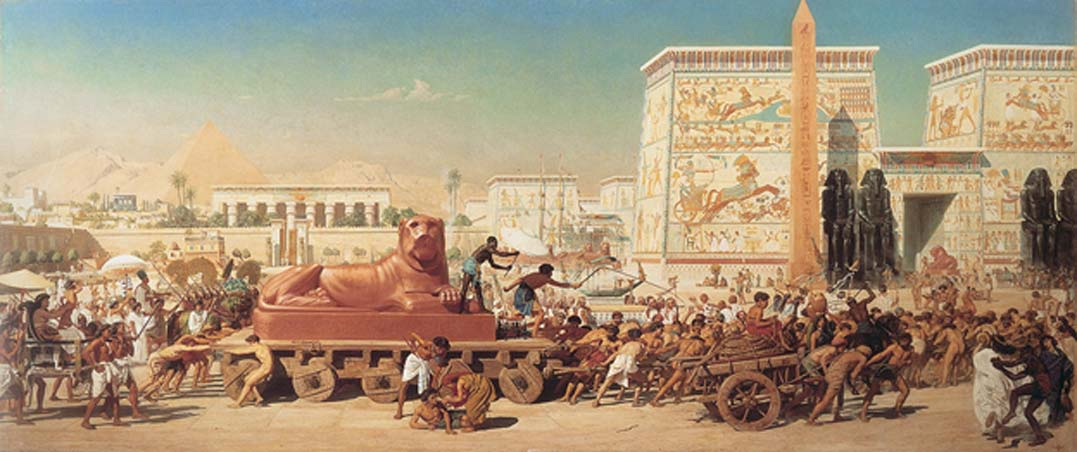
All this is prologue to a note I received from a regular reader of Bracing Views about lies in America. I’ve decided to retain the profanity because it’s more than appropriate:

I don’t know about you, but I find it quite amazing that, despite decades of bold-faced lying about US wars, all of it proven and even reported in the NYT and other mainstream media, the narrative of the each subsequent war is always accepted as true, until it too is exposed as being nothing but lies.

Let’s look at the recent record:

1) Vietnam–exposed as nothing but lies by the Pentagon Papers.

2) Iraq–exposed as lies when the infamous WMD were never found and there was nothing found to back up the claim of links to Al Qaeda.

3) Afghanistan–exposed as pure fiction as revealed by the Washington Post “Afghanistan Papers” which said that “senior US officials failed to tell the truth about the war in Afghanistan throughout the 18-year campaign, making rosy pronouncements they knew to be false and hiding unmistakable evidence the war had become unwinnable.”

Add to the above list the fact that the Mueller report investigating the Russiagate hoax came up with nothing, ZERO.

Currently, there are a couple of new false narratives duly reported by the mainstream media and, for the most part, swallowed by most people. First is the false narrative about the US war in Ukraine, that NATO expansion has nothing to do with it but rather was caused by naked Russian aggression and Putin’s plans to re-create the Soviet Union and take over the rest of Eastern Europe. Second, the false narrative that Israel is just defending itself against Palestinian terrorism rather than committing grotesque war crimes, completely ignoring the fact that the Israelis have been keeping the Palestinians under illegal occupation for over 50 years, since June 1967. 

Lie after lie after lie after lie. And yet none of it matters. It is all sent down the memory hole as if it never happened. And then it is on to the next war, when the official narrative spewed out by the DC blob will once again be swallowed hook, line and sinker. It appears to be never ending. No matter how much lying is exposed, it simply does not matter.

I think it is pretty fucking amazing. What will it take to get people to come out of their coma and realize what the fuck is going on?

And keep in mind…..it has nothing to do with party affiliation. The lying is endemic, it’s in the DNA of the National Security State. Presidents come and go, but the lying for war-making never stops. And no one is ever held accountable either. 

It’s pretty fucking impressive, when you think about it.

Keep this is in mind……one would think that, after this abhorrent track record, the appropriate response would be to assume that the narrative justifying the new war of the moment was not true and nothing but more of the same lying. But that NEVER happens. NEVER.

How is that possible? Is it just a serious form of denial? Is it due to mental illness? Is it just some perverted form of patriotism? In what other realm is it possible to lie non-stop and never be held accountable? Even worse, to continue to have credibility despite a track record of pathological lying? 

A friend of mine pointed out that, in the old USSR, people knew that the official news on their TV every night was nothing but lies. 

So, this begs the question: Which system is more pernicious and has more effectively brainwashed its people? The one where people are controlled but they are aware that they are being fed nothing but lies, or the one that is constantly lied to but the people still believe they are being told the truth?

To those keen insights, I made this reply:

Our [American] system of lying is better! We have state/corporate media too, it’s just more subtle and advertised as “free.” We have our own “Pravda” except it rarely tells the truth, unless that “truth” is in the interests of the powerful.

To which our BV keen reader replied:

Exactly. But to suggest that we have our own version of “Pravda,” only worse because it has the cover of supposedly being “free,” is tantamount to treason, you realize.

This is the reason why Julian Assange/Wikileaks was such a threat…for actually challenging the right of the National Security State to lie non-stop about its war making and never be exposed for its lying or held accountable.

Of course, that is exactly why Assange was locked away in prison for so long and tortured, not because he was spreading lies but because he was revealing truths.

And we can’t have that in America!

Genesis (21-22)

•July 30, 2024 • Leave a Comment

~~~~

Today’s Golden Calf: the 2024 Paris Olympics has gone full Woke dystopian with transgend*r mockery of the Last Supper, the Golden Calf idol,
and even the Pale Horse from the prophetic Book of Revelation; for France

Genesis 21

~~~~

The Holy Land: Judea and Samaria

And the Lord visited Sarah as He had said, and the Lord did unto Sarah as He had spoken. — and the Lord visited Sarah as he had said; to Abraham, Genesis 17:16; in a way of graciousness and kindness, by fulfilling his promise, giving strength to conceive and bear a child;

For Sarah conceived and bore Abraham a son in his old age, at the set time of which God had spoken to him. — and bare Abraham a son in his old age; which circumstance is remarkable, that the favour might appear the greater, and the more wonderful;

— at the set time of which God had spoken to him, Genesis 17:21; God was not only faithful in fulfilling his promise, but in keeping the exact time of it.

And Abraham called the name of his son who was born unto him, whom Sarah bore to him, Isaac. — Isaac; this name not only recorded the fact of the laughter of the father (Genesis 17:17) and of the mother (Genesis 18:12),

— but was a standing memorial that Isaac’s birth was contrary to nature, and one of which the promise was provocative of ridicule in the sight even of his parents; who was born according to the promise, at the set time of which God had spoken;

And Abraham circumcised his son Isaac, being eight days old, as God had commanded him. — he circumcised his son; the covenant being established with him, the seal of the covenant, according to God’s command, was administered to him.

And Abraham was a hundred years old when his son Isaac was born unto him. — and Abraham was an hundred years old when son Isaac was born unto him; so that this was years after his departure from Haran, and coming into the land of Canaan, for then he was seventy five years of age;

And Sarah said, “God hath made me laugh, so that all who hear will laugh with me.” — Sarah said, God has made me to laugh; not through diffidence and irreverence, as my own distrustful heart before made me to laugh; but through excess of holy joy. He hath given me both cause and a heart to rejoice.

And she said, “Who would have said unto Abraham that Sarah should have given children suck? For I have borne him a son in his old age.” — Sarah will nurse children; children, though she had but one child, either by a usual enallage of the plural number for the singular, whereby the word sons or daughters is used when there was but one;

— for she shall bring forth a son in her old age! that she who was ninety years of age should bear a child, and suckle it, as she did; and in doing she set an example to her daughters to do likewise, since neither age nor grandeur, were any objection to this duty of nature;

And the child grew, and was weaned; and Abraham made a great feast the same day that Isaac was weaned. — the child grew, and was weaned; according to tradition, Isaac was two years old when weaned.

And Sarah saw the son of Hagar the Egyptian, whom she had borne unto Abraham, mocking. — mocking; the verb used here is the same as that rendered to laugh in Genesis 21:6, but in an intensive conjugation.

10 Therefore she said unto Abraham, “Cast out this bondwoman and her son; for the son of this bondwoman shall not be heir with my son, even with Isaac.” — for the son of this bondwoman shall not be heir with my son, even with Isaac; which he would seem to be, if continued, and would think himself so, and there would be continual bickerings about it;

11 And the thing was very grievous in Abraham’s sight because of his son. — the issue was very grievous in Abraham’s sight, the matter was evil exceedingly in Abraham’s eyes;

12 And God said unto Abraham, “Let it not be grievous in thy sight because of the lad, and because of thy bondwoman. In all that Sarah hath said unto thee, hearken unto her voice; for in Isaac shall thy seed be called. — let it not be grievous in thy sight because of the lad, and because of the bondwoman:

— that is, let not the motion displease thee, which Sarah has made, to turn out the bondwoman and her son; do not look upon the new situation as an ill thing, or as an hard thing; it is but what is right and proper to be done, and leave the bondwoman and her son to me; I will take care of them, be under no concern for them and their welfare;

13 And also of the son of the bondwoman will I make a nation, because he is thy seed.” — the son of the bondwoman; the handmaid; Hagar is never acknowledged as Abraham’s wife, though her child, as Abraham’s son, receives a noble promise for the father’s sake.

14 And Abraham rose up early in the morning, and took bread and a bottle of water; and he gave it unto Hagar, putting it on her shoulder, and the child, and sent her away. And she departed and wandered in the wilderness of Beersheba.

— and gave it unto Hagar, putting it on her shoulder; that is, the bread and the water, which might be put in one parcel or bundle, or in a basket, and so laid and carried on her shoulder: the Targum of Jonathan adds, “and bound it to her loins, to show that she was an handmaid and dismissed her with a letter of divorce:”

15 And the water in the bottle was spent, and she cast the child under one of the shrubs. — and the water was spent in the bottle; it was all drank up by them, having wandered about some time in a wilderness, where they could not replenish their bottle;

16 And she went and sat down apart from him a good way off, as it were, a bowshot; for she said, “Let me not see the death of the child.” And she sat opposite him, and lifted up her voice and wept. — Hagar, in distress said, Let me not see the death of the child; she could not bear to hear his dying groans, and see him in his dying agonies;

17 And God heard the voice of the lad; and the angel of God called to Hagar out of heaven and said unto her, “What aileth thee, Hagar? Fear not, for God hath heard the voice of the lad where he is. — God had heard the voice of the lad: Arise, lift up the lad, and hold him in thy hand;

18 Arise; lift up the lad and hold him in thine hand, for I will make him a great nation.” — Hagar is assured that he would recover and live, and become a man and the father of children, who in time would become a great nation;

19 And God opened her eyes and she saw a well of water; and she went and filled the bottle with water, and gave the lad drink. — God opened her eyes: he regarded her and directed her to a fountain close beside her, probably hidden amid brushwood, by the waters of which her almost expiring son was revived.

20 And God was with the lad; and he grew, and dwelt in the wilderness, and became an archer. — God was with the lad; He grew an archer, or multiplied into a tribe of archers.

21 And he dwelt in the Wilderness of Paran, and his mother took him a wife out of the land of Egypt. — a wife out of the land of Egypt; in Paran; that is, Arabia, where his posterity has ever dwelt;

— so the Arabians that live in the deserts and round about them, called Nabathees, from Nabaioth, another son of Ishmael; however natural this might be on Hagar’s part, it would nevertheless strengthen the heathen element in Ishmael and his descendants:

— Abraham’s posterity could be broken into four major groups: (1) Ismael: Arabs: Islam; (2) Esau: Catholics; (3) 10 Northern Tribes: Protestants; (4) Southern Tribes: Judaism

22 And it came to pass at that time that Abimelech and Phichol, the chief captain of his host, spoke unto Abraham, saying, “God is with thee in all that thou doest. — that Abimelech and Phichol, the chief captain of his host, spake unto Abraham; Abimelech was king of Gerar, the same that is spoken of in the preceding chapter, and Phichol was the general of his army; these two great personages came together and paid Abraham a visit;

23 Now therefore swear unto me here by God that thou wilt not deal falsely with me, nor with my son, nor with my son’s son; but according to the kindness that I have done unto thee, thou shalt do unto me and to the land wherein thou hast sojourned.” — Abimelek, accompanied by Phikol, his commander-in-chief, proposes to form a league with Abraham;

— that thou wilt not deal falsely with me, nor with my son, nor with my son’s son; perhaps he had heard that God had promised to give the whole land of Canaan to him and his posterity, and among the rest his kingdom, which was a part of it;

— and, seeing him grow great and powerful, he could not tell how soon it might be ere he was put in the possession of it, whether in his own time, or his son’s, or his grandson’s; and therefore desires Abraham that he would swear to do no hurt to them whenever it should be; and that they might not be driven out, but sojourn in it as he had done.

24 And Abraham said, “I will swear.” — and Abraham said, I will swear; grateful of the many favours he had received from Abimelech in times past, he very readily agreed to his proposal;

— that it would be over four hundred years before his posterity should be put into the possession of the land of Canaan; and therefore could take an oath that neither he, nor his son, nor his grandson, should be injured or dispossessed.

25 And Abraham reproved Abimelech because of a well of water which Abimelech’s servants had violently taken away. — which Abimelech’s servants had violently taken away: that is, had by force taken the use of it to themselves for their cattle, and had deprived Abraham of it;

26 And Abimelech said, “I know not who hath done this thing; neither didst thou tell me, neither yet heard I of it until today.” — neither yet heard of it but today: he had not heard of it from others, as the Targum of Jonathan rightly adds, by way of explanation, but that very day, and not till the moment he had it from Abraham himself;

27 And Abraham took sheep and oxen and gave them unto Abimelech, and both of them made a covenant. — and Abraham took sheep and oxen, and gave them unto Abimelech; in gratitude for former favours he had received from him, in token of the friendship that subsisted between them;

28 And Abraham set seven ewe lambs of the flock by themselves. — in the seven ewe-lambs which Abraham tenders, and Abimelek, in token of consent, accepts at his hand.

29 And Abimelech said unto Abraham, “What mean these seven ewe lambs, which thou hast set by themselves?” — what mean these seven ewe lambs which thou hast set by themselves? he understood what the sheep and oxen were for, that they were presents to him,

— at least some of them, and the rest were for the solemnizing and ratifying the covenant between them; but what these were for he could not devise.

30 And he said, “These seven ewe lambs shalt thou take from my hand, that they may be a witness unto me that I have dug this well.” — and he said; that is, Abraham replied to Abimelech:

— that they may be a witness to me that I have digged this well: these were to be a testimony that the well that had been taken away from Abraham was one that he had dug, and was his property, and which Abimelech acknowledged by his acceptance of these seven lambs; and his title to the well, which these were a witness of.

31 Therefore he called that place Beersheba [that is, The well of the oath], because there they swore, both of them. — the Targum of Jonathan says, “and therefore he called the well the well of seven lambs;” “Beer” signifying a well, and “sheba” seven; being expressed, because there they sware both of them; by the living God, to keep the covenant inviolably they had made between them;

32 Thus they made a covenant at Beersheba. Then Abimelech rose up, and Phichol the chief captain of his host, and they returned into the land of the Philistines. — and they returned into the land of the Philistines; from Beersheba, which was in the extreme border of it, unto Gerar, which was the capital city.

33 And Abraham planted a grove in Beersheba, and called there on the name of the Lord, the Everlasting God. — what sort of trees this grove consisted of cannot with certainty be said, nut probably the oak.

34 And Abraham sojourned in the Philistines’ land many days. — and Abraham sojourned in the Philistines’ land many days; even many years, days being often times put for years.

Genesis 22

And it came to pass after these things, that God tested Abraham and said unto him, “Abraham!” And he said, “Behold, here I am.” — and he said, behold, here I am; signifying that he heard his voice, and was ready to obey his commands, be whatever they would be;

— and the Targum of Jerusalem says this was Abraham’s tenth trial “these things that the Lord tried Abraham with the tenth trial”

and the Maimonides lists them as follows:

  1. G‑d tells him to leave his homeland to be a stranger in the land of Canaan
  2. Immediately after his arrival in the Promised Land, he encounters a famine
  3. The Egyptians seize his beloved wife, Sarah, and bring her to Pharaoh
  4. Abraham faces incredible odds in the battle of the four and five kings
  5. He marries Hagar after not being able to have children with Sarah
  6. G‑d tells him to circumcise himself at an advanced age
  7. The king of Gerar captures Sarah, intending to take her for himself
  8. G‑d tells him to send Hagar away after having a child with her
  9. His son, Ishmael, becomes estranged
  10. G‑d tells him to sacrifice his dear son Isaac upon an altar

— the Targum of Jonathan says Isaac was 36 years of age, same as Chabad’s reckoning, but Josephus (Antiqu. l. 1. c. 13. sect. 2) says he was 25 years of age;

— besides, the Targum of Jonathan adds much details of the rivary between Isaac and Ishmael, which would be prophetic on the claimacy of being the firstborn:

And it was after these things that Izhak and Ishmael contended; and Ishmael said, It is right that I should inherit what is the father’s because I am his firstborn son.

And Izhak said, It is right that I should inherit what is the father’s, because I am the son of Sarah his wife, and thou art the son of Hagar the handmaid of my mother.

Ishmael answered and said, I am more righteous than thou, because I was circumcised at thirteen years; and if it had been my will to hinder, they should not have delivered me to be circumcised; but thou wast circumcised a child eight days; if thou hadst had knowledge, perhaps they could not have delivered thee to be circumcised.

Izhak responded and said, Behold now, today I am thirty and six years old; and if the Holy One, blessed be He, were to require all my members, I would not delay.

These words were heard before the Lord of the world, and the Word of the Lord at once tried Abraham, and said to him, Abraham! And he said, Behold me.

And He said, “Take now thy son, thine only son Isaac whom thou lovest, and get thee into the land of Moriah, and offer him there for a burnt offering upon one of the mountains which I will tell thee of.” — thine only son Isaac; the words in the original are emphatic: “Take, I pray, thy son, thine only son, whom thou lovest, even Isaac.”

And Abraham rose up early in the morning and saddled his ass, and took two of his young men with him and Isaac his son; and he cleaved the wood for the burnt offering, and rose up and went unto the place of which God had told him. — and saddled his ass; for his journey, not to carry the wood and provision on, which probably were carried by his servants, but to ride on;

— and Isaac his son: who was the principal person to be taken, since he was to be the sacrifice: whether Abraham acquainted Sarah with the affairs and she consented to it, cannot be said with certainty;

Then on the third day Abraham lifted up his eyes, and saw the place afar off. — afar off; the summit called the Mountain of the House, usually identified with Mount Moriah, cannot be seen by a traveller from Beer-sheba at a greater distance than three miles; but Mount Moriah being forty miles from Beersheba;

And Abraham said unto his young men, “Abide ye here with the ass; and I and the lad will go yonder and worship, and come again to you.” — I and the lad will come again to you; for he knew that God both could and would for his promise sake, either preserve Isaac from being sacrificed, or afterward raise him from the dead;

And Abraham took the wood of the burnt offering, and laid it upon Isaac his son; and he took the fire in his hand and a knife, and they went both of them together. — and he took the fire in his hand, and a knife; a vessel in one hand, in which fire was to kindle the wood, and a knife in the other hand to slay the sacrifice;

And Isaac spoke unto Abraham his father and said, “My father!” And he said, “Here am I, my son.” And he said, “Behold the fire and the wood; but where is the lamb for a burnt offering?” — “Here am I, my son?” is a little formal as a rendering. It is equivalent to a father’s reply: “Well, boy, what is it?”

— and he said, Behold the fire and the wood: but where is the lamb for a burnt offering; a great hint that the sacrificial system did not originate with Moses. Genesis 22:7; and will be there again during the Millennium: Ezekiel 40-48

And Abraham said, “My son, God will provide Himself a lamb for a burnt offering.” So they went both of them together. — God will provide himself a lamb for a burnt offering; in which answer Abraham may have reference to the Messiah, the Lamb of God, John 1:29, whom he had provided in covenant before the world was; and who in promise, and type, was slain from the foundation of the world, Revelation 13:8

And they came to the place which God had told him of; and Abraham built an altar there, and laid the wood in order, and bound Isaac his son and laid him on the altar upon the wood. — to the place which God had told him of; that is, Mount Moriah; this is the place where, later, David and Solomon built an altar in the threshing floor;

10 And Abraham stretched forth his hand, and took the knife to slay his son. — and Abraham stretched forth his hand; all things being ready for execution, the altar built, the wood laid on it, the sacrifice bound and laid on that, nothing remained but to cut the throat of the sacrifice;

— the Targum of Jonathan adds further details:

And Abraham stretched out his hand, and took the knife to slay his son.

And Izhak answered and said to his father, Bind me properly (aright), lest I tremble from the affliction of my soul, and be cast into the pit of destruction, and there be found profaneness in thy offering.

(Now) the eyes of Abraham looked on the eyes of Izhak; but the eyes of Izhak looked towards the angels on high, (and) Izhak beheld them, but Abraham saw them not.

And the angels answered on high, Come, behold how these solitary ones who are in the world kill the one the other; he who slayeth delays not; he who is to be slain reacheth forth his neck.

11 And the angel of the Lord called unto him out of heaven and said, “Abraham, Abraham!” And he said, “Here am I.” — and the Angel of the Lord called unto him out of heaven; most likely not an ordinary angel, but the Son of God, for that this was a divine Person is clear from his swearing by himself, and renewing the promise unto Abraham;

12 And He said, “Lay not thine hand upon the lad, neither do thou any thing unto him; for now I know that thou fearest God, seeing thou hast not withheld thy son, thine only son, from Me.” — and he said, lay not thine hand upon the lad; which he was just going to stretch out, with his knife in it, to slay him; and though the Lord had bid him take his son, and offer him for a burnt offering, to try his faith;

— the Lord will provide; probably alluding to what Abraham had said, God will provide himself a lamb. The Lord will always have his eye upon his people, in their straits and distresses, that he may give them seasonable help;

13 And Abraham lifted up his eyes and looked; and behold, behind him a ram caught in a thicket by his horns. And Abraham went and took the ram, and offered him up for a burnt offering in the stead of his son. — and looked, and, behold, a ram caught in a thicket by his horns; where Abraham was, behind him and he saw it;

— the Targum of Jonathan adds details which Christians could readily infer the ram foreordained before “the foundation of the world” as the Son, who would also later be ordained as the Messiah:

And Abraham lifted up his eyes and saw, and, behold, a certain ram which had been created between the evenings of the foundation of the world, was held in the entanglement of a tree by his horns. And Abraham went and took him, and offered him an offering instead of his son. Genesis 22:13 Jonathan

14 And Abraham called the name of that place Jehovahjireh [that is, The Lord will provide]; as it is said to this day, “In the mount of the Lord it shall be seen.” — God will provide himself a lamb; this was purely the Lord’s doing: where reference was made to the promised Messiah;

15 And the angel of the Lord called unto Abraham out of heaven the second time — the angel having restrained him from slaying his son, and having provided another sacrifice, calls him again;

16 and said, “By Myself have I sworn, saith the Lord, for because thou hast done this thing and hast not withheld thy son, thine only son, — by myself have I sworn; is a great oath, and abides for ever; for because he could swear by no greater, he swore by himself, his own nature, perfections, and life;

17 in blessing I will bless thee, and in multiplying I will multiply thy seed as the stars of the heaven and as the sand which is upon the seashore; and thy seed shall possess the gate of his enemies.

— and this seed is also promised the possession of the gate of its enemies, that is, the conquest of the enemy and the capture of his cities (cf Genesis 24:60: “and let thy seed possess the gate of those who hate them”)

18 And in thy seed shall all the nations of the earth be blessed, because thou hast obeyed My voice.” — and in multiplying I will multiply thy seed as the stars of the heaven, and as the sand which is upon the sea shore;

— both his natural seed, descending from him in the line of Isaac, and his spiritual seed, all the nations of the earth be blessed, both among Jews and Gentiles;

19 So Abraham returned unto his young men, and they rose up and went together to Beersheba; and Abraham dwelt at Beersheba. — Beersheba being south of both Hebron and Jerusalem.

20 And it came to pass after these things, that it was told Abraham, saying, “Behold Milcah, she hath also borne children unto thy brother Nahor: — saying, behold Milcah, she hath also borne children unto thy brother Nahor;

— as Sarah, supposed to be the same with Iscah, a daughter of Haran, had borne a son to him; so Milcah, another daughter of Harsh, had borne children to his brother Nahor, whom he had left in Ur of the Chaldees, when he departed from thence, and who afterwards came and dwelt in Haran of Mesopotamia;

21 Huz his firstborn, and Buz his brother, and Kemuel the father of Aram, — Huz his (Nahor) firstborn, and Buz his brother; the first of these gave name to the land of Uz, where Job dwelt, and some speculate could be a descendant or related to Job;

22 and Chesed and Hazo, and Pildash and Jidlaph and Bethuel.” — all the names of Nahor’s eight children; and Bethuel became the father of Rebekah and Laban,

23 And Bethuel begot Rebekah. These eight Milcah bore to Nahor, Abraham’s brother.

24 And his concubine, whose name was Reumah, she bore also Tebah and Gaham, and Thahash and Maachah.

NATO States Are Embracing Conscription

•July 29, 2024 • Leave a Comment

These NATO States Are Embracing Conscription, Eyeing Future War With Russia

ZeroHedge by Tyler Durden July 25, 2024

As NATO escalates its proxy war in Ukraine and inches closer to fighting directly with Russia, the Washington-led bloc is embracing mandatory military serviceMany European members of NATO have expanded or reintroduced conscription as part of large-scale preparations for such a war, CNN reports. Already outpaced in terms of military industrial capacity by Russia, the alliance’s new battleplans will see an attempt to beef up weapons production and form 35-50 brigades of 3,000-7,000 battle ready troops.

Outgoing NATO Secretary General Jens Stoltenberg has insisted, “Today, we have 500,000 troops on high readiness, combat-ready battlegroups in the eastern part of the Alliance for the first time.” But the bloc is struggling to meet its goals of assembling 300,000 soldiers prepared to be activated within a month and another half a million in six months. There is also a question of whether the bloc can filed a military fit for a protracted war akin to the Ukraine conflict.

Following the end of the Cold War, several European states ceased conscripting their citizens. Although increasing numbers of NATO member countries have resorted to the draconian practice during recent years, especially in the Baltics and Scandinavia. Roughly a third of the NATO alliance practices some form of compulsory military service.

This year, for the first time since it was abolished in 2006, Latvia reimplemented its draft. Male citizens are subject to conscription within a year of turning 18 years old. Additionally, Norway has unveiled a long-term plan to increase its ranks of mandatorily conscripted troops, employees, and reservists by 20,000 as well as double the military budget. In 2015, Oslo became the first NATO government to establish a gender-neutral draft.

Lithuania brought back mandatory military service in 2015, each year drafting 3,500 to 4,000 men between the ages of 18-26 for a nine-month period. Although the Finnish Defense Forces employ only 13,000 people during peacetime, Helsinki claims it has the ability to activate over 900,000 reservists with 280,000 combat-ready troops. Sweden conscripts both men and women, Stockholm drafted 7,000 its citizens and the military expects to conscript 8,000 next year. The Swedes have had conscription since 1901.

Citing the supposed Russian threat to Europe, Robert Hamilton, the head of Eurasia Research at the Foreign Policy Research Institute, said “It is tragically true that here we are, in 2024, and we are grappling with the questions of how to mobilize millions of people to be thrown into a meatgrinder of a war potentially.” For 30 years, Hamiliton served as a US Army officer. “Meatgrinder” is a term often used by frontline troops in Ukraine, particularly during the battle of Bakhmut where the average life span of such a soldier was only a few hours.

In the United Kingdom, conscription is currently being pushed by Conservative MPs. The 2025 National Defense Authorization Act, the annual military spending bill, may include provisions which inter alia will seek to automatically register all eligible men and women for Selective Service, a form of conscripted labor, which could inevitably include military service.

Former Supreme Allied Commander of Europe General Wesley Clark echoed Hamilton’s hawkish sentiments, emphasizing “whether this is a new Cold War or an emerging hot war is unclear.” He added that NATO “must rebuild our defenses,” including with mandatory military drafts.

“I think young people in Europe and the US will come to realize that this generation, like the generation that fought WWII, it didn’t ask to be the ‘Greatest Generation’ but the circumstances thrust that burden on them,” Clark added.

Norwegian Army participate in a military exercise called “Cold Response 2022”

The risk of direct war with Russia is growing by the day amidst the Ukraine proxy war, as the alliance has largely approved NATO missiles to be used for attacks against the Russian mainland. The bloc will soon provide Kiev with F-16s and an explicit green light for the warplanes to carry out direct strikes against Russian territory as well. Without irony, Stoltenberg claimed this should not be viewed by Russia as an escalation.

As NATO considers increasing its nuclear weapons deployments, the US is also planning to deploy previously banned, medium-range, nuclear capable missiles in Germany which has caused Russia to hint it could similarly retaliate. Pointing to the massive US-led buildup for war with China, President Vladimir Putin accused NATO of creating major security threats for Russia in Asia.

NATO set its sights on China four years ago, identifying Beijing as a military threat to European security. China maintains a “no limits” partnership with Russia. “NATO is already ‘moving’ there (to Asia) as if to a permanent place of residence. This, of course, creates a threat to all countries in the region, including the Russian Federation. We are obliged to respond to this and will do it,” Putin vowed earlier this year. That same month, Stoltenberg cited China as a reason the bloc is considering an “adaptation” of its nuclear arsenal.

China’s anti-satellite-killing lasers

•July 28, 2024 • Leave a Comment

Chinese subs may soon sport satellite-killing lasers

PLA scientists suggest submarines equipped with solid-state lasers could target SpaceX and other adversary satellites in a war scenario

AsiaTimes by Gabriel Honrada July 22, 2024 // SCMP

Chinese scientists have proposed developing laser-equipped submarines to kill satellites stealthily from underwater, potentially revolutionizing anti-satellite (ASAT) warfare.

The South China Morning Post (SCMP) reported that People’s Liberation Army (PLA) scientists, led by Professor Wang Dan of the Naval Submarine Academy, have suggested that Chinese submarines could be equipped with megawatt-class, solid-state laser weapons capable of targeting satellites such as SpaceX’s extensive Starlink network while remaining submerged.

The report says this approach addresses the challenge of concealing ASAT operations, which rely on ground-to-air missiles that can easily betray the launch site’s location.

It mentions that the proposed laser attack submarines could use a retractable optoelectronic mast to fire at satellites and then dive back to depth, enhancing the element of surprise and operational security.

SCMP says the study highlights the inefficiency of using missiles against small, numerous and densely packed satellites like those in the Starlink program and advocates for the mass production of laser-equipped submarines to counter military threats.

It notes that the PLA scientists’ paper provides a detailed guide for attacking Starlink-like satellites, emphasizing the need for satellite position guidance from other forces due to the limitations of the submarine’s detection equipment.

In addition to ASAT operations, the report says laser-equipped submarines could perform various tasks, including attacking anti-submarine aircraft, escorting merchant ships and striking land-based targets.

Nuclear attack submarines (SSN) may be ideal platforms for mounting laser weapons, with their nuclear reactors providing enough power for an energy-intensive weapon while giving the stealth advantage of submarines.

In a June 2024 article for the US Naval Institute (USNI), Liam Nawara says that SSNs have the potential to retain unhindered freedom of maneuver under persistent space-based intelligence, surveillance and reconnaissance (ISR), possibly making them potent ASAT platforms.

Nawara mentions that as the cost-to-launch into low-Earth orbit (LEO) decreases, satellite constellations will support more persistent ISR, impacting maritime conflicts.

Submarines could hold the key in China’s defence against enemy satellites, including the enormous Starlink network

He says that SSNs, such as the US Navy’s Virginia class, are an example of a platform capable of attacking adversary surveillance satellites with directed-energy weapons such as lasers and high-powered microwave systems.

Nawara underscores the importance of submarines’ stealth capabilities in an era where surface ships and land forces struggle for localized superiority due to the omnipresence of space-based ISR.

He envisions a future operational environment where submarines equipped with ASAT-directed-energy weapons play a crucial role in achieving localized ISR superiority and supporting joint force operations.

Further, H I Sutton writes in a February 2020 Forbes article that a laser-armed ASAT submarine will only have to reveal itself briefly to eliminate the threat and that lasers are complicated to defend against since they travel at the speed of light.

Sutton mentions that besides killing satellites, submarine-mounted lasers could be effective against swarming unmanned surface vehicles (USV), promising negligible costs per shot, unlike gun and missile-based systems. He adds that laser weapons could be effective against fast attack craft or other manned targets that are not worth a torpedo.

He also says submarine-mounted lasers could strike coastal targets such as submarine piers or communications masts. However, he mentions that the caveat is that the target must be of sufficiently high value to justify the risk of placing the submarine so close to a hostile shore.

However, submarine-mounted lasers may also have significant drawbacks, which may be inferred from developing submarine-launched surface-to-air missiles (SLAMs), a similar mast-mounted weapons system.

Tyler Rogoway mentions in a July 2020 article for The War Zone that mast-mounted submarine weapons systems such as SLAMs and possibly lasers may only be useful as a last line of defense for submarines that have been detected and face destruction from an aerial or space-based threat.

Rogoway says that SLAMs or submarine-mounted lasers would require the submarine to be dangerously close to the surface to take a shot, leaving the submarine vulnerable to attack.

However, he says that using SLAMs or submarine-mounted lasers could allow for plausible deniability, as the nationality of the attacking submarine may not necessarily be known before a SLAM or laser attack.

Rogoway cautions that a SLAM or submarine laser attack might not destroy its intended target outright. If that happens, he says that a failed attack may give away the submarine’s position, which would likely mean guaranteed destruction for the submarine.

He also notes technical issues in mounting SLAMs or lasers on the limited space of a submarine mast.

In January 2024, Asia Times pointed out that current laser weapons are constrained by physical, weight, power and cooling requirements, which may not be available on surface warships and perhaps much less on submarines.

Rogoway says that SLAMs or submarine-mounted lasers may be a weapon of last resort, given the significant implications of their use. Furthermore, he mentions that such weapons conflict with traditional submarine warfare tactics.

The idea of submarine-mounted lasers may also be wholly negated by the increasing transparency of the world’s oceans, brought on by the proliferation of technologies such as commercial satellite imagery, synthetic aperture radar, hydroacoustic monitoring and even social media.

In a March 2023 The Conversation article, Roger Bradbury and other writers say that advancements in science may lead to the detection of submarine movements and their environmental impacts, potentially making the oceans “transparent” and marking the end of the submarine era.

Bradbury and his team conducted a comprehensive analysis in 2020 to anticipate the future and its potential developments, focusing on the 2050s. Their assessment utilized the Intelfuze software, which provides thorough, transparent and updatable probabilistic evaluations, particularly suitable for addressing issues with uncertain and speculative data.

According to their findings, it is highly probable (with a 90% likelihood from some perspectives) that the oceans will become transparent in most cases by the 2050s.

They say that this high-confidence estimate, evaluated independently by the software at above 70% certainty, suggests that submarines, including nuclear-powered ones, will likely be detectable in the world’s oceans due to advancements in science and technology, despite any developments in stealth technologies.

Genesis (19-20)

•July 27, 2024 • Leave a Comment

“We must through much tribulation enter into the Kingdom of God,” Acts 14:22

Genesis 19

1 And there came two angels to Sodom at evening, and Lot sat in the gate of Sodom. And Lot, seeing them, rose up to meet them, and he bowed himself with his face toward the ground; — here came two angels; that is, two of the three that had just before been with Abraham, the two angels, who were now sent to execute God’s purpose concerning Sodom;

and he said, “Behold now, my lords, turn in, I pray you, into your servant’s house and tarry all night, and wash your feet, and ye shall rise up early and go on your ways.” And they said, “Nay, but we will remain in the street all night.”

— they said, Nay, but we will abide in the street all night; so they said, not only to give Lot an opportunity of evincing the sincerity and cordiality of his invitation, but because it was their real intention to abide in the street, to manifest the great difference between Lot and the barbarous Sodomites.

And he pressed upon them greatly, and they turned in unto him and entered into his house; and he made them a feast and baked unleavened bread, and they ate. — Lot’s invitation; at first declined, is at length accepted; and they entered his house.

But before they lay down, the men of the city, even the men of Sodom — both young and old, all the people from every quarter —compassed the house around. — here were the old and young, all vile and from every quarter; for practices too shameful to be mentioned!

And they called unto Lot and said unto him, “Where are the men who came in to thee this night? Bring them out unto us, that we may know them.”

— bring them out unto us, that we may know them; not who they were, or from whence they came, or what their business was; nor did they pretend anything of this kind to hide and cover their design from Lot, but they were open and impudent, and declared their sin without shame and blushing;

And Lot went out at the door unto them, and shut the door after him — and Lot went out at the door unto them, and shut the door after him;

and said, “I pray you, brethren, do not so wickedly. — Lot pleaded, do not so wickedly; as to use ill a man’s guests, to abuse strangers, to break the laws and rules of hospitality, and especially to commit that unnatural sin they were bent upon.

Behold now, I have two daughters who have not known a man. Let me, I pray you, bring them out unto you, and do ye to them as is good in your eyes. Only unto these men do nothing, for therefore came they under the shadow of my roof.”

— I have two daughters; this was unadvisedly and unjustifiably offered, probably through the great discomposure and perturbation which his mind was in.

And they said, “Stand back.” And they said again, “This one fellow came in to sojourn, and he will become a judge! Now will we deal worse with thee than with them.” And they pressed sore upon the man, even Lot, and came near to break the door.

— and they said, stand back; turn on one side, get away from the door, that we may come to it;

— this one fellow came in to sojourn, and he will needs be a judge; this one man, and he a stranger and sojourner, not a citizen of this city, sets himself against the whole body of the inhabitants, and takes upon himself to be judge what is right and wrong;

10 But the men put forth their hands, and pulled Lot into the house to them, and shut the door. — but the men, who were the two angels who had met Abraham, put forth their hand; they came to the door, and opened it, and put out their hands, one on one side the door, and the other on the other;

11 And they smote the men who were at the door of the house with blindness, both small and great, so that they wearied themselves to find the door. — again the men, who were the two angels, smote the others with blindness;

12 And the men said unto Lot, “Hast thou here any besides? Soninlaw, and thy sons, and thy daughters, and whomsoever thou hast in the city — bring them out of this place. — the men said; these were the angels who had met Abraham earlier;

13 For we will destroy this place, because the cry of them has waxed great before the face of the Lord, and the Lord hath sent us to destroy it.” — again, the “we” are the two angels; who said “we will destroy this place”

— might be clearer from the Message Bible:

10-11 But the two men reached out and pulled Lot inside the house, locking the door. Then they struck blind the men who were trying to break down the door, both leaders and followers, leaving them groping in the dark.

12-13 The two men said to Lot, “Do you have any other family here? Sons, daughters—anybody in the city? Get them out of here, and now! We’re going to destroy this place. The outcries of victims here to God are deafening; we’ve been sent to blast this place into oblivion.” Genesis 19:10-12 MSG

14 And Lot went out and spoke unto his sons-in-law, who married his daughters, and said, “Up, get ye out of this place; for the Lord will destroy this city!” But he seemed as one who mocked unto his sons-in-law. — Lot spoke to his sons-in-law; it is a possibilty that these sons-in- law had married other daughters of Lot;

— according to Jewish sources, Lot had two other daughters that perished in Sodom; but according to Josephus (Antiquities. l. 1. c. 11. sect. 4) were espoused to men in the city, but not yet married; and on account of such espousals, as were usual in the eastern countries, Lot calls them his sons-in-law;

15 And when the morning arose, then the angels hastened Lot, saying, “Arise, take thy wife and thy two daughters who are here, lest thou be consumed in the iniquity of the city.” — when the morning arose; Lot had thus the night for making his preparations, part of this he spent in his visits to his sons-in-law;

16 And while he lingered, the men laid hold upon his hand, and upon the hand of his wife and upon the hand of his two daughters, the Lord being merciful unto him; and they brought him forth and set him outside the city.

— while he lingered; he did not make so much haste as the case required, and this would have been fatal to him, if the angels had not laid hold on his hand, and brought him forth. Herein the Lord was merciful to him; and if God had not been merciful to them, their lingering had been their ruin;

17 And it came to pass, when they had brought them forth outside, that he said, “Escape for thy life! Look not behind thee, neither stay thou in all the plain. Escape to the mountain, lest thou be consumed!” — look not behind thee; they must not loiter by the way; stay not in all the plain;

— for it would all be made into one dead sea; he must not take up short of the place of refuge appointed him; escape to the mountain; such are the commands given to those who are delivered out of a sinful state: first, return not to sin and second, rest not in the world, for that is staying in the plain.

18 And Lot said unto them, “Oh, not so, my lord. — oh, not so, my Lord; that is, let me not be obliged to go so far as to the mountain;

19 Behold now, thy servant hath found grace in thy sight, and thou hast magnified thy mercy, which thou hast shown unto me in saving my life; and I cannot escape to the mountain, lest some evil take me, and I die.

— lest some evil take me, and I die; or “that evil” the burning of Sodom, and the cities of the plain, lest that should overtake him before he got to the mountain;

— thus Lot had some distrust of the power of God to strengthen him to go thither, who had appeared so wonderfully for him in his present deliverance; and he might have assured himself, that he that brought him out of Sodom would never suffer him to perish in the destruction of it.

20 Behold now, this city is near enough to flee unto, and it is a little one. Oh, let me escape thither, (is it not a little one?) and my soul shall live.” — the MSG version says:

But Lot protested, “No, masters, you can’t mean it! I know that you’ve taken a liking to me and have done me an immense favor in saving my life, but I can’t run for the mountains—who knows what terrible thing might happen to me in the mountains and leave me for dead.

Look over there—that town is close enough to get to. It’s a small town, hardly anything to it. Let me escape there and save my life—it’s a mere wide place in the road.” Genesis 19:19-21 MSG

21 And he said unto him, “See, I have accepted thee concerning this thing also, that I will not overthrow this city for which thou hast spoken. — the MSG version says:

“All right, Lot. If you insist. I’ll let you have your way. And I won’t stamp out the town you’ve spotted. But hurry up. Run for it! I can’t do anything until you get there.” That’s why the town was called Zoar, that is, Smalltown. Genesis 19:19-21 MSG

22 Hasten thee, escape thither; for I cannot do any thing till thou hast come thither.” Therefore the name of the city was called Zoar. — therefore the name of the city was called Zoar; in later times, and probably first by Lot, from his use of the word “little” which was his request, which Zoar signifies; called Bela, see Genesis 14:2

23 The sun had risen upon the earth when Lot entered into Zoar. — in haste; the ruin of Sodom was suspended till he was secure.

24 Then the Lord rained upon Sodom and upon Gomorrah brimstone and fire, from the Lord out of heaven; — the Lord rained upon Sodom and upon Gomorrah brimstone and fire; the Lord (Yehovah יְהוָ֖ה);

— from the Lord (Yehovah יְהוָ֖ה) out of heaven; this destruction was brought upon them by Yehovah the Son of God, who had appeared to Abraham in an human form, and gave him notice of it, and heard all he had to plead for those cities, and then departed from him to Sodom,

— and the Son, who was the author of this catastrophe; this amazing shower of fire and brimstone was re-inforced and rained by him from Yehovah his Father, out of heaven; as the Targums of Jonathan and Jerusalem both call him, the Word of the Lord;

25 and He overthrew those cities, and all the plain and all the inhabitants of the cities, and that which grew upon the ground. — and he overthrew those cities; of Sodom, Gomorrah, Admah, and Zeboiim: very probably at the same time that this fiery tempest was from the heavens; and all the plain; the plain of Jordan, and the cities on it, all but Zoar;

26 But his wife looked back from behind him, and she became a pillar of salt. — but his wife looked back from behind him; herein she disobeyed an express command; according to the Targums of Jonathan and Jerusalem, she was a native of Sodom; hence menories of her kinmen and sons-in-law; and she became a pillar of salt;

27 And Abraham got up early in the morning to the place where he stood before the Lord; — stood before the Lord, and he looked toward Sodom; he has an extensive view spread out before him which would be the Dead Sea.

28 and he looked toward Sodom and Gomorrah, and toward all the land of the plain, and beheld. And lo, the smoke of the country went up as the smoke of a furnace. — the violence of the fire is indicated by the last word, which is not the ordinary word for a furnace, but means a kiln, such as that used for burning chalk into lime, or for melting ores of metal;

— the smoke of a furnace; after the fiery shower was over, and the cities burnt down, the smoke ascended toward heaven, as the smoke of mystical Babylon will do, Revelation 19:3; like the reek of a boiling cauldron; or like the smoke of a lime kiln always burning.

29 And it came to pass, when God destroyed the cities of the plain, that God remembered Abraham, and sent Lot out of the midst of the overthrow when He overthrew the cities in which Lot dwelt. — the prayer or promise made by Abraham, Genesis 18:23-32, who doubtless in his promise for Sodom would not forget Lot;

30 And Lot went up out of Zoar and dwelt on the mountain, and his two daughters with him, for he feared to dwell in Zoar; and he dwelt in a cave, he and his two daughters. — for he feared to dwell in Zoar; probably he found it as wicked as Sodom; and therefore concluded it could not survive long;

— and dwelt in the mountain; which the Lord had directed him to go to before, but was unwilling, and chose Zoar, and his two daughters with him; and they dwelt in a cave;

31 And the firstborn said unto the younger, “Our father is old, and there is not a man on the earth to come in unto us after the manner of all the earth. — the whole earth; for they thought the same deluge of fire which destroyed the four cities, and all other places;

32 Come, let us make our father drink wine, and we will lie with him, that we may preserve seed of our father.” — and we will lie with him, that we may preserve the seed of our father; have children by him, and propagate and preserve the human species; this incestuous copulations, they might think lawful;

33 And they made their father drink wine that night, and the firstborn went in and lay with her father; and he perceived not when she lay down, nor when she arose. — he perceived not; wherein there is nothing strange, it being usual with drunken men to do many things in that condition, which, when they come to themselves, they perfectly forget.

~~~~

34 And it came to pass on the morrow that the firstborn said unto the younger, “Behold, I lay yesternight with my father. Let us make him drink wine this night also, and go thou in and lie with him, that we may preserve seed of our father.”

— the firstborn said to the younger, behold, I lay last night with my father; informed her, that what they had contrived succeeded according to her wish, and therefore, with her encouragement to go on, proposes to take the same method again;

35 And they made their father drink wine that night also. And the younger arose and lay with him; and he perceived not when she lay down, nor when she arose. — and the younger arose, and lay with him following the bad example of her sister; and he perceived not when she lay down, nor when she arose;

36 Thus were both the daughters of Lot with child by their father. — Lot’s daughters had so little feeling of shame in connection with their conduct, that they gave names to the sons they bore, which have immortalized their paternity;

37 And the firstborn bore a son and called his name Moab; the same is the father of the Moabites unto this day. — his name Moab; the Moabites, who originally inhabited the country northeast of the Dead Sea, and afterward, they occupied the district east of the Salt Sea;

38 And the younger, she also bore a son and called his name Benammi; the same is the father of the children of Ammon unto this day. — the Ammonites dwelt to the northeast of Moab, where they had a capital called Rabbah; they both ultimately merged into the more general class of the Arabs;

— and according to Deuteronomy 2:9, Deuteronomy 2:19, Israel was ordered not to touch the territory of either of these tribes because of their descent from Lot, Abraham’s nephew.

Genesis 20

~~~~

1 And Abraham journeyed from thence toward the south country, and dwelt between Kadesh and Shur and sojourned in Gerar. — and Abraham sojourned in Gerar; in the southern border of Canaan which were occupied by the Philistines. We are not told upon what occasion he removed;

And Abraham said of Sarah his wife, “She is my sister.” And Abimelech king of Gerar sent and took Sarah. — she is my sister; twenty years before, Abraham had acted in the same way in Egypt, and Pharaoh had rebuked him; she was now ninety years of age, yet her naturally beauty had not faded.

But God came to Abimelech in a dream by night, and said to him, “Behold, thou art but a dead man, because of the woman whom thou hast taken; for she is a man’s wife.”

— God came to Abimelech in a dream by night; put fear into his mind, by which he cautioned him against taking Sarah to be his wife; so careful was the Lord that no wrong should be done to such a godly and virtuous person, to which she was exposed through the weakness of her husband;

— and said unto him, behold, thou art but a dead man, for the woman which thou hast taken; that is, God would punish him with death, unless he restored the woman, whom he had taken, to her husband; 

But Abimelech had not come near her; and he said, “Lord, wilt Thou slay also a righteous nation? — “Thou wilt die,” the point of death if he persisted; wilt thou also slay a righteous nation?

— he probably referred to the late destruction of Sodom and the cities of the plain, which, no doubt, must have caused great consternation; and or he knew that this had been usual for people to suffer for the crimes of their governors, or kings, if they sin;

Said he not unto me, ‘She is my sister’? And she, even she herself said, ‘He is my brother.’ In the integrity of my heart and innocency of my hands have I done this.” — in the integrity of my heart; not only does Abimelech assert this, but God himself (Genesis 20:6) admits the plea.

And God said unto him in a dream, “Yea, I know that thou didst this in the integrity of thy heart, for I also withheld thee from sinning against Me. Therefore I suffered thee not to touch her. — without any adulterous design in my heart, or outward actions tending to it, being wholly ignorant of what thou now informest him.

Now therefore restore the man his wife; for he is a prophet, and he shall pray for thee, and thou shalt live. And if thou restore her not, know thou that thou shalt surely die, thou and all that are thine.” — for he is a prophet; of course he is a true prophet of God;

— to whom he communicates his secrets; is able to foretell things to come, as well as to interpret the mind of God, that he might pray for him and save his life, and threatened him with certain death to himself and all belonging to him in case he should refuse;

— a prophet is God’s spokesman, who speaks with authority the things of God Exodus 7:1; Exodus 4:15. This implies two things: first, the things of God are known only to him, and therefore must be communicated by him; secondly, the prophet must be enabled of God to announce in correct terms the things made known to him.;

— these things refer not only to the future, but in general to all such matters as fall within the purpose and procedure of God, like Moses and Aaron in Exodus 7:1. They may even include things otherwise known or knowable by man, so far as these are necessary to the exposition of the divine will. Now Abraham has heretofore received numerous communications from God; this, also constitutes him a prophet;

Therefore Abimelech rose early in the morning, and called all his servants, and told all these things in their hearing; and the men were sore afraid. — and the men were sore afraid; lest they should be struck with death; and perhaps they might call to mind the burning of Sodom and Gomorrah for their sins, they had lately heard of, and might fear that some such calamity would befall them.

Then Abimelech called Abraham and said unto him, “What hast thou done unto us? And how have I offended thee, that thou hast brought on me and on my kingdom a great sin? Thou hast done deeds unto me that ought not to be done.” — thou hast done deeds unto me that ought not to be done; in saying Sarah was his sister, and persuading her to say the same;

10 And Abimelech said unto Abraham, “What sawest thou, that thou hast done this thing?” — that thou hast done this thing? he desires to know what he had observed, either in him or his people, that gave him any reason to conclude that they were a lustful people, lest they should kill him for his wife’s sake.

11 And Abraham said, “Because I thought surely the fear of God is not in this place, and they will slay me for my wife’s sake. — surely the fear of God is not in this place; this is a certain truth, which he thought might be depended upon, and taken for granted, since it was everywhere;

12 And yet indeed she is my sister: she is the daughter of my father, but not the daughter of my mother, and she became my wife. — and yet indeed she is my sister; in the same sense as Lot was his brother; for she was sister to Lot, and both were the children of Haran, the brother of Abraham;

13 And it came to pass, when God caused me to wander from my father’s house, that I said unto her, ‘This is thy kindness which thou shalt show unto me: at every place whither we shall come, say of me, “He is my brother.”’”

— at every place whither we shall come, say of me; or for the sake of me, in order to save me from the hands of wicked men, whom he feared would slay him for her sake: he is my brother; and so he hoped, instead of being ill used or killed, he should meet with favour and friendship on her account;

14 And Abimelech took sheep and oxen, and menservants and womenservants, and gave them unto Abraham, and restored to him Sarah his wife. — the Philistine gives atoning presents on restoring Sarah, and grants her husband permission to dwell in his land wherever it pleased him; this also implies that he had done Abraham a wrong.

15 And Abimelech said, “Behold, my land is before thee. Dwell where it pleaseth thee.” — and Abimelech said, behold, my whole land is before thee; instead of bidding him be gone, and sending him away in haste out of his country, as the king of Egypt did;

16 And unto Sarah he said, “Behold, I have given thy brother a thousand pieces of silver; behold, he is to thee a covering of the eyes unto all who are with thee and with all other.” Thus she was reproved. — behold, he is to thee a covering of the eyes, unto all that are with thee; a protection of her chastity: so an husband, in our language, is said to be a cover to his wife, or that she is under a cover;

17 So Abraham prayed unto God. And God healed Abimelech, and his wife and his maidservants; and they bore children, — and God healed Abimelech, and his wife, and his maidservants: who by reason of some disease were rendered unfit for and incapable of cohabitation with their husbands, and they with them;

— and they bare children; cohabited and conceived, bare and brought forth children, all which are comprehended in this expression.

18 for the Lord had closed up fast all the wombs of the house of Abimelech because of Sarah, Abraham’s wife. — for the Lord had fast closed up all the wombs of the house of Abimelech; with large tumours probably, so that they could not cohabit with their husbands and conceive.

China’s new radar penetrated US jamming jet

•July 26, 2024 • Leave a Comment

China claims new radar penetrated toughest US jamming jet in South China Sea. Using a combination of AI and next-gen tech, the PLA has shown it can overcome US EW systems.

A US Navy EA-18G Growler, a 2-seat F/A-18F carrier-based electronic warfare jet

Interesting Engineering by Christopher McFadden • July 15, 2024 // SCMP

Chinese researchers have revealed how the People’s Liberation Army (PLA) navy’s ‘kill web’ was able to defeat the US Navy’s EA-18G “Growler” electronic warfare (EW) systems. Highlighted in a peer-reviewed paper published last month in the Chinese Academic Journal Radar & ECM, the scientists explained how artificial intelligence (AI) played a crucial role.

This news comes six months after PLA officers onboard a Type 055 destroyer were honored as a “role model of the times” for their actions against a US aircraft carrier fleet. Chinese media showed footage of two US jets buzzing the Nanchang, one widely believed to be an EA-18G “Growler.”

Videos released by China show that the EA-18G may have adopted a combat mode known as jamming-while-accompanying, creating a formation with other warplanes and conducting noise jamming or releasing strong signals of dense, false targets to blind the Nanchang.

However, the radar system on Nanchang continued to operate normally and locked onto the main targets of the US fleet. A commander on the Nanchang later told state media that the US planes and ships backed off shortly after they opened the protective covers of the vertical launching system (VLS).

China’s ‘kill web’ PLAN Nanchang Type 055 Destroyer: able to defeat the US Navy’s EA-18G “Growler” electronic warfare (EW) systems

US losing EW-edge with China

Manufactured by Boeing, the “Growler” is an EW aircraft primarily used for electronic jamming. Based on the F/A-18 “Super Hornet,” it can be loaded with various EW systems to suppress enemy reconnaissance and communication signals in all frequency bands and all directions with high power.

It can also launch anti-radiation missiles for precise strikes against shipborne radars, making it a core combat force in the US AirSea Battle strategy. Production of the “Growler” began 20 years ago; the platform has been extensively upgraded over the years.

However, the new paper shows that all its capabilities are not foolproof.

“Cognitive intelligent radar has capabilities such as proactive environmental sensing, arbitrary transmit and receive design, intelligent processing, and resource scheduling. It can effectively counter the complex and variable electromagnetic jamming of the EA-18G,” wrote the project team led by Professor Liu Shangfu. Shangfu is a radar expert with the Naval Non-Commissioned Officer School in Bengbu, southeast China’s Anhui province.

China’s modern warships reportedly have multiple radars with different working principles and sensors. According to the South China Morning Post (SCMP), China has also solved the bottleneck issue in transmitting and processing massive amounts of data to help streamline integration.

According to the researchers, this combination significantly reduces the effectiveness of the Growler’s jamming against individual radars.

The Nanchang and her crew have been honoured for actions against a US aircraft carrier fleet. But William Coulter, the commander of US Electronic Attack Squadron 136 (VAQ-136) deployed in the South China Sea on the USS Carl Vinson aircraft carrier, was given the axe by the US Navy “due to a loss of confidence in his ability to command.”

China’s ‘kill web’ a gamechanger

“System detection is not simply a stacking of multiple detection sensors, nor a loosely connected network, but rather a comprehensive utilization of the performance characteristics of different sensors based on actual situations, and a rational allocation and scheduling of detection resources from a tactical perspective to enhance the platform’s information control capabilities,” Liu’s team wrote.

Chinese scientists have also made breakthroughs in maintaining high-speed and reliable communication across the entire fleet in complex electromagnetic environments. To this end, the researchers explained that when an EA-18G launches an attack on a Chinese naval ship, nearby Chinese naval ships immediately counter it.

As the ships share information, a giant “kill web” is then created, with the capability to “flexibly, actively, quickly and intelligently counter the EA-18G, achieving a transformation from ‘single-resource confrontation’ to ‘systematic detection resource confrontation,’” Liu and his colleagues wrote.

With technology on its side, the Chinese navy has reversed its previous cautious style and adopted a more proactive tactic of “attacking as defense, taking multiple measures simultaneously, optimizing combinations and joining forces with other elements to counter electronic warfare aircraft,” the scientists added.

A US’s Secret Weapon for Critical Minerals?

•July 25, 2024 • Leave a Comment

Could Critical Metals Corp’s Tanbreez Project Become Washington’s Secret Weapon in the Future for Critical Minerals?

Could this Tanbreez Project Developed into the US’s Most Important Weapon System?

Blessed are the peacemakers, for they will be called children of God. Matthew 5:9

ZeroHedge • July 20, 2024

The western world has only just begun to appreciate the magnitude of the risk posed by China’s control of rare earth elements, the central building blocks behind the modern defense industry. Fortunately, there is hope on the horizon, as a new publicly traded company may help to level the playing field, empowering the West to provide China with its most formidable competitor yet. 

This past June, Nasdaq-listed Critical Metals Corp. (Nasdaq: CRML), a leading mining development company, embarked on a game-changing move when it announced plans to acquire an interest in the world-class Tanbreez rare earths project in Greenland. 

This foundational rare earths project, strategically located in Southern Greenland with access to key transportation outlets, has the potential to turn the tide in the global war for the rare earths market. With an estimated resource of 4.7 billion tonnes containing 28.2 million tonnes of total rare earth oxides, Tanbreez stands as one of the world’s largest known rare earth deposits. A notable differentiator for Tanbreez is its sizable concentration of heavy rare earth elements, which constitutes more than 25% of the resource. 

Rare Earth Elements are Key to our Defense

Before really delving into the significance of this acquisition, it is important to understand what rare earth elements are and why they are essential for investors to consider.

Rare earths are a group of 17 elements on the periodic table, many of which have names that are difficult for the average person to pronounce.  They are divided into two broader categories: Light Rare Earth Elements (LREEs) and Heavy Rare Earth Elements (HREEs), with the latter having limited refining capacity. 

For the most part, Light Rare Earth Elements are used in an enormous range of everyday products, such as mobile phones, electric cars, supercomputers, windmills, quantum computing, and they are essential to the clean energy transition. These elements are used to make modern magnets, vital components of electric vehicle motors, medical equipment, wind turbines and data storage systems 

But, perhaps most importantly, Heavy Rare Earth Elements are critical materials for the development of national defense applications and heavy weaponry. HREEs are also used in fiber optics, medical equipment and hybrid vehicles.

Key HREEs such as Dy, Tb and Gd are essential components in advanced military defense systems, including the F-35 Lightning II Aircraft, the DDG-51 Aegis Destroyer, and Virginia-class submarines. With the Pentagon planning a substantial increase in F-35 procurement in the coming decades, ensuring a reliable supply of these critical metals will be crucial for national security.

For perspective, a single DDG-51 Aegis Destroyer requires 5,200 lbs of rare earth elements, and even a F-35 fighter requires more than 500 lbs of rare earth material.

The Threat of China’s Rare Earth Stranglehold

When it comes to the defense industry, it is alarming how active the Chinese are relative to the western world. The speed of the manufacturing and investment in Chinese defense systems is severely outpacing the of the US, with investments in munitions and high-end weapons systems and equipment progressing more than five times faster than in America. A large part of this is enabled by China’s stranglehold on the rare earth market.

Currently, China is the world’s dominant producer of rare earths, controlling more than 90% of the market. This level of market dominance allows China to influence great control as it did in 2023 when China put export controls on gallium and germanium, citing concern for their own national security. Both are critical minerals in US industrial and defense manufacturing.

What’s even more alarming are the concerns posed by North Korea’s significant untapped rare earth resources. While North Korea is a bit of a ‘black box’ in terms of assessments, many believe that the region has more than six times the amount of rare earths as China. This makes rare earth elements all the more critical of a material.

This is a massive issue that cannot be understated, and it’s only a matter of time before the West wakes up and scrambles to get as many rare earth metals as possible. Critical Metals Corp and the Tanbreez project may be able to help.

Diving into the Tanbreez Project

This highlights the importance and strength of the Tanbreez asset. First and foremost, Tanbreez is massive, containing billions of tonnes of valuable material. The outcropping ore body, known as Kakortokite, spans an impressive 8 by 5 kilometers and boasts a thickness of approximately 400 meters. The production rate is expected to start at 500,000 metric tons per year, eventually increasing to 3 million metric tons per year, supporting an extraordinary mine life.

Significant progress has already been made to tap this valuable asset. Tanbreez was awarded a key exploitation license 4 years ago, extensive studies have been completed, and Critical Metals Corp is close to underway with a SK1300. A total of 414 drill holes and more than 366,000 assays have been conducted, providing a rich database on the deposit’s geology, geochemistry and rare earth element distribution. Substantial bulk testing, totaling approximately 709 tonnes, further demonstrates the asset’s key significant scale and underscores the depth of the work already completed.

One of the key advantages of the Tanbreez Project is its prime location in Southern Greenland, which offers year-round direct shipping access via deep water fjords connected to the North Atlantic Ocean. The region also benefits from the mildest weather conditions in Greenland, with average temperatures ranging from 0 to 5 degrees Celsius in the winter and 10 to 15 degrees Celsius in the summer. These factors significantly enhance the project’s feasibility and economic viability. Moreover, the Tanbreez resource is an open pit that can be mined with minimal waste(approximately 3%), and with minimal need for chemicals.

Greenland is strategically important to both Europe and the US as seaborne trade from the island nation with a population of 58,000 people is easily defended by America’s dominant naval presence in the Atlantic. Material can be protected during transportation – even in the event of war – to both the US and Europe for processing. Tanbreez’s size and uniquely defensible geography have garnered the attention of key national security departments and agencies in both the America and Europe.

They understand the strategic importance of this deposit and its singular ability to solve the vice grip that China holds over the rare earth metals market.   

CRML Is Not Just Rare Earths Company, But Also a Lithium Play

As exciting as the Tanbreez project is, it isn’t even Critical Metals Corp’s flagship project. That distinction belongs to the Wolfsberg Lithium Project in Austria. With Tanbreez and Wolfsberg in its expanding multi-geography portfolio, Critical Metals is strategically focused on two of the most in-demand resources of the 21st century: rare earth elements and lithium – widely regarded as the metals of the future. Europe’s first fully-permitted lithium mine, the Wolfsberg project is strategically located to serve the continent’s burgeoning lithium-ion battery market.

With a resource of 12.88 million tonnes at 1% Li2O grade and a mine life exceeding 15 years, Wolfsberg is set to play a crucial role in Europe’s electric vehicle supply chain. To put this in perspective, the project could produce enough material to power more than 5 million average electric vehicles, assuming an average of 63 kg of lithium carbonate equivalent (LCE) per EV battery.

Further underscoring the project’s viability, Critical Metals Corp has a binding offtake agreement with BMW Group, and recently received a $15 million pre-payment from the automaker. 

This July, the company announced its acceptance of assignment of the European Lithium-Obeikan Group Investment Company (Obeikan Group) joint venture. The 50%/50% JV will be focused on developing, constructing and commissioning a large-scale lithium hydroxide processing plant in Saudi Arabia, and operating the plant for the conversion of lithium spodumene concentrate from the Wolfsberg Lithium Project in Austria. 

The Fundamental Market Opportunities are Robust

For comparables, I would encourage you to check out MP Materials (NYSE:MP), a $2.2 billion market cap issuer with a known resource of just under 3 million tonnes that is almost entirely light rare earth elements (LREE) for comparison. On the lithium side, Sigma Lithium Corp (Nasdaq: SGML) serves as a great comparable.

This all boils down to robust market opportunities. The market for both rare earths and lithium is robust and growing. The global rare earths market is projected to nearly double from $5.3 billion in 2021 to $9.6 billion by 2026, driven by demand for magnets in electric vehicles and wind turbines, but most of all, defense industry applications.

Similarly, lithium demand is expected to quadruple by 2030. While lithium prices have experienced recent declines, a significant shortfall in the supply of lithium spodumene product and battery-grade lithium hydroxide is expected by 2026 or 2027, coinciding with when the Wolfsberg project is expected to be in production.

As the world races to secure supplies of rare earths and lithium, Critical Metals Corp is strategically positioned to play a pivotal role in reshaping global supply chains and bolstering national security. The key to success with future metals projects lies in an experienced management team, the fundamental strength of the assets in question, location, permitting, and offtake partners – all of which are present within the Critical Metals Corp story. 

They will be essential players in securing the essential  elements use to build the products of the future and, more importantly, the national security we so desperately need.

Rare Earth Reserves: Top 8 Countries

Rare Earth Production: Top 5 Countries

China’s ban of rare earth technologies

Trump didn’t say he wouldn’t defend Taiwan

•July 24, 2024 • Leave a Comment

Trump said he can’t defend it, because the island is ’68 miles from China, a slight disadvantage’

AsiaTimes by David Goldman • July 18, 2024

Donald Trump’s July 17 Bloomberg interview prompted headlines to the effect that “the US would not defend Taiwan from a Chinese invasion under his presidency,” as the Daily Telegraph complained.

He said no such thing: He said that China doesn’t need to invade Taiwan, which lies within range of as much Chinese ordnance as the mainland cares to shoot at it. The former president and frontrunner for the November US election spoke common sense, as opposed to the face-saving obfuscation of US defense experts – including many from the Trump camp.

The US has the wrong sort of military to fight a land-based power with the world’s most advanced mass production capability, capable of turning out an arbitrarily large number of anti-ship missiles and drones, and US defense analysts have the unenviable task of explaining away thirty years’ worth of compounded blunders.

Trump, by contrast, ignores the experts and notes the obvious. 

“Taiwan is 9,500 miles away. It’s 68 miles away from China. A slight advantage, and China’s a massive piece of land, they could just bombard it. They don’t even need to – I mean, they can literally just send shells. Now they don’t want to do that because they don’t want to lose all those chip plants,” Trump said. 

Strictly speaking, Taiwan is 100 miles from the Chinese mainland and the maximum range of artillery shells is about 20 miles, but China has enough missiles to obliterate the island if it chooses to do so. It won’t, as Trump suggested, not only because it does not want to destroy the Taiwanese fabrication plants that make 90% of the world’s advanced chips, but because it does not want to kill Taiwanese citizens, whom it considers Chinese nationals.

In the event of a crisis, for example, a move towards formal sovereignty by Taiwan, China would blockade the island. The island imports all of its energy, mainly natural gas, and has about three weeks of storage capacity. China need only inform shipping companies of its intent to sink any LNG tanker approaching the island and the lights would go out in Taiwan in less than a month.

China isn’t stupid enough to send landing craft across 100 miles of open ocean. American defense experts such as the Center for a New American Security and the Center for Strategic and International Studies stage “war games” about a prospective Chinese invasion to obfuscate the failure of US defense strategy.

No expeditionary force 6,000 miles from home can match the land-based firepower of a nearby peer adversary. In the unlikely event of a full-blown battle between China and the US Navy, the outcome would resemble the destruction of the Russian fleet by Japan at the 1905 Battle of Tsushima Strait.

The US military knows this perfectly well and has explained why in numerous published locations.

Speaking of the PLA Rocket Force, Major Christopher J Mihal wrote in 2021 in a US Army journal that “The conventional arm of the PLARF is the largest ground-based missile force in the world, with over 2,200 conventionally armed ballistic and cruise missiles and with enough anti-ship missiles to attack every US surface combatant vessel in the South China Sea with enough firepower to overcome each ship’s missile defense,” 

The Pentagon’s 2023 assessment of the People’s Liberation Army reported: 

The PLARF’s conventionally-armed CSS-5 Mod 5 (DF-21D) ASBM variant gives the PLA the capability to conduct long-range precision strikes against ships, including aircraft carriers, out to the Western Pacific from mainland China. The DF-21D has a range exceeding 1,500 km, is fitted with a maneuverable reentry vehicle (MaRV) and is reportedly capable of rapidly reloading in the field.

The PLARF continues to grow its inventory of DF-26 IRBMs, which it first revealed in 2015 and fielded in 2016. The multi-role DF-26 is designed to rapidly swap conventional and nuclear warheads and is capable of conducting precision land-attack and anti-ship strikes in the Western Pacific, the Indian Ocean, and the SCS from mainland China. In 2020, the PRC fired anti-ship ballistic missiles against a moving target in the SCS.

The PLARF is developing and testing several new variants of theater-range missiles and developing capabilities and methods to counter adversary BMD systems. The DF-17 passed several tests successfully and is deployed operationally. In 2020, a PRC-based military expert described the primary purpose of the DF-17 as striking foreign military bases and fleets in the Western Pacific.

China claims to have automated factories that can manufacture 1,000 cruise missile motors a day. It can also produce as many anti-ship drones of the kind used effectively by the Houthis against US ships in the Red Sea. These are easy to shoot down with modern anti-missile systems, but a US destroyer can carry only 100 interceptors in its hold. China can fire as many projectiles as it wants from land. China also has about 60 silent diesel-electric submarines and about 1,000 4th– and 5th-generation aircraft.

The US built the wrong kind of military, something that no Pentagon-funded think tank or prospective office-seeker wants to admit. Donald Trump by contrast stated the obvious: China’s enormous size and proximity to Taiwan constitute an overwhelming, insuperable advantage. Surface ships, moreover, are sitting ducks for modern missiles, just as the lumbering battleships of 1940 were vulnerable to dive bombers and torpedo planes. 

Today’s situation resembles the eve of World War II, when battleships were the largest line item in the defense budget of every major power except Russia. Victor Davis Hanson observes in The Second World Wars that Germany and Japan made the mistake of building battleships rather than carriers, and that probably cost them the war. After Japanese bombers sunk four US battleships at Pearl Harbor and Britain’s Repulse and Prince of Wales near Singapore in December 1941, no navy started work on a battleship again. 

No matter how much of its existing capability the United States assigns to East Asia, China’s home-theater advantage in missiles and drones can overwhelm it. That makes nonsense out of the now-popular meme of “prioritizing Asia” over Ukraine, a theme promoted by a former junior Pentagon official, Elbridge Colby, reportedly under consideration for a senior national security post in a new Trump Administration.

Just what the United States might prioritize – perhaps 155mm howitzers and Patriot air defense systems – and how this would help against a deluge of Chinese missiles has never been explained. The US should aim for “a balance of power that is consistent with our reasonable differences,” maintaining the status quo over Taiwan, Colby said in a recent interview

Translated into real-world circumstances, that means China will let the United States pretend to be a Pacific power, and pretend to threaten an invasion of Taiwan while Taiwan pretends to defend itself. Taiwan won’t provoke China by promoting sovereignty, and all sides will save face. Face-saving flummery of this sort might keep the peace, but it would depend not on a balance of power, but rather on Chinese forbearance.

Using a million-dollar interceptor to shoot down a $5,000 drone is a losing proposition. Even if America could make enough interceptors to keep pace with China’s missile output and US ships could carry enough of them to counter Chinese attacks, the cost of conventional missile defense is prohibitive.

Directed-energy weapons, including laser and microwave devices, have the potential to destroy projectiles and drones cheaply, but prototypes of such devices can only stop slow-moving drones. Focusing a laser on a ballistic long enough to burn a hole in it isn’t easy, and an enormous amount of R&D would be required to deploy directed-energy weapons effectively against modern missiles.

The Pentagon’s 2025 budget includes just $780 million for directed-energy weapons research, less than the cost of eight F35 fighters.

Drone swarms also have the potential to screen against missile attacks, but this technology also faces formidable obstacles. Drones have a short range and would have to be launched from a platform less vulnerable than surface ships, for example, from a submarine. The US has built just six submarines in the past five years.

Trump has spoken often of building a missile shield for the American homeland, in emulation of Ronald Reagan’s Strategic Defense Initiative. That’s exactly the right idea, but would require a drastic reordering of defense priorities and a radical transformation of the US military. 

Trump also hinted in the Bloomberg interview that the prospect of massive tariffs on Chinese exports to the US, promoted by advisers like former Special Trade Representative Robert Lighthizer and economist Peter Navarro, constitutes a negotiating stance.

Tariffs do “two things,” Trump said. “Economically, it’s great. And man, is it good for negotiation? I’ve had guys, I’ve had countries, that were potentially extremely hostile coming to me and say, ‘Sir, please stop with the tariffs. Stop.’ They would do anything. Nothing to do with economic, they would do—you know, we have more than economic, we have other things like let’s not go to war. Or I don’t want you to go into war in another place.”

Trump also reiterated his April invitation to Chinese car companies to build plants in the United States.

Genesis (17-18)

•July 23, 2024 • Leave a Comment

In view of our current turmoil in Butler County, here’s a Prophecy for reflection:

“The LORD shall smite thee with madness, and blindness, and astonishment of heart; and thou shalt grope at noonday, as the blind gropeth in darkness” Deuteronomy 28:28-29

Genesis 17

1 And when Abram was ninety years old and nine, the Lord appeared to Abram and said unto him, “I am the Almighty God. Walk before Me, and be thou perfect. — Abram was ninety years old and nine; thirteen years, therefore, had passed by since the birth of Ishmael, who doubtless during this time had grown very dear to the childless old man;

And I will make My covenant between Me and thee, and will multiply thee exceedingly.” — and will multiply thee exceedingly; as he had before promised at several times, and now renews it, lest be should think that Ishmael was the promised seed;

And Abram fell on his face; and God talked with him, saying, — and Abram fell on his face while God was talking to him;

“As for Me, behold, My covenant is with thee, and thou shalt be a father of many nations. — and thou shalt be a father of many nations: as he was of many Arabian nations in the line of Ishmael;

— and of the Midianites, and others, in the line of his sons by Keturah; and of the Israelites in the line of Isaac, as well as of the Edomites in the line of Esau; and in a spiritual sense the father of all that believe, in all the nations of the world, circumcised or uncircumcised;

Neither shall thy name any more be called Abram, but thy name shall be Abraham; for a father of many nations have I made thee. — a multitude of nations and kings are to trace their descent from Abram; the twelve tribes of Israel, the twelve princes of Ishmael, Keturah’s descendants, and the dukes of Edom sprang from him; and many Arab tribes;

And I will make thee exceeding fruitful, and I will make nations of thee, and kings shall come out of thee. — and I will make nations of thee; as the nations of Israel and Judah;

— of the Midianites and Edomites, of the Arabs, and and kings shall come out of thee; as the twelve princes of Ishmael, the kings of Edom and Midian, of the Arabs, and of Israel and Judah;

And I will establish My covenant between Me and thee and thy seed after thee in their generations for an everlasting covenant, to be a God unto thee and to thy seed after thee. — thy name shall be Abraham; it signified some new circumstance in the history, rank, or religion of the individual who bears it.

And I will give unto thee and to thy seed after thee the land wherein thou art a stranger, all the land of Canaan, for an everlasting possession; and I will be their God.” — all the land of Canaan, for an everlasting possession; this respects only the natural seed of Abraham, and those in the line of Isaac and Jacob;

And God said unto Abraham, “Thou shalt keep My covenant, therefore, thou and thy seed after thee in their generations. — thou, and thy seed after thee, in their generations; in successive ages;

10 This is My covenant which ye shall keep between Me and you and thy seed after thee: every manchild among you shall be circumcised. — circumcision to be a sign of entering into a covenant, and especially into one to which children were to be admitted;

— and even until the new age, where the uncircumcised wouldn’t be allowed into his Sanctuary, Ezekiel 44:7, 9; if such requirement applied to strangers what more of the Israelites, especially those serving in the inner court;

11 And ye shall circumcise the flesh of your foreskin; and it shall be a token of the covenant between Me and you. — the covenant of circumcision; as the rainbow, might have been in existence before it was adopted as the token of a covenant; is here said to be the covenant which Abraham and his seed must keep, as a copy or counterpart; it is a sign and a seal;

— the covenant is about the land; wherein thou art a stranger, all the land of Canaan, that God would give to Abram and his seed for an everlasting possession; and every manchild among Abram and his seed shall be sealed into a covenant by being circumcised;

12 And he that is eight days old shall be circumcised among you, every manchild in your generations, he that is born in the house or bought with money from any stranger who is not of thy seed. — any stranger who is not of thy seed, but want to live in the same land with the seed of Abram, shall be circumcised among you;

13 He that is born in thy house and he that is bought with thy money must be circumcised; and My covenant shall be in your flesh for an everlasting covenant. — the everlasting covenant is about the land that God was planning to bestow upon those who are part of the covenant; nothing about everlasting life that came later;

14 And the uncircumcised manchild whose flesh of his foreskin is not circumcised, that soul shall be cut off from his people; he hath broken My covenant.” — this sealed only the covenant of the land of Canaan to Isaac’s posterity;

15 And God said unto Abraham, “As for Sarai thy wife, thou shalt not call her name Sarai, but Sarah shall her name be. — Sarai is now formally taken into the covenant, as she is to be the mother of the promised seed;

16 And I will bless her and give thee a son also by her. Yea, I will bless her, and she shall be a mother of nations; kings of people shall be of her.” — a son of her: this is the first place where it was definitely promised that Abram’s heir should be Sarah’s own son.

17 Then Abraham fell upon his face and laughed, and said in his heart, “Shall a child be born unto him that is a hundred years old? And shall Sarah, who is ninety years old, bear?” — and laughed; not through distrust of the promise, as Sarah did (Genesis 18:12), for he staggered not at that through unbelief, but for joy at such good news; and so Onkelos renders it, “and he rejoiced”

18 And Abraham said unto God, “O that Ishmael might live before Thee!” — O that Ishmael might live before thee; he prays that Ishmael’s might be preserved, and that it might be spent in the fear, worship, and service of God; so the Targum of Jonathan says, “O that Ishmael might live and worship before thee,”

19 And God said, “Sarah thy wife shall bear thee a son indeed, and thou shalt call his name Isaac; and I will establish My covenant with him for an everlasting covenant, and with his seed after him. — Thou shalt call his name Isaac; that is, he laughs; the name was to be a perpetual memorial that Isaac’s birth was naturally such an impossibility as to excite ridicule.

20 And as for Ishmael, I have heard thee. Behold, I have blessed him, and will make him fruitful and will multiply him exceedingly. Twelve princes shall he beget, and I will make him a great nation. — the blessings of the covenant are reserved for Isaac, but common blessings were abundantly promised to Ishmael; or twelve sons of Ishmael, his son by Hagar; and, adds he, these going into Arabia;

21 But My covenant will I establish with Isaac, whom Sarah shall bear unto thee at this set time in the next year.” — but my covenant will I establish with Isaac, implying the covenant wasn’t with Ishmael;

22 And He left off talking with him, and God went up from Abraham. — and God went up from Abraham; from the earth, where he had been with Abraham, and ascended above him up to heaven;

23 And Abraham took Ishmael his son, and all that were born in his house, and all that were bought with his money, every male among the men of Abraham’s house, and circumcised the flesh of their foreskin in the selfsame day, as God had said unto him.

— and Abraham took Ishmael his son; to circumcise him; he took his son first, to set an example to his servants; which were three hundred and eighteen when he rescued Lot from the kings, Genesis 14:14; and perhaps they might be now increased;

24 And Abraham was ninety years old and nine when he was circumcised in the flesh of his foreskin. — and Abraham was ninety years old and nine; when he was circumcised in the flesh of his foreskin;

25 And Ishmael his son was thirteen years old when he was circumcised in the flesh of his foreskin. — Ishmael was thirteen years old; hence Arabs and Mohammedans defer circumcision to the thirteenth year.

26 In the selfsame day was Abraham circumcised, and Ishmael his son. — in the selfsame day was Abraham circumcised, and Ishmael his son; this is repeated, that it might be taken notice of that both were circumcised according to the command of God, and on the very day in which it was given.

27 And all the men of his house, born in the house, and bought with money from the stranger, were circumcised with him. — born in the house, or bought with money of the stranger, were circumcised with him; by their will, and with their consent; not forced on them.

Genesis 18

“Is anything too hard for the Lord?”

1 And the Lord appeared unto him in the plains of Mamre, as he sat in the tent door in the heat of the day. — as Abraham was sitting in the tent door in the heat of the day, reposing; then three “men” stood before him;

And he lifted up his eyes and looked, and lo, three men stood by him. And when he saw them, he ran to meet them from the tent door, and bowed himself toward the ground — three men; these three men were three spiritual, heavenly beings, now assuming human shapes, that they might be visible to Abraham,

and said, “My lord, if now I have found favor in thy sight, pass not away, I pray thee, from thy servant. — my lord; Heb ‘donai, a term of simple respect, or denoting one having authority;

Let a little water, I pray you, be fetched, and wash your feet and rest yourselves under the tree; — and wash your feet; which was very refreshing to travellers in hot countries, who walked barefoot or in sandals; and this he proposes to be done by one of his servants;

and I will fetch a morsel of bread and comfort ye your hearts. After that ye shall pass on, for therefor are ye come to your servant.” And they said, “So do, as thou hast said.” — and they said, so do as thou hast said; they agreed to it, that water should be fetched to wash their feet, and food for them to eat.

And Abraham hastened into the tent unto Sarah, and said, “Make ready quickly three measures of fine meal, knead it, and make cakes upon the hearth.” — Sarah is tasked and occupied with the baking;

And Abraham ran unto the herd and fetched a calf, tender and good, and gave it unto a young man, and he hastened to dress it.

— Abraham and his servant are responsible for the selection and killing of a calf, the cooking of the meat, and the procuring of butter and milk from the herd; a meal in which meat is provided is a rarity in a Bedouin’s life, and is the sign of the offering of hospitality.

And he took butter and milk and the calf which he had dressed, and set it before them; and he stood by them under the tree, and they ate. — and they did eat; or seemed to eat, though as they assumed bodies so animated as to be capable of talking and walking, why not of eating and drinking? as the Targum of Jonathan implies;

And they said unto him, “Where is Sarah thy wife?” And he said, “Behold, in the tent.” — Where is Sarah thy wife? by naming her, they gave intimation to Abraham, that though they seemed strangers, yet they well knew him and his family.

10 And he said, “I will certainly return unto thee according to the time of life; and lo, Sarah thy wife shall have a son.” And Sarah heard it from the tent door, which was behind him. — Sarah heard it in the tent door, which was behind him; the women’s place is in the back of the tent, normally divided by a thin partition from the men’s.

11 Now Abraham and Sarah were old and well stricken in age, and it ceased to be with Sarah after the manner of women. — and it ceased to be with Sarah after the manner of women; her monthly visitors had left her, so that she was unfit for conception, and there could be no hope of it in a natural way; —

12 Therefore Sarah laughed within herself, saying, “After I have waxed old shall I have pleasure, my lord being old also?” — Sarah laughed; not from joy and admiration, but from distrust and contempt, as if it were incredible;

— Heb; in her heart, that is, she secretly derided it, though none but herself, as she thought, knew it.

13 And the Lord said unto Abraham, “Why did Sarah laugh, saying, ‘Shall I of a surety bear a child, who am old?’ — which am old? suggesting there was no reason for it, and signifying his displeasure and indignation.

14 Is any thing too hard for the Lord? At the time appointed I will return unto thee, according to the time of life, and Sarah shall have a son.” — at the time appointed will I return to thee, according to the time of life, and Sarah shall have a son; which words are repeated not merely for the confirmation of Abraham’s faith, which staggered not, but to remove any of Sarah’s doubts;

15 Then Sarah denied, saying, “I laughed not,” for she was afraid. And He said, “Nay, but thou didst laugh.” — somewhat a lie, to say she did not laugh when she did; which she might be tempted to say in her confusion; for she was afraid;

16 And the men rose up from thence, and looked toward Sodom; and Abraham went with them to bring them on the way. — and looked toward Sodom; set their faces and steered their course that way, by which it appeared they intended to go thither:

— the Targum of Jonathan says that he that brought the news to Sarah “ascended to high heavens,” and the other two looked toward Sodom; but it seems most likely, that, when the two went on their way to Sodom, Abraham went with them for a distance;

— and upon Abraham’s return, the first may have descended from the first atmosphere, which is the first heaven (not the highest heaven), and continue his discourse with Abraham;

17 And the Lord said, “Shall I hide from Abraham that thing which I do, — and the Lord said; (וַֽיהֹוָ֖ה) Yehovah the Hebrew word we call Lord, shows that this angel was God himself: for this word Yehovah is God.

18 seeing that Abraham shall surely become a great and mighty nation, and all the nations of the earth shall be blessed in him. — the Jonathan says: Abraham is to be a great and mighty people, and through him shall all the peoples of the earth be blessed.

19 For I know him, that he will command his children and his household after him, and they shall keep the way of the Lord to do justice and judgment, that the Lord may bring upon Abraham that which He hath spoken of him.” — this judgment upon Sodom is to be explained to him, that he may train his household to avoid the sins of this doomed city;

— “to keep the way of the Lord, to do justice and judgment; and all this to the further intent that the Lord may bring upon Abraham what he hath spoken of him,” to do justice and judgment; to attend to all the laws, statutes, and judgments of God;

20 And the Lord said, “Because the cry of Sodom and Gomorrah is great, and because their sin is very grievous, — because the cry of Sodom and Gomorrah is great; their sins were grievous; attended with very aggravated circumstances;

21 I will go down now and see whether they have done altogether according to the cry of it, which has come unto Me; and if not, I will know.” — their cry, which ascends to heaven, is an appeal for judgement or punishment;

— I will go down and see; these cities were to be made examples to all future ages of God’s severity; and therefore ample proof given that the judgment was neither rash nor excessive; but well considered by God himself, (Eze 18:23; Jer 18:7).

22 And the men turned their faces from thence, and went toward Sodom; but Abraham stood yet before the Lord. — but Abraham stood yet before the Lord; before the first person, whom Abraham now began to know more clearly;

— he stood before him with all reverence and humility, to hear what the Lord (Yehovah יְהוָֽה) had further to say to him, as well as to say something to him himself; he stood “yet” that is, he continued to stand after the departure of the two angels that were gone to Sodom. Onkelos and Jonathan paraphrase it, “he ministered in prayer before the Lord.”

23 And Abraham drew near and said, “Wilt Thou also destroy the righteous with the wicked? — Abraham prayed or pleaded earnestly that Sodom might be spared, if but a few righteous persons should be found in it.

24 Perhaps there be fifty righteous within the city; wilt Thou also destroy and not spare the place for the fifty righteous that are therein? — within the city, within the pentapolis, which consisted of five cities:

— the Targum of Jonathan says, “perhaps there may be fifty righteous persons in the city who pray before thee, ten for every city, answerable to the five cities of Sodom and Gomorrah, Admah, Zeboiim, and Zoar:”

25 That be far from Thee to do in this manner — to slay the righteous with the wicked; and that the righteous should be as the wicked, that be far from Thee! Shall not the Judge of all the earth do right?” — to slay the righteous with the wicked? which is true of temporal calamities but certainly not true of eternal punishment;

— shall not the Judge of all the earth do right? meaning the Lord, to whom he drew nigh, and was pleading with, even the Son of God in human form, who, as he made the world, was the Governor of it and Judge in it; and indeed, as Mediator, has all judgment committed to him, and is appointed to be Judge of quick and dead at the last day;

26 And the Lord said, “If I find in Sodom fifty righteous within the city, then I will spare all the place for their sakes.” — then will I spare all the place for their sakes; not Sodom only, but the whole country, (Gomorrah, Admah, Zeboiim, and Zoar) of which Sodom was the chief;

27 And Abraham answered and said, “Behold now, I have taken upon me to speak unto the Lord, I, who am but dust and ashes. — but dust and ashes, yet he speaks as one amazed at his own boldness, and the liberty God graciously allowed him, considering God’s greatness;

28 Perhaps there shall lack five of the fifty righteous; wilt Thou destroy all the city for lack of five?” And He said, “If I find there forty and five, I will not destroy it.” — and he asked, if l find there forty and five, I will not destroy it; that is, forty five righteous persons?

29 And he spoke unto Him yet again and said, “Perhaps there shall be forty found there?” And He said, “I will not do it for forty’s sake.” — and he said, I will not do it for forty’s sake; but spare them for their sake.

30 And he said unto Him, “Oh let not the Lord be angry, and I will speak: Perhaps there shall thirty be found there.” And He said, “I will not do it if I find thirty there.” — he said unto him, Oh, let not the Lord be angry, and I will speak; this he feared, through his importunity, he should be wearisome to him and incur his displeasure;

31 And he said, “Behold now, I have taken upon me to speak unto the Lord: Perhaps there shall be twenty found there.” And He said, “I will not destroy it for twenty’s sake.” — and he said, I will not destroy it for twenty’s sake; if there were no more in it, I would spare it for their sake.

32 And he said, “Oh let not the Lord be angry, and I will speak yet but this once: Perhaps ten shall be found there.” And He said, “I will not destroy it for ten’s sake.” — and he said, I will not destroy it for ten’s sake; though no more righteous persons were found in it;

— he ended at ten, perhaps because he supposed there were at least ten righteous persons in Lot’s family, Lot and his wife, and their four daughters, and their four husbands; but they forgot that two of Lot’s daughters were unmarried, and how many he had married is not known; ten they say make a congregation, and wherever there are ten righteous persons, a place is saved for their sakes.

33 And the Lord went His way, as soon as He had finished communing with Abraham; and Abraham returned unto his place. — and Abraham returned unto his place; to his tent in the plains of Mamre, waiting to observe or hear what would be the issue and event of things respecting Sodom and Gomorrah.

Four in five Americans fear country sliding into chaos

•July 22, 2024 • Leave a Comment

“And I will spread My net upon him, and he shall be taken in My [note that it’s not China’s nor Russia’s] snare” Ezekiel 17:20

Exclusive: Four in five Americans fear country is sliding into chaos, Reuters/Ipsos poll finds

Reuters by Jason Lange July 17, 2024

WASHINGTON, July 16 (Reuters) – Americans fear their country is spiraling out of control following an assassination attempt on Donald Trump, with worries growing that the Nov 5 election could spark more political violence, a Reuters/Ipsos poll that closed on Tuesday found.

The two-day poll found Republican presidential candidate Trump opening a marginal lead among registered voters – 43% to 41% – over Democratic US President Joe Biden, an advantage that was within the poll’s 3 percentage point margin of error, suggesting the attempt on Trump’s life had not sparked a major shift in voter sentiment.

But 80% of voters – including similar shares of Democrats and Republicans – said they agreed with a statement that “the country is spiraling out of the control.” The poll, which was conducted online, surveyed 1,202 US adults nationwide, including 992 registered voters.

Trump narrowly avoided death on Saturday when a would-be assassin’s bullet grazed his ear as he spoke at a campaign rally in Pennsylvania. Blood trickled across his face and he defiantly pumped his fist in the air, mouthing the words “Fight! Fight! Fight!” as he was rushed offstage. A rally attendee was slain and two others seriously injured.

The shooting brought back memories of turbulent political periods such as the 1960s, when Democratic President John F Kennedy was assassinated in 1963, followed by the killing of Democratic presidential candidate Robert F Kennedy in 1968.

Some 84% of voters in the poll said they were concerned that extremists will commit acts of violence after the election, an increase from the results of a Reuters/Ipsos poll conducted in May that showed 74% of voters having that fear.

Fears of political violence became more prominent in America after thousands of Trump supporters attacked the US Capitol on Jan 6, 2021, in a bid to overturn Trump’s election loss to Biden. Four people died on the day of the attack, and one Capitol Police officer who fought against the rioters died the next day.

While Americans said they feared violence, few condoned it. Just 5% of respondents said it was acceptable for someone in their political party to commit violence to achieve a political goal, down from 12% in a Reuters/Ipsos poll from June 2023.

Some 67% of respondents in the latest poll said they were concerned about acts of violence against their community because of their political beliefs, compared to 60% in a Reuters/Ipsos poll from June 2023. Bipartisan majorities in the latest poll said they were concerned Americans could resort to violence instead of coming together peacefully to solve disagreements.

The attempt on Trump’s life has dominated media headlines and fueled discussion among some of his conservative Christian supporters that he was protected by God.

In the Reuters/Ipsos poll, 65% of registered Republicans said Trump’s survival showed he was “favored by divine providence or God’s will.” Eleven percent of Democrats agreed.

The United States stands out among rich nations for its embrace of religion, with evangelical Christians largely aligned with the Republican Party in recent decades. Some 77% of Americans surveyed in 2022 said they believed in God, compared to 56% of Canadians and 39% of British respondents, according to a poll by the Gallup International Association.

Who is Ahead in Fusion Energy?

•July 21, 2024 • Leave a Comment

“If we can get fusion up and running, then really we have a very safe and clean energy source which can give us boundless energy for thousands of years.”

Forbes by Deborah Wince-Smith • November 23, 2023 // CNN

Every now and then, a scientific breakthrough changes the world. From the Copernican heliocentric model of the universe and electricity to penicillin and the discovery of the structure of DNA, these developments transform our globe — and another one has been reached.

A new breakthrough with world changing potential.

For most of human history, why stars glitter and the sun shines were a mystery. But, in 1920, British astrophysicist Arthur Eddington suggested that stars get their energy from the fusion of hydrogen atoms into helium. Nuclear physics pioneer Hans Bethe identified the process that underpinned Eddington’s theory in 1939.

On December 5, 2022, scientists at the US Department of Energy’s National Ignition Facility (NIF) at Lawrence Livermore National Laboratory proved that theory for the first time in a laboratory. They achieved “fusion ignition,” reproducing the process that powers the sun, which created a fusion reaction that produced more energy than it took to trigger it. They achieved fusion ignition again this past July.

Nuclear fusion has the potential to deliver an inexhaustible supply of cheap clean energy to any region or geography on the grid already in place, create a market worth trillions, and meet the world’s escalating need for energy expected to grow by nearly 50 percent by 2050.

The race for fusion energy is on.

The United Kingdom, Germany, France, South Korea, and Japan have fusion energy programs underway. China sees the massive implications of nuclear fusion in its competition with the US for global supremacy in the 21st century. It is ramping up spending for fusion energy research and facilities and has reported its own scientific breakthrough—a world record in sustaining a nuclear fusion reaction.

Earlier this year (February 22, 2023), an analysis by the Japanese research company astamuse reported China has filed more patents in nuclear fusion technology that any other country over the past decade.

China came first in a nuclear fusion patent ranking compiled by Tokyo-based research company astamuse — partly owned by Nikkei — ahead of second-placed US, which was followed by the UK and Japan.

The research company ranked 30 countries and regions by studying the 1,133 patents filed between 2011 and September 2022. Each country’s score was calculated by using the number of patents filed, the feasibility of each innovation, and the remaining period of exclusivity, among others.

China was also ranked first in the number of patents, and companies and research institutions that had filed patents in the nuclear fusion field. The number of patents filed by China started to increase from 2015, pushing the country ahead of the US.

Chinese patents were concentrated in the area of practical applications, such as the creation of a ceramic composite material that can be used in the wall of a nuclear fusion reactor. This technology was developed by the Chinese Academy of Sciences and is considered the most important breakthrough in the survey period.

The Chinese Academy of Sciences was ranked second among the organizations covered in the survey, followed by the Southwestern Institute of Physics, an affiliate of China National Nuclear Corp.

There are now 43 fusion companies known worldwide, reports the Fusion Industry Association, and the infant industry has attracted more than $6 billion in funding. Of these, the United States has the most runners in the race—25 of them—and most of this investment. These companies are working on different concepts for a pilot scale demonstration. However, they are too small to solve the host of challenges they face on their own.

Recently, the US Department of Energy announced awards of $43 million to eight of these US companies under its Milestone-Based Fusion Development Program to fund applied R&D to resolve scientific and technological challenges to create a fusion pilot plant. Within 18 months, the companies aim to deliver a preconceptual design (addressing the same issues as a conceptual design but at lower levels of fidelity and with greater uncertainties), and a roadmap toward realizing a fusion pilot plant. This is an important step toward establishing the United States as a leader in nuclear fusion technology.

The United States should seize first mover advantage.

Historically, the commercialization pathway for energy technology has taken 30 to 50 years. But fusion energy has reached a critical turning point. Projections for putting it on the grid range from 10 to more than 20 years. The White House and many commercial companies are targeting the early 2030s, and a few nuclear fusion start-ups have even more aggressive timelines.

Federally-supported efforts have prioritized the basic science for years. Now is the time to pivot and shift into high gear with a whole nation effort to make progress on numerous fronts simultaneously and cut the timeline from proof-of-concept to scale-up within 10 to 15 years. This involves:

  • Increasing investment in applied R&D and engineering development of fusion pilot plants.
  • Establishing a regulatory process that minimizes burdens and cost to developers.
  • Beginning development of supply chains and manufacturing.
  • Expanding STEM education programs to develop commercial fusion-ready physicists, engineers and advanced technicians.
  • Aligning public and private efforts to complement each other.
  • Establishing channels for rapid transfer of new fusion-related research and technology from the research community to industry.

We need to go bold.

The United States has made big bets before and come out as a big winner. President Kennedy challenged the nation to achieve one of the most ambitious feats of engineering in human history in 1961—put a man on the moon and return him safely to earth before the end of the decade. To achieve that goal, 20,000 industrial firms and universities mobilized. A recent cost analysis suggests that nearly $26 billion was spent by the Apollo program’s completion — or $257 billion in 2020 US dollars, as estimated by the paper’s author.

That massive effort helped pave the way for US leadership in the Space Age and our dominance in global aerospace markets. The United States has a 55 percent share of global value-added in aircraft and spacecraft manufacturing; the next largest producer, China, has an eight percent share.

Is it worth taking the risk?

There are tough scientific and engineering challenges that must be overcome to achieve commercial fusion, and it is uncertain which concepts will emerge as winners.

But As Tomás Díaz de la Rubia, Vice President for Research and Partnerships at the University of Oklahoma, puts it plainly:

“Successful commercial development of fusion energy will be among history’s most profound changes. Fusion will offer a clean, sustainable baseload and safe energy source that, when conquered on Earth, will enable a transformational change from energy scarcity to abundance — enabling us to do things that could never have been done before, overcoming enduring global grand challenges, like desalinating water, and making sustainable transportation fuels.”

The stakes are sky high. The nation that leads the fusion revolution will not only enjoy a massive economic boom and energy security, but also gain tremendous geopolitical power as energy has long shaped alliances, competition and conflict. The US position in the Age of Fusion Energy could hang in the balance.

Genesis (15-16)

•July 20, 2024 • Leave a Comment

In view of our current turmoil in Butler County, here’s a Prophecy for reflection:

“The LORD shall smite thee with madness, and blindness, and astonishment of heart; and thou shalt grope at noonday, as the blind gropeth in darkness” Deuteronomy 28:28-29

Genesis 15

~~~~

1 After these things the word of the Lord came unto Abram in a vision, saying, “Fear not, Abram. I am thy shield and thy exceeding great reward.”

— up to this time Abram had received only general promises of offspring, and of the land being the possession of his seed; where is that land? and years were passing by, and the fulfilment of Abram’s hopes remained distant as ever;

— but the war with the Elamite king he had also made for himself powerful enemies; and though the immediate result was fortunate, yet many Canaanite nations may have witnessed with displeasure so remarkable an exhibition of the power and energy of an intruder, an “immigrant!”

— and thus the time had come when the patriarch needed and obtained more formal assurances, first, of the bestowal upon him of offspring (Genesis 15:1-6), and, secondly, of the future possession of that land, now called Palestine (Genesis 15:18-21);

And Abram said, “Lord God, what wilt Thou give me, seeing I go childless and the steward of my house is this Eliezer of Damascus?” — Abram is still childless and landless;

— what wilt thou give me? there is a slight tone of complaint in these words. God promised Abram a “reward great exceedingly”

— Abram answers that no reward can really be great so long as he has no heir.

And Abram said, “Behold, to me Thou hast given no seed; and lo, one born in my house is mine heir.” — “What wilt thou give me?” Of what use will land or wealth be to me, the immediate reward specified by the promise?

And behold, the word of the Lord came unto him, saying, “This shall not be thine heir, but he that shall come forth out of thine own loins shall be thine heir.” — but he that shall come forth out of thine own bowels shall be thine heir; that is, one shall inherit all thou hast, that shall be begotten by thee;

— an own son of Abram’s, and not a servant born in his house; one that should spring out of his own loins: one “out of thy womb”, that is, out of his wife’s, which was his; the phrase designs a genuine and legitimate son, who would be legally his heir.

And He brought him forth outdoors and said, “Look now toward heaven and count the stars, if thou be able to number them.” And He said unto him, “So shall thy seed be.” — Abram’s seed according to the flesh were like the “dust of the earth,” Genesis 13:16, and his spiritual seed are like the stars of heaven.

And he believed in the Lord; and He accounted it to him for righteousness. — Abram believed the Lord. And the Lord accepted Abram’s faith, and that faith made him right with God.

And He said unto him, “I am the Lord who brought thee out of Ur of the Chaldeans, to give thee this land to inherit it.” — the Lord next confirms and explains the promise of “the land” to Abram and further assurance was given tohim of “this land ” the land of Canaan for an inheritance.

And he said, “Lord God, whereby shall I know that I shall inherit it?” — he asks for a sign, not out of distrust of God’s promise, for he was strong in faith, but for further assurance and confirmation.

And He said unto him, “Take Me a heifer of three years old, and a shegoat of three years old, and a ram of three years old, and a turtledove, and a young pigeon.” — the sign to Abram is the sign of the covenant:

— take me an heifer; offer me a sacrifice, a occasion of great importance, when two or more parties join in a compact, they either observe precisely the same rites as Abram did, or, where they do not, they invoke the lamp as their witness;

10 And he took unto Him all these, and divided them in the midst and laid each piece one against another; but the birds divided he not. — divided them in the midst; that is, the three animals, the heifer, goat, and ram into two equal parts; this was done for two reasons:

  • to ratify God’s covenant with Abram and his seed; for this was a rite used in making covenants, as appears both from Scripture, Jeremiah 34:18, and other authors;
  • to represent the torn and distracted condition in which his seed was to lie for a season;

— laid each piece one against another, one half against the other, the left side against the right, shoulder against shoulder, and leg against leg, so that they might seem to join;

— partly in hope they would join together, that God would in his time put those parts together, and unite those dry bones, (to which the Israelites are compared, Ezekiel 37:1-28), and clothe them with flesh; and partly that the persons entering into covenant might pass between those parts, and so testify their union and conjunction in one and the same sacrifice.

— but the birds divided he not; but laid them one against another, as the pieces were laid; so the birds used in sacrifice under the law were not to be divided, Leviticus 1:17; which may signify that when the people of the Jews, in the latter day, are brought together into their own land, when they will better answer the character of turtles and doves than they ever did, will be no more divided and separated from each other;

— but the intended offerings were not burnt, hence, perhaps, God’s commitment of “I am thy shield!” is debatable; or conditional?

11 And when the fowls came down upon the carcasses, Abram drove them away. — and when the birds of prey came down upon the carcases, Abram scared them away;

— had there been a sacrifice the fire would have kept the vultures from approaching; but the bodies lay exposed, and Abram therefore kept guard over them, lest the purpose of the ceremonial should be frustrated by any want of respect shown to the outward symbols.

12 And when the sun was going down, a deep sleep fell upon Abram; and lo, a horror of great darkness fell upon him. — when the sun was going down; the time described was the evening following the night on which he had received the assurance that his seed should be countless as the stars.

13 And He said unto Abram, “Know of a surety that thy seed shall be a stranger in a land that is not theirs, and shall serve them; and they shall afflict them four hundred years. — thy seed shall be strangers; so they were in Canaan first and afterward in Egypt: before they were lords of their own land, they were strangers in a strange land;

— only by entering under Joshua 400 years later would the land be theirs, otherwise they were only strangers to the land;

14 And also that nation whom they shall serve will I judge, and afterward shall they come out with great substance. — that nation; had it been expressly revealed that the country that would afflict them was Egypt, the principal seat of their servitude, and the instrument of their sorest bondage;

— will I judge: that is, punish after judgement, which prediction was in due course fulfilled – and afterward shall they come out with great substance;

15 And thou shalt go to thy fathers in peace; thou shalt be buried at a good old age. — and thou shall go to thy fathers in peace; or die, which is a going the way of all flesh;

16 But in the fourth generation they shall come hither again, for the iniquity of the Amorites is not yet full.” — for the iniquity of the Amorite is not yet full; from this sentence we have much to learn:

— the Amorites in Amos 2:9, “whose height was like the height of the cedars, and he was strong as the oaks; yet I destroyed his fruit from above and his roots from beneath.“ Perhaps like Hamas today;

— first; the Lord foreknows the moral character of people; second. In his providence he administers the affairs of nations on the principle of moral rectitude; third. Nations are spared until their iniquity is full; fourth; they are then cut off in retributive justice in due time. 

17 And it came to pass that when the sun went down and it was dark, behold, a smoking furnace and a burning lamp passed between those pieces. — behold a smoking furnace; this signified the affliction of his seed in Egypt: they were there in the furnace of affliction, and labouring in the very fire;

— a burning lamp; this speaks comfort in this affliction: and this God showed Abram at the same time with the smoking furnace. The lamp indicates direction in the smoke; God’s word was their lamp, a light shining in a dark place.

18 On the same day the Lord made a covenant with Abram, saying, “Unto thy seed have I given this land, from the river of Egypt unto the great river, the River Euphrates:

— from the river of Egypt; the river of Egypt is the Nile, which overflowed annually and made the basin fruitful; so the Targum of Jonathan calls it the Nile of Egypt; it was rendered, “from the Nile of Mizraim” or Egypt to the great river, Euphrates;

— Keil and Delitzsch: the river (נהר) of Egypt is the Nile, and not the brook (נחל) of Egypt (Numbers 34:5); the character of the promise, the two large rivers, the Nile and the Euphrates, are mentioned as the boundaries within which the seed of Abram would possess the promised land,

— and from hence to the river Euphrates, the eastern boundary, was the utmost extent of it in which it was ever possessed, as it was in the times of David and Solomon, II Samuel 8:3.

19 the Kenites and the Kenizzites and the Kadmonites, — the Kenites; thought to be the Idumeans, who sprung from Kenaz of Esau’s posterity; found among the Amalekites in the south (1 Samuel 15:6); note that Jethro, the father-in-law of Moses, was a Kenite (Judges 1:16); he was also the priest of Midian; and they dwelt among the Midianites; so they were very mixed by comparing Exodus 3:1 with Judges 1:16;

— the Kenizzites are also supposed by some to be the descendants of Kenaz, a grandson of Esau, Genesis 36:11; but then they must be so called here by anticipation, or  that is, the land they were anticipated to live there; since Kenaz was not then born; Caleb, the head of the tribe of Judah, was a Kenizzite, Numbers 32:12Joshua 14:6;

and from Deuteronomy 2:5:

Meddle not with them [the children of Esau, who dwell in Seir]; for I will not give you of their land, no, not so much as a foot breadth, because I have given Mount Seir unto Esau for a possession.

— the Kadmonites; elsewhere the Kadmonites are never mentioned again; probably dwellers on the eastern desert frontier of the Jordan, an eastern or an ancient people, of whom we know nothing;

— besides, none of the land of the children of Esau, at least of those that dwelt about Mount Seir (Deuteronomy 2:5) was to be given to the children of Israel; henced could the Edomites or Idumeans (at least a portion of them had left, some remained) have moved away while the children of Israel were in Egypt?

20 and the Hittites and the Perizzites and the Rephaim, — the Hittites, who had their name from Heth, a son of Canaan, see Genesis 10:15; they dwelt about Hebron, in the south of the land of Canaan:

— the Perizzites and the Rephaim; probably these are included in the common name of Canaanites, those that lived in the land of Canaan; 

21 and the Amorites and the Canaanites and the Girgashites and the Jebusites.” —  v16 above; “for the iniquity of the Amorites is not yet full” but soon it would be full, like Hamas today;

— the Jebusites; who inhabited Jerusalem and its surroundings, which was first called Jebus, from the founder of this nation;

— in this and the previous verses ten nations are reckoned as occupying the land of Canaan at that time, whereas only seven are mentioned in the times of Moses and Joshua; Deuteronomy 7:1Joshua 3:10;

— although the Lord made a covenant with Abram, saying, “Unto thy seed have I given this land, from the river of Egypt unto the great river, the River Euphrates,” that seed were meant to be the whole house of Israel. Hence, during the Exodus, Moses was tasked of bringing the children of Israel out of the land of Egypt, for “I have also established My covenant with them, to give them the land of Canaan, the land of their pilgrimage, wherein they were strangers” Exodus 6:4.

“When the Lord thy God shall bring thee into the land whither thou goest to possess it, and hath cast out many nations before thee — the Hittites, and the Girgashites, and the Amorites, and the Canaanites, and the Perizzites, and the Hivites, and the Jebusites, seven nations greater and mightier than thou” Deuteronomy 7:1

And Joshua said, “Hereby ye shall know that the living God is among you, and that He will without fail drive out from before you the Canaanites and the Hittites and the Hivites and the Perizzites and the Girgashites and the Amorites and the Jebusites” Joshua 3:10.

and from MSG

When the sun was down and it was dark, a smoking firepot and a flaming torch moved between the split carcasses. That’s when God made a covenant with Abram: “I’m giving this land to your children, from the Nile River in Egypt to the River Euphrates in Assyria—the country of the Kenites, Kenizzites, Kadmonites, Hittites, Perizzites, Rephaim, Amorites, Canaanites, Girgashites, and Jebusites.”

— and from another perspective, the reason is given in the Book of Jubilees:

And Ham and his sons went into the land which he was to occupy, which he acquired as his portion in the land of the south.

And Canaan saw the land of Lebanon to the river of Egypt that it was very good, and he went not into the land of his inheritance to the west (that is to) the sea,

and he dwelt in the land of Lebanon, eastward and westward from the border of Jordan and from the border of the sea.

And Ham, his father, and Cush and Mizraim, his brothers, said unto him: “Thou hast settled in a land which is not thine, and which did not fall to us by lot:

do not do so; for if thou dost do so, thou and thy sons will fall in the land and (be) accursed through sedition;

for by sedition ye have settled, and by sedition will thy children fall, and thou shalt be rooted out for ever.

Dwell not in the dwelling of Shem; for to Shem and to his sons did it come by their lot.

Cursed art thou, and cursed shalt thou be beyond all the sons of Noah, by the curse by which we bound ourselves by an oath in the presence of the holy judge, and in the presence of Noah our father.”

But he (Canaan) did not hearken unto them, and dwelt in the land of Lebanon from Hamath to the entering of Egypt, he and his sons until this day.
And for this reason that land is named Canaan. Book of Jubilees Chapter 10:40-48

— again, the commitment earlier by an oath; from the Book of Jubilees:

And thus the sons of Noah divided unto their sons in the presence of Noah their father, and he bound them all by an oath, imprecating a curse on every one that sought to seize the portion which had not fallen (to him) by his lot.

And they all said, “So be it; so be it,” for themselves and their sons for ever throughout their generations Book of Jubilees Chapter 9:18-19

~~~~

The Promised Land of Greater Israel 

— Deuteronomy 7:1Joshua 3:10; and these three – the Kenites and the Kenizzites and the Kadmonites- were not among them. Perhaps they were all from the children of Esau, a posterity of Shem (whereas the others are mostly posterity of Ham, and of Canaan), and during this time interval of over 400 years, they had already moved north and eventually settled in Spain and then westward onto the New World;

— note, too, that in the New World, several states of the United States (namely Texas, Arizona, New Mexico, Nevada, and Utah, Colorado, Wyoming and California) have the Spanish Mexicans settled there first, then later during the Mexican-American War from 1846 to 1848, the American zionists took over, which accounted for a loss of 55% of Mexico’s territory;

During the Mexican-American War, Mexico lost 55% of her Territory

— for a more indepth study of Esau or Edom, see Obadiah

Genesis 16

“The anger of the Lord shall not return, until He has executed and until He has performed the intent of His thought; in the latter days ye shall understand it perfectly” Jeremiah 23:20

1 Now Sarai, Abram’s wife, bore him no children; and she had a handmaid, an Egyptian, whose name was Hagar. —  the marriage of Hagar to Abram, who was his secondary wife; and though he may be excused, he cannot be justified; for from the beginning it was not so;

And Sarai said unto Abram, “Behold now, the Lord hath restrained me from bearing. I pray thee, go in unto my maid. It may be that I may obtain children by her.” And Abram hearkened to the voice of Sarai. — Sarah, despairing of bearing a son herself, as she was now seventy-five, and had been ten years in Canaan, concluded that her heir was to be born of a substitute.

And Sarai, Abram’s wife, took Hagar her maid, the Egyptian, after Abram had dwelt ten years in the land of Canaan, and gave her to her husband Abram to be his wife. — after Abram had dwelt ten years in the land of Canaan; so that he was now eighty five years of age;

And he went in unto Hagar, and she conceived. And when she saw that she had conceived, her mistress was despised in her eyes. — her mistress was despised in her eyes; thus began the ill consequences of Abram’s marriage to Hagar;

And Sarai said unto Abram, “My wrong be upon thee. I have given my maid into thy bosom; and when she saw that she had conceived, I was despised in her eyes. The Lord judge between me and thee.”

— my wrong be upon thee; that is, may the wrong done to me be avenged upon thee; Sarai’s act had been one of self-denial for Abram’s sake, and now that it has led to her being treated insolently she makes Abram answerable for it.

But Abram said unto Sarai, “Behold, thy maid is in thy hand. Do to her as it pleaseth thee.” And when Sarai dealt harshly with her, she fled from her face. — do to her as it pleaseth thee: not giving her liberty to take away her life, nor to use her cruelly,

— but to deal with her as a mistress might lawfully do with a servant, or however exercise that power which a first wife had over a second;

And the angel of the Lord found her by a fountain of water in the wilderness, by the fountain on the way to Shur. — by the fountain in the way to Shur; a place before or back to Egypt, from whence the wilderness had its name;

And he said, “Hagar, Sarai’s maid, whence camest thou? And whither wilt thou go?” And she said, “I flee from the face of my mistress Sarai.” — by this title he admonisheth her, that though she was Abram’s wife, yet she was Sarai’s maid;

And the angel of the Lord said unto her, “Return to thy mistress, and submit thyself under her hands.” — the angel of the Lord interrogates her, and requires her to return to her mistress, and humble herself under her hands.

10 And the angel of the Lord said unto her, “I will multiply thy seed exceedingly, that it shall not be numbered for multitude.” — the Hagarenes, Saracens, and various other tribes of Arabs were descended from Ishmael, and they have been, and still are, a great multitude of people.

11 And the angel of the Lord said unto her, “Behold, thou art with child, and shalt bear a son and shalt call his name Ishmael [that is, God shall hear], because the Lord hath heard thy affliction. — Ishmael; that is, God will hear; and the reason is, because the Lord hath heard; he hath, and therefore he will.

12 And he will be a wild man. His hand will be against every man, and every man’s hand against him; and he shall dwell in the presence of all his brethren.” — his hand will be against every man, and every man’s hand against him; signifying, that he would be of a quarrelsome temper and warlike disposition, continually engaged in fighting with his neighbours;

— and they with him in their own defence; and such the Arabs his posterity always have been, and still are, given to rapine and plunder, harassing their neighbours by continual excursions and robberies, and pillaging passengers of all nations, which they think they have a right to do;

— and he shall dwell in the presence of all his brethren; the sons of Abram by Keturah, the Midianites, and others; and the Edomites that sprung from Esau, the son of his brother Isaac; and the Israelites, the descendants of Jacob, another son of Isaac; and his kinsmen the Moabites and Ammonites, upon all which he and his posterity bordered;

13 And she called the name of the Lord who spoke unto her: “Thou God seest me.” For she said, “Have I also here looked upon Him that seeth me?” — looked after him that seeth me, that is, seen the face of my gracious God! That God should appear to me in my master’s house,  that I should have such a favour;

14 Therefore the well was called Beerlahairoi [that is, The well of Him that liveth and seeth me]. Behold, it is between Kadesh and Bered. — behold, it is between Kadesh and Bered; Kadesh is the same with Kadesh Barnea in the wilderness;

— the Targums of Onkelos and Jonathan call it Rekam, the same with Petra, the chief city of Arabia Petraea, near the wilderness of Kadesh, which in his times was inhabited by Saracens, inhabited in later times by the Nabathaeans, the posterity of Ishmael;

15 And Hagar bore Abram a son; and Abram called his son’s name, whom Hagar bore, Ishmael. — and Abram called his son’s name, which Hagar bare, Ishmael; that Hagar upon her return reported to Abram the whole of the conversation she had with the angel; wherefore Abram believing what she said, in obedience to the order and command of the angel, gave him this name.

16 And Abram was fourscore and six years old when Hagar bore Ishmael to Abram. — and Abram was eighty years old when Hagar bare Ishmael to Abram. Which is easily reckoned, for he was seventy five years of age when he left Haran, Genesis 12:4

— and he had been ten years in Canaan when Hagar was given him by Sarai for his wife, Genesis 16:3; and so must be then eighty five years of age, and of course must be eighty six when Ishmael was born.

“We are NATO. And we’re comin’ to get ya”

•July 19, 2024 • Leave a Comment

In view of our current turmoil in Butler County, here’s a Prophecy for reflection:

And to the others He said in mine hearing, “Go ye after him through the city and smite. Let not your eye spare, neither have ye pity.
Slay utterly old and young, both maids and little children and women; but come not near any man upon whom is the mark; and begin at My sanctuary.” Then they began with the elder men who were before the house.
And He said unto them, “Defile the house, and fill the courts with the slain. Go ye forth.” And they went forth and slew in the city.
Ezekiel 9:5-7

We are the world. We are the people. We are NATO. And we’re comin’ to get ya – wherever you are, whether you want it or not.

Strategic Culture by Pepe Escobar • July 11, 2024 // ZeroHedge

Call it the latest pop iteration of the “rules-based international order” – duly christened at NATO’s 75th birthday in DC.

Well, the Global Majority had already been warned – but brains under techno-feudalism tend to be reduced to mush.

So a gentle reminder is in order. This had already been stated in the first paragraph of the Joint Declaration on EU-NATO Cooperation, issued on January 9, 2023:

“We will further mobilize the combined set of instruments at our disposal, be they political, economic, or military, (italics mine) to pursue our common objectives to the benefit of our one billion citizens.”

Correction: barely one million, part of the 0.1% plutocracy. Certainly not one billion.

Cut to the 2024 NATO Summit Declaration – obviously redacted, with stellar mediocrity, by the Americans, with the other 31 assorted vassal members duly assenting.

So here’s the main 2024 NATO “strategic” trifecta:

  1. Extra tens of billions of dollars in “assistance” to the upcoming rump Ukraine; the overwhelming majority of these funds will be slushing around the industrial-military money laundering complex.
  2. Forceful imposition of extra military spending on all members.
  3. Massive hyping up of the “China threat.”

As for the theme song of the NATO 75 show, there are actually two. Apart from “China Threat” (closing credits), the other one (opening credits) is “Free Ukraine.” The lyrics go something like this: it looks like we are at war against Russia in Ukraine, but don’t be fooled: NATO is not a participant in the war.

Well, they are even setting up a NATO office in Kiev, but that is just to coordinate production for a Netflix war series.

Those malignant authoritarians

The outgoing epileptic slab of Norwegian wood posing as NATO Secretary-General – before the arrival of his Dutch Gouda replacement – put on quite a performance. Highlights include his fierce denunciation of “the growing alliance between Russia and its authoritarian friends in Asia,” as in “authoritarian leaders in Iran, North Korea and China.” These malignant entities “all want NATO to fail.” So there’s much work to do “with our friends in the Indo-Pacific.”

“Indo-Pacific” is a crude “rules-based international order” invention. No one across Asia, anywhere, has ever used it; everyone refers to Asia-Pacific.

The joint declaration directly blames China for fueling Russian “aggression” in Ukraine: Beijing is described as a “decisive enabler” of the Kremlin’s “war effort.” NATO script writers even directly threaten China: China “cannot enable the largest war in Europe in recent history without this negatively impacting its interests and reputation.”

To counter-act such malignity, NATO will expand its “partnerships” with “Indo-Pacific” states.

Even before the summit declaration, the Global Times was already losing their cool with these inanities: “Under the hype from the US and NATO, it seems that China has become the ‘key’ to the survival of Europe, controlling the fate of the Russia-Ukraine conflict like a ‘decisive power.’”

The tawdry rhetorical fest in DC definitely won’t cut it in Beijing: the Hegemon just wants “to reach more deeply into Asia, trying to establish an ‘Asia-Pacific NATO’ to help achieve the US’ ‘Indo-Pacific Strategy.’”

Southeast Asia, via diplomatic channels, essentially agrees: with the exception of bought and paid for misguided Filipinos, no one wants serious turbulence across Asia-Pacific like NATO has unleashed across Europe.

Zhou Bo, senior fellow at Tsinghua University’s Center for International Security and Strategy and a retired PLA officer, also dismissed the Indo-Pacific shenanigans even before the summit: we had an excellent exchange about it late last year at the Astana Forum in Kazakhstan.

Whatever happens, Exceptionalistan will remain on overdrive. NATO and Japan have agreed to establish a “highly confidential security information” line, around the clock. So count on meek Japanese Prime Minister Fumio Kishida to enhance Japan’s “pivotal role” in the building of an Asian NATO.

Everyone with a brain from Urumqi to Bangalore knows that the motto across Asia, for the Exceptionalists, is “Today Ukraine, Tomorrow Taiwan.” The absolute majority of ASEAN, and hopefully India, will not fall for it.

What is clear is that the NATO at 75 circus is absolutely clueless and impervious to what happened at the recent SCO summit in Astana. Especially when it comes to the SCO now positioned as a key node in bringing on a new, Eurasia-wide collective security arrangement.

As for Ukraine, once again Medvedev Unplugged, in inimitable style, delivered the Russian position:

“The Washington Summit Declaration of July 10 mentions ‘the irreversible path of Ukraine’ to NATO. For Russia, 2 possible ways of how this path ends are acceptable: either Ukraine disappears, or NATO does. Still better, both.”

In parallel, China is conducting military exercises in Belarus only a few days after Minsk officially became a SCO member. Translation: forget about NATO “expanding” to Asia when Beijing is already making it clear it is very much present in NATO’s alleged “backyard.”

NATO Enlargement; with the Philippines, being left out, screaming to be included

A declaration of war against Eurasia

Michael Hudson once again has reminded everyone with a brain that the running NATO warmongering show has nothing to do with peaceful internationalism.

It’s rather about “a unipolar US military alliance leading toward military aggression and economic sanctions to isolate Russia and China. Or more to the point, to isolate European and other allies from its former trade and investment with Russia and China, making those allies more dependent on the United States.”

The 2024 NATO declaration actually is a renewed declaration of war, hybrid and otherwise, against Eurasia – as well as Afro-Eurasia (yes, there are promises of “partnerships” advancing everywhere from Africa to the Middle East).

The Eurasia integration process is about geoeconomic integration – including, crucially, transportation corridors connecting, among other latitudes, northern Europe with West Asia.

For the Hegemon, this is the ultimate nightmare: Eurasia integration driving Western Europe away from the US and preventing that perennial wet dream, the colonization of Russia.

So only plan A would apply, with absolute ruthlessness: Washington – literally – bombed Russia-Germany integration (Nord Stream 1 and 2, and more) and turned the vassal lands of frightened, discombobulated Europeans into a potentially very dangerous place, right beside a raging Hot War.

So once again, let everyone go back to that first paragraph of the January 2023 EU-NATO joint communiqué. That’s what we’re facing today, reflected on the title of my latest book, Eurasia v. NATOstan: NATO – in theory – fully mobilized, in military, political and economic terms, to fight against any Global Majority forces that may destabilize Imperial Hegemony.

And thou shalt become an astonishment, a proverb, and a byword among all nations whither the Lord shall lead thee. Deuteronomy 28:28-29,37

For more into another Captivity: see Ezekiel Timeline – 190/40 Years

For more about a prophecy of Esau or Edom, see Obadiah

For more on the enemy from the South, see A Sword from the South!

Genesis (13-14)

•July 18, 2024 • Leave a Comment

“The anger of the Lord shall not return, until He has executed and until He has performed the intent of His thought; in the latter days ye shall understand it perfectly” Jeremiah 23:20

Genesis 13

1 And Abram went up out of Egypt, he and his wife and all that he had, and Lot with him, into the south.

— ‘Get thee out from thy father’s house, and from thy country, and from thy kindred,’ was the command to Abram, and to most others called;

— and Lot with him; Lot accompanied him into Egypt, because he comes with him out of it; into the south; that is, into the Negev;

And Abram was very rich in cattle, in silver, and in gold. — and Abram was very rich; he was rich; in cattle, in silver, and in gold; cattle are mentioned first, as being the principal part of the riches of men in those days, such as sheep and oxen;

And he went on his journeys from the south even to Bethel, unto the place where his tent had been at the beginning, between Bethel and Ai, — he went on to Beth-el; because there he had formerly had an altar, and although the altar had fallen down,

— between Bethel and Ai, or Hai; afterwards called Mount Ephraim, and was four miles from Jerusalem on the north; see Genesis 12:8.

unto the place of the altar which he had made there at the first; and there Abram called on the name of the Lord. — unto the place of the altar, which he had made there at the first; when he first came to that place, and before he went down to Egypt;

And Lot also, who went with Abram, had flocks and herds and tents. — Lot; he, too, had possibly received presents in Egypt, for we find him rivalling his uncle in wealth;

And the land was not able to bear them, that they might dwell together; for their substance was great, so that they could not dwell together. — both arises from a large increase of riches, that relations and friends are obliged to part; what one would think would make them more comfortable together, is the cause and occasion of their separation;

And there was strife between the herdsmen of Abram’s cattle and the herdsmen of Lot’s cattle; and the Canaanites and the Perizzites dwelled then in the land. — and there was a strife between the herdmen of Abram’s cattle and the herdmen of Lot’s cattle; not between the two masters, but between their servants;

And Abram said unto Lot, “Let there be no strife, I pray thee, between me and thee and between my herdsmen and thy herdsmen; for we are brethren. — for we be brethren, that is, both by nature near kinsmen, as the word brother is oft used, and in the faith and religion too, amongst whom contentions are very indecent and scandalous.

Is not the whole land before thee? Separate thyself, I pray thee, from me. If thou wilt take the left hand, then I will go to the right, or if thou depart to the right hand, then I will go to the left.” — the Targum of Jonathan says, “if thou wilt go to the north, I will go to the south, or if thou wilt go to the south, I will go to the north:’

10 And Lot lifted up his eyes and beheld all the plain of Jordan, that it was well watered everywhere (before the Lord destroyed Sodom and Gomorrah), even as the garden of the Lord, like the land of Egypt as thou comest unto Zoar. — all the plain of Jordan; a great plain so called, because there the pleasant river Jordan divided itself into divers little streams or rivulets;

11 Then Lot chose for himself all the plain of Jordan; and Lot journeyed east, and they separated themselves the one from the other. — and Lot journeyed east; and that part of the land on which Sodom and Gomorrah stood, were to the east of Bethel;

12 Abram dwelled in the land of Canaan, and Lot dwelled in the cities of the plain, and pitched his tent toward Sodom. — Abram dwelt in the land of Canaan; in that part of the land where the family of the Canaanites had their abode;

13 But the men of Sodom were wicked and sinners before the Lord exceedingly. — the men of Sodom were wicked; exceeding great sinners, guilty of the most notorious crimes, and addicted to the most scandalous and unnatural lusts; and these they committed openly and publicly in the sight of God;

14 And the Lord said unto Abram after Lot was separated from him, “Lift up now thine eyes, and look from the place where thou art, northward and southward and eastward and westward;

15 for all the land which thou seest, to thee will I give it and to thy seed for ever. — on top of Mount Ephraim: all the land which thou seest; so extensive a survey of the country, in all directions,

— northward, and southward, and eastward, and westward; all point in the neighborhood; and those plains and hills, then lying desolate before the eyes of the solitary patriarch, were to be peopled with a mighty nation “like the dust of the earth in number”

16 And I will make thy seed as the dust of the earth, so that if a man can number the dust of the earth, then shall thy seed also be numbered. — and to thy seed for ever; the meaning is, that he gave it to his posterity to be enjoyed; in the days of Solomon, and as they will be in the latter day;

17 Arise, walk through the land in the length of it and in the breadth of it, for I will give it unto thee.” — Arise, walk through the land; enter and take possession, for thy posterity; survey the land, and it will appear better than upon a distant prospect;

18 Then Abram removed his tent and came and dwelt in the plain of Mamre, which is in Hebron, and built there an altar unto the Lord. — the city Hebron was called Mamre; an ancient city built seven years before Zoan or Tanis in Egypt, Numbers 13:22.

Hebron; an ancient city built seven years before Zoan or Tanis of Egypt

Genesis 14

1 And it came to pass in the days of Amraphel king of Shinar, Arioch king of Ellasar, Chedorlaomer king of Elam, and Tidal king of nations, — and it came to pass, in the days of Amraphel king of Shinar; or Babylon, as Onkelos, says, where Nimrod began his kingdom,

that these made war with Bera king of Sodom, and with Birsha king of Gomorrah, Shinab king of Admah, and Shemeber king of Zeboiim, and the king of Bela, which is Zoar. — the cities Sodom and Gomorrah were well established by then; even after the confusion of tongues and that they had dispersed;

All these were joined together in the Vale of Siddim, which is the Salt Sea. — the Salt Sea; as afterwards so called, not at this time, but the Dead Sea, being 1300 feet below the level of the Mediterranean; for then it would not have been fit for armies to be drawn up in battle array in it;

Twelve years they served Chedorlaomer, and in the thirteenth year they rebelled. — they served; that is, paid a yearly tribute in those days;

And in the fourteenth year came Chedorlaomer and the kings that were with him, and smote the Rephaim in Ashteroth Karnaim, and the Zuzim in Ham, and the Emim in Shaveh Kiriathaim, — in the fourteenth year; after some pause and preparation, Chedorlaomer, in conjunction with his allies, set himself to punish the revolters;

and the Horites in their Mount Seir, unto Elparan, which is by the wilderness. — the Horites were the aboriginal inhabitants of Mount Seir, where they dwelt in caves; such as are still to be seen in Petra and other places around; they were centuries later absorbed into the Edomites.

And they returned and came to Enmishpat, which is Kadesh, and smote all the country of the Amalekites and also the Amorites, who dwelt in Hazezontamar. — flashing forward, the country of the Amalekites; they were later inhabited by the prosterity of Esau;

And there went out the king of Sodom, and the king of Gomorrah, and the king of Admah, and the king of Zeboiim, and the king of Bela (the same is Zoar), and they joined battle with them in the Vale of Siddim, — five kings came out and joined battle with the four in the dale of Siddim;

against Chedorlaomer the king of Elam, and against Tidal king of nations, and Amraphel king of Shinar, and Arioch king of Ellasar — four kings against five.

10 And the Vale of Siddim was full of slime pits; and the kings of Sodom and Gomorrah fled and fell there, and those who remained fled to the mountain. — the five initiated the fight against the four but the vale of Siddim was full of slimepits, hence the four prevailed against the five;

11 And they took all the goods of Sodom and Gomorrah and all their victuals, and went their way. — and they took all the goods of Sodom and Gomorrah; they entered these cities and pillaged them, and carried off everything valuable in them;

12 And they took Lot, Abram’s brother’s son, who dwelt in Sodom, and his goods and departed. — the victors plundered the cities of Sodom and Gomorrah, and carried off Lot, who dwelt in Sodom, and all his possessions, along with the rest of the captives, probably taking the route through the valley of the Jordan up to Damascus;

13 And there came one who had escaped, and told Abram the Hebrew, for he dwelt on the plain of Mamre the Amorite, brother of Eshcol and brother of Aner; and these were confederate with Abram. — the plain of Mamre; these were confederate with Abram; probably there was also a league for mutual defence between him and them.

14 And when Abram heard that his brother was taken captive, he armed his trained servants, born in his own house (three hundred and eighteen), and pursued them unto Dan. — and when Abram heard that his brother; regard Lot as his brother’s son, or at the same time his brother-in-law; or just brother;

Hebron, West Bank→Damascus, Syria 340 kilometers or 210 miles

15 And he divided himself against them, he and his servants by night, and smote them and pursued them unto Hobah, which is on the left hand of Damascus. — Hobah, on the left of Damascus, was over 200 miles toward the north from Hebron;

16 And he brought back all the goods, and also brought again his brother Lot and his goods, and the women also and the people. — he brought back all the goods which the victorious kings had taken from the princes and people mentioned earlier;

17 And the king of Sodom went out to meet him at the Valley of Shaveh (which is the King’s Dale) after his return from the slaughter of Chedorlaomer and of the kings who were with him. — the king of Sodom, who had fled, came down from the mountain whither he had escaped, came down to meet Abram;

18 And Melchizedek king of Salem brought forth bread and wine; and he was the priest of the Most High God. — and Melchizedek king of Salem; both the Targums of Jonathan and Jerusalem say, this is Shem, the son of Noah;

— though it is highly probable Shem was living at this time, yet it is not easy to account for it why his name should be changed, or that he should reign in a country in the possession of his brother’s son; or that he should meet Abram, and congratulate him on the slaughter of one of his own descendants;

— some have thought him to be more than a mere man, even the Son of God himself, but he is manifestly distinguished from him in Hebrews 7:

“For this Melchizedek, king of Salem, priest of the Most High God, met Abraham, who was returning from the slaughter of the kings, and blessed him.

To him also Abraham gave a tenth part of all, Melchizedek first being by interpretation “king of righteousness,” and after that also king of Salem, which means “king of peace.”

Without father, without mother and without descent, having neither beginning of days nor end of life, but made like unto the Son of God, he abideth a priest continually.” Hebrews 7:1-3

19 And he blessed him and said, “Blessed be Abram of the Most High God, possessor of heaven and earth; — and Melchizedek blessed Abram, which was one part of his office as a priest; and said, blessed be Abram of the most high God;

20 and blessed be the Most High God, who hath delivered thine enemies into thy hand.” And he gave him tithes of all. — and he gave him tithes of all; not Melchizedek to Abram, but Abram to Melchizedek, and these tithes were given not out of the goods that were recovered;

21 And the king of Sodom said unto Abram, “Give me the persons, and take the goods for thyself.” — Grive me the persons; to this day it is the custom among the people there, that, if a camp be plundered, his own subjects that had been taken and carried away by the four kings, anyone who recovers the booty gives up only the persons, and takes the rest for himself.

22 And Abram said to the king of Sodom, “I have lifted up mine hand unto the Lord, the Most High God, the possessor of heaven and earth, — I have lifted up my hand; this is a serious matter with Abram, either before, or then and there, he made an oath before God, that he would not touch the property of Sodom.

23 that I will not take from a thread even to a shoe strap, and that I will not take any thing that is thine, lest thou shouldest say,‘I have made Abram rich’” — even to a shoelatchet; that is, from a thread used in sewing garments to, a shoelatchet, or the string which fastens the shoes to the foot,

24 except only that which the young men have eaten and the portion of the men who went with me: Aner, Eshcol, and Mamre; let them take their portion.” — the young men have eaten; his three hundred and eighteen trained servants, and those of his confederates;

— who having recovered the victuals taken away from the inhabitants of Sodom and Gomorrah, had eaten of it for their refreshment, as it was but just and right.

Canada’s Big Worry: A US Civil War

•July 17, 2024 • Leave a Comment

In view of our current turmoil in Butler County, here’s a Prophecy for reflection:

“The LORD shall smite thee with madness, and blindness, and astonishment of heart; and thou shalt grope at noonday, as the blind gropeth in darkness” Deuteronomy 28:28-29

Justin Trudeau probably won’t ask Joe Biden if the US is headed for a war between the states. But a report from within his government says it’s time for Canada to get ready.

Politico • July 11, 2024 // National Interest

This growing concern has particularly resonated with neighboring countries, especially Canada. But is the Canadian government truly anxious about the prospect of another American civil war?

A think tank housed within Trudeau’s government is already pondering that question.

In a spring report titled “Disruptions on the Horizon,” a quiet office known as Policy Horizons Canada proposed American civil war as a scenario that Ottawa should consider preparing for.

This hypothetical was tucked into the middle of the 37-page document, which sketched the possibility in 15 spare words: “US ideological divisions, democratic erosion, and domestic unrest escalate, plunging the country into civil war.”

It’s an unsettling thing to find out your immediate neighbor is getting nervous about the possibility of gruesome violence in your home.

There has been no shortage of apocalyptic forecasting about Trump-era American politics. Since the 2016 election, left-leaning nonprofits, political consultants and academics have indulged in endless speculation and role-playing exercises, ostensibly to help them defend democracy. In practice, much of this has amounted to self-indulgence. One hysterical episode in 2020 involved a war-game simulation that ended with Biden and his allies encouraging the entire West Coast to secede from the union.

The Policy Horizons report struck me as different: not dark fan fiction (or anti-fan fiction) from American partisans, but a sober branch of a friendly foreign government contemplating our national crackup.

So, how seriously should people take this on either side of the 49th parallel?

The Policy Horizons report surveyed hundreds of experts and government officials about disruptive events that Canada might do well to prepare for. Then, the authors classed those scenarios based on the likelihood they will occur, how soon they might happen and how much chaos they might create.

American civil war ranked as an improbable but ultra-high-impact event.

Other scenarios in that general category included the proliferation of homemade biological weapons; the rise of antibiotic-resistant pathogens, leading to mass death and food shortages; and the outbreak of World War 3.

John McArthur, a Brookings Institution scholar who sits on the Policy Horizons steering committee, told me the report’s description of American civil war might reflect the depth of Canadian anxiety about US politics, more than a literal concern about an 1861-style war between the states.

Stressing that he was speaking for himself and not Policy Horizons, McArthur noted that the rise of American protectionism and isolationism during the Trump administration had rattled the Canadian psyche and upended decades-old economic relationships. Donald Trump’s policies and personal behavior toward Canada — including trashing Trudeau after a previous G7 meeting in Quebec — have left a painful mark.

“Any sense of disruption to your closest sovereign relationship in the world, any disruption within that country, is a deep worry, I think, to any Canadian outlook,” said McArthur, adding: “Canada’s place in the world has become more complex terrain to navigate.”

The plausibility of the civil war scenario, he said, depends on “how one defines civil war.”

Catherine Beaudry, a professor at Polytechnique Montréal who analyzed the report on a Policy Horizons panel in May, sounded more skeptical.

The value of the “Disruptions” report, in Beaudry’s view, was in laying out a web of hypothetical events worth preparing for, so that experts and officials could see how they are interconnected — and how dealing with one scenario early might help address others later on.

Many of the scenarios in the report, she said, pointed to the urgency of mastering new technology: the threat of cyberattacks disabling critical infrastructure, for instance, or emergency services being overwhelmed to the point of collapse. A government could calibrate its priorities in view of those ideas.

The practical application of a US civil war scenario is not as obvious.

“How do you act on this?” Beaudry wondered. “You know, ‘World war breaks out’ — there are things where you have very little control and there are things where you have full control.”

A future report, she said, might do well to consider “the degree to which the government has tools to act” on various contingencies.

American Civil War Wallpapers

I didn’t get to ask Policy Horizons officials to engage this criticism. Several officials declined to speak with me or didn’t respond to emails. A spokesperson for the Ministry of Employment and Social Development, which houses Policy Horizons, sent me a statement explaining the methodology of the report and underlining that the content “does not necessarily reflect the views of the Government of Canada, or participating departments and agencies.”

Had they realized, perhaps, that speculating about an ally’s incipient civil war could come off as impolite?

Without a more developed sense of Policy Horizons thinking, I asked myself: What would an American civil war look like? Not, I suspect, a huge section of the country breaking away en masse and announcing its departure by shelling a military base. The Confederate approach seems obsolete against today’s vast, professionalized, high-tech federal military.

Most contemporary civil wars — in Yemen or Sudan, for instance — are not helpful reference points for the United States. They involve weak governments in poor countries, often with destabilizing interference from neighboring regimes.

So is the Policy Horizons scenario just idle provocation?

Maybe not entirely.

There is one credible scenario for American civil war, drawn not from the distant past or from far away but from a recent, nearby example — Canada’s own.

The Quebec separatism battle of the 1960s was not a full-blown civil war, but it was a sustained, violent attack on the state, carried out by sectional militants who believed the federal system had changed in unacceptable ways.

Nearly a decade of bombings, robberies and kidnappings culminated in the October Crisis of 1970, when Quebec separatists abducted and murdered Pierre Laporte, the province’s deputy premier.

This was a period of brutal, traumatic civil strife, and in a post-Jan. 6 world it is not wild speculation to envision a similar sequence of events in the United States. We are a heavily armed country with a contested federal system and proud, powerful provincial identities.

Some of our states, like Texas and California, are quasi-national entities already. The next president is sure to be loathed by much of the country, and likely seen as illegitimate by at least a large minority.

It does not take a kaleidoscopic imagination to see how that set of conditions could lead to our own October Crisis.

It does not take a kaleidoscopic imagination to see how that set of conditions could lead to our own October Crisis.

Has that thought crossed Justin Trudeau’s mind? His premiership is itself a legacy of that period: It was in part by crushing the Quebec militants with just-watch-me resolve that Trudeau’s father, Pierre Trudeau, became a dominant figure of modern Canadian politics — the kind of leader who could found a dynasty.

Justin Trudeau may not need a think tank to tell him the churning anger across the border is a threat to North American stability.

But he isn’t his father and this isn’t Canada’s crisis. They are neighbors and spectators, and for now they have a different role: Just watch.

For more into another Captivity: see Ezekiel Timeline – 190/40 Years

For more about a prophecy of Esau or Edom, see Obadiah

For more on the enemy from the South, see A Sword from the South!

Genesis (11-12)

•July 16, 2024 • Leave a Comment

In view of our current turmoil in Butler County, here’s a Prophecy for reflection:

And to the others He said in mine hearing, “Go ye after him through the city and smite. Let not your eye spare, neither have ye pity.
Slay utterly old and young, both maids and little children and women; but come not near any man upon whom is the mark; and begin at My sanctuary.” Then they began with the elder men who were before the house.
And He said unto them, “Defile the house, and fill the courts with the slain. Go ye forth.” And they went forth and slew in the city.
Ezekiel 9:5-7

Genesis 11

~~~~

Armenia, where Noah’s ark rested and where all the creatures dispersed from

And the whole earth was of one language, and of one speech. — the whole earth; that is, all mankind at that time;

— after giving the connection of the various races of the then known world: consisting of Armenia, the regions watered by the Tigris and Euphrates, the Arabian peninsula, the Nile valley, with the districts closely bordering on the Delta, Palestine, the Levant, and the islands of Cyprus, Rhodes, and Crete;

— the whole earth was of one language; this even heathen writers acknowledge; and that language was, probably, the Hebrew; as the Targum of Jonathan says: “in the holy language spake they, that by which the world had been created at the beginning;”

And it came to pass, as they journeyed from the east, that they found a plain in the land of Shinar, and they dwelt there. — “from the east” or “they journeyed east” or another version (AMP) “and as people journeyed eastward”

— Josephus (Antiquities: book I, chapter 4, section 1) explained that God admonished them again to send out colonies; to cultivate a great part of the earth, but they, imagining the prosperity they enjoyed in the cities as before, did not obey him, began to build cities.

And they said one to another, “Come, let us make bricks and burn them thoroughly.” And they had brick for stone, and slime had they for mortar. — let us make brick, for in that low and fat soil they had no quarries of stones; the heathen writers agree that Babylon’s walls were made of brick;

And they said, “Come, let us build us a city and a tower whose top may reach unto heaven; and let us make us a name, lest we be scattered abroad upon the face of the whole earth.” — whose top may reach unto heaven: not that they imagined such a thing could be literally be done;

— but that it should be raised exceeding high, like the cities in Canaan, said to be walled up to heaven, Deuteronomy 1:28 hyperbolically speaking;

And the Lord came down to see the city and the tower which the children of men built. — and the Lord came down to see the city; this is an expression after the manner of men; he knew it as clearly as men know that which they come upon the place to view;

And the Lord said, “Behold, the people are one and they have all one language, and this they begin to do; and now nothing will be withheld from them which they have imagined to do. — nothing will be withholden from them; they will be baulked with no limits; if they mount up to heaven, their arrogance will soon make them endeavour to rival God.

Come, let Us go down, and there confound their language, that they may not understand one another’s speech.” — and the Lord said “let Us” not to the angels or to the spirit, but rather the Father to the Son;

So the Lord scattered them abroad from thence upon the face of all the earth; and they left off building the city. — they brought upon themselves the very thing they feared, and that more speedily and more mischievously to themselves; for now they were not only divided in place, but in language too;

— the Targum of Jonathan says:

And the Word of the Lord was revealed against the city, and with Him seventy angels, having reference to seventy nations, each having its own language, and thence the writing of its own hand:

and He dispersed them from thence upon the face of all the earth into seventy languages. And one knew not what his neighbour would say: but one slew the other; and they ceased from building the city. Jonathan

Therefore is the name of it called Babel [that is, Confusion], because the Lord did there confound the language of all the earth; and from thence did the Lord scatter them abroad upon the face of all the earth. — confound their language; it was a failure in utterance, occasioning a difference in dialect which was intelligible only to those of the same tribe.

10 These are the generations of Shem: Shem was a hundred years old and begot Arphaxad two years after the flood; — Shem was one hundred years old, and begat Arphexad two years after the flood; by which it is pretty plain that he was younger than Japheth;

— for Noah was five hundred years old when he began to beget sons, Genesis 5:32 he was six hundred when he went into the ark, Genesis 7:11 two years after the flood Shem begat Arphaxad, when he was one hundred years old, and Noah six hundred and two, Genesis 11:10 so that Shem must be born when Noah was five hundred and two years old;

— these are the generations of Shem; here also, as in Genesis 5, there is a very considerable divergence between the statements of the Hebrew, the Samaritan, and the Septuagint. According to the Hebrew, the total number of years from Shem to the birth of Abram was 390, according to the Samaritan, 1,040, and according to the LXX, 1,270 1,140

Masoretic: Shem (100 Gen 11:10); Arphaxad (35 Gen 11:12); Salah (30 Gen 11:14); Eber (34 Gen 11:16); Peleg (30 Gen 11:18); Reu (32 Gen 11:20); Serug (30 Gen 11:22); Nahor (29 Gen 11:24); Terah (70 Gen 11:26); Abram = 390

Septuagint: Shem (100 Gen 11:10); Arphaxad (135 Gen 11:12); Salah (130 Gen 11:14); Eber (134 Gen 11:16); Peleg (130 Gen 11:18); Reu (132 Gen 11:20); Serug (130 Gen 11:22); Nahor (179 Gen 11:24); Terah (70 Gen 11:26); Abram = 1,140

Samaritan: Shem (100 Gen 11:10); Arphaxad (135 Gen 11:12); Salah (130 Gen 11:14); Eber (134 Gen 11:16); Peleg (130 Gen 11:18); Reu (132 Gen 11:20); Serug (130 Gen 11:22); Nahor (79 Gen 11:24); Terah (70 Gen 11:26); Abram = 1,040

Targum of Jonathan: Shem (100 Gen 11:10); Arphaxad (35 Gen 11:12); Salah (30 Gen 11:14); Eber (34 Gen 11:16); Peleg (30 Gen 11:18); Reu (32 Gen 11:20); Serug (30 Gen 11:22); Nahor (29 Gen 11:24); Terah (70 Gen 11:26); Abram = 390

— Josephus (Antiquities l. 1. c. 6. sect. 5) his figures go along mostly with the Septuagint and the Samaritan:

I will now treat of the Hebrews. The son of Phaleg, whose father Was Heber, was Ragau; whose son was Serug, to whom was born Nahor; his son was Terah, who was the father of Abraham, who accordingly was the tenth from Noah, and was born in the two hundred and ninety-second year after the deluge; for Terah begat Abram in his seventieth year.

Nahor begat Haran when he was one hundred and twenty years old; Nahor was born to Serug in his hundred and thirty-second year; Ragau had Serug at one hundred and thirty; at the same age also Phaleg had Ragau; Heber begat Phaleg in his hundred and thirty-fourth year; he himself being begotten by Sala when he was a hundred and thirty years old, whom Arphaxad had for his son at the hundred and thirty-fifth year of his age. Arphaxad was the son of Shem, and born twelve years after the deluge.

Now Abram had two brethren, Nahor and Haran: of these Haran left a son, Lot; as also Sarai and Milcha his daughters; and died among the Chaldeans, in a city of the Chaldeans, called Ur; and his monument is shown to this day.

These married their nieces. Nabor married Milcha, and Abram married Sarai. Now Terah hating Chaldea, on account of his mourning for Ilaran, they all removed to Haran of Mesopotamia, where Terah died, and was buried, when he had lived to be two hundred and five years old; for the life of man was already, by degrees, diminished, and became shorter than before, till the birth of Moses; after whom the term of human life was one hundred and twenty years, God determining it to the length that Moses happened to live.

Now Nahor had eight sons by Milcha; Uz and Buz, Kemuel, Chesed, Azau, Pheldas, Jadelph, and Bethuel. These were all the genuine sons of Nahor; for Teba, and Gaam, and Tachas, and Maaca, were born of Reuma his concubine: but Bethuel had a daughter, Rebecca, and a son, Laban. Josephus (Antiquities l. 1. c. 6. sect. 5)

11 and Shem lived after he begot Arphaxad five hundred years, and begot sons and daughters. — and Shem lived, after he begat Arphaxad, five hundred years; so that his whole age was six hundred years, and therefore must live to the times of Abraham; which only true if the Masoretic Text is considered;

— and even throughout the life of Abraham, or near the end of it; and if he was the same with Melchizedek, as is the general beliefs of the Jews, they would have interrelation with each other; but what if the Samaritan and the Septuagint is true instead? Then Melchizedek won’t live until Abraham’s birth;

12 And Arphaxad lived five and thirty years and begot Salah;

13 and Arphaxad lived after he begot Salah four hundred and three years, and begot sons and daughters.

14 And Salah lived thirty years and begot Eber;

15 and Salah lived after he begot Eber four hundred and three years, and begot sons and daughters.

16 And Eber lived four and thirty years and begot Peleg;

17 and Eber lived after he begot Peleg four hundred and thirty years, and begot sons and daughters.

18 And Peleg lived thirty years and begot Reu;

19 and Peleg lived after he begot Reu two hundred and nine years, and begot sons and daughters.

20 And Reu lived two and thirty years and begot Serug;

21 and Reu lived after he begot Serug two hundred and seven years, and begot sons and daughters.

22 And Serug lived thirty years and begot Nahor;

23 and Serug lived after he begot Nahor two hundred years, and begot sons and daughters.

24 And Nahor lived nine and twenty years and begot Terah;

25 and Nahor lived after he begot Terah one hundred and nineteen years, and begot sons and daughters.

26 And Terah lived seventy years and begot Abram, Nahor, and Haran.

— Terah was a idol-worshipper:

And Joshua said unto all the people, “Thus saith the Lord God of Israel: ‘Your fathers dwelt on the other side of the river in old time, even Terah, the father of Abraham and the father of Nahor; and they served other gods. Joshua 234:2

— and here is an abridged story about Abraham’s righteousness: from Bereshit Rabbah 38

Abraham’s father, Terah was an idol manufacturer and worshipper. He operated a shop selling idols; and while he was away, Abraham was asked to look after the shop, but he took a hammer, smashed the idols and placed the hammer in the hand of the largest idol.

When Terah returned, he asked what happened to all the idols, Abraham told him that the idols fought among themselves and then the largest idol took the hammer and smashed all the others. When his father challenged him, saying, “That’s ridiculous, idols are only statues and cannot move!”

Abraham replied, “Then why do you worship them?”

— Josephus wrote:

“Terah, who was the father of Abraham, who accordingly was the tenth from Noah, and was born in the two hundred and ninety-second year after the deluge” (Antiquities: book I, chapter 6, section 5);

— that is, the year 1948 (according to Jewish reckoning).

27 Now these are the generations of Terah: Terah begot Abram, Nahor, and Haran; and Haran begot Lot. — and Terah lived seventy years, and begat Abram, Nahor, and Haran. Abram, though named first, does not appear to be the eldest, but rather Nahor or more probably Haran;

— it seems pretty plain that Abram was not born until the 130th year of his father’s life, for Terah was 205 years old when he died, Genesis 11:32 and Abram was 75 of age when he went out of Haran to Canaan, Genesis 12:4 and that was after his father had died and buried there; so that if 75 years are taken out from 205, Terah would be 130, in which year Abram was born, assuming Abram journeyed on soon after Terah’s death;

And the days of Terah were two hundred and five years, and Terah died in Haran. Genesis 11:32 

So Abram departed as the Lord had spoken unto him, and Lot went with him; and Abram was seventy and five years old when he departed out of Haran. Genesis 12:4

— from here, Abram was born when Terah was 130 years, and not 70 as we believe; and secondly from this case, it proves that the names mentioned first in biblical genealogy may not necessarily be the eldest;

— hypothetically, if Abram’s departure from Haran had been delayed by, say, 2 years after his father’s death, then Terah would be 132 when Abram was born;

28 And Haran died before his father Terah in the land of his nativity, in Ur of the Chaldeans. — Haran died in Ur before his father Terah; thus Abram took Lot as an orphan with him when they left Haran to go to Canaan;

— Abram’s brethren were, Nahor, out of whose family both Isaac and Jacob had their wives; and Haran, the father of Lot, who died before his father. Children cannot be sure that they shall outlive their parents. Haran died in Ur, before the happy removal of the family out of that idolatrous country;

29 And Abram and Nahor took for themselves wives: the name of Abram’s wife was Sarai, and the name of Nahor’s wife, Milcah, the daughter of Haran, the father of Milcah, and the father of Iscah.

30 But Sarai was barren; she had no child. — Joseph says as Abram has no son of his own, he adopted Lot, his brother Haran’s son, and his wife Sarai’s brother; (Antiquities: book I, chapter 7, section 1)

31 And Terah took Abram his son, and Lot the son of Haran his son’s son, and Sarai his daughter-in-law, his son Abram’s wife; and they went forth with them from Ur of the Chaldeans to go into the land of Canaan; and they came unto Haran and dwelt there.

— Abram and Nabor his brother married their nieces. Nabor married Milcha and Abram married Sarai, both daughters of Haran, who died in Ur;

32 And the days of Terah were two hundred and five years, and Terah died in Haran.

— concerning Abram’s courage, Jewish writings say:

Now Abram had two brethren, Nahor and Haran: of these Haran left a son, Lot; as also Sarai and Milcha his daughters; and died among the Chaldeans, in a city called Ur of the Chaldees, where, he adds, his grave is shown to this day:

the Jews have a fable concerning the death of Haran; they say that Terah was not only an idolater, but a maker and seller of images; and that one day going abroad, he left his son Abraham in the shop to sell them, who, during his father’s absence, broke them all to pieces,

except one; upon which, when Terah returned and found what was done, he had him [Abram] before Nimrod, who ordered him [Abram] to be cast into a burning furnace, and he should see whether the God he worshipped would come and save him; and while he was in it, they asked his brother Haran in whom he believed?

he [Haran] answered, if Abraham overcomes, he would believe in his God, but if not, in Nimrod; wherefore, they cast him [Haran] into the furnace, and he was burnt; and with respect to this it is said, “and Haran died before the face of Terah his father”; but Abraham came out safe before the eyes of them all. Now Terah, hating what he had witnessed, and on account of his mourning for his son, they all removed to Haran of Mesopotamia. (Bereshit Rabbah 38);

Joshua 24:2 “even Terah, the father of Abraham, served other gods.”

Genesis 12

1 Now the Lord had said unto Abram, “Get thee out of thy country, and from thy kindred and from thy father’s house, unto a land that I will show thee. — Abram was expressly commanded to leave “his kindred and his father’s house,” but Nahor wasn’t asked to, so Nahor didn’t join Abram;

And I will make of thee a great nation, and I will bless thee and make thy name great; and thou shalt be a blessing. — In thee shall all families of the earth be blessed; henceforward Abram and the nation sprung from him were to be the intermediaries between God and mankind;

And I will bless them that bless thee, and curse him that curseth thee; and in thee shall all families of the earth be blessed.” — and in thee shall all families of the earth be blessed; that is, through his seed;

So Abram departed as the Lord had spoken unto him, and Lot went with him; and Abram was seventy and five years old when he departed out of Haran. — and Lot, being an orphan, went with him; of his own accord, and he only, besides Adram’s wife Sarai and his servants, for Terah was dead, and Nahor and his family stayed behind;

And Abram took Sarai his wife and Lot his brother’s son, and all their substance that they had gathered, and the souls whom they had gotten in Haran; and they went forth to go into the land of Canaan, and into the land of Canaan they came. — into the land of Canaan they came; with all their substance that they had gathered; either in Ur of the Chaldees, or from Haran, or both;

And Abram passed through the land unto the place of Shechem, unto the plain of Moreh. And the Canaanites were then in the land. — Shechem; this name signifies “shoulder,” and was the name of the ridge uniting Mounts Ebal and Gerizim, the summits of which are about two miles apart;

— and the Canaanites were already then in the land; this simply implies that the land was not open for Abram to enter upon immediate possession without a challenge;

And the Lord appeared unto Abram and said, “Unto thy seed will I give this land.” And there built he an altar unto the Lord, who appeared unto him. — Unto thy seed will I give this land; the whole of it inhabited by Canaanites and others; no place or condition can shut us out from God’s gracious gifts;

And he removed from thence unto a mountain on the east of Bethel and pitched his tent, having Bethel on the west and Ai on the east; and there he built an altar unto the Lord, and called upon the name of the Lord. — and the life of God’s calling is ever a pilgrim life, and Bethel has soon to be the home instead of Shechem; here, too, Abram keeps outside the city, and pitches his tent;

— and there he builded an altar unto the Lord: as he had done at Shechem; for wherever he went he worshipped God, and offered sacrifice unto him;

And Abram journeyed, going on still toward the south. — going on still toward the south; the southern part of the land of Canaan, which lay nearest Egypt, into which he is said to go next;

10 And there was a famine in the land; and Abram went down into Egypt to sojourn there, for the famine was grievous in the land. — there was a famine in the land; this famine must have happened within a few years after Abram reached Canaan;

— for he was seventy-five years of age on leaving Haran, and as Ishmael, his son by an Egyptian slave-woman, was thirteen years old when Abram was ninety-nine, only about eight years are left for the events recorded in Genesis 12-16.

11 And it came to pass, when he had come near to enter into Egypt, that he said unto Sarai his wife, “Behold now, I know that thou art a fair woman to look upon. — though sixty five years of age, being ten years younger than her husband; yet might still be a fair woman, having a good complexion and comely features;

— Sarai’s complexion, coming from a mountainous country, would be fresh and fair compared with the faces of Egyptian women which were of unhealthy pale brown;

12 Therefore it shall come to pass, when the Egyptians shall see thee, that they shall say, ‘This is his wife’; and they will kill me, but they will save thee alive. — Sarai then was sixty-five years of age and beauty does not vanish with middle age; but that Sarai’s age corresponds with twenty to thirty years in modern times,

13 Say, I pray thee, thou art my sister, that it may be well with me for thy sake, and my soul shall live because of thee.” — Say thou art my sister; as his niece; for nephews and nieces are in Scripture called brethren and sisters; as Genesis 13:8

14 And it came to pass, when Abram had come into Egypt, that the Egyptians beheld the woman, that she was very fair. — the Egyptians beheld the woman, that she was very fair; Abram knew that Sarai was fair; but in the eyes of the Egyptians she was very fair; perhaps, they there were none of such fairness in Egypt.

15 The princes also of Pharaoh saw her, and commended her before Pharaoh; and the woman was taken into Pharaoh’s house. — the woman was taken into the royal palace of Pharaoh; kings have for ages claimed the privilege of taking to their harem any unmarried woman whom they like;

16 And he treated Abram well for her sake; and he had sheep and oxen and heasses, and menservants and maidservants, and sheasses and camels. — and he entreated Abram well for her sake; Pharaoh was very complaisant to him, showed him great respect,

— and bestowed many favours on him on account of Sarai, whom he took to be his sister, and which were done, that he would consent that she might be his wife; and Abram were given sheep, and oxen, and heasses, and menservants, and maidservants, and sheasses, and camels; 

17 And the Lord plagued Pharaoh and his house with great plagues because of Sarai, Abram’s wife. — not only Pharaoh was plagued, but those of his household also, his courtiers and servants, who were accessary to the bringing of Sarai into his house; for all this was because of Sarai, Abram’s wife;

— Jewish writings and Rashi have a notion, that an angel stood by Sarai with a scourge in his hand, and when Sarai bid the angel to smite Pharaoh, he smote him; signifying not just Pharaoh but his courtiers as well; because she was taken by these courtiers and detained in Pharaoh’s house, and designed Sarai to be made his wife or concubine; and thus for evil intentions was this punishment inflicted to all involved;

— but Josephus says it slightly different:

“but God put a stop to his unjust inclinations, by sending upon him a distemper, and a sedition against his government. And when he inquired of the priests how he might be freed from these calamities, they told him that this his miserable condition was derived from the wrath of God, upon account of his inclinations to abuse the stranger’s wife.

He then, out of fear, asked Sarai who she was, and who it was that she brought along with her. And when he had found out the truth, he excused himself to Abram, that supposing the woman to be his sister, and not his wife, he set his affections on her, as desiring an affinity with him by marrying her, but not as incited by lust to abuse her.

He also made him a large present in money, and gave him leave to enter into conversation with the most learned among the Egyptians; from which conversation his virtue and his reputation became more conspicuous than they had been before.” (Antiquities l. 1. c. 8. sect. 1)

18 And Pharaoh called Abram and said, “What is this that thou hast done unto me? Why didst thou not tell me that she was thy wife? — what is this that thou hast done unto me? to impose upon me, and deceive me after this manner, by giving out that Sarai was thy sister;

— when she is thy wife; by which means I have been led to prepare to take her for my wife, and have brought plagues upon myself and family? and thus he resented it as an injury done him, as he well might;

19 Why saidst thou, ‘She is my sister,’ so I might have taken her to me for a wife? Now therefore behold thy wife; take her and go thy way.” — now therefore, behold thy wife, take her, and go thy way; Sarai it seems was present at this interview, who was delivered to her husband untouched;

20 And Pharaoh commanded his men concerning him; and they sent him away with his wife and all that he had. — and they sent him away, and his wife, and all that he had;

— they did not drive him out by force, or in any disgraceful manner, but being committed to a guard of men, appointed by the king, he had safe conduct out of the land, with his family, and all that he had; all that he brought with him, and all the increase he had made there, and all the gifts he had received of the king.

Asia, say ‘No’ to NATO

•July 15, 2024 • Leave a Comment

Prof John Mearsheimer: NATO Declares Ukraine’s Membership Irreversable

“Asia, say No to NATO,” cautions Kishore Mahbubani: “the Pacific has no need of the destructive militaristic culture of the Atlantic alliance;” but Japan, South Korea, New Zealand, Australia and the Philippines all say Yes to NATO in the Asia-Pacific.

NATO Says It Will Invite Ukraine into NATO; thereafter, to include Asian countries

Pearls and Irritations by Kishore Mahbubani • July 12, 2024

The implicit message was clear: Nato would like to expand its tentacles beyond the Atlantic to the Pacific Ocean. All of us who live close to the Pacific Ocean, especially in East Asia, should be deeply concerned. If Nato comes to the Pacific, it only means trouble for us. Why? Three reasons.

First, Nato is not a geopolitically wise organisation. It did a brilliant job in the Cold War, deterring Soviet expansion into Europe. During the Cold War, it was careful and restrained, building up military capabilities and avoiding direct military conflicts.

The Cold War ended 30 years ago. In theory, after “mission accomplished,” Nato should have shut down. In practice, it desperately looked for new missions. In the process, it destabilised Europe.

With NATO, the Wind from the Ukrainian War might soon spread to Asia

It bears remembering that relations between Russia and Nato used to be much better, so much so that in 1994, Russia officially signed up to the Partnership for Peace, a programme aimed at building trust between Nato and other European and former Soviet countries.

But things fell apart because Nato rejected Russia’s repeated requests to refuse to accept new members in its “backyard.” Then, in April 2008, Nato pushed things further, opening the door to membership for Georgia and Ukraine at the Bucharest summit.

As US commentator Tom Friedman noted:

“There is one thing future historians will surely remark upon, and that is the utter poverty of imagination that characterised US foreign policy in the late 1990s. They will note that one of the seminal events of this century took place between 1989 and 1992 – the collapse of the Soviet Empire …

Thanks to Western resolve and the courage of Russian democrats, that Soviet empire collapsed without a shot, spawning a democratic Russia, setting free the former Soviet republics and leading to unprecedented arms control agreements with the US. And what was America’s response? It was to expand the Nato Cold-War alliance against Russia and bring it closer to Russia’s borders.”

The result was inevitable. Russia had tried to be a friend of the Nato countries after the Cold War ended. Instead, it was slapped in the face with Nato expansion. Many Western media reports portray Russia as a “belligerent, aggressive actor.” They fail to mention that Nato actions generated this response.

A truly dangerous moment surfaced in 2014 when it looked as if Nato was about to encroach into Ukraine with the ouster of its pro-Russian president Viktor Yanukovych by Western-supported demonstrators.

For President Vladimir Putin, that was the last straw, and soon after came the seizure of Crimea, which the Russians consider part of their cultural heartland.

The dangers of Western expansion into Ukraine were well known. Dr Henry Kissinger had pointed out:

“[The Ukrainians] live in a country with a complex history and a polyglot composition. The Western part was incorporated into the Soviet Union in 1939, when Stalin and Hitler divided up the spoils. Crimea, 60 per cent of whose population is Russian, became part of Ukraine only in 1954, when Nikita Khrushchev, a Ukrainian by birth, awarded it as part of the 300th-year celebration of a Russian agreement with the Cossacks.

The west is largely Catholic; the east largely Russian Orthodox. The west speaks Ukrainian; the east speaks mostly Russian. Any attempt by one wing of Ukraine to dominate the other – as has been the pattern – would lead eventually to civil war or break-up. To treat Ukraine as part of an East-West confrontation would scuttle for decades any prospect to bring Russia and the West – especially Russia and Europe – into a cooperative international system.”

Sadly, since 2014, Ukraine has become a divided country. If Nato had shown greater geopolitical restraint, these problems could have been avoided.


Former war crimes prosecutor, Carla Del Ponte, could not investigated NATO’s criminal activities in the former Yugoslavia

The second major weakness of post-Cold War Nato is that its behaviour reflects the old adage: If you are a hammer, every problem looks like a nail.

Curiously, during the Cold War, Nato dropped very few bombs on foreign countries. Since the end of the Cold War, Nato has dropped a massive amount of bombs on many countries. Between March and June 1999, Nato bombing campaigns were estimated to have killed 500 civilians in the former Yugoslavia. Nato also dropped several thousand cluster bombs there, despite their use being illegal under the 2010 Convention on Cluster Munitions Treaty.

Nato airstrikes in Libya in 2011 resulted in 7,700 bombs dropped, and an estimated 70 civilians killed.

Many of the bombing missions were illegal under international law. I vividly remember having dinner at the home of a former Canadian diplomat in Ottawa when Nato decided to bomb Yugoslav forces in 1999. This Canadian diplomat was deeply worried. Since this military campaign was neither an act of self-defence nor authorised by the United Nations Security Council, it was clearly and technically illegal under international law.

Indeed, Ms Carla Del Ponte, a former special prosecutor in the International Criminal Tribunal for Yugoslavia, tried to investigate whether Nato committed war crimes in the former Yugoslavia. Even though most Nato countries believe in the sanctity of international law, they applied so much political pressure that Ms Del Ponte could not carry out her investigations.

Even worse, Nato has often started a military campaign and then walked away from the disastrous consequences of its intervention. Libya is a classic example of this. The Nato countries were exultant when Muammar Gaddafi was removed from Libya. However, after the country split apart and became caught up in a civil war, Nato just walked away.

Many years ago, a wise former US secretary of state, Mr Colin Powell, warned against such military interventions by citing a common statement in crystal shops: “If you break it, you own it.” Nato failed to own the wreckage it left behind.

This leads to the third danger: East Asia has developed, with the assistance of ASEAN, a very cautious and pragmatic geopolitical culture. In the 30 years since the end of the Cold War, Nato has dropped several thousand bombs on many countries. By contrast, in the same period, no bombs have been dropped anywhere in East Asia.

This is therefore the biggest danger we face in Nato expanding its tentacles from the Atlantic to the Pacific: It could end up exporting its disastrous militaristic culture to the relatively peaceful environment we have developed in East Asia.

Indeed, if Nato was a wise, thinking and learning organisation, it should actually be studying the East Asian record – especially the ASEAN record of preserving peace – and learning lessons from it. Instead, it is doing the opposite, thereby creating real dangers for our region.

In view of the risks to East Asia through the potential expansion of Nato culture, all of East Asia should speak with one voice and say no to Nato.

Were the Moon landings faked?

•July 14, 2024 • Leave a Comment

I’d like to believe the Moon landings were faked – the alternative is far bleaker

“We Never Went to the Moon: America’s 30 Billion Dollar Swindle.”

The Telegraph by Mary Harrington • July 8, 2024

In September 2002, the astronaut Buzz Aldrin – the second man to walk on the Moon – was confronted in Beverly Hills by a camera crew led by Bart Sibrel. Sibrel, the creator of several documentaries alleging that the Moon landings never happened, shoved a Bible at Aldrin and demanded he swear on it that he wasn’t lying about walking on the Moon, before calling him “a coward and a liar.”

In response Aldrin, then 72, punched Sibrel in the face. Aldrin’s angry reaction didn’t reassure anyone, though, and just fuelled a new wave of conspiracy theories. The central claim: the Apollo landings were a gigantic scam, perpetrated on the whole world by the American government.

Humans first landed on the Moon on July 20 1969. More than half a billion people watched on tele­vision as Neil Armstrong and Aldrin took their first steps on the arid surface. They left behind an American flag, a patch honouring the fallen crew of Apollo 1, and a plaque that read: “We came in peace for all mankind.” The sixth Apollo mission to land humans on the Moon concluded three years later. The Moon has not been visited by astronauts since December 1972.

By 1976, doubts were already creeping in. That year, Bill Kaysing, a former US Navy officer who had worked for one of Nasa’s rocket manufacturers, self-­published a pamphlet titled “We Never Went to the Moon: America’s 30 Billion Dollar Swindle.” In it, ­Kaysing pointed to unexplained optical anomalies – the absence of dust clouds or blast craters around the lunar module, and the lack of stars in surface photographs – to suggest that the footage was ­created in a studio.

Such hypotheses have proliferated into a body of literature that shades into hallucinatory weirdness: theories on the demonic nature of UFOs, astral projection, ancient aliens genetically engineering the human race, and other oddities.

The hoax is of such a vintage that it’s become a staple of popular culture. Already in 1971, James Bond was depicted stumbling upon a Nasa film set made to look like the lunar surface, before giving chase in a Moon buggy, in Diamonds Are Forever. In this month’s Fly Me to the Moon, Scarlett Johansson plays a marketing genius hired by Nasa to film a fake landing in case the Apollo 11 mission fails.

With that kind of pedigree, the Moon-landing hoax can’t just be explained away as a form of modern-day “fake news” that blooms and fades on social media. Scepticism about the Apollo space programme was swirling long before the advent of the internet, beginning almost immediately after the landings themselves.

In turn, a great deal of effort has been expended over the decades trying to use evidence to dispel the conspiracy ­theories. But attempting to debunk them logically is to misunderstand what such claims are communicating.

Today, one in eight Americans think the Moon landings were staged – as do one in 11 Britons. Why won’t we all just accept the facts? Perhaps because most people aren’t ­interested in or persuaded by facts alone. We need only recall how, when Covid broke out, the educated classes demanded officials discard the existing pandemic action plan to see this extends well beyond those routinely accused of ignorance and emotional reasoning. Conspiracy theories make most sense when understood not as factual claims but as emotional stories – allegories – that exist in oblique relation to empirical reality. They convey diffuse, and sometimes prophetic, intuitions about the world.

The pandemic illustrates this again. Among the many conspiracies that circulated concerning the Covid vaccination programme, one common claim was that vaccines were really a covert programme to inject each of us with a microchip that would allow Bill Gates to track our whereabouts or even control our minds.

This is, we can safely say, not true. Conversely, though, the vaccination programme really was acc­om­panied by the international rollout of digital “vaccine passports”, which link vaccination ­status to other biomedical data, as well as official state iden­tifiers. And while it’s no longer in active use, this architecture now enables states potentially to track individuals’ move­ments, and to index freedoms previously taken for granted – such as travel or access to public spaces – to co-operation with who-knows-what future mandatory medical interventions.

However, this probably isn’t a ­sin­i­ster plot, whatever the conspiracists may say. It does nevertheless prompt us to read the conspiracy differently – poetically – ­interpreting “Bill Gates” as ­personifying a fusion of tech and governance interests, and the “microchip injection” as symbolic shorthand for the discomfiting sense that unknown technologies wielded by this figurative “Bill Gates” increasingly intrude into our physical, embodied lives. It’s fancifully expressed, but is it really so far from the truth?

The Moon-hoax conspiracy also makes sense as allegory, when we consider what the Moon landings symbolised in mid-century American culture and international politics. The “space race” between America and Russia stood, symbolically, for the competition between capitalist West and communist East: that is, between two ways of organising a mass industrial civilisation. Which social framework was better at delivering rapid, ambitious advances in real-world engineering and technological progress? The race to reach the Moon served as a proxy for this competition, by virtue of the sheer immensity of the goal, as well as its technical demands. For a living human being to leave the Earth’s protective envelope for the emptiness of space and walk on the surface of a celestial body took extraordinary financial, organisational and technical resources, not to mention tremendous courage and ambition.

Winning the space race, then, served as proof positive that the Land of the Free was a more fertile home for this kind of ambition and innovation than any command-and-control socialist regime. Putting the first man on the Moon wasn’t just a “giant leap for mankind,” as Neil Armstrong famously said. It was also a watershed moment in the Cold War.

What, then, to make of the sceptics who appeared in the midst of that mid-century American triumphalism to cast aspersions on its veracity? It perhaps reflects an early intuition that America’s long, slow drift away from the material and sociocultural conditions that enabled the space race had already begun at the moment it was won.

To build the lunar landers, the Apollo programme drew on American engineering talent and heavy industry that has since been shredded by globalisation, outsourcing and changing educational priorities. By the last Apollo flight, this process was well under way: US manufacturing was already declining from its 1957 peak of more than a quarter of American GDP – and today it languishes at about 11 per cent.

Meanwhile, the sense of common American purpose that drove the project has also fractured. In a 2001 interview, Armstrong praised the mission’s low rate of engineering failure, which he attributed to a sense of common endeavour and striving towards excellence spread across the “hundreds of thousands” of engineers, makers and fitters involved in the mission. Among this number, he said, “every guy in the project, every guy at the bench building something, every assembler, every inspector, every guy that’s setting up the tests, cranking the torque wrench, and so on, is saying, man or woman, ‘If anything goes wrong here, it’s not going to be my fault, because my part is going to be better than I have to make it.’”

Since the Moon landings, though, the sense of civic unity that enabled this degree of co-ordinated striving towards excellence has become increasingly contested. No longer taken for granted as core American attributes, instead national pride and cultural homogeneity have come increasingly to be seen as actively inimical to American values. And this has occurred, the historian Christopher Caldwell argues in The Age of Entitle­ment (2020), as a consequence of the many state-mandated measures to impose equality by fiat, which have mushroomed since the Civil Rights Act of 1964. Though he does not endorse the segregation the act sought to dismantle, in Caldwell’s view its ratification in effect created a “rival Constitution,” which implicitly treats civic unity and patriotism not as necessary preconditions for high civilisation, but as obstacles to radical equality.

Other distractions have displaced the 20th-century drive for industrial innovation: though there are exceptions, such as Elon Musk’s SpaceX, there has been a notable shift away from trying to reach outer space towards a preoccupation with virtual worlds. Peter Thiel, the Silicon Valley investor, argues that this has been enabled by the digital revolution, whose advances serve, in his view, as a distraction from the stagnation and decline of ­real-world technological progress. In his notorious formulation: “We wanted flying cars, instead we got 140 characters.”

Understood against this backdrop, the eruption of scepticism about the Moon landings can be read as an early intuition that even at America’s crowning civilisational moment, the enabling conditions for that moment were already under threat. Deindustrialisation had already begun; the germinal form of “diversity, equity and inclusion” was already written into American law; the precursors of the internet were spreading.

Earlier this year, Bart Sibrel himself appeared on the wildly popular Joe Rogan Experience podcast. It’s not difficult to see how modern America might struggle to believe that their forebears were capable of the kind of engineering inventiveness, courage and large-scale co-operation required to make the Apollo missions a reality.

At its peak, Apollo involved some 400,000 people, across thousands of institutions. Even the rockets were built across multiple locations. It was an extraordinary feat of co-ordination, achieved in an age before modern computer-design programmes or tools for instantaneous communication. By contrast, when in the 2000s California invited bids for construction of a high-speed rail line through the state, the French rail firm SNCF tendered a proposal – only to withdraw it in 2011 to work on a similar project in Morocco, whose government, the SNCF engineers declared, was less politically dysfunctional than California’s. Morocco’s high-speed railway began operating in 2018. California’s is still not completed.

What do you made of this image reflected off the above visor?

It is unlikely that the America of today could muster the degree of co-ordination and industrial resources that put Armstrong and Aldrin on the Moon in 1969. Were I an American raised on the conviction that progress moves only in one direction, I too might conclude that, logically, these feats could not have been achievable half a century ago.

The most comforting conclusion, in other words, might be that the Moon landings were a hoax. The alternative is far bleaker: that the achievements of mid-20th-century America were the achievements of a different civilisation, one now as distant and mysterious as the Moon.

NATO’s Pacific Partners

•July 13, 2024 • Leave a Comment

~~~~

An Alignment without Limits: NATO and its Partners in the Indo-Pacific

Associated Press by Didi Tang • July 10, 2024

WASHINGTON (AP) — In the third year of the war in Ukraine, NATO is set to deepen relations with its four Indo-Pacific partners, which, although not part of the military alliance, are gaining prominence as Russia and China forge closer ties to counter the United States and the two Koreas support opposing sides of the conflict in Europe.

The leaders of New Zealand, Japan and South Korea for the third year in a row will attend the NATO summit, which starts Tuesday in Washington, DC, while Australia will send its deputy prime minister. China will be following the summit closely, worried by the alliance’s growing interest beyond Europe and the Western Hemisphere.

“Increasingly, partners in Europe see challenges halfway around the world in Asia as being relevant to them, just as partners in Asia see challenges halfway around the world in Europe as being relevant to them,” Secretary of State Antony Blinken said last week at the Brookings Institution.

America’s top diplomat said the US has been working to break down barriers between European alliances, Asian coalitions and other partners worldwide. “That’s part of the new landscape, the new geometry that we’ve put in place.”

President Joe Biden and Ukraine’s Zelenskiy during a bilateral meeting

White House national security adviser Jake Sullivan said Tuesday that NATO allies and the Indo-Pacific partners will launch four new joint projects, which will be on Ukraine, artificial intelligence, disinformation and cybersecurity.

“Each initiative is different, but the main goal is the same: harness the unique strengths of highly capable democracies to address shared challenges,” Sullivan said at a defense industry forum.

Countries with shared security concerns are strengthening ties as competition escalates between the United States and China. Washington is trying to curb Beijing’s ambition to challenge the US-led world order, which the Chinese government dismisses as a Cold War mentality aimed at containing China’s inevitable rise.

Beijing has responded angrily to the prospect of NATO and its four Indo-Pacific partners deepening their cooperation.

Lin Jian, a spokesman for the Chinese foreign ministry, on Monday accused NATO of “breaching its boundary, expanding its mandate, reaching beyond its defense zone and stoking confrontation.”

The war in Ukraine, which has pitted the West against Russia and its friends, has bolstered the argument for closer cooperation between the US, Europe and their Asian allies. “Ukraine of today may be East Asia of tomorrow,” Japanese Prime Minister Fumio Kishida told the US Congress in April.

The US and South Korea accused Pyongyang of supplying Russia with ammunition, while Russian President Vladimir Putin visited North Korea last month and signed a pact with leader Kim Jong Un that envisions mutual military assistance.

South Korea and Japan, meanwhile, are sending military supplies and aid to Ukraine. The US also says China is providing Russia with machine tools, microelectronics and other technology that allow it to make weapons to use against Ukraine.

South Korean President Yoon Suk-yeol will bring to Washington “a strong message regarding the military cooperation between Russia and North Korea and discuss ways to enhance cooperation among NATO allies and Indo-Pacific partners,” his principal deputy national security adviser, Kim Tae-hyo, told reporters Friday.

New Zealand Prime Minister Christopher Luxon said discussions would “focus on our collective efforts to support the rules-based system.”

The partnership does not make NATO a direct player in the Indo-Pacific but allows it to coordinate with the four partners on issues of mutual concern, said Mirna Galic, senior policy analyst on China and East Asia at the US Institute of Peace. For example, she wrote in an analysis, they can share information and align on actions such as sanctions and aid delivery but do not intervene in military crises outside of their own regions.

The NATO summit will allow the United States and its European and Indo-Pacific allies to push back against China, Russia, North Korea and Iran, according to Luis Simon, director of the Centre for Security Diplomacy and Strategy at Vrije Universiteit Brussel.

“The fact that the Euro-Atlantic and Indo-Pacific alliances are structured around a clear anchor — US military power — makes them more cohesive and gives them a strategic edge as compared to the sort of interlocking partnerships that bind China, Russia, Iran, and North Korea,” Simon wrote in a commentary last week on War On the Rocks, a defense and foreign affairs website.

Beijing is worried by NATO’s pivot to the east, said Zhu Feng, dean of the School of International Studies at Nanjing University in eastern China. Beijing has insisted that NATO not interfere in security affairs in the Indo-Pacific and that it should change its view of China as a strategic adversary.

“NATO should consider China as a positive force for the regional peace and stability and for global security,” Zhu said. “We also hope the Ukraine war can end as soon as possible … and we have rejected a return to the triangular relation with Russia and North Korea.”

“In today’s volatile and fragile world, Europe, the US and China should strengthen global and regional cooperation,” Zhu said.

NATO and China had little conflict until tensions grew between Beijing and Washington in 2019, the same year the NATO summit in London raised China as a “challenge” that “we need to address together as an alliance.” Two years later, NATO upgraded China to a “systemic challenge” and said Beijing was “cooperating militarily with Russia.”

After Russia invaded Ukraine in 2022, leaders of Japan, South Korea, Australia and New Zealand attended a NATO summit for the first time, where statements noted the geopolitical challenges China poses. Beijing accused NATO of “cooperating with the US government for an all-around suppression of China.”

Now, Beijing is worried that Washington is forming a NATO-like alliance in the Indo-Pacific.

Chinese Senior Col. Cao Yanzhong, a researcher at China’s Institute of War Studies, asked US Defense Secretary Lloyd Austin last month whether the US was trying to create an Asian version of NATO by emphasizing partnerships and alliances. They include a US grouping with Britain and Australia; another with Australia, India and Japan; and one with Japan and South Korea.

“What implications do you think the strengthening of the US alliance system in the Asia-Pacific will have on this region’s security and stability?” Cao asked at the Shangri-la Dialogue security summit in Singapore.

Austin replied that the US was simply working with “like-minded countries with similar values and a common vision of a free and open Indo-Pacific.”

Beijing has its own conclusion.

“The real intent of the US Indo-Pacific strategy is to integrate all small circles into a big circle as the Asian version of NATO in order to maintain the hegemony as led by the United States,” Chinese Lt Gen Jing Jianfeng said at the forum.

Genesis (9-10)

•July 13, 2024 • Leave a Comment

The Targum was started by Ezra for those returning from the Babylon exile and for these returnees they could only understand the Scriptures in Aramaic. That is, the Targum is as if Ezra is speaking to us today from the Hebrew Bible quoted.

Genesis 9

1 And God blessed Noah and his sons, and said unto them, “Be fruitful and multiply, and replenish the earth. — God blessed Noah and his sons; assuring them of his goodwill and his gracious intentions;

— and said unto them, be fruitful and multiply, and replenish the earth; depopulated by the flood: this is a renewal of the blessing on Adam;

And the fear of you and the dread of you shall be upon every beast of the earth, and upon every fowl of the air, upon all that moveth upon the earth, and upon all the fishes of the sea; into your hand are they delivered. — and the fear of you and the dread of you; this not only reestablishes man’s dominion over the animals, but also incorporate the fear of humans;

— Jewish writings, however, say a new stage is reached where man hereafter is invested with the right to take the life of animals for food; perhaps this was also when certain animals or beasts became wild; lions, tigers, leopards, cheetahs, wolves and foxes;

Every moving thing that liveth shall be meat for you; even as the green herb have I given you all things. — the grant of sustenance is no longer confined to just vegetable, but extended to the animal kinds, with two solemn restrictions;

— animals were slain for sacrifice from the earliest times; but whether they were used for food before this time we are not certain; but now “every creeper that is alive” is granted for food.

— “every moving thing” is everything that moves with the body living, and therefore this seems to describe any animal, clean or unclean; the phrase “that is alive” seems to exclude animals that have died a natural death, or were killed by wild beasts, from being used as food.

“But flesh with the life thereof, which is the blood thereof, shall ye not eat. — the animal must be slain before any part of it is used for food; and as it lives so long as the blood flows in its veins, the life-blood must be drawn before its flesh may be eaten;

Gill explains it another way: not that the blood is of itself the life, but because it is a means of life, should not be eaten; but blood properly let out, and dressed, or mixed with other things, might be eaten, only that it could not to be eaten with the flesh, though it might separately;

— the Targum of Jonathan says, “but flesh which is torn of the living beast, what time the life is in it, or that torn from a slaughtered animal before all the breath has gone forth, you shall not eat.”

And surely your blood of your lives will I require. At the hand of every beast will I require it, and at the hand of man; at the hand of every man’s brother will I require the life of man. — your blood of your lives; or your blood, which is for your souls;

Whoso sheddeth man’s blood, by man shall his blood be shed; for in the image of God made He man. — whoso sheddeth man’s blood, by man shall his blood be shed; that is, he that is guilty of wilful murder shall surely be put to death;

— in the image of God made he man; so that murder is not only an offence against man, but also an injury to God, and a contempt of that image of God which all men are obliged to reverence and maintain;

And you, be ye fruitful and multiply; bring forth abundantly in the earth, and multiply therein.” — and you, be ye fruitful and multiply; instead of taking away the lives of men, the great concern should be to multiply them;

And God spoke unto Noah and to his sons with him, saying,

“And I, behold, I establish My covenant with you and with your seed after you, — and I, behold, I establish my covenant with you; my covenant of the preservation of the creatures in common, a promise that they should not be destroyed any more by a flood;

10 and with every living creature that is with you — of the fowl, of the cattle, and of every beast of the earth with you, from all that go out of the ark to every beast of the earth. — of every fowl, of every cattle, and of every beast of the earth, but no dinosaur exist as living creatures today; hence the obvious conclusion is that the dinosaurs were not among these “cattles” or beasts; otherwise they would be alive today;

11 And I will establish My covenant with you: Neither shall all flesh be cut off any more by the waters of a flood; neither shall there any more be a flood to destroy the earth.” — again, the obvious conclusion is that the dinosaurs were not among these “cattles” or beasts; otherwise, today, they would be in our zoos, or reserves, and not in our museums;

12 And God said, “This is the token of the covenant which I make between Me and you and every living creature that is with you, for perpetual generations: — the covenant is made between God and Noah (and his posterity) and every living creature that is with you;

— that is, any creature that have survived through the Flood, in the ark, would be alive today, but the dinosaurs are only bones and skeletons today; destroyed amass millions of years ago;

— the Targum of Jonathan says,

“I, behold, I establish my covenant with you, and with your children after you; and with every living soul that is with you, of birds, and of cattle, and of every beast of the earth that is with you, of all that go forth from the ark, of every beast of the earth.

And I will establish my covenant with you, and will not again cause all flesh to perish by the waters of a flood; and there shall not again be a flood to destroy the earth.

And the Lord said, This is the sign of the covenant which I establish between My Word and between you and every living soul that is with you, unto the generations of the world.” Genesis 9:9-12 Jonathan

— the Message Bible says:

Then God spoke to Noah and his sons: “I’m setting up my covenant with you including your children who will come after you, along with everything alive around you—birds, farm animals, wild animals—that came out of the ship with you. I’m setting up my covenant with you that never again will everything living be destroyed by floodwaters; no, never again will a flood destroy the Earth.” Genesis 9:8-11 MSG

God continued, “This is the sign of the covenant I am making between me and you and everything living around you and everyone living after you. I’m putting my rainbow in the clouds, a sign of the covenant between me and the Earth.

From now on, when I form a cloud over the Earth and the rainbow appears in the cloud, I’ll remember my covenant between me and you and everything living, that never again will floodwaters destroy all life. When the rainbow appears in the cloud, I’ll see it and remember the eternal covenant between God and everything living, every last living creature on Earth.” Genesis 9:12-16 MSG

13 I do set My rainbow in the cloud, and it shall be for a token of a covenant between Me and the earth. — I set my bow in the clouds; the rainbow, was seen in the clouds before, but was never a seal of the covenant till now;

14 And it shall come to pass, when I bring a cloud over the earth, that the rainbow shall be seen in the cloud. — that the bow shall be seen in the cloud; for the rainbow is always in a thin, not a thick cloud; after the heavy showers are fallen from the thick clouds, and a small thin one remains, then the rainbow is seen;

15 And I will remember My covenant which is between Me and you and every living creature of all flesh, and the waters shall no more become a flood to destroy all flesh. — and the waters shall no more become a flood to destroy all flesh; this is repeated to remove those fears which would be repeated as God would remember his covenant, which he can never forget;

16 And the rainbow shall be in the cloud; and I will look upon it, that I may remember the everlasting covenant between God and every living creature of all flesh that is upon the earth.” — and I will look upon it, that I may remember the everlasting covenant between God and every living creature of all flesh that is upon the earth;

17 And God said unto Noah, “This is the token of the covenant which I have established between Me and all flesh that is upon the earth.” — unfortunately, “all flesh” doesn’t include the dinosaurs, otherwise they would still be alive today, in our zoos or in the wild;

18 And the sons of Noah who went forth from the ark were Shem and Ham and Japheth; and Ham is the father of Canaan. — and the sons of Noah, that went forth of the ark, were Shem, and Ham and Japheth, who are here again mentioned as the heads of the nations into which the family of man developed;

— and Ham is the father of Canaan; this is observed for the sake of the following history, concerning the behaviour of the one to Noah, and of the ultimate curse on Canaan;

19 These are the three sons of Noah, and from them was the whole earth overspread. — these are the three sons of Noah; and his only ones; and if he had any more, they left no posterity behind them; and of them was the whole earth overspread, with inhabitants, by them and their posterity only;

20 And Noah began to be a husbandman, and he planted a vineyard. — Noah began to be an husbandman; or rather, Noah, being a husbandman, began to plant a vineyard;

21 And he drank of the wine, and was drunken; and he was uncovered within his tent. — SDAs (Seventh-day Adventists, over twenty millions of them spread all over the world) claim the use of grape juice in ancient times were masquerading as wine; but have they ever come to their senses and ask how could unfermented grape juice make Noah drunk?

— having already two great disappointments in quick succession in the 1840s might make a third less disappointing and painful than the first two;

22 And Ham, the father of Canaan, saw the nakedness of his father and told his two brethren outside. — and Ham saw the nakedness of his father; he looked with pleasure and delight on his father’s nakedness; not offering to cover him; instead he just went off and told his brethren withside;

23 And Shem and Japheth took a garment and laid it upon both their shoulders, and went backward and covered the nakedness of their father; and their faces were turned away, and they saw not their father’s nakedness. — and Shem and Japheth took a garment; they not only would not see it themselves, but provided that no one else might see it; herein setting an example of good deeds with reference to other men’s sin and shame;

24 And Noah awoke from his wine, and knew what his younger son had done unto him. — now Ham was not the youngest son, but Shem; but only younger, compared to Japheth; and it is not Ham who is cursed, but Canaan, Ham’s fourth or youngest son.

25 And he said, “Cursed be Canaan! A servant of servants shall he be unto his brethren.” — Cursed be Canaan; Noah declares a curse on Canaan, the son of Ham; perhaps this grandson of his was more guilty than the rest; a servant of servants, that is, the vilest and worst of servants; but why?

26 And he said, “Blessed be the Lord God of Shem; and Canaan shall be his servant. — Blessed be the Lord God of Shem; Abraham and all his posterity were included in the descendants of Shem;

27 God shall enlarge Japheth, and he shall dwell in the tents of Shem; and Canaan shall be his servant.” — God shall enlarge Japheth; it is the God of the universe to enlarge Japheth with the most numerous posterity; as most of the inhabitants of northern and eastern parts of Asia are descended from Japheth;

— other definitions or meanings for “enlarge” pathah H6601 (2) to be spacious, wide or open: Genesis 9:27 may God make wide for Japhet (give him an extensive inheritance); (3) entice or seduces as a man seduces a virgin;

— and he shall dwell in the tents of Shem; inhabit the countries belonging to the posterity of Shem; the Targum of Jonathan says “the Lord shall beautify the borders of Japhet, and his sons shall be proselyted and dwell in the schools of Shem;”

— or from a more modern version of Jonathan:

“May the Lord enlarge the territory of Japheth, and may his descendants convert and dwell in the study hall of Shem, and let Canaan be a servant to them.” ChatGPT

“The Lord shall beautify the borders of Japhet, and his sons shall be proselyted and dwell in the schools of Shem, and Canaan shall be a servant to them.” CoPilot

Voice: May God make plenty of room for Japheth’s family and give them homes among Shem’s tents.

Zhangjiajie National Forest Park, Hunan, China
Huangshan, Anhui, China

28 And Noah lived after the flood three hundred and fifty years. — and Noah lived after the flood three hundred and fifty years; so that he not only saw the old wicked world, and its destruction, but another wickedness again: the building of the tower of Babel;

29 And all the days of Noah were nine hundred and fifty years, and he died. — Noah lived twenty years more than Adam did, and within nineteen of Methuselah, and his age must be called a good old age; and what is honourable of all the patriarchs is also applicable to him.

Genesis 10

~~~~

“Fear not, Abram. I am thy shield and your reward shall be very great. Unto thy seed have I given this land, from the river of Egypt unto the great river, the River Euphrates” Genesis 15

1 Now these are the generations of the sons of Noah: Shem, Ham, and Japheth; and unto them were sons born after the flood. — this chapter shows concerning the three sons of Noah, where the whole population were spread from one of these seventy, has come.

The sons of Japheth: Gomer, and Magog, and Madai, and Javan, and Tubal, and Meshech, and Tiras. — the sons of Japheth; Japheth is placed first, because he was, the oldest brother: Genesis 9:24; Genesis 10:21; of seven sons and his descendants were the most numerous and most widely spread from the birthplace of mankind;

— they seem to have been settled north of the Caspian, and to have wandered north and east from that point;

And the sons of Gomer: Ashkenaz and Riphath and Togarmah.

And the sons of Javan: Elishah and Tarshish, Kittim and Dodanim.

By these were the isles of the Gentiles divided into their lands, every one after his own tongue, according to their families, into their nations. — from these were distributed the tribes of the islands of the Gentiles, every one according to his language, to his kindred in their nations.

— the grandchildren of Noah are identified according to Josephus (Antiquities 1:6.1):

Now they were the grandchildren of Noah, in honor of whom names were imposed on the nations by those that first seized upon them. Japhet, the son of Noah, had seven sons: they inhabited so, that, beginning at the mountains Taurus and Amanus, they proceeded along Asia, as far as the river Tansis, and along Europe to Cadiz; and settling themselves on the lands which they light upon, which none had inhabited before, they called the nations by their own names.

For Gomer founded those whom the Greeks now call Galatians, [Galls,] but were then called Gomerites. Magog founded those that from him were named Magogites, but who are by the Greeks called Scythians. Now as to Javan and Madai, the sons of Japhet; from Madai came the Madeans, who are called Medes, by the Greeks; but from Javan, Ionia, and all the Grecians, are derived. Thobel founded the Thobelites, who are now called Iberes; and the Mosocheni were founded by Mosoch; now they are Cappadocians.

There is also a mark of their ancient denomination still to be shown; for there is even now among them a city called Mazaca, which may inform those that are able to understand, that so was the entire nation once called. Thiras also called those whom he ruled over Thirasians; but the Greeks changed the name into Thracians. And so many were the countries that had the children of Japhet for their inhabitants.

Of the three sons of Gomer, Aschanax founded the Aschanaxians, who are now called by the Greeks Rheginians. So did Riphath found the Ripheans, now called Paphlagonians; and Thrugramma the Thrugrammeans, who, as the Greeks resolved, were named Phrygians.

Of the three sons of Javan also, the son of Japhet, Elisa gave name to the Eliseans, who were his subjects; they are now the Aeolians. Tharsus to the Tharsians, for so was Cilicia of old called; the sign of which is this, that the noblest city they have, and a metropolis also, is Tarsus, the tau being by change put for the theta.

Cethimus possessed the island Cethima: it is now called Cyprus; and from that it is that all islands, and the greatest part of the sea-coasts, are named Cethim by the Hebrews: and one city there is in Cyprus that has been able to preserve its denomination; it has been called Citius by those who use the language of the Greeks, and has not, by the use of that dialect, escaped the name of Cethim.

And so many nations have the children and grandchildren of Japhet possessed. Now when I have premised somewhat, which perhaps the Greeks do not know, I will return and explain what I have omitted; for such names are pronounced here after the manner of the Greeks, to please my readers; for our own country language does not so pronounce them: but the names in all cases are of one and the same ending; for the name we here pronounce Noeas, is there Noah, and in every case retains the same termination.

And the sons of Ham: Cush and Mizraim, and Put and Canaan.

And the sons of Cush: Seba and Havilah, and Sabtah and Raamah and Sabtechah; and the sons of Raamah: Sheba, and Dedan.

— the Targum of Jonathan says

And the sons of Kush, Seba, and Havilah, and Sabta, and Raama, and Sabteka, and the name of their provinces, Sinirai, and Hindiki, and Semadi, and Lubai, and Zingai. And the sons of Mauritinos, Zmargad and Mezag.

And Cush begot Nimrod; he began to be a mighty one on the earth.

He was a mighty hunter before the Lord; therefore it is said, “Even as Nimrod the mighty hunter before the Lord.”

10 And the beginning of his kingdom was Babel and Erech, and Accad, and Calneh, in the land of Shinar.

11 Out of that land he went forth to Assyria, and built Nineveh and the city Rehoboth, and Calah,

12 and Resen between Nineveh and Calah; the same is a great city.

13 And Mizraim begot Ludim and Anamim and Lehabim, and Naphtuhim — Mizraim has seven sons, most of the descendants of Mizraim settled in Africa, with the exception of the Philistines, who migrated into the country to which they gave their name; Palestine;

14 and Pathrusim and Casluhim (out of whom came the Philistines) and Caphtorim.

— the Philistines; were originally Egyptians, since they descended from Mizraim; they sprung from both the Casluhim and the Pathrusim; Rashi says they exchanged the intimacy of their wives with one another, hence the Philistines sprung from them both;

— they had five principal cities – Gaza, Ashdod, Ashkelon, Gath and Ekron; but today, they are still dominating the Gaza strip;

15 And Canaan begot Sidon his firstborn, and Heth; — today a city of Sidon (or Zidon); the firstborn, and is in Lebanon; where Joshua smote them: Joshua 11:8, 19:28;

— and Tyre, for that was built by the Sidonians; today they are part of Lebanon, and both cities are dominated by the Hezbollah;

16 and the Jebusite and the Amorite, and the Girgashite

17 and the Hivite, and the Arkite and the Sinite,

18 and the Arvadite and the Zemarite and the Hamathite; and afterward were the families of the Canaanites spread abroad.

19 And the border of the Canaanites was from Sidon as thou comest to Gerar, unto Gaza; and as thou goest unto Sodom and Gomorrah, and Admah and Zeboiim, even unto Lasha.

20 These are the sons of Ham, according to their families, according to their tongues, in their countries and in their nations.

— the children of Ham are identified according to Josephus (Antiquities 1:6.2):

The children of Ham possessed the land from Syria and Amanus, and the mountains of Libanus; seizing upon all that was on its sea-coasts, and as far as the ocean, and keeping it as their own. Some indeed of its names are utterly vanished away; others of them being changed, and another sound given them, are hardly to be discovered; yet a few there are which have kept their denominations entire.

For of the four sons of Ham, time has not at all hurt the name of Chus; for the Ethiopians, over whom he reigned, are even at this day, both by themselves and by all men in Asia, called Chusites. The memory also of the Mesraites is preserved in their name; for all we who inhabit this country [of Judea] called Egypt Mestre, and the Egyptians Mestreans.

Phut also was the founder of Libya, and called the inhabitants Phutites, from himself: there is also a river in the country of Moors which bears that name; whence it is that we may see the greatest part of the Grecian historiographers mention that river and the adjoining country by the apellation of Phut: but the name it has now has been by change given it from one of the sons of Mesraim, who was called Lybyos. We will inform you presently what has been the occasion why it has been called Africa also.

Canaan, the fourth son of Ham, inhabited the country now called Judea, and called it from his own name Canaan. The children of these [four] were these: Sabas, who founded the Sabeans; Evilas, who founded the Evileans, who are called Getuli; Sabathes founded the Sabathens, they are now called by the Greeks Astaborans; Sabactas settled the Sabactens; and Ragmus the Ragmeans; and he had two sons, the one of whom, Judadas, settled the Judadeans, a nation of the western Ethiopians, and left them his name; as did Sabas to the Sabeans: but Nimrod, the son of Chus, staid and tyrannized at Babylon, as we have already informed you.

Now all the children of Mesraim, being eight in number, possessed the country from Gaza to Egypt, though it retained the name of one only, the Philistim; for the Greeks call part of that country Palestine. As for the rest, Ludieim, and Enemim, and Labim, who alone inhabited in Libya, and called the country from himself, Nedim, and Phethrosim, and Chesloim, and Cephthorim, we know nothing of them besides their names; for the Ethiopic war which we shall describe hereafter, was the cause that those cities were overthrown. The sons of Canaan were these: Sidonius, who also built a city of the same name; it is called by the Greeks Sidon

Amathus inhabited in Amathine, which is even now called Amathe by the inhabitants, although the Macedonians named it Epiphania, from one of his posterity: Arudeus possessed the island Aradus: Arucas possessed Arce, which is in Libanus. But for the seven others, [Eueus,] Chetteus, Jebuseus, Amorreus, Gergesus, Eudeus, Sineus, Samareus, we have nothing in the sacred books but their names, for the Hebrews overthrew their cities; and their calamities came upon them on the occasion following.

21 Unto Shem also, the father of all the children of Eber, the brother of Japheth the elder, even to him were children born.

22 The children of Shem: Elam and Asshur, and Arphaxad and Lud and Aram.

23 And the children of Aram: Uz and Hul, and Gether and Mash.

24 And Arphaxad begot Salah, and Salah begot Eber.

25 And unto Eber were born two sons: the name of one was Peleg, for in his days was the earth divided; and his brother’s name was Joktan.

26 And Joktan begot Almodad and Sheleph, and Hazarmaveth and Jerah,

27 and Hadoram and Uzal and Diklah,

28 and Obal and Abimael and Sheba,

29 and Ophir and Havilah and Jobab; all these were the sons of Joktan.

30 And their dwelling was from Mesha as thou goest unto Sephar, a mount of the east.

31 These are the sons of Shem, according to their families, according to their tongues, in their lands, according to their nations.

— the children of Shem are identified according to Josephus (Antiquities 1:6.4):

Shem, the third son of Noah, had five sons, who inhabited the land that began at Euphrates, and reached to the Indian Ocean. For Elam left behind him the Elamites, the ancestors of the Persians.

Ashur lived at the city Nineve; and named his subjects Assyrians, who became the most fortunate nation, beyond others. Arphaxad named the Arphaxadites, who are now called Chaldeans. Aram had the Aramites, which the Greeks called Syrians; as Laud founded the Laudites, which are now called Lydians.

Of the four sons of Aram, Uz founded Trachonitis and Damascus: this country lies between Palestine and Celesyria. Ul founded Armenia; and Gather the Bactrians; and Mesa the Mesaneans; it is now called Charax Spasini.

Sala was the son of Arphaxad; and his son was Heber, from whom they originally called the Jews Hebrews. Heber begat Joetan and Phaleg: he was called Phaleg, because he was born at the dispersion of the nations to their several countries; for Phaleg among the Hebrews signifies division. 

Now Joctan, one of the sons of Heber, had these sonsElmodad, Saleph, Asermoth, Jera, Adoram, Aizel, Decla, Ebal, Abimael, Sabeus, Ophir, Euilat, and Jobab. These inhabited from Cophen, an Indian river, and in part of Asiaadjoining to it. And this shall suffice concerning the sons of Shem.

32 These are the families of the sons of Noah, according to their generations, in their nations; and by these were the nations divided on the earth after the flood.

‘Siberia will be free’

•July 12, 2024 • Leave a Comment

Secretary of Defense Lloyd Austin’s assertion that US wants to ‘weaken’ Russia underlines a long-term Biden covert strategy!

‘Siberia will be free’: Five Russian regions vote in unauthorised independence referendums over a year ago; but as President Joe Biden pushes for the War in Ukraine to continue, this little known referendum news is even more relevant today than a year ago.

Post-Russia Forum
“Moscow takes a lot of resources from Siberia and spends the money not on the development of Siberia, but on its own needs and wars of aggression”

Siberia will be free • February 17, 2023 // Referendum Report

Russians began voting in unauthorised independence referendums in five regions of the country on Thursday, as part of a campaign to promote secession from Moscow’s rule.

The online vote organised by umbrella group the Post-Russia Forum covers Siberia, the Urals, Kaliningrad, Krasnodar and Ingria.

The referendums are not binding, and may be illegal under a law against challenging Russia’s “territorial integrity.” But more than 130,000 votes were recorded on the first day of voting, which remains open until 28 February.

Stanislav Pavlovsky-Suslov, of the Committee of the Independent Confederation of Siberia, said he was confident of a “Yes” vote that would strengthen the campaign.

“The results will allow us to understand whether people in Siberia want to be free from Moscow’s influence,” he told i. “Moscow takes a lot of resources from Siberia and spends the money not on the development of Siberia, but on its own needs and wars of aggression,” he said, adding: “Siberia will be free.”

Independence movements have grown in several regions of Russia since the invasion of Ukraine, with disproportionate death tolls in the provinces and the impact of sanctions adding to pre-existing grievances over a lack of autonomy and perceived exploitation.

In May 2022, representatives of six provinces united to form the League of Free Nations, with the aim of seeking “the collapse of the Russian Federation and the creation of new states on its ruins.”

But while those provinces have long-established campaigns for self-determination, and in most cases a single, predominant ethnic group, the Post-Russian Forum is seeking independence for larger, more diverse areas without a common identity.

In this context, the referendums help to build momentum and normalise the idea of secession, said Dr Alexander Etkind, a professor of international relations at the Central European University in Vienna.

While a potential break up of Russia has gained traction among foreign policy analysts during the war, there are also concerns that attempts to divide Russia could lead to bloody conflict, and insecurity around its nuclear arsenal.

Stanislav Pavlovsky-Suslov, of the Committee of the Independent Confederation of Siberia, said he was confident of a “yes” vote that would strengthen the campaign.

“The results will allow us to understand whether people in Siberia… want to be free from Moscow’s influence,” he told i.

“Moscow takes a lot of resources from Siberia and spends the money not on the development of Siberia, but on its own needs and wars of aggression,” he said, adding: “Siberia will be free.”

But while those provinces have long-established campaigns for self-determination, and in most cases a single, predominant ethnic group, the Post-Russian Forum is seeking independence for larger, more diverse areas without a common identity.

The unauthorised independence referendums call for “the collapse of the Russian Federation and the creation of new states on its ruins”

Independence movements have grown in several regions of Russia since the invasion of Ukraine, with disproportionate death tolls in the provinces and the impact of sanctions adding to pre-existing grievances over a lack of autonomy and perceived exploitation.

The event was the initiative of groups from different Russian regions. The voting took place from February 16 to 28th on Referendum’s website. 5,6 million people participated in votes according to organizers. 

Former Königsberg (Kaliningrad and the district), Ingria (St Petersburg and the Leningrad region), and Kuban (Krasnodar Territory) voted for independence. 

The results of the voting for independence from Moscow are as follows:

Königsberg (Kaliningrad): 72.1% for independence, 27.9% against;
Ingria: 66.2% for independence, 33.8% against;
Kuban: 55.7% for independence, 44.3% against;
Siberia: 63.9% for independence, 36.1% against;
Ural: 68.2% for independence, 31.8% against.

In this context, the referendums help to build momentum and normalise the idea of secession, said Dr Alexander Etkind, a professor of international relations at the Central European University in Vienna.

Foreign political experts previously predicted that Russia will become a failed state or disintegrate by 2033.

US plots to break up the “Russian Empire”

Rand: How to Destroy Russia!

The Plan to Carve Up Russia

Rand’s Strategy to Destroy Russia!

US playing the ‘Tibet card’

•July 11, 2024 • Leave a Comment

The US is playing the ‘Tibet card’ – Asian Media Report

The Dalai Lama with ex-Speaker Nancy Pelosi adding Tibet to other flashpoints

Pearls and Irritations by David Armstrong • July 6, 2024

The US, likely supported by India, is preparing to play the “Tibet card” – to add another Asian crisis point to its confrontation with China, along with Taiwan, the South China Sea and islands claimed by Japan and China.

One of the signs that the US intends to raise the temperature on Tibet was a recent visit to India by a Congressional delegation that included Nancy Pelosi, now with the title of Speaker Emerita.

The group met the Dalai Lama in the northern town of Dharamsala, seat of his government-in-exile. Pelosi was allowed to address the Tibetan parliament-in-exile.

The Indian Express reported Pelosi piled praise on the Dalai Lama, speaking of his knowledge, tradition, compassion, purity of soul and love. But she dismissed the notion that China’s President, Xi Jinping, would leave a legacy.

Ravi Velloor, a senior columnist with Singapore’s The Straits Times, noted this week in a detailed analytical piece the trip followed the passage by Congress of a Bill on Tibet that pressed China to engage the Dalai Lama without preconditions and rejected Beijing’s claim that Tibet had been part of China since ancient times. The Bill is awaiting President Joe Biden’s signature.

Velloor said that while in New Delhi the delegation met Prime Minister Narendra Modi and External Affairs Minister S Jaishankar. The group also had a meeting with US National Security Adviser Jake Sullivan and the administration’s top Asia hand, Kurt Campbell.

“These things do not happen by accident,” Velloor said. “The rest of us must recognise the developments for what they are: a disturbing and potentially dangerous new turn that adds the Tibet border to other Asian flashpoints.”

America was trying to get India into a tighter strategic embrace against China, he wrote. “New Delhi appears increasingly receptive.”

India, he said, might be getting ready to drop its resistance to turning the Quad – the US, Japan, India and Australia – into more of a security partnership.

South China Morning Post reported that China issued a stern warning after the delegation arrived in Dharamsala, vowing “resolute measures” if the US failed to stick by its commitment to recognise Tibet as part of China.

It said Chinese Foreign Ministry spokesman Lin Jian had called the Dalai Lama a political exile engaged in anti-China separatist activities.

Lin said China urged the US to have no contact with the Dalai Lama. Specifically, he warned Biden not to sign the recently passed Tibet Bill.

Lin used the Chinese name Xizang – the pinyin, or Chinese romanisation, of the Mandarin script for Tibet.

In a separate story, the Post said Beijing’s use of Xizang was a way to show its sovereignty over the region.

A recent US congressional delegation meeting with the Dalai Lama

The story quoted La Xianjia, a senior religious studies official, as asserting Beijing’s right to identify the reincarnation of the Dalai Lama, who is expected to announce his own decision in a year’s time.

For more into another Captivity: see Ezekiel Timeline – 190/40 Years

For more about a prophecy of Esau or Edom, see Obadiah

For more on the enemy from the South, see A Sword from the South!

The Shakeup in China’s Rocket Force Continues

•July 10, 2024 • Leave a Comment

Corruption investigations have toppled top leaders of the vaunted PLA Rocket Force. But the new replacements are just as interesting as the mysterious departures. 255 Pages

The Diplomat • January 3, 2024 // AsiaTimes

On December 27, 2023, the Chinese People’s Political Consultative Conference (CPPCC) decided to revoke the political titles of three aerospace-defense executives: Wu Yansheng, Liu Shiquan, and Wang Changqing.  Two days later, on December 29, nine senior military officials were removed from their posts at the National People’s Congress. Notably, five of those were past or current commanders of the People’s Liberation Army Rocket Force (PLARF). Analysts saw the removals as a prelude to further disciplinary action, as NPC members are immune from prosecution.

While a continuation of the Chinese government’s anti-corruption campaign, the events of late December are the latest in a worrying trend of probes targeting China’s aerospace sector.  

Since 2023, Chinese officials in the PLARF, and those with ties to the Rocket Force, have been the subject of corruption investigations and quickly removed from their positions. Such aggressive shuffling in the vaunted Rocket Force is a testament to the political insecurity felt by top Chinese Communist Party leader Xi Jinping, despite having invested greatly in the Rocket Force’s expansion from 2010 onward. In addition, the characteristics of the replacements for those ousted by the purges imply a more aggressive and uncompromising strategic posture for the PLA in the near-future.  

The anti-graft purges targeting the PLA began following the scheduled resignation of the former Rocket Force commander Wei Fenghe from his position as China’s minister of defense in March 2023. Wei has not been heard from since being replaced by Li Shangfu.  

As the anti-corruption probes continued, in June of 2023, Rocket Force Commander Li YuchaoRocket Force Commissar Xu Zhongbo, and his deputies Liu Guangbin and Zhang Zhenzhong were all removed from their positions. While no official cause was given, there has been speculation of embezzlement and espionage by these officers, with one rumor asserting that Li Yuchao’s son leaked government secrets to the United States while studying abroad. The following month, a former deputy of the Rocket Force and head of the secretive Third Department Wu Guohua died under mysterious circumstances. Official reports said that his death was the result of an illness, but a former associate speculated that Wu died of suicide related to work.  

The anti-graft investigations would expand in scope in the following months, no longer targeting solely Rocket Force officials, but are concerning the loyalty of the People’s Liberation Army and Chinese Communist Party as a whole. In July of 2023, Foreign Minister Qin Gang was officially sacked from his position, with reports in diaspora media citing his extramarital affair in the United States as cause for removal. A few weeks later, Ju Qiansheng, commander of the PLA Strategic Support Force (PLASSF) and member of the Third Department, went missing amid investigations of misconduct. Among the PLASSF’s many responsibilities is coordinating with the Rocket Force in using intelligence and space assets. 

In September, there was a major shakeup in the CCP hierarchy as Cheng Dongfang, head of the PLA Military Court and Li Shangfu, the defense minister, were removed from their positions and disappeared without a trace – mere months after taking their latest positions. Li Shangfu was previously the deputy commander of the Strategic Support Force and he also has close ties to the Rocket Force, being an aerospace engineer by trade. He previously held commands in departments relating to the procurement and development of aerospace weaponry.  

The purges continued with the sidelining of still more senior military officers and defense industry executives in late December. On December 29, the National People’s Congress officially announced the removal of nine senior military officials from their positions, including Li Yuchao and Zhang Zhenzhong.  Former PLARF commander Zhou Yaning, head of the PLARF armaments department Lu Hong, and former PLARF deputy Li Chuanguang were all discharged. Commander of the Southern Theater Navy Ju Xinchun and PLAAF commander Ding Laihang were also removed from their positions. Of particular note is the dismissal of Equipment Development Department officials Zhang Yulin, and Rao Wenmin, given the speculation that misconduct originating from the department was responsible for the dismissal of Li Shangfu.  

In spite of all the drama surrounding the missing officials, it is worth noting that those that Xi Jinping selected as replacements are just as interesting as the ousted ministers themselves.  Replacing Qin Gang is veteran diplomat Wang Yi, who has returned to the position of foreign minister and is known to be a longtime ally of Xi. Wang, 69, was even allowed to stay past the normal retirement age and join the Politburo at the 20th National Party Congress last fall.  

On December 29, China finally announced its new defense minister: Dong Jun, who was the commander of the PLA Navy (PLAN). Notably, Dong becomes the first naval officer elevated to the minister of defense position – and he has spent his entire career in the navy, meaning little exposure to whatever corruption scandal may be plaguing the PLARF and PLASSF. He previously served as the deputy commander of the East Sea Fleet, which has responsibility for Taiwan Strait maritime issues and disputed islands in the East China Sea. Before that, Dong was deputy commander of the Southern Theater Command, which oversees the South China Sea.

Before Dong was tapped as Li’s replacement, Zhang Youxia and Liu Zhenli helped fill the role of the Chinese military’s global face. Both are unorthodox selections, with Zhang being past the customary retirement age for a PLA officer and Liu being the youngest in his rank group and both generals are among the few combat veterans left in the PLA, having seen action against Vietnam in the 1980s. 

Li Yuchao and Xu Zhongbo were replaced by Wang Houbin and Xu Xisheng, respectively. Wang was the deputy commander for the PLAN and has a reputation for strict obedience, while Xu Xisheng was previously a PLA Air Force commissar assigned to the important Southern Theater Command.  

These appointments should come as no surprise as Xi Jinping has already revealed his priorities in selecting officials with his picks for the Central Military Commission last year in 2022. These replacements are a continuation of his practices to ensure loyalty to him and support for his aggressive foreign policies. By order of rank, they were Zhang Youxia, He Weidong, Li Shangfu, Liu Zhenli, Miao Hua, and Zhang Shemin. Zhang Youxia, He Weidong, and Liu Zhenli have the operational command experience that Xi values, and while He lacks the combat experience of Zhang and Liu, he previously commanded the Eastern Theater Command which encompasses Taiwan.

Zhang Youxia and Miao Hua have also worked with Xi in the past and Zhang in particular has close family ties to Xi. Zhang Shemin, despite having a career in the Rocket Force, is a part of the Shaanxi Gang, having grown up in the same area as Xi and acting as his enforcer.  Li Shangfu has since lost favor with Xi, but his initial appointment can be attributed to Xi desiring more development in military technology

Taken separately, the political fate of each official appears ambiguous, but together, they paint a picture of the strategic posture and outlook that Xi Jinping wants his government to have. Xi’s points of emphasis for his officials are political loyalty to himself and military command experience. With the investigations of the last few months, Xi has signaled that he has become unhappy with the technocrats in his administration, and is moving to replace them with aggressive commanders that can make his ambitions in the Indo-Pacific come to fruition.

China Aerospace Studies Institute – 255 Pages

Over 15 US Bases on Russia’s Doorstep

•July 9, 2024 • Leave a Comment

Finland Gives US Control Over 15 Military Bases, on Russia’s Doorstep. This explains the US relentless determination “to weaken Russia” in its long-term Covert Strategy!

Map shows 15 Best Cities to Visit in Finland but 15 New US Bases will surface soon

Global Research by Drago Bosnic • July 04, 2024

For nearly half a century, Scandinavia’s neutrality (with the obvious exception of Norway) was an important segment of keeping various buffer zones between the Soviet Union and NATO. And interestingly, despite the fact that the USSR was much more powerful than Russia nowadays, while also being virtually unopposed in the Baltic Sea, for some reason, neither Sweden nor Finland felt the need to become part of NATO.

What’s more, if there ever was a danger of a mythical Soviet invasion of either country, it was gone in 1991. Up to that point, Moscow’s access to the Baltic Sea stretched from Finland to Denmark (nearly, that is). Nowadays, Saint Petersburg and Kaliningrad are Russia’s only access points.

Thus, if the Kremlin hadn’t invaded Sweden and Finland during the (First) Cold War, it surely wouldn’t be doing it now. However, as rabid Russophobia is an extremely damaging degenerative disease, it clouds people’s judgment, leading them to make all sorts of rash and inexplicable decisions.

On the other hand, it’s impossible to explain NATO expansionism in Scandinavia without seeing it as part of a wider offensive build-up that aims to surround Russia with hostile states and other entities (including terrorist ones). In one of the latest such moves, Helsinki just gave the United States the legal permission to station troops in the country. The vote in the Finnish Parliament was unanimous.

The Question is, would the 15 New US Bases Carry Any Nuclear Weapon?

Thus, starting from July 1, Washington DC has access to at least 15 Finnish military bases, with the possibility of deploying heavy weapons. It wasn’t specified what sort of arms and equipment that refers to, but it’s not that difficult to imagine.

The US is already trying to surround both Russia and China with the previously banned medium and intermediate-range missiles, which is precisely why it’s setting up new military bases all across Europe and the Asia-Pacific region. The latest agreement with Finland, aptly termed the “Defense” Cooperation Agreement (DCA), “will allow the United States to bring defense equipment, supplies, materials, and soldiers to Finland,” according to local sources.

Worse yet, the DCA gives America legal grounds to create military exclusion zones, areas that will be accessible to US personnel only. What this really means is that Finland effectively relinquished its sovereignty so it could become a legitimate target for Russian missiles.

Congratulations, Helsinki! You just exposed 5.5 million Finns to virtually immediate thermonuclear annihilation in case of (an increasingly possible) military conflict between NATO and Russia. Considering the fact that the US has similar “exclusive access” facilities all over the world and that the Pentagon usually uses them for illegal programs and experiments, including with deadly biological materials, Russia will respond.

In fact, the Kremlin certainly anticipated such moves, which is why it started deploying new missile brigades in northwestern Russia, including those armed with ballistic and hypersonic weapons.

Moscow’s second-to-none missiles such as those used by the “Iskander-M” platform or the MiG-31K strike fighters with 9-A-7660 “Kinzhal” systems (carrying the 9-S-7760 air-launched hypersonic missiles) put the entire Scandinavia in range.

“Exclusion Zone” so if a soldier rape a local, he is not subjected to Finnish Law

In addition, the sheer speed of these unrivaled weapons gives the Kremlin the ability of a virtually instantaneous retaliation in case anyone gets any ideas. Unfortunately, none of this seems to have deterred the (obviously suicidal) ruling elite in Helsinki.

The Finnish Parliament’s rather senseless decision to antagonize its much larger nuclear-armed neighbor cannot possibly be justified by any excuses of “defense” or any similar reasoning. The simple fact that Finland is allowing the presence of American offensive capabilities on the border with Russia will be enough for the latter to deploy weapons that the former simply has no means of defending against.

As the DCA creates a legal framework for a permanent American military presence in Finland, this also means that the Kremlin will surely respond in kind, making Helsinki far less safe than was the case before it joined NATO, thus defeating the very purpose of its membership in this racketeering cartel.

However, according to Finnish sources, there might even be some opposition to this in the country, as MP Anna Kontula submitted a proposal calling on other MPs to reject the DCA, although her motion received no backing.

Therefore, the Finnish Parliament “did not vote on the agreement, but approved it unanimously,” local sources report. This alone puts the legality of the agreement in serious question, although we’re extremely unlikely to see any major opposition to it.

Last month, Helsinki’s Constitutional Law Committee concluded that the “[DCA] would have to be approved by a two-thirds majority in Parliament, as it affects several aspects of the Finnish constitution” (i.e. it’s unconstitutional).

Another Question is, how would the Russians react to these New US Bases?

In other words, Finland is going out of its way to please the US and NATO, just like it did with Nazi Germany (their geopolitical predecessor) over 80 years ago. This was in the making for quite some time, even predating the special military operation (SMO), as Helsinki wanted to acquire the troubled F-35 fighter jets back in 2021.

Having such aircraft in one’s arsenal also means that a country is relinquishing its sovereignty. Namely, the US has control over the F-35’s systems, as the jet keeps sending data back to Lockheed Martin and the US military, meaning that even if the then “neutral” Finland didn’t join NATO, the Pentagon would effectively control a crucial branch of the country’s armed forces, forcing Russia to respond either way.

Genesis (7-8)

•July 9, 2024 • Leave a Comment

Genesis 7

1 And the Lord said unto Noah, “Come thou and all thy house into the ark, for thee have I seen righteous before Me in this generation. — thou and all thy family; which consisted only of eight persons; Noah and his three sons, and their four wives, Genesis 6:18.

Of every clean beast thou shalt take to thee by sevens, the male and his female; and of beasts that are not clean by two, the male and his female. — of every clean beast; of all clean cattle, thou shalt take to thee by sevens; or seven pairs.

Of fowls also of the air by sevens, the male and the female, to keep seed alive upon the face of all the earth. — of every clean fowls; by sevens or seven pairs.

For yet seven days, and I will cause it to rain upon the earth forty days and forty nights, and every living substance that I have made will I destroy from off the face of the earth.” — yet seven days; or after seven days;

— and I will cause it to rain upon the earth forty days and forty nights: this was not an ordinary but an extraordinary rain, and the quantity of water that fell;

And Noah did according unto all that the Lord commanded him. — and Noah did according to all that the Lord commanded him; he prepared for his entrance into the ark, and all the creatures with him; got everything ready for them, the rooms for their habitation, and food for their sustenance;

And Noah was six hundred years old when the flood of waters was upon the earth. — Noah was six hundred years old; it follows that Shem was about one hundred years of age (Genesis 5:32), and his two brothers were all married, though apparently without children;

And Noah went in, and his sons, and his wife, and his sons’ wives with him into the ark, because of the waters of the flood. — and Noah went in, and his sons, his wife, and his sons’ wives with him, into the ark;

— within the space of the seven days, between the command of God to go into it, and the coming of the flood; or rather on the seventh day, on which it began to rain; when he saw it was coming on;

Of clean beasts, and of beasts that are not clean, and of fowls and of every thing that creepeth upon the earth, — of clean beasts, and of beasts that are not clean; there were no mention of a distinction between clean and not clean in the beasts, birds and the creeping things; or, perhaps, distinction were made but were not written down;

— the behemoth (H930 ḇə·hê·mō·wṯ), or known as as dinosaur in Job 40:15, is not mentioned in this verse or anywhere hereabout; indicating they were not in the ark;

there went in two by two unto Noah into the ark, the male and the female as God had commanded Noah. — there went in two and two unto Noah into the ark, being impressed with an instinct from God so to do; or by the ministry of angels;

10 And it came to pass after seven days that the waters of the flood were upon the earth. — and it came to pass after seven days; were ended, or on the seventh day, after God had given the orders to Noah, to prepare for his going into the ark, with his family, and all the creatures;

11 In the six hundredth year of Noah’s life, in the second month, the seventeenth day of the month, that same day were all the fountains of the great deep broken up, and the windows of heaven were opened. — the second month; either of the one sacred, for the celebration of feasts, beginning in March; or the other civil, for men’s political or civil affairs, beginning in September;

Masoretic, the Flood was 1656 after the creation of Adam: Seth (130 Gen 5:3); Enosh (105 Gen 5:6); Cainan (90 Gen 5:9); Mahalalee (70 Gen 5:12); Jared (65 Gen 5:15); Enoch (162 Gen 5:18); Methuselah (65 Gen 5:21); Lamech (187 Gen 5:25); Noah (182 Gen 7:28-29) Noah (600 Gen 7:6,11) = 1656

Septuagint, the Flood was 2242 after the creation of Adam: Seth (230 Gen 5:3); Enosh (205 Gen 5:6); Cainan (190 Gen 5:9); Mahalalee (170 Gen 5:12); Jared (165 Gen 5:15); Enoch (162 Gen 5:18); Methuselah (165 Gen 5:21); Lamech (167 Gen 5:25); Noah (188 Gen 5:28-29); Noah (600 Gen 7:6,11) = 2242 (a difference of 586 years)

Samaritan, the Flood was 1407 after the creation of Adam: Seth (130 Gen 5:3); Enosh (105 Gen 5:6); Cainan (90 Gen 5:9); Mahalalee (70 Gen 5:12); Jared (65 Gen 5:15); Enoch (162 Gen 5:18); Methuselah (65 Gen 5:21); Lamech (67 Gen 5:25); Noah (53 Gen 7:28-29) Noah (600 Gen 7:6,11) = 1407 (a difference of 249 years from the Masoretic Text)

Targum of Jonathan and the Peshitta both went along with the Masoretic figures; whereas the Armenian largely went along with the Greek Septuagint; both are of Eastern Orthodox Christianity.

12 And the rain was upon the earth forty days and forty nights. — forty days and forty nights; so long it was falling upon it, after the windows of heaven were opened.

13 In the selfsame day entered Noah, and Shem and Ham and Japheth, the sons of Noah, and Noah’s wife, and the three wives of his sons with them, into the ark — a threefold description of the entrance of Noah and his retinue into the ark, first in the command, next in the actual process during the seven days, and, lastly, in the completed act on the seventh day;

14 they, and every beast after his kind, and all the cattle after their kind, and every creeping thing that creepeth upon the earth after his kind, and every fowl after his kind, every bird of every sort. — they, and every beast after his kind, and all the cattle after their kind; all sorts of beasts and cattle, reckoned one hundred and thirty sorts, by some one hundred and fifty, including serpents;

15 And they went in unto Noah into the ark, two by two of all flesh wherein is the breath of life. — two by two of all flesh, wherein is the breath of life; they that went by sevens; being seven couples, as they went by pairs;

16 And they that went in, went in male and female of all flesh, as God had commanded him; and the Lord shut him in. — went in male and female of all flesh; that is, two by two;

17 And the flood was forty days upon the earth, and the waters increased and bore up the ark, and it was lifted up above the earth. — the flood was increasing for forty days; the waters rose so high, that the tops of the highest mountains were overflowed;

Orthodox Judaism says this happens in the year 1656 from Adam; but Josephus says 2656 from Adam, (Antiquities: book 1 chapter 3, section 3); a difference of a thousand years;

— a difference of a thousand years to reconcile:

18 And the waters prevailed and were increased greatly upon the earth, and the ark went upon the face of the waters. — it raised the ark above the earth and above the mountains, and, on the other, destroyed every living being upon the dry land, from man to cattle, creeping things and birds;

19 And the waters prevailed exceedingly upon the earth, and all the high hills that were under the whole heaven were covered. — all the high hills, and the mountains were covered; there were hills and mountains before the flood, and that these were not caused by the deluge.

20 Fifteen cubits upward did the waters prevail, and the mountains were covered. — fifteen cubits would be about twenty-two feet;

21 And all flesh died that moved upon the earth, both of fowl and of cattle and of beast, and of every creeping thing that creepeth upon the earth, and every man: — all the men, women, and children, that were in the world, excepting those in the ark, died;

22 all in whose nostrils was the breath of life, all that was on the dry land, died. — all flesh, fowl, cattle, and creeping thing, died;

23 And every living substance was destroyed which was upon the face of the ground, both man and cattle, and the creeping things and the fowl of the heaven, and they were destroyed from the earth. And Noah only remained alive, and they that were with him in the ark. — of the millions of creatures that were upon the earth (except those who dwell in the sea), none was left, the flood came and destroyed them all;

24 And the waters prevailed upon the earth a hundred and fifty days. — fifty and a hundred days; these, and the forty days of rain, make one hundred and ninety days: about six lunar months and thirteen days;

— this number “one hundred and ninety days” coincides with Ezekiel 4 in the Septuagint version where Ezekiel was asked to sleep for the iniquity for Israel: for more, see Ezekiel Timeline – 190/40 Years

Genesis 8

1 And God remembered Noah, and every living thing, and all the cattle that were with him in the ark; and God made a wind to pass over the earth, and the waters were assuaged. — Noah, who having heard nothing of him for five months, and having been perhaps longer in the ark than expected, might begin to think that he was forgotten of God; but God remembered him;

The fountains also of the deep and the windows of heaven were stopped, and the rain from heaven was restrained. — the subterraneous waters in great quantity upon the earth, and the clouds of heaven, which poured down water upon it like spouts, were stopped from sending forth any more;

And the waters returned from off the earth continually, and after the end of the hundred and fifty days the waters were abated. — the waters returned from off the earth; a vast wave from the sea had swept over the land, in addition to the forty days of rain; now it has return back to the ocean;

And the ark rested in the seventh month, on the seventeenth day of the month, upon the mountains of Ararat. — the ark rested upon one of the mountains of Ararat; some, Josephus and the Targum of Jonathan, think one of those mountains in Armenia, for other loose cannons, in Turkey;

And the waters decreased continually until the tenth month. In the tenth month, on the first day of the month, were the tops of the mountains seen. — the ark rested; it is stranded on some hill in Ararat; this country forms part of Armenia;

And it came to pass at the end of forty days, that Noah opened the window of the ark which he had made. — at the end of forty days; it is easy to imagine the ardent longing Noah and his family must have felt to enjoy again the sight of land as well as breathe the fresh air;

And he sent forth a raven, which went forth to and fro, until the waters were dried up from off the earth. — Noah sent forth a raven; through the window of the ark; which wentback and forth; until the waters were dried up from the earth;

Also he sent forth a dove from him to see if the waters were abated from off the face of the ground; — Noah sent forth the dove a second time, probably seven days after the first time, and the third time was after seven days too after the sending forth of the raven;

but the dove found no rest for the sole of her foot, and she returned unto him into the ark, for the waters were on the face of the whole earth. Then he put forth his hand and took her, and pulled her in unto him into the ark. — the dove found no rest for the sole of her foot; because the tops of the hills which then could not be landed;

Mount Aragats in Aragatsotn Province, Shirak Province, Armenia

10 And he stayed yet another seven days, and again he sent forth the dove out of the ark. — and he stayed yet other seven days; as he had stayed seven days between the sending out of the raven and the dove, so he stayed seven days more after he had sent out the dove, and it returned to him;

11 And the dove came in to him in the evening, and lo, in her mouth was an olive leaf plucked off; so Noah knew that the waters were abated from off the earth. — so Noah knew the waters were abated from off the earth: by this he perceived not only that they were gone off the mountains, but the lower grounds, at least the hills on which olive trees delight to grow;

12 And he stayed yet another seven days and sent forth the dove, which returned not again unto him any more. — which returned not again unto him any more: the earth being dry, it found rest for the sole of its feet, sufficient food to eat; and liking to be at liberty in the open air, chose not to return to the ark;

13 And it came to pass in the six hundredth and first year, in the first month, the first day of the month, the waters were dried up from off the earth; and Noah removed the covering of the ark and looked, and behold, the face of the ground was dry.

— and, behold, the face of the ground was dry; the ground or surface of the earth looked dry; but was not so dry and hard as to bear heavy bodies, or the foot to tread on it, being soft and tender;

14 And in the second month, on the seven and twentieth day of the month, was the earth dried. — Noah delays apparently another month, and, on the first day of the new year, ventures to remove the covering of the ark;

15 And God spoke unto Noah, saying, — and God spake unto Noah, saying; whether in a dream or vision, or by an articulate voice, appearing in an human form, or by an impulse on his mind, is not certain;

16 “Go forth from the ark, thou and thy wife, and thy sons and thy sons’ wives with thee. — Go forth of the ark; though the earth was dry and fit to be inhabited, yet they would not go out without orders, as he had to go in; which he waited for before he would, and now he has them;

17 Bring forth with thee every living thing that is with thee of all flesh, both of fowl and of cattle and of every creeping thing that creepeth upon the earth, that they may breed abundantly on the earth, and be fruitful and multiply upon the earth.”

— Question: how could these creatures which came out of the ark in Asia get thence to America, Australia, like the slow moving koalas or to the islands remote from the continent? A: perhaps with the help of angels;

18 And Noah went forth, and his sons and his wife and his sons’ wives with him. — and his sons, and his wife, and his sons’ wives with him: in all eight persons, and no more were saved in the ark;

— interestingly the Chinese symbol for “boat” or 船 is made of 舟 (which means vessel), 八 (meaning eight) and 口 (meaning mouth); 船 literally translate “eight people in the boat.” This character was used in the ancient Chinese story of Noah’s ark.

19 Every beast, every creeping thing, and every fowl, and whatsoever creepeth upon the earth, after their kinds, went forth out of the ark. — after their kind; not in a confused disorderly manner, mixing with one another; but as they went in by pairs, male and female of every sort, so they came forth in like manner;

20 And Noah built an altar unto the Lord, and took of every clean beast and of every clean fowl, and offered burnt offerings on the altar. — Noah builded an altar; literally, “a high place” probably a mound of earth, on which a sacrifice was offered;

21 And the Lord smelled a sweet savor; and the Lord said in His heart, “I will not again curse the ground any more for man’s sake, for the imagination of man’s heart is evil from his youth; neither will I again smite any more every thing living, as I have done. — the Lord said in his heart; same as “I have sworn that the waters of Noah should no more go over the earth” Isaiah 54:9.

22 While the earth remaineth, seedtime and harvest, and cold and heat, and summer and winter, and day and night shall not cease.” — while the earth remaineth; literally, as yet, all the days of the earth, that is, henceforth, so long as the earth continues.

Chinese Fueling America’s Fentanyl Crisis

•July 8, 2024 • Leave a Comment

Inside The Chinese Money-Laundering Network Fueling America’s Fentanyl Crisis

ZeroHedge by Tyler Durden • July 4, 2024

It’s worth noting that 100,000 Americans die in drug-related deaths per year, the vast majority from pills cooked with fentanyl, an opioid analog 50 times more potent than heroin. Every six months, the US drug death catastrophe eclipses the Vietnam War.

Fueling the fentanyl epidemic across the US are Chinese money launderers helping international drug traffickers, like Mexican cartels. Capital flight from China is not a new phenomenon, but in recent years, the scale of these transfers, washed through the drug trade, has become very alarming.

Paul Murphy from the Financial Times has provided the most straightforward explanation yet of the new Chinese money laundering network fueling America’s fentanyl crisis: 

First, understand that Chinese nationals are barred from transferring more than $50,000 out of China each year. And yet, as you are surely aware, there are many many Chinese nationals living very comfortable lives in the west, as students perhaps, or tourists, or simply not working.

Now understand that Mexican drug cartels are harvesting untold billions of dollars, in cash, selling drugs in North America — and that the pill of the moment is fentanyl, which kills about 70,000 people a year in the US.

The chemicals to make fentanyl come from China. These are shipped to Mexico by otherwise legit Chinese chemical manufacturers.

In Mexico, the cartels turn the chemicals into pills and smuggle these north across the border, where they are sold for cash — dollar bills that then need to be cleaned.

Murphy continued:

Meanwhile, in New York for instance, there will be a Chinese student attending an educational establishment, where the fees will be circa $66,000 a year, books and extras another $10,000, food and lodging costs of maybe $5,000 a month, or a lot more.

The $50,000 Chinese transfer cap doesn’t cover these things, so she will go on WeChat and broadcast a message to her network of friends saying: “I need dollars in New York to meet my outgoings. Can anyone help?”

In due course, someone associated with what is a very efficient Chinese underground banking system will get in touch and tell the student to meet a courier at a preordained time and place, typically a park in Brooklyn. There, the student will be handed a bundle of cash.

Back in China, the parents of the student will then be asked to transfer the same amount of money (plus commission) to an account that will eventually make its way to the chemical company that produced the precursor ingredients for fentanyl, settling the outstanding bill for the Mexican drug cartel.

Murphy explained, “Drug addicts in the US are facilitating the Western education of Chinese youth, as well as helping to fund the lifestyles of other Chinese nations living outside China.” 

He provided a flow chart showing how the complex laundering system works. 

In a separate report last week, FT’s Joe Miller and James Kynge published an in-depth analysis of the Chinese-Mexican laundering network in a report titled “The new money laundering network fuelling the fentanyl crisis.”

The report sheds light on the less understood part of the money laundering operation — the demand for dollars from wealthy Chinese individuals. While capital flight from China is not new, the methods have become increasingly creative, involving chemical companies that, in turn, have fueled America’s opioid epidemic.

“The levels of capital flight in the past three years have been quite alarming,” one senior Chinese official told FT, adding, “Some wealthy private entrepreneurs are losing confidence in China’s future. They feel unsafe, so they find ways to get their money out.”

Brad Setser, a former US Treasury official and an expert on global capital flows at the Council on Foreign Relations, estimated that capital flight from China is running at an annualized rate of about $516 billion as of 1Q24. This figure was even higher in the 3Q22, reaching almost $738 billion. 

“The whole system of drug trafficking is being sustained by a network of clandestine [Chinese] money brokers,” said Giovanni Melillo, the chief prosecutor for Italy’s National Anti-Mafia and Terrorism Directorate. His office has been coordinating laundering probes across Italy this past year.  

Previous cases of money laundering in the US involving Chinese nationals have raised serious questions about how much Beijing knows about these dark laundering networks. For instance, a recent Wall Street Journal report revealed that Chinese crime groups and drug traffickers used the Toronto-Dominion Bank to launder money from US fentanyl sales. 

In mid-April, the House Select Committee on China revealed that the Chinese Communist Party used tax rebates to subsidize the manufacturing and exporting of fentanyl chemicals to overseas customers. 

The biggest mystery here is why the Biden administration hasn’t taken a tougher stance on China while America’s fentanyl epidemic kills as many citizens each year as two Vietnam Wars.

But here is another big problem: there would be much civil unrest, because many Mexicans (or other Latinos included, legal or illegals) considered their land being occupied. And when Trump wants to throw them out, there could be fierce fightback

Many Mexicans (or other Latinos included, legal or illegals) considered their land being occupied. And when Trump wants to throw them out, there could be fierce fightback

CSIS: China could take over Taiwan without a Shot

•July 7, 2024 • Leave a Comment

The prominent think tank, CSIS, says China could take control of Taiwan without even launching an invasion — here’s how

Yahoo News • June 30, 2024 // Business Insider

  • China could take control of Taiwan without even launching an invasion, CSIS says.
  • The CSIS report says that China could use a “quarantine” of Taiwan to exert control over the island.
  • The report comes amid heightened tensions between China and Taiwan.

China could take control of Taiwan without ever having to invade, a prominent think tank has said.

China has long seen Taiwan as a breakaway province destined to come under its control, but Taiwan views itself as distinct from the mainland, with its own government and constitution and a staunchly pro-independence president.

While China has not ruled out using force to take control of Taiwan, it may be able to exert its power over the island without resorting to military means, according to a report by the Washington DC-based think tank the Center for Strategic and International Studies (CSIS).

China could initiate a full or partial “gray zone” quarantine of Taiwan using its coast guard and other law enforcement agencies to restrict access to the island’s ports, per the report.

This would not completely seal off the island from the world, but it would “assert China’s control over Taiwan by setting the terms for traffic in and out of the island,” the report says.

“A key goal is to compel countries and companies to comply with China’s terms. If foreign actors largely comply with the quarantine, it strengthens China’s narrative that it has control over Taiwan and undermines Taipei’s sovereignty claims,” it adds.

CSIS: China could take control of Taiwan without even firing a Shot

How a Guarantine could play out

The China Coast Guard and China’s Maritime Safety Administration would likely lead a quarantine, patrolling the waters around the island and intercepting any vessel that might breach the quarantine’s terms.

They could be supported by other air, naval, cyber, missile, and other forces “to intimidate Taiwan, deter outside intervention, and provide crucial intelligence, surveillance, and reconnaissance,” the report says.

It follows another report that was published last month by experts from the American Enterprise Institute and the Institute for the Study of War, which looked at the idea of a potential Chinese “coercion campaign” that would also fall short of an invasion but would still bring Taiwan under Beijing’s control.

China has already begun carrying out certain elements of such a campaign, launching increasing military exercises around the island.

The report also noted that while the US must still prepare for a potential invasion of Taiwan, the possibility of a coercion campaign represented a “significant gap in US strategic thought.”

However, Sidharth Kaushal, a senior research fellow at the Royal United Services Institute, told CNN: “Historical evidence shows that even severe blockades have limited coercive value, and a limited quarantine might result in a rally around the flag effect.”

A screen grab captured from a video shows the Chinese People's Liberation Army's Eastern Theater Command launching large-scale joint military exercises around Taiwan with naval vessels and military aircraft in China on May 24, 2024.
Chinese fighter jets during military exercises near Taiwan in May

Why a quarantine could suit China

A quarantine might appeal to China for several reasons, the CSIS report says.

Firstly, unlike an invasion or blockade, the latter of which the CSIS defines as a “military-led campaign to significantly curtail the flow of traffic into Taiwan,” a quarantine “would not be seen as an act of war.”

“It is also more reversible and would not require closing off the Taiwan Strait,” the report adds.

Under the Taiwan Relations Act, the US is obliged to ensure that Taiwan with the means to defend itself — but there is no stipulation on whether US forces would be sent in the event of an invasion. Despite this, President Joe Biden said in 2022 that US forces would defend Taiwan should China invade.

However, a “law enforcement-led gray zone operation” would complicate any third-party intervention, per the CSIS report.

Tensions between China and Taiwan are increasing by the day

Relations between Taiwan and China remain on a knife edge.

At a conference in Singapore earlier this month, Chinese Defense Minister Dong Jun said that the idea of peaceful “reunification” with Taiwan was being “eroded” by Taiwanese separatists and external forces.

“We will take resolute actions to curb Taiwan independence and make sure such a plot never succeeds,” he said.

In April last year, Chinese leader Xi Jinping said that Taiwan was at the “core” of China’s interests, according to a press statement, adding: “If anyone expects China to compromise and concede on the Taiwan question, they are having a pipe dream and would shoot themselves in the foot.”

Beijing has also continued to launch military exercises around the island.

Last month, China began the two-day exercise “Joint Sword” around Taiwan, carrying out “joint sea-air combat readiness patrols, joint seizure of comprehensive battlefield control, and joint precision strikes on key targets,” per Chinese state media.

A screen grab captured from a video shows the Chinese People's Liberation Army's Eastern Theater Command launching large-scale joint military exercises around Taiwan with naval vessels and military aircraft in China on May 24, 2024.
Chinese military exercises off Taiwan.Gui Xinhua/PLA/China Military

The training included mock strikes by fighter jets and drills with a number of naval vessels.

Further large-scale drills occurred in April 2023 and August 2022.

China’s armed forces have been able to “essentially start mounting an increased tempo of these large-scale drills that have a lot of the makings of a blockade,” Tom Shugart, a former US Navy officer and adjunct senior fellow at the Center for a New American Security think tank, previously told BI.

He added that the recent May exercises showed that China’s fleet was “very well suited” for a blockade or quarantine of Taiwan.

Ukraine war will end in surrender

•July 6, 2024 • Leave a Comment

And there won’t be any negotiations with Zelensky when the Ukrainian army collapses and a replacement government is installed

AsiaTimes by Stephen Bryen • July 2, 2024

The Ukraine war will end in a surrender, not in a negotiated deal. That is my sense of where the war is headed and why the parties cannot negotiate a settlement.

The latest wrinkle in the missing negotiating saga is a declaration in the form of an interview given by Ukrainian President Volodymyr Zelensky to the Philadelphia Inquirer. 

In the interview, Zelensky said there can’t be direct negotiations between Ukraine and Russia but there could be indirect negotiations through a third party. In Zelensky’s proposed scenario, the third party will serve as an intermediary and any deal will only be with the intermediary, not between Russia or Ukraine. Zelensky suggested the UN could act in this role.

However, the Zelensky proposal is a non-starter for many reasons, but the biggest one is that warring states need to directly agree on ending a conflict. 

There is no hope of a third party implementing any deal, as the failed Minsk agreements (2014, 2015) proved. Minsk was a hybrid case where the deal was signed by Russia, Ukraine and the Organization for Security and Cooperation in Europe (OSCE). 

Ukraine refused to implement the deal and the OSCE proved toothless and unwilling to try and enforce the Minsk accords. The deal had political backing from Germany and France, although neither was a signatory nor legally obliged in any manner to support the resulting deal. 

Zelensky’s “proposal” really is just another smokescreen to deflect criticism of Ukraine for not wanting a settlement with Russia. Three strong forces are keeping Zelensky from the negotiating table. 

The most important is that the main Anglo-Saxon players in NATO, namely the US and the UK, strongly oppose any negotiations with Russia. The US has done everything it can, including through sanctions and diplomatic measures, to prevent any dialogue with Russia on any subject (other than prisoner exchanges).  

The second reason is Ukrainian legislation, sponsored by Zelensky, prohibiting negotiations with Russia. The Verkhovna Rada (Ukraine’s parliament) could rescind that legislation in a nanosecond if Zelensky asked them to do so but he likely won’t. 

Zelensky completely controls the Ukrainian parliament, has arrested or exiled opposition politicians, and controls the press and other media. Zelensky’s iron fist means that he won’t personally allow direct negotiations.

Zelensky also has signed a decree prohibiting any negotiations with Russia’s president, Vladimir Putin.

The third reason relates to pressure on Zelensky from hard-right nationalists, including especially the neo-Nazi Azov brigade. Direct evidence for this is the firing of Lieutenant General Yuri Sodol, the top commander of Kiev’s forces in the Kharkov area.

Sodol was accused by Azov brigade leaders of killing more Ukrainians than the Russians in the Kharkov battles. Azov took their message to the Rada and Zelensky obliged them by firing Sodol.

Since Sodol’s dismissal, Ukraine’s situation has worsened along the entire line of contact. Ukrainian battle losses are very high, with as many as 2,000 killed and wounded on some days.

The Russians have stepped up their attacks with FAB glide bombs, including the monster FAB-3000 which just hit a Ukrainian army command center in the Donbas town of New York and reportedly killed 60 or more Ukrainian military personnel.

The Russians say that Zelensky is not a viable negotiating partner because his term of office expired in May. There is some confusion about the legal situation in Ukraine but experts in and outside Ukraine think that the leadership of the country should pass to the Speaker of the Rada since Zelensky completed his term.  

Ruslan Stefanchuk is the Rada speaker and is becoming more politically active, though he has not opposed Zelensky’s continued rule.

Meanwhile, given the battlefield situation, the Russians no doubt figure that the time will soon come when the Ukrainian army either collapses or surrenders, or both. 

In either case, the Ukrainian government will need to be replaced in some manner, perhaps with an interim military leadership selected by Russia. That would allow the Russians to formulate a capitulation agreement with a replacement government.

A surrender by Ukraine’s army and an agreement with a Russia-appointed government would make NATO’s continued involvement in Ukraine impossible.

That could open the door, finally, to a security dialogue between NATO and Russia once NATO digests what happened and why. Unfortunately, loading NATO with has-been political leaders like Marc Rutte does not bode well for the future of the alliance. 

The key message for NATO if the Russians win in Ukraine, as seems more and more likely, is that the security alliance must stop its expansion and look for a more stable arrangement with Russia in Europe.

Genesis (5-6)

•July 6, 2024 • Leave a Comment

The secret of the Lord is with them that fear Him, and He will show them His covenant. Psalm 25:14

Genesis 5

1 This is the book of the generations of Adam. In the day that God created man, in the likeness of God made He him. — in the likeness of God; man is now a fallen being, yet these words are repeated to show that the Divine likeness was not lost, nor the primæval blessing bestowed at his creation revoked.

Male and female created He them, and blessed them and called their name Adam in the day when they were created. — he called their name Adam; he gave this name both to the man and the woman, being at first one by nature, and afterward one by marriage, it was fit they should both have the same name in token of their union.

And Adam lived a hundred and thirty years, and begot a son in his own likeness, after his image, and called his name Seth. — in his own likeness, after his image; that is, Adam handed down to his posterity that Divine likeness which he had himself received.

And the days of Adam after he had begotten Seth were eight hundred years; and he begot sons and daughters. — and the days of Adam, after he had begotten Seth, were eight hundred years; the Septuagint has it as seven hundred; probably counting a hundred years later where Adam began to have other children; which Josephus agrees (Antiquities of the Jews: book I, chapter 2, section 3)

— and he begat sons and daughters; not only after the birth of Seth, but before, though we have no account from the Scriptures of any; and what their number is, either before or after;

— but Josephus says the number of children Adam had, according to the old tradition, was thirty three sons and twenty three daughters. Joseph. Antiquities of the Jews: book I, chapter 2, section 3, footnote 8

— below is from Josephus’ Antiquities of the Jews: book I, chapter 2, section 3:

Now Adam, who was the first man, and made out of the earth, [for our discourse must now be about him,] after Abel was slain, and Cain fled away, on account of his murder, was solicitous for posterity, and had a vehement desire of children, he being two hundred and thirty years old; after which time he lived other seven hundred, and then died. He had indeed many other children,8 but Seth in particular.

As for the rest, it would be tedious to name them; I will therefore only endeavor to give an account of those that proceeded from Seth. Now this Seth, when he was brought up, and came to those years in which he could discern what was good, became a virtuous man; and as he was himself of an excellent character, so did he leave children behind him who imitated his virtues. 

All these proved to be of good dispositions. They also inhabited the same country without dissensions, and in a happy condition, without any misfortunes falling upon them, till they died. They also were the inventors of that peculiar sort of wisdom which is concerned with the heavenly bodies, and their order.

And that their inventions might not be lost before they were sufficiently known, upon Adam’s prediction that the world was to be destroyed at one time by the force of fire, and at another time by the violence and quantity of water, they made two pillars, the one of brick, the other of stone: they inscribed their discoveries on them both, that in case the pillar of brick should be destroyed by the flood, the pillar of stone might remain, and exhibit those discoveries to mankind; and also inform them that there was another pillar of brick erected by them. Now this remains in the land of Siriad to this day.

And all the days that Adam lived were nine hundred and thirty years; and he died. — he was from thence sentenced the sentence of death, and liable to it; yea, death seized upon him till it brought him to the dust of it; his life, though so long protracted, was a dying life, and at last he submitted to the stroke of death, as all his posterity ever since;

— the MSG has these verses as:

When Adam was 130 years old, he had a son who was just like him, his very spirit and image, and named him Seth. After the birth of Seth, Adam lived another 800 years, having more sons and daughters. Adam lived a total of 930 years. And he died. Genesis 5:3-5 MSG

And Seth lived a hundred and five years, and begot Enosh. — and Seth lived an hundred and five years, and begat Enos. Not that this was his firstborn, no doubt but he had other children before this time; but this is only mentioned, because it carried the lineage and descent directly from Adam to Noah;

And Seth lived after he begot Enosh eight hundred and seven years, and begot sons and daughters. — and begat sons and daughters; very probably both before and after Enos was born; but how many is not said;

And all the days of Seth were nine hundred and twelve years; and he died. — and all the days of Seth were nine hundred and twelve years;

— Seth, according to Josephus (Antiquities: book 1 chapter 2, section 3), was a very good man, and brought up his children well, who trod in his steps, and who studied the nature of the heavenly bodies; and that the knowledge of these things they had acquired might not be lost, remembering a prophecy of Adam, that the world should be destroyed both by fire and by water;

And Enosh lived ninety years, and begot Cainan. — and Enos lived ninety years, and begat Cainan, but according to the Septuagint, a hundred and ninety years;

10 And Enosh lived after he begot Cainan eight hundred and fifteen years, and begot sons and daughters. — and Enos lived, after he begat Cainan, eight hundred and fifteen years; the Septuagint is seven hundred and fifteen;

11 And all the days of Enosh were nine hundred and five years; and he died. — he died in the year of his age nine hundred and five; and according to Gill, is AM 1340, and was buried in the holy mountain; 

12 And Cainan lived seventy years, and begot Mahalaleel. — and Cainan lived seventy years, and begat Mahalaleel; here the Septuagint adds an hundred years, as before;

13 And Cainan lived after he begot Mahalaleel eight hundred and forty years, and begot sons and daughters. — eight hundred and forty years; the Septuagint has seven hundred and forty, which, when added to the years given him before, makes the same sum;

14 And all the days of Cainan were nine hundred and ten years; and he died.

15 And Mahalaleel lived sixty and five years, and begot Jared. — and Mahalaleel lived sixty and five years, and begat Jared. A hundred and sixty, according to the Septuagint version;

16 And Mahalaleel lived after he begot Jared eight hundred and thirty years, and begot sons and daughters.

17 And all the days of Mahalaleel were eight hundred ninety and five years; and he died.

18 And Jared lived a hundred sixty and two years, and he begot Enoch. — and Jared lived an hundred and sixty two years, and he begat Enoch. Here the Septuagint agrees with the Hebrew text, and the Samaritan version differs, reading only sixty two;

19 And Jared lived after he begot Enoch eight hundred years, and begot sons and daughters. — and Jared lived, after he begat Enoch, eight hundred years; and so, the Septuagint version, but the Samaritan is seven hundred and eighty five;

20 And all the days of Jared were nine hundred sixty and two years; and he died.

21 And Enoch lived sixty and five years, and begot Methuselah. — and Enoch lived sixty and five years, and begat Methuselah; here the Septuagint version adds again an hundred years;

22 And Enoch walked with God after he begot Methuselah three hundred years, and begot sons and daughters. — and Enoch walked with God, after he begat Methuselah, three hundred years; the Septuagint version is two hundred;

23 And all the days of Enoch were three hundred sixty and five years. — their lives a getting shorter, and now approximately half the age of those older patriarchs;

24 And Enoch walked with God; and he was not, for God took him. — and he was not, for God took him; instead of the mournful refrain when one died, we have here an early removal into another world, suggesting Enoch, in this special case, may have the highest form of blessing;

— “another world” may mean into heaven, where God’s throne is, where he is with the holy angels and other saints; Revelation: he could be one of the 24 Elders in Revelation?

— the Targum of Jonathan paraphrases it; “behold, he was not with the sojourners of the earth; for he was withdrawn, and he ascended to the firmament by the Word before the Lord,”

Who are the 24 Elders in Revelation?

25 And Methuselah lived a hundred eighty and seven years, and begot Lamech. — and Methuselah lived an hundred and eighty and seven years, and beget Lamech; the Septuagint version is an hundred and sixty seven;

Methuselah lived a hundred eighty and seven years, and begot Lamech

26 And Methuselah lived after he begot Lamech seven hundred eighty and two years, and begot sons and daughters. — and Methuselah lived, after he begat Lamech, seven hundred eighty and two years; but the Septuagint version is eight hundred and two years, and so makes the sum total of his life the same;

27 And all the days of Methuselah were nine hundred sixty and nine years; and he died. — and all the days of Methuselah were nine hundred and sixty nine years, and he died; this was the oldest man that ever lived, no man ever lived to a thousand years;

28 And Lamech lived a hundred eighty and two years, and begot a son. — and Lamech lived an hundred eighty and two years, and begat son; according to the Septuagint version he was an hundred and eighty eight years old; 

— Josephus says after the seventh generation, his posterity turned into wickedness:

Now this posterity of Seth continued to esteem God as the Lord of the universe, and to have an entire regard to virtue, for seven generations; but in process of time they were perverted, and forsook the practices of their forefathers; and did neither pay those honors to God which were appointed them, nor had they any concern to do justice towards men. But for what degree of zeal they had formerly shown for virtue, they now showed by their actions a double degree of wickedness, whereby they made God to be their enemy. (Antiquities: book 1 chapter 3, section 1),

29 And he called his name Noah, saying, “This same shall comfort us concerning our work and toil of our hands, because of the ground which the Lord hath cursed.” — the Lord hath cursed; because of the ground, which the Lord hath cursed;

— this he spake, foreseeing what his son would be, and of what advantage to him and his family, and to the world: the earth was cursed for the sin of man immediately after the fall, and continued under it to this time, bringing forth thorns and thistles in great abundance of itself, which occasioned much trouble to root and pluck them up, and nothing else, without digging, and planting and sowing;

— the Message version is:

When Lamech was 182 years old, he had a son. He named him Noah, saying, “This one will give us a break from the hard work of farming the ground that God cursed.” After Lamech had Noah, he lived another 595 years, having more sons and daughters. Lamech lived a total of 777 years. And he died. Genesis 5:28-30 MSG

30 And Lamech lived after he begot Noah five hundred ninety and five years, and begot sons and daughters. — and Lamech lived, after he begat Noah, five hundred ninety and five years; the Septuagint version is five hundred and sixty five;

31 And all the days of Lamech were seven hundred seventy and seven years; and he died. — and all the days of Lamech were seven hundred seventy and seven years, and he died; the Septuagint version he lived but seven hundred and fifty three;

32 And Noah was five hundred years old; and Noah begot Shem, Ham, and Japheth. — and Noah begat Shem, Ham, and Japheth; not together, but one after another;

— Shem was an hundred years old two years after the flood, Genesis 11:10 he must be born in the five hundred and second year of his father’s age; so that it seems most probable that Japheth was the eldest.

— for more, see Japheth, the Eldest

— discrepancies of dates in Jospehus (Antiquities: book 1.1 chapter 3 section 3): “and this was two thousand six hundred and fifty-six [one thousand six hundred and fifty-six] years from Adam, the first man.”

Genesis 6

1 And it came to pass, when men began to multiply on the face of the earth and daughters were born unto them, — and it came to pass, when men began to multiply upon the face of the earth; either mankind in general, or rather the posterity of Cain;

— or the the posterity of Seth, or a mixture of the two; but then again, Josephus says the number of children Adam had, was thirty three sons and twenty three daughters;

that the sons of God saw the daughters of men, that they were fair; and they took for themselves wives of all whom they chose. — the sons of God saw the daughters of men; by the former, from God’s point of view, is meant the family of Seth, who were of good dispositions, virtuous and professedly religious;

— by the latter, the descendants of apostate Cain, the daughters of men; from God’s point of view, mixed marriages between parties of opposite principles and practice were necessarily sources of evils and corruption;

— persons of greatest eminency for place and power, for such are called gods, and children of the Most High, Psalm 82:6 ‘I have said, “Ye are gods, and all of you are children of the Most High,”’ where, in contrast, also they are opposed to men, Genesis 6:7, that is, to meaner men.

And the Lord said, “My Spirit shall not always strive with man, for he also is flesh; yet his days shall be a hundred and twenty years.” — my spirit shall not always strive with man; indicating his spirit strives with man up to a certain point; and there will a certain point beyond which he will not go; hence God reduced their days and it shall be an hundred and twenty years; given to them to repent;

There were giants on the earth in those days; and also after that, when the sons of God came in unto the daughters of men and they bore children to them, the same became mighty men who were of old, men of renown. — there were giants on the earth in those days; before those intermarriages were beginning to take place, and these intermarriages bare children unto them, or giants unto them;

— the same became mighty, which were of old: like those that were of old before; hence, perhaps, there were now two sets of giants?

— or a third set, from the evil angels: as Josephus says:

“For many angels of God accompanied with women, and begat sons that proved unjust, and despisers of all that was good, on account of the confidence they had in their own strength; for the tradition is, that these men did what resembled the acts of those whom the Grecians call giants.” This notion, that the fallen angels were, in some sense, the fathers of the old giants, was the constant opinion of antiquity; (Antiquities: book 1 chapter 3, section 1).

And God saw that the wickedness of man was great in the earth, and that every imagining of the thoughts of his heart was only evil continually. — and God saw the wickedness of man was great on the earth; that it spread throughout the earth, wherever it was inhabited, both among the posterity of Cain and Seth, who now were mixed together;

And the Lord repented that He had made man on the earth, and it grieved Him in His heart. — and it repented the Lord; not in the sense the Lord wished he haven’t created man, since he was able to declare the end from the beginning; but that it grieved him at his heart to see man sinned;

Rashi: it was a consolation to Him that He had created him [man] of the earthly beings, for had he been one of the heavenly beings, he would have caused them to rebel.

And the Lord said, “I will destroy man whom I have created from the face of the earth, both man and beast, and the creeping thing and the fowls of the air, for I repent that I have made them.” — for I repent that I have made them; same in the sense that he was able to declare the end from the beginning; but that God grieved that his creation had sinned;

But Noah found grace in the eyes of the Lord. — but Noah found grace; this is evidence that grace found in the Old Testament; that is, Noah obtained mercy and favour from the Lord;

These are the generations of Noah. Noah was a just man and perfect in his generations, and Noah walked with God. — Noah was a just man and perfect in his generations; “Just” is, literally, righteous, one whose actions were sufficiently upright to exempt him from the punishment inflicted upon the rest of mankind;

10 And Noah begot three sons: Shem, Ham, and Japheth. — Shem was an hundred years old two years after the flood, Genesis 11:10 he must be born in the five hundred and second year of his father’s age;

— so that it seems most probable that Japheth was the eldest; and born in the five hundred and first year of his age; though Shem is usually mentioned first, because of his superior dignity: Abraham and from whom king David and the Messiah was to spring from;

— for more, see Japheth, the Eldest

11 The earth also was corrupt before God, and the earth was filled with violence. — and the land was corrupt, abominable, and other enormous crimes; in contrast with Noah, the rest of the race were corrupt; entirely depraved by sin;

12 And God looked upon the earth, and behold, it was corrupt; for all flesh had corrupted his way upon the earth. — the land was corrupt; the earth was filled with violence, with their uncleanness and wickedness of various sorts;

13 And God said unto Noah, “The end of all flesh has come before Me, for the earth is filled with violence through them; and behold, I will destroy them with the earth. — the end of all flesh is come before me; that is, it was determined to put an end to the lives of all men, and of all cattle, and fowl and creeping things on the earth;

— before an order is executed the case is presented to the sovereign, that it may finally be examined, and if approved, receive the judgement, upon which it becomes a decree: “I will destroy them with the earth.”

14 Make thee an ark of gopherwood; rooms shalt thou make in the ark, and shalt cover it within and without with pitch. — make thee an ark, or chest; an oblong box; not capable of sailing, but intended merely to float; the secret of the Lord is with them that fear him;

— the Targum of Jonathan says

“Make thee an ark of the wood of cedars; a hundred and fifty cells shalt thou make to the ark in its left side, and thirty and six in its breadth; and ten cabins in the midst, to lay up in them provision; and five repositories on the right, and five on the left; and thou shalt protect it within and without a pitch.”

15 And this is the fashion which thou shalt make it of: the length of the ark shall be three hundred cubits, the breadth of it fifty cubits, and the height of it thirty cubits. — the cubit is the length of the arm from the elbow to the tip of the middle finger;

— as, further, it was regarded as one-fourth of a man’s height, we may safely compute it at eighteen inches, except where the sacred or longer cubit is expressly mentioned; thus the ark was 450 feet long, 75 broad, and 45 in depth.

16 A window shalt thou make for the ark, and to a cubit shalt thou finish it above; and the door of the ark shalt thou set in the side thereof; with lower, second, and third stories shalt thou make it. — it is not necessary to suppose that Noah and his three sons built this vast vessel with their own hands; he was probably a powerful chieftain, and many of the Sethites may have given him aid;

— the highest story was for men and birds; the second for provision for the brute creatures; the lowest for the beasts, under which was the bottom of the ark, which most probably was made sloping on both sides;

17 And behold, I, even I, do bring a flood of waters upon the earth to destroy all flesh wherein is the breath of life from under heaven; and every thing that is on the earth shall die. — every thing that is in the earth shall die; this limitation that the fishes are not included in the destruction because they did not live in the same element wherein men lived and sinned;

18 But with thee will I establish My covenant; and thou shalt come into the ark, thou and thy sons, and thy wife and thy sons’ wives with thee. — my covenant; there had been no covenant with Adam or with the Sethites, but in the higher state of things it began with Noah;

19 And of every living thing of all flesh, two of every sort shalt thou bring into the ark to keep them alive with thee; they shall be male and female. — and of every living thing of all flesh, two of every sort shalt thou bring into the ark; that is, of fowls, cattle, and creeping things,

20 Of fowls after their kind, and of cattle after their kind, of every creeping thing of the earth after his kind, two of every sort shall come unto thee to keep them alive. — they shall be male and female; not any two, but one male and one female, they are to come in pairs for propagation;

21 And take thou unto thee of all food that is eaten, and thou shalt gather it to thee; and it shall be food for thee and for them.” — and take thou unto thee of all food that is eaten; by man and beast;

22 Thus did Noah; according to all that God commanded him, so did he. — thus did Noah as he began without delay to prepare the colossal fabric, and in every step of his progress faithfully followed the divine directions he had received.

Washington Defeated in the Red Sea

•July 5, 2024 • Leave a Comment

Washington, Tel Aviv and London are now been Defeated by the Houthis in the Red Sea.

“There remains some degree of speculation that if a US warship [refering to the USS Dwight Eisenhower] did suffer damage, it might be kept under wraps. It’s entirely possible that the Pentagon would not publicize such an event in order to prevent the Houthis from declaring a ‘win’ and using it in their subsequent propaganda.”

The Unz Review by Mike Whitney • June 22, 2024

In June, the Defense Intelligence Agency (DIA) released a report highlighting the impact of Houthi attacks on commercial shipping in the Red Sea. The report is a devastating account of Washington’s failure to protect critical transit corridors in one of the world’s most important waterways.

The Biden administration’s makeshift naval coalition, dubbed Operation Prosperity Guardian, has not only been unable to ensure safe passage for commercial carriers in the Red Sea, it’s actually made matters worse. The Houthis have fine-tuned their military operations while adding more lethal weapons to their arsenal.

The Houthis claims they hit numerous American warships in the Red Sea

In short, the Houthis have shown that a disparate group of militants can impose costly penalties on their enemies by implementing asymmetrical strategies that undermine the “rules-based order.”

Here’s an excerpt from the DIA’s report:

As of mid-February, container shipping through Red Sea had declined by approximately 90% since December 2023; shipping via the Red Sea typically accounts for approximately 10-15% of international maritime trade….

Alternate shipping routes around Africa add about 11,000 nautical miles, 1-2 weeks of transit time, and approximately $1 million in fuel costs for each voyage. For many shipping companies, the combined costs of crew bonuses, war risk insurance (roughly 1000% more than pre-war costs)…

As of mid-February, insurance premiums for Red Sea transits have risen to 0.7-1.0% of a ship’s total value, compared to less than 0.1% prior to December 2023 Houthi Attacks Placing Pressure on International Trade, DIA

This is a shocking report. According to the Government’s own analysis, Biden’s Red Sea policy has been an abject failure. Container shipping is down by 90 percent while insurance premiums, fueling costs and ‘extra miles sailed’ have skyrocketed. There’s not a trace of optimism in the entire report. The Houthis have basically achieved all of their strategic objectives while Washington’s meddling has accomplished nothing.

 The USS Dwight D Eisenhower from the Red Sea, now Streaming back to its Home Base in Norfolk, Virginia, for Some Unknown Major Repairs

Surprisingly, the journalists at Business Insider have drawn the same conclusion as the DIA, that the Houthis have out maneuvered Uncle Sam at every turn. Here’s a clip from a recent BI article:

The Houthis have proven to be a wily and formidable foe. Five months after rounds of US-led coalition airstrikes to “disrupt and degrade” their capabilities, the militants continue to wreak havoc. They’re routinely forcing the US-led task force to intercept their missiles, bomb boats, and flying drones that have turned shipping lanes in the Red Sea and Gulf of Aden into a dangerous — and deadly — corridor.

The Houthis have struck multiple ships in the last week, and US officials say these attacks are unlikely to end anytime soon, raising concerns the US is stuck in a costly and unsustainable standoff.

The Houthis have managed to drag Washington into a prolonged, expensive, resource-depleting conflict and driven shipping costs much higher. While no American warships have been hit, the US must bear the growing financial costs and wear and tear to its warships. US Navy warships are stuck in a Red Sea battle they can’t fight forever, Business Insider

The Houthis have essentially closed commercial shipping through one of the world’s most important transit chokepoints and the US is unable to do anything about it. Couldn’t someone have anticipated this scenario before Biden impulsively deployed a naval flotilla to the Red Sea?

Why the US Won’t Negotiate to End the War in Ukraine?

•July 4, 2024 • Leave a Comment
The US flag, Russian flag, Ukraine flag.

For goodness’ sake, negotiate!

AntiWar by Jeffrey D Sachs • June 26, 2024 // Pearls and Irritations

For the fifth time since 2008, Russia has proposed to negotiate with the US over security arrangements, this time in proposals made by President Vladimir Putin on June 14, 2024. Four previous times, the US rejected the offer of negotiations in favor of a neocon strategy to weaken or dismember Russia through war and covert operations. The US neocon tactics have failed disastrously, devastating Ukraine in the process, and endangering the whole world. After all the warmongering, it’s time for Biden to open negotiations for peace with Russia.

Since the end of the Cold War, the US grand strategy has been to weaken Russia. As early as 1992, then Defense Secretary Richard Cheney opined that following the 1991 demise of the Soviet Union, Russia too should be dismembered. Zbigniew Brzezinski opined in 1997 that Russia should be divided into three loosely confederated entities in Russian Europe, Siberia, and the far east. In 1999, the US-led NATO alliance bombed Russia’s ally, Serbia, for 78 days in order to break Serbia apart and install a massive NATO military base in breakaway Kosovo. Leaders of the US military-industrial complex vociferously supported the Chechen war against Russia in the early 2000s.

To secure these US advances against Russia, Washington aggressively pushed NATO enlargement, despite promises to Mikhail Gorbachev and Boris Yeltsin that NATO would not move one inch eastward from Germany. Most tendentiously, the US pushed NATO enlargement to Ukraine and Georgia, with the idea of surrounding Russia’s naval fleet in Sevastopol, Crimea with NATO states: Ukraine, Romania (NATO member 2004), Bulgaria (NATO member 2004), Turkey (NATO member 1952), and Georgia, an idea straight from the playbook of the British Empire in the Crimean War (1853-6).

Brzezinski spelled out a chronology of NATO enlargement in 1997, including NATO membership of Ukraine during 2005-2010. The US in fact proposed NATO membership for Ukraine and Georgia at the 2008 NATO Bucharest Summit. By 2020, NATO had in fact enlarged by 14 countries in Central Europe, Eastern Europe, and the former Soviet Union (Czech Republic, Hungary, and Poland in 1999; Bulgaria, Estonia, Latvia, Lithuania, Romania, Slovakia, and Slovenia in 2004; Albania and Croatia, 2009; Montenegro, 2017; and Northern Macedonia, 2020), while promising future membership to Ukraine and Georgia.

In short, the 30-year US project, hatched originally by Cheney and the neocons, and carried forward consistently since then, has been to weaken or even dismember Russia, surround Russia with NATO forces, and depict Russia as the belligerent power.

It is against this grim backdrop that Russian leaders have repeatedly proposed to negotiate security arrangements with Europe and the US. that would provide security for all countries concerned, not just the NATO bloc. Guided by the neocon game plan, the US has refused to negotiate on every occasion, while trying to pin the blame on Russia for the lack of negotiations.

In June 2008, as the US prepared to expand NATO to Ukraine and Georgia, Russian President Dmitry Medvedev proposed a European Security Treaty, calling for collective security and an end to NATO’s unilateralism. Suffice it to say, the US showed no interest whatsoever in Russia’s proposals, and instead proceeded with its long-held plans for NATO enlargement.

The second Russian proposal for negotiations came from Putin following the violent overthrow of Ukraine’s President Viktor Yanukovych in February 2014, with the active complicity if not outright leadership of the US government. I happened to see the US complicity up close, as the post-coup government invited me for urgent economic discussions. When I arrived in Kiev, I was taken to the Maidan, where I was told directly about US funding of the Maidan protest.

The evidence of US complicity in the coup is overwhelming. Assistant Secretary of State Victoria Nuland was caught on a phone line in January 2014 plotting the change of government in Ukraine. Meanwhile, US Senators went personally to Kiev to stir up the protests (akin to Chinese or Russian political leaders coming to DC on January 6, 2021 to rile up the crowds).

On February 21, 2014, the Europeans, US and Russia brokered a deal with Yanukovych in which Yanukovich agreed to early elections. Yet the coup leaders reneged on the deal the same day, took over government buildings, threatened more violence, and deposed Yanukovych the next day. The US supported the coup and immediately extended recognition to the new government.

In my view, this was a standard CIA-led covert regime change operation, of which there have been several dozen around the world, including sixty-four episodes between 1947 and 1989 meticulously documented by Professor Lindsey O’Rourke. Covert regime-change operations are of course not really hidden from view, but the US government vociferously denies its role, keeps all documents highly confidential, and systematically gaslights the world: “Do not believe what you see plainly with your own eyes! The U.S. had nothing to do with this.” Details of the operations eventually emerge, however, through eyewitnesses, whistleblowers, the forced release of documents under the Freedom of Information Act, declassification of papers after years or decades, and memoirs, but all far too late for real accountability.

In any event, the violent coup induced the ethnic-Russia Donbas region of Eastern Ukraine to break from the coup leaders, many of whom were extreme Russophobic nationalists, and some in violent groups with a history of Nazi SS links in the past. Almost immediately, the coup leaders took steps to repress the use of the Russian language even in the Russian-speaking Donbas. In the following months and years, the government in Kiev launched a military campaign to retake the breakaway regions, deploying neo-Nazi paramilitary units and US arms.

In the course of 2014, Putin called repeatedly for a negotiated peace, and this led to the Minsk II Agreement in February 2015 based on autonomy of the Donbas and an end to violence by both sides. Russia did not claim the Donbas as Russian territory, but instead called for autonomy and the protection of ethnic Russians within Ukraine. The UN Security Council endorsed the Minsk II agreement, but the US neocons privately subverted it. Years later, Chancellor Angela Merkel blurted out the truth. The Western side treated the agreement not as a solemn treaty but as a delaying tactic to “give Ukraine time” to build its military strength. In the meantime, around 14,000 people died in the fighting in Donbas between 2014 and 2021.

Following the definitive collapse of the Minsk II agreement, Putin again proposed negotiations with the US in December 2021. By that point, the issues went even beyond NATO enlargement to include fundamental issues of nuclear armaments. Step by step, the US neocons had abandoned nuclear arms control with Russia, with the US unilaterally abandoning the Anti-Ballistic Missile (ABM) Treaty in 2002, placing Aegis missiles in Poland and Romania in 2010 onwards, and walking out of the Intermediate Nuclear Force (INF) Treaty in 2019.

In view of these dire concerns, Putin put on the table on December 15, 2021 a draft “Treaty between the United States of America and the Russian Federation on Security Guarantees.” The most immediate issue on the table (Article 4 of the draft treaty) was the end of the US attempt to expand NATO to Ukraine. I called US National Security Advisor Jake Sullivan at the end of 2021 to try to convince the Biden White House to enter the negotiations. My main advice was to avoid a war in Ukraine by accepting Ukraine’s neutrality, rather than NATO membership, which was a bright red line for Russia.

The White House flatly rejected the advice, claiming remarkably (and obtusely) that NATO’s enlargement to Ukraine was none of Russia’s business! Yet what would the US say if some country in the Western hemisphere decided to host Chinese or Russian bases? Would the White House, State Department, or Congress say, “That’s just fine, that’s a matter of concern only to Russia or China and the host country?” No. The world nearly came to nuclear Armageddon in 1962 when the Soviet Union placed nuclear missiles in Cuba and the US imposed a naval quarantine and threatened war unless the Russians removed the missiles. The US military alliance does not belong in Ukraine any more than the Russian or Chinese military belongs close to the US border.

The fourth offer of Putin to negotiate came in March 2022, when Russia and Ukraine nearly closed a peace deal just weeks after the start of Russia’s special military operation that began on February 24, 2022. Russia, once again, was after one big thing: Ukraine’s neutrality, i.e., no NATO membership and no hosting of US missiles on Russia’s border.

Ukraine’s President Vladimir Zelensky quickly accepted Ukraine’s neutrality, and Ukraine and Russia exchanged papers, with the skillful mediation of the Foreign Ministry of Turkey. Then suddenly, at the end of March, Ukraine abandoned the negotiations.

UK Prime Minister Boris Johnson, following in the tradition of British anti-Russian war-mongering dating back to the Crimean War (1853-6), actually flew to Kiev to warn Zelensky against neutrality and the importance of Ukraine defeating Russia on the battlefield. Since that date, Ukraine has lost around 500,000 dead and is on the ropes on the battlefield.

Now we have Russia’s fifth offer of negotiations, explained clearly and cogently by Putin himself in his speech to diplomats at the Russian Foreign Ministry on June 14. Putin laid out Russia’s proposed terms to end the war in Ukraine.

“Ukraine should adopt a neutral, non-aligned status, be nuclear-free, and undergo demilitarization and de-nazification,” Putin said. “These parameters were broadly agreed upon during the Istanbul negotiations in 2022, including specific details on demilitarization such as the agreed numbers of tanks and other military equipment. We reached consensus on all points.

“Certainly, the rights, freedoms, and interests of Russian-speaking citizens in Ukraine must be fully protected,” he continued. “The new territorial realities, including the status of Crimea, Sevastopol, Donetsk and Lugansk people’s republics, Kherson, and Zaporozhye regions as parts of the Russian Federation, should be acknowledged. These foundational principles need to be formalized through fundamental international agreements in the future. Naturally, this entails the removal of all Western sanctions against Russia as well.”

Let me say a few words about negotiating.

Russia’s proposals should now be met at the negotiating table by proposals from the US and Ukraine. The White House is dead wrong to evade negotiations just because of disagreements with Russia’s proposals. It should put up its own proposals and get down to the business of negotiating an end to the war.

There are three core issues for Russia: Ukraine’s neutrality (non-NATO enlargement), Crimea remaining in Russian hands, and boundary changes in Eastern and Southern Ukraine. The first two are almost surely non-negotiable. The end of NATO enlargement is the fundamental casus belli. Crimea is also core for Russia, as Crimea has been home to Russia’s Black Sea fleet since 1783 and is fundamental to Russia’s national security.

The third core issue, the borders of Eastern and Southern Ukraine, will be a key point of negotiations. The US cannot pretend that borders are sacrosanct after NATO bombed Serbia in 1999 to relinquish Kosovo, and after the US pressured Sudan to relinquish South Sudan. Yes, Ukraine’s borders will be redrawn as the result of the 10 years of war, the situation on the battlefield, the choices of the local populations, and tradeoffs made at the negotiating table.

Biden needs to accept that negotiations are not a sign of weakness. As Kennedy put it, “Never negotiate out of fear, but never fear to negotiate.” Ronald Reagan famously described his own negotiating strategy using a Russian proverb, “Trust but verify.”

The neocon approach to Russia, delusional and hubristic from the start, lies in ruins. NATO will never enlarge to Ukraine and Georgia. Russia will not be toppled by a CIA covert operation. Ukraine is being horribly bloodied on the battlefield, often losing 1,000 or more dead and wounded in a single day. The failed neocon game plan brings us closer to nuclear Armageddon.

Yet Biden still refuses to negotiate. Following Putin’s speech, the US, NATO, and Ukraine firmly rejected negotiations once again. Biden and his team have still not relinquished the neocon fantasy of defeating Russia and expanding NATO to Ukraine.

The Ukrainian people have been lied to time and again by Zelensky and Biden and other leaders of NATO countries, who told them falsely and repeatedly that Ukraine would prevail on the battlefield and that there were no options to negotiate. Ukraine is now under martial law. The public is given no say about its own slaughter.

For the sake of Ukraine’s very survival, and to avoid nuclear war, the President of the United States has one overriding responsibility today: Negotiate.

Genesis (3-4)

•July 3, 2024 • Leave a Comment
Many species of Dinosaurs were discovered over time; and their ages spread over million of years; hence they are unlikely to be created only in the Creation Week of Genesis 1:3-31. The Truth of God should get along with True Science

Genesis 3

1 Now the serpent was more subtle than any beast of the field which the Lord God had made. And he said unto the woman, “Yea, hath God said, ‘Ye shall not eat of every tree of the garden’?” — the serpent was more subtle, or crafty, by its manipulation of God’s Words and its loathly form, is the natural symbol of such a deceiver of man;

— the tempter appreared unto the woman as the more susceptible and unguarded of the two creatures he would betray; and ventures upon a half-questioning, half-insinuating remark;

And the woman said unto the serpent, “We may eat of the fruit of the trees of the garden, — the woman said, We may eat of the fruit of the trees of the garden; indicating, Eve extolled the large extent of liberty they enjoyed in ranging at will amongst all the trees, except one;

but of the fruit of the tree which is in the midst of the garden, God hath said, ‘Ye shall not eat of it, neither shall ye touch it, lest ye die.’” — but of the fruit of the tree, which is in the midst of the garden; this tree, is highly probable, stood near the tree of life, since that is described in the same “midst of the garden,” Genesis 2:9

And the serpent said unto the woman, “Ye shall not surely die; — ye shall not surely die; the serpent proceeded, in direct contradiction to divine command, not only to assure her of perfect impunity, but to promise great benefits from partaking of it;

for God doth know that in the day ye eat thereof, then your eyes shall be opened, and ye shall be as gods, knowing good and evil.” — your eyes shall be opened; his words meant more than met the ear “your eyes shall be opened”

— and ye shall be as gods, knowing good and evil: as “Elohim” which word is sometimes used of judges or magistrates, sometimes of angels, or “the mighty angels” as the Targum of Jonathan paraphrases the word; and sometimes of God himself, and of the divine Persons in the Godhead;

— knowing good and evil; or, as God, like unto God himself in that their knowledge should be enlarged, knowing more than just good and evil as many are being deceived with a new version today: “and you’ll go to heaven”

— the Targum, whose origin was in the Aramaic language, could be traced to Ezra speaking to the returning exiles who couldn’t understand Hebrew, but was expounded to them in a language they could understand.

And when the woman saw that the tree was good for food, and that it was pleasant to the eyes, and a tree to be desired to make one wise, she took of the fruit thereof and ate, and gave also unto her husband with her; and he ate. — the prevailing motive to influence her to eat: pleasant to the eyes, of a beautiful colour, and very inviting to the taste; succumbed to the lust of the flesh;

— and a tree to be desired to make one wise; which promised not only what she perceived by the discourse she had with the serpent, which she believed that this would be the consequence of eating this fruit, which looked very desirable, and she concluded to justify herself to eat;

— and gave also to her husband with her; that he might eat as well as she, and partake of the same benefits and advantages she hoped to reap from hence;

— and he did eat; an emphasis upon his eating lies the fate of his posterity; not the woman for the man was the federal head, and he sinning, all his posterity sinned in him, and died in him; through this offence judgment came upon all to condemnation; all became sinners, and subject to death;

And the eyes of them both were opened, and they knew that they were naked; and they sewed fig leaves together, and made themselves things to gird about. — the eyes of them both were opened that they were naked; the consciousness of guilt striked upon them as soon as they had broken God’s commandment by eating of the forbidden fruit;

— and they sewed, or platted fig leaves together; to cover at least part of their shame one from another, made themselves aprons;

And they heard the voice of the Lord God, walking in the garden in the cool of the day. And Adam and his wife hid themselves from the presence of the Lord God amongst the trees of the garden. — “the voice of the Lord God, walking” seems like he appears as of the same kind;

— Adam and his wife hid themselves: being sensible of God’s approach, filled with shame and conscience of their own guilt, and dread of judgment; instead of flying to God for mercy, they foolishly attempted to run away from him, whom it was impossible to avoid;

And the Lord God called unto Adam and said unto him, “Where art thou?” — the question, “Where art thou?” implies that the Lord was aware of their endeavor to hide themselves from him to face the consequence;

10 And he said, “I heard Thy voice in the garden, and I was afraid because I was naked; and I hid myself.” — I was afraid, because I was naked; he confesses his nakedness, which was evident; but makes no mention of his sin; this he wished rather to hide, feeling the shameful effects of himself;

11 And He said, “Who told thee that thou wast naked? Hast thou eaten of the tree whereof I commanded thee that thou shouldest not eat?” — hast thou eaten of the tree; though God knows all our sins, yet he will know them from us, and requires from us an ingenuous confession of them, not that he may be informed, but that we may be humbled;

12 And the man said, “The woman whom Thou gavest to be with me, she gave me of the tree, and I ate.” — the woman gave me; he shifts the blame to God; since the woman had been given him for his companion and help, he had eaten of the tree from her;

13 And the Lord God said unto the woman, “What is this that thou hast done?” And the woman said, “The serpent beguiled me, and I ate.” — the serpent beguiled me; that is, a spirit in the serpent, which she took for a good one, but proved a bad one, with lying words and deceitful language imposed upon her; thus similarily laying the blame on otheers;

14 And the Lord God said unto the serpent, “Because thou hast done this, thou art cursed above all cattle, and above every beast of the field. Upon thy belly shalt thou go, and dust shalt thou eat all the days of thy life. — upon thy belly shalt thou go; thus “no longer on thy feet, or half erect,” but thou shalt crawl along, thy belly cleaving to the earth;

— the Targum of Jonathan adds more details:

And the Lord God brought the three unto judgment; and He said to the serpent, Because thou hast done this, cursed art thou of all the cattle, and of all the beasts of the field: upon thy belly thou shalt go,

and thy feet shall be cut off, and thy skin thou shalt cast away once in seven years; and the poison of death shall be in thy mouth, and dust shalt thou eat all the days of thy life.

15 And I will put enmity between thee and the woman, and between thy seed and her Seed; It shall bruise thy head, and thou shalt bruise His heel.” — I will put enmity between thee and the woman; and the man too, but the woman alone is mentioned, for the devil’s greater confusion;

— she conceived an antipathy against it, and which is become natural between the serpent and man; man abhors the sight of a serpent, and the serpent the sight of man; and are poison to each other;

16 Unto the woman He said, “I will greatly multiply thy sorrow and thy conception. In sorrow thou shalt bring forth children; and thy desire shall be to thy husband, and he shall rule over thee.” — multiplies “her sorrow and her conception,” that is, her sorrow generally, but especially in connection with pregnancy, when with anguish and peril of life she wins the joy of bringing a man into the world;

17 And unto Adam He said, “Because thou hast hearkened unto the voice of thy wife, and hast eaten of the tree of which I commanded thee, saying, ‘Thou shalt not eat of it,’ cursed is the ground for thy sake; in sorrow shalt thou eat of it all the days of thy life.

— cursed is the ground for thy sake; it shall now yield both fewer and worse fruits, and not even those without more care and trouble to thy mind, and the minds of thy posterity, and more labour to your bodies than otherwise would have been requisite;

— in sorrow shall thou eat of it all the days of thy life, meaning that with much toil and trouble, in manuring and cultivating the earth, he should get his living out of the produce of it, though with great difficulty; and this would be his case as long as he was in it.

18 Thorns also and thistles shall it bring forth to thee, and thou shalt eat the herb of the field. — thorns also and thistles shall it bring forth to thee; to give him more trouble, and cause him more fatigue and sorrow to root them up;

— and thou shalt eat the herb of the field; not the fruits of the garden of Eden, but only the common herbs of the wild, such as even the beasts of the earth fed upon: to such a low condition was man, the lord of the whole earth; and this was according to the law of consequence effect, of eating the forbidden fruit should be deprived of them all;

19 In the sweat of thy face shalt thou eat bread till thou return unto the ground, for out of it wast thou taken; for dust thou art, and unto dust shalt thou return.” — in the sweat of thy face shalt thou eat bread; sweat appearing chiefly on the forehead, from whence it trickles down by the nose in persons employed in hard labour;

— for dust thou art, and unto dust shall thou return; his body was composed of the dust, was of the earth, earthly, and should be reduced to that again by death;

20 And Adam called his wife’s name Eve, because she was the mother of all living. — Adam called his wife’s name Eve; named “Ishah” a woman, because taken from the man; for through her alone could human life be continued, and the “woman’s seed” be obtained who was to raise up man from his fall.

21 Unto Adam also and to his wife did the Lord God make coats of skins, and clothed them. — coats of skins; animals, therefore, were killed not just for food, but also for clothing, to defend them from the heat and cold, and other injuries of the air to which they were now to be exposed;

22 And the Lord God said, “Behold, the man has become as one of Us, to know good and evil. And now, lest he put forth his hand and take also of the tree of life, and eat and live for ever” — behold, the man is become as one of us to know good and evil; we are now prepared to understand the nature of the two trees which were in the midst of the garden;

— the tree of knowledge of good and evil; if man had obeyed, he would have come to this knowledge in a legitimate way; and to partake of the Divine nature of God;

— as one of us, if it concerning the angels, it is an unreasonable conceit that the great God should level himself with the angels, and give them a kind of equality with himself, as this expression indicates. To know all things, both good and evil; no, the “Us” incorporates just the Father and Son; see John 1:1-3

23 therefore the Lord God sent him forth from the Garden of Eden to till the ground from whence he was taken. — therefore the Lord God sent him forth from the garden of Eden; gave him orders to depart immediately; sent or put him away as a man does his wife, when he divorces her;

— to till the ground, from whence he was taken: either the earth in general, out of which he was made, and to which he must return, and in the mean while must labour hard, in digging and ploughing, in planting and sowing, that so he might get a livelihood;

— the Targum of Jonathan adds more details, “and he went and dwelt in Mount Moriah, to till the ground from which he had been created.”

24 So He drove out the man; and He placed at the east of the Garden of Eden cherubims and a flaming sword which turned every way, to keep the way of the tree of life. — so he drove out the man; this signified the exclusion of him and his guilty race from that communion with God which was the bliss and glory of paradise;

— cherubim, armed with a dreadful and irresistible power, represented by flaming swords which turned every way; on that side the garden which lay next to the place where Adam was sent, to keep the way that led to the tree of life.

Genesis 4

1 And Adam knew Eve his wife; and she conceived and bore Cain, and said, “I have gotten a man from the Lord.” — Eve calls Cain “a man,” Hebrew, ish, a man;

— Adam and Eve had many sons and daughters, Genesis 5:4 “And the days of Adam after he had begotten Seth were eight hundred years; and he begot sons and daughters,” but Cain and Abel seem to have been the two eldest;

And she again bore his brother Abel. And Abel was a keeper of sheep, but Cain was a tiller of the ground. — Abel was a keeper of sheep, but Cain was a tiller of the ground; as Adam was 130 years old when Seth was born (Genesis 5:3), there was a long period for the increase of Adam’s family (comp. Genesis 4:14-17);

And in process of time it came to pass that Cain brought of the fruit of the ground an offering unto the Lord. — in process of time; might be after a harvest, or after a long indefinite period, shown by the age of Adam at the birth of Seth to have been something less than 130 years;

— the Targum of Jonathan says “it was at the end of days, on the fourteenth of Nisan,” as if it was the preparation of the Passover;

— remember, the Targum, whose origin was in the Aramaic language, could be traced to Ezra speaking to the returning exiles who couldn’t understand Hebrew, but was expounded to them in a language they could understand.

And Abel also brought of the firstlings of his flock and of the fat thereof. And the Lord had respect unto Abel and to his offering; — and the Lord God had respect to Abel and to his offering; and God showed his acceptance of his offering;

Rashi adds more details: “Fire descended and consumed his offering”

but unto Cain and to his offering He had not respect. And Cain was very wroth, and his countenance fell. — and Cain was very angry, his countenance fell; a feeling of resentment, and a sense of disappointment and condemnation take possession of Cain’s heart; 

And the Lord said unto Cain, “Why art thou wroth? And why is thy countenance fallen? — Why art thou wroth? and why is thy countenance fallen? the Lord does not yet give up Cain but make an efford to deal with him;

— if thou do well, shalt thou not be accepted? to do well is to retrace his steps, to consider his ways, and find out wherein he has been wrong, and to amend his offering and his intention accordingly.

If thou doest well, shalt thou not be accepted? And if thou doest not well, sin lieth at the door. And unto thee shall be his desire, and thou shalt rule over him.” — if thou doest well; but he (Cain) didn’t do well, hence Cain couldn’t qualify the last phase: “and thou shalt rule over him.”

— and unto thee shall be his desire; to whom do the pronouns “his” and “him” refer? Perhaps it should be read as: “And as to thy brother, unto thee shall be his desire, and thou shalt rule over thee with all the right of the first born,” which is misleading since this clause is subjected to the first clause, “If thou doest well,”

— perhaps this verse could have been restructured this way: “If thou doest well, shalt thou not be accepted; and thou shalt rule over him? But if thou doest not well, sin lieth at the door; and unto thee shall be his desire.”

And Cain talked with Abel his brother; and it came to pass, when they were in the field, that Cain rose up against Abel his brother and slew him. — And Cain talked with Abel his brother; under the guise of brotherly familiarity, he concealed his premeditated purpose till a convenient time and place occurred for the murder;

— the Targum of Jonathan adds some step-by-step details:

And Kain said to Habel his brother, Come, and let us two go forth into the field.

And it was that when they two had gone forth into the field, Kain answered and said to Habel, I perceive that the world was created in goodness, but it is not governed (or conducted) according to the fruit of good works, for there is respect to persons in judgment; therefore it is that thy offering was accepted, and mine not accepted with good will.

Habel answered and said to Kain, In goodness was the world created, and according to the fruit of good works is it governed; and there is no respect of persons in judgment; but because the fruits of my works were better than thine, my oblation, before thine, hath been accepted with good will.

Kain answered and said to Habel, There is neither judgment nor Judge, nor another world; nor will good reward be given to the righteous, nor vengeance be taken of the wicked.

And Habel answered and said to Kain, There is a judgment, and there is a Judge; and there is another world, and a good reward given to the righteous, and vengeance taken of the wicked.

And because of these words they had contention upon the face of the field; and Kain arose against Habel his brother, and drave a stone into his forehead, and killed him.

— or for a more modern version:

“And Cain said to Abel his brother, ‘Let us go out to the field.’

And when they were in the field, Cain said to Abel, ‘I perceive that the world is created by mercy, but it does not operate according to good deeds; therefore, your offering was accepted while mine was not.’

Abel answered Cain, ‘The world is indeed created by mercy and operates according to good deeds; because my deeds were better than yours, my offering was accepted.’

Cain replied to Abel, ‘There is no judgment, no judge, no other world, no reward for the righteous, and no punishment for the wicked.’

Abel responded, ‘There is judgment, there is a judge, there is another world, there is reward for the righteous, and there is punishment for the wicked.’

And as they argued about these matters, Cain rose up against Abel his brother and struck him with a stone in his forehead, and killed him.”

And the Lord said unto Cain, “Where is Abel thy brother?” And he said, “I know not. Am I my brother’s keeper?” — it seems that Cain went away, scarcely conscious of the greatness of his crime; thus in Cain, like the devil, was both a murderer and a liar from the beginning;

— then the voice of God repeated it in his own heart, Where is Abel, thy brother! Not that God was ignorant where he was, but to inquire into the causes, and hear the accused speak for themselves, before passing sentence;

— am I my brother’s keeper? Why dost thou inquire of me concerning him who is of age to look to himself? Is he such a stripling that he needs a guardian? Or didst thou ever make me his guardian? all which was very saucily and impudently thought of in his harden heart;

10 And He said, “What hast thou done? The voice of thy brother’s blood crieth unto Me from the ground. — thy brother’s blood crieth unto me; the sight God has seen tells him that the blood he has shed calls aloud for judgement and vengeance;

11 And now art thou cursed from the earth, which hath opened her mouth to receive thy brother’s blood from thy hand. — and now art thou cursed from the earth; from receiving its benefit and enjoying its fruits as before;

12 When thou tillest the ground, it shall not henceforth yield unto thee her strength. A fugitive and a vagabond shalt thou be on the earth.” — a fugitive; condemned to perpetual exile; a degraded outcast; the miserable victim of an accusing conscience;

— “a fugitive and a vagabond shalt thou be on the earth” a vagabond shalt thou be, banished from thy own land and kindred; reminds us of the Gypsies; who are they?

13 And Cain said unto the Lord, “My punishment is greater than I can bear. — my punishment is greater than I can bear; what an overwhelming sense of misery; but no sign of repentence, nor cry for pardon;

14 Behold, Thou hast driven me out this day from the face of the earth, and from Thy face shall I be hid; and I shall be a fugitive and a vagabond on the earth. And it shall come to pass that every one who findeth me shall slay me.”

— he is driven, not “from the face of the earth,” which was impossible, but from the adâmâh, his dear native soil, banished from which, he must go into the silence and solitude of an earth unknown and untracked;

— whosoever findeth me, shall slay me; implies that the family of Adam had now become numerous. Not only sons and daughters, but their children and grandchildren may have been growing up when Cain was sent into exile; but in his present terror even an excited fancy suggested an enemy at every turn.

15 And the Lord said unto him, “Therefore whosoever slayeth Cain, vengeance shall be taken on him sevenfold.” And the Lord set a mark upon Cain, lest any finding him should kill him.

— sevenfold; Cain’s punishment was severe, because his crime was the result of violent passions, but his life was not to be taken because God wanted the earth to be populated;

— and the Lord set a mark upon Cain; to distinguish him from the rest of man; what the mark was, God has not told us: therefore any conjectures of men are just conjectures; and the Targum of Jonathan says: “Behold now, any one who killeth Kain, unto seven generations vengeance shall be taken of him,”

16 And Cain went out from the presence of the Lord, and dwelt in the land of Nod to the east of Eden. — Cain, on migrating from the whole land of Eden, regarded himself as beyond the range of the sight of his fellow humans and from God;

— the land of Nod; read the word Nod with different set of vowels, the place could well be India! The Sacred Text in its original doesn’t have any vowel; they were added later, so the possibility is there.

17 And Cain knew his wife, and she conceived and bore Enoch. And he built a city, and called the name of the city after the name of his son, Enoch. — he calls his son Henok (Enoch), and his city after the name of his son; the same word is employed in the lines of Seth Genesis 5:18, of Midian Genesis 25:4, and of Reuben Genesis 46:9

18 And unto Enoch was born Irad; and Irad begot Mehujael, and Mehujael begot Methushael, and Methushael begot Lamech. — and unto Enoch was born Irad; and Irad begat Mehujael, and Mehujael begat Methusael; and Methusael begat Lamech;

— God, “declaring the end from the beginning, and from ancient times the things that are not yet done,” Isaiah 46:10 hence he, by preserving Cains despite his sin, wants this line to be preserved;

19 And Lamech took unto him two wives: the name of the one was Adah, and the name of the other Zillah. — Lamech took unto him two wives; contrary to the first institution of marriage, whereby only one man and one woman were to be joined together, and become one flesh, Genesis 2:24

20 And Adah bore Jabal; he was the father of those who dwell in tents, and of those who have cattle. — the father of such as dwelt in tents, and of such as have cattle: though his posterity might succeed the same business; since he was the first inventor of tents or movable habitations, which could be carried from place to place;

21 And his brother’s name was Jubal; he was the father of all those who handle the harp and organ. — he was the father of all such that handle the harp and organ: he was the inventor of instrumental music, both of stringed instruments;

22 And Zillah, she also bore Tubalcain, an instructor of every artificer in brass and iron; and the sister of Tubalcain was Naamah. — an instructor of every artificer in brass and iron; he taught men the way of melting metals, and of making armour and weapons of war, and other instruments, for various uses;

23 And Lamech said unto his wives, “Adah and Zillah, hear my voice; ye wives of Lamech, hearken unto my speech! For I have slain a man for my wounding, and a young man for my hurt. — and Lamech (Josephus says he had 77 children) said unto his wives, Adah and Zillah; besides confessing what he had done, he self boasting what he would do should he be attacked; as this he wasn’t backed by God; but acting as if he were God;

24 If Cain shall be avenged sevenfold, truly Lamech seventy and sevenfold.” — the Septuagint has it “seventy times seven” which may also seem probable; in view of his boasting; like Nebuchadnezzar, saying, “Is not this great Babylon that I have built for the house of the kingdom, by the might of my power and for the honor of my majesty?”

— the line of Cain is traced no further than the seventh generation from Adam, as Josephus says “the posterity of Cain became exceeding wicked, every one successively dying, one after another, more wicked than the former.” We cannot tell whether there were any more in that line before the flood; the other line through Noah and Abraham is from Seth; and from them the Messiah would descend;

— perhaps the seven generation in verse 15 above, the Targum of Jonathan: “Behold now, any one who killeth Kain, unto seven generations vengeance shall be taken of him,” may mean that Cain’s posterity would be protected only till the seventh generation;

25 And Adam knew his wife again; and she bore a son and called his name Seth. “For God,” said she, “hath appointed me another seed instead of Abel, whom Cain slew.” — another seed instead of Abel, whom Cain slew; Cain, the firstborn, and Abel, who had outstripped him in prosperity, were both lost to Adam;

26 And to Seth also there was born a son, and he called his name Enosh. Then began men to call upon the name of the Lord. — then began men to be called by the name of the Lord; to pray unto God, to worship God; or to call themselves by the name of the Lord;

— now Cain and those that had deserted God had built a city, they began to err, and they made themselves idols, and surnamed their idols by the name of the Lord; and begun to declare for themselves the sons of men. Those that adhered to God began to declare for him and his worship, and called themselves the sons of God.

North Korea will send engineering troops to help Russia

•July 2, 2024 • Leave a Comment

North Korea to send engineering troops to help Russia rebuild bombed cities; or are they military troops in disguise?

Kim Jong Un and Vladimir Putin after a signing ceremony

The Telegraph • June 28, 2024 // Daily Mail

North Korea will send a “large number” of engineering and construction troops to help rebuild Russian-occupied cities in eastern Ukraine, according to reports.

The soldiers will arrive as early as June and take part in “reconstruction” works largely in the heavily bombed Donetsk region, TV Chosun reported, citing a South Korean government official.

The report stated that the North Korean army has 10 engineering brigades, three out of four of which will be sent to Ukraine in exchange for an annual payment of $115 million (£92 million) from Russia.

“The goal is to rebuild a city destroyed by fighting,” said the unnamed official, without specifying further on the location.

There is currently no indication the soldiers would have combat roles.

Pentagon spokesman Pat Ryder warned on Tuesday that North Korean troops would become “cannon fodder” if they joined Moscow’s forces on the battlefield in Ukraine.

It follows Vladimir Putin’s rare state visit to Pyongyang last week to sign a new military pact with his growing ally, Kim Jong-un as the two states position themselves at the centre of an anti-West axis.

North Korea is already a major weapons supplier to Moscow which is facing depleted weapons stocks and a defence industry hampered by Western sanctions.

EU signs security deal with Ukraine

•July 1, 2024 • Leave a Comment

EU and Ukraine sign security deal, thus establishing Ukraine as both a de-facto EU and a NATO member. Second, the deal ensures Europe’s Forever War with Russia will not end.

RT World News • June 28, 2024 // Yahoo News

Ukrainian President Volodymyr Zelensky signed a security pact with the European Union providing long-term assurances, at a summit of EU leaders in Brussels on Thursday.

Zelensky signed the accord in a ceremony along with European Council President Charles Michel and European Commission President Ursula von der Leyen.

The deal intends to show the EU’s long-term support for Kiev as the conflict with Moscow shows no sign of ending soon. Ukraine has “no immediate prospect” of joining either the EU or NATO, Reuters said.

Ukrainian Zelenskiy and European leaders attend a family photo session, during the European Union leaders’ summit in Brussels, Belgium, June 27, 2024

“Under the EU-Ukraine agreement, the bloc pledges to provide ‘predictable, long-term and sustainable support for Ukraine’s security and defence,’ to continue training Ukrainian security and military forces, to boost cooperation between Ukrainian and European defence industries, and to strengthen cooperation to counter hybrid and cyber threats as well as foreign information manipulation and interference.”

According to the agreement, it obligates the bloc to help Kiev in nine areas of security and defense policy, from weapons deliveries and training of the Ukrainian military, to demining and “defense industry cooperation.”

Zelensky himself has signed it in Brussels on Thursday, while making an unannounced visit to the summit of EU member state leaders.

The security agreement isn’t quite a mutual defense pact, but a pledge that the EU will provide Ukraine with weapons and other aid against “future invasion,” according to anonymous officials who spoke to Reuters. In the event of “future aggression,” the deal obligates the EU and Ukraine to consult within 24 hours and “swiftly determine” their next steps.

It does not specify the value or quantity of future military aid, beyond acknowledging the bloc’s agreement to fund the Ukrainian military to the tune of €5 billion this year, while “further comparable annual increases could be envisaged until 2027.”

Similar security treaties with Kiev have already been made by the US, UK, France, and Germany. Western powers have sought to formalize the ad-hoc funding to Kiev in case of election upsets later this year.

The EU agreement’s commitments will remain in effect “as Ukraine pursues its European path” and will be reviewed within ten years, Reuters said. The bloc formally opened negotiations for Ukraine’s eventual membership on Tuesday, with the EU ambassador in Kiev speculating that the process could be complete by 2030.

Biden and Zelensky sign security pact