
Balaam’s Oracle as a warning to Modern Israel
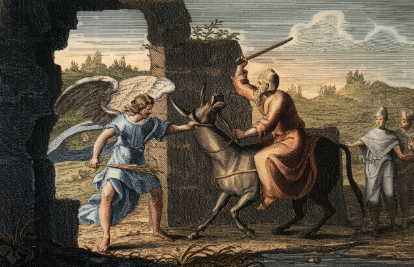
After the Israelites had terrified the Moabites, Balak, King of Moab, had sought help from Balaam hoping to gives Balak any mean to curse and destroy Israel before Israel took their land and destroy them instead. For more, see Numbers 22
Politics makes strange bedfellows, so although natural enemies, Moab and Midian banded together and appointed a Midianite, Balak son of Zippor, as king over them.
All methods of cursings fails, but perhaps one may succeed as the story continues in Numbers 24:
1 And when Balaam saw that it pleased the Lord to bless Israel, he went not, as at other times, to seek out enchantments, but he set his face toward the wilderness.
2 And Balaam lifted up his eyes, and he saw Israel abiding in his tents according to their tribes; and the Spirit of God came upon him. — Balak recognized that the power of the Israelites was supernatural, so he sought a way of undermining them supernaturally.
3 And he took up his parable and said: “Balaam the son of Beor hath said, and the man whose eyes are open hath said,
4 he hath said, who heard the words of God, who saw the vision of the Almighty, falling into a trance, but having his eyes open:
5 How goodly are thy tents, O Jacob, and thy tabernacles, O Israel!
6 As the valleys are they spread forth, as gardens by the river’s side, as the trees of lignaloes which the Lord hath planted, and as cedar trees beside the waters.
7 He shall pour the water out of his buckets, and his seed shall be in many waters; and his king shall be higher than Agag, and his kingdom shall be exalted.
8 God brought him forth out of Egypt; he hath, as it were, the strength of a unicorn. He shall eat up the nations his enemies, and shall break their bones and pierce them through with his arrows.
9 He couched, he lay down as a lion. And as a great lion, who shall stir him up? Blessed is he that blesseth thee, and cursed is he that curseth thee.”
10 And Balak’s anger was kindled against Balaam, and he smote his hands together; and Balak said unto Balaam, “I called thee to curse mine enemies, and behold, thou hast altogether blessed them these three times.
11 Therefore now flee thou to thy place. I thought to promote thee unto great honor, but lo, the Lord hath kept thee back from honor.”
12 And Balaam said unto Balak, “Spoke I not also to thy messengers whom thou sentest unto me, saying,
13 ‘If Balak would give me his house full of silver and gold, I cannot go beyond the commandment of the Lord to do either good or bad of mine own mind; but what the Lord saith, that will I speak’?
14 And now, behold, I go unto my people. Come therefore, and I will warn thee what this people shall do to thy people in the latter days.” Numbers 24:1-14
— the Targum has more explicit details how the Israelites could be subdued as Balaam gives Balak a prophetic strategy before walking away:
“And now, behold, I [Balaam] return to go to my people. Come, I will give thee [Balak] counsel: Go, furnish tavern houses, and employ seductive women to sell food and drinks cheaply, and to bring this people together to eat and drink, and commit whoredom with them, that they may deny their God;
“then in a brief time will they [the Israelites] be delivered into thy hand, and many of them will fall. Nevertheless, after this they [the Israelites] will still have dominion over thy people [the Moabites] at the end of days.” Numbers 24:14 Jonathan.
Did Balak ever form any sort of alliance with the Edomites?
In the canonical account of the Hebrew Bible, no—Balak never established a direct political or military alliance with them. However, an encrypted reference might suggest otherwise, as the phrase “and his king shall be higher than Agag” (verse 7 above) could imply a connection with the Edomite king.
When facing the perceived threat of the advancing Israelite camp, the text explicitly states that Balak and the Moabites turned to and formed an alliance with the elders of Midian (Numbers 22:4-6), and possibly with Edom’s Agag.
However, when you broaden the scope to include Targumic interpretations, broader biblical literature, and Midrashic traditions, the dynamic shifts dramatically. In these contexts, Balak and the Edomites are bound tightly together through prophetic destiny, covert military operations, and shared lineages.
1. The Covert Military Ambush (Targum Pseudo-Jonathan)
As explored in Targum Pseudo-Jonathan on Numbers 21:14, ancient Aramaic traditions reveal that while there wasn’t an official diplomatic treaty signed by Balak, a secret military coalition did exist between their peoples.
According to this Targum, the armies of Edom and Moab hid themselves inside secret caves on opposing mountain cliffs flanking a narrow valley. Their plan was to launch a devastating, joint surprise ambush to completely destroy the House of Israel as they marched through the pass. While Balak is not mentioned by name in that specific military deployment, it illustrates that in the Targumic view, the forces of Moab and Edom operated in close tactical alignment during this exact timeline.
2. The Prophetic Alignment (Balaam’s Oracle)
While Balak sought an immediate alliance to curse Israel, the oracle he bought from Balaam actually linked the ultimate fates of Moab and Edom forever. In Numbers 24:17–18, Balaam looks into the future and prophesies a singular conqueror:
“There shall come a Star out of Jacob, and a Scepter shall rise out of Israel, and shall smite the corners of Moab and destroy all the children of Sheth.
“And Edom shall be a possession; Seir also shall be a possession for his enemies, and Israel shall do valiantly” Numbers 24:17–18
Through this prophecy, Balak learns that regardless of whether they stood together in his day, Moab and Edom represented a paired geopolitical destiny—both destined to fall under the future dominion of Israel’s monarchy. They were being warned “A star shall come out of Jacob, and a scepter shall rise out of Israel; it shall crush the forehead of Moab; Edom shall be dispossessed.”
3. The Liturgical Coalition (Psalm 83)
If we look at how later biblical literature conceptualizes the historical anxiety of Balak, the poetic and liturgical traditions do place them in a grand alliance. Psalm 83 details a massive, multi-nation conspiracy specifically designed to cut off Israel from being a nation. The text explicitly groups them together:
“For they conspire with one accord; against you they make a covenant—the tents of Edom and the Ishmaelites, Moab and the Hagrites…” (Psalm 83:5-6)
— in summary, the ancient tribes and countries mentioned in Psalm 83 are:
of Edom and the Ishmaelites, of Moab and the Hagarites (verse 6); Gebal and Ammon and Amalek, the Philistines with the inhabitants of Tyre (verse 7); Assyria also has joined with them; they have helped the children of Lot (verse 8); the Midianites, as to Sisera, as to Jabin at the Brook of Kishon (verse 9); their nobles like Oreb and like Zeeb, yea, all their princes as Zebah and as Zalmunna (verse 11);
While this Psalm reflects a broader, cumulative spiritual reality of Israel’s neighbors plotting their downfall, it honors the spirit of what Balak initiated: a collective regional effort to dismantle the covenant people.
4. The Hidden Ancestral Irony: Laban, Esau, and Jacob
The deepest, most fascinating connection comes when you look at the Targumic identification of Balaam as Laban the Aramean (Targum Pseudo-Jonathan on Numbers 22:5).
- Balak hires Balaam (Laban, or was one of his posterity of the same name) to destroy Israel (Jacob).
- Laban is the grandfather of Jacob, but he is also closely tied to the ancestral lineage of Esau (Edom); because Laban is the maternal uncle (Laban‘s sister is Rebekah) to both Jacob and Esau.
By bringing Laban into the picture, the Targum highlights a bitter family dynamic: Balak is tapping into an ancient, foundational family grudge. The spiritual animosity fueling Balak’s camp is the exact same spiritual animosity that defined the fracture between Esau (Edom) and Jacob. Thus, even without a formal treaty signed on parchment, Balak’s campaign against Israel was fundamentally an alliance with the spirit of Edom.
These days, many Americans and Canadians head to Mexico and other Latin countries for luxurious hotels and resorts, indulging in a lavish lifestyle, in regions home to Edomean heritage. Similarly, Western Europeans often take vacation in northern Africa, especially in Tunisia, Algeria and Morocco, areas historically linked to Ishmaelite heritage.
Some Mexican cities have enacted “tolerance zones” (“zonas de tolerancia”) which allow regulated prostitution and function as red-light districts. In Tuxtla Gutiérrez, capital of the state of Chiapas, there is a state-run brothel at the Zona Galáctica (Galactic Zone). In most parts of the country, pimping is illegal, although pimp-worker relationships still occur, sometimes under female pimps called “madrotas”(“Big Mothers”). The government provides shelter for former prostitutes.
This Balaam‘s prophecy of making the children of Israel sinned by indulging in a lavish lifestyle and breaking God’s laws tie in nicely with an earlier of Isaac’s blessing uopn Esau:
“And upon thy sword shalt thou depend, entering at every place: yet thou shalt be supple and credulous, and be in subjection to thy brother; but it will be that when his sons become evil, and fall from keeping the commandments of the law, thou shalt break his yoke of servitude from off thy neck” Genesis 27:40 Jonathan.
“And Esau harbored hatred in his heart against Jacob, his brother, because of the blessing with which his father had blessed him.
“And Esau said in his heart, ‘I will not do as Cain did, who killed Abel during their father’s lifetime and then their father had another son, Seth.
“Rather, I will wait until the days of mourning for my father have passed, and then I will kill Jacob my brother, and I will be the killer and sole heir’” Genesis 27:41 Jonathan.

~~~~ The End ~~~~


