
An autopsy of American empire

AsiaTimes • June 16, 2026
While Washington’s war with Iran drags on, month after month, without any end in sight, the world is witnessing the very real limits of US global power. As President Donald Trump lurches repeatedly from threats of devastation to promises of peace, it’s becoming increasingly clear that US military might is no longer capable of subduing even a mid-sized power like Iran, much less holding the rest of the world in its thrall.
Amid all the drama of air raids, drone strikes, and naval blockades, there are deeper geopolitical forces at play that lend a lasting historical import to events in the Persian Gulf—dynamics best seen by comparing two newspaper editorials with revealing similarities despite the 80 years separating their publication.
Writing in 1942, during some of Britain’s darkest days in World War II, the editors of the venerable London Times looked far beyond the relentless German attacks on their forces in Egypt or the Nazi U-Boat sinkings of Royal Navy ships in the Atlantic to predict their empire’s future with an uncommon prescience.
With its contradictory motto of “Imperium et Libertas” (Empire and Liberty), the vast British Empire, which still covered a quarter of the globe, had already become what those editors called “a self-liquidating concern.”
Once the “temporary circumstances” that had allowed Britain’s ascent — naval dominance, industrial preeminence, and “the relative weakness of rival states” — faded, that empire’s “ultimate reliance on coercion” could no longer hold.
Ready for self-governance, Britain’s many colonies, the editors suggested, would soon begin breaking away and so eclipse the empire. And that prediction couldn’t have been more accurate. Within five years of that editorial’s publication, the British Empire had already started to break apart.
Writing in a May 2026 edition of The New York Times, contributing editor Christopher Caldwell made a strikingly similar prediction about the future of US global hegemony. Under the provocative headline “America Is Officially an Empire in Decline,” Caldwell noted some unsettling parallels between the fate of America today and Great Britain 80 years ago.
Back then, England was “deindustrializing, overcommitted, complacent,” and found itself “essentially bankrupt” by the end of World War II. Apart from its “ill-fated attempt” to seize the Suez Canal from Egypt in 1956, however, it managed to decolonize in a successful fashion by giving up “territories it could no longer afford.” As he points out, Britain even “wound up on reasonably good terms with its former colonial possessions.”
At the start of his second term as president in 2025, Donald Trump, Caldwell continued, “had a chance of pulling off something similar” by withdrawing “to a less expansive sphere of influence” and “refocusing American attention on the Western Hemisphere.” Caldwell considered that strategy potentially “workable” since “imperial systems, whatever you call them, last only as long as their means are adequate to their ends.”
Instead of keeping to that plan, however, Trump “has overextended the empire dangerously” by his intervention in Iran, which has now become nothing less than a “watershed in the decline of the American empire.”
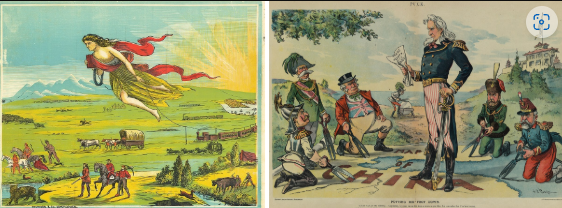
As The New York Times editorial board put it after Donald Trump’s recent Beijing summit with Chinese leader Xi Jinping (where the US president showed a “worrisome lack of interest” in Taiwan), “America’s inability to defeat Iran’s much smaller military has raised questions about whether it could help defend Taiwan from a mainland invasion.”
If China ultimately takes that island, the US defensive perimeter in the Pacific would be pushed back from the “first island chain” (Japan-Taiwan-the Philippines) to the “second island chain” (Japan-Guam)—inflicting a major geopolitical blow on the US by crippling its capacity to aid its Asian allies.
More broadly, the Trump administration’s plans, as stated in its recent National Security Strategy, for “a readjustment of our global military presence” by shifting forces into the Western Hemisphere would be tantamount, if fully implemented, to a unilateral surrender in what foreign policy experts have come to call “the new Cold War” with Beijing and Moscow.
As the rest of the world enjoyed a rapid economic recovery from the ravages of World War II, America’s share of the global economy declined from an overwhelmingly dominant 50% in 1945 to less than half that figure today.
Using an index called PPP (Purchasing Power Parity) that measures the real value of economic growth, the IMF calculates that, in 2026, China is producing 20% of global economic output, the US just 15%, and the European Union (EU) 14%.
But the relative economic decline of the United States should by no means be the crucial measure of its failure. Quite the opposite, in fact. It should be considered a tribute to Washington’s success in leading the world economy to unprecedented prosperity. In those 80 years since the end of World War II, the US economy has grown fast, but many other nations have grown faster still.
The consequences of America’s decline
Yes, the world of a Pax Americana in the previous century (though imperial America never could fully avoid wars) is gone. And a world without active US international leadership will not necessarily be a better place.
Without a single superpower or set of superpowers to backstop otherwise toothless resolutions from the United Nations, international relations in a post-American world order will likely be both more complex and possibly more conflict-ridden as well.
In the new multipolar world likely to emerge in the next decade (if not sooner), even major countries like the United States and China will undoubtedly find themselves exercising their asymmetric power ever closer to home.
While some global areas will suffer from localized rivalries—Beijing versus Tokyo in East Asia, Ankara versus Cairo and Riyadh in the Middle East—regional associations like ASEAN, Mercosur, and the European Union are likely to play an increasingly important role in forging diplomatic consensus and mediating local conflicts.
Instead of the bipolar rivalry of the old Cold War era or American-led interventions in places like Afghanistan, Panama, or Kuwait during the more recent decades of its unipolar power, in the future regional rivals will likely wage bitter local wars in hot spots around the globe over boundaries, the control of minerals, water rights, or climate-change refugees.
To take but one example, Ethiopia, an arid, landlocked, overcrowded nation of 140 million people in East Africa, faces potential conflicts with Egypt over the Nile’s headwaters, with Eritrea over port access, and with Somalia over the fate of the breakaway state of Somaliland.
Though their scope might be narrow, regional wars can potentially cause massive human carnage, as shown by the Second Congo War (1998-2003) that ravaged eastern Congo, as neighboring states like Rwanda and warlord armies like the murderous M-23 militia battled over mineral rights, killing an estimated 5.4 million people.
And lastly, there are fives articles in a series on the identities of Ephraim and Manasseh, (1) The Irony of a Birthright (2) Ephraim preferred over Manasseh (3) Ephraim as the Thirteenth Tribe (4) Who is this lying Ephraim? (5) The Ox with horns of a Unicorn


