
Joshua (3-4)

Joshua 3
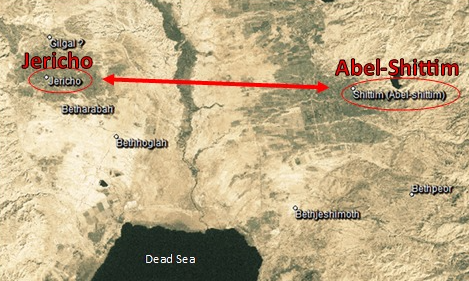
1 And Joshua rose early in the morning; and they removed from Shittim and came to the Jordan, he and all the children of Israel, and lodged there before they passed over.
— after the spies returned and three days mentioned earlier, the march from Shittim to Jordan is their first march under Joshua.
2 And it came to pass after three days that the officers went through the host,
— the officers went through the host the second time to give them more particular directions, as they had given them a general direction,
3 and they commanded the people, saying, “When ye see the ark of the covenant of the Lord your God and the priests the Levites bearing it, then ye shall remove from your place and go after it.
— the priests the Levites bearing it: because the priests, who were also Levites, were to carry it; this journey differs from other journeys, for whereas in the days of Moses, the pillar of cloud would lead the way, the Ark following in the very middle of the camp after two divisions, now the Ark would travel ahead.
4 Yet there shall be a space between you and it, about two thousand cubits by measure. Come not near unto it, that ye may know the way by which ye must go, for ye have not passed this way heretofore.”
— a space between the ark and the people that followed it; the distance which the people were to keep in the rear of the ark three-quarters of a mile or thereabouts.
5 And Joshua said unto the people, “Sanctify yourselves, for tomorrow the Lord will do wonders among you.”
— sanctify yourselves; not only wash your clothes, and shun all kinds of bodily impurities, but purify your minds and hearts, by repentance, without which the external purifications of your bodies and garments will be of little effect.
6 And Joshua spoke unto the priests, saying, “Take up the ark of the covenant, and pass over before the people.” And they took up the ark of the covenant, and went before the people.
— Joshua spoke unto the priests; this order to the priests must be considered as announced in the name and by the authority of God; take up the ark, upon their shoulders.
7 And the Lord said unto Joshua, “This day will I begin to magnify thee in the sight of all Israel, that they may know that as I was with Moses, so I will be with thee.
— this day will I begin to magnify thee; that is, to honour thee in a peculiar manner, and gain thee authority; in the sight of all Israel.
8 And thou shalt command the priests who bear the ark of the covenant, saying, ‘When ye have come to the brink of the water of the Jordan, ye shall stand still in the Jordan.’”
— ye shall stand still to the brink of the water of Jordan; into the middle of the river, where they were ordered to stop and stand still…
9 And Joshua said unto the children of Israel, “Come hither, and hear the words of the Lord your God.”
— the waters of Jordan shall be cut off; this must be done in such a way as never was done, as was the dividing of the Red sea.
10 And Joshua said, “Hereby ye shall know that the living God is among you, and that He will without fail drive out from before you the Canaanites and the Hittites and the Hivites and the Perizzites and the Girgashites and the Amorites and the Jebusites.
— by the following miracle of dividing the waters of Jordan, it would be a plain case that the Lord was again among them, to protect and defend them, deliver and drive their enemies away.
11 Behold, the ark of the covenant of the Lord of all the earth passeth over before you into the Jordan.
— the ark of the covenant, which is the covenant of the Lord of all the earth; and, by the power of God whose presence was with it, the waters of Jordan were to be divided, to give them a passage through it as on dry land, and so it came to pass.
12 Now therefore, take for yourselves twelve men out of the tribes of Israel, out of every tribe a man.
— take ye twelve men, to be taken out of the tribes of Israel, out of every tribe a man.
13 And it shall come to pass, as soon as the soles of the feet of the priests who bear the ark of the Lord, the Lord of all the earth, shall rest in the waters of the Jordan, that the waters of the Jordan shall be cut off from the waters that come down from above; and they shall stand up in a heap.”
— the soles of the feet of the priests; as soon as their feet rested in the overflow, that is, at the edge, Jordan was driven back.
14 And it came to pass, when the people removed from their tents to pass over the Jordan, and the priests bearing the ark of the covenant before the people,
— here the priests, perhaps with the Levites closeby, moves first and ahead with the ark of the covenant;
— according to Numbers 2:3 Judah; this tribe was in the first post, and in their marches led the van, not only because it was the most numerous, but they have the sceptre; the Lion of the tribe of Judah; then those of the South (Camp of Reuben); then the West (Camp of Ephraim); the Rear Guard: then the North (Camp of Dan);
— one of a series of JUDAH FIRST (1) Movement of the Camp, Numbers 2:3; (2) Judah’s First Day to present Offering, Numbers 7:12; (3) but Judah wasn’t the first to cross the Jordan River as claimed in Jewish Malbim writing? It would be possible only after the men of Reuben, Gad and the half-tribe of Manasseh crossed first, ready to fight;

15 and as those who bore the ark had come unto the Jordan, and the feet of the priests who bore the ark were dipped in the brim of the water (for the Jordan overfloweth all his banks all the time of harvest),
— but when the Israelites crossed the Jordan, it was the men of Reuben, Gad and the half-tribe of Manasseh that crossed next after those with the Ark, ready for battle, in front of the other Israelites, as Moses had directed them. About 40,000 armed troops crossed over before the Lord into the plains of Jericho for battle, Joshua 4:12–13
— Moses had earlier conditioned their inheritance on a solemn pledge: their fighting force had to cross the Jordan at the head of the Israelite army and assist the remaining nine-and-a-half tribes in conquering the land of Canaan before returning to their families.
16 that the waters which came down from above stood and rose up in a heap very far from the city Adam, that is beside Zaretan. And those who came down toward the sea of the plain, even the Salt Sea, failed and were cut off; and the people passed over right against Jericho.
17 And the priests who bore the ark of the covenant of the Lord stood firm on dry ground in the midst of the Jordan, and all the Israelites passed over on dry ground, until all the people had passed clean over the Jordan.
— General Marching Order: in the standard wilderness camp formation (Numbers 10), the Tribe of Judah held the premier position at the front of the Eastern division and normally led the march when the entire nation moved. However, for the specific crossing of the Jordan recorded in Joshua 4, the vanguard of Reuben, Gad, and half-Manasseh went first to secure the way for the remaining tribes.

Joshua 4
1 And it came to pass, when all the people had clean passed over the Jordan, that the Lord spoke unto Joshua, saying,
2 “Take you twelve men out of the people, out of every tribe a man,
— the Lord spoke unto Joshua, Take you twelve men; each representing a tribe;
3 and command ye them, saying, ‘Take you hence out of the midst of the Jordan, from the place where the priests’ feet stood firm, twelve stones; and ye shall carry them over with you and leave them in the lodging place where ye shall lodge this night.’”
— twelve stones; each man a stone; and, according to some claim, each man inscribed his name or his tribe’s name on the stone.
4 Then Joshua called the twelve men, whom he had prepared of the children of Israel, out of every tribe a man.
5 And Joshua said unto them, “Pass over before the ark of the Lord your God into the midst of the Jordan, and take ye up every man of you a stone upon his shoulder, according unto the number of the tribes of the children of Israel,
— they pass over before the ark and deposit the stones in the place of next encampment (Joshua 4:19-20), namely, Gilgal;
6 that this may be a sign among you, that when your children ask their fathers in time to come, saying, ‘What mean ye by these stones?’
— a sign among you; a monument or memorial of a design to perpetuate a miracle directed by divine inspiration, a work of the Lord worthy of rememberance;
7 then ye shall answer them that the waters of the Jordan were cut off before the ark of the covenant of the Lord: when it passed over the Jordan, the waters of the Jordan were cut off. And these stones shall be for a memorial unto the children of Israel for ever.”
— this was done before and in the presence of the ark of the covenant, to show that is was owing to the power of God, of whose presence the ark was a symbol. But where are these stones today? Could some excavation in or around Gilgal someday unexpectedly expose them to the world?
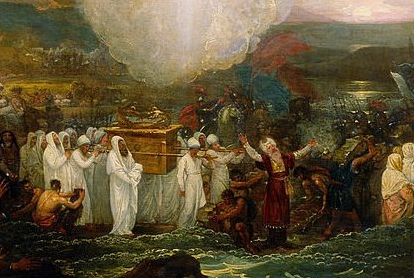
8 And the children of Israel did so as Joshua commanded, and took up twelve stones out of the midst of the Jordan, as the Lord spoke unto Joshua, according to the number of the tribes of the children of Israel, and carried them over with them unto the place where they lodged, and laid them down there.
— the setting up at Gilgal is mentioned for the first time in Joshua 4:20; in addition to this, Joshua set up twelve stones for a memorial, on the spot where the feet of the priests had stood as they bore the ark of the covenant.
9 And Joshua set up twelve stones in the midst of the Jordan in the place where the feet of the priests who bore the ark of the covenant stood; and they are there unto this day.
— Joshua set up twelve stones; in the place where the feet of the priests stood; this in addition to the memorial just described, there was another memento of the miraculous event, a duplicate of the former, set up in the river itself, on the very spot where the ark had rested; which stones were there “to this day,” that is, the time when the account was written.
10 For the priests who bore the ark stood in the midst of the Jordan until everything was finished that the Lord commanded Joshua to speak unto the people, according to all that Moses commanded Joshua; and the people hastened and passed over.
— the priests which bare the ark stood; their patient attitude, standing still and motionless, was a character which the carriers must possess, was eminently calculated to impart courage to the people. Tat is, the priests bearing the ark of God, the visible symbol of his presence, stood solemnly still unshakened at the brink of the river, nor did they stir until every one of that mighty host had passed over.
11 And it came to pass, when all the people had clean passed over, that the ark of the Lord passed over, and the priests, in the presence of the people.
— the ark is mentioned as the first to move, it was the last to leave; its movements drawed deep attention of the people, who probably stood on the opposite bank, wrapt in admiration and awe of this closing scene. It was a great miracle, perhaps greater even than the passage of the Red Sea in this respect.
12 And the children of Reuben and the children of Gad and half the tribe of Manasseh passed over armed before the children of Israel, as Moses spoke unto them.
— there is no reason to suppose that the usual order of march was departed from; but these are honorably mentioned to show that, in pursuance of their promise mentioned earlier, they had sent a complement of fighting men to accompany their brethren in the war of invasion.
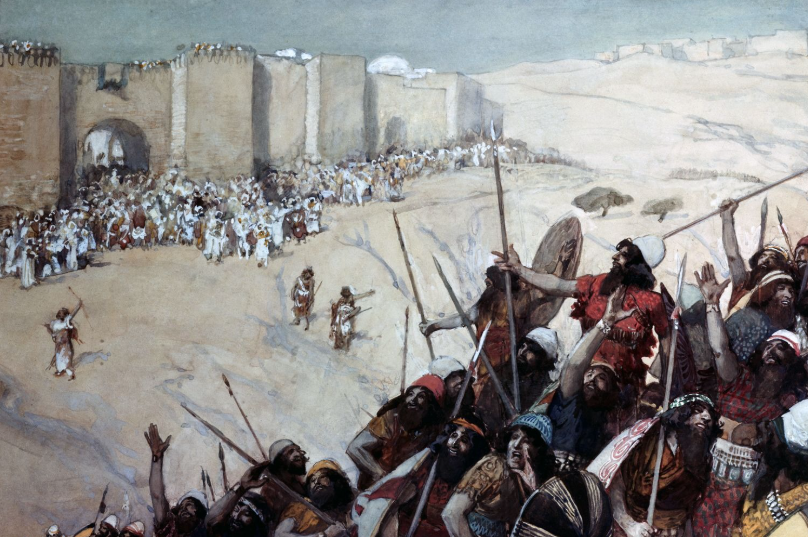
13 About forty thousand prepared for war passed over before the Lord unto battle to the plains of Jericho.
— about forty thousand prepared for war; it is likely that Joshua drew out this number only of chosen men; and left all the rest to take care of their families and flocks.
14 On that day the Lord magnified Joshua in the sight of all Israel; and they feared him, as they feared Moses, all the days of his life.
— on that day the Lord magnified Joshua; as he was the divinely appointed leader; for even the priests did not enter the river or quit their position, except at his command.
15 And the Lord spoke unto Joshua, saying,
16 “Command the priests who bear the ark of the Testimony that they come up out of the Jordan.”
— the Lord magnified Joshua in the sight of all Israel, as he was God’s appointed leader; for even the priests did not left their post except at his command.
17 Joshua therefore commanded the priests, saying, “Come ye up out of the Jordan.”
— therefore, in obedience to the Lord, Joshua commanded the priests, “come ye up out of Jordan.”
18 And it came to pass, when the priests who bore the ark of the covenant of the Lord had come up out of the midst of the Jordan, and the soles of the priests’ feet were lifted up unto the dry land, that the waters of the Jordan returned unto their place and flowed over all his banks, as they did before.
— the waters of Jordan had stood on a heap while the ark was in the river, but came tumbling down when the ark was removed.
19 And the people came up out of the Jordan on the tenth day of the first month and encamped in Gilgal on the east border of Jericho.
— on the tenth day of the first month, Nisan, short of five days of forty years from the time of their coming out of Egypt, which was on the fifteenth day of this month. So punctual is God in the performing according to his schedule.
20 And those twelve stones which they took out of the Jordan did Joshua set up in Gilgal. — it would appear that, besides explaining the erection of the stones to their children, the Israelites were also to explain the meaning of Gilgal, the place where the stones were.
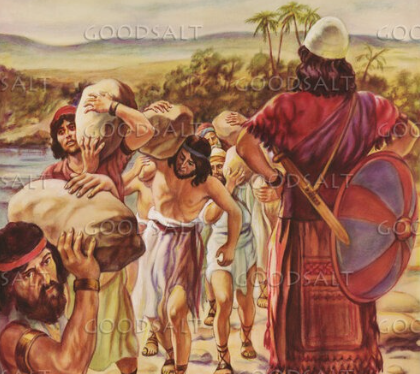
21 And he spoke unto the children of Israel, saying, “When your children shall ask their fathers in time to come, saying, ‘What mean these stones?’
— there, at Gilgal, the Israelites were circumcised; there they celebrated the passover for the first time in the land of Canaan; and there the tabernacle was erected and fixed, till, Canaan being subdued, they placed it in Shiloh.
22 then ye shall let your children know, saying, ‘Israel came over this Jordan on dry land.’
— it is their essential duty to ensure their children become familiar with the historical paths their forefathers once tread.
23 For the Lord your God dried up the waters of the Jordan from before you until ye had passed over, as the Lord your God did to the Red Sea, which He dried up from before us until we had gone over,
— that they may be trained up in the way they should go; in all the instruction parents should teach them to fear God and obey his voice.
24 that all the people of the earth might know the hand of the Lord, that it is mighty, that ye might fear the Lord your God for ever.”
— Joshua set up the twelve stones, which they could explain to the people at the same time the importance of this memorial to their descendants; that they might fear the Lord their God forever.


