
God the Father and God the Son
Who is the God of the Old Testament? And who is his Son?
To put it another way, Who is Yehovah? Or who is the YHVH, יְהוָֽה who identified himself to Abraham, Isaac and Jacob in the Old Testament?
But some say he is the Son who spoke to Moses as the “I AM” in the burning bush (Exodus 3:14); and that He reappeared as the same “I AM” in John 18:5-6.
They also pointed out that “No man hath seen God at any time; . . . and Ye have neither heard His voice at any time, nor seen His shape,” John 1:18; 5:37.
This Study establishes a number of points to explore the very Beginning:
(1) “I brought forth” — Proverbs 8
22 “The Lord possessed (qanah H7069, could be translated as “created”) me at the beginning of His way, before His works of old. — the whole phase could be translated as, “The LORD created me as the first of his creation, before any of his works.”
Others translate the critical phase as “I was brought forth” “I was born” “I was conceived” “I was begotten“ “I was given birth.”
23 I (God the Son) was set up from everlasting, from the beginning, or ever the earth was.
24 When there were no depths I (God the Son) was brought forth, when there were no fountains abounding with water.
25 Before the mountains were settled, before the hills was I brought forth,
26 while as yet He had not made the earth, nor the fields, nor the first parts of dust of the world.
27 When He (God the Father) prepared the heavens, I (God the Son) was there; when He set a compass upon the face of the deep,
28 when He established the clouds above, when He strengthened the fountains of the deep,
29 when He gave to the sea His decree that the waters should not pass His commandment, when He appointed the foundations of the earth”
30 then I was by Him (God the Father), as one brought up with Him, and I (God the Son) was daily His delight, rejoicing always before Him,
31 rejoicing in the habitable part of His earth; and my delights were with the sons of men. Proverbs 8:22-31
The phrase “I was brought forth” feels similar to how Eve was brought forth from Adam’s rib. This suggests the Son wasn’t created in the same way Adam was, who was formed from the dust of the earth.
Further, it implies the Son came forth from the Spirit or essence of the Father, rather than from something else or from nothing.
The Message Bible says:
“God (God the Father) sovereignly made me (God the Son)—the first, the basic—
before he did anything else.
I (God the Son) was brought into being a long time ago,
well before Earth got its start.
I arrived on the scene before Ocean,
yes, even before Springs and Rivers and Lakes.
Before Mountains were sculpted and Hills took shape,
I was already there, newborn;
Long before God stretched out Earth’s Horizons,
and tended to the minute details of Soil and Weather,
And set Sky firmly in place,
I was there.When he mapped and gave borders to wild Ocean,
built the vast vault of Heaven,
and installed the fountains that fed Ocean,
When he drew a boundary for Sea,
posted a sign that said no trespassing,
And then staked out Earth’s Foundations,
I was right there with him, making sure everything fit.
Day after day I was there, with my joyful applause,
always enjoying his company,
Delighted with the world of things and creatures,
happily celebrating the human family. Proverbs 8:22-31 MSG
After the Son was brought forth, He joined His Father in creating everything else—the earth, the oceans, the seas, and every other thing. That is, the Scripture comes before Genesis 1:1, “In the beginning . . .”
This is the same Beginning as John 1:1 “In the Beginning was the Word . . .” and revealing more details how the Word came into being.
Perhaps this tie in with Colossians 1:15, “He is the image of the invisible God, the firstborn of every creature.” Some translations translated the last part as “the firstborn of all creation.”
When these Scriptures are read with this understanding, all other difficult Scriptures fall into place.
(2) Proverb 30:4. God was posing a challenge, asking what His name is and who His Son is.
Who hath ascended up into heaven or hath descended? Who hath gathered the wind in His fists? Who hath bound the waters in a garment? Who hath established all the ends of the earth? What is His name, and what is His Son’s name, if thou canst tell? Proverb 30:4.
The Speaker’s name is YHVH (Yehovah יְהוָֽה) ) and this is written as if his Son is already in existence, although we are not told what his Son’s name is, beside being a name derived from his Father as considered in Exodus 23:20-21. Verse 21 didn’t say “What shall his name be, if thou canst tell?”
Q. What would the Orthodox (one who couldn’t acknowledged Yeshua as the Son) say about this verse? About “What shall his name be?”
(3) Elohim [Strong’s H430 – ‘ĕlōhîm]: the word God (Elohim) as used in Hebrew, which is in the plural (im), and when Jesus was challenged, he replied; “I and my father are one,” John 10:30. This suggests that Elohim consists of God the Father and God the Son, the two Beings who embody the essence of God.
Yet God the Son is the Son, not on equal level as God the Father:
“Let this mind be in you, which was also in Christ Jesus, who, being in the form of God, thought it not robbery to be equal with God.” Philippians 2:5-6
“Let Christ himself be your example as to what your attitude should be. For he, who had always been God by nature, did not cling to his prerogatives as God’s equal, but stripped himself of all privilege by consenting to be a slave by nature and being born as mortal man.
“And, having become man, he humbled himself by living a life of utter obedience, even to the extent of dying, and the death he died was the death of a common criminal.
“That is why God has now lifted him so high, and has given him the name beyond all names, so that at the name of Jesus “every knee shall bow,” whether in Heaven or earth or under the earth.
“And that is why, in the end, “every tongue shall confess” that Jesus Christ” is the Lord, to the glory of God the Father.” Philippians 2:5-11
(4) The name Yehovah יְהוָֽה: first used in Genesis 2:4, “These are the generations of the heavens and of the earth when they were created, in the day that the LORD H3068 God made the earth and the heavens.”
But our study stems from a different revelation, when God was speaking to Moses and, secondarily, to the children of Israel:
“Behold, I send an angel (messenger) before thee to keep thee in the way, and to bring thee into the place which I have prepared.
“Have regard for him, and obey his voice. Provoke him not, for he will not pardon your transgressions, for My name is in him.” Exodus 23:20-21
“For My name is in him,” that name couldn’t be other than Yehovah יְהוָֽה. Here the Father was speaking; and as the “him” above is singular, this could only be the Son. And both are a component of Elohim; and both are worthy of worship.
“Behold, I (Father) send an Angel/Messenger (Yeshua, Jesus or the Son) before you to keep you in the way and to bring you into the place which I have prepared.
21 “Beware of Him (Yeshua) and obey His voice; do not provoke Him (Yeshua), for He will not pardon your transgressions; for My name (Yehovah יְהוָֽה) is in Him (hence YHVH’s name is also in the Son”). Exodus 23:20-21
Thus in some cases, the name Yehovah יְהוָֽה is also found in the Son, but it is in a derivitive form, that is from Father to Son, as in Genesis 18-19. And this is also why Jesus addressed the Father in his prayer as “the only true God,” John 17:3.
(5) The Father: the concept of the Father was already established during the Exodus as the God of the OT spoke to Moses in Deuteronomy 32:
“Do ye thus requite the Lord, O foolish people and unwise? Is not He thy Father that hath bought thee? Hath He not made thee and established thee? Deuteronomy 32:6
— thus it could be established that the God speaking to Moses all these forty years, is the Father;
— is not he thy Father, that hath bought thee from the Egyptians? This establishes that the God of the Old Testament is not just the Father, but that He is also the Rock:
“He (the God of the OT) is the Rock, His work is perfect; for all His ways are judgment, a God of truth and without iniquity; just and right is He” Deuteronomy 32:4
— from the above, it is established God the Father is also the Rock, his work is perfect; or rather, the Rock, perfect is his work;
Obviously, this clearly tie the God of the OT as the Father in Hebrew 1:1-3
“God (the Father), who at sundry times and in divers manners spoke in times past unto the fathers by the prophets (including Moses? if not, why not?),
2 hath in these last days spoken unto us by His Son, whom He hath appointed Heir of all things, by whom also He made the worlds,
3 who being the brightness of His glory and the express image of His person, upholding all things by the word of His power, when He had by Himself purged our sins, sat down at the right hand of the Majesty on high,” Hebrews 1:1-3
(6) Psalm 2:1 Why do the heathen rage, and the people devise a vain thing?
2 The kings of the earth set themselves, and the rulers take counsel together, against the LORD (YHVH יְהוָֽה) and against his anointed (Yeshua), saying, — notice two Beings above, a. the LORD; and b. His Annointed;
3 Let us break their bands asunder, and cast away their cords from us.
4 He that sitteth in the heavens shall laugh: the LORD (יְהוָֽה; one of the 134 changes) shall have them in derision.
5 Then shall he speak unto them in his wrath, and vex them in his sore displeasure.
6 Yet have I set my king upon my holy hill of Zion.
7 I will declare the decree: the LORD (יְהוָֽה) hath said unto Me, Thou art my Son (Yeshua); this day have I begotten thee. Psalm 2:1-7 — YHVH (Father) speaking to Yeshua (Son) in the present tense, hence both were in existence at that OT time.
And in the New Testament
For unto which of the angels said God at any time, “Thou art My Son; this day have I begotten Thee”? And again, “I will be to Him a Father, and He shall be to Me a Son”? Hebrews 1:5
Q. What would the Orthodox (one who couldn’t acknowledged Yeshua as the Son) say about this verse? About “Thou art my Son?”
(7) Psalm 110; the LORD (YHVH יְהוָֽה the Father) said unto my Lord (that is, David’s Lord, the Messiah. Compare Matthew 22:41-46).
1 Sit thou at my right hand, until I make thine enemies thy footstool.
2 The LORD (יְהוָֽה) shall send the rod of thy strength out of Zion: rule thou in the midst of thine enemies.
3 Thy people shall be willing in the day of thy power, in the beauties of holiness from the womb of the morning: thou hast the dew of thy youth.
4 The LORD (יְהוָֽה) hath sworn, and will not repent, Thou art a priest forever after the order of Melchizedek.
5 The LORD (יְהוָֽה; one of the 134 changes made by the Sopherim to Adonai) at thy right hand shall strike through kings in the day of his wrath.
— notice that the second Lord sitting on the right hand of the Father in verse 2 has become LORD in verse 5. By doing so, the Soferim blurred the evidence of another YHVH (by making one of the 134 changes); although it is in a derived form from Exodus 23:20-21.
6 He shall judge among the heathen, he shall fill the places with the dead bodies; he shall wound the heads over many countries.
7 He shall drink of the brook in the way: therefore shall he lift up the head.
— the above indicates that the Father was referring to his Son also as Lord יְהוָֽה, the second Being in the Godhead; he’s actually the anointed Son in Psalm 2:2.
(8) Daniel 7:13 “I saw in the night visions, and, behold, one like the Son of man came with the clouds of heaven, and came to the Ancient of Days, and they brought him near before him.”
— from the above, it could be established that the Ancient of Days is a title attributable to the Father, YHVH; and the Son of man came to the Father; their relationship already established in the OT times, as none of which were written in future tenses.

(9) Zechariah 2: instances of both YHVH יְהוָֽה together (both are YHVH יְהוָֽה; but below here LORD is identified as the Father; and Lord as Son and narrator) — the Son speaking to Zechariah regarding Zion, or Jerusalem, the apple of his eye;
5 For I (Son),’ saith the Lord (יְהוָֽה Son as narrator), ‘will be unto her a wall of fire round about, and will be the glory in the midst of her.’”
6 “Up! Up! Come forth, and flee from the land of the north,” saith the Lord (יְהוָֽה Son); “for I (Son) have spread you abroad as the four winds of the heaven,” saith the Lord (Son).
7 “Deliver thyself, O Zion, ye that dwellest with the daughter of Babylon.”
8 For thus saith the LORD (יְהוָֽה Father) of hosts: “After the glory hath He (Father) sent Me (Son) unto the nations which despoiled you, for he that toucheth you toucheth the apple of His (Father) eye.
— the prophet Zechariah was never sent to the nations; hence the One being sent was the Son and his request was to those “that dwellest with the daughter of Babylon” to flee back to the holy land from land of the north;
9 For behold, I (Son) will shake Mine hand upon them, and they shall be a spoil to their servants. And ye shall know that the LORD (יְהוָֽה Father) of hosts hath sent Me (Son).
10 “Sing and rejoice, O daughter of Zion; for lo, I (Son) come, and I (Son) will dwell in the midst of thee,” saith the Lord (Son). — Yeshua, the Messiah and Son will dwell in Jerusalem in the midst of his people;
11 “And many nations shall be joined to the Lord (Son) in that day, and shall be My (Son) people; and I (Son) will dwell in the midst of thee. And thou shalt know that the LORD (יְהוָֽה) of hosts hath sent Me (Son) unto thee.
12 And the Lord (Son) shall inherit Judah as His portion in the holy land, and shall choose Jerusalem again.” — Yeshua, the Messiah and Son, was prophecised to be descended from the tribe of Judah and of the line of king David;
13 Be silent, O all flesh, before the Lord (Son), for He (Son) is raised up out of His (Son) holy habitation. Zechariah 2:5-13
This in turn means that the great majority of places in the Old Testament that used the name YHVH are references to the Father.
Q. What would the Orthodox (one who couldn’t acknowledged Yeshua as the Son) say about these few verses?
(10) Now, let’s consider the God of the Old Testament as the Being who called out Moses:
And I appeared unto Abraham, unto Isaac, and unto Jacob, by the name of God Almighty (El Shaddai), but by My name Yehovah (YHVH יְהוָֽה) was I not known to them (Exodus 6:3).
So God told Moses: Abraham, Isaac and Jacob only knew Me as “El Shaddai.” But now I am telling you, Moses, that My name is Yehovah (יְהוָֽה YHVH). So this YHVH is the same Being as El Shaddai, the Father.
Similarily, this is what Jacob said to Joseph in Genesis 48:3:
And Jacob said unto Joseph, God Almighty (El Shaddai) appeared unto me at Luz in the land of Canaan, and blessed me, (Genesis 48:3)
This Being, El Shaddai, (יְהוָֽה) YHVH, the Father, is also the YHVH who appeared to Jacob. And Jacob also heard the voice of YHVH, when YHVH blessed Jacob.
(11) Some have thought that according to Jesus Christ’s own witness in John 5:37 this means nobody have been God the Father. They jump to conclusion that the God who dealt with Abraham, Isaac and Jacob (Exodus 6:3) was Jesus Christ, and he was the only Being who “appeared” to men.
But wait a minute; Let’s look at the context. Jesus was speaking to those around him “Ye [you that are present] have neither heard his voice at any time, nor seen his shape.”
Q. Who were these people “Ye” that Jesus was speaking to?
The context for “Ye” refered to “the Jews” who sought to slay him: “And therefore did the Jews persecute Jesus and sought to slay Him, because He had done these things on the Sabbath day” John 5:16.
Yes, Jesus was speaking to the Jews, who were either misled by, or in alliance with the Sadducees or the Pharisees, or both; and they were adament of getting rid of Jesus;
17 But Jesus answered them, “My Father worketh hitherto, and I work.”
18 Therefore the Jews sought the more to kill Him, because He not only had broken the Sabbath, but said also that God was His Father, making Himself equal with God. John 5:17-18
So we have to conclude that John 5:37 couldn’t be used to decide the God who dealt with Abraham, Isaac and Jacob (Exodus 6:3) was Jesus Christ, since Jesus was speaking to the Jews around him in Jerusalem (John 5:1-2) at that time.
Those Jews had not have any opportunity to hear from the Father, but Jesus’ disciples (Peter, James, and John) did:
While he yet spoke, behold, a bright cloud overshadowed them. And behold, a voice out of the cloud, said, “This Is My Beloved Son In Whom I Am Well Pleased. Hear Ye Him!” Matthew 17:5
And there was a cloud that overshadowed them; and a voice came out of the cloud, saying, “This Is My Beloved Son: Hear Him!” Mark 9:7
And earlier, John the Baptist and many around his disciples had heard the Father: And suddenly, a voice came from Heaven, saying, “This Is My Beloved Son, In Whom I Am Well Pleased” Matthew 3:17.
(12) “No man hath seen God at any time, the only begotten Son, which is in the bosom of the Father, he hath declared him” John 1:18.
There are two opinions of this ‘God not seen’: (a) Only refers to the Father, the context says so; (b) Since God is spirit, it only made sense if this refers to God in its glorified state. The Jews saw Jesus, who was then God in the flesh.
God told Moses,
“You cannot see My face; for no man shall see Me and live,” (Exodus 33:20).
Refering back to I John 4:12 “No man hath seen God at any time. If we love one another, God dwelleth in us, and his love is perfected in us.” The context indicates John meant God the Father was not seen, this is because many had seen Jesus Christ, God the Son, and only in human form.
John 6:46 “Not that anyone has seen the Father, except He who is from God; He has seen the Father.” In context, Yeshua, the Son, was speaking to the doubting Jews (v41); but the problem is that the context is a generic statement, “Not that anyone has seen the Father,” means that nobody had seen the Father, except the Son.
That is, the YHVH that Abraham saw in Genesis 18 to 19, wasn’t the Father! Hence we can confidently conclude the God that Abraham saw was the Son.
Q. But who was the Lord in Exodus 33:11 who spoke to Moses face to face?
The verse shows that when Moses was making a request to see YHVH, the Lord wasn’t in a glorified state, otherwise why would Moses later ask to see His glory? Second, Moses would be dead, and it would contradict v23 as Moses couldn’t see the Lord’s face and live:
21 And the Lord said, “Here is a place by Me, and you shall stand on the rock. 22 So it shall be, while My glory passes by, that I will put you in the cleft of the rock, and will cover you with My hand while I pass by. 23 Then I will take away My hand, and you shall see My back; but My face shall not be seen” Exodus 33:21-23.
(13) Below are verses that claimed the God of the Old Testament is the Son.
They claimed that Jesus Christ created all things (John 1:3; Colossians 1:16; Hebrews 2:10; etc).
But God the Father, who is the original creator of all things, is one who called out Abraham, that is, the Father is the God who called out Abram.
“Thus saith the Lord (יְהוָה֙), thy Redeemer, and He that formed thee from the womb: I am the Lord (יְהוָה֙) that maketh all things, that stretcheth forth the heavens alone, that spreadeth abroad the earth by Myself” Isaiah 44:24.
“Thou, even Thou, art Lord (יְהוָה֙) alone; Thou hast made heaven, the heaven of heavens with all their host, the earth and all things that are therein, the seas and all that is therein; and Thou preservest them all; and the host of heaven worshipeth Thee.
“Thou art the Lord (יְהוָה֙) the God, who didst choose Abram, and broughtest him forth out of Ur of the Chaldees, and gavest him the name of Abraham” Nehemiah 9:6-7.
And only God the Father could claim, “Besides Me, there is none else”
“For thus saith the Lord (יְהוָה֙) that created the heavens, God Himself that formed the earth and made it—He hath established it, He created it not in vain, He formed it to be inhabited . . . “And there is no God else besides Me, a just God and a Savior. There is none besides Me”” Isaiah 45:18, 21.
(14) I Corinthians 10:4 states unequivocally that the One called “the Rock” in the Old Testament is Christ (II Samuel 22:47; Psalm 18:2; etc). The one called YHWH is also our Saviour and Jesus Christ, the Son.
Yet God the Father is also the Rock, a testimony by Moses in Deuteronomy 32:
“He is the Rock, His work is perfect; for all His ways are judgment, a God of truth and without iniquity; just and right is He. . . . Is not He thy Father that hath bought thee? Hath He not made thee and established thee?” Deuteronomy 32:3-6.
Notice in 1 Corinthians 10:4 and all drank the same spiritual drink. For they drank of that spiritual Rock that followed them (the Israelites), and that Rock was Christ.
Here in context, this other Rock was following the Israelites, not leading them. Only the Shekinah, God the Father, was leading them:
“By day the Lord went ahead of them in a pillar of cloud to guide them on their way and by night in a pillar of fire to give them light, so that they could travel by day or night” Exodus 13:21–22.
Neither the pillar of cloud by day nor the pillar of fire by night left its place in front of the people:
“Who went in the way before you, to search you out a place to pitch your tents in, in fire by night, to shew you by what way ye should go, and in a cloud by day” Deuteronomy 1:33.
Q. As the Orthodox couldn’t acknowledge there is God the Father and God the Son, how could they explain these few verses? Especially “thy Father that hath bought thee?” Deuteronomy 32:6?
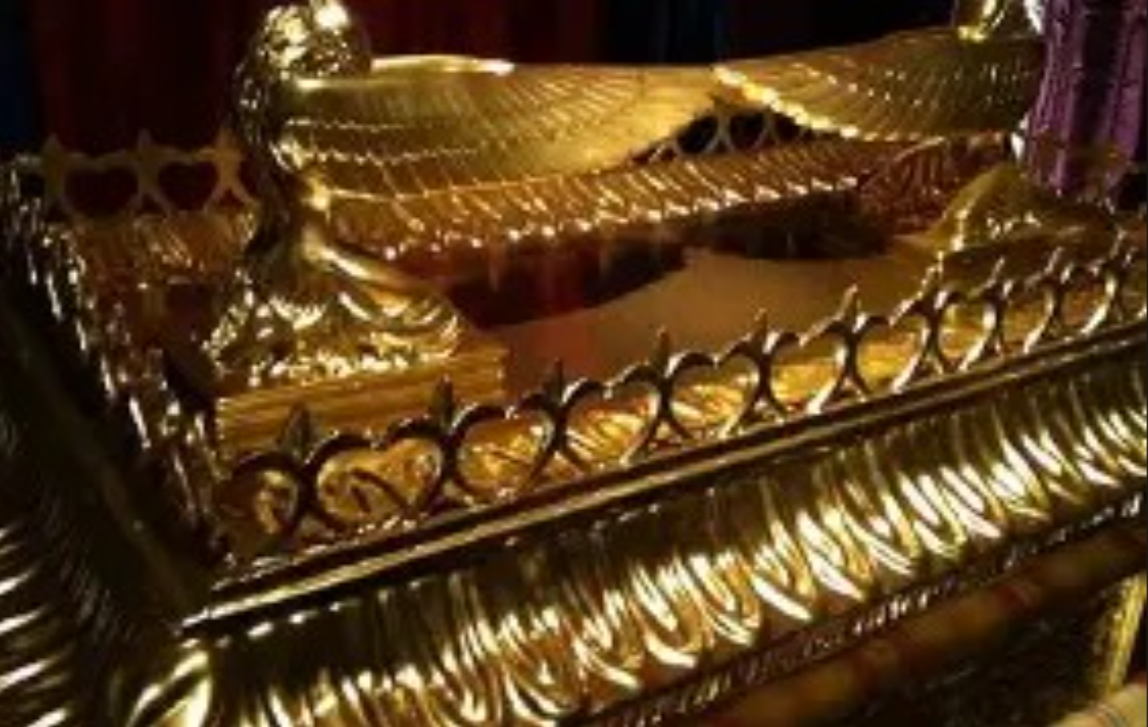
(15) Lastly, who dwell in the Temple, in the Holy of Holies; the Lord of Hosts, who dwells between the cherubim? I Samuel 4:4, II Samuel 6:2
And Jesus rebuked those who traded in the Temple as He, God the Son, didn’t claimed the Temple as “my house,” but “My Father’s house.”
“Take these things away! Do not make My Father’s house a house of merchandise!” John 2:16.
He, God the Father, was the Lord of Hosts who sat between the Cherubim. Jesus Christ, God the Son, acknowledged that the Temple was His Father’s house (John 2:16); again endorsing that His Father as “the Most High” and “the God of Abraham, Isaac and Jacob.”
And in Acts:
“The God of Abraham and of Isaac and of Jacob, the God of our fathers, hath glorified His Son Jesus, whom ye delivered up, and denied Him in the presence of Pilate when he was determined to let Him go” Acts 3:13.
Everything is consistent that the evidence in the New Testaments supports the identity of the God of the Old Testament as God the Father.

In Temple service, it doesn’t make sense that on the Day of Atonement, the goat’s blood, representing Christ’s blood, was presented to himself to be accepted.
Tracing back, He, God the Father, was the Being who asked Moses to build Him a sanctuary, so that He could dwell among men:
And let them make Me a sanctuary, that I may dwell among them. Exodus 25:8
Of course, it must be the Father sitting between the Cherubim that accepts Christ’s blood. Otherwise, why are God’s pretentious ministers rendered as wretched, blind and naked? Revelation 3:17.


