
Genesis (45-46)
~~~~~
Genesis 45
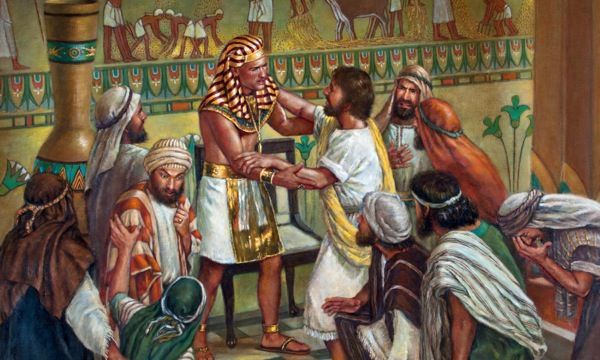
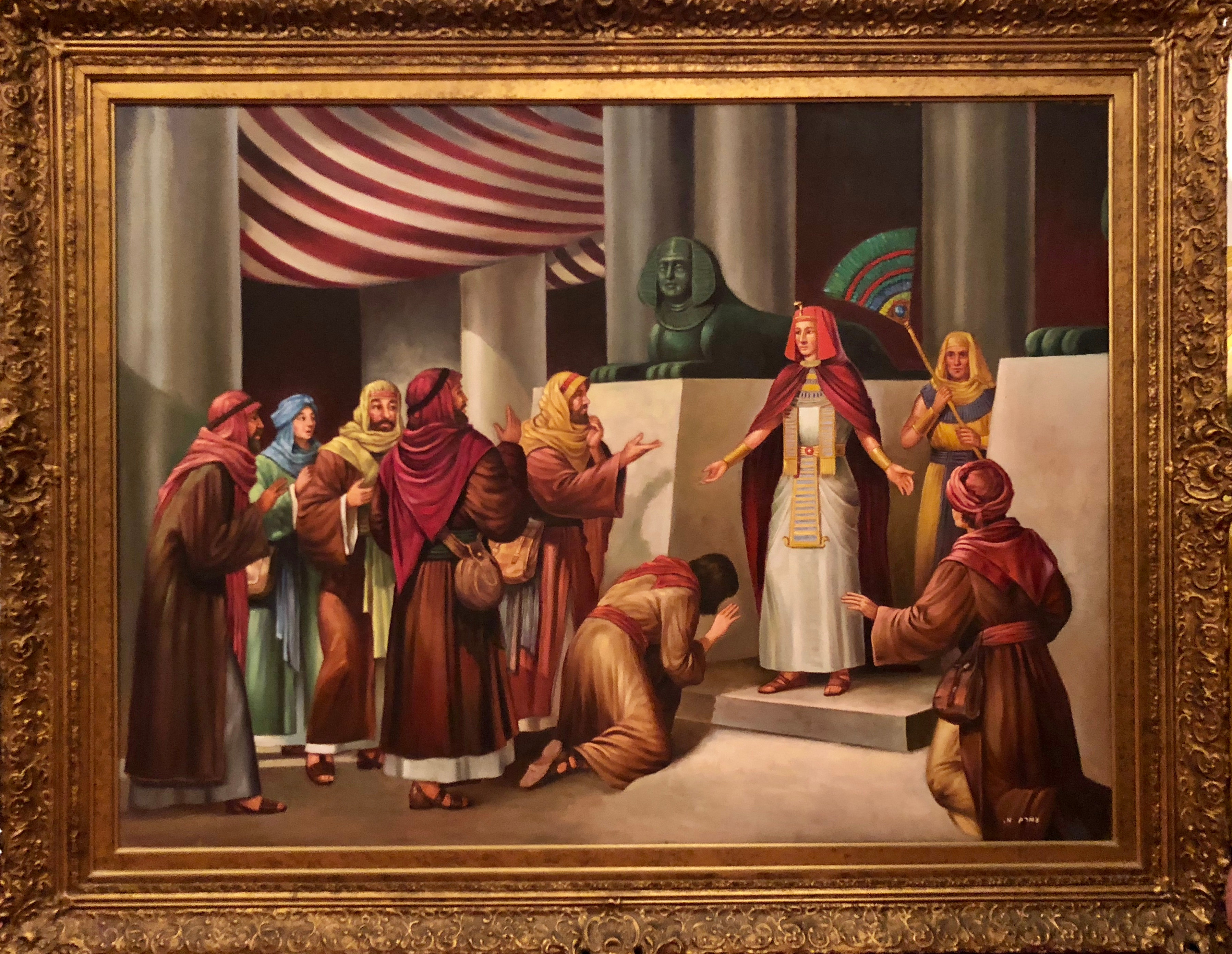
1 Then Joseph could not restrain himself before all those who stood by him; and he cried, “Cause every man to go out from me!” And there stood no man with him while Joseph made himself known unto his brethren.
— the Targum Onkelos says
Yoseif could not contain his emotions in the presence of all who stood before him, and he cried out Let everyone leave my presence. No man remained with him, when Yoseif made himself known to his brothers.
2 And he wept aloud, and the Egyptians and the house of Pharaoh heard.
— the Targum Onkelos says
He wept aloud, and the Egyptians heard about it, and the [people of the] house of Pharaoh [also] heard.
3 And Joseph said unto his brethren, “I am Joseph. Doth my father yet live?” And his brethren could not answer him, for they were troubled at his presence.
— the Targum Onkelos says
Yoseif said to his brothers, I am Yoseif, is my father still alive? His brothers could not answer [a word to] him for they were shocked at his presence.
4 And Joseph said unto his brethren, “Come near to me, I pray you.” And they came near; and he said, “I am Joseph your brother, whom ye sold into Egypt.
— the Targum Onkelos says
[Then] Yoseif said to his brothers, Please [Now] come close to me. They came close [to him] and he said, I am Yoseif your brother, whom you sold into Egypt.
5 Now therefore be not grieved nor angry with yourselves that ye sold me hither, for God sent me before you to preserve life.
— the Targum Onkelos says
Now do not worry, and do not be angry with yourselves that you sold me here; for it was to preserve life that Elohim sent me [here] before you.
6 For these two years hath the famine been in the land, and yet there are five years in which there shall neither be planting nor harvest.
— the Targum Onkelos says
For it is [now] two years that there has been famine in the land; and for another five years there will be no plowing [sowing] or harvest.
7 And God sent me before you to preserve you a posterity in the earth, and to save your lives by a great deliverance.
— the Targum Onkelos says
Elohim sent me [here] before you to insure your survival in the land, and to keep you alive for a great deliverance.
8 So now it was not you that sent me hither, but God; and He hath made me a father to Pharaoh, and lord of all his house and a ruler throughout all the land of Egypt.
— God hath made me a father to Pharaoh; that is, the Pharaoh’s principal counsellor of state, to guide his affairs with a fatherly care, and to have the authority, respect, and power of a father with him;
— the Targum Onkelos says
Now [then] it was not you that sent me here, but [it was from before] Elohim; and He has made me as a father to Pharaoh, and master of all [the people of] his house, and ruler over all the land of Egypt.
— the Targum of Jonathan says
“And now, it was not you who sent me here, but from before the Lord the matter was ordained); and He has made me a father (counselor) to Pharaoh, and lord over all his house, and ruler in all the land of Egypt.”
9 Hasten ye, and go up to my father and say unto him, ‘Thus saith thy son Joseph: God hath made me lord of all Egypt. Come down unto me, tarry not;
— the Targum Onkelos says
Hurry, go up to my father and tell him: this is what your son, Yoseif, says, Elohim has made me master of all Egypt. Come down to me, do not delay.
10 and thou shalt dwell in the land of Goshen, and thou shalt be near unto me — thou, and thy children, and thy children’s children, and thy flocks and thy herds and all that thou hast.
— the land of Goshen; this land, also called “the land of Rameses” (Genesis 47:11), probably from the city “Raamses,” which the Israelites were compelled to build there (Exodus 1:11)
— was situated on the eastern bank of the Nile, hence when the Israelites were fleeing Egypt during the Exodus they were not known to have crossed the Nile;
— the Targum Onkelos says
You will dwell in the land of Goshen, and you will be close to me—you, your children, your grandchildren, your sheep, your cattle and all that you own.
11 And there will I nourish thee (for yet there are five years of famine), lest thou and thy household and all that thou hast come to poverty.’
— thy household; as the famine had lasted only two years, and as Jacob had preserved his flocks and herds, so probably he had lost few or none of the large number of men-servants and women-servants who belonged to him;
— the Targum Onkelos says
I will provide for you there, since there will be another five years of famine; lest you become impoverished together with [the people of] your household and all that is yours.
12 And behold, your eyes see, and the eyes of my brother Benjamin, that it is my mouth that speaketh unto you.
— the Targum Onkelos says
Behold, your eyes see it along with my brother Binyomin’s eyes, that I speak to you with my own mouth [in your language].
13 And ye shall tell my father of all my glory in Egypt, and of all that ye have seen; and ye shall make haste and bring down my father hither.”
— the Targum Onkelos says
Tell my father of all my honor in Egypt, and all that you saw. Hurry and bring my father down here.
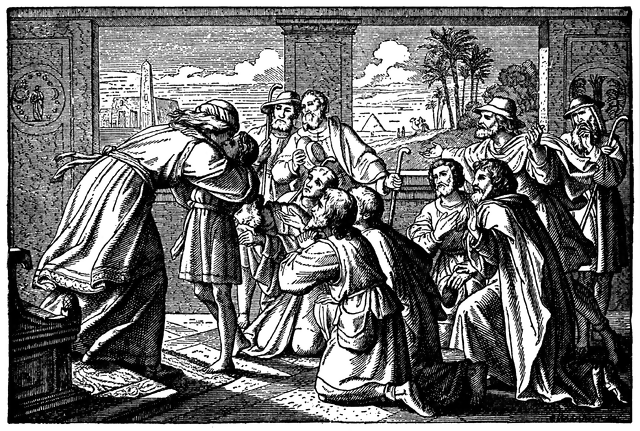
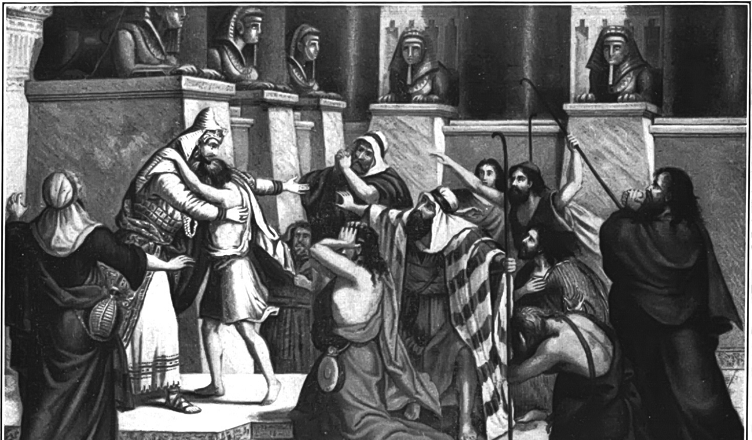
14 And he fell upon his brother Benjamin’s neck, and wept; and Benjamin wept upon his neck.
— the Targum Onkelos says
He [then] fell upon his brother Binyomin’s neck and wept, and Binyomin wept upon his neck.
— the Targum of Jonathan says
“And he fell upon the neck of his brother Benjamin and wept—because the Holy Temple was destined to be built in the portion of Benjamin, and was destined to be destroyed twice. And Benjamin wept upon the neck of Joseph, for he saw the Tabernacle of Shiloh (Mashkena de-Shiloh) which was destined to be in the portion of Joseph, and was destined to be destroyed.”
15 Moreover he kissed all his brethren, and wept upon them; and after that his brethren talked with him.
— the Targum Onkelos says
He kissed all his brothers and wept upon [their necks]. After that his brothers spoke with him.
16 And the fame thereof was heard in Pharaoh’s house, saying, “Joseph’s brethren have come”; and it pleased Pharaoh well, and his servants.
— the Targum Onkelos says
The news was heard in Pharaoh’s house that Yoseif’s brothers had come. This was good [news] in the eyes of Pharaoh and in the eyes of his servants.
17 And Pharaoh said unto Joseph, “Say unto thy brethren, ‘This do ye: Load your beasts and go, get you unto the land of Canaan.
— the Targum Onkelos says
Pharaoh said to Yoseif, Tell your brothers to do this: load up your beasts, and go and enter [bring to] the land of Canaan.
18 And take your father and your households, and come unto me; and I will give you the good of the land of Egypt, and ye shall eat the fat of the land.’
— the Targum Onkelos says
Bring your father and [the people of] your households and come to me; and I will give you the best of the land of Egypt. You will eat of the fat of the land.
19 Now thou art commanded, this do ye: ‘Take with you wagons out of the land of Egypt for your little ones and for your wives, and bring your father, and come.
— the Targum Onkelos says
Now you are commanded [to order (your) brothers to] do the following: Take wagons from the land of Egypt for your little ones and for your wives. Bring your father and come.
20 Also, regard not your possessions, for the good of all the land of Egypt is yours.’”
— the Targum Onkelos says
Do not be concerned with your belongings, for the best of Egypt is yours,
21 And the children of Israel did so; and Joseph gave them wagons, according to the commandment of Pharaoh, and gave them provision for the way.
— the Targum Onkelos says
The sons of Yisrael did so. Yoseif gave them wagons by order of Pharaoh, and he gave them provisions for the journey.
22 To all of them he gave each man changes of raiment; but to Benjamin he gave three hundred pieces of silver, and five changes of raiment.
— the Targum Onkelos says
To each of them, he gave a change of clothing. To Binyomin he gave three hundred [selaim of] silver pieces and five changes of clothing.
23 And to his father he sent in this manner: ten asses laden with the good things of Egypt, and ten sheasses laden with corn and bread and meat for his father on the way.
— the Targum Onkelos says
To his father he sent the following: Ten male donkeys loaded with the best of Egypt, and ten female donkeys loaded with grain, bread, and food [provisions] for his father for the journey.
24 So he sent his brethren away, and they departed; and he said unto them, “See that ye fall not out on the way.”
— the Targum Onkelos says
He sent his brothers off and they went. He said to them, Do not be troubled [argue] along the way.
25 And they went up out of Egypt, and came into the land of Canaan unto Jacob their father,
— the Targum Onkelos says
They went up from Egypt, and they came to the land of Canaan, to their father Yaakov.
26 and told him, saying, “Joseph is yet alive, and he is governor over all the land of Egypt.” And Jacob’s heart fainted, for he believed them not.
— the Targum Onkelos says
They told him saying, Yoseif is still alive, and he is ruler of all the land of Egypt. His [Yaakov’s] heart stood still [The words created uncertainty in his heart], for he could not believe them.
27 And they told him all the words of Joseph which he had said unto them; and when he saw the wagons which Joseph had sent to carry him, the spirit of Jacob their father revived.
— the Targum Onkelos says
They told him all the words of Yoseif which he had spoken to them, and he saw the wagons that Yoseif had sent to carry him. [Then] the spirit of [prophecy rested upon] their father Yaakov was revived.
— the Targum of Jonathan says
“And they spoke with him all the words of Joseph which he had spoken with them; and he saw the wagons which Joseph had sent to carry him; and the Spirit of Prophecy—which had departed from him at the time they sold Joseph—rested upon and returned to Jacob their father.”
28 And Israel said, “It is enough; Joseph my son is yet alive! I will go and see him before I die.”
— the Targum Onkelos says
Yisrael said, It is too much [There is great joy for me]! My son Yoseif still lives. I will go and see him before I die.
— the Targum of Jonathan says
“And Israel said: ‘Many are the favors the Lord has done with me! He delivered me from the hands of Esau, and from the hands of Laban, and from the hands of the Canaanites who pursued after me.
“And many are the comforts I have seen and hoped to see; but for this I did not hope—that my son Joseph is still alive until now! I will go now and see him before I die.'”
Genesis 46
1 And Israel took his journey with all that he had and came to Beersheba, and offered sacrifices unto the God of his father Isaac.
— the Targum Onkelos says
Yisrael journeyed with all that he possessed, and he came to Beer Sheva. He offered sacrifices [there] to the God of his father Yitzchok.
2 And God spoke unto Israel in the visions of the night and said, “Jacob, Jacob.” And he said, “Here am I.”
— the Targum Onkelos says
Elohim said to Yisrael in a night vision, and He said, Yaakov, Yaakov. And he said, Here I am.
3 And He said, “I am God, the God of thy father. Fear not to go down into Egypt, for I will there make of thee a great nation.
— the Targum Onkelos says
He said I am the Almighty, God of your father. Do not be afraid to do down to Egypt, for there I will make you into a great nation.
4 I will go down with thee into Egypt, and I will also surely bring thee up again; and Joseph shall put his hand upon thine eyes.”
— the Targum Onkelos says
I will go down with you to Egypt, and I will also surely bring you up again. Yoseif shall place his hand upon your eyes.
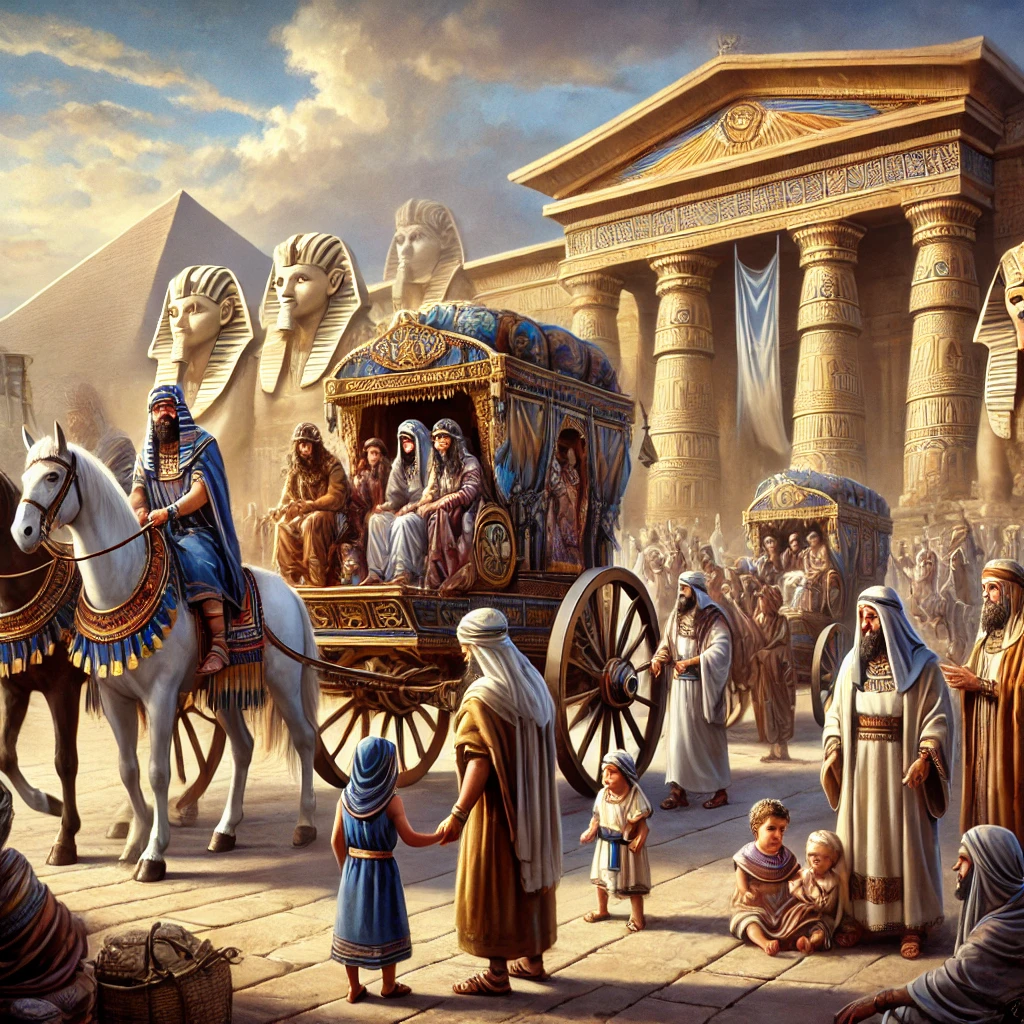
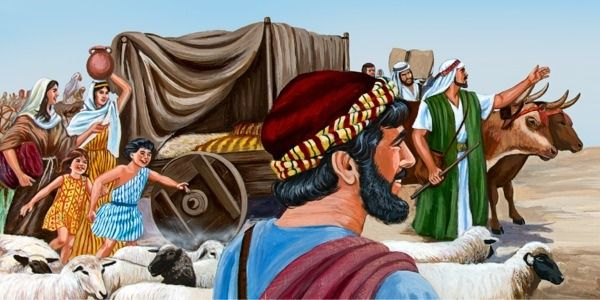
5 And Jacob rose up from Beersheba; and the sons of Israel carried Jacob their father, and their little ones and their wives, in the wagons which Pharaoh had sent to carry him.
— the Targum Onkelos says
Yaakov rose up from Beer Sheva. The sons of Yisrael transported their father Yaakov, their children, their wives in the wagons that Pharaoh had sent to carry him.
6 And they took their cattle and their goods which they had gotten in the land of Canaan, and came into Egypt, Jacob, and all his seed with him:
— the Targum Onkelos says
They took their livestock and their possessions that they had acquired in the land of Canaan, and they came to Egypt; Yaakov and all his descendants with him.
7 his sons and his sons’ sons with him, his daughters and his sons’ daughters; and all his seed brought he with him into Egypt. — Jacob had daughters (plural), that is, beside Dinah, but they were not named;
— the Targum Onkelos says
His sons and grandsons were with him. His daughters and his granddaughters, and all his descendants he brought with him to Egypt.
8 And these are the names of the children of Israel who came into Egypt, Jacob and his sons: Reuben, Jacob’s firstborn.
— the Targum Onkelos says
These are the names of the sons of Yisrael who were coming to Egypt, Yaakov and his sons. The firstborn of Yaakov was Reuvein.
9 And the sons of Reuben: Hanoch and Pallu, and Hezron and Carmi.
— the Targum Onkelos says
The sons of Reuvein [were]: Chanoch, Phallu, Chetzron and Carmi.
10 And the sons of Simeon: Jemuel and Jamin and Ohad and Jachin and Zohar and Shaul the son of a Canaanite woman.
— the Targum Onkelos says
The sons, of Shimon [were]: Yemueil, Yamin, Ohad, Yachin, Tzochar and Shaul, the son of the Canaanite woman.
11 And the sons of Levi: Gershon, Kohath, and Merari.
— the Targum Onkelos says
The sons of Leivi [were] Gershon, Kehas and Merari.
12 And the sons of Judah: Er and Onan, and Shelah and Perez and Zerah (but Er and Onan died in the land of Canaan). And the sons of Perez were Hezron and Hamul.
— the Targum Onkelos says
The sons of Yehudah [were]: Eir, Onan, Sheiloh, Peretz and Zorach. Eir and Onan died in the land of Canaan. The sons of Peretz were Chetzron and Chamul.
13 And the sons of Issachar: Tola, and Puvah and Job, and Shimron.
— the Targum Onkelos says
The sons of Yissachar [were]: Tolah, Phuvah, Yov and Shimron.
14 And the sons of Zebulun: Sered and Elon and Jahleel.
— the Targum Onkelos says
The sons of Zevulun [were]: Sered, Eilon and Yachle’eil.
15 These are the sons of Leah, whom she bore unto Jacob in Padanaram, with his daughter Dinah. All the souls of his sons and his daughters were thirty and three. — Leah’s daughter Dinah also came to Egypt; no sign she was married after her misfortune in Shechem;
— all the souls; were thirty and three; that is, six sons, twenty-three grandsons, two great grandsons, Dinah, and Jacob himself; the other daughters and granddaughters are omitted;
— the Targum Onkelos says
These are the sons of Leah that she bore to Yaakov in Padan Aram, along with his daughter Deenah. All the souls of his sons and daughters were thirty-three.
16 And the sons of Gad: Ziphion and Haggi, Shuni, and Ezbon, Eri, and Arodi, and Areli.
— the Targum Onkelos says
The sons of Gad [were]: Tzifyon, Chagi, Shuni, Etzbon, Eiri, Arodi, and Areili.
17 And the sons of Asher: Jimnah and Ishuah, and Isui and Beriah, and Serah their sister. And the sons of Beriah: Heber and Malchiel.
— the Targum Onkelos says
The sons of Asher [were]: Yimnah, Yishvah, Yishvi, and Beriah, and their sister, Serach. The sons of Beriah [were]: Chever and Malki’eil.
18 These are the sons of Zilpah, whom Laban gave to Leah his daughter, and these she bore unto Jacob, even sixteen souls.
— the Targum Onkelos says
These are the sons of Zilpah, whom Lavan gave to his daughter, Leah. She bore these to Yaakov, sixteen souls.
19 The sons of Rachel, Jacob’s wife: Joseph and Benjamin.
— the Targum Onkelos says
The sons of Rochel, Yaakov’s wife [were]: Yoseif and Binyomin.
20 And unto Joseph in the land of Egypt were born Manasseh and Ephraim, whom Asenath the daughter of Potipherah, priest of On, bore unto him.
— the Targum Onkelos says
In the land of Egypt, [sons] were born to Yoseif, which were born to him by Osnas, daughter of Poti Phera, priest [chief] of On; [they were] Menasheh and Ephraim.
— the Targum of Jonathan says
“And there were born to Joseph children in the land of Egypt, whom Asenath—the daughter of Dinah, who was raised in the house of Potiphera, the prince of Tanis—bore to him: Manasseh and Ephraim.”
21 And the sons of Benjamin were Belah and Becher and Ashbel, Gera and Naaman, Ehi and Rosh, Muppim and Huppim and Ard.
— the LXX gives Benjamin three sons, Bela, Chobor, and Ashbel; six grandsons, sons of Bela, viz. Gera, Naaman, Ehi, Rosh, Muppim, and Huppim; and one great-grandson, Ard, the son of Gera.
And the sons of Benjamin; Bala, and Bochor, and Asbel. And the sons of Bala were Gera, and Noeman, and Anchis, and Ros, and Mamphim. And Gera begot Arad. Genesis 46:21 Septuagint
— the Targum Onkelos says
The sons of Binyomin [were]: Bela, Becher, Ashbeil, Geiroh, Naamon, Eichi, Rosh, Muppim, Chuppim and Ard.
22 These are the sons of Rachel, who were born to Jacob; all the souls were fourteen.
— the Targum Onkelos says
These are the sons of Rochel that she bore to Yaakov. All the souls were fourteen.
23 And the son of Dan: Hushim.
— the Targum Onkelos says
The sons of Don [were] Chushim.
24 And the sons of Naphtali: Jahzeel and Guni, and Jezer and Shillem.
— the Targum Onkelos says
The sons of Naftali were: Yachtze’eil, Guni, Yeitzer and Shileim.
25 These are the sons of Bilhah, whom Laban gave unto Rachel his daughter, and she bore these unto Jacob; all the souls were seven.
— the Targum Onkelos says
These are the sons of Bilhah whom Lavan gave to his daughter Rochel. She bore these to Yaakov, seven souls in all.
26 All the souls who came with Jacob into Egypt, who came out of his loins, besides Jacob’s sons’ wives, all the souls were threescore and six.
— the Targum Onkelos says
All the souls coming with Yaakov to Egypt, who came out of his loins, not counting the wives of Yaakov’s sons, all the souls totaled sixty-six.
27 And the sons of Joseph who were born to him in Egypt were two souls; all the souls of the house of Jacob who came into Egypt, were threescore and ten.
— the Targum Onkelos says
The sons of Yoseif who were born to him in Egypt were [another] two souls. All the souls of the house of Yaakov that came to Egypt were seventy.
28 And he sent Judah before him unto Joseph to direct his face unto Goshen, and they came into the land of Goshen.
— the Targum Onkelos says
He [Yaakov] sent Yehudah ahead of him to Yoseif, so that he might direct him to [clear a place before him in] Goshen. They then came to the land of Goshen.
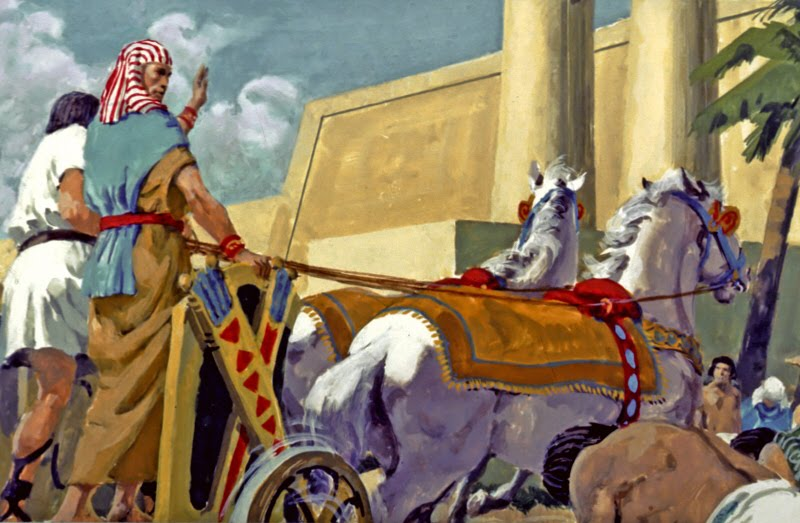
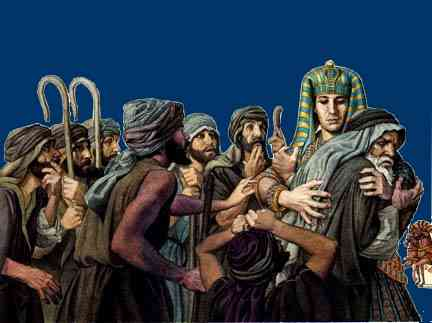
29 And Joseph made ready his chariot, and went up to meet Israel his father in Goshen, and presented himself unto him; and he fell on his neck, and wept on his neck a good while.
— the Targum Onkelos says
Yoseif harnessed his chariot, and went up to greet his father, Yisrael in Goshen. [When] he appeared before him, he fell on his neck, and wept on his neck for a long time.
30 And Israel said unto Joseph, “Now let me die, since I have seen thy face, because thou art yet alive.”
— the Targum Onkelos says
Yisrael said to Yoseif, Now I can [If I were to] die [now I will have been consoled]; after I have seen your face that you are alive.
31 And Joseph said unto his brethren and unto his father’s house, “I will go up and show Pharaoh, and say unto him, ‘My brethren and my father’s house, who were in the land of Canaan, have come unto me.
— the Targum Onkelos says
Yoseif said to his brothers and to his father’s household, I will go up and tell Pharaoh. I will say to him, My brothers and my father’s household, who were in the land of Canaan, have come to me.
32 And the men are shepherds, for their trade hath been to feed cattle; and they have brought their flocks and their herds, and all that they have.’
— the Targum Onkelos says
The men are shepherds, for they are owners of livestock. Their sheep, their cattle, and all their possessions, they have brought [with them.]
33 And it shall come to pass, when Pharaoh shall call you and shall say, ‘What is your occupation?’
— the Targum Onkelos says
And when Pharaoh calls you, and says, What is your occupation,
34 that ye shall say, ‘Thy servants’ trade hath been about cattle from our youth even until now, both we and also our fathers,’ that ye may dwell in the land of Goshen; for every shepherd is an abomination unto the Egyptians.”
— the Targum Onkelos says
You should say, Your servants have been livestock owners from our youth until now, we and our fathers; so that you will be able to settle in the land of Goshen, since every shepherd is abhorrent to Egypt [the Egyptians make distant all shepherds].


