
Genesis (31-32)
After Jacob had stolen his birthright, Esau pleaded with Isaac his father if he could still bless him.
Then Isaac his father answered and prophesied, saying, “Thy dwelling shall be away from the fatness of the earth; and away from the dew of heaven above; Genesis 27:39
“And by your sword shall you live, you will go to every place, and wander, and you will be subject to your brother. But when his descendants abandon the commandments of the Torah, then you will break his yoke from your neck.”
“And Esau harbored hatred in his heart against Jacob, his brother, because of the blessing with which his father had blessed him. And Esau said in his heart, ‘I will not do as Cain did, who killed Abel during their father’s lifetime and then their father had another son, Seth. Rather, I will wait until the days of mourning for my father have passed, and then I will kill Jacob my brother, and I will be the sole heir.’” Genesis 27:41-42 Targum (Jonathan)
This is looking at the Scriptures with a blast of fresh air, because the deeper you dig, the more you’ll find!
“The anger of the Lord shall not return, until He has executed and until He has performed the intent of His thought; in the latter days ye shall understand it perfectly.” Jeremiah 23:20
Genesis 31
1 And he heard the words of Laban’s sons, saying, “Jacob hath taken away all that was our father’s; and from that which was our father’s hath he gotten all this glory.”
— their complaining word “glory” suggests that, enriched by cattle and commerce, Jacob had now become a person of great importance in the eyes of the people of Haran;
— the Targum Onkelos says
He [Yaakov] heard the words of Lavan’s sons [who were] saying, Yaakov has taken all that belonged to our father. From that which was our father’s, he made [acquired] all this wealth [these possessions].
— as the Targum of Jonathan says, by which he got the name and glory for himsel of these riches among men: and it was so far true what they say, that it was out of their father’s flock that Jacob got all his increase;
2 And Jacob beheld the countenance of Laban, and behold, it was not toward him as before. — and, behold, it was not as peaceful as before;
— he said nothing to Jacob, nor charged him with robbing of him, or any false dealing with him, yet was uneasy at his growing prosperity; he put on sour looks, and an envious countenance, sad, and surly, and lowering;
— the Targum Onkelos says
Yaakov saw [the expression of] Lavan’s face [demeanor] and it was not toward him as it was before.
3 And the Lord said unto Jacob, “Return unto the land of thy fathers and to thy kindred, and I will be with thee.” — the Lord said unto Jacob; in answer tohsi prayer, perhaps; or seeing what difficulties and discouragements Jacob laboured under, he appeared unto him for his encouragement and instruction how to proceed;
— the Targum Onkelos says
Adonoy said to Yaakov, Return to the land of your fathers and to your birthplace, and I will be with you [My Word will be your support].
4 And Jacob sent and called Rachel and Leah to the field unto his flock, — and Jacob sent; having this encouragement and direction from the Lord, which seems while he was attending his flocks, he dispatched a messenger home to his wives, one of his servants or under shepherds;
— the Targum Onkelos says
Yaakov sent and called Rochel and Leah to [come to] the field, to his flock.
— the Targum of Jonathan says it was his son Naphtali, of Rachels’ maid, Bilhah, whom he sent, because he was a swift messenger;
5 and said unto them, “I see your father’s countenance, that it is not toward me as before; but the God of my father hath been with me. — his father-in-law’s countenance are becoming not peaceful;
— but the God of my father hath been with me; not only supported him under all his troubles; but by his good providence prospering him in his affairs, as well as he had lately appeared to him, and encouraged him to return to his own country;
— the Targum Onkelos says
He said to them, I saw [the expression of] your father’s face; it is not toward me as it was before, but the God of my father was with me [my support].
6 And ye know that with all my power I have served your father. — and ye know, that with all my power I have served your father; with all faithfulness and uprightness;
— with all diligence and industry; with all wisdom and prudence; and sparing no pains by day or night to take care of his flocks, and increase his substance;
— the Targum Onkelos says
You know that I served your father with all my strength.

7 And your father hath deceived me, and changed my wages ten times, but God did not suffer him to hurt me. — hath changed my wages ten times; that is, oft-times, as is often the signification of the number ten;
— the Targum Onkelos says
Your father cheated me and changed my wage ten countings; but Elohim did not let him harm me.
8 If he said thus: ‘The speckled shall be thy wages,’ then all the animals bore speckled; and if he said thus: ‘The ringstreaked shall be thy hire,’ then all the animals bore ringstreaked.
— the ring-straked shall be thy hire; hence it appears that Laban through envy and covetousness did break his agreement made with Jacob, and altered it as he thought meet, and that Jacob patiently yielded to all such changes;
— the Targum Onkelos says
If he would say, The speckled will be your wage, then all the flock [sheep] gave birth to speckled ones. If he would say, Ringed ones will be your wage, all the flock [sheep] gave birth to ringed ones.
9 Thus God hath taken away the flocks of your father, and given them to me. — Laban’s flock was much lessened by those means, and more were taken away, and came to Jacob’s share;
— the Targum Onkelos says
Thus God delivered [separated] your father’s livestock, and gave it to me.
10 And it came to pass at the time that the animals conceived, that I lifted up mine eyes and saw in a dream, and behold, the rams which leaped upon the animals were ringstreaked, speckled, and grizzled.
— not that the rams in the flock were really of those colours, for they were all white, but so they were represented to Jacob in the vision, to suggest to him, that such would be produced by them;
— the Targum Onkelos says
At the time the flock [sheep] were in heat [to mate], I lifted my eyes, and in a dream I saw that the males [rams] going upon the flock [sheep] were ringed, speckled and striped.
11 And the angel of God spoke unto me in a dream, saying, ‘Jacob!’ And I said, ‘Here am I.’ — saying, Jacob; and I said, here am I; the angel called him by his name, to which he answered, and signified that he was ready to attend to whatsoever he should say to him;
— the Targum Onkelos says
An angel of Elohim said to me in a dream, Yaakov, and I said, Here I am.
12 And he said, ‘Lift up now thine eyes and see: all the rams which leap upon the animals are ringstreaked, speckled, and grizzled; for I have seen all that Laban doeth unto thee. — and the angel said, for I have seen all that Laban doeth to thee;
— the Targum Onkelos says
He said, Lift up your eyes [now] and see, all the males [rams] going up on the flock [sheep] are ringed, speckled, and striped; for I have seen all that Lavan is doing to you [is revealed before Me].
13 I am the God of Bethel, where thou anointed the pillar, and where thou vowed a vow unto Me. Now arise, get thee out from this land, and return unto the land of thy kindred.’” — I am the God of Bethel; the same Angel that appeared to Jacob in a dream, the God of Bethel; hence this ‘angel’ is the Son of God;
— the Targum Onkelos says
I am the Almighty of Elohim who appeared to you in Beis Eil, where you anointed a monument, where you made a vow to [before] Me. Now arise and leave this land, and return to the land of your birthplace.
14 And Rachel and Leah answered and said unto him, “Is there yet any portion or inheritance for us in our father’s house? — having heard his views, Rachel and Leah answered; they expressed their entire approval;
— the Targum Onkelos says
Rochel and Leah replied and said to him, Do we still have a portion and an inheritance in our father’s house?
15 Are we not counted by him strangers? For he hath sold us, and hath quite devoured also our money. — are we not confuted of him strangers? as if we had no more right to his estate than strangers? instead of a good part of his estate, which by the law of God and nature belongs to us;
— the Targum Onkelos says
Are we not considered by him as strangers? For he has sold us, and has completely consumed our money.
16 For all the riches which God hath taken from our father, that is ours and our children’s. Now then, whatsoever God hath said unto thee, do.”
— now then, whatsoever God hath said unto thee, do; this was well spoken indeed; they mean, that he should leave their father’s house, and go into the land of Canaan, as God had directed him;
— the Targum Onkelos says
All the wealth that Elohim rescued [separated] from our father belongs to us and our children. Now, whatever God has said to you, do it.
17 Then Jacob rose up, and set his sons and his wives upon camels. — then Jacob rose up; and went with them to Laban’s house, where his children were, as is plain from Rachel’s theft, Genesis 31:19
— the Targum Onkelos says
Yaakov rose and lifted his sons and his wives upon the camels.
18 And he carried away all his flocks and all his goods which he had gotten, the flocks of his getting which he had gotten in Padanaram, to go to Isaac his father in the land of Canaan.
— for to go to Isaac his father in the land of Canaan; but staying at several places by the way. No mention is made of his mother Rebekah, she perhaps being now dead;
— the Targum Onkelos says
He led away all his livestock, and all his possessions that he had acquired, which he had purchased with his own livestock that he had acquired in Padan Aram, [in order] to come to Yitzchok, his father, to the land of Canaan.
19 And Laban went to shear his sheep; and Rachel had stolen the images that were her father’s. — images; images of angels, teraphim, called Laban’s gods in Genesis 31:30, which he made use of in an idolatrous and superstitious manner;
— Rachel had a lingering attachment to those idols of her family, and secretly carried them away as relics of a home she was to visit no more; and we find that such idolatry worship continued throughout their pre-Babylonian history;
— when we read of Rachel’s stealing her father’s images, what a scene of the family of Nahor, and even Terah, his father, who left the idolatrous Chaldees; is not this family itself had been tainted or even deeply idolatrous? Until the days they were purified during the Babylonian captivity;
— the Targum Onkelos says
Lavan [meanwhile] had gone to shear his flock [sheep], and Rochel stole [hid] the idols that belonged to her father.
— the Targum of Jnathan says
And Laban had gone to shear his flock; and Rahel stole the images. For they had slain a man, a firstborn, and had cut off his head; they salted it with salt and balsams, and wrote incantations on a plate of gold, and put it under his tongue, and set it up in the wall, and it spake with them; and unto such their father bowed himself.
20 And Jacob stole away unawares to Laban the Syrian, in that he told him not that he fled. — Jacob stole away; he thought the prudence and necessity of departing secretly; otherwise, Laban might have detained him by violence or artifice if he waited;
— the Targum Onkelos says
Yaakov fooled [concealed his intentions from the heart of] Lavan, the Aramean, by not telling him that he had fled [gone].
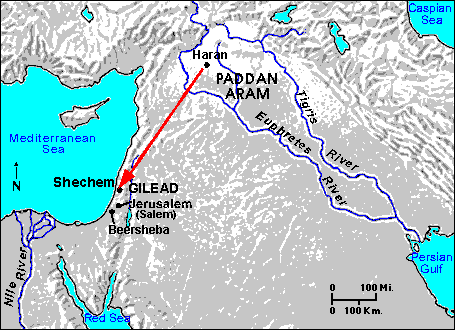
21 So he fled with all that he had; and he rose up and passed over the river, and set his face toward the mount of Gilead. — and he rose up, and passed over the river; the river Euphrates, as the Targum of Jonathan expresses it, which lay between Mesopotamia and Canaan;
— and set his face toward Mount Gilead: this, was a mountain on the border of the land of Canaan, adjoining to Lebanon, near which was a very fruitful country, which had its name from it;
— the Targum Onkelos says
He fled [went] with all that he possessed. He set out and crossed the river [P’ras], setting out in the direction of Mount Gilod.
22 And it was told Laban on the third day that Jacob had fled. — and it was told Laban on the third day, that Jacob was fled; three days after Jacob was gone he had the report to him;
— the Targum Onkelos says
Lavan was told on the third day that Yaakov had fled [gone].
— the Targum of Jonathan adds more concerning Jacob’s blessings while living there:
But after Jakob had gone, the shepherds went to the well, but found no water; and they waited three days, if that it might (again) overflow; but it overflowed not; and then came they to Laban on the third day, and he knew that Jakob had fled; because through his righteousness it had flowed twenty years.
23 And he took his brethren with him, and pursued after him seven days’ journey; and they overtook him on the mount of Gilead. — seven days’ journey; the route chosen by Jacob was apparently the more easterly one, past Damascus to the west; the hill, which subsequently was called Mount Gilead, lay to the south of the Jabbok;
— the Targum Onkelos says
He took his brothers [kinsmen] with him, and pursued him a distance of seven days. He overtook him in Mount Gilod.
24 And God came to Laban the Syrian in a dream by night, and said unto him, “Take heed that thou speak not to Jacob either good or bad.” — God came to Laban and warn him of any altercations, or any use no harsh language with him, which may occasion a quarrel;
— God can put a bridle in the mouth of wicked men, to restrain their malice, though he do not change their hearts. Though they have no love to God’s people, they will pretend to it, and try to make a merit of necessity;
— the Targum Onkelos says
Elohim appeared [The Word came from before Elohim] to Lavan the Aramean, in a dream that night, and said to him, Guard yourself, that you do not speak to Yaakov either good or evil.
— the Targum of Jonathan adds a sword from an angel, warning “Laban the Deceiver”
And there came an angel with a word from before the Lord; and he drew the sword against Laban the Deceiver in a dream of the night, and said to him, Beware lest thou speak with Jakob from good to evil.
25 Then Laban overtook Jacob. Now Jacob had pitched his tent on the mount; and Laban with his brethren pitched on the mount of Gilead. — then Laban overtook Jacob; he was come to the mount overnight, and now in the morning he came nearer to him;
— the Targum Onkelos says
Lavan overtook Yaakov. Yaakov had set up [spread] his tents on the mountain, and Lavan and his brothers had set up [encamped] on Mount Gilod.
26 And Laban said to Jacob, “What hast thou done, that thou hast stolen away unawares to me, and carried away my daughters as captives taken with the sword? — despite being warned by God, Laban still took a hostile approach: What hast thou done?
— the Targum Onkelos says
Lavan said to Yaakov, What have you done? You fooled [hid from] me, and led my daughters away like prisoners of war.
27 Why didst thou flee away secretly, and steal away from me and didst not tell me, that I might have sent thee away with mirth and with songs, with taboret and with harp,
— thou flee away secretly, and steal away from me? but that he had no need to have used such privacy, and go away like a thief by stealth, as if he had done something he had reason to be ashamed of:
— and didst not tell me, that I might have sent thee away with mirth, and with songs, with tabret and with harp: so that he would have given him a pleasant leave to depart;
— the Targum Onkelos says
Why did you flee [go] so stealthily? You robbed [hid from] me and did not tell me. I would have sent you away, with joy and with song, with drum[s] and harp[s].
28 and hast not suffered me to kiss my sons and my daughters? Thou hast now done foolishly in so doing. — thou hast done foolishly in so doing: since, as he would have him believe that he was both a loser by this step he took;
— and exposed himself foolishly to danger, as Laban has means to do him hurt; but Jacob knew what he did, and that it was the wisest part to follow the direction of God; yet God didn’t direct Jacob to fled in stealth in the night, so to speak, or by stealing his idols in the process;
— the Targum Onkelos says
You did not let me kiss my [grand]sons and daughters. Now see how foolishly you acted.
29 It is in the power of my hand to do you hurt; but the God of your father spoke unto me yesternight, saying, ‘Take thou heed that thou speak not to Jacob either good or bad.’ — the God of your father, Isaac or Abraham, by which Laban seemed to distance himself and disowned him for his God;
— speak not to Jacob either good or bad; this, though greatly to Jacob’s honour, and against Laban’s interest, God was warning him of staying out of his business;
— the Targum Onkelos says
It is within the power of my hand to harm you, but the God of your father spoke to me last night saying, Guard yourself not to speak to Yaakov either good or evil.
30 And now, though thou wouldest be gone, because thou sorely longed after thy father’s house, yet why hast thou stolen my gods?”
— yet, wherefore, hast thou stolen my gods? what reason had he for that? if he took away himself, his wives, his children, his goods, what business had he with his gods?
— thou stolen my gods? teraphim, small images of human figures, used as idols or objects of worship, and as talismans, for superstitious purposes;
— the Targum Onkelos says
Now you have gone for you yearned for your father’s house, but why did you steal [take] my gods?
31 And Jacob answered and said to Laban, “Because I was afraid; for I said, ‘Perhaps thou wouldest take by force thy daughters from me.’
— Jacob answered; he gives the true reason for his flight: thou wouldest take by force thy daughters from me; which of right belonged to him; for though they were Laban’s daughters, they were Jacob’s wives;
— after which, indignant at the charge of theft, he returns, in his anger, as rash an answer about the teraphim as Joseph’s brethren a generation later did about the stolen cup;
— the Targum Onkelos says
Yaakov replied and said to Lavan, Because I was afraid, for I said you might forcibly take your daughters from me.
32 With whomsoever thou findest thy gods, let him not live. Before our brethren, discern thou what is thine with me, and take it with thee.” For Jacob knew not that Rachel had stolen them. — real foolish for Jacob to say this: “thou findest thy gods, let him not live”
— for Jacob knew not that Rachel had stolen them; the images or gods; or he would have been more careful of his expression, in love and tenderness to his most beloved wife;
— the Targum Onkelos says
With whomsoever you find your gods, he shall not live. In the presence of our brethren, identify anything belonging to you that is here with me and take it back with you. Yaakov did not know that Rochel had stolen [taken] them.
— the Targum of Jonathan says
“With whomsoever thou shalt find the images of thy idols, let him die before his time. Before all our brethren take knowledge of what with me is thine, and take it. But Jakob knew not that Rahel had stolen them.”
33 And Laban went into Jacob’s tent, and into Leah’s tent, and into the two maidservants’ tents, but he found them not. Then went he out of Leah’s tent, and entered into Rachel’s tent.
— and Laban went into Jacob’s tent; into that first where he most suspected they were, being taken not out of value for them, but contempt of them;
— and into Leah’s tent; and not Leah’s tent next, whom next to Jacob he might suspect of taking them, out of veneration to them, because her tent lay next: and into the two maidservants’ tents: Bilhah and Zilpah; but he found them not; in neither of these tents:
— the Targum Onkelos says
Lavan came into Yaakov’s tent, and into Leah’s tent, and into the tents of the two handmaids [concubines], but he found nothing. He left Leah’s tent and came into Rochel’s tent.
34 Now Rachel had taken the images, and put them in the camel’s saddle and sat upon them. And Laban searched all the tent, but found them not.
— then went he out of Leah’s tent, and entered into Rachel’s tent; which he went into last of all, the least suspecting of her, but covertly more addicted to the superstition and idolatry of his family than Leah and the maidservants;
— the Targum Onkelos says
Rochel had taken the idols, and placed them in the camel’s saddle-pillow, and sat upon them. Lavan searched the whole tent and found nothing.
35 And she said to her father, “Let it not displease my lord that I cannot rise up before thee, for the custom of women is upon me.” And he searched, but found not the images.
— Rachel pleads the custom of women as an excuse for keeping her seat; either of ceremonial defilement; or she was already pregnant with Benjamin;
— but found not the images; and so left off searching; nor do we find that he searched the flock for any of his cattle there, knowing full well Jacob’s “honesty and integrity.”
— the Targum Onkelos indicates her pregnancy, saying
She said to her father, Let there not be anger in the eyes of my master that I cannot rise before you, for the way of women is upon me. He searched but did not find the idols.
36 And Jacob was wroth, and chided Laban; and Jacob answered and said to Laban, “What is my trespass? What is my sin, that thou hast so hotly pursued after me?
— Jacob was wroth; naturally he regarded the accusation about the teraphim as a mere device for searching his goods, and when nothing was found gave free vent to his indignation;
— having answered Laban’s questions to the silencing of him, and nothing of his upon search, being found with him, Jacob took heart, and was of good courage and in high spirits, and in his turn was heated also;
— what is my trespass? what is my sin? what heinous offence have I committed? what law of God or man have I broke? that thou hast so hotly pursued after me? with so much haste and swiftness, and with such a number of men, as if he came to take a thief, a robber, or a murderer;
— the Targum Onkelos says
Yaakov was angry and he argued with Lavan. Yaakov replied and said to Lavan, What is my crime? What sin did I commit that you were in such hot pursuit of me?
37 Whereas thou hast searched all my goods, what hast thou found of all thy household things? Set it here before my brethren and thy brethren, that they may judge between us both.
— set it here before my brethren and thy brethren; publicly before them all, and let it be thoroughly inquired into whose property it was, and whether lawfully taken or not;
— the Targum Onkelos says
When you searched all my goods, what did you find of all your household goods? Place it here in the presence of my brethren and your brethren, and let them decide between the two of us.
38 These twenty years have I been with thee; thy ewes and thy shegoats have not cast their young, and the rams of thy flock have I not eaten. — in the twenty years I’ve worked for you, ewes and she-goats never miscarried; neither have I feasted on the rams from your flock;
— the Targum Onkelos says
These twenty years that I was with you, your ewes and she-goats never miscarried, and I did not eat any rams of your flocks.
39 That which was torn by beasts I brought not unto thee; I bore the loss of it. From my hand didst thou require it, whether stolen by day or stolen by night.
— that which was torn of beasts I brought not unto thee; the shepherds are strictly responsible for losses in the flock, unless they can prove these were occasioned by wild beasts;
— the Targum Onkelos says
I never brought you a mutilated animal. I will take the blame for it. You demanded compensation from my hand whether [an animal] was stolen from me by day or whether it was stolen from me by night. [You demanded compensation from me for that which was missing from the total. I guarded by day and I guarded by night.]
40 Thus I was: in the day the drought consumed me, and the frost by night, and my sleep departed from mine eyes. — all the blessings because it was through my extraordinary thoughtfulness and care about thy cattle, especially in cases of danger;
— the Targum Onkelos says
I was consumed by the burning heat by day and ice [frost came down upon me] at night. My sleep was taken from my eyes.
41 Thus have I been twenty years in thy house. I served thee fourteen years for thy two daughters, and six years for thy flocks; and thou hast changed my wages ten times.
— and six years for thy cattle, to have as many of them for his hire, as were produced from a flock of white sheep, that were speckled, spotted, or ringstraked, or brown;
— the Targum Onkelos says
These twenty years that I have been in your house, I served you fourteen years for your two daughters, and six years for your sheep, but you changed my wages ten times.
42 Unless the God of my father, the God of Abraham and the fear of Isaac, had been with me, surely thou would have sent me away now empty. God hath seen mine affliction and the labor of my hands, and rebuked thee yesternight.”
— and rebuked thee yesternight; in a dream, charging him to say neither good nor evil to Jacob, which he himself had confessed;
— the Targum Onkelos says
Had not the God of my father, the God of Avraham and the Fear of Yitzchok been with me [my support], you would have sent me away empty-handed. My misery [toil] and the labor [weariness] of my hands was seen by [revealed before] Elohim, and He reprimanded you last night.
43 And Laban answered and said unto Jacob, “These daughters are my daughters, and these children are my children, and these flocks are my flocks, and all that thou seest is mine. And what can I do this day unto these my daughters, or unto their children whom they have borne?
— though Laban does not attempt any reply to Jacob’s angry invectives, he answers affectionately; but offers a compromise;
— the Targum Onkelos says
Lavan replied and said to Yaakov, The daughters are my daughters, and the sons are my sons, and the[se] flocks are my flocks. All that you see is mine. What can I do unto these, my daughters, today, or to their children that they have born.
44 Now therefore come thou, let us make a covenant, I and thou; and let it be a witness between me and thee.” — a covenant; that all past differences and quarrels subside, and that for the future peace and good will subsist; of which a covenant made between them would be a testimony;
— the Targum Onkelos says
Now come [therefore] let us make a pact, I and you. Let Him be witness between me and you.
45 And Jacob took a stone and set it up as a pillar.
— the Targum Onkelos says
Yaakov took a boulder and raised it as a monument.
46 And Jacob said unto his brethren, “Gather stones”; and they took stones and made a heap, and they ate there upon the heap.
— Jacob set it up for a pillar, to show his readiness to agree to the motion, he immediately took a large stone that lay upon the mount, to be a standing monument of the agreement now about to be made between them;
— the Targum Onkelos says
Yaakov said to his brethren, Gather stones. They took stones and made a mound, and they ate on the mound.
47 And Laban called it Jegarsahadutha [that is, The heap of witness], but Jacob called it Galeed. — but Jacob called it Galeed; which in the Hebrew tongue signifies “an heap of witness” or an heap, the witness;
— the Targum Onkelos says
Lavan called it Yegar Sohadusa, but Yaakov called it Galeid.
48 And Laban said, “This heap is a witness between me and thee this day.” Therefore was the name of it called Galeed,
— the Targum Onkelos says
Lavan said, This mound is witness between me and you this day. He therefore called its name Galeid.
49 and Mizpah [that is, A beacon or watchtower]; for he said, “The Lord watch between me and thee when we are absent one from another. — and Mizpah; which being an Hebrew word, it looks as if the heap had also this name given it by Jacob, which signifies a “watch” or “watchtower”
— the Targum Onkelos says
And [he also called it] Mitzpah [Watchtower] because he said, [The Word of] Adonoy will watch between me and you, when we are concealed from each other[’s sight].
50 If thou shalt afflict my daughters, or if thou shalt take other wives besides my daughters, no man is with us—see, God is witness between me and thee!”
— if thou shall afflict my daughters; in body or mind, by giving them hard blows, or ill words, and by withholding from them the necessaries of life, food and raiment, and the like;
— or if thou shall take other wives besides my daughters; which also would be an affliction and vexation to them; Laban, though he had led Jacob into polygamy, and even obliged him to it, did not choose he should go further into it;
— the Targum Onkelos says
If you afflict my daughters, or marry other wives in addition to my daughters, there may be no man with us, but see, [the Word of] Elohim is witness between me and you.
51 And Laban said to Jacob, “Behold this heap and behold this pillar, which I have cast between me and thee.
— the Targum Onkelos says
Lavan said to Yaakov, Here is this mound, and here is this monument that I have cast [established] between me and you.
52 This heap is a witness, and this pillar is a witness, that I will not pass beyond this heap to thee, and that thou shalt not pass beyond this heap and this pillar unto me, for harm.
— the Targum Onkelos says
This mound is witness, and the monument is witness, that I will not cross over to you beyond this mound; and you are not to cross over to me beyond this mound and this monument for harmful purposes.
53 The God of Abraham, and the God of Nahor, the God of their father, judge between us.” And Jacob swore by the fear of his father Isaac. — the God of Abraham, and the God of Nahor, the God of their father, judge between us; and the father of these was Terah;
— so that the god of them was not the true God, and is not meant, at least not as truly worshipped; but the god or gods of Terah and Nahor worshipped while idolaters, and Laban still continued to do; but Jacob swore by the fear of his father Isaac; that is, by the true God his father Isaac feared, served, and worshipped;
— the Targum Onkelos says
The God of Avraham and the god of Nachor, the god of their fathers will judge between us. Yaakov swore by the Fear of his father, Yitzchok [He who Yitchok his father feared].
54 Then Jacob offered sacrifice upon the mount, and called his brethren to eat bread; and they ate bread, and tarried all night on the mount. — Jacob offered sacrifice; the meaning is, that Jacob slaughtered cattle, and made a feast after offering sacrifices;
— the Targum Onkelos says
Yaakov slaughtered animals on the mountain, and invited his brethren to eat bread [a meal]. They ate bread and spent the night on the mountain.
55 And early in the morning Laban rose up, and kissed his sons and his daughters and blessed them. And Laban departed, and returned unto his place. — and kissed his sons and his daughters; Jacob and his sons, who were his grandsons;
— and his daughters Rachel and Leah, with Dinah his granddaughter, as was the custom of relations and friends in those countries and times, at parting: and blessed them; wished all happiness to them;
— the Targum Onkelos says
Lavan rose early in the morning. He kissed his sons and daughters and blessed them. Lavan departed and returned to his place.
Genesis 32
1 And Jacob went on his way, and the angels of God met him. — the angels (plural) appear in warlike guise as they were seen by Jacob; but were the “messengers of Elohim,”
— the Targum Onkelos says
Yaakov went on his way, and the angels of Elohim met him.
2 And when Jacob saw them, he said, “This is God’s host.” And he called the name of that place Mahanaim [that is, Two hosts or camps].
— he said, this is God’s host: or army, hence he is often called the Lord of hosts; angels have this name from their number, order, strength, and military exploits they perform;
— the Targum Onkelos says
When Yaakov saw them, he said, This is Elohim’s camp. [This is a camp from before Elohim.] He named the place Machanayim.
— the Targum of Jonathan says
And Jakob said when he saw them, These are not the host of Esau who are coming to meet me, nor the host of Laban, who have returned from pursuing me; but they are the host of the holy angels who are sent from before the Lord. Therefore the name of that place he called, in the language of the sanctuary, Machanaim.
3 And Jacob sent messengers before him to Esau his brother unto the land of Seir, the country of Edom. — as they approached the eastern confines of Canaan, Jacob sent messengers before him to Esau;
— it was a prudent precaution to ascertain the present temper of Esau, lay near the wild district where his brother was now established; land of Seir, a highland country on the east and south of the Dead Sea;
— the Targum Onkelos says
Yaakov sent messengers before him to Eisov, his brother, to the Land of Seir, to the field of Edom.
4 And he commanded them, saying, “Thus shall ye speak unto my lord Esau, ‘Thy servant Jacob saith thus: I have sojourned with Laban and stayed there until now,
— speak unto my lord Esau; Jacob calls Esau his lord, and himself his servant, to indicate that he did not insist on the prerogatives of the birthright and blessing which he had obtained for himself;
— thy servant Jacob saith thus, expressing great humility and modesty; for though his father not being yet dead; and besides, was to have its accomplishment not in his own person, but in his posterity;
— the Targum Onkelos says
He commanded them saying, This is what you should say to my master, Eisov. Your servant, Yaakov says, I lived as a stranger with Lavan, and was delayed until now.
5 and I have oxen and asses, flocks and menservants and womenservants; and I have sent to tell my lord, that I may find grace in thy sight.’”
— and I have oxen, and asses, flocks, and menservants, and womenservants; this he would have said, lest he should think he was come to ask anything of him, and put himself and his family upon him; and lest he should treat him with contempt;
— and I have sent to tell my lord; of his coming: that I may find grace in thy sight; share in his good will, which was all he wanted, and that friendship, harmony, and brotherly love, might subsist between them, which he was very desirous of;
— the Targum Onkelos says
I acquired oxen, donkeys, sheep, servants and maidservants. I have sent [these messengers] to tell my master, to find favor in your eyes.
6 And the messengers returned to Jacob, saying, “We came to thy brother Esau, and also he cometh to meet thee, and four hundred men with him.” — he cometh to meet thee, and four hundred men with him; he is now weary of waiting for the days of mourning for his father, and before they come resolves to slay thee;
— the Targum Onkelos says
The messengers returned to Yaakov saying, We came to your brother, to Eisov, and he is also coming to meet you; and there are four hundred men with him.
— the Targums of Jonathan and Jerusalem call these four hundred chiefs or warriors;
7 Then Jacob was greatly afraid and distressed; and he divided the people who were with him, and the flocks and herds and the camels into two bands. — conscious how deeply he had offended his brother, Jacob became greatly afraid and distressed;
— and he divided the people that was with him, and the flocks, herds, and camels, into two bands: some of his servants and shepherds, with a part of the flocks and herds, in one band, and some with the rest of them, and the camels, and his wives, and his children, in the other;
— the Targum Onkelos says
Yaakov was very frightened, and distressed. He divided the people that were with him, along with the sheep, cattle and camels, into two camps.
8 And he said, “If Esau come to the one company and smite it, then the other company which is left shall escape.”
— and said, if Esau come to the one company, and smite it; the first, which perhaps consisted only of servants, with a part of his cattle; so that if Esau should come in an hostile manner, and fall upon that, and slay the servants, and take the cattle as a booty;
— then the other company which is left shall escape; by flight, in which most probably were he himself, his wives and children, and the camels to carry them off who would have notice by what should happen to the first band;
— the Targum Onkelos says
He said, If Eisov comes to one camp and attacks it, the remaining camp will survive.
9 And Jacob said, “O God of my father Abraham and God of my father Isaac, the Lord who saidst unto me, ‘Return unto thy country and to thy kindred, and I will deal well with thee’
— and in this distress Jacob does not consult the teraphim Rachel had taken from her father; nor does he call upon the hosts of angels that had just appeared to him, but to God only, the God of his fathers;
— the Lord which saidst unto me, return unto thy country, and to thy kindred; the same God had appeared to him, when in Laban’s house, and bid him return to his own country, and I will deal well with thee: bestow good things on thee;
— the Targum Onkelos says
Yaakov said, God of my father Avraham, and God of my father Yitzchok, Adonoy Who said to me, Return to your land, to your birthplace, and I will do good with you.
10 I am not worthy of the least of all the mercies and of all the truth which Thou hast shown unto Thy servant; for with my staff I passed over this Jordan, and now I have become two bands. — I am not worthy; it is a surprising plea:
— one would think he should have pleaded that what was now in danger was his own against all the world, and that he had earned it dear enough; no, he pleads, Lord, I am not worthy of it. Of the least of all thy mercies;
— the Targum Onkelos says
I am unworthy [My merits are few] because of all the kindness and of all the faithfulness [goodness] that you have done with Your servant; for I crossed over this Jordan [only] with my staff [alone], and now I have become two camps.
11 Deliver me, I pray Thee, from the hand of my brother, from the hand of Esau; for I fear him, lest he will come and smite me and the mother with the children. — for I fear him; the fear that quickens prayer is itself pleadable. It was not a robber, but a murderer that he was afraid of:
— but the mothers’, and the children’s; thou said, I will surely do thee good; God’s promises, as they are the surest guide of our prayer, and furnish us with the best petitions; so they are the firmest ground of our hopes, and furnish us with the best pleas;
— the Targum Onkelos says
Rescue me, I pray [now], from the hand of my brother, from the hand of Eisov, for I fear him, that he will come and attack me—mother and children alike.
12 And Thou saidst, ‘I will surely do thee good, and make thy seed as the sand of the sea, which cannot be numbered for multitude.’” — Jacob draws an argument for a special preservation of him and his family, he was now pleading for; and the rather he might hope to succeed;
— the Targum Onkelos says
You have said, I will do very good with you, and I will make your offspring [many] like the sands of the sea, which are too numerous to count.
13 And he lodged there that same night, and took from that which came to his hand a present for Esau his brother: — in order to pacify him, the present of Jacob consisted of five hundred fifty head of cattle, of different kinds, such as would be most prized by Esau;
— the Targum Onkelos says
He spent that night there. He took from that which comes into his hand, [for] a present to his brother, Eisov.
14 two hundred shegoats and twenty hegoats, two hundred ewes and twenty rams,
— the Targum Onkelos says
Two hundred female goats and twenty male goats, two hundred ewes and twenty rams.
15 thirty milk camels with their colts, forty cows and ten bulls, twenty sheasses and ten foals.
— the Targum Onkelos says
Thirty nursing camels and their young, forty cows and ten bulls, twenty female donkeys and ten male donkeys.
16 And he delivered them into the hand of his servants, every drove by itself, and said unto his servants, “Pass over before me, and put a space between drove and drove.” — and put a space between drove and drove; his meaning is, that they should not follow each other closely;
— but that there should be a considerable distance between them: his view in this was, partly to prolong time, Esau stopping, as he supposed he would, at each drove, and asking questions of the men; and partly that he might the better and more distinctly observe the largeness of his present;
— the Targum Onkelos says
He placed them in the hand of his servants, each herd by itself. He said to his servants, Pass on ahead of me, and keep a space between each herd.
17 And he commanded the foremost, saying, “When Esau my brother meeteth thee and asketh thee, saying, ‘Whose art thou? And whither goest thou? And whose are these before thee?’
— the Targum Onkelos says
He commanded the first one, saying, When my brother, Eisov meets you and asks you saying, To whom do you belong, and where are you going; and who is the owner of this that is before you?
18 then thou shalt say, ‘They are thy servant Jacob’s. It is a present sent unto my lord Esau; and behold also, he is behind us.’”
— the repetition of the announcement of the gift, and they are of “thy servant Jacob’s,” was calculated to appease Esau, and persuade him that Jacob was approaching him in all brotherly confidence and affection;
— and behold also he is behind us: that is, Jacob: this they were bid to tell, lest he should think that Jacob was afraid of him, and was gone another way; but that he was coming to pay a visit to him, and might expect shortly to see him, which would prepare his mind how to behave towards him.
— the Targum Onkelos says
You should [then] say, [They belong] to your servant, Yaakov. It is a present sent to my master, Eisov, and see, he is also [coming] behind us.
19 And so commanded he the second, and the third, and all who followed the droves, saying, “In this manner shall ye speak unto Esau when ye find him.
— saying, on this manner shall you speak to Esau, when you find him; that is, when they met him and perceived it was he that put questions to them;
— the Targum Onkelos says
He also commanded the second and also the third, and to all who followed after the herds, saying, In like manner must you speak to Eisov when you find [meet] him.
20 And say ye moreover, ‘Behold, thy servant Jacob is behind us.’” For he said, “I will appease him with the presents that goeth before me, and afterward I will see his face. Perhaps he will accept me.”
— I will appease him with the present that goeth before me, and afterwards I will see his face: he hoped the present would produce the desired effect; that it would turn away his wrath from him, and pacify him;
— the Targum Onkelos says
You should also say, See, your servant Yaakov is [coming] behind us. For he said, I will appease him [quieten his anger] with the present that goes before me, and afterwards I will see his face, perhaps he will forgive me.
21 So went the presents over before him, and he himself lodged that night in the company. — Jacob sends a series of presents to Esau, then he himself lodged that night with Esau’s company;
— the Targum Onkelos says
The present passed on ahead of him, but he spent the night in the camp.
22 And he rose up that night, and took his two wives and his two womenservants and his eleven sons, and passed over the ford Jabbok.
— ford Jabbok; now the Zerka, a stream that rises among the mountains of Gilead, and running from east to west, enters the Jordan, about forty miles south of the Sea of Tiberias;
— the Targum Onkelos says
He got up that night and took his two wives, his two handmaids [concubines], and his eleven children, and crossed over the ford of the Yabbok [River].
23 And he took them and sent them over the brook, and sent over what he had. — and he took them, and sent them over the brook; his wives and children, under the care of some of his servants:
— he rose up and took, unable to sleep, Jacob waded the ford in the night time by himself; and having ascertained its safety, he returned to the north bank and sent over his family and attendants, remaining behind, to seek anew, in silent prayer, the divine blessing on the means he had set in motion;
— the Targum Onkelos says
He [then] took them and crossed them over the stream. He [also] brought over all that he possessed.
24 And Jacob was left alone, and there wrestled a man with him until the breaking of the day. — there wrestled a man with him; the eternal Word, or Son of God, who often appeared in a human shape, before he assumed the human nature;
— the Targum Onkelos says
Yaakov remained alone, and a man wrestled with him until daybreak.
— the Targum of Jonathan identifies that the man was angel Michael, but why only ten sons this time, for only Benjamin was not yet born? Seems like Reuben wasn’t counted, but why?
And Jakob remained alone beyond the Jubeka; and an Angel contended with him in the likeness of a man. And he said, Hast thou not promised to give the tenth of all that is thine? And, behold, thou hast ten sons and one daughter: nevertheless thou hast not tithed them.
Immediately he set apart the four firstborn of the four mothers, and there remained eight. And he began to number from Shimeon, and Levi came up for the tenth.
Michael answered and said, Lord of the world, this is Thy lot. And on account of these things he (Michael) remained from God at the torrent till the column of the morning was ascending.
— one possible explanation is that they cannot tithe a firstborn: they already belong to God. The Deduction: Jacob removed the four firstborns (Reuben, Dan, Gad, and Joseph). The Count: of the remaining 8 sons and 1 daughter (9 total), Jacob added the “count” from the previous generation or skipped the firstborns, and Levi became the 10th;
— the moment Levi is identified as the tenth, Michael presents him to God as the “tithe” — the tribe that would later serve in the Tabernacle and Temple. This transforms the wrestling match from a physical brawl into a formal sanctification of the Levites.
25 And when the man saw that he prevailed not against him, he touched the hollow of his thigh; and the hollow of Jacob’s thigh was out of joint as he wrestled with him. — the hollow of Jacob’s thigh was out of joint;
— the Targum Onkelos says
He [the man] saw that he could not defeat him, and he struck the socket [girth] of his hip. [The girth of] Yaakov’s hip joint was dislocated as he wrestled with him.
26 And the man said, “Let me go, for the day breaketh.” And he said, “I will not let thee go, unless thou bless me.” — let me go; the asking of permission to depart was the acknowledgment of defeat;
— the Targum Onkelos says
He [the man] said, Let me go, for the dawn is breaking. He [Yaakov] said, I will not let you go unless you bless me.
— the Targum of Jonathan says
And he said, Let me go, for the column of the morning ascendeth; and the hour cometh when the angels on high offer praise to the Lord of the world: and I am one of the angels of praise, but from the day that the world was created my time to praise hath not come until now. And he said, I will not let thee go, until thou bless me.
27 And he said unto him, “What is thy name?” And he said, “Jacob.” — What is thy name? and he replied, Jacob; that is, a supplanter, as the word signifies;
— the Targum Onkelos says
He [the man] said to him, What is your name? And he replied, Yaakov.
28 And he said, “Thy name shall be called no more Jacob, but Israel; for as a prince hast thou power with God and with men, and hast prevailed.” — Israel signifies a prince or prevailer with God; or a prince of God, that is, a great prince and conqueror;
— the Targum Onkelos says
He [the man] said, No longer will your name be spoken of as Yaakov, but as Yisrael, for you have contended with God[ly beings] [are great before God] and with men, and you have won.
29 And Jacob asked him, and said, “Tell me, I pray thee, thy name.” And he said, “Why is it that thou dost ask after my name?” And he blessed him there. — in much the same manner the angel refuses to tell Manoah his name (Judges 13:18)
— but probably in the blessing which followed there was a clear proof that Jacob’s opponent was a Divine personage, the Son of God;
— the Targum Onkelos says
Yaakov asked him, and said, Please [Now] tell me your name. He said, Why then do you ask my name? He then blessed him [Yaakov] there.
30 And Jacob called the name of the place Peniel [that is, the face of God]: “For I have seen God face to face, and my life is preserved.” — Peniel; that is, the face of God: for I have seen God face to face;
— the Targum Onkelos says
Yaakov named the place Peniel [God’s Face], For I have seen God[ly beings] [Angles of God] face to face, and my soul has survived.
31 And as he passed over Penuel the sun rose upon him, and he limped upon his thigh. — and he limped upon his thigh; he being out of joint, of which he became more sensitive when he came to walk upon it;
— the Targum Onkelos says
The sun shone for him as he passed by Penuel, and he limped due to his hip.
32 Therefore the children of Israel eat not of the sinew which shrank, which is upon the hollow of the thigh, unto this day, because he touched the hollow of Jacob’s thigh in the sinew that shrank.
— the sinew which shrank; the nerve that fastens the thigh bone in its socket: the practice of the Jews in abstaining from eating this in the flesh of animals, is not founded on the law of Moses, but is merely a traditional heritage;
— the Targum Onkelos says
Therefore, the children of Israel must not eat the displaced tendon [nerve] which is on the [girth of the] hip joint to this very day; because he struck [the girth of] Yaakov’s hip joint on the displaced tendon.


 Joel
Joel A Prophecy of Esau and Jacob