
Genesis (29-30)
~~~~
But when Abraham’s servant went to look for a wife for Isaac, he came with ten camels, carrying gifts of “jewels of silver, and jewels of gold, and raiment,” to Rebekah; her brother and to her mother precious things, Genesis 24:10,53
Genesis 29
1 Then Jacob went on his journey, and came into the land of the people of the east. — the people of the East; and arrives at the well of Haran, which was about four degrees east of Beer-sheba;
— and the distance was about four hundred and fifty miles, and therefore it would take Jacob fifteen days to journey there;
— the Targum Onkelos says
Yaakov [then] lifted his feet and went toward the land of the people of the East.
2 And he looked, and behold, a well in the field, and lo, there were three flocks of sheep lying by it; for out of that well they watered the flocks; and a great stone was upon the well’s mouth.
— a well in the field; near Haran; having travelled that far, he might purposely look out for a well; as knowing these people frequently came for water for their families,
— as knowing these people frequently came for water for their families, or shepherds to water their flocks, of whom he might get intelligence concerning Laban’s family, and where they dwelt;
— the Targum Onkelos says
He looked and [saw] a well in the field; and behold there were three flocks of sheep lying beside it, for from that well the flocks are watered. There was a large stone over the mouth of the well.
3 And thither were all the flocks gathered; and they rolled the stone from the well’s mouth and watered the sheep, and put the stone again upon the well’s mouth in his place.
— and they rolled the stone from the well’s mouth, and watered the sheep; that is, when they watered the sheep, they used to roll away the stone from the mouth of the well in order to do it; and put a stone back upon the well’s mouth in this place;
— the Targum Onkelos says
When all the flocks would gather, [the shepherds] would roll the stone from the well’s mouth, and water the sheep. They would [then] return the stone to its place over the mouth of the well.
4 And Jacob said unto them, “My brethren, from whence be ye?” And they said, “Of Haran are we.” — and they said, of Haran are we; the very place he was bound for, and was sent unto;
— the Targum Onkelos says
Yaakov said to them, My brothers, from where do you come? They said, We are from Charan.
5 And he said unto them, “Know ye Laban the son of Nahor?” And they said, “We know him.” — Laban the son of Nahor; Laban was really the son of Bethuel and grandson of Nahor;
— but Nahor was the founder of the family, as being the original immigrant from Ur, who came to supply Abraham’s place on his departure;
— the Targum Onkelos says
He said to them, Do you know Lavan, the son of Nachor? They said, We know him.
6 And he said unto them, “Is he well?” And they said, “He is well; and behold, Rachel his daughter cometh with the sheep.” — and, behold, Rachel his daughter cometh with the sheep;
— at that very instant Rachel was coming out of the city with her father’s flock of sheep, to water them at the well; an instance of great humility, diligence, and simplicity; this was very providential to Jacob;
— the Targum Onkelos says
He said to them, Is he doing well? They said, He is doing well. Behold Rochel, his daughter, is coming with the sheep.
7 And he said, “Lo, it is yet high day, neither is it time that the cattle should be gathered together. Water ye the sheep, and go and feed them.”
— the Targum Onkelos says
He said to them, The day is yet long, it is not yet time for the sheep to be gathered, water the sheep and go pasture them.
8 And they said, “We cannot until all the flocks are gathered together, and until they roll the stone from the well’s mouth. Then we water the sheep.”
— the Message Bible has this passage clearer as:
6 “Are things well with him?” Jacob continued.
“Very well,” they said. “And here is his daughter Rachel coming with the flock.”
7 Jacob said, “There’s a lot of daylight still left; it isn’t time to round up the sheep yet, is it? So why not water the flocks and go back to grazing?”
8 “We can’t,” they said. “Not until all the shepherds get here. It takes all of us to roll the stone from the well. Not until then can we water the flocks.” Genesis 29:6-8 MSG
— the Targum Onkelos says
They said, We cannot [do so] until all the flocks have gathered and [the shepherds] roll the stone from the mouth of the well. Then we can water the sheep.
9 And while he yet spoke with them, Rachel came with her father’s sheep, for she kept them. — for she kept them; having, no doubt, servants under her who performed the meaner and more laborious offices, and whom it was her place to oversee;
— the Targum Onkelos says
While he was still speaking with them, Rochel came with her father’s sheep, for she was a shepherdess.
— the Targum of Jonathan says
“While he was still speaking with them, Rachel came with her father’s sheep, for she was a shepherdess at that time. For a plague from the Lord had been among Laban’s sheep, and only a few of them remained; therefore, he [Laban] had dismissed his shepherds, and those that remained he placed before Rachel his daughter.”
10 And it came to pass, when Jacob saw Rachel the daughter of Laban, his mother’s brother, and the sheep of Laban, his mother’s brother, that Jacob went near and rolled the stone from the well’s mouth and watered the flock of Laban, his mother’s brother.
— Laban his mother’s brother; the threefold repetition of these words signifies the importance of this relationship;
— the Targum Onkelos repeats the threefold repetition, saying
When Yaakov saw Rochel, the daughter of Lavan, his mother’s brother, with the sheep of Lavan, his mother’s brother, he stepped near and rolled the stone from the mouth of the well. He then watered the sheep of Lavan, his mother’s brother.
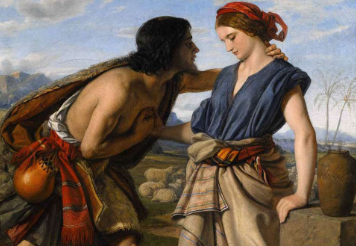
11 And Jacob kissed Rachel, and lifted up his voice and wept. — Jacob kissed Rachel and wept; Jacob first made himself, useful to Rachel, and then discloses to her who he is, claims her as a cousin, and kisses her;
— the Targum Onkelos says
Yaakov kissed Rochel and cried in a loud voice.
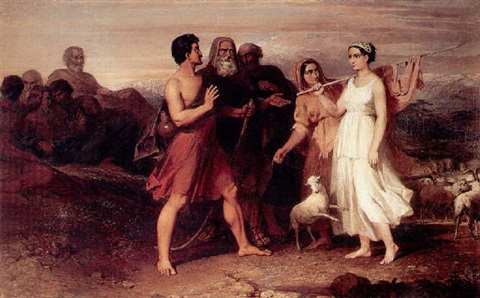
12 And Jacob told Rachel that he was her father’s brother, and that he was Rebekah’s son; and she ran and told her father. — and Rachel ran and told her father; leaving the care of her flock with Jacob; earlier, Rebekah, in a like case, ran and told her mother;
— the Targum Onkelos says
Yaakov told Rochel that he was a relative of her father [the son of her father’s sister], that he was the son of Rivkah. She ran and told her father.
— the Targum of Jonathan says
“And Jacob told Rachel that he had come to be a relative to her father and to take one of his daughters. Rachel answered and said: ‘It is not possible for you to dwell with him, for he is a cunning man.’ Jacob said to her: ‘I am as cunning and wiser than he, and he has no power to do me harm, for the Word of the Lord is my help.’ And when she knew that he was the son of Rebekah, she ran and told her father.”
13 And it came to pass, when Laban heard the tidings of Jacob his sister’s son, that he ran to meet him, and embraced him and kissed him, and brought him to his house. And he told Laban all these things.
— and he told Laban all these things; how he was sent hither by his parents on account of the hatred of his brother Esau, because he had got the birthright and blessing from him;
— the Targum Onkelos says
When Lavan heard the news of Yaakov, his sister’s son, he ran to greet him. He embraced him and kissed him, and brought him to his house. [Yaakov] told Lavan all that had happened.
— the Targum of Jonathan says
“And it was, when Laban heard the report of the mighty deeds and the righteousness of Jacob, his sister’s son—how he had taken the birthright and the order of the blessings from the hand of his brother; and how the Lord had revealed Himself to him at Bethel; and how he had fenced in the stone; and how the well had overflowed and risen to its surface—he ran to meet him, and embraced him, and kissed him, and brought him to his house. And Jacob recounted to Laban all these things.”
— in the Masoretic Text, “all these things” is vague; the Targum Jonathan makes it clear that Jacob was open about his past; that he was a fugitive from Esau, that he had experienced divine miracles; which sets up the irony: to let Laban knows Jacob is divinely blessed, yet Laban spends the next twenty years cunningly trying to outwit him.
14 And Laban said to him, “Surely thou art my bone and my flesh.” And he abode with him the space of a month. — and Laban said to him, surely thou art my bone and my flesh; closely allied in blood, being his sister’s son;
— the Targum Onkelos says
Lavan said to him, Nevertheless, you are my bone [relative] and flesh. [Yaakov] lived with him for a month.
15 And Laban said unto Jacob, “Because thou art my brother, shouldest thou therefore serve me for nought? Tell me, what shall thy wages be?” — doubtless Laban had seen, during Jacob’s stay of a month, that his services would be very valuable; hence the offer;
— the Targum Onkelos says
Lavan said to Yaakov, Just because you are my relative, must you work for me without pay? Tell me, [what should] your wages [be]?
16 And Laban had two daughters: the name of the elder was Leah, and the name of the younger was Rachel. — and the name of the elder was Leah; which signifies labour or weariness: and the name of the younger was Rachel; before mentioned, whom Jacob met at the well;
— the Targum Onkelos says
Lavan had two daughters. The name of the older one was Leah, and the name of the younger one was Rochel.
17 Leah was tendereyed, but Rachel was beautiful and wellfavored. — “Tender eyed” is the KJ translation; other translations are weak eyes, though other versions call her eyes blue (apparently a real turn-off), or dull, or soft, or lacking sparkle;
— the Targum Onkelos says
The eyes of Leah were tender [beautiful]. Rochel was of beautiful form and of beautiful appearance.
— the Targum of Jonathan says
“And the eyes of Leah were clouded/sore from weeping (tzirnaytan di-vachya); for she was praying before the Lord that He would not designate her for the wicked Esau. But Rachel was beautiful in form and fair in appearance.”
18 And Jacob loved Rachel, and said, “I will serve thee seven years for Rachel thy younger daughter.” — Jacob, not having any gold and silver, offer to serve seven years for Rachel;
— the Targum Onkelos says
Yaakov loved Rochel. and he said, I will work for you seven years for Rochel, your younger daughter.
19 And Laban said, “It is better that I give her to thee, than that I should give her to another man. Abide with me.” — it is better that I should give her to thee, than that I should give her to another man; by which he not only intimates that he preferred him, a relation, to another man, a stranger;
— the Targum Onkelos says
Lavan said, Better that I give her to you than I should give her to another man. [Remain] living with me.
20 And Jacob served seven years for Rachel; and they seemed unto him but a few days, for the love he had for her. — they seemed unto him but a few days; Jacob was at least fifty-seven years of age, but the late marriages hitherto of the patriarchs show that they only slowly arrived at manhood;
— the Targum Onkelos says
Yaakov worked seven years for Rochel, but they seemed to him like a few days, so much did he love her.
21 And Jacob said unto Laban, “Give me my wife, for my days are fulfilled, that I may go in unto her.” — the seven years were up he agreed to serve him for his daughter; that I may go in unto her; as his lawful wife, and it was high time Jacob had her;
— the Targum Onkelos says
Yaakov said to Lavan, Give me my wife, for my term [of labor] is completed; and thus I will consummate the marriage with her.
22 And Laban gathered together all the men of the place and made a feast. — and made a feast; a marriage or marriage feast; normally lasting seven days;
— the Targum Onkelos says
Lavan gathered all the local people and he made a [wedding] feast.
— the Targum of Jonathan reveals how Laban tried to outwit Jacob
“And Laban gathered all the men of the place and made a banquet for them. And he said to them: ‘Behold, for the seven years that Jacob has been with us, the wells have not failed and our watering places have increased. And now, come, let us take counsel against him with a plan of cunning counsel so that he will remain with us.’ And they made a plan of cunning counsel against him, to bring to him Leah instead of Rachel.”
23 And it came to pass in the evening, that he took Leah his daughter and brought her to him; and he went in unto her. — and he went in unto her; or lay with her as his wife; a modest expression of the use of the bed;
— the conduct of Laban is perfectly intelligible as the outcome of his sordid avarice; but it is difficult to understand how Leah could acquiesce in a proposal so base as to wrong her sister by marrying one who neither sought nor loved her;
— the Targum Onkelos says
When it was evening, he took Leah, his daughter, and brought her to him [Yaakov]. He consummated the marriage with her.
24 And Laban gave unto his daughter Leah, Zilpah his maid for a handmaid. — instead of Rachel, Laban took his elder daughter Leah into the bride-chamber, and Jacob went in unto her, without discovering in the dark;
— the Targum Onkelos says
Lavan gave Zilpah, his servant to her, to Leah, his daughter as a handmaid.
— the Targum of Jonathan says, “and Laban gave her Zilpah his daughter, whom his concubine bore unto him:” hence some Jewish authorities say that the daughters of a man by his concubines are called maids.
25 And it came to pass that in the morning, behold, it was Leah; and he said to Laban, “What is this thou hast done unto me? Did not I serve with thee for Rachel? Why then hast thou beguiled me?”
— wherefore then hast thou beguiled me? by giving Leah instead of her: though Laban is not to be justified in this action;
— yet it appears in Providence a righteous retaliation of Jacob; he beguiled his own father, pretending he was his brother Esau; and now his father-in-law beguiles him, giving him blear eyed Leah instead of beautiful Rachel;
— the Targum Onkelos says
When it was morning, behold it was Leah! He [Yaakov] said to Lavan, What have you done to me? Did I not work with you for Rochel? Why did you deceive me?
26 And Laban said, “It must not be so done in our country, to give the younger before the firstborn. — it is still the custom not to give the younger in marriage before the older, unless the latter be deformed or in some way defective;
— the Targum Onkelos says
Lavan said, It is not done so in our place, to give the younger [daughter in marriage] before the firstborn.
27 Fulfill her week, and we will give thee this other also, for which service thou shalt serve with me yet seven other years.” — fulfil her week; not Rachel’s week,
— or a week of years of servitude for her, but Leah’s week, or the week of seven days of feasting for her marriage; for a marriage feast used to be kept seven days;
— the Targum Onkelos says
Complete the [marriage] week for this one. We will then give you the other also—in return for the work that you will do with me for another seven years.
28 And Jacob did so, and fulfilled her week; and he gave him Rachel his daughter for a wife also. — and he gave him Rachel his daughter to wife also; not after seven years’ service, but after the seven days of feasting for Leah;
— the Targum Onkelos says
Yaakov did so, and he completed the [marriage] week for this one [Leah]. He [Lavan] then gave Rochel, his daughter to him as a wife.
29 And Laban gave to Rachel his daughter Bilhah his handmaid to be her maid. — also giving Bilhah her handmaid unto him; and this the Targum of Jonathan is said to be a daughter of Laban by a concubine also;
— the Targum Onkelos says
To his daughter, Rochel, Lavan gave his servant Bilhah, to be her handmaid.
30 And he went in also unto Rachel, and he loved also Rachel more than Leah, and served with him yet seven other years. — and served with him, yet seven other years; that is, Jacob served so many years with Laban after he had married his two daughters, and fulfilled the weeks of feasting for each of them;
— the Targum Onkelos says
He [Yaakov] also consummated his marriage with Rochel. He loved Rochel more than Leah, and he worked with [Lavan] additionally, another seven years.
31 And when the Lord saw that Leah was hated, he opened her womb; but Rachel was barren. — Leah was hated; for plainly Leah was not the object of love at all; it was her fruitfulness which gave her value in her husband’s eyes, and when this ceased, Jacob utterly neglected her (Genesis 30:15);
— the Targum Onkelos says
Adonoy saw that Leah was the hated one, and He opened her womb [allowed her to conceive]. Rochel remained barren.
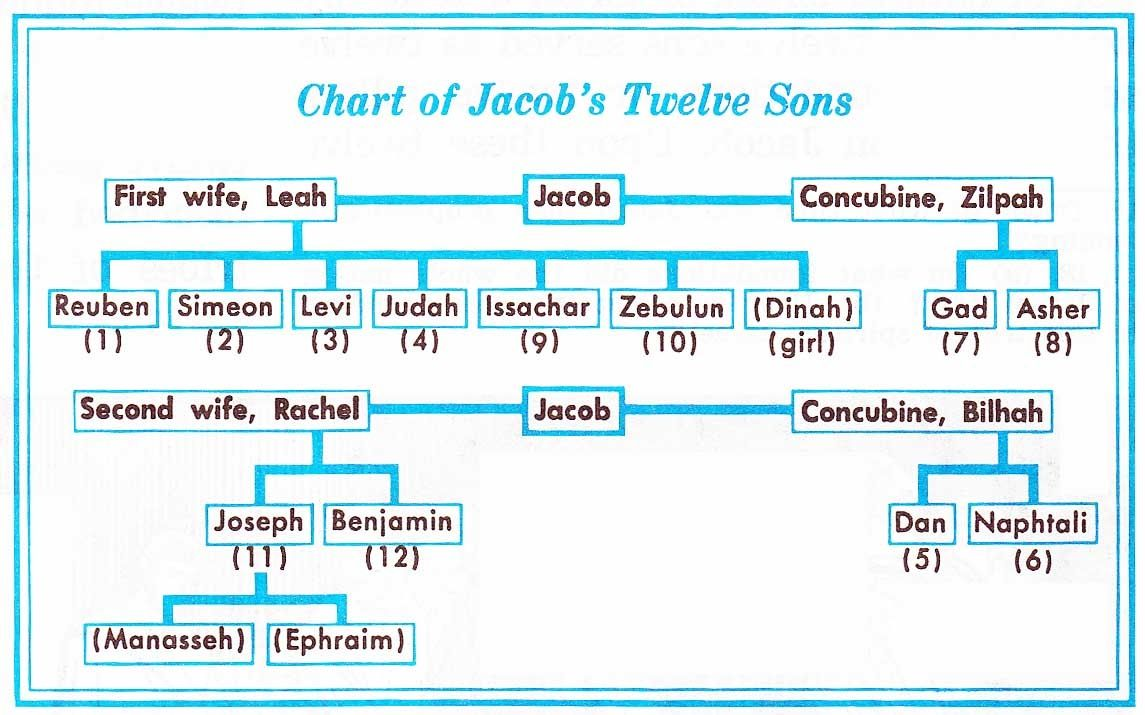
32 And Leah conceived and bore a son, and she called his name Reuben [that is, See a son]; for she said, “Surely the Lord hath looked upon my affliction. Now therefore my husband will love me.” — Reuben ~ France;
— the Targum Onkelos says
Leah conceived and gave birth to a son. She named him Reuvein, as she said, Adonoy has seen my affliction [was revealed before Adonoy]; for now my husband will love me.
33 And she conceived again and bore a son, and said, “Because the Lord hath heard that I was hated, He hath therefore given me this son also.” And she called his name Simeon [that is, Hearing]. — Germany?
— the Targum Onkelos says
She conceived again and gave birth to a son. She said, Since Adonoy [it was] heard [before Adonoy] that I am the hated one, He also gave me this one, and she named him Shimon.
34 And she conceived again and bore a son, and said, “Now this time will my husband be joined unto me, because I have borne him three sons.” Therefore was his name called Levi [that is, Joined]. — Judah and Levi ~ Israel;
— the Targum Onkelos says
She conceived again and gave birth to a son. She said, This time my husband will become attached to me, for I have born him three sons. He therefore named him Leivi.
35 And she conceived again and bore a son; and she said, “Now will I praise the Lord.” Therefore she called his name Judah [that is, Praise], and ceased bearing.
— the Targum Onkelos says
She conceived again and gave birth to a son. She said, This time I will [give] praise [before] Adonoy. She therefore named him Yehudah. She then stopped giving birth.
— Judah; which signifies “praise” the Targum of Jonathan adds this as a reason, “because from this my son shall come forth kings, and from him shall come forth David the king, who shall praise the Lord,” and a son in whose line, and from whose tribe, the Messiah was to spring.
Genesis 30
1 And when Rachel saw that she bore Jacob no children, Rachel envied her sister, and said unto Jacob, “Give me children, or else I die.” — Give me children, or else I die’this is the stress proverb that a childless person is as good as dead;
— the Targum Onkelos says
Rochel saw that she was not bearing children to Yaakov. Rochel became jealous of her sister, and she said to Yaakov, Give me children; if not I am [considered] dead.
2 And Jacob’s anger was kindled against Rachel; and he said, “Am I in God’s stead, who hath withheld from thee the fruit of the womb?” — Am I in God’s stead? that is, do you take me to be God, for it is God’s prerogative to give children;
— the Targum Onkelos says
Yaakov became very angry with Rochel, and he said, Am I in God’s place? [Are you asking me? Is it not from before God that you should ask?] [It is He] who has withheld from you the fruit of the womb.
3 And she said, “Behold my maid Bilhah. Go in unto her, and she shall bear upon my knees, that I may also have children by her.” — behold my maid Bilhah; in desperation, she would rather have children by reputation than none at all; children that she can call her own, though they be not so;
— the Targum Onkelos says
She said, Here is my handmaid, Bilhah, consummate a marriage with her. Let her give birth upon my knees [and I will rear them], and I too will have a son [be built up] through her.
4 And she gave him Bilhah her handmaid for a wife; and Jacob went in unto her. — and Jacob went in unto her; consenting to what Rachel his wife proposed to him:
— having concubines, as well as more wives than one, were not thought criminal in those times, and were suffered of God, and in this case for the multiplication of Jacob’s seed;
— the Targum Onkelos says
She gave him Bilhah, her handmaid, as a wife and Yaakov consummated the marriage with her.
5 And Bilhah conceived and bore Jacob a son.
— the Targum Onkelos says
Bilhah conceived and bore Yaakov a son.
6 And Rachel said, “God hath judged me, and hath also heard my voice and hath given me a son.” Therefore she called his name Dan [that is, Judging]. — Dan means judging; signifies judgment; Dan ~ Ireland, Denmark;
— the Targum Onkelos says
Rochel said, Elohim has judged me. He has also heard my voice [accepted my prayer], and has given me a son. She therefore named him Don.
7 And Bilhah, Rachel’s maid, conceived again and bore Jacob a second son.
— the Targum Onkelos says
She conceived again, and Bilhah, Rochel’s handmaid, bore a second son to Yaakov.
8 And Rachel said, “With great wrestlings have I wrestled with my sister, and I have prevailed.” And she called his name Naphtali [that is, My wrestling]. — Naphtali ~ Sweden;
— the Targum Onkelos says
Rochel said, With Elohim’s bonds, I have been joined to my sister, and I have also prevailed [Elohim accepted my request, when I pleaded in my prayer, I desired that I would have offspring like my sister, it was also given to me]. She [therefore] called him Naftali.
9 When Leah saw that she had ceased bearing, she took Zilpah her maid and gave her to Jacob for a wife;
— the Targum Onkelos says
Leah realized that she was no longer bearing children. She [therefore] took Zilpah, her handmaid, and gave her to Yaakov as a wife.
10 and Zilpah, Leah’s maid, bore Jacob a son.
— the Targum Onkelos says
Zilpah, Leah’s handmaid, bore Yaakov a son.
11 And Leah said, “A troop cometh.” And she called his name Gad [that is, A troop or company]. — Gad ~ Switzerland;
— the Targum Onkelos says
Leah said, Unexpected success has come, and she named him Gad.
12 And Zilpah, Leah’s maid, bore Jacob a second son.
— the Targum Onkelos says
Zilpah, Leah’s handmaid bore a second son to Yaakov.
13 And Leah said, “Happy am I, for the daughters will call me blessed.” And she called his name Asher [that is, Happy]. — Asher ~ Belgium;
— the Targum Onkelos says
Leah said, It is in my good fortune that daughters [women] will consider me fortunate. [Praise is mine, because women will praise me from now.] She named him Asher.
14 And Reuben went in the days of wheat harvest and found mandrakes in the field, and brought them unto his mother Leah. Then Rachel said to Leah, “Give me, I pray thee, of thy son’s mandrakes.” — mandrakes; arose from the popular belief that it was a specific against barrenness;
— Rachel, therefore, who still hankered after children of her own, was anxious to obtain some of the fruit, and Leah consents only upon the proffered condition that Jacob shall spend the night in her tent;
— the Targum Onkelos says
Reuvein went in the days of the wheat harvest, and found jasmine flowers in the field. He brought them to Leah, his mother. Rochel said to Leah, Please [Now] give me some of your son’s jasmine flowers.
15 But she said unto her, “Is it a small matter that thou hast taken my husband? And wouldest thou take away my son’s mandrakes also?” And Rachel said, “Therefore he shall lie with thee tonight, for thy son’s mandrakes.”
— and Rachel said, therefore he shall lie with thee tonight for thy son’s mandrakes; which showed no great affection to her husband, and a slight of his company, to be willing to part with it for such a trifle;
— and it seems by this as if they took their turns to lie with Jacob, and this night being Rachel’s turn, she agrees to give it to Leah for the sake of the mandrakes;
— the Targum Onkelos says
She [Leah] said to her, Isn’t it enough that you took my husband? Would you also take my son’s jasmine flowers? Rochel said, Therefore, he shall be with you tonight in exchange for your son’s jasmine flowers.
16 And Jacob came out of the field in the evening, and Leah went out to meet him and said, “Thou must come in unto me, for surely I have hired thee with my son’s mandrakes.” And he lay with her that night.
— the Targum Onkelos says
Yaakov came from the field in the evening, and Leah went out to meet him. She said, You will come to me, for I have hired you with my son’s jasmine flowers, and he was with her at night.
17 And God hearkened unto Leah, and she conceived and bore Jacob the fifth son.
— the Targum Onkelos says
Elohim perceived [accepted] Leah’s [wish] [prayer]. She conceived and bore [her] fifth son to Yaakov.
18 And Leah said, “God hath given me my hire, because I have given my maiden to my husband.” And she called his name Issachar [that is, A hire]. — Issachar ~ Finland;
— the Targum Onkelos says
Leah said, Elohim has given me my reward because I gave my handmaid to my husband. She named him Yissachar.
19 And Leah conceived again and bore Jacob the sixth son.
— the Targum Onkelos says
Leah conceived again and bore [her] sixth son to Yaakov.
20 And Leah said, “God hath endued me with a good dowry. Now will my husband dwell with me, because I have borne him six sons.” And she called his name Zebulun [that is, Dwelling]. — Zebulun ~ Holland;
— the Targum Onkelos says
Leah said, Elohim has given [me] a goodly portion. Now my husband will make his [main] home with me, for I have borne him six sons. She named him Zevulun.
21 And afterwards she bore a daughter, and called her name Dinah [that is, Judgment].
— and here from the Message Bible:
14 One day during the wheat harvest Reuben found some mandrakes in the field and brought them home to his mother Leah. Rachel asked Leah, “Could I please have some of your son’s mandrakes?”
15 Leah said, “Wasn’t it enough that you got my husband away from me? And now you also want my son’s mandrakes?”
Rachel said, “All right. I’ll let him sleep with you tonight in exchange for your son’s mandrakes.”
16-21 When Jacob came home that evening from the fields, Leah was there to meet him: “Sleep with me tonight; I’ve bartered my son’s mandrakes for a night with you.” So he slept with her that night.
God listened to Leah; she became pregnant and gave Jacob a fifth son. She said, “God rewarded me for giving my maid to my husband.” She named him Issachar (Bartered).
Leah became pregnant yet again and gave Jacob a sixth son, saying, “God has given me a great gift. This time my husband will honor me with gifts—I’ve given him six sons!”
She named him Zebulun (Honor). Last of all she had a daughter and named her Dinah. Genesis 30:14-16 MSG
— the Targum Onkelos says
Afterwards she gave birth to a daughter, and named her Deenah.
22 And God remembered Rachel, and God hearkened to her and opened her womb. — God remembered Rachel; her long barrenness had probably humbled and disciplined her; and cured of her former petulance, she trusts no longer to mandrakes or “love-apples” but looks to God for the great blessing of children;
— the Targum Onkelos says
Elohim remembered Rochel [The remembrance of Rochel came before Elohim, and Elohim perceived her plight] [accepted her prayer] and opened her womb [allowed her to conceive].
— the Targum Jerusalem says
“Four keys are delivered into the hand of the Lord of all the world, and He has not delivered them to angel or seraph: The Key of Rain, the Key of Sustenance, the Key of the Graves (Resurrection), and the Key of the Barren Woman.
- The Key of Rain: As the explicit scripture says: ‘The Lord will open for you His good treasury [the heavens, to give rain]’ (Deut. 28:12).
- The Key of Sustenance: As the explicit scripture says: ‘You open Your hand [and satisfy the desire of every living thing]’ (Psalm 145:16).
- The Key of the Graves: As the explicit scripture says: ‘When I open your graves [O My people]’ (Ezekiel 37:13).
- The Key of the Barren Woman: As the explicit scripture says: ‘And God remembered Rachel…’ (Gen. 30:22).
And the Word (Memra) of the Lord in His good mercies remembered Rachel; and the Word of the Lord heard the voice of her prayer, and He said by His Word to give her children.”
23 And she conceived and bore a son, and said, “God hath taken away my reproach.” — and she conceived and bare a son; through the goodness of God unto her, and for which she was greatly thankful;
— the Targum Onkelos says
She conceived and gave birth to a son. She said, Elohim has removed my shame.
24 And she called his name Joseph [that is, Adding], and said, “The Lord shall add to me another son.” — the name appears to be, that they were influenced by the promises of God to Abraham; whose posterity were promised the richest blessings: Manasseh ~ UK; Ephraim ~ US;
— the Targum Onkelos says
She named him Yoseif, saying, May Adonoy add to me another son.
25 And it came to pass, when Rachel had borne Joseph, that Jacob said unto Laban, “Send me away, that I may go unto mine own place and to my country.
— that Jacob said unto Laban, send me away; give me leave to depart thy house: he had a right to demand his liberty, and to insist upon it, since the time of his servitude was up; but he chose to have leave;
— that I may go unto mine own place, to Beersheba, where his father and mother lived, and whom, no doubt, he longed to see; and to the land of Canaan, in which that place was, which was his native country and was given him by promise, and was to be the inheritance of his seed;
— the Targum Onkelos says
When Rochel had given birth to Yoseif, Yaakov said to Lavan, Send me on my way, and I will go to my own place and to my homeland.
— the Targum of Jonathan reveals how the posterity of Joseph, not Judah, were to be a yoke (Genesis 27:40) and a flame unto the house of Esau, saying
“And it was, when Rachel had given birth to Joseph, that Jacob said through the Holy Spirit that the House of Joseph is destined to be like a flame to consume the House of Esau. He said: ‘From now on, I am not afraid of Esau and his legions.’ And he said to Laban: ‘Send me away, that I may go to my own place and to my own land.'”
26 Give me my wives and my children for whom I have served thee, and let me go; for thou knowest my service which I have done thee.” — give me my wives; his two wives, Leah and Rachel, and the two maids, Bilhah and Zilpah, which he had given him for wives also;
— Jacob desires leave not only to have them, but to take them away with him;
— the Targum Onkelos says
Give me [permission to take] my wives and my children, for whom I worked for you, and I will go; for you know my work that I did for you.
27 And Laban said unto him, “I pray thee, if I have found favor in thine eyes, tarry; for I have learned by experience that the Lord hath blessed me for thy sake.”
— that the Lord hath blessed me: Laban, the good things he had, from the Lord, as the author and giver; that it was for Jacob’s sake that he was thus blessed;
— the Targum Onkelos says
Lavan said to him, If [now] I have found favor in your eyes, I have divined [determined] that Adonoy has blessed me because of you.
28 And he said, “Appoint me thy wages, and I will give it.” — and he went on, “So name your wages. I’ll pay you.”
— the Targum Onkelos says
He said, Set your wage for me, and I will give it.
29 And he said unto him, “Thou knowest how I have served thee and how thy flocks have been with me. — and Jacob said to Laban: thou knowest that I have served diligently and faithfully, without any salary, excepting for his wives; had no wages for his service all this time;
— the Targum Onkelos says
He [Yaakov] said to him, You know how I worked for you, and how your livestock were with me.
30 For it was little which thou had before I came, and it is now increased unto a multitude; and the Lord hath blessed thee since my coming. And now, when shall I provide for mine own house also?” — for it was little before I came; perhaps just a single flock, since Rachel, his youngest daughter, had the care of it;
— and it is now increased unto a multitude; or “broke forth,” spread itself over the fields and plains, hills and mountains adjacent, so that they were covered with his sheep, these bringing forth thousands and ten thousands;
— the Targum Onkelos says
For the little you had before I came here has increased and has become a multitude. Adonoy has blessed you with my coming [for my sake]. Now when will I also do something for my own house?
31 And he said, “What shall I give thee?” And Jacob said, “Thou shalt not give me anything. If thou wilt do this thing for me, I will again feed and keep thy flock: — I will again feed and keep thy flock; it seems by this that Jacob had relinquished the care of the flock, upon the time of his servitude being out;
— but, upon the following condition, proposes to return to it, lead it out to the pastures, and feed it on them, and keep it night and day, as he had used to do;
— the Targum Onkelos says
He [Lavan] said, What shall I give you? Yaakov said, Do not give me anything—if you do this thing for me. I will continue to tend your flock and guard it.
32 I will pass through all thy flock today, removing from thence all the speckled and spotted animals, and all the brown animals among the sheep, and the spotted and speckled among the goats; and of such shall be my hire.
— sheep are generally white, the goats black, and spotted or speckled ones comparatively few and rare;
— the Targum Onkelos says
I will go through all your flocks this day. I will remove from them every lamb that is speckled, or spotted, and every dark one among the sheep, and every goat that is spotted and speckled. That [kind] will be my wage.
33 So shall my righteousness answer for me in time to come, when it shall come for my hire before thy face: every one that is not speckled and spotted among the goats, and brown among the sheep, that shall be counted stolen with me.”
— Jacob proposed to remove all existing ones of that description from the flock, and to be content with what might appear at the next lambing time. The proposal seemed so much in favor of Laban, that he at once agreed to it;
— the Targum Onkelos says
My righteousness shall testify for me in the future when it comes before you regarding my wage. Any goat which is not speckled or spotted, and any sheep that is [not] dark, is stolen [if it is] in my possession.
34 And Laban said, “Behold, I would it might be according to thy word.” — and everyone that is not speckled and spotted amongst the goats, and brown among the sheep, that shall be accounted stolen with me;
— if any such were found among those that Jacob should hereafter call his flock, as were without specks and spots, or were not brown, he was content they should be reckoned as stolen;
— the Targum Onkelos says
Lavan said, Agreed, may it be as you say.
35 And he removed that day the hegoats that were ringstreaked and spotted, and all the shegoats that were speckled and spotted, and every one that had some white in it, and all the brown among the sheep, and gave them into the hand of his sons.
— and all the she goats that were speckled and spotted; so that there might be neither male nor female of those mixed colours; this he did to prevent any generation of them:;
— the Targum Onkelos says
That day he [Lavan] removed the he-goats that were ringed and spotted, and all the she-goats that were speckled and spotted, everyone that had white in it, and all the dark ones among the sheep; and he gave them to his sons.
— and everyone that had some white in it; any white spot in it, as the Targum of Jonathan; that is, everyone of the brown or black colour, that had any white in it: and all the brown among the sheep: that were entirely so: and, gave them into the hands of his sons; the sons of Laban, who were now grown up and fit for such service.
36 And he set three days’ journey between himself and Jacob; and Jacob fed the rest of Laban’s flocks. — he set three days’ journey betwixt himself and Jacob; this means that Laban required that there should be an interval of between thirty and forty miles between himself, that is, his flocks, and those of Jacob;
— the Targum Onkelos says
He placed a three days journey between himself and Yaakov. Yaakov tended Lavan’s remaining flocks.
37 And Jacob took rods of green poplar and of the hazel and chestnut tree, and peeled white strips in them and made the white appear which was in the rods. — and pilled white strakes in them; took off the bark of them in some places, and left it on in others, which made white strakes;
— the Targum Onkelos says
Yaakov took rods of poplar that were fresh, hazel and chestnut [trees], and peeled white stripes in them by uncovering the white which is in the rods.
38 And he set the rods which he had peeled before the flocks in the gutters, in the watering troughs when the flocks came to drink, that they should conceive when they came to drink.
— in the gutters in the watering troughs, when the flocks came to drink; that is, in places of water, where troughs or vessels were made, into which the water ran convenient for the cattle to drink out of; and here he placed his party coloured rods right over against the flocks;
— the Targum Onkelos says
He stuck [inserted] the rods that he had peeled into the ducts of the [place of the] watering troughs [the place] where the flock [ewes] came to drink, facing the flock [rams]; that they should become heated when they came to drink.
39 And the flocks conceived before the rods, and brought forth animals ringstreaked, speckled and spotted. — brought forth cattle ringstraked, speckled, and spotted; such as Jacob was to have for his hire;
— the Targum Onkelos says
The flock [sheep] became heated [and mated] before the rods, and the flock [sheep] gave birth to ringed, speckled and spotted [offspring].
40 And Jacob separated the lambs, and set the faces of the flocks toward the ringstreaked and all the brown in the flock of Laban; and he put his own flocks by themselves, and put them not with Laban’s flocks. — Jacob did separate the lambs, such as were ring-straked and brown from the white;
— and he put his own flocks by themselves, and put them not unto Laban’s cattle; partly that they might not be mixed together, but kept distinct; and so his flocks be lessened;
— the Targum Onkelos says
Yaakov separated the lambs. He set the faces [at the head] of the flock [sheep] toward [all] the ringed ones and all the dark ones; [he did so] with Lavan’s flocks. He formed separate flocks of his own, and did not set [mix] them with Lavan’s flocks.
41 And it came to pass, whensoever the stronger animals conceived, that Jacob laid the rods before the eyes of the animals in the gutters, that they might conceive among the rods.
— and it came to pass, whensoever the stronger cattle did conceive; whose limbs were well compact, and were strong and healthy: that Jacob laid the rods before the eyes of the cattle in the gutters;
— the Targum Onkelos says
When the early-bearing flock [sheep] were heated [to mate], Yaakov placed the rods before the flock’s [sheep’s] eyes at the ducts, so they would be in heat among the rods.
42 But when the animals were feeble, he put them not in; so the feebler were Laban’s, and the stronger Jacob’s. — so the feebler were Laban’s, and the stronger Jacob’s; not only his flocks became more numerous than Laban’s, but were a better quality;
— the Targum Onkelos says
But when the flock [sheep] were late-bearing, he did not place [the rods before them]. Thus the late-bearing ones were Lavan’s, and the early-bearing ones became the possession of Yaakov.
43 And the man increased exceedingly and had large flocks, and maidservants and menservants, and camels and asses. — and the man increased exceedingly; Jacob grew very rich:
— and here from the Message Bible:
37-42 But Jacob got fresh branches from poplar, almond, and plane trees and peeled the bark, leaving white stripes on them. He stuck the peeled branches in front of the watering troughs where the flocks came to drink.
When the flocks were in heat, they came to drink and mated in front of the streaked branches. Then they gave birth to young that were streaked or spotted or speckled. Jacob placed the ewes before the dark-colored animals of Laban. That way he got distinctive flocks for himself which he didn’t mix with Laban’s flocks.
And when the sturdier animals were mating, Jacob placed branches at the troughs in view of the animals so that they mated in front of the branches. But he wouldn’t set up the branches before the feebler animals. That way the feeble animals went to Laban and the sturdy ones to Jacob.
43 The man got richer and richer, acquiring huge flocks, lots and lots of servants, not to mention camels and donkeys. Genesis 30:37-43 MSG
— the Targum Onkelos says
The man became tremendously prosperous. He had multipying flocks, female slaves and male slaves, camels and donkeys.


