
Ezekiel (Ch 47-48)
During the Millennium the most important feature is the faithful observance of the Sabbaths, both weekly and annual, the Feast days, especially the Passover, Pentecost and the Feast of Tablernacles, accompanied by an elaborate system of animal sacrifices and offerings at the Temple. So why are we not keeping the Sabbaths and Feast Days during this time?
The other feature is that the portion of land thus given to each tribe would be, on average, just two-thirds that were assigned by Joshua. And given the Great Sea is the Mediterranean Sea, and the east sea is the Dead Sea or even the Sea of Galilee, then the new Land allocated is rather small and restricted. Perhaps an area holding no more than 10 to 20 million people!
This could be partly because there would be only a small remnants that came out of the Great Tribulation, after the Time of the Gentiles (after the Flaming Sword from the South of Ezekiel 20-21; and after the Ezekiel 4 – 390/40 Years of captivity), the same as the Time of Jacob’s Troubles. The end result may, perhaps, be no more than five percent of the house of Jacob would survive to go through to dwell in the new Promised land.
Ezekiel 47
1 Afterward he brought me again unto the door of the house, and behold, waters issued out from under the threshold of the house eastward; for the forefront of the house stood toward the east, and the waters came down from under from the right side of the house, at the south side of the altar.
— afterward Ezekiel was brought before the waters of Shiloah Psalm 46:4; Isaiah 8:6 flowed from the rocks which is believed beneath the Temple Mount;
— waters; so Revelation 22:1 represents “the water of life as proceeding out of the throne of God and of the Lamb.”
— the Targum says,
“Then he brought me back to the door of the House; and behold, waters issued out from under the threshold of the House eastward, for the front of the House faced east; and the waters came down from beneath, from the right side of the House, on the south of the altar.”
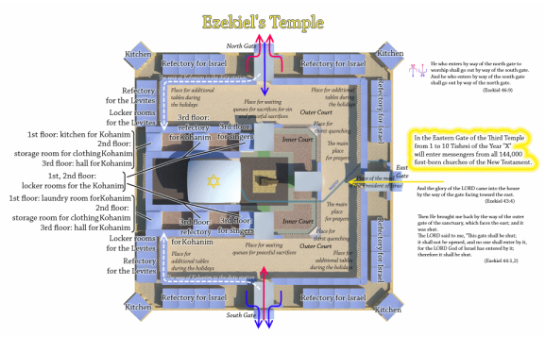
2 Then he brought me out of the way of the gate northward, and led me about the way outside unto the outer gate by the way that looketh eastward; and, behold, there ran out waters on the right side.
— the way of the gate northward: the east gate being shut, the prophet Ezekiel in this vision is led to the north gate, out of which he goes into the next court, and so through them all, till he comes to the north gate of the outermost court;
— and, behold, there ran out waters on the right side; or south side of the gateway;
— the Targum says,
“Then he brought me out by the way of the north gate, and led me round by the way without unto the outer gate, by the way of the gate that faces east; and behold, there were waters trickling forth from the right side.”
3 And when the man who had the line in his hand went forth eastward, he measured a thousand cubits, and he brought me through the waters; the waters were to the ankles. — a thousand cubits, or about one-third of a mile or half a kilometer;
— the waters flow eastward, that is, towards the Kedron, and thence towards the Jordan and then into the Dead Sea;
— the Targum says,
“When the man went forth eastward with a measuring line in his hand, he measured a thousand cubits, and he led me through the waters; the waters were ankle-deep.”
4 Again he measured a thousand, and brought me through the waters; the waters were to the knees. Again he measured a thousand, and brought me through; the waters were to the loins.
— the Targum says,
“Again he measured a thousand, and led me through the waters; the waters were to the knees. And he measured a thousand, and led me through; the waters were to the waist.”

5 Afterward he measured a thousand, and it was a river that I could not pass over; for the waters had risen, waters to swim in, a river that could not be passed over. — afterward he measured a thousand; a fourth time a thousand cubits, or about a mile and a half;
— the waters flow eastward, that is, from the Kedron onward into the Dead Sea; those lifeless waters were healed, but the main point in the picture is the rapid augmentation from a petty stream, getting deeper and deeper into a mighty river;
— the Targum says,
“And he measured a thousand, and it was a river that I could not pass through; for the waters had risen, waters to swim in, a river that could not be passed over.”
6 And he said unto me, “Son of man, hast thou seen this?” Then he brought me and caused me to return to the brink of the river.
— the metaphor; if we search into the things of God, we find some things plain and easy to be understood, as the waters that were but to the ankles; others more difficult, which require a deeper search, as the waters to the knees or the loins; and some quite beyond our reach, which we cannot penetrate;
— the Targum says,
“And he said to me, ‘Have you seen this, son of man?’ Then he led me and brought me back to the bank of the river.”
7 Now when I had returned, behold, at the bank of the river were very many trees on the one side and on the other. — in his first appearance he observed no trees, and no mention is made of any, but it seems Ezekiel found them on this return:
— though they may not really grow so soon, they might be visionary there; as he measured the waters; sees this wonderful sight; an emblem of true Saints, believers and regenerate persons, who are trees of righteousness, planted by the river with divine spirits;
— the Targum says,
“As I returned, behold, on the bank of the river were very many trees, on this side and on that side.”
8 Then said he unto me, “These waters issue out toward the east country and go down into the desert and go into the sea, which being brought forth into the sea, the waters shall be healed. — these waters signify the healing effect of God, which went forth from Jerusalem, and spread into the countries about;
— also the gifts and powers of the holy spirits which accompanied it, by virtue of which is spread far and produced healing and blessed effects;
— the Targum says,
“And he said to me: These waters issue out toward the eastern region, and go down into the plain (the Arabah), and enter into the sea; they are brought forth into the great sea, and the waters shall be healed.”
9 And it shall come to pass that every thing that liveth, which moveth, whithersoever the rivers shall come, shall live. And there shall be a very great multitude of fish, because these waters shall come thither; for they shall be healed, and every thing shall live whither the river cometh.
— the rivers, according to the pointing of the Hebrew text this is “the two rivers” as is expressed in the original;
— this peculiar form has occasioned some perplexity, especially because in the vision of Zechariah (Zechariah 14:8) the waters are represented as divided, half of them flowing into the Dead Sea and half into the Mediterranean.
— and there shall be a great multitude of fish, because these waters shall come multitude of fish in the Dead sea where none lived before, and owing to those waters coming thither: it signifies the great number of living Saints, who shall appear wherever the truth is truly, purely and powerfully preached;
— the Targum says,
“And it shall come to pass, that every living soul that swarms, in every place where the waters of the river come, shall live; and there shall be a very great multitude of fish, because these waters have come there; and they shall be healed and established in every place where the waters of the river come.”
10 And it shall come to pass that the fishers shall stand upon it from Engedi even unto Eneglaim; they shall be a place to spread forth nets. Their fish shall be according to their kinds as the fish of the Great Sea, exceeding many.
— from Engedi even unto Eneglaim; two places, which lay, the latter one at the entrance of the Dead sea, and the former at the end of it;
— for their fish shall be according to their kind as the fish of the Great Sea, the Mediterranean, exceeding many: that is, there shall be fish of all sorts, small and great, and in large numbers as in the Mediterranean;
— the Targum says,
“And it shall come to pass, that fishers shall stand by it from En-gedi even unto En-eglaim; there shall be a place for the spreading of nets; their fish shall be according to their kinds, like the fish of the Great Sea, exceeding many.”
11 But the miry places thereof and the marshes thereof shall not be healed; they shall be given to salt.
— shall not be healed; these design the reprobate part of the world, obstinate and perverse sinners, that abandon themselves to their filthy lusts, and sensual pleasures like Sodom; that wallow like swine in the mire and dirt of sin; are wholly immersed in all sorts of evils and falsehoods of this world;
— the Targum says,
“Its swamps and its marshes shall not be healed; they shall be set aside for salt pits.”
12 And by the river upon the bank thereof, on this side and on that side, shall grow all trees for food, whose leaf shall not fade, neither shall the fruit thereof be consumed. It shall bring forth new fruit according to his months, because their waters issued out of the sanctuary; and the fruit thereof shall be for food and the leaf thereof for medicine.”
— shall grow all trees for food; such as bear fruit, that may be eaten and is good for food: by these “trees” are meant truly gracious souls, converted persons, real Saints, true believers in the Scriptures;
— in the ancient world, many medicines were “topical” (applied to the skin) or brewed as teas, making the “leaf” the natural symbol for pharmaceutical power; but during the Millennium it further emphasizes that the leaves are but designed as a pharmacy;
“And by the river shall grow on its bank, from this side and from that side, every tree for food; its leaves shall not wither, and its fruit shall not fail; month by month it shall produce fruit, because its waters issue forth from the Sanctuary; and its fruit shall be for food, and its leaves for healing (לְאַסוּתָא – L’asuta).” Ezekiel 47:12 Jonathan
— this often implies that the creation of plants was not just for food, but to provide for all human needs; and that’s including health and healing.
13 Thus saith the Lord God: “This shall be the border whereby ye shall inherit the land according to the twelve tribes of Israel. Joseph shall have two portions. — according to the twelve tribes of Israel; in the ideal land of the restoration, not today’s Judah and Benjamin only, but all the twelve tribes are to have their portions;
— yet Levi is otherwise provided for in the “oblation,” and therefore Joseph, in accordance with Genesis 48:5, 22, and with the whole history of the nation, is to have two portions: Manasseh and Ephraim, for all Israel (all twelve tribes) is to return and dwell as one people of God under King David to their own land;
— this is further confirmed in Jeremiah 23:7-8
“Therefore, behold, the days come,” saith the Lord, “that they shall no more say, ‘The Lord liveth who brought up the children of Israel out of the land of Egypt,’ v8 but, ‘the Lord liveth who brought up and who led the seed of the house of Israel out of the north country, and from all countries whither I had driven them.’And they shall dwell in their own land” Jeremiah 23:7-8
— in the Lord’s eye, the land they are dwelling now, in western and northern Europe, North America and Australasia, are not their land!
— the Targum says,
“Thus says the Lord God: This is the border by which you shall divide the land for inheritance to the twelve tribes of Israel; Joseph shall have two portions.”
14 And ye shall inherit it, one as well as another, concerning which I lifted up Mine hand to give it unto your fathers; and this land shall fall unto you for inheritance. — again, and they shall dwell in their own land which God gave to their fathers;
— the Targum says,
“And you shall inherit it, one as well as another (equally); for I swore by My word to give it to your fathers; and this land shall fall to you as an inheritance.”
15 “And this shall be the border of the land: toward the north side, from the Great Sea, the way of Hethlon, as men go to Zedad,
— this shall be the border toward the north; the northern border of the land was to begin from the west point, on which side lay the Mediterranean sea, and to go on northward toward Hethlon, a place between Tyre and Damascus, and so forward to Zedad, mentioned Numbers 34:8, Hamath, and other places here mentioned in these verses;
— the Targum says,
“And this shall be the border of the land on the north side: from the Great Sea, by the way of Hethlon, as men go to Zedad.”
16 Hamath, Berothah, Sibraim, which is between the border of Damascus and the border of Hamath, Hazarhatticon, which is by the coast of Hauran.
— the Targum says,
“Hamath, Berothah, Sibraim, which is between the border of Damascus and the border of Hamath; Chatzar-Enon (The Pool of Agba’ei), which is on the border of Hauran.”
17 And the border from the sea shall be Hazarenon, the border of Damascus, and the north northward, and the border of Hamath. And this is the north side.
— the Targum says,
“And the border from the sea shall be Hazar-enon, the border of Damascus; and the north northward, and the border of Hamath. And this is the north side.”

18 “And the east side ye shall measure from Hauran, and from Damascus, and from Gilead, and from the land of Israel by the Jordan, from the border unto the east sea. And this is the east side.
— if the east sea is the Dead Sea extending even the Sea of Galilee, then the land allocated is rather small and restricted. Probably this is the beginning of the Millennium and not many of the twelve tribes could have survived to make the trip;
— the Targum says,
“And the east side: from between Hauran and Damascus, and from between Gilead and the land of Israel, the Jordan shall be the border; from the (northern) border unto the East Sea you shall measure. And this is the east side.”
19 “And the south side southward, from Tamar even to the Waters of Strife in Kadesh, the river to the Great Sea. And this is the south side southward.
— Tamar has been identified with Kurnub, a ruined village some twenty-five miles south-west of the southern end of the Dead Sea; no mention that it would extend unto the river of Egypt (Nile)
— the Targum says,
“And the south side southward: from Jericho (Tamar) unto the waters of strife of Rekem (Meribath-kadesh), along the stream to the Great Sea. And this is the south side southward.”
20 “The west side also shall be the Great Sea from the border till a man come opposite Hamath. This is the west side. — the Mediterranean Sea is known as the Great Sea and the land given is small and restricted;
— the Targum says,
“And the west side shall be the Great Sea, from the (southern) border as far as opposite the entrance of Hamath. This is the west side.”
21 “So shall ye divide this land unto you according to the tribes of Israel. — the division of the territory given into twelve parts or tribes of Israel, to which all, but what are allotted to the Prince, the priests, the Levites and the city;
— the Targum says,
“And you shall divide this land among you according to the tribes of Israel.”
22 And it shall come to pass that ye shall divide it by lot for an inheritance unto you and to the strangers that sojourn among you, who shall beget children among you. And they shall be unto you as born in the country among the children of Israel; they shall have inheritance with you among the tribes of Israel.
— the land so bounded shall be divided by lot among the families of each tribe; and strangers sojourning in Israel shall inherit just as those born in the land. The stranger shall have his inheritance by lots as well among the members of the tribe in which he sojourns, which they never had such privilege before;
— the Targum says,
“And it shall come to pass, that you shall divide it by lot for an inheritance unto you and to the strangers (proselytes) who dwell among you, who shall beget children among you; and they shall be unto you as the native-born among the children of Israel; with you they shall divide the inheritance in the midst of the tribes of Israel.”
23 And it shall come to pass that in what tribe the stranger sojourneth, there shall ye give him his inheritance, saith the Lord God.
— no stranger or proselyte or Gentile that joins himself to the people of God shall be excluded out of the tribe’s inheritance, among whom he hath sojourned as begotten children. Hence pushing back against refugees is unlawful in God’s eye;
— the Targum says,
“And it shall come to pass, that in whatever tribe the stranger (proselyte) sojourns, there you shall give him his inheritance, says the Lord God.”
Ezekiel 48
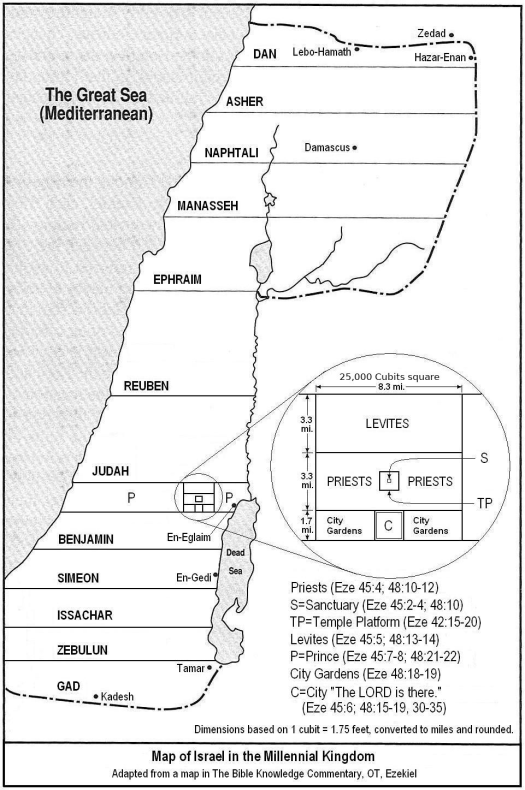
1 “Now these are the names of the tribes: From the north end to the coast of the way of Hethlon, as one goeth to Hamath, Hazarenan, the border of Damascus northward to the coast of Hamath; for these are his sides east and west: a portion for Dan.
— the territory falling to each tribe was somewhat smaller than of old, maybe because of some space occupied by the “oblation” (perhaps one-twentieth of the whole);
— and partly because these are those that came out of the Great Tribulation, during the Time of the Gentiles (perhaps this is also when the Flaming Sword from the South of Ezekiel 20-21; and during the Ezekiel 4 – 190/40 Years of captivity, during the Time of Jacob’s Troubles; the portion thus given to each tribe would be rather less than two-thirds that assigned, on the average, by Joshua; perhaps no more than five percent would survive and go through to live in the new Promised land.
For I will be unto Ephraim as a lion, and as a young lion to the house of Judah; I, even I, will tear and go away; I will take away, and none shall rescue him. Hosea 5:14
— the Targum says,
“And these are the names of the tribes: From the northern edge along the way of Hethlon, to the entrance of Hamath, Hazar-enan, the border of Damascus northward, beside Hamath; and they shall have from the east side to the west side: Dan, one portion.”
2 And by the border of Dan, from the east side unto the west side: a portion for Asher. — the original portion of Dan was at the west of Benjamin, but a part of the tribe having conquered Laish, and settled at the extreme north, now Dan is allotted the most northern of the tribes;
— Dan ~ which today is being identified as Ireland and Denmark;
— the Targum says,
“And by the border of Dan, from the east side unto the west side: Asher, one portion.”
3 And by the border of Asher, from the east side even unto the west side: a portion for Naphtali. — Asher, Naphtali, Manasseh and Ephraim are so far approximated to their old places as to be north of the sanctuary, Jerusalem and the Temple.
— Asher ~ Belgium
— the Targum says,
“And by the border of Asher, from the east side unto the west side: Naphtali, one portion.”
4 And by the border of Naphtali, from the east side unto the west side: a portion for Manasseh. — “Zebulun and Issachar” are removed from the north to the south to make room for the second half of “Manasseh” brought over from the east of Jordan;
— Naphtali ~ Sweden
— the Targum says,
“On the border of Naphtali, from the eastern side to the western side, (there shall be) one portion for Manasseh.”
5 And by the border of Manasseh, from the east side unto the west side: a portion for Ephraim.
— Manasseh ~ the United Kingdom
— the Targum says,
“And by the border of Manasseh, from the east side unto the west side: Ephraim, one portion.”
6 And by the border of Ephraim, from the east side even unto the west side: a portion for Reuben. — “Reuben,” brought over from the east, is placed between “Ephraim and Judah;”
— Ephraim ~ the United States
— the Targum says,
“And by the border of Ephraim, from the east side unto the west side: Reuben, one portion.”
7 And by the border of Reuben, from the east side unto the west side: a portion for Judah. — Reuben; doomed formerly for incest and instability “not to excel” (Genesis 49:4). So no distinguished prophet, priest, or king had come from him;
— Reuben ~ France
— the Targum says,
“And by the border of Reuben, from the east side unto the west side: Judah, one portion.”
8 “And by the border of Judah, from the east side unto the west side, shall be the offering which ye shall offer of five and twenty thousand reeds in breadth, and in length as one of the other parts, from the east side unto the west side; and the sanctuary shall be in the midst of it.
— Jerusalem would be allocated to Judah, but bordering Benjamin as would be different from the time of Joshua;
— and within the house of Judah, the priests and the Levites who would dwell among Judah in Jerusalem;
— Judah ~ modern state of Israel
— the Targum says,
And by the border of Judah, from the east side unto the west side, shall be the offering (contribution) which you shall offer, twenty-five thousand [reeds] in breadth, and in length as one of the [tribal] portions, from the east side unto the west side; and the Sanctuary shall be in the midst of it.”

9 The oblation that ye shall offer unto the Lord shall be of five and twenty thousand [reeds] in length, and of ten thousand in breadth.
— the Targum says,
“The offering (contribution) that you shall set apart before the Lord shall be twenty-five thousand [reeds] in length, and ten thousand in breadth.”
10 And for them, even for the priests, shall be this holy oblation: toward the north five and twenty thousand in length, and toward the west ten thousand in breadth, and toward the east ten thousand in breadth, and toward the south five and twenty thousand in length. And the sanctuary of the Lord shall be in the midst thereof.
— the Targum says,
“And for these shall be the holy offering, even for the priests: toward the north twenty-five thousand [reeds] in length, and toward the west ten thousand in breadth, and toward the east ten thousand in breadth, and toward the south twenty-five thousand in length; and the Sanctuary of the Lord shall be in the midst thereof.”
11 It shall be for the priests who are sanctified of the sons of Zadok, who have kept My charge, who went not astray when the children of Israel went astray, as the Levites went astray.
— the original Zadok was the high priest of Israel during the reigns of David and Solomon (II Samuel 8:16–18); so now a seed will come out of the original Zadok;
— the Targum says,
“It shall be for the priests who are sanctified, of the sons of Zadok, who kept the charge of My Word, who did not go astray when the children of Israel went astray, as the Levites went astray.”
12 And this oblation of the land that is offered shall be unto them a thing most holy by the border of the Levites. — so this land is for “a seed will come out of the original Zadok” which could be the new high priest!
— so we could conclude that the Prince (nā·śî) is not the Son, not the Messiah, nor Melchizedek, nor one of the seed of Zadok; but most probably King David; but problems remains to be clearly identified as concluded at the end of Chapter 36!
— the Targum says,
“And it shall be unto them an offering from the offering of the land, a thing most holy (Holy of Holies), by the border of the Levites.”
13 And opposite the border of the priests, the Levites shall have five and twenty thousand in length, and ten thousand in breadth; all the length shall be five and twenty thousand, and the breadth ten thousand.
— the Targum says,
“And the Levites, corresponding to the border of the priests, shall have twenty-five thousand [reeds] in length, and ten thousand in breadth; all the length shall be twenty-five thousand, and the breadth ten thousand (though the combined breadth of both priestly and Levite sections is twenty thousand).”
14 And they shall not sell any of it, neither exchange nor alienate the firstfruits of the land; for it is holy unto the Lord.
— the Targum says,
“And they shall not sell of it, nor exchange it, nor shall the first-fruits of the land be alienated; for it is holy unto the Lord.”
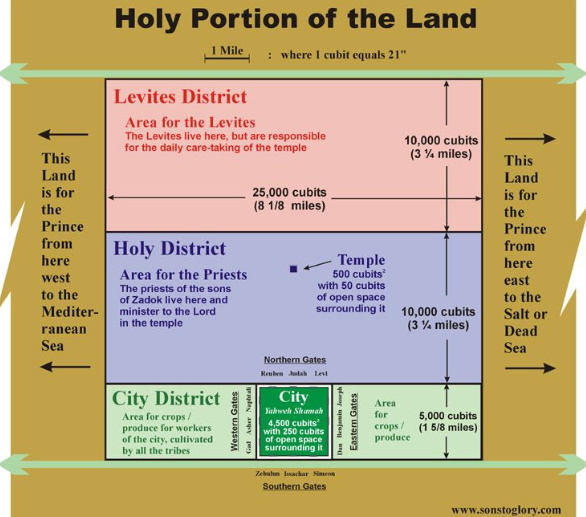
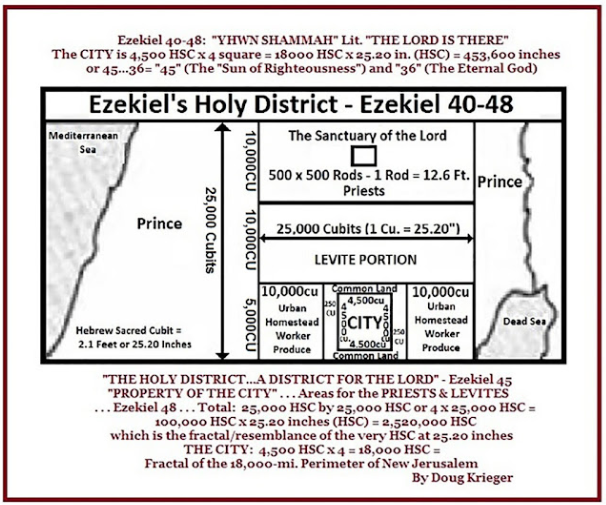
15 “And the five thousand that are left in the breadth opposite the five and twenty thousand, shall be a profane place for the city, for dwelling and for suburbs; and the city shall be in the midst thereof.
— the five thousand that are left; the two strips of territory for the Levites and the priests, each 10,000 reeds wide, being deducted from the whole width of the oblation, leaves a strip of 5,000 wide and 25,000 long which is here apportioned to the city and its suburbs;
— it is called “profane” comparatively, because it was not so holy in contrast to the Temple and the sanctuary deemed as the “holy” possession of the Levites (Ezekiel 48:14), and the “most holy” of the priests (Ezekiel 48:12), though it was still a part of the oblation;
— the Targum says,
“And the five thousand [reeds] that are left in the breadth, over against the twenty-five thousand [in length], shall be profane (common) for the city, for dwelling and for open space; and the city shall be in the midst thereof.”
16 And these shall be the measurements thereof: the north side four thousand and five hundred, and the south side four thousand and five hundred, and on the east side four thousand and five hundred, and the west side four thousand and five hundred.
— the measures; the city itself is to be an exact square of 4,500 reeds, and according to Ezekiel 48:17, was to have “suburbs,” or rather an open space on all sides of 250 reeds;
— the whole was, therefore, 5,000 reeds—a little less than ten miles—square, the exact width of the space that was left of the oblation, and leaving 10,000 reeds on each side;
— the Targum says,
“And these shall be its measures: the north side four thousand and five hundred, and the south side four thousand and five hundred, and on the east side four thousand and five hundred, and the west side four thousand and five hundred.”

17 And the suburbs of the city shall be toward the north two hundred and fifty, and toward the south two hundred and fifty, and toward the east two hundred and fifty, and toward the west two hundred and fifty.
— the Targum says,
“And the open space (suburbs) of the city shall be: toward the north two hundred and fifty, and toward the south two hundred and fifty, and toward the east two hundred and fifty, and toward the west two hundred and fifty.”
18 And the residue in length over against the oblation of the holy portion shall be ten thousand eastward and ten thousand westward; and it shall be over against the oblation of the holy portion, and the increase thereof shall be for food unto them that serve the city.
— shall be for food; this piece of land, only four times the size of the city itself, would seem a very insufficient provision for raising all the food unto them that serve the city; for the city officers, so that they may live nearby, whose life is spent for the city;
— the Targum says,
“And the residue in length, corresponding to the holy offering, shall be ten thousand toward the east, and ten thousand toward the west; and it shall be corresponding to the holy offering; and the increase thereof shall be for food for those who serve the city.”
19 And those who serve the city shall serve it out of all the tribes of Israel.
— out of all the tribes of Israel; the city itself is no longer to belong to any particular tribe, as of old, but is to be situated on the common oblation and its labourers are to be taken alike from all the tribes; still there is a portion for the tribe of Levites;
— the Targum says,
“And they that serve the city shall serve it out of all the tribes of Israel.”
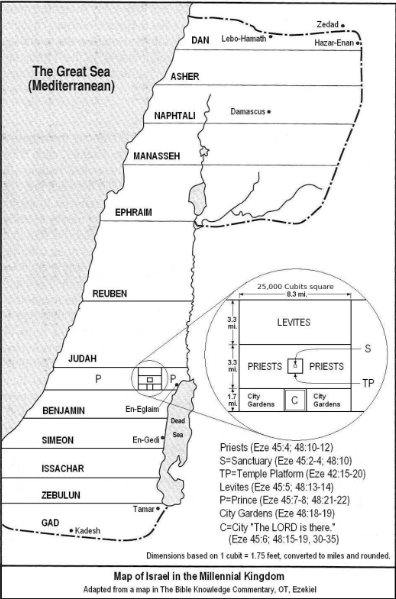

20 All the oblation shall be five and twenty thousand by five and twenty thousand. Ye shall offer the holy oblation foursquare, with the possession of the city. — the verse means that the holy oblation when the possession of the city is included forms a square of 25,000 by 25,000; that is, 10 miles square, which isn’t very big;
— the Targum says,
“All the offering (contribution) shall be twenty-five thousand by twenty-five thousand; you shall offer the holy offering four-square, with the possession of the city.”
21 “And the residue shall be for the prince, on the one side and on the other of the holy oblation, and of the possession of the city, over against the five and twenty thousand of the oblation toward the east border, and westward over against the five and twenty thousand toward the west border, over against the portions: for the prince. And it shall be the holy oblation, and the sanctuary of the house shall be in the midst thereof.
— the Land beyond the east toward the Mediterranean and beyond the west of the city toward the Dead Sea, will be allocated to the Prince, who remains a Mystery; Who is the Prince? Most probably King David or one of his seeds?
— King David was of the tribe of Judah (1 Chronicles 2:13-15), whereas Moses and Aaron; a lawgiver and a law-practitioner, were from the tribe of Levi (Exodus 6:20)
— the Targum says,
“And the residue shall be for the prince, on the one side and on the other side of the holy offering and of the possession of the city; in front of the twenty-five thousand [reeds] of the offering toward the east border, and westward in front of the twenty-five thousand toward the west border, corresponding to the [tribal] portions, it shall be for the prince; and the holy offering and the sanctuary of the house shall be in the midst thereof.”

22 Moreover from the possession of the Levites and from the possession of the city which is in the midst of that which is the prince’s, between the border of Judah and the border of Benjamin, shall be for the prince.
— the Prince’s allocation, of the tribe of Judah, seems clearly marked away from the Levites and those of the priests, which are of the tribe of Levi;
— “Benjamin” comes immediately south of the city, and “Gad” is brought over from the east to the extreme south;
— the Targum says,
“And from the possession of the Levites, and from the possession of the city, being in the midst of that which belongs to the prince, between the border of Judah and the border of Benjamin, it shall be for the prince.”
23 “As for the rest of the tribes, from the east side unto the west side, Benjamin shall have a portion.
— Benjamin ~ Norway
— the Targum says,
“And as for the rest of the tribes: from the east side unto the west side, Benjamin, one portion.”
24 And by the border of Benjamin, from the east side unto the west side, Simeon shall have a portion.
— Simeon was prophesied to be scattered
— the Targum says,
“And by the border of Benjamin, from the east side unto the west side: Simeon, one portion.”
25 And by the border of Simeon, from the east side unto the west side, Issachar a portion.
— Issachar ~ Finland
— the Targum says,
“And by the border of Simeon, from the east side unto the west side: Issachar, one portion.”
26 And by the border of Issachar, from the east side unto the west side, Zebulun a portion.
— Zebulun ~ the Netherlands (Holland)
— the Targum says,
“And by the border of Issachar, from the east side unto the west side: Zebulun, one portion.”
27 And by the border of Zebulun, from the east side unto the west side, Gad a portion.
— Gad ~ Switzerland
— the Targum says,
“And by the border of Zebulun, from the east side unto the west side: Gad, one portion.”
28 And by the border of Gad at the south side southward, the border shall be even from Tamar unto the Waters of Strife in Kadesh, and to the river toward the Great Sea.
— the Targum says,
“And by the border of Gad, at the south side southward, the border shall be even from Tamar (Aramaic: Yericho) unto the waters of strife (Meribah) of Kadesh, to the inheritance (the Brook of Egypt) unto the Great Sea.”
29 This is the land which ye shall divide by lot unto the tribes of Israel for inheritance, and these are their portions,” saith the Lord God.
— the Targum says,
“This is the land which you shall divide by lot for an inheritance unto the tribes of Israel, and these are their portions, saith the Lord God.”
30 “And these are the exits out of the city: On the north side, four thousand and five hundred measures,
— the Targum says,
“And these are the exits of the city: on the north side, four thousand and five hundred [reeds] by measure.”

31 and the gates of the city shall be after the names of the tribes of Israel, three gates northward: one gate of Reuben, one gate of Judah, one gate of Levi. — Judah and Levi ~ Israel;
— the Targum says,
“And the gates of the city shall be after the names of the tribes of Israel; three gates toward the north: the gate of Reuben, one; the gate of Judah, one; the gate of Levi, one.”
32 And at the east side, four thousand and five hundred, and three gates: and one gate of Joseph, one gate of Benjamin, one gate of Dan. — Manasseh ~ UK; Ephraim ~ US; Benjamin ~ Norway, Iceland; Dan ~ Ireland, Denmark;
— the Targum says,
“And at the east side four thousand and five hundred [reeds]; and three gates: the gate of Joseph, one; the gate of Benjamin, one; the gate of Dan, one.”
33 And at the south side, four thousand and five hundred measures, and three gates: one gate of Simeon, one gate of Issachar, one gate of Zebulun. — Simeon ~ scattered throughout Israel; Issachar ~ Finland; Zebulun ~ Holland;
— the Targum says,
“And at the south side four thousand and five hundred [reeds] by measure; and three gates: the gate of Simeon, one; the gate of Issachar, one; the gate of Zebulun, one.”
34 At the west side, four thousand and five hundred, with their three gates: one gate of Gad, one gate of Asher, one gate of Naphtali. — Gad ~ Switzerland; Asher ~ Belgium; Naphtali ~ Sweden.
— the Targum says,
“And at the west side four thousand and five hundred [reeds]; their gates shall be three: the gate of Gad, one; the gate of Asher, one; the gate of Naphtali, one.”
35 It was round about eighteen thousand measures. “And the name of the city from that day shall be: The LORD Is There.”
— the Targum says,
“Round about shall be eighteen thousand [reeds]; and the name of the city from that day shall be: ‘The Lord (Hashem) has caused His Shekhinah (Divine Presence) to dwell there.'” Ezekiel 48:35
~~~~~~
The identities of the various tribes above are largely drawn from the researches done by Steven Collins and Yair Davidiy; although there are some minor variants between them. Both, however, are erroneous in their identities of Ephraim and Manasseh.
~ and this below is from Yair Davidiy ~
The Tribes of Joseph dominate the USA, Britain, and related nations. Manasseh is especially evident in the USA, and was once present in Scotland. The Tribe of Reuben prevails in France;
Issachar in Switzerland and Finland; Benjamin in Belgium; Zebulon in the Netherlands; Dan in Denmark, as well as in Ireland, and parts of Britain; Naphtali in Norway, Gad in Sweden. The Tribe of Asher may be seen in Ireland; Ephraim, Manasseh and Judah in Ulster.
The Jewish People on the other hand derives mainly from the Tribes of Judah, Benjamin and Levi with minority element from the others.
~~~ THE END ~~~


