
China’s ‘Starlink killer’
China’s ‘Starlink killer’ new cutting edge of microwave weapons

China’s newly unveiled TPG1000Cs made to target satellites, shape a Taiwan fight and test US and allied space deterrence
AsiaTimes • February 10, 2026 ~ EuroNews
China’s latest high-power microwave (HPM) breakthrough, a powerful truck-mountable system described by Chinese researchers and Chinese media as a potential counter to Low-Earth Orbit (LEO) constellations such as Starlink, signals a shift toward non-kinetic weapons designed to paralyze satellites, command networks, and modern warfare itself.
This month, the South China Morning Post (SCMP) reported that Chinese researchers have developed what they claim is the world’s first HPM weapon compact driver. This device can generate 20 gigawatts of energy for up to 60 seconds.
They believe this breakthrough could pose a threat to large Low-Earth-Orbit (LEO) satellite constellations, like SpaceX’s Starlink. The team published their findings in the peer-reviewed journal Chinese High Power Laser and Particle Beams.
The device, known as the TPG1000Cs and developed at the Northwest Institute of Nuclear Technology in Xi’an, weighs about five tons, measures roughly four meters, and is designed for deployment on trucks, ships, aircraft or potentially in space, marking a sharp leap from earlier, bulkier systems that could operate only for a few seconds.
Researchers led by Wang Gang wrote that the system could deliver as many as 3,000 high-energy pulses in a single session and has already accumulated more than 200,000 test pulses, indicating stable performance.
Chinese experts estimate that outputs above 1 gigawatt could disrupt or damage low-orbit satellites, which China has warned pose national security risks. At the same time, SpaceX’s move to lower Starlink’s orbital altitude may increase vulnerability to ground-based directed-energy weapons.
The team said design changes—including lighter alloys, modified insulation paths, and a compact energy-storage geometry—enabled sustained power levels, underscoring China’s push to develop cost-effective counters to satellite networks.
HPM weapons disable electronics by forcing intense radiofrequency (RF) energy into systems through antennas, cables, and openings, inducing destructive voltage and current surges that disrupt or permanently damage components rather than simply heating them.
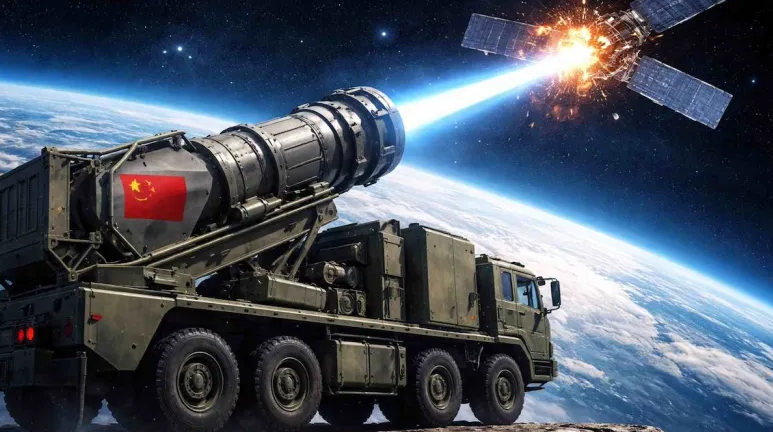
China’s TPG1000Cs may improve on earlier Hurricane-series HPM weapons, which were mainly for short-range drone defense at 2-3 kilometers, as some sources claim, using vehicle-mounted arrays for quick, cost-effective responses.
These earlier models had limited reach, power, and mission scope, making them unsuitable for attacking distant or hardened targets. In contrast, TPG1000Cs offer higher power and sustained energy, surpassing previous systems’ limits in duration, intensity, and reach.
With significantly increased power, China’s new HPM weapon could play a significant role in a Taiwan campaign. As noted by Tin Pak and Yu-cheng Chen in a May 2025 Jamestown article, the People’s Liberation Army (PLA) would employ HPM weapons as first-wave, non-kinetic strike tools to disable specific high-value electronic targets rather than for general disruption.
Pak and Chen mention that HPM strikes could be directed against command centers, radar installations, missile-defense systems, power grids, and communications networks, to collapse Taiwan’s command and control, and intelligence, surveillance, and reconnaissance (ISR) architecture and prevent coordinated resistance.


 Joel
Joel A Prophecy of Esau and Jacob