
Did the Ibēr or Ibēros River has its Hebraic roots?
Before Joseph went to Egypt, Jacob had already settled in the land of Canaan, taking possession from Esau. As it is written, “And Jacob lived in the land where his father had been a stranger, in the land of Canaan.” Genesis 37:1
After realizing the land of Canaan wasn’t his to claim, Esau gathered his family and possessions and departed. But where did he go—was it to a distant land, or somewhere still close to Canaan?
And Esau took his wives, and his sons and his daughters, and all the persons of his house, and his cattle and all his beasts, and all his substance which he had gotten in the land of Canaan, and went into the country from the face of his brother Jacob. Genesis 36:6
— and it wasn’t that Jacob feared Esau, but that Esau feared Jacob that lead him to flee the land of Canaan as the Targum testifies;
And Esau took his wives, and his sons, and his daughters, and all the persons of his house, and his herds, and his cattle, and all his property which he had acquired in the land of Canaan, and went to another land because the fear of Jacob his brother was cast upon him. Genesis 36:6 Jonathan
Even if Esau had stayed near the land of Canaan, he would soon have had to leave further away, as the effects of the famine took hold, and only in Egypt could they find grain. And they were no record of any of the children of Esau coming to Egypt. It seems very probable then that they would have gone further north-west to the Iberian peninsula.
Did the river called the Ibēr or Ibēros which flows through northeastern Spain have a marking of their Hebraic roots?
The connection between the Ebro River (Ibēr or Ibēros) and a potential Hebraic root is one of history’s most fascinating intersections of linguistics, biblical geography, and regional legend.
While mainstream, secular linguistics views the similarity as purely coincidental, a deeply rooted historical and theological tradition strongly links the river’s name directly to the Hebrews. This is an affirmative, as the children of Esau were also Hebrews, a name that came from their common forefather, Eber.
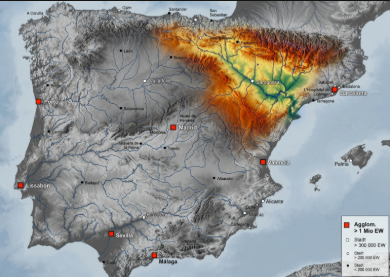
1. The Linguistic Connection: Iber and Ivri
The core of the Hebraic argument relies on phonetic and etymological convergence.
- The Hebrew Root: The Hebrew word for a Hebrew person is Ivri (עִבְרִי). This name is derived from the patriarch Eber (עֵבֶר), a great-grandson of Shem and a direct ancestor of Abraham.
- The Meaning: The trilateral Hebrew root ע-ב-ר (ʕ-b-r) literally means “to cross over” or “the region beyond.” Historically, Abraham and his family were called Ivriyyim (“Hebrews”) because they migrated from “the other side” of the Euphrates River.
- The Comparison: When the ancient Greeks arrived in northeastern Spain, they recorded the native name of the river as Ibēr. Stripped of Greek and Latin grammatical endings (-os or -us), the base root I-B-R mirrors the Hebrew root ע-ב-ר (E-B-R / I-V-R).
Because of this, historical traditions have argued that the Greek name for the river—and subsequently, the entire Iberian Peninsula—originally designated Hebrew-speaking colonies or settlements that had established themselves along its banks in antiquity.
2. The Historical Context: Solomon’s Navies and Tarshish
For a Hebraic root to exist in Spain, ancient Israelites or their closely aligned neighbors would have needed a physical presence there. The biblical and archaeological records provide exactly that:
- The Tarshish Trade Route: The Hebrew Bible frequently mentions that King Solomon formed a maritime alliance with King Hiram of Tyre, sending a grand fleet of “ships of Tarshish” out into the Mediterranean to harvest vast quantities of silver, iron, tin, and gold (1 Kings 10:22).
- Locating Tarshish: Ancient historians (such as Diodorus of Sicily) and modern archaeologists heavily identify the biblical Tarshish with the region of Tartessos in southern Spain—a land famed in antiquity for possessing the richest silver mines in the known world.
- The Phoenician Vector: The Phoenicians (who spoke a Northwest Semitic language nearly identical to biblical Hebrew) established major trading posts across Spain, including Cádiz and areas extending up the eastern coast toward the Ebro River. Hebrew merchants and miners traveled along these exact maritime trade loops during the First Temple period, leaving a linguistic footprint in the region.
3. The Counter-Argument: The Basque Isolate
To maintain objectivity, mainstream modern linguistics offers a completely non-Hebraic explanation rooted in Spain’s indigenous geography.
The Basque language (Euskara) is a pre-Roman language isolate completely unrelated to Indo-European or Semitic tongues. In modern Basque, the word ibai means “river” and ibar means “valley” or “watered meadow.” Secular geographers argue that when the early inhabitants called the river the Ibēr, they weren’t invoking the Hebrew patriarch Eber; they were simply using their native word for “The River” or “The Valley,” which the Greeks later transcribed into Ibēros.
Summary
Ultimately, whether the name Ibēr is a pure geographical coincidence or a permanent marker of ancient Israelite maritime exploration remains a subject of intense debate.
And the exiles of this nation of the Children of Israel that is in the land of the Canaanites (shall inherit) until Zerapahath. And the exiles of Jerusalem that are in Ispamiah will inherit the villages of the south land. Obadiah 1:20 Jonathan
And with evidence from the prophet Obadiah, indications are strong that the Edomites had moved into Spain and, centuries later, the captives from Judea who would also live there, that is, the Jews—specifically, the Sepharadi Jews, are from Spain, often referring to the broader Iberian Peninsula.
However, within Jewish history, the peninsula’s connection to the biblical narrative is absolute. When later Sephardic Jewish communities adopted the biblical name Sepharad (סְפָרַד) to explicitly mean Spain, they were honoring a deeply held conviction that the soil of Iberia had been bound to the world of the Hebrew scriptures since the days of the Kings of Israel.


