
The Quest of Manifest Destiny
Is this Manifest Destiny an expanistic belief of white nationalistic chauvinism or is it that of a Divine Providence?
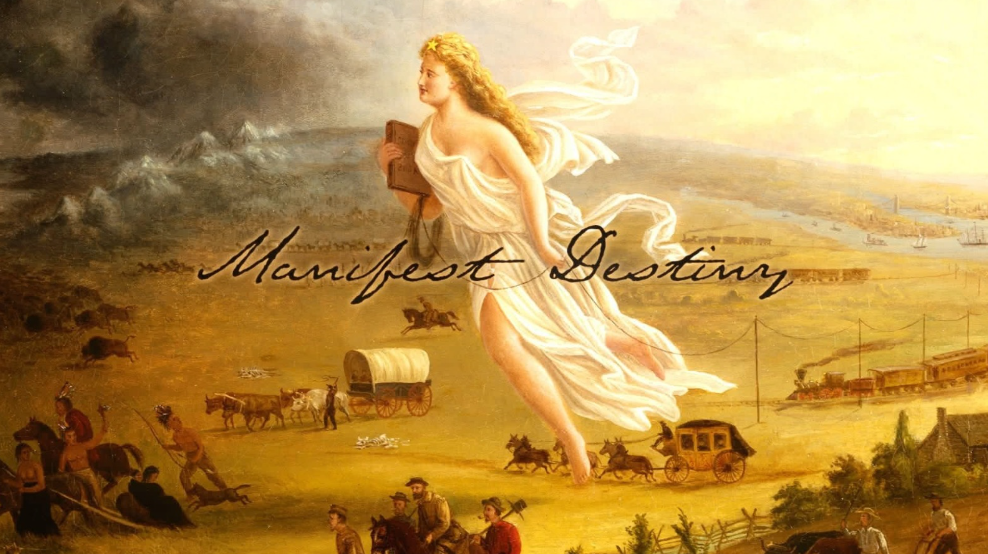
The evidence seems to incorporate both.
The Manifest Destiny, a termed coined by John O’Sullivan, is a manifesto for the expansionist belief in the 19th-century United States that American settlers were destined to expand westward across North America and beyond, and that this belief was both obvious “manifest” and certain “destiny.”
This belief is rooted in American exceptionalism, romantic nationalism, and nascent ideas of white nationalistic chauvinism, implying the inevitable spread of the American way. It is one of the earliest expressions of American imperialism.
According to historian William Earl Weeks, there were three basic tenets behind the concept:
- The assumption of the unique moral virtue of the United States.
- The assertion of a mission to redeem the world by the spread of the “American way of life.”
- The belief in the nation’s divinely ordained destiny to succeed in this mission.
Although Manifest Destiny remained divisive in politics, causing constant conflict with regard to slavery in new states and territories, most agreed with the expansion of European settlers onto the territories of Indigenous natives and the annexation of lands to the west of their borders, all involving the harsh removal of Indigenous communities, for farms and mining.
The concept became one of several major campaign issues during the 1844 presidential election, where the Democratic Party won and the term “Manifest Destiny” gained acceptance and was coined within a year.
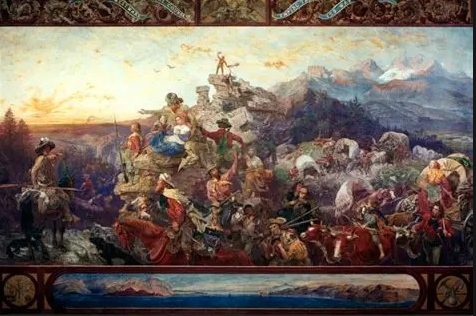
A Manifesto for Expansion
The impatient English who colonized North America in the 1600s and 1700s gazed westward and passionately considered ways to venture into the wilderness and tame it. The cause of such ceaseless wanderlust varied from region to region, but the behaviour became a tradition within one generation.
Although the Manifest manifesto became a rallying cry as well as a rationale forits expansive policy that reached its culmination in 1845–46, the attitude behind Manifest Destiny had long been a part of the American experience.
Thanks to a high birth rate and brisk immigration, the US population exploded in the first half of the 19th century, from around 5 million people in 1800 to more than 23 million by 1850.
In 1803, President Thomas Jefferson’s Louisiana Purchase doubled the size of the country with the stroke of a pen, adding some 828,000 square miles stretching from the Mississippi River to the Rocky Mountains.

Andrew Jackson’s invasion of Florida in 1818 and the subsequent Transcontinental Treaty (Adams-Onís Treaty) settled a southern border question that had been vexing the region for a generation and established an American claim to the Pacific Northwest as Spain renounced its claim to the Oregon Country.
The most consequential territorial expansion in the country’s history occurred during the 1820s. Spreading American settlements often caused additional unrest on the country’s western borders.
As the United States pacified and stabilized volatile regions, the resulting appropriation of territory usually worsened relations with neighbours, setting off a cycle of instability that encouraged additional annexations.
Finally, in the 1840s, diplomacy resolved the dispute over the Oregon Country with Britain, and victory in the Mexican-American War (1846–48) closed out a period of dramatically swift growth for the United States.
In less than a century after breaking from the British Empire, the United States had gone far in creating its own empire by extending sovereignty across the continent to the Pacific, up to the 49th parallel on the Canadian border, and down to the Rio Grande in the south.
Realizing its Manifest Destiny with triumph over Mexico in 1848 gave the United States an immense domain that came with spectacular abundance and potential.
Under the Treaty of Guadalupe Hidalgo, the United States acquired more than 525,000 square miles of land, including Arizona, California, western Colorado, Nevada, New Mexico, Texas and Utah.
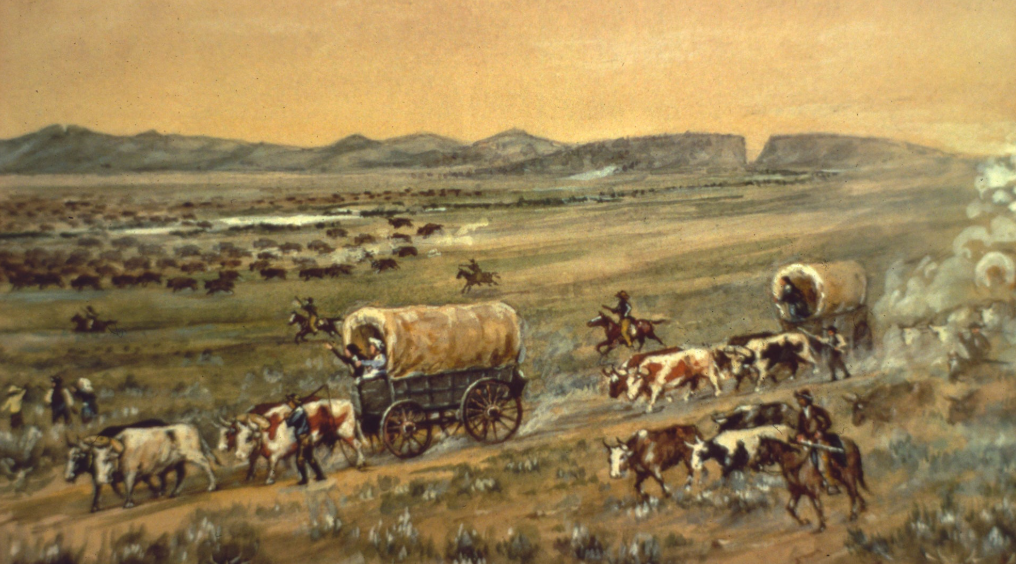
California’s climate made much of it a natural garden, and its gold would finance decades of impressive growth. Burgeoning Pacific trade required opening diplomatic relations with heretofore isolationist Japan and created American trade in places that before had always been European commercial preserves.
Plans to tie the eastern United States to the Pacific Coast with a transcontinental railroad led to the country’s final land acquisition before the Civil War when US Minister to Mexico James Gadsden purchased a small parcel of land in 1853 to facilitate a southern route.
For that reason alone, the Gadsden Purchase provoked the North, and Americans soon found themselves embroiled in additional arguments that foiled the railroad while killing any possible consensus for further expansion.
Having transformed a group of sparsely settled colonies into a continental power of enormous potential, many Americans thought the achievement so stunning as to be obvious. It was for them proof that God had chosen the United States to grow and flourish, thus building and consolidating in the belief of Divine Providence.
The New Manifest Destiny
After the Civil War, the Union preoccupied itself in reestablishing and promoting the industrial base that had made the United States such an economic power from coast to coast.
By the 1890s, the United States and other great powers embraced geopolitical doctrines stemming from the writings of naval officer and historian Alfred Thayer Mahan, who posited that national greatness in a competitive world derived from the ability to control navigation of the seas.
Thus the belief that unfettered competition promoted progress led to a naval arms race that revolutionized seagoing architecture and hastened the replacement of sail with steam.
Although they accommodated bigger guns and could meet schedules regardless of weather, fuel-hungry steamships required far-flung coaling stations, which encouraged naval powers to plant their flags on remote outposts and define their interest in places never before connected to their security or commerce.
Americans dubbed this freshly found national endeavour the “New Manifest Destiny.” As before, it was a way of clothing imperial ambitions in a higher purpose ostensibly decreed by Providence. And manifest destiny was often cited to promote overseas expansion.
The Spanish-American War of 1898 arose from popular outrage over Madrid’s reportedly barbarous colonial policies in Cuba and, more immediately, in response to the destruction of the US battleship Maine, but it ended with the United States acquiring remnants of Spain’s dwindling global empire.
Similarly, the annexation of Hawaii in 1898 provided the United States Navy with the desirable port facilities at Pearl Harbor, when President William McKinley said that “We need Hawaii just as much and a good deal more than we did California. It is manifest destiny.”
Historians continued that debate; some have interpreted American acquisition of other Pacific island groups in the 1890s as an extension of manifest destiny across the Pacific Ocean. Others have regarded it as merely imperialism.
That is, advocates of this New Manifest Destiny believed that “Divine Providence” had given the United States a mission to spread republican democracy, “the great experiment of liberty” around the world.
In 1898, the United States intervened in the Cuban insurrection and launched the Spanish–American War to force Spain out. According to the terms of the Treaty of Paris, Spain relinquished sovereignty over Cuba and ceded the Philippine Islands, Puerto Rico, and Guam to the United States.
In the 1890s, the United States expanded into Polynesia and Asia with the annexation of the Republic of Hawaii, the Philippines, Guam, and American Samoa.
Because the British government would not spread democracy, they thought British claims any of their territories should be overruled. Manifest Destiny was to be a moral ideal, a “higher moral law” that superseded all other considerations.
A possible influence in their “Divine Providence” is racial predominance, namely the idea that the American Anglo-Saxon race was “separate, innately superior” and “destined to bring good government, commercial prosperity and Christianity to the American continents and the world.”
Author Reginald Horsman wrote in 1981 that this view also held that “inferior races were doomed to subordinate status or extinction” and that this was used to justify “the enslavement of the blacks and the expulsion and possible extermination of the Indians.”
The origin of the first theme, later known as American exceptionalism, was often traced to America’s Puritan heritage, particularly John Winthrop’s famous “City upon a Hill” sermon of 1630, in which he called for the establishment of a virtuous community that would be a shining light to the New World.

As a natural outgrowth of this belief that God had a direct influence in the foundation and further actions of the United States. Political scientist and historian Clinton Rossiter described this view as summing “that God, at the proper stage in the march of history, called forth certain hardy souls from the old and privilege-ridden nations … and that in bestowing his grace He also bestowed a peculiar responsibility.”
Americans presupposed that they were not only divinely elected to maintain the North American continent, but also to “spread abroad the fundamental principles stated in the Bill of Rights.” In many cases, this meant neighboring colonial holdings and countries were seen as obstacles rather than the destiny God had provided the United States.
Onto the 21st Century
The desire for trade with China and other Asian countries was another ground for expansionism, with Americans seeing prospects of westward contact with Asia as fulfilling long-held Western hopes of finding new routes to Asia.
If the United States was successful as a “shining city upon a hill,” people in other countries would seek to establish their own democratic republics, believing that the United States was destined to serve as a virtuous light to the rest of the world, and also had a divine obligation to spread its superordinate political system and a way of life well beyond their North American continent.
Today, these United States are part of the Five Eyes, and their nerve center runs through Washington DC, not London.
For other indepth Study of Who the United States is, and its destination, see
(1) The Birthrights (2) Ephraim and Manasseh (3) Ephraim as the Thirteenth Tribe (4) Who is this lying Ephraim? (5) The Ox with horns of a Unicorn


 Joel
Joel A Prophecy of Esau and Jacob