
Genesis (33-34)
Then after Esau found that he had lost his birthright to Jacob, he pleaded his father if he had anything left, and Isaac answered and prophesied, saying,
“And by your sword shall you live, you will go to every place, and wander, and you will be subject to your brother. But when his descendants abandon the commandments of the Torah, then you will break his yoke from your neck.”
“And Esau harbored hatred in his heart against Jacob, his brother, because of the blessing with which his father had blessed him.
And Esau said in his heart, ‘I will not do as Cain did, who killed Abel during their father’s lifetime and then their father had another son, Seth.
Rather, I will wait until the days of mourning for my father have passed, and then I will kill Jacob my brother, and I will be the sole heir.'” Genesis 27:41-42 Jonathan
Looking through the Scriptures with a blast of fresh air!
“The anger of the Lord shall not return, until He has executed and until He has performed the intent of His thought; in the latter days ye shall understand it perfectly.” Jeremiah 23:20
Genesis 33
1 And Jacob lifted up his eyes and looked, and behold, Esau came and with him four hundred men. And he divided the children among Leah and Rachel and the two handmaids. — as Jacob went forward, he saw Esau coming to meet him with his 400 mean;
— the Targum Onkelos says
Yaakov raised his eyes and saw that Eisov was coming, and with him there were four hundred men. He then divided the children among Leah, Rochel and the two handmaids [concubines].
2 And he put the handmaids and their children foremost, and Leah and her children after, and Rachel and Joseph hindmost. — he then arranged his wives and children in such a manner, that the maids with their children went first, Leah with hers in the middle, and Rachel with Joseph behind, thus forming a long procession;
— the Targum Onkelos says
He placed the handmaids [concubines] and their children foremost, Leah and her sons behind them, and Rochel and Yoseif in the rear.
— the Targum of Jonathan says
and placed the concubines and their sons foremost; for he said, If Esau come to destroy the children and abuse the women, he will do it with them, and meantime we will arise and encounter him in fight; and Leah and her children after, and Rahel and Joseph after them.
3 And he passed over before them, and bowed himself to the ground seven times until he came near to his brother. — he bowed seven times; the manner of doing this is by looking towards a superior and bowing to the ground;
— then advancing a few steps and bowing again, and repeating his obeisance till, at the seventh time; members of his family did the same; this was a token of profound fear of terror rather than respect;
— the Targum Onkelos says
He went ahead of them, and he prostrated himself to the earth seven times, until he approached his brother.
4 And Esau ran to meet him, and embraced him and fell on his neck and kissed him; and they wept. — and they wept; Jacob wept for joy to be thus kindly received; Esau, perhaps, with grief and shame, to think of the ill design he had conceived against his brother;
— and they wept, both Jacob and Esau, for joy at the sight of each other, and both seriously; and especially there can be no doubt of Jacob, who must be glad of this reconciliation, and the lives of his wives and children, would be spared;
— the Targum Onkelos says
Eisov ran to meet him. He hugged him and fell on his neck and kissed him. They [both] wept.
— the Targum of Jonathan says
And Esau ran to meet him, and embraced him, and fell upon his neck and kissed him, and they wept. Esau wept on account of the pain of his teeth which were shaken; but Jakob wept because of the pain of his neck.
5 And he lifted up his eyes, and saw the women and the children, and said, “Who are those with thee?” And he said, “The children which God hath graciously given thy servant.” — Jacob speaks of his children as God’s gifts; a heritage of the Lord, and as choice gifts, graciously given him;
— the Targum Onkelos says
[Eisov] raised his eyes and saw the women and children. He said, Who are these to you? He [Yaakov] said, These are the children whom God has graciously [compassionately] granted your servant.
6 Then the handmaidens came near, they and their children, and they bowed themselves. — the handmaidsand their children came near; they, being foremost, and next to, Jacob, as Bilhah and her two sons, Dan and Naphtali, and Zilpah and her two sons, Gad and Asher;
— the Targum Onkelos says
The handmaids [concubines] [then] approached, they, and their children, and prostrated themselves.
7 And Leah also with her children came near and bowed themselves; and after these came Joseph and Rachel near, and they bowed themselves.
— and Leah also with her children came near, and bowed themselves; who were in the next division or company; their children were seven, Reuben, Simeon, Levi, Judah, Issachar, Zebulun, and Dinah, six sons and one daughter:
— and after came Joseph and Rachel, and they bowed themselves; it is observed that Joseph is mentioned before his mother; it may be, because they might put him before her in the procession, for greater safety; or she might present him to Esau, being a child of little more than six years of age;
— the Targum Onkelos says
Leah and her children also approached and prostrated themselves, and finally Yoseif and Rochel approached and prostrated themselves.
8 And he said, “What meanest thou by all this drove which I met?” And he said, “These are to find grace in the sight of my lord.” — and he said, these are to find grace in the sight of my lord; to gain his favour and good will; and which, as it was a token of Jacob’s good will to him;
— the Targum Onkelos says
He [Eisov] said, What do you have to do with that whole camp that approached me? He [Yaakov] said, It was to find favor in the eyes of my master.
9 And Esau said, “I have enough, my brother. Keep what thou hast unto thyself.” — and Esau said, I have enough; literally, I have abundance; keep that thou hast unto thyself, let be to thee what is to thee;
— the Targum Onkelos says
Eisov said, I have plenty. My brother, let what you have remain yours [be successful].
10 And Jacob said, “Nay, I pray thee, if now I have found grace in thy sight, then receive my present at my hand; for therefore I have seen thy face as though I had seen the face of God, and thou wast pleased with me.
— as though I had seen the face of God. It is in a manner as pleasant a sight to me as the sight of God himself, because in thy reconciled face I see the face and favour of God thus manifested unto me;
— the Targum Onkelos says
Yaakov said, Please, no. If I have found favor in your eyes [now], take [accept] my present from my hand, because I have seen your face [and it was] like seeing the face of a God[ly being] [great ones]; and you have received me favorably.
11 Take, I pray thee, my blessing that is brought to thee, because God hath dealt graciously with me, and because I have enough.” And he urged him, and he took it. — and Jacob urged him, and Esau took it: being pressing on him, or importunate with him, Esau accepted of his present;
— the Targum Onkelos says
Please [Now] accept my blessing [present] as it was brought to you, for God has been gracious to me, for I have everything. He thus urged him and he took [accepted] it.
12 And he said, “Let us take our journey; and let us go, and I will go before thee.” — and Esau offers himself to be Jacob’s guide and companion, in token of a sincere reconciliation;
— the Targum Onkelos says
He [Eisov] said, Go and we will move on, and I will move on with you.
13 And he said unto him, “My lord knoweth that the children are tender, and the flocks and herds with young are with me; and if men should overdrive them one day, all the flock will die. — and Jacob said unto Esau; the children are tender; the eldest of them, Reuben, not being yet fourteen years old;
— the Targum Onkelos says
He [Yaakov] said to him, My master knows that the children are delicate, and that the sheep and cattle with me are nursing. If they are driven hard for [even] one day, all the sheep will die.
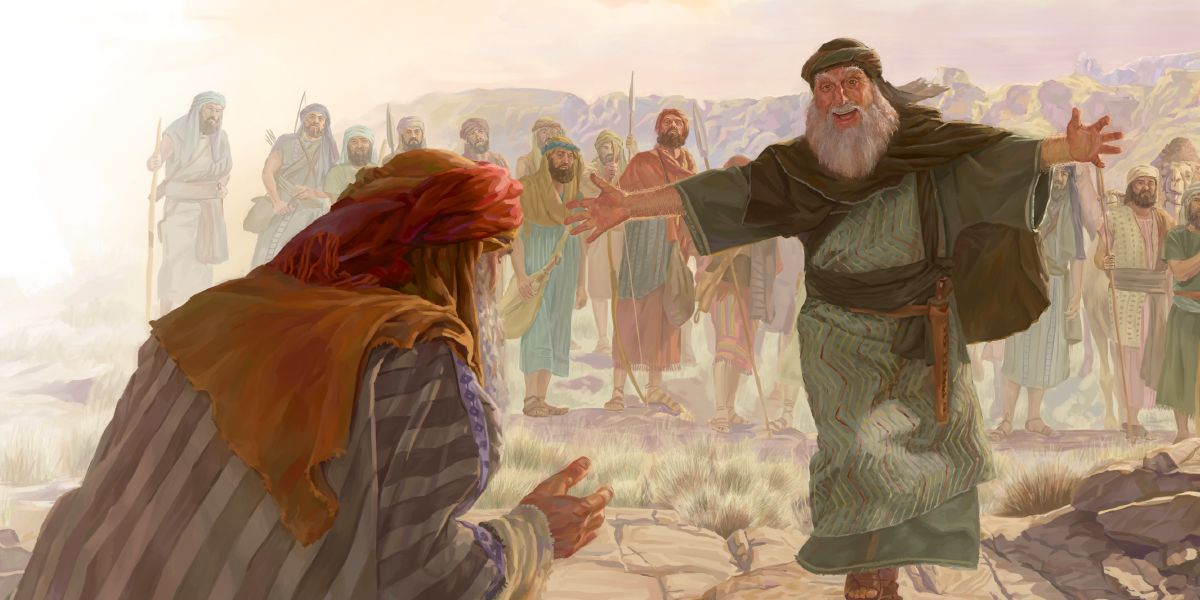
14 Let my lord, I pray thee, pass over before his servant; and I will lead on gently, according as the cattle that goeth before me and the children are able to endure, until I come unto my lord unto Seir.”
— unto Seir; this implies a purpose of visiting Esau, but not carried out probably because Esau hadn’t settled there yet, he instead returned to Hebron to his father;
— the Targum Onkelos says
Please [Now] my master, go on ahead of your servant. I will lead on gently, in my slow pace, according to the pace of the work that is before me, and according to the pace of the children, until I come to my master in Seir.
15 And Esau said, “Let me now leave with thee some of the folk who are with me.” And he said, “What need is there? Let me find grace in the sight of my lord.” — and he said, what needeth it? Jacob knew the direct way very probably; he thought himself in no danger;
— the Targum Onkelos says
Eisov said, Let me leave [now] with you some of the people that are with me. He [Yaakov] said, What for? Let me find favor in the eyes of my master.
16 So Esau returned that day on his way unto Seir. — Esau took his leave of Jacob the same day he met Jacob, and proceeded on in his journey towards Seir;
— the Targum Onkelos says
On that day Eisov returned on his way—going to Seir.
17 And Jacob journeyed to Succoth, and built him a house, and made booths for his cattle. Therefore the name of the place is called Succoth [that is, Booths].
— and built him an house, and made booths for his cattle; an house for himself and family, and booths or tents for his servants or shepherds, and for the cattle they had the care of, some for one, and some for the other;
— the Targum Onkelos says
Yaakov traveled to Sukkos and built himself a house, and for his livestock he made shelters. He therefore named the place Sukkos.
18 And Jacob came to Shalem, a city of Shechem which is in the land of Canaan, when he came from Padanaram, and pitched his tent before the city. — Shechem, where Jacob’s well is still there; where a woman of Samaria to draw water and met Jesus: John 4:6
— the Targum Onkelos says
Yaakov arrived safely at the city of Shechem, which is in the Land of Canaan, when he came from Padan Aram. He encamped before the city.
19 And he bought a parcel of a field where he had spread his tent, at the hand of the children of Hamor, Shechem’s father, for a hundred pieces of money. — a hundred pieces of money; may signify either lambs, given in way of exchange for it, or a hundred pieces of silvers;
— the Targum Onkelos says
He bought the part [possession] of the field where he had spread his tent, from the sons of Chamor, father of Shechem, for one hundred kesitahs [sheep].
20 And he erected there an altar, and called it El-elohe-Israel [that is, God, the God of Israel]. — Jacob erected there an altar; Abraham had already built an altar in this neighbourhood (Genesis 12:7), and Jacob now followed his example;
— the Targum Onkelos says
He erected an altar there and called it [worshiped upon it before] the Almighty is [the] God of Yisrael.
Genesis 34
1 And Dinah the daughter of Leah, whom she bore unto Jacob, went out to see the daughters of the land. — Dinah went out to see the daughters of the land; from her father’s house into the city, out of curiosity, to explore the daughters of the land;
— the Targum Onkelos says
Deenah went out, the daughter of Leah, whom she had borne to Yaakov, to see [visit] the local girls.
2 And when Shechem the son of Hamor the Hivite, prince of the country, saw her, he took her and lay with her, and defiled her. — Shechem the Hivite, took her by force, and evilly defiled her;
— the Targum Onkelos says
She was seen by Shechem, son of Chamor, the Chivite, who was the prince of the land. He took her, was with her, and mistreated her.
3 And his soul cleaved unto Dinah the daughter of Jacob, and he loved the damsel and spoke kindly unto the damsel.
— and his soul clave unto Dinah the daughter of Jacob; his inclination was to her; it was not a mere lustful desire that was suddenly raised, but a constant and continued affection he bore to her; professing great love to her;
— the Targum Onkelos says
He became deeply attached to [He desired] Deenah, the daughter of Yaakov, and he loved the girl. He spoke to the girl’s heart.
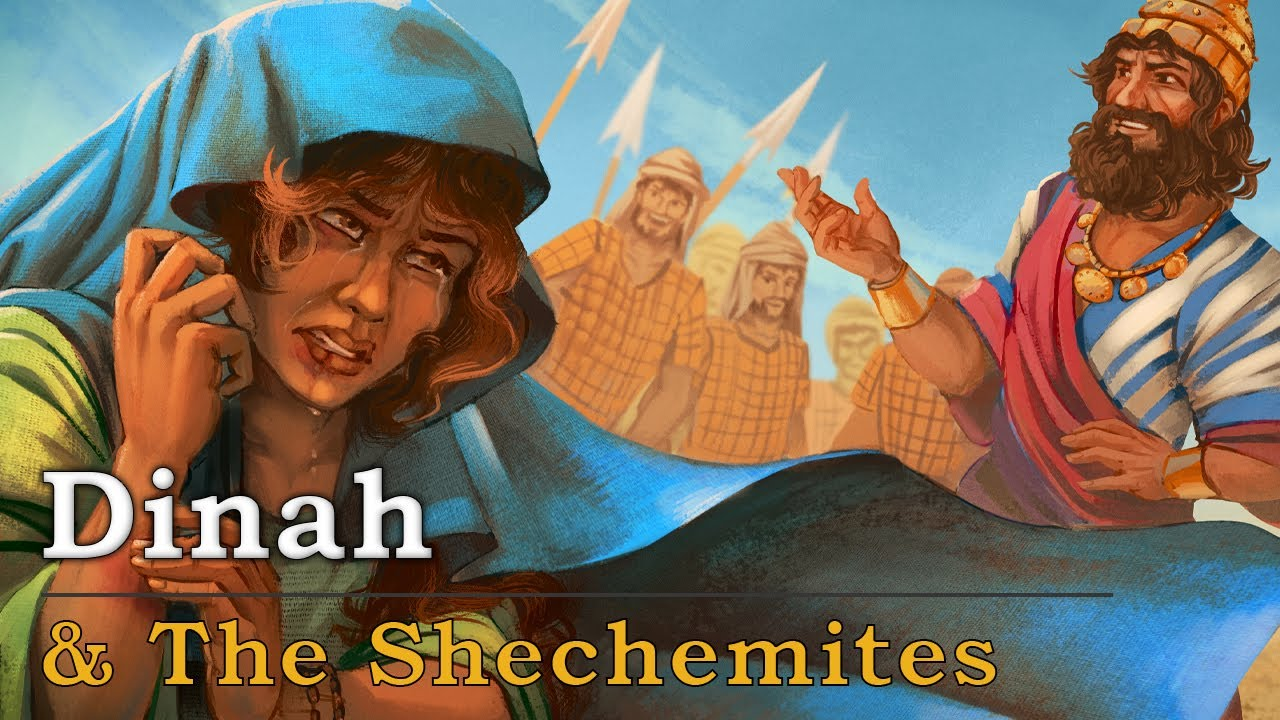
4 And Shechem spoke unto his father Hamor, saying, “Get me this damsel for a wife.” — and Shechem spake unto his father Hamor; and told him the whole affair, at least what a strong affection he had for Dinah;
— the Targum Onkelos says
Shechem spoke to his father Chamor, saying, Take this young girl for me as a wife.
5 And Jacob heard that he had defiled Dinah his daughter. Now his sons were with his cattle in the field, and Jacob held his peace until they had come. — Jacob held his peace; he as a father and a good man, must have been deeply distressed; baitded for time;
— the Targum Onkelos says
Yaakov heard that he had defiled his daughter, Deenah, [while] his sons were with the livestock in the fields. Yaakov remained silent until they returned.
6 And Hamor the father of Shechem went out unto Jacob to commune with him. — to commune with him; to talk with him about the affair of Dinah, to pacify him, and endeavour to gain his consent, that his son might marry her, and to settle the terms of the marriage;
— the Targum Onkelos says
Chamor, father of Shechem, went out to Yaakov to speak with him.
7 And the sons of Jacob came out of the field when they heard it; and the men were grieved and they were very wroth, because he had wrought folly in Israel by lying with Jacob’s daughter, which thing ought not to be done.
— and the men were grieved and were very wroth; they were grieved for the wickedness committed against God as well as for the injury done to their sister;
— the Targum Onkelos says
The sons of Yaakov returned from the field when they heard [what had happened]. The men grieved and were very angry, for he [Shechem] had committed an outrage against Yisrael to lie with a daughter of Yaakov. Such a thing should not be done [It is not fitting for such a think to have been done].
8 And Hamor communed with them, saying, “The soul of my son Shechem longeth for your daughter. I pray you give her to him for a wife; — Hamor communed with Jacob’s sons, to whom Jacob committed the business, being himself oppressed with shame and grief, and fear for his daughter;
— the Targum Onkelos says
Chamor spoke with them saying, My son, Shechem, desires your daughter. Please [Now] grant her to him for a wife.
9 and make ye marriages with us, and give your daughters unto us, and take our daughters unto you.
— and make ye marriages with us; there was no objection on their side, it lay on Jacob’s; Abraham’s servant was charged by him not to take a wife of the Canaanites to his son Isaac; and the same charge was given Jacob by Isaac, Genesis 24:3
— the Targum Onkelos says
Intermarry with us. Give us your daughters, and take our daughters for yourselves.
10 And ye shall dwell with us, and the land shall be before you. Dwell and trade ye therein, and get you possessions therein.” — ye shall dwell with us; Hamor proposes that Jacob’s family shall abandon their nomad life, and settle among the Hivites; and trade with them;
— the Targum Onkelos says
You will [then] live with us and the land will be open to you. Live and [do] trade in [with] it and possess it.
11 And Shechem said unto her father and unto her brethren, “Let me find grace in your eyes, and what ye shall say unto me, I will give. — and what ye shall say unto me, I will give; to her, to her parents, to her brethren and relations; let what will be fixed, shall be given;
— the Targum Onkelos says
Shechem said to her father and her brothers, Let me find favor in your eyes and what ever you say [ask of me], I will give.
12 Ask me ever so much dowry and gift, and I will give according as ye shall say unto me; but give me the damsel for a wife.”
— and I will give according as ye shall say unto me; determine among yourselves whatever shall be the dowry and gift, and it shall be punctually observed: but give me the damsel to wife; only agree to that, and I care not what is required of me;
— the Targum Onkelos says
Increase greatly the amount I must pay for the bridal dowry and gifts. I will give whatever you say, but give me the girl for a wife.
13 And the sons of Jacob answered Shechem and Hamor his father deceitfully, and said — because he had defiled Dinah their sister”
— and the sons of Jacob answered Shechem and Hamor deceitfully; or with carnal wisdom and wicked cunning, proposing the marriage of their sister, when they never intended it should ever be;
— the Targum Onkelos says
The sons of Yaakov answered Shechem, and his father Chamor, with guile [cleverness], when they spoke; because he had defiled their sister, Deenah.
14 and they said unto them, “We cannot do this thing, to give our sister to one who is uncircumcised, for that would be a reproach unto us. — and Levi and Simeon said unto Hamor and Shechem:
— nothing is said of their teaching the people to worship the true God, but only of their insisting on their being circumcised; a cloak to cover their diabolical design;
— the Targum Onkelos says
They said to them, We cannot do such a thing—to give our sister [in marriage] to an uncircumcised man, for that is a disgrace to us.
15 But in this will we consent unto you: If ye will be as we are, that every male of you be circumcised, — as we are; that is; the sons of Jacob were all circumcised as they claimed;
— the Targum Onkelos says
This is the only way we will consent to you: if you will be like us, circumcising all your males.
16 then will we give our daughters unto you; and we will take your daughters to us, and we will dwell with you, and we will become one people. — and we will take your daughters to us; in marriage for wives: and we will dwell with you; not as sojourners but as fellow citizens;
— the Targum Onkelos says
[Then] we will give our daughters to you, and we will take your daughters for ourselves. We will live together with you, and we will become one people.
17 But if ye will not hearken unto us to be circumcised, then will we take our daughter and we will be gone.” — then will we take our daughter; by force,
— the Targum Onkelos says
But if you do not listen to [obey] us to be circumcised, we will take our daughter and go.
— as the Targum of Jonathan adds: and we will be gone: depart from this part of the country, and go elsewhere.
18 And their words pleased Hamor, and Shechem, Hamor’s son. — Hamor, and Shechem, the son of Hamor the Hivite;
— the Targum Onkelos says
Their words were agreeable in the eyes of Chamor, and in the eyes of Shechem, the son of Chamor.
19 And the young man deferred not to do the thing, because he had delight in Jacob’s daughter; and he was more honorable than all the house of his father.
— and he was more honourable than all the house of his father; for though in defiling Jacob’s daughter, yet in this he was honourable, that he sought to marry her, and to recompence the injury;
— the Targum Onkelos says
The young man did not delay doing the thing, because he desired the daughter of Yaakov. He was the most honored person in his father’s house.
20 And Hamor and Shechem his son came unto the gate of their city, and communed with the men of their city, saying, — and communed with the men of their city; upon the subject of entering into an alliance with Jacob’s family, of admitting them to be fellow citizens with them;
— the Targum Onkelos says
Chamor and his son, Shechem came to the gate of their city, and they spoke to the men of their city saying,
21 “These men are peaceable with us. Therefore let them dwell in the land and trade therein; for the land, behold, it is large enough for them. Let us take their daughters to us for wives, and let us give them our daughters.
— let us take their daughters to us for wives, and let us give them our daughters; this is not just a horror to Abraham or Isaac, but to God himself;
— alas! for how one sin leads on to another, and, like flames of fire, spread desolation in every direction! For this will put God’s direction to no effect:
“Unto thy seed have I given this land, from the river of Egypt unto the great river, the River Euphrates: the Kenites and the Kenizzites and the Kadmonites, and the Hittites and the Perizzites and the Rephaim, and the Amorites and the Canaanites and the Girgashites and the Jebusites.” Genesis 15:18-21
— the Targum Onkelos says
These men are completely at peace with us. Let them live in the land and [do] trade in [with] it. The land has ample room to be open to them. We will take their daughters for wives, and we will give them our daughters.
22 Only herein will the men consent unto us to dwell with us, to be one people: if every male among us be circumcised, as they are circumcised.
— if every male among us be circumcised, as they are circumcised; submitting to this rite, they agree to take up their residence with us, and be incorporated among us, and to God’s horror, become one people;
— the Targum Onkelos says
But only on these terms will the men consent to live with us, to become one people: every male among us must be circumcised, just as they are circumcised.
23 Shall not their cattle and their substance and every beast of theirs be ours? Only let us consent unto them, and they will dwell with us.”
— only let us consent unto them; in the affair of circumcision: and they will dwell with us; and what by trading with them, and marrying among them, all their wealth and riches will come into our hands;
— the Targum Onkelos says
Their livestock, their possessions and all their cattle, will it not be ours? Only let us consent to them, and they will live with us.
24 And unto Hamor and unto Shechem his son hearkened all who went out of the gate of his city; and every male was circumcised, all who went out of the gate of his city.
— they consented to be circumcised, in compliance with their young prince, whom they either feared or loved; to be willing to expose themselves to great pains and hazards;
— the purpose of circumcision was to keep the Israelites “unmixed” or maintained separated from all the neighbouring tribes, for Josephus (Antiquities. l. 1. c. 10. sect. 5) said:
The forementioned son was born to Abram when he was eighty-six years old: but when he was ninety-nine, God appeared to him, and promised him that he Should have a son by Sarai, and commanded that his name should be Isaac; and showed him, that from this son should spring great nations and kings, and that they should obtain all the land of Canaan by war, from Sidon to Egypt.
But he charged him, in order to keep his posterity unmixed with others, that they should be circumcised in the flesh of their foreskin, and that this should be done on the eighth day after they were born.
— the Targum Onkelos says
They listened to [obeyed] Chamor, and to his son, Shechem—all those who passed through the gate of his city. Every male was circumcised—all who passed through the gate of his city.
25 And it came to pass on the third day, when they were sore, that two of the sons of Jacob, Simeon and Levi, Dinah’s brethren, took each man his sword, and came upon the city boldly and slew all the males.
— Simeon and Levi, being Leah’s children; Dinah’s brethren; they act as sworn enemies to those to whom they were lately become sworn friends;
— the Targum Onkelos says
On the third day when they were in pain [their pain was strong upon them], two of Yaakov’s sons, Shimon and Leivi, brothers of Deenah, each took his sword. They approached the city with confidence [whose inhabitants dwell in security], and killed every male.
26 And they slew Hamor and Shechem his son with the edge of the sword, and took Dinah out of Shechem’s house, and went out.
— and took Dinah out of Shechem’s house; where she was detained from the time of her being ravished by Shechem, the son of Hamor the Hivite, against her will, as hostage, with an evil intention of forcing a marriage on her;
— what a parallel in today’s environment where the Hamas terrorists killed many Jews on October 7, 2023; and captured over two hundreds of the others as hostages, trying to force “peace” onto Israel;
— the Targum Onkelos says
They killed Chamor and his son Shechem at the point of the sword. They took Deenah from the house of Shechem and they left.
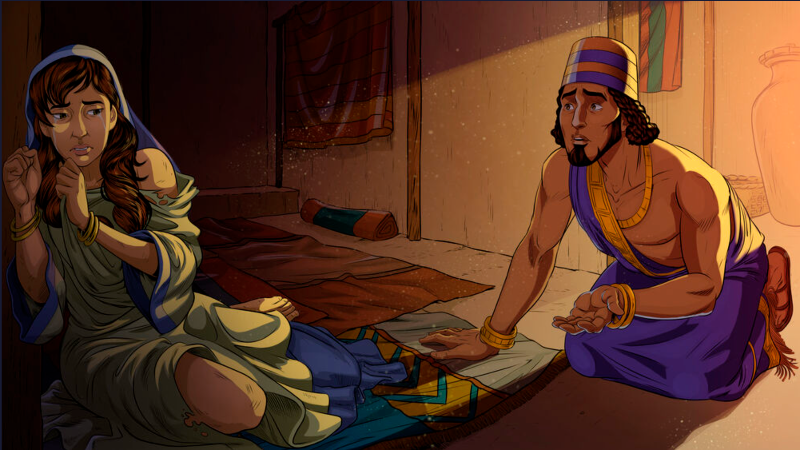
27 The sons of Jacob came upon the slain and despoiled the city, because they had defiled their sister. — although only two of Jacob’s sons were mentioned, they might be assisted by the rest; at least, no doubt, they were attended with servants, who were aiding: in accomplishing a bloody judgement;
— the Targum Onkelos says
The sons of Yaakov came upon the corpses [to strip the corpses], and they plundered the city that had defiled their sister.
28 They took their sheep and their oxen and their asses, and that which was in the city, and that which was in the field;
— the Targum Onkelos says
Their sheep, their cattle, their donkeys, whatever was in the city and whatever was in the field—they took [plundered].
29 and all their wealth, and all their little ones and their wives took they captive, and despoiled even all that was in the house. — and spoiled even all that was in the house; of Shechem or Hamor, or in any of the houses of the inhabitants; they rifled and plundered everyone, and took away whatsoever they found;
— the Targum Onkelos says
All their wealth, all their children, and their wives—they took captive, and plundered—including everything in the houses.
30 And Jacob said to Simeon and Levi, “Ye have troubled me to make me a stench among the inhabitants of the land, among the Canaanites and the Perizzites. And I being few in number, they shall gather themselves together against me and slay me; and I shall be destroyed, I and my house.”
— amongst the Canaanites and the Perizzites; and I being few in number; or men of number; he and his sons and servants, in all, making but a small number in comparison of the nations about him:
— they shall slay me: he could expect no other in human reason, and they were hindered from so doing only by the hand of the great God smiting them with terror, Genesis 35:5
— the Targum Onkelos says
Yaakov said to Shimon and Leivi, You have made trouble for me, making me obnoxious to [putting hatred between us and] the inhabitants of the land, the Canaanites and the Perizzites. [Since] I am few in number, they will gather together and attack me. I and my house [family] will be destroyed.
31 And they said, “Should he deal with our sister as with a harlot?” — should he deal with our sister as with an harlot? make a whore of her, and then keep her in his house as such?
— the Targum Onkelos says
They said, Should he make our sister [be treated] into a harlot [like one who goes outside]?
— the Targum of Jonathan says:
“Simeon and Levi answered: ‘It is not fitting that it should be said in the assemblies of Israel: Uncircumcised men defiled a virgin, and idol-worshippers polluted the daughter of Jacob.
“Rather, let it be said thus: Uncircumcised men were slain because of a virgin, and idol-worshippers because of the daughter of Jacob! Let not Shechem the son of Hamor mock us in his words, saying: “Like a straying woman, this girl went out; she has no one to avenge her.”
“Shall he treat our sister [as a harlot] if we had not done this thing?'”


 A Prophecy of Esau and Jacob