
Genesis (13-14)
The Targum, which originated in the Aramaic language, is strongly linked to the work of Ezra, holds significance for shedding light on biblical concepts. When the Masoretic Text can be vague, uncertain, or unclear, the Targum often offers clearer meaning, broader insight, and deeper understanding.
Yes, sometimes the Targum clarifies metaphors and interprets idioms or difficult passages instead of translating them literally, which often makes no sense. Such an endeavor should be highly commended rather than criticized.
For example, the Targum interprets natural imagery—like cedars, cypresses, oaks, forests, and fire—as metaphors for political political and social structures, especially kings, rulers, governors, and wealthy elites. Such imagery can be sweeping: forests laid waste, lions roaring as their habitat is destroyed, and power structures crumbling. Fire symbolizes divine punishment, sweeping through defenses and dismantling the very foundations of their power.
Translating such natural imagery literally could convey limited information or even distort it, but Ezra was determined to share their true meaning. He was a righteous man, for God had prepared his heart to seek the law of the Lord, to follow it, and to teach the statutes and judgments in Israel Ezra 7:10.
“The anger of the Lord shall not return, until He has executed and until He has performed the intent of His thought; in the latter days ye shall understand it perfectly” Jeremiah 23:20
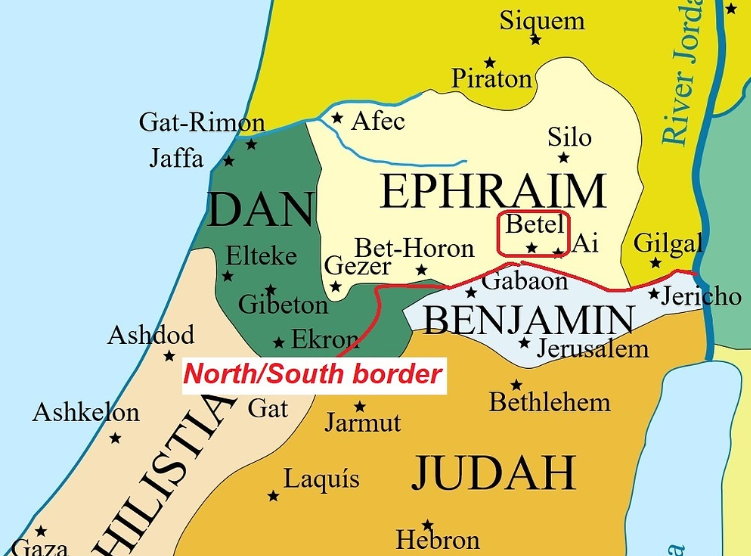
Genesis 13
1 And Abram went up out of Egypt, he and his wife and all that he had, and Lot with him, into the south.
— ‘Get thee out from thy father’s house, and from thy country, and from thy kindred,’ was the command to Abram, and to most others called;
— and Lot with him; Lot accompanied him into Egypt, because he comes with him out of it; into the south; that is, into the Negev;
— the Targum Onkelos says
Avram went up from Egypt; he, his wife, and all that he had, together with Lot into the south.
2 And Abram was very rich in cattle, in silver, and in gold. — and Abram was very rich; he was rich; in cattle, in silver, and in gold; cattle are mentioned first, as being the principal part of the riches of men in those days, such as sheep and oxen;
— the Targum Onkelos says
Avram was very wealthy in livestock, silver and gold.
3 And he went on his journeys from the south even to Bethel, unto the place where his tent had been at the beginning, between Bethel and Ai, — he went on to Bethel; because there he had formerly had an altar, and although the altar had fallen down,
— between Bethel and Ai, or Hai; thereafter was called Mount Ephraim, and was four miles from Jerusalem on the north; see Genesis 12:8
— the Targum Onkelos says
He continued on his travels from the south to Beis-Eil, until the place where he originally had [set up] his tent, between Beis-Eil and Ai.
4 unto the place of the altar which he had made there at the first; and there Abram called on the name of the Lord. — unto the place of the altar, which he had made there at the first; when he first came to that place, and before he went down to Egypt;
— the Targum Onkelos says
To the site of the altar which he made there at first; and there Avram called [prayed] in the Name of Adonoy.
5 And Lot also, who went with Abram, had flocks and herds and tents. — Lot; he, too, had possibly received presents in Egypt, for we find him rivalling his uncle in wealth;
— the Targum Onkelos says
Lot who accompanied Avram also had sheep, cattle and tents.
6 And the land was not able to bear them, that they might dwell together; for their substance was great, so that they could not dwell together.
— both arises from a large increase of riches, that relations and friends are obliged to part; what one would think would make them more comfortable together, is the cause and occasion of their separation;
— the Targum Onkelos says
The land was unable to support them that they might dwell together, for their wealth was so great that they were unable to dwell together.
— the Targum of Jonathan reveals deails about the Canaanites and the Perizzites
And contentions arose between the shepherds of Abram’s flock, and the shepherds of the flocks of Lot; for the shepherds of Abram had been instructed by him not to go among the Kenaanaee and the Pherizaee, who, as yet, had power in the land, and to restrain the cattle that they should make no depredation in going to the place of their pasture: but the shepherds of Lot would go and feed in the grounds of the Kenaanaee and Pherizaee who yet dwelt in the land.
7 And there was strife between the herdsmen of Abram’s cattle and the herdsmen of Lot’s cattle; and the Canaanites and the Perizzites dwelled then in the land. — and there was a strife between the herdmen of Abram’s cattle and the herdmen of Lot’s cattle; not between the two masters, but between their servants;
— the Targum Onkelos says
There was a quarrel between the herdsmen of Avram’s flocks and the herdsmen of Lot’s flocks. The Canaanites and the Perizzites were then living in the land.
— the Targum of Jonathan says
And contentions arose between the shepherds of Abram’s flock, and the shepherds of the flocks of Lot; for the shepherds of Abram had been instructed by him not to go among the Kenaanaee and the Pherizaee, who, as yet, had power in the land, and to restrain the cattle that they should make no depredation in going to the place of their pasture: but the shepherds of Lot would go and feed in the grounds of the Kenaanaee and Pherizaee who yet dwelt in the land.
8 And Abram said unto Lot, “Let there be no strife, I pray thee, between me and thee and between my herdsmen and thy herdsmen; for we are brethren. — for we be brethren, that is, both by nature near kinsmen, as the word brother is oft used, and in the faith and religion too, amongst whom contentions are very indecent and scandalous;
— the Targum Onkelos says
Avram said to Lot: Please [Now], let there not be strife between me and you, and between my herdsmen and your herdsmen, for we are kinsmen.
9 Is not the whole land before thee? Separate thyself, I pray thee, from me. If thou wilt take the left hand, then I will go to the right, or if thou depart to the right hand, then I will go to the left.”
— the Targum Onkelos says
Is not all the land before you? Please [Now] separate from me, if [you go] to the left [north], I [will go] to the right [south], and if [you go] to the right [south], I [will go] to the left [north].
— the Targum of Jonathan says, “if thou wilt go to the north, I will go to the south, or if thou wilt go to the south, I will go to the north:’
10 And Lot lifted up his eyes and beheld all the plain of Jordan, that it was well watered everywhere (before the Lord destroyed Sodom and Gomorrah), even as the garden of the Lord, like the land of Egypt as thou comest unto Zoar.
— all the plain of Jordan; a great plain so called, because there the pleasant river Jordan divided itself into divers little streams or rivulets;
— the Targum Onkelos says
Lot raised his eyes and saw the entire Jordan Plain, that it was [an] abundantly watered [place]; before Adonoy destroyed Sedom and Amorah, it was like Adonoy’s garden, like the land of Egypt, going towards Zoar.
11 Then Lot chose for himself all the plain of Jordan; and Lot journeyed east, and they separated themselves the one from the other. — and Lot journeyed east; and that part of the land on which Sodom and Gomorrah stood, were to the east of Bethel;
— the Targum Onkelos says
Lot chose for himself the entire Jordan Plain; Lot journeyed from the east [before], and they separated one from another.
12 Abram dwelled in the land of Canaan, and Lot dwelled in the cities of the plain, and pitched his tent toward Sodom. — Abram dwelt in the land of Canaan; in that part of the land where the family of the Canaanites had their abode;
— the Targum Onkelos says
Avram lived in the land of Canaan; and Lot lived in the cities of the Plain, setting up his tents as far as Sedom.
13 But the men of Sodom were wicked and sinners before the Lord exceedingly. — the men of Sodom were wicked; exceeding great sinners, guilty of the most notorious crimes, and addicted to the most scandalous and unnatural lusts; and these they committed openly and publicly in the sight of God;
— the Targum Onkelos says
The people of Sedom were wicked [with their property] and sinful [with their bodies] towards [before] Adonoy, exceedingly.
14 And the Lord said unto Abram after Lot was separated from him, “Lift up now thine eyes, and look from the place where thou art, northward and southward and eastward and westward;
— the Targum Onkelos says
Adonoy said to Avram after Lot had separated from him: Raise your eyes and look about from the place where you are, to the north, to the south to the east and to the west.
15 for all the land which thou seest, to thee will I give it and to thy seed for ever. — on top of Mount Ephraim: all the land which thou seest; so extensive a survey of the country, in all directions,
— northward, and southward, and eastward, and westward; all point in the neighborhood; and those plains and hills, then lying desolate before the eyes of the solitary patriarch, were to be peopled with a mighty nation “like the dust of the earth in number”
— the Targum Onkelos says
For all the land that you see I give to you and to your descendants forever.
16 And I will make thy seed as the dust of the earth, so that if a man can number the dust of the earth, then shall thy seed also be numbered. — and to thy seed for ever; the meaning is, that he gave it to his posterity to be enjoyed; in the days of Solomon, and as they will be in the latter day;
— the Targum Onkelos says
I will make your descendants [numerous] as the dust of the earth; so that if a man can count the dust of the earth, then your descendants too will be countable [just as it is impossible for a man to count the dust of the earth, so too your descendants will not be countable].
17 Arise, walk through the land in the length of it and in the breadth of it, for I will give it unto thee.” — Arise, walk through the land; enter and take possession, for thy posterity; survey the land, and it will appear better than upon a distant prospect;
— the Targum Onkelos says
Rise, walk through the land—its length and breadth—for to you I will give it.
18 Then Abram removed his tent and came and dwelt in the plain of Mamre, which is in Hebron, and built there an altar unto the Lord. — the city Hebron was called Mamre; an ancient city built seven years before Zoan or Tanis in Egypt, Numbers 13:22
— the Targum Onkelos says
Avram set up his tent, and he came and settled in the Plains of Mamrei which are in Chevron, and he built there an altar to [before] Adonoy.

Genesis 14
1 And it came to pass in the days of Amraphel king of Shinar, Arioch king of Ellasar, Chedorlaomer king of Elam, and Tidal king of nations, — and it came to pass, in the days of Amraphel king of Shinar; or Babylon, as Onkelos, says, where Nimrod began his kingdom,
— the Targum Onkelos says
This happened in the days of Amraphel, king of Shinar [Babylon], Aryoch, king of Elasar, Kedorlaomer, king of Ailam, and Tidal, king of Goyim [king of peoples].
— the Targum of Jonathan reveals that Amraphel was Nimrod,
And it was in the days of Amraphel,–he is Nimrod, who commanded Abram to be cast into the furnace; he was then king of Pontos; Ariok, (so called) because he was (arik) tall among the giants, king of Thalasar, Kedarlaomer, (so called) because he had bound himself (or gone over) among the bondmen of the king of Elam, and Thidal, crafty as a fox, king of the peoples subjected to him,
2 that these made war with Bera king of Sodom, and with Birsha king of Gomorrah, Shinab king of Admah, and Shemeber king of Zeboiim, and the king of Bela, which is Zoar. — the cities Sodom and Gomorrah were well established by then; even after the confusion of tongues and that they had dispersed;
— the Targum Onkelos says
They waged war against Bera, king of Sedom, Birsha, king of Amorah, Shinav, king of Admah, Shemeiver, king of Tzevoyim, and the king of Bela, which is Zoar.
3 All these were joined together in the Vale of Siddim, which is the Salt Sea. — the Salt Sea; as afterwards so called, not at this time, but the Dead Sea, being 1300 feet below the level of the Mediterranean; for then it would not have been fit for armies to be drawn up in battle array in it;
— the Targum Onkelos says
All these joined together [assembled] at the valley of Siddim [the plain of the fields], which is [now] [the place of] the Salt Sea.
4 Twelve years they served Chedorlaomer, and in the thirteenth year they rebelled. — they served; that is, paid a yearly tribute in those days;
— the Targum Onkelos says
[For] twelve years they had served Kedorlaomer, and for thirteen years they rebelled.
5 And in the fourteenth year came Chedorlaomer and the kings that were with him, and smote the Rephaim in Ashteroth Karnaim, and the Zuzim in Ham, and the Emim in Shaveh Kiriathaim, — in the fourteenth year; after some pause and preparation, Chedorlaomer, in conjunction with his allies, set himself to punish the revolters;
— the Targum Onkelos says
In the fourteenth year, Kedorlaomer came together with the kings that were with him and they defeated the Rephaim [the mighty ones] in Ashteros Karnayim, the Zuzim [the powerful ones] in Ham, the Aimim [the ones that incite fear] at Shaveh Kiryasayim,
6 and the Horites in their Mount Seir, unto Elparan, which is by the wilderness. — the Horites were the aboriginal inhabitants of Mount Seir, where they dwelt in caves; such as are still to be seen in Petra and other places around; they were centuries later absorbed into the Edomites;
— the Targum Onkelos says
And the Chorites in their hills of Seir, as far as Eil [the Plain of] Paran which borders [is next to] the wilderness.
7 And they returned and came to Enmishpat, which is Kadesh, and smote all the country of the Amalekites and also the Amorites, who dwelt in Hazezontamar. — flashing forward, the country of the Amalekites; they were later inhabited by the posterity of Esau;
— the Targum Onkelos says
They turned back and came to Ein Mishpat [the plain of compromise] which is Kadeish [Rekem], and they struck all the territory of Amaleik, as well as the Emorites who lived in Chazazon Tamar [Ein Gedi].
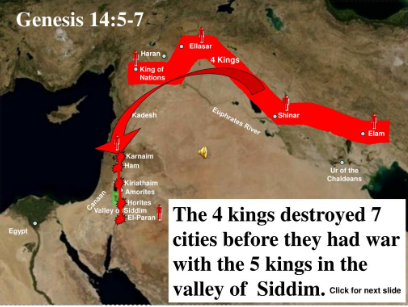
8 And there went out the king of Sodom, and the king of Gomorrah, and the king of Admah, and the king of Zeboiim, and the king of Bela (the same is Zoar), and they joined battle with them in the Vale of Siddim, — five kings came out and joined battle with the four in the dale of Siddim;
— the Targum Onkelos says
The king of Sedom set out, along with the king of Amorah, the king of Admah, the king of Tzevoyim, and the king of Bela, which is Zoar, and engaged them in battle in the Valley of Siddim [in the plain of the fields].
9 against Chedorlaomer the king of Elam, and against Tidal king of nations, and Amraphel king of Shinar, and Arioch king of Ellasar — four kings against five.
— the Targum Onkelos says
Against Kedorlaomer, king of Eilam, Sidal, king of Goyim [king of peoples], Amraphel, king of Shinar [Babylon], and Aryoch, king of Elasar; [there were] four kings against the five.
10 And the Vale of Siddim was full of slime pits; and the kings of Sodom and Gomorrah fled and fell there, and those who remained fled to the mountain. — the five initiated the fight against the four but the vale of Siddim was full of slimepits, hence the four prevailed against the five;
— the Targum Onkelos says
The Valley of Siddim [The plain of the fields] was [full of] mortar pits [pits from which they raise up mortar]; [and when] the Kings of Sedom and Amorah fled they fell there [into the pits], while the remainder fled to the mountains.
11 And they took all the goods of Sodom and Gomorrah and all their victuals, and went their way. — and they took all the goods of Sodom and Gomorrah; they entered these cities and pillaged them, and carried off everything valuable in them;
— the Targum Onkelos says
They took [captured] all the wealth of Sedom and Amorah and all their provisions and they went on their way.
12 And they took Lot, Abram’s brother’s son, who dwelt in Sodom, and his goods and departed.
— the victors plundered the cities of Sodom and Gomorrah, and carried off Lot, who dwelt in Sodom, and all his possessions, along with the rest of the captives, probably taking the route through the valley of the Jordan up to Damascus;
— the Targum Onkelos says
They took [captured] Lot and his wealth. [Lot was] Avram’s nephew. Then they went on their way. He had been living in Sedom.
13 And there came one who had escaped, and told Abram the Hebrew, for he dwelt on the plain of Mamre the Amorite, brother of Eshcol and brother of Aner; and these were confederate with Abram.
— the plain of Mamre; these were confederate with Abram; probably there was also a league for mutual defence between him and them;
— the Targum Onkelos says
The one who had escaped came and told Avram the Ivri, who was living in the Plains of Mamrei the Emorite, the brother of Eshkol and Aneir. They were Avram’s allies.
— the Targum of Jonathan reveals the one who had escaped as Og, the King of Bashan (modern-day Golan Heights and Hauran), saying
“And Og came, who had been saved from the giants who died in the Flood; he had ridden upon the top of the Ark and had a covering over his head, and was sustained by the food of Noah. It was not because of his merit that he was saved, but so that the inhabitants of the world might see the power of the Lord and say: ‘Behold, the giants who were of old rebelled against the Master of the world, and He destroyed them from the earth.’
And when these kings [the four kings vs. the five] waged war, Og was with them. He said in his heart: ‘I will go and tell Abram about the matter of Lot who has been captured, so that he will come to rescue him from the hands of the kings and fall into their hands.’
He arrived on the eve of the day of Passover; he found him [Abram] making unleavened cakes (Matzot). Then he told Abram the Hebrew, and he was dwelling in the plains of Mamre the Amorite, brother of Eshkol and brother of Aner, and they were the masters of Abram’s covenant.”
— according to this tradition, Og was a remnant of the Nephilim (giants). He survived the Great Flood by clinging to the outside of Noah’s Ark. Noah fed him through a hole in the side of the boat. The text clarifies that God didn’t save him because he was a “good guy,” but as a living monument to show that even the mightiest rebels are subject to God’s will.
— in the biblical text, a “fugitive” tells Abraham that his nephew Lot was captured. The Midrash identifies this fugitive as Og. However, his intent was malicious: he hoped Abraham would rush into battle, be killed by the powerful Mesopotamian kings, and then Og could marry Abraham’s beautiful wife, Sarah.
14 And when Abram heard that his brother was taken captive, he armed his trained servants, born in his own house (three hundred and eighteen), and pursued them unto Dan. — and when Abram heard that his brother; regard Lot as his brother’s son, or at the same time his brother-in-law; or just brother;
— the Targum Onkelos says
When Avram heard that his kinsman was taken captive, he armed his trained servants [lads] who were born in his household, three hundred and eighteen [men], and he pursued [them] until Dan.
— the Targum of Jonathan says
And when Abram heard that his brother was made captive, he armed his young men who were trained for war, grown up in his house; but they willed not to go with him. And he chose from them Eliezer the son of Nimrod, who was equal in strength to all the three hundred and eighteen; and he pursued unto Dan.

15 And he divided himself against them, he and his servants by night, and smote them and pursued them unto Hobah, which is on the left hand of Damascus. — Hobah, on the left of Damascus, was over 200 miles toward the north from Hebron;
— the Targum Onkelos says
He divided [his men] against them at night, he and his servants and he attacked them. He pursued them until Chovah, which is to the left [north] of Damascus.
16 And he brought back all the goods, and also brought again his brother Lot and his goods, and the women also and the people. — he brought back all the goods which the victorious kings had taken from the princes and people mentioned earlier;
— the Targum Onkelos says
He brought back all the property. His kinsman [His brother’s son] Lot and his possessions he also brought back, as well as the women and the people.
17 And the king of Sodom went out to meet him at the Valley of Shaveh (which is the King’s Dale) after his return from the slaughter of Chedorlaomer and of the kings who were with him. — the king of Sodom, who had fled, came down from the mountain whither he had escaped, came down to meet Abram;
— the Targum Onkelos says
The King of Sedom went out to meet him after his return from defeating Kedorlaomer and the kings that were with him, to the Valley of Shaveh which is the King’s Valley [to the barren plain, which is the place of the racetrack of the king].
18 And Melchizedek king of Salem brought forth bread and wine; and he was the priest of the Most High God. — and Melchizedek king of Salem; both the Targums of Jonathan and Jerusalem say, this is Shem, the son of Noah;
— though it is highly probable Shem was living at this time, yet it is not easy to account for it why his name should be changed, or that he should reign in a country in the possession of his brother’s son; or that he should meet Abram, and congratulate him on the slaughter of one of his own descendants;
— some have thought him to be more than a mere man, even the Son of God himself, but he is manifestly distinguished from him in Hebrews 7:
“For this Melchizedek, king of Salem, priest of the Most High God, met Abraham, who was returning from the slaughter of the kings, and blessed him.
To him also Abraham gave a tenth part of all, Melchizedek first being by interpretation “king of righteousness,” and after that also king of Salem, which means “king of peace.”
Without father, without mother and without descent, having neither beginning of days nor end of life, but made like unto the Son of God, he abideth a priest continually.” Hebrews 7:1-3
— the Targum Onkelos says
Malki Zedek, king of Shaleim [Yerushalayim], brought out bread and wine. He was a Kohein of [He was serving before] the Most High Almighty.
— the Targum of Jonathan identifies the mysterious priest-king Melchizedek
And Malka Zadika, who was Shem bar Noah, the king of Yerushalem, came forth to meet Abram, and brought forth to him bread and wine; and in that time he ministered before Eloha Ilaha.
“And the righteous king—he is Shem, the son of Noah, the king of Jerusalem—went out to meet Abram and brought out to him bread and wine; at that time, he was ministering before God Most High.”
19 And he blessed him and said, “Blessed be Abram of the Most High God, possessor of heaven and earth; — and Melchizedek blessed Abram, which was one part of his office as a priest; and said, blessed be Abram of the most high God;
— the Targum Onkelos says
He blessed him and said: Blessed be Avram to the Most High, Almighty Possessor of heaven and earth.
20 and blessed be the Most High God, who hath delivered thine enemies into thy hand.” And he gave him tithes of all. — and he gave him tithes of all; not Melchizedek to Abram, but Abram to Melchizedek, and these tithes were given not out of the goods that were recovered;
— the Targum Onkelos says
And blessed be the Most High Almighty Who has delivered your enemies into your hand. [Avram] gave him a tenth of everything.
21 And the king of Sodom said unto Abram, “Give me the persons, and take the goods for thyself.”
— Grive me the persons; to this day it is the custom among the people there, that, if a camp be plundered, his own subjects that had been taken and carried away by the four kings, anyone who recovers the booty gives up only the persons, and takes the rest for himself;
— the Targum Onkelos says
The King of Sedom said to Avram: Give me the people, and take the possessions for yourself.
22 And Abram said to the king of Sodom, “I have lifted up mine hand unto the Lord, the Most High God, the possessor of heaven and earth, — I have lifted up my hand; this is a serious matter with Abram, either before, or then and there, he made an oath before God, that he would not touch the property of Sodom;
— the Targum Onkelos says
Avram said to the King of Sedom: I have lifted my hand [in prayer] to [before] Adonoy [before] the Most High Almighty, Possessor of heaven and earth.
23 that I will not take from a thread even to a shoe strap, and that I will not take any thing that is thine, lest thou shouldest say,‘I have made Abram rich’” — even to a shoelatchet; that is, from a thread used in sewing garments to, a shoelatchet, or the string which fastens the shoes to the foot,
— the Targum Onkelos says
Neither a thread nor a shoelace! And I will not take anything of yours, so you will not [be able] to say, I have made Avram wealthy.
24 except only that which the young men have eaten and the portion of the men who went with me: Aner, Eshcol, and Mamre; let them take their portion.” — the young men have eaten; his three hundred and eighteen trained servants, and those of his confederates;
— who having recovered the victuals taken away from the inhabitants of Sodom and Gomorrah, had eaten of it for their refreshment, as it was but just and right;
— the Targum Onkelos says
I am excluding myself; only what the lads have eaten, and the portion of the men who went with me, Aneir, Eshkol and Mamrei, they may take their portion.


 A Prophecy of Esau and Jacob