
The Roosevelt Big Stick Policy
The Monroe Doctrine is more than just an United States foreign policy position that opposes European colonialism in the Western Hemisphere.
Outwardly the Monroe Doctrine holds that any intervention in the political affairs of the Americas by European powers is an hostile act against the United States, it is an imperial ambition to hold all nations in the Western Hemisphere to the American grand strategy when it was first articulated on December 2, 1823 by its then President James Monroe.
The Monroe Doctrine was a liberation from European enslavement but soon morphed into an imperial ambition by the United States to control the destiny of all countries in the Western Hemisphere. It began as freedom but became a chain, and indeed it was a yoke Esau would bear under Jacob prophecised millennia beforehand.
And upon thy sword shalt thou depend, entering at every place: yet thou shalt be supple and credulous, and be in subjection to thy brother; but it will be that when his sons become evil, and fall from keeping the commandments of the law, thou shalt break his yoke of servitude from off thy neck. Genesis 27:40 Jonathan
For a more detailed setting how this was fulfilled, see
From its original role of keeping all nations in the Western Hemisphere to the American grand strategy, the Monroe Doctrine has finally emerged into an “international police power” for the United States against it Latino neighbors, a burden or a yoke they would bear. Now it has morphed into the Roosevelt Corollary, started by President Theodore Roosevelt in 1904 as the Big Stick Policy.
A Corollary is a proposition that follows from (and is often appended to) one already proved, something readily deduced from a previous, already proven proposition; and that already proven or established proposition is the Monroe Doctrine.
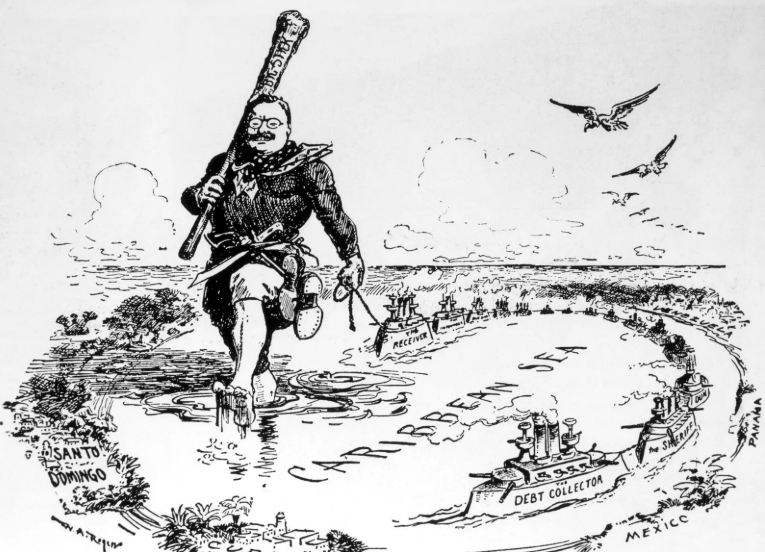
In the history of United States foreign policy, the Roosevelt Corollary was an addition to the Monroe Doctrine articulated by President Theodore Roosevelt in his 1904 State of the Union Address, largely as a consequence of the Venezuelan crisis of 1902–1903.
The corollary states that the United States could intervene in the internal affairs of any Latin American country guilty of “chronic wrongdoing, or an impotence which results in a general loosening of the ties of civilized society.”
Roosevelt tied his policy to the Monroe Doctrine, and it was also consistent with the foreign policy included in his big stick ideology. He stated that in keeping with the Monroe Doctrine, the US was justified in exercising “international police power” to put an end to chronic unrest or wrongdoing in the Western Hemisphere.
President Herbert Hoover in 1930 endorsed the Clark Memorandum that repudiated the Roosevelt Corollary in favor of what was later called the Good Neighbor policy.
Background
The Roosevelt Corollary was articulated in the aftermath of the Venezuelan crisis of 1902–1903. In late 1902, Britain, Germany, and Italy imposed a naval blockade of several months against Venezuela after President Cipriano Castro refused to pay foreign debts and damages suffered by Europeans in a recent civil war.
The dispute was referred to the International Court of Arbitration at The Hague, which concluded on 22 February 1904 that the blockading powers involved in the Venezuela crisis were entitled to preferential treatment in the payment of their claims. This left other countries which did not take military action, including the United States, with no recourse.
The US disagreed with the outcome in principle, and Roosevelt saw the need to take action politically. The corollary went towards ensuring that US interests abroad were protected from, in future, European powers using this ruling at The Hague as justification for military action and/or occupation in Central and Latin America.
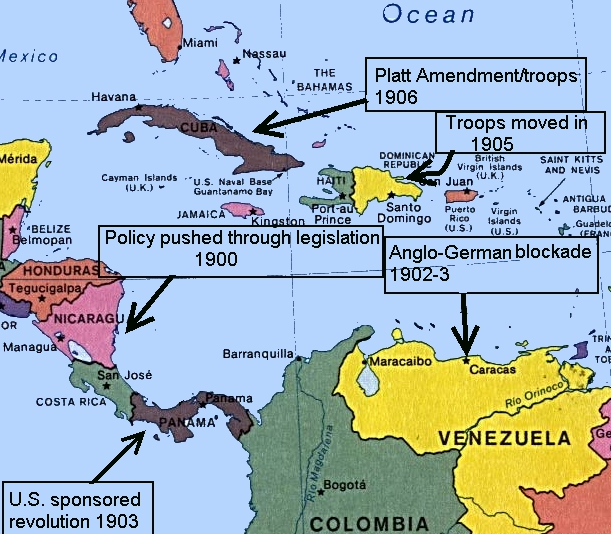
There were many contributing factors to the assertion of the Roosevelt Corollary in 1904, including both physical events such as the Venezuelan crisis and mentalities that existed within the US that shaped the foreign policy of the period.
Anti-European sentiment amongst Americans built up following the preferential treatment that the International Court of Arbitration awarded the European powers. This contributed to the domestic political situation in which Roosevelt was shaping his corollary, making the introduction of the corollary harder to sell to the American public, especially as few people had any true understanding of the importance of the US in international affairs.
Even the long-existing concept of Manifest destiny, which was commonly used during the expansion of the United States’ western frontier, came into play to build the Roosevelt Corollary.
Manifest destiny by the early 20th century had become an expression of American exceptionalism, whereby the US had superior virtue and a duty to help ‘lesser’ states in their development.
Roosevelt showed longer-lasting ideas of the US being the police state for the Western Hemisphere than is seen simply in the Venezuelan crisis, with him asserting in his 1901 annual message that international police duty “must be performed for the sake of the welfare of mankind.”
Therefore, the Roosevelt Corollary was largely shaped and created as a result of the ruling of the Venezuelan crisis, but there were still underlying and previously seen ideas and domestic mentalities that contributed to its form.
While the Monroe Doctrine had been verbal and defensive in warning European powers to keep their hands off countries in the Americas, Roosevelt changed this into an aggressive military “obligation” of the US to intervene in Latin America to maintain stability in these areas.
Where the Monroe Doctrine had been asserted in the early 19th century when the European powers looked to recolonize in the Western Hemisphere, the Roosevelt Corollary nearly a century later looked to once again promote the US in Latin America.
The corollary contributed to the transition of the United States into a great power after the Spanish–American War, which largely marked the start of the US expanding its interest in states beyond its own borders, promoting its influence and ideas abroad.
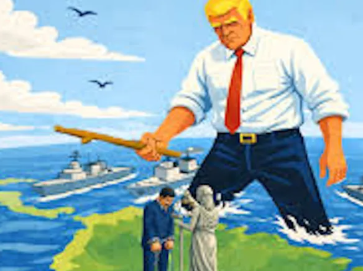
By expanding on the Monroe Doctrine, rather than creating a whole new policy, Roosevelt was able to justify more easily the US exercising “international police power” to put an end to wrongdoing in the Western Hemisphere, as a more limited version of the corollary already existed in the Monroe Doctrine, despite the shift from verbal to active intervention.
US presidents also cited the Roosevelt Corollary as justification for intervention in Cuba (1906–1909), Nicaragua (1909–1910, 1912–1925, and 1926–1933), Haiti (1915–1934), and the Dominican Republic (1916–1924).
Although the main rationale for the corollary was to keep Europe from meddling in the Western Hemisphere, other intentions were hidden to retain the United States’ reputation. Many other benefits such as the acquisition of raw materials and new markets attracted Roosevelt. These gains can be seen in the copious amount of sugar in Cuba or the abundant oil in Nicaragua.
Big stick ideology
The Big stick ideology (also known as big stick diplomacy, big stick philosophy, or big stick policy) was a political approach used by the 26th president of the United States, Theodore Roosevelt.
The terms are derived from an aphorism which Roosevelt often said: “speak softly and carry a big stick; you will go far.” The American press during his time, as well as many modern historians today, used the term “big stick” to describe the foreign policy positions during his administration.
Roosevelt described his style of foreign policy as “the exercise of intelligent forethought and of decisive action sufficiently far in advance of any likely crisis.” As practiced by Roosevelt, the big stick diplomacy had five components. First, it was essential to possess serious military capability that would force the adversary to pay close attention.
At the time that meant a world-class navy. The other qualities were to act justly toward other nations, never to bluff, to strike only when prepared to strike hard, and to be willing to allow the adversary to save face in defeat.
The idea is negotiating peacefully but also having strength in case things go wrong. Simultaneously threatening with the “big stick,” or the military, which implies a pursuit of political power that resembles Machiavellian ideals. It is comparable to gunboat diplomacy, as used in international politics by US powers.
~~~~~
And continuing of the Prophecy concerning the rivarly between Esau and Jacob, about a heavy yoke, a heavy burden that Esau would one day break from his brother, Jacob:
“And Esau harbored hatred in his heart against Jacob, his brother, because of the blessing with which his father had blessed him.
“And Esau said in his heart, ‘I will not do as Cain did, who killed Abel during their father’s lifetime and then their father had another son, Seth.
“Rather, I will wait until the days of mourning for my father have passed, and then I will kill Jacob my brother, and I will be the sole heir.’” Genesis 27:41 Jonathan
For a detailed Study of who Esau is, see Obadiah
And who then is Ephraim, see (1) Ephraim and Manasseh (2) Ephraim as the Thirteenth Tribe
And how they would play out, see Ezekiel 4 – 390/40 Years Timeline


 Joel
Joel A Prophecy of Esau and Jacob