
The “Monroe Doctrine” Is the Yoke of Jacob
The Monroe Doctrine is more than just an United States foreign policy position that opposes European colonialism in the Western Hemisphere.
Outwardly it holds that any intervention in the political affairs of the Americas by foreign powers is an hostile act against the United States, it is an imperial ambition to hold all nations in the Western Hemisphere to the American grand strategy when it was first articulated on December 2, 1823 by its then President James Monroe.
At the time, nearly all Spanish colonies in the Americas had either achieved or were close to independence. President Monroe asserted that the New World and the Old World were to remain distinct separate spheres of influence, and thus further efforts by European powers to control or influence sovereign states in the region would be viewed as a threat to US security.
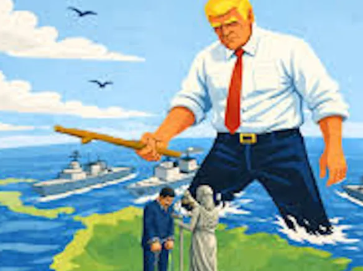
This Monroe doctrine, however, was met with approval from Britain, who enforced it tactically as part of the wider Pax Britannica, which included enforcing the freedom of the seas. In fact, for many years after the doctrine took effect, the Britain Royal Navy was the sole nation enforcing it, as the United States Navy was then a small force.
Britain’s fast-growing industries sought markets for their manufactured goods, and the British feared their trade with the Americas would be damaged if other European powers further colonized it. Conversely, to uphold this anticolonial stance the US relied heavily upon the British Empire’s navy, and thus indirectly maintained the Monroe Doctrine through the British imperial might.
In early 1833, the British reasserted their sovereignty over the Falkland islands, thus violating the Monroe Doctrine, Andrew Jackson protested but did nothing as stipulated in the doctrine. From 1838-1850, France and Britain blockaded Argentina but no American action followed.
The doctrine transformed at the century’s turn. The Venezuela crisis of 1902-1903 prompted Theodore Roosevelt to announce the Roosevelt Corollary, transforming the Monroe Doctrine from defensive shield into offensive sword justifying American intervention throughout Latin America. During the Cold War, it justified opposing Soviet influence. In the 1980s, Reagan’s version committed America to aiding anti-Marxist insurgencies, with Nicaragua as a primary target.
These two nations, which form today the only two powers in the world, will not permit that they should be given back to imperial Spain.
From today’s perspective, it may come as a surprise that many Latin Americans were supportive of Monroe’s defiant declaration bolstering their precarious independence.
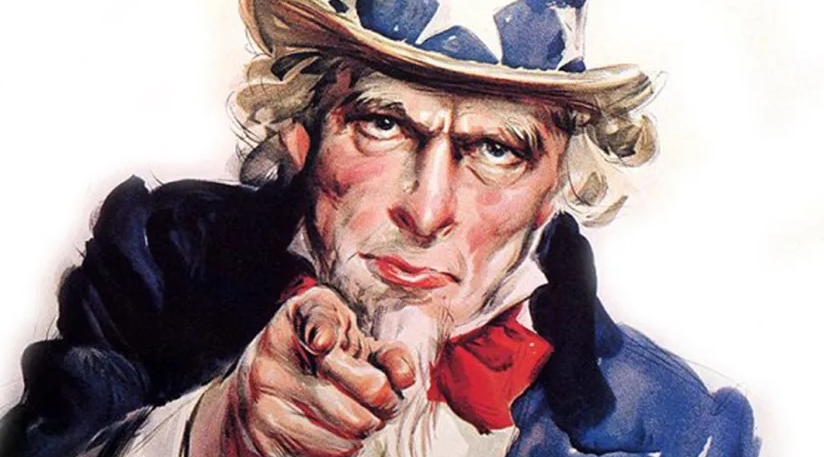
In 1904, under President Theodore Roosevelt, and with much greater global influence than in 1823, the Monroe Doctrine was expanded to assert that it could justify the United States exercising a policing power internationally. Roosevelt advocated for US intervention in the Western Hemisphere, justifying it by stressing the need to “keep order ourselves,” which meant using force to manage interference in America’s geopolitical neighborhood.
In the event, the Monroe Doctrine and its Corollary would branch out into FDR’s ‘Good Neighbour’ and JFK’s ‘Alliance for Progress’ policies, in an attempt to secure partnerships and regional hegemony, including in the security sector, within the Americas.
More recently, the new National Security Strategy published by the US Government in December of 2025 explicitly introduces what it calls ‘The Trump Corollary to the Monroe Doctrine:’
‘After years of neglect, the United States will reassert and enforce the Monroe Doctrine to restore American preeminence in the Western Hemisphere, and to protect our homeland and our access to key geographies throughout the region. We will deny non-Hemispheric competitors the ability to position forces or other threatening capabilities, or to own or control strategically vital assets, in our Hemisphere. This “Trump Corollary” to the Monroe Doctrine is a common-sense and potent restoration of American power and priorities, consistent with American security interests.’
Historians have observed that while the doctrine contained a commitment to resist further European colonialism in the Americas, it resulted in some aggressive implications for US foreign policy, since there were no limitations on its own actions mentioned within it.
Historian Jay Sexton notes that the tactics used to implement the doctrine were modeled after those employed by European imperial powers during the 17th and 18th centuries. American historian William Appleman Williams, seeing the doctrine as a form of American imperialism, described it as a form of “imperial anti-colonialism.”
Noam Chomsky argues that in practice the Monroe Doctrine has been used by the US government as a declaration of hegemony and a right of unilateral intervention over the Americas.
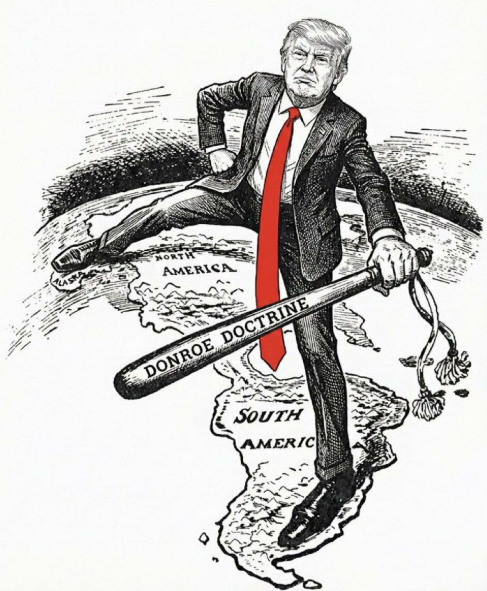
When regime change succeeded…(RT)
Guatemala, 1954
In June of 1954, Guatemala’s elected president, Jacobo Árbenz, was ousted by a group of mercenaries trained and funded by Washington. The reason for the first US-backed Latin American regime change of the Cold War era was a land reform that threatened the interests of the America’s United Fruit Corporation.
The CIA acknowledged its role in the coup and declassified relevant documents only in the 2000s, revealing what would become a template for future US intervention: the strategy involved psychological operations, elite pressure, and engineered political outcomes beyond the coup itself.Dominican Republic, 1965
A decade later, Washington resorted to direct military intervention to steer a crisis in a Caribbean country to its benefit. Citing a “Communist threat,” the US sent its military to Santo Domingo to crack down on supporters of Juan Bosch – the first democratically elected president of the Dominican Republic, who had been overthrown by a military junta.
The US dispatched over 20,000 troops to the island in Operation Power Pack to support anti-Bosch forces. Subsequent elections in 1966, which were marred by allegations of fraud, brought a US-backed candidate to power. The US occupation led to increased repression in the Dominican Republic and sowed distrust towards Washington’s interventionism in Latin America.Chile, 1973
Less than a decade later, another democratically elected president – Salvador Allende – was ousted in a US-backed coup in Chile that would become the most-cited example of Washington’s disregard for democratic procedures in Latin America.
Prior to the coup, the CIA had been conducting covert operations and spreading anti-Communist propaganda since the mid-1960s to prevent Allende from becoming president in the first place. After his election in 1970, Washington spent three years and another $8 million on covert activities, while expanding contacts with the Chilean military and the militant pro-coup opposition.
The 1973 US-backed regime change led to a 17-year-long dictatorship under Augusto Pinochet. During that period, tens of thousands of people were imprisoned for political reasons, many of whom were subjected to torture.… and when coup attempts failed
Cuba, 1961
In April of 1961, a force of Cuban exiles heavily backed by the US landed on the south coast of Cuba to overthrow the government of Fidel Castro. Castro himself had come to power on the Caribbean island after a left-wing revolution overthrew US-backed dictator Fulgencio Batista in 1959.
The Bay of Pigs invasion ended in disaster, as the Cuban military led by Castro himself defeated the 1,500-strong force in just two days. The attempted coup pushed Cuba closer to the Soviet Union and set the stage for the Cuban Missile Crisis in 1962. The failure also opened the way to the US Operation Mongoose, a campaign of attacks on civilian facilities in Cuba and covert action designed to undermine Castro’s government.
Nicaragua, 1979
Washington also sought to reverse the outcome of another Latin America revolution that ousted US-backed dictator Anastasio Somoza and brought the Marxist Daniel Ortega in Nicaragua to power in 1979. US President Ronald Reagan secretly authorized the CIA to provide $20 million in aid to militants opposing Ortega, known as the Contras. The scheme was partly funded by sales of arms to Iran in violation of the US’s own embargo.
The plan led to the 1986 Iran-Contra scandal in the US and plunged Nicaragua into a decade-long civil war that claimed 50,000 lives. It still failed to achieve its goal, as Ortega retained power. While he lost re-election in 1996, Ortega returned to power a decade later and remains the country’s president as of early 2026.
The US empire’s goals in Latin America
The US government has always meddled in Latin America’s internal affairs. This is far from new.
The United States overthrew at least 41 governments in Latin America from 1898 to 1994, according to research by Columbia University historian John Coatsworth.
In the past three decades, Washington has backed dozens more coups, coup attempts, regime-change operations, and “color revolutions” in the region.
The US military has intervened in every single country in Latin America, according to data from the Congressional Research Service. (The only exception is French Guiana, which is a colony of France.)
US imperialism has always been bipartisan in Washington, and has continued under both Republican and Democratic presidents.
However, Donald Trump has brought back the most overt, aggressive form of interventionism.
In its flagrant attacks on the sovereignty of Latin America, the US empire has three main goals.
Exploit the region’s resources
One, the US wants to exploit Latin America’s plentiful natural resources, including oil and natural gas; gold, iron ore, lithium, copper, and other minerals; agricultural products; and fresh water. (As the climate crisis worsens, water will become increasingly important geopolitically.)
Trump has been very open about the fact that he wants US corporations to take over and profit from the region’s natural resources.
At a 2023 rally, Trump boasted that he wanted to “take over” Venezuela, and “we would have gotten all that oil.”
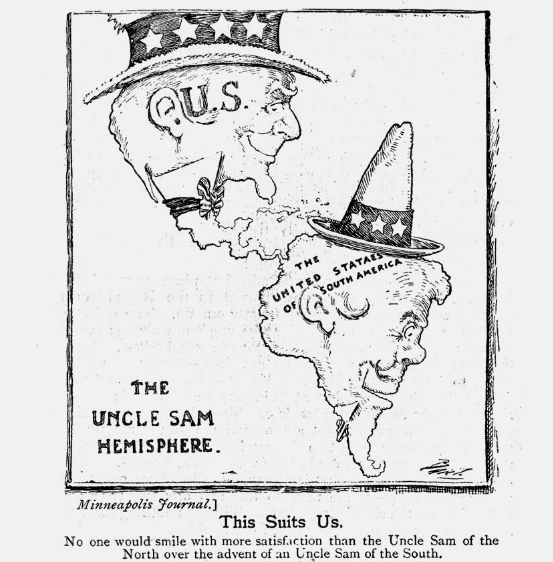
Cut off relations with China
The second goal of the US empire is to prevent all governments in Latin America from having close ties with China. Washington would like to cut off regional relations with Russia and Iran as well, but China is the top priority.
China is already the number one trading partner of South America, and economic exchange is growing more and more by the year.
The United States is waging a Second Cold War, or Cold War Two, which seeks to isolate China. US strategists want to turn not only Latin America but all of the western hemisphere into an imperial “sphere of influence.”
It is not a coincidence that, in the first trip that Trump’s Secretary of State Marco Rubio took abroad, he went to Panama, where he successfully pressured the country to withdraw from China’s global infrastructure project, the Belt and Road Initiative (BRI).
And below is a Prophecy concerning the rivarly between Esau and Jacob, about a heavy yoke, a heavy burden that Esau would one day break from his brother, Jacob:
And upon thy sword shalt thou depend, entering at every place: yet thou shalt be supple and credulous, and be in subjection to thy brother; but it will be that when his sons become evil, and fall from keeping the commandments of the law, thou shalt break his yoke of servitude from off thy neck. Genesis 27:40 Jonathan
“And Esau harbored hatred in his heart against Jacob, his brother, because of the blessing with which his father had blessed him.
“And Esau said in his heart, ‘I will not do as Cain did, who killed Abel during their father’s lifetime and then their father had another son, Seth.
“Rather, I will wait until the days of mourning for my father have passed, and then I will kill Jacob my brother, and I will be the sole heir.’” Genesis 27:41 Jonathan
For a detailed Study of who Esau is, see Obadiah
And who then is Ephraim, see (1) Ephraim and Manasseh (2) Ephraim as the Thirteenth Tribe
And how they would play out, see Ezekiel 4 – 390/40 Years Timeline


 Joel
Joel A Prophecy of Esau and Jacob