Destined to be Caught in a Snare, how this Prophecy is to be Fulfilled: And notice a Composite Message of Sweetness and Bitterness! “You only have I known of all the families of the earth; therefore I will punish you for all your iniquities” Amos 3:2
Ezekiel (Ch 9-10)
As Ezekiel continues his visions of God in Jerusalem, the focus of his prophecy is for the children of Israel at the endtime. In the next two chapters, the children of Israel refers to both the northern house of Israel and the southern house of Judah.
In chapter 9 it has the core subject about those who preside over God’s Sanctuary in the endtime, the remnants. Yet these remnants are to be slain: “Slay utterly old and young . . . and begin at my Sanctuary,” Ezekiel 9:6.
But an even smaller remnants are spared; why are they spared and not the others?
Ezekiel’s Vision of God for the endtime rebellious house of Israel
Ezekiel 9
1 He cried also in mine ears with a loud voice, saying, “Cause them that have charge over the city to draw near, even every man with his destroying weapon in his hand.”
— he, the Divine, cried also in mine ears with a loud voice; that is, the Shekinah, whom the prophet saw in the Temple, and who directed him from place to place, now wanted to show him all the abominations committed there;
— saying, cause them that have the charge over the city to draw near; or “those appointed over the city,” that is, the city of Jerusalem after the four abominations shown in chapter 8; by whom are meant the ministering angels, who had the charge of executing God’s judgements upon the city;
— even every man with his destroying weapon in his hand; weapons of war, as bows and arrows, sword and spear, each of these had a weapon proper for that kind of destruction which he was to effect; and so, some to slay with sword, other with the pestilence, another with famine;
“And it came to pass that I heard a great voice saying: ‘Draw near, you who are appointed over the city, and let each man have his weapon of destruction in his hand.’”
2 And behold, six men came from the way of the higher gate, which lieth toward the north, and every man a slaughter weapon in his hand; and one man among them was clothed with linen, with a writer’s inkhorn by his side. And they went in and stood beside the brazen altar.
— in the good old days, these “six men” or six destroyers, or angels of wrath, or they could be the generals of Nebuchadnezzar Jeremiah 39:3;
— but if this “six men” are meant to be prophecy, then who are they? In modern times, could they be Chechens, Syrians, Iraqis, Palestinians, Libyans and Afghans? Or perhaps some other combinations?
— or, as Ezekiel 38:22 renders it, I will strike thee with six plagues; those mentioned, namely, pestilence, blood, overflowing rain, hailstones, fire, brimstone; in the Talmud, it was expressed as “Anger, Wrath, Fury, Destroyer, Breaker, Annihilator;”
“And behold, six men came from the direction of the upper gate that faces north, each man with his weapon in his hand; and one man among them was clothed in garments, with a scribe’s ink‑case at his waist. And they went up and stood beside the bronze altar.”
3 And the glory of the God of Israel had gone up from the cherub, whereupon he was, to the threshold of the house. And He called to the man clothed with linen, who had the writer’s inkhorn by his side;
— Ezekiel was explicitly commanded to write down his visions, Ezekiel 43:11; so he was the man who had the writer’s inkhorn by his side;
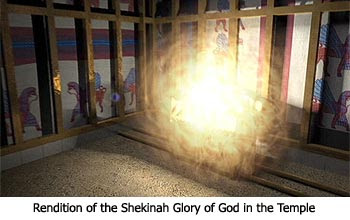
— and the glory of the God of Israel was gone up from the cherub; that is, the glorious God; or the Shekinah, removed from thence, as a token of his being about to depart from the temple, and with its protection removed, the temple would be destroyed in a short time;
— the Targum says, “the glory of the God of Israel departed in the cherub on which he dwelt, in the house of the holy of holies;” the cherubim removed with him, as were his chariot in which he rode;
Shekinah, the Glory of God left the Temple and Jerusalem was soon destroyed
4 and the Lord said unto him, “Go through the midst of the city, through the midst of Jerusalem, and set a mark upon the foreheads of the men who sigh and who cry because of all the abominations that are done in the midst thereof.” — and the Lord said unto Ezekiel;
— and you shall mark a sign: you shall mark a sign on the foreheads of the righteous men in order to show the destroyers those men whom they should not strike;
— it is a Rabbinical thought that Gabriel had orders to write the letter ת (tav; the last letter of the alphabet) in ink upon the foreheads of the righteous, which signified תחיה, “thou shall live.” And for the wicked the same letter ת were written in blood upon the foreheads, but it signified תמות, “thou shall die.”
— the letter ת in the original paleo Hebrew looks like an x sign;
“And the Lord said to him: ‘Pass through the midst of the city, through the midst of Jerusalem, and you shall mark a sign upon the foreheads of the men who sigh and who groan over all the abominations that are committed in her midst.'”
5 And to the others He said in mine hearing, “Go ye after him through the city and smite. Let not your eye spare, neither have ye pity. — He said into mine hearing; that is, God spoke into Ezekiel’s ears;
— the remnant fell by the sword of the Chaldeans, but God found out some way to spare or secure them; as in the last destruction of Jerusalem by the Romans;
— the Christians were spared in a city on the mountains, called Pella, east of the Jordan; and certain Jews, including some Pharisees of the House of Hillel; they escaped to Yavne along the coast of the Mediterranean sea;
“And to these He said in my hearing: ‘Pass through the city after him and kill; let your eye not spare, and do not have pity.'”
6 Slay utterly old and young, both maids and little children and women; but come not near any man upon whom is the mark; and begin at My sanctuary.” Then they began with the elder men who were before the house.
— and begin at my sanctuary; the Temple, the house of God, and the priests and Levites that dwelt there; and in today’s climate, the synagogues, the churches; the chapels, the assemblies or some other terms;
— begin at My sanctuary means “begin with my elects” those who professed themselves to be saints of the Lord, and were separated and devoted to his service; and so the Rabbins say, do not read ממקדשי, “at my sanctuary;” but ממקודשי, “at those that sanctify me” or “my sanctified ones” which they interpret of those that keep the whole law, from “aleph” to “tau;”
“Old man, youth, virgin, child, and women — you shall kill for destruction; but do not approach any man on whom is the mark. And begin from My sanctuary, and begin with the old men who are before the House.”
7 And He said unto them, “Defile the house, and fill the courts with the slain. Go ye forth.” And they went forth and slew in the city. — and fill the courts with the slain; the court of the priests, and the court of the Israelites, and the court of the women, and all the chambers where the priests and Levites were;
“And He said to them: ‘Defile the Temple and fill the courtyards with the slain; go forth!’ And they went forth and struck in the city.”
8 And it came to pass, while they were slaying them and I was left, that I fell upon my face and cried, and said, “Ah Lord God! Wilt Thou destroy all the residue of Israel in Thy pouring out of Thy fury upon Jerusalem?”
— when Ezekiel was delivering his message to both houses of Israel and Judah, they were already in captivity. He was among the captives at the river Chebar, so Ezekiel’s messages were actually meant for those living far into the future, in our time, to the modern house of Israel, the chief of whom is Ephraim, the United States of America;
“And it came to pass, while they were slaying them, and I was left alone, that I fell upon my face and cried out and said: ‘Accept my prayer, O Lord God! Are You destroying all the remnant of Israel by pouring out Your fury upon Jerusalem?'”
A Nation Full of Blood Crimes!
9 Then said He unto me, “The iniquity of the house of Israel and Judah is exceeding great, and the land is full of blood and the city full of perverseness; for they say, ‘The Lord hath forsaken the earth, and the Lord seeth not.’
— both the iniquity of the house of Israel and Judah is immeasurably great, and the land is full of blood-guiltiness, and the city full of perversion;
— for they say God hath forsaken the land, and he seeth not. Ezekiel 9:10. So also shall my eye not look with pity, and I will not spare; I will give their way upon their head. Ezekiel 9:11
“And He said to me: ‘The sins of the house of Israel and Judah are exceedingly great; the land is filled with those guilty of murder, and the city is filled with the perversion of justice; for they have said, “The Lord has removed the inhabitants of the land,” and “Nothing is revealed before the Lord.”‘”
10 And as for Me also, Mine eye shall not spare, neither will I have pity, but I will recompense their ways upon their heads.” — a parallel Scripture, “As you have done [unto others], it shall be done to you; your dealings will return upon your own head” Obadiah 1:15
“And He said to me: ‘The sins of the house of Israel and Judah are exceedingly great; the land is filled with those guilty of murder, and the city is filled with the perversion of justice; for they have said, “The Lord has removed the inhabitants of the land,” and “Nothing is revealed before the Lord.”‘”
11 And behold, the man clothed with linen, who had the inkhorn by his side, reported the matter, saying, “I have done as Thou hast commanded me.” — the man clad in linen returns, announcing the execution of God’s commands;
“And behold, the man who was clothed in the garment (linen), who had the tablet (writing kit) at his side, brought back word, saying: ‘I have done as You commanded me.'”
~~~~
More on Ezekiel 9:6 Slay utterly old and young . . . and begin at my sanctuary:
Today many pretentious Christians, especially among the CoG Communities, believe they will go into a place of safety? But this is just day dreaming. It’s far more likely that lightnings and thunderstorms would begin with these professing Christians.
Deuteronomy 16:18 “You shall appoint judges and officers in all your towns that the Lord your God is giving you, according to your tribes, and they shall judge the people with righteous judgment.
Deuteronomy 17:11 According to the sentence of the law which they shall teach thee, and according to the judgment which they shall tell thee, thou shalt do: thou shalt not decline from the sentence which they shall shew thee, to the right hand, nor to the left. 12 And the man who will do presumptuously, and will not hearken unto the priest who standeth to minister there before the Lord thy God, or unto the judge, even that man shall die.
Moses knew he would die soon and his understanding had been conveyed to the judges, the Levites and priests where the true interpretation of the law were taught.
So in the book of Deuteronomy Moses spoke and explained unto all Israel “according unto all that the Lord had given him” as to how to keep them, the blessing they would have if they obey, or cursing if they disobey, in a language they could understand. Men may have good intentions, but may do things seen as presumptuously?
The Jews were prophesied they would mourn One whom they had rejected: “And they shall look to Me whom they have pierced; then they shall mourn for him, as one mourns for an only son” (Zechariah 12:10). But these Christians have nothing to mourn?
Currently these endtime virgins are described as lukewarm and in need of nothing, but would they not mourn when they realise that they had been blind, wretched and naked, seeing finally that Christ had suffered far more through His torn flesh and shed blood than they had ever realised? No?
Today more than 98.5 percent of Christians are honoring the SUN by observing SUNday. They have “their backs toward the temple of the Lord and their faces toward the east; and they worshiped the SUN toward the east,” Ezekiel 8:16.
Others, following the SUN-worshipping Samaritans, the Church of God Communities are showing their contempt for God by having their “wavesheaf offering” and Pentecost on a SUNday. Always on SUNdays.
And these are supposedly in God’s sanctuary, but God says He is a jealous God, so these pretentious Christians could be spewed out of His mouth! No? Regardless, there are those being described in Revelation 3:17 — wretched, miserable, poor, blind and naked. “As many as I love, I rebuke and chasten: or else I will spew thee out of My mouth (v16,19).”
Despite the above, there’ll be a remnant that are spared: “Go through the midst of the city, through the midst of Jerusalem, and set a mark upon the foreheads of the men who sigh and who cry because of all the abominations that are done in the midst thereof,” Ezekiel 9:4. These remnants “who sigh and who cry” will be marked with a letter ת in ink on the forehead;
— but the question is, do we qualify to be in this category?
Ezekiel 10
In Chapter 10, Ezekiel was again in a vision, very much like that in the first chapter, but with a different view; the design being to represent the wrath of God against Jerusalem and his departure from the city and Temple. A throne much like that in Ezekiel 1:26 is described.
1 Then I looked, and behold, in the firmament that was above the head of the cherubims there appeared over them, as it were, a sapphire stone with the appearance of the likeness of a throne. — description much like in chapter 1
“And I saw, and behold—in the firmament above the heads of the cherubim there appeared something like a precious stone, like the appearance of the likeness of a throne, seen above them.”
2 And He spoke unto the man clothed with linen, and said, “Go in between the wheels, even under the cherub, and fill thine hand with coals of fire from between the cherubims, and scatter them over the city.” And he went in in my sight.
— and He spake unto the man clothed with linen; that is, the God of Israel gave orders to the man clothed in linen, who appears in another character, and represents the Chaldean or Roman army; these “coals of fire” were an emblem of the wrath of God against Jerusalem;
“And He spoke to the man clothed in the garments (linen) and said: ‘Go in between the whirling wheels, beneath the cherub, and fill your hands with coals of fire from between the cherubim, and scatter them over the city.’ And he went in as I watched.”
3 Now the cherubims stood on the right side of the house when the man went in; and the cloud filled the inner court. — now the cherubim stood on the right side of the house; according to the Targum, it was the south side of the house (the idolatries could be seen from the north); opposite the north; that’s where the gross idolatries were committed;
“And the cherubim were standing on the south side of the House (the Temple) when the man entered; and the thick cloud filled the inner courtyard.”
4 Then the glory of the Lord went up from the cherub and stood over the threshold of the house; and the house was filled with the cloud, and the court was full of the brightness of the Lord’S glory. — this is a token and intimation of the Lord’s leaving of the temple; and a little before the destruction of Jerusalem by the Romans;
“And the Glory of the Lord rose up from the cherub upon which it had rested, and rested above, opposite the threshold of the House; and the House was filled with the thick cloud, and the courtyard was filled with the brightness of the Glory of the Lord.”
5 And the sound of the cherubims’ wings was heard even to the outer court, as the voice of the Almighty God when He speaketh. — and the sound of the cherubim’s wings was heard even to the outer court; or court of the Gentiles;
— the swift ministry of the apostles, signified by the “cherubim’s wings” went into all the earth, and throughout the Gentiles; the sound of the Kingdom, and redemption by Christ; the sound of this in the swift ministry of the apostles, signified by the “cherubim’s wings” going out into all the earth, especially to the Gentile world;
“And the sound of the wings of the cherubim was heard as far as the outer court, like the voice of the Almighty when He speaks.”
6 And it came to pass that when He had commanded the man clothed with linen, saying, “Take fire from between the wheels, from between the cherubims,” then he went in and stood beside the wheels.
— the cherubims stood as servants waiting; then the chariot of fire being taken from between the wheels;
“And when He commanded the man clothed in linen, saying, ‘Take fire from between the wheels, from between the cherubim,’ he went and stood beside the wheel.”
7 And one cherub stretched forth his hand from between the cherubims unto the fire that was between the cherubims, and took thereof and put it into the hands of him that was clothed with linen, who took it and went out.
— who took it, and went out; took the fire, and went out of the Temple, and scattered it upon the city of Jerusalem; so representing the Chaldean, or rather the Roman army, burning it with fire;
“And the cherub stretched out his hand from among the cherubim to the fire that was between them, took it, and placed it into the hands of the man clothed in linen; and he took it and went out.”
8 And there appeared in the cherubims the form of a man’s hand under their wings. — one of them put forth his hand, which was seen by Ezekiel, but this was only the “form” of one; which may not to be taken literally, but as seen in the vision of prophecy; and being under their wings indicates secrecy and privacy;
“And there appeared to the cherubim the form of a human hand beneath their wings.”
9 And when I looked, behold, the four wheels by the cherubims, one wheel by one cherub and another wheel by another cherub; and the appearance of the wheels was as the color of a beryl stone. — a beryl stone is of sea-green colour;
— the Targum renders it in general, “a precious stone;”
“And I looked, and behold, there were four wheels beside the cherubim, one wheel beside one cherub and another wheel beside another cherub; and the appearance of the wheels was like the color of a precious stone.”
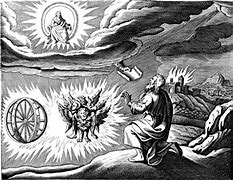
All four had one likeness, as if a wheel had been in the midst of a wheel
10 And as for their appearance, all four had one likeness, as if a wheel had been in the midst of a wheel. — and as for their appearances, all four had one likeness, see picture above;
“And as for their appearance, the four of them had one likeness, as if it were a wheel within a wheel.”
11 When they went, they went upon their four sides. They turned not as they went, but to the place whither the head looked they followed it; they turned not as they went. — the wheels were not guided by some external impetus, but by the cherubim themselves;
“When they moved toward their four directions, they went; they did not turn as they moved, for toward the place the first face turned, they went after it, and they did not turn as they moved.”
12 And their whole body, and their backs, and their hands, and their wings, and the wheels, were full of eyes round about — even the wheels that the four had. — and the wheels were full of eyes; that is, the rings or circles of the wheels, as in Ezekiel 1:18; even the four wheels were “full of eyes;”
“And all their flesh, and their backs, and their sides, and their wings, and the wheels were full of eyes all around, for all four of the wheels.”
13 As for the wheels, it was cried unto them in my hearing, “O wheel.” — the word “galgal הַגַּלְגַּ֖ל whirl” could be better rendered “chariot” instead of “wheel;” “chariot” or whirl representing very well the collection of wheels;
“To the wheels, it was called ‘Wheel,’ and I heard.”
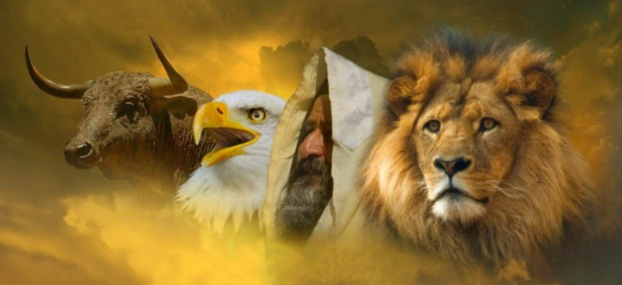
14 And every one had four faces: the first face was the face of a cherub, and the second face was the face of a man, and the third the face of a lion, and the fourth the face of an eagle. — these faces represent four archetypal forms of life in biblical symbolism—exalted, intelligent, powerful and swift;
As for the likeness of their faces, all four had the face of a man, and the face of a lion on the right side, and all four had the face of an ox on the left side; all four also had the face of an eagle. Ezekiel 1:10
— compare to chapter 1 of the description of the cherub, the first face was the face of an OX; the ox, being placed toward the west, now this is a face of a CHERUB, indicating, perhaps, that now in chapter 10, the face of an ox and a cherub has a change of significance. If so, what are they? Why the change of the face from that of an OX to that of a CHERUB?
— Jewish commentary (Talmud, Hagigah 13b) explains that Ezekiel prayed for the “ox” face to be changed because it reminded God of the Sin of the Golden Calf. Hence it was replaced with the face of a cherub;
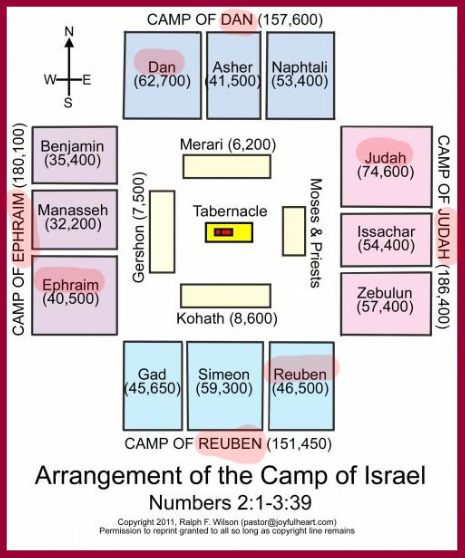
— note, on the west side were Benjamin (Norway), Manasseh (United Kingdom and the Commonwealth) and Ephraim (the United States); all children of matriarch Rachel; they all have enormous natural resources, but not much from any of the other matriarchs;
“Each one had four faces: one was the face of a cherub, the second the face of a human, the third the face of a lion, and the fourth the face of an eagle.”
Ox (West), Eagle (North), Man (South), Lion (East)
15 And the cherubims were lifted up. This is the living creature that I saw by the River of Chebar.
“And the cherubim rose; they are the creatures that I saw at the River Kebar.”
16 And when the cherubims went, the wheels went alongside them; and when the cherubims lifted up their wings to mount up from the earth, the same wheels also turned not from beside them;
“And when the cherubim moved, the wheels moved with them; and when the cherubim lifted their wings to rise upward toward heaven, the wheels did not turn, but they too rose correspondingly with them.”
17 When they stood, these stood, and when they were lifted up, these lifted up themselves also; for the spirit of the living creature was in them. — when they stood, these stood; when the one were inactive, lifeless, and without motion, making no progress in knowledge, experience, and practice, the other were so likewise;
“They stand in their place, and when they rise, they rise with them, for the spirit of the creatures is in them.”
18 Then the glory of the Lord departed from off the threshold of the house and stood over the cherubims. — the departure of Shekinah from the Holy of Holies to the east gate of the Temple, with the motion of the cherubim and wheels along;
“And the Glory of the LORD, which had been dwelling upon it, rose up from above to the threshold of the House and settled upon the cherubim.”
19 And the cherubims lifted up their wings and mounted up from the earth in my sight. When they went out, the wheels also were beside them, and every one stood at the door of the east gate of the Lord’S house; and the glory of the God of Israel was over above them.
— again, the departure of Shekinah from the Holy of Holies with the cherubims lifting up their wings and went along with the wheels toward the east gate;
“And the cherubim lifted their wings and rose upward toward heaven, and I saw them as they went out, and the wheels were beside them; and it stood at the entrance of the eastern gate of the House of the LORD, and the Glory of the God of Israel was above them.”
20 This is the living creature that I saw under the God of Israel by the River of Chebar; and I knew that they were the cherubims.
“These are the creatures I saw beneath the Glory of the God of Israel at the River Kebar, and I recognized that they were cherubim.”
21 Every one had four faces apiece, and every one four wings, and the likeness of the hands of a man was under their wings. — and everyone four wings: the Septuagint reads eight wings; the Syriac version six;
“Each one had four faces, and each one had four wings, and the likeness of a human hand was beneath their wings.”
22 And the likeness of their faces was the same as the faces which I saw by the River of Chebar, their appearances and themselves. They went every one straight forward.
— they went everyone straight forward; their motion as well as their form were alike; they kept one even course, looking right on, and their eyes right before them;
“And the likeness of their faces was the same as the faces I saw at the River Kebar; their appearance was the same, and each creature went straight ahead in the direction of its face.”
~~~
More on the Ox and the Unicorn:
His glory is like the firstling of his ox (bullock), and his horns are like the horns of unicorns. With them he shall push the people together to the ends of the earth; and they are the ten thousands of Ephraim, and they are the thousands of Manasseh,” Deuteronomy 33:17.
In the above verse, the Ox (verse 14 above) and Ephraim are named first, the firstborn of his (Joseph’s) “bullock is his glory”: the reference being to Ephraim; followed by Unicorn and Manasseh.
Although Manasseh was the firstborn, Joseph the father crossed his hands and placed Ephraim as firstborn, hence Ephraim, often known as the thirteenth tribe, represents not just the house of Joseph, but more often the house of the 10-tribes Northern Kingdom.
The Coat of Arms of the United States; thirteen Stars, thirteen stripes, thirteen leaves, thirteen letters and thirteen Arrows – the thirteenth tribe
A Unicorn in the Royal Coat of Arms of the United Kingdom
In Rabbinic teachings: the myriads (ten thousands) slain by Joshua, of the tribe of Ephraim: These are the myriads descended from Ephraim:
— Rashi: and the thousands of Manasseh: these are the thousands slain by Gideon, who was of the tribe of Manasseh. These are the thousands descended from Manasseh.
— also; his ox. whose strength is as mighty as that of an ox, to conquer many kings; and his horns are the horns of a re’em. The ox is powerful, but its horns are not beautiful; [on the other hand,] a re’em has beautiful horns, but it is not powerful. [Moses thus] blessed Joshua with the power of an ox and the beauty of a re’em ‘s horns. — [Sifrei 33:17]
In his blessings Jacob ascribes to Ephraim ten thousands, and to Manasseh only thousands; thus foreshadowing, that Ephraim the younger was to be the more numerous of the two, as Jacob had before prophesied of them.
~ Come to my parlour ~ the spider says to the butterfly: “Hear, ye deaf; and look, ye blind, that ye may see.”
"Who is blind, but My servant? Or deaf, as My messenger that I sent? Who is blind as he that is perfect, and blind as the Lord’s servant?” Isaiah 42:18-19
"Where two sit together to study the Torah, the Shekinah rests between them."
“Cry aloud, spare not; lift up thy voice like a trumpet! And show My people their transgression and the house of Jacob their sins" Isaiah 58:1
“Son of man, I have made thee a watchman unto the house of Israel; therefore hear the word out of My mouth, and give them warning from Me.
18 When I say unto the wicked, ‘Thou shalt surely die,’ and thou givest him not warning, nor speakest to warn the wicked from his wicked way to save his life, the same wicked man shall die in his iniquity; but his blood will I require at thine hand.
19 Yet if thou warn the wicked, and he turn not from his wickedness nor from his wicked way, he shall die in his iniquity; but thou hast delivered thy soul" Ezekiel 3:17-19
Now, consider this PROPHECY:
“And upon thy sword shalt thou depend, entering at every place: yet thou shalt be supple and credulous, and be in subjection to thy brother [Jacob]; but it will be that when his sons [the children of Israel] become evil, and fall from keeping the commandments of the law, thou shalt break his yoke of servitude from off thy neck…. and then will I kill Jakob my brother,” Genesis 27:41-42 the Targum of Jonathan
“Speak thou also unto the children of Israel, saying, ‘Verily My Sabbaths ye shall keep; for it is a sign between Me and you throughout your generations, that ye may know that I am the Lord who doth sanctify you'" Exodus 31:13
ISRAEL, today as in the past, has many BLIND shepherd, for it was prophesied:
“His watchmen are BLIND; they are all ignorant; they are all DUMB dogs, they cannot bark, sleeping, lying down, loving to slumber” Isaiah 56:10
The mission here is to provide research ARTICLES that are ENLIGHTENING and EASY TO UNDERSTAND using SCRIPTURES to help improve our knowledge and make our life better.
“I have seen a horrible thing in the house of ISRAEL; there is the whoredom of EPHRAIM, Israel is defiled” Hosea 6:10
“Shall a TRUMPET be blown in the city, and the people not be afraid? Shall there be evil in a city, and the LORD hath not done it?” Amos 3:6
“Hear, ye DEAF; and look, ye BLIND, that ye may see” Isaiah 42:18
Hence the RESEARCH produced here are to help us UNDERSTAND and hopefully WE all could learn together.
There's nothing special about me, except perhaps, since I was younger, I (L Siaw) had an inner struggle between my heart and my head, hence this blog.
I produce articles that I would understand and hopefully you could too.
Please SUBSCRIBE for more will come.
You may contact me on: eqlunn@gmail.com






 Joel
Joel A Prophecy of Esau and Jacob