
Isaiah (Ch 53-54)
Inspired by the Lord, Isaiah prophesied that both houses of Israel were blind and deaf:
“Hear, ye deaf; and look, ye blind, that ye may see” Isaiah 42:18
“His watchmen are blind; they are all ignorant; they are all dumb dogs, they cannot bark, sleeping, lying down, loving to slumber” Isaiah 56:10
Their wolfy shepherd and watchmen are just the same—dumb, deaf and blind!
Isaiah 53
Many theologians noted that the subject of the Suffering Servant, which the Targum (Isaiah 52:13) identifies as the Messiah, should start from Chapter 52:13 and onto the end of Chapter 53. More commentaries of this Suffering Servant and its prophecy are at the end.
1 Who hath believed our report? And to whom is the arm of the Lord revealed?
— our report; literally, that which has been heard by us, or reported to us. But the word is used technically for a prophetic revelation (see Isaiah 28:9,19; Jeremiah 49:14);
— here the word would seem to refer especially to the Messianic prophecies delivered by Isaiah. To whom is the arm of the Lord revealed? The “arm of the Lord,” which has been “made bare in the eyes of all the nations” (Isaiah 52:10); the word of God is expressly called the power of God, 1 Corinthians 1:18.
2 For He shall grow up before Him as a tender plant, and as a root out of a dry ground. He hath no form nor comeliness, and when we shall see Him, there is no beauty that we should desire Him. — Rashi justifies erroneously that “all Israel as one man;”
— for his Suffering Servant shall grow up as a tender plant and as a root out of a dry ground; and the reason or occasion why the Jews generally rejected their Messiah is because he didn’t come into the world with pomp and power, like an earthly monarch, as they would imagine; but
— he shall grow up, brought forth, and brought up; before him (before the unbelieving Jews, of whom “my servant the Messiah” spoken of in Isaiah 52:13 (Targum) and which the Jews are blinded to, as springing up of a low and insignificant plant or shrub out of the earth; has no strength nor straightness, of body; without verdure, leaves, blossom, and therefore despised;
— the Suffering Servant hath no form nor comeliness; when we shall see him, there is no beauty that we should desire him; when we shall look upon him, expecting to find incomparable beauty and majesty in his countenance, and carriage and condition, we shall be altogether disappointed and shall meet with nothing amiable or desirable in him.
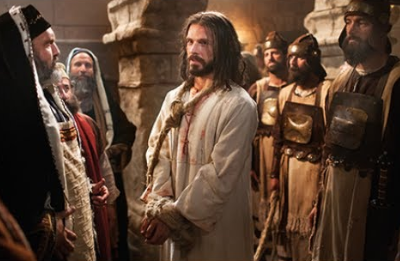
3 He is despised and rejected of men, a Man of sorrows, and acquainted with grief. And we hid as it were our faces from Him; He was despised, and we esteemed Him not.
— nowhere in all the Old Testament is it so plainly and fully prophesied that the Messiah ought to suffer and the Jews esteemed him not; which is repeated to show the great contempt cast upon him, to be despised and rejected of men before he is to enter into his glory.
4 Surely He hath borne our griefs and carried our sorrows; yet we did esteem Him stricken, smitten of God, and afflicted.
— the Septuagint renders the words, “he bears our sins” and the Targum, where the ancient Jews understood this prophecy of the Messiah, is, “he shall pray for our sins, and our iniquities for his sake shall be forgiven us.”
— Rashi erroneously says “he [that is, Israel] was chastised with pains so that all the nations be atoned for with Israel’s suffering.” No human, from Abraham to Jacob, nor from King David to Zerubbabel could have such intrinsic qualities; and of course, Israel or Jacob (whom the Jews thought was the suffering servant) doesn’t suffer for the sins of the nations; they suffer because of their own sins;
In Daniel 9:5, Daniel prayed, “We have sinned, we have done wickedly.” Daniel nowhere says that Judah’s captivity and suffering were to bear the griefs or sorrows for other nations!
— for more, see Daniel’s Prayer, a Critique
5 But He was wounded for our transgressions; He was bruised for our iniquities. The chastisement of our peace was upon Him, and with His stripes we are healed.
— but he, the Suffering Servant, was wounded for our transgressions; not for any sins of his own, but for ours, for our transgressions of his law, in order to make atonement and satisfaction for them;
— he was bruised for our iniquities; as bread corn is bruised by threshing it; he being broken and crushed to pieces under the weight of sin, and its punishment; the ancient Jews understood this of the Messiah; for in one place they say of King Messiah, “he was wounded for our transgressions; and bruised for our iniquities;”
— and with his stripes we are healed; or “by his stripe” so called from the gathering and settling of the blood where the blow is given. As a physician, the wonderful Messiah heals by taking the sicknesses of his people upon himself, by bearing their sins, and being wounded and bruised for them and by his enduring blows and suffering death itself for them;
— nar! the phase “with His stripes we are healed” is Isaiah speaking on behalf of “we” that is, Israel of both houses; how then could Israel suffers for the sins of Israel?
— the Targum says, therefore, He shall pray for our sins, and our iniquities for His sake shall be forgiven us.
6 All we like sheep have gone astray; we have turned every one to his own way; and the Lord hath laid on Him the iniquity of us all.
— all we like sheep have gone astray; all the children of God, whether Jews or Gentiles; whom he compares to “sheep” not for any good qualities, but for our foolishness and stupidity;
— and particularly for their being subject to go astray from the shepherd and from their good pastures, and who never return of themselves until they are brought back by the shepherd; so the people of God, in a state of nature are like the silly sheep who go astray from God;
— and the Lord hath laid on him the iniquity of us all; that is, God the Father against whom we have sinned, from whom we have turned and whose justice must be satisfied; he has laid on his own Son, the sins of all his elect.
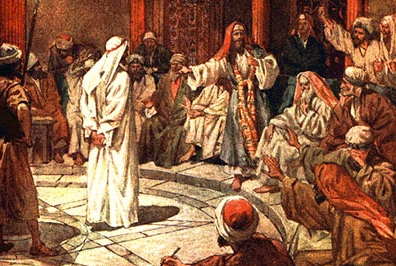
7 He was oppressed, and He was afflicted, yet He opened not his mouth; He is brought as a lamb to the slaughter; and as a sheep before her shearers is dumb, so He openeth not His mouth.
— he, the Suffering Servant, was oppressed and was afflicted; he was injuriously treated by both the Jews and Romans; they handled him roughly; he was oppressed and afflicted, both in body and mind, with their blows and with their reproaches;
— and he being the surety of his people, was responsible for them and did answer, the debt they owed was required, the payment of it was called for and he accordingly answered; the punishment of the sins of his people was exacted of him and did bear it in his own body on the tree;
— so the Suffering Servant opened not his mouth: not against his enemies, by way of threats or complaint; nor even in his own defence; nor against the justice of God as bearing hard upon him, not sparing him but demanding and having full satisfaction; nor against his people and their sins.
8 He was taken from prison and from judgement; and who shall declare His generation? For He was cut off out of the land of the living; for the transgression of My people was He stricken.
— the Suffering Servant was taken away from due justice and judgement; that is, his life was taken away in a violent manner, under a pretence of justice; whereas the utmost injustice was done him; a wrong charge was brought against him, false witnesses were suborned, and his life was taken away with wicked hands.
9 And He made His grave with the wicked, and with the rich in His death, because He had done no violence, neither was any deceit in His mouth.
— and he made his grave with the wicked and with the rich in his death; these words are generally supposed to refer to a fact that Christ who died with two wicked men besides him as if he himself had been one, was buried in a rich man’s grave;
— neither was any deceit in his mouth: no false accusation was delivered by him; he was no deceiver of the people as he was charged; he did not attempt to seduce them from the true worship of God or persuade them to believe anything contrary to the law of Moses and the prophets;
— he, the Suffering Servant, was no enemy to the state, nor indeed guilty of any manner of sin, nor given to any arts of trick and dissimulation.
10 Yet it pleased the Lord to bruise Him; He hath put Him to grief. When thou shalt make His soul an offering for sin, He shall see His seed, He shall prolong His days, and the pleasure of the Lord shall prosper in His hand.
— yet it pleased the Lord to bruise him; the sufferings of Christ are signified by his being “bruised” as it was foretold he should have his heel bruised by the serpent, Genesis 3:15;
— but here it is ascribed to Yeshua or Jesus as the Suffering Servant: he was bruised in body when scourged and nailed to the cross; and was bruised and broken in spirit when the sins of his people were laid on him;
— “He shall see His seed.” Opponents of Jesus being the description here point to this Being has seed, whereas Jesus hadn’t; first, it makes no sense that whether Jesus has seed is being dependent on us (or ‘thou’ as the verse says) making an offering for sin; second, this phase “for sin” imputes that Christ would sin, for we know that he didn’t sin, else he cannot save humanity with his own sacrifice;
— and third; following the evidence presented above, this verse could be another example of the lying pen of the scribes, Isaiah 8:8; that is, some scribes could most probably had altered it;
— the Targum has it this way:
“And it was the pleasure of the Lord to refine and to purify the remnant of His people, in order to cleanse their souls from sin, that they might see the kingdom of their messiah, that their sons and daughters might multiply, and prolong their days, and those that keep the law of the Lord shall prosper through His pleasure” Isaiah 8:8 Jonathan
11 He shall see of the travail of His soul, and shall be satisfied. By His knowledge shall My righteous Servant justify many, for He shall bear their iniquities.
— the travail of his soul is the toil and labour which the Suffering Servant had endured in working out the salvation of his people; his obedience and death, his sorrows and sufferings;
— particularly those birth throes of his soul under a sense of divine wrath for the allusion is to women in travail; and all the agonies and pains of death which he went through;
— now the fruit of all this he sees with inexpressible pleasure and which gives him an infinite satisfaction; namely, the complete redemption of all the chosen ones and the glory of the divine perfections as well as his own glory which follows.
12 Therefore will I divide Him a portion with the great, and He shall divide the spoil with the strong, because He hath poured out His soul unto death. And He was numbered with the transgressors; and He bore the sin of many, and made intercession for the transgressors.
— therefore will God divide him a portion with the great; the great ones of the earth: these are the words of God the Father, promising his Son that he shall have as great a part or portion assigned him as any of the mighty monarchs of the world;
— nay; he would be made much higher than the kings of the earth, and his name above every name in this world; and all this in consequence of his sufferings and as a reward of all the sacrifice he made.

~~~
More on the Suffering Servant and its Fulfilment
He will be exalted (52:13) Philippians 2:9
He will be disfigured (52:14; 53:2) Mark 15:17,19
He will make a blood atonement (52:15) 1 Peter 1:2
He will be widely rejected (53:1,3) John 12:37,38
He will bear our sins and sorrows (53:4,5) Romans 4:25; 1 Peter 2:24,25
He will be our substitute (53:6,8) II Corinthians 5:21
He will voluntarily accept our guilt and punishment (53:7-8) John 10:11; 19:30
He will be buried in a rich man’s tomb (53:9) John 19:38-42
He will save those who believe in Him (53:10-11) John 3:16; Acts 16:31
He will die on behalf of transgressors (53:12) Mark 15:27,28; Luke 22:37
Isaiah 54
1 “Sing, O barren, thou that didst not bear! Break forth into singing and cry aloud, thou that didst not travail with child! For more are the children of the desolate than the children of the married wife,” saith the Lord.
— Sing, O barren, thou that didst not bear; the Targum refers this to Jerusalem, paraphrasing the words thus,
“Sing, O Jerusalem, which was like a barren woman that bears not; rejoice with praise and be glad, who was like a woman that conceives not: for more shall be the children of Jerusalem that was laid desolate, than of the inhabited city, saith the Lord.”
2 Enlarge the place of thy tent, and let them stretch forth the curtains of thine habitations; spare not, lengthen thy cords, and strengthen thy stakes.
— enlarge the place of Jerusalem; to which the church is compared because of its uncertain and movable condition, being sometimes in one place and sometimes in another;
— and before the day of Pentecost, Jerusalem was like a barren woman; the number of converts were very small; few believed in the Messiah; the names of the disciples were but a hundred and twenty;
— but after Pentecost great multitudes were converted to the living God; which is a great rejoicing to the church; the bounds of the church were extended to other parts of Judea, Galilee, Samaria and beyond.
3 For thou shalt break forth on the right hand and on the left, and thy seed shall inherit the Gentiles, and make the desolate cities to be inhabited.
— for thou shall break forth on the right hand and on the left; to the south and to the north as the Targum says, like an inundation of water that breaks through and overflows the banks of the river and spreads itself into adjacent countries.
4 “Fear not; for thou shalt not be ashamed; neither be thou confounded, for thou shalt not be put to shame: for thou shalt forget the shame of thy youth, and shalt not remember the reproach of thy widowhood any more.
— fear not; the fulfilment of these things, however unlikely they might seem yet God is able to perform them; and therefore thou should not be given to a fearful, distrustful, and unbelieving heart:
— for thou shall not be ashamed; but should not be ashamed of her hope, faith and confidence; nor should she be ashamed of her barrenness which should cease; and of the fewness of her children or converts which would be many; and would now be enlarged.
5 For thy Maker is thine husband; the Lord of hosts is His name and thy Redeemer, the Holy One of Israel; the God of the whole earth shall He be called.
— for thy Maker is thine Husband, that is the Husband of the church, and of every true believer; who secretly betrothed them to himself in eternity;
— God’s name is the four-letter Hebrew word יהוה YHVH Yehovah (not Jehovah since the letter J wasn’t around but only after the sixteenth century; (more on this at the end)
6 For the Lord hath called thee as a woman forsaken and grieved in spirit, and a wife of youth, when thou wast refused,” saith thy God.
7 “For a small moment have I forsaken thee, but with great mercies will I gather thee. — for a short moment have I forsaken thee.
8 In a little wrath I hid My face from thee for a moment, but with everlasting kindness will I have mercy on thee, saith the Lord thy Redeemer.
— in a little wrath; or in a short moment of indignation, as the Targum says; the Septuagint, ‘In a little wrath I turned away my face from thee.’
In a little wrath might be 40 years for Judah and 190 years for Israel; for an indepth study, see Ezekiel 4 – 390/40 Years Timeline.
— I hid my face from thee; the Targum says, “I removed the presence of my Shekinah, yea, for a short time from thee,” indicating here that the husband is the Father rather than the Son (as the Shekinah is associated only with the Father, who sits between the Cherubim on the mercy seat).
9 “For this is as the waters of Noah unto Me; for as I have sworn that the waters of Noah should no more go over the earth, so have I sworn that I would not be wroth with thee nor rebuke thee.
— for as I have sworn that the waters of Noah should no more go over the earth; and confirmed it by a rainbow; for as the Targum says, this is as the waters in the days of Noah;
— so have I sworn that I would not in wrath with thee, but in love; and of this he has given the strongest assurances; he has not only said it, but swore to it like unto Noah and the rainbow.
10 For the mountains shall depart and the hills be removed, but My kindness shall not depart from thee, neither shall the covenant of My peace be removed,” saith the Lord that hath mercy on thee.
— though the mountains should remove and the hills be shaken yet my loving-kindness shall not depart, neither shall the covenant of my peace be removed.
11 “O thou afflicted, tossed with tempest and not comforted, behold, I will lay thy stones with fair colors and lay thy foundations with sapphires.
— O thou afflicted, tossed with tempests, and not comforted; Or “O thou poor” – for the first Christian churches chiefly consisted of poor people not the mighty and noble being called;
— and which were greatly “afflicted” with false teachers who broached errors and heresies and made schisms among them; and “tossed with tempests” like a ship at sea;
— behold, I will lay thy stones with fair colours; or “with paint” such as women used to paint their faces or eyes with; the Targum is, “behold, I lay the stones of thy pavement with mosaic, and thy foundations with costly stones.”
12 And I will make thy windows of agates and thy gates of rubies, and all thy borders of pleasant stones.
— the Septuagint renders it, “of jasper” a stone more fit for that purpose; and it is interpreted of the jasper in the New Jerusalem is said to be like unto the “jasper stone” Revelation 21:11.
13 And all thy children shall be taught of the Lord, and great shall be the peace of thy children.
— the Targum says, “all thy children shall know the law of the Lord.” Of course, the law is the statutes and all the ordinances as in the Old Testament, except with some modifications, but the trunk is from there.
14 In righteousness shalt thou be established; thou shalt be far from oppression, for thou shalt not fear; and from terror, for it shall not come near thee.
— thou shalt be far from oppression, for thou shall not fear; neither from within nor from outside your borders; not from any false teachers; nor from persecutors that oppress the people.
15 Behold, they shall surely gather together, but not by Me; whosoever shall gather together against thee shall fall for thy sake.
— or as the Targum says, “in the end, the kings of the nations, who are gathered together to oppress thee, O Jerusalem, shall be cast down in the midst of thee.”
16 Behold, I have created the smith that bloweth the coals in the fire, and that bringeth forth an instrument for his work; and I have created the waster to destroy.
— both the smith that makes all warlike instruments and the soldier that uses them are my creations; and totally at my command and therefore they cannot hurt you without my leave. To destroy; to destroy only whom and when I please.
17 No weapon that is formed against thee shall prosper; and every tongue that shall rise against thee in judgement thou shalt condemn. This is the heritage of the servants of the Lord, and their righteousness is of Me,” saith the Lord.
— no weapon that is formed; no instrument of war, no sword, or spear; no instrument of persecution or torture that is made by the smith, Isaiah 54:16; shall prosper, that it shall not have the ultimate prosperity. It might be permitted for a time to appear to prosper – as persecutors and oppressors have done; but there would not be final and complete success.
~~~
More on God’s name, Yehovah.
God’s name is the four-letter Hebrew word יהוה YHVH Yehovah, which are embedded in the Masoretic text over 6000 times, yet when translated into our English language most had been translated as Lord, or LORD, which are titles, but not his name. His name is יהוה Yehovah, or YEHOVAH (but there are no capital letters in Hebrew).
It wasn’t until 1524 that Gian Giorgio Trissino, an Italian Renaissance grammarian, invented the letter J that this new letter started to take a hold in the writings of western Europe. Even in 1611 when the English Bible the King James has our subject of study by the prophet Jeremiah, he was known as Ieremiah. Similarly, the name Jehovah is a very late comer.
But the Orthodox Jews have gone overboard, so holy is his name, they believe, they refrain from even calling his name, referring to him as Hashem, that is, “The Name,” which isn’t his name; just pointing, saying somewhat ‘you know what name I mean.’ His name is Yehovah, and is also not Yahweh, which is the Samaritan counterfeit version.
It is the same as the name Jesus we used today; if his name was used in his time two thousand years ago, he would have been known as Yeshua instead of Jesus. But never mind, as had often been the case, the essence is more important than the form.
His name Yehovah, is specifically stated, and should be used. Titles are okay, but sometimes He asked us pointedly to call on His name. The following verses translated as the LORD erred in presenting His name:
I am the LORD; that is My name. And My glory will I not give to another, neither My praise to graven images. Isaiah 42:8
And it shall come to pass, that whosoever shall call on the name of the LORD shall be delivered; for in Mount Zion and in Jerusalem shall be deliverance, as the LORD hath said, and in the remnant whom the LORD shall call. Joel 2:32
“I am sought of them that asked not for Me; I am found of them that sought Me not. I said, ‘Behold Me, behold Me,’ unto a nation that was not called by My name. Isaiah 65:1
When we call our God, the LORD, we err, because his name is not the LORD, which is a title. His name is YEHOVAH! May We all ask for his forgiveness, and may Our merciful God forgive us all.


 Joel
Joel A Prophecy of Esau and Jacob