
China to deploy world’s largest mothership drone
China to deploy world’s largest drone mothership with 4,500-mile range, 100-UAV payload
Interesting Engineering • May 19, 2025 ~ RT World News
In a significant development that underlines China’s continued investment in unmanned warfare capabilities, the People’s Liberation Army (PLA) is preparing to deploy the Jiu Tian (“High Sky”) drone carrier for its inaugural mission by the end of June.
State broadcaster CCTV confirmed the upcoming test flight on Monday, following preliminary reports from Chinese media over the weekend.
The Jiu Tian is a high-altitude, long-range unmanned aerial vehicle (UAV) designed as a force multiplier for the PLA’s drone warfare and swarming capabilities.
World’s largest drone carrier
First unveiled at the Zhuhai Air Show in November, the South China Morning Post reported that the aircraft represents a strategic leap in Beijing’s pursuit of extended-range UAV operations and asymmetric warfare advantages.
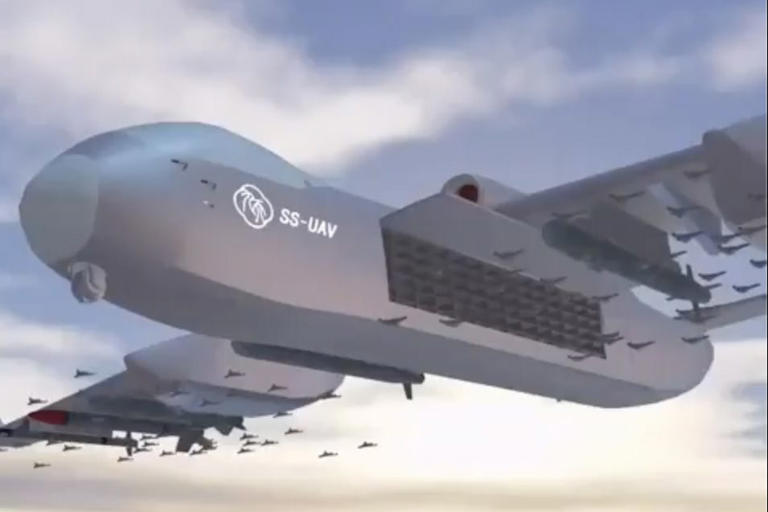
Its maiden sortie will initiate broader operational tests before full-scale deployment within the PLA’s aerial fleet.
The drone carrier possesses a maximum range of 7,000 kilometers (nearly 4,500 miles) and an operational ceiling of 15,000 meters, placing it well above the engagement envelope of most medium-range air defense systems.
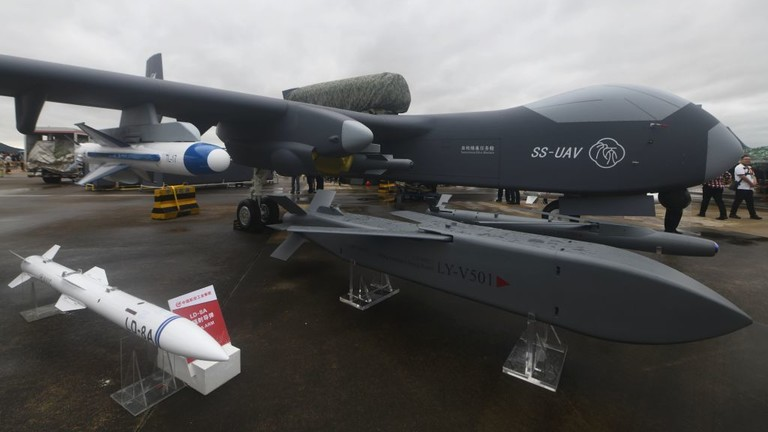
Jiu Tian is configured for long-endurance missions across contested airspace with a maximum take-off weight of 16 tonnes (nearly 17.5 US tons) and a wingspan measuring 25 meters.
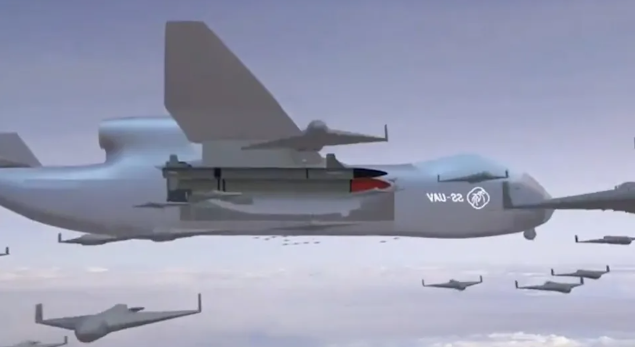
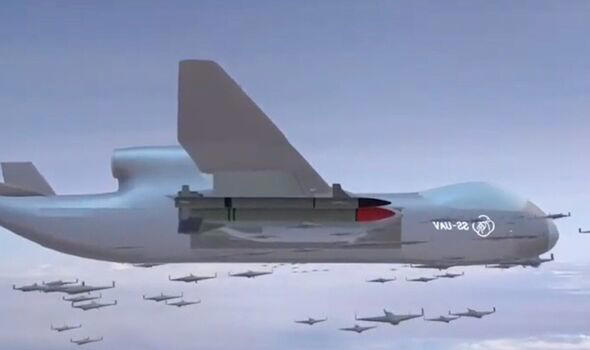
A specific feature of the UAV is its internal bay system, which is capable of releasing up to 100 loitering munitions or miniature drones, potentially including kamikaze-type UAVs.
These are deployed symmetrically from dual bays on the aircraft’s underside, enabling distributed or saturation attacks on enemy defenses.
Jiu Tian’s primary combat function is enabling swarming tactics: the coordinated deployment of networked drones to saturate, deceive, or turn off adversary air defense systems.
With eight hardpoints for external payloads, the UAV can also be configured for electronic warfare, intelligence, surveillance, reconnaissance (ISR) operations, and electronic suppression missions.
China’s global dominance strategy for UAVs
Developed by Shaanxi Unmanned Equipment Technology, a defense-oriented firm registered in 2023, the platform is produced by Xi’an Chida Aircraft Parts Manufacturing, a state-run Guangzhou Haige Communications Group subsidiary.
The UAV’s conceptual and aerodynamic design is attributed to the Aviation Industry Corporation of China (AVIC), one of the country’s principal aerospace conglomerates.
According to the manufacturer, Jiu Tian’s payload system employs a modular configuration, allowing mission-specific customization across military and paramilitary domains.
In addition to combat applications, the UAV is designed for maritime patrol, border security, resource monitoring, disaster relief, and emergency response operations.
Such versatility supports Beijing’s broader objective of multi-domain readiness and dual-use military technology expansion.
The platform is widely considered part of China’s competitive response to U.S. unmanned systems.
While the RQ-4 Global Hawk surpasses Jiu Tian in altitude (up to 18,000 meters) and reconnaissance sophistication, it lacks strike capability.
The MQ-9 Reaper, in contrast, boasts strike and ISR flexibility but is constrained by its lower operational altitude and 5-tonne maximum take-off weight, far below Jiu Tian’s capacity.
“The children of Ephraim, being armed and carrying bows, turned back in the day of battle” Psalm 78:9


 Joel
Joel A Prophecy of Esau and Jacob