
China’s laser-armed warships
China’s laser-equipped amphibious ship represents a significant naval advance amid escalating Indo-Pacific tensions
AsiaTimes by Gabriel Honrada • August 21, 2024
China’s latest move to mount a laser weapon on an amphibious warfare ship signals a bold leap in its naval capabilities, echoing global shifts toward energy-based defenses while ramping up tensions in the Pacific.
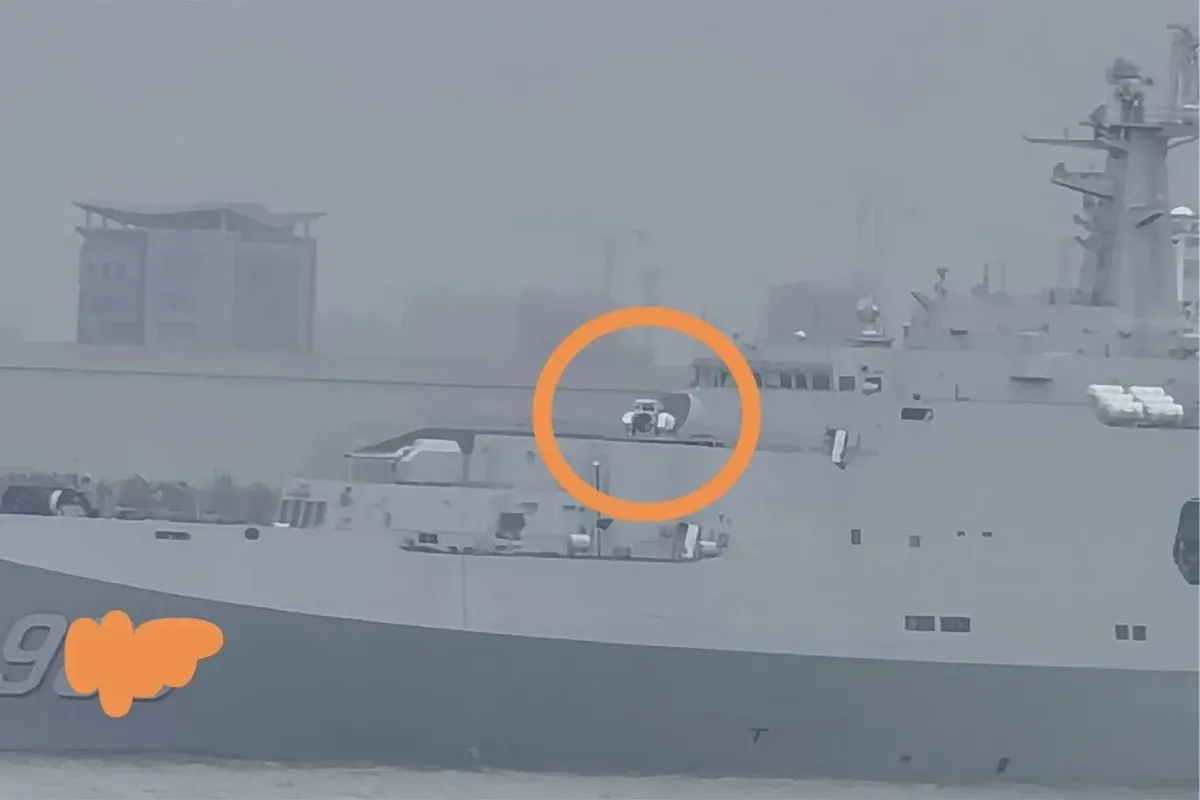
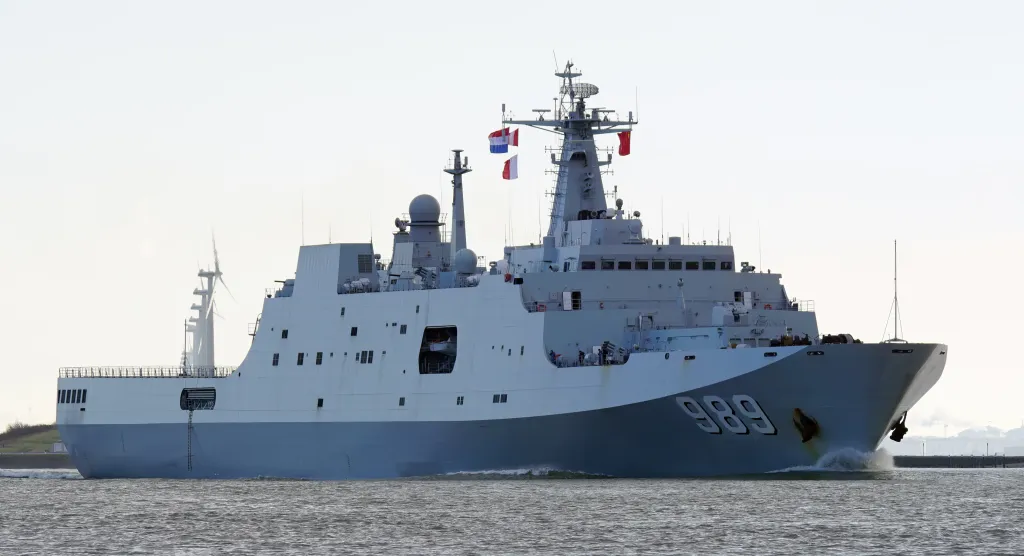
This month, The War Zone reported that China has equipped a Type 071 amphibious transport dock with a new laser weapon system.
The War Zone notes that the vessel, believed to be the Siming Shan, hull number 986, was spotted with the weapon immediately aft of the bow’s 76mm gun, concealed under a dome-like cover when not in use.
The report mentions that this move mirrors the US and other nations’ efforts to integrate directed energy weapons onto their warships, as seen with the USS Portland’s Laser Weapon System Demonstrator.

The report says that China’s laser system, details of which remain undisclosed, is expected to bolster defense against unmanned aircraft and small boat swarms, potentially including dazzler capabilities to blind sensors and seekers.
The War Zone states that the Type 071 ship, comparable to the US San Antonio class, serves as a test platform for the laser weapon, indicating China’s growing interest in enhancing its naval warfare technology.
China has previously used laser weapons in a non-lethal capacity in the South China Sea. For instance, Chinese maritime law enforcement personnel used a laser weapon against the Philippine military in a series of maritime standoffs in June, focusing what appeared to be a blinding laser at Philippine personnel documenting the encounter.
Asia Times reported in February 2023 that the Philippines accused China of directing a military-grade laser at a Philippine Coast Guard vessel, BRP Malapascua, during a resupply mission to the contested Second Thomas Shoal in the South China Sea.
The incident, which temporarily blinded the Philippine crew, occurred soon after the Philippines granted the US more comprehensive access to its military bases. China’s Foreign Ministry denied using lasers against the BRP Malapascua, asserting that the Philippine ship had entered the area without authorization.
Such actions align with China’s strategic “war without gunsmoke,” aiming to undermine allied confidence in US resolve and expand China’s positional advantage in the region.
In mounting a new type of laser weapon on its Type 071 amphibious transport dock, China may have taken lessons from the Ukraine war and Houthi attacks in the Red Sea.
In Ukraine, unmanned surface vehicles (USVs) have inflicted significant damage against Russia’s Black Sea Fleet while the Houthi’s arsenal of ballistic missiles and suicide drones have strained US and allied interceptor missile stockpiles.
In April 2024, Asia Times reported that Taiwan, drawing lessons from Ukraine’s naval successes, is escalating its USV production to counter potential Chinese aggression. Taiwan’s strategic shift toward asymmetric drone warfare is inspired at least in part by Ukraine’s effective use of USVs against Russia’s naval assets in the Black Sea.
Taiwan’s National Chung-Shan Institute of Science and Technology has initiated a US$25 million development program for USVs to start production of at least 200 vessels by 2026.
These USVs, costing around US$250,000 each, are designed for suicide attacks against People’s Liberation Army Navy (PLA-N) ships and can be operated remotely from up to 70 kilometers away.
Taiwan may be getting a boost from the US in scaling up USV production. Asia Times reported in February 2024 that the US Department of Defense (DOD) is actively seeking design proposals for a new fleet of low-cost, highly autonomous drone boats known as the Production-Ready, Inexpensive, Maritime Expeditionary (PRIME) Small Unmanned Surface Vehicle (SUSV) project.
This initiative aims to bolster maritime expeditionary capabilities in light of the strategic insights gained from the Ukraine war. The proposed SUSVs are expected to have a range of 926 to 1,852 kilometers, carry a payload of 450 kilograms and achieve a sprint speed of at least 35 knots.
They must also navigate autonomously, even in GPS-denied environments, and feature a resilient manufacturing supply chain for critical components.
The PRIME project underscores the importance of collaborative autonomy and the ability to integrate various modular payloads, sensors and effectors.
In the context of a potential conflict in the Taiwan Strait, these drone ships could significantly enhance the capabilities of foreign allies and partners, including Taiwan and the Philippines, offering a cost-effective solution for asymmetric naval warfare.
Aside from USVs, Taiwan’s new loitering munitions may have added a sense of urgency for China to develop laser weapons as a cost-effective countermeasure, considering the unsustainability of using multi-million-dollar interceptor missiles against suicide drones that cost just a few thousand dollars each.
This month, The Aviationist reported that Taiwan is set to deploy its Chien Hsiang loitering munitions in a large-scale “precision live-fire exercise” from August 20-22 near Jiupeng Base in Pingtung. The Aviationist says this is the first operational use of the domestically developed drones, unveiled in 2019 and resembling the Israeli IAI Harpy.
The Aviationist says the Chien Hsiang, designed to engage enemy missile positions and radar stations, has two variants: an anti-radiation weapon and a decoy.
It states that with a range of 1,000 kilometers, speeds of up to 600 kilometers per hour and five-hour endurance, these drones can autonomously navigate to preset waypoints and are launched from a 12-cell trailer-mounted launcher.
In addition to the Chien Hsiang, Asia Times reported in June 2024 that the US has approved the potential sale to Taiwan of Switchblade 300 and Anduril ALTIUS 600M loitering munitions, both of which have been combat-tested in Ukraine.

In contrast to China’s progress in using and developing laser weapons, Defense One reported this month that the US Navy is striving to enhance its anti-air defenses with pure energy weapons. However, Defense One says US progress has been hindered by the absence of a commercial market for sufficiently powerful lasers.
The primary obstacle is developing lasers capable of downing missiles from miles away, a technology not driven by commercial demand. It says the urgency for cost-effective and flexible defenses increases as offensive missiles and drones become more accessible and lethal.
Defense One notes that although the US Navy has deployed experimental lasers, such as the Optical Dazzling Interdictor, Navy (ODIN) and the 120-kilowatt High-Energy Laser with Integrated Optical Dazzler and Surveillance (HELIOS), their effectiveness against fast-moving or non-optical sensor weapons is still limited.
The report says collaboration between US defense contractor Lockheed Martin and the Office of the Secretary of Defense aims to test and develop prototypes of up to 500 kilowatts. However, it points out that integrating these systems into a layered defense strategy is challenging.
Defense One says the US has tested individual directed-energy equipment per ship to establish a multi-system defense in the coming years. However, it mentions that the US military continues to rely on costly missiles to counter inexpensive drones, underscoring the need for more efficient solutions.
“The children of Ephraim, being armed and carrying bows, turned back in the day of battle” Psalm 78:9


 Joel
Joel A Prophecy of Esau and Jacob