
Leviticus (15-16)
Leviticus 15
1 And the Lord spoke unto Moses and to Aaron, saying,
2 “Speak unto the children of Israel, and say unto them, ‘When any man hath a running issue out of his flesh, because of his issue he is unclean.
— clearer from the MSG
God spoke to Moses and Aaron: “Speak to the People of Israel. Tell them, When a man has a discharge from his genitals, the discharge is unclean. Whether it comes from a seepage or an obstruction he is unclean. He is unclean all the days his body has a seepage or an obstruction. Leviticus 15:1-3
3 And this shall be his uncleanness in his issue: whether his flesh run with his issue or his flesh be stopped from running with his issue, it is his uncleanness.
4 Every bed whereon he lieth who hath the issue is unclean, and every thing whereon he sitteth shall be unclean. — every thing; Heb. vessel, by which the Hebrews understand all sorts of household stuff.
5 And whosoever toucheth his bed shall wash his clothes and bathe himself in water, and be unclean until the evening.
— every bed, whereon he lieth; so severely did the canonical law deal with these cases that any defilement communicated to the bed, and hence also to his seat and saddle, by the patient in five different ways: by standing, sitting, lying, hanging, or leaning on it;
— and be unclean until the even; be unfit for conversation with other men till the even, though both his body and clothes are washed.
6 And he that sitteth on any thing whereon he sat who hath the issue shall wash his clothes and bathe himself in water, and be unclean until the evening. — and he that sitteth on any thing whereon he sat that hath the issue; shall be unclean, even though he does not touch it.
7 And he that toucheth the flesh of him that hath the issue shall wash his clothes and bathe himself in water, and is unclean until the evening.
8 And if he that hath the issue spit upon him that is clean, then he shall wash his clothes and bathe himself in water, and be unclean until the evening. — and if he that hath the issue spit upon him that is clean; not purposely, which is not usual for a man to do, and whenever it is done, nothing is more affronting; but accidentally;
— whatever is brought up by coughing, as phlegm, or flows from the nose, or is pressed out of it;
9 And what saddle soever he rideth upon who hath the issue shall be unclean. — and what saddle soever he sitteth upon that hath the issue; when he rides upon any beast, horse, ass, or camel, whatever is put upon the creature, and he sits upon it, the saddle, and whatever appertains to it, the housing and girdle;
10 And whosoever toucheth any thing that was under him shall be unclean until the evening; and he that beareth any of those things shall wash his clothes and bathe himself in water, and be unclean until the evening. — and whosoever toucheth anything that was under him shall be unclean until the even; either when lying along, or sitting, or riding;
11 And whomsoever he toucheth who hath the issue and hath not rinsed his hands in water, he shall wash his clothes and bathe himself in water, and be unclean until the evening.
12 And the vessel of earth that he toucheth who hath the issue shall be broken, and every vessel of wood shall be rinsed in water. — and the vessel of earth . . . shall be broken; for the reason why vessels of a porous clay must be destroyed when contaminated by defilement;
13 “‘And when he that hath an issue is cleansed of his issue, then he shall number to himself seven days for his cleansing, and wash his clothes, and bathe his flesh in running water, and shall be clean. — man’s “ritual” impurity;
— from the Chabad Bible for this verse:
When the man with the discharge is cleansed of his discharge, he shall count seven days for himself for his purification, and then immerse his garments and immerse his flesh in spring water, and he shall be clean.
14 And on the eighth day he shall take for himself two turtledoves or two young pigeons, and come before the Lord unto the door of the tabernacle of the congregation, and give them unto the priest.
— from the MSG
“When a person with a discharge is cleansed from it, he is to count off seven days for his cleansing, wash his clothes, and bathe in running water. Then he is clean. On the eighth day he is to take two doves or two pigeons and come before God at the entrance of the Tent of Meeting and give them to the priest.
The priest then offers one as an Absolution-Offering and one as a Whole-Burnt-Offering and makes atonement for him in the presence of God because of his discharge. Leviticus 15:13-15
15 And the priest shall offer them, the one for a sin offering and the other for a burnt offering; and the priest shall make an atonement for him before the Lord for his issue.
16 “‘And if any man’s seed of copulation go out from him, then he shall wash all his flesh in water and be unclean until the evening.
17 And every garment and every skin whereon is the seed of copulation, shall be washed with water and be unclean until the evening.
— from MSG
“When a man has an emission of semen, he must bathe his entire body in water; he remains unclean until evening. Every piece of clothing and everything made of leather which gets semen on it must be washed with water; it remains unclean until evening. When a man sleeps with a woman and has an emission of semen, both are to wash in water; they remain unclean until evening. Leviticus 15:16-18
18 The woman also with whom a man shall lie with seed of copulation, they shall both bathe themselves in water and be unclean until the evening.
19 “‘And if a woman have an issue and her issue from her flesh be blood, she shall be put apart seven days; and whosoever toucheth her shall be unclean until the evening.
20 And every thing that she lieth upon in her separation shall be unclean; every thing also that she sitteth upon shall be unclean.
21 And whosoever toucheth her bed shall wash his clothes and bathe himself in water, and be unclean until the evening.
22 And whosoever toucheth any thing that she sat upon shall wash his clothes and bathe himself in water, and be unclean until the evening.
— from MSG
“When a woman has a discharge of blood, the impurity of her menstrual period lasts seven days. Anyone who touches her is unclean until evening. Everything on which she lies or sits during her period is unclean. Anyone who touches her bed or anything on which she sits must wash his clothes and bathe in water; he remains unclean until evening. Leviticus 15:19-23
23 And if it be on her bed or on any thing whereon she sitteth, when he toucheth it, he shall be unclean until the evening.
24 And if any man lie with her at all and her monthly discharge be upon him, he shall be unclean seven days; and all the bed whereon he lieth shall be unclean.
25 “‘And if a woman have an issue of her blood many days out of the time of her separation, or if it run beyond the time of her separation, all the days of the issue of her uncleanness shall be as the days of her separation; she shall be unclean.
26 Every bed whereon she lieth all the days of her issue shall be unto her as the bed of her separation; and whatsoever she sitteth upon shall be unclean, as the uncleanness of her separation.
— from MSG
“If a woman has a discharge of blood for many days, but not at the time of her monthly period, or has a discharge that continues beyond the time of her period, she is unclean the same as during the time of her period.
Every bed on which she lies during the time of the discharge and everything on which she sits becomes unclean the same as in her monthly period. Anyone who touches these things becomes unclean and must wash his clothes and bathe in water; he remains unclean until evening. Leviticus 15:25-27
27 And whosoever toucheth those things shall be unclean, and shall wash his clothes and bathe himself in water, and be unclean until the evening.
28 But if she be cleansed of her issue, then she shall number to herself seven days, and after that she shall be clean.
29 And on the eighth day she shall take unto her two turtledoves or two young pigeons, and bring them unto the priest to the door of the tabernacle of the congregation.
30 And the priest shall offer one for a sin offering and the other for a burnt offering; and the priest shall make an atonement for her before the Lord for the issue of her uncleanness.
— from MSG
“When she is cleansed from her discharge, she is to count off seven days; then she is clean. On the eighth day she is to take two doves or two pigeons and bring them to the priest at the entrance to the Tent of Meeting.
The priest will offer one for an Absolution-Offering and the other for a Whole-Burnt-Offering. The priest will make atonement for her in the presence of God because of the discharge that made her unclean. Leviticus 15:28-30 —
31 “‘Thus shall ye separate the children of Israel from their uncleanness, that they die not in their uncleanness when they defile My tabernacle that is among them.’”
32 This is the law of him that hath an issue, and of him whose seed goeth from him and is defiled therewith,
33 and of her that is sick with her monthly discharge, and of him that hath an issue, of the man and of the woman, and of him that lieth with her that is unclean.
— from MSG
“These are the procedures to follow for a man with a discharge or an emission of semen that makes him unclean, and for a woman in her menstrual period—any man or woman with a discharge and also for a man who sleeps with a woman who is unclean.”
Leviticus 16
1 And the Lord spoke unto Moses after the death of the two sons of Aaron, when they offered before the Lord, and died;
— after the death of the two sons of Aaron; that is, after Nadab and Abihu, his two eldest sons, had died, in consequence of having presumptuously entered the sanctuary in a profane manner, and playing with strange fire; they died by a flaming fire; or lightning?
2 and the Lord said unto Moses, “Speak unto Aaron thy brother, that he come not at all times into the Holy Place within the veil before the mercy seat which is upon the ark, that he die not; for I will appear in the cloud upon the mercy seat.
— that he come not at all times; Moses is therefore to warn his brother Aaron, the high priest, that if he wishes to escape a similar fate, he is not to presume to enter the Holy of Holies except on one day of the year, the Day of Atonement;
— as Aaron here stands for all those who in future are to succeed him in the pontificate, so Moses, who teaches him his duty, stands for his successors who are hereafter to impart instruction to the high priests on these most solemn occasions;
— he was to go into the holy of holies four times on the Day of Atoneme; first to offer incense, a second time to sprinkle the blood of the bullock, a third time to sprinkle the blood of the goat, and a fourth time to fetch out the censer; and if he entered a fifth time, he was worthy of death; yet Moses might at any time, and consult the Lord upon the mercy seat, Exodus 25:22;
— during the second Temple the instruction and preparation of the high priest for his functions devolved upon the Sanhedrin, who prescribed most minute rules for his guidance. Seven days before the Day of Atonement he was separated from his wife, and lodged in a chamber in the Temple, lest he should contract defilement, which might unfit him for the performance of his pontifical duties;
— the elders or the representatives of the Sanhedrin read and expounded to him the ordinances contained in this chapter; which he had to practise in their [presence, so as to make sure that he could rightly perform all the ceremonies. This continued during the whole night previous to the Day of Atonement, where he was to be kept awake, so as to prevent any pollution arising from a dream or accident by night.
3 Thus shall Aaron come into the Holy Place: with a young bullock for a sin offering and a ram for a burnt offering. — thus shall Aaron come; preparatory to his entering on this solemn service the high-priest was to offer two sacrifices in behalf of himself and his family.
4 He shall put on the holy linen coat, and he shall have the linen breeches upon his flesh and shall be girded with a linen girdle, and with the linen miter shall he be attired. These are holy garments. Therefore shall he wash his flesh in water, and so put them on.
— and he shall wash; he had to bathe his body every time when he changed his vestments, which were no less than five times on this day, and washes his hands and feet ten times on that day, and all are done in the holy place.
5 And he shall take from the congregation of the children of Israel two kids of the goats for a sin offering and one ram for a burnt offering. — and make atonement for himself and his house; for his own personal sins and for his family’s sins, those of his wife and children; and it may be extended to all the priests of the house of Aaron;
6 And Aaron shall offer his bullock of the sin offering which is for himself, and make an atonement for himself and for his house.
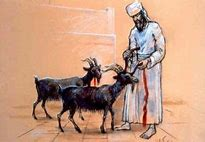
On the Day of Atonement
7 And he shall take the two goats and present them before the Lord at the door of the tabernacle of the congregation. — both goats were presented for the Day of Atonement before the Lord at the door of the tabernacle of the congregation; it is commanded that they should be alike in colour, height, and price,
— which may represent the two natures in Christ; his divine nature, as the Son of God, in which he is impassable, and lives for ever, which may be signified by the goat in which he suffered and died at the hand of the high-priest;
— and the second goat, and may be fitly represented by the goat that was alive, when it too was offered to the Lord, but let go; and in his human nature, as the Son of Man, in which he also suffered in the wilderness called Azazel, and died;
8 And Aaron shall cast lots upon the two goats — one lot for the Lord and the other lot for Azazel. — after the lot had been chosen, the two goats were distinguished from each other by having a piece of scarlet cloth tied, the first round its neck, the second round its horn. One lot for the Lord, and the other lot for Azazel, which is a wilderness about 12 miles from Jerusalem;
9 And Aaron shall bring the goat upon which the Lord’S lot fell, and offer him for a sin offering.
10 But the goat on which the lot fell to be for Azazel shall be presented alive before the Lord, to make an atonement with him and to let him go into the wilderness to Azazel. — Jonathan says “by sending him to die in a place rough and hard in the rocky desert which is Beth-hadurey.”
— both goats were presented before the Lord; thus it doesn’t go well that the goat destined for Azazel should represent a demon, or Azazel, to be the same as the evil angel in the Book of Enoch 8:1; 10:10; 13:1; while others as Satan; but Satan or any of his evil demons have never play that role of atoning for the sins of Israel.

11 “And Aaron shall bring the bullock of the sin offering which is for himself, and shall make an atonement for himself and for his house, and shall kill the bullock of the sin offering which is for himself.
— and shall make atonement for himself and for his house: by a confession of sins, as the second confession; and in the same words as before; then he put a tongue-shaped piece of scarlet wool upon the head of the goat to be sent away, and came beside his bullock;
12 And he shall take a censer full of burning coals of fire from off the altar before the Lord, and his hands full of sweet incense beaten small, and bring it inside the veil. — inside the veil, that is, into the holy of holies before the Lord Leviticus 16:2.
13 And he shall put the incense upon the fire before the Lord, that the cloud of the incense may cover the mercy seat that is upon the testimony, that he die not. — that he die not for so gross an error committed in the highest acts of worship, and that by a high priest, whose knowledge and function was a great aggravation to his sin.
14 And he shall take of the blood of the bullock and sprinkle it with his finger upon the mercy seat eastward; and before the mercy seat shall he sprinkle of the blood with his finger seven times. — and sprinkle it with his finger upon the mercy seat, eastward; with his right finger; and the blood sprinkled with it did not fall upon the mercy seat;
15 Then shall he kill the goat of the sin offering that is for the people, and bring his blood within the veil, and do with that blood as he did with the blood of the bullock, and sprinkle it upon the mercy seat and before the mercy seat. — having completed the atonement in the holy of holies on behalf of the priests, the high priest had now to do the same thing on behalf of the people.
16 And he shall make an atonement for the Holy Place, because of the uncleanness of the children of Israel and because of their transgressions in all their sins; and so shall he do for the tabernacle of the congregation that remaineth among them in the midst of their uncleanness.
— next he cleansed the tent of meeting, or the court of the sanctuary, where the Israelites were usually admitted; that is, the high priest sprinkled the court and the altar of burnt offering which was in it eight times with the mingled blood of the bullock and goat.
17 And there shall be no man in the tabernacle of the congregation when he goeth in to make an atonement in the Holy Place until he come out, and has made an atonement for himself and for his household and for all the congregation of Israel.
— and there shall be no man; whilst the high priest was performing this process of cleansing, no one, whether priest or Israelite, was permitted to be present;
18 And he shall go out unto the altar that is before the Lord and make an atonement for it, and shall take of the blood of the bullock and of the blood of the goat, and put it upon the horns of the altar round about.
— the order of the ceremony required that atonement should first be made for the most holy place with the mercy-seat, then for the holy place with the golden altar, and then for the altar in the court;
— the horns of the brazen altar were touched with the blood, as they were in the ordinary sin-offerings.
19 And he shall sprinkle of the blood upon it with his finger seven times, and cleanse it and hallow it from the uncleanness of the children of Israel. — and he shall sprinkle of the blood upon it with his finger seven times; this was done with his right finger, or forefinger, and seven times, to denote the perfect cleansing of the altar with it.
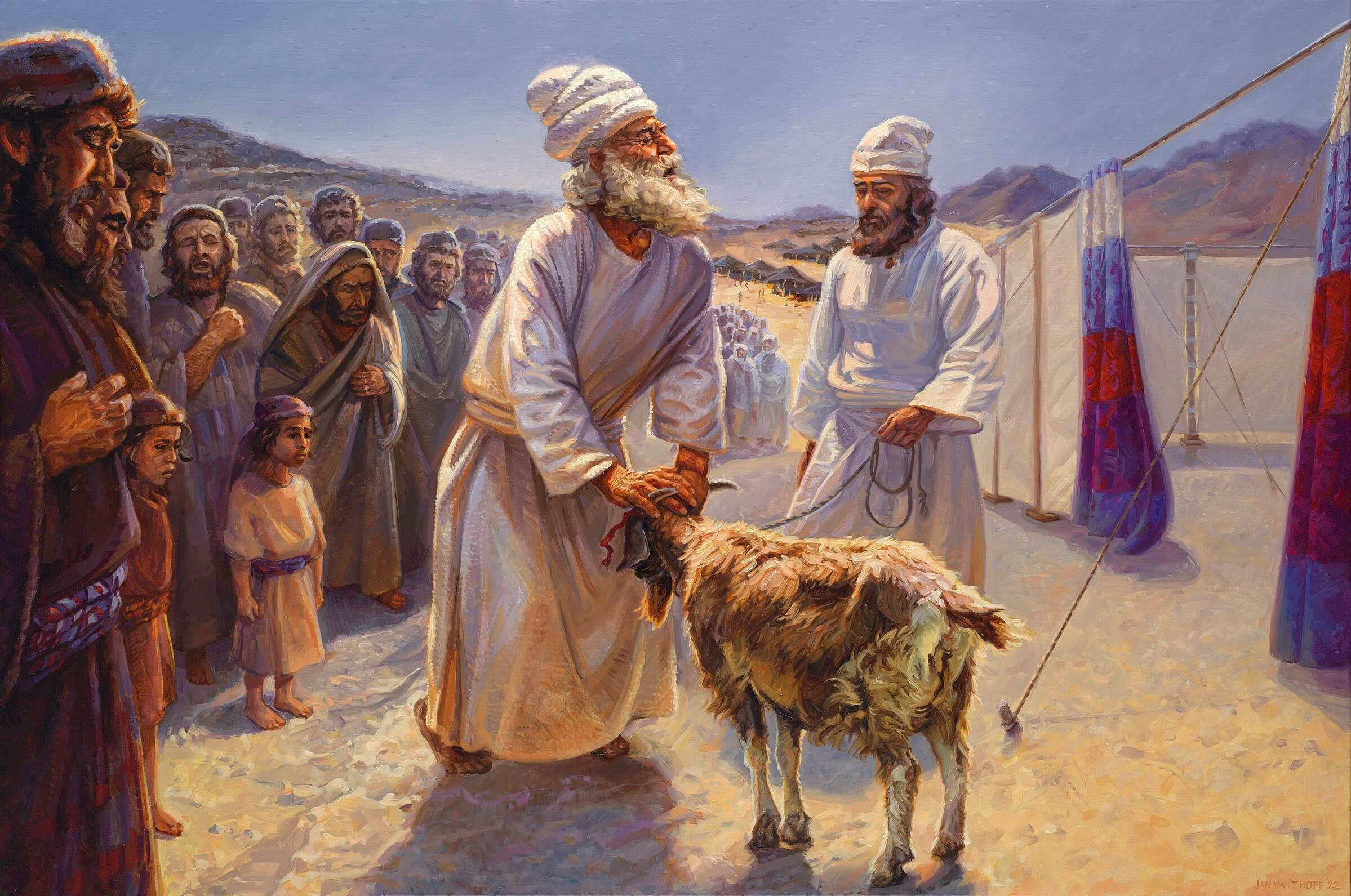
20 “And when he hath made an end of reconciling the Holy Place and the tabernacle of the congregation and the altar, he shall bring the live goat. — he shall bring the live goat; having already been presented before the Lord (Lev 16:10), it was now brought forward to the high priest;
21 And Aaron shall lay both his hands upon the head of the live goat, and confess over him all the iniquities of the children of Israel and all their transgressions in all their sins, putting them upon the head of the goat, and shall send him away by the hand of a fit man into the wilderness.
— the high priest, who, placing his hands upon its head, and “having confessed over it all the iniquities of the people of Israel, and all their transgressions in all their sins,” transferred them by this act to the goat as their substitute.
22 And the goat shall bear upon him all their iniquities unto a land not inhabited; and he shall let go the goat in the wilderness.
— it was then delivered into the hands of a person, who was appointed to lead him away into a distant, solitary, and desert place, “Azazel,” where he was led to a high rocky twelve miles from Jerusalem, and there, being thrust over the precipice, he was killed.
23 “And Aaron shall come into the tabernacle of the congregation, and shall put off the linen garments which he put on when he went into the Holy Place and shall leave them there;
— and shall put off the linen garments which he put on when he went into the holy place; the holy of holies, that is, after he had brought it (the censer) out, then he clothed himself with the golden garments for the daily evening sacrifice;
— and this was the order of the services (on the day of atonement); the daily morning sacrifice (was performed) in the golden garments; the service of the bullock and of the goat, and the incense of the censer, in the white garments; and his ram, and the ram of the people, and some of the additions, in the golden garments;
24 and he shall wash his flesh with water in the Holy Place and put on his garments, and come forth and offer his burnt offering and the burnt offering of the people, and make an atonement for himself and for the people. — he shall wash in the holy place; that is, in the court of the tabernacle, where stood the altar of burnt-offering, and the sacred laver.
25 And the fat of the sin offering shall he burn upon the altar.
26 And he that let go the goat for Azazel shall wash his clothes and bathe his flesh in water, and afterward come into the camp. — Jonathan: “And he who led away the goat to Azazel shall wash his clothes, and bathe his flesh in forty seahs of water, and afterward he may enter the camp.”
27 And the bullock for the sin offering and the goat for the sin offering, whose blood was brought in to make atonement in the Holy Place, shall one carry forth outside the camp; and they shall burn in the fire their skins and their flesh and their dung. — shall one carry forth; shall be carried forth; during the second Temple four men carried the carcases upon two poles to the place set aside outside Jerusalem for burning.
28 And he that burneth them shall wash his clothes and bathe his flesh in water, and afterward he shall come into the camp. — because they had been defiled by the animals laden with sin.
29 “And this shall be a statute for ever unto you: that in the seventh month on the tenth day of the month, ye shall afflict your souls and do no work at all, whether it be one of your own country or a stranger who sojourneth among you;
— seventh month, on the tenth day; the month of Tisri, as being the seventh in the Sacred year; on the first day was celebrated the Feast of Trumpets, the tenth day was the Day of Atonement, and on the fourteenth day the Feast of tabernacles commenced;
— a stranger that sojourneth among you; rather, the foreigner who dwelleth among you; meaning is, one of foreign blood, who dwelt with the Israelites, and had become familiarly known to his neighbors: the Kenites (Judges 4:11, etc.); the Gibeonites Joshua 9; and a considerable portion of the “mixed multitude” (compare Exodus 12:38, Exodus 12:48);
30 for on that day shall the priest make an atonement for you to cleanse you, that ye may be clean from all your sins before the Lord.
31 It shall be a sabbath of rest unto you and ye shall afflict your souls, by a statute for ever. — it shall be a Sabbath of rest unto you; literally, a resting day of solemn resting, a Sabbath of Sabbaths, ithat is, a day of complete and perfect rest.
32 And the priest, whom he shall anoint and whom he shall consecrate to minister in the priest’s office in his father’s stead, shall make the atonement, and shall put on the linen clothes, even the holy garments;
— and shall put on the linen clothes, even the holy garments: that is, on the Day of Atonement; in which clothes all the service peculiar to that day, as it was done by Aaron, so it was to be done by all his successors;
33 and he shall make an atonement for the Holy Sanctuary, and he shall make an atonement for the tabernacle of the congregation and for the altar, and he shall make an atonement for the priests and for all the people of the congregation.
34 And this shall be an everlasting statute unto you: to make an atonement for the children of Israel for all their sins once a year.” And he did as the Lord commanded Moses. — these several atonements, for his family, and for all the priests, were separate and distinct, and did not hinder one another, or interfere with one another.


 Joel
Joel A Prophecy of Esau and Jacob