
Genesis (25-26)
After Jacob had stolen his birthright, Esau pleaded with Isaac his father if he could still bless him.
Then Isaac his father answered and prophesied, saying, “Thy dwelling shall be away from the fatness of the earth; and away from the dew of heaven above; Genesis 27:39
“And by your sword shall you live, you will go to every place, and wander, and you will be subject to your brother. But when his descendants abandon the commandments of the Torah, then you will break his yoke from your neck.”
“And Esau harbored hatred in his heart against Jacob, his brother, because of the blessing with which his father had blessed him. And Esau said in his heart, ‘I will not do as Cain did, who killed Abel during their father’s lifetime and then their father had another son, Seth. Rather, I will wait until the days of mourning for my father have passed, and then I will kill Jacob my brother, and I will be the sole heir.'” Genesis 27:41-42 Targum (Jonathan)
This is looking at the Scriptures with a blast of fresh air, because the deeper you dig, the more you’ll find!
“The anger of the Lord shall not return, until He has executed and until He has performed the intent of His thought; in the latter days ye shall understand it perfectly.” Jeremiah 23:20
Genesis 25
1 Then again Abraham took a wife, and her name was Keturah. — and her name was Keturah; who she was, or of what family, is not said. Abraham was 137 years of age at Sarah’s death, and lived to be 175;
— it is quite possible that, left solitary by Isaac’s marriage, he took Keturah to wife, and had by her six sons; yet Keturah is called Abraham’s concubine, or secondary wife (1Ch 1:32)
— the Targum Onkelos says
Avraham again took a wife. Her name was Keturah.
— the Targum Jerusalem says
She is Hagar, who had been tied to him from the beginning.
— the Targum of Jonathan says that Keturah was Hagar
“And Abraham added and took a wife, and her name was Keturah; she is Hagar, who had been bound to him from the beginning.”
— Targum Pseudo-Jonathan (along with Rashi and Midrash Genesis Rabbah 61:4) explicitly identifies Keturah as Hagar; which could explain why she was still called Abraham’s concubine, 1Ch 1:32. The logic is that after Sarah died and Isaac was married, Abraham returned to his original concubine.
2 And she bore him Zimran and Jokshan and Medan, and Midian and Ishbak and Shuah. — Midian is the one son of Keturah who had a great future before him, for his race became famous traders (Genesis 37:28); Jethro, the father-in-law of Moses, belonged to them (Exodus 2:15-16)
— the Targum Onkelos says
She bore him Zimran, Yokshon, Medan, Midian, Yishbok, and Shuach.
3 And Jokshan begot Sheba and Dedan. And the sons of Dedan were Asshurim and Letushim and Leummim. — Asshurim, and Letushim, and Leummim; these are certainly not the names of men, but of the three tribes;
— the Targum Onkelos says
Yokshon fathered Shevah and Dedan. The sons of Dedan were Ashurim [those who dwell in camps], Letushim [those who dwell in tents] and Leumim [those who dwell on islands].
4 And the sons of Midian: Ephah and Epher, and Hanoch and Abidah and Eldaah. All these were the children of Keturah. — they to be sons of Abraham by Keturah, when they were his actually grandchildren;
— the Targum Onkelos says
The sons of Midian were Eiphah, Eipher, Chanoch, Avidah and Eldoah. All these were children of Keturah.
5 And Abraham gave all that he had unto Isaac. — And Abraham gave all that he had to Isaac; as he was bound to do, not only in justice to Sarah his first wife, but also to Rebekah, who married Isaac upon this assurance;
— the Targum Onkelos says
Avraham gave all that he possessed to Yitzchok.
6 But unto the sons of the concubines whom Abraham had, Abraham gave gifts; and while he yet lived he sent them away from Isaac his son, eastward unto the east country.
— but unto the sons of the concubines; that is, of Hagar and Keturah; migrated to “the east country,” that is, Arabia and Southern Mesopotamia;
— the Targum Onkelos says
To the sons of the concubines that Avraham had, Avraham gave gifts. He sent them away from Yitzchok, his son, while he [Avraham] was still alive. [He sent them] eastward to the Land of the East.
7 And these are the days of the years of Abraham’s life which he lived, a hundred threescore and fifteen years.
— Abraham’s years were a hundred and seventy-five; he survived Sarah thirty-eight years, and Isaac’s marriage thirty-five, and Jacob and Esau must how be fifteen years of age at this time;
— the Targum Onkelos says
These are the days of the years of Avraham which he lived, one hundred years, seventy years and five years.
8 Then Abraham gave up the ghost and died in a good old age, an old man and full of years, and was gathered to his people.
—‘full of years’ in the original it is only, “and full” and does not seem to be a mere synonym for longevity; but appreciating all the good and unpleasantness of life, much like Job and David also had;
— the Targum Onkelos says
Avraham expired and died in a good old age, old and satisfied [and in the fullness of days], and he was gathered to his people.
9 And his sons Isaac and Ishmael buried him in the cave of Machpelah, in the field of Ephron the son of Zohar the Hittite, which is before Mamre,
— none of the six sons of Keturah were present; and had no particular blessing bestored upon them; perhaps they were apparently already sent far away into the far end of Arabia, while Ishmael was nearer at Paran;
— the Targum Onkelos says
His sons Yitzchok and Yishmael buried him in the Machpeilah cave, in the field of Ephron, son of Tzochar, the Chitite, which faces Mamrei.
10 the field which Abraham purchased from the sons of Heth. There was Abraham buried, and Sarah his wife. — there was Abraham buried, and Sarah his wife; Sarah had been buried there thirty eight years before, which was the reason why his sons buried, him there;
— the Targum Onkelos says
[This was] the field that Avraham purchased from the sons of Cheis. Avraham and his wife, Sarah, were buried there.
11 And it came to pass after the death of Abraham, that God blessed his son Isaac; and Isaac dwelt by the well Lahairoi. — God blessed Isaac; for the blessing of Abraham did not die with him, but was perpetuated to his posterity, and especially to the children of the promise;
— the Targum Onkelos says
After Avraham died, Elohim blessed his son Yitzchok. Yitzchok lived near Be’er Lachai Ro’i [the well at which a living angel appeared].
— the Targum of Jonatham adds some complexities, saying:
And because Abraham had not designed to bless Ishmael, therefore he blessed not Isaac; for had he blessed Izhak and not Ishmael, it would have kept them in enmity.
But, after the death of Abraham, the Lord blessed Isaac; and Isaac dwelt near the well at which was revealed the glory of the Living and Eternal One, who seeth and is not seen.
— the Targum fills the silence by explaining Abraham’s dilemma. Abraham loved both sons; he knew the primary blessing belonged to Isaac, but he feared that a public formal blessing of Isaac would incite Ishmael’s enmity, a grudge or hatred. To maintain peace in the family while he was alive, Abraham refrained from blessing either.
12 Now these are the generations of Ishmael, Abraham’s son, whom Hagar the Egyptian, Sarah’s handmaid, bore unto Abraham. — Ishmael had twelve sons, whose families became distinct tribes; they populated a very large country that lay between Egypt and Assyria, called Arabia;
— the Targum Onkelos says
These are the descendants of Yishmael son of Avraham, whom Hagar, the Egyptian, Sarah’s slave, bore to Avraham.
13 And these are the names of the sons of Ishmael, by their names, according to their generations: the firstborn of Ishmael, Nebajoth; and Kedar and Adbeel and Mibsam,
— the firstborn of Ishmael, Nebajoth: mentioned in Isaiah 60:7; and from whence a people of the Arabs are called Nabathaeans, and their country Nabathaea; they inhabit the town and capital at Petra;
— the Targum Onkelos says
These are the names of Yishmael’s sons, by their names according to their birth. Nevayos was Yishmael’s first born, [he also had] Keidar, Adbeil and Mivsom,
14 and Mishma and Dumah and Massa,
— the Targum Onkelos says
Mishma, Dumah and Masa,
15 Hadar and Tema, Jetur, Naphish, and Kedemah.
— the Targum Onkelos says
Chadad, Teima, Yetur, Nofish and Keidmah.
16 These are the sons of Ishmael, and these are their names, by their towns and by their castles, twelve princes according to their nations. — twelve princes according to their nations; these were princes, or heads of tribes, and there were twelve of them;
— the Targum Onkelos says
These are the sons of Yishmael, and these are their names in their open villages and in their fortified strongholds, twelve princes in their nations.
17 And these are the years of the life of Ishmael, a hundred and thirty and seven years; and he gave up the ghost and died, and was gathered unto his people. — then Ishmael also died at the age of a hundred and thirty-seven; in the presence of all his brethren;
— the Targum Onkelos says
These are the years of Yishmael’s life, one hundred years, thirty years and seven years. He expired and died and was gathered to his people.
18 And they dwelt from Havilah unto Shur, that is before Egypt as thou goest toward Assyria; and he died in the presence of all his brethren. — and he died; they being present when he died, or in peace with them, in all prosperity along with them;
— the Targum Onkelos says
They lived from Chavilah to Shur [Chagar], which borders on Egypt, going towards Asshur. He lived in the presence of all his brethren.
19 And these are the generations of Isaac, Abraham’s son. Abraham begot Isaac.
— the Targum Onkelos says
And these are the descendants of Yitzchok son of Avraham. Avraham was the father of Yitzchok.
— the Targum of Jonatham says
“And these are the generations of Isaac, the son of Abraham: And because the features (Ikunin) of Isaac were similar to the features of Abraham, the people said, ‘Truly, Abraham fathered Isaac.'”
20 And Isaac was forty years old when he took Rebekah for a wife, the daughter of Bethuel the Syrian of Padanaram, the sister of Laban the Syrian.
— the daughter of Bethuel the Syrian, they were originally Chaldees, being descended from Nahor the brother of Abraham, who both were of Ur of the Chaldees; so Jacob is called a Syrian;
— the Targum Onkelos says
Yitzchok was forty years old when he took Rivkah, the daughter of Besueil, the Aramite, of Padan Aram, sister of Lavan, the Aramite, for a wife.
21 And Isaac entreated the Lord for his wife, because she was barren; and the Lord was entreated by him, and Rebekah his wife conceived. — and Isaac entreated the Lord for his wife; though God had promised to multiply his family, he prayed for it;
— the Targum Onkelos says
Yitzchok prayed to [before] Adonoy across from [opposite] his wife, for she was barren. Adonoy granted his prayer and his wife, Rivkah, conceived.
— the Targum of Jonathan says, that, after twenty years, Isaac took her and went with her to Mount Moriah, to the place where he was bound, and prayed that she might conceive; putting the Lord in mind of the promise he there made of the multiplication of Abraham’s seed; and Rebekah conceived; two sons at once;
22 And the children struggled together within her; and she said, “If it be so, why am I thus?” And she went to inquire of the Lord.
— the Targum Onkelos says
The children clashed [pressed] inside her, and [when this happened] she said, If this is so, why did I desire this? She [then] went to inquire of [to ask for instruction from before] Adonoy.
— say the Targums of Jonathan and Jerusalem; and she went to inquire of the Lord; to the school of Shem the great;
23 And the Lord said unto her, “Two nations are in thy womb, and two manner of people shall be separated from thy body; and the one people shall be stronger than the other people, and the elder shall serve the younger.”
— the Targum Onkelos says
Adonoy said to her, Two nations are in your womb, and two Kingdoms will separate from within you. One government will be mightier than the other, but the greater one will serve the smaller one.
— the Targums of Jonathan says
“And the children struggled within her, and it was like men fighting. And she said, ‘If this is the pain of pregnancy, why do I desire children?’ So she went to the study hall of Shem the Great to seek mercy from before the Lord.”
“And the Lord said to her, ‘Two nations are in your womb, and two kingdoms will separate from your belly. One kingdom will be stronger than the other, and the elder will serve the younger if the descendants of the younger keep the commandments of the Torah.'” Genesis 25:22-23 Jonathan
— important to note that “the elder will [only] serve the younger if the descendants of the younger keep the commandments of the Law.”
24 And when her days to be delivered were fulfilled, behold, there were twins in her womb.
— the Targum Onkelos says
When her days of pregnancy were completed, behold, there were twins in her womb.
— and when her days to be delivered were fulfilled; the nine months were up from the time of her conception; or, as the Targum of Jonathan, when the two hundred and seventy days she went with child were completed;
25 And the first came out red, all over like a hairy garment; and they called his name Esau. — red, like a hairy garment; with red hair all over his body, whence he had his name, Esau, made, reared already;
— the Targum Onkelos says
The first one came out with a reddish complexion, covered completely with what was like a hairy robe, and they named him Eisov.
— the Targum of Jonathan says Esau was born as if he was already a grown man
and the first came forth wholly red, as a garment of hair: and they called his name Esau, because he was born altogether complete, with the hair of the head, and the beard, and teeth, and grinders;
26 And after that came his brother out, and his hand took hold of Esau’s heel; and his name was called Jacob. And Isaac was threescore years old when she bore them.
— and his name was called Jacob; by his parents; because he took his brother by the heel, which his name has the signification of, and Esau has respect to in Genesis 27:36,
— the Targum Onkelos says
After that his brother came out, his hand grasping the heel of Eisov, and he [Yitzchok] named him Yaakov. Yitzchok was sixty years old when she [Rivkah] gave birth to them.
27 And the boys grew. And Esau was a cunning hunter, a man of the field; and Jacob was a plain man, dwelling in tents.
— Esau a cunning hunter and equally had a tent for his abode, but Jacob stayed at home, and busied about the flocks and cattle; hence he was the mother’s darling, while Isaac preferred his more enterprising son;
— the Targum Onkelos says
The lads grew up. Eisov became a skilled trapper [an idle man], a man of the field [a man going out to the field]. Yaakov was a wholesome man, living in tents [serving in the house of study].
28 And Isaac loved Esau, because he ate of his venison; but Rebekah loved Jacob. — because he did eat of his venison, literally, because the venison—that is, the produce of Esau’s hunting—was in his mouth; in our phrase, was to his taste—was what he liked;
— but Rebekah loved Jacob upon better grounds, both because of his more pious and meek temper, and because of the oracle and promise of God;
— the Targum Onkelos says
Yitzchok loved Eisov because he ate of his trappings, but Rivkah loved Yaakov.
29 And Jacob boiled pottage; and Esau came from the field, and he was faint. — and Esau came from the field, and be was faint: for want of food, and weary with hunting, and perhaps more so, having toiled and got nothing;
— the Targum Onkelos says
Yaakov was simmering a pottage when Eisov came in from the field, exhausted.
— the Targum of Jonathan says
“And on that day that Abraham died, Jacob cooked a dish of lentils and went to comfort his father [Isaac]. And Esau came from the field, and he was exhausted; for on that day he had committed five transgressions: he worshipped a foreign worship [idolatry], he shed innocent blood [murder], he went in unto a betrothed maiden [adultery], he denied the life of the World to Come, and he despised the birthright.”
30 And Esau said to Jacob, “Feed me, I pray thee, with that same red pottage, for I am faint”; therefore was his name called Edom. — therefore was his name called Edom; besides from his red hair, but more from this red pottage; for Edom signifies red;
— the Targum Onkelos says
Eisov said to Yaakov, Please [Now] give me a swallow of this red [pottage], for I am exhausted. He was therefore named Edom [Red].
31 And Jacob said, “Sell me this day thy birthright.” — and Jacob said, sell me this day thy birthright; which had many privileges annexed to it; a double portion of inheritance; some say the exercise of priesthood, but that is questioned; the parental blessing;
— the Targum Onkelos says
Yaakov said, As of this day [Like this day], sell your birthright to me.
32 And Esau said, “Behold, I am at the point of dying. And what profit shall this birthright be to me?” — Esau said, I am at the point to die; that is, I am running daily risk of my life; and of what use will the birthright be to me;
— the Targum Onkelos says
Eisov said, Here I am going to die, what [good] is this birthright to me.
33 And Jacob said, “Swear to me this day.” And he swore unto him, and he sold his birthright unto Jacob. — and he swear unto him; that he would abide by the bargain, and never give him any trouble on that account; God himself being appealed to as a witness of it;
— the Targum Onkelos says
Yaakov said, Swear to me as of this day [like this day]. He swore to him, and sold his birthright to Yaakov.
34 Then Jacob gave Esau bread and pottage of lentils; and he ate and drank, and rose up and went his way. Thus Esau despised his birthright. — thus Esau despised his birthright; he used no means to get the bargain revoked, made no appeal to his father about it;
— the Targum Onkelos says
Yaakov then gave Eisov bread and a pottage of lentils. He [Eisov] ate and drank, got up and left. [Thus] Eisov scorned the birthright.
— the Targum of Jonathan says
“And Jacob gave to Esau bread and a cooked dish of lentils; and he ate and drank, and rose up and went. And Esau despised the birthright and [his] portion in the World to Come.”
Genesis 26
1 And there was a famine in the land, besides the first famine that was in the days of Abraham. And Isaac went unto Abimelech king of the Philistines, unto Gerar.
— it is probable that Abraham was now dead; in that case, Esau and Jacob would be at least fifteen years of age when the following event occurred;
— the Targum Onkelos says
There was a famine in the land, aside from the first famine that was in the days of Avraham. Yitzchok went to Avimelech, king of the Philistines, in Gerar.
2 And the Lord appeared unto him, and said, “Go not down into Egypt; dwell in the land which I shall tell thee of. — and the Lord appeared unto Isaac, Go not down into Egypt; it being a very fruitful place, washed by the Nile;
— the Targum Onkelos says
Adonoy appeared [became revealed] to him and said, Do not go down to Egypt. Settle in the land that I will make known to you.
— and Jonathan says it was in the heart of Isaac to go down into Egypt.
3 Sojourn in this land, and I will be with thee and will bless thee. For unto thee and unto thy seed I will give all these countries, and I will perform the oath which I swore unto Abraham thy father.
— and I will be with thee, and I will bless thee, Isaac; with a supply of all the necessaries of life; for unto thee, and to thy seed, will I give these countries; inhabited at that time by the Philistines, Canaanites, and the several tribes of them;
— the Targum Onkelos says
Stay temporarily in this land and I will be with you and bless you [My Word will be your support and I will bless you], for to you and your descendants I will give all these lands. I will [thus] keep the oath that I swore to Avraham, your father.
4 And I will make thy seed to multiply as the stars of heaven, and will give unto thy seed all these countries; and in thy seed shall all the nations of the earth be blessed,
— for I will make thy seed to multiply; a renewal to Isaac of all God’s promises made to Abraham; in thy seed shall all the nations of the earth be blessed;
— perhaps Abraham might suppose God spoke of his immediate seed, namely, of Isaac; but when the promise was renewed to him in the very same words, it became evident that the seed which was to be this universal blessing was still to come;
— the Targum Onkelos says
I will make your descendants [as numerous] as the stars of the heavens, and I will give your descendants all these lands. Through [Because of] your descendants shall be blessed all the nations of the world.
5 because Abraham obeyed My voice, and kept My charge, My commandments, My statutes, and My laws.” — my voice, my charge, my commandments: this variety of expression seems to be designed to show the universality and exactness of Abraham’s obedience, that he readily complied with every intimation of the divine will;
— the Targum Onkelos says
[All this is] because Avraham listened to [accepted] My voice [Word], and minded My mandate [the mandate of My Word], My commandments, My decrees and My teachings.
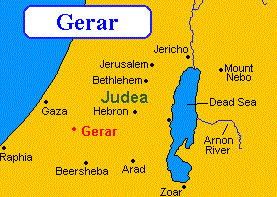
6 And Isaac dwelt in Gerar. — Gerar was probably a trading town between Syria and Egypt, and therefore Isaac’s needs during the famine are here supplied;
— the Targum Onkelos says
Yitzchok [thus] settled in Gerar.
7 And the men of the place asked him concerning his wife. And he said, “She is my sister”; for he feared to say, “She is my wife,” lest, said he, “the men of the place should kill me for Rebekah, because she was fair to look upon.”
— we now find Isaac imitating his father’s example with even less reason for his unjustifiable conduct;
— the Targum Onkelos says
The local men asked about his wife, and he said, She is my sister. He was afraid to say, [she is] my wife, lest the local men kill me for Rivkah, for she is so good looking.
8 And it came to pass, when he had been there a long time, that Abimelech king of the Philistines looked out a window and saw, and behold, Isaac was frolicking with Rebekah his wife. — Abimelek observes Isaac sporting with Rebekah as only husband and wife should;
— constrains him to confess that she is his wife, charges him with the impropriety of his conduct, and commands his people to refrain from harming either of them on pain of death;
— the Targum Onkelos says
Once, after [Yitzchok] had been there a long while, Avimelech, king of the Philistines, looked at the window, and he saw, and behold, Yitzchok was amusing himself with Rivkah, his wife.
9 And Abimelech called Isaac and said, “Behold, of a surety she is thy wife; and how saidst thou, ‘She is my sister’?” And Isaac said unto him, “Because I said, ‘Lest I die for her.’”
— lest I die for her; for her sake, that another might have and enjoy her; it was fear of losing his life that led him to take such a step, and give out that she was his sister, like his father, Abraham;
— the Targum Onkelos says
Avimelech called Yitzchok and he said, But she is your wife. How could you have said, She is my sister? Yitzchok said to him, Because I said, I might die because of her.
10 And Abimelech said, “What is this thou hast done unto us? One of the people might lightly have lain with thy wife, and thou shouldest have brought guiltiness upon us.”
— the Targum Onkelos says
Avimelech said, What have you done to us? One of the people [The unique one among the people] could have easily slept with your wife, and you would have brought guilt upon us.
11 And Abimelech charged all his people, saying, “He that toucheth this man or his wife shall surely be put to death.” — whoever shall go near to injure this man or his wife, shall verily be put to death.
— the Targum Onkelos says
Avimelech [then] commanded all his people, saying, Whoever touches [injures] this man or his wife, shall die.
12 Then Isaac sowed in that land, and received in the same year a hundredfold; and the Lord blessed him. — an hundredfold, that is, a hundred times as much as he sowed; the same degree of increase is repeated in Matthew 13:8;
— the Targum Onkelos says
Yitzchok planted in that land, and in that year he reaped a hundred fold [more than that which they estimated], for Adonoy had blessed him.
13 And the man waxed great, and went forward, and grew until he became very great. — Isaac became increasingly great and strong, until he was very powerful and his wealth very great;
— the Targum Onkelos says
The man prospered. He continued to prosper [and increase] until he became very great.
14 For he had possession of flocks and possession of herds, and great store of servants; and the Philistines envied him. — so that the Philistines envied Isaac, which makes men grieve at the good of others;
— the Targum Onkelos says
He owned flocks of sheep, herds of cattle, and many slaves, and the Philistines were jealous of him.
15 For all the wells which his father’s servants had dug in the days of Abraham his father, the Philistines had stopped them and filled them with earth. — and the Philistines endeavoured to do him injury by stopping up and filling with rubbish all the wells that had been dug in his father’s time;
— the Targum Onkelos says
All the wells that his father’s servants had dug in the days of his father, Avraham—the Philistines plugged them, and filled them with earth.
16 And Abimelech said unto Isaac, “Go from us, for thou art much mightier than we.” — and even Abimelech requested Isaac to depart, because he was afraid of his power; his family being greatly increased, his servants numerous;
— the Targum Onkelos says
Avimelech said to Yitzchok, Go away from us. You have become much more powerful than us.
17 And Isaac departed from thence, and pitched his tent in the Valley of Gerar and dwelt there. — Isaac’s retreats from Gerar and its suburbs, and takes up his abode in the valley, or wady of Gerar;
— the Targum Onkelos says
Yitzchok went away from there. He camped in the valley of Gerar and settled there.
18 And Isaac dug again the wells of water which they had dug in the days of Abraham his father, for the Philistines had stopped them after the death of Abraham; and he called their names after the names by which his father had called them.
— and Isaac digged those rather than new ones, partly to keep up his father’s memory, and partly because he had most right to them, and others less cause of quarrel with him about them;
— the Targum Onkelos says
Yitzchok returned and excavated the wells of water which were dug in the days of his father, Avraham, and were plugged by the Philistines after Avraham’s death. He gave them the same names that his father had given them.
19 And Isaac’s servants dug in the valley, and found there a well of springing water. — and found there a well of springing water; or “living water” which flows continually;
— the Targum Onkelos says
Yitzchok’s servants dug in the valley and found there a well of spring [flowing] water.
20 And the herdsmen of Gerar strove with Isaac’s herdsmen, saying, “The water is ours.” And he called the name of the well Esek [that is, Contention], because they strove with him. — and Isaac called the name of the well Esek: which signifies “contention” because they strove with him;
— the Targum Onkelos says
The shepherds of Gerar argued with the shepherds of Yitzchok, saying, the water is ours. He named the well Eisek [Quarrel], because they had quarreled with him.
21 And they dug another well, and strove for that also; and he called the name of it Sitnah [that is, Hatred]. — signifies “hatred” it being out of hatred and malice to him that they gave him so much trouble;
— the Targum Onkelos says
They dug another well and they also argued about it. He named the well Sitnah [Obstruction].
22 And he removed from thence, and dug another well, and for that they strove not; and he called the name of it Rehoboth [that is, Room]. And he said, “For now the Lord hath made room for us, and we shall be fruitful in the land.”
— and we shall be fruitful in the land; his flocks and his herds increase, having good pasturage and watering for them, and so he and his family be in prosperous circumstances;
— the Targum Onkelos says
He moved away from there and he dug another well, and there was no argument over it. He named it Rechovos [Wide Spaces], and said, For now Adonoy has made room for us, and we shall be fruitful in the land.
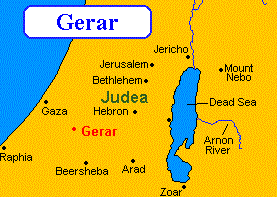
23 And he went up from thence to Beersheba. — and Isaac went south from thence to Beer-sheba;
— this was a very serious act on Isaac’s part as he leaves the solitudes where he had found a refuge from the enmity of the Philistines, and returns to a place scarcely five leagues distant from their city;
— the Targum Onkelos says
From there he went to Beer Sheva.
24 And the Lord appeared unto him the same night and said, “I am the God of Abraham thy father. Fear not, for I am with thee, and will bless thee, and multiply thy seed for My servant Abraham’s sake.” — Isaac is again and again reminded of the relation in which his father stood to God;
— fear not; any future famine, nor want of any good things, nor any enemies, the Philistines his neighbours, who had driven him from their country, and had harassed him from place to place;
— and multiply thy seed, for my servant Abraham’s sake; who was a faithful, diligent, servant of his; whose service was, not forgotten by him;
— the Targum Onkelos says
Adonoy appeared [became revealed] to him that night and said, I am the God of your father, Avraham. Do not fear for I am with you [My Word is your support]. I will bless you and make your descendants numerous, because of My servant, Avraham.
25 And he built an altar there, and called upon the name of the Lord, and pitched his tent there; and there Isaac’s servants dug a well.
— and he builded an altar there; at Beersheba, where his father Abraham had planted a grove before, and very probably had built an altar also, though it might not be now standing, Genesis 21:33,
— and there Isaac’s servants digged a well; in order to find water for the family, and for the flocks and herds; and called upon the name of the Lord; and gave him thanks for all his mercies to him; especially during the time of famine;
— the Targum Onkelos says
He [Yitzchok] built an altar there, and proclaimed [prayed in] the Name of Adonoy. He set up his tent there, and Yitzchok’s servants dug a well there.
26 Then Abimelech went to him from Gerar with Ahuzzath one of his friends and Phichol the chief captain of his army.
— then Abimelech went to Isaac; as there was a lapse of ninety years between the visit of Abraham and of Isaac, the Abimelech and Phichol spoken of must have been different persons’ official titles;
— then Abimelech went to him from Gerar, after Isaac was settled at Beersheba, and was still increasing in his family and substance;
— the Targum Onkelos says
Avimelech came to Yitzchok from Gerar along with a group of friends and Pichol, his general.
27 And Isaac said unto them, “Why come ye to me, seeing ye hate me and have sent me away from you?” — wherefore come ye to me? Isaac’s return had brought matters to a crisis, and the king must now decide whether there was to be peace or war;
— the Targum Onkelos says
Yitzchok said to them, Why have you come to me? You hate me and drove me away from you.
28 And they said, “We saw certainly that the Lord was with thee; and we said, ‘Let there be now an oath between us, even between us and thee, and let us make a covenant with thee,
— Let there be now an oath; the word literally signifies a curse; each side uttered an imprecation, with the prayer that it might fall upon himself if he broke the terms of the covenant;
— the Targum Onkelos says
They said, We have indeed seen that Adonoy is with you [the Word of Adonoy is your support], and we said, Let there now be an oath between us, [Let the oath that was between our fathers now be established] between ourselves and you, and let us make a covenant with you;
29 that thou wilt do us no hurt, as we have not touched thee, and as we have done unto thee nothing but good, and have sent thee away in peace. Thou art now the blessed of the Lord.’”
— as we have not touched thee; not done the least injury to him, to his person, family, and substance, but suffered him to go away with nothing but good; by royal authority;
— the Targum Onkelos says
that you will do us no harm, just as we did not touch [injure] you. We did nothing but good to you, and sent you away in peace. You are now the blessed one of Adonoy.
30 And he made them a feast, and they ate and drank. — and they did eat and drink; freely and in a friendly manner; for both having spoken their minds, they agreed to bury all former things oblivion, and live in peace and friendship;
— the Targum Onkelos says
He [Yitzchok] made a feast for them, and they ate and drank.
31 And they rose up early in the morning and swore one to another; and Isaac sent them away, and they departed from him in peace. — and Isaac sent them away, and they departed from him in peace; he took his leave of them in a friendly manner to mutual satisfaction;
— the Targum Onkelos says
They got up early in the morning, and they each swore to the other. Yitzchok sent them away and they left in peace.
32 And it came to pass the same day, that Isaac’s servants came and told him concerning the well which they had dug, and said unto him, “We have found water.”
— not only had dug a well, but they had found plenty of water, and that which was good; or otherwise it would not have been worth while to have troubled Isaac;
— the Targum Onkelos says
On that day Yitzchok’s servants came and told him about the well they had dug; and they said to him, We have found water.
33 And he called it Shebah [that is, An oath]; therefore the name of the city is Beersheba [that is, The well of the oath] unto this day. — the well of the oath: it had been so called by Abraham an hundred years ago or more; but now upon this occasion it was renewed and confirmed;
— the Targum Onkelos says
He named it Shiva. Therefore the city is called Beer Sheva until this very day.
34 And Esau was forty years old when he took for a wife Judith the daughter of Beeri the Hittite, and Basemath the daughter of Elon the Hittite,
— Esau, by thus inter marrying with idolaters he violated the great principle laid down by Abraham (Genesis 24:3), forfeited thereby his birthright, and, as such marriages were beyond righteousness;
— the Targum Onkelos says
Eisov was forty years old and he married Yehudis, the daughter of Be’eri, the Chittite and Bosmas, the daughter of Eylon the Chittite.
35 who were a grief of mind unto Isaac and to Rebekah. — which were a grief of mind unto Isaac, and to Rebekah; although Esau partially repented, and took as a third wife a daughter of Ishmael (Genesis 28:9)
— the Targum Onkelos says
They were rebellious of spirit to [They were rebels and aggravators against the words of] Yitzchok and Rivkah.


 Joel
Joel A Prophecy of Esau and Jacob