
Genesis (1-2)
Remember the former things of old; for I am God, and there is none other; I am God, and there is none like Me,
declaring the end from the beginning, and from ancient times the things that are not yet done, saying, ‘My counsel shall stand, and I will do all My pleasure,’ Isaiah 46:9-10
This study would incorporate the Targum, whose origin was in the Aramaic language, could be traced to Ezra speaking to the returning exiles who couldn’t understand Hebrew, but was expounded to them in a language they could understand.
Genesis 1
1 In the beginning God created the heaven and the earth. — God; Heb. Elohim; a word plural in form (Father and Son), but joined with a verb singular; created; the idea of creating them out of nothing;
— created; not formed or made from any pre-existing materials, but created out of nothing; in the beginning of this sidereal system, of which our sun, with its planets; of this material, visible, and temporal world; not the the spiritual, invisible and eternal world;
— the Targum Onkelos says
In the beginning Elohim created the heavens and the earth.
2 And the earth was without form and void, and darkness was upon the face of the deep. And the Spirit of God moved upon the face of the waters. — and the earth; the conjunction “and” (וְ) negatives the well-meant attempt to harmonise geology and Scripture while studying Genesis 1:1
— and the earth was/became (hā·yə H1961 could be translated as “became” in some versions (GW, EASY, ISV, NOG, NIV, VOICE as in CEV Genesis 3:20) without form and void; it just doesn’t make sense that God created something that is already in a state of decay (bohû and tohû); more sense that it became bohû and tohû;
— this process of hā·yə could have taken many years, perhaps thousands, or even million, the details we’re not given; we’re only given the gist of it only; hence today, many trace marks could be gathered to prove that the earth is very old;
— one example is the Tibetan Plateau, sometimes called the “roof of the world,” and according to Bradley Hacker, a professor of geological sciences at the University of California, “the plateau dates back 13.5 million years and has reached a maximum average height of five kilometers.”

— a second example is the Hawaiian chain of islands; more from Britannica; “The origin of Hawaii’s islands, islets, and seamounts can be traced to at least 70 million years ago, near the end of the Cretaceous Period (145 million to 66 million years ago);”
— a third evidence is the absence of the creation of the dinosaurs in Genesis chapter two, indicating they were created and destroyed millions of years before another creation in Genesis 1:1

— both the Targums of Jonathan and Onkelos paraphrase it, a waste and desert, empty and destitute of both men and beasts;
— the Targum Onkelos says
The earth was unformed and desolate, and (there was) darkness [was spread] over the surface of the abyss. The breath of [from before] Elohim hovered [blew] above the surface of the water.
3 And God said, “Let there be light”; and there was light. — God said, Let there be light; he willed it, and at once there was light. Oh, the power of the Word of God!
— the Targum Onkelos says
Elohim said, Let there be light. and there was light.
4 And God saw the light, that it was good; and God divided the light from the darkness. — divided between the light and between the darkness; God then separates light and darkness, by assigning to each its relative position in time and space; which refers to the division of day and night;
— the Targum Onkelos says
Elohim saw that the light was good, and Elohim divided the light from the darkness.

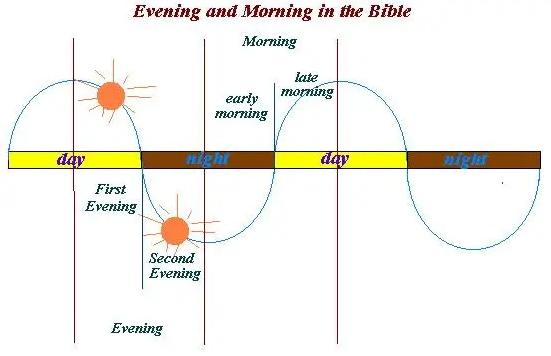
5 And God called the light Day, and the darkness He called Night. And the evening and the morning were the first day. — and the Evening and the Morning were the first day: the evening, the first and second part of the evening; about the space of twelve hours;
— and the morning, which is also the second part of the night, and the second morning, in the light, in all together they make the opposite space from Evening; and both form one natural day, consisting of twenty four hours;
— the Targum Onkelos says
Elohim called the light day, and the darkness He called night. It became evening and it became morning, one day.
6 And God said, “Let there be a firmament in the midst of the waters, and let it divide the waters from the waters.” — a firmament; an extension, or a space; or place extended or stretched out, and spread abroad like a tent or curtain, it indicates something solid;
— and let it be dividing between water and water; it appears that the water in the atmosphereic sphere was in contact with another mass of water ion the earth; hence the Targum of Jonathan says “Let there be an expanse in the midst of the waters, and let it separate between the waters above and the waters beneath.”
— the Targum Onkelos says
Elohim said, Let there be a canopy in the midst [middle] of the waters, and let it divide between waters and waters.
7 And God made the firmament, and divided the waters which were under the firmament from the waters which were above the firmament; and it was so. — the waters under the firmament are seas, rivers, lakes, fountains, and other waters in the bowels of the earth;
— the Targum Onkelos says
Elohim made the canopy, and divided the waters which were beneath the canopy, from the waters which were above the canopy, and it was so.
8 And God called the firmament Heaven. And the evening and the morning were the second day. — God called the firmament (the expanse) heaven; and means something heaved up; including the starry and airy heavens; being above the earth, and reaching to the third heaven;
— and the evening; and the morning were the second day; these together made up the space of twenty four hours, which was another natural day;
— the Targum Onkelos says
Elohim called the canopy heaven. It became evening and it became morning the second day.
9 And God said, “Let the waters under the heaven be gathered together unto one place, and let the dry land appear”; and it was so. — unto one place; the ocean bed. We must add the vast depth of the ocean to the height of the mountains before we can rightly estimate the intensity of the forces at work on the third day;
— and let the dry land appear: clear of the waters, dried by the expanded air, hardened by the fiery light, and as yet without any herb or tree upon it: and it was so; immediately done;
— the Targum Onkelos says
Elohim said, Let the waters beneath the heavens be gathered into one place, and let the dryness be seen. It was so.
10 And God called the dry land Earth; and the gathering together of the waters called He Seas; and God saw that it was good. — he called them not sea, but seas; because of the differing quantity and nature both of several seas, and of the rivers, and other lesser collections of waters, all which the Hebrews call seas;
— the Targum Onkelos says
Elohim called the dryness, earth, and the gathering of the waters, He called seas, and Elohim saw that it was good.
11 And God said, “Let the earth bring forth grass, the herb yielding seed, and the fruit tree yielding fruit after his kind, whose seed is in itself, upon the earth”; and it was so. — and God said, Let the earth bring forth grass; which had been impregnated by the spirit of God that moved upon it when a fluid; and though now become dry land;
— the Targum Onkelos says
Elohim said, Let the earth sprout grass, seed-yielding herbs, fruit trees bearing fruit of its own kind, with its seed within it, upon the earth. And it was so.
— the Targum of Jonathan says
And the Lord said, Let the earth increase the grassy herb whose seed seedeth, and the fruit-tree making fruit after its kind, whose seed is in itself upon the earth. And it was so.
12 And the earth brought forth grass, and herb yielding seed after his kind, and the tree yielding fruit, whose seed was in itself, after his kind; and God saw that it was good. — and the fruit tree yielding fruit after his kind; as apples, pears, plums, apricots, nectars, peaches, oranges, lemons, and more;
— the Targum Onkelos says
The earth brought forth grass, herbs yielding seed of its kind, and trees bearing fruit which has in it seeds of its kind; and Elohim saw that it was good.
— the Targum of Jonathan implies their fruit shall be for food and leaves for healing
“And the earth brought forth greenery: herbs whose seed is sown, and trees producing fruit according to their kind; and the Lord saw that it was good.”
— in the ancient world, many medicines were “topical” (applied to the skin) or brewed as teas, making the “leaf” the natural symbol for pharmaceutical power; but in the Targum of Jonathan it emphasizes that the leaves are but designed by the Creator as a pharmacy;
“And by the river shall grow on its bank, from this side and from that side, every tree for food; its leaves shall not wither, and its fruit shall not fail; month by month it shall produce fruit, because its waters issue forth from the Sanctuary; and its fruit shall be for food, and its leaves for healing (לְאַסוּתָא – L’asuta).” Ezekiel 47:12 Jonathan
— this often implies that the creation of plants was not just for food, but to provide for all human needs; and that’s including health and healing.
13 And the evening and the morning were the third day. — the space of twenty four hours ran out, and were measured, either by the rotation of the body of light and heat around the earth, or of the earth upon its axis;
— the Targum Onkelos says
It became evening and it became morning, the third day.
14 And God said, “Let there be lights in the firmament of the heaven to divide the day from the night; and let them be for signs and for seasons, and for days and years; — and God said, let there be lights in the firmament of the heaven; in the upper part of it, commonly called the starry heaven;
— and let them be for signs and the times of the feasts, and to reckon with them the number of days, and, sanctify the beginnings of the months, and the beginnings of the years;
— the Targum Onkelos says
Elohim said, Let there be lights in the canopy of heaven to divide between the day and the night, and they will serve for signs for seasons, [and to count] (for) days and (for) years [with them].
— the Targum of Jonathan adds “and let them be for signs and for festival times.”
15 and let them be for lights in the firmament of the heaven to give light upon the earth”; and it was so. — to give light upon the earth and their inhabitants when formed, and it was so;
— the Targum Onkelos says
They will be for lights in the canopy of heaven to illuminate the earth. And it was so.
16 And God made two great lights: the greater light to rule the day, and the lesser light to rule the night. He made the stars also. — the great light, the sun, which is really and considerably greater than the moon with the little light from man’s point of view, are insignificant; and the stars;
— the Targum Onkelos says
Elohim made the two great lights, the large light to rule the day, and the small light to rule the night, and the stars
17 And God set them in the firmament of the heaven to give light upon the earth, — and God set them in the firmament of the heaven; he not only ordered that there they should be, and made them that there they might be,
— but he placed them there with his own hands; and they are placed, particularly the sun, at such a particular distance as to be beneficial and not hurtful: had it been set nearer to the earth, its heat would have been intolerable; in the one case we should have been scorched with its heat, and in the other been frozen up for the lack of it;
— the Targum Onkelos says
Elohim set them in the canopy of the heaven to illuminate the earth,
18 and to rule over the day and over the night, and to divide the light from the darkness. And God saw that it was good. — in the fourth day’s work, the creation of the sun, moon, and stars is accounted for; all by the works of God;
— the Targum Onkelos says
to rule in the day and the night, and to divide between the light and the darkness; and Elohim saw that it was good.
19 And the evening and the morning were the fourth day. — the fourth day, made by the rotation of the earth on its own axis, in the space of twenty four hours; twelve hours each, the evening includes the afternoon;
— the Targum Onkelos says
It became evening and it became morning, the fourth day.
20 And God said, “Let the waters bring forth abundantly the moving creature that hath life, and fowl that may fly above the earth in the open firmament of heaven.” — moving creature; all oviparous animals, both among the finny and the feathery tribes, remarkable for their rapid and prodigious increase: fowl, which means every flying thing;
— the Targum Onkelos says
Elohim said, Let the waters teem with swarms of living creatures, and let birds fly above the earth, in the open canopy of the heaven.
21 And God created great whales and every living creature that moveth, which the waters brought forth abundantly after their kind, and every winged fowl after his kind; and God saw that it was good. — great whales; those vast sea monsters known by that name, though elsewhere this word be applied to great creatures of the earth, or under the seas;
— the Targum Onkelos says
And thus Elohim created the great whales, and every living creature that creeps, with which the waters teem, of its kind, and every winged bird of its kind; and Elohim saw that it was good.
22 And God blessed them, saying, “Be fruitful and multiply, and fill the waters in the seas, and let fowl multiply on the earth.” — be fruitful, and multiply; this blessing shows that the earth was replenished with animal life from a limited number of progenitors, and probably from a small number of centres, both for the flora and for the fauna;
— the Targum Onkelos says
Elohim blessed them saying, Be fruitful and multiply, fill the waters of the seas, and let the birds multiply on the earth.
23 And the evening and the morning were the fifth day. — the evening and the morning were the fifth day; the sun now in the firmament, where it was fixed the day before, having gone round the earth, or the earth about that, in the space of twenty four hours;
— the Targum Onkelos says
It became evening and it became morning, the fifth day.
24 And God said, “Let the earth bring forth the living creature after his kind: cattle and creeping thing and beast of the earth after his kind”; and it was so. — “cattle” which seem to design domestic cattle, and such as are for the use of man, either for carriage, food,
— or clothing, as horses, asses, camels, oxen, sheep and “creeping” things, which are different from the creeping things in the sea before mentioned, are such as either have no feet, and go upon their bellies, or are very short, and seem to do so, whether greater or lesser, as serpents, worms, ants and more;
— the Targum Onkelos says
Elohim said, Let the earth bring forth living creatures, each of its kind, animals [of pasture], creeping things, and beasts of the earth, each to its kind. And it was so.
25 And God made the beast of the earth after his kind, and cattle after their kind, and every thing that creepeth upon the earth after his kind; and God saw that it was good. — and God saw that it was good; that every creature he had made would some way or other be for his glory, and for the benefit of man;

— the Behemoth (H930 ḇə·hê·mō·wṯ), or known as as dinosaur in Job 40:15, is a different word from Cattle (H929 bə·hê·māh) used in this verse and elsewhere; the word “dinosaur” was coined only in 1841 by an Englishman named Sir Richard Owen, hence most translations today continue to use the antiquated word Behemoth;
— the Targum Onkelos says
And thus Elohim made the beasts of the earth, each of its kind, the animals [of pasture] each of its kind, and everything that creeps on the ground, each of its kind, and Elohim saw that it was good.

26 And God said, “Let Us make man in Our image, after Our likeness; and let them have dominion over the fish of the sea, and over the fowl of the air, and over the cattle, and over all the earth and over every creeping thing that creepeth upon the earth.”
— in our image, in our form; after our likeness; with the ability to understand and to discern; these Words “let us” indicates the plurality of God (Elohim); are spoken by God the Father to the Son; hence the “US” and “OUR” plural form of a singuar God;
— the Targum Onkelos says
Elohim said, Let us make man in our image, as our likeness, and let him dominate the fish of the sea, the birds of the heaven, the animals, all the earth, and every creeping thing that creeps on the earth.
27 So God created man in His own image, in the image of God created He him; male and female created He them. — in our image, that is, in our form; after our likeness; with the ability to understand and to discern, showing man’s superior glory and dignity to the rest of the creations;
— and the parallel revealing of the Word by apostle John
In the beginning was the Word, and the Word was with God, and the Word was God.
The same was in the beginning with God.
All things were made by Him, and without Him was not anything made that was made. John 1:1-3
— the Jerusalem Targum says,
And the Word of the Lord created man in His likeness, in the likeness of the presence of the Lord He created him, the male and his yoke-fellow He created them.
28 And God blessed them, and God said unto them, “Be fruitful and multiply, and replenish the earth, and subdue it; and have dominion over the fish of the sea, and over the fowl of the air, and over every living thing that moveth upon the earth.”
— so God created man in his own image; and with man’s superior intelligence, to subdue and have dominion over them;
— the Targum Onkelos says
Elohim blessed them, and Elohim said to them, Be fruitful and multiply, fill the earth and subdue it, and dominate the fish of the sea, the birds of the heaven, and every living thing that moves upon the earth.
29 And God said, “Behold, I have given you every herb bearing seed which is upon the face of all the earth, and every tree in which is the fruit of a tree yielding seed; to you it shall be for meat.
— to you it shall be for meat: which is generally thought to be the food; as the Hebrew word “meat” is an old English term for “food;” compares this Luke 24:41 And while they yet believed not for joy, and wondered, He said unto them, “Have ye here any meat?”
— the Targum Onkelos says
Elohim said, Behold, I have given you all seed-yielding herbs that are on the surface of the earth, and every tree that has seed-yielding fruit; to you it shall be for food.
— the Targum Jonathan says
And the Lord said, Behold, I have given you every herb whose seed seedeth upon the face of all the earth, and every unfruitful tree for the need of building and for burning; and the tree in which is fruit seeding after its kind, to you it shall be for food.
30 And to every beast of the earth, and to every fowl of the air, and to every thing that creepeth upon the earth wherein there is life, I have given every green herb for meat;” and it was so. — and to every beast, and to every fowl and every thing that creepeth, are likewise for food;
— the Targum Onkelos says
And for every animal of the earth, for every bird of the heaven, and for everything that creeps on the ground, in which there is a living spirit, all vegetational herbs shall be [their] food. And it was so.
31 And God saw every thing that He had made, and behold, it was very good. And the evening and the morning were the sixth day. — it is affirmed here everything is good that flesh and meat as well as herbs and fruits, are granted to the first men for food;
— and therefore we are safe to ignore any false shepherds who came along later and preached derogatively the eating of meat as if eating corpses; it is sufficient for us that it was expressly allowed here; as was instructed to righteous Noah in Genesis 9:3 (except the blood);
— and Ellen G White is thus a false prophetess; for she wrote derogatively of eating meat as if eating corpses:
From the light God has given me, the prevalence of cancer and tumors is largely due to gross living on dead flesh.
I sincerely and prayerfully hope that, as a physician, you will not forever be blind on this subject, for blindness is mingled with a want of moral courage to deny our appetite, to lift the cross, which means, to take up the very duties which cut across the natural passions.
Feeding on flesh, the juices and fluids of what you eat pass into the circulation of your blood, and, as we are composed of what we eat, we become animalized; thus a feverish condition is created, because the animals are diseased, and by partaking of their flesh, we plant the seeds of disease in our own tissue and blood.
Then when exposed to the changes in a malarious atmosphere, these are more sensibly felt; also when we are exposed to prevailing epidemics and contagious diseases the system is not in condition to resist the disease. TSDF 68.11
I have the subject presented to me in different aspects. The mortality caused by meat-eating is not discerned; if it were, we would hear no more arguments and excuses in favor of the indulgence of the appetite for dead flesh. We have plenty of good things to satisfy hunger without bringing CORPSES upon our table to compose our bill of fare. TSDF 68.12
The prophets prophesy falsely, and the priests bear rule by their means; and My people love to have it so. And what will ye do in the end thereof? Jeremiah 5:31
For they prophesy falsely unto you in My name: I have not sent them, saith the Lord. Jeremiah 29:9
— the Targum says
Elohim saw all that He had made, and behold it was very good [completely prepared]. It became evening and it became morning, the sixth day.
Genesis 2
1 Thus the heavens and the earth were finished, and all the host of them. — the host of them; that is, the creatures contained therein; the host of heaven, in Scripture language, sometimes signifies the stars and sometimes the angels;
— the Targum Onkelos says
Elohim completed by the seventh day His work which He had made, and He abstained on the seventh day from all His work which He had made.
2 And on the seventh day God ended His work which He had made; and He rested on the seventh day from all His work which He had made. — God ended his work; not all work (John 5:17), but the work of this specific creation;
— the Targum Onkelos says
Elohim completed by the seventh day His work which He had made, and He abstained on the seventh day from all His work which He had made.
3 And God blessed the seventh day and sanctified it, because in it He had rested from all His work which God created and made. — God blessed the seventh day, by conferring special honours and privileges upon it above all other days, that it should be a day of solemn rest and rejoicing and celebration of God and his works;
— the Targum Onkelos says
Elohim blessed the seventh day and sanctified it, for on it He abstained from all His work, which Elohim had created to do.
4 These are the generations of the heavens and of the earth when they were created, in the day that the Lord God (יְהוָה אֱלֹהִים) made the earth and the heavens, — this is the first time God’s name YHVH יְהוָה was introduced; but introduces as a compound name, LORD God;
— these are the generations of the heavens and the earth, when they were created; that is, the above account is a history of the creation of the heavens and earth, and of all things, creatures and animals; their creation being a sort of birthday;
— the Targum Onkelos translates יְהוָה as Adonoy but it could have being ‘Yehovah,’ or LORD, saying
This is the history of the heavens and the earth when they were created, on the day when Adonoy Elohim made earth and heaven.
— from this verse on, the Onkelos consistently uses the divine name as “Adonoy Elohim,” that is, the text uses יְיָ אֱלֹהִים which could be translated as the “Lord God,” not just “God.” The symbol יְיָ (a double Yod) is a a shorthand for יהוה (YHVH); a specialized placeholder for the Tetragrammaton—the sacred, four-letter Name of God: יהוה (YHVH));
5 and before every plant of the field was in the earth, and before every herb of the field grew; for the Lord God had not caused it to rain upon the earth, and there was not a man to till the ground.
— for the Lord God had not caused it to rain upon the earth: so the plants and herbs could not grow owing to that; since on the third day, when they were made, there was no sun to exhale and draw up the waters into the clouds, in order to be let down again in showers of rain;
— and there was not a man to till the ground; who was not created till the sixth day, and therefore could have no concern in the cultivation of the earth, and of the plants and herbs in it; but these were the produce of almighty power;
— the Targum Onkelos says
All the plants of the field were not yet on the earth, and all the herbal vegetation of the field had not yet sprouted, for Adonoy Elohim had not brought rain [down] upon the earth, and there was [yet] no man to work the soil.
6 But there went up a mist from the earth, and watered the whole face of the ground. — a mist; this mist, as we learn from Job 36:27, where the same word is translated vapour, is the measure and material of the rain;
— the Targum Onkelos says
A mist rose up from the earth, and it watered the entire surface of the soil.
7 And the Lord God formed man of the dust of the ground, and breathed into his nostrils the breath of life; and man became a living soul. — and the Lord God formed man of the dust of the ground; literally, formed the man (adam) dust from the ground;
— became a living soul, that is, a living man: not only capable of performing the functions of the animal life, of eating, drinking, walking and more; and of thinking, reasoning, and discoursing as a rational creature;
— the Targum Onkelos says
Adonoy Elohim then formed the man, dust from the ground, and He blew into his nostrils the breath of life. And so man became a living [speaking] soul.
8 And the Lord God planted a garden eastward in Eden, and there He put the man whom He had formed. — and the Lord God planted a garden eastward in Eden; or “had planted” for this wasn’t done before the creation of man;
— the Targum Onkelos says
Adonoy Elohim planted a garden in Eden, to the east, and there He placed the man He had formed.
9 And out of the ground made the Lord God to grow every tree that is pleasant to the sight and good for food, the tree of life also in the midst of the garden, and the tree of knowledge of good and evil.
— so called the tree of life because of assuring him of the continuance of life and happiness, on condition of his persevering in obedience; because God had given the fruit of it a singular virtue for the support of nature, the prolongation of life, and the prevention of all diseases, infirmities, and decays through age;
— the tree of knowledge of good and evil; to man, who by the use of it would know, to his cost, how great and good things he did enjoy, and might have kept by his obedience, and how evil and bitter the fruits of his disobedience were to himself and all his posterity; thus knowing both the good and evil;
— the Targum Onkelos says
Adonoy Elohim made grow out of the soil every tree that is pleasant to look at, and good for [producing] food; the Tree of Life in the middle of the Garden, and the Tree (of) [from which the fruit if eaten gives] Knowledge [of what is] good and evil.
10 And a river went out of Eden to water the garden, and from thence it was parted and became four heads. — the Targum of Jonathan says And a river went forth from Eden, to water the garden, and from thence was separated, and became four heads of rivers (or four chief rivers)
— the Targum Onkelos says
A river went out of Eden to water the Garden, and from there it separated and became four headwaters.
11 The name of the first is Pishon; that is it which compasseth the whole land of Havilah, where there is gold. — the first is Pishon; or Pison, perhaps an eminent branch of the river Tigris, probably that called by others Pasi-tigris, or Piso-tigris;
— the Targum Onkelos says
The name of the first is Pishon which surrounds all the land of Chavilah, where there is gold.
12 And the gold of that land is good, and there is bdellium and the onyx stone. — there is the bdellium, and the onyx stone; the first of these is either an aromatic gum; the tree is black, and is of the size of an olive tree, has the leaf of an oak;
— the Targum Onkelos says
The gold of that land is good. Also found there is bdellium and onyx stones.
13 And the name of the second river is Gihon; the same is it that compasseth the whole land of Cush. — Gihon, the second river, flows by the land of Kush; there is one other Gihon mentioned in 1 Kings 1:33, and in II Chronicles 32:30;
— the rivers Pishon and Gihon may have been greatly altered or even effaced by the deluge and other causes over time;
— the Targum Onkelos says
The name of the second river is Gichon. It surrounds all the land of Kush.
14 And the name of the third river is Hiddekel; that is it which goeth toward the east of Assyria. And the fourth river is Euphrates. — of the “Hiddekel” and “Euphrates” there high probability the former is the Tigris, or Tigres;
— and the fourth river is Euphrates; which retains its name till modern time as we know it today;
— the Targum Onkelos says
The name of the third river is Chidekel[Diglas], which flows to the east of Ashur. The fourth river is P’ras.
15 And the Lord God took the man and put him into the Garden of Eden to dress it and to keep it. — to dress the Garden and to keep it; the first word literally means to work it; for though a paradise, yet the garden had to be tilled and planted; seeds must be sown and the cultivated plots kept in order;
— the other word, “to keep it,” implies, however, some difficulty and danger, though no unpropitious weather, nor blight nor mildew, spoiled the crop, yet apparently it had to be guarded against the incursion of wild animals and birds, and protected even against the violence of winds and the burning heat of the sun;
— the Targum Onkelos says
Adonoy Elohim took the man, and put him in the Garden of Eden, to work it and to preserve it.
16 And the Lord God commanded the man, saying, “Of every tree of the garden thou mayest freely eat; — saying, of every tree of the garden thou mayest freely eat: a very generous, large, and liberal allowance this: or “in eating thou mayest eat”
— the Targum Onkelos says
Adonoy Elohim commanded the man, saying, You may certainly eat from every tree in the Garden.
17 but of the tree of the knowledge of good and evil, thou shalt not eat of it. For in the day that thou eatest thereof, thou shalt surely die.” — the tree of knowledge of good and evil; a consequence to humanity of how evil and bitter the fruits of his disobedience were to himself and all his posterity; thus knowing both the good and evil;
— for in the day thou eatest thereof thou shalt surely die; man became at once a mortal creature; but had he obeyed by eating of the tree of life, he would have lived an immortal life;
— the Targum Onkelos says
But from the Tree (of) [from which the fruit if eaten gives] Knowledge of what is good and evil, you shall not eat from it, for on the day you eat from it, you will certainly die.
18 And the Lord God said, “It is not good that the man should be alone; I will make him a helper meet for him.” — a new and final need of man is stated, a helper; she is formed to be social, to hold converse, not only with her superior, but also with him, a co-worker;
— the Targum Onkelos says
Adonoy Elohim said, It is not good [fitting] for the man to be alone. I will make a helper for him.
19 And out of the ground the Lord God formed every beast of the field, and every fowl of the air, and brought them unto Adam to see what he would call them; and whatsoever Adam called every living creature, that was the name thereof.
— whatsoever Adam called every living creature, that was the name thereof; his powers of perception and intelligence were supernaturally enlarged to know the characters, habits, and uses of each species that was brought to him;
— the Targum Onkelos says
Adonoy Elohim formed from the ground, every beast of the field, and every bird of the heaven, and brought them to the man, to see what he would call them. Whatever the man called [each] living creature, that is its name.
20 And Adam gave names to all cattle, and to the fowl of the air, and to every beast of the field; but for Adam there was not found a helper meet for him. — power and dominian over the creatures were also given to man, and as a proof of this he named them all;
— the Targum Onkelos says
The man gave names to every animal, to the birds of the heaven, and to every beast of the field, but the man did not find a helper for himself.
21 And the Lord God caused a deep sleep to fall upon Adam, and he slept; and He took one of his ribs, and closed up the flesh instead thereof. — the deep sleep as divine anesthesia, a precise anatomical miracle;
— that opening of his side and the taking away of his rib might be no grievance to him; while he knows no sin, God will take care that he shall feel no pain;
— the Targum Onkelos says
Adonoy Elohim caused unconsciousness to fall upon the man and he slept. He took one of his ribs and closed over [filled] flesh in its place.
— this is a classic example of the Targum adding specific details that aren’t in the original Hebrew; the Targum of Jonathan specifies that God “took one of his ribs; it was the thirteenth rib of his right side:”
And the Lord God threw a deep slumber upon Adam, and he slept. And He took one of his ribs, it was the thirteenth rib of the right side, and closed it up with flesh.
— according to Jewish thoughts, man was created with 13 ribs on each side, totaling 26. In Gematria (Jewish numerology), 26 is the numerical value of the Tetragrammaton (the four-letter name of God, YHVH). By taking one rib to create woman, the text suggests that the divine “wholeness” of the human being is achieved only when man and woman, each with 24 ribs, are joined back together.
22 And the rib which the Lord God had taken from man, made He a woman and brought her unto the man.
— the rib, which the Lord God had taken from man, made he woman; was not made from the superior part of man, that she might not be thought to be above him, and have power over him; nor from any inferior part, as being below him, and to be trampled on by him; but out of his side;
— the Targum Onkelos says
Adonoy Elohim built the rib that He took from the man into a woman, and He brought her to the man.
23 And Adam said, “This is now bone of my bones, and flesh of my flesh; she shall be called Woman, because she was taken out of Man.” — she shall be called Woman (Ishah), because she was taken out of Man (Ish); from hence the suffix ish is derived from: British (English, Scottish), Irish, Danish, Swedish, Finnish; indicating they are of Hebraic origin;
— the Targum Onkelos says
The man said: This at last is bone of my bones and flesh of my flesh. This shall be called Woman, for from Man [husband] was she taken.
24 Therefore shall a man leave his father and his mother, and shall cleave unto his wife; and they shall be one flesh. — one flesh; the human pair differed from all other pairs, that by peculiar formation of Eve, they were one; the man and his wife;
— the Targum Onkelos says
Therefore, a man shall leave [the house where] his father and his mother [sleep], and cling to his wife, and they shall become one flesh.
25 And they were both naked, the man and his wife, and were not ashamed. — and they were both naked, the man and his wife, but were not ashamed;
— the Targum Onkelos says
The two of them were naked, the man and his wife, but they were not ashamed.


 Joel
Joel A Prophecy of Esau and Jacob