
Ezekiel (Ch 45-46)
During the Millennium the world will still have an elaborate system of animal sacrifices and other material offerings, along with observance of New Moons and the Sabbaths, both weekly and annual.
Note the Five types of Offerings during the Millennium in Ezekiel:
Ezekiel 46:12 ‘Now when the prince prepares a voluntary burnt offering, or peace offerings unto the Lord
Ezekiel 44:29 ‘They shall eat the meat offering and the sin offering and the trespass offering
Compare to the Five types of Offerings during Moses’ time:
Leviticus 1:3 ‘If his offering be a burnt sacrifice
Leviticus 2:1 ‘And when any will offer a meat offering
Leviticus 3:1 ‘And if his oblation be a sacrifice of peace offering
Leviticus 4:3 ‘If the priest … for a sin offering
Leviticus 5:6 ‘And he shall bring his trespass offering
Now, if the Churches teach that these ordinances and sacrifices are for ritual or ‘sacrificial’ laws only, then why are these brought back during the Millennium?
Surely false teachers abound in the land of Israel today, their prophets and watchmen are just plain blind, naked and misguided!
“Hear, ye deaf; and look, ye blind, that ye may see” Isaiah 42:18
“His watchmen are blind; they are all ignorant; they are all dumb dogs, they cannot bark, sleeping, lying down, loving to slumber” Isaiah 56:10
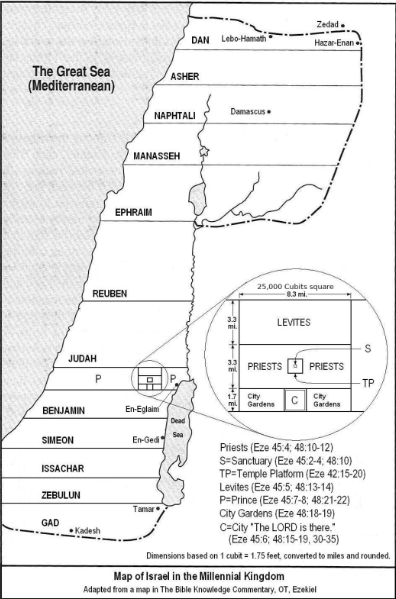
Below is a redrawn map for each of the Twelve Tribes of Israel during the Millennium
Ezekiel 45
We now come to the usage and division of the Land, beyond the Temple or its courtyard.
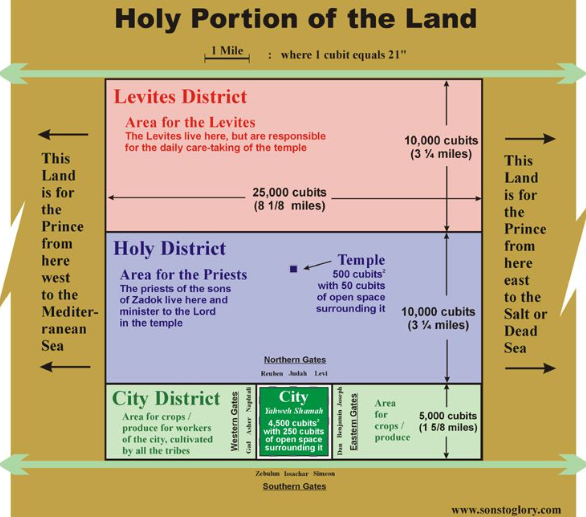
1 “‘Moreover, when ye shall divide by lot the land for inheritance, ye shall offer an oblation unto the Lord, a holy portion of the land. The length shall be the length of five and twenty thousand reeds, and the breadth shall be ten thousand; this shall be holy in all the borders thereof round about.
— an oblation; a heave offering; sacrificial gifts which were lifted up or heaved before the Lord, seeking his will; when ye shall divide by lot the land for inheritance; the land was originally divided by lot under Joshua, a particular share of which was to be God’s portion, as an acknowledgment of his sovereignty:
— the length shall be five and twenty thousand reeds; the Hebrew does not express either reeds, rods or cubits: although our translation supplies the word reeds, its true length remains uncertain;
— the Targum says,
“And when you divide the land for inheritance, you shall set apart a contribution (an allotment) before the Lord, a holy portion of the land; the length shall be twenty-five thousand [cubits] in length, and the width shall be ten thousand; it shall be holy in all its borders round about.”
2 Of this there shall be for the sanctuary five hundred in length with five hundred in breadth, square round about, and fifty cubits round about for the open places thereof. — cubits is mentioned here;
— five hundred in length, and five hundred in breadth, square round about: that is, five hundred reeds square, and this indicates the spaciousness, perfection and stability of the Millennium;
— the Targum says,
“Of this [area] there shall be for the Sanctuary five hundred [cubits] by five hundred, a square round about; and fifty cubits for an open space (margin) round about it.”
3 And of this measure shalt thou measure the length of five and twenty thousand and the breadth of ten thousand; and in it shall be the sanctuary and the Most Holy Place. — this verse is a repetition of the latter part of Ezekiel 45:1; hence the uncertainties of how long a reed remain;
— the Targum says,
“And from this area you shall measure a length of twenty-five thousand [cubits] and a width of ten thousand; and in it shall be the Sanctuary, the Holy of Holies.”
4 The holy portion of the land shall be for the priests, the ministers of the sanctuary, who shall come near to minister unto the Lord; and it shall be a place for their houses and a holy place for the sanctuary.
— for the priests; sons of Zadok, who minister to the Lord, and others with them, who, though degraded from the priestly honour, yet lived upon priestly provision;
— a place for their houses; in which twenty-three of twenty-four courses of priests may dwell conveniently, while the twenty-fourth minister serve at the Temple, as by order they did;
— the Targum says,
“It is a holy portion of the land; it shall be for the priests, the ministers of the Sanctuary of the Lord, who draw near to minister before the Lord; and it shall be for them a vacant place for their houses, and a sacred place for the Sanctuary.”
5 And the five and twenty thousand of length and the ten thousand of breadth shall also the Levites, the ministers of the house, have for themselves as a possession for twenty chambers.
— Rashi says the Levites portion is to the south; for a possession for twenty chambers; adjoining the priests’ portion of the oblation, another equal portion is assigned to the Levites;
— the Targum says,
“And twenty-five thousand [cubits] in length and ten thousand in width shall belong to the Levites, the ministers of the House; it shall be for them for a possession, twenty chambers.”
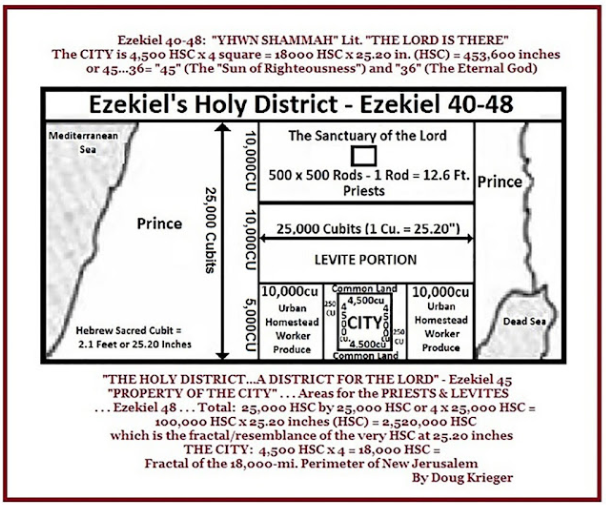
6 “‘And ye shall appoint as the possession of the city five thousand broad, and five and twenty thousand long, opposite the oblation of the holy portion; it shall be for the whole house of Israel. — this must run parallel in length with the holy portion, though half its breadth, by which means these three portions made an exact square;
— it shall be for the whole house of Israel; that is, the two houses of Israel, including the capital city, to which all the tribes shall resort upon the solemn festivals, and shall have twelve gates, according to the number of the tribes of Israel, Ezekiel 48:31
— the Targum says,
“And the possession of the city you shall appoint: five thousand [cubits] in width and twenty-five thousand in length, alongside the holy contribution; it shall belong to the whole House of Israel.”
7 “‘And a portion shall be for the Prince on the one side and on the other side of the oblation of the holy portion and of the possession of the city, before the oblation of the holy portion, and before the possession of the city, from the west side westward and from the east side eastward; and the length shall be over against one of the portions, from the west border unto the east border.
— and a portion shall be for the prince; meaning the Prince (nā·śî), he could be the Prince Messiah, see Ezekiel 44:3; but this prince could be another being:
— and from the Message Bible
“The prince gets the land abutting the seven-mile east and west borders of the central sacred square, extending eastward toward the Jordan and westward toward the Mediterranean. This is the prince’s possession in Israel.
My princes will no longer bully my people, running roughshod over them. They’ll respect the land as it has been allotted to the tribes. Ezekiel 45:7-8 MSG
— the Targum says,
“And for the Prince, [there shall be a portion] on this side and on that side of the holy contribution and the possession of the city; alongside the holy contribution and the possession of the city, from the west side westward, and from the east side eastward; and the length shall correspond to one of the [tribal] portions, from the west border to the east border.”
8 In the land shall be his possession in Israel; and My princes shall no more oppress My people, and the rest of the land shall they give to the house of Israel according to their tribes.
— my princes; plural; one possibility is that the language my is indicative of possession, as Jonathan renders: This land shall be for the prince as a possession; but as in Ezekiel 45:9 “princes of Israel;” it is plural!
— another possibility is that this Prince (and / or with other princes) is yet to be identified, so the mystery remains;
— the Targum says,
“This land shall be for the Prince as a possession in Israel; and My Princes shall no more oppress My people; and the [rest of the] land they shall give to the house of Israel according to their tribes.”
9 “‘Thus saith the Lord God: Let it suffice you, O princes of Israel. Remove violence and spoil, and execute judgement and justice. Take away your exactions from My people, saith the Lord God. — duties of princes are to execute judgement and justice;
— again “princes” in the plural, could these be the progeny of the Prince? If so, then the Prince wouldn’t be the Messiah as Yeshua never married? Unless, he was made or allowed to marry; so the Mystery remains;
— execute judgement; judge righteously, and look at the sentences executed, (1) exile into Babylon, (2) Jerusalem in inferno in AD70; why were they sent into exile in the first place? and relief of the oppressed; those that cried out for forgiveness and forgiveness;
— the Targum says,
“Thus says the Lord God: ‘Enough for you, O princes of Israel! Remove violence and spoil, and execute judgment and justice; take away your exactions (evictions) from My people,’ says the Lord God.”
10 “‘Ye shall have just balances, and a just ephah, and a just bath. — and a just ephah, and a just bath; and not make the ephah small, and the shekel great, and falsifying the balances by deceit, as some did, Amos 8:5
— the Targum says,
“You shall have just balances, and a just ephah (dry measure), and a just bath (liquid measure).”
11 The ephah and the bath shall be of one measure, that the bath may contain a tenth part of a homer, and the ephah a tenth part of a homer; the measure thereof shall be according to the homer.
— the Targum says,
“The Ephah and the Bath shall be of one measure, that the Bath may contain the tenth part of a Kor, and the Ephah the tenth part of a Kor; the standard thereof shall be according to the Kor.”
12 And the shekel shall be twenty gerahs; twenty shekels, five and twenty shekels, fifteen shekels shall be your maneh. — the standard weights were lost when the Chaldeans destroyed the Temple and the people exiled, here God will revive the same measurements as used before;
— the Targum says,
“And the Sela (Shekel) shall be twenty Ma’in (Gerahs); twenty Selas, twenty-five Selas, and fifteen Selas shall be your Maneh (totaling sixty); the Great Maneh of the Sanctuary shall be for you.”
13 “‘This is the oblation that ye shall offer: a sixth part of an ephah of a homer of wheat, and ye shall give a sixth part of an ephah of a homer of barley.
— the oblation; Ezekiel 45:13-16 provide for a regular tithe (no, not a tenth; but “one lamb out of the flock of two hundred” v15) to be paid to the Prince, in order that he may be able to furnish the required offerings at the sanctuary;
— this, like the oblation of land (Ezekiel 45:1), is described as a “heave offering,” and was the sixtieth part of the grain, the hundredth of the oil, and the two-hundredth of the flock, all being from the year’s increase;
— the Targum says,
“This is the contribution that you shall set apart: a sixth part of an Ephah from a Kor of wheat, and a sixth part of an Ephah from a Kor of barley.”
14 Concerning the ordinance of oil, the bath of oil, ye shall offer a tenth part of a bath out of the cor, which is a homer of ten baths; for ten baths are a homer.
— and from the Message Bible
“‘These are the prescribed offerings you are to supply: one-sixtieth part of your wheat, one-sixtieth part of your barley, one-hundredth part of your oil, one sheep out of every two hundred from the lush pastures of Israel. These will be used for the grain offerings, burnt offerings, and peace offerings for making the atonement sacrifices for the people. Decree of God, the Master. Ezekiel 45:13-15 MSG
— the Targum says,
“And the set portion of oil, of the bath of oil, shall be the tithe (tenth) of a bath out of the Kor; for ten baths are a Kor.”
15 And one lamb out of the flock of two hundred, out of the fat pastures of Israel, for a meat offering and for a burnt offering and for peace offerings, to make reconciliation for them, saith the Lord God.
— for a meat offering, and for a burnt offering, and for peace offerings; not that the lamb was given for all these; but the wheat and the oil for the meat offering, and the lamb for the burnt offering and peace offerings;
— the Targum says,
“And one lamb out of the flock, out of two hundred, from the well-watered pastures (the fatlings) of Israel, for a meal-offering, and for a burnt-offering, and for peace-offerings, to make atonement for them, says the Lord God.”
16 All the people of the land shall give this oblation for the prince in Israel. — this oblation is for the Prince in Israel; perhaps not the high priest, but, perhaps, for the Prince Messiah; or to another yet-to-be identified Prince?
— not a tenth; but “one lamb out of the flock of two hundred” from all Israel to be paid to the Prince; it seems like this Prince is to be treated very differently from the high priest; and he was given a separate portion of the land different from that of the priests and the Levites;
— the Targum says,
“All the people of the land shall be responsible for this contribution to the Prince in Israel.”
17 And it shall be the prince’s part to give burnt offerings and meat offerings and drink offerings, in the feasts and in the new moons and in the Sabbaths, in all solemnities of the house of Israel. He shall prepare the sin offering and the meat offering and the burnt offering and the peace offerings to make reconciliation for the house of Israel.
— “He shall prepare the sin offering” but is he, the Prince, going to act as a high priest to offer it? and it shall be the Prince’s part to give burnt offerings; or “upon the Prince shall be the burnt offerings” made; if he is the Son it is his overseeing duty to oversee the various offerings for the Father;
— the Temple is “my Father house,” Jesus said. He, the Son, never claim the Temple is his house; hence it follows that it was the Father who said this, “For my house will be called a house of prayer for all nations,” Isaiah 56:7. And the Son acknowledged, “In My Father’s house are many mansions,” John 14:2;
— during the feasts, the new moons and the Sabbaths and in all solemnities of the house of Israel; in the Feasts of the Passover, Pentecost and Tabernacle would all be prominent features of the Millennium;
— and the “new moons” and “Sabbaths” and “solemn days” are OT phrases reinstating these festivals as the main features of the Millennium; see Isaiah 66:23;
— the Targum says,
“And it shall be the Prince’s duty to provide the burnt-offerings, the meal-offerings, and the drink-offerings, at the feasts, the new moons, and the Sabbaths, in all the appointed times of the house of Israel; he shall prepare the sin-offering, the meal-offering, the burnt-offering, and the peace-offerings, to make atonement for the house of Israel.”
18 “‘Thus saith the Lord God: In the first month, on the first day of the month, thou shalt take a young bullock without blemish and cleanse the sanctuary.
— perhaps, in preparation for the Passover, there would be ashes from the red heifer to cleanse the sanctuary; that by this, according to the law, the Temple might be cleansed;
— the Targum says,
“Thus says the Lord God: ‘In the first month, on the first day of the month, you shall take a young bull without blemish, and you shall purify the Sanctuary.'”
19 And the priest shall take of the blood of the sin offering, and put it upon the posts of the house and upon the four corners of the ledge of the altar and upon the posts of the gate of the inner court.
— only after the Temple were cleansed, verse 18 above, were any sin offering allowed to be offered;
— the Q is, is this priest the same personage as the Prince in verse 17 above? Or are they separate beings?
— and the priest, not the Prince, shall take of the blood of the sin offering; an emblem of the blood of Christ, who was made sin for his people, and an offering for their sin; and which blood cleanses from all sin:
— and the priest, again not the Prince, shall put it upon the posts of the house; of the house of God, the Temple; which stood at the entrance;
— the Targum says, “upon the threshold of the house:” and upon the four corners of the settle of the altar; or four horns of it;
“And the Priest shall take of the blood of the sin-offering, and put it upon the doorposts of the House, and upon the four corners of the ledge of the Altar, and upon the doorposts of the gate of the inner court.”
20 And so thou shalt do the seventh day of the month for every one that erreth, and for him that is simple; so shall ye reconcile the house. — and for anyone “that erreth” that sinned thoughtlessly rather than wilfully, shall you do on seven days in the month:
— and so shall you do the seventh days of the month, and so too he says above (Ezekiel 43:26): “For seven days shall they purge the altar and purify it, and they shall consecrate themselves;”
— the Targum says,
“And so you shall do on the seventh day of the month for anyone who sins through error or ignorance; so shall you make atonement for the House.”
21 “‘In the first month, on the fourteenth day of the month, ye shall have the Passover, a feast of seven days. Unleavened bread shall be eaten. — this is a reinstatement of the Passover, that is, Passover would be an important feature in God’s calendar, a hybrid feastival with the Days of unleavened bread, “a feast of seven days;”
— in other words, the Passover and the Feast of Unleavened Bread, a feast of or weeks of days, are a composite Feast and is used interchangeably in Deuteronomy 16:6 as well as throughout the New Testament era! To understand it differently is just being misguided;
— the Targum confirms the hybrid nature of the Feast, saying,
“In the month of Nisan, on the fourteenth day of the month, you shall have the Passover; a feast of seven days, in which unleavened bread shall be eaten.”
And belowe are some strong rebukes for these dumb and deaf shepherd from the Scriptures:
“Hear, ye deaf; and look, ye blind, that ye may see” Isaiah 42:18
“His watchmen are blind; they are all ignorant; they are all dumb dogs, they cannot bark, sleeping, lying down, loving to slumber” Isaiah 56:10
22 And upon that day shall the prince prepare for himself and for all the people of the land a bullock for a sin offering. — shall the Prince prepare for himself, and for all the people of the land, a bullock for a sin offering; here everything again is made new; but who is this Prince?
— if this Prince is king David (Ezekiel 37:25 forever), he would be a spiritual being, not subject to sin, but why would he still need to make a sin offering for himself?
— according to the law of Moses; every family was to prepare a lamb for themselves; but here the Prince is to prepare for himself, and all the people of the land; by that it was to be a lamb, but here it is a bullock;
— and that for a sin offering; whereas during Exodus, but a goat, not a bullock as used here for a sin offering. So what is the significance of these changes? Perhaps people are more affluent during the Millennium;
— the Targum confirms the change, saying,
“And upon that day shall the Prince prepare for himself and for all the people of the land a bullock for a sin-offering.”
23 And seven days of the feast he shall prepare a burnt offering to the Lord, seven bullocks and seven rams without blemish daily the seven days, and a kid of the goats daily for a sin offering. — still on the seven-day Passover,
— the sin offering by the Mosaic law (Numbers 28:17; 22) was to be a he-goat for each day; here, seven bullock and seven rams everyday for burnt offering, and a he-goat everyday for a sin offering;
— prepare “the sin offering” but again, is the Prince going to offer it?
— forty-nine of each kind of sacrifices in the space of the seven days, and ninety-eight ephahs and as many hins with them: a great and costly service during the Millennium, which God had foreseen, his people could well afford;
— the Targum says,
“And for the seven days of the feast he shall prepare a burnt-offering before the Lord: seven bulls and seven rams without blemish daily for the seven days; and a he-goat for a sin-offering daily.”
24 And he shall prepare a meat offering of an ephah for a bullock, and an ephah for a ram, and a hin of oil for an ephah. — and he, the Prince, shall prepare the various offerings;
— the Targum says,
“And he shall prepare a meal-offering: an Ephah for each bull, and an Ephah for each ram, and a Hin of oil for every Ephah.”
25 In the seventh month, on the fifteenth day of the month, shall he do the like at the feast of the seven days, according to the sin offering, according to the burnt offering, and according to the meat offering, and according to the oil.
— shall he, that is, the Prince, shall he prepare to do the feast of the seven days, the Feast of Tabernacles, and numerous offerings; the month Tisri, the fifteenth, or the Feast of Sukkot, without naming it, is again being celebrate during the Millennium;
— instead of one ram and seven lambs for the daily burnt offering as was in the law of Moses, here again during the Millennium, there would be seven bullocks and seven rams, “like as the feast of the seven days,” that is, as the seven days during the Passover week, verses 21-23;
— the Targum says,
“In the seventh month, on the fifteenth day of the month, during the Feast, he shall do the like for seven days: according to the sin-offering, according to the burnt-offering, and according to the meal-offering, and according to the oil.”
Ezekiel 46
During the Millennium, the Sabbaths (plural), both weekly and annual, will be restored.
“Moreover also I gave them My Sabbaths to be a sign between Me and them, that they might know that I am the Lord who sanctify them,” Ezekiel 20:12.
Notwithstanding, the children rebelled against Me. They walked not in My statutes, neither kept My judgments to do them, which if a man do, he shall even live in them; they polluted My Sabbaths. “‘Then I said I would pour out My fury upon them to accomplish My anger against them in the wilderness. Ezekiel 20:21
The Sabbath/s are mentioned four times in this chapter alone, signifying its importance.
1 “‘Thus saith the Lord God: The gate of the inner court that looketh toward the east shall be shut the six working days, but on the Sabbath it shall be opened, and on the day of the new moon it shall be opened. — during the Millennium, there would be six working days;
— but on the Sabbath; on that holy rest the prospect into the Temple and to the altar shall be free and be opened; the priests should open it. The new moon festival is named and all the rest are included: this gate was to be opened on all holy days, which were days of holy service to God; but shut only on working days; but why is this so?
— the Targum says,
“Thus says the Lord God: The gate of the inner court that faces east shall be shut during the six working days; but on the Sabbath day it shall be opened, and on the day of the New Moon it shall be opened.”
2 And the prince shall enter by the way of the porch of that gate outside and shall stand by the post of the gate, and the priests shall prepare his burnt offering and his peace offerings, and he shall worship at the threshold of the gate. Then he shall go forth, but the gate shall not be shut until the evening.
— and the Prince (ha·nā·śî), King David or the Messiah perhaps; shall enter the sanctuary by the east gate of the outer court, pass through that court to the inner gate, and oversee the “worship at the threshold of the gate” immediately adjoining the inner court;
— while the priests make ready their sacrifices, but he, the Prince, is not to enter the inner court, or to assume any priestly functions; how could he be a priest in the order of Melchizedek if he doesn’t perform any priestly duties? (Psalm 110:4). Afterwards he is to go forth by the same way (Ezekiel 46:8, and Ezekiel 44:3), and stands “by the post of the gate” which is open until evening, though no one else is to enter thereby;
— speaking of the Son of God as a priest:
The Lord hath sworn and will not repent: “Thou art a priest for ever, after the order of Melchizedek” Psalm 110:4
— again, the Q is, is this Prince the Messiah, Melchizedek or is he another yet-to-be identified Prince?
— the Targum says,
“And the Prince shall enter by the way of the porch of the gate from without, and shall stand by the post of the gate, and the priests shall prepare his burnt-offering and his peace-offerings, and he shall worship at the threshold of the gate; then he shall go forth; but the gate shall not be shut until the evening.”
3 Likewise the people of the land shall worship at the door of this gate before the Lord on the Sabbaths and on the new moons. — this seems to be the restitution of all things as the Prince enters by the way of the porch of that gate outside;
— the Prince shall go through the outer gate of the eastern gate, even the outermost gate of the porch and so pass to the inner gate, where he would oversee the whole sacrificial service performed at the altar;
— on the Sabbaths, plurals, both weekly and annually, and on the new moons; these observance would be strictly carried out. These commandments were poorly observed throughout history, now these are to be observed correctly, with the Prince overseeing everything is done correctly; the beginning of the restitution of all things;
— could he be another appointed leader: King David, their Prince, according to
23 And I will set up one Shepherd over them, and He shall feed them, even My servant David. He shall feed them, and He shall be their Shepherd.
24 And I, the Lord, will be their God, and My servant David a prince among them. I, the Lord, have spoken it.
25 “‘And I will make with them a covenant of peace, and will cause the evil beasts to cease out of the land; and they shall dwell safely in the wilderness and sleep in the woods. Ezekiel 34:23-25?
“And they shall dwell in the land that I have given unto Jacob My servant, wherein your fathers have dwelt; and they shall dwell therein, even they and their children and their children’s children for ever. And My servant David shall be their Prince for ever.” Ezekiel 37:25
— the Targum says,
“And the people of the land shall worship at the entrance of that gate on the Sabbaths and on the New Moons before the Lord.”
4 And the burnt offering that the prince shall offer unto the Lord on the Sabbath day shall be six lambs without blemish and a ram without blemish. — six lambs . . . and a ram; the burnt offering for the Sabbath, according to the Mosaic law (Numbers 28:9), was two lambs;
— this is greatly increased here, and the “meat offering” for the ram is also made larger, while that for the lambs (Ezekiel 46:5) is left to the Prince’s generosity;
— the Targum says,
“And the burnt-offering that the Prince shall offer unto the Lord on the Sabbath day shall be six lambs without blemish and one ram without blemish.”
5 And the meat offering shall be an ephah for a ram, and the meat offering for the lambs as he shall be able to give, and a hin of oil to an ephah.
— the Targum says,
“And the meal-offering shall be an Ephah for the ram, and for the lambs a meal-offering as much as his hand can give, and a Hin of oil for every Ephah.”
6 And on the day of the new moon it shall be a young bullock without blemish and six lambs and a ram; they shall be without blemish.
— a young bullock and six lambs, and a ram; the law required for the new moons, for a burnt offering, two bullocks, seven lambs, and a ram (Numbers 28:11), so that this sacrifice is here diminished; it also required a he-goat for a sin offering, of which no mention is made here;
— the Targum says,
“And on the day of the New Moon, it shall be a young bull without blemish, and six lambs, and a ram; they shall be without blemish.”
7 And he shall prepare a meat offering: an ephah for a bullock, and an ephah for a ram, and for the lambs according as his hand shall attain unto, and a hin of oil to an ephah.
— the Targum says,
“And he shall prepare a meal-offering: an Ephah for the bull, and an Ephah for the ram, and for the lambs as much as his hand can give, and a Hin of oil for every Ephah.”
8 And when the prince shall enter, he shall go in by the way of the porch of that gate, and he shall go forth by the way thereof. — while the priests make ready their sacrifices, the Prince, or the Messiah, or Melchizedek, or King David, shall continue to oversee their performances;
— or by another yet-to-be identified Prince? If so, who would he be? A seed from the house of Zadok; or a seed of the house of David?
— the Targum says,
“And when the Prince enters, he shall enter by the way of the porch of the gate, and he shall go out by the same way.”
9 “‘But when the people of the land shall come before the Lord at the solemn feasts, he that entereth in by the way of the North Gate to worship shall go out by the way of the South Gate, and he that entereth by the way of the South Gate shall go forth by the way of the North gate; he shall not return by the way of the gate whereby he came in, but shall go forth opposite it.
— when the people of the land shall come; these are people from the nations, the Gentiles;
— he, the people of the nations, that entereth in by the way of the north gate to worship shall go out by the way of the south gate; and he that entereth in by the way of the south gate shall go forth by the way of the north gate; that so such as were coming in, and going out, might not meet, and stop and hinder one another in going out and coming in:
— no mention is made of entering in by the east gate, which was only for the Prince in Ezekiel 44:1, and there was no entering in, or going out, on the west;
— the Targum says,
“And when the people of the land come to worship before the Lord at the appointed feasts: he who enters by the way of the North Gate to worship shall go out by the way of the South Gate; and he who enters by the way of the South Gate shall go out by the way of the North Gate. He shall not return by the way of the gate by which he entered, but shall go out straight ahead.”
10 And the prince in the midst of them, when they go in, shall go in, and when they go forth, shall go forth. — the Prince: the Son, the Messiah, or Melchizedek, or King David, or another mysterious yet-to-be identified Prince in the midst;
— not isolated as at other times, but joining the great throng of worshippers; the Prince and people must meet together at the time for the morning or evening sacrifice, be ready to present their prayers to the Father;
— the Targum says,
“And the Prince, in the midst of them, when they enter, he shall enter; and when they go forth, they shall go forth [together].”
11 “‘And at the feasts and at the solemnities, the meat offering shall be an ephah to a bullock and an ephah to a ram, and to the lambs as he is able to give, and a hin of oil to an ephah.
— the Targum says,
“And in the feasts and in the appointed seasons, the meal-offering shall be an Ephah for a bull, and an Ephah for a ram, and for the lambs as much as his hand can give, and a Hin of oil for every Ephah.”
12 Now when the prince shall prepare a voluntary burnt offering, or peace offerings voluntarily unto the Lord, one shall then open him the gate that looketh toward the east; and he shall prepare his burnt offering and his peace offerings as he did on the Sabbath day. Then he shall go forth, and after his going forth one shall shut the gate.
— now when the Prince shall prepare a voluntary offering; the foregoing verses gave directions about the sacrifices the Prince was enjoined to offer upon solemn days; this gives directions concerning his free-will, or voluntary offerings;
— note that it is only a voluntary burnt offering, or peace offerings, but not a sin offering; perhaps, because the Son (if he is the Prince) never sinned; or could another yet-to-be identified Prince sinned?
— upon these occasions the eastern gate was to be opened for the Prince; but then, as soon as the service was over, and he was gone out, the gate was to be shut, indicating he is no ordinary personage;
— the Targum says,
“And when the Prince shall prepare a free-will offering, a burnt-offering or peace-offerings as a free-will offering unto the Lord, the gate that faces east shall be opened for him; and he shall prepare his burnt-offering and his peace-offerings as he does on the Sabbath day; then he shall go forth, and after his going forth, the gate shall be shut.”
13 “‘Thou shalt daily prepare a burnt offering unto the Lord of a lamb of the first year without blemish; thou shalt prepare it every morning. — and a yearling lamb without blemish shalt thou prepare as a burnt-offering daily for the Father every morning or, “morning by morning” shalt thou prepare it;
— the Mosaic law required such a lamb both morning and evening (Numbers 28:3-4); here it omits the evening sacrifice, but increases the meat-offering to the sixth of an ephah of meal and the third of a hin of oil, against the tenth of an ephah of meal and the fourth of a hin of oil prescribed by the Mosaic law;
— the Targum says,
“And you shall prepare a lamb of the first year without blemish for a burnt-offering daily unto the Lord; morning by morning you shall prepare it.”
14 And thou shalt prepare a meat offering for it every morning, a sixth part of an ephah and a third part of a hin of oil to temper with the fine flour — a meat offering continually by a perpetual ordinance unto the Lord.
— the repeated emphasizing of “every morning” shows that the silence as to the evening sacrifice is not a mere oversight of the matter, but perhaps, that in the new order of worship the evening sacrifice is to be omitted;
— the Targum says,
“And you shall prepare a meal-offering with it morning by morning: one-sixth of an Ephah, and the third part of a Hin of oil, to moisten the fine flour; a meal-offering unto the Lord, an eternal statute continually.”
15 Thus shall they prepare the lamb and the meat offering and the oil every morning for a continual burnt offering. — “every morning” or “morning by morning”
— again, no mention is made of the evening sacrifice; while some think is included in the morning burnt offering, others think that the true reason is that Christ has appeared once in the evening of the world, and offered up himself; yea, it was literally in the evening, whereby he offered himself a type of the Passover lamb; hence no evening sacrifice is further needed;
— the Targum says,
“Thus shall they prepare the lamb, and the meal-offering, and the oil, morning by morning, for a continual burnt-offering.”
16 “‘Thus saith the Lord God: If the prince give a gift unto any of his sons, the inheritance thereof shall be his sons’; it shall be their possession by inheritance. — if the Prince is the Messiah Jesus, the Son, then this verse has problem, as Yeshua was known not to have any children; so with Melchizedek; both having no descent;
— for this Melchizedek, priest of the Most High God, met Abraham, who was returning from the slaughter of the kings, and blessed him; without father, without mother and without descent, having neither beginning of days nor end of life, but made like unto the Son of God, he abideth a priest continually. Hebrew 7:1,3; so it seems he could not be Melchizedek;
— so maybe King David, what do you think? or to another yet-to-be identified Prince? He would be mortal, since he’s going to have sons, and children, and wife? If this is the case, he wouldn’t be either the Son, the Messiah, nor Melchizedek!!
— the Targum says,
“But if he gives a gift of his inheritance to one of his servants, it shall be his until the year of liberty; then it shall return to the Prince. But as for his inheritance, it shall belong to his sons; it is theirs.”
17 But if he give a gift of his inheritance to one of his servants, then it shall be his to the year of liberty; afterward it shall return to the prince. But his inheritance shall be his sons’ for them.
— whatever lands of the prince are given to servants, by gift, shall at the year of jubilee revert to the sons of the Prince, who shall repossess them, forasmuch as they are lands of inheritance, and of right belong to the heir;
— the Targum says,
“But if he gives a gift of his inheritance to one of his servants, it shall be his until the Year of Jubilee; then it shall return to the Prince. But as for his inheritance, it belongs to his sons; it shall be theirs.”
18 Moreover the prince shall not take of the people’s inheritance by oppression to thrust them out of their possession; but he shall give his sons inheritance out of his own possession, that My people be not scattered every man from his possession.’”
— the Prince seems to be mortal, and chances increases for him to be a seed of Zadok or of David increases; but his land allotment is set away from other priests; on this point the weight goes to a seed of King David; but still the mystery remains.
— see parallel Scriptures in Jeremiah:
8 “‘For it shall come to pass in that day,’ saith the Lord of hosts, ‘that I will break his yoke from off thy neck, and will burst thy bonds, and strangers shall no more be served by him.
9 But they shall serve the Lord their God, and David their king, whom I will raise up unto them. Jeremiah 30:8-9
— the Targum says,
“And the Prince shall not take of the people’s inheritance, to evict them by force from their possession; out of his own inheritance he shall give an inheritance to his sons, so that My people be not scattered every man from his possession.”
19 After that he brought me through the entry, which was at the side of the gate, into the holy chambers of the priests which looked toward the north; and behold, there was a place on the two sides westward.
— “the holy chambers of the priests” is where the priests shall boil the trespass offering, and the sin offering; this was the priests’ kitchen, in which they prepared the sacrifices that were to be eaten;
— the Targum says,
“Then he brought me through the entry, which was at the side of the gate, into the holy chambers of the priests, which faced north; and behold, there was a place on the western side at the far end.”
20 Then said he unto me, “This is the place where the priests shall boil the trespass offering and the sin offering, where they shall bake the meat offering, that they bear them not out into the outer court, to sanctify the people.”
— shall boil . . . shall bake; the flesh of all sacrifices except the Passover was by the law required to be boiled, and the unbloody “meat offering,” when not already cooked, was to be baked;
— the Targum says,
“And he said to me: This is the place where the priests shall boil the guilt-offering and the sin-offering, and where they shall bake the meal-offering; so as not to bring them out into the outer court, to mingle with the people.”
21 Then he brought me forth into the outer court and caused me to pass by the four corners of the court; and behold, in every corner of the court there was a court. — behold, there was a court at every corner, where the side walls met in right angles, there was another little court;
— the Targum says,
“Then he brought me forth into the outer court, and caused me to pass by the four corners of the court; and behold, in every corner of the court there was a [small] court.”
22 In the four corners of the court there were courts joined of forty cubits long and thirty broad. These four corners were of one measure. — of forty cubits long, and thirty broad; an oblong quadrangle;
— these four corners were of the same measure; the courts that were in these four corners were of the same dimensions as to length and breadth;
— the Targum says,
“In the four corners of the court there were enclosed courts, forty cubits long and thirty broad; these four in the corners had one measure.”
23 And there was a row of building round about in them, round about the four, and it was made with boiling places under the rows round about.
— and it was made with boiling places under the rows round about; under these rows of building, chambers or sheds; or under these stone walls were furnaces, and coppers, and cauldrons, set on them, for the boiling of the sacrifices;
— the Targum says,
“And there was a row of masonry built around all four of them, and cooking places were prepared under the rows round about.”
24 Then said he unto me, “These are the places of those who boil, where the ministers of the house shall boil the sacrifice of the people.”
— the “ministers” are the subordinate officials, the Levites; where the ministers of the house shall boil the sacrifice of the people; these seem to be the Levites, as distinct from the priests mentioned before; though in this prophecy they are both used of the same persons;
— the Targum says,
“And he said to me: These are the boiling-houses (the kitchens), where the servants of the House shall boil the sacrifices of the people.”
~~~~~~~
So who is the Prince?
Seems like God’s appointed leader: King David, their Prince, has a very strong case.
Below are the Pros:
23 And I will set up one Shepherd over them, and He shall feed them, even My servant David. He shall feed them, and He shall be their Shepherd.
24 And I, the Lord, will be their God, and My servant David a prince among them. I, the Lord, have spoken it.
25 “And I will make with them a covenant of peace, and will cause the evil beasts to cease out of the land; and they shall dwell safely in the wilderness and sleep in the woods” Ezekiel 34:23-25
“And they shall dwell in the land that I have given unto Jacob My servant, wherein your fathers have dwelt; and they shall dwell therein, even they and their children and their children’s children for ever. And My servant David shall be their Prince for ever.” Ezekiel 37:25
And below are the Cons:
And his duties as a Prince are to get the sacrifices ready, then at the Temple, the Levites, the priests and high priest are to take over with the actually sacrificing:
Ezekiel 45:21 “‘In the first month, on the fourteenth day of the month, ye shall have the Passover, a feast of seven days. Unleavened bread shall be eaten. — this is the Passover, that is, Passover will be reinstated, “a feast of a full week,” as in Deuteronomy 16:6
22 And upon that day shall the prince prepare for himself and for all the people of the land a bullock for a sin offering. — shall the Prince prepare for himself, and for all the people of the land, a bullock for a sin offering; here everything again is renew;
— according to the Levitical laws of God conveyed down through Moses; every family was to prepare a lamb for themselves for a sin offering; but here the Prince is to prepare for himself, too, and if he is a resurrected being, “their Prince for ever,” he would be sinless; so why would he still need to prepare himself for a sin offering?
— perhaps a resurrected being could still sin, such as sins of neglect and those of minor vigours, for anyone “that erreth” that sinned thoughtlessly rather than wilfully; or who sins through error or ignorance; and just as spirit angels could sin; perhaps resurrected being like king David could still sin, perhaps, perhaps;
— prepare “the sin offering” but again, sin offering being offered in Levitical times was a foreshadowing of Christ’s death, but here, perhaps, it would be offered as a memorial;
— shall he, that is, the Prince, shall make available all the animals needed for the feast of seven days, and other offerings; the month Tisri, the fifteenth, the Feast of Tabernacles is again described here; King David would not be allowed to offer sacrifice, as he was from the tribe of Judah; only those of the tribe of Levi could offer sacrifices,
— instead of one ram and seven lambs for the daily burnt offering as was in the Levitical law, here again during the Millennium, there would be seven bullocks and seven rams, “like as the feast of the seven days,” that is, as the seven days during the Passover week.
This ties in with God’s calling of Israel during the Exodus
And ye shall be unto Me a kingdom of priests and a holy nation. These are the words which thou shalt speak unto the children of Israel Exodus 19:6
Perhaps, the Targum below interpretes it this way: Israel would be a holy kingdom, with crowned kings, and King David, “their Prince for ever,” would head them all
And before Me you shall be crowned kings, and sanctified priests, and a holy people. These are the words thou shalt speak to the sons of Israel. Exodus 19:6 Jonathan


 A Prophecy of Esau and Jacob