
Iran to Acquire China’s CM-302 Supersonic Missiles
Since the United States has approved a $11.15 billion sale (December 18, 2025) of weapons to Taiwan under the $40 billion defense budget announced by Taipei’s Lai Ching-te in November 2025, Beijing feels compelled to allow Iran to acquire its CM-302 Supersonic Missiles as US “Massive Armada” enters the Persian Gulf region.
It is Beijing’s Strategic Balance to keep the USS Abraham Lincoln in suspense in the Strait of Hormuz or the Gulf of Oman instead of in the South China Sea or anywhere around the Western Pacific. But in a statement to Reuters, China’s Ministry of Foreign Affairs claims it did not know of any talks to sell missiles to Iran.
The CM-302 could arm with a 500-kilogram warhead is the export version of YJ-12 missiles. Their maximum speed is estimated from Mach 2.5 to 4 with a range of 400-460 kilometers. Another in the series is the YJ-18, YJ-100; then comes the more advance DF-17, DF-27, DF-31, DF-41, all could be modified to an export version should Washington continues its weapon sale to Taiwan.
The US package to Taiwan, the biggest on record as per Reuters, comprises 82 HIMARS rocket artillery systems and related equipment worth $4.05 billion, including 420 ATACMS missiles with a range of up to 300 kilometers, as well as unmanned surveillance systems and military software.
It also includes 60 M109A7 self-propelled howitzer systems and related equipment worth more than $4 billion, as well as Javelin and TOW antitank missiles worth more than $700 million. [Total $11.15 billion]
(And dated March 13, 2026, another $14 billion including interceptor missiles from the Patriot PAC-3 and the NASAMS air defence system; and other high-speed ballistic missiles and large-scale drone swarms)
DefenceSecurityAsia • February 26, 2026 ~ GlobalSecurity CNBC SCMP
Tehran’s reported move to field Mach-4 anti-ship cruise missiles coincides with the largest US naval surge since 2003, raising escalation risks across the world’s most critical oil chokepoint.
Sources indicate that Iranian military and government officials have traveled to China to accelerate negotiations, underscoring the urgency Tehran attaches to fortifying its maritime deterrent amid what it perceives as expanding Western coercive pressure and sustained US naval forward deployment.
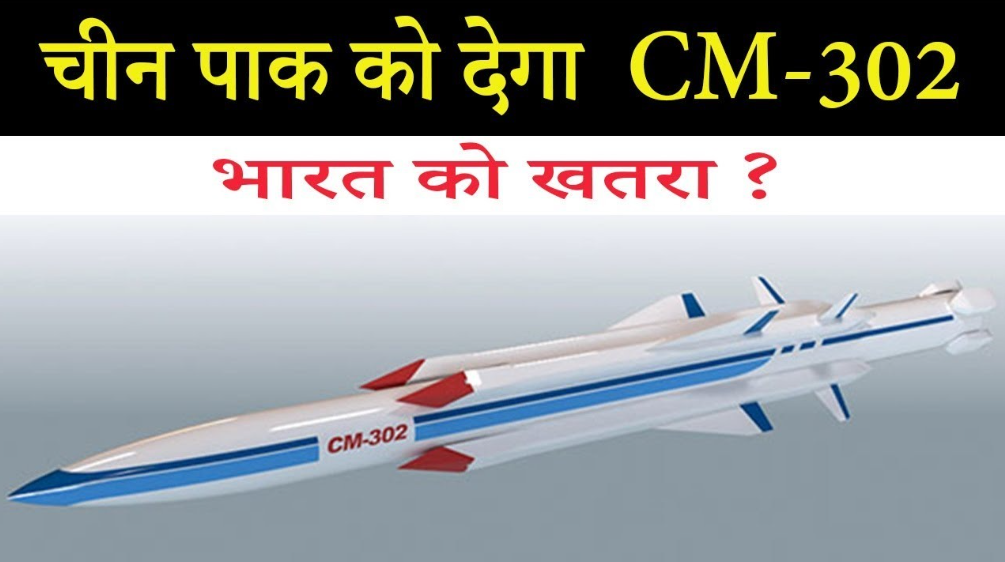
(DEFENCE SECURITY ASIA) — Iran’s reported move to finalize procurement of China’s CM-302 supersonic anti-ship cruise missiles unfolds at a moment when the United States has surged an unprecedented naval and air armada into the Persian Gulf theatre, creating a compressed escalation environment in which missile range, reaction time, and sea-control doctrine now directly intersect with nuclear diplomacy and regional deterrence signaling.
Multiple sources familiar with the negotiations indicate that Tehran and Beijing have been engaged in advanced discussions for at least two years, with talks accelerating after last year’s brief but intense Israel-Iran confrontation, a timeline suggesting that this missile acquisition is not opportunistic but structurally embedded in Iran’s long-term anti-access/area denial recalibration.
An Iranian Foreign Ministry official, speaking anonymously, framed the rationale in strategic terms, stating, “Iran has military and security agreements with its allies, and now is an appropriate time to make use of these agreements,” a formulation that implicitly situates the CM-302 procurement within a broader Eastward pivot shaped by sanctions pressure and constrained Western arms access.
President Donald Trump has simultaneously described the expanding US deployment as a “massive Armada” heading toward Iran, reinforcing that the military buildup is not merely routine force rotation but a coercive signaling mechanism linked explicitly to Tehran’s nuclear posture and previous punitive strikes on Iranian facilities.
The convergence of these two trajectories—China’s advanced supersonic missile technology potentially entering Iran’s coastal arsenal and Washington’s dual-carrier strike group presence within operational proximity—creates a volatile strategic geometry in which engagement envelopes, missile velocity, and electronic warfare resilience now determine deterrence credibility in one of the world’s most economically critical maritime chokepoints.
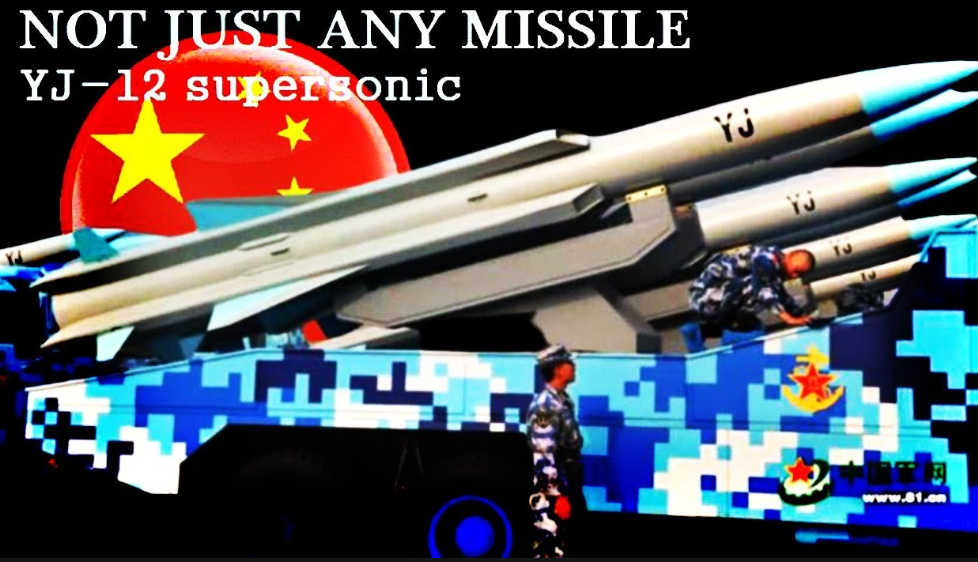
The Persian Gulf’s importance, through which roughly one-fifth of global oil shipments transit via the Strait of Hormuz, magnifies the implications of any enhancement in Iran’s anti-ship strike capacity, as even incremental reductions in reaction time for US destroyers or commercial tankers can translate into disproportionate geopolitical shockwaves across global energy markets.
The CM-302’s reported 280–290 kilometer range places launch platforms deep inside Iran’s coastline yet within striking distance of vessels operating in contested waters, altering the calculus for US surface combatants equipped with layered defenses such as the Aegis Combat System, which are optimized for multi-vector threats but are fundamentally constrained by radar horizon and engagement time compression.
If confirmed, the deal would represent one of the most technologically sophisticated Chinese weapon systems transferred to Iran, signaling not only tactical reinforcement of Tehran’s naval strike doctrine but also the maturing of a China-Iran defense axis that now intersects directly with US naval power projection architecture in the Indo-Pacific and Middle Eastern theatres.
The Reported CM-302 Procurement: Timeline, Negotiation Dynamics, and Strategic Intent
Sources indicate that Iranian military and government officials have traveled to China to accelerate negotiations, underscoring the urgency Tehran attaches to fortifying its maritime deterrent amid what it perceives as expanding Western coercive pressure and sustained US naval forward deployment.
The absence of a confirmed delivery timeline introduces uncertainty into regional threat assessments, yet the advanced stage of negotiations implies that doctrinal integration planning may already be underway within Iranian naval command structures, particularly the Islamic Revolutionary Guard Corps Navy, which prioritizes asymmetric maritime disruption.
“Woe to the crown of pride, to the drunkards of Ephraim, whose glorious beauty is a fading flower, which is on the head of the fat valleys of them that are overcome with wine!” Isaiah 28:1
“The crown of pride, the drunkards of Ephraim, shall be trodden under feet” Isaiah 28:3


 Joel
Joel A Prophecy of Esau and Jacob