
Ezekiel (Ch 41-42)
The start of the Millennium begins with the building of the Temple, known as the Ezekiel Temple. What we have here is a very detailed description of a magnificent physical Temple, somewhat loosely patterned after the Temple of Solomon, only much larger, complete with special living quarters for priests and Levites.
God declares the end from the beginning; He knows and accomplishes His eternal plan with perfect foresight and sovereignty.
Declaring the end from the beginning, and from ancient times the things that are not yet done, saying, ‘My counsel shall stand, and I will do all My pleasure,’ Isaiah 46:10.
Thus from the beginning the Lord had declared that various forms of offerings and sacrifices will be reinstated during the Millennium: included would be an elaborate system of animal sacrifices and other material offerings, along with the faithful observance of New Moons and Sabbaths, the whole picture rivaling the Book of Leviticus itself.
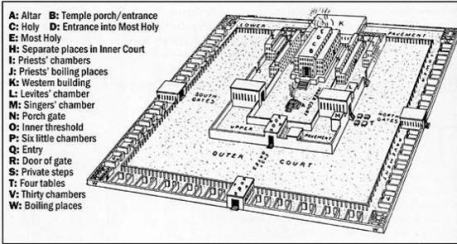
Ezekiel 41
This continues the description of the Temple from Chapter 40, where the Inner and Outer Courts—replacing the Women’s Court and the Court of the Gentiles in the Temple of Solomon—along with other details, were measured and presented.
1 Afterward he brought me to the temple and measured the posts, six cubits broad on the one side and six cubits broad on the other side, which was the breadth of the tabernacle.
— after the prophet Ezekiel had observed the courts, he (a man; one in human form; appearance of brass, a cherub? or the Son of God? Ezekiel 40:3) was brought to the Temple; the posts of six cubits broad; each cubit consisting of about one and a half foot, or eighteen inches, or one half-yard;
— the Targum says,
“And he brought me to the Sanctuary (Heichal), and he measured the posts: six cubits broad on this side and six cubits broad on that side, [which was] the breadth of the Tabernacle.”
2 And the breadth of the door was ten cubits; and the sides of the door were five cubits on the one side and five cubits on the other side; and he measured the length thereof, forty cubits, and the breadth, twenty cubits.
— the length thereof, forty cubits; these are exactly the dimensions of the holy place in Solomon’s Temple. The measurements are internal, the same as in the Temple of Solomon;
— the Targum says,
“And the breadth of the entrance was ten cubits; and the sides (shoulders) of the entrance were five cubits on this side and five cubits on that side; and he measured the length thereof, forty cubits, and the breadth, twenty cubits.”
3 Then went he inward and measured the post of the door, two cubits; and the door, six cubits; and the breadth of the door, seven cubits. — he went inside; here is a noticeable change in the usual expression; in all other cases the man or angel had brought the prophet Ezekiel to the places to be measured;
— but as he is entering the Holy of Holies, into which, under the law, Ezekiel might not enter, because the Holy of Holies was not to be entered even by a priest like Ezekiel, but only by the high priest once a year; but then again, Ezekiel was only in vision;
— the Targum says,
“Then he went inward, and measured the post of the entrance, two cubits; and the entrance, six cubits; and the breadth of the entrance [walls], seven cubits.”
4 So he measured the length thereof, twenty cubits; and the breadth, twenty cubits, before the temple. And he said unto me, “This is the Most Holy Place.” — the Holy of Holies, it was an exact square, as was Solomon’s, 1 Kings 6:20
— the Targum says,
“And he measured the length thereof, twenty cubits, and the breadth, twenty cubits, before the Sanctuary; and he said unto me: ‘This is the Holy of Holies.’“
5 After that, he measured the wall of the house, six cubits; and the breadth of every side chamber, four cubits, round about the house on every side.
— the wall of the house, six cubits, the thickness of the wall is the same with that of the wall of the outer court (Ezekiel 40:5), about ten feet. Great massiveness is characteristic of the Temple, to set forth the firmness and security of the things symbolised;
— the Targum says,
“And he measured the wall of the House, six cubits; and the breadth of the side-chamber, four cubits, all around, surrounding the House on every side.”
6 And the side chambers were three, one over another, and thirty in order; and they entered into the wall which was of the house for the side chambers round about, that they might have support, but they had no support in the wall of the house.
— there were three storeys of chambers; one above the other, and this was repeated thirty times, giving thirty chambers in each storey, or ninety in all; these chambers were exactly like those surrounding Solomon’s Temple, except that they were one cubit narrower, and the description of them is made clearer by a comparison with 1 Kings 6:5-10
— the Targum says,
“And the chambers were chamber over chamber, thirty-three; eleven in [each] row; and they were fixed into the wall which was inside for the chambers all around, so that the heads of the beams might rest upon the ledge (shelf), and the beams would not penetrate into the walls of the House.”
7 And there was an enlarging and a winding about still upward to the side chambers; for the winding about of the house went still upward round about the house. Therefore the breadth of the house was still upward, and so increased from the lowest chamber to the highest by the middle chamber.
— there was an increase in the width of each storey of the side chambers by the distance which the wall receded, as is expressly said in 1 Kings 6:6; but whether there was a corresponding recession in the thickness of the outer wall of the chambers is not stated;
— it is also plain that the side chambers surrounded the house; and that the two upper storeys were reached by a winding staircase (Ezekiel 40:44-49)
— the Targum says,
“And there was an enlargement and a winding about still upward to the chambers; for the winding of the House went upward, higher and higher all around within; therefore the breadth of the House [chambers] was greater at the top; and so from the lowest [story] one went up to the highest by way of the middle [story].”
8 I saw also the height of the house round about; the foundations of the side chambers were a full reed of six great cubits. — the Temple, as has been already said (Ezekiel 40:49), was entered by a flight of steps leading up to the porch, and the “house round and side chambers” were therefore on a lower level than the Temple;
— the Targum says,
“And I saw that the House had a height all around; the foundations of the side-chambers were the full measure of a reed, six cubits to the joint.”
9 The thickness of the wall, which was for the side chamber outside, was five cubits; and that which was left was the place of the side chambers that were within. — the thickness of the wall, which was for the side chambers without, was five cubits; this is the outward wall of the chambers, north and south, which was five cubits thick, made of stone;
— the Targum says,
“The breadth of the wall for the side-chamber on the outside was five cubits; and there was an open space (abandoned area) between the side-chambers of the House.”
10 And between the chambers was the wideness of twenty cubits round about the house on every side. — there was a space of twenty cubits between the foundation on which the chambers and the Temple stood and the wall of the court on all three sides on which the chambers extended;
— the Targum says,
“And between the chambers (cells) was a breadth of twenty cubits all around, surrounding the House on every side.”
11 And the doors of the side chambers were toward the place that was left, one door toward the north and another door toward the south; and the breadth of the place that was left was five cubits round about.
— we may now sum up the measurements of the Temple with its chambers and surrounding space. The wall, 6 cubits; the chambers, 4; their outer wall, 5; the platform beyond, 5; the space beyond this, 20 (6 + 4 + 5 + 5 + 20 = 40);
— this was on each side, and therefore is to be doubled, making 80 cubits; to this add the 20 cubits of the inner width of the Temple, and we have exactly the 100 cubits, the width of the inner court. In the same way the length: here the porch is considered as belonging to the court, and with it the front wall of the Temple, the thickness of which is included in the length of the porch;
— beginning then at the inside of the outer walls, we have the inner length of Temple, 60 cubits; rear wall, 6; chambers, 4; outer wall, 5; platform, 5; space, 20; in all, 100 cubits. thus making an exact square;
— the Targum says,
“And the doors of the side-chamber were toward the open space (walkway); one door was open toward the north, and one door was open toward the south; and the breadth of the open space was five cubits all around.”
12 Now the building fronting the separate place at the end toward the west was seventy cubits broad; and the wall of the building was five cubits thick round about and the length thereof ninety cubits.
— this building was to the west of the Temple, at which end stood the Holy of Holies, and this near to that; it was seventy cubits broad; and the length thereof ninety cubits;
— the Targum says,
“And the building that was before the separate area (Gizrah) on the side toward the west was seventy cubits broad; and the wall of the building was five cubits thick all around, and the length thereof was ninety cubits.”
13 So he measured the house, a hundred cubits long; and the separate place and the building with the walls thereof, a hundred cubits long; — the house; the whole Temple, oracle, sanctuary, and porch, with the walls;
— the length was ninety cubits, which, adding as before the thickness of the walls, gives 100 cubits in length, from north to south; the whole temple-building was 500 cubits from west to east, and from north to south, 500 cubits;
— the Targum says,
“So he measured the House (Sanctuary), one hundred cubits long; and the separate area (Gizrah), and the building, and the walls thereof, one hundred cubits long.”
14 also the breadth of the face of the house and of the separate place toward the east, a hundred cubits. — toward the east; the separate place was measured on its eastern side, for the western was not approachable for the purpose of measurement;
— the whole temple-building was 500 cubits from west to east, and from north to south, 500 cubits;
— the Targum says,
“And the breadth of the face of the House, and of the separate area (Gizrah) toward the east, was one hundred cubits.”
15 And he measured the length of the building opposite the separate place which was behind it, and the galleries thereof on the one side and on the other side, a hundred cubits, with the inner temple and the porches of the court.
— the Targum says,
“And he measured the length of the building before the separate area which was at the back of it, and its galleries (corners) on the one side and on the other side, one hundred cubits; and the inner Sanctuary, and the porches of the court.”
16 the doorposts, and the narrow windows, and the galleries round about on their three stories opposite the door, ceiled with wood round about, and from the ground up to the windows (and the windows were covered),
— the door posts and the narrow windows; of the inner Temple or the Holy of Holies; for this is what is last mentioned; of the door posts of it, see Ezekiel 41:3, in the Holy of Holies; both in Moses’s tabernacle, and Solomon’s Temple, in this inner Temple, the Holy of Holies were no windows, 1 Kings 8:12; Yehovah dwelt in thick darkness in human’s eyes;
— the Targum says,
“The thresholds, and the closed windows, and the galleries (attics) round about their three stories, opposite the threshold, were paneled with cedar wood all around, from the ground up to the windows; and the windows were covered (closed).”
17 to the space above the door, even unto the inner house and outside, and by all the wall round about within and without, by measure. — over above the door; inside and outside was “by measure.” This asserts that all the overlaying was done by careful measurement;
— the Targum says,
“Above the entrance, and even unto the inner House (Holy of Holies) and without, and on all the wall round about, within and without, were measurements [and patterns].”
18 And it was made with cherubims and palm trees, so that a palm tree was between a cherub and a cherub; and every cherub had two faces, — the cherubim are represented each with two faces, but in Ezekiel 1 and 10, they have each four faces;
— the Targum says,
“And it was carved with cherubim and palm trees; and a palm tree was between cherub and cherub; and every cherub had two faces.”
19 so that the face of a man was toward the palm tree on the one side, and the face of a young lion toward the palm tree on the other side; it was made through all the house round about. — a man’s face toward the palm on this side, and a lion’s face toward the palm on that side: thus was it made round about the whole house;
— the Targum says,
“The face of a man was [turned] toward the palm tree on this side, and the face of a lion was [turned] toward the palm tree on that side; [thus it was] carved on the whole House all around.”
20 From the ground unto above the door were cherubims and palm trees made, and on the wall of the temple. — it remains obscure whether it be the “door” of the holiest or that of the holy place to which he refers, or both;
— the Targum says,
“From the ground until above the entrance, the cherubim and palm trees were carved; and [so it was] on the wall of the Sanctuary (Heichal).”
21 The posts of the temple were squared, and also the face of the sanctuary; the appearance of the one as the appearance of the other. — the door-frames of both were square and just alike;
— the Targum says,
“The doorposts of the Sanctuary were squared; and the front of the House of Atonement (Holy of Holies), its appearance was like the appearance of its Glory.”
22 The altar of wood was three cubits high and the length thereof two cubits; and the corners thereof and the length thereof and the walls thereof were of wood. And he said unto me, “This is the table that is before the Lord.”
— the altar of burnt offering in Solomon’s Temple was of brass (II Chronicles 4:1), and in the tabernacle of shittim wood (Exodus 27:1); the altar of incense in the tabernacle (Exodus 30:1) and in Solomon’s Temple (1 Kings 7:48) was constructed of wood overlaid with gold, but in this temple only of wood;
— the altar had corners, probably somewhat raised, but may or may not look like horns;
— the Targum says,
“The Altar was of wood, three cubits high, and the length thereof two cubits; and the corners thereof, and the length thereof, and the walls thereof, were of wood; and he spoke with me: ‘This is the Table that is before the Lord.‘”
23 And the temple and the sanctuary had two doors.
24 And the doors had two leaves apiece, two turning leaves: two leaves for the one door and two leaves for the other door. — each had a double or two-leaved door; the doors of the holy place and the holiest;
— the Temple or holy place and the holiest had each a two-leaved door; and each of the leaves was again divided into two leaves;
— the Targum says,
“And the doors had two leaves apiece, two turning leaves; two [leaves] for the one door, and two leaves for the other door.”
25 And there were made on them, on the doors of the temple, cherubims and palm trees, as were made upon the walls; and there were thick planks upon the face of the porch outside. — cherubim and palm trees, like as were made on the walls; the doors of both places had the same decorations as the walls of each;
— and there were thick planks upon the face of the porch outside; on the outward front of the porch were some thick wainscot boards, which projected as a cover to the entrance into it;
— the Targum says,
“And there were carved on them, on the doors of the Sanctuary, cherubim and palm trees, just as they were carved on the walls; and there was a thick beam of wood (canopy) over the face of the Porch on the outside.”
26 And there were narrow windows and palm trees on the one side and on the other side, on the sides of the porch, and upon the side chambers of the house, and thick planks.
— it is to be observed that in these outer parts of the Temple only palm trees were used in the ornamentation, the cherubim being reserved for the holy place and the Holy of Holies;
— the description of the Temple proper is now finished, and it is noticeable how very little is said of its interior furniture and arrangements; there is no mention at all of that profuse overlaying with gold so characteristic of Solomon’s Temple; nothing is said of the candlestick, or the table of showbread; even the ark itself, that climax of Israel’s symbolic worship, is not mentioned;
— the Targum says,
“And there were closed windows and palm trees on the one side and on the other side, on the shoulders of the Porch; and [so it was with] the side-chambers of the House and the thick beams (canopies).”
Ezekiel 42
1 Then he brought me forth into the outer court, the way toward the north; and he brought me into the chamber that was opposite the separate place and which was before the building toward the north.
— then he brought me forth into the outer court; outer with respect to the Temple itself, or the outer part of the court, one replacing the Women’s Court and the Court of the Gentiles;
— the Targum says,
“Then he brought me forth into the outer court, by the way of the gate that faces toward the north; and he brought me into the chamber that was opposite the separate area (Gizrah), and which was opposite the building toward the north.”
2 Along the length of a hundred cubits was the north door, and the breadth was fifty cubits.
— he brought me “before” a row of chambers 100 cubits long, east and west. “The door” of which lay on the north side of the chambers. The priests entered from the outer court; the breadth of this block of chambers was fifty cubits, north and south Ezekiel 42:8
— the Targum says,
“Opposite the length of one hundred cubits was the north door, and the breadth was fifty cubits.”
3 Opposite the twenty cubits which were for the inner court, and opposite the pavement which was for the outer court, was gallery upon gallery in three stories.
— the Targum says,
“Opposite the twenty [cubits] which belonged to the inner court, and opposite the pavement which belonged to the outer court, was gallery (corner) against gallery in three stories.”
4 And before the chambers was a walk of ten cubits breadth inward, a way of one cubit, and their doors toward the north.
— the Targum says,
“And before the chambers was a walkway of ten cubits breadth [leading] inward, a path of one cubit; and their doors were open toward the north.”
5 Now the upper chambers were shorter; for the galleries were higher than these — than the lower and than the middlemost of the building;
— the Targum says,
“And the upper chambers were narrower (pressed); for the galleries (corners) took away from them, more than from the lower and the middle stories of the building.”
6 For they were in three stories, but had not pillars as the pillars of the courts; therefore the upper building was narrowed more than the lowest and the middlemost from the ground.
— the Targum says,
“For they were three-storied, but they had no pillars like the pillars of the [outer] courts; therefore [the upper stories] were narrowed (set back) more than the lower and the middle ones from the ground up.”
7 And the wall that was outside opposite the chambers, toward the outer court on the forepart of the chambers, the length thereof was fifty cubits.
— the Targum says,
“And the wall that was without, opposite the chambers, toward the outer court, before the chambers, its length was fifty cubits.”
8 For the length of the chambers that were in the outer court was fifty cubits; and lo, those before the temple were a hundred cubits.
— the Targum says,
“For the length of the chambers that were [facing] the outer court was fifty cubits; but behold, [the total length] facing the Sanctuary was one hundred cubits.”
9 And from under these chambers was the entry on the east side, as one goeth into them from the outer court.
— the Targum says,
“And from under these chambers was the entryway from the east, as one enters them from the outer court.”
10 The chambers were within the thickness of the wall of the court toward the east, opposite the separate place and opposite the building.
— the Targum says,
“In the breadth (thickness) of the wall of the court toward the east, facing the separate area (Gizrah) and facing the building, there were chambers.”
11 And the walk before them was like the appearance of the chambers which were toward the north, as long as they and as broad as they; and all their exits were both according to their fashions, and according to their doors.
— the Targum says,
“And the way before them was like the appearance of the chambers which were toward the north; as their length, so was their breadth, and all their exits, and according to their fashions, and according to their doors.”
12 And according to the doors of the chambers that were toward the south was a door in the head of the walk, the passage directly before the wall toward the east as one entereth into them.
— the Targum says,
“And as for the doors of the chambers that were toward the south, there was a door at the head of the path, the path facing the Levites’ platform toward the east as one enters them.”
13 Then said he unto me, “The north chambers and the south chambers, which are in front of the separate place, they are holy chambers where the priests who approach unto the Lord shall eat the most holy things. There shall they lay the most holy things, and the meat offering, and the sin offering, and the trespass offering; for the place is holy.
— the north chambers, and the south chambers; namely, those described in the foregoing part of the chapter; they be holy chambers, where the priests shall eat the most holy things;
— the showbread, the remainder of the meat-offering, sin-offering, and trespass-offering, are expressly called the most holy things, Leviticus 6:14; 6:17; established much earlier as a ”perpetual statute” as in Leviticus 24:9;
— and are distinguished from the holy things, such as the peace-offerings, first-fruits, and tithes, Leviticus 21:22. These were to be eaten within the precincts of the Temple, by the direction of Levitical law. There shall they lay the most holy things;
— these rooms were likewise set apart for laying up the remainder of the sacrifices, till they were eaten by the priests and their families, Leviticus 10:13; 22:13;
— if the Churches teach that these activities are for ritual or sacrificial laws, then why are these brought back during the Millennium? Surely false teachers abound, their shepherd and watchmen are not only misguided but blind, deaf, dumb and liars!
“A sword is upon the liars, and they shall dote! A sword is upon her mighty men, and they shall be dismayed!” Jeremiah 50:36
“Hear, ye deaf; and look, ye blind, that ye may see” Isaiah 42:18
“His watchmen are blind; they are all ignorant; they are all dumb dogs, they cannot bark, sleeping, lying down, loving to slumber” Isaiah 56:10
— the Targum says,
“Then he said to me: ‘The north chambers and the south chambers which are opposite the separate area, they are holy chambers, where the priests who approach to serve before the Lord shall eat the Most Holy [sacrifices]; there they shall place the Most Holy [items]—the meal-offering, the sin-offering, and the guilt-offering; for the place is holy.'”
14 When the priests enter therein, then shall they not go out of the holy place into the outer court; but there they shall lay their garments wherein they minister, for they are holy; and they shall put on other garments and shall approach those things which are for the people.”
— same thing with garments; when on duty, they are holy; because of the presence of God, these signify the robe of righteousness and of purity, that fine linen, clean and white, which is the righteousness of Godly people; and were to be holy, pure and spotless;
— the Targum says,
“When the priests enter, they shall not go out from the holy place into the outer court, but there they shall lay down their garments in which they minister, for they are holy; and they shall put on other garments, and [then] they shall mingle with the people.”
15 Now when he had made an end of measuring the inner house, he brought me forth toward the gate whose prospect is toward the east, and measured it round about.
— the Targum says,
“And when he had finished the measurements of the inner house, he brought me forth by way of the gate that faces toward the east, and he measured it all around.”
16 He measured the east side with the measuring reed, five hundred reeds with the measuring reed round about.
— the Targum says,
“He measured the east side with the measuring reed: five hundred reeds, with the measuring reed all around.”
17 He measured the north side, five hundred reeds with the measuring reed round about.
— the Targum says,
“He measured the north side: five hundred reeds, with the measuring reed all around.”
18 He measured the south side, five hundred reeds with the measuring reed.
— the Targum says,
“The south side he measured: five hundred reeds, with the measuring reed.”
19 He turned about to the west side and measured five hundred reeds with the measuring reed.
— the Targum says,
“He turned about to the west side, and measured five hundred reeds with the measuring reed.”
20 He measured it on the four sides; it had a wall round about, five hundred reeds long and five hundred broad, to make a separation between the sanctuary and the profane place.
— this vast enclosure on all sides was a wall, a massive wall surrounding the outer court; “to make a separation between the sanctuary and the profane place” that is, the holy places separated from that which are common or ordinary;
— the precincts; the Temple and its courts were surrounded by an area of exact dimensions 3,000 cubits (1,500 yards) square;
— the Targum says,
“By the four sides he measured it; it had a wall all around, the length five hundred and the breadth five hundred, to separate between the Holy and the Common (Profane).”


 A Prophecy of Esau and Jacob