
Ezekiel (Ch 17-18)
Chapter 17 starts with a riddle of two eagles and a vine and some mysteries along the historical footpath in the complexities of the house of Judah and the house of Israel. The best book to have expounded this riddle is “Judah’s Sceptre and Joseph’s Birthright” by J.H. Allen (1847-1930).
In summary, this chapter is a mysterious prophecy as a form of a riddle to both Judah and Israel, which shows how the planting and rebuilding of David’s throne had survived beyond the captivity.
“And the word of the Lord came unto me, saying, Son of man, put forth a riddle, and speak a parable unto the house of Israel; and say,
Thus says the Lord God; A great eagle… came unto Lebanon, and took the highest branch of the cedar: he cropped off the top of his young twigs, and carried it into a land of traffic; he set it in a city of merchants.
He took also of the seed of the land, and planted it in a fruitful field; he placed it by great waters, and set it as a willow tree. And it grew, and became a spreading vine of low stature… and shot forth sprigs” (Ezekiel 17:1-6).
An Amazing Commission—and a Breach Healed!
The great eagle at the beginning of the riddle was the king of Babylon, who took Zedekiah captive. From verse 1 to 6 it describes the destruction of Zedekiah’s Pharez lineage. The execution of his sons is the cropping off of the cedar’s young twigs. The “vine of low stature… [shooting] forth sprigs” reflects Judah’s freedom to movement while in captivity in Babylon.
The second great eagle (v7) refers to Jeremiah who took the princess from Babylon to Egypt, and later, beyond the seas to the British Isles.
This part of the prophecy pertained to the first eagle of Ezekiel’s riddle—the rooting up and tearing down of the existing throne in Judah. But within this same prophecy, the planting and building up is also addressed, which is the work of the second eagle performed by prophet Jeremiah.
Verses 22-23 go on to describe what was Jeremiah’s commission to re-establish David’s throne in another location. God says that He will take of the highest branch—the seed of King Zedekiah—and set it or plant it.
The “tender young twig” of verse 22 could be none other than one of the king’s daughters that Jeremiah took with him to plant in the British Isles. Thus, the “high mountain and eminent” depicts the nations of Israel as God knew they were destined to become, once the birthright promise was realized.
God states that it will eventually be known that it was He who brought down the high tree and exalted the low tree (v24). In light of this, notice a parallel Scripture in Isaiah:
“And the remnant that is escaped of the house of Judah shall again take root downward, and bear fruit upward” (Isaiah 37:31).
Jeremiah presented this young Hebrew princess—Tea Tephi—to the Zarah line ruling in the British Isles! Her marriage and children would continue the scepter and the dynasty promised David—and heal the breach.
Ezekiel 17
1 And the word of the Lord came unto me, saying, — the word of prophecy from the Lord, as the Targum renders it.
2 “Son of man, put forth a riddle, and speak a parable unto the house of Israel, — again, this “house of Israel” is emphasized; that in this chapter, the prophecy concerns chiefly the transferring of the “tender young twig” into the United Kingdom;
— the Targum says
“Son of man, present a riddle and speak a parable concerning the House of Israel.”
3 and say, ‘Thus saith the Lord God: A great eagle with great wings, longwinged, full of feathers which had diverse colors, came unto Lebanon and took the highest branch of the cedar.
— a great eagle; which is Nebuchadnezzar king of Babylon, as it is explained, Ezekiel 17:12; who is compared to an eagle for his power and authority, that being the king of birds, and for his swiftness and voracity in conquering and subduing kingdoms; see Jeremiah 48:40
— the Targum says
“And you shall say: Thus says the Lord God: ‘A great eagle, with great wings, with long pinions, covered with feathers of many colors, came to Lebanon and took the topmost branch of the cedar.'”
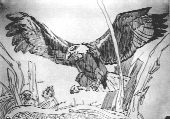
4 He cropped off the top of its young twigs and carried it into a land of traffic; he set it in a city of merchants. — young twigs mentioned, and tender ones, which are meant the princess of the land;
— the Targum says
“The head of its young twigs he plucked, and he brought it to a land that was idle from service (the land of Canaan), and before the House of Israel entered it, in a city of merchants he set it.”
5 He took also of the seed of the land and planted it in a fruitful field. He placed it by great waters and set it as a willow tree. — the seed of the land; Zedekiah, brother of Jehoiachin, and all their young twigs, their children;
— the Targum says
“And he took of the seed of the land and placed it in a good field for sowing; he set it as a plant by abundant waters, he made it a planted vine.”
6 And it [the seed] grew and became a spreading vine of low stature, whose branches turned toward him and the roots thereof were under him. So it became a vine, and brought forth branches and shot forth sprigs.
— this indicates that children were born unto them that were in captivity, but that they grew and flourished toward him; Nebuchadnezzar, to whom the Jews were tributary;
— the Targum says
“And he took of the seed of the land and placed it in a good field for sowing; he set it as a plant by abundant waters, he made it a planted vine.”
7 “‘There was also another great eagle with great wings and many feathers; and behold, this vine did bend her roots toward him and shot forth her branches toward him, that he might water it by the furrows of her planting. — there was also another great eagle, with great wings and many feathers:
— most (John Gill, Adam Clarke, etc; though J.H. Allen is indecisive or ambiguous) identify this second eagle as the Pharaoh of Egypt, but the Pharaoh never came to the land of Judea to capture the land and take the seed; and the entourage fled on their own to Egypt on foot;
— hence it seems more like whoever took Jeremiah and the king’s daughters to the British Isles fit this character of another great eagle with great wings; it remains a mystery but whoever took Jeremiah and the king’s daughters in its ship or ships, would most probably be the second eagle that flew over the great seas to transplant the tender twigs there;
— the Targum says
“And there was another great eagle, with great wings and many feathers; and behold, this vine bent its roots toward him and sent its branches toward him, that he might water it from the beds of its plantation.”
8 It was planted in a good soil by great waters, that it might bring forth branches and that it might bear fruit, that it might be a goodly vine.’ — following the trail of Tea Tephi, this would led Jeremiah and the king’s daughters to Ireland . . .
— the Targum says
“In a good field, by abundant waters, it was planted, to produce branches and to bear fruit, to become a mighty vine.”
9 Say thou, ‘Thus saith the Lord God: Shall it prosper? Shall he not pull up the roots thereof and cut off the fruit thereof, that it wither? It shall wither in all the leaves of her spring, even without great power or many people to pluck it up by the roots thereof.
— Shall it prosper? Could the tender twig not pull up the roots thereof; like the first eagle, Nebuchadnezzar, being provoked by the rebellion of the king of Judah and his people?
— a translation of the riddle of the tender twig from the Voice
Now I, the Eternal Lord, ask, will that vine continue to flourish? Won’t the [second] eagle pull it out of the lush, fertile soil by its roots, strip it of its fruit, and leave it to wither? It won’t take much strength or many people to pull it up by the roots. Ezekiel 17:9-10 Voice
— the Targum says
“Say: Thus says the Lord God: ‘Shall it prosper? Will he not cut off its roots and pluck off its fruit, and all the leaves of its growth shall wither and fall? And not with a mighty army or with many people [will they need to come] to uproot it from its roots.'”
10 Yea, behold, being planted, shall it prosper? Shall it not utterly wither when the east wind toucheth it? It shall wither in the furrows where it grew.’”
— the mystery remains whether it shall prosper? it shall not; their own strength, even with the help of the king of Egypt, perhaps will not be able to protect them from the rage of the king of Babylon;
— the Targum says
“And behold, though it is planted, shall it prosper? Will it not utterly wither as soon as the east wind touches it? In the beds of its plantation, it shall wither.”
11 Moreover the word of the Lord came unto me, saying, — again, the Lord assures Ezekiel;
12 “Say now to the rebellious house: ‘Know ye not what these things mean?’ Tell them: ‘Behold, the king of Babylon is come to Jerusalem, and hath taken the king thereof and the princes thereof, and led them with him to Babylon;
— and hath taken the king thereof, and the princes (but princess were left off here) thereof, and led them with him to Babylon; the king of Judea, and the princes of it; Jeconiah and his nobles, who had been carried captive into Babylon by Nebuchadnezzar; for Ezekiel was among these captives;
— the Targum says
“Say now to the rebellious people: ‘Do you not know what these things mean?’ Say: ‘Behold, the king of Babylon came to Jerusalem, and he took its king and its princes, and he brought them to himself to Babylon.'”
13 and hath taken of the king’s seed and made a covenant with him, and hath taken an oath from him. He hath also taken the mighty of the land, — and hath taken of the king’s seed, one of the royal family, signified by the seed of the land;
— the Targum says
“And he took of the royal seed and made a covenant with him, and brought him into an oath; and the mighty of the land he took [away].”
14 that the kingdom might be base, that it might not lift itself up, but that by keeping of his covenant it might stand. — that the king’s seed will take roots and grow, continuing a bloodline, which is a kingdom;
— the Targum says
“That the kingdom might be weak, so as not to exalt itself; to keep its covenant, so as to serve him.”
15 But he rebelled against him in sending his ambassadors into Egypt, that they might give him horses and many people. Shall he prosper? Shall he escape that doeth such things? Or shall he break the covenant and be delivered?
— but he rebelled against him; Zedekiah and his court rebelled against the king of Babylon, broke the covenant he entered into, and violated his oath;
— Zedekiah violated his oath by sending his ambassadors to Egypt; the Targum says
“But he rebelled against him by sending his ambassadors to Egypt, to give him horses and many people. Shall he prosper? Shall he escape who does these things? And he who changes (breaks) the covenant, shall he escape?”
16 As I live, saith the Lord God, surely in the place where the king dwelleth that made him king, whose oath he despised and whose covenant he broke, even with him in the midst of Babylon he shall die.
— surely in the place where the king dwelleth in Babylon, where Nebuchadnezzar dwelt, that made Zedekiah king of Judah; which is mentioned, to point out the ingratitude of Zedekiah toward the king of Babylon, but instead, send envoys to Egypt, asking for horses and an army to help him (verse 15 above);
— the Targum says
“As I live, says the Lord God, surely in the place of the king who made him king, whose oath he despised and whose covenant he changed—with him, in the midst of Babylon, he shall die.”
17 Neither shall Pharaoh with his mighty army and great company help him in the war, by casting up siege mounds and building forts to cut off many persons.
— by casting up mounts, and building forts; that is, when Nebuchadnezzar should besiege Jerusalem, and raise mounts, and build fortifications, in order to take the city, and destroy its inhabitants; as he did, Jeremiah 52:4
— the Targum says
“And not with a mighty army or with many people shall Pharaoh perform for him [a successful] battle, when [the enemy] heaps up mounds and builds siege-walls to destroy many lives.”
18 Seeing he despised the oath by breaking the covenant, when, lo, he had given his hand and hath done all these things, he shall not escape. — he shall not escape; divine vengeance, just and proper punishment for his sins;
— the Targum says
“And he despised the oath by changing (breaking) the covenant; and behold, he gave his hand to Pharaoh, and all these things he has done—he shall not escape.”
19 Therefore thus saith the Lord God: As I live, surely Mine oath that he hath despised and My covenant that he hath broken, even it will I recompense upon his own head. — even it will I recompense upon his own head; he shall personally bear the punishment due to such crimes;
— the Targum says,
“Therefore, thus says the Lord God: ‘As I live, surely My oath which he despised and My covenant which he changed (broken), I will bring the retribution of his way upon his own head.'”
20 And I will spread My net upon him, and he shall be taken in My snare, and I will bring him to Babylon and will plead with him there for his trespass that he hath trespassed against Me.
— and I will spread my net upon him, and he shall be taken in my snare; see Ezekiel 12:13; where the same expressions are used, and of the same person;
— the Targum says
“And I will spread My net over him, and he shall be caught in My snare; and I will lead him to Babylon, and I will exact punishment from him there for the falsehood which he committed against Me.”
21 And all his fugitives with all his troops shall fall by the sword, and they that remain shall be scattered toward all winds; and ye shall know that I, the Lord, have spoken it.
— shall fall by the sword; the enemy shall overtake, and cut in pieces; the few that do escape shall be scattered abroad among strangers, who will show them very little kindness;
— the Targum says
“And all his mighty men, in all his armies, shall be slain by the sword; and those who remain shall be scattered to every wind; and you shall know that I, the Lord, have decreed it by My Word.”
22 “‘Thus saith the Lord God: I will also take of the highest branch of the high cedar, and will set it; I will crop off from the top of his young twigs a tender one, and will plant it upon a high mountain and eminent (of a person famous and respected).
— the highest branch of the high cedar would be Zedekiah, king of Judah; I (through the second eagle) will crop off from the top of his young twigs a tender one (the feminine gender);
— and by the “top” and “young twigs” of the highest branch of the cedar, or of the chief tribe in Israel, are meant the royal house and family of David, and the chief of the tribe of Judah; and by the “tender one” is designed the tender gender, the daughters;
— and the Targum says,
“Thus says the Lord God: ‘And I will bring near [a ruler] from the kingdom of the House of David, which is likened to a high cedar, and I will establish him; from the children of his children, a tender one, I will increase and establish by My Word on a high and exalted mountain.'”
And the fulfilment was as followed;
Then Ishmael carried away captive all the residue of the people who were in Mizpah, even the king’s daughters and all the people that remained in Mizpah, whom Nebuzaradan the captain of the guard had committed to Gedaliah the son of Ahikam; and Ishmael the son of Nethaniah carried them away captive, and departed to go over to the Ammonites. Jeremiah 41:10
23 In the mountain of the height of Israel will I plant it; and it shall bring forth boughs and bear fruit and be a goodly cedar, and under it shall dwell all fowl of every wing; in the shadow of the branches thereof shall they dwell.
— in the mountain of the height of Israel will I plant it; in the highest part of the land of Israel, which during that time those at “the height of Israel” could well be in the British Isles (Israel in the isles of the sea, Isaiah 24:15), led by Ephraim. (Ephraim followeth after the east wind, Hosea 12:1)
— the Targum says
“On the holy mountain of Israel I will establish him; and he shall gather armies, and perform mighty deeds, and he shall be a mighty king; and all the righteous and all the humble shall rely upon him; in the shadow of his kingdom they shall dwell.”
24 And all the trees of the field shall know that I, the Lord, have brought down the high tree, have exalted the low tree, have dried up the green tree, and have made the dry tree to flourish. I, the Lord, have spoken and have done it.’”
— all the trees of the field shall know; as the cedar represents the kingdom of Israel, so the other trees represent all other earthly powers who shall ultimately acknowledge the work of the Lord
— “I, the Lord, have spoken and have done it;” runs parallel with what Isaiah says:
“Remember the former things of old; for I am God, and there is none other; I am God, and there is none like Me, declaring the end from the beginning, and from ancient times the things that are not yet done, saying, ‘My counsel shall stand, and I will do all My pleasure,’” Isaiah 46:9-10
— the Targum says
“And all the kings of the nations shall know that I, the Lord, have humbled the kingdom that was strong, and strengthened the kingdom that was weak; I have humbled the kingdom of the nations which was as strong as a green tree, and I have strengthened the kingdom of the House of Israel which was as weak as a dry tree; I, the Lord, have decreed it by My Word, and I will establish it.
Ezekiel 18
Earlier, we have established that this prophecy that Ezekiel delivered was for many years to come (Ezekiel 12:27), and the message is primarily and principally for the United States of America and secondarily for its European allies. Here the prophecy on the house of Israel continues. . .
1 The word of the Lord came unto me again, saying, — the word of prophecy from the Lord, as the Targum renders it. So Ezra expounds it as a prophecy and a reference to our time.
2 “What mean ye, that ye use this proverb concerning the land of Israel, saying: ‘The fathers have eaten sour grapes, and the children’s teeth are set on edge’? — that is, as the Targum explains it, “the fathers have sinned, and the children are smitten,” or punished, as the ten tribes for the sins of Jeroboam;
— the Targum says
“What is it to you that you use this proverb concerning the land of Israel, saying: ‘The fathers have sinned, and the children are smitten?'”
3 As I live, saith the Lord God, ye shall not have occasion any more to use this proverb in Israel. — as surely as I live, I, the Eternal Lord, declare you will not quote this proverb in Israel anymore;
— the Targum says
“As I live, says the Lord God, surely you shall no longer have [cause] to use this proverb in Israel.”
4 Behold, all souls are Mine. As the soul of the father, so also the soul of the son is Mine: the soul that sinneth, it shall die. — all souls are mine; therefore I can deal with all, being My own creation, as I please, Jeremiah 18:6;
— the soul that sinneth, it shall die; the soul that continues in sin, without repentance towards God, shall be separated from the presence of God, and endure his wrath to all eternity;
— the Targum says
“Behold, all souls are Mine; as the soul of the father, so the soul of the son—they are [equal] before Me; the person who sins, he [alone] shall die.”
5 But if a man be just and do that which is lawful and right, — and do that which is lawful and right; or “judgement” and “justice” ~ true judgement and justice;
— the Targum says
“And if a man be righteous, and does true judgment and justice.”
6 and hath not eaten upon the mountains, neither hath lifted up his eyes to the idols of the house of Israel, neither hath defiled his neighbor’s wife, neither hath come near to a menstruous woman,
— neither hath been guilty of adultery; or by marrying one divorced, not having committed fornication; which divorces were common among the people, or marrying such one so divorced;
— the Targum says
“Upon the mountains he does not worship idols, and his eyes he does not lift up to the worship of the idols of the House of Israel; and the wife of his neighbor he does not defile, and to a woman who is impure he does not approach.”
7 and hath not oppressed any, but hath restored to the debtor his pledge, hath despoiled none by violence, hath given his bread to the hungry, and hath covered the naked with a garment;
— the Targum says
“And [if] a man does not oppress; the pledge for a debt he returns; he does not commit robbery; his bread he gives to the hungry, and the naked he covers with clothing.”
8 he that hath not given forth upon usury, neither hath taken any increase, that hath withdrawn his hand from iniquity, hath executed true judgement between man and man,
— hath executed true judgement; whether in office as a judge; or as an arbitrator chosen to decide matters in controversy between one and another, and that does everything just and right between man and man;
— the Targum says
“With interest he does not give, and usury he does not take; from falsehood he withdraws his hand; true judgment he performs between man and man.”
9 hath walked in My statutes and hath kept My judgements to deal truly; he is just: he shall surely live, saith the Lord God.
— God’s statutes and Judgements are dedicated to his servants to implement, starting with the Great Assembly, later the Sanhedrin. Today this Sanhedrin has been re-established here, inheriting and embedded with the following mandates
18 “Judges and officers shalt thou make thee in all thy gates which the Lord thy God giveth thee, throughout thy tribes; and they shall judge the people with just judgement.
19 Thou shalt not distort judgement; thou shalt not respect persons, neither take a bribe; for a bribe doth blind the eyes of the wise and pervert the words of the righteous. Deuteronomy 16:18-19
11 According to the sentence of the law which they shall teach thee and according to the judgment which they shall tell thee, thou shalt do. Thou shalt not decline from the sentence which they shall show thee to the right hand nor to the left.
12 And the man who will do presumptuously, and will not hearken unto the priest who standeth to minister there before the Lord thy God, or unto the judge, even that man shall die; and thou shalt put away the evil from Israel.
13 And all the people shall hear, and fear, and do no more presumptuously. Deuteronomy 17:11-13
I create darkness; I create evil; I, the LORD, do all these things (Isaiah 45:7). And what happened in AD 70 in Jerusalem and Judea when God exercised His judgement?
(a) The Sadducees and Boethusians, following the heretic Samaritan way of observing Passover, kept it too early on the night of the fourteenth; they perished in the inferno;
(b) The Essenes, after they had repudiated the calendar that was sanctioned by the Sanhedrin, then went about presumptuously making one of their own. They all perished by either the flaming Sword or the consuming Fire. AN AUTOPSY OF JERUSALEM IN THE AD 70 INFERNO
— the Targum says
“In My covenants he has walked, and My judgments he has kept to perform truth; he is righteous, he shall surely live, says the Lord God.”
10 “If he beget a son who is a robber, a shedder of blood, and who doeth the like to any one of these things, — a robber; one implies robbery with violence, perhaps, as that of a housebreaker;
— the Targum says
“And [if] he begets a wicked son, a shedder of blood, and he does to his brother any one of these [sins].”
11 and who doeth not any of those duties, but even hath eaten upon the mountains and defiled his neighbor’s wife,
— the Targum says
“And he [the father] did none of these [sins]; but he [the son] worshiped idols upon the mountains, and defiled the wife of his neighbor.”
12 hath oppressed the poor and needy, hath despoiled by violence, hath not restored the pledge and hath lifted up his eyes to the idols, hath committed abomination,
— the Targum says
“The poor and the needy he has oppressed; he has committed robbery; the pledge he has not returned; and toward the worship of idols he has lifted up his eyes; an abomination he has committed.”
13 hath given forth upon usury and hath taken increase — shall he then live? He shall not live, a decisive answer to the former question; he hath done all these abominations: he shall surely die. His blood shall be upon him;
— the Targum says
“With interest he gave, and usury he took—shall he live? He shall not live! All these abominations he has committed; he shall surely die; the guilt of his slaying (his blood) shall be within him.”
14 “Now, lo, if he beget a son who seeth all his father’s sins which he hath done, and considereth and doeth not the like, — another case: a son who walks not in the steps of an unrighteous father, but in the ways of God; for example, Josiah, the pious son of guilty Amon; Hezekiah, of Ahaz;
— the Targum says
“And behold, he begets a son, and he sees all the sins of his father which he committed; and he saw, and did not do like them.”
15 who hath not eaten upon the mountains, neither hath lifted up his eyes to the idols of the house of Israel, hath not defiled his neighbor’s wife,
— the Targum says
Upon the mountains he does not worship idols, and his eyes he does not lift up to the worship of the idols of the House of Israel; and the wife of his neighbor he does not defile.”
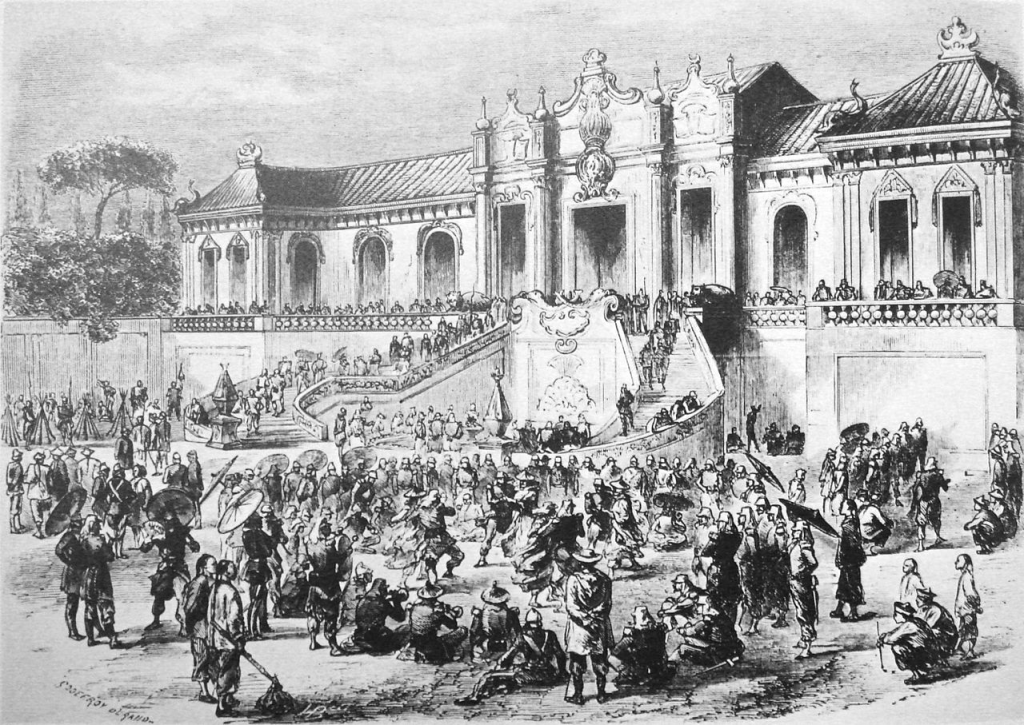
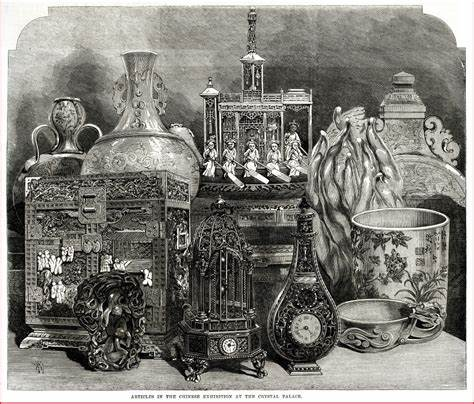
16 neither hath oppressed any, hath not withheld the pledge, neither hath despoiled by violence, but hath given his bread to the hungry and hath covered the naked with a garment; — “despoiled by violence:” not unlike the looting of the Old Summer Palace by Anglo-French forces in 1860;
— the Targum says
“And [if] a man does not oppress; a pledge he does not take; and robbery he does not commit; his bread he gives to the hungry, and the naked he covers with clothing.”
17 who hath taken off his hand from the poor, who hath not received usury nor increase, hath executed My judgements, hath walked in My statutes; he shall not die for the iniquity of his father: he shall surely live.
— the Targum says
“From [harming] the poor he withdrew his hand; interest and usury he did not take; My judgments he performed, in My covenants he walked; he shall not die for the sins of his father; he shall surely live.”
18 As for his father, because he cruelly oppressed, despoiled his brother by violence, and did that which is not good among his people, lo, even he shall die in his iniquity.
— the Targum says
“His father, because he oppressed with oppression, committed robbery against his brother, and did that which is not right among his people—behold, he died in his sins.”
19 “Yet say ye, ‘Why? Doth not the son bear the iniquity of the father?’ When the son hath done that which is lawful and right, and hath kept all My statutes and hath done them, he shall surely live.
— the Targum says
“And you say, ‘Why does the son not suffer for the sins of the father?‘ But the son has done judgment, truth, and justice; all My covenants he has kept and performed them; he shall surely live.”
20 The soul that sinneth, it shall die. The son shall not bear the iniquity of the father, neither shall the father bear the iniquity of the son: the righteousness of the righteous shall be upon him, and the wickedness of the wicked shall be upon him.
— but sometimes, one goes through great sufferings though no fault of his or her own, to develop righteous character, like Job and many others did; these will be rewarded enormously at the end;
— or as the Targum paraphrases it, “the son shall not be punished for the sins of the father, nor shall the father be punished for the sins of the son.”
21 But if the wicked will turn from all his sins that he hath committed and keep all My statutes and do that which is lawful and right, he shall surely live: he shall not die.
— the Targum says
“And the wicked man, if he turns from all his sins that he has committed, and keeps all My covenants, and does true judgment and justice, he shall surely live; he shall not die.”
22 All his transgressions that he hath committed, they shall not be mentioned unto him. In his righteousness that he hath done he shall live. — that is, if the wicked will turn from all his sins;
— the Targum says
“All his sins (debts) which he committed shall not be remembered against him; by the merit which he has performed, he shall be established (shall live).”
23 “Have I any pleasure at all that the wicked should die, saith the Lord God, and not that he should return from his ways and live?
— the Targum says
“Do I truly desire the death of the wicked, says the Lord God? Is it not rather when he turns from his way, that he may be established (live)?”
24 But when the righteous turneth away from his righteousness, and committeth iniquity, and doeth according to all the abominations that the wicked man doeth, shall he live? All his righteousness that he hath done shall not be mentioned: in his trespass that he hath trespassed and in his sin that he hath sinned, in them shall he die.
— but if the righteous man turn from his righteousness, and doeth wickedness, should he live? All the righteousness that he hath done shall not be remembered: for his unfaithfulness that he hath committed, and for his sin that he hath sinned, for these he shall die;
— the Targum says
“And when the righteous man turns from his righteousness and performs falsehood, doing according to all the abominations that the wicked man does—shall he live? All his merit that he performed shall not be remembered; for the falsehood that he lied and the sins (debts) that he sinned—in them he shall die.”
25 “Yet ye say, ‘The way of the Lord is not equal.’ Hear now, O house of Israel: Is not My way equal? Are not your ways unequal? — note the subject of study is the house of Israel, not the house of Judah;
— from the Message Bible
“Do I hear you saying, ‘That’s not fair! God’s not fair!’? “Listen, Israel. I’m not fair? You’re the ones who aren’t fair! If a good person turns away from his good life and takes up sinning, he’ll die for it. He’ll die for his own sin. Likewise, if a bad person turns away from his bad life and starts living a good life, a fair life, he will save his life. Because he faces up to all the wrongs he’s committed and puts them behind him, he will live, really live. He won’t die. Ezekiel 18:25-28 MSG
— the Targum says
“And you say, ‘The good way of the Lord is not explained (clear) to us.‘ Hear now, O House of Israel: Is it My good way that is not explained? Is it not your own ways that are not right (proper)?“
26 When a righteous man turneth away from his righteousness, and committeth iniquity and dieth in it, for his iniquity that he hath done shall he die.
— the Targum says
“And when the righteous man turns from his merit and performs falsehood, and dies upon them—for the falsehood which he has performed, he shall die.”
27 Again, when the wicked man turneth away from his wickedness that he hath committed, and doeth that which is lawful and right, he shall save his soul alive. — he shall save his soul from famine, pestilence, the sword, or captivity; he shall be preserved, and not be involved in calamities and distress;
— the Targum says
“And when the wicked man turns from his sins (debts) which he has performed, and performs true judgment and justice, he shall sustain (establish) his soul.”
28 Because he considereth and turneth away from all his transgressions that he hath committed, he shall surely live: he shall not die. — in God’s judgement of AD 70, both the Nazarenes and the Hillel branch of Pharisees survived . . . (more below)
— the Targum says
“And he saw, and turned from all his sins (debts) which he had performed; he shall surely live, he shall not die.”
29 Yet saith the house of Israel, ‘The way of the Lord is not equal.’ O house of Israel, are not My ways equal? Are not your ways unequal? — yet the house of Israel complains; the way of the Lord is not equal;
— the Targum says
“And the House of Israel said, ‘The good way of the Lord is not explained (clear) to us.‘ Is it My good way that is not explained to you, O House of Israel? Is it not your own ways that are not right (proper)?“
30 “Therefore I will judge you, O house of Israel, every one according to his ways, saith the Lord God. Repent, and turn yourselves from all your transgressions, so iniquity shall not be your ruin. — you complain of the injustice of my ways; so what if I judge you according to your ways?
— the Targum says
“Therefore, each man according to his ways I will exact punishment from you, O House of Israel, says the Lord God; Return to My worship, and remove from yourselves the worship of idols, so that they shall not be a stumbling block of sin for you.”
31 Cast away from you all your transgressions whereby ye have transgressed, and make yourselves a new heart and a new spirit. For why will ye die, O house of Israel? — this chapter emphasizes on numerous times the house of Israel, rather than the house of Judah;
— earlier we have established that Ezekiel’s messages were actually meant for those living far into the future, in our time, the message to the modern house of Israel, the chief of whom is Ephraim, the United States of America;
— the Targum says
“Remove far from you all your sins (debts) which you have committed; and make for yourselves a fearing heart and a fearing spirit; for why should you die, O House of Israel?”
32 For I have no pleasure in the death of him that dieth, saith the Lord God. Therefore turn yourselves, and live ye.
— the Targum says
“For I do not desire the death of the guilty one who is to die, says the Lord God; Return to My worship, and be established (live).”
~~~
The JUDGEMENT, and it is GOD’S JUDGEMENT
But which sects managed to escape from the Romans during the AD 66 to 70 siege of Jerusalem? History recorded only two sects that escaped this inferno:
(1) The Christians, known as Nazarenes in Acts 24:5. Many died as martyrs but according to Eusebius, some received divine warning and escaped to a northern town called Pella, west of the Jordan River.
(2) Pharisees of the House of Hillel escaped to Yavne. These were headed by a rabbi, Johanan ben Zakkai, the head of the Sanhedrin; he was smuggled out of besieged Jerusalem in a coffin. Later, his followers re-emerged as Rabbinic Jews who established the Hillel Calendar, which was revealed by Hillel II in about AD 359 concerning the rules of the Calendar.
And two sects that died like as if they were Sodom and Gomorrah:
(1) The Sadducees: their main heresies — Greatly influenced by their neighbouring Sun-worshipping Samaritans, their Passover celebrated on the Early Fourteenth; their Pentecost always counted a morrow after the weekly Sabbath; and ends always on a Sunday.
(2) The Essenes: their main heresies — A Calendar different from one established by the Sandhdrin; with their Passover always falling on a Wednesday. This means they celebrated the holy day on a different day and squabble over the one ordained by God operating in the Jerusalem Temple.
For an indepth Study, see AN AUTOPSY OF JERUSALEM IN THE AD 70 INFERNO


 Joel
Joel A Prophecy of Esau and Jacob