
Did China Down Two US Aircraft in South China Sea?
China builds an electromagnetic kill zone; And Down Two US Aircrafts in South China Sea?
Two US Navy aircrafts clashed mysteriously in the South China Sea
This is the fourth F/A-18 that the navy has lost this year.
AsiaTimes • December 12, 2025 ~ RealClear Defense
Accident or Attack? In what is considered a highly unusual event, two US naval aircraft flying from the US aircraft carrier Nimitz (CVN 68), an MH-60R Sea Hawk helicopter and an F/A-18 Super Hornet fighter crashed within a 30-minute time span in the volatile South China Sea on October 26 on a Sunday.
The incidents occurred amid President Trump’s tour of Asia, during which he is expected to meet a host of Asian leaders, including China’s leader, Xi Jinping, making it more suspicious, and embarrassing.
With a surge of hidden electronic warfare upgrades, China is reshaping the South China Sea into an electronic battlespace tilted decisively in its favor.
This month, the Asia Maritime Transparency Initiative (AMTI) reported that China has quietly expanded its electronic warfare and surveillance infrastructure across its artificial island bases in the disputed Spratly Islands.
The upgrades, implemented between 2023 and 2025, bolster China’s ability to monitor and contest activity in the South China Sea, a strategic waterway claimed by multiple nations.
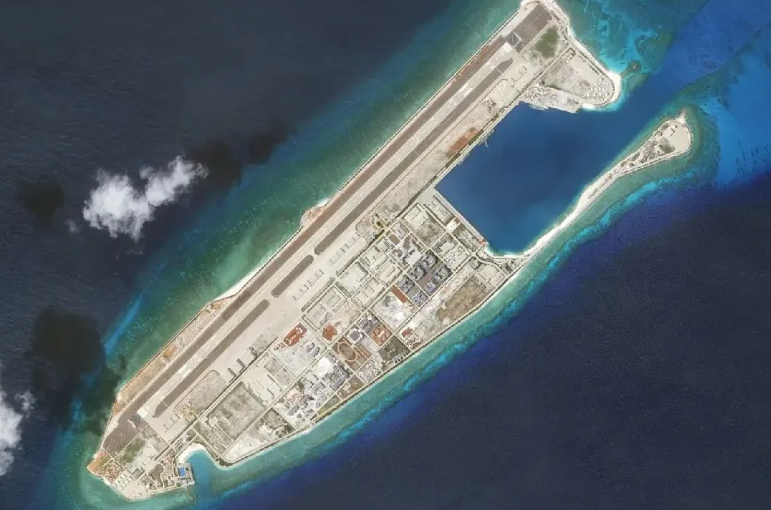
Satellite imagery shows new antenna arrays and mobile electronic warfare vehicles deployed on Fiery Cross, Mischief and Subi reefs. At least six paved sites with monopole antennas were installed, each oriented toward the sea.
The facilities appear linked to vehicle-mounted jamming systems designed to target specific electromagnetic bands. At Subi Reef, a roofed shelter was built in 2025 to house the units, while Mischief Reef hosts five vehicles connected to fixed arrays.
Additional upgrades include a circular concrete platform at Mischief Reef, for rapid antenna deployment, and two new radomes at Subi Reef, mirroring earlier installations on Fiery Cross and Mischief. These radomes provide overlapping intelligence, surveillance, and reconnaissance (ISR) coverage.
China also constructed fortified coastal emplacements at Mischief Reef, capable of hosting artillery or mobile weapons.
Outlining the threat that China’s electronic warfare capabilities pose to the US and its allies in the South China Sea and in the Taiwan Strait, a November 2025 report by the US-China Economic and Security Review Commission (USCC) states that these capabilities target the networks that are the nervous system of US military operations.

Upon hearing of this rare occurrence many informed observers, and many uninformed ones, worried that the naval aircraft had been attacked with some sort of electronic warfare (EW) or Directed Energy Warfare (DEW) laser, or cyber weapon, causing them to fail and crash.
DEW, EW or cyber warfare, could all induce these crashes by disrupting flight systems subtly, including aircraft GPS, or frying electronics, especially in a contested area like the South China Sea where advanced Chinese surveillance ships and EW aircraft operate routinely.
China likely also has the capabilities to down aircraft, either through sabotage or flaws in our avionics that they have discovered through espionage.
All are part of China’s emphasis on ‘grey zone’ warfare.
China’s People’s Liberation Army (PLA) doctrine includes targeting US Navy carrier groups’ electronic vulnerabilities, potentially causing cascading failures in coordinated operations like those from the USS Nimitz.
For instance, Chinese High-Power Microwave (HPM) weapons, such as those unveiled in 2025 capable of disabling electronics, could disable aircraft electronics non-kinetically, while aerial EW platforms like China’s J-16D jets are designed to create “electronic nightmares” by overwhelming US defenses.
These Chinese efforts are potentially more effective in the South China Sea due to China’s A2/AD (anti-access/area denial) networks, and militarized artificial island outposts, though US aircraft do have countermeasures like hardened electronics that should mitigate these threats.

If China did employ these measures, it would likely be detectable post-crash via telemetry analysis. Though, not with certainty. It would be most difficult to detect if this was a cyber attack.
After offering to help in search and rescue efforts, a Chinese Foreign Ministry spokesman took the opportunity to criticize US operations in the region, accusing Washington of carrying out regular displays of military force in the South China Sea (while ignoring its own displays), and claiming that these US naval activities are increasing the risk to maritime activity, and undermining regional peace.
When President Trump was asked by a reporter aboard Air Force One enroute to Japan if he knew what had happened to the two aircraft Trump shrugged off worries of foul play, saying:
They’re going to let me know pretty soon. I think they should be able to find out. It could be bad fuel. I mean, it’s possible it’s bad fuel. Very unusual that that would happen. We’re going to find out. Nothing to hide. We’ll find out.
Yes, it is very unusual, as Newsweek reported:
“it’s certainly unusual to have two on the same day,” said Matthew Savill, the director of military sciences at the Royal United Services Institute (RUSI), a British think tank.
It is “odd for two aircraft to go down in separate instances, so close together in time,” added Dan Rice, a former aide to Ukraine’s commander in chief and West Point graduate currently the president of American University Kyiv. The US Navy is likely to be on high alert.
And, as some have noted, bad fuel would likely affect more than just these two aircraft. Beware, Team Trump may be trying to downplay the event to avoid sabotaging his meeting with Xi.
If China was guilty, it would be an act of war. But it may be very difficult to prove.
However, it could be something else entirely. “Carrier operations are fearsomely complicated, especially on a big and busy one like the Nimitz,” Savill told Newsweek.
“There are any number of small things that can go wrong which can have dangerous consequences.”
Bad, or contaminated fuel, onboard the Nimitz could definitely have been one thing that could have gone wrong. But it could also have been an undetected Chinese DEW, EW, or cyber attack.
Either way, this is a costly couple of incidents, both financially, running into a couple of hundred million dollars, and reputationally. It is critical to quickly identify the cause.
Two US Navy aircrafts clashed mysteriously in the South China Sea


 A Prophecy of Esau and Jacob