
How Europe is vying for its Rare Earth independence
How Europe is vying for rare earth independence from China
BBC • August 7, 2025
For almost 80 years rare earth metals have been pumped out of this industrial plant in La Rochelle on France’s west coast.
But as the materials become more and more crucial to the global economy, chemicals firm Solvay is expanding its processing plant next to the glistening Atlantic Ocean to meet surging demand across Europe.
This group of 17 metals are essential to huge amounts of modern technology such as smartphones, electric vehicles and wind turbines and MRI scanners.
However, around 70% of rare earths mining, and 90% of refining, happens in China, as a result of years of support from the Chinese government.
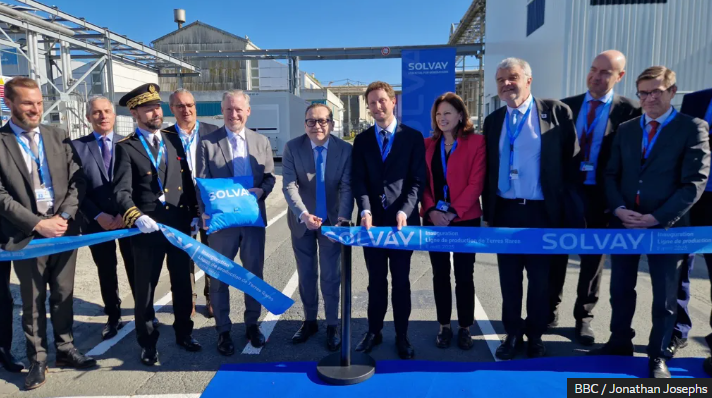
Europe, like many other parts of the world, is trying to reduce its dependence on importing these key metals from China. The future of Solvay’s plant will be critical to those ambitions.
“This is a market that is growing fast, and, also, there is a greater demand for shorter supply chains,” says Solvay’s CEO Philippe Kehren.
The Covid pandemic and the war in Ukraine have made companies and politicians try to remove some of the vulnerabilities in their supply chains.
“When you have a material that is coming almost 100% from one specific location, if you are dependent on this, you want to diversify your sourcing. This is what we can offer,” explains the boss of the Belgian chemicals giant.
That is why the EU’s Critical Raw Materials Act came into force last year. It sets targets for reducing dependence on imports for the extraction, processing and recycling of the most important substances by 2030.
Europe only has two rare earth processing facilities, one in Estonia and this one in western France. It is the only plant outside of China that can process all 17 different rare earths.
The increased investment in the facility comes as it is moving away from focusing on supplying rare earths for catalytic convertors, to instead focus on soaring demand for the magnets that are essential to electric car batteries, advanced electronics and defence systems.
For now the focus is on recycling rare earths that are already in Europe. “We think that we can probably produce 30% of the rare earths needed by Europe just by recycling end of life motors and other equipment,” says Mr Kehren.
As demand continues to grow that will change, and more virgin material will be needed from countries such as Brazil, Canada and Australia.
There are no operational rare earth mines in Europe. Projects in Norway and Sweden are amongst the most advanced, but its likely to be another decade before they are ready.
“I think it’s absolutely necessary to have our own mines, not necessarily a lot of them, because we can have a mix, but it’s important to have our own sourcing,” says Mr Kehren.
It is a complex process to turn those materials into the powders that are the end product of this plant.
It requires approximately 1,500 processes, and given the unique capabilities of this facility, outsiders are rarely allowed in. This is due to concerns about rivals potentially gaining some of the knowledge that is currently otherwise concentrated in China.
However we’ve been granted special access to one of the separation rooms that are a vital part of the closely-guarded know-how built up since this plant started operating in 1948.
“The objective of the liquid separation unit will be to purify cerium on one side, lanthanum on the other side,” explains production manager Florian Gouneau as we walk up a flight of metal stairs.
“It’s basically like if you have a multi fruit juice with orange juice, apple juice, pineapple juice, the objective of the liquid separation unit will be to separate apple juice on one side, orange juice on the other side, and so on.”


 Joel
Joel A Prophecy of Esau and Jacob