
Could China Sink All US Carriers in 20 Minutes?
Could China’s Hypersonic Missiles Sink All US Carriers in 20 Minutes?
China-Arms • April 29, 2025
Recent comments made by US Secretary of Defense Pete Hegseth at the end of last year have sparked heated discussions among military enthusiasts in both China and the United States. China’s Ministry of National Defense also responded to the remarks last week.
Before assuming office as US Secretary of Defense in January this year at the age of 44, Hegseth was a host on Fox News. In a November appearance on former US Navy SEAL Shawn Ryan’s podcast, he warned that China is building a military force specifically designed to defeat the US. The PLA’s hypersonic missiles, he claimed, could sink all US aircraft carriers within the first few minutes of a potential conflict. Every war simulation conducted by the Pentagon ends in defeat by China.
Hegseth stated in the program:
“If 15 hypersonic missiles can destroy our (US) 10 carriers (a slip of the tongue, he meant 11) within 20 minutes of a conflict breaking out—what does that look like?”
These remarks were widely reported by several US media outlets in mid-April, reflecting growing concerns on the Pacific East Coast over China’s increasing “carrier killer” capabilities.
On April 24, Chinese Defense Ministry spokesman Zhang Xiaogang indirectly criticized these comments during a routine press conference. Without naming names, he said certain individuals in the US always view the Chinese military through “colored glasses,” exaggerate the “China military threat,” and that this is a major obstacle to US-China military relations.

Zhang stated that non-conflict, non-confrontation, and peaceful coexistence are the most fundamental shared interests between the US and China:
“We are clear-eyed about our development. We hope the US does not have a ‘persecution complex’ and keeps using others as an excuse.”
Some media outlets suggest the once-dominant US aircraft carrier fleet is showing signs of being strong in appearance but weak in essence.
According to China Central Television (CCTV) and China Military Online, as of March this year, only four out of the US Navy’s 11 active nuclear-powered aircraft carriers were in deployable condition. A Washington Times article on April 16 reporting on Hegseth’s comments also noted the limited defensive capabilities of US carrier strike groups against hypersonic missiles.
Reports say China has deployed two distinct hypersonic missile systems capable of flying at over five times the speed of sound and maneuvering to strike targets within minutes while evading missile defense systems.

The Pentagon’s annual report on China’s military noted significant progress with the PLA’s DF-17 medium-range missile, which has a range of about 2,400 kilometers and can be equipped with a hypersonic glide vehicle, “intended to strike foreign military bases and fleets in the Western Pacific.”
The DF-27, with a range of about 8,000 kilometers, can also be equipped with hypersonic warheads. Its payload includes land-attack warheads, conventional anti-ship warheads, or nuclear warheads.

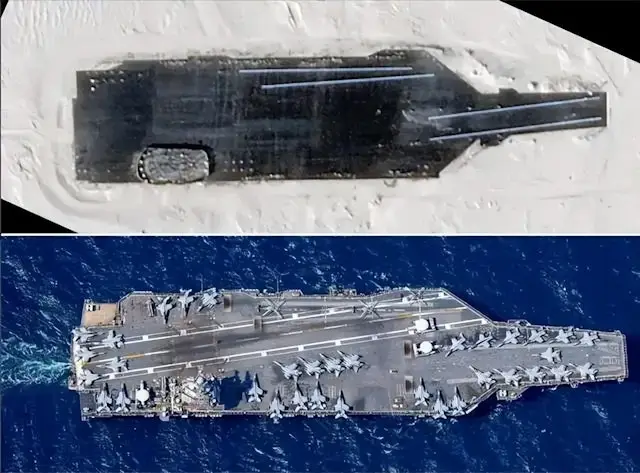
Meanwhile, recent satellite imagery has shown that China’s weapons testing grounds in the northwestern deserts are using US carrier mock-ups as targets, heightening US military concerns about the PLA rehearsing carrier attacks.
Satellite images taken in October 2021 by US space tech company Maxar Technologies show a newly constructed test range in the Taklamakan Desert in southwestern Xinjiang. The range features full-scale models of US Navy ships, possibly used for training, including one aircraft carrier and at least two Arleigh Burke-class destroyers—both used by the US Seventh Fleet in transits through the Taiwan Strait.

A satellite image taken by US commercial satellite firm Planet Labs on January 1, 2023, shows the PLA constructed a new mock-up in the Taklamakan Desert starting in November 2023 that fully imitates the US Navy’s latest aircraft carrier, the USS Gerald R Ford.
Chinese Public Opinion: PLA Has Full Capability to Annihilate US Carriers
Chinese media commentators believe the PLA does indeed possess the capability to annihilate US carriers.
On April 24, Yangtze Evening News military commentator Chen Guangwen wrote that although US senior officials’ statements are exaggerated, they reflect the powerful deterrent of China’s anti-access strategy and the PLA’s enhanced carrier-killing capabilities. China’s anti-ship ballistic missiles, such as the DF-21D, DF-26, and DF-17, have achieved mature strike capabilities.
Chen explained that the first-generation DF-21D missile, equipped with a high-explosive warhead, can penetrate a US carrier’s deck via a high-angle trajectory, rendering it completely inoperable.
The DF-26 belongs to the second generation, with a range of over 4,000 km, improved accuracy, and has been dubbed the “Guam Killer,” Chen claims:
“It can send all US carriers inside and outside the second island chain to the bottom of the sea.”
The DF-17 is a hypersonic model with a wave-riding warhead, giving it an unpredictable flight path that renders any missile defense system ineffective. Its carrier-killing potential is unimpeded by interception threats.
Chen assessed that in addition to advanced weapons, China’s anti-carrier strategy emphasizes a comprehensive system: UAVs, underwater vehicles, anti-ship cruise missiles, supercavitating torpedoes, pre-deployed intelligent mines, and strategic support from space-based and electronic warfare systems.
“Enough to ensure that US carriers come but never return.”
However, China’s military web series Junwu Subdimension on April 25 downplayed the idea of the PLA fully destroying US carriers, arguing that Hegseth exaggerated the China threat to secure more US defense funding and build allied consensus for stronger military cooperation with countries like Japan and Australia.
This year, the Pentagon is seeking a defense budget of up to $6.9 billion, including funding for hypersonic missile research.
The program added that one of the PLA’s major goals over the past 20 years has been to break through the first island chain and win a localized war near China’s periphery—preventing third-party intervention in the Western Pacific.
In such anti-access operations, the expectation might be to attack or sink one or two foreign carriers or fleets. But the idea that China could sink all 11 US carriers in 20 minutes is far-fetched:
“I’m sure China has never even considered that—not only do we not know if we have that capability, but it’s also impossible for the US to deploy all 11 carriers to the Western Pacific.”
Junwu Subdimension added that aircraft carriers are the hardest naval vessels to sink. Back in 1946, the US conducted nuclear tests on carriers. The USS Independence withstood the explosion of a 23-kiloton nuclear bomb just 510 meters away and then survived a second underwater blast—yet it never sank.
Modern US carriers have many times the strike resistance of the Independence. With special underwater armor, they are extremely difficult to sink via underwater bombs or torpedoes. Carrier strike groups are also escorted by several warships, making it very difficult for torpedoes or missiles to reach the carrier itself.
In June 2021, amid heightened US-China tensions in the Taiwan Strait, the US military unusually released footage of a shock trial. A blast strong enough to trigger a magnitude-4 earthquake detonated next to the USS Ford—yet the carrier remained undamaged.
“The children of Ephraim, being armed and carrying bows, turned back in the day of battle” Psalm 78:9


 Joel
Joel A Prophecy of Esau and Jacob