Destined to be Caught in a Snare, how this Prophecy is to be Fulfilled: And notice a Composite Message of Sweetness and Bitterness! “You only have I known of all the families of the earth; therefore I will punish you for all your iniquities” Amos 3:2
China is the top producer of rare earths and also holds the largest rare earths reserves. Which other countries made the list?
The outlook for rare earths is supported by strong supply and demand fundamentals as the world heads into a new economic era with a focus on clean energy and technological advancements.
But with supply chain worries rising, it’s worth looking at which countries have the highest rare earths reserves. Many of the world’s major rare earths producers have large reserves, but some countries with high reserves have low output.
Case in point — mines in Brazil produced only 20 metric tons (MT) of rare earth elements in 2024, but Brazil’s rare earths reserves are the second highest in the world. Countries like this could become bigger players in the space in the future.
Top rare earth reserves by country
Here’s an overview of rare earths reserves by country, with a focus on the eight countries whose reserves are over 1 million metric tons. Data is taken from the US Geological Survey’s latest report on rare earth elements. Reserves are measured in metric tons of rare earth oxide equivalent.
Reserves information is unavailable for a few rare earths producers, including Myanmar, which took the second spot for rare earths production last year.
China Rare earths reserves: 44 million metric tons
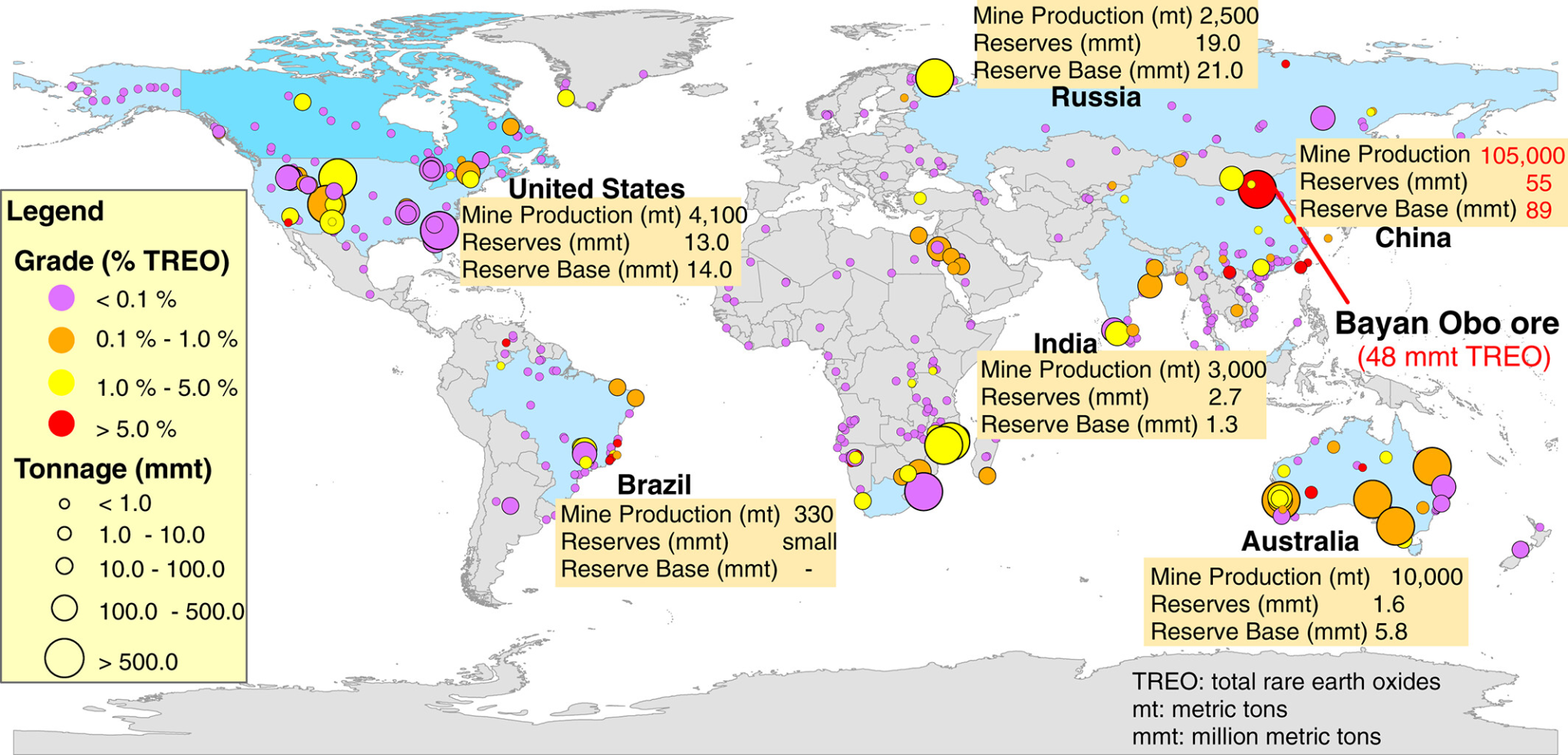
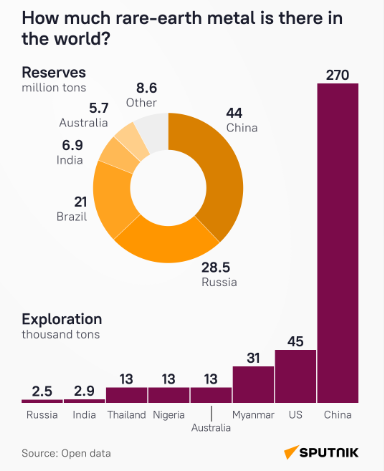
Unsurprisingly, China has the highest reserves of rare earths at 44 million metric tons. The country was also the world’s leading rare earths producer in 2024 by a long shot, producing 270,000 MT.
Despite already holding the top position, China remains focused on ensuring that its rare earths reserves remain elevated. Back in 2012, the Asian nation declared that its reserves of these materials were declining; it then announced in 2016 that it would raise domestic reserves by establishing both commercial and national stockpiles.
The country has also been reining in illicit rare earths mining for a number of years, shutting illegal or environmentally non-compliant rare earths mines and limiting production and exports. These production limits have been easing, and in the last few years the country has raised mining quotas several times.
China’s dominance in both rare earth elements production and reserves has caused problems in the past. Rare earths prices surged when the country cut exports in 2010, resulting in an ongoing rush to secure supply elsewhere.
China and the US have been in a trade war over rare earths as each nation battles over who will dominate the global electric vehicle and tech sectors. Taking aim at the US, China banned the export of technology to make rare earth magnets in December 2023.
In recent years, China has begun importing more heavy rare earths from Myanmar, for which the US Geological Survey does not have rare earths reserves data. While China has stricter environmental regulations, the same cannot be said for Myanmar, and the mountains along its border with China have been heavily damaged by rare earths mining.
Total rare earth reserves 122 MT, of which China has 44 MT; about 40% of world’s total
Brazil Rare earths reserves: 21 million metric tons
Brazil holds the world’s second largest rare earths reserves at 21 million metric tons.
While the nation was not a major producer of rare earths in 2024, that will soon be changing. Rare earths company Serra Verde began Phase 1 commercial production from its Pela Ema rare earths deposit in Goiás state at the top of 2024. By 2026, the miner expects to produce 5,000 MT of rare-earth oxide annually.
Pela Ema, one of the world’s largest ionic clay deposits, will produce the four critical magnet rare earth elements: neodymium, praseodymium, terbium and dysprosium. According to the company, it is the only rare earths operation outside of China to produce all four of those magnet rare earths.
India Rare earths reserves: 6.9 million metric tons
India’s rare earths reserves sit at 6.9 million metric tons, and it produced 2,900 MT of rare earths in 2024, which is on par with the previous few years. India has nearly 35 percent of the world’s beach and sand mineral deposits, which are significant sources of rare earths. The country’s Department of Atomic Energy released a statement in December 2022 breaking down its rare earths production and refining capacity.
In late 2023, the Indian government was reported to be putting policies and legislation in place to establish and support rare earths research and development projects to take advantage of its reserve base. In October 2024, Trafalgar, an Indian engineering and procurement firm, announced plans to build the country’s first rare earth metals, alloy and magnet plant.
Australia Rare earths reserves: 5.7 million metric tons*
Australia holds the fourth largest rare earths reserves in the world at 5.7 million metric tons. The country was also tied for fourth largest rare earths-mining country at 13,000 MT in production. Rare earths have only been mined in Australia since 2007, but extraction is expected to increase moving forward.
Lynas Rare Earths operates the Mount Weld mine and concentration plant in the country as well as a rare earths refining and processing facility in Malaysia. The company is considered the world’s largest non-Chinese rare earths supplier. An expansion of the Mt Weld plant is slated for completion in 2025, according to Mining Database Online. MDO also reports that the company’s new rare earths processing facility in Kalgoorlie commenced production in mid-2024, producing a mixed rare earth carbonate feed for Lynas’ Malaysia plant.
Hastings Technology Metals’ Yangibana rare earths mine is shovel ready, and the company recently signed an offtake agreement with Baotou Sky Rock for concentrate produced at the mine. Hastings expects the operation to produce up to 37,000 MT of rare earths concentrate annually and deliver first concentrate in Q4 2026.
*As per the USGS, “Joint Ore Reserves Committee-compliant or equivalent reserves were 3.3 million tons”
Russia Rare earths reserves: 3.8 million metric tons
In 2024, Russia’s rare earth reserves total 3.8 million metric tons. The country’s reserves were lowered significantly from 10 million MT the prior year based on data from company and government reports. Russia produced 2,500 MT of rare earths in 2024, on par with the previous year.
But Russia claims they have 28.5 million tons at Sputnik International; which is very possible because of the size of the country.
The Russian government shared plans in 2020 to invest US$1.5 billion in order to compete with China in the rare earths market.
Russia’s invasion of Ukraine caused some concern over possible disruptions to the rare earths supply chain in the US and Europe, and there are signs the government has had to put its domestic rare earths sector development plans on ice while it’s mired in war.
Vietnam Rare earths reserves: 3.5 million metric tons
Vietnam’s rare earths reserves stand at 3.5 million MT. It reportedly hosts several deposits with rare earths concentrations against its northwestern border with China, and along its eastern coastline.
For 2024, the USGS has revised down Vietnam’s rare earths reserves from a whopping 22 million MT in the previous year based on company and government reports.
Vietnam’s rare earths production in 2024 was just 300 MT. In 2023, the country had stated a goal to produce 2.02 million MT of rare earths by 2030. However, the arrests of six rare earths executives, including the chairman of Vietnam Rare Earth, in October 2023 may have put a kink in those plans. “VTRE’s chairman, Luu Anh Tuan, was accused of forging value-added-tax receipts in trading rare earths,” reported Asia Financial.
United States Rare earths reserves: 1.9 million metric tons
While the country holds second place for rare earths production in 2024 at 45,000 metric tons, the United States takes only the seventh top spot when it comes to global rare earths reserves at 1.9 million metric tons.
Rare earths mining in the US now happens only at California’s Mountain Pass mine, owned by MP Materials. MDO reports that MP Materials “is establishing downstream (Stage III) capabilities at its Fort Worth Facility to convert a portion of the REO produced at Mountain Pass into rare earth magnets and its precursor products.”
Over the past few years, the US government has made several moves toward strengthening the nation’s rare earths industry. In April 2024, under the Biden Administration, the US Department of Energy earmarked US$17.5 million for four rare earths and critical minerals and materials processing technologies that would produce rare earths from secondary coal and coal by-products as feedstocks.
Greenland Rare earths reserves: 1.5 million metric tons
Greenland’s rare earths reserves total 1.5 million metric tons, but the island nation currently doesn’t produce the metals. However, it does have two significant rare earths projects with large reserves, the Tanbreez project and the Kvanefjeld project.
In July 2024, Critical Metals completed Stage 1 in its acquisition of a controlling-stake in the Tanbreez project from private company Tanbreez Mining. The company commenced drilling on the project in September to better understand the resource model and the projected mine life of the deposit.
Meanwhile, Energy Transition Minerals has had some challenges with the Greenland government over permitting. Its license for Kvanefjeld was revoked by Greenland’s current government due to the company’s plans to exploit uranium. The company submitted an amended plan that did not include uranium, but the updated version was rejected as well in September 2023. MDO reports that as of October 2024, the company is still awaiting a court decision on its appeal.
With US President Donald Trump back in the White House, Greenland (an autonomous region in the Kingdom of Denmark) and its rare earths reserves are on his radar. However, Greenland’s Prime Minister and the King of Denmark have made it clear that the Greenland is not for sale.
~ Come to my parlour ~ the spider says to the butterfly: “Hear, ye deaf; and look, ye blind, that ye may see.”
"Who is blind, but My servant? Or deaf, as My messenger that I sent? Who is blind as he that is perfect, and blind as the Lord’s servant?” Isaiah 42:18-19
"Where two sit together to study the Torah, the Shekinah rests between them."
“Cry aloud, spare not; lift up thy voice like a trumpet! And show My people their transgression and the house of Jacob their sins" Isaiah 58:1
“Son of man, I have made thee a watchman unto the house of Israel; therefore hear the word out of My mouth, and give them warning from Me.
18 When I say unto the wicked, ‘Thou shalt surely die,’ and thou givest him not warning, nor speakest to warn the wicked from his wicked way to save his life, the same wicked man shall die in his iniquity; but his blood will I require at thine hand.
19 Yet if thou warn the wicked, and he turn not from his wickedness nor from his wicked way, he shall die in his iniquity; but thou hast delivered thy soul" Ezekiel 3:17-19
Now, consider this PROPHECY:
“And upon thy sword shalt thou depend, entering at every place: yet thou shalt be supple and credulous, and be in subjection to thy brother [Jacob]; but it will be that when his sons [the children of Israel] become evil, and fall from keeping the commandments of the law, thou shalt break his yoke of servitude from off thy neck…. and then will I kill Jakob my brother,” Genesis 27:41-42 the Targum of Jonathan
“Speak thou also unto the children of Israel, saying, ‘Verily My Sabbaths ye shall keep; for it is a sign between Me and you throughout your generations, that ye may know that I am the Lord who doth sanctify you'" Exodus 31:13
ISRAEL, today as in the past, has many BLIND shepherd, for it was prophesied:
“His watchmen are BLIND; they are all ignorant; they are all DUMB dogs, they cannot bark, sleeping, lying down, loving to slumber” Isaiah 56:10
The mission here is to provide research ARTICLES that are ENLIGHTENING and EASY TO UNDERSTAND using SCRIPTURES to help improve our knowledge and make our life better.
“I have seen a horrible thing in the house of ISRAEL; there is the whoredom of EPHRAIM, Israel is defiled” Hosea 6:10
“Shall a TRUMPET be blown in the city, and the people not be afraid? Shall there be evil in a city, and the LORD hath not done it?” Amos 3:6
“Hear, ye DEAF; and look, ye BLIND, that ye may see” Isaiah 42:18
Hence the RESEARCH produced here are to help us UNDERSTAND and hopefully WE all could learn together.
There's nothing special about me, except perhaps, since I was younger, I (L Siaw) had an inner struggle between my heart and my head, hence this blog.
I produce articles that I would understand and hopefully you could too.
Please SUBSCRIBE for more will come.
You may contact me on: eqlunn@gmail.com



 A Prophecy of Esau and Jacob