
China’s Anti-Drone Microwave to Zap US Drones
China’s microwave weapons aim to zap US drone swarms. High-power microwave weapon designed to destroy components in enemy systems, heralding the next level in electronic warfare.
AsisTimes by Gabriel by Gabriel Honrada • January 16, 2025 ~ The WarZone
China’s new high-power microwave (HPM) weapons promise to redefine electronic warfare, countering US advancements in drone and space capabilities while closing the firepower gap between their warships.
This month, the South China Morning Post (SCMP) reported that Chinese scientists have achieved a significant breakthrough in developing a compact HPM weapon capable of generating electromagnetic pulses comparable to a nuclear explosion.
The SCMP report mentions that China’s HPM weapon can generate electric fields up to 80,000 volts, comparable to the EMP pulses generated by nuclear explosions.
This weapon, still in laboratory testing, can disrupt or destroy electronic components within enemy systems. It mentions that the research behind it, conducted by a joint team from the National University of Defence Technology in Changsha and the Northwest Institute of Nuclear Technology in Xian, overcame the challenge of preventing the weapon from self-destructing due to its intense pulses.
According to the report, the weapon uses phased-array transmission technology to precisely focus energy, increasing its range and damage effects and enabling simultaneous attacks on multiple targets. During tests, the weapon withstood over 5,000 full-power pulse emissions without breakdown, maintaining a high operating efficiency of 96.6%.
SCMP mentions that the development of this weapon is part of China’s efforts to counter potential threats from the US military, which plans to deploy HPM weapons in the Indo-Pacific region.
It notes that the People’s Liberation Army (PLA) is also pursuing anti-satellite capabilities, targeting communication satellites like Starlink, which played a significant role in the Ukraine war. It says this advancement marks a crucial step in China’s military technology, enhancing its strategic capabilities in electronic warfare.

China is actively developing ground and space-based counter-space capabilities, with HPM weapons as part of that arsenal. In an August 2024 article for the Journal of Strategic Studies, Jonas Berge and Henrik Hiim mention that China is advancing ground and space-based microwave weapons as part of its soft-kill counter-space strategy, targeting satellites with plausible deniability and minimal escalation risk.
Berge and Hiim note these weapons, along with electronic warfare and cyber tools, enable reversible or lasting disruption without creating debris or provoking retaliation.
China’s recent advancements in HPM weapons show its focus on these systems as a counter to drone swarms, which the US is actively developing through its Replicator initiative, which aims to expedite the fielding of expendable air, sea and land drone systems.
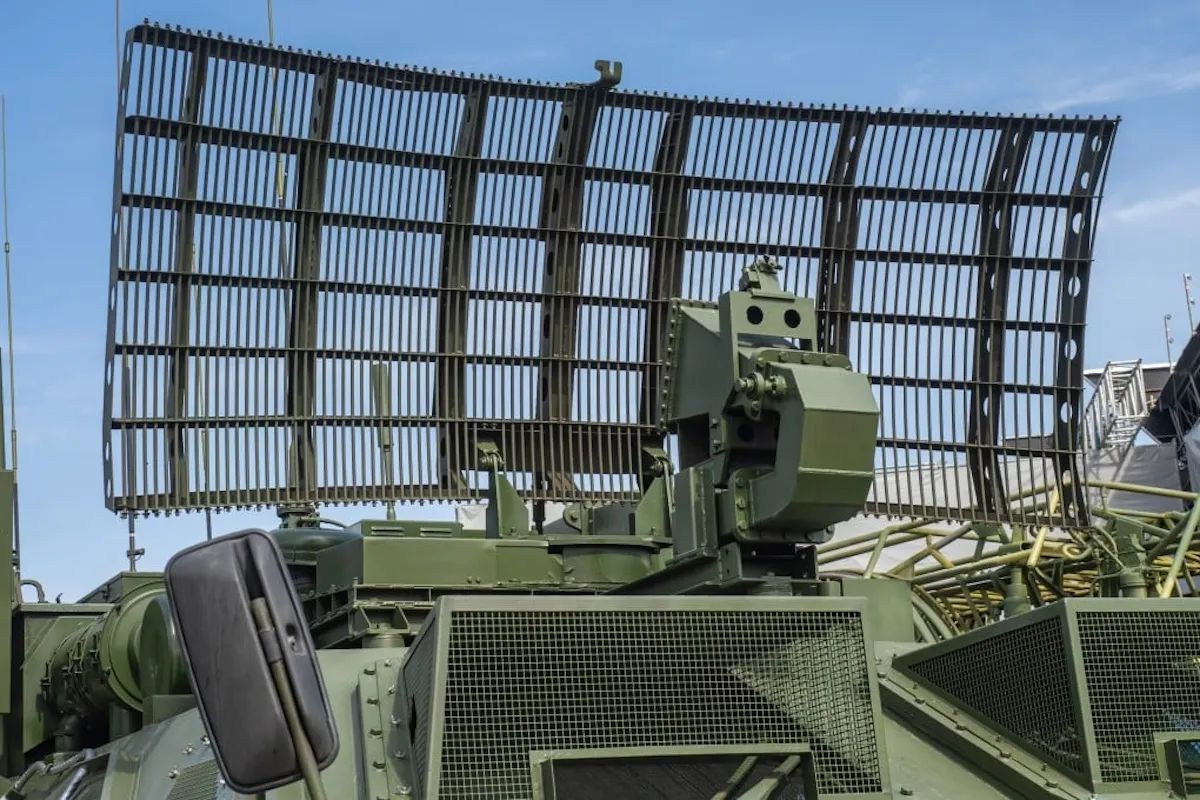
Far from China’s HPM weapons being mere laboratory experiments, The War Zone reported in November 2024 that during that year’s Zhuhai Airshow, China unveiled multiple HPM systems designed to disable drones and other aerial threats.
The War Zone mentions that the showcased HPM weapons, developed by state-run firms China South Industries Group Corporation (CSGC) and Norinco, include a large planar array mounted on an 8×8 light armored vehicle chassis and a more extensive system installed on a Shacman SX2400/2500-series 8×8 truck.
China has fielded phased and planar array designs for HPM weapons. A planar array design, such as the ground-based HPM weapon described by The War Zone report, consists of multiple emitting elements arranged in a flat, two-dimensional plane. It focuses signals on specific directions but usually needs physical or mechanical movement to change the beam’s direction.
In contrast, the HPM weapon the SCMP reports about is a phased array design. While a phased array has multiple emitting elements like a planar array, the difference is that the beams can be electronically steered without physically moving the antenna. This advantage enables quick and precise focusing of HPM energy at targets.

Both systems are equipped with radar for detecting and tracking targets, allowing them to engage multiple threats simultaneously with their wide beams.
HPM weapons provide military advantages against multiple targets, such as swarming drones and LEO satellites. They can disrupt electronic systems without visible damage, are cost-effective, and are scalable for various platforms. Their wide beam allows the engagement of multiple targets at once.
However, they face challenges, including low efficiency, high energy consumption, and limited atmospheric range. Their large size also restricts deployment options.
Nevertheless, China may be working to solve the size and power limitations of its HPM weapons. For instance, in February 2024, Asia Times reported that Chinese scientists had unveiled a groundbreaking HPM weapon powered by Stirling engines, marking a significant advancement in directed-energy warfare technology.
This weapon, developed by a National University of Defense Technology team, utilizes four compact Stirling closed-cycle heat engines to convert thermal energy into mechanical energy efficiently. It drives HPM waves capable of disabling drones, military aircraft, and satellites.
The weapon’s superconducting coil generates a magnetic field of up to four teslas, significantly reducing energy consumption compared to existing technologies. Initial tests show that the weapon consumes only 20% of the energy needed by existing technologies and can function continuously for four hours.
China’s progress on HPM weapons could also enable them to be mounted on ship-based point defense against anti-ship ballistic and cruise missiles, offering a feasible alternative to interceptor missiles, naval guns, railguns, and lasers.


 Joel
Joel A Prophecy of Esau and Jacob